Introduction
Numerous studies have documented the spread of insects and other arthropods into new areas facilitated by the availability of alternative hosts (Kenis et al., Reference Kenis, Auger-rozenberg, Roques, Timms, Péré, Cock, Settele, Augustin and Lopez-vaamonde2009; Kenis and Branco, Reference Kenis, Branco and Roques2010). The ecological and economic consequences of these novel associations are often substantial, particularly when they affect food-web dynamics and interspecific interactions (Kempel et al., Reference Kempel, Nater, Fischer and van Kleunen2013). Less attention has been paid to the reverse process, whereby the expansion of a new plant host into novel environments creates opportunities for native herbivores to adapt, potentially altering their performance and host use. In this context, the success of phytophagous insects on new hosts may depend on a combination of plant-related factors, including reduced resistance under specific climatic and environmental conditions (Ning et al., Reference Ning, Xie, Liu, Bai and Cui2019), and genetic differences among host genotypes, such as hybrids and local cultivars. Moreover, mating systems may play a key role in shaping the ability of phytophagous insects to colonise and persist on new hosts (Rhainds, Reference Rhainds2010; Degen et al., Reference Degen, Hovestadt, Mitesser and Hölker2015).
Among phytophagous insects, the ambrosia beetle Anisandrus dispar (Fabricius) (Coleoptera: Curculionidae: Scolytinae) is a polyphagous species of concern for forestry, ornamental, and fruit production systems. It attacks a wide range of broad-leaved trees and several fruit hosts, including chestnut, hazel, peach, pear, apple, walnut, cherry, plum, and grapevine (Wood and Bright, Reference Wood and Bright1992; Beaver et al., Reference Beaver, Sittichaya and Liu2014; Tanasković et al., Reference Tanasković, Marjanović, Gvozdenac, Popović and Drašković2016; CABI Compendium, 2024). Although outbreaks are generally sporadic, A. dispar has caused significant damage to hazel and peach in Europe and western Asia, at times reaching severe infestation levels (Bucini et al., Reference Bucini, Balestra, Pucci, Paparatti, Speranza, Proietti Zolla and Varvaro2005; Speranza et al., Reference Speranza, Bucini and Paparatti2009; Saruhan and Akyol, Reference Saruhan and Akyol2013). Like other ambrosia beetles, A. dispar feeds on symbiotic fungi cultivated within the xylem, which enables it to exploit a broad range of host taxa when thermal, environmental, and host-genetic conditions are favourable (Jordal et al., Reference Jordal, Normark and Farrell2000). In Scolytinae, A. dispar is characterised by inbreeding and polygyny (Gohli et al., Reference Gohli, Selvarajah, Kirkendall and Jordal2016), and its general life history involves dispersing mated females that excavate brood chambers and establish galleries in different parts of the host tree (Biedermann, Reference Biedermann2010). Males develop from unfertilised eggs and are typically apterous, smaller, and less mobile than females (French and Roeper, Reference French and Roeper1975; Biedermann, Reference Biedermann2010), but their competitive role inside galleries and the actual sex ratio prior to emergence remain poorly understood.
In 2022, following reports from technicians of the Regional Phytosanitary Service of Calabria, widespread mortality of hybrid chestnut trees, Castanea sativa × Castanea crenata cv. Bouche de Bétizac (Fagales: Fagaceae), was observed in at least two provinces of the region. To investigate the cause, branch samples were collected in May from three sites across the affected provinces. Preliminary analyses of emerged individuals and specimens recovered from the wood showed that A. dispar was the only species associated with the observed desiccation, with no marked differences in infestation levels among sites. Additional ethanol-baited traps confirmed a high local abundance of A. dispar.
Based on these findings, further sampling was conducted in the following year to assess the genetic structure, infestation dynamics, and reproductive behaviour of this species. Accordingly, this study assessed haplotype diversity and distribution among sites, as well as female-biased sex ratios and mating competence in overwintering males. By integrating field observations, molecular analyses, and laboratory assays, we sought to clarify the biological and genetic features associated with the successful colonisation of orchards planted with the hybrid chestnut cultivar ‘Bouche de Bétizac’ and to provide information useful for monitoring and managing A. dispar in chestnut agroecosystems.
Materials and methods
Study areas
The study was conducted in two chestnut production areas in Calabria, southern Italy. The first area was located in the western part of Aspromonte National Park and included two sites in the municipality of Santa Eufemia d’Aspromonte, province of Reggio Calabria: Lionello (38°11′52.75″ N, 15°50′37.59″ E; 1130 m a.s.l.) and Melina (38°12′4.72″ N, 15°50′56.61″ E; 1130 m a.s.l.). The second area, comprising the third site, was located in the municipality of Cicala, province of Catanzaro, in the southern part of Sila National Park: Muraca (39°01′3.16″ N, 16°28′39.72″ E; 750 m a.s.l.). These sites, approximately 150 km apart, are characterised by dense forests and mountain agricultural landscapes, where European chestnut, Castanea sativa Mill. (Fagales: Fagaceae), is widespread.
In recent years, both areas have been involved in the replanting of hybrid chestnut orchards (C. sativa × C. crenata cv. Bouche de Bétizac), introduced to reduce the economic losses caused by Dryocosmus kuriphilus Yasumatsu, 1951 (Hymenoptera: Cynipidae). In addition to their resistance to the Asian chestnut gall wasp, these hybrids are valued for their early fruit ripening. The orchards were established in 2016, with trees planted in a single row at 7 × 8 m spacing and reaching approximately 2.5–3.0 m in height. During the study period, the orchards showed severe mortality associated with bark beetle infestation. At Cicala, approximately 90% of trees had died, whereas mortality was lower at Lionello and Melina, reaching approximately 30% and 35%, respectively.
The mean annual temperature was 10.8°C at Santa Eufemia d’Aspromonte and 14.8°C at Cicala. Mean temperatures in March and April were 6.2°C and 9.1°C, respectively, at Santa Eufemia d’Aspromonte (ARPACAL monitoring station 2180), and 8.7°C and 11.4°C at Cicala (ARPACAL monitoring station 2890).
Bioecology: sex ratio, phenology, and behaviour
Sampling was conducted in 2023 with monthly collections from April to June at each site. Adults of A. dispar were obtained from branches collected from 10 randomly selected trees per orchard, regardless of whether the trees showed signs of desiccation, stress, or circular exit holes visible by direct observation. Branches of variable diameter were cut into sections of approximately 30–35 cm in length. At each site and sampling date, 10 branches were placed in rearing cages (40 × 40 × 60 cm) made of fine mesh (40 mesh), resulting in a total of 90 branches monitored for emergence across the entire sampling period (10 branches × 3 sampling dates × 3 sites). In the laboratory, temperature and relative humidity were maintained at 20 ± 5°C and 50–60%, respectively, under a 14L:10D photoperiod. To prevent rapid desiccation before emergence, the cut ends of the branches were sealed with wax, and the samples were sprayed with distilled water twice at 15-day intervals. Every 15 days, emerged adults were collected and preserved in 98% ethanol for subsequent analyses.
Additional branch samples (n = 4 per site per sampling date, for a total of n = 36 dissected branches) were collected on the same dates and dissected within 48 h to observe developmental stages and determine the sex of adults present inside the wood. For each branch, the number of exit holes and the distance between adjacent holes were recorded, together with orthogonal diameter measurements at the exit points. Across the 90 reared branches, the relationship between the number of exit holes and mean branch diameter was assessed. In mid-December, supplementary sampling involved the collection of eight branches per site (n = 24 total branches across all three sites): four per site (n = 12) were dissected immediately, whereas the remaining four per site (n = 12) were placed in rearing cages and monitored every 15 days until June to detect emergence of overwintering adults. Sex ratios were calculated from adults emerging from branches collected between April and June, from branches sampled in mid-December, and from dissected material at all three sites.
To investigate the occurrence of A. dispar on additional woody hosts in the study area, a targeted survey was conducted in November 2024.
The survey was limited to the Santa Eufemia d’Aspromonte site because the second orchard was excluded due to the advanced degradation of the Bouche de Bétizac chestnut trees, which would have compromised data reliability. Five tree species (Juglans regia L., Malus domestica Borkh., Pyrus communis L., Castanea sativa Mill., and Prunus domestica L.) were sampled by collecting five to six branches per species, each approximately 50 cm long and of variable diameter, from two representative trees showing early stress symptoms. Samples were collected within a 300 m radius of the main site and monitored during the following spring for A. dispar emergence.
Molecular identification and haplotype diversity
A total of 10 female specimens of A. dispar were selected for DNA barcoding from material collected during the 2023 sampling season. The specimens originated from branch samples collected at the three study sites and included individuals obtained either after emergence from reared branches or directly from branch dissections. Specimens were observed under a stereomicroscope (Olympus SZX9, Tokyo, Japan) at magnifications ranging from 20× to 60×, and images were acquired using a Dino-Lite AM73915MZTL (Dino-Lite Europe, IDCP B.V., The Netherlands) digital microscope system. After observation, specimens were preserved individually in Eppendorf tubes containing absolute ethanol and stored at −20°C. Taxonomic identification was based on morphological diagnostic characters reported in the literature (Rabaglia et al., Reference Rabaglia, Dole and Cognato2006; Faccoli, Reference Faccoli2008; Dole and Cognato, Reference Dole and Cognato2010; Hulcr and Smith, Reference Hulcr and Smith2010; Gomez et al., Reference Gomez, Rabaglia, Fairbanks and Hulcr2018; Smith et al., Reference Smith, Beaver and Cognato2020).
Genomic DNA was extracted from the 10 specimens listed in table 1, following the protocols described by Vono et al. (Reference Vono, Bonsignore, Gullo and Marullo2020) and Nugnes et al. (Reference Nugnes, Gebiola, Gualtieri, Russo, Sasso and Bernardo2016). After DNA extraction, voucher specimens were preserved and deposited in the authors’ collection. For each sample, DNA concentration was determined using a Qubit fluorometer (Thermo Fisher Scientific, Wilmington, DE, USA), whereas DNA purity was evaluated with a NanoDrop spectrophotometer (Thermo Fisher Scientific, Wilmington, DE, USA). A fragment of the mitochondrial cytochrome c oxidase subunit I (COI) gene was amplified and sequenced using the primers LCO1490/HCO2198 (Folmer et al., Reference Folmer, Black, Hoeh, Lutz and Vrijenhoek1994), following de Benedetta et al. (Reference de Benedetta, Gargiulo, Miele, Figlioli, Innangi, Audisio, Nugnes and Bernardo2022). Assembly, editing, translation in amino acids, and alignment of sequences were carried out using BioEdit 7.0 software (Hall, Reference Hall1999). Sequences containing ambiguous bases, premature stop codons, or inconsistent alignments were excluded. After trimming and editing, the resulting COI fragments were 567 bp long. Sequences from the study areas were compared with homologous sequences available in GenBank and BOLD and then submitted to GenBank under the accession numbers reported in table 1. The alignment included all study sequences, homologous sequences retrieved from public databases, and one outgroup. Identical sequences were removed before phylogenetic analyses, resulting in a reduced dataset of unique haplotypes.
List of specimens of Anisandrus dispar used for DNA barcoding

Table 1 Long description
Columns give specimen code, municipality, site, coordinates, altitude in meters asl, collection month, MtH, specimen colour, and accession number. AA531 from Santa Eufemia dAspromonte (RC), site Melina, at 38 degrees 124.72N, 15 degrees 5056.61E, altitude 1130, collected April 2023, has MtH H1, dark brown, accession number, PV270112. AA533 lists MtH H1, dark brown, accession number, PV270114, with municipality, site, coordinates, altitude, and collection month not shown. AA532 lists site Lionello with coordinates 38 degrees 1152.75N, 15 degrees 5037.59E, MtH H2, dark brown, accession number, PV270113, with municipality, altitude, and collection month not shown. AA534 lists MtH H3, dark brown, accession number, PV270115, with municipality, site, coordinates, altitude, and collection month not shown. AA547 from Cicala (CZ), site Muraca, at 39 degrees 13.16N, 16 degrees 2839.72E, altitude 750, collected May 2023, has MtH H4, light brown, accession number, PV270116. AA548 lists MtH H5, light brown, accession number, PV270117; AA549 lists MtH H4, light brown, accession number, PV270118; AA550 lists MtH H6, dark brown, accession number, PV270119; AA551 lists MtH H4, dark brown, accession number, PV270120; AA552 lists MtH H5, dark brown, accession number, PV270121, and these rows do not show municipality, site, coordinates, altitude, or collection month.
a.s.l., above sea level; CZ, Catanzaro; MtH, mitochondrial haplotype; RC, Reggio Calabria.
Maximum likelihood analyses were performed in raxmlGUI v. 2.0.14 with 10,000 bootstrap replications, and Bayesian inference was conducted in MrBayes v. 3.2 for 3.5 million generations (Ronquist et al., Reference Ronquist, Teslenko, Van der Mark, Ayres, Darling, Höhna, Larget, Liu, Suchard and Huelsenbeck2012; Edler et al., Reference Edler, Klein, Antonelli and Silvestro2021). The best-fit evolutionary model was selected using ModelTest-NG integrated within raxmlGUI (Darriba et al., Reference Darriba, Posada, Kozlov, Stamatakis, Morel and Flouri2020). Trees were rooted using Anisandrus maiche Kurentzov (Coleoptera: Curculionidae: Scolytinae) as the outgroup. Sequence distances and standard errors were calculated in MEGA v. 10.2.4 using uncorrected p-distances (Stecher et al., Reference Stecher, Tamura and Kumar2020).
Mating behaviour
To investigate male behaviour, mating attempts, and mating success in A. dispar, controlled laboratory observations were conducted following an observational protocol adapted from a previously validated procedure used for Capnodis tenebrionis (Linnaeus, 1758) (Coleoptera: Buprestidae) (Bonsignore and Jones, Reference Bonsignore and Jones2014). Overwintered adults were collected in mid-December by dissecting infested branches from the Melina and Lionello sites, approximately 1 h before each test. Individuals were sexed upon collection and randomly selected from different branches and then placed in circular steel arenas (12 cm diameter × 2.5 cm height), covered with glass and ventilated with 40-mesh fine mesh. Each arena contained one male and two females and a hybrid chestnut shoot approximately 5 cm in diameter, positioned centrally. Fifteen replicates were performed for each test.
Observations were carried out at 15-min intervals between 12:00 and 17:00 under laboratory conditions (22 ± 3°C). All behavioural observations were performed by a single operator to ensure consistency across trials. Male behaviour was monitored visually using an Eschenbach 10× loupe, with the observer positioned close to the glass-covered arenas, as described in the experimental setup. During each session, the number of male mating attempts and successful matings was recorded; successful matings were evaluated when the male mounted the female and inserted the aedeagus.
Statistical analyses
All analyses were conducted using data from both emerged adults and individuals recovered through branch dissection. Deviations from a 1:1 sex ratio and differences among sites were tested using chi-square tests. These tests were also used to compare sex ratios of adults recovered from dissected branches in April–June and in mid-December. Mating attempts and success rates were calculated as proportions. Differences in the number of mating attempts between males that successfully mated and those that remained unmated were evaluated using the Mann–Whitney U test. To evaluate spatial patterns in emergence, linear and nonlinear regressions were applied to test the relationship between the distance between adjacent emergence holes and mean branch diameter. The relationship between the total number of exit holes and mean branch diameter was assessed using Spearman’s rank correlation. Variation in the number of exit holes among the three sites was analysed using univariate ANOVA. Normality and homoscedasticity were checked using the Shapiro–Wilk and Levene’s tests, respectively, and appropriate transformations were applied when assumptions were violated. No formal correction for multiple testing was applied, as the analyses addressed separate a priori hypotheses. Unless otherwise indicated, results are presented as means ± SE. Statistical analyses were performed in SPSS Statistics v. 23 (IBM SPSS Inc., Chicago, IL, USA), and figures were produced using SigmaPlot v. 13.0 (Systat Software Inc., San Jose, CA, USA).
Results
Field symptoms and infestation pattern
Field observations revealed localised leaf discolouration, branch decay, shoot suppression, and, in the most severely affected trees, mortality by early summer. Canopy decline was consistently associated with brown discolouration of woody tissues in the cross-section of cut branches or main limbs. Fresh frass and the protruding distal abdomen of females were observed at tunnel entry holes. Internal examination of affected branches revealed discoloured xylem tissues and galleries of variable morphology and depth. All developmental stages, including eggs, larvae, and pupae, were recorded throughout the season, with pupae typically positioned near the outer xylem edge.
A targeted survey of additional woody hosts surrounding the infested hybrid chestnut orchards was conducted in November 2024. Among the five tree species examined, A. dispar emerged only from P. domestica. No adults emerged from J. regia, M. domestica, P. communis, and C. sativa.
Adult emergence and sex ratio
During the study, 708 A. dispar adults emerged from rearing cages, whereas 111 adults were recovered by branch dissection. An additional 97 adults emerged from winter-collected branches, and 64 were identified through winter dissections. Adult emergence from reared branches was recorded from 4 May to 15 December 2023. Emergence peaked on 1 June and subsequently showed an overall decline, although smaller fluctuations occurred throughout the remaining observation period (fig. 1).
Dynamics of Anisandrus dispar adult emergence throughout the observation season.

In all samples, sex ratios were strongly female-biased. The overall male-to-female ratio in seasonally emerged adults was 0.23, significantly deviating from parity (χ 2 = 278.44, df = 1, p < 0.001, n = 708), with variation among orchards (χ 2 = 10.45, df = 2, p = 0.005, n = 708): Melina, 0.164 (n = 234); Lionello, 0.158 (n = 124); and Muraca, 0.31 (n = 350). Dissected branches showed a slightly higher but still female-biased ratio (0.37; χ 2 = 23.43, df = 1, p < 0.001, n = 111). Among overwintering individuals (male-to-female ratio = 0.213; χ 2 = 40.92, df = 1, p < 0.001, n = 97) and dissected (male-to-female ratio = 0.207; χ 2 = 27.56, df = 1, p < 0.001, n = 64) groups also showed significant female bias.
Branch traits and exit holes
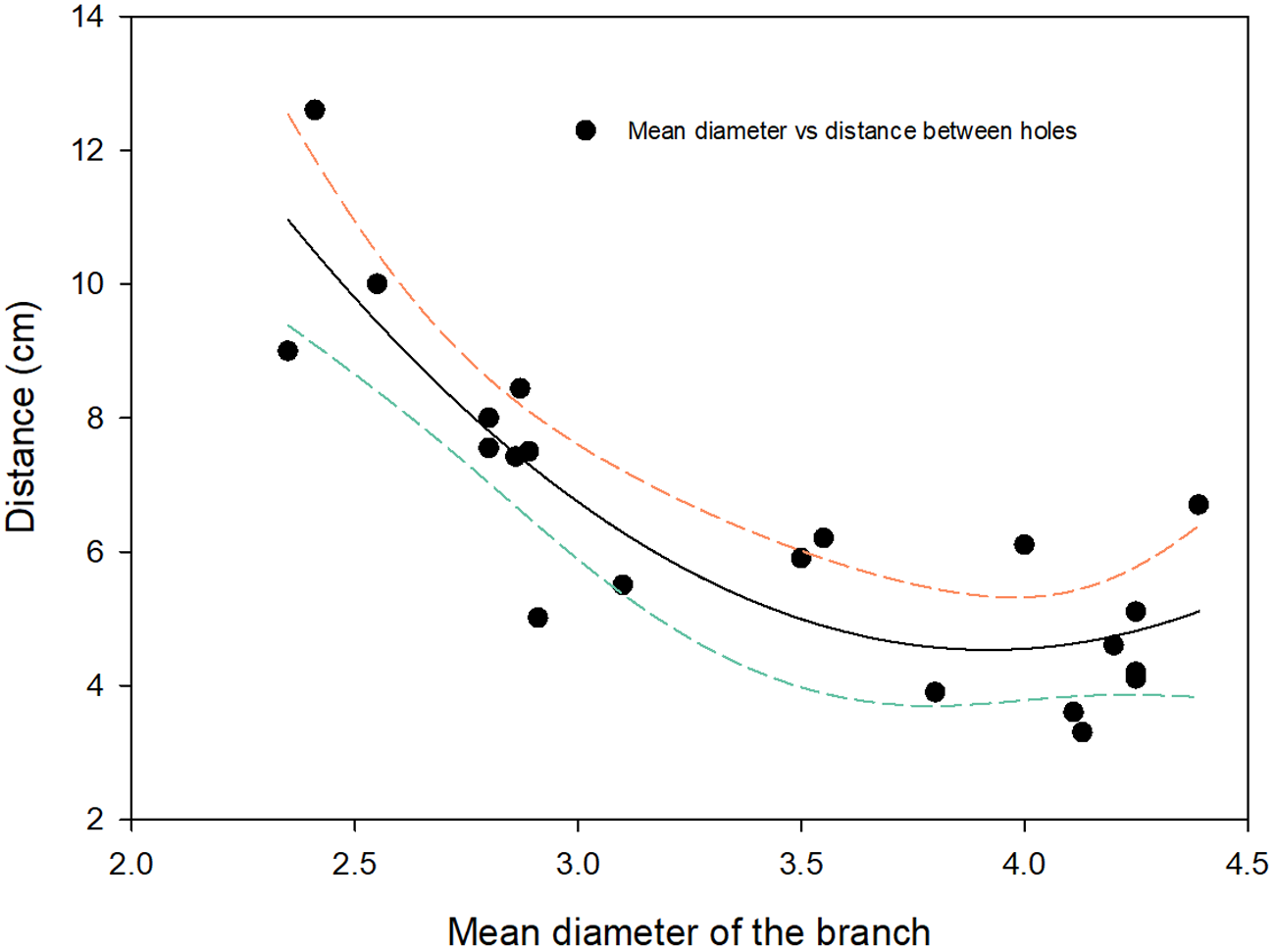
Hole spacing on branches averaged 6.42 ± 0.51 cm (n = 21, range: 3.30–12.60 cm). A significant quadratic relationship was found between mean branch diameter and inter-hole distance (R 2 = 0.76, F₂, ₁₈ = 27.73, P < 0.001, n = 21; fig. 2). Entry holes were nearly circular, with a mean diameter of 2.05 ± 0.05 mm (n = 20, range: 1.49–2.32 mm). No entry holes were observed in branches less than 1.5 cm in diameter.
Relationship between the distance between two consecutive holes and the mean branch diameter (cm). The equation fitted to the data is: f = y 0 + a*x + b*x 2; y 0 = 44.61 (SE 9.68); a = −20.45 (SE 5.86); b = 2.61 (SE 5.86); R 2 = 0.76; F = 27.73, P < 0.001, n = 21. The dotted line represents the 95% confidence band.

A total of 298 exit holes were recorded, with a mean of 3.31 ± 0.49 holes per branch. The mean number of holes differed significantly among sites: Muraca, 4.97 ± 1.09; Lionello, 1.93 ± 0.51; and Melina, 3.03 ± 0.79 (F = 3.41, df = 2, 87, p = 0.038). Branch diameter was positively correlated with the number of holes (Spearman’s r s = 0.387, p < 0.001, n = 90).
Mating behaviour
In 10 of 15 laboratory trials (66.7%), males of A. dispar attempted to copulate with a female. Successful copulation occurred in 8 of 15 trials (53.3%). Among these, five females accepted the first male that initiated contact, whereas the remaining three rejected one or more copulation attempts before mating. Males that successfully copulated made more attempts (1.37 ± 0.183 SE) than males that did not copulate (0.17 ± 0.167 SE; Mann–Whitney U test: Z = 2.20, p = 0.031).
Morpho-molecular identification and haplotype diversity
Morphological identification confirmed that all individuals belonged to A. dispar, which showed marked sexual dimorphism. Molecular analyses based on COI sequences supported these identifications, with BLAST results consistently matching A. dispar. The resulting COI fragments were 567 bp long. Six distinct haplotypes were identified, all belonging to the European lineage. The Santa Eufemia d’Aspromonte study area and the Cicala study area each contained three unique haplotypes, and no haplotypes were shared among the three study sites (table 1).
Only one haplotype (H6, specimen AA550) matched sequences reported from other countries, including France, Germany, Canada, the UK, and the USA. The designation H6 used here refers only to the internal haplotype numbering adopted in the present study. The remaining haplotypes were not found in public databases.
Genetic divergence within each study area was low but variable, with pairwise distances averaging 0.18% ± 0.0012 SE at Santa Eufemia d’Aspromonte and 0.38% ± 0.0016 SE at Cicala. Across all samples, the mean inter-haplotype divergence was 0.41%, ranging from 0.18% to 0.70% (table 2). No association was found between adult colouration and haplotype identity in the specimens examined (table 1).
Uncorrected p-distances and standard errors (in italics) calculated on the COI haplotypes found in A. dispar samples in this study

Table 2 Long description
Matrix of uncorrected p distances among haplotypes H1 through H6, with standard errors shown in the upper right triangle and p distances shown in the lower left triangle. Upper triangle standard errors range from 0.0016 to 0.0034. Standard errors from H1 to others are 0.0017 with H2, H3, and H4, 0.0016 with H5, and 0.0028 with H6. Standard errors among H2 to H5 range from 0.0023 to 0.0025, and standard errors from H2 to H6, H3 to H6, H4 to H6, and H5 to H6 are 0.0034, 0.0034, 0.0033, and 0.0032. Lower triangle p distances are 0.18 for H2 with H1 and for H3, H4, and H5 with H1. P distances among H2, H3, H4, and H5 are 0.35 for each pair listed. P distances involving H6 are 0.53 with H1 and 0.70 with H2, H3, H4, and H5.
Phylogenetic reconstruction using maximum likelihood and Bayesian inference produced congruent topologies (fig. 3). Most samples clustered within a well-supported clade that also included a Portuguese specimen (GMPTA53172) and samples from the Euganean Hills, Italy (accession number: ON164665–ON164664). None of the haplotypes from this study clustered with individuals from northeastern Italy (Porto Nogaro, San Giorgio di Nogaro, Udine), which formed a clearly distinct clade. Haplotype H6 diverged from the remaining haplotypes and grouped within a separate lineage.
Phylogenetic tree inferred by maximum likelihood (ML) and Bayesian inference (BI) analyses of the COI gene fragment of Anisandrus dispar. ML bootstrap support >70% and Bayesian posterior probabilities >0.7 are reported above the branches. Asterisks (*) indicate lower values of bootstrap and posterior probabilities. Sequences obtained in this paper are reported in bold with respective Mt-haplotype in brackets.

Figure 3 Long description
The phylogenetic tree is vertically oriented, showing relationships among COI gene sequences. It is constructed using Maximum Likelihood and Bayesian Inference analyses. Support values greater than 70 percent and Bayesian posterior probabilities greater than 0.7 are displayed above the branches, with asterisks indicating lower values. The tree begins with an outgroup branch leading to sequences HQ665751 and others. A major clade includes sequences such as AA567, AA449 and AA451, with respective haplotypes indicated in brackets. This clade is well-supported, grouping samples from various locations, including Portugal and the Euganean Hills, Italy. Another distinct clade diverges, containing sequences OM164683 and MWY001384. The scale bar at the bottom represents a genetic distance of 0.02, illustrating the evolutionary divergence among the sequences.
Discussion
Area infestation
Anisandrus dispar was recorded in hybrid chestnut stands, and unmanaged infestations were associated with severe tree decline over time. In the most affected cases, decline progressed to tree death within 2–3 years. Damage developed rapidly after infestation and was associated with a progressive loss of tree vigour. The association between canopy decline, internal wood discolouration, and the presence of galleries suggests that fungal colonisation associated with A. dispar may contribute to the deterioration of woody tissues and progressive host decline. However, the present study did not experimentally assess the causal contribution of fungal colonisation to tree mortality.
Bioecology: sex ratio, phenology, and behaviour
A strongly female-biased sex ratio was consistently observed among emerged adults, although some variation was noted between branch dissections and emergence cages. Some males were recovered inside natal galleries, whereas others were observed to emerge. Early observations by Schneider-Orelli (Reference Schneider-Orelli1913) support this possibility, noting the occasional presence of males on bark in spring possibly near overwintered females from adjacent galleries. For instance, the Muraca site showed both the highest number of exit holes and the greatest male emergence, which coincided with elevated host tree mortality. This observation may indicate site-level differences in adult emergence. The female-biased sex ratio may be influenced by multiple factors, including mating opportunities within galleries and the timing of male emergence. Unmated females may still contribute to reproduction by laying haploid eggs, although this possibility requires confirmation.
The spatial distribution of exit holes (mean spacing 6.42 cm) was recorded across branches. Anisandrus species, including A. dispar, are associated with Ambrosiella spp. (Microascales: Ceratocystidaceae), in particular Ambrosiella hartigii (French and Roeper, Reference French and Roeper1975; Mayers et al., Reference Mayers, McNew, Harrington, Roeper, Fraedrich, Biedermann, Castrillo and Reed2015; van de Peppel et al., Reference van de Peppel, Aanen and Biedermann2018), which is cultivated along tunnel walls and consumed by both larvae and adults (Harrington, Reference Harrington, Vega and Blackwell2005). The negative relationship between branch diameter and inter-hole distance, together with the absence of holes in branches less than 1.5 cm in diameter, suggests that branch structure may influence gallery establishment. The positive correlation between branch diameter and hole number further suggests that thicker branches may provide more suitable conditions for colonisation or allow a greater number of galleries to be established.
This spatial pattern could also affect the estimation of male numbers if some males remain inside galleries or emerge later than females. Seasonal and yearly variation in population density may further contribute to differences in observed sex ratios among sites. A similar reproductive pattern has been reported in Xyleborinus saxesenii (Ratzeburg, 1837) (Coleoptera: Curculionidae: Scolytinae) (Biedermann, Reference Biedermann2010), where males often remain in natal galleries to mate with emerging sisters and may also disperse. These observations suggest that A. dispar may show a comparable pattern, although the relative importance of male retention within galleries and subsequent dispersal remains to be clarified.
Finally, males collected from galleries in mid-December mated with conspecific females under laboratory conditions. This indicates that overwintering males retained mating capability under the conditions tested, although the extent to which this contributes to reproductive success under field conditions remains to be determined.
Mating behaviour
The mating behaviour of A. dispar appears to involve male persistence and female selectivity, two traits that are common in ambrosia beetles and may affect reproductive success.
In our observations, 66.7% of trials resulted in mating attempts by males, and 53.3% of females successfully copulated. Males that succeeded in mating showed a significantly higher number of mating attempts than those that did not indicating that repeated attempts were associated with mating success. This is consistent with observations in related species such as X. saxesenii, where males perform repeated courtship behaviours, including antennal contact and body grooming, to increase the likelihood of acceptance (Biedermann, Reference Biedermann2010).
Female selectivity also appeared to be an important component of the mating system in A. dispar. A number of females rejected initial mating attempts before eventually accepting a mate, indicating that mate acceptance was not immediate in all trials.
These findings suggest that A. dispar may combine in-gallery encounters with behavioural mechanisms that affect mate acceptance, but the relative importance of each component remains to be clarified. Further research on mate acceptance thresholds and male dispersal will help define how this system operates under field conditions.
Morpho-molecular identification and haplotype diversity
The combined use of morphological traits and molecular diagnostics supported the identification of the collected specimens as A. dispar. Genetic analyses revealed six distinct haplotypes within the European lineage, indicating the presence of intraspecific variation within the sampled populations. This variability may reflect population structure, although the available data do not allow a definitive assessment of the processes generating this pattern. The infestations observed on the cultivar Bouche de Bétizac initially raised concerns about the possible involvement of the putatively invasive and potentially aggressive lineage associated with haplotype H6 described by Ruzzier et al. (Reference Ruzzier, Martinez Sañudo, Cavaletto, Faccoli, Smith, Cognato and Rassati2023). However, molecular analyses did not detect this haplotype in Calabria. The haplotype designated H6 in the present study corresponds to a different COI sequence and reflects only the internal numbering adopted for the Calabrian samples. The present dataset does not support a bridgehead scenario involving the invasion fronts previously reported from Porto Nogaro, San Giorgio di Nogaro, and Udine (Italy). The clustering of most Calabrian samples with COI sequences from Portugal and the Euganean Hills indicates genetic similarity among samples from different European localities. However, given the limited number of specimens analysed and the use of a single mitochondrial marker, this pattern cannot be interpreted as evidence of a specific biogeographic connection or dispersal route.
Alternative explanations for the observed pest aggressiveness include ecological or physiological factors, such as interactions with microbial symbionts that may influence beetle fitness and host-pathogen dynamics. Similar associations have been demonstrated in other ambrosia beetles (Luchi et al., Reference Luchi, Mancini, Feducci, Santini and Capretti2012), where changes in fungal partners can alter host impact. However, the absence of severe damage on local chestnut varieties indicates that additional factors may be involved, and symbiont-mediated effects alone are unlikely to account for all differences in host susceptibility.
These findings support the need for broader genetic and ecological surveys of A. dispar populations across Europe. The detection of multiple previously unreported haplotypes indicates that genetic diversity in this species may have been underestimated. Although anthropogenic movement remains a plausible vector for long-distance dispersal (Rassati et al., Reference Rassati, Faccoli, Haack, Rabaglia, Petrucco Toffolo, Battisti and Marini2016), the available COI data do not allow the relative contributions of anthropogenic movement and natural dispersal to be determined.
Monitoring and implications for management
Adult monitoring, particularly of females, is commonly based on traps baited with ethanol-based attractants. These traps can provide useful information on female flight activity in the field and, indirectly, on the presence of ovipositing females. This information is important for identifying the timing of possible interventions targeting vulnerable adult stages. In addition, such traps may also detect other species, including the non-native A. maiche, which is already established and widespread in northern Italy (Ruzzier et al., Reference Ruzzier, Bani, Cavaletto, Faccoli and Rassati2022). New approaches for detecting infestations could also include molecular assays such as TaqMan™ qPCR, which can identify species in different matrices and may allow early detection even in the absence of adults (Rizzo et al., Reference Rizzo, D’agostino, Stabile, Ranaldi, Marrucci, Zubieta, Da Lio, Bartolini, Pennacchio, Rossi and Garonna2023).
Although the recent expansion of hybrid orchards has partly reduced damage caused by D. kuriphilus in southern Italy (Bonsignore and Bernardo, Reference Bonsignore and Bernardo2018), it may also have created favourable conditions for ambrosia beetle outbreaks. Understanding how host vigour and stress responses affect plant–insect–microbe interactions will be important for predicting pest risk in novel agroecosystems. The behavioural ecology of A. dispar has direct implications for management strategies. The strongly female-biased sex ratio and the mating capability of overwintering males observed under laboratory conditions are reproductive traits that should be considered in monitoring and management. This pattern may complicate pest control, especially in fragmented or newly colonised habitats.
Male persistence and female selectivity appear to contribute to mating success, highlighting the importance of behavioural interactions in population dynamics. Interventions that disrupt mating cues or reduce successful courtship may help lower reproductive output. Accordingly, early-season monitoring may be particularly relevant in areas with mild winters.
The spatial pattern of exit holes and the reliance on fungal cultivation also offer possible management targets. Strategies aimed at disrupting fungal symbionts, including the use of competitive or antagonistic microbial strains, may reduce brood development and larval survival. In addition, understanding the ecological conditions that favour dispersal and colonisation, such as host tree size, gallery density, and local climate, may help predict infestation spread and identify high-risk areas.
Finally, the presence of cryptic haplotypes within the native European lineage, together with the behavioural flexibility of the species, underlines the need for integrative monitoring programmes combining genetic, ecological, and behavioural surveillance. Such an approach will be useful not only for managing current outbreaks but also for anticipating changes in population structure or virulence linked to environmental change or human-mediated dispersal.
Conclusion
This study provides an integrated overview of the bioecology, reproductive behaviour, and genetic diversity of A. dispar populations infesting hybrid chestnut orchards in southern Italy. By combining field observations, laboratory trials, and DNA barcoding, we documented female-biased sex ratios, mating capability of overwintering males under laboratory conditions, site-specific emergence patterns, and COI haplotype diversity. These findings indicate that A. dispar can persist under the conditions examined and that overwintering males retain the capacity to mate under laboratory conditions. However, mating within galleries and successful reproduction under field conditions were not directly demonstrated. Understanding the factors potentially influencing reproductive success and host exploitation will be important for developing sustainable management strategies and limiting future outbreaks in economically and ecologically important tree species.
Acknowledgements
The authors wish to thank the farmers of the study sites in Melina, Lionello, and Muraca/Cicala for assisting with field collections of Bouche de Bétizac. Special thanks are due to Dr Sarah M. Smith for providing taxonomic advice on the identification of the detected species. We also thank Dr Fortuna Miele (CNR-IPSP, Portici, Italy) for valuable technical support in the molecular analyses.
Author contributions
B.C.P.: conceptualisation; data curation; formal analysis; funding acquisition; investigation; methodology; project administration; resources; software; supervision; validation; visualisation; writing – original draft; writing – review & editing. N.F.: data curation; formal analysis; investigation; resources; software; validation; visualisation; writing – review & editing. M.P.: investigation; resources; validation; writing – review & editing. T.B.: investigation; resources; validation; writing – review & editing. B.U.: conceptualisation; data curation; investigation; methodology; project administration; resources; supervision; validation; writing – original draft; writing – review & editing.
Financial support
This study was partially supported by a grant from the FIRB project awarded to Carmelo Peter Bonsignore.
Competing interests
The authors declare that they have no conflicts of interest related to the preparation, submission, or publication of this manuscript.