INTRODUCTION
Triatomines (Hemiptera: Reduviidae) are nocturnal hematophagous insects that require blood meals for survival and development in all stages. These insects are primarily sylvatic, living in their natural habitats in association with warm-blooded animals. Some species, however, can colonize human dwellings, in which man and domestic animals become readily available feeding sources. Besides exploiting their hosts for blood, triatomines also act as vectors of protozoan parasites such as Trypanosoma cruzi and Trypanosoma rangeli. The former is the aetiological agent of Chagas disease, which affects approximately 7 million people, mostly in Latin America (World Health Organization, 2015). Trypanosoma rangeli does not cause disease in humans, but can be pathogenic to its vectors, principally when infecting triatomines of the genus Rhodnius (Brecher and Wigglesworth, Reference Brecher and Wigglesworth1944; D'Alessandro, Reference D'Alessandro, Lumsden and Evans1976). The development of T. rangeli in triatomines starts when these insects feed on infected mammals. Trypomastigote forms, ingested with the blood meal, reach the midgut and transform into epimastigotes. After that, parasites colonize the entire intestinal tract and may cross the intestinal epithelium reaching the haemolymph, where they divide and migrate to salivary glands. There, epimastigotes transform into metacyclic trypomastigotes, which will be transmitted by the next insect bite (D'Alessandro, Reference D'Alessandro, Lumsden and Evans1976). Crossing the intestinal epithelium is not trivial, since the proportion of insects with complete infections (i.e. intestine, haemolymph and salivary glands) varies widely and depends on several factors, which may include parasite strain and life history (Anez et al. Reference Anez, Nieves and Cazorla1987; Hecker et al. Reference Hecker, Schwarzenbach and Rudin1990). Virulence of T. rangeli to vectors is well accepted in the literature, even though reports on its degree of pathogenicity are controversial (Grewal, Reference Grewal1957; Anez et al. Reference Anez, Nieves and Cazorla1987; Tovar et al. Reference Tovar, Urdaneta-Morales and Tejero1988). Experimental conditions used in previous reports vary considerably, limiting the possibility of comparison. Interestingly, it has been shown that T. rangeli needs cyclical passages through vertebrate and invertebrate hosts to maintain its infectivity to mice (Vallejo et al. Reference Vallejo, Marinkelle, Guhl and de Sanchez1986). Therefore, parasite life-history could act as a factor modulating the outcome of the interaction of these parasites and their invertebrate hosts.
It is now well known that temperature can be a crucial factor in determining how invertebrate–microbe interactions proceed (Blanford and Thomas, Reference Blanford and Thomas1999; Elliot et al. Reference Elliot, Blanford and Thomas2002) and this has more recently been extended to interactions between insect vectors and the parasites they vector (e.g. Sternberg and Thomas, Reference Sternberg and Thomas2014; Elliot et al. Reference Elliot, Rodrigues, Lorenzo, Martins-Filho and Guarneri2015). In this context, it has been shown that a pathogen's virulence can depend critically on host body temperature and how this fluctuates with external environmental conditions. In the light of these considerations, we hypothesized that environmental factors and parasite life history may modulate the virulence of T. rangeli to triatomines. Moreover, we propose that these may interact, defining the potential outcome of the infection process in a more complex scenario. Therefore, we performed two different experiments to evaluate whether temperature and/or trypanosome life-history could interact in such a fashion as to affect the outcome of the T. rangeli–Rhodnius prolixus interaction. For this, we generated parasites exposed to two different life-histories, to use these in the experiments performed for this study. In a first treatment, hereafter called ‘cultured’, parasites were exclusively maintained in culture medium. For the second treatment (passaged), parasites were exposed to cyclical passages through mice and triatomines every 3 months between which they were kept in culture medium. In a first series of assays, we evaluated whether the virulence of cultured and passaged T. rangeli to R. prolixus depends on the environmental temperature to which insects are exposed. A second experiment was designed to measure the effects of temperature on the growth of parasites originated from both treatments. This was performed offering parasites an environment presenting ad libitum nutritional resources and no immune responses from insects. For this, T. rangeli was allowed to grow in culture medium kept at four different temperatures.
MATERIALS AND METHODS
Ethics statement
All experiments using live animals were performed in accordance with FIOCRUZ guidelines on animal experimentation and were approved by the Ethics Committee in Animal Experimentation (CEUA/FIOCRUZ) under the protocol number L-058/08.
Insects and parasites
A sample of domiciliary R. prolixus originally captured in Honduras has been reared in a colony maintained by our group since 1990s. Insects were reared at 25 ± 1 °C, 60 ± 10% RH and a natural illumination. They were fed on chicken and mice anesthetized with an intraperitoneal injection of a ketamine (150 mg kg−1; Cristália, Brazil)/xylazine (10 mg kg−1; Bayer, Brazil) mixture. Mice were used as food source in addition to chicken as we have previously demonstrated that avian blood alone promotes a delay in the development of triatomines in addition to an increase in their mortality rates (Guarneri et al. Reference Guarneri, Diotaiuti, Gontijo, Gontijo and Pereira2000).
The Choachi strain of T. rangeli, originally isolated from naturally-infected R. prolixus from Colombia (Schottelius, Reference Schottelius1987), was used in our study. Epimastigote forms were cultured at 27 °C in liver infusion tryptose (LIT) medium supplemented with 15% fetal bovine serum, 100 µg mL−1 streptomycin and 100 units mL−1 penicillin. To test whether virulence varies with parasite life-history, two alternative maintenance protocols were used. In one procedure, parasites were subjected to twice-weekly passages in LIT medium for over a year (cultured). In the second, parasites were maintained for over 2 years by cyclical passages through mice and triatomines, being cultured in LIT medium for 2 months after each passage (passaged).
Temperature effects on the development of infected insects
Insects were infected by the inoculation of T. rangeli directly into the coelomatic cavity as described by Ferreira et al. (Reference Ferreira, Lorenzo, Elliot and Guarneri2010). This methodology was chosen in preference to oral infection, as we wanted standardized insects with parasites in the haemolymph and the salivary glands. The numbers of insects with parasites in both of these locations that are obtained from oral infections are highly variable and are low (Grewal, Reference Grewal1957; Tobie, Reference Tobie1964, Reference Tobie1965; Ferreira et al. Reference Ferreira, Lorenzo, Elliot and Guarneri2010), which makes interpretation of experimental results difficult. Briefly, epimastigotes obtained from 10-day old cultured and passaged cultures were washed and resuspended in sterile phosphate buffered saline (PBS; 0·15 m NaCl, 0·01 m sodium phosphate, pH 7·4). Seven-day old 4th instar nymphs were inoculated with 1 µL of parasite suspension (5 × 10⁴ par mL−1) injected in the side of the thorax using a 50 µL Hamilton syringe connected to a fine needle (13 × 3·30 G, ½″). For T. rangeli cultured, 120 nymphs were used, while for the passaged infection, 80 nymphs were injected. An equivalent volume of sterile blank PBS was inoculated into each insect of the control group (n = 120 for cultured and n = 76 for passaged). One day after inoculation, insects were fed to repletion on anaesthetized mice, transferred to Petri dishes and kept in separate temperature control chambers at 21 ± 0·2, 24 ± 0·2, 27 ± 0·2 or 30 ± 0·2 °C (maximum of six insects per plate; plates from both treatments were randomly distributed in the chambers). Time taken to reach the 5th instar and mortality rates were evaluated daily until the 30th day after the first ecdysis of each group. The number of defective ecdyses characterized as the proportion of insects presenting morphological alterations after moulting, such as leg deformities, was also evaluated. At the end of the experiment, the haemolymph and salivary glands of live insects were examined for parasites.
Temperature effects on parasite growth in culture medium
The effects of temperature on parasite growth were measured by flow cytometry as described (Elliot et al. Reference Elliot, Rodrigues, Lorenzo, Martins-Filho and Guarneri2015). Culture epimastigotes (1 × 10⁶ mL−1) were transferred to cell culture flasks (25 cm2) containing fresh LIT medium to a final volume of 8 mL. The flasks were immediately transferred to four independent controlled temperature chambers (21 ± 0·2, 24 ± 0·2, 27 ± 0·2 or 30 ± 0·2 °C) and kept there for 7 days. Two replicate culture samples were simultaneously tested for each temperature. Daily, a 50 µL sample was collected from each flask and stained for absolute counts and viability analyses were performed through flow cytometry.
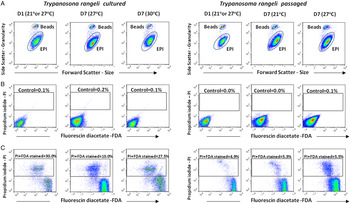
Dual label fluorescent staining procedures were performed to determine the absolute counts of live and dead parasites on each sample. For this, 50 µL of cultured epimastigotes were added to a solution containing 120 µL of sterile PBS, 25 µL of fluorescein diacetate (FDA, 7 µg mL−1) and 5 µL of propidium iodide (PI, 25 µg mL−1), both from Sigma (St Louis, MO, USA) and incubated for 10 min at room temperature. Following incubation, 20 µL of fluorospheres (Flow-Count™ Fluorospheres; Beckman Coulter Inc., Miami Lakes, FL, USA) suspension were added to each tube immediately before flow cytometric acquisition. The fluorospheres were used as a calibration device to directly obtain absolute counts of parasite using flow cytometry. In each experimental batch, a sample with no dye was used as an internal control. Figure 1 shows representative flow cytometric density plots for both T. rangeli treatments. Flow cytometric acquisition was carried out in a Becton Dickinson flow cytometer – FACScan (BD Bioscience, San Jose, CA, USA) using the FlowJo software version 7.6·4 (Ashland, OR, USA) for data analysis.
Representative flow cytometry pseudocolour charts illustrating the morphometric profiles and fluorescent patterns of Trypanosoma rangeli cultured and passaged epimastigotes growth in vitro. Plots illustrated the profiles of epimastigotes at one day, D1 (representative for 21°, 27° and 30 °C), and seven days, D7, of culture at 21° and 27 °C. Row A shows a representative morphormetric (Forward Scatter – Size vs Side Scatter – Granularity) distribution of epimastigotes (Epi) and the cluster of 5 µm polystyrene calibration beads used for absolute counts calculation (Beads). Rows B and C show representative fluorochrome labelling patterns for controls (PBS; row B) and FDA vs PI staining of epimastigote selected organisms (row C). Rectangles boxes were used to select and quantify the frequency of dead epimastigotes (FDA + PI + double labelled events = DEAD EPI) and leave outside the live epimastigotes (FDA + PI − labelled events = LIVE EPI). Data analysis was carried out by first calculating the Epimastigote absolute counts = EPI/(50 × Beads/19 720) where: EPI thinsp;= number of epimastigote event counts on a given tube, 50 = volume of cultures suspension added to each tube; Beads = number of fluorosphere beads aspirated in a given tube and 19 720 = number of fluorosphere beads add to each tube, considering the volume of 20 mL of beads suspension. Moreover, data were also expressed as Viable Epimastigote Counts = EPI absolute counts * % of LIVE EPI/100, where: LIVE EPI = percentage of FDA + PI-events and 100 = the percentage conversion factor.Abbreviations: FDA, fluorescein diacetate; PI, propidium iodide; PBS, phosphate buffered saline.

Statistical analyses
Intermoult periods were evaluated using Kaplan–Meier survival analyses. Comparisons were made with log-rank tests (temperature and infection were analysed separately). An overall effect of the parasite infection was obtained by the sum of negative effects such as mortality, absence of moulting and morphological defects. A Z-test for proportions was used to compare this effect in each treatment. A Chi-square partition test was used to compare the proportions of live insects presenting parasites on the haemolymph or salivary glands at the end of experiments. The accepted significance level used throughout was P < 0·05.
Analyses of temperature effects on in vitro parasite growth were conducted in R version 2.13·0 (Statistical Package, 2009). The first step was to determine growth rates (i.e. regression slopes) for each replicate (bottle) for each temperature treatment. For this, live parasite population sizes were log-transformed (i.e. log10 of parasite number + 1) and linear mixed effects models were used to account for the repeated measures (i.e. days 1, 2, 3 and so on). Eight growth rate values were therefore obtained (two replicates × four temperatures). These were subjected to regression analyses aimed at detecting temperature effects on growth rates, in particular, to test whether growth rates could be seen to peak at different temperatures.
RESULTS
Infected insect development at different temperatures
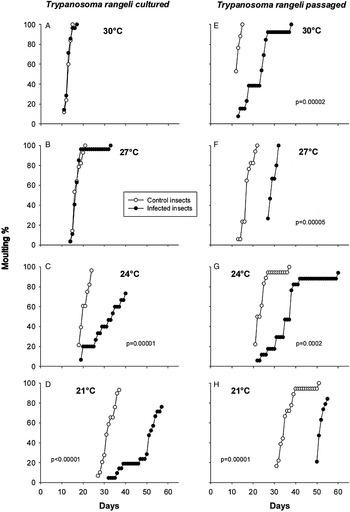
There was an overall effect of higher temperatures accelerating moult to 5th instar (Fig. 2, log-rank test, P = 0·00001 for all groups). This effect was similar for both sets of controls, median times ranging from 13 to 31 days for the first set of controls (30 and 21 °C, respectively, paired with cultured infection, Fig. 2A–D) and 12–35 days for the second set (30 and 21 °C, respectively, paired with passaged infection, Fig. 2E–H). While both T. rangeli treatments delayed insect moult overall, this effect was strongly dependent upon temperature for cultured -infected insects, only being significant at lower temperatures (Fig. 2, log rank tests, P = 0·00001 for both 21 and 24 °C). For passaged-infected insects, however, this delay was seen across all four temperatures (differences in medians consistently 12 days or more, log rank tests all P < 0·0002).
Effect of infection with cultured (A–D) and passaged (E–H) treatments of Trypanosoma rangeli on the times required by 4th instar nymphs of Rhodnius prolixus to reach 5th when held at four different temperatures. Open circles are data from control insects, while closed circles are data from infected ones (values of n for control and infected groups, respectively: A: 23C & 28I; B: 28C & 27I; C: 26C & 11I; D: 27C & 16I; E: 17C & 13I; F: 17C & 16I; G: 18C & 17I; H: 18C & 16I). P values represent the significance of statistical comparisons between temperature treatments (log-rank test).

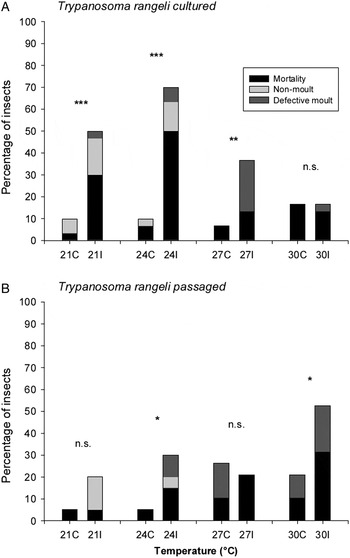
Infection with both treatments of T. rangeli did reduce ecdysis success, by up to 60% in the case of cultured-infected insects at 24 °C (Fig. 3). For cultured-infected insects (Fig. 3A), this reduction was very pronounced at temperatures of 21, 24 and 27 °C (Fig. 3A, Z test, P = 0·0007 at 21 °C, P < 0·00001 at 24 °C and P = 0·0048 at 27 °C) but disappeared at 30 °C. Meanwhile, for passaged-infected insects, there were pronounced reductions in ecdysis success at 24 and 30 °C (Fig. 3B, Z test, P = 0·03 at 24 °C and P = 0·02 at 30 °C) but not at 21 and 27 °C. It is important to observe the apparent increase in unsuccessful moult in control insects with increasing temperatures, for both sets of controls, as a background effect, although we did not analyse this statistically and the differences were less than the effects of parasite infection. Patterns can be observed in the nature of unsuccessful moults. Thus, unsuccessful moults seemed to result in non-moulting more at lower temperatures and defective moults at higher temperatures, over the range of treatments.
Effect of infection by cultured (A) and passaged (B) treatments of Trypanosoma rangeli on the fitness of Rhodnius prolixus nymphs at moult from 4th to 5th instar. Data represent the percentages of insects that died at the period of moulting (black bars), did not moult at all (light grey bars) or moulted with visible morphological defects (dark grey bars) (the remaining insects moulted successfully). (cultured assay: n = 30 for each temperature and treatment; passaged assay: n = 19 for control and n = 20 for infected insects for each temperature) Asterisks represent significant differences in the total effects, without discriminating according to category of defective moult or death, according to a Z-test (*P = 0·02; **P = 0·002; ***P < 0·0001).

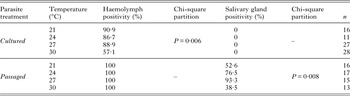
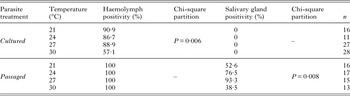
The haemolymph and salivary glands of cultured and passaged T. rangeli-infected insects were examined for parasite presence at the end of the experiment (Table 1). Salivary gland infection was never observed in cultured T. rangeli-infected insects, regardless of the temperature tested. In relation to haemolymph infection, nymphs kept at 30 °C presented a reduction in positivity rates compared with those kept at lower temperatures (Table 1, Chi-square partition, P = 0·006). Thirty days after moulting to the 5th instar, all passaged T. rangeli-infected nymphs presented parasites in their haemolymph (Table 1). However, the proportion of salivary gland infection was reduced for insects kept at 21 and 30 °C (Chi-square partition, P = 0·008).
Infection rates of Rhodnius prolixus nymphs 30 days after moulting
The effect of temperature on the growth of parasite cultures
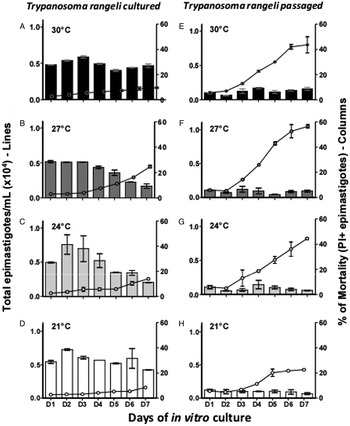
Overall, final populations of passaged parasites were at least twice as abundant as those of cultured parasites (Fig. 4). Mortality rates of cultured T. rangeli varied between 10 and 40%, parasites exposed to 27 °C showing the lowest mortality (Fig. 4A–D). Mortality rates for passaged T. rangeli were consistently below 10%, irrespective of temperature (Fig. 4E–H).
Impact of temperature on cultured (A–D) and passaged (E–H) Trypanosoma rangeli epimastigotes growth curves and mortality rates. A dual-colour flow cytometry procedure (FDA + PI) associated with fluorosphere calibration beads was used to directly determine absolute counts of epimastigotes (line chart) and percentage mortality (bar charts) considering PI positive and PI and FDA double positive events (PI + FDA stained parasites) in cultures kept at different temperatures. Data represent the means of two biological replicates. Abbreviations: FDA, fluorescein diacetate; PI, propidium iodide.

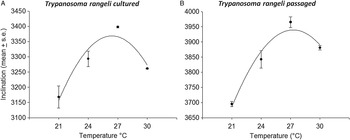
Trypanosoma rangeli from both treatments grew faster at higher temperatures, but the best fits for the regressions were quadratic functions, implying that growth rates peaked at ca. 27 °C for both treatments (Fig. 5; P < 0·01 in both cases).
Temperature profiles of (A) cultured and (B) passaged treatments of Trypanosoma rangeli CHOACH strain when grown in vitro under four different temperature regimes. Shown are values of slopes (Inclination) estimated from growth curves and quadratic functions fitted to these data. See text for full explanation.

DISCUSSION
The influence of environmental factors on the distribution and abundance of insects is well established, since climatic variables strongly affect their vital functions (Deutsch et al. Reference Deutsch, Tewksbury, Huey, Sheldon, Ghalambor, Haak and Martin2008; Bale and Hayward, Reference Bale and Hayward2010). As observed for other insects, environmental temperature affects several aspects of triatomine life. These include egg hatching (Clark, Reference Clark1935; Guarneri et al. Reference Guarneri, Lazzari, Xavier, Diotaiuti and Lorenzo2003), fecundity and sexual maturity (Joerg, Reference Joerg1962; Ehrenfeld et al. Reference Ehrenfeld, Canals and Cattan1998), adult dispersion (Lehane et al. Reference Lehane, McEwen, Whitaker and Schofield1992) and shelter selection (Lorenzo and Lazzari, Reference Lorenzo and Lazzari1998). Triatomines are able to perceive warm objects (Wigglesworth and Gillett, Reference Wigglesworth and Gillett1934) by means of detecting infrared radiation (Lazzari and Nunez, Reference Lazzari and Nunez1989) and the choice of preferred temperatures is modulated by nutritional status (Di Luciano, Reference Di Luciano1983; Lazzari, Reference Lazzari1991; Guarneri et al. Reference Guarneri, Lazzari, Xavier, Diotaiuti and Lorenzo2003; Schilman and Lazzari, Reference Schilman and Lazzari2004). Additionally, triatomines hide in shelters whose temperature dynamics offer stable and favourable environments (Lorenzo et al. Reference Lorenzo, Guarneri, Pires, Diotaiuti and Lazzari2000).
Trypanosoma rangeli has been shown to promote diverse pathogenic effects on triatomines, such as increased mortality, delay or absence of moulting, as well as defective moults and tissue damage (Brecher and Wigglesworth, Reference Brecher and Wigglesworth1944; Grewal, Reference Grewal1957; Lake and Friend, Reference Lake and Friend1967; Watkins, Reference Watkins1971; D'Alessandro, Reference D'Alessandro, Lumsden and Evans1976; Vallejo et al. Reference Vallejo, Marinkelle, Guhl and de Sanchez1986; Anez et al. Reference Anez, Nieves and Cazorla1987; Ferreira et al. Reference Ferreira, Lorenzo, Elliot and Guarneri2010). Trypanosoma rangeli also affect reproductive parameters of R. prolixus adults, which includes reductions in fecundity and fertility of parasite-infected pairs (Fellet et al. Reference Fellet, Lorenzo, Elliot, Carrasco and Guarneri2014). Recently, it has been shown that T. rangeli infection also changes the triatomine behaviour, affecting the intensity of locomotion, negative phototaxis and the expression of a behaviour-associated gene (Rpfor) in R. prolixus (Marliére et al. Reference Marliére, Latorre-Estivalis, Lorenzo, Carrasco, Alves-Silva, Rodrigues, Ferreira, Lara, Lowenberger and Guarneri2015). Since no work published to date studied environmental conditions as modulators of triatomine–T. rangeli interactions, we evaluated whether the temperature or parasite life-history would affect T. rangeli virulence to R. prolixus. In general, both T. rangeli treatments produced negative effects on infected insects. Nevertheless, the level of pathogenicity shown by parasites that originated from the different treatments and the way in which infection processes reacted to the temperatures tested were relatively different.
Trypanosoma rangeli presented more evident pathogenic effects when R. prolixus nymphs were infected with parasites maintained exclusively in culture medium (cultured), especially for insects kept at lower temperatures. All the altered parameters produced a 5-fold increase on the overall effect of T. rangeli infection, suggesting that insects kept at lower temperatures might harbour larger parasite loads. It is interesting to note that cultured-infected insects kept at 24 °C presented an increased mortality rate, and more than 50% of their deaths occurred during ecdysis (data not shown). In addition, defective moulting was the only effect observed on cultured-infected insects kept at 27 °C. This suggests that an increase of 3 °C in environmental temperature may have allowed infected insects to survive and moult despite parasite infection, although most of them presented problems at ecdysis. No significant pathologies were seen in cultured-infected insects kept at 30 °C, which could be related with the significant decrease in haemolymph infection shown by insects maintained at this temperature. Interestingly, cultured T. rangeli were not able to invade the salivary glands of R. prolixus nymphs, remaining in the haemocoel and promoting massive infections, which probably provoked the stronger pathological effects observed. Changes in pathogen virulence according to environmental conditions are frequently observed in host–pathogen interactions (Thomas and Blanford, Reference Thomas and Blanford2003). One example is the fungus Entomophaga grylli that infects the grasshopper Zonocerus variegates working as a mortality factor in the grasshopper populations, although it can be controlled by insect responses if the daylight maximum temperature increases by only 2 °C (Chapman and Page, Reference Chapman and Page1979; Blanford et al. Reference Blanford, Thomas and Langewald2000). In the case of passaged T. rangeli infections, parasites did not induce an increase in insect mortality rates, suggesting that these parasites were not directly virulent to their invertebrate host. The negative effects of passaged parasites were evidenced when all the effects on fitness parameters were grouped; in this case the effects were evident at most temperatures, suggesting that they are independent of this parameter. Passaged treatment was obtained by frequently exposing T. rangeli parasites to both vertebrate and invertebrate hosts. As a consequence, elevated salivary gland infection rates were reached, particularly at intermediate temperatures. Nevertheless, the observed reduction in salivary gland infection in insects maintained at 30 °C suggests that parasites had a reduced development at this temperature.
Despite their differences in pathogenicity, parasites from both treatments promoted a weaker infection in insects exposed to 30 °C. This result led us to raise two hypotheses: a first one was that parasites do not tolerate the higher temperatures within the range tested; an alternative hypothesis proposed that insect immune responses can reduce or even eliminate infection at those temperatures. The parasite growth in culture medium showed that the temperature tolerance of cultured and passaged T. rangeli parasites was clearly different. Cultured parasites were very susceptible to both high and low temperatures, since almost no growth was observed in cultures exposed to 21 and 30 °C. In fact, cultured parasites did not grow properly independent from the temperature tested, and this was probably a result of the high mortality observed throughout all assays. Even when kept at the best temperature (27 °C), cultured parasite populations never exceeded 5000 parasites µL−1. Meanwhile, passaged T. rangeli presented a better growth at all temperatures tested, reaching more than 10 000 parasites µL−1 in cultures exposed to 27 °C. In addition, passaged parasites were more resistant to lower temperatures, increasing their population sizes almost 3-fold when at 21 °C. Nevertheless, and similarly as seen with cultured T. rangeli, passaged parasites were susceptible to 30 °C. Based on this, we suggest that T. rangeli is sensitive to high temperatures that, associated with insect immune responses, may lead to its elimination in vivo. Consequently, this parasite would have its development impaired in infected insects living at high temperatures. Studies evaluating T. rangeli infection in R. prolixus by inoculating the parasite directly in the haemolymph showed several immunological responses triggered against the parasite, such as prophenoloxidase pathway activation (Gregório and Ratcliffe, Reference Gregório and Ratcliffe1991; Garcia et al. Reference Garcia, Machado and Azambuja2004) superoxide and nitric oxide production (Whitten et al. Reference Whitten, Mello, Gomes, Nigam, Azambuja, Garcia and Ratcliffe2001, Reference Whitten, Sun, Tew, Schaub, Soukou, Nappi and Ratcliffe2007; Gazos-Lopes et al. Reference Gazos-Lopes, Mesquita, Silva-Cardoso, Senna, Silveira, Jablonka, Cudischevitch, Carneiro, Machado, Lima, Monteiro, Nussenzveig, Follu, Romeiro, Vanbeselaere, Mendonça-Previato, Previato, Valenzuela, Ribeiro, Atella and Silva-Neto2012), and phagocytosis (Takle, Reference Takle1988; Figueiredo et al. Reference Figueiredo, Genta, Garcia and Azambuja2008). Interestingly, the responses only kill short epimastigotes efficiently, while the long epimastigotes are unaffected (see review in Garcia et al. Reference Garcia, Castro, Figueiredo, Genta and Azambuja2009). Apparently, these long forms are responsible for the maintenance of the infection. It is worth noting that these studies did not consider temperature as a modulator of parasite virulence. In this sense, it would be interesting to evaluate if the insect immunological responses can also be modulated by temperature.
It is worth noting that passaged T. rangeli parasites tend to gradually behave as cultured after being kept in LIT medium for more than 2 months. This lack of exposure to natural hosts apparently induces Choachi strain parasites to lose their ability to invade insect salivary glands, thus preventing their transmission to vertebrate hosts. In this sense, and as suggested by Vallejo et al. (Reference Vallejo, Marinkelle, Guhl and de Sanchez1986), it would be desirable that T. rangeli strains used in experimentation frequently undergo cyclical infections in vertebrate and invertebrate hosts in order to maintain a proper infection performance.
Based on the present results, it becomes clear that environmental factors can modify the components of triatomine-T. rangeli fitness. We recently evaluated the infection of R. prolixus with T. cruzi in the same conditions reported in the present study (Elliot et al. Reference Elliot, Rodrigues, Lorenzo, Martins-Filho and Guarneri2015). Similarly to that observed with passaged T. rangeli-infected insects, T. cruzi infection promoted a delay in the intermoult period independent from the temperature insects were reared. Nevertheless, and similarly to that observed with cultured T. rangeli-infected insects, T. cruzi parasites increased the mortality rate in insects kept at intermediate temperatures (Elliot et al. Reference Elliot, Rodrigues, Lorenzo, Martins-Filho and Guarneri2015) indicating that these parasites respond differently to changes in external conditions.
Insects belonging to the genus Rhodnius are normally found inside palm tree crowns where they associate with diverse vertebrates (Teixeira et al. Reference Teixeira, Monteiro, Rebelo, Argañaraz, Vieira, Lauria-Pires, Nascimento, Vexenat, Silva and Ault2001; Abad-Franch et al. Reference Abad-Franch, Palomeque, Aguilar and Miles2005; Dias et al. Reference Dias, de Paula, Belisario, Lorenzo, Bezerra, Harry and Diotaiuti2011). In these sylvatic ecotopes they can be found harbouring T. cruzi and T. rangeli in single or mixed infections (Dias et al. Reference Dias, Bezerra, Machado, Casanova and Diotaiuti2008; Thekisoe et al. Reference Thekisoe, Rodriguez, Rivas, Coronel-Servian, Fukumoto, Sugimoto, Kawazu and Inoue2010). The temperatures of these environments and the corresponding triatomine refuges oscillate closely around 25 °C (Heger et al. Reference Heger, Guerin and Eugster2006), which is in fact, the temperature chosen by R. prolixus when exposed to temperature gradients (Schilman and Lazzari, Reference Schilman and Lazzari2004). Cultured and passaged parasites showed clear differences in relation to their virulence to insects, cultured being the most virulent treatment. However, parasites with passaged characteristics are more probably found circulating in wild ecotopes. Even with attenuated virulence, T. rangeli can be pathogenic to invertebrate hosts at these intermediate temperatures. Indeed, these parasites prolonged the intermoult period, independent from which temperature insects were exposed to. In addition, when the overall pathogenic effects are taken altogether it is possible to reinforce that these parasites are pathogenic to R. prolixus. Whether this has implications on the dynamics of parasite transmission by changing physiological or behavioural parameters deserves further investigation. As mentioned before, T. rangeli parasites complete all phases of their developmental cycle solely in triatomine species belonging to the genus Rhodnius, which normally inhabit microenvironments with mild temperatures (Heger et al. Reference Heger, Guerin and Eugster2006). This probably reflects a long coevolution shaped by temperature restrictions on both parasite and invertebrate hosts.
ACKNOWLEDGEMENTS
We are grateful to Farley William S. Silva for the statistical analyses of the in vitro growth data.
FINANCIAL SUPPORT
SLE, OAM and MGL were supported by CNPq productivity grants. This work was supported by CNPq (Conselho Nacional de Desenvolvimento Científico e Tecnológico) under grant 478786/2007-7 (AAG), FAPEMIG (Fundação de Amparo à Pesquisa do Estado de Minas Gerais) under grant APQ-00805-11 (AAG), and PAPES VI/FIOCRUZ (Programa Estratégico de Apoio a Pesquisa em Saúde) under grant 407614/2012-5 (AAG).