Anxiety and depression are collectively the most common mental health problems across development, with most typical onset during childhood and adolescence. These problems co-occur at high rates, have similar or shared underlying core mechanisms, and respond to comparable psychosocial and pharmacotherapy interventions (see Garber & Weersing, Reference Garber and Weersing2010 for review). A decade ago in 2009, and with the goal of identifying mechanisms underlying these “near-neighbor” disorders (Weersing, Gonzalez, Campo, & Lucas, Reference Weersing, Gonzalez, Campo and Lucas2008) for personalized intervention, the National Institute of Mental Health (NIMH) developed a framework called research domain criteria (RDoC; Insel et al., Reference Insel, Cuthbert, Garvey, Heinssen, Pine, Quinn and Wang2010). The immediate goals of RDoC are to integrate levels of information to investigate psychopathology (Insel, Reference Insel2014). RDoC's ultimate goals are to identify transdiagnostic features across mental health problems, as well as use this information to personalize intervention efforts. To this end, the aim of RDoC is to assess systematically the nature of “dysfunction” across a wide variety of intrapersonal systems (genes, circuits, biology, behavior, etc.). Use of the RDoC framework has resulted in an abundance of research examining mechanisms underlying anxiety and depression in both youth and adults. Three such exemplar mechanisms indicated in anxiety, depression, and their co-occurrence are: cognitive biases, biological processes, and affective processes. Yet relatively little work has been done to examine how these intrapersonal processes intersect with context during the child and adolescent period, which are sensitive developmental stages for socioemotional functioning and potential onset of internalizing problems.
The RDoC framework utilizes a “matrix” to depict specific mechanistic domains and their units of analysis. RDoC is designed to identify transdiagnostic mechanisms that cut across traditional diagnostic categories (Cuthbert, Reference Cuthbert2014). Current conceptualizations of anxiety and depression may be particularly well suited to this approach, as these disorders are related, and have even been proposed to reflect the same underlying mechanisms manifested by various symptoms across development (for more on heterotypic continuity of internalizing problems, see Garber & Weersing, Reference Garber and Weersing2010). A simultaneous benefit and challenge with the RDoC matrix is that it relies heavily on intrapersonal factors such as brain circuits, genetics, and individual behavior, and the majority of behavioral tasks utilized to measure these constructs are limited to use in the laboratory. While this feature allows isolation and identification of many basic science mechanisms using well-validated tools, the matrix places relatively little emphasis on how these intrapersonal factors intersect with environmental factors such as poverty, maltreatment, and parenting, all of which can contribute to the etiology and maintenance of internalizing problems. Environmental, social, and cultural variables are not core units of analysis in the RDoC matrix, although the RDoC conceptualization does include developmental processes and interpersonal factors as “dimensions that should inform hypotheses and conclusions derived from the RDoC organizational structure,” and their absence from the matrix “should not be misinterpreted as indicating that these important considerations are not relevant to the RDoC research framework” (Morris & Cuthbert, Reference Morris and Cuthbert2012). To date, much of the research that fits squarely within the RDoC framework in internalizing youth examines one or more intrapersonal factors (e.g., genetic, biological, cognitive, and affective) without also measuring relevant contextual factors.
The dimensional nature of internalizing symptoms across development is particularly in line with RDoC's focus on dimensional models of psychopathology (Clark & Watson, Reference Clark and Watson1991; Watson, Reference Watson2005), particularly given findings that childhood anxiety precedes and very strongly predicts adolescent depression, although the converse is not true (Garber & Weersing, Reference Garber and Weersing2010). The onset of both disorders also most frequently occurs prior to adulthood, and – as discussed throughout this paper – is very strongly influenced by contextual factors. For these reasons, we view RDoC as particularly well suited to study internalizing problems through a developmental lens (Casey, Oliveri, & Insel, Reference Casey, Oliveri and Insel2014), where units of analysis identified in the matrix are studied within context (e.g., environmental, cultural, and other influences on intrapersonal factors). Some noteworthy work by experts in pediatric anxiety, depression, and their comorbidity have already begun to link RDoC to contextual factors, and it is our aim herein to highlight and recognize work that exemplifies the importance of context in the translational study of youth internalizing problems using the RDoC framework. As we will argue in this paper, and as others we cite have argued previously, we view the NIMH RDoC matrix as an important and perhaps integral tool to study internalizing problems in youth. Simultaneously, a more deliberate and systematic focus on the integration of development and environmental factors into the matrix will only strengthen our knowledge of the etiology, maintenance, treatment, and prevention of internalizing problems in youth. In this context, identifying papers focused on how ecological systems may be especially helpful for us and other clinical/developmental psychopathology scientists who utilize RDoC to understand internalizing problems in youth.
Ecological Systems Theory: Integrating Context into RDoC
Why is context critical to understanding youth internalizing mechanisms identified with the RDoC framework? It is perhaps obvious to state that context and intrapersonal vulnerabilities interact irrespective of the mental health problems and/or developmental stage being considered. As an example, negative life events, especially those that involve loss of status or relationships, are some of the strongest predictors of depression (Monroe, Slavich, & Georgiades, Reference Monroe, Slavich, Georgiades, Gotlib and Hammen2014) and can compound biological and behavioral vulnerabilities, leading to earlier onset and more severe course of depressive episodes (e.g., Liu & Alloy, Reference Liu and Alloy2010). It would be a mistake to consider solely the genetic and neurobiological underpinnings of depression without considering an individual's experiences and context, just as it would be a mistake to consider only experiences and context in the absence of genetic, neural, cognitive, biological, and emotional processes. In a similar example, living in poverty predicts worse youth anxiety and depression (Reiss, Reference Reiss2013) and is associated with changes in neurobiology, cognition, and emotion that are likely to underlie risk for these disorders (Kim et al., Reference Kim, Evans, Angstadt, Ho, Sripada, Swain and Phan2013; Palacios-Barrios & Hanson, Reference Palacios-Barrios and Hanson2019). Without understanding how contextual factors associated with poverty (e.g., financial stress, housing quality, nutrition, contaminant exposure, overcrowding, neighborhood violence) interact with intrapersonal factors already captured within RDoC domains, critical information would be missing that could potentially inform efforts to understand etiology, course, and prevention and intervention efforts.
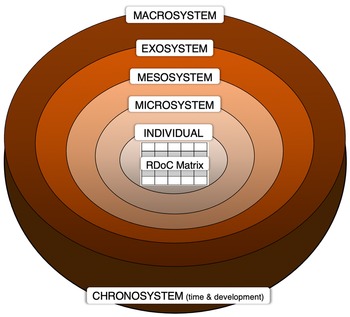
One way to consider the influence of context is to utilize Bronfenbrenner's ecological systems theory (Bronfenbrenner, Reference Bronfenbrenner1979, Reference Bronfenbrenner and Vasta1992), a long-standing and empirically supported framework in developmental psychopathology that structures how the individual intersects with their environments (e.g., familial, school, neighborhood). The ecological systems model contains five levels of environmental systems that interact with an individual, including those close to the individual, such as parents or friends, as well as those farther away, including the larger community, socioeconomic forces, and cultural values. Visually, the model contains a series of concentric circles, with the individual as the circle in the center (see Figure 1 for a conceptualization of the RDoC framework within Bronfenbrenner's ecological systems). In the surrounding circle closest to the individual, the microsystem includes environments closest to the individual, including family, friends, school, and the neighborhood. In the next circle, the mesosystem, there are interactions between microsystems, such as parents interfacing with schools, or friends interacting with family. Beyond the mesosystem, the exosystem includes environments that do not directly include the individual, such as a parents’ workplace, as events in these environments may indirectly affect the individual (e.g., parent workplace conflict affecting parent mood and parenting behaviors). The next furthest circle is the macrosystem, which includes the greater context the child is embedded in, which can include location, ethnicity, culture, and socioeconomic status, for example. Finally, the chronosystem consists of events and changes across time at the individual level, as well as socio-historical changes such as historical events or cultural shifts.
Conceptualization of the RDoC framework within Bronfenbrenner's ecological systems theory. Adapted from Santrock (Reference Santrock2014); Woody & Gibb (Reference Woody and Gibb2015).

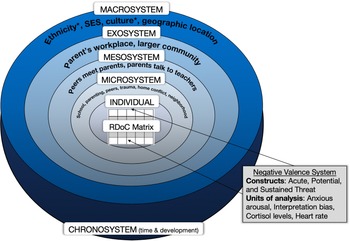
Each of these Bronfenbrennarian circles may interact with RDoC constructs across development to influence risk for youth internalizing disorders. It is undisputed (from genetic, epigenetic, developmental, and prospective longitudinal investigations supporting the diathesis–stress theory of psychopathology) that youth do not develop mental health problems in a “bubble,” but rather that at least half of the variance in predicting onset and maintenance of psychopathology occurs as a function of their context. Although not visually captured in the RDoC matrix, RDoC publications and the NIMH website clearly state that a particular unit of analysis within an RDoC construct only makes sense in relation to other constructs in the environment and across development (Woody & Gibb, Reference Woody and Gibb2015). The environment may interact with several units of analysis within a construct, such as childhood abuse interacting with both attention bias to threat and hypothalamic–pituitary–adrenal (HPA) axis dysregulation within the sustained threat domain. For integration purposes, it may be most helpful to consider the environment as another plane in the RDoC matrix (Woody & Gibb, Reference Woody and Gibb2015) that intersects with both mechanistic constructs and their units of analysis. Moreover, the study of developmental trajectories (progression of behavior and brain changes over time) within the RDoC matrix closely parallels Bronfenbrenner's chronosystem, where there may be dynamic interactions of systems over time (e.g., microsystem and exosystem interacting). Of course, consideration of development in and of itself requires consideration of the chronosystem. Ideally, truly integrative and translational research will examine multiple contextual factors and RDoC constructs across time (see Figure 2 for examples of contexts that could be considered when contemplating using the RDoC framework to understand youth internalizing disorders). It is also important to consider whether there may be sensitive periods of exposure to contextual factors that have implications for trajectories of typical and atypical development that may put children at risk for internalizing disorders (Casey et al., Reference Casey, Oliveri and Insel2014). To our knowledge, no review has explored and provided examples of how RDoC constructs intersect across one or more Bronfenbrennarian contexts to influence youth internalizing problems specifically. As such, there has also been little guidance about how best to incorporate studies of the environment and development within the traditional RDoC framework.
Example of how the RDoC framework may be examined within ecological systems theory across development to understand risk for youth internalizing disorders. While we include some examples of ecological factors that are more commonly studied in relation to the RDoC framework in the figure, we do not want to constrain the imaginations of researchers considering what ecological factors may interact with RDoC constructs. Thus, we encourage researchers to think beyond the contexts that have been most commonly studied in the literature to date or to imagine how new contexts may interact with those more commonly studied. Adapted from Santrock (Reference Santrock2014); Woody & Gibb (Reference Woody and Gibb2015). *The culture and ethnicity domains actually span across systems from the microsystem to the macrosystem (Amir & McAuliffe, Reference Amir and McAuliffe2020; Vélez-Agosto, Soto-Crespo, Vizcarrondo-Oppenheimer, Vega-Molina, & García Coll, Reference Vélez-Agosto, Soto-Crespo, Vizcarrondo-Oppenheimer, Vega-Molina and García Coll2017; Williams et al., Reference Williams, Byrd, Quintana, Anicama, Kiang, Umaña-Taylor and Tuitt2020), even though they are shown in the macrosystem in this figure.

The current review
The aim of this review is to link some of the most well-studied RDoC constructs in youth internalizing problems (i.e., anxiety, depression) to ecological systems theory. In the following sections, we first describe findings from a literature search in which ecological systems theory constructs were applied to the study of RDoC-relevant exemplar constructs in youth internalizing problems. A main goal of RDoC has been to connect RDoC constructs to internalizing problems, so our goal here is to specify areas where RDoC constructs and internalizing problems have been linked to ecological systems theory, as well as to identify areas in which the link has not been well explored in order to call for future research priorities using examples from the literature. Another goal was to investigate how researchers discussed links between RDoC constructs, internalizing problems, and ecological systems in these reviews. To accomplish these goals, we focus on three mechanisms underlying youth internalizing problems that fit squarely within the RDoC matrix and have been previously identified as mechanisms underlying the onset and maintenance of youth anxiety and depression: (a) cognitive biases, (b) biological systems (primarily HPA axis and autonomic nervous system), and (c) affect/emotion. To be clear, we view these three mechanisms as exemplar processes that have been well studied across youth anxiety, depression, and their comorbidity, and reflect what is sometimes referred to as the “triple vulnerability theory” (Barlow, Reference Barlow2002; Brown & Naragon-Gainey, Reference Brown and Naragon-Gainey2013) – a cognitive, biological, and emotional triad well studied within the internalizing cluster (e.g., Barlow, Reference Barlow2002; Garber & Weersing, Reference Garber and Weersing2010; Watson, Reference Watson2005). Thus, we focus on these three mechanisms as strong examples of how we might further link ecological systems to RDoC and acknowledge that there are other processes not discussed herein. Second, we identify areas in which links appear to be missing to date within these three constructs, with a rationale for how the intrapersonal (RDoC) and interpersonal context (ecological systems theory) might theoretically and empirically intersect and add value to our understanding of how internalizing problems arise and might be maintained over time. In each section, the intersection of the RDoC domain with ecological systems is ordered in terms of the degree to which the review papers identified in our literature search reflected that link (e.g., for cognitive biases, parenting factors are discussed first because they represent the most substantive portions of reviews and meta-analyses as compared to other environmental factors linked to cognitive biases).Footnote 1 Third and finally, we highlight strong examples of empirical studies and review papers that have linked RDoC to ecological systems (Tables 2 and 3). We provide recommendations and future directions to continue cross-disciplinary collaborations that, ultimately, may improve our understanding of internalizing problems, with implications for intervention and prevention.
Details of literature search
The search was conducted in April 2020 in PsycInfo. Search terms are included in Table 1. The search resulted in 351 articles. Two coders reviewed abstracts for all articles and included all narrative, qualitative, or quantitative reviews, meta-analyses, and commentaries that were focused (a) at least in part on children and adolescents, (b) on depression, anxiety, or internalizing disorders/symptoms, and (c) on emotion, cognition, and/or psychophysiology. Coders excluded any papers that were empirical or experimental studies, dissertations, or book reviews. Papers that only focused on adults or infants, focused on other forms of psychopathology (i.e., not depression, anxiety, or internalizing disorders), or were not in English were excluded after the initial search. Any disagreement between coders was conferenced with the coders and the first author to come to a final decision. After this initial inclusion/exclusion step, 131 articles remained to be reviewed by the authors of this paper. A total of 10 articles were reviewed by multiple authors to establish guidelines for reviewing and extracting information. After reading full texts, 32 additional articles were excluded for not fitting the inclusion/exclusion criteria. The remaining 99 articles were read by one of the co-authors and coded for whether an article had mentioned a link between RDoC constructs and ecological systems and whether they provided at least one citation to support the link. If they were coded as “yes” for both, we coded for whether an article had mentioned a link between RDoC constructs and ecological systems in the context of internalizing problems and whether they provided at least one citation to support the link. We then reviewed these articles to code for the type of RDoC construct (i.e., cognitive biases, biological systems, affect/emotion), ecological systems factor and level (e.g., micro- or macrosystem), and type of internalizing problem (e.g., depression, anxiety, or internalizing problems broadly). Weekly conferences were held with the full team to discuss questions about articles and coding. A total of 40 articles mentioned a link between RDoC constructs and ecological systems in the context of internalizing problems and provided at least one citation to support the link. These articles form the basis of the current review. We highlight some as exemplar review articles in the text below and in Table 2. We also draw exemplar empirical papers from these reviews, some of which are discussed in the text below and in Table 3.
Search terms for review

Exemplar review articles

Exemplar empirical papers
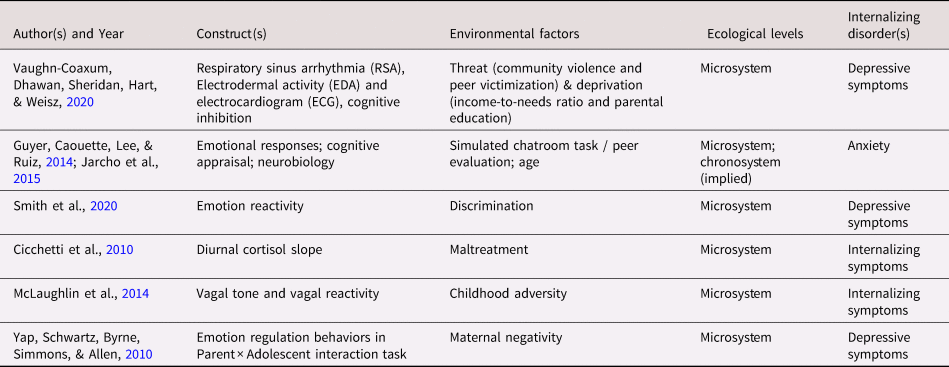
As the current paper was not a comprehensive review of all original research articles on ecological systems, RDoC, and internalizing disorders in youth, we cannot make conclusions about the frequency with which ecological systems are considered in “RDoC-ian” clinical research on internalizing problems in youth. However, this was not our goal. Instead, our goal was first to identify reviews and meta-analyses in order to identify extant findings that exemplify the type of research that informs our understanding of risk and presence of youth internalizing problems and to highlight areas for growth, and second (when relevant), returned to original empirical articles for specific methods. Third and finally, it must be noted that we focused exclusively on the pediatric period in order to constrain research to the developmental period during which the onset of internalizing symptoms and diagnoses are most likely to occur. We acknowledge that there is likely to be more work that has been done relevant to the current topic in adults that is not reviewed here. However, as discussed in each section of this review, evidence has accumulated that constructs discussed throughout this paper are particularly sensitive to both developmental transitions during the pediatric period (as compared to transitions occurring in adulthood) and in part dependent on contextual factors (e.g., reliance on and daily interaction with caregivers) in a way that adults are not. Thus, we focus exclusively on data from studies and reviews that address these processes in infancy through adolescence. As our review was not a comprehensive search of all empirical articles on this topic, we will focus our attention below on outlining findings from several exemplar papers that highlight the benefit of incorporating ecological systems into examination of RDoC units of analysis in the context of youth internalizing problems.
Cognitive Biases and Ecological Systems Theory
Cognitive processes have long been considered correlates of and mechanisms underlying internalizing problems across development (e.g., Cuthbert & Kozak, Reference Cuthbert and Kozak2013; Zahn-Waxler, Klimes-Dougan, & Slattery, Reference Zahn-Waxler, Klimes-Dougan and Slattery2000). Cognition is a core component of the three targeted mechanisms in cognitive behavioral therapy for anxiety and depression (cognition, emotions, behavior). RDoC captures a variety of cognition-relevant constructs within the negative valence, cognitive, and social process domains that are relevant for both youth anxiety and depression. Three of these in particular – information processing (attention and interpretation) biases, cognitive distortions, and memory biases – are explored in this section to illustrate how these RDoC subconstructs and their units of analysis (i.e., measurement) have been linked to internalizing problems in youth with consideration of ecological systems theory. Across the youth internalizing literature, all three of these cognitive processes share an overly threatening and/or negative focus on information.
Some limitations should be considered in interpreting the review of extant findings in this section. First, the cognitive subconstructs explored in this section reflect some (but not all) of the most commonly studied across youth anxiety and depression. This is not to suggest that other subconstructs or domains are irrelevant. Rather, other constructs that have been well validated and have accumulated evidence in children and adolescents have either demonstrated clear specificity for youth anxiety (e.g., fear conditioning in the acute threat “fear” construct, negative valence systems domain) or depression (reward responsiveness in the positive valence system). Second, constructs that have gained recent attention as correlates of, or mechanisms in, the development of internalizing problems (e.g., cognitive control) that have only begun to be studied in youth internalizing problems utilizing an RDoC-ian framework have demonstrated sufficiently mixed findings that we felt it imprudent to attempt to comment on them at the time this review is written. Third and finally, given the significant heterogeneity in samples (community, at risk, elevated symptom, diagnosed) across studies, it is difficult to discern patterns of findings for clinical as opposed to symptom-level data.
Information processing biases
Broadly, information processing biases, often referred to as cognitive biases, refer to the ways in which individuals selectively attend to, interpret, and remember information in their environment. Attention bias traditionally refers to the selective allocation of attentional resources to threatening and/or negatively valenced information.Footnote 2 Interpretation bias refers to the attribution of threatening or negative meaning to ambiguous information. Both attention and interpretation biases are considered “uncontrolled” processes, or those that occur so quickly the individual is unaware of them, and thus are best measured with performance-based behavioral/reaction time tasks (for review, see Schoth & Liossi, Reference Schoth and Liossi2017). Distorted cognition or appraisal biases can include judgments about oneself (e.g., “I'm not capable or can't handle this situation or stress”), others in their social world, threat and danger, or other aspects of the environment, and can also include perceptions of relative risk and emotional responses. These appraisal biases are considered to occur within “controlled” cognition, reflecting that the individual can learn to identify when they make biased appraisals (as with cognitive restructuring in cognitive behavioral therapy). Memory biases can involve explicit recall or recognition, or implicit completion of word fragments or decisions about stimuli, indicating that the individual preferentially remembers threat or negative, rather than neutral or positive, information. Broadly, these biases fit within the RDoC matrix's negative valence systems under acute or sustained threat, depending on the methods of measurement.
Collectively, information processing biases are proposed, and have been shown in some experimental and longitudinal studies, to exert strong downstream effects on avoidance and withdrawal (Lau & Waters, Reference Lau and Waters2017; Pérez-Edgar et al., Reference Pérez-Edgar, Reeb-Sutherland, McDermott, White, Henderson, Degnan and Fox2011), the core functional impairments in internalizing problems. Further, the presence of these biases in infancy and childhood have been suggested to predict onset of anxiety and depressive disorders later in development (e.g., Fu & Pérez-Edgar, Reference Fu and Pérez-Edgar2019). The attention (Dudeney, Sharpe, & Hunt, Reference Dudeney, Sharpe and Hunt2015; Lisk, Vaswani, Linetzky, Bar-Haim, & Lau, Reference Lisk, Vaswani, Linetzky, Bar-Haim and Lau2020; Oliver, Pile, Elm, & Lau, Reference Oliver, Pile, Elm and Lau2019) and memory (Field & Field, Reference Field and Field2013; Lau & Waters, Reference Lau and Waters2017; Mitte, Reference Mitte2008; Zahn-Waxler et al., Reference Zahn-Waxler, Klimes-Dougan and Slattery2000) bias literature shows mixed associations with youth internalizing problems, resulting in overall small effect sizes in meta-analyses. In contrast, interpretation bias and distorted appraisals are somewhat ubiquitous in their associations with internalizing symptoms and diagnoses (Muris & Field, Reference Muris and Field2008; Stuijfzand, Creswell, Field, Pearcey, & Dodd, Reference Stuijfzand, Creswell, Field, Pearcey and Dodd2018; Zahn-Waxler et al., Reference Zahn-Waxler, Klimes-Dougan and Slattery2000).
Each of these cognitive biases has also demonstrated some specificity for anxiety versus depression. For example, emotional stimuli reflecting fear (e.g., scared face) in attention bias tasks are associated with youth anxiety, while stimuli reflecting anger or sadness (e.g., sad face) are associated with youth depression (Hankin, Gibb, Abela, & Flory, Reference Hankin, Gibb, Abela and Flory2010; Oliver et al., Reference Oliver, Pile, Elm and Lau2019; Shechner et al., Reference Shechner, Jarcho, Britton, Leibenluft, Pine and Nelson2013). Similarly, some work suggests that interpretation and appraisal biases may be content-specific to symptom domain (Leung & Poon, Reference Leung and Poon2001; Schoth & Liossi, Reference Schoth and Liossi2017; Stuijfzand et al., Reference Stuijfzand, Creswell, Field, Pearcey and Dodd2018; Subar, Humphrey, & Rozenman, Reference Subar, Humphrey and Rozenmanunder review). For example, youth with social anxiety symptoms may be faster to endorse social threat as related to ambiguity (e.g., “kids are laughing at me in class because I made a mistake”), while those with depressive symptoms may attribute negative, global attributions about themselves to ambiguity (e.g., “kids are laughing at me in class because they don't like me as a person”). However, other studies suggest that both anxious and depressed youth exhibit negative appraisals, lower thresholds for threat perception, and associated negative emotion, and that the relationship may be stronger for anxiety than depression when information presented is threat-relevant (Muris & van Doorn, Reference Muris and van Doorn2003; Muris, Luermans, Merckelbach, & Mayer, Reference Muris, Luermans, Merckelbach and Mayer2000). Following a similar pattern, synthesis of the memory bias literature may suggest that depressed youth tend to ruminate and have higher recall for negative memories/events (Wilkinson & Goodyer, Reference Wilkinson and Goodyer2011), while anxious youth exhibit memory biases for threat information specifically (e.g., Daleiden, Reference Daleiden1998).
In summary, information processing biases are relevant to youth internalizing problems, with the most data supporting interpretation (uncontrolled) and appraisal (controlled) biases, and mixed data for attention and memory biases. Specificity for symptoms, with threat being more closely linked to anxiety and broadly negatively valenced emotional information for depression, seems to be a pattern in the findings. Other important considerations based on the extant literature include age/development, whether the stimuli are self-referent, and (a relatively unexplored area) the intersection or additive features of anxiety and depression symptoms or diagnostic comorbidity in youth.
Information processing biases and ecological outcomes
Prior to reviewing the literature on information processing biases measured in internalizing youth in the context of ecological outcomes, we would like to acknowledge that theoretical models suggest, and data support, the genetic and neurobiological contributions to information processing biases (e.g., Muris & Field, Reference Muris and Field2008; Rapee, Reference Rapee, Vasey and Dadds2001). However, the vast majority of extant studies do not disentangle the effects of genetic contributions and parental (i.e., behavioral and verbal parenting) influences, or clearly reflect how neurobiological systems intersect with one another and simultaneously link to ecological outcomes. Thus, we do not focus on genetics and neurobiology in this section except where we attempt to disentangle genetic and parenting factors (or comment on the inability to do so based on methodologic limitations). This caveat applies both to this and the subsequent sections on biology and affective constructs. Papers included below focused on infancy through adolescence, and both clinical and community samples. The majority of papers in the cognitive biases section focused on the microsystem level, with a heavy emphasis on parental influences and negative life events. Relatively little in review papers focused on the meso- or other systems, so we do not discuss them further in this section. Importantly, while some work linked youth cognitive biases to the chronosystem in the context of internalizing problems, the vast majority of this work was cross-sectional and most identified articles were speculative about developmental processes, which is likely to be due to the relative dearth of empirical data in this area.
Microsystem: Parental influences
Theoretical models suggest that various parent-relevant factors may influence the development of specific information processing biases, including attention, interpretation, and cognitive distortions (e.g., Hadwin, Garner, & Perez-Olivas, Reference Hadwin, Garner and Perez-Olivas2006; Muris & Field, Reference Muris and Field2008; Murray, Creswell, & Cooper, Reference Murray, Creswell and Cooper2009), although most of this work is cross-sectional (see Bögels & Brechman-Toussaint, Reference Bögels and Brechman-Toussaint2006, for review). Of note, none utilizes methodology that would disentangle genetic from environmental (parental psychopathology and subsequent modeling or parenting behavior, parental expression of bias verbally, etc.) effects (Fu & Pérez-Edgar, Reference Fu and Pérez-Edgar2019).
Cross-sectional, primarily correlational studies have found that maternal anxiety (Morales et al., Reference Morales, Brown, Taber-Thomas, LoBue, Buss and Pérez-Edgar2017; Pine, Klein, et al., Reference Pine, Klein, Mannuzza, Moulton, Lissek, Guardino and Woldehawariat2005) and depression (Dearing & Gotlib, Reference Dearing and Gotlib2009; Joormann, Gilbert, & Gotlib, Reference Joormann, Gilbert and Gotlib2010; Joormann, Talbot, & Gotlib, Reference Joormann, Talbot and Gotlib2007) are associated with their offspring's attention and interpretation biases for threat (in anxiety) and negative information (in depression). Moreover, some work suggests that maternal and child threat-related cognitions are correlated (see Muris & Field, Reference Muris and Field2008, for review), although this literature is mixed (Reference Subar and RozenmanSubar & Rozenman, in preparation). Some studies also suggest that parenting practices in early childhood may influence youth interpretation biases and threat-focused appraisals (Field & Cartwright-Hatton, Reference Field and Cartwright-Hatton2008). Behavioral coding studies have found that during Parent × Child interactions in the laboratory, mothers of clinically anxious youth are more likely to respond to child avoidance (due to the child making a threatening interpretation) of situations by reassuring their child, which may inadvertently reinforce the child's threat-focused biases and anxiety symptoms. Similarly, Parent × Child interactions in the laboratory influence youth mood and attention bias for negative emotions (Joormann et al., Reference Joormann, Talbot and Gotlib2007); over time the interplay between parent and youth mood, attention bias, and interactions may create a negative feedback loop.
As family interaction and communication are dynamic processes, the development and maintenance of some cognitive biases may therefore be a result of youth intrapersonal risk in concert with two factors. First, parental factors, including modeling avoidance or withdrawal, information transfer about bias, and parenting style and behaviors specifically related to overcontrol (McLeod, Wood, & Weisz, Reference McLeod, Wood and Weisz2007; Wood, McLeod, Sigman, Hwang, & Chu, Reference Wood, McLeod, Sigman, Hwang and Chu2003), may teach youth biases about the world around them. Second, youth and parental communication and interaction may result in a feedback loop (Hadwin et al., Reference Hadwin, Garner and Perez-Olivas2006), in which the parent may inadvertently reinforce youth biases, which in turn influences parental responsiveness to the youth's biases and avoidance or withdrawal. Thus, youth internalizing symptoms may be explicitly tied to learning from their caregivers about their home environment and the world around them, which results in cognitive biases, influences avoidance and withdrawal, and ultimately leads to anxiety and depressive symptoms (Hadwin et al., Reference Hadwin, Garner and Perez-Olivas2006).
Microsystem: Adversity
In the clinical literature, trauma, maltreatment, and negative life events are often lumped into a single grouping, and it is therefore often unclear in the literature whether trauma is defined as occurring within the family unit or in the broader community. Similarly, negative life events are often not specifically defined as occurring within the familial system (microsystem), youth's immediate environment but not related to familial behavior or influences (microsystem), or as a result of broader contextual factors (e.g., meso-, exo-, or macrosystem). Thus, we detail where available which ecological system and specific familial or broader factors may be at play as related to research findings. This body of work also does not often disentangle experiences of maltreatment in childhood from parenting style and behaviors and/or parental psychopathology, which remains an area for future research.
Attention biases for threat and broadly negative emotional facial stimuli have been associated with childhood neglect (e.g., Doretto & Scivoletto, Reference Doretto and Scivoletto2018; Pollak, Cicchetti, Hornung, & Reed, Reference Pollak, Cicchetti, Hornung and Reed2000), physical abuse and anxiety symptoms (Briggs-Gowan et al., Reference Briggs-Gowan, Pollak, Grasso, Voss, Mian, Zobel and Pine2015; Pine, Mogg, et al., Reference Pine, Mogg, Bradley, Montgomery, Monk, McClure and Kaufman2005; Pollak & Tolley-Schell, Reference Pollak and Tolley-Schell2003), and depressive symptoms (Kujawa et al., Reference Kujawa, Torpey, Kim, Hajcak, Rose, Gotlib and Klein2011), including longitudinally (MacLeod & Hagan, Reference MacLeod and Hagan1992; McCrory, Gerin, & Viding, Reference McCrory, Gerin and Viding2017). Attention bias also seems to be related to negative (but not abusive) parenting (Gulley, Oppenheimer, & Hankin, Reference Gulley, Oppenheimer and Hankin2014). The interaction of stress and genetics also seems to interact to predict attention bias to negative emotions (Jenness, Hankin, Young, & Smolen, Reference Jenness, Hankin, Young and Smolen2016). Authors generally interpret findings to suggest that maltreatment experiences may lead to the development of hypervigilance toward threat, which in turn may increase internalizing symptoms. Similarly, neglected children who exhibit a memory bias for negative information about their mother also self-report more depressive symptoms (Maguire et al., Reference Maguire, Williams, Naughton, Cowley, Tempest, Mann and Kemp2015; Valentino, Cicchetti, Rogosch, & Toth, Reference Valentino, Cicchetti, Rogosch and Toth2008). Adverse childhood experiences (defined broadly) have also been found to interact with negative attributional style to predict depression, including in longitudinal studies (Joiner & Wagner, Reference Joiner and Wagner1995). However, findings are mixed across these studies, and the majority of this work is cross-sectional in nature. Nonetheless, these findings collectively suggest that experience of trauma and negative life events are associated with the presence of cognitive biases and should be studied in the context of youth internalizing problems.
Microsystem: Peer relationships
The impact of cognitive biases on peer relationships has been found as early as infancy. For example, attention bias at 9 months predicted future behavioral inhibition at age 7 years (Pérez-Edgar, McDermott, et al., Reference Pérez-Edgar, McDermott, Korelitz, Degnan, Curby, Pine and Fox2010), and attention bias during preschool has been associated with behavioral inhibition (a component of temperament and robust predictor of anxiety), preschool social withdrawal (Pérez-Edgar et al., Reference Pérez-Edgar, Reeb-Sutherland, McDermott, White, Henderson, Degnan and Fox2011), and adolescent social withdrawal (Pérez-Edgar, Bar-Haim, et al., Reference Pérez-Edgar, Bar-Haim, McDermott, Chronis-Tuscano, Pine and Fox2010), which are correlates of internalizing symptoms in youth. In regard to interpretation biases and cognitive distortions, a negative attributional style in combination with peer rejection (measured by nominations) predicted depression months later (Panak & Garber, Reference Panak and Garber1992).
Researchers have begun to develop ecologically valid social interaction tasks in order to attempt approximating youth social milieu and social experiences in the laboratory. Findings from cross-sectional experimental laboratory studies are conflicted in whether computerized tasks involving chat rooms, Cyberball, or other simulated peer rejection experiences predict depressive symptoms (Platt, Kadosh, & Lau, Reference Platt, Kadosh and Lau2013). In contrast, tasks in which adolescents expect a virtual peer to chat with them in a chatroom were associated with social anxiety and activation in relevant neural regions (e.g., amygdala, ventrolateral prefrontal cortex; Guyer et al., Reference Guyer, Lau, McClure-Tone, Parrish, Shiffrin, Reynolds and Fox2008; Spielberg et al., Reference Spielberg, Jarcho, Dahl, Pine, Ernst and Nelson2015). Guyer and colleagues (Reference Guyer, Caouette, Lee and Ruiz2014) developed a task in which adolescents rate a series of photographs of other adolescents based on who they would like to interact with in a chatroom, and then at a later laboratory visit were presented with fictitious feedback about whether those peers were interested in interacting with the adolescent or not. Importantly, adolescents with a history of behavioral inhibition (again, a correlate of anxiety symptoms) demonstrated neural hyperactivation in brain regions implicated in anxiety when they were anticipating, but not actually receiving, feedback (Guyer, Benson, et al., Reference Guyer, Benson, Choate, Bar-Haim, Perez-Edgar, Jarcho and Nelson2014). While these task-based studies did not measure cognitive biases, we hypothesize that measurement of cognitive biases (particularly selective attention to emotional information, threatening and negative interpretations, and cognitive distortions) may play a critical role in youth behavior during these socially focused tasks. As with familial interactions, peer interactions are reciprocal. Both the impact of an internalizing youth's cognitive biases on their social world, and the social world's impact on their biases and symptoms, should be considered (e.g., Capaldi & Stoolmiller, Reference Capaldi and Stoolmiller1999).
Microsystem: Academic achievement
Anxiety and depression negatively impact academic and occupational attainment for young people (e.g., Kessler, Foster, Saunders, & Stang, Reference Kessler, Foster, Saunders and Stang1995). Given that cognitive biases influence avoidance and withdrawal behavior (and subsequently internalizing symptoms), they may also negatively impact academic functioning via stress during academic work, perceptions and beliefs about the self, and avoidance and withdrawal specifically in the academic domain (e.g., Romano, Babchishin, Marquis, & Fréchette, Reference Romano, Babchishin, Marquis and Fréchette2015). For example, receiving a poor grade on a report card interacted with cognitive distortions and other self-perceptions (e.g., perceived academic competence, perceptions of control) to predict subsequent depressive symptoms (Hilsman & Garber, Reference Hilsman and Garber1995; Metalsky, Halberstadt, & Abramson, Reference Metalsky, Halberstadt and Abramson1987). However, this area of research is sparse, primarily utilizes laboratory tasks, and focuses on working memory rather than cognitive biases, both of which may play equally important roles. It also goes unsaid that peer relationships as they occur in the school setting may influence and be influenced by academic performance. Thus, a major gap in identified reviews is how information processing biases as they occur in real time may interact with internalizing symptoms in the school setting and across development.
Chronosystem: Chronological, cognitive, and pubertal development
Adolescence is a sensitive developmental period when risk is influenced by both maturational and external factors (e.g., Henderson, Pine, & Fox, Reference Henderson, Pine and Fox2015). However, as described in this section, cognitive biases may appear and be influenced from infancy onward (Fu & Pérez-Edgar, Reference Fu and Pérez-Edgar2019), and particularly come online during neurocognitive and/or chronological maturation throughout childhood (Hankin et al., Reference Hankin, Snyder, Gulley, Schweizer, Bijttebier, Nelis and Vasey2016). Again, the majority of studies identified in the reviews linking cognitive biases to development are cross-sectional. Such studies suggest that cognitive biases may be excessive in internalizing youth (as compared to unaffected counterparts), but the content of the biases are often consistent with normative developmental worries (e.g., threat-focused biases about separation from caregiver in early childhood; interpretation biases about peer relationships, rejection, and exclusion in adolescence; Hankin et al., Reference Hankin, Snyder, Gulley, Schweizer, Bijttebier, Nelis and Vasey2016). Others have found that some information processing biases, such as performance-based interpretation bias, may be difficult to measure in younger children because of task demands (e.g., needing to read stimuli quickly on the screen), and therefore, it is unclear whether these processes develop later or whether our assessment tools are insufficient for measuring them (e.g., Rozenman, Amir, & Weersing, Reference Rozenman, Amir and Weersing2014). Neuroimaging data provide important contributions about the developmental course of changes in brain networks, particularly in areas relevant to fear, learning, reward sensitivity, and prefrontal areas important for social–affective brain development, all of which may be relevant for studying cognitive biases (Haller, Kadosh, Scerif, & Lau, Reference Haller, Kadosh, Scerif and Lau2015). Finally, longitudinal research suggests that cognitive biases interact with stress over the course of development to predict future internalizing symptoms, although this may have some content-specificity whereby stress interacts with self-referent cognitive distortions to predict depressive symptoms specifically, it interacts with rumination to predict both depression and anxiety symptoms (Hankin et al., Reference Hankin, Snyder, Gulley, Schweizer, Bijttebier, Nelis and Vasey2016). The relative dearth of information in this area as identified by review papers as compared to other ecological systems such as parenting (microsystem) prohibit us from currently drawing conclusions about how chronological, cognitive, and pubertal development exert transactional forces in concert with the youth's experiences to lead to internalizing symptoms. However, these extant data are clear in their linking each of these domains to cognitive bias, and to youth internalizing symptoms, warranting further study.
Biological Systems and Ecological Systems Theory
Individual vulnerability or sensitivity to stress has been identified as a factor underlying many youth internalizing problems (Garber & Weersing, Reference Garber and Weersing2010). Some of the core units of analysis explored in internalizing problems in youth and in the context of the RDoC framework have been neural systems and genetics. Biological systems have been well explored in the developmental psychology literature (particularly in studies exploring ecological systems); therefore, our review of the biological systems literature primarily focused on articles that examined biological systems with measurement of the autonomic nervous system (ANS) and the HPA axis. However, we do discuss some papers that integrated neural/genetic units of analysis in addition to the ANS and HPA system in the context of ecological systems. The ANS and HPA system work together and with other biological systems to coordinate biology and behavior at baseline, in response to stress, and during recovery from stress (for a review of these systems, see Gunnar, Doom, & Esposito, Reference Gunnar, Doom, Esposito, Lamb and Lerner2015; Koss & Gunnar, Reference Koss and Gunnar2018; Kreibig, Reference Kreibig2010). In the current review, the most common ANS measurements identified included vagal tone and vagal reactivity. The most common HPA measures were levels of cortisol (the end product of the HPA axis), cortisol reactivity to stress, and diurnal cortisol slope across the day.
Within the RDoC framework, the ANS and HPA system can be subdivided into smaller units of analysis (e.g., heart rate, skin conductance, average cortisol levels, dysregulated HPA axis) and are primarily part of the negative valence (fear, anxiety) and positive valence (reward learning) systems, depending on the tasks or other measurement used. Within the negative valence system, the HPA axis and ANS are often measured during tasks assessing acute threat (fear), potential threat (anxiety), and sustained threat. At the physiology level, units of analysis such as blood pressure, heart rate, skin conductance, and respiration are within the acute threat subconstruct. Adrenocorticotropic hormone levels and average cortisol levels are in the potential threat construct. A dysregulated HPA axis is in the sustained threat construct. Overall, review papers with RDoC biological constructs and ecological systems interactions tended to focus on youth depression more than youth anxiety. However, this may be because the reviews identified in our literature search of youth anxiety mechanisms tended to focus on neural, genetic, cognitive, and behavioral units of analysis. The papers included herein reviewed both children and adolescents and included both clinical and community samples.
Biological systems
As noted in the cognitive bias section above, a large body of research incorporating ecological constructs into laboratory studies has used stress tasks that are intended to approximate stressful situations in real life. The most commonly used stress task for youth, the Trier social stress test for children (TSST-C; Buske-Kirschbaum et al., Reference Buske-Kirschbaum, Jobst, Wustmans, Kirschbaum, Rauh and Hellhammer1997), involves social evaluation components, including a standardized speech and math task in front of judges. There is evidence that stress responses to the TSST parallel those for real-life oral exams (Henze et al., Reference Henze, Zänkert, Urschler, Hiltl, Kudielka, Pruessner and Wüst2017), suggesting some ecological validity for the task. There may be variations on the TSST such as the group TSST (Von Dawans, Kirschbaum, & Heinrichs, Reference Von Dawans, Kirschbaum and Heinrichs2011), where participants are socially evaluated by peers rather than judges, which could make the task more ecologically valid. Tasks that use mild pain like the cold pressor task can sometimes include an audience for a social challenge (von Baeyer, Piira, Chambers, Trapanotto, & Zeltzer, Reference von Baeyer, Piira, Chambers, Trapanotto and Zeltzer2005), although it is unlikely to parallel many types of challenges that youth would typically face. Other examples of more ecologically valid stress tasks include conflict–discussion tasks between parents and children or simulated conflict between parents, although these tasks variably activate stress–response systems (Gunnar, Talge, & Herrera, Reference Gunnar, Talge and Herrera2009). It could be that these conflicts do not reliably activate stress responses in real life or that these tasks do not sufficiently resemble real relational conflicts to provoke stress responses.
It is challenging to create stress tasks that are subjectively stressful and activate biological systems in the same way at different points in childhood and adolescence (reviewed in Gunnar et al., Reference Gunnar, Talge and Herrera2009). For example, the TSST-C is a potent activator of the ANS and HPA systems in late childhood and adolescence, but has previously been found to have limited utility in early childhood (Gunnar et al., Reference Gunnar, Talge and Herrera2009). Although each of these stressor tasks has elements of challenges children may experience in their daily lives (e.g., social evaluation, pain, parental conflict), none is able to represent perfectly a challenge experienced in children's environments as they may occur in a laboratory or have novel elements (e.g., panel of judges in white coats). There is ultimately a balance between experimental control and ecological validity. There are also ethical limitations that appropriately prohibit the use of stressors in research that would be psychologically or physically harmful to youth, although these stressors are unfortunately experienced by many children chronically.
Outside the lab, researchers have relied upon home collection of biological samples in youth or ecological momentary assessment techniques that can include daily diary data entailing the events of the day or even the minutes before the biological sample was taken. Although there are greater methodologic challenges with participant adherence to study protocols when not in the lab, the added benefit of being able to learn about biological responses to challenges in youth's ecosystems and understanding what factors may moderate responses is invaluable.
Biological systems and ecological outcomes
In the current review of reviews, interactions between biological RDoC domains and ecological systems primarily occurred at the microsystem level. Across identified studies, adversity was the most frequent environmental factor mentioned interacting with biological units of analysis, although a number of papers also focused on aspects of parenting or attachment. At the microsystem level, there were also interactions between biological units of analysis and peers and peer rejection, siblings, and achievement-related stress. After the microsystem level, the most common interaction studied was at the chronosystem level, which included developmental changes in RDoC constructs or questions about timing of exposure to environmental factors. Few papers we reviewed included interactions with the macrosystem, including factors such as electronic media, socioeconomic status (SES), and culture (Bush et al., Reference Bush, Wakschlag, LeWinn, Hertz-Picciotto, Nozadi, Pieper and Deardorff2020; Méndez Leal & Silvers, Reference Méndez Leal and Silvers2020; Neophytou, Manwell, & Eikelboom, Reference Neophytou, Manwell and Eikelboom2019; Piccinelli & Wilkinson, Reference Piccinelli and Wilkinson2000). No other ecological systems were identified in our review of reviews linking ecological systems, biological units of analysis, and youth internalizing problems. Across ecological outcomes, the link between ANS and HPA axis to the environment was consistent. This is not surprising given that biological systems adeptly respond to both real and interpreted threats in order to mobilize energy to initiate fight-or-flight responses (Sapolsky, Romero, & Munck, Reference Sapolsky, Romero and Munck2000). In addition, allostatic load (a composite measure of many biological markers, some of which are included in the RDoC matrix [cortisol, sympathetic activation, blood pressure]) is more likely to be increased in the context of environmental stress, which may lead to internalizing symptoms and diagnoses in youth.
Microsystem: Trauma, maltreatment, and negative life events
The most common microsystem-level factors we identified in relation to biological processes in youth internalizing problems in our review of reviews were trauma and adversity. Specifically, the empirical data support the strong link between experience of maltreatment and negative life events and biological processes in the context of youth internalizing problems. For example, early life adversity and trauma influence risk for depression (Riso, Miyatake, & Thase, Reference Riso, Miyatake and Thase2002) and anxious avoidant behavior (Cicchetti & Rogosch, Reference Cicchetti and Rogosch2001; Tarullo & Gunnar, Reference Tarullo and Gunnar2006) through several potential mechanisms, including altered biological responses to stress and in regulation of biological systems across the day. However, it has been proposed that for youth experiencing life-threatening adversity, changes to physiological arousal may be protective and allow these youth to respond more quickly in the context of danger (e.g., Obradović, Reference Obradović2012). Below we describe several components of biological systems that have each been identified to intersect with environmental stress (e.g., Wilkinson & Goodyer, Reference Wilkinson and Goodyer2011).
With chronic exposure to adversity, incorrectly calibrated responses to environmental demands that comprise allostatic load may be detrimental to brain development and mental health (Wilkinson & Goodyer, Reference Wilkinson and Goodyer2011). For example, heightened stress reactivity stemming from early life adversity precedes abnormal immune responses to stress, and these processes could precede the onset of internalizing problems (Riso et al., Reference Riso, Miyatake and Thase2002). Experiencing too much adversity over time, particularly with few supports, predicts an increase in allostatic load, which occurs when there is greater wear and tear on the body that can lead to both mental and physical health problems at multiple points across development (Lupien, McEwen, Gunnar, & Heim, Reference Lupien, McEwen, Gunnar and Heim2009), and predict future anxiety and depression symptoms in youth (Badanes, Watamura, & Hankin, Reference Badanes, Watamura and Hankin2011).
For the ANS, higher vagal tone and greater vagal reactivity are typically associated with lower levels of internalizing symptoms (Graziano & Derefinko, Reference Graziano and Derefinko2013; McLaughlin, Alves, & Sheridan, Reference McLaughlin, Alves and Sheridan2014). Interestingly, it is important to note that both too high and too low levels of cortisol and cortisol reactivity have been associated with youth internalizing problems (Gunnar & Vazquez, Reference Gunnar and Vazquez2001; Koss & Gunnar, Reference Koss and Gunnar2018). As a result, it is thought that levels of cortisol that are neither too high nor too low, and an appropriate level of cortisol reactivity to respond to a stressor and recover from a stressor quickly, are the most adaptive HPA profiles. However, it is unclear what level is an appropriate amount, and the amount is likely to vary between individuals. Some factors that could influence whether a child shows high or low cortisol levels in response to trauma include the type, timing, and chronicity of trauma, among many other intra- and interpersonal factors (Carlson & Earls, Reference Carlson and Earls1997; Goenjian et al., Reference Goenjian, Yehuda, Pynoos, Steinberg, Tashjian, Yang and Fairbanks1996; Gunnar & Cheatham, Reference Gunnar and Cheatham2003; Gunnar & Donzella, Reference Gunnar and Donzella2002; Lupien, King, Meaney, & McEwen, Reference Lupien, King, Meaney and McEwen2000). There is evidence of an important developmental shift where cortisol levels are higher soon after adversities such as abuse but are lower a year later, which provides evidence of down-regulation of glucocorticoid receptors following trauma (De Bellis, Reference De Bellis2002).
Differences in HPA regulation among children who have experienced maltreatment are due at least in part to timing of maltreatment, parenting, ongoing adversity, type of adversity, and type of psychopathology experienced (Van Voorhees & Scarpa, Reference Van Voorhees and Scarpa2004). As a result, fully considering environmental factors is crucial to understanding HPA regulation. Abuse in childhood may lead to HPA hypersensitivity, which can leave individuals more vulnerable to future adversity. Longitudinal work also provides support that childhood maltreatment prior to adoption is associated with higher levels of both anxiety and cortisol secretion in adulthood (van der Vegt, Van Der Ende, Kirschbaum, Verhulst, & Tiemeier, Reference van der Vegt, Van Der Ende, Kirschbaum, Verhulst and Tiemeier2009). Understanding regulation of stress–response systems and behavior across development (chronosystem) will help us to understand how physiological alterations may lead to internalizing problems.
Although most studies do not integrate stress, HPA function, and internalizing symptomatology, there are some notable exceptions (Wilkinson & Goodyer, Reference Wilkinson and Goodyer2011). Cicchetti and Rogosch found that children who have experienced maltreatment and have high levels of internalizing problems show higher morning and afternoon cortisol than maltreated and low internalizing, nonmaltreated and high internalizing, and nonmaltreated and low internalizing groups (Cicchetti & Rogosch, Reference Cicchetti and Rogosch2001). Children who experience physical and/or sexual abuse during the preschool period and high internalizing problems showed a flattened diurnal cortisol slope across the day (Cicchetti, Rogosch, Gunnar, & Toth, Reference Cicchetti, Rogosch, Gunnar and Toth2010). Another study found that children who were both depressed and maltreated showed lower morning cortisol levels, consistent with a flattening of the diurnal cortisol curve (Kaufman, Reference Kaufman1991). Importantly, very few studies longitudinally follow children who have experienced early adversity with multiple HPA axis measurements over time to understand which physiological profiles precede internalizing problems. Another important goal of work in this area will be to define subtypes of internalizing problems in youth that may be characterized by HPA or autonomic dysregulation as well as environmental contributors, which can be better treated through more individualized interventions. For example, individuals who experienced abuse may need psychotherapy to effectively manage depression rather than use antidepressants alone (Nemeroff et al., Reference Nemeroff, Heim, Thase, Klein, Rush, Schatzberg and Dunner2003). There may be interactions between adversity and ANS and HPA regulation in the development and maintenance of internalizing problems, which will be important to explore further.
Although many reviews focused on HPA axis functioning and trauma, associations between ANS functioning and trauma have also been reported in relation to internalizing symptoms (Hamilton & Alloy, Reference Hamilton and Alloy2016). Childhood adversity predicts greater internalizing symptoms among adolescents with low vagal reactivity and low vagal tone, but this association is not observed for adolescents with high vagal reactivity and high vagal tone (McLaughlin et al., Reference McLaughlin, Alves and Sheridan2014). As trauma impacts neural systems implicated in vagal reactivity and regulation (Tottenham & Sheridan, Reference Tottenham and Sheridan2010), it is important to consider how trauma may be affecting RDoC constructs with implications for internalizing pathology. Other environmental factors associated with blunted vagal reactivity include low SES and maternal depression (Hamilton & Alloy, Reference Hamilton and Alloy2016). Blunted vagal reactivity could be one mechanism by which environmental factors in childhood increase risk for internalizing pathology.
Microsystem: Family, parent, and peer relationships
One of the most frequently identified microsystem-level constructs in our review of reviews was that of parental influences, including both positive and negative aspects of parenting. Infant and youth relationships with the attachment figure have been associated with HPA axis functioning following maltreatment (Van Voorhees & Scarpa, Reference Van Voorhees and Scarpa2004) and in response to acute stress (Gunnar, Reference Gunnar and Nelson2000; Nachmias, Gunnar, Mangelsdorf, Parritz, & Buss, Reference Nachmias, Gunnar, Mangelsdorf, Parritz and Buss1996), which may influence onset of internalizing symptoms (Gunnar, Reference Gunnar and Nelson2000). Relatedly, parental psychopathology may influence a range of infant and youth outcomes, including physical growth, cognitive and emotional development, and alterations in physiological reactivity (Bush et al., Reference Bush, Wakschlag, LeWinn, Hertz-Picciotto, Nozadi, Pieper and Deardorff2020; Field, Diego, & Hernandez-Reif, Reference Field, Diego and Hernandez-Reif2006), immune system (Meyer, Yee, & Feldon, Reference Meyer, Yee and Feldon2007; O'Donnell, O'Connor, & Glover, Reference O'Donnell, O'Connor and Glover2009), and brain function (Field et al., Reference Field, Diego and Hernandez-Reif2006; Field, Fox, Pickens, & Nawrocki, Reference Field, Fox, Pickens and Nawrocki1995; Lin et al., Reference Lin, Xu, Huang, Jia, Zhang, Yan and Zhang2017; Pine, Reference Pine2007; Posner et al., Reference Posner, Cha, Roy, Peterson, Bansal, Gustafsson and Monk2016; Rifkin-Graboi et al., Reference Rifkin-Graboi, Bai, Chen, Hameed, Sim, Tint and Fortier2013), which may subsequently increase internalizing risk as the child ages. These data also extend to the prenatal period – when the mother is distressed, the placenta releases corticotropin-releasing hormone, which may exacerbate effects of stress for the mother (King, Smith, & Nicholson, Reference King, Smith and Nicholson2001; Weinstock, Reference Weinstock2001) and the fetus to affect fetal development (Girard & Sebire, Reference Girard and Sebire2016). Specific parenting behaviors and marital conflict may also result in stress during Parent × Youth interactions when either youth or parent has internalizing symptoms or diagnoses (e.g., Crowell et al., Reference Crowell, Baucom, Yaptangco, Bride, Hsiao, McCauley and Beauchaine2014; El-Sheikh, Keiley, Erath, & Dyer, Reference El-Sheikh, Keiley, Erath and Dyer2013; Gonzalez & Weersing, Reference Gonzalez and Weersing2014). As with the cognitive bias literature, an important note is that, for infants and youth, studies often do not disentangle the effects of genetics versus the environment (i.e., specific parenting behaviors). In contrast, high-quality caregiving may buffer biological stress responses and scaffold neurobiological development (Callaghan & Tottenham, Reference Callaghan and Tottenham2016; Gee, Reference Gee, Rutherford and Mayes2016; Hostinar, Johnson, & Gunnar, Reference Hostinar, Johnson and Gunnar2015) and has even been demonstrated to be a protective factor in ameliorating the effects of adversity on youth internalizing problems (Méndez Leal & Silvers, Reference Méndez Leal and Silvers2020).
Finally, growing work in the area of peer relationships and social support indicates that peers can influence adolescent biological stress responses (Calhoun et al., Reference Calhoun, Helms, Heilbron, Rudolph, Hastings and Prinstein2014; Doom, Doyle, & Gunnar, Reference Doom, Doyle and Gunnar2017), but provides little evidence to date that peers modulate resilience to early adversity during adolescence (Fritz, Fried, Goodyer, Wilkinson, & van Harmelen, Reference Fritz, Fried, Goodyer, Wilkinson and van Harmelen2018). Adolescence is a time of independence, during which parents become less effective buffers of stress (Doom, Hostinar, VanZomeren-Dohm, & Gunnar, Reference Doom, Hostinar, VanZomeren-Dohm and Gunnar2015; Hostinar et al., Reference Hostinar, Johnson and Gunnar2015; Méndez Leal & Silvers, Reference Méndez Leal and Silvers2020). This increasing role that peers play in social networks may actually increase rather than reduce HPA axis reactivity to stressors during adolescence (Calhoun et al., Reference Calhoun, Helms, Heilbron, Rudolph, Hastings and Prinstein2014; Doom et al., Reference Doom, Doyle and Gunnar2017). Adolescents exposed to early adversity may have unique social challenges that prevent peers from being effective (McCrory, Ogle, Gerin, & Viding, Reference McCrory, Ogle, Gerin and Viding2019); this, in turn, may affect how peers respond to them, further impacting internalizing symptoms. Although these interactions between the microsystem, chronosystem (pubertal development during adolescence), and biological responses to stress are compelling, it is unknown whether social buffering efficacy is linked to internalizing problems. Guyer and colleagues encourage future research considering hormonal and behavioral changes that have implications for internalizing psychopathology in adolescence in a context-specific manner (Guyer, Silk, & Nelson, Reference Guyer, Silk and Nelson2016).
Chronosystem
Understanding the regulation of stress–response systems and behavior across development (chronosystem) is critical in order to better identify when, how, and which physiological alterations may precede and predict onset of youth anxiety and depression, particularly given that anxiety disorder onset precedes and predicts depression onset in the majority of pediatric cases (Garber & Weersing, Reference Garber and Weersing2010).
Integrating the environment, biology, and development, recent findings suggest that there may be an acceleration of pubertal onset, especially in girls, following adversity (Méndez Leal & Silvers, Reference Méndez Leal and Silvers2020; Noll et al., Reference Noll, Trickett, Long, Negriff, Susman, Shalev and Putnam2017). Early puberty is a risk factor for internalizing symptoms in girls, but recent research has examined puberty as a potential window of opportunity for recalibrating the environment (Dorn, Hostinar, Susman, & Pervanidou, Reference Dorn, Hostinar, Susman and Pervanidou2019; Gunnar, DePasquale, Reid, & Donzella, Reference Gunnar, DePasquale, Reid and Donzella2019). For example, adolescents who experienced institutional care early in life began to show cortisol reactivity more comparable adolescents who have never been institutionalized (Gunnar et al., Reference Gunnar, DePasquale, Reid and Donzella2019). As a result, HPA axis reactivity appears to adapt to the current environment during puberty following early adversity, although this reset may be associated with greater internalizing problems for youth who experienced adversity (Perry, DePasquale, Donzella, & Gunnar, Reference Perry, DePasquale, Donzella and Gunnar2020). Overall, few studies longitudinally follow children who have experienced early adversity with multiple HPA axis measurements over time to understand which physiological profiles precede internalizing problems. There may be interactions between adversity and HPA regulation in the development and maintenance of anxiety and depression, which will be important to explore further.
A critical consideration is that adolescence may serve as a particularly sensitive developmental window (i.e., Bronfenbrenner's chronosystem) in relation to both context and psychopathology (particularly depression, as the average age of first depressive episode is between the ages of 13 and 17 years; Méndez Leal & Silvers, Reference Méndez Leal and Silvers2020). Adolescents show heightened sensitivity to the social environment (Blakemore & Mills, Reference Blakemore and Mills2014), which provides a promising developmental period to cultivate factors that promote resilience within adolescents’ unique social context. Although there is mixed evidence regarding whether sensitive periods for the effects of adversity exist (with the exception of caregiver deprivation), adversity may shift the timing of neurobiological sensitive periods (Gabard-Durnam & McLaughlin, Reference Gabard-Durnam and McLaughlin2019). As a result, researchers linking adversity and other ecological influences to RDoC domains should consider potential shifts in sensitive periods.
Finally, biological (specifically hormonal) changes relevant to sleep (an RDoC element within the arousal and regulatory systems domain, and not discussed in this paper), may serve as a potential mediator between the environment and internalizing problems (Blake, Trinder, & Allen, Reference Blake, Trinder and Allen2018). Developmental changes in melatonin production delays sleep/wake cycles in adolescents compared to children. In addition, bedtime hormone levels are different for children with anxiety and adolescents with depression compared to each other (Forbes et al., Reference Forbes, Williamson, Ryan, Birmaher, Axelson and Dahl2006), but also compared to youth with no history of psychopathology, suggesting influences of the chronosystem on sleep and internalizing risk.
Macrosystem
At least in the current review of reviews, the intersection between the RDoC biological domains/subdomains and macrosystem factors was rarely discussed or empirically explored in the context of youth internalizing problems. The most commonly cited macrosystem factors were SES and SES-related factors, such as chemical exposures, that are more common for youth living in low-SES neighborhoods. Low SES has been associated with disruptions in neurodevelopment and greater youth internalizing problems (Bush et al., Reference Bush, Wakschlag, LeWinn, Hertz-Picciotto, Nozadi, Pieper and Deardorff2020). Chemical exposures, such as proximity to hazardous waste sites and high levels of pollution, may mediate or exacerbate some of the effects of low SES on child neurodevelopment. Additional risk factors such as poor early nutrition, which is more common in low-SES families, may also exacerbate some of these effects (Bush et al., Reference Bush, Wakschlag, LeWinn, Hertz-Picciotto, Nozadi, Pieper and Deardorff2020). Low SES may also affect biological systems through changes in social factors, including a lack of social support, the challenges of single parenting, or low perceived social status, which are all associated with internalizing problems (Piccinelli & Wilkinson, Reference Piccinelli and Wilkinson2000). As a result, low SES may be a macrosystem factor that affects risk for internalizing problems through a number of pathways.
Although culture is not often considered in the context of RDoC and youth internalizing problems, Bush et al. (Reference Bush, Wakschlag, LeWinn, Hertz-Picciotto, Nozadi, Pieper and Deardorff2020) note that certain socioeconomic factors may differ in their associations with child neurodevelopment by culture. For example, having a high number of people living in one household may be considered overcrowding in cultures characterized by individualism with a high need for privacy, while the same situation may be normative in cultures with more collective child-rearing and less need for privacy. Considering and incorporating cultural norms and values into future research is needed.
The current context as well as local, community, and societal factors should be considered when understanding adaptations to early adversity that may confer risk or resilience (Méndez Leal & Silvers, Reference Méndez Leal and Silvers2020). For example, neurobehavioral adaptations to adversity within a child may reduce the impact of adversity on neural circuitry, although these adaptations could lead to better or worse functioning depending on the fit to the current context. In addition, family-centered interventions that support positive parenting and pride in racial identity, such as the strong African American families intervention, improve neurodevelopmental, immune, endocrine, and epigenetic outcomes and reduce depressive symptoms (Brody et al., Reference Brody, Chen, Kogan, Yu, Molgaard, DiClemente and Wingood2012, Reference Brody, Gray, Yu, Barton, Beach, Galván and Miller2017; Brody, Yu, Chen, Beach, & Miller, Reference Brody, Yu, Chen, Beach and Miller2016). Implementing and testing effective family-based interventions is an excellent strategy for testing hypotheses about how ecological systems affect biological mediators of internalizing problems in youth, and directly target resilience in families and communities.
Finally, while rarely studied in the context of RDoC biological factors, particularly in the current review, technology and social media may interact with RDoC factors to influence risk for internalizing problems in youth. For example, exposure to digital media, particularly at nighttime, may interfere with sleep quantity and quality, which could have negative implications for depressive symptoms (Neophytou et al., Reference Neophytou, Manwell and Eikelboom2019). More empirical research should focus on the macrosystem level of ecological systems theory when considering how RDoC biological factors are associated with youth internalizing problems.
Affective Processes and Ecological Systems Theory
Affective processes are subjective internal experiences that can be both positive and negative, including emotions, moods, and feelings. These can be related to external stimuli as well as other internal processes (e.g., cognitions). Affective processes are not currently an RDoC domain in their own right; however, these processes cut across the existing six domains. As such, we view affective processes as integral to understanding each of the other domains. For example, some research has found that cognitive biases worsen or become more apparent in internalizing individuals during the experience of stress or when negative mood states are elicited (Hilt, Leitzke, & Pollak, Reference Hilt, Leitzke and Pollak2014). In light of their importance, some researchers have advocated for including emotion regulation as a new RDoC domain to capture functional relationships between RDoC domains that give rise to unique, affective regulatory processes (e.g., Fernandez, Jazaieri, & Gross, Reference Fernandez, Jazaieri and Gross2016).
While affective processes span a range of RDoC domains, the bulk of research examining the effects of environment and affective processes on youth internalizing problems includes the negative valence system (e.g., reactions to negative stimuli and situations, with subconstructs of acute, potential, and sustained threat, loss, and frustrative nonreward). Some of the terms found in our review of reviews used to describe this work include: emotion dysregulation, emotion regulation, coping, irritability, negative mood, and sustained threat. This section thus primarily focuses on these affective constructs that were directly linked to internalizing psychopathology in youth and to ecological systems. Consistent with the broader literature, reviews mentioned here often examine emotion regulation processes that cut across RDoC constructs; where possible, we attended to the specific RDoC construct referred to when using the term emotion regulation.
Emotion regulation/dysregulation is an umbrella term referring to a range of emotion regulation failures and emotion mis-regulation; these can include irregularities in the intensity, duration, frequency, and type of emotional experience (Gross & Jazaieri, Reference Gross and Jazaieri2014). In the context of developmental psychopathology, RDoC subconstructs within the negative valence system domain are often called emotion dysregulation (e.g., Eisenberg, Spinrad, & Eggum, Reference Eisenberg, Spinrad and Eggum2010). These affective responses can include irregularities in the intensity, duration, frequency, and type of emotional experience (Gross & Jazaieri, Reference Gross and Jazaieri2014). In contrast, successful emotion regulation occurs through effective coping strategies that help one to regulate their own emotional experience, which tends to require accurate awareness of one's emotional state. Both emotion dysregulation and emotion regulation, via emotional awareness and coping styles, are discussed within the reviewed literature. These constructs are primarily assessed via child/adolescent self-report measures or parent reports of their child or adolescent's emotion regulation/dysregulation and/or coping styles. They are also infrequently assessed via experimental studies assessing changes in emotion before and after a stressor, and via experimental studies in which the effectiveness of emotion regulation strategies is gauged.
Irritability and negative mood are considered reactive and/or chronic negative emotional states, which are frequently studied within the internalizing literature as irritability and/or dysphoria (a term most commonly used in the depression literature). These can be considered part of the RDoC sustained threat subconstruct, although may also appear in other constructs (e.g., some laboratory tasks assess the influence of positive and negative social interactions on mood and might fit within the social processes construct in the RDoC matrix). Negative mood, irritability, and dysphoria are primarily assessed using self-reported and parent-reported standardized mood questionnaires as well as clinical interviewing.
A large body of research has examined links between emotion regulation, emotion dysregulation, and internalizing psychopathology in youth. It was found, in a large and scoping meta-analysis and narrative review across over 200 studies and nearly 81,000 youth (Compas et al., Reference Compas, Jaser, Bettis, Watson, Gruhn, Dunbar and Thigpen2017), that emotion regulation and coping skills were associated with lower symptoms of internalizing psychopathology, whereas emotional suppression, avoidance, and denial were each related to higher symptoms of internalizing psychopathology in youth, and particularly in adolescents. Of note, these effects were less consistent when considered longitudinally; emotion regulation was no longer protective for psychopathology, and only avoidance and suppression were significantly and positively predictive of internalizing psychopathology in longitudinal studies of youth. Regardless, results of hundreds of studies examining emotion regulation and internalizing psychopathology in youth have found a moderate association, highlighting that certain facets of emotion dysregulation may play an important role in internalizing psychopathology in youth.
Affective processes and ecological outcomes
There is a large and growing body of research linking environmental factors to both emotion dysregulation and internalizing psychopathology. For example, there is evidence that parenting factors impact both processes. Whereas parental support and acceptance are associated with lower symptoms of internalizing psychopathology (e.g., Kliewer et al., Reference Kliewer, Cunningham, Diehl, Parrish, Walker, Atiyeh and Mejia2004), unsupportive reactions to child negative emotions are associated with increased emotion dysregulation in youth (e.g., Shaffer, Suveg, Thomassin, & Bradbury, Reference Shaffer, Suveg, Thomassin and Bradbury2012). Moreover, childhood maltreatment is associated with both emotion dysregulation and internalizing psychopathology in youth (e.g., Heleniak, Jenness, Vander Stoep, McCauley, & McLaughlin, Reference Heleniak, Jenness, Vander Stoep, McCauley and McLaughlin2016). Although it is broadly understood that environmental factors impact both internalizing psychopathology and emotion regulation and dysregulation, there is a dearth of studies intentionally linking these three critical factors. Transactions across these processes could be critical to understanding the etiology and course of internalizing psychopathology in youth. In this section, we will summarize research to date that links environmental factors, across ecological systems levels, to both internalizing psychopathology and affective processes. Unfortunately, none of the reviews we examined explored transactions across the chronosystem, affective processes, and internalizing pathology in youth.
Microsystem: Parental influences
As mentioned previously, a wide range of parent and parenting factors may influence the development of emotion regulation processes and internalizing psychopathology in youth. These relationships have been hypothesized (e.g., Wolff & Ollendick, Reference Wolff and Ollendick2006) and demonstrated across several studies. For example, maternal disengagement and low autonomy granting are related to maladaptive emotion regulation, and parental suppression of adolescent positivity and incongruent communication styles are related to youth depression specifically via pathways including maladaptive emotion regulation (Chapman, Parkinson, & Halligan, Reference Chapman, Parkinson and Halligan2016). Parenting styles can also interact with negative affectivity (Lahat, Hong, & Fox, Reference Lahat, Hong and Fox2011) and irritability (Leibenluft & Stoddard, Reference Leibenluft and Stoddard2013), conferring risk for both depression and anxiety in adulthood. Extending this work, there is evidence that parenting behaviors can interact with behavioral inhibition, a component of child temperament, to predict later symptoms of anxiety (Fox, Henderson, Marshall, Nichols, & Ghera, Reference Fox, Henderson, Marshall, Nichols and Ghera2005). Although behavioral inhibition is not in and of itself an RDoC construct or a diagnostic symptom, consistent with the RDoC negative valence system, it contains an affective component and is thought to emerge from enhanced fear responses (e.g., Kagan, Reznick, Clarke, Snidman, & Garcia-Coll, Reference Kagan, Reznick, Clarke, Snidman and Garcia-Coll1984); it also predicts future internalizing psychopathology (Pérez-Edgar et al., Reference Pérez-Edgar, Reeb-Sutherland, McDermott, White, Henderson, Degnan and Fox2011; Pérez-Edgar, Bar-Haim, et al., Reference Pérez-Edgar, Bar-Haim, McDermott, Chronis-Tuscano, Pine and Fox2010).
In addition to parenting styles, parent characteristics interact with affective processes and internalizing psychopathology. For example, parental negative emotionality can reinforce adolescent negative emotions, with downstream influences on depressive symptoms in children (Schwartz et al., Reference Schwartz, Simmons, Whittle, Byrne, Yap, Sheeber and Allen2017). Relatedly, prior to RDoC, researchers proposed a model in which parental emotion regulation, socialization, and temperament interact with adolescent temperament to shape their emotion regulation and later risk for onset of depression (Yap, Allen, & Sheeber, Reference Yap, Allen and Sheeber2007). Specifically, negative affectivity and emotion reactivity to stress may arise, in part, from these parent factors, and may together confer depression risk.
Microsystem: Trauma, maltreatment, and negative life events
Child abuse, maltreatment, and exposure to violence are commonly studied stressors that impact both emotion regulation and internalizing psychopathology. For example, anhedonia, or the inability to feel previously pleasurable activities, and specific emotion regulation strategies each mediate the relationship between early life child abuse experiences and adolescent depression (Méndez Leal & Silvers, Reference Méndez Leal and Silvers2020). Exposure to violence also changes child perceptions of the world and themselves, which can affect emotion regulation and have downstream effects on increased internalizing problems (Howell, Reference Howell2011). Specifically, teaching children strategies to decrease negative emotionality may ameliorate the effects of exposure to violence on child socioemotional competence.
Providing a thorough review on this topic, McLaughlin and colleagues (Reference McLaughlin, Colich, Rodman and Weissman2020) highlight that childhood trauma and internalizing psychopathology are related via heightened emotion reactivity, low emotion awareness, and difficulties regulating emotion. They highlight research demonstrating that trauma-exposed – but not deprivation-exposed – youth show increased vigilance and hyperemotionality in response to potential threats, which has been demonstrated across a range of experimental methods (McLaughlin, Colich, Rodman, & Weissman, Reference McLaughlin, Colich, Rodman and Weissman2020). Moreover, and more clearly tied to RDoC, exposure to trauma is also associated with aversive learning, a central feature of anxiety risk (Craske et al., Reference Craske, Waters, Bergman, Naliboff, Lipp, Negoro and Ornitz2008; Craske, Treanor, Conway, Zbozinek, & Vervliet, Reference Craske, Treanor, Conway, Zbozinek and Vervliet2014).
Microsystem: Family and peer relationships
Relationships across friends, family members, and close others are also strongly linked to both affective processes and internalizing pathology. Across studies leveraging ecological momentary assessment and self-report, depressed youth consistently experience more intense negative emotionality than their nondepressed peers; moreover, these negatively valenced emotions are attenuated by increased engagement in family and peer relationships (Kovacs & Yaroslavsky, Reference Kovacs and Yaroslavsky2014) with mixed evidence for reduction in depressive symptoms. Although social deficits and social avoidance have also been found in anxiety (e.g., Miers, Blöte, Heyne, & Westenberg, Reference Miers, Blöte, Heyne and Westenberg2014), current methodologic limitations leave unclear whether social processes and their interaction with the social environment currently reflect anxiety symptoms, true social deficits, peer behavior, or (most likely) some combination of these.
Macrosystem
The macrosystem factors of poverty and homelessness are associated with a range of stressors, including lack of food access, parental unemployment, and increased exposure to violence. As such, several components of poverty and homelessness are likely to overlap with threat and deprivation, as discussed above in relation to microsystem-level stress. However, there is evidence that economic hardship and poverty have an impact on emotion regulation and internalizing psychopathology (Samaan, Reference Samaan2000). Moreover, homelessness (which, it is worth noting, is also associated with a range of stress, threat, and deprivation experiences) is associated with a range of emotional difficulties and later internalizing psychopathology (Bush et al., Reference Bush, Wakschlag, LeWinn, Hertz-Picciotto, Nozadi, Pieper and Deardorff2020). Relatedly, broader macro-level factors, including urbanicity, and corresponding stressors may have an impact on socialization toward emotion expression and communication, conferring risk for depression and other mental health problems (Barreto & McManus, Reference Barreto and McManus1997; Wu, Slesnick, & Murnan, Reference Wu, Slesnick and Murnan2018).
In addition to being related to microsystem-level stress (e.g., harassment, interpersonal difficulties), minoritized groups face a host of macrosystem-level stressors, including discriminatory policies, bigoted cultural norms and ideologies, and more barriers to health and mental healthcare, housing, and stable employment. There is increasing evidence that these forms of stress relate both to internalizing psychopathology and to affective processes in youth (e.g., Hatzenbuehler, Reference Hatzenbuehler2014; Richman & Hatzenbuehler, Reference Richman and Hatzenbuehler2014).
More directly studying this model, Hatzenbuehler (Reference Hatzenbuehler2009) proposed that people identifying as lesbian, gay, bisexual, queer (LGBQ) face increased stress due to stigma and discrimination, leading to emotion dysregulation which then confers risk for psychopathology, including depression and related internalizing pathology. He proposes that this stigma can occur at multiple levels, including the interpersonal (e.g., homophobia) and structural levels (e.g., laws banning gay marriage; Hatzenbuehler, Reference Hatzenbuehler2009). In another review, Hatzenbuehler (Reference Hatzenbuehler2017) highlights the range of structural forms of stigma that impact LGBQ youth, as indicated by the presence of gay/gender–straight alliances in schools, antibullying policies including sexual orientation as a protected identity, school climate measured via required trainings, and so on (Hatzenbuehler, Reference Hatzenbuehler2017). This work has spawned several studies testing whether and the degree to which stigma may increase emotion dysregulation, and whether emotion dysregulation then mediates the relationship between identity and psychopathology in adolescents (e.g., Smith, Fox, Carter, Thoma, & Hooley, Reference Smith, Fox, Carter, Thoma and Hooley2020).
RDoC and Ecological Systems: Looking Forward to the Future
Within this review of reviews on the youth internalizing literature, attentional, biological, and affective processes have primarily been linked to microsystem-level ecological factors, particularly parenting, trauma, social relationships, and academic functioning, and to a lesser degree empirically to chronosystem-level factors (pubertal and chronological maturation). Limited data are available on the impacts of mesosystem-, exosystem-, or macrosystem-level stressors and events from the current review. In the reviewed papers, there is a lack of specificity in studies about the type of negative life or traumatic events experienced (for a review that is a notable exception, see McLaughlin et al., Reference McLaughlin, Colich, Rodman and Weissman2020), little consideration of the possible influence of poverty, community, and historical events on development of internalizing problems in youth, and little empirical research on the likely impacts of systemic inequities or other national- or global-level factors. Taken together, the data thus far support not only consideration, but explicit inclusion of ecological system-level variables when studying cognitive, biological, and affective processes, consistent with models of internalizing psychopathology that highlight the interaction of diathesis and stress factors (Fox & Pine, Reference Fox and Pine2012; Hankin et al., Reference Hankin, Snyder, Gulley, Schweizer, Bijttebier, Nelis and Vasey2016; Lau & Waters, Reference Lau and Waters2017). In this context, we raise questions, highlight gaps in the extant literature, and provide recommendations for further integration of RDoC and ecological systems constructs in future research.
(1) Ecologically valid measurement of target processes
Existing assessments of cognitive and affective biases primarily use self- and parent-reported questionnaires or standardized experimental tasks in the laboratory that may or may not be relevant to a youth's daily life (e.g., Parent × Child interaction task to discuss a specific problem in the laboratory) and/or involve pre-selected and standardized static stimuli displayed on a computer screen. Such tasks may not capture the active components of these biases as they occur “online” or in real time (Fu & Pérez-Edgar, Reference Fu and Pérez-Edgar2019; Schilbach, Reference Schilbach2014). They may also not sufficiently mimic how resources may be drawn upon in the youth's familial and social world. For example, it is as yet unclear in the child literature whether stress or internalizing symptoms must be induced in order to accurately measure bias, or whether a “baseline” bias measured irrespective of priming or contextual factors is relevant (Muris & Field, Reference Muris and Field2008). Some studies have begun to integrate live face-to-face interactions into functional magnetic resonance imaging experiments (Redcay et al., Reference Redcay, Dodell-Feder, Pearrow, Mavros, Kleiner, Gabrieli and Saxe2010; Risko, Laidlaw, Freeth, Foulsham, & Kingstone, Reference Risko, Laidlaw, Freeth, Foulsham and Kingstone2012), although again it is unclear how well these may parallel real-world experiences outside the laboratory (Guyer, McClure-Tone, Shiffrin, Pine, & Nelson, Reference Guyer, McClure-Tone, Shiffrin, Pine and Nelson2009). Similarly, standardized stress tasks used to elicit biological responses to stress, such as the TSST, may not always reflect biological responses to stressors outside the laboratory setting. Thus, use of ecological momentary assessment or other ambulatory tools that permit examination of cognitive, biological, and affective processes in the context of the youth's daily life and as related to their moment-by-moment stress, physiological arousal, anxiety symptoms, and mood should be a focus of future research.
(2) Exactly “how much” of the mechanism is necessary to indicate risk/diagnosis?
Assumptions across the clinical literature focus on cognitive biases, certain emotion regulation strategies (e.g., avoidance), and hyper and hypo-physiological reactivity as problematic given their links to internalizing symptoms. However, affective and social scientists who use evolutionary models to conduct research suggest that some forms and degrees of these biases may actually be adaptive (e.g., McLaughlin et al., Reference McLaughlin, Colich, Rodman and Weissman2020; Mihalache & Sweeny, Reference Mihalache and Sweeny2017). Some prior work has demonstrated that infants and toddlers develop a “normal” attention bias to threat (Leppänen, Reference Leppänen2016; Pérez-Edgar et al., Reference Pérez-Edgar, Morales, LoBue, Taber-Thomas, Allen, Brown and Buss2017), and that in the face of trauma, there are affective and biological adaptations to increase safety (McLaughlin et al., Reference McLaughlin, Colich, Rodman and Weissman2020). Some studies also find that youth without any history of mental health problems and no familial risk demonstrate some degree of these biases. More work to understand how much, when, and in what contexts aberrations in these systems may be problematic will only serve to elucidate how these mechanisms might be targeted in interventions. Understanding how such cognitive biases, and biological and affective reactivity link to ecological factors is critical to this end, as aberrations in these processes compared to a static laboratory baseline may be appropriate and even protective in some settings or under some circumstances (e.g., maltreatment). Relatedly, evaluating whether and how these processes may be linked to resilience (Méndez Leal & Silvers, Reference Méndez Leal and Silvers2020), rather than only to psychopathology, may be especially important to understand how much of a cognitive bias is “bad,” or whether there is a particular level of HPA or ANS reactivity, for example, that is a threshold representing risk for psychopathology across individuals. Individual biological set points, history of psychopathology and health problems, age/developmental stage, and past and current context should be considered when determining risk factors for psychopathology.
(3) Operationally defining and specifying ecological constructs
As described in the micro- and meso-system-level factors related to trauma and negative life events, as well as in the microsystem parenting sections, the youth's world is a “complex and multifaceted” one (McCrory et al., Reference McCrory, Gerin and Viding2017). Clearly defining and describing constructs is necessary to understand whether and how well results generalize (Hankin et al., Reference Hankin, Snyder, Gulley, Schweizer, Bijttebier, Nelis and Vasey2016). This is especially important in instances where study inclusion is dependent on constructs such as experience of maltreatment, negative life events, parental psychopathology, poverty, and so forth. McCrory and colleagues (Reference McCrory, Gerin and Viding2017) describe in detail the difficulties in defining samples of youth exposed to trauma, with youth often experiencing multiple maltreatment events (and/or chronic maltreatment), and individual differences in severity, frequency, and other relevant circumstances (e.g., threat vs. deprivation; Sheridan & McLaughlin, Reference Sheridan and McLaughlin2014) that may influence both internalizing symptoms and cognitive, biological, and affective processes. This need for operational definitions is not specific to trauma; any investigations focused on parenting, the home environment, or caregiver roles in youth symptoms also face this challenge. Unless genetic analyses are included, the microsystem level effects of intergenerational transmission of psychopathology via each of these processes may be attributed to genetic and neurobiological factors and/or parent–child relationship, interaction, modeling, and other factors. There is currently little guidance on how to incorporate measurement of the environment and development into the RDoC framework. Standardized measures of environmental constructs across research groups will be important to enhance replication of these findings.
Moreover, most of the reviews identified and described within this review, and empirical papers examined, did not focus on poverty or resources. Yet it is undisputed that SES is a significant risk factor for internalizing problems (Bush et al., Reference Bush, Wakschlag, LeWinn, Hertz-Picciotto, Nozadi, Pieper and Deardorff2020), and can be measured within family contexts, as well as across the microsystem into the exosystem (e.g., the broader community). Given links between this construct (which can be considered part of the macrosystem, or be specifically focused within the micro- or meso-system if SES can be disentangled from broader systemic influences) and experience of trauma and parental psychological distress and behavior (Barreto & McManus, Reference Barreto and McManus1997), one additional area for future study and clear operational definitions should include resources and risk.
Although most reviews highlighted papers where RDoC and ecological systems interacted at the level of the microsystem, and specifically parenting, adversity, and family factors, we hope that this range of ecological factors will not constrain future research. While these factors have demonstrated reliable associations with youth internalizing symptoms, future work should also consider less studied microsystem factors as well as factors at the level of the mesosystem, exosystem, macrosystem, and chronosystem in relation to RDoC constructs and youth internalizing disorders. This need has become particularly salient in the last decade, during which time sociopolitical and other factors highlight the impact of institutional- and federal-level policy on communities and individuals.
(4) Bidirectional (and multidirectional) influences over time
Early evidence supports that cognitive processes (Murray et al., Reference Murray, Creswell and Cooper2009) and emotion regulation (e.g., Morris, Silk, Steinberg, Myers, & Robinson, Reference Morris, Silk, Steinberg, Myers and Robinson2007) are reciprocal and interactive, such as between youth and parent. As proposed by other experts (e.g., Fu & Pérez-Edgar, Reference Fu and Pérez-Edgar2019), more experimental longitudinal work is necessary to track relationships among cognitive, biological, and affective processes, ecological factors, and internalizing symptoms over time.
(5) Heterotypic continuity of internalizing problems and the chronosystem
Heterotypic continuity is the shared underlying processes that may lead to phenomenological expression of symptoms as anxiety earlier and depression later in development. Amassed data support heterotypic continuity as the explanatory hypothesis for the relationship between anxiety and depression (Garber & Weersing, Reference Garber and Weersing2010). However, little work has attempted to explore and understand these problems as related versus separate. Although there is some specificity in research findings such that cognitive biases in anxiety are more threat focused and those in depression more relevant to negative cognition and affect broadly, not all data support this specificity hypothesis. Moreover, the fact that childhood or pre-adolescent anxiety precedes adolescent depression in nearly all cases (e.g., Garber & Weersing, Reference Garber and Weersing2010), and because depression is linked to puberty for females (Hankin et al., Reference Hankin, Snyder, Gulley, Schweizer, Bijttebier, Nelis and Vasey2016), suggests that the chronosystem, and pubertal development specifically, may be a moderator and simultaneously a confounding factor. More work to unpack youth changes in youth cognitive, biological, and affective processes across the pediatric period (from infancy to early adulthood), and in tandem with specific internalizing symptoms longitudinally (Siess, Blechert, & Schmitz, Reference Siess, Blechert and Schmitz2014) will be critical.
(6) Considering the chronosystem and potential shifts in sensitive periods
While a great deal of developmental research and theory has focused on the existence, nature, and timing of sensitive periods, more recent research in both human and nonhuman animals suggests that experiences may shift the timing of neurobiological sensitive periods (Gabard-Durnam & McLaughlin, Reference Gabard-Durnam and McLaughlin2019; Hensch, Reference Hensch2004). A more nuanced view of individual differences in sensitive periods and how contextual factors may shift sensitive periods will improve our understanding of the origins of youth internalizing disorders.
(7) Inability to generalize findings to minoritized youth
Finally, and perhaps more critical than the other recommendations, is our current scientific context: the sociopolitical climate, police brutality, and the impacts of systemic inequities, racism, and microaggressions on minoritized youth (e.g., Paradies et al., Reference Paradies, Ben, Denson, Elias, Priest, Pieterse and Gee2015). Nearly all articles referenced in this section reflect a problem in the youth internalizing literature: studies either provide no information about the composition of their samples, or when they do, samples are primarily white and presumably middle-class given their recruitment from studies primarily conducted in university-based medical centers and related university departments (e.g., psychology). This is slightly less true for studies that have examined youth internalizing psychopathology in the context of ecological systems, but this appears to be due to the correlation between ethnoracial composition and higher level factors such as poverty and lack of resources. We call on ourselves and colleagues to, at the minimum, recruit racially/ethnically and socioeconomically diverse samples and report their composition in publications, and ideally, consider how cognitive, affective, and biological processes may be protective and/or reflect broader contextual factors (rather than psychopathology necessarily) that may be responsible for their occurrence in children and adolescents. Further, research conducted solely with racial/ethnic minority youth should not be considered to be only of interest in specialty journals, nor should this research be criticized for lack of generalizability. More research is needed within racial/ethnic and other minority youth to better understand how context interacts with risk and resilience processes to influence risk for internalizing disorders.
Conclusions
Our review of reviews highlights the importance of considering ecological systems and context in the RDoC framework when studying youth internalizing disorders. Factors within the microsystem, including adversity, parenting, and peer relationships, are most often studied in relation to RDoC. Little has been done with other microsystem factors, such as school context, or broader ecological factors, such as those within the mesosystem, exosystem, or macrosystem. Given the additional opportunities that ecological systems theory and the RDoC framework provide us to understand risk and resilience within the context of youth internalizing disorders, more research should be done and research funding allocated to better integrate the study of ecological systems and RDoC in the field of developmental psychopathology. We are hopeful that those already conducting such work, and those of us with intentions to do so, will significantly improve identification of the early origins of youth internalizing problems so that youth may maintain or move toward socioemotional well-being.
Acknowledgments
We would like to thank Marcus Lee and Madeleine Billings for their assistance with our literature review. We would also like to thank Erica (Annie) Hart for her assistance designing the figures for this manuscript.
Funding Statement
Dr. Doom was supported by the National Heart, Lung, and Blood Institute (K01HL143159) while writing this manuscript. Dr. Rozenman has received funding in the last 3 years from the National Institute of Mental Health (NIMH) (R61MH121552; R56MH125159), the University of Denver Faculty Research Fund (no ID), and the University of Denver Professional Research Opportunities for Faculty (no ID), to conduct research unrelated to the current project. Anni Subar was also funded by R61MH121552 and R56MH125159 to conduct research unrelated to the current project. Kenia Rivera was funded by a NIMH Diversity Supplement (R01MH109662-04S1).
Conflicts of Interest
None.