I. INTRODUCTION
The aluminum alloy-based metal matrix nanocomposites (AMMNCs) are generally preferred for their low density and high specific mechanical properties when use for light-weight parts significantly for numerous applications in aerospace, automobile, and construction industries. Reference Casati1,Reference Ramezanalizadeh, Emamy and Shokouhimehr2 Matrix strengthening by reinforcing nano-sized ceramic particles has attracted many researchers as it maintains good ductility, high temperature creep resistance, fatigue properties, and wear resistance. Reference Casati1,Reference Ajayan, Schadler and Braun3,Reference Reddy4
Magnesium and silicon are main alloying elements in 6xxx-series aluminum alloys. Chemical composition and morphology of these multiphase alloys, which are considered as momentous members of commercial aluminum alloys, perform a vital role in their properties. Reference Khamei and Dehghani5–Reference Wei, Guan and Wang7 In spite of the attractive mechanical properties of 6xxx-series aluminum alloys, the formability of these alloys is still a challenge. Therefore, investigation of hot deformation behavior of materials as a substantial procedure in the industrial production of metals and alloys has been continuously improved to realize the optimal conditions of hot deformation. Reference Deng, Wang, Zheng and Wu8–Reference Li, Liu, Luo, Ma and Liu12
Hot workability of aluminum based metal matrix composites (AMMCs) has been extensively investigated in the past. However, limited works have been done about the influence of nanoparticles on hot deformation behavior in nanocomposites especially when nanocomposites are fabricated by casting methods. Reference Asgharzadeh, Simchi and Kim13–Reference Bhandare and Sonawane15 The flow behavior of metal matrix composites at elevated temperatures heavily depends on the process parameters such as strain, strain rate, and temperature. Recent researches indicate the importance of controlling strain rate and temperature in the deformation process at elevated temperatures and the significant role of aforementioned parameters on the mechanical properties of final product; meanwhile, less concentration has been focused on the effect of strain rate in comparison with temperature, particularly for aluminum based nanocomposites. Reference Khamei and Dehghani5,Reference Yang, Deng, Zhang, Liu, Jia and Huang16,Reference Ezatpour, Sabzevar, Sajjadi and Huang17 In aluminum alloys, flow softening of the specimen during hot deformation process is obtained by dynamic recovery (DRV), dynamic recrystallization (DRX), and dynamic precipitation (DPN) as the fundamental sources of microstructure softening. Work hardening and softening mechanisms take place concurrently during the hot deformation process and the tendency of work piece for occurrence of dynamic recrystallization increases by rising the temperature. Reference Fan, Li, Li, Shao, Zhang and Peng11
The addition of ceramic nanoparticles to base alloy can heavily affect the occurrence of softening mechanisms by retarding or accelerating DRV and dynamic recrystallization depending on the mechanical and physical properties of base alloy. Reference Asgharzadeh, Simchi and Kim13,Reference Kai, Zhao, Wang, Wang and Mao18 For a tangible instance, the addition of alumina nanoparticles to aluminum based nanocomposites, such as Al 7075/Al2O3, restricts the safe domain for hot working due to the suppression of softening mechanisms. Reference Ezatpour, Chaichi and Sajjadi19 In addition, Saravanan and Asgharzadeh also confirmed the restrictive effect of nanoparticles additives to aluminum alloy matrices during hot deformation. Reference Asgharzadeh, Simchi and Kim13,Reference Saravanan and Senthilvelan20 However, the influence of nano-sized alumina particles is totally different in Mg alloys. Accordingly, Prasad et al. reported that alumina nanoparticles behave as the nucleation sites for dynamic recrystallization during hot deformation of Mg based nanocomposites, thus the deformation process at high temperatures is facilitated. Reference Prasad, Rao and Gupta21
Phenomenological constitutive model was developed in the past for simulating the forming processes of composites at different strain rates and temperatures. Hogg et al. Reference Hogg, Palmer, Thomas and Grant22 emphasized the great influence of strain rate on the dynamic recrystallization of materials. They have proved that the alternations of temperature and strain rate would definitely change the transformation of recrystallization mechanisms in Al–Mg–Li–Zr alloy. Therefore, the Arrhenius equation was most widely used to describe the relationship between strain rate, flow stress, and temperature.
During the hot deformation process of alloys, effect of strain rate and work hardening can be surveyed by means of stress–strain curves achieved from isotherm compression experiments. Work hardening rate (θ) can be described as Eq. (1). Reference Nan, Ning, Liang, Guo, Yao and Fu23,Reference Lin and Chen24
 $$\theta = {{{\rm{d}}\sigma } \over {{\rm{d}}\varepsilon }} = {{{\rm{d}}\sigma } \over {{\rm{d}}\rho }} \times {{{\rm{d}}\rho } \over {{\rm{d}}\varepsilon }} = {{\alpha GMb} \over 2} \times \left( {k - \Omega \sqrt \rho } \right)\quad .$$
In which, σ is flow stress, ε is strain, ρ is the dislocation density, G is shear modulus, M is the Taylor conversion factor, b is the Burgers vector, k is the dislocation multiplication coefficient, and
 ${\rm{\Omega }}$
is defined as the annihilation coefficient. Flow stress in the hot deformation process can be expressed by Eq. (2) and it is considerably relevant to the density of dislocations.
Reference Nan, Ning, Liang, Guo, Yao and Fu23
 $$\sigma = \alpha GMb\sqrt \rho \quad ,$$
where α is defined as the Taylor constant.
An exponential function illustrates the dependence of flow stress to strain rate and temperature as is shown in Eq. (3). Reference Yang, Deng, Zhang, Liu, Jia and Huang16
 $${\sigma ^n} = A \cdot \dot \varepsilon \cdot {{\rm{e}}^{{{{Q_{{\rm{Def}}}}} \over {RT}}}}\quad ,$$
where n indicates stress exponent, A is defined as the proportionality constant,
 ${\rm{\dot \varepsilon }}$
is strain rate, and Q
Def is the activation energy needed for deformation.
Several researchers conducted profound studies about the softening mechanisms of alloys under various circumstances. However, detailed effects of deformation conditions and nanoparticles addition on work softening mechanisms of Al6061 are not investigated completely. Reference Fan, Li, Li, Shao, Zhang and Peng11
The significant role of deformation parameters in hot deformation process of aluminum based nanocomposites encouraged us to investigate the effect of these parameters at elevated temperatures quantitatively and qualitatively by means of isotherm compression experiments for Al6061 and its nanocomposites. The aim of this research is evaluating the fundamental deformation mechanisms activated at high temperatures and surveying the effect of principal hot working parameters in Al6061 base alloy in comparison with Al6061/Al2O3 nanocomposite to suggest an optimized condition for the hot deformation of the mentioned material.
II. MATERIAL AND METHODS
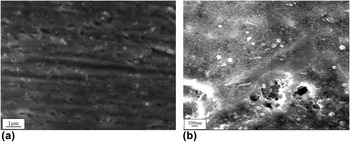
Materials used in this work were Al6061 ingots (the chemical composition is shown in Table I Reference Mondolfo25 ) and Al2O3-nanoparticles with the size of 50 nm (SEM image of the nanocomposite with 1 wt% Al2O3 is provided in Fig. 1). The cylindrical samples of Al6061 and its nanocomposites with 0.5 and 1 wt% Al2O3 were fabricated by stir-casting process and then extruded with an extrusion ratio of 20:12. After extrusion, solution heat treatment was performed at 550 °C for 2 h on the specimens and then they were quenched in water. Subsequently the age hardening heat treatment (T6) was carried out for all of the samples at temperature of 200 °C with an age hardening time of 3 h.
The amount (wt%) of alloying elements for aluminum 6061. Reference Mondolfo25

FESEM micrographs of Al6061–1 Al2O3 nanocomposite, (a) at low magnification, (b) at high magnification.

Hot compression test specimens with the height of 15 mm and diameter of 10 mm were prepared from extruded bars. Hot compression tests were carried out at the temperature range of (T) 350–500 °C and in the strain rate range (
 ${\rm{\dot \varepsilon }}$
) of 0.0005–0.5 s−1. After compression tests, specimens were rapidly quenched in water. High resolution transition electron microscopy (HRTEM) and scanning electron microscopy (SEM) were used to investigate microstructural evaluation during hot deformation. Thin foil TEM samples were prepared by cutting the longitudinal section of the deformed specimen and then cut 3 mm discs from the thin wafer. The discs were ground to a thickness of about 60 µm and then a sphere-shaped deepening was ground into the polished disk by a dimpler. Finally the discs were subjected to ion polishing.
III. RESULTS AND DISCUSSION
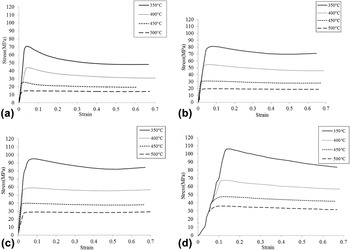
The occurrence of softening mechanisms, such as DRV and recrystallization, during the hot deformation process is usually surveyed from the changes of original microstructure that is reflected apparently from the flow stress diagrams. Reference Chen, Zhao and Yu26 It is vividly observable from the stress–strain curves (Fig. 2) that the variations of strain rate and temperature definitely affect the deformation behavior of nanocomposite. Because of the high hardening rate during the initial stages of deformation, the value of peak stress increases at low strains. Regardless of the overall deformation value, the amount of peak stress is increased by the increment of strain rate and decrease of temperature. This fact is a matter of dislocations density and it experiences an increment by rising this significant parameter. While the amount of strain rate directly influences the generation and motion of dislocations, peak stress increases due to the inadequate time for activation and extending softening mechanisms all over the specimen. Reference Huang, Diao, Hua, Li and Hu27 Therefore, in aluminum matrix nanocomposite, the value of peak stress increases by approximately 57% from 70 MPa to 110 MPa at 350 °C, and this behavior is similar at three other temperatures. According to recent researches for aluminum alloys, at low strain rates DRX seems the predominant mechanism in hot deformation process and DRV plays a remarkable role at high strain rates. Reference Fan, Li, Li, Shao, Zhang and Peng11 However, this concept is not totally true in this particular subject. Because of the addition of ceramic nanoparticles, DRX mechanism is hindered and even at low strain rates, DRV can be described as the only activated softening mechanism for this nanocomposite. The detailed discussion of softening and hardening mechanisms is scrutinized in the following sections by the comparison of hot deformation analysis data and microstructural evaluations.
Stress–strain curves of Al6061–1 Al2O3 nanocomposite at temperature range of 350–500 °C and strain rates of (a) 0.0005 (b) 0.005 (c) 0.05 and (d) 0.5 s−1.

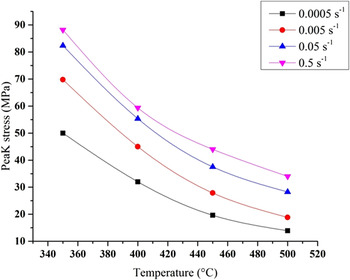
The variation of peak stress with the temperature in the strain rate range of 0.0005–0.5 s−1 is illustrated in Fig. 3 for Al6061–1 Al2O3 nanocomposite. As is evident, by increasing the strain rate from 0.0005 to 0.5 s−1, the peak stress experiences a climb while is consistent with decreasing temperature. Furthermore, due to the changes in strain rate sensitivity for the nanocomposite at higher temperatures (T > 400 °C), the behavior of material differs at lower temperatures from higher ones and it is clearly observable in Fig. 3.
Variation of peak stress versus temperature in strain rate range of 0.0005–0.5 s−1.

During the hot deformation of metals and alloys, constitutive equation is an indisputable mathematical approach to reveal the relationship between deformation parameters in an Arrhenius form Eq. (4) Reference Yang, Deng, Zhang, Liu, Jia and Huang16,Reference Wu, Wen, Huang, Wu, Gao, Wang and Nie28 :
 $$Z = \dot \varepsilon \,\exp \left( {{Q \over {RT}}} \right) = A{\left[ {\sinh \left( {\alpha {\sigma _{\rm{p}}}} \right)} \right]^n}\quad .$$
In which
 ${{\dot \varepsilon }}$
is defined as the strain rate, T is the regarding temperature in Kelvin, and Q is the activation energy needed for deformation. Moreover, A, α, and n are constants depending on the given material and hot working situation, and R is the universal gas constant. The influence of temperature and strain rate on the hot deformation behavior of the nanocomposite is surveyed by means of Zener–Hollomon parameter (Z) in the aforementioned equation. By taking logarithm from Eq. (4), the following equation can be resulted to quantify the values of n and Q.
Reference Wu, Wen, Huang, Wu, Gao, Wang and Nie28,Reference Akbari, Mirzadeh and Cabrera29
 $$\ln \left( Z \right) = \ln \left( {\dot \varepsilon } \right) + {Q \over R} \cdot {1 \over T} = \ln \left( A \right) + n\ln \left( {\sinh \left( {\alpha {\sigma _{\rm{p}}}} \right)} \right)\quad .$$
At last, the determination of n and Q would be achieved from the slopes of
 $\log \left( {\sinh \left( {\alpha {\sigma _{\rm{p}}}} \right)} \right)$
versus
 $\log \left( {{\rm{strain\ rate}}} \right)$
and
 $\log \left( {\sinh \left( {\alpha {\sigma _{\rm{p}}}} \right)} \right)$
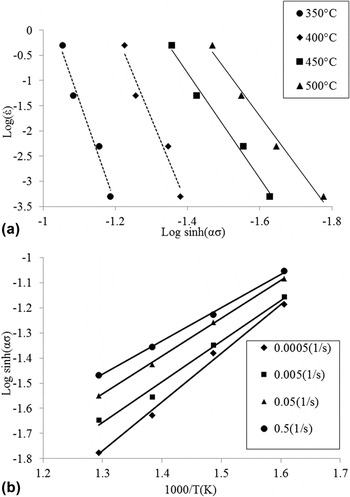
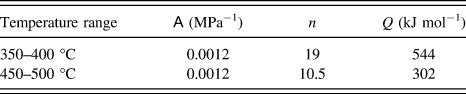
versus 1000/T diagrams, respectively. Figure 4 demonstrates the linear correspondence of flow curves data in peak strain in accordance with Eq. (5), and Table II reports the value of α, n, and Q constants acquired from Fig. 4.
(a) Plots of log strain rate versus log sinh function of the stress and (b) log sinh function of stress versus the reciprocal of the absolute temperature.

The value of α, n and Q constants of nanocomposite derived from Fig. 4.

The amount of activation energy of this nanocomposite at temperature range of 350–400 °C and 450–500 °C is 544 and 302 kJ/mol, respectively. Activation energy value at low temperature range is approximately twice higher than that of at high temperature range. These results indicate that the nanocomposite at high temperatures or low strain rates (low activation energy) compared to low temperatures or high strain rates (high activation energy) can exhibit an appropriate behavior for the hot deformation process because of the favorite conditions for activation and continuing softening mechanisms through the specimen. Also higher activation energy in the nanocomposite than Al6061 (274 kJ/mol) Reference Ezatpour, Sabzevar, Sajjadi and Huang17 can suggest great effect of nanoparticles in hardening the specimen via induced restriction to the motion of dislocations. Luan et al. studied the hot deformation behavior of aluminum composites with micro alumina additives and the estimated activation energy reported was 252.9 kJ. Reference Luan, Qiu, Li, Yang, Li, Zhang and Qing30 Likewise, Li et al. reported the value of Q, 249.87 kJ for AA6061 that was reinforced with micro SiC particles. Reference Li, Liu, Luo, Ma and Liu31 Apparently, the amount activation energy for Al6061–1% Al2O3 nanocomposite is considerably higher than that of the mentioned reports. This event can be justified by the strong influence of nano-sized particles in comparison with micro-sized ones while micro-particles can act as nucleation sites during hot deformation. Reference Luan, Qiu, Li, Yang, Li, Zhang and Qing30,Reference Li, Liu, Luo, Ma and Liu31 The effective interface of particle/matrix increases dramatically by decreasing the size of ceramic additives to nano-scale. Reference Reddy4
Furthermore, increasing the strain rate to high values may cause failure and instability due to increasing the adiabatic temperature and the considerable strain hardening. Therefore, controlling such factors is requisite to prevent unfavorable phenomena like the occurrence of adiabatic shear bands, flow localization and the formation of voids and cracks. The relationship between flow stress and deformation parameters are delineated within the hot deformation processing map to optimize these factors in a practical manner. Reference Prasad32
Equation (6) describes the flow stress as a function of strain rate in constant deformation temperature and strain. Reference Asgharzadeh, Simchi and Kim13
 $$\sigma = {\left| {K{{\dot \varepsilon }^m}} \right|_{T,\varepsilon }}\quad .$$
During hot deformation process, specimen is assumed as the source of power dissipation. Strain rate sensitivity (m) is also defined in the form of power distribution parameter that determines the amount power needed for microstructural transformations. Reference Ezatpour, Sajjadi, Haddad-Sabzevar and Ebrahimi33
 $$m = {\left| {{{\partial \log \sigma } \over {\partial \log \dot \varepsilon }}} \right|_{\varepsilon ,T}}\quad .$$
In Eq. (8), J demonstrates the effect of metallurgical changes in the power dissipation of work piece which is determined by strain rate sensitivity. Reference Nan, Ning, Liang, Guo, Yao and Fu23
 $$\eta = {J \over {{J_{\max }}}} = {{2m} \over {m + 1}}\quad .$$
Ziegler defined the stability criterion on the basis of irreversible thermodynamics and large plastic flow continuum mechanics that was developed by Prasad and Sasidhara. Reference Narayana Murty, Nageswara Rao and Kashyap34
A processing map is obtained by describing the variation of efficiency with temperature and strain rate and includes distinctive domains which can be correlated with microstructural evolutions throughout the material. Reference Prasad32 Usually the zone that consists of DRX and DRV mechanisms is contemplated as the optimal situation for the hot working process. Meanwhile, the description is somehow different in nanocomposites due to the significant influence of nanoparticles in the suppression of softening mechanisms. Reference Ezatpour, Chaichi and Sajjadi19
Consequently, a dimensionless parameter
 $\left[ {\xi \left( {\dot \varepsilon } \right)} \right]$
is proposed for the designation of stable and unstable domains.
 $$\xi \left( {\dot \varepsilon } \right) = {{\partial \ln \left[ {{m \over {m + 1}}} \right]} \over {\partial \ln \dot \varepsilon }} + m \,\,\lt\,\, 0\quad .$$
In Eq. (9),
 $\xi \left( {\dot \varepsilon } \right)$
is the instability parameter. While the value of this factor is negative, work piece will undergo the instability conditions accompanied with the manifestation of microstructural defects. Calculation of instability parameter is apparently dependent to determination of m value at different temperatures and strain rates which can be acquired from isothermal compression data polynomial fitting and differential of the related curves.
Reference Mrówka-Nowotnik, Sieniawski, Kotowski, Nowotnik and Motyka35
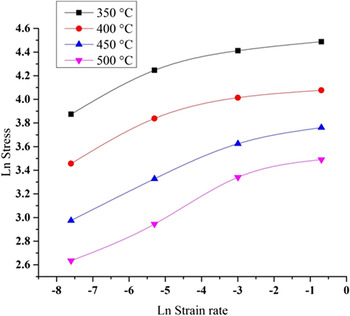
Figure 5 illustrates the logarithmic variation of stress in strain of 0.5 as a function of strain rate. It is implied that the flow stress experiences a mild increment as the strain rate increases or the temperature decreases. The relationship between log (σ) and log (
 $\dot \varepsilon$
) using third degree polynomial in strain of 0.5 and different temperatures obtained of Fig. 5 helps to draw processing map in accordance with Eqs. (8) and (9).
Logarithmic plot of stress (MPa) versus strain rate (s−1) at different temperatures of Al6061–1 Al2O3 nanocomposite.

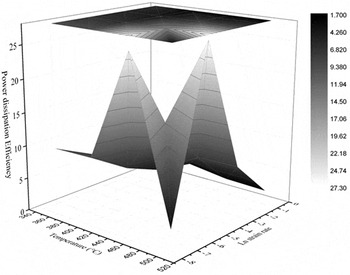
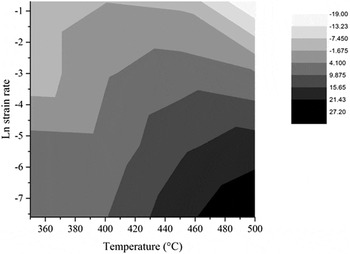
Figures 6 and 7 depict the 3D and 2D processing maps for the hot deformation of Al606–Al2O3. As is evident from the plots, it can be contemplated that the maximum efficiency of power dissipation for nanocomposite is approximately 26% which is much lower than the values achieved for Al6061 (40–44%) in the previous papers. Reference Ezatpour, Sabzevar, Sajjadi and Huang17 Thus the amount of power dissipation efficiency is drastically affected with the addition of alumina nanoparticles and diminished at the temperature of 450 °C and strain rate of 0.0005 s−1, from 40% to 26%. In spite of the effect of dynamic recrystallization mechanism during the hot deformation of aluminum alloys and composites, it seems that contrary to the results of last reports, DRV exerts more influence on the deformation process of such nanocomposites. Reference Kai, Chen, Sun, Wang and Zhao36
3D processing map for the hot deformation of Al6061–1 Al2O3 nanocomposite.

2D processing map for the hot deformation of Al6061–1 Al2O3 nanocomposite showing instability domains (negative values).

As shown in Fig. 7, the unstable zone is observable through the whole temperature range of 350–500 °C, at high strain rates. This outcome explicitly approves the negative effect of nanoparticles addition on the hot deformation behavior of aluminum alloys at high strain rates.
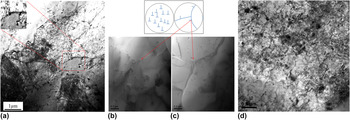
Electron microscopy images are in a suitable agreement with the results achieved from theoretical equations and processing maps. Corresponding to TEM images in Fig. 8, it is noticeable that the density of dislocations decreases when the temperature increases from 400 °C to 450 °C. Furthermore, there is a dislocation accumulation in the vicinity of grain boundaries through climbing and sliding dislocation that causes the formation of cell walls and decreases of the dislocation density which provides substructures with very low energy (DRV mechanism). Because of low strain rate, usually subgrains formed are equiaxed. As a result, the occurrence of DRV is extensively possible in this domain with the power dissipation efficiency of 26% [Figs. 8(a)–8(c)]. An accumulation of dislocations is observed in Fig. 8(d) at 500 °C and 0.0005 s−1. In comparison with the base alloy, Reference Ezatpour, Sabzevar, Sajjadi and Huang17 there is no evidence for dynamic recrystallization and nucleation of new grains in this domain. Moreover, the efficiency of power dissipation which is a criterion for indicating the tendency of material in the activation of softening mechanisms during hot deformation for Al6061–1 Al2O3 nanocomposite is diminished in comparison with Al6061 alloy from 44% to 10%. In fact, at high temperature and low strain rate (500 °C and 0.0005 s−1), grain boundary migration has the main role in work softening while the presence of reinforcing additives suppresses the motion and growth of grain boundaries by applying restriction to their mobility [Fig. 8(a)]. In addition, there is not enough stored energy due to applied deformation for microstructure evaluation in this domain. Finally, the safe domain for hot working of this nanocomposite in accordance with experimental data and microscopic observations are recognized at (I) 450 °C, 0.0005 s−1 and (II) 500 °C, 0.05 s−1.
TEM micrographs of Al6061–1 Al2O3 nanocomposite at strain rate of 0.0005 s−1 and temperatures of (a) 400 °C, (b and c) 450 °C and (d) 500 °C.

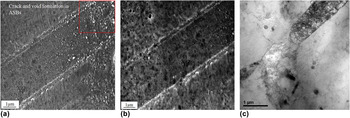
Figure 9 shows TEM and SEM images for the nanocomposite in the unstable domain. The presence of nanoparticles and high dislocation density throughout the shear bands is clearly approvable via TEM and SEM micrographs. Furthermore, TEM image in Fig. 9(c) supports the existence of elongated cells in the adiabatic shear with a great volume of dislocations inside. There are also some other faults and defects exhibited in unstable domain. The presence of several tiny cracks and voids has been detected in the unstable domain as well as the separated interface of nanoparticles and matrix. The existence of these defects can heavily affect the performance of work piece after the deformation while should be controlled and prevented as much as possible [Figs. 9(a) and 9(b)]. The presence of ASBs at high strain rates can originate from the difference in the thermal conductivity coefficient of matrix and nanoparticles. Introducing such ceramic particles with a low thermal conductivity potential (30 W/m K) Reference Nunes37 compared to matrix (167 W/m K) Reference Kok38 can interfere in microstructural evolutions and revolves the overall material thermal behavior.
SEM and TEM micrographs of Al6061-1 Al2O3 nanocomposite at strain rate of 0.5 s−1 and temperatures of (a) 400 °C, (b) 450 °C and (c) 400 °C.

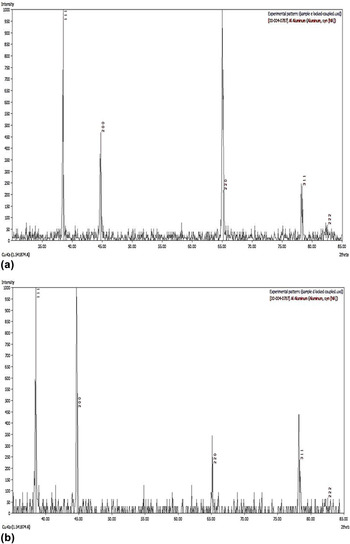
X-ray diffractogram for Al6061–1 Al2O3 nanocomposite is illustrated in Fig. 10 at strain rate of 0.0005 s−1 and temperatures of 350 °C and 450 °C. Results show the extension of (200) texture with increasing temperature. Firstly, the development of (200) texture is connected with the migration of grains and subgrains within the sample. Secondly, the enlargement of (200) pole at elevated temperatures is associated with the tendency of growth for subgrains holding lower stored energy and lower dislocation density. Reference Ezatpour, Sabzevar, Sajjadi and Huang17 In the current sample, the intensity of (220) and (200) poles diminishes and increases by increasing the temperature from 350 °C to 450 °C, respectively. The pivotal explanation for the lower intensity of (200) texture at 350 °C is the existence of nanoparticles and precipitates (Mg2Si) which can retard the motion of grain boundaries during migration. This phenomenon is gradually decreased via increasing the temperature to 450 °C.
X-ray diffractogram for Al6061-1 Al2O3 nanocomposite at strain rate of 0.0005 s−1 and temperatures of (a) 350 °C and (b) 450 °C.

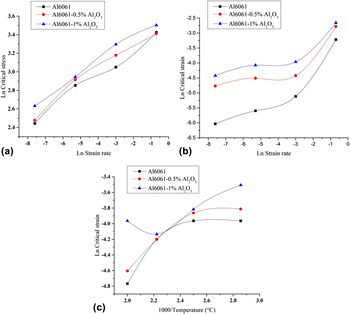
Fig. 11 presents three plots that explain the influence of strain rate and temperature on deformation parameters for the base alloy and its nanocomposites to compare the effect of reinforcement additives. Figure 11(a) illustrates the logarithmic variation of critical stress (σc) as a function of strain rate at temperature of 500 °C. As can be seen, the critical stress for all the samples increases gently; meanwhile, this increment is more remarkable at higher stain rates. Besides, the addition of ceramic nanoparticles encourages the critical stress to climb up in comparison with the base alloy. Also as a result of plot, at low strain rates, with adding nanoparticles particularly in nanocomposite with 1% reinforcement, the stress sensitivity to strain rate
 $\left( {{{{\rm{d}}\sigma } \over {{\rm{d}}\dot \varepsilon }}} \right)$
has decreased and by increasing the strain rate, this sensitivity has gradually decreased. These results indicate that the presence of nanoparticles leads to microstructure stability and decreasing the occurrence of softening mechanisms considerably.
Logarithmic variations of (a) critical stress versus strain rate, (b) critical strain versus strain rate at temperature of 500 °C and (c) critical strain versus temperature at strain rate of 0.05 s−1 of Al6061, Al6061 reinforced with 0.5 and 1% Al2O3.

In Fig. 11(b), the value of critical strain is delineated versus strain rate at temperature of 500 °C. As is apparent, the amount of critical strain increases with elevating the strain rate and the addition of reinforcements. However, this increment is much more intensive at high strain rates. It is noticeable to indicate that it seems the addition of alumina affects the critical strain significantly at low strain rates. When strain rate is lower than 0.05 s−1, the critical strain, i.e., a proper criterion for initiation of microstructural evolutions during hot deformation, decreases notably and consequently the inception of softening mechanisms is delayed. Also, critical strain sensitivity to strain rate
 $\left( {{{{\rm{d}}\varepsilon } \over {{\rm{d}}\dot \varepsilon }}} \right)$
decreases with adding nanoparticles; while designates the negative effect of nano-reinforcement additives on the hot workability of base alloy.
Fig. 11(c) reveals the dependence of critical strain to deformation temperature at strain rate of 0.05 s−1. Accordingly, the value of critical strain drops off gradually by increasing the temperature with an exception for Al6061–1 Al2O3 nanocomposite at 500 °C. Changes of critical strain versus temperature for Al6061 and Al6061–0.5 Al2O3 is comparable, while with more addition of nanoparticles in the composite with 1% Al2O3, the overall trend changes. Results show that with increasing temperature, the critical strain sensitivity to temperature
 $\left( {{{{\rm{d}}\varepsilon } \over {{\rm{d}}T}}} \right)$
has increased. With adding nanoparticles to base alloy, the critical strain has increased and the critical strain sensitivity to temperature has also decreased. With increasing temperature, diffusion phenomenon increases and activation of softening mechanisms (DRV and DRX) by the cross-sliding and climbing dislocations and grain boundary migration becomes easier. Addition of nanoparticles to the matrix changes the microstructure evaluations particularly at higher temperature which restrict dislocations slip and grain boundaries migration. Therefore, although presence of nanoparticles as reinforcement can predominantly improve mechanical properties of aluminum alloys at room temperature compared to micro-particles but also they have the negative effect on hot workability behavior while indicating optimal conditions of these materials during hot deformation is very important for finally production.
IV. CONCLUSIONS
Influence of deformation parameters and alumina nanoparticles addition on Al6061 alloy were investigated quantitatively and qualitatively via hot compression tests data and microstructure results. The following conclusions are drawn:
-
(1) The high activation energy of Al6061–1 Al2O3 nanocomposite was an evident to the negative effect of nanoparticles on the hot deformation behavior.
-
(2) The optimum conditions for hot deformation of the nanocomposite with 1% Al2O3 were represented in two regions: (I) 450 °C, 0.0005 s−1 and (II) 500 °C, 0.05 s−1 while DRV was the main softening mechanism.
-
(3) Formation of adiabatic shear bands, voids, and cracks, elongated subgrains, accumulation of dislocations and separation of matrix/alumina interfaces were defects in the unstable domains.
ACKNOWLEDGMENT
The authors wish to acknowledge Department of Materials Science and Metallurgical Engineering, Ferdowsi University of Mashhad and School of Materials Science and Engineering, Nanyang Technological University of Singapore (NTU) for supporting this research.