

Introduction
Imagine that you work all day long laying bricks, filing paperwork, or grading exams only to find out that your employer paid someone else twice as much money for the same job. Many people in this position feel that they have been treated unfairly (Fehr and Schmidt Reference Fehr and Schmidt1999; Sweeney Reference Sweeney1990; Sweeney et al. Reference Sweeney, McFarlin and Inderrieden1990). However, workers might be more accepting of lower pay if they judge the procedure for determining pay to be fair, such as paying higher wages to more qualified, talented, or senior employees. In contrast, people show outrage and political activism when procedures are unfair such as paying lower wages to women and minorities (Blau and Kahn 1992, Reference Blau and Kahn2000; Leicht Reference Leicht2008). People’s sense of procedural justice also shapes legislation such as equal employment laws that prohibit certain types of pay discrimination. But questions remain about what makes a procedure fair or unfair, and whether some discriminatory rules are judged to be more unfair than others. Here we examine people’s moral judgments about pay discrimination by using an online labor market to test what makes people perceive unequal pay as more or less unfair.
Procedural justice shapes how people react to the ways that leaders make decisions, police handle suspects, courts determine guilt, employers set wages, and other important events in our personal, economic, and political lives (Dickson, Gordon, and Huber Reference Dickson, Gordon and Huber2009, Reference Dickson, Gordon and Huber2015; Gerber et al. Reference Gerber, Huber, Doherty and Dowling2012; Gibson Reference Gibson1989; Hibbing and Theiss-Morse Reference Hibbing and Theiss-Morse2001; Tyler and Blader Reference Tyler and Blader2003; Tyler, Casper, and Fisher Reference Tyler, Casper and Fisher1989). Procedural justice pertains to the process by which decisions are made as opposed to the outcome, which is the purview of distributive justice.
We investigate procedural justice in the context of pay discrimination. Pay discrimination occurs when an employer deliberately pays some workers lower wages based on categories that are irrelevant for merit or performance such as race, gender, or age. Pay discrimination violates procedural justice because the employer uses a rule or procedure to determine pay that is not acceptable, particularly transgressing the expectation that procedures should be impartial (Lind and Tyler Reference Lind and T. R.1988; Shaw Reference Shaw2013; Shaw et al. Reference Shaw, DeScioli and Olson2012; Tyler and Blader Reference Tyler and Blader2003). In this way, pay discrimination is analogous to racial profiling in which the police decide who to search based on race. Indeed, previous research found that participants judged racial profiling by police or airport security to be an unfair violation of procedural justice (Sindhav et al. Reference Sindhav, Holland, Rodie, Adidam and Pol2006; Tyler and Wakslak Reference Tyler and C. J.2004). Moreover, for both wage discrimination and racial profiling, the procedure, that is, treating people in one category differently than others, is distinct from the outcome, that is, the distribution of wages or police searches. The procedural justice literature finds that people care about both procedures and outcomes, so this implies that for pay discrimination, people will care not only about the distribution of wages but also about whether the procedure for determining wages is impartial and fair.
The principle of equity, “equal pay for equal work,” is a popular and intuitive notion rooted in our social psychology (Fehr and Schmidt Reference Fehr and Schmidt1999; Sweeney Reference Sweeney1990; Sweeney et al. Reference Sweeney, McFarlin and Inderrieden1990). Nevertheless, inequalities in pay are common, and many people accept unequal wages when the differences result from procedures for paying workers based on experience, longevity, effort, talent, performance, market demand, or other criteria deemed fair within a given community. At the same time, people reject other possible rules such as paying lower wages to the elderly, a practice that is prohibited by US law. Hence, for some inequalities, people show outrage and political activism, whereas in other cases, people accept or at least tolerate unequal pay. Yet, it is unclear which types of inequality people view as more unfair than others. That is, holding constant the inequality in pay for the same work, why do some forms of pay discrimination provoke more outrage than others?
We propose that a procedure’s divisiveness is a key factor underlying fairness judgments. A rule or procedure is divisive when it consistently disfavors the same individuals, as opposed to rules that only temporarily or sporadically disfavor a particular group. The divisiveness hypothesis draws on ideas from evolutionary game theory. In a theoretical model, Grafen (Reference Grafen1987) found that individuals most resist rules for solving coordination games when the rule consistently goes against their interests. These divisive rules resolve coordination problems based on the stable characteristics of players so that they consistently disadvantage the same individuals. For this reason, disadvantaged players resist divisive rules even if this leads to costly failures to coordinate. Grafen (Reference Grafen1987) gave an example of a rule that benefits younger people at the expense of older people. Because the older people will never benefit from the rule, they are expected to strongly oppose it. In contrast, a rule that benefits older people at the expense of younger people is less strongly opposed by the young because they stand to benefit from the rule in the future.
Divisiveness could influence procedural justice because procedures often function to solve coordination problems (Camerer Reference Camerer2003; Chwe Reference Chwe2001; Cronk and Leech Reference Cronk and Leech2012; Schelling Reference Schelling1960; Thomas et al. Reference Thomas, DeScioli, Haque and Pinker2014), such as when citizens need to agree on the legitimacy of a leader’s decision or the guilt of a suspect. In general terms, a procedure can serve as a convention for resolving the coordination problems posed by disagreement. For instance, if an employer and worker disagree about the worker’s wage, then they can use conventional procedures to resolve the impasse, such as rules that scale pay based on experience, performance, longevity, or outside offers.
The divisiveness hypothesis holds that the strategic logic of divisiveness shapes our intuitive judgments of fairness, such that people judge procedures as less fair when they consistently deprive the same individuals. Importantly, this does not mean that people consciously reason about coordination problems when they make judgments of fairness. Rather, the hypothesis is that the strategic logic of divisiveness shapes people’s intuitions about fairness, analogous to how geometry guides our perceptions of depth by shaping visual cognition rather than through people’s conscious calculations (Pinker Reference Pinker1997). This theory builds on a growing literature arguing that the logic of coordination shapes the psychology of language (Lewis Reference Lewis1969; Pinker Reference Pinker2007), emotions (Reed et al. Reference Reed, DeScioli and Pinker2014; Tybur et al. Reference Tybur, Lieberman, Kurzban and DeScioli2013), reasoning about mental states (Thomas et al. Reference Thomas, DeScioli, Haque and Pinker2014), moral judgment (DeScioli and Kurzban Reference DeScioli and Kurzban2013), property rights (DeScioli and Karpoff Reference DeScioli and Karpoff2015; DeScioli and Wilson Reference DeScioli and Wilson2011; Maynard Smith Reference Maynard Smith1982), and leadership (Van Vugt Reference Van Vugt2006).
Finally, we examine whether people judge divisive rules to be even more unfair when they transgress a factional divide in society, specifically the tense opposition between Democrats and Republicans in the USA. Democrats and Republicans are prominent competing factions in American politics with a long history of conflict and antagonism. Moreover, researchers have argued that Americans have become increasingly polarized along party lines, including a rise in affective polarization with hostile feelings toward the opposing party (Green, Palmquist, and Schickler Reference Green, Palmquist and Schickler2004; Iyenger, Sood, and Lelkes Reference Iyengar, Sood and Lelkes2012; Mason Reference Mason2015). This hostility even extends outside of politics, such as partisans who say they would disapprove if their son or daughter married someone who is a member of the opposing party (Iyengar, Sood, and Lelkes Reference Iyengar, Sood and Lelkes2012). Given the antagonism between parties, people might judge partisan discrimination to be especially unfair because it inflames partisan conflict. Hence, people might judge that partisan discrimination is unfair not only because it is divisive, based on a stable characteristic, but also because it incites partisan hostility.
The Present Experiment
We test theories about unfair procedures by manipulating workers’ actual wages for completing jobs in an online labor market. In different treatments, workers who did the same job received pay that was equal or unequal to other workers, and if unequal, they were either advantaged or disadvantaged by different payment rules. Workers first completed the job by transcribing text, next they learned the payment rule that determined wages, and then they judged the fairness of the payment rule.
In a between-subject design, we presented workers with one of three different unequal payment rules based on their choice of a door, eye color, or political partisanship. We selected the choice of a door (yellow or green) as a familiar, arbitrary decision like choosing between doors in a game show, which is transient choice rather than a stable characteristic of a person. We selected eye color as a stable characteristic of a person, and we selected political party (Democrat or Republican) as a stable characteristic that is additionally fraught by affective polarization. Hence, the door rule is low in divisiveness, the eyes rule and party rule are high in divisiveness, and the party rule adds an association with partisan hostility.
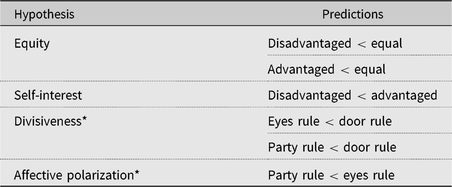
Hence, the experiment has a 3 (relative pay: disadvantaged, advantaged, equal) × 3 (payment rule: door, eyes, party) design. Table 1 summarizes the hypotheses and experimental predictions. First, based on a large literature (e.g., Dawes et al. Reference Dawes, Fowler, Johnson, McElreath and Smirnov2007; Fehr and Schmidt Reference Fehr and Schmidt1999; Shaw and Olson Reference Shaw and Olson2012; Starmans, Sheskin, and Bloom Reference Starmans, Sheskin and Bloom2017), the equity hypothesis predicts that participants will judge unequal pay for the same work as less fair than equal pay, especially when they are disadvantaged by the rule (holding constant the amount of pay; disadvantaged and equal pay are both a 30-cent bonus). Second, the self-interest hypothesis is also drawn from previous work (DeScioli et al. Reference DeScioli, Massenkoff, Shaw, Petersen and Kurzban2014; Fehr and Schmidt Reference Fehr and Schmidt1999; Sweeney Reference Sweeney1990; Sweeney et al. Reference Sweeney, McFarlin and Inderrieden1990), and self-interest predicts that participants will judge a payment rule to be less fair when they are disadvantaged compared to advantaged by it.
Experimental predictions for fairness judgments
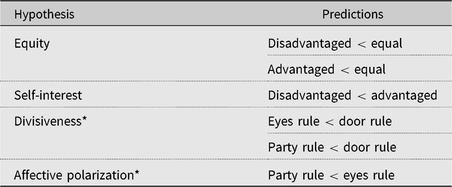
Note. Summary of experimental predictions, where < means “less fair than.” The * indicates the distinctive hypotheses about payment procedures that are the main focus of the experiment. The predictions imply all else equal (e.g., “disadvantaged < equal” means within each payment rule). Note that these hypotheses are not mutually exclusive.
The main focus of this experiment is the next hypotheses in Table 1 about discriminatory payment rules. The divisiveness hypothesis predicts that participants will judge the eyes rule and party rule to be less fair than the door rule. This is because the choice of door is transient, whereas eye color and partisanship are stable characteristics so that rules based on them consistently deprive the same individuals, making these rules divisive, and hence more intensely opposed (Grafen Reference Grafen1987). This prediction applies especially to the disadvantaged participants, and to a lesser extent the advantaged (given the expected mitigating effect of self-interest previously discussed).
Last, the affective polarization hypothesis predicts that the party rule will be judged as less fair than eyes rule. The party rule is not only divisive but is also associated with a prominent and increasingly hostile divide between Democrats and Republicans. Aware of these social tensions, participants will judge procedures to be more unfair when they further provoke ongoing conflicts. Note that this polarization hypothesis does not require that someone is an active or strong partisan themselves, but only that they are aware of partisan conflict in society (just as someone does not need to be elderly or disabled to be offended by discrimination against the elderly or disabled).
Methods
We recruited 541 participants (45% female; age: M = 32.5, SD = 10.7) to complete a short study (approximately 10 min) using the online labor market MTurk (Berinsky, Margolis, and Sances Reference Berinsky, Margolis and Sances2014). We applied MTurk filters requiring that participants were located in the USA and had a 98% approval rate for previous work. Participants received a small payment (50 cents) and could earn additional money from the task which would be paid to them as a bonus. We report all measures, manipulations, and exclusions in the experiment. The sample size of approximately 60 per condition was determined before analysis to provide sufficient power to detect medium effect sizes in the key comparisons. Data collection was not continued after the analysis began.
Participants first answered demographic items, reported their political party, selected their eye color, and chose between a yellow door and a green door (see full materials in the Appendix in the Supplementary Material). For political party, participants answered a forced-choice question about whether they were a strong, moderate, or weak Democrat or Republican; if none applied, participants were prompted to choose “the closest option,” since many independents lean more toward one party (Layman and Carsey Reference Layman and Carsey2002). For eye color, participants made a forced choice between blue/green and brown/other.
Next, participants transcribed two paragraphs for an additional payment. They read that the exact nature of the payment would be shown after they finished the work. Then participants were shown the payment rule used to determine their earnings for transcription and the amount they made. Participants next answered the question “In your opinion, how fair was the Payment Rule used for the transcription task?” by rating fairness on a 7-point scale (coded as very unfair = −3, neither fair nor unfair = 0, and very fair = +3). Participants were debriefed and later paid their MTurk bonuses.
In a 3 (relative pay: advantaged, disadvantaged, and equal) × 3 (payment rule: door, eyes, or political parties) between-subject design, we manipulated participants’ pay relative to other workers and the payment rules that determined earnings. For the political party rule, participants read:
“Participants who chose Democrat [Republican] receive 30 cents for completing the transcription task. Participants who chose Republican [Democrat] receive 60 cents for completing the transcription task.”
The survey software (Qualtrics) automatically completed the text with the participant’s reported political party and according to whether they were randomly assigned to the advantaged or disadvantaged condition. The door rule and eyes rule were similar except it said their pay was determined by their choice of door or eye color.
We also included an equal pay condition alongside each unequal payment rule.
Instead of the text above, participants readFootnote 1:
“All participants receive the same payment of 30 cents for completing the transcription task.”
We used the same equal pay condition as separate baselines for each unequal payment rule. For equal pay, participants received 30 cents which was the same amount as the disadvantaged participants. We set the equal pay to be the same as disadvantaged pay so that any difference in fairness judgments can be attributed to the payment rule rather than the absolute amount of earnings.
Results
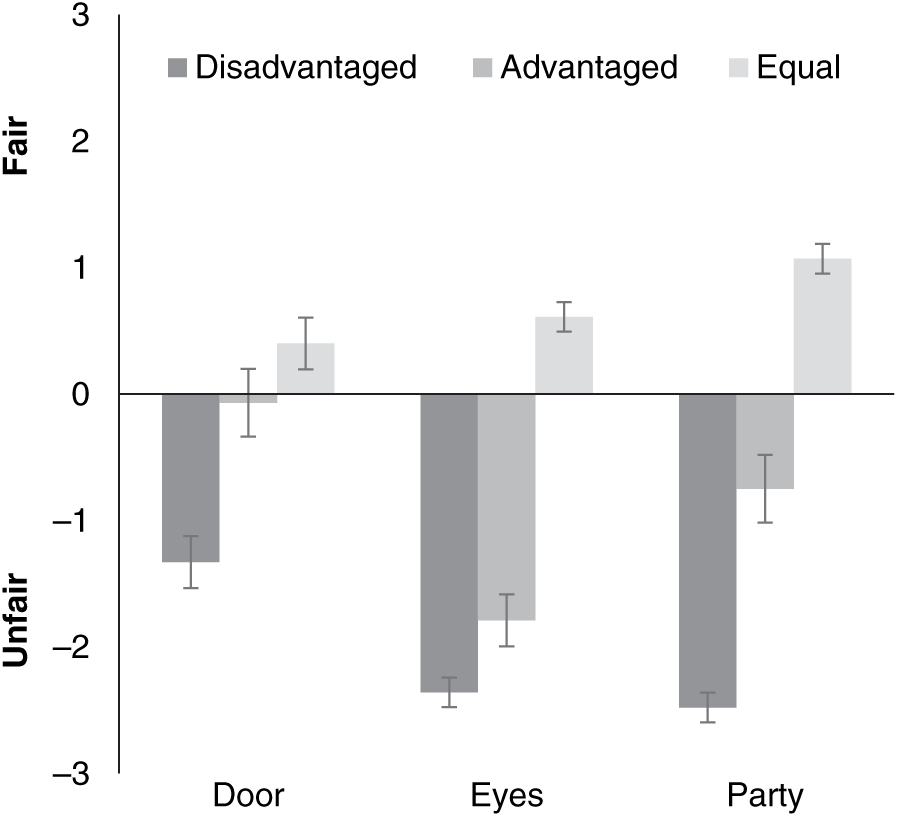
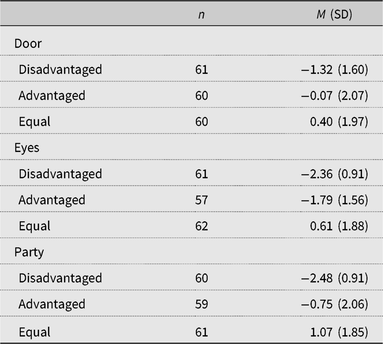
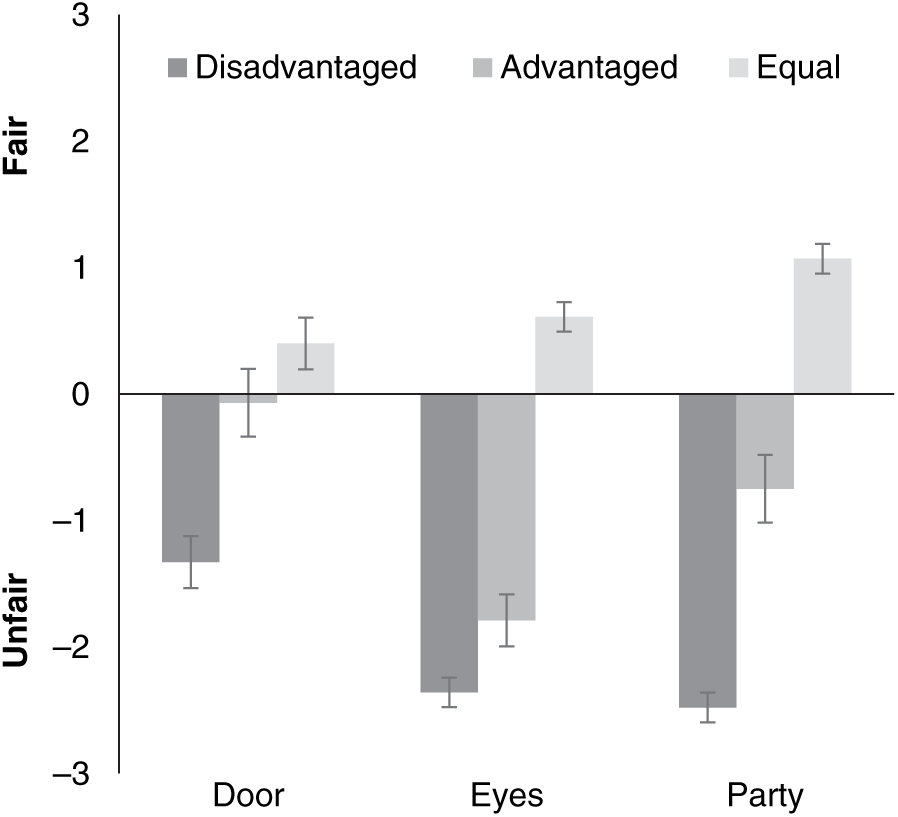
Figure 1 and Table 2 show the results. We first examine the predictions from previous theories about equity and self-interest. We then report the main analysis testing predictions from the divisiveness and affective polarization hypotheses.
Mean (SE) unfairness ratings by payment rule (door, eyes, political party) and relative pay (disadvantaged, advantaged, equal). Unfairness was rated on a 7-point scale (−3 = very unfair, 0 = neither fair nor unfair, and 3 = very fair).
Fairness ratings for payment rule
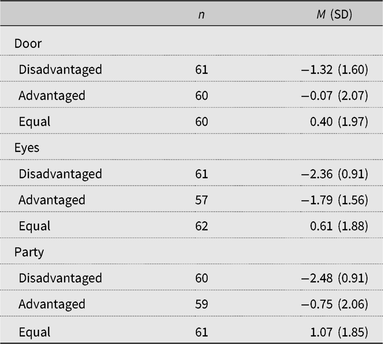
Note. Fairness scale from very unfair = −3 to very fair = +3.
Equity and Self-interest
We test how relative pay affects fairness judgments within each payment rule. For the door rule, participants judged that payments were less fair when they were disadvantaged compared to equal pay, t(119) = 5.31, p < 0.001, d = 0.96. This shows a concern for equity particularly because the disadvantaged payment was the same as for those who receive equal pay (30 cents). In contrast, advantaged participants’ judgments did not differ from equal pay, t(118) = 1.26, p = 0.10, d = 0.23, showing little concern for equity. Consistent with self-interest, participants who were advantaged rated the same rule as more fair than those who were disadvantaged by it, t(119) = 3.75, p < 0.001, d = 0.68.
For the eyes rule, participants judged the payments as less fair when disadvantaged compared to equal pay, t(121) = 11.10, p < 0.001, d = 2.00, and when advantaged compared to equal pay, t(117) = 7.55, p < 0.001, d = 1.39, which shows concern for equity. And again showing self-interest, participants judged the payment rule to be more fair when they were advantaged then disadvantaged by it, t(116) = 2.45, p = 0.01, d = 0.45.
For the political party rule, participants again showed concern for equity: They judged the rule as less fair when disadvantaged compared to equal pay, t(118) = 13.34, p < 0.001, d = 2.43, and when advantaged compared to equal pay, t(118) = 5.07, p < 0.001, d = 0.93. And evincing self-interest, participants judged the rule as more fair when advantaged than disadvantaged, t(117) = 5.98, p < 0.001, d = 1.10.
Divisiveness and Affective Polarization
To test the divisiveness and affective polarization hypotheses, the main analysis compares the different payment rules, especially for disadvantaged participants. When disadvantaged, participants judged the eyes rule as less fair than the door rule,t(120) = 4.38, p < 0.001, d = 0.79, and they judged the party rule as less fair than the door rule, t(119) = 4.87, p < 0.001, d = 0.89. These results support the divisiveness hypothesis. Participants’ judgments of the eyes rule and party rule did not differ, t(119) = 0.74, p = 0.23, d = 0.13, contradicting the affective polarization hypothesis.
When advantaged, participants judged the eyes rule as less fair than the door rule, t(115) = 5.06, p < 0.001, d = 0.94, and they judged the political party rule as less fair than the door rule, t(117) = 1.79, p = 0.04, d = 0.33.Footnote 2 Unexpectedly, however, advantaged participants judged the party rule as more fair than the eyes rule, t(114) = 3.08, p = 0.001, d = 0.57, which is the opposite direction of our initial prediction based on affective polarization. Apparently, participants thought it was more acceptable to earn more money than political rivals, compared to those with different eye color. Although we had not considered this possibility, it does have an intuitive (post hoc) interpretation, which is that partisan antipathy reduces someone’s sympathy for a partisan rival who is deprived of equal pay.
How Does Partisan Strength Relate to Judgments of Fairness for Partisan Discrimination?
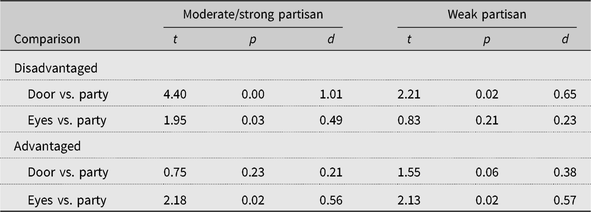
We also conducted a post-hoc analysis of partisan strength. Although we did not have initial predictions about partisan strength, it seems likely that someone’s loyalty to their party would affect how offended they are by partisan discrimination. To take an initial look, we divided participants who said they were weak partisans from those who were moderate or strong partisans. (Note that weak partisans would also include independents who chose the closest party in the forced-choice partisanship question.) We repeat the key comparisons between payment rules, separately for weak and moderate/strong partisans.
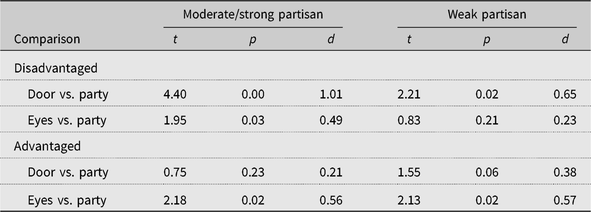
Table 3 shows the results (see Appendix in the Supplementary Material for descriptive statistics). For disadvantaged participants, both groups of partisans judged the party rule as less fair than the door rule, as before. However, the moderate/strong partisans judged that the party rule was less fair than the eyes rule, differing from before and in this case consistent with the affective polarization hypothesis; in contrast, weak partisans continued to show no difference as in the initial analysis. For advantaged participants, both groups of partisans showed no significant difference between the party rule and the door rule (although marginal for weak partisans), which is consistent with the tenuous effect found in the main analysis. And both groups judged that the party rule is more fair than the door rule, as in the main analysis. In sum, moderate/strong partisans, when disadvantaged, judged that the party rule is less fair than the eyes rule, which lends some support to the affective polarization hypothesis, although cautious support given that this analysis is post hoc.
Comparisons with party rule by partisan strength
Discussion
The main focus of this experiment was to test whether disadvantaged participants’ judgments of fairness differ depending on the basis of pay discrimination. We found that disadvantaged participants judged that lower pay was less fair when it was based on their political party or eye color, compared to their choice between doors. This finding shows that participants judged some forms of wage discrimination to be more unfair than others. This is consistent with the procedural justice literature which finds that people are concerned not only with outcomes but also the particular procedures that determine the outcomes (Tyler and Blader Reference Tyler and Blader2003). More specifically, this result supports the divisiveness hypothesis which holds that people judge rules and procedures to be less fair when they consistently deprive the same individuals.
We found mixed evidence for the affective polarization hypothesis. Participants judged partisan discrimination as highly unfair but not as significantly more unfair than discrimination based on eye color, which is not explicitly associated with polarized factions in society. However, we found in a post hoc analysis that disadvantaged participants who were moderate or strong partisans did judge the party rule as less fair than the eyes rule. But we note that this experiment was not designed to examine partisan strength, although this preliminary evidence suggests that it could be a promising direction for future research on partisan discrimination.
We note that another possible interpretation of the eyes rule is that some participants saw it as a correlate of race. We acknowledge this possibility which can be addressed in future research by examining discrimination based on other traits such as handedness. Even so, we point out that eye color is only roughly linked to race in the United States (where the study was conducted) since brown eyes are widespread across races in the United States. Moreover, even if this occurred, we intended the eyes rule to be less explicitly associated with polarized factions than political partisanship. For this purpose, we think it is informative to compare the eyes rule to the party rule, even while we agree that future research should continue to examine additional stable characteristics.
For the advantaged participants, we observed a similar pattern of differences across payment rules, with one exception: Participants thought it was more fair when they were advantaged over their political rivals, compared to people with different color eyes, contrary to our initial expectation. This observation suggests that tense polarization can reduce an advantaged group’s sympathy for the disadvantaged group’s unfair treatment.
Finally, the effects of relative pay were consistent with previous research on equity and self-interest (DeScioli et al. Reference DeScioli, Massenkoff, Shaw, Petersen and Kurzban2014; Fehr and Schmidt Reference Fehr and Schmidt1999; Sweeney Reference Sweeney1990; Sweeney et al. Reference Sweeney, McFarlin and Inderrieden1990). Participants showed a concern for equity by judging unequal pay to be less fair than equal pay (while the amount of pay was held constant). And, they showed a self-interested bias by judging the same payment rule to be more fair when they were advantaged rather than disadvantaged by it.
Importantly, these patterns of results are necessarily based on a small number of cases looking at three particular rules. We think the current experiment provides revealing tests of the current theories, but we do not recommend drawing firm conclusions about them, which would ultimately depend on a large number of tests that examine a variety of rules in future research.
The divisiveness hypothesis could have important policy implications. For example, it may help explain why protected classes in anti-discrimination laws tend to be defined by stable characteristics such as race, sex, age, religion, and national origin. Discrimination based on these characteristics is divisive because it consistently disadvantages the same people. Divisiveness might also affect other political domains such as conflicts over economic redistribution. For instance, policies that increase taxes on the wealthy are more divisive when the wealthy are consistently the same people, while economic mobility is expected to reduce divisiveness, and hence conflict surrounding progressive taxes (Moene and Wallerstein Reference Moene and Wallerstein2001; Rehm et al. Reference Rehm, Hacker and Schlesinger2012).
In sum, we found in the case of wage discrimination that even among illegitimate rules – all three payment rules in this experiment – participants judged some rules to be a more serious breach of fairness than others. We suggest that researchers can leverage this variation in unfairness to test alternative theories about procedural justice. Moreover, these theories could have important implications for which forms of inequality are more likely to provoke public opposition, political mobilization, and legislative action, and which forms might escape notice even if they have damaging effects. The present results offer some initial evidence that one key factor may be a rule’s divisiveness based on its connection to stable characteristics rather than transient choices. Finally, these findings about fairness and wage discrimination may hint at deeper connections between coordination games, moral judgment, and procedural justice.
Supplementary Material
To view supplementary material for this article, please visit https://doi.org/10.1017/XPS.2019.11.
Author ORCIDs
Reuben Kline 0000-0003-1874-4975