Introduction
More than 10% of older adults seen in primary healthcare settings show differing degrees of depressive disorders (Lyness et al., Reference Lyness, Yu, Tang, Tu and Conwell2009b), and the prevalence of depression in the community-dwelling Chinese population aged 65 years and over in Taiwan is more than 20% (Chong et al., Reference Chong2001). However, older adults often deny feelings of depression or anxiety and present with unspecific symptoms (Bland, Reference Bland2012), which may contribute to the lack of awareness of the community burden of geriatric depression.
Depression is a major factor associated with declining QOL in older adults (Webb et al., Reference Webb, Blane, McMunn and Netuveli2011; Garin et al., Reference Garin2014). In fact, depression is the most common disease clustered or paired with other chronic diseases in older adults, affecting their QOL (Wikman et al., Reference Wikman, Wardle and Steptoe2011; Sinnige et al., Reference Sinnige, Braspenning, Schellevis, Stirbu-Wagner, Westert and Korevaar2013). The severity of depression is closely associated with the overall and domain scores for QOL, and the scores on the 15-item GDS may affect every facet and domain of the WHOQOL-BREF among community-dwelling older adults. (Naumann and Byrne, Reference Naumann and Byrne2004; Chang et al., Reference Chang, Yao, Hu and Wang2015) In the very old elderly (aged from 90 to 99 years), depression has been demonstrated to be strongly correlated with QOL (Lapid et al., Reference Lapid2011). In fact, QOL has been suggested to be a crucial measure of the outcome of depression interventions (IsHak et al., Reference IsHak2011). Thus, it is important to gain a better understanding of the association between depression and the QOL of community-dwelling older adults. In addition to depression, age is another important factor associated with QOL. In some studies, age has been associated with a decreased QOL (Webb et al., Reference Webb, Blane, McMunn and Netuveli2011), but this is not always the case. Other studies have reported that although some facets of affective well-being may be decreased after 80 years old, the rising trend of the U-shaped curve for overall well-being over their lifespan may continue even after 80 years old (Blanchflower and Oswald, Reference Blanchflower and Oswald2008; Stone et al., Reference Stone, Schwartz, Broderick and Deaton2010). Although theories that explain these findings are limited, Carstensen's theory may provide a possible explanation. Carstensen argued that, with aging, individuals may possess increased motivation to develop emotional meaning from life and reduced motivation to expand their horizons (Carstensen et al., Reference Carstensen, Isaacowitz and Charles1999). Whether this theory can be generalized to the entire elderly population is worthy of exploration.
Although the LLDS is clinically important, it has not been well defined. For people who express clinically depressive symptoms but who have not yet reached the threshold for a major depression diagnosis based on screening instruments for geriatric depression (e.g. the 15-item GDS), the LLDS may include subsyndromal depression, dysthymia, minor depression, and adjustment disorder with depressive symptoms or with mixed anxiety. In people aged 55 years or older, the prevalence rates of minor depression and subsyndromal depression have been reported to be 10.4% and 30%, respectively (Cohen et al., Reference Cohen, Magai, Yaffee and Walcott-Brown2005; Polyakova et al., Reference Polyakova2014).
In addition to the high prevalence of depression in primary healthcare settings, Lyness et al. reported several clinically significant cases of subsyndromal depression, which they associated with a higher risk of major depression and functional impairment (compared with people who do not have depression) (Lyness et al., Reference Lyness2006; Reference Lyness2007; Reference Lyness, Chapman, McGriff, Drayer and Duberstein2009a). Another report showed that community-dwelling older adults exhibiting clinically significant non-major depression had demographic risks similar to those associated with major depression in such adults (Chen et al., Reference Chen, Chong and Tsang2007). Despite the high prevalence and clinical significance, if professionals solely depend on the Diagnostic and Statistical Manual of Mental Disorders, Fourth Edition, to identify major or minor depression, they may overlook a substantial proportion of older adults who have significant levels of depressive symptoms (Lyness et al., Reference Lyness2007).
Some studies have indicated that the LLDS significantly influences QOL (da Silva Lima and de Almeida Fleck, Reference da Silva Lima and de Almeida Fleck2007), although the impact may be smaller but still significant compared with major depression. However, because physical function is associated with depression and QOL (Webb et al., Reference Webb, Blane, McMunn and Netuveli2011), analyses were confounded in the studies that did not control for physical function or multi-morbidity. Although some studies have attempted to control for such confounding effects based on the number of diagnosed chronic diseases, these efforts may not have sufficiently accounted for physical function and multi-morbidity.
The effects of predisposing factors on QOL in individuals exhibiting different levels of depressive symptoms are even less studied. If QOL is affected primarily by objective conditions, then the relationships between QOL and respective variables should be similar among different levels of depressive symptoms; in contrast, if the influences of specific variables on QOL depend upon the depressive conditions, then we may see dissimilar relationships of QOL with these variables among different levels of depressive symptoms. Understanding the diverse influences of these factors in the presence of differing levels of depressive symptoms may lead to varied strategies to improve QOL. The aim of the present study, therefore, was to understand how different levels of depressive symptoms affect the relationships between QOL and its major socio-demographic factors, taking into consideration physical function and multi-morbidities, in community-dwelling older adults.
Methods
Study design
This was a cross-sectional study. The study design was evaluated and approved by the Institutional Ethics Committee of Chia-Yi Christian Hospital (registry number 101064) before its commencement. All participants signed an informed consent form before participating in the study.
Information on demographic characteristics, including age, sex, education level, marital status, household cohabitants, and multi-morbidities (including diabetes, hypertension, heart disease, stroke, and cancer), and specific assessments of QOL, depressive symptoms, physical function, and cognitive impairment were obtained via a self-administered questionnaire. Personal assistance was provided to complete the questionnaire for those participants with difficulties in reading or writing. Each assistant had completed at least 12 years of formal education and interviewer training prior to conducting the study.
Participants
Participants were recruited from senior centers in two cities located in the northern and southern parts of Taiwan. These centers, which are financially sponsored by the government, welcome community-dwelling older adults to participate in active aging programmes. Invitation letters were sent to each household, and public notices, such as posters and/or pamphlets, were delivered by community volunteers. The inclusion criteria for the study were an age of 60 years or older and willingness to answer the questionnaire. The exclusion criteria were a diagnosis of severe cognitive impairment (MMSE score <18) and physical dependence (MBI score <60).
Measurements
Demographic characteristics and clinical variables
Socio-demographic information was collected. Several definitions of old age and its subdivisions have been reported. Some studies have subdivided the final stages of life into the young-old (60s), middle-old (70s) and very old (80+) (Forman et al., Reference Forman, Berman, McCabe, Baim and Wei1992), or the young-old (65–74), old or middle-old (75–84), and oldest-old (85+) (Zizza et al., Reference Zizza, Ellison and Wernette2009). The present sample was classified into the following three groups according to age: 60–69, 70–79 and ≧80 years old. The education variable was classified as (1) no formal education, (2) elementary education, or (3) high school education and above. Marital status was classified as married or not married, and the household cohabitant variable was classified as single or accompanied. Diabetes, hypertension, heart disease, stroke, and cancer were determined and recorded based on self-reports.
Quality of life (QOL)
The WHOQOL-BREF instrument (1998) was used to assess each participant's QOL. This measurement, which has been culturally adapted into a Chinese version and has been widely used in Taiwan (Fang et al., Reference Fang, Hsiung, Yu, Chen and Wang2002; Jang et al., Reference Jang, Hsieh, Wang and Wu2004), includes 26 items that represent specific facets, with a response scale ranging from 1 to 5. The 26 items include two general items, and the remaining items are classified into the following four domains: physical, psychological, social relationship, and environmental. For each domain, the scores were transformed into scores ranging from 4 to 20, with a higher score indicating a better QOL. Each total WHOQOL-BREF score was the sum of the scores for the two general items and four domains.
Depressive symptoms
Depressive symptoms were measured using the 15-item GDS, which was first developed by Sheikh and Yesavage (Reference Sheikh and Yesavage1986) and has been used extensively since then. The Chinese version is available and has been validated (Chan, Reference Chan1996). The sensitivity and specificity of this scale for major depression are 71.8% and 78.2%, respectively, when the cut-off point is 5 (score >5) and the maximum score is 15 (Marc et al., Reference Marc, Raue and Bruce2008). In the present study, therefore, the LLDS pertained to a GDS score of greater than or equal to 1 but no more than 5 (1≦score≦5), and the HLDS pertained to a GDS score of 6 or greater (6≦score). People with GDS = 0 were categorized as having NDS.
Activities of daily living (ADLs)
ADLs were assessed using the MBI (Mahoney and Barthel, Reference Mahoney and Barthel1965) and the modified scoring system developed by Granger et al. (Reference Granger, Dewis, Peters, Sherwood and Barrett1979). This index includes ten items, and total scores range from 0 to 100, with scores of less than 20 indicating total dependence, scores from 20 to 39 indicating extreme dependence, scores from 40 to 59 indicating partial dependence, scores from 60 to 79 indicating the need for minimal help, and scores from 80 to 100 indicating independence (for older adults) (Sinoff and Ore, Reference Sinoff and Ore1997).
Cognitive function
The MMSE (Folstein et al., Reference Folstein, Folstein and McHugh1975) was used to measure cognitive function. This scale includes 30 items, each having a binary score (1 for a correct answer and 0 otherwise). The scores range from 0 to 30, and people with severe cognitive impairment (MMSE <18) (Tombaugh and McIntyre, Reference Tombaugh and McIntyre1992) were excluded from the study.
Statistics
Descriptive analyses were performed to assess socio-demographic variables, chronic diseases, including diabetes, hypertension, heart disease, stroke, and cancer, and the MBI, MMSE, and WHOQOL-BREF scores. The χ2 test or Fisher's exact test was applied to compare variable differences. The Cochran–Armitage trend test and simple linear regression were applied to analyze the trends among the three levels of depressive symptoms as appropriate. One-way analysis of variance (ANOVA) was performed to compare the WHOQOL-BREF scores across the subgroups for each domain, and the Bonferroni post hoc test for correction of multiple comparisons was applied. Pearson's correlation test was performed to estimate the correlation coefficient between the WHOQOL-BREF scores and MMSE total score. Multiple linear regression analyses were conducted to assess the associations between the scores for the different domains or individual facets of the WHOQOL-BREF and the potential determining factors (including age, sex, education level, marriage and/or cohabitation status, the scores on the MBI, GDS, and MMSE, and six common comorbidities), stratified by three levels of depressive symptoms. Data are presented as β ± standard error (SE). A two-sided p value < 0.05 was considered statistically significant. SAS statistical package (version 9.2 for Windows; SAS Institute, Inc., Cary, NC) was used to conduct the above analyses.
Results
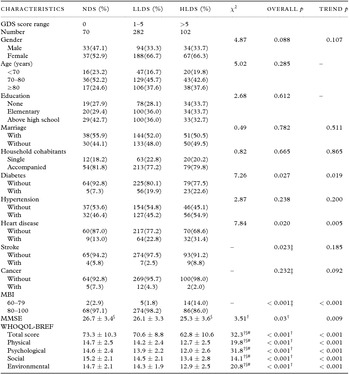
Five hundred and sixteen older adults who attended senior centers were invited to participate in the study. After excluding 26 of these individuals who did not meet the inclusion criteria and 36 who did not complete all the assessments, 454 participants were ultimately included in the study. The distributions of the basic characteristics among the participants exhibiting different levels of depressive symptoms are summarized in Table 1. The MBI, MMSE, and WHOQOL-BREF scores and common morbidities, including diabetes, heart disease, and stroke, significantly differed among the three depressive groups. The Bonferroni post hoc multiple comparison test revealed the presence of significant differences between NDS and HLDS, and between LLDS and HLDS respectively. Significant trends were observed for the variables of diabetes, heart disease, and the MBI score.
Distribution of basic characteristics among participants stratified by three levels of depressive symptoms: no depressive symptoms (NDS), lower level of depressive symptoms (LLDS), and higher level of depressive symptoms (HLDS)

Data are presented as n (%) or mean ± standard deviation.
The χ2 test was performed for overall p; the Cochran–Armitage trend test was performed for trend p for categorical variables; and the single linear regression model (set NDS, LLDS, and HLDS as a continuous covariate) was used for trend p for continuous variables, such as the MMSE and WHOQOL-BREF scores. ‡Fisher's exact test was performed.
†F and p values were estimated by one-way ANOVA.
§Statistically significant difference in variable between NDS and HLDS, as determined by Bonferroni correction.
#Statistically significant difference in variable between LLDS and HLDS, as determined by Bonferroni correction.
WHOQOL-BREF = world health organization quality of life scale-brief version; MBI: modified barthel index; MMSE: Mini-Mental State Examination; GDS: 15-item geriatric depression scale.
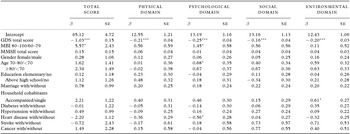
Regression analyses of the WHOQOL-BREF scores demonstrated that the GDS and MBI scores were significantly associated with the WHOQOL-BREF total score and that the GDS score impacted all four WHOQOL-BREF domains (total score: −1.03 ± 0.15; physical domain: −0.21 ± 0.04; psychological domain: −0.25 ± 0.04; social domain: −0.16 ± 0.04; and environmental domain: −0.20 ± 0.03; p < 0.001 for all domains). The MBI score and old age independently affected the psychological domain (Table 2), while having household cohabitants was significantly associated with a higher environmental domain score (accompanied/single: 0.61 ± 0.27, p < 0.05). Furthermore, heart disease negatively impacted the psychological domain score.
Regression coefficients and SEs of the covariates for WHOQOL-BREF domain scores under multiple linear regression models

*0.01≤ p < 0.05, **0.001≤ p < 0.01, ***p < 0.001.
β: linear regression coefficient. SE: standard error.
WHOQOL-BREF: world health organization quality of life scale-brief version; MBI: modified barthel index; MMSE: Mini-Mental State Examination; GDS: 15-item geriatric depression scale.
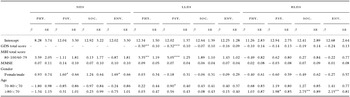
The relationships between the covariates and different WHOQOL-BREF domains stratified by the level of depressive symptoms were further explored; these relationships are summarized in Table 3. The GDS and MBI scores were both significantly associated with the WHOQOL-BREF scores for the physical and psychological domains in the LLDS group. The females in the NDS group exhibited lower scores for the physical and environmental domains, and older age (≧80) was associated with higher scores for three of the WHOQOL-BREF domains in the HLDS group.
Regression coefficients and SEs of the covariates for each domain score of the WHOQOL-BREF, stratified according to different levels of depressive symptoms under multiple linear regression models adjusted for potential confounders†

*0.01≤p < 0.05, **0.001≤p < 0.01, ***p < 0.001.
β: linear regression coefficient; SE: standard error.
†Each regression is adjusted for education level, marriage status, household cohabitants and multi-morbidities, including diabetes, hypertension, heart disease, stroke, and cancer.
WHOQOL-BREF: world health organization quality of life scale-brief version; MBI: modified barthel index; GDS: 15-item geriatric depression scale; MMSE: mini-mental state examination; no depressive symptoms (NDS): GDS = 0; lower level of depressive symptoms (LLDS): 1≦GDS≦5; higher level of depressive symptoms (HLDS): 5<GDS.
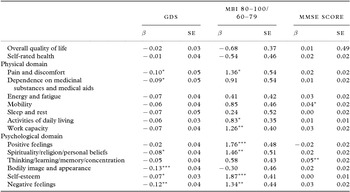
Further analyses of the relationships between each facet of the physical and psychological WHOQOL-BREF domains and the covariates are summarized in Table 4. After controlling for potential confounders, the scores related to facets of pain/discomfort, spirituality/religion/personal beliefs, self-esteem, and negative feelings were higher among the elderly participants who had fewer functional disabilities or were less depressed. In additions, the GDS score was negatively associated with dependence on medicinal substances and medical aids as well as body image and appearance, whereas the MBI score was positively associated with ADLs, work capacity, and positive feelings. Moreover, the MMSE score was positively associated with the two facets of thinking/learning/memory/concentration and mobility.
Regression coefficients and SEs of the covariates for each facet of the physical and psychological domains of the WHOQOL-BREF for the older adults with a lower level of depressive symptoms (LLDS) under multiple linear regression models adjusted for potential confounders†

*0.01≤ p < 0.05, **0.001≤ p < 0.01, ***p < 0.001.
β: linear regression coefficient; SE: standard error.
†Each regression is adjusted for gender, age, education level, marriage, household cohabitants and multi-morbidities, including diabetes, hypertension, heart disease, stroke, and cancer.
WHOQOL-BREF = world health organization quality of life scale-brief version; MBI: modified barthel index; GDS: 15-item geriatric depression scale; MMSE: Mini-Mental State Examination; LLDS: 1≦GDS≦5.
The relationships between the covariates and WHOQOL-BREF scores according to the subjects’ differing levels of depressive symptoms are shown in the appendix. The GDS, MBI, and MMSE scores were all significantly predictive of the WHOQOL-BREF scores in the LLDS group, in contrast with the results obtained for the NDS and HLDS groups. The females experienced a better QOL compared with the males in the NDS group, and the older participants (≧80 years old) experienced a better QOL compared with the younger participants (60–69 years old) in the HLDS group.
Discussion
This study shows that differing levels of depressive symptoms may result in modification of the relationships between QOL and its major determining factors in community-dwelling older adults. Previous studies have reported that age, gender, education level, marital status, family support, and health conditions, such as physical, psychological, and cognitive functions, are associated with QOL (Webb et al., Reference Webb, Blane, McMunn and Netuveli2011; Baernholdt et al., Reference Baernholdt, Hinton, Yan, Rose and Mattos2012; Campos et al., Reference Campos, Ferreira e Ferreira, Vargas and Albala2014; Chang et al., Reference Chang, Yao, Hu and Wang2015; Fernandez-Mayoralas et al., Reference Fernandez-Mayoralas2015), although these factors have not been consistently demonstrated to be significantly associated with QOL by all relevant studies. However, the present study further demonstrates the diverse influences of such variables in people with different levels of depressive symptoms.
In addition to corroborating previous studies’ findings that depressive symptoms may affect every domain and/or facet of the WHOQOL-BREF (Chang et al., Reference Chang, Yao, Hu and Wang2015), this present study demonstrates that the GDS score affects QOL in people with LLDS more than those with HLDS and that its effects are particularly remarkable in the physical and psychological domains. These results indicate that efforts to reduce depressive symptoms may improve the QOL of people with LLDS, particularly with regard to the physical and psychological domains. Moreover, the present study also supports prioritizing the treatment of depressive symptoms and the improvement of physical function among this aging population over other determining factors, as many item scores of QOL investigated in this study were more sensitive to the MBI and GDS scores than to the MMSE score and other co-morbidities.
ADLs are associated with the overall WHOQOL-BREF score (Webb et al., Reference Webb, Blane, McMunn and Netuveli2011; Fusco et al., Reference Fusco, Ferrini, Santoro, Lo Monaco, Gambassi and Cesari2012), although this association may disappear when depressive symptoms are considered (Chang et al., Reference Chang, Yao, Hu and Wang2015). However, the results concerning the effects of the MBI score on the WHOQOL-BREF measurement were only significant for the LLDS group in our study, particularly when considering the physical and psychological domains. In addition to the associations of a high MBI score with many facets of the physical domain, it is associated with lower scores on several psychological facets, including self-esteem, positive and negative feelings, and spirituality/religion/personal beliefs. Perhaps the LLDS subjects with a higher MBI score felt more blessed in their life. The detailed reasons remain to be explored, and these findings may reinforce the importance of research focusing on the LLDS.
Cognitive function may affect QOL, which is in agreement with the results of previous studies (Leon-Salas et al., Reference Leon-Salas2015). Nevertheless, our study may be the first to disclose diverse associations between cognitive function and QOL according to different levels of depressive symptoms. In this study, we deliberately excluded people with severe cognitive impairment (MMSE <18) and observed significant effects of cognitive function only on the facets of mobility and thinking/learning/memory/concentration in the LLDS subjects. This finding implies that better cognitive function may improve satisfaction scores regarding mobility and personal thinking; however, more studies are needed to corroborate this hypothesis.
Interestingly, increased age had protective effects on QOL in the HLDS subjects, particularly with regard to the psychological, social relationship, and environmental domains, although protective effects of age were also found for the psychological domain in the LLDS subjects. This finding appears to be in partial agreement with the U-shaped curve of psychological well-being over lifespan reported in 72 developed and developing countries (Blanchflower and Oswald, Reference Blanchflower and Oswald2008), although this previous study did not control for variables of physical health. If Carstensen's theory, which suggests that the development of life's meaning and decline in the desire to expand one's horizons occurs during aging, is generally true, then similar associations between age and QOL among different levels of depressive symptoms may exist. However, this trend only appeared in the HLDS group in our study. This finding may imply that Carstensen's theory may be more applicable for individuals with HLDS. Our results did not suggest that older individuals with HLDS had a better QOL; however, they implied that aging may have a positive influence on QOL in these individuals. In other words, they may suggest dissimilar effects of life changes in the presence of different levels of depressive symptoms. In addition to the possible interpretation derived from Carstensen's theory, the participants’ conditions must be carefully considered. The participants in our study were apparently physically independent (MBI ≧60) and willing to participate in community activities. The results of the present study may suggest that older persons with HLDS possessing such characteristics and conditions may be more likely to adapt to life's changes and derive meaning from life's events during aging. Notably, the application of these interpretations may be limited and require much caution until a more extensive study is performed.
Previous studies have reported gender differences in QOL in individuals with certain chronic conditions, such as cardiac disease and chronic lung disease (Emery et al., Reference Emery2004; Benton et al., Reference Benton, Alexander and Holland2014). However, the effect of gender on QOL seems to disappear once chronic conditions and depressive symptoms are controlled for (da Rocha et al., Reference da Rocha, Schuch and Fleck2014). The results of the present study indicate that improvements in the WHOQOL-BREF scores associated with being female are only observed in older adults without depressive symptoms (i.e. NDS) and that these effects are restricted to the psychological and environmental domains.
It is important to note the limitations of our study. First, the participants included may not represent the entire community-dwelling older adult population, as they were not randomly selected from the community. However, all community-dwelling older adults were invited to participate and were free to respond. Furthermore, the prevalence of depressive symptoms in our study was 22.3%, which is comparable to that reported in a previous study conducted in Taiwan (21.7%) (Chong et al., Reference Chong2001). Second, the definitions of the LLDS and HLDS, categorized based on the GDS, are not well documented. Definitions based on a screening instrument cannot rule out the possibility of including cases of major, minor, or subsyndromal depression in the LLDS, which may limit the interpretation of our findings. However, given that random misclassification generally trends towards a null effect, it is expected that this limitation would result in underestimation of the magnitude of the effects. Third, we did not make inquiries regarding the participants’ histories of anti-depressant or chronic medication use; thus, we may have underestimated the prevalence of depressive symptoms. We also did not make inquiries regarding poly-pharmacy, which may cause depression. Nevertheless, in constructing our models, we controlled for multi-morbidities, including common chronic diseases, in older adults, which may have helped to control for the effects of medication.
Conclusions
The level of depressive symptoms is an important modifier of the relationships between QOL and its determining factors in community-dwelling older adults. Thus, in caring for this population, identification of the level of depressive symptoms, and proactive intervention should be given priority. Future studies that clarify our hypothesis and/or explore the causal relationships between covariates and QOL and the effects of differing levels of depressive symptoms are warranted to facilitate the development of more practical interventions to improve QOL in older adults.
Acknowledgments
This study was conducted by the Integrated Community heAlth Research and Education (ICARE) in Taiwan with support from grants from Chia-Yi Christian Hospital (R102–6). We are indebted to the Department of Social Services of Chia-Yi Christian Hospital and the Home Service Centre of Chia-Yi County for their kind assistance with data collection. Funding source: Chia-Yi Christian Hospital (R102-6).