Introduction
The acquisition of word-initial clusters generally develops later than that of coda clusters (Kirk & Demuth, Reference Kirk and Demuth2005; Levelt, Schiller & Levelt, Reference Levelt, Schiller and Levelt2000), with two-member /s/-stop clusters (i.e., /sp/, /st/, /sk/) and three-member /s/-stop clusters (i.e., /spr/, /spl/, /str/, /skr/, /skw/) presenting particular challenges for children acquiring English, the former being acquired around 4 years, and the latter not before 6 years (Goad & Rose, Reference Goad and Rose2003; Kirk & Demuth, Reference Kirk and Demuth2005; McLeod, Doorn & Reed, Reference McLeod, Doorn and Reed2001; Smit, Reference Smit1993). Young children often omit the /s/ in /s/-stop clusters, reducing a word like ‘stick’ to ‘tick’, though older children may drop the stop (‘stick’ becomes ‘sick’; Goad & Rose, Reference Goad and Rose2003). Reduced clusters may change the meaning of a word, and/or create a non-word, which may lead to communication problems. The present work focuses on the acquisition of two-member /s/-stop clusters, generally well-produced by typically-developing children before they start school.
One explanation for the challenges children face with /s/-stop clusters is that these violate the Sonority Sequencing Principle (SSP). The SSP is a phonological constraint on the sequences of consonants within a syllable (Clements, Reference Clements, Kingston and Beckman1990; Gierut, Reference Gierut1999), with a preference for a rise in sonority from the edge to the centre of the syllable, following the hierarchy shown in (1).
Thus, a word like ‘slide’ adheres to the SSP, as there is a continuous increase in sonority from the fricative /s/ to the liquid /l/ to the nucleus of the syllable (i.e., the vowel) (Clements, Reference Clements, Kingston and Beckman1990; Fikkert, Reference Fikkert1994; Goad & Rose, Reference Goad and Rose2003; Ohala, Reference Ohala1999). However, a word like ‘stick’ involves a drop in sonority from the fricative /s/ to the plosive /t/, violating the SSP. Such ‘marked’ types of syllable structures tend to be later acquired (e.g., Demuth, Reference Demuth and Beckman1995; Pater & Barlow, Reference Pater, Barlow, Skarabela, Fish and Do2002).
Cluster reduction is also common in the speech of children with hearing loss (HL), where it can continue until 12 years of age. Studies of children fitted with either hearing aids (HAs) or cochlear implants (CIs) suggest that both perform poorly when compared with normal-hearing (NH) children (Asad, Purdy, Ballard, Fairgray & Bowen, Reference Asad, Purdy, Ballard, Fairgray and Bowen2018). Others have found that CI users tend to be more accurate than those fitted with HAs (Baudonck, Lierde, D’haeseleer & Dhooge, Reference Baudonck, Lierde, D’haeseleer and Dhooge2011), and sometimes have a similar phonological development to their NH peers (Eriks-Brophy, Gibson & Tucker, Reference Eriks-Brophy, Gibson and Tucker2013; Faes & Gillis, Reference Faes and Gillis2017; Flipsen & Parker, Reference Flipsen and Parker2008; Fulcher, Baker, Purcell & Munro, Reference Fulcher, Baker, Purcell and Munro2014). However, it is also reported that English-speaking children with CIs tend to preserve the least sonorant segment (e.g., the stop in /s/-stop clusters) when reducing onset clusters in general (Chin, Reference Chin2006; Chin & Finnegan, Reference Chin and Finnegan2002; Faes & Gillis, Reference Faes and Gillis2017), though none of these studies specifically discussed the acquisition of /s/-stop clusters, which are known to be challenging for both typically-developing children (Kirk & Demuth, Reference Kirk and Demuth2005) and those with phonological disorders (Yavaş & McLeod, Reference Yavaş and McLeod2010).
The acquisition of /s/-stop clusters by children with HL cannot be considered independently of these children’s ability to detect/perceive the sounds that constitute the cluster. Fitted with hearing devices, children have access to auditory input, but devices also distort the acoustic signal in different ways, potentially changing the phonetic structure of /s/ (Moeller et al., Reference Moeller, Hoover, Putman, Arbataitis, Bohnenkamp, Peterson, Lewis, Estee, Pittman and Stelmachowicz2007; Serry & Blamey, Reference Serry and Blamey1999). For instance, the bandwidth restrictions of HAs affect the processing of high frequencies, therefore limiting the perception of /s/ by HA users (Stelmachowicz, Pittman, Hoover & Lewis, Reference Stelmachowicz, Pittman, Hoover and Lewis2001). Conversely, CI users have better access to high frequency sounds (e.g., /s/) and are therefore more likely to produce /s/ with a better accuracy than their peers with HAs, especially those with more severe HL (Macherey and Carlyon, Reference Macherey and Carlyon2014). When accompanied by early intervention and targeted auditory training, the use of hearing devices can improve the quality of the speech outcome (e.g., Ching, Zhang & Hou, Reference Ching, Zhang, Hou, Madell and Flexer2017). Nevertheless, acoustic distortion of fricatives may present a challenge for developing phonological representations of /s/, contributing to the late acquisition of English plural morphemes for children with HL (Davies, Xu Rattanasone, Davis & Demuth, Reference Davies, Xu Rattanasone, Davis and Demuth2020).
Most of our knowledge about /s/-stop cluster production in children with HL comes from adult listeners’ transcriptions of these children’s speech. While these methods are important for understanding a child’s phonological inventory and assessing their understanding of language processes, children may sometimes appear to omit segments in their productions, yet leave an acoustic trace, suggesting that they ‘know’ the segment should be there (e.g., Munson, Edwards & Beckman, Reference Munson, Edwards and Beckman2005; Scobbie, Gibbon, Hardcastle & Fletcher, Reference Scobbie, Gibbon, Hardcastle, Fletcher, Pierrehumbert and Broe2000; Song & Demuth, Reference Song and Demuth2008). Importantly, these ‘covert contrasts’ can reveal that children have some phonological representation of the segments they ‘omit’. Therefore, examining the acoustic characteristics of the remaining stop in a reduced /s/-stop cluster can provide a way to determine if children with HL have a representation of the /s/ even when it is ‘omitted’. English voiceless stops are aspirated when they occur as a word-initial singleton (e.g., t ick), but not when they are part of an /s/-stop cluster (e.g., s t ick; Cho, Lee & Kim, Reference Cho, Lee and Kim2014; Klatt, Reference Klatt1975). This difference is evidenced acoustically in terms of the voice onset time (VOT), where aspirated stops have a longer VOT than unaspirated stops. English-speaking two-year-olds with NH already produce the preserved stop in a reduced /s/-stop cluster with a short VOT (i.e., unaspirated) when /s/ is omitted, suggesting an early representation of /s/-stop clusters (Catts & Kamhi, Reference Catts and Kamhi1984). Thus, comparing perceptual ratings by adult listeners with acoustic analysis of children’s productions will provide a more complete picture of the developing phonological knowledge of /s/-stop clusters by children with HL.
The goal of the present study was therefore threefold. First, to objectively determine how often pre-schoolers with HL reduce /s/-stop clusters, which consonant in the cluster is affected, and how this compares to their NH peers. This was done by acoustic inspection of the children’s productions (Analysis 1). It was expected that children with HL would omit more /s/ than their peers with NH. Second, we wanted to know how well the clusters of the children with HL would be understood by naïve listeners who transcribed their speech (Analysis 2). It was hypothesised that naïve listeners would perceive more cluster reduction in the speech of children with HL than in that of children with NH. Finally, we acoustically analysed the clusters with perceived /s/-omissions, looking for covert evidence that the children might have a representation of the ‘missing’ /s/, even though it was not perceived (Analysis 3). It was hypothesised that children with HL would show covert traces of missing /s/ in the acoustic properties (i.e., VOT) of the following stop. Taken together, the findings should provide a comprehensive picture of the acquisition of /s/-stop clusters in English-speaking children with HL, helping both researchers and clinicians develop more targeted interventions.
Method
Participants
Two groups of children participated in the study. The first consisted of 14 children with mild to profound HL (aged 3;4 to 5;9 years, M = 5;0; 5 females, 9 males), recruited from hearing service providers across Australia. Eleven participants were recruited from the Sydney area, two from Melbourne and one from Perth. Four-frequency pure tone averages over the better ear ranged from 15 to 120 dB (M = 57 dB). All participants had bilateral HL. Eight were fitted with HAs (six with bilateral HAs, one with bilateral bone-anchored hearing aids (BAHAs), and one with a unilateral BAHA), five were fitted with bilateral CIs, and one participant used bimodal devices (i.e., one HA and one CI). An additional participant diagnosed with a severe speech disorder (overall speech intelligibility < 50%) was excluded from the study. With the parents’ consent, we obtained clinical and demographic information (Table 1) about each child from their speech-language pathologist. The second group of participants comprised 20 children with NH (aged 4;1 to 5;8 years, M = 4;10; 12 females, 8 males), recruited from various participant pools at Macquarie University in Sydney. All participants had typical speech and cognitive development, all were born in Australia from Australia-born parents, and all were exposed to only Australian English at home. All received stickers and $20 for their participation. The study was approved by the Macquarie University Human Research Ethics Committee, and informed parental consent was obtained for all children prior to their participation in the study.
Demographic and clinical information of children with HL. Age is displayed in years;months

Stimuli
The auditory stimuli were composed of nine high-frequency picturable sCVC words (/sp/: spit, spud, spot; /st/: stick, stuff, stop; /sk/: skip, skull, scone). These were selected by crossing three stop places of articulation (bilabial, alveolar and velar) with three short/lax vowels (i.e., /ɪ/, /ɐ/ and /ɔ/; Cox and Palethorpe, Reference Cox and Palethorpe2007). The selected words had a mean frequency of 4.2 Zipf in the Subtlex-UK CBeebies, a word frequency corpus derived from subtitles of TV programs of the BBC channel for pre-schoolers, CBeebies (van Heuven, Mandera, Keuleers & Brysbaert, Reference van Heuven, Mandera, Keuleers and Brysbaert2014). Stimuli were embedded in a carrier sentence with a preceding vowel: “See my XXX” (for nouns), and “See me XXX” (for verbs). The sentences were recorded by a 25-year-old female native speaker of Australian English in a sound-attenuated room at a sampling rate of 44.1kHz with 16-bit quantization. Each audio prompt was then paired with a cartoon-like drawing of the target word and inserted into Keynote on an iPad.
Procedure
The data for this study were collected as part of a larger study involving multiple conditions (cf. Bruggeman, Millasseau, Yuen & Demuth, Reference Bruggeman, Millasseau, Yuen and Demuth2021). Both groups of participants were tested in a sound-attenuated booth either at the university (n=28) or at a speech therapy centre (n=6). They sat in front of an iPad and an AKG C535 EB microphone placed on a table. The microphone was set at approximately 30cm from the participant’s mouth. For participants tested at the university, the microphone was connected by an XLR cable to a computer in a control room via a pre-amplifier (Sound Devices, USBPre2). For the participants tested elsewhere, the microphone was connected by an XLR cable to a portable Marantz recorder (PMD661MKII). Recordings were encoded as mono WAV files with a 44.1 kHz sampling rate and 16-bit quantization. Audio stimuli were played via a GENELEC 8020A active monitoring loudspeaker (with a free field frequency response of 66 Hz to 20 kHz ± 2.5 dB). The sound level was adjusted at the beginning of the session until the participant could clearly hear the words. No additional filtering or clipping was present. For each trial, a picture was displayed on the iPad. Participants were first familiarized with the target words, being asked to name them. If a child could not name a picture, the target word was played and the child was asked to repeat it. Then, participants were shown how to proceed with the task. When they touched the screen, they saw a picture and the associated sentence/target word played. Each participant completed five pseudo-randomized blocks, each containing all nine target words, for a total of 45 tokens (9 words x 5 repetitions) per participant.
In total, 630 target words were recorded from children with HL and 900 from children with NH. All items were inspected in Praat (Boersma & Weenink, Reference Boersma and Weenink2019) by the first author. Fifteen tokens were excluded from the children with HL (2.4%) and 48 tokens were excluded from the children with NH (5.3%) due either to noise during the recording or because the child was fussy. All 1467 remaining tokens were then subject to acoustic analysis using Praat (Analysis 1) and perceptual rating by two adult listeners (Analysis 2).
Results
Analysis 1
The first author acoustically annotated all tokens in Praat to determine if the productions were accurate and to identify any missing segments. Using visual inspection of the waveform and the spectrogram, four acoustic landmarks were identified in each token to determine the presence of the fricative /s/, the stop closure and the stop release (e.g., Nissen & Fox, Reference Nissen and Fox2005). The beginning of the fricative was identified by a sudden rise in high-frequency energy in the spectrogram, while its end was identified by a drop in high-frequency energy in the spectrogram matching with the beginning of a flat waveform (i.e., beginning of the closure duration). The start of the following stop was identified from the first peak of energy and a sudden spike in the amplitude of the waveform following the closure. The end of the stop was identified at the start of the following vowel by the beginning of a strong F2 in the spectrogram aligned with the beginning of the complex periodicity of the waveform. Any token with a missing fricative was classified as /s/-omission. Those without closure duration and stop release were classed as stop omission. No other types of reduction were observed in the data.
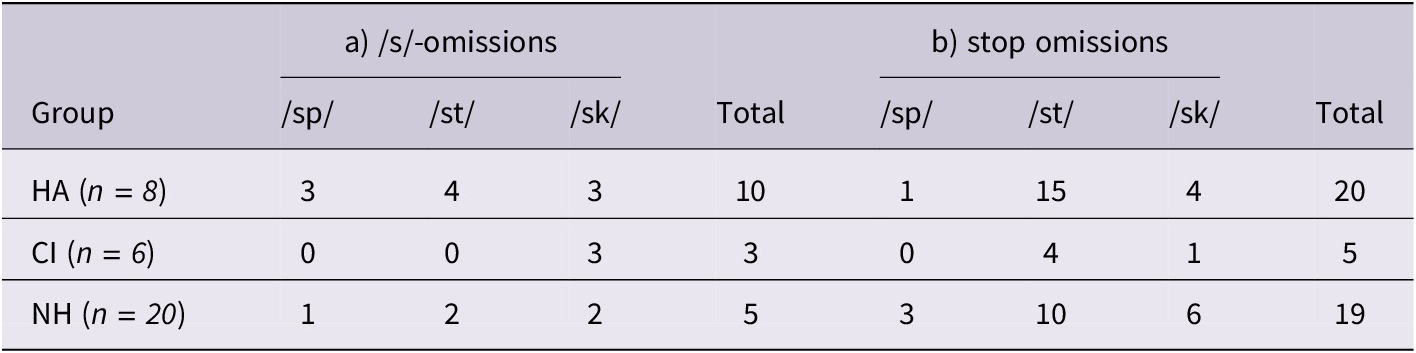
The total number of /s/-omissions and stop omissions is shown in Table 2, with most of the stop omissions occurring in words with /st/-clusters, where both segments share the same (alveolar) place of articulation. Overall, the children with HL reduced only 38 tokens (6% of the HL data), and the children with NH 24 tokens (3% of the NH data). The majority of reductions by the children with HL came from those with HAs (30 tokens), with only eight from those with CIs. Most came from participants HL1 (7 /s/-omissions, 2 stop omissions) and HL4 (1 /s/-omission, 10 stop omissions). The majority of reductions from the children with NH were contributed by one participant (5;0 years; 5 /s/-omissions, 13 stop omissions). These participants and omission patterns are further explored in the Discussion.
Number of acoustic a) /s/-omissions and b) stop omissions by cluster type and group (HA: hearing aid; CI: cochlear implant; NH: normal hearing).

To determine whether the children with HL reduced /s/-stop clusters more often than their peers with NH, we statistically compared the children with HL to those with NH, on 1) the number of overall cluster reductions, 2) the number of /s/-omissions, and 3) the number of stop omissions. The small number of cluster reductions precluded further statistical comparison between users of different types of hearing devices. Three separate generalized mixed-effects models were fitted in R (R Core Team, 2016) using the lme4 package (Bates, Mächler, Bolker & Walker, Reference Bates, Mächler, Bolker and Walker2015). Each model included the fixed predictor Group (NH vs. HL), as well as random intercepts for items and participants. The predictor Group was dummy-coded with NH children as the reference level (coded: 0), and children with HL coded as 1. The models fitted to cluster reductions and stop omissions both revealed a significant effect of Group, indicating that children with HL made more errors (β = 0.91, z = 3.40, p>0.001), and omitted more stops (β = 0.70, z = 2.25, p = 0.024) than their peers with NH. The model fitted to the /s/-omissions revealed no effect of Group (β = 2.11, z = 1.02, p = 0.307), i.e., the children with HL did not omit /s/ more often than their peers with NH.
Analysis 2
We then continued with a perceptual analysis of the data. Without prior knowledge of the material, two monolingual native speakers of Australian English orthographically transcribed the 615 words produced by the participants with HL (HA: 395 tokens; CI: 220 tokens). We chose naïve listeners rather than trained clinicians, as the former are a better proxy for the general population that children with HL interact with in everyday life. Both raters’ transcriptions matched the intended target word in 81% of cases (n = 496), with 35 tokens transcribed as incorrect by only one rater, and 41 tokens by neither rater. Of all incorrect perceptions/transcriptions (n = 35 + 2*41 = 117), 52 were /s/-omissions, 21 were stop omissions, 43 were stop fronting/backing errors and one was a fricative backing error (/s/ became /ʃ/). The misperceptions were spread across participants, occurring for 10 out of the 14 children with HL (see Table 3).
Number of perceived a) /s/-omissions and b) stop omissions by cluster type and group (HA: hearing aid; CI: cochlear implant).

Thirty-eight of the 52 transcriptions (73%) where /s/ was perceived as omitted additionally involved incorrect perception of the following stop as voiced (e.g., ‘spit’ was perceived as ‘ b it’), These were spread amongst six of the children with HL (4 HAs, 2 CIs; age range: 4;1 – 5;9 years), with three (HL1 with HAs, HL12 and HL14 with CIs) accounting for most of these perceived /s/-omissions (28 tokens). Interestingly, of the 18 tokens from both groups of children deemed to have acoustic /s/-omissions in Analysis 1, only ten were perceived as /s/-omissions here. The remaining 8 came from two participants: three from HL1 (an HA user) and five from NH10.
Analysis 3
To investigate the possibility of a (non-perceptible) acoustic trace for the ‘missing’ /s/, we then examined HL1, HL12, HL14, and NH10’s mean VOT in a) the stops of all tokens where /s/ was perceived as omitted by at least one rater in Analysis 2, and b) the eight additional tokens without /s/ that were acoustically identified in Analysis 1. VOT was measured from the onset of the stop release burst until the beginning of the following vowel, using the landmarks placed in Analysis 1. To validate the placement of acoustic landmarks, the third author also annotated all tokens. Reliability of the annotation was high (r = 0.99, p<0.001).
We then compared the above with the same participants’ mean VOTs when a) clusters were fully produced (e.g., ‘s t ick’) and when b) the same voiceless stops were produced in singleton words (e.g., ‘ t ick’; data from Bruggeman et al., Reference Bruggeman, Millasseau, Yuen and Demuth2021; see Figure 1). If the VOT of the preserved stop is shorter than that of the singleton, this would suggest that the child had a phonological representation of the ‘missing’ /s/, adjusting the acoustic realization of the stop to match what it would be in a full cluster. However, if the VOT of the preserved stop is similar in duration to the VOT of singletons, this might indicate a lack of phonological representation of the /s/.
VOT (ms) of the preserved stops in reduced clusters (e.g., ‘stick’ > ‘tick’) produced by participants HL1 (HA), HL12 (CI), HL14 (CI) and NH10, compared to participant means for stops in fully-realised clusters (e.g., ‘stick’; shown in orange) vs. target voiceless singletons (e.g., ‘tick’; from Bruggeman et al., Reference Bruggeman, Millasseau, Yuen and Demuth2021; shown in blue). Note that each token is only displayed once, even if it was misperceived by both raters.

Given the small number of tokens, no statistical analysis was conducted. However, visual inspection of the data suggests that these children have a phonological representation for /s/ even when it is ‘omitted’, with the VOT of their preserved stops being closer to the mean VOT in their clusters than the mean VOT of their singletons. Overall, these VOT patterns, in conjunction with the small number of /s/-omissions overall, suggest that these children with HL have a representation of /s/ even when it is perceived as ‘omitted’. This is further supported by the raters’ reports of perceiving a voiced stop when the /s/ was perceived as missing: a shorter VOT would contribute to this perception.
Discussion
The present study acoustically examined the realization of English word-initial /s/-stop clusters produced by pre-schoolers with HL, anticipating that they would reduce /s/-stop clusters more often than their peers with NH. In line with previous findings on cluster reductions by children with HL, they indeed made more errors than their NH peers (Asad et al., Reference Asad, Purdy, Ballard, Fairgray and Bowen2018; Eriks-Brophy et al., Reference Eriks-Brophy, Gibson and Tucker2013). Encouragingly however, they were quite accurate overall (Analysis 1: 94% acoustically correct production; Analysis 2: 81% correct perception by naïve listeners), suggesting that they have acquired the phonological representation for /s/-stop clusters (Fulcher et al., Reference Fulcher, Baker, Purcell and Munro2014). Since amplification improves children’s ability to perceive high-frequency sounds such as /s/, this reinforces emerging evidence of the benefits of both newborn hearing screening and early intervention (Ching et al., Reference Ching, Zhang, Hou, Madell and Flexer2017).
Analysis 1 revealed that most of the acoustic omission errors by the children with NH came from a single participant, aged 5;0 years, who omitted more stops than /s/, typical of 4-to-5-year-olds’ omissions (Goad & Rose, Reference Goad and Rose2003). Most of the acoustic omissions by the children with HL also involved omission of the stop, and came from 5;3-year-old participant HL3 (with HAs). This child was diagnosed at birth with mild bilateral HL but not fitted with HAs until the age of 4;5. This prolonged period without amplification should have resulted in more /s/ than stop omission. It is possible that this child’s residual hearing helped him build knowledge about cluster structure, leading to the reduction patterns more typical of older NH children.
The results of Analysis 1 also showed that most of the stop omissions, by two children with HA and one with NH, involved the cluster /st/, where both segments share the alveolar place of articulation suggesting a potential influence of articulatory factors. It has been suggested that alveolar segments, especially /s/ and /t/, may not reach an intelligible level in children fitted with CIs even after six years of implant usage (Blamey, Barry & Jacq, Reference Blamey, Barry and Jacq2001). Although no reports on children with HA are available, it is possible that the difficulty in producing these segments is due to a lack of the fine articulatory control of the tongue tip required to vary the manner of articulation, from the fricative /s/ to the stop /t/. Further investigation is needed to explore the possibly articulatory underpinnings of this phenomenon.
Both Analysis 2 and 3 suggest that the children with HL who had some omission errors follow the reduction patterns often observed in children with NH (i.e., more /s/-omissions for younger children, and more stop omissions for older children; Goad & Rose, Reference Goad and Rose2003). This suggests that young children with HL may also first maximise the sonority difference between the preserved stop and the following vowel. Then, as they get older, they preserve the head of the consonant cluster (i.e., the /s/). This provides encouraging evidence that children with HL may follow some of the same phonological developmental patterns as their NH peers. Challenges seem to remain at the articulatory level, as evidenced by cluster reduction being more likely in /st/-clusters, where both segments share the same place of articulation.
The fact that there were fewer acoustic than perceived errors suggests that pre-schoolers with HL have some covert contrasts for ‘missing’ /s/, indicating that they have a representation of /s/ even when it may not be perceivable by listeners. This was confirmed by Analysis 3. Recall that, in English, voiceless stops occurring as a singleton at word-onset are aspirated and have a long VOT, whereas voiceless stops that form part of an /s/-stop cluster are unaspirated and have shorter VOT (Cho et al., Reference Cho, Lee and Kim2014; Klatt, Reference Klatt1975). For the three participants (one with HAs, two with CIs) who had the most /s/-omissions, the VOT of the preserved stop generally resembled the mean VOT of the stops they produced in full clusters, and was shorter than the mean VOT of the stops they had produced as target voiceless singleton stops (cf. Bruggeman et al., Reference Bruggeman, Millasseau, Yuen and Demuth2021). This further supports the idea that these children have a phonological representation of /s/-clusters, even if /s/ is sometimes perceived as omitted.
Interestingly, there were overall more perceived (Analysis 2) than acoustic /s/-omissions (Analysis 1). Further investigation suggests that in some items the /s/ was re-syllabified as the coda of the preceding word in the carrier phrase. These re-syllabified fricatives had a mean duration of 190ms whereas the fricatives correctly syllabified as part of the onset cluster had a mean duration of 167ms. However, given the small number of items (n = 8), no further analysis was conducted.
In sum, our analyses show that pre-schoolers with HL generally produce /s/-stop clusters accurately, following the same developmental patterns as their peers with NH. Even when /s/ is omitted from a cluster, covert contrasts are present, pointing to the existence of a phonological representation of the ‘missing’ /s/. Taken together, these acoustic and perceptual analyses provide a more comprehensive understanding of the development of phonological representations in children with HL, confirming that articulation may present a challenge.
Acknowledgments
We thank our collaborators at The Shepherd Centre, The Royal Institute for Deaf and Blind Children (RIDBC)/NextSense and Hearing Australia for helping recruit participants and sharing facilities, Elise Tobin and Mary Youkhanna for the perceptual analysis, and members of the Child Language Lab at Macquarie University for helpful discussion and feedback. This research was supported, in part, by an Australian Research Council (ARC) Laureate Fellowship to the last author (#FL130100014), an ARC/Macquarie University scholarship (2013225) to the first author and by the ARC Centre of Excellence in Cognition and its Disorders (#CE110001021).