

The Source of the Douix (Fig. 1), a freshwater spring within the modern town of Châtillon-sur-Seine, Côte-d’Or, France, has been a focal point for ritual offerings for over 2000 years. Three phases of deposits dating from the late Hallstatt to early La Tène periods, the late La Tène to the Gallo-Roman periods, and the early modern period (Table 1) share some similarities despite being separated by hundreds of years and seem to have a possible connection to women. Could these deposits represent the continuity of practice and ideas despite the gaps? If not, how are we to understand the intermittent ritual deposits here? Using the material and historical evidence available from each period, we will examine if and how a place could maintain a similar ritual tradition for over two millennia.
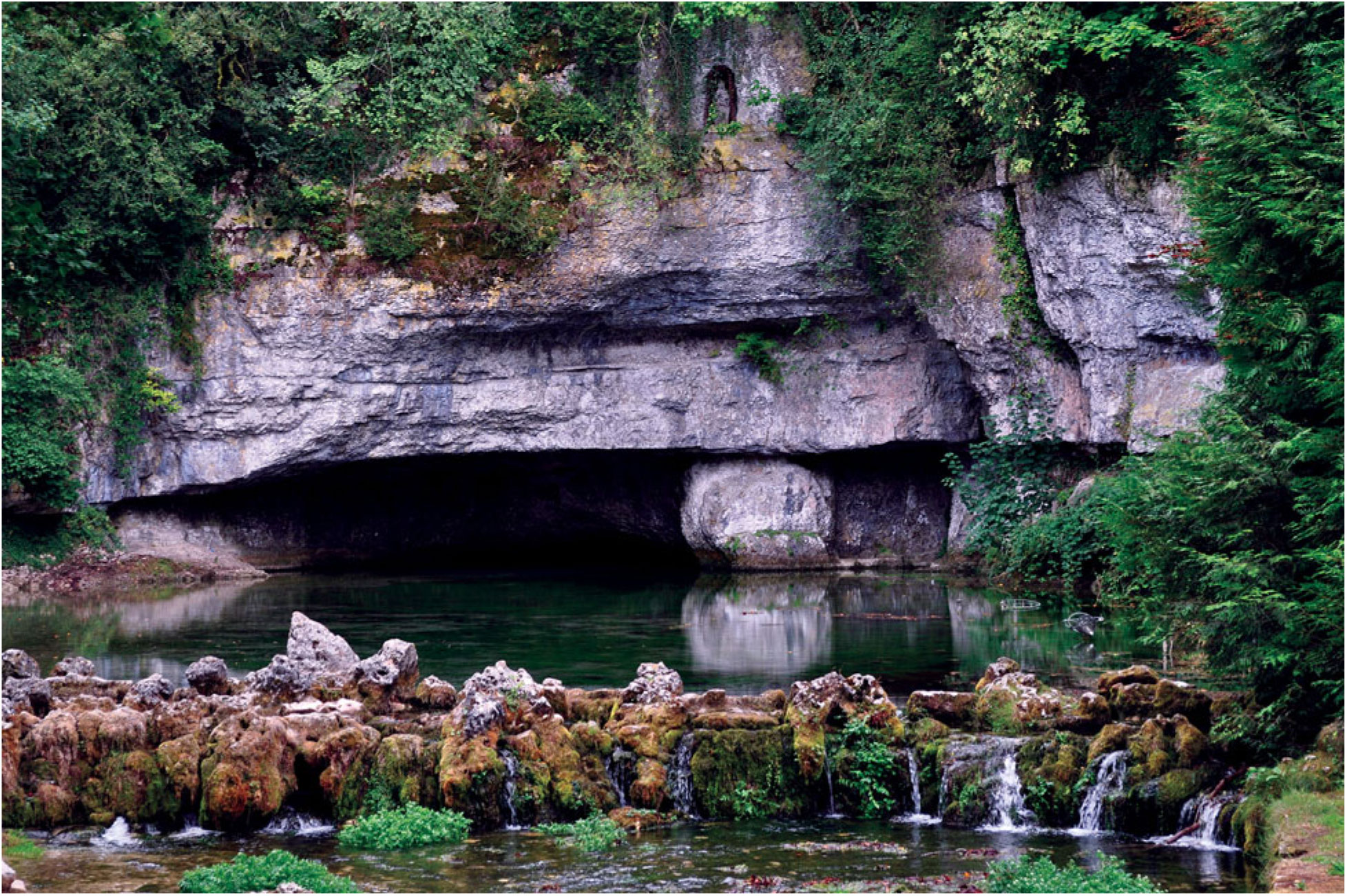
The Source of the Douix, Châtillon-sur-Seine (© K. Erdman)

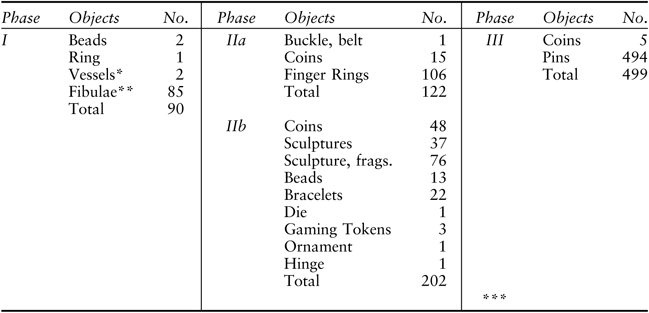
DEPOSITIONAL PHASES AT THE DOUIX (APPROXIMATE DATES)

WATER DEPOSITS IN EUROPE
Deposits of diverse objects into various forms of water are not uncommon throughout European prehistory (Bradley Reference Bradley1990; Reference Bradley2017). Lakes, marshlands, rivers, and springs were focal points for ritual practices from at least the Neolithic period through modern times. While sometimes challenging to interpret the reasons for venerating watery features, different examples suggest that fertility, safe passage, prevention of droughts, protecting cultural boundaries, recovery from an illness, or military success, are just a few of the possible motivations. The materials deposited into or near watery contexts vary over time and space demonstrating the complexity of this ancient tradition.
The late Iron Age site of La Tène at Lake Neuchâtel in Switzerland is well-known for its collection of mangled weaponry and metalwork, human and animal remains, craft tools, and agricultural equipment associated with a timber causeway (Vouga Reference Vouga1923; de Navarro Reference de Navarro1972). Some of the weapons were heavily broken or altered as a form of display during the ritual process which has been observed at other contemporary land-based ritual centres such as Gournay-sur-Aronde discussed below (Brunaux et al. Reference Brunaux, Méniel and Poplin1985). In addition to their destruction, another crucial part of the spectacle was the visible separation of offerings from the physical world as they were thrown off the wooden bridge jutting into the lake (Bradley Reference Bradley1990, 173).
Marshlands, swamps, and bogs were important features in the landscape for ritual activity in northern Europe and the British Isles and have preserved rare organic materials as well as metallic luxury items or ‘special’ objects like the Trundholm Sun Chariot from the Early Bronze Age and the Gundestrup Cauldron from the La Tène period (Green Reference Green and Green1996, 468; Kaul Reference Kaul1998). In a peat bog in Hjortspring, Denmark, a 19 m long boat dating to the late 4th century bc was preserved (Randsborg Reference Randsborg1995, 19). It was filled with assorted weapons and their organic elements, such as wooden scabbards, bone and antler spearheads, and wooden shields and handles, as well as bronze objects, wooden vessels, and moulded boxes with lids, ceramics, cordage, and other materials. The complex assemblage, which shows possible Mediterranean influences on local offering traditions, has been interpreted as a way of solidifying social boundaries through the spoils of a battle and was deposited here where the sky and underworld meet (Randsborg Reference Randsborg1995, 75, 203). One of the best-known categories of bog deposits, preserved human sacrificial victims, also described as bog bodies, have been discovered across northern Europe dating from the Bronze Age through Roman period. Some of the victims ate special meals prior to their deaths preserved in their stomachs, have elaborate hairstyles (Green Reference Green1998, 173), and show strong evidence for ‘overkill’ (Turner & Briggs Reference Turner, Briggs, Stead, Bourke and Brothwell1986, 159) indicating these were planned ritualised deaths with the human as the primary offering.
Unlike those in lakes and bogs, river deposits can be more complicated to interpret as they are in a more turbulent environment which may obscure their original contexts and assemblages. Deposits in some rivers span incredible depths of time, like the Saône (Bonnamour Reference Bonnamour2000, 28–35). As far back as the Neolithic, tools made from antler, ground stone axes, ceramics, and long flint knives have been recovered. There is some evidence for the continuity of tradition into the Bronze Age when long bronze knives replace those made of flint, with the additions of ceramics, axes, and pins. In the Late Bronze Age bracelets and swords appear for the first time along with pendants, other armour and weapons such as lances and helmets, and many bronze vessels in various forms. There is a decline in materials from the early Hallstatt period but, later, weapons such as swords and knives appear. La Tène deposits include helmets, lance points, and swords with highly decorated scabbards, and objects associated with fireplaces, such as firedogs and bronze cauldrons, as well as brooches, iron ingots, and human remains. Some of these objects continue to be deposited in the Roman period as well as ceramic vessels and amphorae, many coins, bronze and silver vessels in a variety of forms, and iron tools. Interestingly, from the Middle Ages through to World War II, weapons continue to be deposited into the river. Three categories are present across almost the entire temporal span: tools, weapons, and metal vessels; the similarities suggest some transference of traditions and ideas.
Springs are another receptacle for deposits and will be the primary focus of the subsequent text. They share similarities with other watery contexts but differ in several ways which also have implications for their analysis by archaeologists. Unlike some other forms, the connection between water and the earth is often visible at springs as water flows out from below the surface, offering a host of symbolism available for interpretation. Additionally, some may be associated with unusual formations, such as rock outcrops or large fissures, or other natural features, such as trees, requiring a more extensive interpretation of the surrounding landscape. The immediate locations around springs and in the water itself are often saturated and stable, like bogs, leading to the preservation of organic materials, for instance the Source de la Roches, Puy-de-Dôme (Romeuf & Dumontet Reference Romeuf and Dumontet2000). And since the context is overall less turbulent than rivers, the findspot of artefacts is quite likely their original depositional location, or close to it. Artefacts in or near the water, especially large quantities of similar objects, are less likely to be accidental as water typically moves away from the source, indicating intentional deposition. Unlike other watery contexts, such as rivers, lakes, or bogs, where the inability to recover offerings seems to be important in depositional practices, offerings at some springs can be retrieved since the water is shallower. This demonstrates different ritual norms, rules, and motivations at those locations. One exception to this would be hot springs, as at Bourbonne-les-Bains, Haute-Marne, whose temperatures may not permit recovery (Sauer Reference Sauer2005).
Water from springs can vary significantly. In addition to hot springs, some are known for their high levels of salt, sulphur, or iron. For example, the spring of Röekillorna in Sweden has iron-rich, red water which surely stood out on the landscape (Stjernquist Reference Stjernquist1997, 59). Intermittently used from the Neolithic through early Roman period, a large quantity of bones from horse, dog, cattle, sheep, pig, and some human bones were recovered along with ceramic vessels and tools for processing meat dating to the Neolithic. The presence of domesticates, and a carved wooden phallus and figurine also recovered from the spring, suggest the spring was associated with fertility (Stjernquist Reference Stjernquist1997, 92). Röekillorna illustrates several points made above: its stable environment preserved organic remains providing a better understanding of the spring’s importance; the large quantity of similar deposited materials into the spring indicates this was not the result of accidental loss; and the unusual water marked it as a special place in the landscape with the red water heightening an analogy to fertility.
Not all water deposits are the same, even during the same period between sites or within the same geographic range or at a particular site (Bradley Reference Bradley2017, 50). There is great diversity that needs to be explored and contextualised with broader ritual and social landscapes as well as within a site itself when great time-depth is evident. Rivers have evidence for deposits over millennia, but their less secure environment can sometimes make interpretations challenging. It is unusual for such depositional practices to persist at a single spring for centuries let alone millennia; many examples represent single depositional events or repeated behaviours lasting a few generations. The Source of the Douix, whose offerings transcend the transition from the prehistoric to historic periods and into the modern world, is a rare example and therefore, must be explored.
THE SOURCE OF THE DOUIX
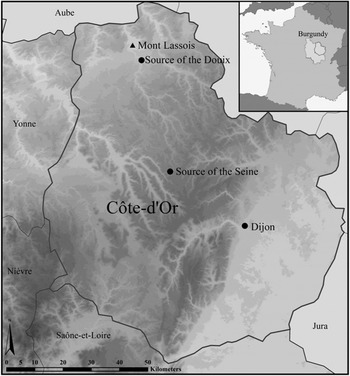
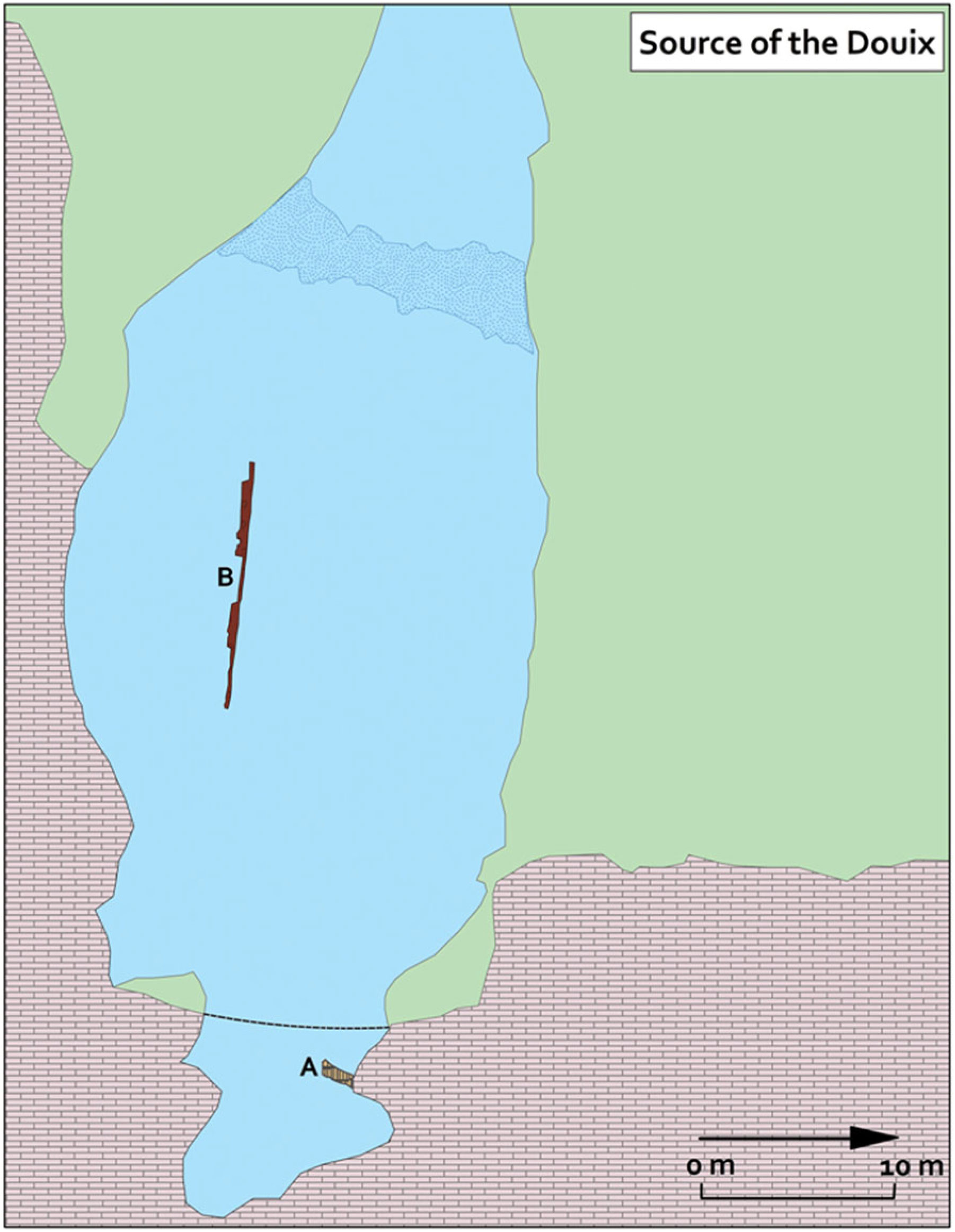
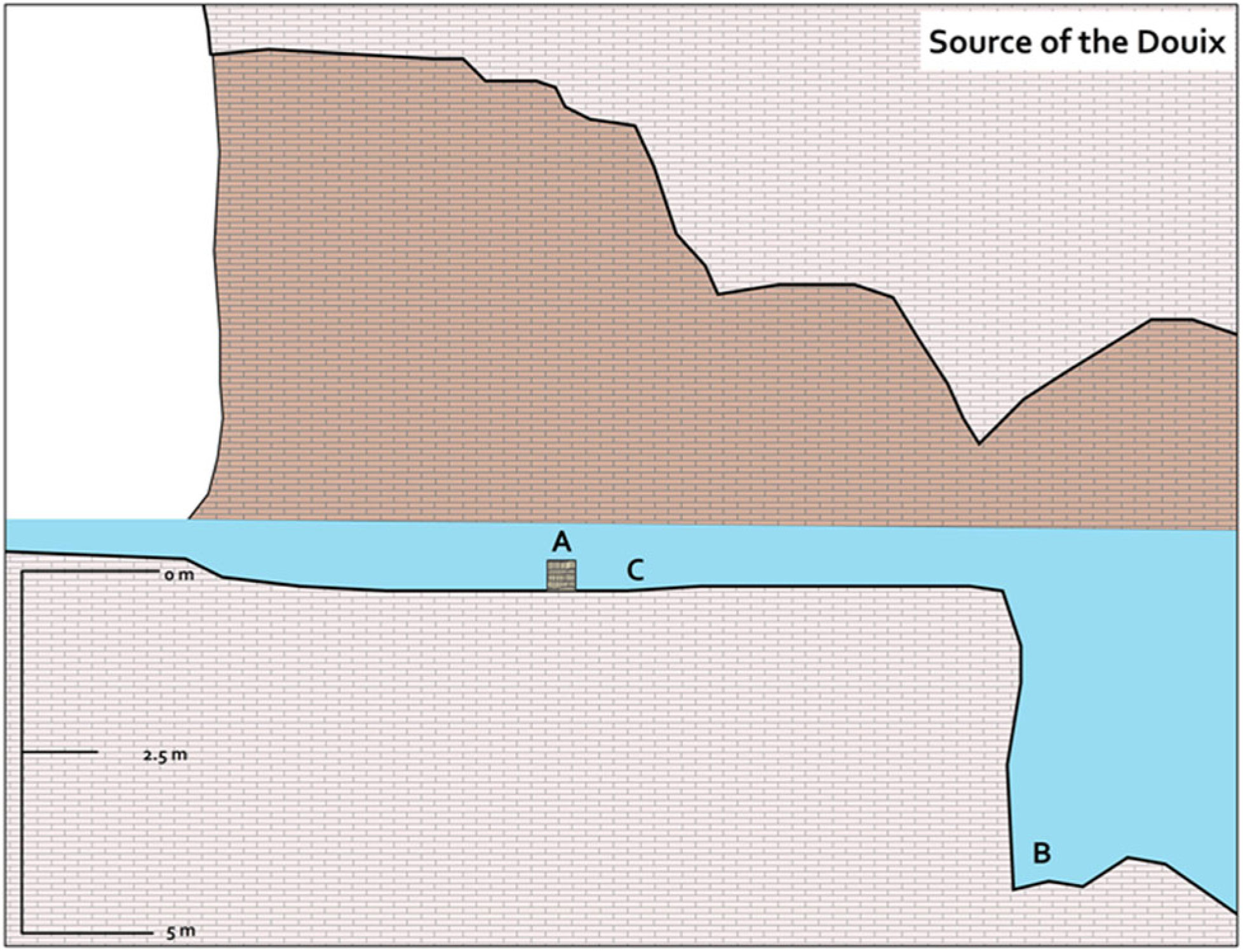
Located 83 km north of Dijon and 7 km south-east of Mont Lassois, the Source of the Douix (Fig. 2) erupts through an eroded cave at the base of a limestone plateau within the modern town of Châtillon-sur-Seine. Speleologists investigating the spring’s subterranean karst system in the 1990s recovered cultural materials while diverting the water in an attempt to remove a subterranean blockage (Buvot Reference Buvot1996). Though some mosaic tiles and paving stones were found during their exploration, the only structures uncovered were the remains of a 16th century washing station erected to the south-west of the cave and a Gallo-Roman wall (Fig. 3). The latter was built inside and perpendicular to the mouth of the cave with a central opening for the water to flow out as a small stream before connecting with the Seine river (Buvot et al. Reference Buvot, Degouve, Laureau and Levêque1997, 54; Renard Reference Renard1997, 69). Most of the artefacts were recovered from behind this wall under around 1.5 m of sediment which had built up over time, eventually covering both the artefacts and the wall itself and simultaneously raising the water level over 2 m from antiquity – reducing the grandeur of the cave. The location of the artefacts (Fig. 4), inside the cave and behind the wall from which water flows out, indicates objects were intentionally deposited into the water and were not the result of accidental loss or flow accumulation. The objects have little to no damage resulting from water turbation, rather many became encrusted by sediments, further supporting their deposition in a stable, unmoving environment.
Map illustrating the locations of the Source of the Douix, Mont Lassois, and the Source of the Seine

Plan of the Source of the Douix showing the locations of (A) the Gallo-Roman wall and (B) the 16th century washing station (adapted from Buvot et al. Reference Buvot, Degouve, Laureau and Levêque1997)

Profile of the Source of Douix’s cave, water level, a portion of the subterranean karst system, and approximate locations of (A) the Gallo-Roman wall, (B) the Iron Age fibulae, and (C) Gallo-Roman sculptures (adapted from Buvot et al. Reference Buvot, Degouve, Laureau and Levêque1997)

Despite the lack of more specific contextual and stratigraphic information and the pre-depositional wear obscuring recognisable attributes of some objects, we have identified a total of 1170 objects dating from the Hallstatt, La Tène, Gallo-Roman, early modern, and modern periods (Table 2). The following discussion focuses only on the dominant artefact categories from the ancient and Early Modern period assemblages; a complete catalogue of the entire assemblage is available online (see Erdman Reference Erdman2014a).
TOTAL NUMBER OF OBJECTS FROM THE DOUIX BY DEPOSITIONAL PHASE

* These vessels are broken, but complete. Additional sherds are being studied and will be presented by Bardel, pers. comm.
** These fibulae are complete or nearly complete. There are over 100 fibulae fragments not included in this total
*** Table does not include modern or indeterminable objects (see Erdman Reference Erdman2014a for complete catalogue)
DEPOSITIONAL PHASES, THE MATERIALS, AND THEIR CONTEMPORARY SOCIAL CONTEXTS
Over the course of 2000 years, there are three phases of deposition at the Douix with two major breaks in the record, the first spanning about 325 years and the second almost 1100 years.
Phase I: The princess and the fibulae
Phase I dates from Hallstatt D1 to La Tène A (approximately 620–400 bc). Bronze and iron fibulae dominate the assemblage with 85 complete or nearly complete examples and more than 100 additional fragments.
These dates are particularly significant because they overlap chronologically with the fibulae recovered from the buildings, backfill, and graves at the nearby princely centre of Vix, located on and around Mont Lassois. The site is best known for its large tumulus found in the plains of Vix containing elaborate feasting and luxury objects imported from the Mediterranean between 530 and 480 bc and the remains of a female often referred to as the ‘Lady’ or ‘Princess’ of Vix, the designation of which has been discussed elsewhere (Pauli Reference Pauli1972; Reference Pauli1975; Arnold Reference Arnold, Walde and Willows1991; Reference Arnold1995; Reference Arnold, Torreira, Ruiz and Camacho2012; Knüsel Reference Knüsel2002; Ginolhac et al. Reference Ginolhac, Orlando, Thenot, Hänni and Rolley2003). Later excavations, in the 1990s, uncovered an adjacent square enclosure used during Hallstatt D2–D3 for ancestor veneration and feasting, as demonstrated by a large number of ceramic cups (Chaume & Reinhard 2007; Reference Chaume, Reinhard and Chaume2009). Recent excavations have revealed that the site extends into the modern village of Vix with a large apsidal house on the bank of the Seine and onto the plateau of Mont Lassois, where five large houses have been exposed, the largest of which dates to around 500 bc (Chaume & Reinhard Reference Chaume and Reinhard2007; Chaume et al. Reference Chaume, Nieszery, Reinhard, Chaume and Mordant2011).
As demonstrated by these special features, the Lady of Vix likely held power and status within this conglomerate as a venerable female leader, an unusual example within this phenomenon. Around the middle of the 6th century bc there is a noticeable shift in burial customs from primarily graves of elite male warriors with their swords (820–630 bc) to a system which includes elaborate female graves whose status and frequency is equal to their male counterparts (Chaume Reference Chaume, Fernoux and Stein2007, 44). This change suggests there is increasing complexity in Hallstatt social and political systems where power may be inherited not only by men but also by women. At some princely centres, such as Mont Lassois, a matrilineal society may have even taken root for a time. While future DNA analyses may shed light on the transmission of power and women’s leadership roles in society, we can use this as a hypothetical model to explain the burial evidence and wider changes happening in the archaeological record during the late Hallstatt period. Historical examples of the Lombard or Ostrogoths queens of Italy (7th–8th centuries ad) and their Carolingian counterparts in France in the 9th century ad show what this model may have looked like. Widowed queens possessing both royal treasure and titles, as well as other claims from their dead kings, had legitimised and prominent positions in their own claims for royal succession (Stafford Reference Stafford and Tyler2000, 72–3). During the late Hallstatt period, in the absence of a male heir, women could have stepped into political roles, a term used here in its broadest sense. Their social position could have been further strengthened by religious or divinatory powers which they could have possessed as envisaged by some authors (Pauli Reference Pauli1972; Arnold Reference Arnold, Walde and Willows1991; Knüsel Reference Knüsel2002). Political and religious powers, far from being antinomic, were closely intertwined in antiquity (Krausse Reference Krausse, Villes and Bataille-Melkon1999).
The centre of Vix offers a contemporary, proximal, and well-documented site to which the Phase I fibulae from the Douix can be examined. The similarities and differences between the sites shed light on the role of fibulae in ritual practices (Fig. 5). There is overlap in some fibula types, for example Mansfeld dP4 and F4 (Fig. 6, Nos 4 & 9; after Mansfeld Reference Mansfeld1973 typology) are abundant at both the Douix and Vix; however, some types are more common or unique to one site than the other. Within the Douix assemblage, 16.4% are the Weidach type (Fig. 6, No. 10; Mansfeld Reference Mansfeld1973 P4), whereas there is only one example (0.77%) at Mont Lassois (Chaume Reference Chaume2001, 116–20). Another example, the dZ3 type found at Vix, was not deposited at the Douix (Chaume Reference Chaume2001, 120–2, fig. 99). In other words, there are shared fibula types between Vix and the Douix, but those common at Vix are less frequent at the Douix and those that are more abundant at the Douix are less common at Vix. The overlapping fibulae confirm that the inhabitants from Vix visited the Douix for some sort of ritual activity that required the deliberate selection of particular fibula types.
Chart comparing the fibulae from Mont Lassois and the Douix

Typology of the Douix fibulae: 1. S1; 2. S4–S5; 3. P2; 4. dP4; 5. Golfe du Lion; 6. F2 A1; 7. F2 E; 8. F3; 9. F4; 10. P4 or Weidach; 11. zoomorph; 12. discoïd; 13. Marzabotto (scale 1:1, © K.B. Rothe)

Many of the fibulae were discovered in the water pump, drawn up from a lower level by accident, during the exploration of the spring (Fig. 4), so one must speculate whether the fibulae were thrown into the source all at once or if they represent a series of successive deposits. There is a 200 year gap between the oldest fibulae (dating to Hallstatt D1) and the most recent (dating to LTA) suggesting a series of deposits over time. However, it is also possible that the fibulae were retained, possibly as heirlooms, and collected in a single container before being thrown into the spring. A similar practice has been observed at a hot spring near Duchcov in the Czech Republic. A late Hallstatt bronze cauldron was found containing at least 1600 bronze objects including 850 fibulae, 650 bracelets, and 100 finger rings from the La Tène period; the stylistically limited ornaments point to a very narrow period of deposition in the spring (Kruta Reference Kruta1971, 26). However, as conceivable as it may be to apply this model to the Douix, the idea of a single deposit is inconsistent with the available evidence and better reflects a scenario of multiple offerings over a period of about two centuries.
The depositional chronology for Phase I pre-dates the reign of the Princess of Vix, but there are far fewer fibulae from the earlier dates at both Vix and the Douix. During and after this period, there is an increase in the quantity of fibulae deposited in the spring suggesting the ritual became more popular or took on a new significance under her leadership. It is probable that the Lady of Vix, who held a special status in her society, had power that extended to ritual activities too, which ensured social cohesion and stability of the community (Chaume Reference Chaume, Fernoux and Stein2007; Brun & Chaume Reference Brun and Chaume2013).
One issue we must consider is the difficulty in attributing fibulae to a particular sex without broader contextual information. As evident in Hallstatt and La Tène burials, both men and women wore fibulae but in different places on the body and in varying quantities over time (Arnold Reference Arnold, Walde and Willows1991). There is, however, at least one contemporary example which supports a possible female focus to the Phase I rituals at the Douix. An unusual natural rock arch in Egesheim, Germany known as the Heidentor was a ritually significant place for women and fertility in the Hallstatt and La Tène periods. Nearly 70 fibulae and fibulae fragments were recovered from the slope near the arch, as well as other objects often found with women in burials – bronze earrings, finger rings, pendants, beads, belt pieces, hairpins, and ceramics (Dehn Reference Dehn1991). While we cannot rule out participation of men in the ritual deposition of fibulae at the Douix, examples like the Heidentor illustrate that female-centric offerings of personal ornaments were not unheard of during the Iron Age. This example combined with the increased frequency of fibulae during and after the time of the Princess of Vix offers a compelling argument that the Douix could have been a ritual centre for women like the Heidentor, or that rituals here could have been led by or performed on the behalf of women or conceptually linked to women.
Phase II: transformations, fertility, and diverse offerings
Between Phases I and II, there is a gap of approximately 300–350 years with no depositional evidence. Phase II is divided into two sub-phases representing two culturally and materially distinct periods. Phase IIa (mid-1st century bc–ad 14) is defined by major social, political, and economic upheaval including the invasion of Gaul by Julius Caesar, the subsequent Gallic Wars, the conquest of the Gauls, and life under the first Roman emperor, Augustus. It marks the beginning of significant changes and transitions from late La Tène culture to early Gallo-Roman, which are visible archaeologically by a shift to the mass production of goods, the rapid development of infrastructure, and the introduction of writing. Phase IIb (ad 14–350) represents a more stable time and an identifiable Gallo-Roman culture with Gaul and its inhabitants firmly rooted within the Empire and its governance.
The division between sub-phases is visible at some Gallo-Roman sanctuaries. Architecturally, earlier pit and ditch enclosures or timber structures are replaced by stone temples such as at Essarois, or the Les Bolards Sanctuary, both in Côte-d’Or (Daviet Reference Daviet1963, 84; Pommeret Reference Pommeret2001, 31–40), and many new sanctuaries are added across the landscape in the 1st and 2nd centuries ad. Deities take on anthropomorphic forms and those with local origins are often joined to Roman ones through ‘marriage’ or in name, such as the Roman god Apollo to the local fertility goddess Sirona, or Apollo Moritasgus (Lombard Reference Lombard and Walter2000, 177; de Cazanove et al. Reference de Cazanove, Barrière, Creuzenet, Dessales, Dobrovitch, Féret, Leclerc, Popovitch, Simon, Vidal, de Cazanove and Méniel2012, 95). Additionally, offerings shift from ceramics and metallic objects, such as bronze and iron fibulae, miniature wheels, or finger rings, to more familiar types of Roman offerings such as coins and bronze plaquettes or stone statues of deities, humans, or anatomical elements (Rey-Vodoz Reference Rey-Vodoz and Brunaux1991; VanAndringa Reference VanAndringa2002, 122–3); such is the situation at the Douix across Phase II.
Sometime during Phase II a wall was constructed at the mouth of the cave, which likely served two purposes. First, it delineated the area and water belonging to the deity from the area and water available for functional use, such as washing or gathering drinking water (Ben Abed & Scheid Reference Ben Abed, Scheid, de Cazanove and Scheid2003, 14). Second, it offered a focal point for ritual practices as well as an area for affixing or displaying certain types of offerings, such as sculptures.
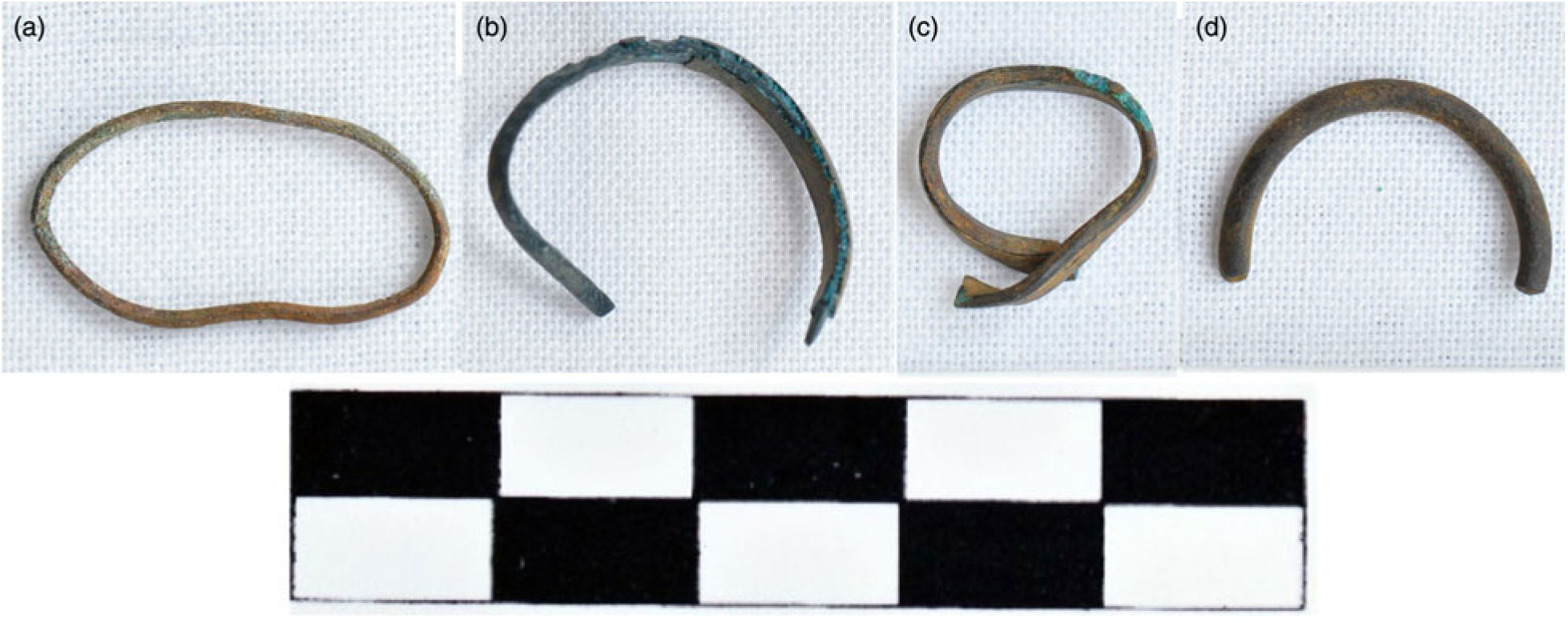
Phase IIa consists of only metallic offerings. There are 15 coins dating from the early part of the 1st century bc–ad 14, which include Republican, Gallic, and Imperial examples. Two coins featuring Augustus were cut in half prior to deposition. There are also 106 bronze and iron finger rings. The rings, most of which are poorly preserved thin strips of metal, were likely made exclusively for ritual deposition as they were quickly shaped into the form of a ring by wrapping metal around a finger, similar to those hastily made examples known from Le Chastelard de Lardiers in the Alpes-de-Haute-Provence; Uley, Gloucestershire; or Digeon, Picardy (Girard et al. Reference Girard, Gentric, Malagoli, Richard Ralite, Roussel-Ode, Roux, Rouzeau, Rouzeau and Bois2016, 70, 79; Henig Reference Henig, Woodward and Leach1993, 174; Jobic Reference Jobic1986, 104 respectively), and were then altered through compression, pulling, cutting, or twisting as part of the deposition ritual (Fig. 7). This modification may be connected to La Tène practices elsewhere of destroying objects before deposition.
Examples of altered rings: (A) pressed; (B) pulled; (C) twisted; and (D) cut (© K. Erdman; Musée du Pays Châtillonnais – Trésor de Vix)

Metallic offerings persist into Phase IIb, the chronology of which is demarcated by 48 high and low value bronze and silver coins dating from the 1st century, after the reign of Augustus, to 4th century ad (Meissonnier Reference Meissonnier1994, 29; Reference Meissonnier1996, 10–14). There are 22 halves or fragments of thin bronze bracelets which were intentionally broken or cut prior to deposition. Six have simple notches on the band which are stylistically similar to bracelets from the sanctuary of Uley dating to the 4th century ad (Bayley Reference Bayley, Woodward and Leach1993, 164), but may be of a slightly earlier date here.
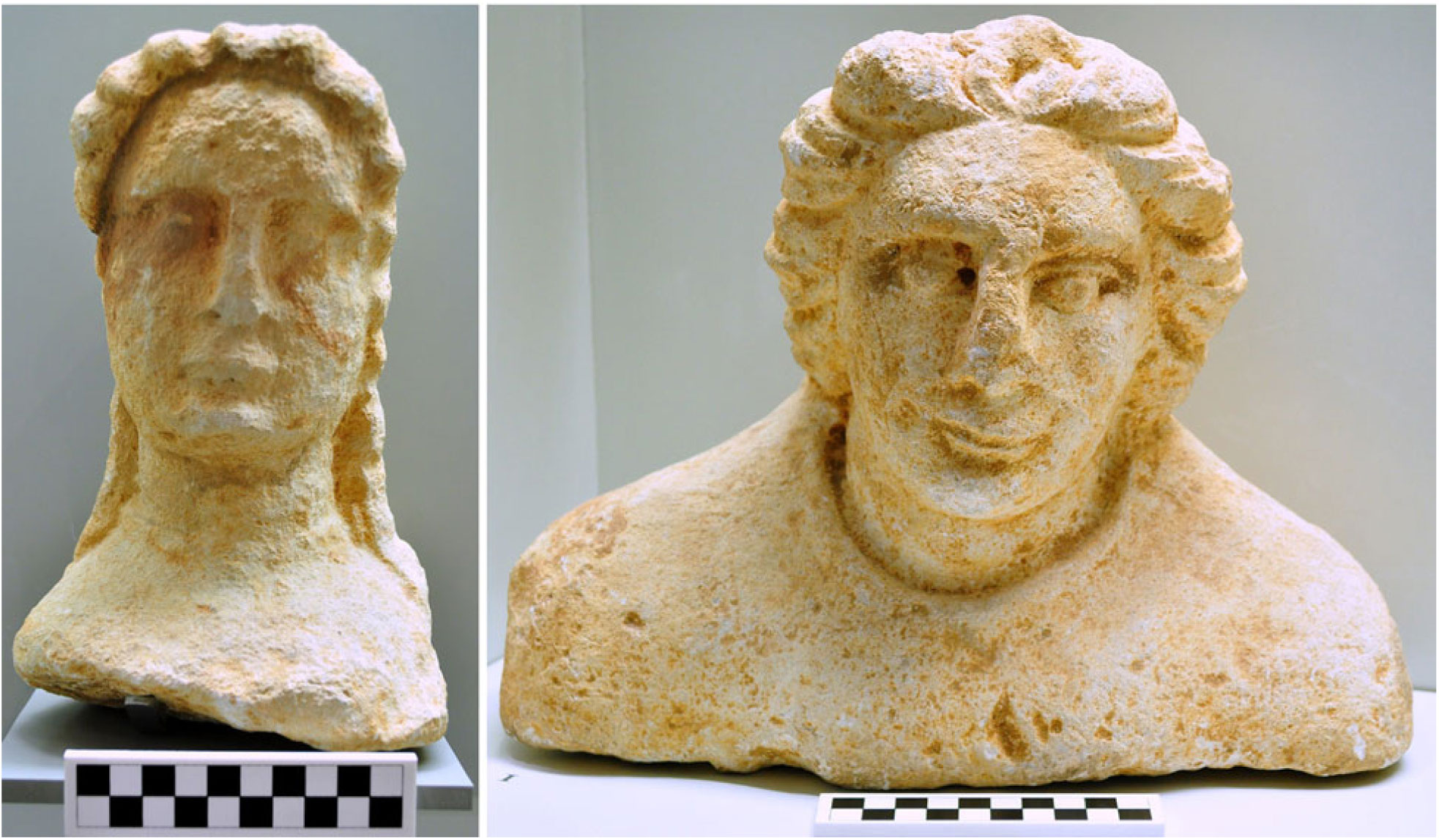
Sculptures made from locally-sourced limestone date to the 1st and 2nd centuries ad (Renard Reference Renard1996, 15). Seventeen are anatomical representations of feet, legs, or nude male torsos or pelvic areas. Nineteen statues are heads, busts, or nearly complete bodies, most of which depict young and adult women. While all the sculptures were recovered from behind the wall, the busts (Fig. 8) were particularly suited for display atop it (they are relatively heavy with broad, flat bottoms) and were simply pushed back into the water after a time or as a means of disposal once religious traditions changed.
Examples of statues representing a young woman (left) and an adult woman (right) from the Douix (© K. Erdman; Musée du Pays Châtillonnais – Trésor de Vix)

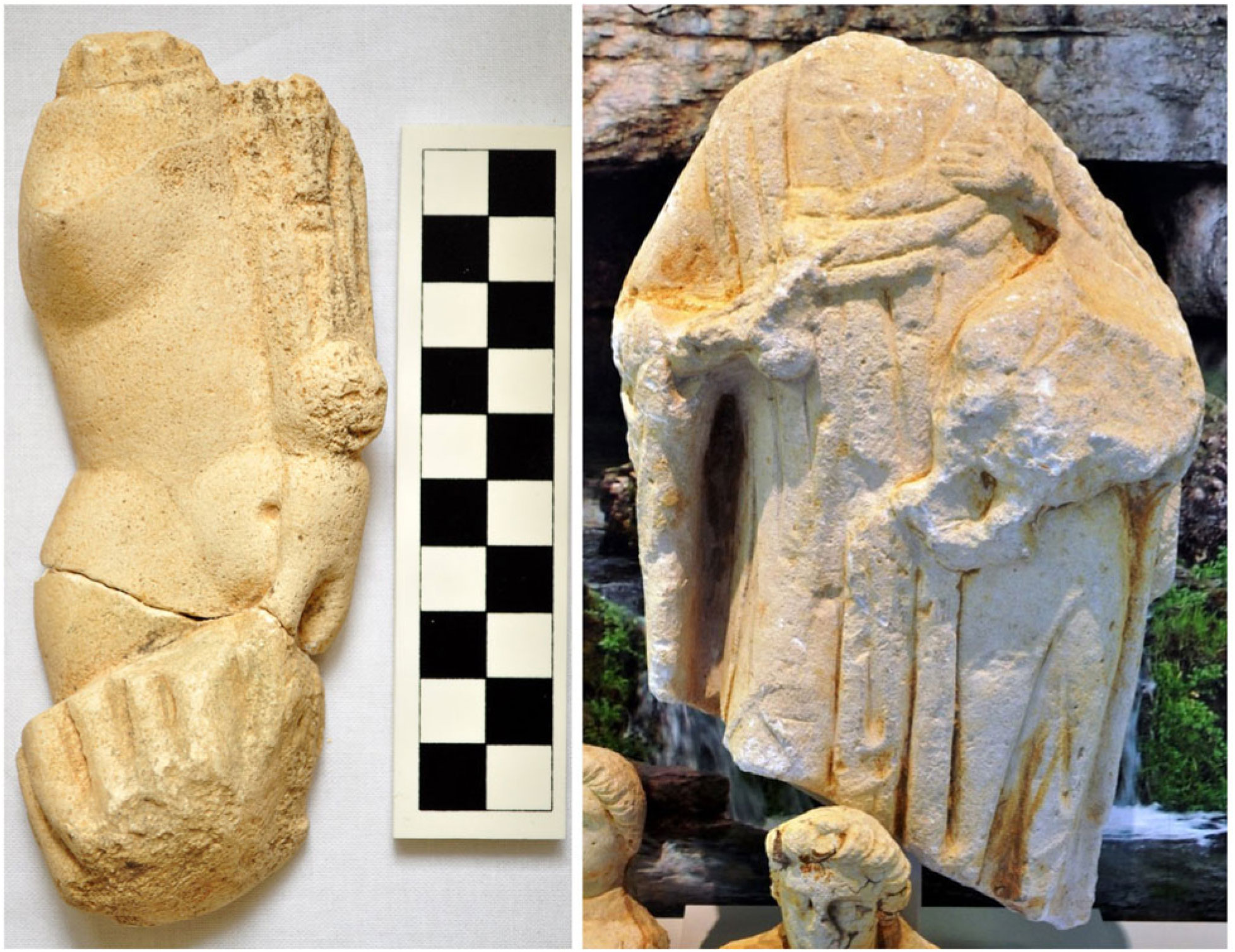
Three statues in the assemblage may represent deities. The first is a statuette of a mostly nude, limbless female wearing a neck collar and some draped fabric over one breast while standing beside a child (Fig. 9). She is a type of Venus similar to some forms from Allier but made of stone rather than clay and carved on only one side. The second, and the largest statue in the assemblage, at 1 m high, is a woman holding a child in one hand and a round purse in the other (Fig. 9). She may represent a local matrona, or mother goddess, but could also be an image of a supplicant similar to statues from the Source of the Seine, discussed below (Deyts Reference Deyts1994). Another fragment depicts the flame of a torch, which may belong to the solar god Mithras, whose mythology and worship were connected to caves and sometimes springs (Planson et al. Reference Planson, Langrange, Minot and Herard1973, 55–7).
A semi-nude, Venus torso wearing a collar and standing next to a child (left). This is a large sculpture recovered from the Douix representing a possible local mother goddess holding a child in her left arm and a purse in her right hand (right). At her feet are examples of busts depicting women also recovered from the spring (© K. Erdman; Musée du Pays Châtillonnais – Trésor de Vix)

Many sites are available for comparing, contextualising, and interpreting the Phase II materials. The locations of sanctuaries vary – in cities and the countryside, along roads, or near natural features such as rivers or springs. Water is important in the Châtillonnais. Within 200 km of the Douix there are 27 sanctuaries with evidence for spring veneration (Erdman Reference Erdman2014b, 295). Spring sanctuaries are distinguishable from sites that simply have water nearby because they have central basins or fountain that act as focal points for rituals and/or contain large quantities of offerings deposited in or near the springs. Often multiple indigenous and Roman deities are venerated together at the same site, the most recurring examples being Apollo or Apollo paired with the name of a local male deity, the local matronae goddesses, Minerva, and Venus (Erdman Reference Erdman2014b, 379). Deities present at the same sanctuary typically share some connection, such as being partners (Apollo and Damona), possess the ability to heal and/or protect (Apollo, Minerva, matronae), or are classified as fertility (matronae, Venus) or solar deities (Apollo) (Erdman Reference Erdman2014b, 381–2).
The Source of the Seine, active around 40 bc to the 4th century ad, was dedicated to a local deity but also had Roman deities present. It is one of the best-known spring sanctuaries in the region making it a useful example for interpreting the Douix and other spring sites. A large assemblage of wooden sculptures dating from 40 bc–ad 30, as well as a few hundred animal bones, represent the earliest activity at the site (Deyts Reference Deyts1983; Vernou et al. Reference Vernou and Fèvre2012, 7) and correspond to Phase IIa at the Douix. After this, a fanum (shrine) and basin were constructed around the spring and new architectural features continued to be added. Unlike at the Douix, inscriptions and sculptures identify the primary deity at the Seine – Sequana, an indigenous water goddess with healing powers – and secondary deities, including Apollo Grannus, Minerva, Venus, Juno, and Hercules, whose powers include the healing arts, fertility, and protection (Baudot Reference Baudot1845; Corot Reference Corot1933). The sanctuary became a pilgrimage centre for those seeking improved health and fertility, as demonstrated by the offerings. Some of the sculptures depict supplicants and children holding offerings of small animals, purses, or food, such as fruits and bread. There are many sculptures and bronze plaquettes depicting parts of the body, including heads, busts, eyes, arms, hands, torsos, sexual organs, legs, and feet, and some have VSLM inscribed indicating they were offered in fulfilment of their vow to the deity. Other objects, such as small altars, ceramic vessels, and jewellery have inscriptions identifying Sequana as well as supplicants thanking her for her services (Baudot Reference Baudot1845). Coins, of which over a thousand were found, were also an important offering.
Like the Source of the Seine, coins and stone statues are the most common categories of offerings recovered from other spring sanctuaries surveyed in this area, followed by jewellery such as fibulae and finger rings (Erdman Reference Erdman2014b, 361). However, not every site contains the same types of offerings, nor in the same quantities. For example, at Bourbonne-les-Bains, active from the 1st century bc to the 4th century ad with peak activity from 9 bc–ad 1, thousands of coins were given to Borvo and Damona, indigenous forest and spring deities worshipped as a pair (Sauer Reference Sauer2005, 7). At another nearby site, the Croix Saint Charles spring at Alesia, whose 1st–4th century Gallo-Roman sanctuary was constructed over a La Tène enclosure, Apollo Moritasgus was venerated with large quantities of coins, sculptures of body parts and busts, and bronze plaquettes depicting eyes or genitals (de Cazanove et al. Reference de Cazanove, Barrière, Creuzenet, Dessales, Dobrovitch, Féret, Leclerc, Popovitch, Simon, Vidal, de Cazanove and Méniel2012).
Phase II at the Douix overlaps chronologically with these sites and has similar offerings, but differs in some ways, namely, the site is less defined architecturally and it lacks inscriptions identifying who was venerated or why they were sought out. Like these regional sanctuaries, the presence of anatomical representations and busts during Phase IIb indicates that the Douix was a centre for healing and fertility with a focus on young women since they are depicted more frequently, and the deities of the spring were a matrona and/or Venus. The Phase IIa materials are more challenging to interpret. Like the Phase I fibulae, the coins and rings cannot be attributed to men or women specifically. However, the continuous use between sub-phases and another type of offering found at other sanctuaries from this time can illuminate potential connections. Miniature metal wheels, or rouelles, were offered at early sanctuaries in the Burgundian region, such as at the Temple of Jupiter at Alesia (Provost & Leclant Reference Provost and Leclant2009, 361–2). They were symbols of solar deities, many of whom possess healing powers and serve as patrons of springs, such as Borvo at Entrains and Apollo and later Mithras, alongside fertility deities, suggesting an overlap or relatedness in their abilities (Thévenot Reference Thévenot1951; Reference Thévenot1968, 201–6; Green Reference Green1984, 210). Venus, a fertility goddess, is sometimes depicted with solar wheels and circles connecting her to sun cults. Green argues the association of sky and earth (fertility) is logical: ‘The sun, like the mothers, was acknowledged as having powers of regeneration, renewal, healing, and protection; its warmth is necessary for germination and growth, and the penetration of the sun’s rays into the dark womb of the earth gave scope in the imaginative Celtic mind in the visual linking of these two crucial religious themes’ (Green Reference Green1989, 39).
The traditional functions of wheels are fundamentally different from coins and rings, but their material and circular shape are keys to understanding their relatedness. During the La Tène period, different circular motifs were sometimes interchangeable and connected, such as the depiction of wheels, rings, and dots on coins, a perspective which may have continued into the early Gallo-Roman period, ie, coins, rings, and wheels could be substituted one for another (Kiernan Reference Kiernan2009, 23). Interchangeable symbols are found in other Gallo-Roman representations. For example, in the Moselle Valley, mother goddesses can be depicted with corn, fruit, children, and dogs, each of which possesses their own nuances but are used as fertility symbols (Green Reference Green1989, 29). If round metallic offerings could be used interchangeably then perhaps coins and rings were offered in place of wheels to the deities at the Douix as part of healing and fertility rites in Phase IIa. This connection is further strengthened by the continued presence of round offerings, such as bracelets and coins, and fertility goddesses and the possible representation of the solar god Mithras (fragment of a torch) in Phase IIb at the Douix, and the representations elsewhere of pilgrims and deities depicted holding round objects, such as breads or fruits, at the Source of the Seine, as symbols of fertility or abundance.
A connection between the Phase II offerings and solar and fertility deities seems likely. There is a broad connection with fertility and health, as shown by the naked male torsos and anatomical representations. The statues of deities, each of whom is depicted with a young child, further emphasise the fertility and protection of women in childbearing years which is supported by the busts of both young and adult women; however, the emphasis on female fertility or health in the earlier sub-phase is harder to demonstrate. While each sub-phase is materially represented by different objects, circular metallic artefacts (coins, rings, bracelets) and their modification prior to deposition persist over time showing continuous use throughout the Gallo-Roman period.
Phase III: folklore, marriage, and pins
In the inventory of the 1993 report from the first campaign at the Douix, ceramics from the Merovingian period, Middle Ages, and modern period are listed; however, no mention of the style or quantities were provided nor are they described in the analyses of the ceramics other than the mention that only La Tène period ceramics were viable for study, others were negligible (Buvot Reference Buvot1993; Buvot et al. Reference Buvot, Degouve, Laureau and Levêque1997). It is possible that further undocumented analysis revealed these ceramics were not, in fact, from the periods initially assigned to them. As the authors were unable to confirm information about subsequent ceramics, we have omitted them from our discussion of later periods at the Douix.
After Phase II, there is a gap of nearly 1100 years from late antiquity to the late medieval period (if we omit the unverified ceramics mentioned above). Regional folklore from this time connected springs to fertility, the health of women and children, and pregnancy. For example, Lachaleur has a fountain to St Barbara whose waters are said to help sterile women conceive and Chatel-Gerard has a fountain to St Ambrose, which was a site of pilgrimage for sick children (Drioux Reference Drioux1934, 154–6). Douix-specific folklore describes the tradition of depositing cakes and breads on Candlemas, a Christian feast day originating in the 4th century which celebrates the presentation of the infant Christ at the Temple and the purification of the Virgin Mary following the birth. Sometime after the 12th century, a statue of the Virgin and Child was added to a niche above the cave and below the Roman Catholic church of St Vorles, located at the top of the cliff (Belotte Reference Belotte1997, 39).
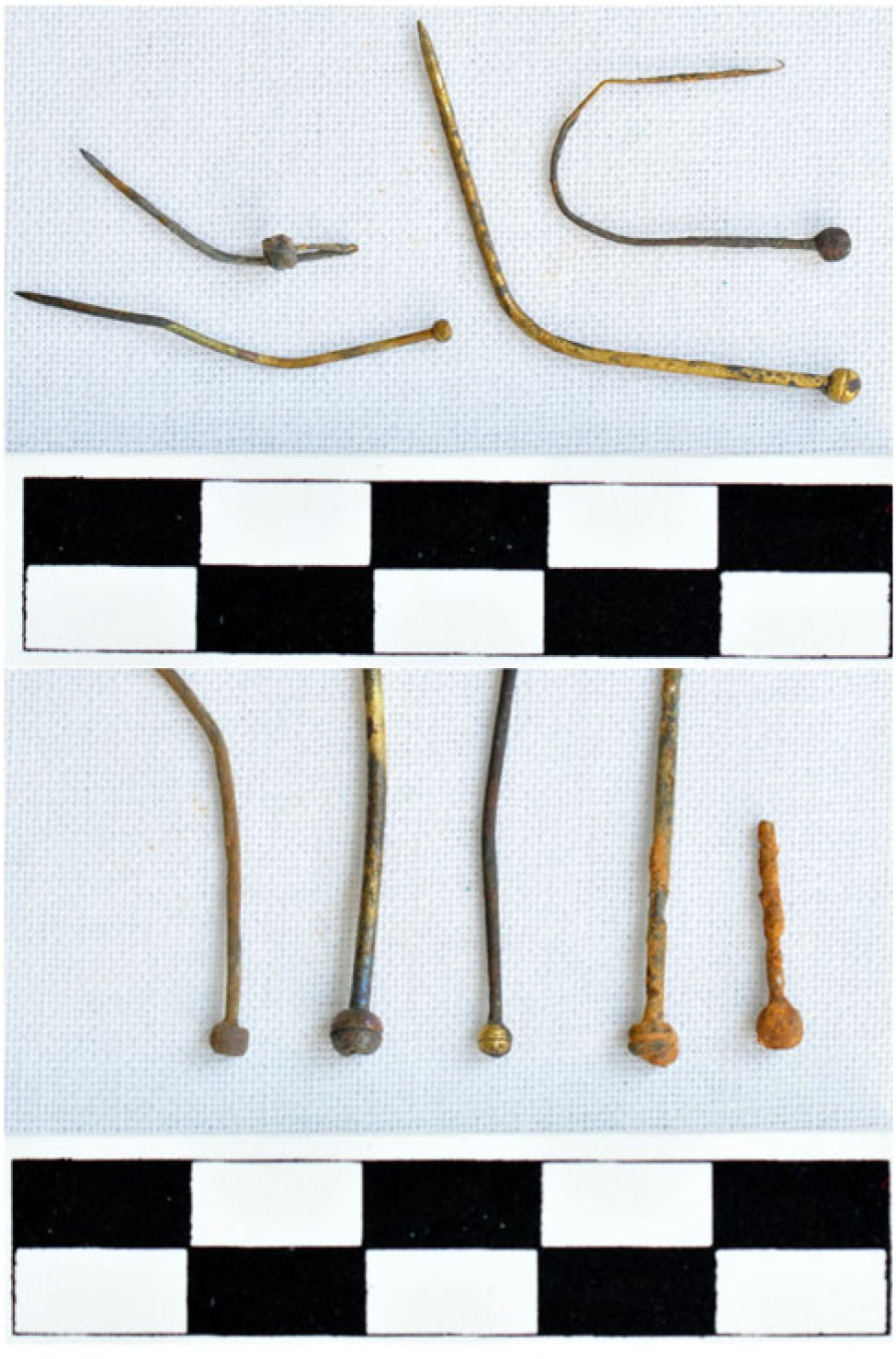
Phase III is marked by the tradition of tossing wound wire headed dress pins, of which there are 494 copper alloy and iron examples (Fig. 10), into the Douix when a young girl reached a marriageable age. This type of pin was used to maintain the elaborate female fashions and pleats of the medieval and post-medieval eras (Caple Reference Caple1991). Local history states that, if the pins floated for a time, the girl could hope to be married in the year; if they sank … better luck next year (Buvot Reference Buvot1996, 6). Though it is unknown precisely when this activity occurred, similar pins found at Laon, Aisne, France date to the late 15th–early 16th centuries (Jorrand Reference Jorrand1986). Like the rings in Phase IIa, some of the pins were bent prior to deposition but the reason for this is not mentioned. The dates of this practice overlap with the 16th century washing station erected near the Douix where one can imagine young women probably spent much time laundering, talking, and thinking about their futures.
Wound wire headed pins from the Douix (© K. Erdman; Musée du Pays Châtillonnais – Trésor de Vix)

RITUAL PERSISTENCE AT THE DOUIX
The chronology of the Douix presents an interpretative challenge for understanding long-term use of the spring for ritual practices. There are two primary questions to address: 1) how are we to understand the intermittent use of the Douix as a ritual centre, and, 2) could ideological associations, specifically those with women, persist over time, and if so, how?
People have continually inhabited the landscapes surrounding the Douix. La Tène period residents maintained rural settlements throughout the region after the abandonment of Mont Lassois (Goguey et al. Reference Goguey, Pautrat, Guillaumet, Thevenot and Popovitch2010). The Gallo-Romans had a cemetery in Etrochey, a village between Vix and Châtillon-sur-Seine, indicating a nearby settlement. In Late Antiquity (5th century ad), the plateau of Mont Lassois was reoccupied and people lived in Châtillon-sur-Seine into the medieval era and later (Kasprzyk Reference Kasprzyk and Chaumeforthcoming). Despite their consistent proximity to the Douix, it seemingly falls in and out of favour as a place for ritual activities. There are two possibilities to explore which may help explain the ebb and flow in the material record.
The first possibility is that people continued to deposit ritual offerings at the Douix and what we are observing (or rather, not observing) is an issue of preservation. Evidence of these activities during inter-depositional phases may not have preserved archaeologically because the offerings were organic. For example, at Oberdorla pond in Germany objects recovered from the shoreline included human and animal remains, ceramics, and over 30 wooden male and female anthropomorphic figurines which had carved heads and utilised the natural forks of tree branches to represent legs. These date its use as a ritual centre from 500 bc to the early Middle Ages, with its most significant period between 200 bc and ad 300 (Behm-Blancke et al. Reference Behm-Blancke, Dušek and Lettmann2003). The timing overlaps with the first inter-depositional phase at the Douix. Locally, the Source of the Seine also had stylised wooden statues dendrochronologically dating from 40 bc–ad 30 (Deyts Reference Deyts1983; Vernou et al. Reference Vernou and Fèvre2012, 7). While these dates coincide with Phase IIa at the Douix, it shows that the tradition of carved, wooden images at sacred sites is not unknown in this region. Farther away and of a slightly later date (end of the 1st century bc–ad 70), the Source des Roches at Chamalières had over 3500 beech anthropomorphic and anatomic statues preserved as offerings in a natural depression of a peat-covered pool (Romeuf & Dumontet Reference Romeuf and Dumontet2000, 22–3). Other potentially humanly-deposited offerings from the site include plums, peaches, walnuts, hazelnuts, and cultivated grapes (represented by their pits, shells, and nuts), which were symbols of fertility and expand the spectrum of possible perishable offerings (Prat & Cabanis Reference Prat and Cabanis2006, 15–16). Such offerings are also supported by representations of pilgrims at various sanctuaries, including the Source of the Seine. Materials from these sites were intentionally buried (Source of the Seine) or deposited into a natural depression (Source des Roches), both of which were protective, unmoving contexts that anchored the buoyant materials in place. The water at the Douix flows out from the cave meaning that wooden figures or offerings of food could have been easily transported or worn away over time if not anchored or buried.
Across Europe in the early Middle Ages, there is a decline in evidence for spring veneration, or at least in the deposition of coins and other metals, visible at sites like Bourbonne-les-Bains which had over 3500 Roman coins and only a single early medieval example (Sauer Reference Sauer, Lavan and Mulryan2011, 513–4). The only later materials found here which may have been offerings are 12 aurochsen horn cores dating to ad 340–540 (Grant & Sauer Reference Grant and Sauer2006, 629). Most traditional Christian offerings would be archaeologically undetectable, such as candles, wax votives, pieces of textile, liquid libations, incense, and foodstuffs. The cakes or breads offered for Candlemas mentioned in the local medieval folklore, for example, would leave no trace. Modern examples, like the Catholic pilgrimage site of Lourdes, show the persistent use of perishable offerings, such as photos of the person seeking help, scraps of linen and clothing, and wooden crutches (Notermans & Jansen Reference Notermans and Jansen2011, 177). At various springs across Estonia, people have also left strips of cloth or unwanted waste (pieces of iron, nails, glass; Valk Reference Valk2009, 52), which either would not preserve or may be misinterpreted as settlement waste. Perishable offerings like these could have been given during the second inter-depositional phase yet leave no trace in the archaeological record.
The second and more viable possibility is that social, political, or religious fluxes pushed and pulled people away from the Douix as a ritual centre. Springs in the Châtillonnais and beyond have little to no evidence for Iron Age ritual deposition, making the Phase I late Hallstatt and early La Tène deposits at the Douix rare, and the dearth of materials corresponding to the first inter-depositional phase rather normal (Erdman Reference Erdman2014b, 390–6). Instead, other types of watery contexts, such as the sites of La Tène and the River Saône, as well as terrestrial centres, were preferred locations for ritual activity at this time.
Multiple phases of ritual activity are known at the open-air centre of Mirebeau-sur-Bèze (Joly & Barral Reference Joly, Barral, de Cazanove and Méniel2012, 87–9). The earliest phase (300–160 bc) has a ditch and palisade surrounding a space with pits containing deposited ceramic vessels. The second phase (160–80 bc) saw a reorganisation of space with a rectangular building as the ritual focal point. Around this structure, distinct sets of offerings were made in multiple pits, including one containing two vessels with coins from 150–120 bc. A second pit contained sets of objects, coins, weapons, tools, and ceramics and miniature pots containing food, and a third had small metal objects, tools, glass jewellery, and coins. Another pit contained pieces of weapons including swords, blades, lances, belt pieces, a shield boss, and a helmet, all of which were voluntarily mutilated. At the roadside sanctuary of Les Bolards, the earliest phase (2nd–1st century bc) has evidence for a timber structure and a pit containing eight intentionally broken and burned La Tène vessels (Pommeret Reference Pommeret2001, 32–4). The features and deposits at these two sites share similarities with the early La Tène site of Gournay-sur-Aronde, Oise, which is characterised as an open-air ritual centre demarcated by a large ditch and palisade surrounding multiple pits (Brunaux et al. Reference Brunaux, Méniel and Poplin1985). Within particular locations throughout the site, thousands of human and animal remains and metallic offerings, primarily ritually destroyed weapons, were organised, displayed, and left to decay (Brunaux et al. Reference Brunaux, Méniel and Poplin1985; Brunaux & Rapin Reference Brunaux and Rapin1988; Lejars Reference Lejars1994). Like Mirebeau-sur-Bèze and Les Bolards, ditches were used to demarcate sacred space and pits were focal points for the ritual deposition of specifically selected objects. At each of these sites offerings were also broken or mutilated as part of the ritual and this activity is especially important for the weapons at Mirebeau and Gournay.
For practical reasons, the Douix cannot accommodate offerings like those in lakes and rivers as it is not deep enough to make things unrecoverable and nor would people want to taint such a valuable fresh water source with decaying remains. Unlike the site of La Tène, with its timber causeway, the riverbank of the Saône, or the posts and palisades of Gournay, the possibility for visibility and display of large communal offerings would have been limited at the Douix. Ditches around the Douix would have been unnecessary or inappropriate as the cliff and spring itself serve as natural boundaries and focal points. In general, the ritual needs during the La Tène period did not overlap with what the Douix could provide, therefore, it was not utilised.
The second inter-depositional phase corresponds to the spread of Christianity and a general decline in archaeologically visible ritual activity at springs across Europe (Sauer Reference Sauer, Lavan and Mulryan2011, 513). We know from historical Christian authors that the church frowned upon the use of ancient ritual centres. Martin of Braga, writing in the 6th century, claims that lighting candles at springs or throwing bread into them honours the Devil and should cease immediately (De correctione rusticorum 16). Bishop Caesarius of Arles, also writing in the 6th century, condemns those who have banquets at, make vows to, or hang herbs, charms, or other items around fountains and trees, and encourages the destruction of such pagan temples, shrines, and altars (Sermons 13.5, 14.4, 54.5–6). In some places where such features could not be destroyed, sacred landscapes were reorganised to shift the focus to the church. The Witham valley in Lincolnshire, for example, had a long prehistoric tradition of deposition into the river that persisted into the Romano-British and medieval periods (Stocker & Everson Reference Stocker, Everson and Carver2003). As in prehistory, metal items and weapons, most notably swords and the 8th century Fiskerton hanging bowl, continued to be deposited. However, rituals that formerly focused on the river and nearby pools shifted with the construction of monastic churches placed at the ends of causeways in the 7th–16th centuries, visually and spiritually drawing people to them instead of towards past traditions. In this way, the church shepherded people away from natural features which they could not erase from the landscape, something that could have happened at the Douix with the construction of the church atop the cliff above the source.
Despite broader events that intermittently pulled people away from the Douix, they returned and used it as a place for rituals in markedly similar ways. Even if people were not consistently visiting for ritual activity, it does not mean it was forgotten. Histories and ideas associated with the spring likely became part of local oral traditions. Other cultures with strong oral traditions demonstrate that unchanging landscapes, such as the Douix, act as anchors for beliefs and human actions. For example, the Badger-Two Medicine area in Montana, USA, is sacred to the Blackfeet tribe whose deities, mythology, and beliefs are directly tied to features in the landscape. The area is also seen as the point of creation demonstrating the antiquity, persistence, and authority of the oral tradition for generations (Vest Reference Vest1988, 482). Similar connections with the landscape and preserving one’s understanding of it exists within Australian Aboriginal traditions. As people move through and interact with their landscapes, they use songs and sometimes rock art to identify different natural features and paths (Ross Reference Ross2001, 546). Singing the landscape helps them to navigate and connect with it as their ancestors did preserving ancient knowledge, beliefs, and memory.
In this way, ideas surrounding the unchanging Douix may have persisted. Testart sees springs as symbols for fertility in the landscape (Reference Testart and Testart2012, 224). This interpretation is particularly applicable for the Douix as its cave, through which the spring flows, may be representative of a woman’s fertility, ie, a symbolic womb. Springs are inherently liminal spaces connecting the unseen subterranean with the visible surface; they are marked as places of connection, change, and power. Water flows almost unceasingly making the areas around them lush and fertile. It would not be surprising then for such a powerful and transformative space in nature to be recognised as a physical symbol of fertility. Springs may be associated with both male and female fertility, but the cave surrounding the Douix, which may be perceived as a symbolic womb, changes how it is viewed making it more akin to female fertility. Such a view would not necessarily exclude the role of male fertility as the flow of water could also be an analogy for semen ejaculation. Additionally, the very act of offering objects into the cave and spring may have been a way of ‘impregnating’ it to ensure continued abundance. Testart believes the concept of springs as fertility symbols is universal across cultures but notes that the religious rites associated with them are not (Reference Testart and Testart2012, 215). This interpretation assumes people across time and space share similar ideas and symbols of fertility and the feminine, which is inaccurate. However, if an oral tradition developed around the Douix, then its figurative associations and role in the landscape could have been preserved for extensive lengths of time as the Blackfeet and Australian Aboriginal examples demonstrate. So even if people were not using the Douix as a ritual centre it is possible that some information, such as beliefs surrounding the spring or what people offered, from past ritual traditions was preserved orally.
As a fixed point in the landscape, the Douix could have acted as an anchor around which an oral tradition could have developed and persisted; however, cultures and language are not static, making some oral traditions susceptible to change. ‘The knowledge that comes from oral tradition is learned and subject to common and yet ever-evolving understandings of what constitutes performance and its contents… [and] Oral traditions are told over time in recognizably similar ways but with variations of detail and emphasis subject to the circumstances of each performance and the liberties taken by the speakers’ (Schneider Reference Schneider2003, 268).
An accumulation of small modifications over multiple generations would eventually change the meanings and motivations behind the rituals leading to visibly distinct ritual practices and deposits. At the core of an oral tradition, some elements may remain the same, such as the symbolic connection between springs and women, but the practices and nuances surrounding that core may vary. Gender roles also change in societies over time, therefore, the subject(s) emphasised in the oral tradition would also likely be modified to better reflect contemporary values of the speaker(s) and the culture in which he or she is embedded. In other words, an association between springs and women could have persisted but the details of that connection and how it was celebrated changed over time along with the societies honouring it. Slight modifications in practice and belief have been documented in modern folkloric examples demonstrating that significant change can occur in just a few generations. Offerings associated with a medieval well and tree on the Isle of Maree in Scotland show the evolution of offering practices. Originally identified as a holy well that could cure ‘lunacy’, the well was a site of pilgrimage where people first sacrificed bulls and poured milk libations on the mainland prior to visiting the island to drink from the well (Houlbrook Reference Houlbrook, Houlbrook and Armitage2015, 128). Eventually, after the well dried up, offerings were instead centred around the nearby tree which became a wishing-tree. Initially, as early as the 18th century, people tied pieces of clothing to its branches or nailed them to its trunk but the cloth decayed leaving only nails, leading to its transformation into a nail-tree, then into a tree where any metal could be left as an offering. Finally, during the 19th century, it became a coin-tree leading to its eventual death from metal poisoning (Houlbrook Reference Houlbrook, Houlbrook and Armitage2015, 137).
Maintenance of an oral tradition and folklore, or even chance finds of ancient materials by later visitors to the Douix, could have led to a re-imagining of the past and/or recreation of old practices. This may provide one explanation for the similarities and differences in materials throughout the Douix’s use. In Phase I, fibulae dominate the assemblage followed by finger rings in Phase IIa, bracelets in Phase IIb, and dress pins in Phase III. The first three examples are all forms of personal ornamentation. While dress pins are functional rather than ornamental, like the personal ornaments, they are metallic and worn on the body. The coins technically possess these characteristics too and could have been viewed as symbolically interchangeable, as discussed above. The ornaments and, in some ways, the coins also share a symbolic component in their removal from the body; one is more naked, humbled, or made poorer before the god(s) without these objects. Elements of performance also carry on across some phases. The act of modifying the offerings, such as the rings, bracelets, and a few of the coins, even some of the dress pins, through bending or cutting, is something that continues from Phase IIa through Phase III. The tradition of rendering offerings unusable in the human world was a popular ritual action during the La Tène period at sites like Gournay and Mireabeau (contemporary with the first inter-depositional phase) and may have influenced the birth of this action at the Douix. Another element of performance is the atmosphere of deposition. The fact that the entire assemblage most likely represents multiple individual offerings, rather than collective, communal deposits at any given time, points to a shared understanding of how one connects with the spring’s entity, ie, individually. This point is further strengthened by the modification of these objects, which acts as a way of personalising an offering, helping it to stand out from the rest (Erdman Reference Erdman2014b, 475). The offerings at the Douix evolved to reflect the materiality and ritual performance of each period.
Each theme in the materially represented periods, while possibly connected to women, has a slightly different focus that could be explained by normal alterations of an oral tradition. During the Hallstatt period, for example, the ritual may be associated with women and solidifying power if we think about the influence of the Lady of Vix. In the Gallo-Roman period, the focus is on fertility and health of the family but seems to favour women. In the early modern period, women finding love and getting married are emphasised in connection with their coming of age. Associating objects with a particular gender may lead to unsubstantiated connections by biasing some materials over others. Are we seeing gendered objects because that is what we want to see? The best hope for connecting objects to men or women comes from graves which can still be inaccurate as identifying gender in the past is more complicated than previous research suggested (Arnold Reference Arnold2016). This is difficult to do in the case of the Douix because many of the objects are not artefacts one would typically find in burial contexts, such as sculptures, or are things that may be found with both men and women, such as fibulae, finger rings, or coins. The only assemblage which we can positively connect with women, and exclude men entirely, are the early modern pins because folklore describes these as offerings deposited for and by young women. The Gallo-Roman materials are less clear since many objects can be connected to either men or women, such as the coins or finger rings. Additionally, both men and women are represented in the sculptures, however, there are more images of women and the possible deities are goddesses. So, while elements of both sexes are present, there seems to be a stronger connection to women, at least in Phase IIb. The Iron Age fibulae are more challenging as they can be associated with both men and women (Arnold Reference Arnold, Walde and Willows1991), and without additional information, they cannot be linked to a particular gender based on this assemblage alone. For this reason, the connection to women based on the parallel chronology of fibulae and the leadership of the Vix Princess may be coincidence.
Another explanation for the similarities and differences in themes across time could be attributed to the site itself rather than the persistence of an oral tradition. The Douix today is still an impressive feature in the landscape, one which fosters a sense of intimacy even in the midst of sometimes large groups of visitors. It is a natural temple defined by a sheer cliff face, large cave, and cold, fresh flowing water that draws people to it. With the exception of boulders, which were added downstream in the 19th century to create an artificial pool that would not have been present in antiquity, the spring itself is mostly unchanged. The stability associated with the Douix is likely what called people back to it time and time again.
The initial use of the spring in Phase I corresponds with a period of dramatic social and political change where power shifts from the exclusive purview of men to also include women as demonstrated by the status of the Lady of Vix. The intimate nature of the Douix, more appropriate for individualised worship or connection with the divine, could not accommodate the grand displays of weapons and animal or human sacrifices made at rivers or other La Tène period sanctuaries. The return of ritual activity in Phase IIa marks the end of the Gallic Wars, a time of immense social, political, and cultural trauma where stability and familiarity would likely have been sought out and the spring maintained as a place of comfort and healing into Phase IIb. The transition to Christianity did not permit continued veneration at the Douix and, instead, people were encouraged to worship elsewhere, such as in churches overlooking the spring. While Christianity remained the dominant religion in Phase III, strong folkloric traditions brought people back to the spring as a source for wish-fulfilment when coming of age. For young women, it gave them a degree of control over their lives in a period where, historically, they would have had little. The common thread within all of these is the appeal of the Douix as a place for intimate ritual practices, particularly in times of social and personal change, where an individual’s needs could be met through their own intercession. This is further supported by the modification of objects as a way of identifying the giver. Small personal acts, in comparison to large martial displays, may appear feminine in nature.
CONCLUSIONS
The Source of the Douix has attracted people to it for over two millennia. The material record shows the site was used intermittently as a ritual centre for the deposition of offerings during three distinct phases. While it is possible that the breaks in the record were the result of preservation, ie, perishable organic offerings, it is more likely that people fulfilled their ritual needs in other locations according to social or religious norms at the time. Even though people may not have been actively engaged in ritual practices at the Douix, they may have been aware of past uses of the site, knowledge of which could have been preserved and transmitted through oral tradition, stories, or folklore. This possibility provides some explanation for the similarities and treatment of offerings from distinct depositional phases, the most notable being the recurrent use of metallic offerings that ornamented the body or were worn close to it, and the intentional alteration of these items. Such information could have been shared and updated according to contemporary norms and values, been naturally altered through human error over time, or even be the result of a reimagining or recreating of older ‘lost’ traditions.
Further attention needs to be given to the site itself. The setting created by the natural features of the Douix fosters a sense of stability, quiet, and accessibility. The spring was physically approachable, not barred by man-made temples, meaning an individual could interact with their deities or god and nature. Visitors were empowered to act directly on their own behalf. We see them as agents of their own fate through the personalisation or individualisation of their offerings – modifications to finger rings, bracelets, and dress pins. It seems fitting then that the reasons for appealing to the power of the Douix would be of a more intimate, personal nature. While the motivations for deposits here seem to have a connection with women, it is not exclusive as we cannot rule out the importance of male health and fertility in Phase II, nor the possibility of men depositing fibulae in Phase I; only the deposits of dress pins in Phase III are exclusive to women, according to the folkloric description of the ritual.
What we can say about the motivations for visiting the Douix is that it was a stable place that appealed to both women and men during times of major social, political, or personal change. The increasing social complexity in the late Hallstatt period that elevated the status of women in comparison to that of men, as evidenced by the Lady of Vix, drew people to the Douix during Phase I. Perhaps this coincided with women’s new religious and political responsibilities as leaders, or ritual deposits were meant to reflect changes in their own personal status. During and in the aftermath of the Gallic Wars, corresponding to Phase II, the Douix would have acted as a stable, familiar, and lifegiving feature in a time of major political and cultural upheaval, thus attracting women and men who may have sought physical and emotional healing or hope for the future through the promise of fertility – notions which persisted for several centuries. Hope for the future is also evident in Phase III as young women coming into adulthood sought the power of the Douix to predict their future and find a husband. Significant external forces and changes always affect individuals. What we see then is the individual’s attempt to regain some control over personal aspects of their lives at a place that invites them to do so and, perhaps through orally transmitted knowledge, tells them how to do so successfully.
Acknowledgements:
The authors would like to thank the anonymous reviewers whose concise, thoughtful, and encouraging feedback and bibliographic references strengthened and enriched this paper.