Adolescent delinquency and substance use can have serious implications for individual long-term health and well-being (Biglan et al., Reference Biglan, Brennan, Foster, Holder, Miller and Cunningham2004). As such, early adolescence has received a great deal of research attention, particularly because this time of transition commonly involves changes in parent–adolescent relationships and the coevolution of peer dynamics within which amplification of problem behavior is embedded. For example, early adolescence is often characterized by less time spent with parents, reduced communication between youths and parents, more conflict, and lower levels of parental involvement in and monitoring of adolescents' lives (Granic, Dishion, & Hollenstein, Reference Granic, Dishion, Hollenstein, Adams and Berzonsky2003; Hill, Bromell, Tyson, & Flint, Reference Hill, Bromell, Tyson and Flint2007; Larson, Richards, Moneta, Holmbeck, & Duckett, Reference Larson, Richards, Moneta, Holmbeck and Duckett1996; Loeber et al., Reference Loeber, Drinkwater, Yin, Anderson, Schmidt and Crawford2000). Concomitant with these changes in the parent–youth relationship is the coevolution of problem behavior in the peer group, which can maintain and even amplify minor problem behaviors to more frequent and more serious forms of antisocial behavior (Dishion, Nelson, & Bullock, Reference Dishion, Nelson and Bullock2004; Dodge, Greenberg, Malone, & Conduct Problems Prevention Research Group, Reference Dodge, Greenberg and Malone2008; Lacourse, Nagin, Tremblay, Vitaro, & Claes, Reference Lacourse, Nagin, Tremblay, Vitaro and Claes2003; Moffitt, Caspi, Harrington, & Milne, Reference Moffitt, Caspi, Harrington and Milne2002; Nagin, Farrington, & Moffitt, Reference Nagin, Farrington and Moffitt1999). There is at least an implicit assumption that, in order to understand the developmental processes underlying adolescent problem behavior, models of antisocial behavior must be tested using randomized field experiments. Such experiments would evaluate the likelihood that the behavior problems can be prevented and would appraise the viability of the causal hypotheses underlying the developmental model (Dishion & Patterson, Reference Dishion and Patterson1999; Patterson, Reid, & Dishion, Reference Patterson, Reid and Dishion1992).
Given the centrality of the family in the etiology of antisocial behavior in childhood and adolescence, it would seem logical that most prevention trials would focus on family-centered interventions. Family-centered treatments actually show considerable promise for reducing childhood conduct disorder (Webster-Stratton & Reid, Reference Webster-Stratton, Reid, Weisz and Kazdin2010), substance use (Liddle, Reference Liddle, Weisz and Kazdin2010; Waldron & Brody, Reference Waldron, Brody, Weisz and Kazdin2010), and more serious forms of antisocial behavior (Henggeler & Schaeffer, Reference Henggeler, Schaeffer, Weisz and Kazdin2010). However, few family-centered prevention approaches appear to target early adolescence (for exceptions see Brody et al., Reference Brody, Murry, Gerrard, Gibbons, Molgaard and McNair2004; Spoth, Redmond, & Shin, Reference Spoth, Redmond and Shin2001). Especially important are the design and development of family-centered interventions that can be embedded in service delivery systems in order to reach a broad, high-risk population and thereby reduce the prevalence of antisocial behavior and associated risk for violent delinquency in adulthood (Hoagwood & Koretz, Reference Hoagwood and Koretz1996; Kellam, Reference Kellam and Patterson1990).
The Family Check-Up (FCU; Dishion & Kavanagh, Reference Dishion and Kavanagh2003) is an example of such an intervention. The FCU is designed to support parents' accurate appraisal of their child's risk status and their own parenting practices and then to help parents identify appropriate services and reasonable change strategies (Dishion, Stormshak, & Siler, Reference Dishion, Stormshak, Siler, Shinn and Walker2010). The FCU includes an initial interview, a family assessment, and a feedback session that focuses on motivation to improve parenting. Following the FCU, a menu of family-centered interventions is offered that supports parents in their efforts to improve their communication skills and family management practices. In this way, the FCU actively promotes self-selection into the most appropriate intervention services on the basis of systematic assessments of observed family interactions, available resources, and parents' motivation and skills (Dishion & Stormshak, Reference Dishion and Stormshak2007). Randomized trials have documented the effectiveness of the FCU for reducing levels of adolescent substance use, antisocial behavior, and depression and improving adolescent school performance (Connell & Dishion, Reference Connell and Dishion2008; Connell, Dishion, & Deater-Deckard, Reference Connell, Dishion and Deater-Deckard2006; Connell, Dishion, Yasui, & Kavanagh, Reference Connell, Dishion, Yasui and Kavanagh2007; Dishion, Nelson, & Kavanagh, Reference Dishion, Nelson and Kavanagh2003; Stormshak, Connell, & Dishion, Reference Stormshak, Connell and Dishion2009; Stormshak et al., Reference Stormshak, Connell, Véronneau, Myers, Dishion and Kavanagh2011; Stormshak, Fosco, & Dishion, Reference Stormshak, Fosco and Dishion2010).
The FCU is grounded in coercion theory (Patterson et al., Reference Patterson, Reid and Dishion1992), which hypothesizes that noncompliant child behavior is reinforced when parents acquiesce in the face of highly negative, aversive family exchanges. In other words, children learn to escalate conflict in order to reduce parents' efforts to set limits on their behavior. Over time, the gradual withdrawal of parental monitoring of behavior provides not only the opportunity for the child to engage in antisocial behavior but also the chance to become involved with deviant peers, who can further promote antisocial behavior (Barrera, Biglan, Ary, & Li, Reference Barrera, Biglan, Ary and Li2001; Dishion & Patterson, Reference Dishion, Patterson, Cicchetti and Cohen2006; Galambos, Barker, & Almeida, Reference Galambos, Barker and Almeida2003; Hoeve et al., Reference Hoeve, Dubas, Eichelsheim, van der Laan, Smeenk and Gerris2009; Pettit, Laird, Dodge, Bates, & Criss, Reference Pettit, Laird, Dodge, Bates and Criss2001; Simons-Morton, Hartos, & Haynie, Reference Simons-Morton, Hartos and Haynie2004). The association with deviant peers has been found to partially mediate the effects of parental monitoring on adolescent problem behavior (Ary et al., Reference Ary, Duncan, Biglan, Metzler, Noell and Smolkowski1999).
A critical step in testing a theory such as that outlined above is to examine not only the outcomes associated with an intervention but also the mediation processes by which they are achieved. However, examination of mediation effects is as rare as it is valuable in the family-based intervention literature. Although family-based programs are almost universally lauded for their effects on a wide variety of adolescent behavioral and emotional problems (Alexander, Robbins, & Sexton, Reference Alexander, Robbins and Sexton2000; Austin, Macgowan, & Wagner, Reference Austin, Macgowan and Wagner2005; Dusenbury, Reference Dusenbury2000; Farrington & Welsh, Reference Farrington and Welsh1999; Liddle, Reference Liddle2004), there is a notable lack of research on mediating processes. The work by Forgatch and colleagues (DeGarmo & Forgatch, Reference DeGarmo and Forgatch2005; DeGarmo, Patterson, & Forgatch, Reference DeGarmo, Patterson and Forgatch2004; Forgatch, DeGarmo, & Beldavs, Reference Forgatch, DeGarmo and Beldavs2005; Forgatch, Patterson, DeGarmo, & Beldavs, Reference Forgatch, Patterson, DeGarmo and Beldavs2009) that examined intervention effects on recently divorced mothers and stepparent families with young children is a noteworthy exception, in that their studies documented intervention effects with respect to the mediating mechanisms suggested by coercion theory. Specifically, these studies supported the hypothesis that improved family management reduces coercive exchanges, which in turn leads to improved child behavior in multiple settings.
In an analysis of the FCU, Dishion and colleagues (Reference Dishion, Nelson and Kavanagh2003) found that actively motivating parents to monitor and manage substance-using adolescents resulted in decreased adolescent substance use, with parental monitoring mediating the impact of the FCU on substance use. By using complier average causal effect modeling, Van Ryzin, Stormshak, and Dishion (in press) found intervention effects on family conflict, parental monitoring, antisocial behavior, and alcohol use. However, complier average causal effect is not designed to evaluate mediation. It is notable that no research has examined deviant peer association as a mediator of intervention effects, despite the centrality of deviant peer association to coercion theory.
Another issue that has not yet been addressed by current research but that has a direct implication for intervention and prevention programs is the notion that not all families experience coercive family processes in the same way or at the same time. Very little is known about the unique trajectories of key constructs such as family conflict, parental monitoring, and deviant peer association in adolescence; how these trajectories overlap; and their implications for antisocial behavior. Although antisocial behavior itself has been examined at length and typologies have been developed that describe unique trajectories of antisocial behavior across time (e.g., adolescence-limited vs. life-course persistent, childhood onset vs. adolescence onset; see Moffitt, Reference Moffitt1993; Moffitt, Caspi, Dickson, Silva, & Stanton, Reference Moffitt, Caspi, Dickson, Silva and Stanton1996), similar typologies have not been developed for family conflict, parental monitoring, and deviant peer association, nor have they been considered with respect to their possible unique implications for intervention and prevention. Development of such typologies would not only deepen our understanding of family and peer processes, but they would also support the development of more customized, family-based interventions that target different types of family problems.
Our Study
In sum, much is yet to be learned about the FCU and, in more general terms, about the family and peer processes that are thought to promote or discourage adolescent delinquency. To address this gap in the literature, we used two distinct approaches: (a) a variable-oriented approach, in which we tested family conflict as a mediator of intervention effects of the FCU on antisocial behavior, as well as parental monitoring and deviant peer association as mediators of the link between family conflict and antisocial behavior (see Figure 1); and (b) a person-oriented approach, in which we empirically examined unique trajectories of family conflict, parental monitoring, and deviant peer association, and then considered how the trajectories link to antisocial behavior. In general, a variable-oriented approach assumes that the relationships between variables are consistent across an entire population (i.e., it presumes a homogeneous population), and a person-oriented approach assumes that the covariation among variables may vary across distinct subgroups within a population (i.e., it presumes a heterogeneous population; see von Eye & Bogat, Reference von Eye and Bogat2006). By conducting both variable- and person-oriented analyses, one can (a) consider the most parsimonious model that could be a guide to family-centered interventions in early adolescence and (b) explore the possibility of unique intervention needs of families that may end up with high levels of antisocial behavior, but via unique pathways.
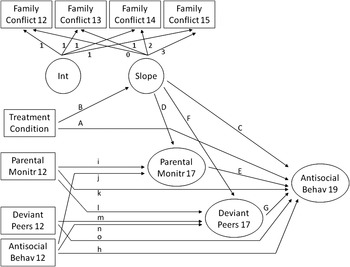
The hypothesized model. The latent variable for antisocial behavior (age 19) includes mother, father, and youth report; latent variables for parental monitoring and deviant peers (age 17) include mother, father, and youth report, as well as independent observer ratings (not shown). Key paths are denoted by capital letters and paths for control variables are denoted with lowercase letters. Path A, the direct effects of the intervention on antisocial behavior at age 18–19; Path B, the intervention effects on the change in family conflict across ages 12–15; Path C, the effects of family conflict on antisocial behavior; Paths B*C, the significance of the indirect path; Path D, the effect of family conflict on parental monitoring; Path E, the effect of parental monitoring on antisocial behavior; Path F, the deviant peer association at age 17; Path G, the effect of deviant peer association on antisocial behavior; and Paths D*E and F*G, the significance of the indirect paths, respectively. Paths h–o, controls at age 12 to ensure the equivalence of the intervention and control groups on key constructs.

Variable-oriented analysis
In general, the requirements for mediation include a significant direct effect of the predictor on the presumed mediator, a significant effect of the mediator on the distal outcome, a significant indirect effect on the outcome via the mediator, and a significant effect of the predictor on the outcome that is rendered nonsignificant when the mediator is entered into the model (Judd, Kenny, & McClelland, Reference Judd, Kenny and McClelland2001; MacKinnon & Dwyer, Reference MacKinnon and Dwyer1993). Consistent with the analysis of several family-centered intervention studies, multiple levels of mediation may be found (Sandler, Schoenfelder, Wolchik, & MacKinnon, Reference Sandler, Schoenfelder, Wolchik and MacKinnon2011).
With regard to the FCU, coercion theory and research suggest that family conflict would be a mediator of intervention effects on antisocial behavior, as has been shown in other studies with modest sample sizes (e.g., Dishion, Patterson, & Kavanagh, Reference Dishion, Patterson, Kavanagh, McCord and Trembley1992). Because high levels of conflict can cause parents to give up their efforts to manage child behavior, especially as the adolescent becomes engaged with deviant peers (Dishion, Nelson, et al., Reference Dishion, Nelson and Bullock2004), we also hypothesized that parental monitoring and deviant peer association would mediate any effects of family conflict on antisocial behavior. Simply put, the levels of antisocial behavior should be lower in families in which there is considerable parental monitoring and the youth is not involved with deviant peers. The network of intervention and mediation effects is summarized in Figure 1. We examined the direct effects of the intervention on antisocial behavior at age 18–19 (Path A in Figure 1), the intervention effects on change in family conflict across ages 12–15 (Path B), the effects of family conflict on antisocial behavior (Path C), the significance of the indirect path (B*C), the effect of family conflict on parental monitoring (Path D) and deviant peer association (Path F) at age 17, the effect of parental monitoring and deviant peer association on antisocial behavior (Paths E and G, respectively), and the significance of the indirect paths (D*E and F*G, respectively). Figure 1 also includes controls at age 12 to ensure the equivalence of the intervention and control groups on key constructs; these paths are labeled “h” through “o” (key paths are denoted by capital letters and paths for control variables are denoted with small letters). We hypothesized that a change in family conflict would mediate intervention effects on antisocial behavior and that parental monitoring and deviant peer association would mediate the effects of change in family conflict on antisocial behavior; however, given recent evidence that the effects of parental monitoring on youth behavior tend to wane in later adolescence (Van Ryzin, Fosco, & Dishion, Reference Van Ryzin, Fosco and Dishion2011), we hypothesized that the effects of monitoring on antisocial behavior would not be as strong as those of deviant peer association and thus monitoring would not attain the status of a mediator.
Person-oriented analysis
We applied group-based trajectory modeling (Nagin, Reference Nagin2005) to determine whether our sample included unique trajectories of family conflict, parental monitoring, and deviant peer association across adolescence. We then conducted a “risk factor” analysis to determine whether the intervention condition predicted trajectory membership and an “outcome analysis” to compare levels of antisocial behavior among the different trajectories. Finally, we performed a dual-trajectory analysis to examine the overlap in the trajectory groups and to identify unique subpopulations of families that displayed unique developmental pathways.
As previously noted, very little research has examined the typologies of family conflict, parental monitoring, and deviant peer association across adolescence, making it difficult to formulate specific hypotheses for any of our analyses. In general, the frequency of family conflict is thought to be greater in early adolescence and to subsequently decline during middle and late adolescence (Smetana, Campione-Barr, & Metzger, Reference Smetana, Campione-Barr and Metzger2006). The timing of conflict may vary across families, depending on multiple issues, including puberty, deviant peer involvement, and levels of problem behavior. With regard to parental monitoring, a recent study found four unique trajectories across sixth to eighth grades: high, moderate, declining, and inconsistent (Tobler & Komro, Reference Tobler and Komro2010). With regard to deviant peer association, one study found three unique trajectories based upon a dichotomous indicator of group affiliation: early-adolescence onset, middle-adolescence onset, and never (Lacourse et al., Reference Lacourse, Nagin, Tremblay, Vitaro and Claes2003, Reference Lacourse, Nagin, Vitaro, Côté, Arseneault and Tremblay2006). Given this paucity in the literature, we treated our person-oriented analysis as exploratory.
Method
Participants
The participants included 998 adolescents and their families who were recruited in sixth grade from three middle schools in an ethnically diverse metropolitan community in the northwestern United States. Parents of all sixth grade students in two cohorts were approached for participation in the study, and 90% consented. The sample included 526 males (52.7%) and 472 females (47.3%). By youth self-report, there were 423 European Americans (42.3%), 291 African Americans (29.1%), 68 Latinos (6.8%), 52 Asian Americans (5.2%), and 164 (16.4%) other ethnicities (including biracial). Biological fathers were present in 585 families (58.6%). Annual family income ranged from less than $5,000 to more than $90,000, with the median being $30,000–$40,000. Youths were randomly assigned at the individual level to either control (n = 498 youths) or intervention (n = 500) classrooms in the spring of sixth grade. Approximately 80% of youths were retained across the span of the current study (sixth grade to 1 year after high school).
Intervention protocol
The FCU is part of an ecological approach to family prevention and intervention originally articulated as a model for adolescents in school settings who are at high risk for problem behavior (Dishion & Kavanagh, Reference Dishion and Kavanagh2003). This approach, called the Adolescent Transitions Program, was later extended as an ecological approach to family intervention (Dishion & Stormshak, Reference Dishion and Stormshak2007) for children ages 2 through 17. The FCU is an adaptive approach that tailors school-based interventions so that families most in need of parenting support are those who are engaged in the program (Dishion, Kavanagh, & Kiesner, Reference Dishion, Kavanagh, Kiesner and Ashery1999). In recent years, adaptive interventions for youth behavior problems have been increasingly emphasized as a way to obtain maximum leverage from available resources (Collins, Murphy, & Bierman, Reference Collins, Murphy and Bierman2004). Contrary to traditional intervention strategies in which all participants receive identical services during the course of a study, an adaptive intervention framework recognizes that individual adolescents or families may have very different intervention needs and that differing intervention programs and dosages chosen in respect to those needs are more likely to be maximally effective. The core feature of an adaptive intervention framework is that specific intervention approaches are determined individually based on decision rules in order to customize intervention to the needs of the families. Advantages include a decreased likelihood of negative effects of intervention components that are not appropriate for a given individual, less waste of limited resources, potentially increased compliance with the intervention, and increased intervention potency (Collins et al., Reference Collins, Murphy and Bierman2004). This approach enables intervention researchers to address problems of public health from within a cost-effective, sensitive intervention framework that more closely resembles real-world clinical practice.
The first level of the ecological approach to a family intervention program, a universal intervention, established a family resource center (FRC) in each of the three participating public middle schools. The parent-centered services of the FRC were available for the entire intervention group. These services included brief consultations with parents, feedback to parents about their student's behavior at school, and access to videotapes and books about parenting. When the students moved on to high school, FRC services were discontinued. The selected intervention was the FCU, a three-session intervention modeled on the Drinker's Check-Up (Miller & Rollnick, Reference Miller and Rollnick2002). Although all families could receive the FCU, families of high-risk youths, whose risk had been determined by teacher ratings, were specifically offered the FCU in seventh and eighth grades. The three FCU sessions consisted of an initial interview, an assessment session, and a feedback session. During the initial interview, a therapist explored parent concerns and encouraged the parents to participate in a family assessment. During the assessment session, the family was videotaped in the home while engaging in a variety of tasks that would help us evaluate parent–child interactions. In the feedback session, the therapist used motivational interviewing strategies (Miller & Rollnick, Reference Miller and Rollnick2002) to summarize the results of the assessment. An essential objective of the feedback session was to explore potential intervention services that could provide additional support to parents in changing family management practices. These services included interventions consistent with the Everyday Parenting Curriculum (Dishion, Stormshak, & Kavanagh, Reference Dishion, Stormshak and Kavanagh2011), which provides intensive exposure to family management practices, including positive behavior support, monitoring, limit setting, and change planning. Students who left the targeted schools were offered these services if they remained in the same county.
In the intervention condition, 115 families (23%) elected to receive the FCU and 88 of these families received at least one follow-up intervention following the FCU. For Cohort 1, 46% of FCUs were completed following the seventh grade family assessment, 53% were completed following the eighth grade family assessment, and 1% were completed following the ninth grade family assessment. For Cohort 2, 93% of FCUs were completed following the seventh grade family assessment and 7% were completed following the eighth grade family assessment. These families had an average of 8.9 hr of direct contact with the intervention staff during the course of the study (SD = 9.42).
Measurement procedures
In the spring semester, from 6th through 9th grades (Waves 1–4) and again in the 11th grade (Wave 6), students were surveyed with an instrument based upon work done by the Oregon Research Institute (Metzler, Biglan, Rusby, & Sprague, Reference Metzler, Biglan, Rusby and Sprague2001). Assessments were conducted primarily in the schools. If students moved out of their original schools, they were followed up at their new location. When adolescents were 19 (1 year after high school), parents and youths were surveyed regarding adolescent behaviors (i.e., antisocial behavior).
Measures
Family conflict
Youth reports of family conflict with parents at ages 12–15 and 17 were measured averaging across five items. Items reflected the frequency with which parents and adolescents engaged in severe or maladaptive conflict behaviors (e.g., “We had a big argument about a little thing” and “One of us got so mad, we hit the other person”). Responses ranged from 0 (never) to 7 (more than 7 times). Adequate internal reliability was found for this scale (α = 0.71–0.81).
By design, we collected more intensive family conflict data, including direct observations, on a high risk subsample of 12-year-olds who had clinically significant levels of antisocial behavior in sixth grade as reported by parents and teachers (n = 68, equally distributed across intervention and control). At youth ages 12, 13, and 17, these families were instructed to resolve a disagreement they had had in the previous month. Their discussion was videotaped and coded by trained undergraduate research assistants who assessed verbal content, behavior, and affect during the interaction by using the Relationship Affect Coding System (Peterson, Winter, Jabson, & Dishion, Reference Peterson, Winter, Jabson and Dishion2008).
In this analysis, we used the observed degree of negative or coercive behavior demonstrated by mothers and youths as markers of family conflict and compared these data to the youth reports of family conflict among the high-risk subsample. Negative or coercive behavior included ratings of negative verbal content (e.g., expressions of disapproval, threats of some unpleasant consequence), negative physical behavior (e.g., hitting, slapping, kicking), and negative affect (e.g., anger, disgust, distress). Interrater agreement was 71% at ages 12 and 13 and 94% at age 17. The parent–child negative behavior was computed as a duration proportion score, which reflects the proportion of time the parent and child engaged in negative interaction, relative to the overall duration of the interaction.
Parental monitoring knowledge
Youth reports of parental monitoring at ages 12–15 and 17 were measured averaging across five items. Items reflected the degree to which parents were aware of the youth's location, their activities, and their companions during free time (e.g., “How often does at least one of your parents know where you are after school?” and “How often does at least one of your parents know what you are doing when you are away from home?”). Responses ranged from 0 (never or almost never) to 5 (always or almost always). Good internal reliability was found for this scale (α = 0.84–0.85).
Mother report and father report of monitoring were also measured at age 17 by using four items. Mothers and fathers reported about the degree to which they were aware of the youth's location and their activities (e.g., “How often do you know what your teen is doing when he/she is away from home?” and “How often do you know where your teen is after school?”). Responses ranged from 1 (never or almost never) to 5 (always or almost always). Good internal reliability was found for this scale (α = 0.89 for mothers, α = 0.88 for fathers).
Finally, when the youths were age 17, observers rated families for the quality of parental monitoring. Primarily in the home, families (i.e., parents and youths) were given a set of family tasks to complete while being videotaped. For parental monitoring, the child was asked to talk about a time in the past month when he or she spent at least 1 hr with friends outside of adult supervision. The youth was asked to report whom he/she spent time with, where they were, and what they were doing. Parents were asked to listen and then to ask questions or make comments as needed. This task took 8 min. The videotapes were coded by undergraduate trained research assistants who completed macroratings of family interaction dynamics for each task (Dishion, Peterson, Winter, Jabson, & Hogansen, Reference Dishion, Peterson, Winter, Jabson and Hogansen2007). To assess reliability, two coders randomly sampled and coded 20% of the data for all codes; interrater agreement was 84%. A Lack of Parental Monitoring Scale was based on seven macroratings of family behavior during the monitoring task. The macroratings reflected the coder's impression that the child lacked adult supervision, adult involvement, structure, and rules. Each macrorating was made on a scale ranging from 1 (not at all) to 9 (very much). The items were averaged to arrive at the composite score (Cronbach α = 0.77). To be comparable with child and parent reports of monitoring, coder ratings were reverse scored so that higher scores would reflect more parental monitoring.
Deviant peer association
Youth reports of deviant peer involvement at ages 12–15 and 17 were measured averaging across four items. Items assessed youths' reports of the number of times in the past week they had spent time with peers who get into trouble, fight a lot, take things that do not belong to them, and smoke cigarettes or chew tobacco (at age 17, the assessment included two items regarding the use of alcohol and of marijuana). Responses ranged from 0 (never) to 7 (more than seven times). Good internal reliability was found for this scale (α = 0.80–0.83).
Mother report and father report of deviant peer involvement were also measured at age 17 by using four items. Mothers and fathers reported about the percentage of the youth's friends that engaged in problem behavior (e.g., “well behaved in school” [reverse scored], “misbehaved or broke rules,” and “experimented with smoking or other substances”). Responses ranged from 1 (very few, less than 25%) to 5 (almost all, more than 75%). Adequate internal reliability was found for this scale (α = 0.69 for mothers, α = 0.71 for fathers).
An independent rating of deviant peer association at age 17 was based upon observed deviant talk (i.e., endorsement of deviant activities) in dyadic interactions between the youth and a peer (Dishion, Peterson, Piehler, Winter, & Woodworth, Reference Dishion, Peterson, Piehler, Winter and Woodworth2006). Observers rated the degree of deviant talk between the youth and peer from 1 (not at all) to 9 (very much) according to the following categories: made deviant or antisocial suggestions or solutions; mentioned antisocial or deviant goals; encouraged the friend's deviant goals or statements; indicated involvement with deviant peers or groups; mentioned or supported involvement in gang activity or deviant peer groups; boasted about connections with peers who engage in problem behavior; mentioned friends planning or engaging in deviant behaviors; suggested the presence or possibility of physical violence at a party; mentioned people of another race in a derogatory way; made negative or biased statements about the opposite sex; made homophobic comments; and used prejudiced, biased, or racist statements about others. Interrater agreement was 86%, and internal consistency (Cronbach α) of the items comprising this score was 0.81.
Antisocial behavior
Youth reports of antisocial behavior at age 12 were measured averaging across nine items. Items assessed youths' reports of the number of times in the past month they had done things such as lied to parents about where they were or who they were with, hit or threatened someone at school, and engaged in theft and vandalism. Responses ranged from 0 (never) to 6 (more than 20 times). Good internal reliability was found for this scale (α = 0.83).
Youth and parent reports of youth antisocial behavior at age 19 were measured using the externalizing subscale of the Child Behavior Checklist (Achenbach, Reference Achenbach1991). The Child Behavior Checklist is a widely used measure that consists of 112 items rated on the extent to which each item accurately describes the youth's behavior in the past 6 months, including 0 (rarely/never), 1 (somewhat or sometimes true), and 2 (often or very true) in terms of aggressive, disruptive, or delinquent behaviors. Good internal reliability was found for this scale (α reliability = 0.89 for youths and 0.93 and 0.94 for maternal and paternal reports, respectively).
Variable-oriented analysis
In a preliminary analysis, we evaluated the correlations between youth-report survey measures of family conflict and observations of family conflict among the high-risk subsample (n = 68) at ages 12, 13, and 17. We also evaluated the observation data for an intervention effect. We used age 12 measures of observed mother and youth negative behavior to create a baseline and then examined intervention effects at age 17, again using a combined measure of mother and youth negative behavior.
We evaluated our hypotheses by breaking down the full model into three submodels that built upon one another. In Model 1 we examined the intent to treat effects of the intervention condition on antisocial behavior at age 19 (see Figure 1, Path A), controlling for adolescent reports of antisocial behavior at age 12 (see Figure 1, Path h). In this model, antisocial behavior at age 19 is represented by a latent construct that includes mother, father, and youth report; at age 12, however, antisocial behavior was limited to youth report, because parent-report data were not available.
In Model 2 we evaluated the effect of the intervention on the change in family conflict across time (see Figure 1, Path B). The change in family conflict was modeled as a growth curve using data from ages 12 through 15; in Figure 1, the latent variable “Slope” refers to the linear change over time. In this model we evaluated the effect of the change in family conflict on antisocial behavior (see Figure 1, Path C). We also evaluated the joint significance of the indirect effect of the intervention condition on antisocial behavior (i.e., Path B*Path C).
In Model 3 we inserted parental monitoring and deviant peer association at ages 12 and 17 and examined the impact of the change in family conflict on the change in monitoring (see Figure 1, Path D) and the impact of the change in monitoring on antisocial behavior (Path E). Likewise, we evaluated the impact of the change in family conflict on the change in deviant peer association (Path F) and the impact of the change in deviant peer association on antisocial behavior (Path G). We also evaluated the joint significance of the indirect effect of the change in family conflict on antisocial behavior via parental monitoring (i.e., Path D*Path E) and deviant peer association (i.e., Path F*Path G). Parental monitoring and deviant peer association at age 17 were represented by latent constructs that included mother, father, and youth report, as well as independent observations; at age 12, however, these variables were limited to youth report, because parent-report and observer data were not available.
We point out that Paths D and E refer to the change in parental monitoring and deviant peer association between ages 12 and 17, because the age 12 levels are controlled in both cases (Paths i and m, respectively). Finally, we note that all mediators and outcomes were regressed on the latent variables representing the growth curve slope and the intercept (labeled “Int” in Figure 1) for family conflict, but the paths to the intercept are not shown in Figure 1 to maintain clarity and readability.
All modeling was conducted using structural equation modeling with Mplus (Muthén & Muthén, Reference Muthén and Muthén2006). Standard measures of fit are reported for each model, including the chi-square (χ2), comparative fit index (CFI), nonnormed or Tucker–Lewis index (TLI), and root mean square error of approximation (RMSEA). CFI values greater than 0.95, TLI values greater than 0.90, RMSEA values less than 0.05, and a nonsignificant χ2 (or a ratio of χ2/df < 3.0) indicate good fit (Bentler, Reference Bentler1990; Bentler & Bonett, Reference Bentler and Bonett1980; Hu & Bentler, Reference Hu and Bentler1999).
Person-oriented analysis
Our first step was to conduct group-based trajectory modeling (Nagin, Reference Nagin2005) to identify the appropriate number of groups and their associated trajectories for family conflict, parental monitoring, and deviant peer association across 6th through 11th grades (five waves, ages 12, 13, 14, 15, and 17). In each case, we started with a single group and added one group at a time until we achieved optimal model fit (as discussed in Nagin, Reference Nagin2005). We then evaluated whether gender, race (European American vs. other), and intervention condition predicted group membership (i.e., a “risk factor analysis”; see Nagin, Reference Nagin2005). When predictors of group membership are examined, group-based modeling provides the log odds of the impact of each predictor on the likelihood of membership in each trajectory group relative to a baseline or comparison group. The results from this analysis can be considered a set of binary logistic regression models that predict group membership in the designated comparison group versus each of the other groups in the model. A positive coefficient for a risk factor implies that higher levels of the factor increase the probability of group membership in the specified group relative to the comparison group, and a negative coefficient implies the opposite.
We then used trajectory group membership to predict later antisocial behavior (i.e., an “outcome analysis”; see Nagin, Reference Nagin2005). In this type of analysis, posterior probabilities of trajectory group membership are used as weights for each individual's outcome value, and the resulting values are summed for each trajectory group to arrive at the group's average outcome value. The posterior probabilities represent the probability that each member of the sample belongs to each trajectory group in the model; together, the posterior probabilities for each individual sum to 1.0. As discussed in Nagin (Reference Nagin2005), these outcome values can be compared using a Wald test, which is based upon a chi-squared distribution with degrees of freedom equal to the number of equality constraints being tested. A significant Wald test indicates that the outcome values being compared across trajectory groups are significantly different from one another (analogous to a t test or, with more than two trajectory groups, an analysis of variance). Thus, the impact of different patterns of family conflict, parental monitoring, and deviant peer association on later antisocial behavior can be examined. In each analysis, we first conducted an omnibus test (i.e., H 0: Group 1 = Group 2 = Group 3 = . . .); if this was significant, we conducted a series of pairwise comparisons among trajectories using a Bonferroni correction.
Finally, we conducted a dual-trajectory analysis to examine the overlap in group membership among the trajectories of family conflict, parental monitoring, and deviant peer association. Dual-trajectory analysis is based on the posterior probabilities of group membership; when two sets of trajectories are brought together (e.g., family conflict and parental monitoring), each individual will have two sets of posterior probabilities. Using these probabilities, the joint likelihood of membership in each possible combination of trajectories can be calculated. A dual-trajectory model may reveal that, for example, different trajectories of family conflict may show different patterns of relationships with trajectories of parental monitoring and deviant peer association because the processes that link the variables may be different across the various trajectory groups. For all group-based trajectory models, including the risk factor analysis, outcome analysis, and dual-trajectory models, we used SAS Proc Traj (Jones & Nagin, Reference Jones and Nagin2007; Jones, Nagin, & Roeder, Reference Jones, Nagin and Roeder2001).
Results
We first evaluated the correlations between the survey-based and observed measures of family conflict in a high-risk subsample (n = 68). At ages 12 and 13, the correlations between youth report of family conflict and observed youth negative engagement were r = .31, p < .05, and r = .17, ns, respectively. At age 17, the correlations between youth report of family conflict and observed youth negative behavior and between mother report of family conflict and observed mother negative behavior were both r = .34, p < .05. These correlations suggest that the observational and youth-report measures are capturing similar constructs.
Next, we used the age 12 measures of negative behavior as a baseline and examined intervention effects on negative behavior at age 17, controlling for age 12. The effect of the intervention condition was significant (β = 0.30, p < .05), showing for the highest risk families, randomization to the FCU resulted in reductions in an observed measure of family conflict.
Variable-oriented analysis
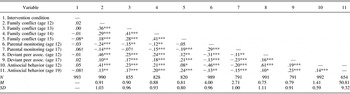
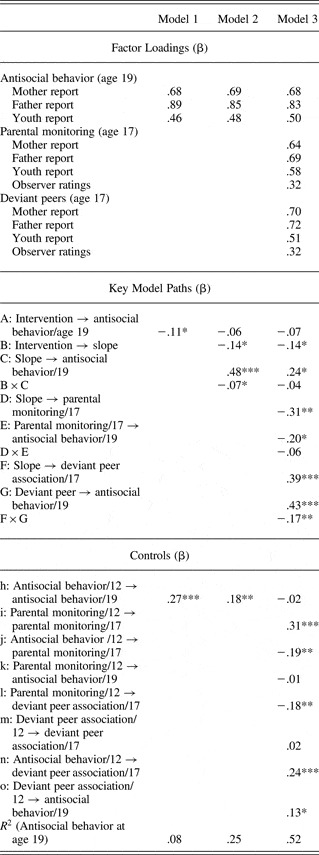
Means, standard deviations, and intercorrelations for all variables used in this analysis can be found in Table 1. We initially examined the direct effect of the intervention (Model 1) and found that the model generally fit the data well, χ2 (5) = 16.45, p < .01, CFI = 0.95, TLI = 0.91, RMSEA = 0.048 (0.023|0.075). As shown in Table 2, the intervention condition predicted significantly lower levels of antisocial behavior at age 19 (Path A); the effects of adolescent-report antisocial behavior in sixth grade were controlled (Path i).
Correlations and sample descriptives for variable-oriented analysis

†p < .10. *p < .05. **p < .01. ***p < .001.
Model coefficients for variable-oriented analysis

*p < .05. **p < .01. ***p < .001.
We next fit a model containing family conflict across ages 12 through 15 (Model 2). The model fit the data well, χ2 (22) = 41.41, p < .01, CFI = 0.98, TLI = 0.97, RMSEA = 0.030 (0.015|0.044). As shown in Table 2, the effect of the intervention condition predicted a significant decrease in family conflict (Path B), and family conflict was significantly and positively related to antisocial behavior (Path C). The indirect effect of the intervention on antisocial behavior (B*C) was significant and negative. The direct effect of the intervention condition on antisocial behavior (Path A) was reduced to nonsignificance, suggesting that the change over time in family conflict completely mediated the impact of the intervention on adolescent antisocial behavior. This finding confirms the hypothesis offered earlier.
We next inserted parental monitoring and deviant peer association and refit the model (Model 3). The model generally fit the data well, χ2 (118) = 257.92, p < .001, CFI = 0.93, TLI = 0.91, RMSEA = 0.034 (0.029|0.040). Model path coefficients are presented in Table 2. The change over time in family conflict was significantly and negatively related to parental monitoring (i.e., lower levels of family conflict predicted higher levels of monitoring; Path D) and was significantly and positively related to deviant peer association (i.e., lower levels of family conflict predicted lower levels of deviant peer association; Path F). Parental monitoring and deviant peer association predicted the change in antisocial behavior (Paths E and G). The indirect effect of the change in family conflict on antisocial behavior via parental monitoring (D*E) was not significant, but the indirect effect via deviant peer association (F*G) was significant; and the direct effect of the change in family conflict on antisocial behavior was reduced to nonsignificance, suggesting that deviant peer association completely mediated the impact of family conflict on adolescent antisocial behavior. These findings confirm the hypotheses offered earlier.
Person-oriented analysis
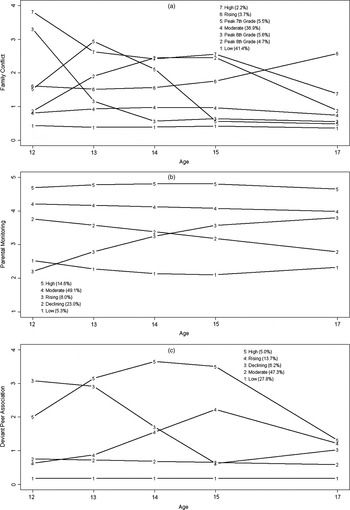
We determined that the optimal number of trajectory groups for family conflict, parental monitoring, and deviant peer association was 7, 5, and 5, respectively. The trajectory paths and sizes are presented in Figure 2a–c.
Trajectory groups for (a) family conflict, (b) parental monitoring, and (c) deviant peer association.

Risk analysis
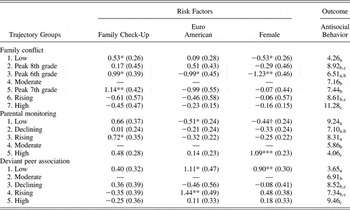
Predictors of group membership are provided in Table 3; in each analysis, we selected a stable, moderate group as our basis for comparison. For the family conflict trajectories, we selected Trajectory 4 (moderate) and found that the intervention condition predicted an increased likelihood of membership in Trajectories 1, 3, and 5 (low, peak sixth grade, and peak seventh grade, respectively). The latter two trajectories were relatively high in conflict and then declined, eventually reaching low levels. Among other results, we also found that female youths were less likely to belong to Trajectories 1 and 3; in other words, these lower conflict trajectories were more likely to consist of males.
Risk and outcome analyses for trajectory groups

Note: The comparison groups for the risk analysis are numbers 4, 4, and 2, respectively (moderate). Outcome values with different subscripts are significantly different at p < .0025 (family conflict) or p < .005 (parental monitoring and deviant peers).
†p < .06. *p < .05. **p < .01. ***p < .001.
For parental monitoring, our comparison group was Trajectory 4 (moderate). We found that the intervention condition predicted increased likelihood of membership in Trajectory 3 (rising). This finding is consistent with those of previous analyses of parental monitoring effects that used direct observations (Dishion, Nelson, et al., Reference Dishion, Nelson and Kavanagh2003). Being female predicted an increased likelihood of membership in Trajectory 5 (high), suggesting that youths reporting high degrees of monitoring tended to be female rather than male.
For deviant peer association, we selected Trajectory 2 (moderate), but we found no effects for the intervention condition. Females were more likely to belong to Trajectory 1 (low) than males, as were European American youth; however, European American youths were also more likely to belong to Trajectory 4 (rising) than those of other ethnicities, suggesting that ethnicity is not a consistent predictor of risk in this sample.
Outcome analysis
We then examined trajectory differences in later antisocial behavior. We saved the antisocial factor scores from the variable-oriented analysis and then used them in an outcome analysis. Within each group of trajectories, we estimated each trajectory score for antisocial behavior; conducted an omnibus test to determine whether the trajectory scores were different from one another; and, if so, conducted pairwise comparisons as described earlier.
Our first outcome analysis used the trajectories of family conflict. The outcome values for each trajectory are presented in Table 3, and the omnibus test was significant, χ2 (6) = 64.48, p < .001. Significance for the pairwise comparisons was set at p < .0025 (.05/20 comparisons). As Table 3 shows, the levels of conflict roughly corresponded to later antisocial behavior. However, Trajectory 2 (peak 8th grade) was notable in that it was not significantly different from the highest level of antisocial behavior (Trajectory 7 or high conflict), despite a decline in family conflict from 8th to 11th grade. Similarly, Trajectory 6 (rising), despite having a relatively low level of conflict through Grades 6 through 8, possessed a relatively high degree of antisocial behavior that also did not differ from that of Trajectory 7 (high). In contrast, antisocial behavior for Trajectories 3 and 5 (peak sixth and peak seventh grades) was significantly lower than that of Trajectory 7, even though these two trajectories possessed relatively high levels of conflict in 6th and 7th grades, respectively.
The outcome values for the parental monitoring trajectories are shown in Table 3; the omnibus test was significant, χ2 (4) = 63.47, p < .001. Pairwise comparisons set at p < .005 (.05/10 comparisons) suggested that antisocial behavior had an inverse relationship with monitoring, with some exceptions. The most notable was that Trajectory 2 (declining) possessed a level of antisocial behavior that did not differ significantly from that of Trajectory 4 (moderate); in contrast, Trajectory 3 (rising) was significantly higher than Trajectory 4.
The outcome values for the deviant peer trajectories can be found in Table 3; the omnibus test was significant, χ2 (4) = 60.08, p < .001. Pairwise comparisons set at p < .005 revealed that Trajectory 1 (low) had significantly lower antisocial behavior whereas Trajectories 2, 3, and 4 (moderate, declining, and rising, respectively) were not significantly different. Trajectory 5 (high), however, was significantly higher in behavior when compared with Trajectories 1 and 2 (but not when compared with Trajectories 3 and 4).
Dual-trajectory analysis
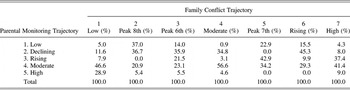
The dual-trajectory models are provided in Table 4 (family conflict and parental monitoring) and Table 5 (family conflict and deviant peer association). In each table we identify subgroups of families that behaved in very different ways. For example, we found that a number of families in the peak eighth grade (Trajectory 2), rising (Trajectory 6), and high (Trajectory 7) family conflict trajectories had either moderate (20.9%, 29.3%, and 41.1%, respectively) or high (5.4%, 0%, and 9.0%, respectively) levels of parental monitoring, despite their elevated levels of family conflict. We considered this group to be “resilient” in that they did not appear to be following the developmental model of antisocial behavior. Further, youths in the resilient families reported lower levels of deviant peer association (averaged across Waves 1–4, ages 12–15) than youths in the “low” monitoring trajectory, F (1, 47) = 34.46, p < .001, so these differences in these families were certainly salient for later antisocial behavior.
Cross-trajectory memberships for family conflict, conditional on parental monitoring trajectory membership

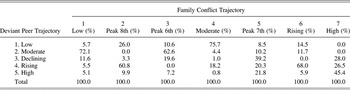
Cross-trajectory memberships for family conflict, conditional on deviant peer trajectory membership

We identified a similar subgroup of resilient families with relatively high degrees of conflict yet lower levels of deviant peer association (see Table 5), and this group overlapped closely with the resilient group discussed in the previous paragraph. We found that 28.0% of families in the high family conflict trajectory (Trajectory 7), 14.5% and 11.7% of families in the rising conflict trajectory (Trajectory 6), and 26.0% and 3.3% of families in the peak eighth grade conflict trajectory (Trajectory 2) possessed high or rising levels of family conflict but low, moderate, or declining levels of deviant peer association. In the other at-risk families, high or rising degrees of conflict were associated with high or rising levels of deviant peer association. We conducted a post hoc comparison and found that these resilient families reported higher levels of parental monitoring (averaged across Waves 1–4, ages 12–15) than the at-risk families, F (1, 84) = 9.38, p < .01. Thus, despite high degrees of family conflict, parents in the resilient group were able to maintain higher levels of monitoring of youth behavior and thus insulate their children to an extent from the influence of deviant peers. Exploring further, we found that these resilient families were marginally more likely to be non-European American, χ2 (1) = 3.59, p = .058. The largest subgroup was African American; and when we restricted our comparison to European American versus African American, we found the results to be significant, χ2 (1) = 6.36, p < .05. We found no significant differences on standard measures of socioeconomic status (e.g., income, education) or family status (i.e., married, divorced, etc.), but we did find that mothers in resilient families were more likely to be a full-time parent than to be employed or to be a student, χ2 (1) = 3.87, p < .05.
Turning again to Table 5, we can also see that a percentage of the families in the low family conflict trajectory (Trajectory 1) had rising (5.5%) or high (5.1%) levels of deviant peer association, as did 7.2% of the families in the peak sixth grade family conflict trajectory (Trajectory 3); these families could thus be considered to be “at risk” in spite of their low or declining levels of family conflict. In contrast, other families in these two conflict trajectories had low, moderate, or declining levels of deviant peer association. We conducted a brief post hoc comparison between the two groups in terms of parental monitoring (averaged across Waves 1–4) and parental deviant talk (coded during the family interactions in a manner similar to youth deviant talk; see Method Section). We found that the at-risk group reported lower levels of parental monitoring, F (1, 361) = 5.61, p < .05, and higher levels of parental deviant talk, F (1, 258) = 5.60, p < .05. Thus, despite relatively low levels of family conflict, adolescents in the at-risk group would seem to be vulnerable to the influence of deviant peers and therefore at risk for later behavioral problems resulting from either withdrawal of parental attempts to monitor behavior (suggesting coercive processes in the past), encouragement of deviant behavior by parents, or both.
Discussion
We approached the issue of understanding the etiology of adolescent antisocial behavior and the impact of the randomized family intervention by using a multilevel strategy that combined variable-oriented and person-oriented analyses. The variable-oriented analyses extended existing research on the FCU by demonstrating that the intervention not only reduced family conflict across time (corroborating and extending the findings from a different sample, i.e., Van Ryzin et al., in press) but also reduced adolescent antisocial behavior several years after the conclusion of the intervention.
Even more significant, our results also provided a highly detailed picture of the mechanisms by which the FCU exerted its effects and, in so doing, provided causal evidence for the effects of parenting and related family processes on adolescent behavior (Collins, Maccoby, Steinberg, Hetherington, & Bornstein, Reference Collins, Maccoby, Steinberg, Hetherington and Bornstein2000). In general, our findings confirm the basic underpinnings of the coercion model (Patterson et al., Reference Patterson, Reid and Dishion1992). Change in family conflict in early adolescence predicted later levels of parental monitoring (Path D) and deviant peer association (Path F), and in turn parental monitoring and deviant peer association predicted antisocial behavior in late adolescence (Paths E and G). As predicted, parental monitoring was not a mediator of the effects of family conflict on antisocial behavior. It is interesting that Dishion et al. (Reference Dishion, Nelson and Kavanagh2003) found that monitoring did mediate intervention effects on problem behavior in early adolescence. These two findings suggest that the effects of parental monitoring on problem behavior, although strong in early adolescence, may wane in later adolescence. This hypothesis was first offered by Van Ryzin et al. (Reference Van Ryzin, Fosco and Dishion2011), who examined the developmental course of substance use across adolescence and early adulthood and found that parental monitoring and deviant peers exerted relatively equal influence on early adolescence use, but peer influence tended to increase and the influence of parental monitoring tended to decline by late adolescence.
Our person-oriented analysis provided further corroboration of the role of the FCU in reducing family conflict and improving parental monitoring. Specifically, the FCU was associated with declining trajectories of family conflict and rising trajectories of parental monitoring; however, the FCU was not associated with trajectories of deviant peer association, suggesting the need to either buttress the FCU's focus on peer environments or design new school-based interventions that address peer aggregation and group formation.
With regard to our person-oriented analysis, our findings suggest the need for additional research in several areas. First, we found that family conflict in later adolescence (Grades 8–11) may be more salient for later antisocial behavior than conflict in earlier adolescence (Grades 6–7), perhaps because conflict in early adolescence is more normative (Smetana et al., Reference Smetana, Campione-Barr and Metzger2006). Second, we found that a rising trajectory of parental monitoring was associated with a higher level of antisocial behavior than was a declining trajectory. This seems counterintuitive and thus may suggest that, to some extent, increased parental monitoring may have been elicited by youth misbehavior. In other words, more delinquent, antisocial youths may have elicited greater parental monitoring during the course of adolescence, whereas parents of less delinquent youths may have been more comfortable reducing their level of monitoring. This suggests that, absent an intervention such as the FCU, an increase in monitoring across adolescence could be an outcome of problem behavior rather than a predictor. We also found consistent links between deviant peer association and later antisocial behavior.
Third and finally, our person-oriented analysis provided a more nuanced representation of the different types of families in our sample and hinted at the diversity of intervention and prevention approaches that are required to address the multiple pathways of antisocial behavior. Family conflict, which is often an early indicator of coercive dynamics in family systems, did not always portend reduced parental monitoring and in turn a higher degree of deviant peer association and later antisocial behavior. In some situations the parents were able to maintain a high degree of engagement in family management despite high conflict; we labeled these families as resilient in the face of high conflict. Their high degree of monitoring implied reduced levels of deviant peer association and in turn lower levels of future antisocial behavior.
The processes underlying resilience, however, were not entirely clear and present an intriguing topic for future research. In an exploratory analysis, we found that these resilient families were more likely to be African American, and therefore there may be cultural differences in family interactions that do not fit within the coercion model; parents may not “give up” but rather continue to monitor youths through to late adolescence. Alternatively, this resilience may be related to our finding of a greater likelihood for mothers to be in the home having regular contact with their adolescent children, which can reduce problem behavior (Dishion, Bullock, & Kiesner, Reference Dishion, Bullock, Kiesner, Kerr, Stattin and Engels2008). We can also speculate that the regular presence of the mother in the home and her investment in her child's behavior may have contributed to the higher degree of conflict.
One possible approach to understanding this family resilience would be to measure parent motivation to engage in the labor-intensive caregiving and family management process over time. This approach could include acquiring self-report measures of parents' motivation to remain actively involved and engaged with their youth or reviewing existing videotaped parent–child interactions for evidence of parent motivation, vis-à-vis parents' interaction patterns over time with their adolescent (e.g., persistence, return to topic, observed concern). It is interesting that it is thought that a key factor in the success of the FCU is the support of parent motivation to continue monitoring and to stay engaged in the parenting process despite challenges, such as increased conflict (Dishion & Stormshak, Reference Dishion and Stormshak2007). However, this aspect of the change model has rarely been tested. If research could identify factors that explain why these resilient families were able to maintain parental monitoring despite high degrees of conflict, it could have significant implications for prevention and intervention.
We also found families in which conflict did not play a role in creating elevated levels of deviant peer association. We instead found that low levels of monitoring, parental support for deviance, or both contributed to deviant peer association. Given the low levels of family conflict, it may be that these families had experienced coercive family processes in the past and by middle school had “given up” their efforts to monitor adolescent behavior. Alternatively, it may be that these parents were themselves deviant, suggestive of the “sibling parent” dynamic described by Patterson (Reference Patterson and Abate1985) in the early definition of the coercion model. The sibling parent is more like a peer and may at times encourage problem behavior through telling stories of their own deviant background. This finding is supported by research that has examined boys whose fathers directly encouraged antisocial behavior in a home observation; these boys were more likely to engage in deviant talk with peers (Dishion, Owen, & Bullock, Reference Dishion, Owen and Bullock2004). In any case, the implications for prevention and intervention are significant and suggest a need to tailor and adapt parenting interventions to account for parental role modeling of deviant behavior.
General discussion
These analyses, when combined, suggest several things. First, our results support the coercion model (Patterson et al., Reference Patterson, Reid and Dishion1992) by documenting that a family-based intervention can reduce later levels of antisocial behavior by focusing on issues such as family management, communication, and parental motivation. Our findings are even more noteworthy considering that less than a quarter of the intervention group actually engaged in the FCU.
Second, our results also point to the need for increasing flexibility and customization of family-based interventions. The diversity in family dynamics is illustrated in our dual-trajectory analyses, which suggest that a family therapist delivering an intervention may encounter a wide range of issues and targets for intervention among different families. One family may be experiencing an escalating level of family conflict, declining levels of monitoring, and increasing levels of deviant peer association; whereas another family, having already had these experiences, may possess low levels of conflict and monitoring and high levels of deviant peer association. Alternatively, it may be that low conflict and high deviant peer association is not indicative of past coercive processes but rather parental approval of deviant behavior. Clearly, the three types of families would require very distinct intervention approaches. The high-conflict family would be best served by training in communication and conflict resolution. In contrast, the low-conflict family with a history of coercive processes would appear to have given up their attempts to monitor adolescent behavior and would require assistance in becoming more involved with their adolescent and reengaging in family management activities. The low-conflict family with deviant parents would require an intervention aimed at identifying and rectifying the deviant behavioral patterns being supported and encouraged by means of tacit or explicit parental approval.
One aspect of the FCU that stands in contrast to the broader intervention literature is the manner of engagement. In this study the families did not seek interventions but rather were approached proactively and engaged in using the FCU. In contrast, the vast majority of intervention studies that target parenting involve caregivers seeking treatment. This is clearly a selection bias and one that is avoided in this intervention study, because parents in the community were actively solicited through existing community organizations (e.g., schools).
The design of interventions that proactively engage caregivers in parenting support is more than a research innovation. A public health model encourages the design of interventions that can be embedded in service settings that reach the majority of the children and families in a community (Biglan & Taylor, Reference Biglan and Taylor2000; Kellam, Reference Kellam and Patterson1990). In particular, designing interventions that fit the ecology of a service setting (e.g., public school systems; Head Start; Women, Infants, and Children) is ideal in that such settings potentially also provide other support services relevant to parents and children that can be coordinated and integrated (Dishion & Stormshak, Reference Dishion and Stormshak2007; Hoagwood & Koretz, Reference Hoagwood and Koretz1996).
In FCU research with indigent families with toddlers enrolled in Women, Infants, and Children, we found that 75% engaged in the FCU, which resulted in significant improvements in parent involvement and positive behavior support, which in turn translated to reductions in early childhood problem behavior and in maternal depression (Dishion et al., Reference Dishion, Shaw, Connell, Gardner, Weaver and Wilson2008; Shaw, Connell, Dishion, Wilson, & Gardner, Reference Shaw, Connell, Dishion, Wilson and Gardner2009; Shaw, Dishion, Supplee, Gardner, & Arnds, Reference Shaw, Dishion, Supplee, Gardner and Arnds2006). These findings support the public health approach to addressing parenting in general, as well as the viability of tailoring and adapting an ecological approach to parent interventions to meet the specific needs of individual children and families. In this sense, that a relatively brief, tailored intervention that is family centered and proactively delivered in service venues could improve the lives of many children and families bodes well for the future of prevention science and the hope of reducing the prevalence of maladaptation in children and families.
However, the FCU strategy does place the burden on family-support specialists (e.g., school psychologists, school counselors, social workers) to tactfully and respectfully capture the attention of families and motivate changes in parenting. In our multiple gating approach (Dishion & Patterson, Reference Dishion, Patterson, Singer, Singer and Anglin1993; Loeber, Dishion, & Patterson, Reference Loeber, Dishion and Patterson1984) we found that having parents provide the initial assessment of their child's risk at the beginning of their involvement in service venues is preferable to having others assess risk, identify the child, and then approach the parents. Joining with parents in their concerns is a positive first step in creating a collaborative relationship, which sets the foundation for supporting motivation. Moreover, motivational enhancement requires a considerable degree of interpersonal competence (e.g., Patterson, Reference Patterson and Abate1985) and heavy reliance on motivational approaches (Miller & Rollnick, Reference Miller and Rollnick1991, Reference Miller and Rollnick2002).
Limitations and conclusion
Several limitations to these results should temper interpretation. First, the measures of parent–child conflict used in the main analyses were based entirely on youth report. At first glance, this is positive in that the vast majority of the intervention activity involved parents, and therefore youth report is less vulnerable to participant bias. The advantage of youth report for large-scale prevention trials is that it is relatively inexpensive to collect longitudinally. However, it may have limited validity. Fortunately, by design, we directly observed a subset of high-risk families and followed them through youth age 17. We did find some evidence of validity for the youth reports of conflict in that generally significant correlations were found between the survey and observational measures; we also found that survey and observational measures demonstrated an intervention effect. Our variable-oriented analysis also made use of youth-report measures of parental monitoring and deviant peer association; although we could not validate them at every wave of measurement, we note that the factor loadings at age 17 among survey and observational measures were acceptable (see Table 2), which provides some evidence of validity.
Second, in formulating the hypotheses for this study, we did not look beyond coercion theory to examine other possible mechanisms by which the FCU may have been operating. One intriguing possibility is parent–adolescent relationship quality. In general, parent–adolescent relationship quality has been linked to decreased risk for substance use, antisocial behavior, and depression and is associated with increased youth behavioral and emotional health (Ackard, Neumark-Sztainer, Story, & Perry, Reference Ackard, Neumark-Sztainer, Story and Perry2006; Resnick et al., Reference Resnick, Bearman, Blum, Bauman, Harris and Jones1997). Relationship quality remains an important predictor of youth problem behavior even when controlling for parenting styles (i.e., authoritarian, permissive, etc.; Bronte-Tinkew, Moore, & Carrano, Reference Bronte-Tinkew, Moore and Carrano2006). The FCU is used to assess parent–youth relationship quality and provide feedback. Moreover, in the Everyday Parenting Curriculum (Dishion et al., Reference Dishion, Stormshak and Kavanagh2011), which can be used to guide further intervention services, four sessions target improved relationship quality, including listening skills, conflict resolution, positive communication, and engagement in parent–child activities. Our study data suggest that the FCU could improve outcomes by emphasizing relationship quality, as would new interventions that strengthen a sense of connectedness in the parent–child relationship.
In sum, this study extends current research by demonstrating that the FCU can have salutary effects on parenting, family processes, and adolescent outcomes. By linking these elements, this study provides a detailed picture of the mechanisms underlying the FCU and provides strong evidence for the impact of parenting and family processes on adolescent antisocial behavior. It is also clear, however, that more work must be done to understand the different pathways to the development of youth antisocial behavior. In addition to the finding that high conflict can create reduced parental monitoring and more association with deviant peers, our study results and the extant literature also suggest that parents can influence the development of antisocial behavior through their tacit or explicit approval of deviant activities. Further, we discovered that among resilient families high conflict does not invariably lead to reduced monitoring and increased peer deviance. This finding, which may be related to factors such as ethnicity or maternal presence in the home, is a critical topic for future research. Much can be learned from this group that would be directly relevant to prevention and intervention efforts. Even though the FCU model does integrate assessment with decision making to identify interventions that are most likely to be helpful for a youth and family, our findings suggest a more dynamic approach will be necessary to adapt and optimize family-centered interventions to the needs of different families. A new generation of intervention trials is needed that is both based on theory and dynamic; addresses the social ecology and family history; and considers the ebb and flow of adaptation, maladaptation, and motivation.