I. INTRODUCTION
The use of textile fibers and structures is conventionally associated with clothing and household applications. However, in recent years, due to important scientific and technological efforts, their application in other high-end sectors gained attention, especially when enhanced performance products are required. In this way, many research activities are being undertaken worldwide to improve the performance of fiber-based materials, especially when applied in combination with different types of polymeric matrixes. The result is the development of composites with exceptional properties. Reference Padaki and Alagirusamy1–Reference Oliveira, Fernandes, Carneiro and Souto3
Textile technologies are very attractive for tailoring properties in each direction and to reinforce the thickness direction to avoid the delamination. Reference Araújo, Fangueiro and Hong4 Furthermore, composites made from textile fabrics can be used in several structural applications, presenting lower production cost Reference Pandita, Falconet and Verpoest5 and may offer shape ability for near-net-shape manufacturing. Reference Ramakrishna6
The properties of the textile reinforcement may also be designed by selecting from a wide range of possibilities including long or short fibers, yarns, filaments, woven, nonwoven, knitted or braided fabrics. The choice depends on raw material and production costs, desired properties, production process, and final application.
Braiding and knitting technologies are gaining importance in the production of composite reinforcements. Braiding is appropriate for the production of tubular preforms from single to multilayer structures with high formability and superior mechanical behavior. Knitting technology can be divided between warp and weft technology. Warp technology is used for the production of fabrics reinforced by noncrimp yarns. Flat knitting technology used to produce weft-knitted fabrics is commonly suitable to produce complex-shaped and sandwich fabrics. Reference Araújo, Fangueiro and Hong4 For example, a flexible matrix composite reinforced with a weft-knitted fabric is extremely deformable and appropriate for manufacturing complex-shaped components. Conversely, a composite material produced from a warp-knitted fabric and a rigid resin matrix is suitable for applications that require good stiffness and tensile strength. Reference Ramakrishna6
Thus, the development of special kinds of textile structures is an opportunity to improve the benefits of composites reinforced with weft-knitted fabrics. The development of auxetic fibrous architectures provides significant improvements in the material’s mechanical properties, such as enhancement in fracture toughness, shear moduli, indentation resistance, and allows porosity and permeability variation (under pressure) Reference Chan and Evans7,Reference Alderson and Alderson8 and dome shape. Reference Alderson and Alderson9,Reference Ugbolue, Kim, Warner, Fan, Yang, Kyzymchuk, Feng and Lord10 As a result of this range of benefits, auxetic materials can be used in various areas, including medicine, architecture, civil engineering, sport clothing, high-performance equipment, blast protection, insulation, filters, among others. Reference Alderson and Alderson9,Reference Evans and Alderson11–Reference Pichandi, Rana, Oliveira, Fangueiro and Xavier20
In this case, the most interesting challenge is to maintain the auxetic properties in the composite provided by the fibrous reinforcement. The choice of the correct matrix will allow the desired movement in the structure during deformation responsible for the negative Poisson ratio.
Lately, a proliferation of articles about composites made from auxetic textile structures provided by helical auxetic yarns has been noticed. Reference Pichandi, Rana, Oliveira, Fangueiro and Xavier20–Reference Zhang, Ghita and Evans24 The formation of helical auxetic yarns consists of a stiffer thin filament helically wounded around a low stiffness thick filament. When this arrangement is longitudinally stretched, both filaments are elongated, causing an overall lateral expansion of the thicker filament, leading to the formation of an auxetic helical yarn. Among the works developed within this scope, the studies from Miller et al. on the development of auxetic composites based on the helical auxetic principle using weaving technology is an important Ref. Reference Miller, Hook, Smith, Wanga and Evans21. In the first study, an ultrahigh molecular weight polyethylene yarn has been twisted with a polyurethane one, used as a core. This yarn has been used as the weft of a plain woven structure, using a meta-aramid yarn in the warp. For the polymeric matrix a silicone rubber gel was used. Reference Miller, Hook, Smith, Wanga and Evans21 Miller et al. developed the helical auxetic principle using a polyamide (PA) as a core and a carbon yarn helically wound around it, referred to as a “wrap”, in an unsaturated polyester matrix. Reference Miller, Ren, Smith and Evans22 Bhattacharya et al. studied the influence of the interaction between wrap and the core on the stiffness, showing that the number of filaments in the wrap can also influence the auxetic properties. Reference Bhattacharya, Zhang, Ghita and Evans23
Pichandi et al. studied the development of auxetic composites from braiding technology. In his research, different auxetic structures were developed with varying structural angles, using core reinforced braided composite rods containing glass fibers for axial reinforcement, polyester filaments for braided structure and epoxy resin as matrix. Reference Pichandi, Rana, Oliveira, Fangueiro and Xavier20 Recently, Zhang et al. introduce a third component in the helical auxetic principle: a sheath coated stiff wrap fiber around an elastomeric fiber. The auxetic effect decreased with an increase of the coating thickness. Reference Zhang, Ghita and Evans24 Despite the scientific works mentioned above, according to the authors’ knowledge, composite materials reinforced with auxetic knitted fabrics have not been studied.
Thus, the main objective of the present work is to develop an advanced composite material reinforced with a novel weft-knitted auxetic fabric using high-performance yarns and to study the transfer of the negative Poisson’s ratio (NPR) effect to the resulting composite.
II. EXPERIMENTAL SECTION
A. Materials
Knitted fabrics with auxetic behavior were produced from para-aramid (p-AR) fiber yarn Standard TWARON® 2000 (88.5 Tex, 500 monofilaments) and high-tenacity PA fiber yarn (98.6 Tex, 140 monofilaments), supplied by TEIJIN Company (Arnhem, the Netherland) and RHODIA Company (Lisboa, Portugal), respectively.
Composite materials were reinforced by the knitted structures produced using an epoxy resin (Biresin® CR83 and 30.0% Biresin CH83-2 catalyst, Sika Deutschland GmbH, Stuttgart, Germany) and nonsaturated polyester resin (PES) with an isophthalic acid-base (Allnex® Viapal Up 130/65 [Resiquimica S.A, Porto, Portugal], 0.3% cobalt accelerator and Butanox M50 catalyst [Akzo Chemical Ltd, Amersfoort, Netherlands]—2.0% of matrix volume).
Epoxy resin has been chosen in this research due to its exceptional combination of properties such as excellent toughness, adhesion, thermal, and chemical resistance. Besides, this type of thermoset polymer finds application in several different fields. On the other hand, the unsaturated polyester thermosetting resin from isophthalic acid presents high strain at break, high impact strength, and an excellent structural flexibility, showing a high percentage of extension at break (approximately 60%).
B. Mechanical characterization
The linear density of the yarns was determined according to ISO 2060 standard. 25 Tensile tests were carried out according to NP EN ISO 2062 (PA) and ASTM D7269/D7269M standards (p-AR) using a H10KS Hounsfield Universal Testing machine (Hounsfield Test Equipment, Redhill, United Kingdom). 26,27 The loop tensile strength for the PA and p-AR yarns was obtained based on the ASTM D 3217 standard. 28 For all experiments, the yarns were previously kept during 4 h at 45 ± 5 °C and subsequently, for 14 h at room temperature before testing and all experiments were performed at least 20 times.
C. Knitted textile structure
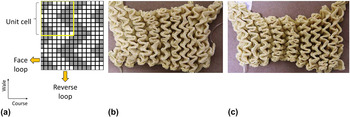
Auxetic weft-knitted textile structures were manufactured on a 10-gauge Stoll CMS 320 TC flat knitting machine (Stoll GmbH & Co., Reutlingen, Germany) using a 2-cam system with a pattern based on a purl structure through a zigzag organization, like parallelograms, on the face and back loops. The structure tends to curl and form a three-dimensional geometry after the knitting process. The equipment allows the control of needle selection, cam setting, and take-down tension setting, supporting the production of specimen structures, conventional and three-dimensional preforms or three-dimensional structures like sandwich. Reference Araújo, Fangueiro and Hong29 The structural geometry of the knitted textile structure used as reinforcement is shown in Fig. 1(a).
(a) Structural geometry of the knitted fabric and samples produced: (b) Hybrid structure, (c) 100% p-AR.

Two types of samples were produced using 100% p-AR and 50% PA/50% p-AR (hybrid). The hybrid structure was studied to create novel material properties by synergetic combination of different fibers (p-AR and PA), making this material cheaper and more interesting for several applications. All structural and machine parameters (loop length and take down load, respectively) to produce the samples were kept constant. Figs. 1(b) and 1(c) show the developed knitted fabrics.
D. Composites
Before impregnation, samples were conditioned for thirty days at 20 ± 1 °C and 65% humidity. This extended relaxation time ensured that the three-dimensional effect of the fabric was achieved.
Samples were impregnated with resin Biresin® CR83 (epoxy) mixed with the catalyst Biresin CH83-2 and resin Allnex® Viapal Up 130/65 (PES) mixed with the catalyst Butanox M50, with cobalt as an accelerator.
The auxetic knitted fabrics were impregnated according to the following steps:
-
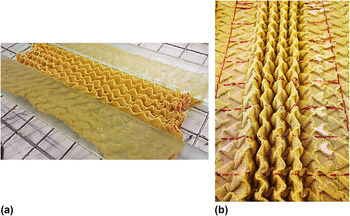
(i) The knitted fabric was manually impregnated by pouring the epoxy and PES resin on top of each specimen’s face and placing on a raised and planar grid, to remove the excess material. Glass sheets were also used to flatten the samples at their ends. The original geometry of the knitted fabrics was maintained [Fig. 2(a)].
-
(ii) Postcure temperature of 65 °C, for two days, was applied to the knitted fabrics impregnated with PES resin.
-
(iii) The samples were marked into specified dimensions according to ISO 527 30 : 180 × 40 mm [Fig. 2(b)].
(a) Knitted fabrics impregnated with the resin placed on a raised and planar grid and (b) marked into specified dimensions (180 × 40 mm).

E. Auxetic knitted fabrics—evaluation of the Poisson’s ratio
In the literature, it is possible to find different ways to evaluate the deformation of auxetic specimens produced from knitted fabrics, including record microscope, Reference Hu, Wang and Liu31 image analysis, Reference Alderson, Alderson, Anand, Simkins, Nazare and Ravirala32 and videoextensometry software attached to the tensile testing. Reference Alderson, Alderson, Anand, Simkins, Nazare and Ravirala32
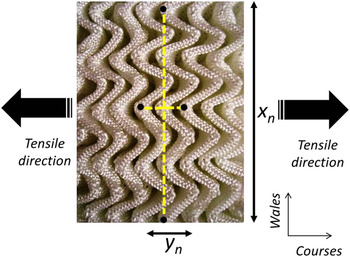
For the evaluation of NPR of the knitted structures, the specimens were marked at specific points in the coursewise and walewise directions, as shown in Fig. 3. The fabrics were extended along the course direction and the distance between the reference points along the coursewise (ε y ) and walewise directions (ε x ) at each deformation step were measured. Poisson’s ratio was calculated using Eq. (1) for 3 samples in each composition group (p-AR and hybrid fabrics). The maximum NPR obtained during the whole deformation cycle was considered and the average of the values obtained for 3 samples of each group was calculated. Reference Steffens, Rana and Fangueiro33
 $${\nu _{xy}} = - {{{\varepsilon _x}} \over {{\varepsilon _y}}}$$
Distance between the marked points on the knitted fabrics.

F. Poisson ratio evaluation of the composites developed
The Poisson ratio evaluation of the composites followed 3 steps:
-
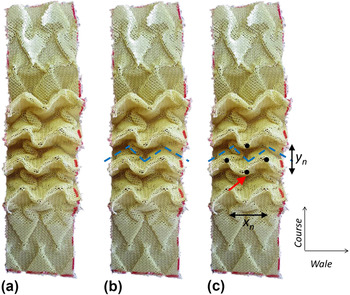
(i) Specimens were cut along the course direction in a standard size of 180 × 40 mm [Fig. 4(a)].
-
(ii) Horizontal center column in each specimen was identified, with appearance like “valley in zigzag” (black dashed line) [Fig. 4(b)].
-
(iii) Specimens were marked at the vertices of the parallelograms, as can be seen in Fig. 4(c).
(a) Preparation of the composites, (b) identification of the horizontal center column, and (c) marked point in the coursewise and walewise directions.

Both ends of each knitted fabric (after impregnation) were clamped in the jaws of the H10KS Hounsfield Universal Testing machine. Due to the size limit of the jaws, the specimens’ width could not be more than 40 mm. The impregnated knitted fabrics were extended along the coursewise direction. The evaluation took place under axial tensile with a constant speed of 1 mm/min. Pictures were taken during the load application process. The distances between the reference points along the coursewise and walewise directions at the equivalent deformation step were achieved through image analysis. Calculations of the axial strains in the coursewise (ε y ) and walewise (ε x ) directions were performed using Eqs. (2) and (3), respectively.
 $${\varepsilon _x} = - {{{x_n} - {x_0}} \over {{x_0}}}\quad ,$$
 $${\varepsilon _y} = - {{{y_n} - {y_0}} \over {{y_0}}}\quad ,$$
where x n and x y are the distances between the points marked in the walewise and coursewise directions in each deformation step, i.e., 1 mm. The initial intervals between the reference points are x 0 and y 0. Reference Hu, Wang and Liu31 Values for ε x and ε y were determined and the Poisson’s ratio calculated through the relation between the deformation in the walewise and coursewise directions in each deformation step using Eq. (1). Three samples were measured in each group of 100% p-AR and hybrid composites. The maximum NPR obtained during the whole deformation cycle was considered and the average of the highest values obtained for p-AR and hybrid composites were calculated.
G. Scanning electronic microscopy
Morphological analysis of the composites was carried out in an ultrahigh resolution field emission gun scanning electron microscopy, NOVA 1 and 200 micro SEM (FEI, Eindhoven, the Netherlands). Backscattering electron images were obtained with an acceleration voltage of 10 kV. Samples were covered with a film of Au–Pd (80–20 wt%) in a high-resolution sputter coater, 208HR Cressington Company, coupled to a MTM-20 Cressington High Resolution Thickness Controller (Cressington Company, Watford, United Kingdom).
III. RESULTS AND DISCUSSIONS
A. Mechanical characterization of filaments
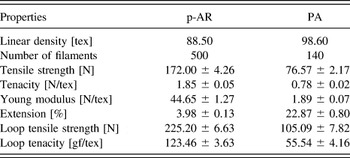
Table I shows the main properties of the p-AR and PA multifilament yarns used in this study.
Comparison of PA and p-AR yarn properties.

As observed in Table I, the linear count (g/1000 m) of PA is higher than p-AR yarn; however, the number of monofilament in the transversal section of the p-AR is significantly higher. As expected, the p-AR yarn presented the best mechanical performance for strength, tenacity, and young modulus. These characteristics can be also observed for the loop tensile strength, where the values obtained to p-AR yarn were twice higher than for PA yarn, 225.00 N and 105.09 N, respectively. Nonetheless, the PA yarn presents a higher extension.
B. Poisson’s ratio
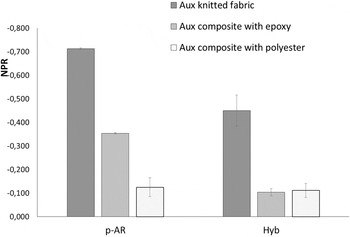
Before the resin impregnation, the Poisson’s ratio of the knitted fabrics was measured. The average values found were −0.713 and −0.450 for the p-AR and hybrid knitted fabrics, respectively, which shows the auxetic behavior of the samples.
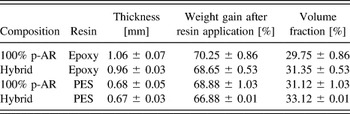
Table II shows the values for the thickness and the volume fraction of the composites produced. The composites’ thickness was measured with the use of a digital caliper at ten different points and the average of the values obtained was calculated.
Composition of model composites.

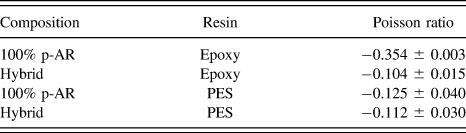
The NPR average values for the composites are listed in Table III. Regardless of the kind of resin used, it can be observed that the maximum NPR obtained was for composites reinforced with p-AR fiber-knitted fabrics. The highest NPR value was −0.354 for the composite impregnated with epoxy resin. The Poisson’s ratio values obtained for the hybrid composites produced with epoxy and PES resins were lower than those were used p-AR fibers. These results indicate that the fiber type in the construction of the knitted fabric also demonstrated significant influence on the auxetic behavior. The use of high-stiffness yarns like p-AR provided the highest NPR value. This occurs because during the loop formation, the use of stiffness fiber prevents the uniformity of stitches. Reference Lau and Dias34 Consequently, to attain equilibrium between the stitches during relaxation, internal forces are set up, leading to more deformation and shrinkage. Therefore, the NPR value is higher than those produced with fibers of higher flexibility. Reference Steffens, Rana and Fangueiro33
Average results of the NPR for composites reinforced with p-AR and hybrid auxetic knitted fabric.

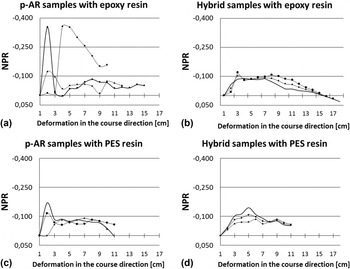
Figure 5 illustrates the variation curves during the deformation of the NPR for composites impregnated with epoxy and PES resin using p-AR and hybrid reinforcements. It is possible to verify that the curves for the hybrid composites are more linear than those obtained for the p-AR ones. Once again, such behavior can be directly related to the stiffness of the yarn and the optimum interface between the resin and the p-AR fibers, preventing greater flexibility during deformation of the yarns.
Analysis of the NPR during the deformation: (a) p-AR and (b) hybrid impregnated with epoxy resin, (c) p-AR and (d) hybrid impregnated with PES resin.

Figure 6 illustrates the comparison between the NPR values for the weft-knitted auxetic fabrics and the ones obtained for the composite materials. When comparing the results obtained before and after the resin impregnation, regardless of the resin used, epoxy or PES, it is possible to observe that the NPR values in the composites are maintained, even though there is a decrease in values. Composites produced from p-AR yarns with epoxy and PES resins present reductions of 50.3% and 82.4%, respectively, in NPR. For composites produced from hybrids filaments with epoxy and PES resins, the reduction is 76.9% and 75.1%, respectively. This reduction is due restricting the movement of the yarns movement when impregnated with the resin. However, the optimum interface between p-AR yarns and the resins used allows a better mobility of stiches and therefore, higher NPR values than those presented by hybrids filaments.
Comparison between the NPR obtained in the auxetic knitted fabric and in the composites reinforced with auxetic structure.

C. Scanning electronic microscopy
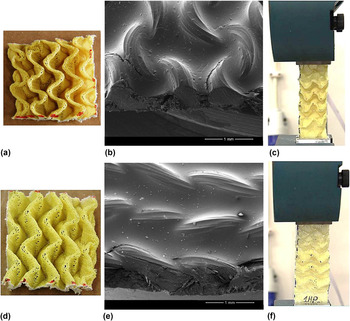
Figure 7 shows pictures of the developed auxetic composites impregnated with epoxy resin for p-AR and hybrid reinforcements, respectively (trimmed samples, SEM micrographs captured with magnification of 90× and composites clamped in the jaws of the tensile testing machine).
(a) Composite reinforced with p-AR and (d) hybrid auxetic knitted structure using epoxy resin, (b, e) SEM micrographs and (c, f) composites deformations in the coursewise direction, for p-AR and hybrid composites, respectively.

SEM micrographs show optimum interface between epoxy resin and textile reinforcement for the composite produced from 100% p-AR and hybrid yarns. It is possible to observe that the composites produced from p-AR [Fig. 7(a)] presents a superior tridimensional effect: the “zigzag valley” is more pronounced than that of the composite reinforced with hybrid weft-knitted auxetic fabric [Fig. 7(d)], which can be proved through the results of the thickness of the composites presented in Table II. Furthermore, while comparing the images obtained during the mechanical analyses of the composite deformation in the coursewise direction, it is possible to verify that in the p-AR sample [Fig. 7(c)] the tridimensional effect is more pronounced than that in the hybrid sample [Fig. 7(d)]. In this way, the composite may be deformed further until it reaches its planar form, resulting in an increased auxetic effect.
IV. CONCLUSIONS
In this study, composites reinforced with auxetic weft-knitted fabrics have been developed using high-performance yarns. The auxetic behavior transfer from the reinforcing fabric to the composite was thoroughly investigated for two types of resins, i.e., epoxy and PES, by evaluating the Poisson’s coefficient. The results obtained show that, although the auxetic behavior decreases, it is still maintained in the produced composites. Moreover, the use of high-stiffness fibers, such as p-AR, in the production of the auxetic weft-knitted fabric, resulted in strong improvement in NPR in the composites.
The present study opens new perspectives for the use of auxetic polymeric composite materials with unique features and better performance, in various technical applications, such as bulletproof vests, helmets, protective clothing, and in all other areas where energy absorption is a key factor to be considered.
AUTHOR CONTRIBUTIONS
The manuscript was written through contributions of all authors. All authors have given approval to the final version of the manuscript.
ACKNOWLEDGMENTS
We gratefully acknowledge the financial support from CAPES Foundation, Ministry of Education of Brazil, Caixa Postal 250, Brasília – DF 70040-020, Brazil, for the doctoral grant BEX 0978/12-4 and the Teijin Company for the TWARON® yarn.