


Introduction
One of the most significant recent trends in regulatory governance involves the widespread adoption of approaches designed to provide lower-cost, more flexible alternatives to traditional “command and control” regulation. These approaches generally afford regulated businesses greater discretion, with governments relying more heavily on market forces and third parties to monitor compliance. Examples include market-based incentives, public-private partnerships, environmental management systems, devolution, and corporate self-reporting (Press and Mazmanian Reference Press, Mazmanian, Vig and Kraft2019). Depending on the context, these measures may be implemented independently or in conjunction with one another. Often described as second-generation or “new” environmental regulation, these approaches have been widely studied (Coglianese and Mendelson Reference Coglianese, Mendelson, Baldwin Cave and Lodge2010; Fiorino Reference Fiorino2006; Gilad Reference Gilad2010).
In theory, these policy tools help overcome information asymmetries faced by traditional regulators and enable goal-based rather than rule-based regulatory regimes, encouraging a shift from adversarial to more cooperative relationships between government and industry. As a result, greater cooperation may build trust and help both parties overcome the suboptimal outcomes associated with the “regulation dilemma” (Potoski and Prakash Reference Potoski and Prakash2004).
However, these practices are controversial. Critics have questioned the underlying assumptions, practical implementation, and general effectiveness of such policies. Scholars have found that third-party involvement in policy monitoring and enforcement creates a chaotic policy environment (Simon Reference Simon2017), that industry self-regulation alone is unlikely to mitigate damage to common-pool resources (Andrews Reference Andrews1998), and that participation in self-governance environmental programs may actually increase firms’ toxic pollution levels (Gamper-Rabindran and Finger Reference Gamper-Rabindran and Finger2013). Thus, critics maintain, credible enforcement and verification are important conditions for extracting environmental benefits (King et al. Reference King, Prado, Rivera, Bansal and Hoffman2012).
One of the most common themes running through these varied critiques is that second-generation policies may invite abuse by reducing traditional regulatory monitoring and enforcement levels, leading to poorer policy outcomes. At its core, this debate centers on the relationship between two distinct regulatory tools: traditional monitoring and enforcement on the one hand, and information transparency on the other. Monitoring and enforcement rely on direct oversight and sanctions. Information transparency, by contrast, seeks to influence firm behavior indirectly by mobilizing external audiences. Whether these tools operate as substitutes or complements remains an open question. If transparency substitutes for enforcement, agencies may reduce inspections and punitive actions. If it complements enforcement, disclosure may strengthen regulatory oversight and improve environmental outcomes.
In this study, we empirically examine the relationship between transparency and traditional command-and-control regulatory approaches within the context of toxics information disclosure policies in the United States. Such policies, which center on the U.S. Toxics Release Inventory (TRI), are considered to be among the earliest and most well-established forms of the new environmental regulation (Fiorino Reference Fiorino2006), and many observers consider them to be among the most important and effective environmental policies ever enacted (Graham Reference Graham2002; Kraft et al. Reference Kraft, Stephan and Abel2011; Stephan Reference Stephan2002). Although the federal TRI imposes uniform reporting requirements, during the 1980s and 1990s many U.S. states adopted programs designed to disseminate toxics information more broadly and aid in its interpretation. There is substantial variation in the breadth of the programs states adopted. States are also responsible for the bulk of implementation and enforcement of core federal pollution control laws such as the Clean Air Act, Clean Water Act, and Resource Conservation and Recovery Act, which governs the disposal of hazardous solid waste (Woods Reference Woods2022). This allows us to exploit variation in policies, enforcement rates, and emissions across states and time to examine two important questions: (1) Are policies promoting greater information disclosure associated with lower overall levels of traditional inspection and enforcement activity? and (2) Are these policies associated with greater reductions in toxic emissions?
Targeted transparency and toxics
Information transparency is a cornerstone of second-generation regulatory policy. In recent years governments around the world have adopted a wide variety of initiatives aimed at providing the public with the information necessary to evaluate agency and firm performance (Etzioni Reference Etzioni2014; Fung et al. Reference Fung, Graham and Weil2007; Noh and Park Reference Noh and Park2022). Commonly framed around communities’ or consumers’ “right to know” about relevant financial, health, and environmental risks, information disclosures impact day-to-day life in a variety of circumstances, including school performance reports, restaurant grading systems, campaign finance disclosures, corporate financial reports, and consumer product disclaimers, among others (Graham Reference Graham2002).
Such policies often provide “targeted transparency,” which, in contrast to traditional government transparency policies, requires information provision by private-sector entities (Fung et al. Reference Fung, Graham and Weil2007; Weil et al. Reference Weil, Graham and Fung2013). Targeted transparency policies “mandate disclosure by corporations or other actors of standardized, comparable, and disaggregated information regarding specific products or practices to a broad audience to achieve a public policy purpose” (Fung et al. Reference Fung, Graham and Weil2007, pp. 37–38). These policies are increasingly viewed as an important alternative to both traditional regulatory standard setting and market-based approaches (Fung et al. Reference Fung, Graham and Weil2007; Weil et al. Reference Weil, Graham and Fung2013). Recent research suggests that, in some contexts, mandatory disclosure can increase compliance (Baker et al. Reference Baker, Bennear and Olmstead2023; Bennear and Olmstead Reference Bennear and Olmstead2008) and may also increase trust in regulated industries, though its effects are inconsistent across policy domains (Grimmelikhuijsen et al. Reference Grimmelikhuijsen, de Vries and Bouwman2024).
One of the most important U.S. targeted transparency policies is the TRI. It dates back to 1986, when Congress passed the Emergency Planning and Community Right-to-Know Act (EPCRA) in response to a toxic gas release from a pesticide plant in Bhopal, India, that resulted in the deaths of over 2,000 people. EPCRA established annual reporting requirements for industrial facilities in the United States and provided communities and stakeholders with access to detailed facility-level information on the total pounds of toxic substances released annually into the air, ground, and water.
Since the inception of the TRI program the amount of toxic chemicals released in the U.S. has declined dramatically, leading the TRI to be considered by some to be one of the most successful environmental programs in history and a model for information disclosure programs worldwide (Graham Reference Graham2002). At the same time, there has been substantial variation in observed environmental performance across both states and firms (Kraft et al. Reference Kraft, Stephan and Abel2011).
The program has also come under criticism on a variety of fronts. The data have been criticized for not accurately reflecting environmental risk (Gerde and Logsdon Reference Gerde and Logsdon2001), for inconsistencies in reporting requirements over time (Poje and Horowitz Reference Poje and Horowitz1990), and for having many reporting errors (Koehler and Spengler Reference Koehler and Spengler2007; Ozymy and Jarrell Reference Ozymy and Jarrell2011; Poje and Horowitz Reference Poje and Horowitz1990). Critics likewise argue that the technical complexity of the reported information makes it challenging for non-experts to access, accurately interpret, and effectively use without supplemental analysis or additional information dissemination efforts (Bae et al. Reference Bae, Wilcoxen and Popp2010; Gerde and Logsdon Reference Gerde and Logsdon2001; Weil et al. Reference Weil, Fung, Graham and Fagotto2006). The extent to which the observed reductions in overall toxic releases can be attributed to the TRI program has also been called into question (Graham Reference Graham2002; Natan and Miller Reference Natan and Miller1998), and some scholars have argued that relying on information disclosure without a strong traditional regulatory monitoring and enforcement infrastructure would be ineffective and possibly counterproductive (Kraft et al. Reference Kraft, Stephan and Abel2011).
Information transparency policies and traditional regulation: substitutes or complements?
Governments frequently employ multiple policy tools to pursue regulatory goals. Yet how these tools work together has received far less attention than studies of individual instruments (Capano and Howlett Reference Capano and Howlett2020). Within environmental regulation in particular, the characteristics and effects of individual policy tools have been widely examined (Park and Cho Reference Park and Cho2025; Salamon Reference Salamon2002; Yi et al. Reference Yi, Fang, Wen, Guang and Zhang2019), but comparatively less attention has been given to how these tools interact and how such interactions shape policy outcomes (see Cheng and Yi Reference Cheng and Yi2017; Yi and Feiock Reference Yi and Feiock2012 for notable exceptions). This study explores the interaction between two such tools in the environmental regulatory arena: traditional command-and-control regulation and public information disclosure.
Within this broader debate, the TRI has often been described as marking a notable transition away from the traditional command-and-control regulatory approach in the U.S. (Fiorino Reference Fiorino2006). Yet its relationship to existing oversight practices is far from clear. Depending on the source one consults, one could conclude that environmental protection agencies treat it either as a substitute for or a complement to their regular regulatory monitoring and enforcement activities. We argue below, however, that the effects of transparency are conditional rather than uniform. Whether transparency substitutes for or complements traditional oversight depends on what reported emissions signal about the seriousness of the pollution problem. Finally, the net effect of these informational policies on pollution emissions remains uncertain. We elaborate on these points in the remainder of this section.
Information transparency policies as a substitute for traditional regulation
Advocates view public information policies as a more effective, lower-cost substitute for traditional forms of regulation such as formulating, monitoring, and enforcing strict standards on pollution emissions (Fiorino Reference Fiorino2006; Fung et al. Reference Fung, Graham and Weil2007). Like other information transparency policies, the TRI is premised on the idea that citizens, consumers, and/or investors care about environmental performance and will be empowered to utilize the information to pressure firms into reducing pollution levels, effectively taking the place of traditional regulators (Harrison and Antweiler Reference Harrison and Antweiler2003; Stephan Reference Stephan2002). Despite some mixed results, scholars have generally found that TRI reporting has impacted the behavior of consumers (Mastromonaco Reference Mastromonaco2015), community and environmental groups (Grant Reference Grant1997), the media (Saha and Mohr Reference Saha and Mohr2013), stock market and firm values (Clarkson et al. Reference Clarkson, Fang, Li and Richardson2010; Konar and Cohen Reference Konar and Cohen1997), and ultimately, polluting firms (Kraft et al. Reference Kraft, Stephan and Abel2011; Lee Reference Lee2010). When governments adopt strong toxics information disclosure policies, then they may rely less on traditional regulatory monitoring and enforcement activities, effectively outsourcing these regulatory functions to third parties. Thus, the regulatory substitution hypothesis suggests that stronger information disclosure policies lead to reduced rates of regulatory inspections and enforcement actions.
Information transparency policies as a complement to traditional regulation
Alternatively, information transparency policies may be viewed as a complement to existing regulatory approaches. This view emphasizes the ability of government agencies to incorporate information gleaned through public disclosure into their regulatory process. A growing body of empirical evidence suggests that combining traditional enforcement measures with public disclosure can yield additional compliance gains (Evans Reference Evans2016; Foulon et al. Reference Foulon, Lanoie and Laplante2002). In the context of toxic reduction policies, TRI information often becomes highly “embedded” in the decision-making of regulatory agencies (Weil et al. Reference Weil, Fung, Graham and Fagotto2006; Yu et al. Reference Yu, O’Toole, Cooley, Cowie, Crow and Herbert1998). Indeed, Kraft et al. (Reference Kraft, Stephan and Abel2011) find that regulators actively utilize TRI information to set priorities and inform regulatory monitoring and enforcement and argue that the value of informational policies is dependent on having a strong regulatory regime in place as well, a combination that they refer to as a hybrid approach. Thus, TRI reporting may be effective in reducing firms’ emissions primarily when governments use the information to bolster their regulatory enforcement efforts (Bui Reference Bui2005).
There is clear evidence that state regulators utilize TRI information to target enforcement actions at major polluters (Li Reference Li2023). This may, in fact, be a primary reason for its success in lowering overall emissions. In an analysis of facility-level toxic emissions under Canada’s version of the TRI, the National Pollutant Release Inventory (NPRI), Harrison and Antweiler (Reference Harrison and Antweiler2003) find that reductions were “less a product of better-informed communities, workers, consumers and shareholders taking matters into their own hands than of governments pursuing quite traditional command and control regulation…[i]ndeed, one of the most valuable, though little acknowledged, functions of NPRI thus far has been tracking the success of regulation, rather than prompting non-governmental pressures as a substitute for regulation” (p. 378). The aggregate impact of using transparency policies as a complement to existing regulatory practices is somewhat more ambiguous than that of using it as a substitute; while it may lead to overall increases in regulatory inspection and enforcement actions, it may alternatively simply lead agencies to shift enforcement resources toward high-polluting facilities, leaving overall effort unchanged. However, if a positive association between public information policies and overall levels of regulatory actions is observed, it would indicate that these tools are being used as complements. Thus, the regulatory complement hypothesis suggests that information disclosure is associated with increased rates of regulatory inspections and enforcement actions.
The importance of the informational signal
In addition to guiding enforcement and enabling third-party pressure on polluting facilities, we argue that TRI disclosures serve a third function: they provide external audiences with information about the performance of regulatory agencies themselves. That is, high levels of aggregate state toxic emissions may be viewed by environmental interest groups, the media, and the public as evidence of a significant pollution problem in the state, generating increased pressure on agencies to take corrective action.
Evidence suggests that TRI information motivates external stakeholders, with high emissions levels increasing negative attention from the mass media (Campa Reference Campa2018) and nonprofit organizations (Maxwell et al. Reference Maxwell, Lyon and Hackett2000).Footnote 1 Both the presence of highly polluting facilities and high overall levels of toxic releases in a state have often been portrayed in the news media as indicators of a significant state pollution problem. The U.S. newsmagazine U.S. News and World Report, for instance, has for many years employed toxic pollution emissions as one of two indicators it uses to rank the fifty states in its Best States for the Natural Environment rankings.Footnote 2 Additionally, toxic emissions play a prominent role in report cards issued by various environmental organizations, such as the Natural Resources Defense Council’s periodic list of the “Toxic Twenty” states. Local newspapers also often devote prominent attention to reported levels of toxic emissions in their state.Footnote 3
Building on these insights, Fung and O’Rourke’s (Reference Fung and O’Rourke2000) account of TRI provides an important behavioral mechanism linking disclosure to both emissions reductions and regulatory response. They argue that TRI helped create a form of “populist maxi-min regulation,” in which disclosed emissions data allow citizens, advocacy organizations, journalists, investors, and regulators to identify and concentrate attention on the worst environmental performers. Rather than operating through generalized public awareness, they argue TRI works by making poor performers visible, comparable, and targetable.
This mechanism is especially relevant for understanding why the effects of information disclosure may depend on prior emissions levels. That is, high emissions create a stronger informational signal that is more likely to attract external attention and regulatory scrutiny. In this sense, prior emissions condition the effects of transparency by determining whether disclosed information generates political, social, or regulatory pressure.
Such attention by third parties is likely to impact agency behavior. Government agencies carefully seek to cultivate and protect their reputation (Carpenter Reference Carpenter2002; Carpenter and Krause Reference Carpenter and Krause2012). Thus, when information that reflects poorly on their performance is publicized, state environmental agencies may respond by increasing their overall enforcement effort. As Li (Reference Li2023) states, “…to the extent that mandatory information disclosure mobilizes stakeholders, it is also expected to affect the behaviors of bureaucrats. In the case of information about pollution…when regulated entities experience enhanced scrutiny from other stakeholders following disclosure of performance information, regulators are expected to increase their own scrutiny/inspections on regulated entities (p. 752).”
Reports of high emissions, either statewide or in particular facilities, can serve as focusing events that generate a significant state regulatory response. The revelation of high levels of toxic emissions from Bullseye Glass Company in Portland, Oregon, in 2016, for instance, prompted a series of regulatory changes from the state’s Department of Environmental Quality, including the creation of Cleaner Air Oregon, a risk-based air toxics regulatory program (Guevarra Reference Guevarra2018). Media attention can likewise lead to increased enforcement activity; one study found that the number of local media outlets is a key influence on the enforcement actions at TRI facilities (Campa Reference Campa2018).
Taken together, these dynamics suggest a conditional regulation hypothesis in which the effects of public information policies depend on emission levels. Specifically, when overall emissions are low, agencies may treat informational policies as a substitute for traditional regulatory activities. When emissions are high, however, they are more likely to expand inspections and enforcement efforts in response to both the heightened severity of the problem and increased pressure from external audiences.
Implications for toxic releases
The question of whether states utilize information disclosure policies as a substitute or complement for traditional regulatory activities has implications for overall levels of toxic emissions. If strictly used as a complement, levels of toxic emissions should be lower (or, at worst, the same) as with traditional forms of regulation, because overall levels of traditional monitoring and enforcement activities will (at minimum) remain unchanged. If used as a substitute, however, the effect is uncertain a priori. Advocates of second-generation policies argue that these policies are more effective than traditional regulatory activities, suggesting that substitution should lead to greater reductions in releases. If, on the other hand, the critics are correct, it may be the case that firms respond to laxer government scrutiny by increasing emissions. That is, reliance on external actors may empower polluting firms to evade scrutiny and accountability for their actions (Li Reference Li2020). Further, if the relationship between information disclosure policies and future emissions is mediated by prior levels of toxic emissions, as suggested by the conditional regulation hypothesis, either of the above effects also could be observed.
State toxics information transparency policies
There have been numerous discussions about the difficulties citizens may encounter in trying to make sense of TRI data. In recent years there has been an increased effort by the U.S. Environmental Protection Agency (EPA) to make TRI data more comprehensible to average citizens, including providing modeling tools to help citizens understand the toxicity of air emissions in their community.Footnote 4 Today, such information dissemination features tend to be primarily internet-based, hosted on interactive platforms on the EPA website. With the dominance of the web as an information dissemination platform, there is today relatively little variation across states in the ease of access to the data or ability to interpret it.
However, this was not always the case. Our analysis focuses on the period 1991–1998. During this era overall internet usage was far lower, and TRI data were not uniformly accessible through centralized online platforms. Instead, states played a central role in processing, contextualizing, and disseminating emissions information, and they adopted varying policies to support public access and analysis. This cross-state variation in dissemination practices creates a useful empirical setting for assessing when disclosure substitutes for traditional oversight and when it complements it. Given the baseline complexity of interpreting raw release data, these state-level initiatives were potentially consequential for how disclosure translated into regulatory and behavioral responses.
To capture variation in state information transparency policies, we follow other researchers (Shapiro Reference Shapiro2005; Yu et al. Reference Yu, O’Toole, Cooley, Cowie, Crow and Herbert1998) in using a simple additive index of various state activities collected from surveys conducted by the National Conference of State Legislatures (NCSL) from 1991 to 1998. To maintain consistency across years, we include only the nine survey items that appear in all waves.Footnote 5 The NCSL survey results, which were reported by the EPA in its annual TRI State Fact Sheets, represent the most consistent and reliable source for evaluating state dissemination initiatives for publicly disclosed toxic emissions information.
The nine initiatives included in our index reflect two broad dimensions of state transparency efforts: dissemination of raw data on toxic emissions and initiatives designed to provide contextualized or interpretative information designed to help the public understand these data. The former category includes (1) providing copies of facility TRI form R submissions upon request; (2) maintaining a public reading room where TRI documents could be reviewed; and (3) distributing EPA TRI diskettes containing state-level data files. In the largely pre-web environment of the 1990s, these mechanisms were primary means through which journalists, advocacy groups, and citizens could obtain facility-level emissions data.
Additional dissemination initiatives reflect state data management and processing capacity. These include: (4) maintaining a computerized state TRI database; and (5) providing public access to that database, whether in person or via limited online systems where available. During this period, relatively few states provided public online access, so database availability represented a meaningful expansion of dissemination and transparency beyond paper records.
Finally, several initiatives capture state efforts to interpret, contextualize, and make TRI data more usable for external audiences. These include (6) producing an annual state TRI summary report; (7) performing additional data runs or customized analyses upon request; (8) incorporating geographic data or GIS mapping capabilities; and (9) providing customizable reports or other state-produced TRI documents. These activities go beyond passive disclosure and involve states actively processing or contextualizing emissions data, potentially making the information more usable for external audiences.
For example, Massachusetts supplemented federal TRI disclosures by publishing annual Toxics Use Reduction Act (TURA) Information Releases that incorporated TRI release information alongside additional state reporting and analysis of toxic chemical use and pollution prevention. Rather than simply reproducing federal TRI data, these reports summarized trends over time, defined key reporting concepts, and contextualized TRI releases within broader patterns of chemical use and waste generation (Massachusetts Department of Environmental Protection 1997). Similarly, New Jersey’s Community Right-to-Know Program collected, processed, and disseminated TRI-related environmental release and materials accounting information to support public awareness and community access to chemical information. Together, these initiatives illustrate how some states moved beyond simply making TRI records available by producing state-level analyses and reports that enhanced the accessibility, interpretability, and usefulness of federal disclosure data.
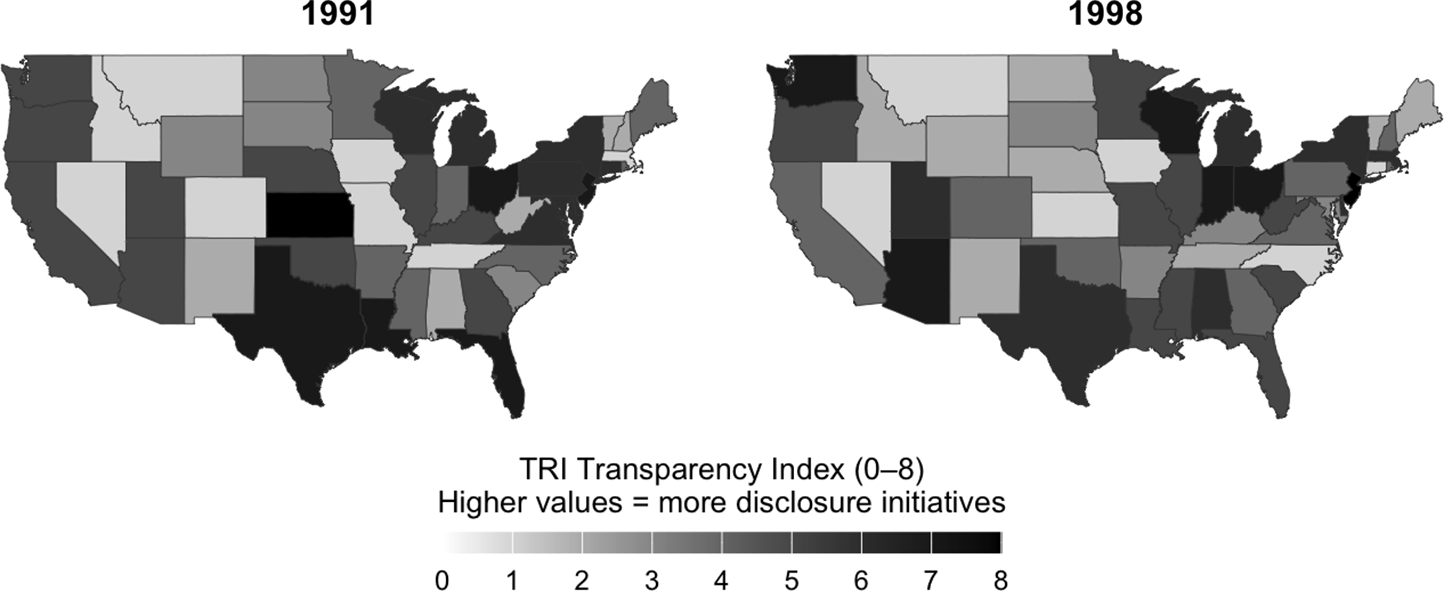
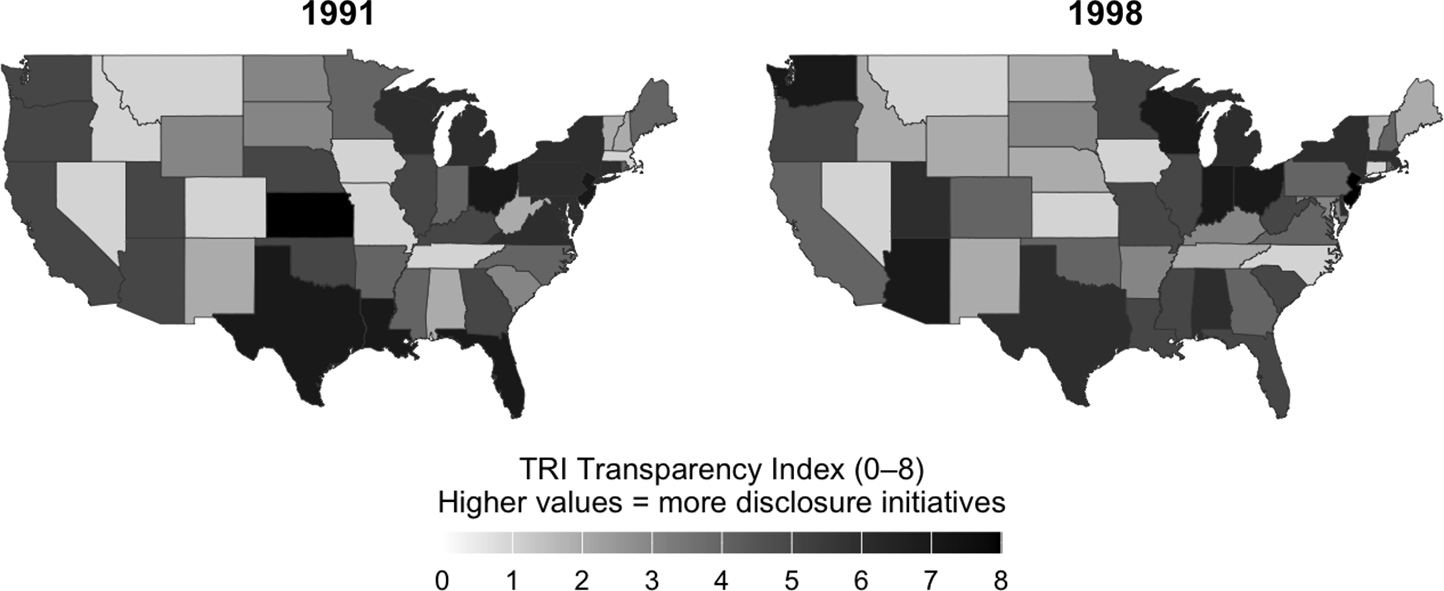
Some prior research suggests that these different types of policies have different effects on toxic release outcomes (Bae et al. Reference Bae, Wilcoxen and Popp2010). However, preliminary analyses did not uncover clear differences across these initiatives in terms of the phenomena we are assessing here. We therefore code each initiative as a binary indicator and sum them to create an additive index of dissemination efforts. Consistent with prior research using these NCSL data (Shapiro Reference Shapiro2005; Yu et al. Reference Yu, O’Toole, Cooley, Cowie, Crow and Herbert1998), we employ an unweighted index. Because there is no established basis for weighting individual activities, this approach captures the overall extensiveness of a state’s transparency efforts while maintaining comparability with previous studies. We do not interpret the index as a measure of transparency “quality,” but rather as an indicator of the breadth of state-level dissemination infrastructure during this period. State scores range from 0 to 8 with an average score of 4. Figure 1 displays the number of these initiatives that had been adopted by each state in 1991 and 1998, illustrating both cross-state variation and changes in the adoption of disclosure policies over time.
State toxics information transparency policies, 1991 and 1998.
The link between a state’s capacity to process or disseminate TRI information and subsequent emission reductions has been examined in a small number of prior studies. Prior researchers have found that these policies are not associated with lower overall emission levels (O’Toole Jr et al. Reference O’Toole, Yu, Cooley, Cowie, Crow, DeMeo and Herbert1997; Yu et al. Reference Yu, O’Toole, Cooley, Cowie, Crow and Herbert1998), though they do appear to be associated with reductions in environmental risk (Shapiro Reference Shapiro2005). More recently, as mentioned above, Bae et al. (Reference Bae, Wilcoxen and Popp2010) find that their effect depends on the type of informational policy, with policies that disseminate emissions data leading to lower emissions levels, while policies that aid in interpreting these data leading to lower risk.
Overall, the existing literature comes to unclear conclusions regarding the relationship between information disclosure policies and levels of toxic emissions. However, prior researchers do not examine how these policies affect the use of traditional regulatory monitoring and enforcement tools or assess whether their effects are conditional on emission levels. We now turn to these questions.
Data and method
Our empirical analyses seek to determine whether information dissemination efforts drive regulatory behavior or subsequent changes in emissions. Our analyses proceed in two stages. During the first stage we examine the relationships between toxics information disclosure policies and state regulatory inspection and enforcement rates, and in the second we examine their association with state-level toxic releases.
Estimation strategy
To assess our hypotheses, we estimate a set of panel data models of the following basic forms:
 $${{Y_{it}} = \alpha + \beta {P_{it}} + \beta {T_{it - 1}} + \beta {X_{it}} + {s_i} + {y_t} + {\epsilon _{it}},}$$
 $${Y_{it}} = \alpha + \beta {P_{it}} + \beta {T_{it - 1}} + \beta {P_{it}}*{T_{it - 1}} + \beta {X_{it}} + {s_i} + {y_t} + {\epsilon _{it}},$$
where
 ${Y}_{it}$
is one of our dependent variables (inspections, enforcement actions, or toxic emissions) in state i at time t, P is our measure of state public information disclosure policy, T is logged toxic emissions,
 ${P}_{it}*{T}_{it-1}$
is an interaction term,
 ${X}_{it}$
is a vector of state-level control variables,
 ${s}_{i}$
and
 ${y}_{t}$
are state and year fixed effects, respectively, and
 ${\epsilon _{it}}$
are errors.
For models estimated using Equation 1, a significant negative coefficient on
 $\beta{P}_{it}$
suggests that public information policies act as substitutes for inspections and/or enforcement actions, while a significant positive coefficient suggests that they act as complements. For models estimated using Equation 2, a significant interaction term suggests that the association between public information policies and inspections, enforcement actions, and/or current toxic releases is conditional upon the amount of prior toxic releases, supporting the conditional regulation hypothesis.
The inclusion of state fixed effects controls for time-invariant state-level factors, such as political culture or long-run institutional differences that may affect our dependent variables, while the inclusion of year fixed effects controls for national-level influences over time such as federal policy changes or national trends. This within-unit specification allows us to investigate whether changes in state transparency policies over time are associated with changes in agency outputs or emissions rates over time. This approach rules out endogeneity on the basis of relatively time-invariant state characteristics and reduces the possibility of omitted variable bias due to such characteristics. However, fixed effects are not perfect solutions to these problems, and a remaining assumption is that there are no state-specific time-varying omitted variables correlated with transparency policies.
Variation across time is important for any panel study, particularly one that employs, as we do, fixed unit effects. Only New Mexico, with a value of 2 for all years, exhibited no variation in our information transparency variable during the period studied. On average states experienced increases in this variable over time, as evidenced by the generally darker shades in the 1998 panel than the 1992 panel, though some states did experience decreases in transparency in individual years.
Dependent variables
Our first analysis looks at regulatory inspections and punitive actions. Such bureaucratic outputs are commonly used as measures of environmental policy in the American states (see Konisky and Woods (Reference Konisky and Woods2012) for an overview). The dependent variables are summary measures of overall state environmental inspection and enforcement rates. These variables are constructed from counts of the annual number of inspections and punitive actions taken by state governments during the period 1991–1998 in the course of implementing the federal RCRA hazardous waste program.
The state-implemented portion of the RCRA program governs the disposal of hazardous waste. Toxicity is one characteristic a substance may possess that makes it hazardous and thus eligible to be covered by the RCRA regulatory program. The others include corrosivity, reactivity, and ignitability. Hazardous substances may be deposited in the ground, air, or water. Subtitle I of RCRA, for instance, deals with underground storage tanks that store petroleum and other hazardous substances, a major source of both land and groundwater contamination.
Although the RCRA hazardous waste program thus regulates a variety of pollutants, including some not listed in the TRI, there is fairly strong overlap between the two programs. For instance, based on EPA facility counts and cross-program linkage via the Facility Registry Service (FRS), approximately 70–75% of TRI-reporting facilities are also subject to RCRA hazardous waste regulation. Many chemicals are listed as falling under both TRI and RCRA regulations, with substantial overlap for chlorinated solvents (e.g., Trichloroethylene (TCE), Tetrachloroethylene (PCE), Chloroform) and Aromatic hydrocarbons (e.g., benzene). Moreover, in addition to such substances that are directly listed under both programs, there are indirect connections between TRI chemicals and substances that are regulated under RCRA because they exhibit hazardous characteristics. Such substances include many heavy metals (e.g., lead, mercury, cadmium, chromium, and silver). In sum, there is a high degree of overlap between TRI and the RCRA hazardous waste program, both in terms of specific substances and regulated facilities. Moreover, to the extent that state agencies use TRI information to target high-polluting facilities (e.g., Li Reference Li2023) or that state-level TRI information is used by external audiences to pressure agencies for greater enforcement (as we argue in this paper), greater TRI emissions may affect enforcements even in cases that are not specifically tied, directly or indirectly, to TRI substances. If this does not hold, of course, it would mitigate against significant findings in our models.
Our first set of analyses assesses state inspection rates (RCRA inspections normalized by the number of large quantity hazardous waste generators) and enforcement rates (RCRA formal enforcement actions normalized by the number of large quantity hazardous waste generators). In our second analysis, we use the annual change in statewide toxic emissions, discussed below, as our dependent variable.
Core independent variables
The core independent variables represent the strength of state information disclosure policies and the content of the information that is being disclosed, as well as the interaction between the two. The first is represented by our index of state information and dissemination efforts, discussed above. This index has several advantages for this analysis: it is transparent, consistently applied across states, and does not require subjective valuation of the importance of specific policies. Nonetheless, a potential disadvantage is that it assumes that each step up in the index represents relatively equal changes in transparency. Because some policies may be more effective in generating information transparency than others, this may be a limiting assumption. In practice, the largest discontinuity may occur when a state first adopts a dissemination or processing policy, with subsequent policies of either type having a smaller marginal effect (Bae et al. Reference Bae, Wilcoxen and Popp2010). Because of data limitations we cannot properly estimate the effect of these initial adoptions. Thus, the effect we estimate must be considered the marginal effect of each additional policy. Notably, very similar indexes of state TRI public information transparency policies have been successfully used by other researchers (Shapiro Reference Shapiro2005; Yu et al. Reference Yu, O’Toole, Cooley, Cowie, Crow and Herbert1998) to explain toxic emissions outcomes, giving us confidence that higher values on this index do represent meaningful differences in state public information disclosure policies and that the variable is appropriate for use in our analysis.
The second variable represents the information that is being disseminated, in this case about the overall severity of the pollution problem in the state. We capture this by using the reported tons of TRI emissions from air, water, and hazardous waste sources. Our state-level data is collected from the U.S. EPA’s Toxic Release Inventory and includes total air emissions, surface water discharges, underground injections, and all other reported releases, both on and off-site. The chemicals reported in the TRI have changed over time, so in order to make our data comparable we include only the EPA’s 1991 core chemicals group. In order to correct for skewness, this independent variable is expressed as a natural log in our analyses.
It is important to observe that tons of toxic chemicals released has significant limitations as a measure of overall state environmental pollution severity for several reasons: TRI releases are self-reported, pounds of chemical releases are a weak proxy for overall level of toxicity, and other important features of state environmental quality are omitted. Nonetheless, due to comparability across states, annual reporting, and breadth of indicators involved (including air media, water media, and hazardous waste), aggregate levels of toxic emissions across environmental media have often been used as an indicator of overall level of pollution severity in a state by many scholars (e.g., Fowler Reference Fowler2020; Fowler and Kettler Reference Fowler and Kettler2021; Newmark and Witko Reference Newmark and Witko2007; Woods Reference Woods2008, Reference Woods2015). More importantly for our purposes, aggregate releases (sometimes standardized by area, population, or number of TRI facilities) is the measure generally employed by the media and interest groups to characterize the extent of a state’s toxic chemical problems, and is thus the most theoretically relevant measure for this analysis.
Control variables
The models also include a set of other independent variables to control for a variety of political, economic, and demographic factors that may influence levels of regulatory enforcement and toxic releases. These variables are analogous to those commonly employed in other studies of state environmental enforcement outputs (Cline Reference Cline2003; Hopper Reference Hopper2017; Konisky Reference Konisky2007; Konisky and Woods Reference Konisky and Woods2010; Liang et al. Reference Liang, Park and Zhao2020) and toxic releases (Abel et al. Reference Abel, Stephan and Kraft2007; Bae et al. Reference Bae, Wilcoxen and Popp2010; Fowler and Kettler Reference Fowler and Kettler2021; Kraft et al. Reference Kraft, Stephan and Abel2011). Although these two streams of literature examine different phenomena, the variables included in their empirical models are fairly comparable, and the logic for their inclusion is similar.
Both enforcement effort and emissions may be influenced by the ideological preferences of elected state political officials. Our analyses employ Berry et al.’s (Reference Berry, Fording, Ringquist, Hanson and Klarner2013) dynamic measure of government ideology to capture these preferences, with the expectation that more liberal political officials will press for more aggressive regulatory enforcement and lower emissions.
To capture constituency influences, we also include a variable measuring pro-environment public opinion in the states, which was created by Kim and Urpelainen (Reference Kim and Urpelainen2018) using a multilevel regression and post-stratification technique. The resulting annual measure is the estimated percentage of state respondents who feel that the U.S. is spending too little on environmental protection. Regulatory enforcement may also reflect interest group pressures in a state. States in which manufacturing industries wield significant political power may seek to enforce regulations less stringently than states in which the industry is relatively weak. Manufacturing gross state product as a percentage of total gross state product is therefore included as a proxy measure of manufacturing industry’s economic clout. In order to represent citizen demands for heavier environmental regulation, the analyses similarly include a variable representing annual per capita Sierra Club membership.
State economic conditions may also affect the political pressures facing state officials, with states in poorer economic climates facing greater political pressure to reduce regulatory stringency and allow greater emissions. The analyses include two indicators of these conditions. First, real personal income per capita is included to account for the availability of financial resources with the state. Greater resources may facilitate increased monitoring and enforcement effort. Second, the state’s unemployment rate is included as a general indicator of the state’s overall economic circumstances. States may be more willing to reduce enforcement aggressiveness during economic recessions and increase it during periods of relative prosperity.
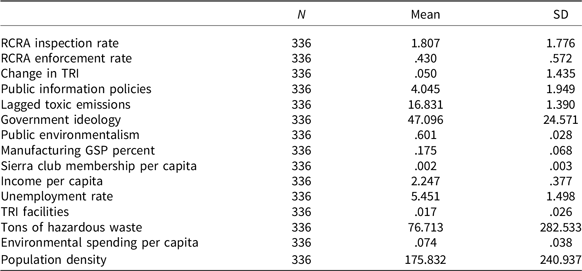
The number of regulated facilities and size of the hazardous waste problem are important task factors facing state regulatory bureaucracies and a significant contributor to variation in emissions levels across states; we utilize the number of TRI facilities in each state and tons of hazardous waste governed by RCRA (in 1000s) to account for these factors.Footnote 6 Each of these variables is normalized by state area. The analyses also include state environmental spending per capita to represent the state environmental agency’s capacity to address the problem. Finally, the models include a measure of population density as a general demographic variable, as well as fixed effects for state and year in order to account for spatial and temporal heterogeneity. Descriptive statistics for the independent and dependent variables are provided in Table 1, and data sources are provided in the appendix.
Descriptive statistics
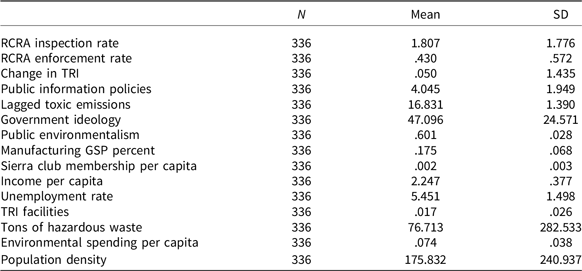
Table 1. Long description
A table with 336 rows and 18 columns displaying descriptive statistics for various environmental and demographic variables across states. The columns include N, Mean, and SD. The row labels are RCRA inspection rate, RCRA enforcement rate, Change in TRI, Public information policies, Lagged toxic emissions, Government ideology, Public environmentalism, Manufacturing GSP percent, Sierra club membership per capita, Income per capita, Unemployment rate, TRI facilities, Tons of hazardous waste, Environmental spending per capita, and Population density. Each row provides the number of observations (N), the mean value, and the standard deviation (SD) for each variable. The table captures a wide range of data points related to environmental regulation, economic factors, and demographic characteristics.
Results
Public information policies and regulatory activity
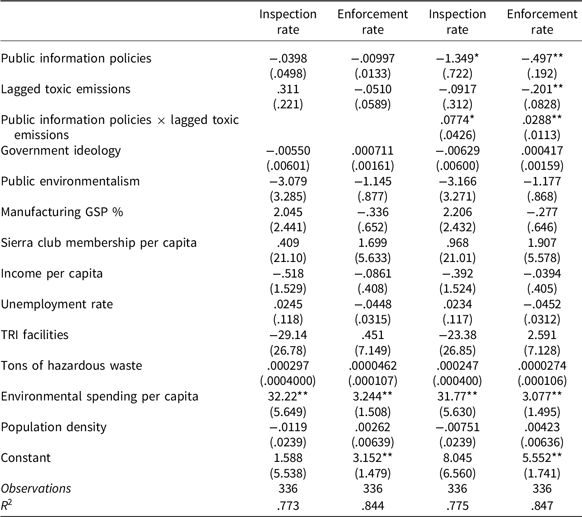
Our first analyses assess the direct relationship between toxics information disclosure policies and levels of (1) inspections and (2) enforcement actions. The results are presented in the first two columns of Table 2. The coefficient estimates on public information policies are not significant in either model. Thus, these models provide no evidence that state information disclosure policies are associated with compliance monitoring or enforcement actions independent of prior toxic releases.
The relationship between public information policies and RCRA inspection and enforcement rates
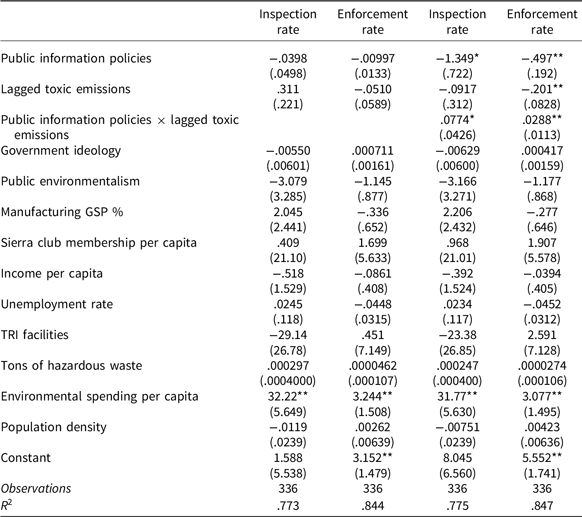
Table 2. Long description
A table with 15 rows and 8 columns. The columns are labeled Inspection rate, Enforcement rate, Inspection rate, and Enforcement rate. The rows are labeled with different factors such as Public information policies, Lagged toxic emissions, Public information policies × lagged toxic emissions, Government ideology, Public environmentalism, Manufacturing GSP percent, Sierra club membership per capita, Income per capita, Unemployment rate, TRI facilities, Tons of hazardous waste, Environmental spending per capita, Population density, Constant, Observations, and R squared. Each row contains values corresponding to the inspection and enforcement rates for each factor. Notable trends include significant values for Lagged toxic emissions, Public information policies × lagged toxic emissions, Manufacturing GSP percent, Sierra club membership per capita, TRI facilities, and Environmental spending per capita.
Note: All models include fixed effects for state and year.
**p < .05, *p < .1.
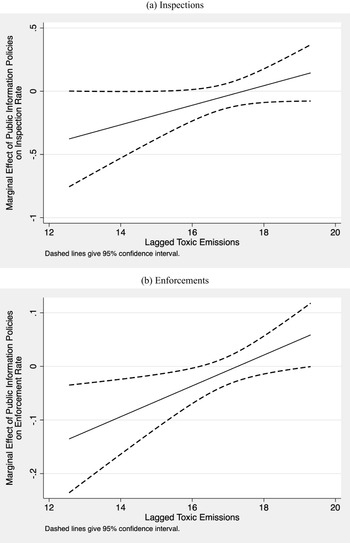
The picture changes, however, when one looks at results of the interactive models, which are presented in the next two columns. In both cases, the coefficient estimate on the interaction term is positive and significant, indicating that the association between state information disclosure policies and both inspection and enforcement rates becomes stronger as prior toxic emission levels increase, consistent with the conditional regulation hypothesis. These relationships are illustrated graphically in Figure 2. In each case, the upward-sloping line indicates that the positive association between public information policies and inspections and enforcement actions is stronger as lagged emission levels increase, an effect that is significant across virtually the entire range of emissions in both cases. The overall levels of inspection and enforcement activity are relatively low over most of the range of these variables (recall that the dependent variable is standardized with a mean that is near zero in each case), suggesting that at low and moderate levels of toxic emissions states may be substituting public information policies for traditional regulatory tools. As levels of toxic emissions increase, however, state public information policies are associated with elevated levels of traditional regulatory enforcement. At high levels of toxic emissions, states evidence higher than average inspection and enforcement activity, suggesting that the two act more as complements.
Marginal effect of public information policies on inspection and enforcement rates. (a) Inspections. (b) Enforcements.
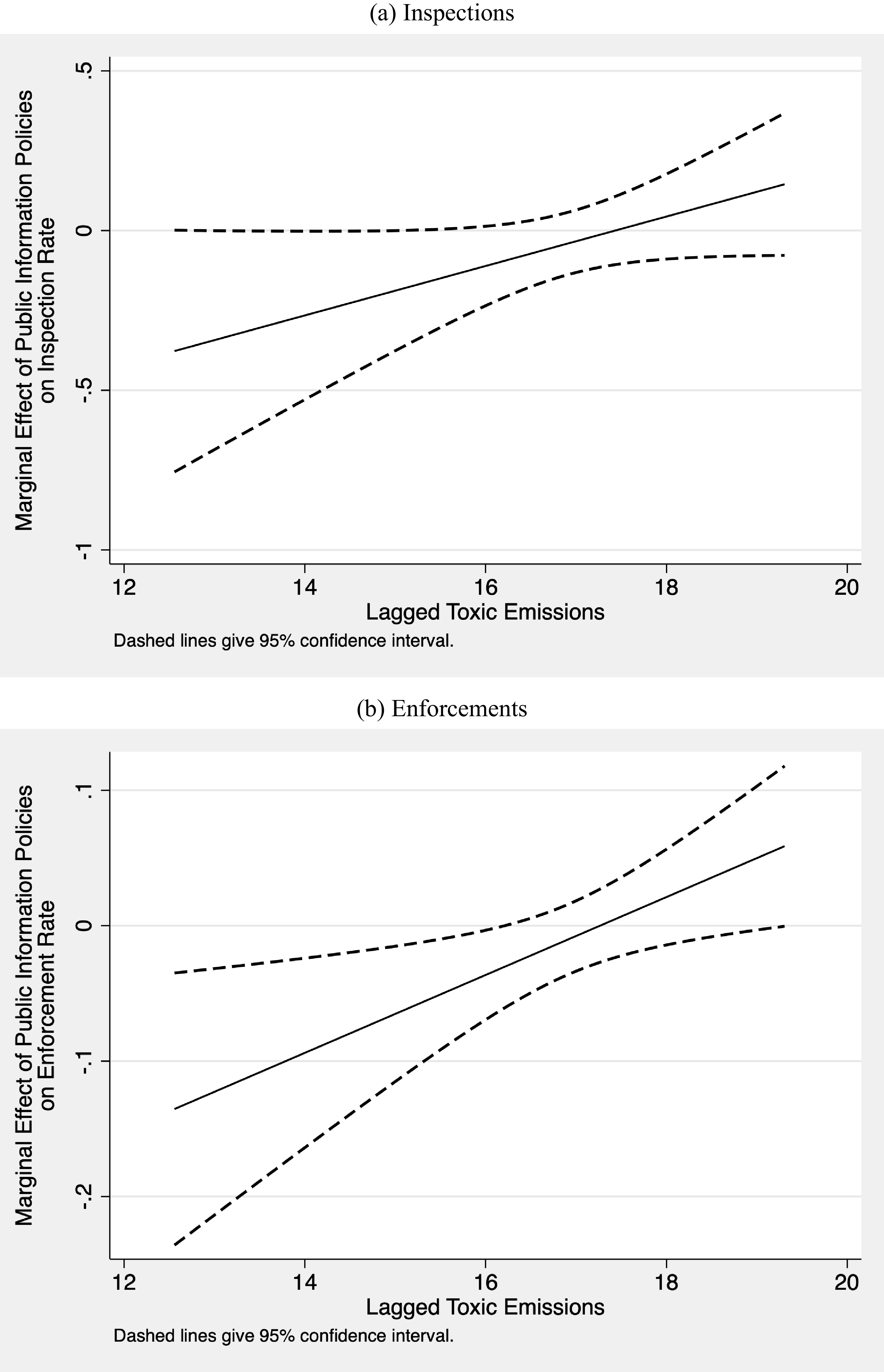
The estimated relationships are substantively meaningful. Across the range of the index (0 to 8), the estimated relationship between TRI policies and inspection rates varies by approximately .62 inspections per facility, while the corresponding relationship with enforcement rates varies by about .23 enforcement actions per facility. Relative to mean inspection and enforcement rates of 1.8 and .43, respectively, these differences are substantial.
Thus, the evidence suggests that across much of the range of toxic emissions observed in our data, regulators in states with strong public information policies may be content to outsource traditional regulatory functions to third parties (environmental interest groups, the media, investors, and consumers) in accordance with the theoretical underpinnings of the new environmental regulation. However, at higher levels of toxic releases, regulators in these states may be more aware of the problem posed by these toxic emissions and feel greater pressure to deal with it due to the concerns generated in part by these same third parties.
Public information policies and toxic emissions
How does the conditional relationship between public information policies and traditional regulatory activities relate to overall levels of toxic releases? In this section we take a preliminary step towards addressing that question. Our dependent variable for this analysis is the year-over-year change in total pounds of statewide toxic releases. Our independent variables mirror those used in the first set of analyses.
We employ a first difference specification because our theory pertains to the effect of transparency policies on changes in the trajectory of emissions, rather than their absolute levels. Aggregate emissions levels vary across states for many reasons, including industrial composition, manufacturing intensity, historical patterns of industrial development, and natural resource endowments. A first-difference specification allows us to isolate policy-induced changes in this baseline behavior, and we follow other studies of state policies in using changes in toxic emissions as our outcome variable of interest (Kraft et al Reference Kraft, Stephan and Abel2011; Shapiro Reference Shapiro2005; Yu et al Reference Yu, O’Toole, Cooley, Cowie, Crow and Herbert1998).
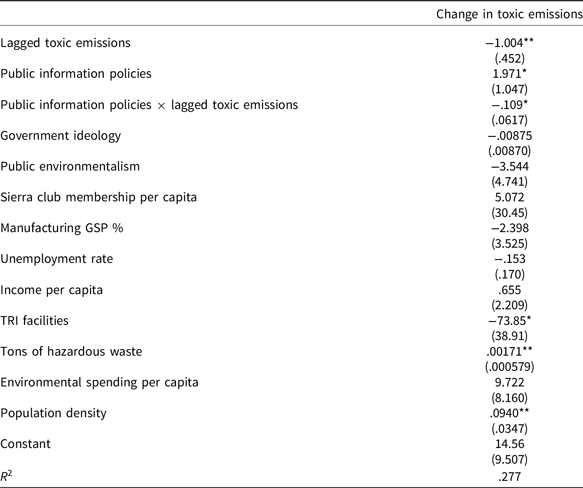
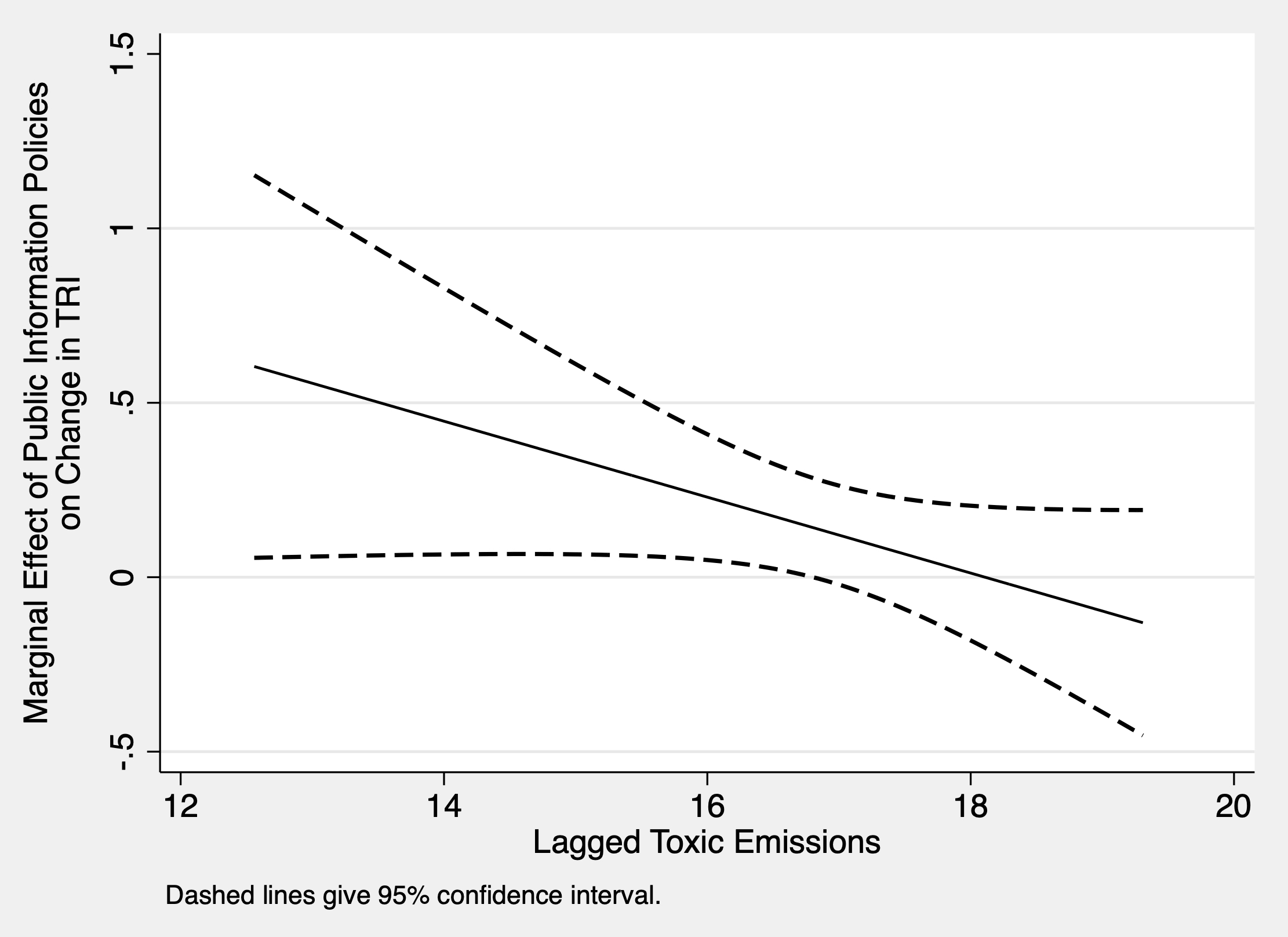
The results of our panel regression model are presented in Table 3. Again, the interaction term is significant, suggesting that the association between public information policies and changes in emission levels is conditional on levels of prior emissions. The relationship is presented graphically in Figure 3. In this case, the downward-sloping line indicates that at relatively low levels of prior toxic emissions, public information policies are associated with greater increases (or, in most cases, smaller decreases) in toxic pollution emissions. This conditional association is significant over most of the range of prior toxic emissions, but not at higher levels, where the relationship loses statistical significance. Again, the magnitude of the estimated relationship is substantial, with the slope of the line changing nearly one unit when the variable has a mean of .05.
The relationship between public information policies and toxic emissions
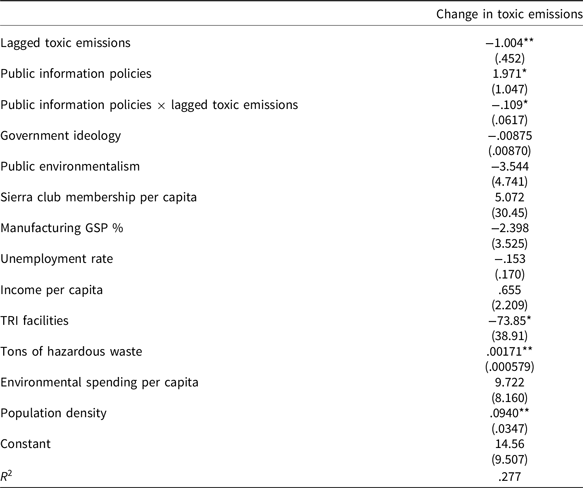
Table 3. Long description
A table with 16 rows and 3 columns showing the relationship between various factors and changes in toxic emissions. The columns are labeled ‘Lagged toxic emissions’, ‘Public information policies’, ‘Public information policies × lagged toxic emissions’, ‘Government ideology’, ‘Public environmentalism’, ‘Sierra club membership per capita’, ‘Manufacturing GSP %’, ‘Unemployment rate’, ‘Income per capita’, ‘TRI facilities’, ‘Tons of hazardous waste’, ‘Environmental spending per capita’, ‘Population density’, and ‘Constant’. Each row lists a factor and its corresponding change in toxic emissions value and standard error. Notable trends include significant values for ‘Public information policies’ and ‘TRI facilities’.
Note: Model includes fixed effects for state and year.
**p < .05, *p < .1.
Marginal effect of public information policies on toxic emissions.
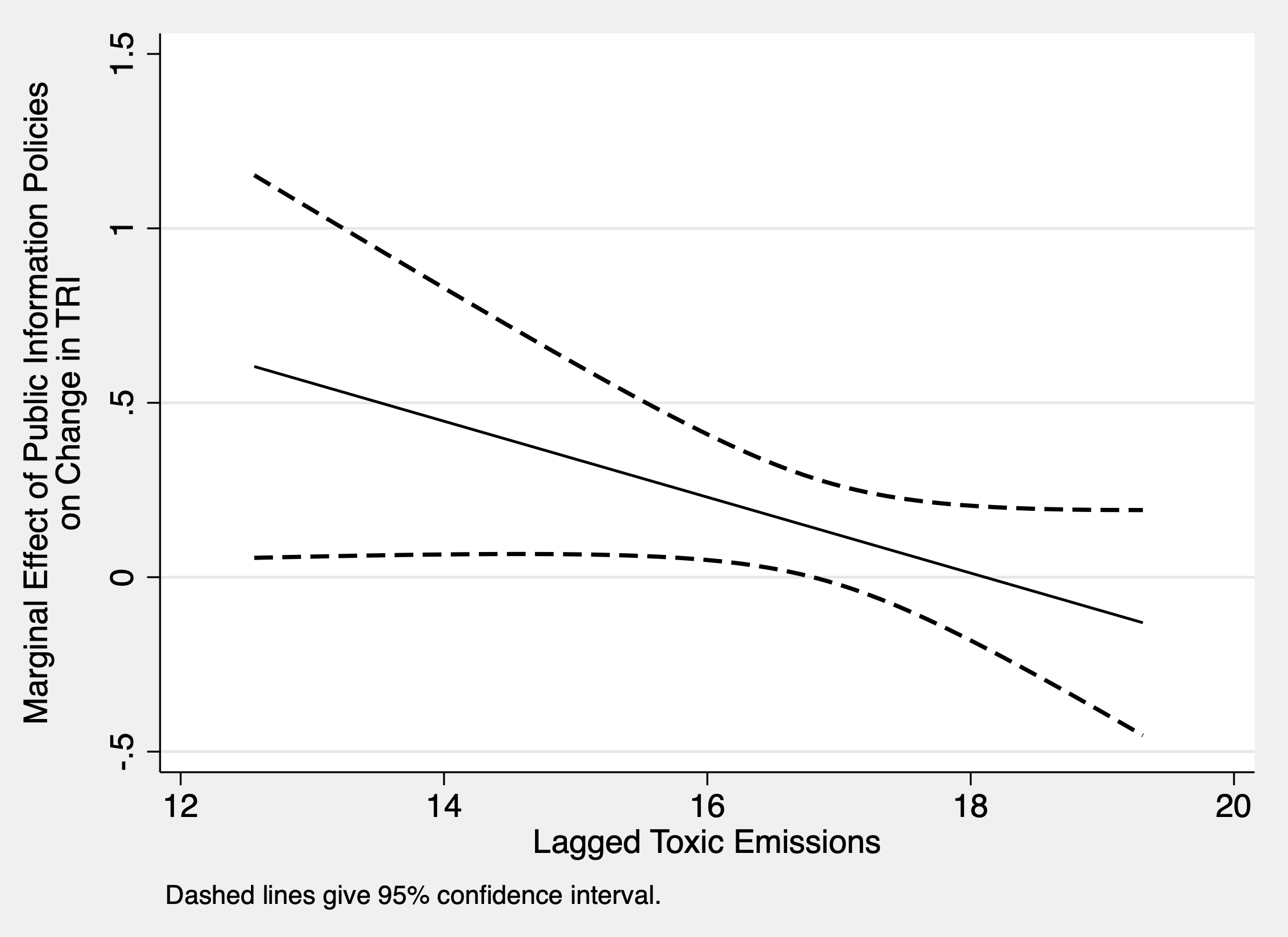
Recall that in the previous analyses, the results indicated that in cases where there are low levels of overall toxic emissions, traditional inspection and enforcement rates are the lowest. At increasingly higher levels of prior toxic emissions public information policies are associated with increased inspection and enforcement rates. Thus, our analyses indicate that (1) as toxic releases increase, states with stronger information disclosure policies evidence increased future inspection and enforcement rates, and (2) as toxic emissions increase, states with stronger information disclosure policies evidence decreased future emissions. Taken together, these findings provide suggestive (though not dispositive) evidence that when states supplement toxics information disclosure policies with greater regulatory inspection and enforcement effort, they also tend to exhibit larger reductions in overall toxic releases. This interpretation is broadly consistent with prior research finding that stronger environmental monitoring and enforcement are associated with improved regulatory compliance and lower emissions (Gray and Shimshack Reference Gray and Shimshack2011; Shimshack Reference Shimshack2014; Stafford Reference Stafford2002, Reference Stafford2003).
Conclusion
Adoption of governmental tools within a policy arena may change how governments utilize existing tools, and the net effect of such changes on policy outcomes is often unclear a priori. In this paper we have examined how state environmental agencies have responded to the adoption of an important and widely publicized new policy tool – toxics public information policies – by changing their traditional regulatory monitoring and enforcement practices, and how these changes have impacted the release of toxic chemicals within their jurisdiction.
Our findings indicate that information transparency policies are significantly associated with both agency monitoring and enforcement actions at the aggregate level, though not by always treating them as either complements or substitutes. Rather, the relationship between these sets of policy tools appears to be mediated by the content of the information being disclosed regarding the total pounds of statewide toxic releases. This information has undeniable limitations both in terms of underlying data quality and accurately characterizing public health risk. At the same time, however, the information is widely disseminated in environmental interest groups and local news media, incorporated into state regulatory decision-making, and is widely considered an important indicator of the overall health of a state’s physical environment.
Our analyses suggest that this information, in combination with state policies facilitating its wide dissemination and public understanding of it, is jointly associated with both traditional regulatory functions and policy outcomes in complex ways. States with low and moderate levels of emissions both inspect facilities at a lower rate and issue punitive actions at a lower rate if they have stronger information dissemination policies. This suggests that state regulatory officials generally behave as if information disclosure, and subsequent monitoring by external actors, is an effective substitute for traditional regulation. As levels of toxic emissions increase, however, state public information policies are associated with elevated levels of traditional regulatory enforcement. At very high levels of toxic emissions, states evidence higher than average inspection and enforcement activity, suggesting that the two act more as complements.
Our results also indicate that in states with low and moderate levels of toxic releases (those with relatively low rates of traditional inspection and enforcement activity) public information policies are associated with greater increases (or, in most cases, smaller decreases) in toxic pollution emissions. However, as prior toxic releases increase – and states correspondingly devote greater attention to inspection and enforcement – public information disclosure policies are associated with larger reductions in toxic releases. Thus, our analyses provide suggestive evidence that the trend toward supplementing information disclosure policies with elevated inspection and enforcement rates in cases where states have high prior levels of toxic emissions pays off in terms of greater future emissions reductions. Thus, public information policies and traditional forms of regulation may be imperfect substitutes, and successfully reducing toxic emissions may require both working in concert.
This study examines a formative period in the evolution of toxics information disclosure policy. The 1991–1998 window captures a time when state governments played a central role in interpreting and disseminating TRI information in a pre-web environment characterized by substantial cross-state variation in accessibility and analysis. Although institutional features of TRI dissemination have evolved substantially since that period, the core theoretical contribution of this study, the conditional interaction between information transparency policies and traditional regulatory monitoring and enforcement, does not depend on those specific historical arrangements. Rather, we highlight a broader dynamic in which the information itself functions as a signal of problem severity, shaping how it is used by regulators and external audiences and, in turn, whether transparency policies substitute for or complement traditional regulatory oversight.
At the same time, caution is warranted in generalizing institutional details of this period to contemporary governance. Today, TRI data are centrally hosted, standardized, and supported by sophisticated EPA web-based tools, including toxicity modeling and geographic visualization platforms. These developments have reduced cross-state differences in information accessibility and may alter how disclosure interacts with enforcement. In a more digitally integrated information environment, variation may arise less from state dissemination practices and more from differences in agency capacity, stakeholder mobilization, media ecosystems, or political context. Thus, future research should examine whether similar conditional substitution and complementarity dynamics emerge under these contemporary conditions and in other policy domains where transparency initiatives coexist with traditional regulatory tools.
Beyond these questions of temporal scope and institutional change, additional limitations warrant consideration. Our results, while suggestive, do not conclusively demonstrate a causal relationship between toxics disclosure policies, inspection and enforcement rates, and levels of toxic emissions. In the future, scholars may seek to further unpack these interrelationships. More generally, future researchers may expand the study of policy tool interactions and their effect on policy outcomes to a variety of other policy contexts. To date, little attention has been paid to how the use of one policy tool impacts the use of another. Our study suggests that such policy tool interactions may have significant consequences for policy outcomes.
Supplementary material
The supplementary material for this article can be found at https://doi.org/10.1017/S0143814X26101366.
Data availability statement
Replication materials are available in the Journal of Public Policy Dataverse at https://doi.org/10.7910/DVN/ACHL0P, Harvard Dataverse, V1, UNF:6:cNMTwWHibv36cz2122tt9g= =
Acknowledgements
We thank the editors and anonymous reviewers of the Journal of Public Policy for their constructive comments and guidance.


 Open access

