Greenhouse gas (GHG) emissions are typically disaggregated into the key responsible sectors such as transport and waste. In some countries, emission reduction targets have also been allocated to each of these sectors. Rural land use is one such sector, and in 2006 in Scotland, the total emission of over 15 Mt CO2e (carbon dioxide equivalents) was similar to that of the transport sector. However, within rural land use is the capacity of trees and soils to sequester carbon. For example, in 2006 the net emissions/removals were reduced to 2.6 Mt CO2e after consideration of the sink effect of trees and soil of around 13 Mt CO2e. In this context, the sector is unique; no other sector has the potential to mitigate against its own emissions. Effective management of Scotland's rural land use has the potential to offset GHG emissions from other sectors of the Scottish economy. However, it will be necessary to put robust policies and procedures in place to achieve this under changing climate and land use patterns. This paper describes the status of rural land use in Scotland, some of the pressures that it faces, some of the opportunities for the sector to mitigate against climate change and some of the barriers that need to be overcome.
1. Land use, soils and waters: current status
There are multiple drivers and pressures on our land resources and it is important to understand these if we are to determine our future direction and response to climate change.
1.1. Land use
Land is under pressure. As more land is developed for housing and other urban uses, that available for other uses is reduced – in particular, agriculturally-productive land and the associated ecosystem services it provides. Scotland's population of 5.2 million in 2009 has increased by 1% since 1997, and is expected to increase to 5.54 million by 2031 (General Register Office for Scotland 2009). Over the period 1997–2004, the area of land taken into the built environment averaged 1,200 ha yr–1. This occurred at a time of relatively stable population (Towers et al. Reference Towers, Grieve, Hudson, Campbell, Lilly, Davidson, Bacon, Langan and Hopkins2006) and may be linked to lifestyle changes (e.g. single occupancy) and other infra-structural development (e.g. over 1994–2007, total road length increased from 52,346 km to 55,089 km). Not only do building developments seal most of the soil they replace, they can also fragment land.
Facing up to climate change brings additional pressures on land. Infrastructure for renewable energy projects, such as on-shore wind farms, utilise land. In August 2010, there were 1162 wind turbines already installed, with 2,779 more planned and at different phases of the planning process (Scottish Renewables 2010). Assuming an average of 20 turbines km–2, on-shore wind farms currently occupy ∼58 km2 of land. Whilst not all development is on greenfield sites (55% of new house builds were on brownfield sites in 2007), some expansion will take place on greenfield sites in response to net migration out of cities towards smaller and more rural settlements. Historic settlements and their expansion invariably coincide with the best agricultural land, and this will bring potential losses of food-producing land, putting pressure on ecosystem services. By contrast, evidence gathered in Glasgow from the Clyde Gateway and redevelopment of the East End (Royal Society of Edinburgh 2011) shows how brownfield developments can generate integrated solutions that offer energy-efficient housing, restoration of contaminated land, reduction of carbon footprints and creation of amenities close to the heart of our cities.
1.2. Agriculture
Agricultural use of land currently covers about 73% of Scotland. It is dominated by livestock systems on enclosed or free-ranging land – typified by improved grasslands and rough grazing on habitats such as heather moor. Arable agriculture covers only 7.6% of the land area, while farm woodland has been steadily increasing (Scottish Government 2011). There is interdependency between upland and lowland systems, with the latter used for fattening upland livestock and growing lowland cereals and grass for feed and fodder for the livestock industry. Cereal crop yields in Scotland have increased since 1960 without increasing the land area under cultivation. About 50% of wheat and 33% of barley is used in distilling and malting, with significant quantities (14% wheat, 64% barley) used as livestock feed (DTZ 2007).
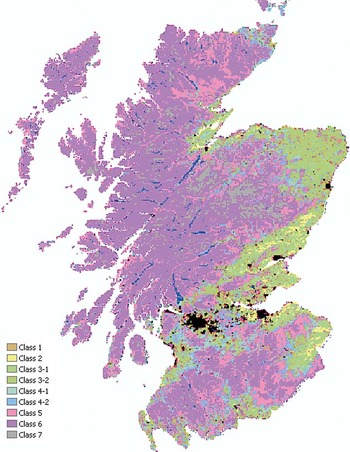
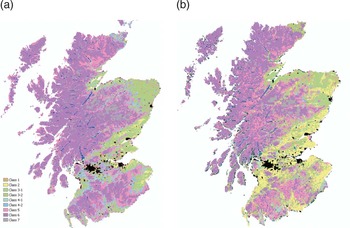
The Land Capability for Agriculture (LCA) classification system is widely used by planners, land managers and policy makers. LCA is based upon the physical constraints on land use: soils, climate, topography and vegetation (Bibby et al. Reference Bibby, Douglas, Thomasson and Robertson1982). The original guidelines and maps were published in the early 1980s (Fig. 1), with the most flexible land, classes 1, 2 & 3.1, identified as ‘prime land’ and having a presumption against development in the planning system. As climate is a key component determining the LCA class, a change in climate has significant implications for land capability and, therefore, how we plan and manage land use. Climate is represented by metrics such as accumulated temperature and soil moisture deficit that are closely associated with the viability and productivity of crops and livestock. The LCA system, therefore, provides a way to consider the impacts of future climate change, along with the management options at local, regional and national scales.
Current Land Capability for Agriculture Assessment based on Bibby et al. (Reference Bibby, Douglas, Thomasson and Robertson1982) guidelines.

1.3. Forests
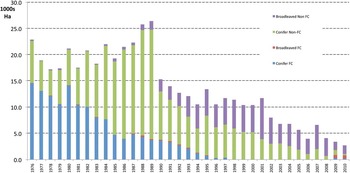
Woodland in Scotland currently covers 1,386 kha – approximately 18% of the land area (Towers et al. Reference Towers, Sing, Ray and Crow2011). The Scottish Government has an aspirational target of increasing this to 25%, with a target planting rate of 10kha yr–1 over the next ten years. This is very ambitious, as planting rates have been declining for some time and are currently well below this target rate (Fig. 2). In 2006, native species comprised 29% of the total forest area, while the Forestry Commission Scotland estate (predominantly spruce and other non-native conifers) accounted for 35% of all woodlands (Forestry Commission 2006). Just over 65% of woodlands are in private ownership and 28% are managed under approved long-term forest plans.
The type and planting rates of trees in Scotland 1976–2009. The new planting and restocking figures come from the Forestry Commission. Abbreviations: FC=Forestry Commission; Non-FC=All other woodland, including some other publicly-owned woodland. Note the dramatic reduction in planting rate following the removal of tax incentives in 1989.

1.4. Soils
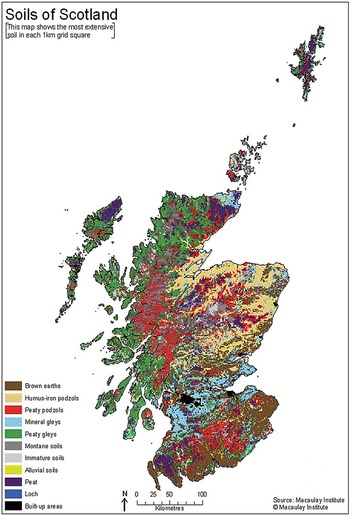
The diverse geology and climate of Scotland has given rise to a wide variety of soil types (Soil Survey of Scotland Staff 1984; Fig. 3). Variations in topography have caused further small-scale variation in soil types, associated with slope and landform. The strongly maritime climate, with cool temperatures and rocks that are generally resistant to weathering, has resulted in soils that are more organic, more leached, acidic and wetter than those of most other European countries. There is a contrast between soil types in the Midland Valley (primarily mineral soils) and those in the Highlands and Southern Uplands (primarily peaty soils).
Distribution of the soils of Scotland.

Scotland's soils are at the heart of the primary production industries of agriculture and forestry. Soils also deliver less tangible benefits by way of other ecosystem services, for example by storing and filtering water. Using data in the Scottish Soils Knowledge and Information Base (SSKIB), we estimated that Scotland's soils hold 40 billion cubic metres of water in the top metre when fully wet, which is more water than is in all Scotland's fresh water lochs. This ability to store water helps prevent flooding. Soils also filter, transform and break down the hundreds of different acidifying, potentially toxic elements and compounds that enter the ecosystem from polluted rainfall. Soils are also an important store of carbon. Even though Scotland is only one third of the UK land mass, its soils contain ∼3000 Mt of carbon (∼50% of total UK soil carbon), equivalent to nearly 200 years of Scotland's total annual CO2 emissions (Scottish Government 2010). The peatlands are an especially large carbon store, accounting for 53% of the total and comprising 1,620 Mt Carbon (Chapman et al. Reference Chapman, Bell, Lilly and Donnelly2009). The carbon stock reflects the depth of peat. Locally highly variable, a mean peat depth across the country of 2 m represents 3,000–9,000 years of accumulation. However, evidence is growing (Bain et al. Reference Bain, Bonn, Stoneman, Chapman, Coupar, Evans, Gearey, Howat, Joosten, Keenleyside, Labadz, Lindsay, Littlewood, Lunt, Miller, Moxey, Orr, Reed, Smith, Swales, Thompson, Thompson, Van de Noort, Wilson and Worrall2011) that many peatland areas are now losing this carbon due to the pressures of land use and climate change.
1.5. Waters
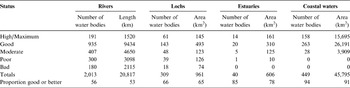
In the Scottish Environment Protection Agency's (SEPA) inventory of water bodies reported to the European Union under the Water Framework Directive, there are 2,012 river, 309 loch, 284 groundwater, 40 estuary and 449 coastal water bodies within the Scotland River Basin District (SEPA 2009). Of these, 65% were classified in 2008 as having good or better status in terms of their ecology and water quality (EU Water Framework Directive) (Table 1). Collectively, these water bodies provide a crucial link between the land-based and marine-based components of the carbon cycle.
Status of surface waters in the Scotland River Basin District in 2008. Source: SEPA (2009).

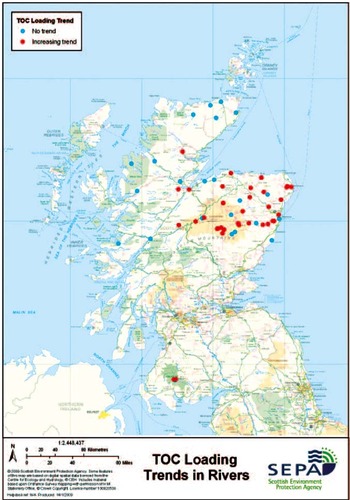
Carbon released from the soil by tillage, forestry operations, disturbance and erosion is transported via rivers and lochs to estuaries and coastal waters (Fig. 4). The current estimate of around 2 Mt CO2e yr–1 transfer of land-based carbon to the marine environment is based on SEPA's monitoring of total organic carbon in rivers and lochs from catchments mainly dominated by organic-rich soils and peatlands (SEPA 2010). Over the last two decades, the concentrations (3–10 mg l–1) and loads (10–100 g m–2 yr–1) of total organic carbon (TOC) in many of Scotland's rivers have roughly doubled (Fig. 4), with soils being the most likely source, reflecting increases in temperature and rainfall and/or recovery from acid rain. TOC concentrations in lochs have also increased from the early 1990s until the early 2000s, but appear to have decreased in a few examples over the last five years.
Trends in total organic carbon loading in Scottish rivers.

The environmental impacts of these trends include a darkening of water colour, which increases treatment costs for Scottish Water and reduces light and energy impacting on the flora in lochs. Increasing TOC levels in water bodies may also reflect changes in the rate of exchange of CO2 and methane between soils and the atmosphere, with consequent impacts on land-based carbon stocks. In addition to the carbon in transit (in the water column) from land-based to marine-based stores, significant amounts of carbon are locked up in sediments that have accumulated over years and decades (streams or small ponds), and centuries and millennia in the case of larger water bodies (reservoirs, lochs and estuaries).
1.6. Biodiversity
Biodiversity is a key component in Scotland's land-based environment, the health and future of which is subject to numerous international and national treaties and regulations. The plants and animals of Scotland and the Nordic countries have many common elements, reflecting similar geology and soils, glacial history and cool maritime climate. Scotland's plant and animal species comprise a diverse mix of Atlantic, Arctic, Arctic-alpine and boreal elements, with many species at the extreme of their global range. Thus the species assemblages of boreal-Arctic peatland birds and birds of the montane plateaux are unique. In addition, the natural range of 31 species is restricted to Scotland. Approximately 370 species of national and international importance in terms of conservation occur within 1,451 protected areas in Scotland (Sites of Special Scientific Interest, Natura sites, and National Nature Reserves), which collectively cover around 12% of Scotland's land area (Mackey & Mudge Reference Mackey and Mudge2010).
In 2004, Scottish Natural Heritage (SNH) set out a long-term vision and framework for action to protect Scotland's biodiversity. The first of five key objectives related to species and habitats with the aim “to halt the loss of biodiversity and reverse previous losses through targeted action for species and habitats” (SNH 2004). Six years later, SNH published an update on progress to 2008 (Mackey & Mudge Reference Mackey and Mudge2010) and a further update is currently under way. Encouragingly, in 2008 there was a positive overall trend for 29 priority habitats. However, this contrasted with an overall negative trend for 181 priority species. Noteworthy changes in broad habitat extent between 1998 and 2007 underpinning these trends were:
• 6% increase in the number of ponds;
• 13% decline in arable and horticultural areas;
• 8% decrease in linear features (hedges, walls fences etc);
• 10% increase in broadleaf woodland;
• 7% decline in coniferous woodland (felling cycle producing temporary open habitats);
• 8% increase in acid grassland in uplands.
Turning now to the challenges posed by climate change in managing biodiversity, Mackey & Mudge (Reference Mackey and Mudge2010) have itemised the following as being especially significant:
• differentiating changes that can be managed (e.g. allowing or preventing natural succession by altering grazing rates) from those that cannot be managed (e.g. reduced snow lie);
• taking into account the changing ‘climate space’ for each species and habitat and acknowledging that the loss of a species from a region, or even from Scotland, may have to be accepted;
• promoting ecological networks and connectivity, which may help species disperse as they find new ‘climate spaces’. This requires action to prevent fragmentation of habitat and to promote ecological connectivity wherever possible;
• considering the translocation of species from sites with inadequate ecological networks to new sites. This implies that the current locations of nature conservation sites will also need to be reviewed;
• undertaking a risk assessment of the threats posed by colonisation by non-native species (including pests and diseases).
Throughout all of the above challenges in managing biodiversity, maintaining ecosystem resilience is a key goal alongside the promotion of ecosystem services.
2. Opportunities and challenges in the shift to a low-carbon society
Land use, soils and waters are likely to be significantly altered by future climate change and this is the focus of much work on adaptation. But they can also play a crucial role in mitigating emissions, as by skilful management they can be used to store carbon on a large scale at relatively low cost. Moreover, the effect can be brought into play within a few years.
The Land Capability for Agriculture Assessment has recently been re-assessed using the UK Climate Impacts Programme 2002 predictions of future climates. Large increases in the areas designated as prime land and those suitable for farming systems based on improved grassland in the uplands may be possible (Fig. 5; Brown et al. Reference Brown, Towers, Rivington and Black2008). Additional work is necessary to identify areas at risk of drought or excess soil water, in order to determine the overall extent of changes from the current situation. However, the assessment shows that, while there may be new opportunities for agriculture, the habitats we currently value for biodiversity and for storing carbon in their soils may be vulnerable to change even without a change in management.
Land Capability for Agriculture Assessment under (a) currently applied guidelines (Bibby et al. Reference Bibby, Douglas, Thomasson and Robertson1982) and (b) 2050 climate scenario (UKCIP02 Med-High); note this excludes assessment of the risk of drought or excess soil wetness which will modify any final assessment (Brown et al. Reference Brown, Towers, Rivington and Black2008) © MLURI.

2.1. Land use – agriculture and forests
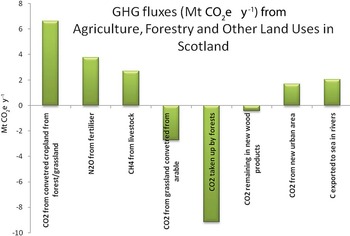
In 2007, agriculture contributed about 10.2% of Scottish greenhouse gas emissions, while the total for all rural land uses was 13.2%. By contrast, forests and grasslands have the potential to act as carbon sinks, with about 19% of the gross greenhouse gas emissions being offset by forests, grasslands and other land use activities (Jackson et al. Reference Jackson, Li, Murrells, Passant, Sneddon, Thomas, Thistlewaite, Dyson and Cardenas2007); see Figure 6.
Greenhouse gas fluxes (Mt CO2e yr–1) from Agriculture, Forestry and Other Land Uses in Scotland. Figures for 2008. (Data from Greenhouse Gas Inventories for England, Scotland, Wales and Northern Ireland 1990–2008). Notes: CO2 comes from cropland when forest/grassland is converted to arable.

Methane and nitrous oxide are also significant contributors to agricultural emissions. Methane comes primarily from livestock, which deliver greater emissions of greenhouse gases per unit of product than any other agricultural commodity, while nitrous oxide is primarily derived from adding fertilisers and manure to the soil. Nitrous oxide emissions are currently estimated at ∼6 million kg N yr–1 (Lilly et al. Reference Lilly, Ball, McTaggart and DeGroote2009).
As the Farming for a Better Climate initiative articulates (http://www.farmingforabetterclimate.org/; accessed 31/05/2012), several management options exist to lower nitrogen emissions and/or reduce farmers’ costs, while other options exist for forest management:
• optimising the timing of fertiliser application;
• substituting legumes for mineral nitrogen;
• managing livestock in ways that reduce the amount of methane they produce;
• undertaking low disturbance tillage of soils to minimise carbon loss;
• reducing the number of machinery passes in arable cultivation;
• increasing carbon sequestration (in soils and in above-ground biomass); e.g., by conversion of arable land to woodland or grassland and through peatland restoration;
• use of carbon-neutral energy crops;
• increasing the density of forest stands;
• managing forests in ways that increase sequestration and reduce ‘leakage’.
Forests contribute to reducing CO2 emissions by carbon uptake into both growing biomass and forest soils. Substituting wood fuels for fossil fuels, and timber and other wood products for more energy-intensive materials such as concrete and steel, further reduces Scotland's use of carbon (Read et al. Reference Read, Freer-Smith, Morison, Hanley, West and Snowdon2009). Short-rotation coppice or short-rotation forestry, supplied to nearby bio-energy producers, can contribute to community energy and renewable heat strategies. Given that tree crops take many years to mature, planned rather than reactive adaptation in woodland creation is needed (Read et al. Reference Read, Freer-Smith, Morison, Hanley, West and Snowdon2009). In the short term, creating new woodlands and restocking existing ones can be done using species currently in use. In the longer term and under a changed climate, new species may need to be considered, raising difficult questions in terms of protecting Scotland's woodland biodiversity.
The greenhouse gas mitigation potential from UK agriculture, land use, land use change and forestry sectors has been analysed using marginal abatement cost curves to assess the efficacy of different abatement strategies (Moran et al. Reference Moran, MacLeod, Wall, Eory, Pajot, Matthews, McVittie, Barnes, Rees, Moxey and Williams2008; Hanley & Brennan Reference Hanley and Brennan2012 (this volume)). The results indicate that in 2022, around 6.36 Mt CO2e could be abated at negative or zero cost. Further, over 17% of agricultural greenhouse gas emissions (7.85 Mt CO2e) could be abated at a cost of less than the estimated 2022 shadow price of carbon (£34 t–1 CO2e). Thus, managing land use to abate greenhouse gas emissions is an attractive policy option. However, pressures to produce more food and energy crops are most easily achieved by activities that increase emissions, for example by applying more fertiliser or employing increased mechanisation.
Growing more food will put pressures on prime agricultural land and thus will be difficult to achieve without intensive cultivation, especially if the area of good land is reduced due to changing climate or conversion to other land uses; sustainable intensification is a concept that is attracting increasing interest to meet future food requirements. Another pressure comes from the desire to increase the area under forest and arises from the Scottish Forestry Strategy, with its aspiration of increasing the extent of woodland cover to 25% of Scotland by 2050 (Forestry Commission 2010), restated in the Land Use Strategy (Scottish Government 2012). This has been recently revised and now has no set time line. Additionally, the land best suited to growing trees is often the same as that used by the beef cattle industry, another mainstay of the Scottish agricultural scene and the rural economy (Royal Society of Edinburgh 2008). This illustrates the complexity of dealing with competing pressures on land and achieving an overall reduction in land use emissions. This need for integration is beginning to be addressed in the Scottish Government's Land Use Strategy (Scottish Government 2012).
2.2. Peat and organo-mineral soils
Existing policies and strategies fully recognise the need to protect land that has carbon-rich soils, such as peatlands and upland organo-mineral soils. However, many peatlands are no longer in pristine condition and there is uncertainty about their rate of growth and the balance between emissions and sequestration. There is clearly a large gap in knowledge here that is a barrier to more-informed decision making about protecting or restoring peatlands. This is recognised in the Scottish Government's 2010 Report on Proposals and Policies underpinning the Climate Change (Scotland) Act 2009. Another important unknown is a lack of knowledge about how peatlands will adapt and respond to future climate change. Without such knowledge, it is difficult to decide how and where peatland restoration should be undertaken (Bain et al. Reference Bain, Bonn, Stoneman, Chapman, Coupar, Evans, Gearey, Howat, Joosten, Keenleyside, Labadz, Lindsay, Littlewood, Lunt, Miller, Moxey, Orr, Reed, Smith, Swales, Thompson, Thompson, Van de Noort, Wilson and Worrall2011). Peatlands in good condition should continue to accumulate carbon and, if all peatlands were in good condition, this could amount to 0.4 Mt C yr–1. This would offset about 3% of Scotland's total carbon dioxide emissions. However, there are concerns that climate change, and in particular drier summers, may reverse this long-term storage and cause peatlands to become a source rather than a sink of carbon. Bearing in mind the size of the peatland store, any switch from present trends of sequestration to future emissions would impede progress towards overall Scottish and UK reductions in emissions. Although other factors such as over-grazing, fires (including muirburn), trampling, drainage (or gripping), peat cutting and other land management practices are probably involved in impacting the health of peat bogs, these will only be exacerbated by future climate change.
2.3. Waters
The water environment provides both challenges and opportunities in the shift to a low-carbon future. In terms of managing organic matter in transit, it is important to manage tillage, forestry operations and the installation of on-shore wind turbines, so that the export of carbon into water bodies is minimised and, ideally, the recent upward trend in loads reversed. The amount of particulate carbon locked away in river, loch, reservoir and estuary sediments has only been quantified at a limited number of sites (e.g. Loch Creran; Loh et al. Reference Loh, Reeves, Miller, Harvey and Overnell2010) and an overall budget for Scotland has yet to be determined. But unless these sediments are physically disturbed (e.g. by the flushing of reservoirs or dredging of river or estuarine channels), they are unlikely to significantly alter the export of around 2 Mt CO2e yr–1 from land- to marine-based stores. However, carbon stored in farm ponds is potentially more mobile and represents a more vulnerable store of land-based carbon should the ponds be dredged or removed.
2.3.1. Using river catchments to improve water quality and reduce flood risk
At present, water quality is regulated by SEPA and the Water Quality Regulator for Scotland. SEPA regulates discharges into water bodies (mainly from industry, farms and sewage treatment plants) and the Water Quality Regulator for Scotland monitors compliance with drinking water standards. Current methods for ensuring compliance with these regulations result in high energy costs for water treatment. Alternative ways of achieving compliance have been developed in recent years, based on natural processes of filtration in river catchments and changes in farming practice (especially the use of fertilisers and pesticides and the management of livestock and their wastes).
Measures for flood risk management have similarly embraced a river catchment approach in recent years, with the Flood Risk Management (Scotland) Act 2009 explicitly requiring SEPA and local authorities to explore options for using natural processes in river catchments to reduce flood risk.
2.4. Role of ecosystem services
As a primary natural resource, land not only supports primary industries (agriculture, forestry) but also supports wellbeing through the provisioning of clean and nutritious food, clean air and water, energy and flood management, as well as health and fitness through recreation and enjoyment of the outdoors. These wider benefits (or ecosystem goods and services) are now more widely recognised and are seen as part of the land's multifunctional use. Land and landscapes are also major factors in Scotland's largest industry (tourism) and the use of rural land for ecotourism is growing rapidly. Furthermore, land supports a world-class food and drink industry (e.g. beef and whisky) which strives to compete on quality, authenticity and association with an iconic landscape. A recent SNH-sponsored study showed that 11% of our total economic output depends on the natural environment, and was valued at £17.2 billion (RPA & Cambridge Econometrics 2008). A changing climate will clearly affect that natural environment.
2.4.1. The Ecosystem Approach
In order to manage the natural environment, the Scottish Government and its agencies now favour the Ecosystem Approach, which is governed by the principles of the 1993 UN Convention on Biological Diversity (CBD) and places people at its heart. The growing interest in the Ecosystem Approach to strategic planning and management of natural resources reflects the inter-dependence between human wellbeing and the health of ecosystems (Haines-Young & Potschin Reference Haines-Young and Potschin2007). There is a raft of international and national experience and outcomes, in particular the Millennium Ecosystem Assessment (www.millenniumassessment.org/en/index.aspx; accessed 31/05/2012), Intergovernmental Platform for Biodiversity and Ecosystem Services, the UK's National Ecosystem Assessment (http://uknea.unep-wcmc.org/; accessed 31/05/2012) and Scotland's Model Ecosystem Framework (www.globallandproject.org/049_Aspinall.shtml; accessed 31/05/2012) that all build on the CBD and underpin this movement towards an Ecosystem Approach.
The Ecosystem Approach is a strategy for the integrated management of land, water and living resources that promotes conservation and sustainable use. Delivering an Ecosystem Approach requires the potential of ecosystem services to be fully realised. The Millennium Ecosystem Assessment identified the following four categories of benefits that humans receive from ecosystem services:
• Supporting services: the functions that are necessary for the production of all the other ecosystem services, including soil formation, photosynthesis, primary production, nutrient cycling and water cycling;
• Provisioning services: the products obtained from ecosystems, including food, fibre, fuel, genetic resources, biochemicals, natural medicines, pharmaceuticals, ornamental resources and fresh water;
• Regulating services: the benefits obtained from the regulation of ecosystem processes, including air quality, climate, water supply and purification, disease and pest control, pollination, and protection against erosion and natural hazards;
• Cultural services: the non-material benefits people obtain from ecosystems through spiritual enrichment, cognitive development, reflection, recreation and aesthetic experiences – i.e. taking account of landscape values.
An Ecosystem Approach thus examines how environmental assets deliver against each of these four categories, which in turn deliver human wellbeing and economic prosperity. The Ecosystem Approach has potential to help make strategic decisions more informed, efficient and transparent, such that management of natural resources is more equitable, sustainable and profitable. Multiple policies seek to protect and enhance the environment and promote economic sustainability, but these often address different components of natural resources, drivers and scales. A systems approach, that takes an integrated view of the interactions between ecosystem services, offers potential to more fully evaluate potential consequences of decision making.
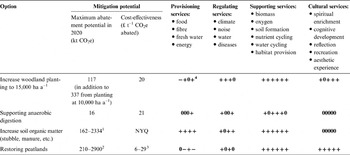
Table 2 seeks to link measures to reduce carbon emissions with the wider ecosystem services. The columns on the left illustrate the mitigation potential in terms of magnitude of the potential cut in emissions and the cost-effectiveness of such actions. The columns on the right reflect the likely effect of the measure on the different sets of ecosystem services concerned with provisioning, regulating or supporting society. A plus or minus is scored for each service within each category, based on widely available evidence and expert opinion. Such a table is difficult to quantify and cost, but even this semi-quantitative, partially subjective approach gives useful insights.
Abatement potential and cost effectiveness of mitigation options for selected land use and management options with illustrative impact on ecosystem services (co-benefit/dis-benefit or unknown as +/− or 0, respectively). The latter are grouped under the categories provisioning, regulating, supporting and cultural services. Data from Moran et al. (Reference Moran, MacLeod, Wall, Eory, Pajot, Matthews, McVittie, Barnes, Rees, Moxey and Williams2008), unless stated otherwise. NYQ=not yet quantified.

1 Chapman (Reference Chapman, Hester and Harrison2010).
2 Artz et al. (Reference Artz, Chapman, Donnelly and Matthews2012), based on restoration of 350 kha severely damaged peatland.
3 Moxey (Reference Moxey2011).
4 The order of the assessment reflects the order of the services in the column cell above. The same protocol applies for all the assessments.
For example, Table 2 points to several important conclusions:
• Actions on forestry, soil carbon and restoring peatlands each have the potential to reduce emissions in 2020 by several million tonnes.
• Many of the actions to reduce emissions from land use have beneficial effects on ecosystem services. In other words, if we can cut emissions we improve the environment.
• The cost of reducing emissions through land use change can be low in relation to other means of cutting emissions (Hanley & Brennan Reference Hanley and Brennan2012 (this volume)).
• In view of the large potential store of carbon in soils, it would be instructive to know more about the link between farming management and soil carbon. A crucial unknown is the relative importance of low-till cultivation in relation to normal deep ploughing, and the relative costs.
• Anaerobic digestion has an important niche role, since it can be deployed at the scale of individual farms.
3. Conclusion
This paper has explored the wider context of land use in relation to greenhouse gas emissions. The critical message is that the management of land use can help in the adaptation to climate change and in mitigation through sequestration of carbon, and such management is mostly compatible with making businesses more cost-effective. It can also work to improve the environment. The magnitude of the quantities involved and the sensitivity of the emission/sensitivity switch highlight its importance to future plans. It is clear that land use is driven by a complex array of natural, social and economic factors. In order to achieve effective change, it is important to implement a land use strategy that optimises both carbon reductions and ecosystem services, although this joint optimisation is not always simple, since trade-offs exists between some ecosystem services (Caparros et al. Reference Caparros, Cerda, Ovando and Campos2010). Given that most agricultural and forest land is privately owned, this will involve the establishment of a set of economic incentives such as tradable land use carbon credits, which encourage land managers to take up these land-based mitigation options. However, with more complex decisions and more detailed planning requiring the availability of relevant data, the need for further information and evidence is greater still.
4. Acknowledgements
CDC, AL, SJC and WT are funded by the Scottish Government's Rural and Environment Science and Analytical Services Division (RESAS).