Collective action problems are an enduring concern in social science and particularly political science. Activities that are vital to a community may be under-provided by self-interested individuals.Footnote 1 Voter turnout and political participation represent one such collective action problem, because the community benefits are significant,Footnote 2 but the individual incentives are low.Footnote 3 Social capital has been offered as one potential solution to low turnout and other collective action problems.Footnote 4 This article explicitly tests the validity of this claim.
Social capital refers to the connectedness and trust within a community, which are built in varying degrees through interaction between community members.Footnote 5 In this article, we exploit a natural experiment to test the effect of social capital on voter turnout. Does community activity which increases trust and connectedness lead to collectively beneficial behaviour and improve the quality of democracy? In particular, we evaluate whether voter turnout is affected by the timing of large-scale community interactions which create and reinforce social capital.
Previous scholars have proposed several ways in which community activity and subsequent social capital can increase collective action such as voter turnout. First, well-connected communities can more easily enforce co-operative behaviour,Footnote 6 and recent field experiments demonstrate the potential role of social pressure in voter mobilization.Footnote 7 Secondly, social capital can increase turnout by increasing the flow of information. While the direct costs of voting are a significant barrier to turnout, social capital may alleviate the additional costs of becoming engaged and informed about politics.Footnote 8 Lastly, social capital may expose citizens to potential benefits for others and increase their incentive to vote.Footnote 9
Despite these theoretical predictions that social capital will increase democratic participation, there are competing possibilities. First, time is an essential resource for voting and other collective behaviour,Footnote 10 and community activities can consume much of an individual's available time.Footnote 11 Secondly, social capital exposes citizens to conflicting views, which may create uncertainty and depress participation.Footnote 12 Lastly, social capital could decrease voter turnout through personal satisfaction. Previous theories suggest that voters derive satisfaction from the act of voting itself,Footnote 13 and social capital provides an alternative way in which citizens can achieve this personal fulfilment. Furthermore, even if connectedness and trust themselves are not detrimental for participation, the community activities recommended by scholars to increase social capital may have adverse consequences, distracting citizens and depressing political participation. Since we know that governments and development organizations are currently implementing policies to increase community activity on the assumption that this will foster and maintain democracy,Footnote 14 an empirical assessment of these effects is needed.
Putting the theoretical arguments together, social capital and the community activities which generate social capital may have positive or negative effects on collective action, and they could serve as either a complement or a substitute for political participation. In this article, we explicitly assess the relationship between social capital and voter turnout by exploiting exogenous increases in community interactions which build and reinforce social capital. In doing so, we test a fundamental question in the literatures on social capital and political participation: can increased community activity lead to increased participation thereby improving the health of democracy? In the ideal experiment, we would randomly treat some individuals or communities with high doses of community engagement close to the date of an election. While this experiment is practically unfeasible, we have identified a naturally occurring process which closely mimics this ideal experiment: saint's day fiestas in Mexico.
To assess the relationship between social capital and voter turnout, we exploit two sources of quasi-random variation. First, the fiesta date of each community is quasi-random, such that a community with a fiesta date close to an election date is on average no different from a community with a fiesta date far from the election, apart from their differing fiesta dates. Comparing these groups of communities, we can estimate the causal effect of heightened community interaction around the date of an election. Secondly, the timing of Mexico's federal elections switched from mid-August in 1994 to early July in 1997. As a result, some communities which previously had fiestas near the election no longer do and vice versa. Exploiting this quasi-random shock to the electoral calendar, we have tested whether voter turnout within a community changes as the election date moves closer to or further from the fiesta date. With both tests, we estimate a significant, negative effect of social capital on voter turnout. When a saint's day occurs within two weeks of an election, turnout in that community is depressed by 2.5 to 3.5 percentage points.
In the next section, we discuss previous attempts to assess the effect of social capital, and we explain why these studies systematically overestimate the true causal effect. Next, we provide a brief history of saint's day fiestas, demonstrate that the fiesta dates are quasi-random, and show that the fiestas successfully generate social capital. Then, we provide the main empirical results, analysing the voting behaviour of 325 Mexican municipalities that each have only one Catholic church in seven federal elections between 1991 and 2009. Then, we extend the analysis to present three additional sets of findings. (1) Because turnout is persistent across elections, a fiesta which demobilizes a community in one election will depress turnout in subsequent elections as well. (2) The size of the effect of saint's day fiestas varies in important ways. The effect is stronger (more negative) in smaller, more Catholic communities where the fiestas are more intense. Also, the effect is equally strong when local elections coincide with the federal election, even though overall participation is greater during local elections. (3) Having analysed rural municipalities, we replicate the same effect in Monterrey, a large urban setting. Then, we discuss and rule out several alternative explanations of our findings. Finally, we conclude by discussing the implications of our results for collective action and democratic governance.
In numerous academic fields, social capital is posited to boost the economic, social and political health of society.Footnote 15 Despite the importance of these causal claims, they have not been rigorously tested. Not surprisingly, individuals who are connected to their community or trust their community are more likely to participate in politics. However, it remains to be determined whether social capital as a policy prescription could causally increase democratic participation. To our knowledge, this article offers the best available evidence on the causal effects of social capital and the types of community activity which generate social capital. We find no evidence that social capital causally increases collective action; in fact, an exogenous increase in community activity actually decreases voter turnout.
Previous Estimates and the Problem of Endogeneity
Existing empirical evidence for the effects of social capital is correlational: trends in measures of social activity over time correspond with trends in turnout and other collective actions,Footnote 16 regions with high measures of social activity tend to have higher turnout,Footnote 17 and individuals who are socially connected are more likely to vote.Footnote 18 Moreover, citizens who participate in their community are more likely to participate in politics.Footnote 19 However, these correlations lack a causal interpretation due to reverse causation and confounding variables. Social capital is not randomly assigned but rather an endogenous characteristic of generations, regions and individuals. For instance, the act of participating in politics may generate social capital. Additionally, the types of individuals who are socially connected are probably the types of citizens who would vote regardless of their social situation.
Even in 1840, Alexis de Tocqueville acknowledged the possibility that social capital is endogenous to political activity: ‘Civil associations, therefore, pave the way for political associations; on the other hand, political associations develop and improve in some strange way civil associations’.Footnote 20 This type of reverse causation would lead any correlational finding to overestimate the true causal effect of community engagement on political participation. Several studies suggest that good political institutions foster community connectedness, but the reverse relationship does not hold.Footnote 21
One important confounding variable in these studies is an individual's underlying level of sociability. Researchers have shown that personality traits such as extroversion, social aggression and self-confidence have direct effects on both measures of social capitalFootnote 22 and voter turnout.Footnote 23 Individuals predisposed to be social are more likely to be involved in their communities and are more likely to vote. However, forcing a non-social person to connect with others may have no impact on her decision to vote. Numerous other omitted variables may further cloud the interpretation of the generational, regional and individual correlations between social capital and turnout.
Ideally, we could obtain an unbiased estimate of the effect of community participation on turnout through a randomized, controlled experiment. In the correlational observations, socially connected individuals or groups are significantly different from those who are unconnected. Randomization would remove endogeneity because we could be sure that the comparison groups are truly comparable to one another. We would randomly assign some individuals or groups to be socially connected and others to be disconnected. Unfortunately, such an experiment would be practically, financially and ethically unfeasible. Therefore, we exploit a natural experiment in which social capital is assigned in a quasi-random manner: saint's day fiestas in Mexico. Furthermore, different communities receive this shock at different times throughout the year as determined by the feast day associated with each parish's patron saint. By exploiting the quasi-random variation in the timing of fiestas across municipalities and by exploiting an exogenous change in Mexico's electoral calendar, we obtain unbiased estimates of the effect of community activity on turnout. Moreover, because saint's day fiestas are exactly the types of prescriptions recommended by social capital scholars, our results speak the potential of social capital as a policy prescription for increased democratic performance.
We are aware of only one other study that employs a quasi-experimental approach to study social capital and turnout. Condon conducts an ongoing study of American elementary schools randomly assigned into the FAST (Families and Schools Together) programme.Footnote 24 Parents of students in the FAST schools are encouraged to become more involved in their child's school. Condon estimates a negative effect of the programme on turnout. Parents assigned to the FAST programme were less likely to vote than the control parents. Unfortunately, the way in which subjects were recruited for the study led to significant pre-treatment differences between parents in the two comparison groups. Specifically, parents in the FAST programme were typically poorer and less likely to vote before the study, which could generate biased estimates. Nevertheless, we admire this approach and have exploited a separate quasi-experiment to address the effects of social capital in a different political setting.
Saint's Day Fiestas in Mexico
The generation of social capital is not a formal process. Rather, citizens become connected to one another by coming together, engaging in casual conversation, eating, drinking and having fun. In their review of communities which succeed in generating social capital, Putnam and Feldstein identify dinner parties, picnics, music, local art and dancing as important sources of community engagement and trust.Footnote 25 In one specific example, the authors argue that a multicultural festival helped the Dudley Street Neighborhood Initiative to build social capital in a previously deteriorating Boston neighborhood: ‘At countless community meetings, at the multicultural festival, through hard side-by-side labor, they [the initiative] helped people connect and reconnect.’ According to Putnam and Feldstein, social capital arises from casual community interaction, and it can arise quickly over the course of days or weeks. By this account, saint's day fiestas in Mexico generate social capital in abundance. These are exactly the interventions that scholars would prescribe to increase the social capital and subsequent democratic performance of a community.
For the following reasons, Saint's day fiestas offer a unique opportunity to test the effects of community activity and the subsequent social capital. Roman Catholic churches predominate throughout Mexico, and each church or parish has a patron saint. Each patron saint has a particular feast day, typically the day of the year that the saint died. Around the feast day of a particular church's patron saint, the members of the church community hold a large festival, celebrating their saint and their community. In most Mexican communities, these saint's day fiestas are the biggest social event of the year, comparable to if not bigger than the celebrations coinciding with Easter and Christmas.
Our subsequent analysis makes three assumptions about saint's day fiestas in Mexico. First, the time of year at which each parish celebrates its fiesta is exogenous to other features of the communities. For example, a community that celebrates its fiesta in January is on average no different from one that celebrates its fiesta in July.Footnote 26 Secondly, these fiestas temporarily increase the social capital of the community. For several weeks leading up to and following the fiesta, the community experiences an increase in social connectedness, sense of belonging, trust in the community and discussion of important issues in the community. Thirdly, if these fiestas do in fact influence voter turnout, we can attribute this effect to the boost of community activity generated by the fiestas. The following sub-sections provide empirical support for these assumptions.
The Timing of Fiestas Is Quasi-Random
To make an initial assessment of whether fiesta dates are quasi-random, we surveyed fourteen Catholic priests and officials in Mexico whose e-mail addresses were listed in online church directories.Footnote 27 These individuals are not representative of all Catholic communities in Mexico, but they provide general, qualitative support for our assumptions about when fiestas occur and the extent to which they increase social capital.
The patron saint of each church is typically chosen for historical or idiosyncratic reasons. Moreover, the particular fiesta day for each saint is arbitrary, typically the day of the year that the saint died centuries ago. In our survey, we asked respondents how their particular parish chose its patron saint. No respondent indicated that the time of year for the fiesta was considered in this decision. Rather, patron saints resulted from idiosyncratic events or the preferences of one particular priest or bishop. For example, one respondent from a church called ‘Our Lady of Refuge’ provided the following account: ‘The people of God were consulted with the approval of the bishop. Here in Tamaulipas, there is great devotion to Our Lady of Refuge because we were officially put under the patronage of Our Lady of Refuge by the Spanish royalty during colonial times.’Footnote 28 In this case, as in many other cases, Spanish colonizers chose the patron saint of the community for arbitrary reasons. These stories indicate that the fiesta date of a particular parish is exogenous to the characteristics of the community. Later in the article, we provide further empirical evidence that the fiesta dates are exogenous. Demographic variables are uncorrelated with the fiesta dates, and communities with fiestas occurring near an election are no different from others in terms of their economic and demographic characteristics.
Fiestas Provide a Temporary Shock to Social Capital
To discern whether saint's day fiestas increase the short-term connectedness of their communities, we asked a series of survey questions regarding the nature of these fiestas. The priests and officials indicated that their fiestas last between one to ten days, require eight to more than thirty days of preparation, and involve 400 to 5,000 attendants. When asked about the type of activities at the fiestas, respondents listed numerous social and religious activities including eating, dancing, theatrical performances, wheelbarrow races, egg tosses, lotteries, singing, musical performances, mass, communion, confession and religious processions. We expected that priests and religious officials would focus on the religious aspects of the event. However, more than half of the activities mentioned were social and secular. Several respondents specifically mentioned that recognition of the coexistence of neighbours is a primary component of the fiestas.
When we asked more specifically whether fiesta attendants discussed important political issues, respondents indicated that community members discuss municipal administration, public safety, unemployment and the performance of political leaders at the fiestas. Finally, we asked whether the fiesta helps to build trust within the community. All respondents confirmed that this was the case. Community trust and discussion of important issues are critical elements of social capital, and fiestas are successful in fostering these phenomena. Saint's day fiestas bring members of a community together. By preparing food, singing, dancing and discussing important issues, the citizens are temporarily raising the connectedness of the entire community. As one clergy-member remarked, ‘Saint's day fiestas are a means to increase communion between the faithful.’
Lastra, Sherzer and Sherzer conducted an in-depth ethnographic study of two saint's day fiestas in Central Mexico.Footnote 29 In their descriptive account, the authors note the significance of these events for community connectedness:
The event reinforces peoples’ sense of community … It is striking that all the events of the patron saint fiesta are group activities that require collaboration … Every year the collaboration necessary for the complex organization of the fiesta reaffirms its [the community's] social and ritual structure … One aspect of sociability that is prevalent during fiestas is the cultural theme of accompanying, that is, or being with, sharing the moment with, friends, compadres, and the saint.
This account affirms our claim that saint's day fiestas temporarily increase a community's capital.
The account of Lastra, Sherzer and Sherzer and our survey responses suggest that saint's day fiestas provide quasi-random shocks to social capital. Every community receives this positive shock at some point throughout the year, but the particular time of year is essentially random. We focus our study on Mexican municipalities with only one Catholic church. On average, municipalities which celebrate their fiesta around an election should be no different than those that do not, except for the timing of their fiesta day. Both sets of municipalities have the same general level of social activity, but they receive these shocks to connectedness and trust at different times. We exploit this quasi-random variation to estimate the effects of community activity and the subsequent boost of social capital on voter turnout.
Some scholars assume that social capital is a long-term characteristic of a community that cannot vary over short periods of time, but according to Putnam himself, this view is a misconception. ‘While some early work was understood to imply that stocks of social capital were immutable except on a time-scale of centuries, we now are beginning to explore ways in which individual behavior and collective choice can have important effects on social capital over even relatively short periods.’Footnote 30 According to Putnam, social capital can be increased in the short term, and saint's day fiestas are precisely the types of events prescribed to do so. In fact, if social capital is indeed ‘immutable except on a time-scale of centuries’, then the concept has no policy relevance and can only be useful for historical summary. Our subsequent empirical analysis assesses the consequences of these short-term shocks to social capital.
The Effect of Saint's Day Fiestas on Voter Turnout
We have collected census and electoral data for all municipalities across Mexico in which there is only one Catholic church and in which we could confidently identify the patron saint and corresponding feast day of the church.Footnote 31 We focus specifically on municipalities with one church because we want to ensure that the saint's day fiesta and corresponding social capital is affecting a large proportion of the community that we observe.Footnote 32 In total, we examine 325 municipalities across seven national elections for a total of 2,255 observations.Footnote 33 Summary statistics for all municipalities are presented in the Appendix. These communities are predominantly rural, agricultural, low-income and Roman Catholic.
Our surveys indicate that saint's day fiestas increase social capital for several weeks before and after the actual fiesta date. As a result, we code a ‘treatment’ variable, Fiesta, which takes a value of 1 if the fiesta day is within two weeks of the election date and 0 if the fiesta day is further from the election. We will say that a municipality is receiving a shock of community participation if its fiesta day lies anywhere within the four-week window surrounding the election in that particular year. In the Appendix, we show that our subsequent results are not sensitive to the choice of this arbitrary window size. Our subsequent results would be nearly identical for any cutoff between three and eighteen days.
Municipalities with fiesta days after the election are included in our fiesta ‘treatment’, because fiesta preparations begin weeks before the actual fiesta date. The shock to social capital begins several weeks before the fiesta date and continues for several weeks afterwards. Moreover, individuals may smoothly allocate their free time,Footnote 34 so an upcoming fiesta will consume time and affect citizens before it begins. However, our subsequent results are unchanged if we only include municipalities with a fiesta day before the election in our coding of the Fiesta variable. For any of the seven election years in our dataset, there are fifty-two to fifty-four municipalities with fiestas occurring within two weeks of the election date.
With these data in hand, we quantitatively test our assumption that fiesta days are quasi-random and then evaluate whether community activity is a complement or a substitute for political participation.
If fiesta timing is quasi-random, there should be few differences in observable pre-treatment characteristics between municipalities which have fiestas close to and far from the election date. The Appendix presents placebo regressions that test for differences between these two sets of municipalities along numerous demographic, economic and political variables. There are few meaningful differences and, for the variables where we do see some small differences (earnings, partisan support and government employment), these differences may result from the downstream effects of the fiesta day and the subsequent shock to voter turnout. Importantly, our subsequent results are robust to the inclusion of any of these covariates as controls in our analysis. Consistent with our prior argument that fiesta days are quasi-random, this analysis suggests that the municipalities in our comparison groups are truly comparable to one another.
We can also assess the comparability of municipalities in our comparison groups by estimating a propensity score. We estimate a Logit model, regressing the Fiesta variable on sixty demographic variables from the census. A municipality's propensity score is its predicted value, representing the a priori predicted probability that the municipality would be in the fiesta treatment given its demographic characteristics. The Appendix presents the distribution of propensity scores for both sets of municipalities. The distribution of propensity scores is similar for both groups.
Having established that fiesta timing is quasi-random, we now turn to evaluating the effect of saint's day fiestas on turnout. If community activity and social capital influence voter turnout, we expect turnout to vary with fiesta dates. If this exogenous shock of community participation increases voter turnout, we should see higher average turnout levels for municipalities with fiestas closer to the election date. Conversely, we should see the opposite trend if this shock to social capital decreases turnout.
We take several approaches to estimating the effect of fiestas on turnout. We begin by presenting a nonparametric approach: kernel regression. We calculate residual turnout for each observation removing variation associated with different election years and the mean turnout levels in each state. Figure 1 shows the predicted level of residual turnout relative to the number of weeks that a municipality's fiesta occurs before or after the election. Turnout is significantly lower for municipalities holding a fiesta close to the election date. Several weeks before the election we begin to see the negative effect, and it continues for municipalities holding fiestas several weeks after the election.
Kernel regression: turnout across fiesta dates
Note: Residual turnout removes year-level and state-level variation in turnout. For each municipality-year, we regress turnout on year fixed effects and state-level turnout, and then compute the residuals. This graph uses an Epanechnikov kernel with bandwidth 3.5, but the result is not sensitive to the choice of kernel or bandwidth. Dotted lines indicate standard errors.

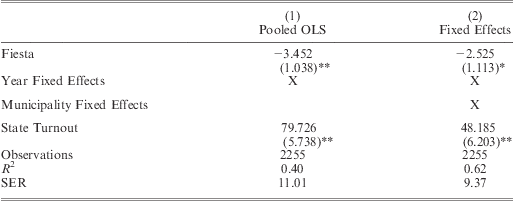
Next, we employ two parametric approaches to estimate the effect of fiesta timing on voter turnout. Both results are presented in Table 1. First, we estimate the effect of the Fiesta treatment by ordinary least squares (pooled OLS). To improve the precision of the estimates, we include year fixed-effects and state turnout in the model. According to this estimate, a fiesta occurring within two weeks of the election decreases voter turnout by 3.5 percentage points. This estimate, which primarily exploits variation across different municipalities, is statistically (p < 0.01) and substantively significant. In the Appendix (Tables A3 and A4) we show that a simple difference-in-means yields the same result, and the result is robust to the exclusion or inclusion of different years or control variables.
The Effect of Saint's Day Fiestas on Voter Turnout

Notes: Municipality-clustered standard errors are shown in parentheses. The dependent variable is voter turnout, coded as percentage points from 0 to 100. Each observation is a municipality-year between 1991 and 2009. ‘Fiesta’ is a dummy variable indicating whether the municipality's saint's day fiesta occurred within two weeks of the election.
*Significant at 5%; **significant at 1%.
As a second test of the effect of saint's day fiestas, we leverage a shift in the federal election date. For the 1991 and 1994 elections, elections took place in mid-August, but the subsequent five elections took place in early July. Therefore, we can test for changes in voter turnout for individual municipalities which fell into or out of the Fiesta treatment as a result of the change in election date. Our second estimate in Table 1 includes municipality fixed effects, removing any variation in turnout across different municipalities. As the election date moves within (outside) two weeks of a municipality's fiesta day, turnout decreases (increases) by 2.5 percentage points (p < 0.05).Footnote 35 Even if fiesta days are endogenous to turnout for some unknown reason, this fixed effects estimate would still provide an unbiased estimate because we have removed any variation across different municipalities.
We reject the hypothesis that social capital, along with the type of community activity thought to improve democracy, increases turnout. Rather, a fiesta occurring within two weeks of a federal election will reduce voter turnout in the municipality by 2.5 to 3.5 percentage points. This result is inconsistent with previous correlational observations, suggesting that those analyses are biased upward due to reverse causation and omitted variable bias. While social individuals and groups are more likely to vote, the random assignment of community activity does not increase but rather decreases voter turnout.
Persistence of Turnout Across Subsequent Elections
If saint's day fiestas decrease turnout in one election, we expect that such demobilization will continue to have an effect in subsequent elections. Empirical research suggests that voting is habitual,Footnote 36 so the decision to abstain from voting in one election will decrease the probability of voting in future elections. To explore this possibility we take a closer look at the switchers, those municipalities which fell into or out of the fiesta treatment over time.
Our cases fall into three categories in regard to their receipt of the fiesta treatment. There are approximately fifty municipalities with August fiesta days which only experienced the social capital shock in 1991 and 1994. There are approximately fifty municipalities with late June or early July feast days which only experienced the social capital shock in the five elections following 1994. And there are approximately 220 municipalities with other feast days which never had a fiesta within two weeks of the election.Footnote 37
Figure 2 shows the residual turnout rates for all three of these groups across each election year. We can see that the municipalities celebrating in June/July voted at the same rate as the ‘control’ municipalities in 1991 and 1994 when they had not yet received the treatment. Then, after the election date moved towards their fiesta day, their turnout rates dropped and remained lower through all subsequent elections. The municipalities celebrating in August initially began with lower turnout rates because their fiestas coincided with the elections in 1991 and 1994. Following the change in election date, turnout remained low through subsequent years even though these municipalities no longer received the social capital shock around the election. The observed trend is consistent with the hypothesis that negative shocks to voter turnout will persist over time.
A closer look at the switchers
Note: Again, residual turnout removes variation associated with each year and state. The graph presents the average level of residual turnout for three different subsets of municipalities. Those with fiesta days in August were ‘treated’ in the 1991 and 1994 elections. Those with fiesta days in late June/early July were treated in all elections from 1997 to 2009. All remaining municipalities were never treated in any election. The vertical bars represent standard errors.
Looking more closely at the municipalities treated from after 1994, we see further evidence that the fiesta treatment is persistent. Residual turnout is initially similar between the two groups when neither group has a fiesta near the election, but once the election date switches, residual turnout progressively declines with each election. The longer a municipality has had a fiesta near the election, the greater the negative effect. By 2006 when these municipalities have their fourth election around the time of a fiesta, their turnout is 4.5 percentage points lower than their counterparts. The repeated existence of a fiesta around the time of elections has a particularly strong demobilizing effect. These results do not suggest that the social capital generated by a fiesta persists for several years; we saw earlier that the fiestas only increase community participation for several weeks. Rather, the act of voting itself is persistent, so an individual's failure to vote in one election decreases her chances of voting in the next election.
The persistence of the fiesta effect explains why our fixed effects estimate is slightly smaller (closer to zero) than our cross-sectional results. The fixed effects analysis focuses on individual municipalities in which the treatment changed. When the election date changed, the municipalities with August elections were no longer treated. However, the negative effects of their previous treatments persisted, causing turnout to remain low. Given this phenomenon, our fixed effects estimate is likely to be biased towards zero, suggesting that we should rely more heavily on our cross-sectional results. Alternatively, if we think that the data in Figure 2 results from imbalances between the municipalities celebrating in August and the rest of the sample, then we should rely more heavily on our fixed effects estimate. Both estimates provide similar results, so the interpretation of these patterns is inconsequential for our main empirical result.
Variation of the Effect Across Municipalities
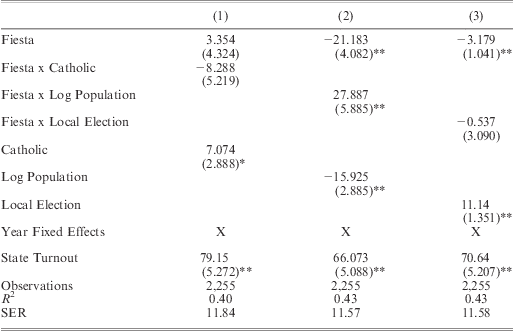
If saint's day fiestas decrease voter turnout, we expect the effect to vary across different type of municipalities. We modify our pooled OLS model to include interaction terms which assess the conditions under which the fiestas will have a stronger or weaker effect on voter turnout. Table 2 shows the results of three regressions which include various interaction terms. In each case, the variables have been re-coded to range from 0 to 1. Therefore, we can interpret the coefficient on an interaction term as the change in the effect of fiestas as we move from municipalities with the lowest level of the explanatory variable to those with the highest level.
Variance of the Fiesta Effect across Municipalities
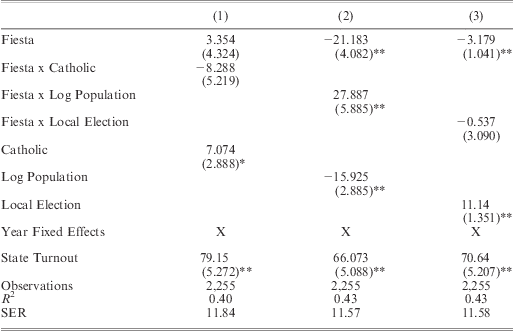
Notes: Municipality-clustered standard errors are shown in parentheses. The dependent variable is voter turnout, coded as percentage points from 0 to 100. Each observation is a municipality-election between 1991 and 2009. ‘Fiesta’ is a dummy variable indicating whether the municipality's saint's day fiesta occurred within two weeks of the election. ‘Local Election’ is a dummy variable indicating whether the federal election coincided with a state or local election in that particular municipality. The variables ‘Catholic’ and ‘Log Pop’ are coded to range from 0 to 1. Therefore, the interaction terms can be interpreted as the change in the treatment effect as we move from the smallest (least Catholic) to the largest (most Catholic) municipalities in the dataset.
*Significant at 5%; **significant at 1%.
First, we expect the effect to be larger in municipalities with a higher percentage of Catholics. In these municipalities, the fiesta will involve a higher proportion of residents and the shocks to social capital will be more intense. Column 1 shows that the effect is 8.3 percentage points greater (more negative) as we move from the municipalities with the lowest proportion of Catholics to those with the highest proportion of Catholics.
Secondly, the effect should be greater in smaller municipalities for several reasons. Smaller communities with fewer social alternatives will attract a higher proportion of residents to the fiesta. Also, we have restricted our analysis to municipalities with only one church. Larger municipalities may have other churches that we are unaware of. If this is the case, our effect will be diluted in these larger municipalities because a smaller proportion of residents will attend the fiesta. Column 2 indicates that the effect of fiesta timing is strongest for smaller municipalities. Saint's day fiestas actually decrease turnout by 21 per cent for the smallest municipalities in our dataset.Footnote 38 In a community of 400 to 500 residents, one in five individuals are demobilized by a fiesta occurring near the election date.
Lastly, we test whether the effect is different if a local election happens to coincide with the federal election. Turnout is typically higher in local elections compared to federal elections, and citizens are more likely to care about the local races. In column 3, we do find that turnout is significantly higher when a local election coincides with the federal election, but the demobilizing effect of saint's day fiestas is unchanged. Even in elections where citizens are highly interested, the demobilizing effect of community participation remains.
Replicating the Findings in an Urban Setting
Our previous analysis has focused solely on Mexican municipalities with just one Catholic church. Thus, our dataset consists of primarily poor, rural, agricultural communities. The question remains whether our results will generalize to other democratic communities. In order to ensure internal validity, we have limited our study to the subset of regions for which we can make valid inferences. To test for external validity, we test the effect of saint's day fiestas on turnout in an urban centre, Monterrey. This analysis, presented in the Appendix, lacks the precision of our previous analysis. Nonetheless, we estimate a similar effect. Saint's day fiestas decrease turnout in Monterey by approximately 3 percentage points, just as they do in rural municipalities. Therefore, the same mechanisms affecting community participation and leading to a decreased turnout in rural municipalities are present in urban settings as well.
Testing Alternative Explanations
We have presented evidence that the occurrence of a saint's day fiesta near a federal election significantly decreases voter turnout in a community, and we have argued that this decrease is causally attributable to the community activity and subsequent social capital generated by fiestas. In this section, we consider alternatives to our causal interpretation. Challenges to our findings will be likely to come in two forms. First, there may be unobserved differences between municipalities in our comparison groups that confound our results. Secondly, the observed effect may be driven by some extraneous factor that also changes during the fiestas.
We have already attempted to rule out the first challenge regarding the comparability of municipalities with fiesta dates near and far from the election date. The placebo regressions and distribution of propensity scores demonstrate that there are few observable differences between these groups. Moreover, we obtain a similar result by employing municipality fixed effects, which are not sensitive to differences between municipalities. All of these results are consistent with our claim that fiesta dates are quasi-random. However, more subtle alternative explanations are still possible.
Catholic parishes choose their patron saints for many reasons. Perhaps certain characteristics are correlated with the type of patron saint that a church will select. Since some saints are quite common, one may worry that the results are driven by the churches of one saint or a few particular saints. There are seven different fiesta days that are shared by more than fifteen churches in our dataset. Our results are robust to the exclusion of any of these sets of churches. Another way to address this concern is to measure the degree of similarity within churches sharing a fiesta day. We find that the variance of census covariates among municipalities sharing a fiesta day is the same as the variance of covariates across all municipalities. Therefore, all evidence is consistent with our argument that the fiesta days are quasi-random.
Another possibility is that certain types of municipalities will choose patron saints whose feast day occurs at a convenient time. Perhaps the family members of college students or migrant workers will prefer to have their fiestas during the summer or around Christmas so that their relatives can return home during the celebration. We find that municipalities with summer or Christmas fiesta days are demographically similar to all other municipalities. However, as previously discussed, even if there were some unobserved variable correlated with fiesta days, our fixed effects estimate would still provide an unbiased estimate because it removes differences across municipalities.
We assume that saint's day fiestas influence social capital, and the way in which the fiestas affect voter turnout is through both community activity and the subsequent social capital generated by the fiestas. Since we cannot obtain a precise measure of community participation, we estimate the effect of fiestas on turnout. If fiestas influence turnout through some mechanism other than community participation, we could draw a misleading conclusion about the relationship between social capital and turnout. While we cannot prove the validity of this assumption, we can raise alternative possibilities and assess their plausibility.
As we have discussed, saints day fiestas are large events spanning several days and requiring many weeks of preparation. Is there something other than social capital that changes during the fiesta which might explain our result? One possibility is that intense celebration and consumption of alcohol exhaust citizens. On one level, exhaustion is not inherently at odds with social capital. We want to test the effect of citizens coming together and connecting. If they happen to consume alcohol or lose sleep when they convene, that would be one by-product of social engagement. However, our results cannot be attributed solely to hangovers or sleeping in, because we look at a four-week window. Tiredness might influence turnout if the fiesta occurs one or two days before the election. However, we find that fiestas occurring two weeks before or after the election date decrease turnout in the same way as those occurring the day before the election. The fact that the effect spans a long time-period both before and after the election rules out the possibility that our effect could be entirely driven by exhaustion, hangovers or other factors that would not span this same time period.
Another possibility is that political candidates or government officials would visit the festivals in order to influence the community's political participation. Since turnout decreases during the fiestas, this type of political activity would have to decrease turnout in order to work against our conclusions. Perhaps citizens are disillusioned by political campaigning at the festivals or government officials actually attempt to decrease turnout in communities that oppose them. Both possibilities are unlikely, particularly for the small, rural municipalities in our dataset. Additionally, our survey respondents indicated that there is never any official political or government activity at their fiestas. We can also rule out the possibility that voter registration plays a role because the deadline to register is several months before the election date.
A related explanation is that saint's day fiestas interfere with the campaign activity that would typically mobilize voters. Again, this story may not be at odds with our claim if community activity and social capital in general tend to interfere with campaign activity. This campaign effect would be part of the downstream effect of community participation. Nonetheless, altered campaign activity cannot entirely explain our results, because of the duration of our effect. We would not expect a fiesta after the election to interfere with campaign activity in the same way that a fiesta before the election might. Again, the long time-period across which we see an effect rules out the possibility that our results are driven by a short-term factor such as altered campaign activity before the election. If anything, the occurrence of the fiesta should make it easier for campaigns to reach citizens and mobilize citizens, but we do not observe this phenomenon.
Since saint's day fiestas have an inherently religious purpose, the fiestas may alter the community's level of personal religiosity which in turn influences turnout. Ten out of twelve survey respondents indicated that church attendance increases during the fiestas, so this hypothesis is plausible. However, religious participation is thought to be both a source and consequence of social capital,Footnote 39 so this possibility is not at odds with our conclusions. In fact, we take this increased religiosity as supporting evidence that fiestas temporarily increase social connectedness and trust within a community. Moreover, evidence suggests that religious activity may causally increase, not decrease, voter turnout,Footnote 40 so we suspect that our results cannot be entirely attributed to religiosity.
Discussion and Conclusion
Social scientists have long considered vibrant civic political associations a basic requisite of democracy. Lipset claims, ‘In a large complex society, the body of the citizenry is unable to affect the policies of the state. If citizens do not belong to politically relevant groups, if they are atomized, the controllers of the central power apparatus will completely dominate the society.’Footnote 41 More recently, scholars of social capital have argued that non-political civic associations promote participation and effective governance.Footnote 42 This study focuses on the hypothesis regarding social capital and political participation.
We exploit a natural experiment to test the effect of participation in local community festivals on voter turnout. Saint's day fiestas bring together individuals in a community, allowing them to connect with one another and discuss important issues. Contrary to previous theories and observational findings, this exogenous shock to community activity around the time of a federal election actually decreases voter turnout. To be clear, we do not conclude that social capital on its own depresses political participation. Rather, the types of community activities that increase social capital can have adverse consequences. As these activities increase trust and connectedness, they also distract citizens from the political process and decrease participation. This finding is not obvious. In fact, when we described our design to other researchers, many predicted that turnout would increase and none expected that it would decrease.
While the results presented in this article undermine one of the most important social capital hypotheses, our findings are not a general indictment of the role of civic engagement in democratic governance and collective behaviour. The mechanisms connecting citizen behaviour and quality of governance are manifold and complex. The direct effect of community activity on turnout is only one component. There are other ways that community engagement could improve the quality of democracy. For example, governments might be more responsive to a socially-connected citizenry. Also, our analysis takes advantage of short-term shocks to social capital, but we cannot say whether the development of long-lasting social capital would have the same effect. Perhaps the temporary shock of a community festival decreases turnout but the long-term social capital necessary to hold regular community festivals is actually beneficial for participation. Nonetheless, we provide the best available test of the hypothesis that social capital will increase turnout and representation, and we find the opposite. Moreover, any policy prescription which aims to increase social capital will be likely to generate this short-term variety of connectedness, so a test of the consequences of short-term social capital is warranted.
How can we reconcile our findings with previous observations? In virtually every case, measures of social capital are correlated with political participation. However, these correlations may be driven by confounding variables or reverse causation, in which case they tell us nothing about the causal effect of community activity.
Several previous studies are consistent with our finding that community participation decreases turnout. As previously mentioned, Condon finds that parents assigned to the FAST (Families and Schools Together) programme are less likely to vote.Footnote 43 Additionally, Stoker and Jennings find that young couples experience a decrease in political participation around the time of their weddings.Footnote 44 Marriage ceremonies bring families and friends together like no other event, and despite the elevated level of social activity, turnout decreases. We present a similar result but hope to overcome the methodological limitations of previous studies by exploiting the quasi-random timing of saint's day fiestas.
Community festivals do not always detract from voter turnout. Addonizio, Green and Glaser find that festivals held on the election date near the polling location can increase voter turnout by several percentage points.Footnote 45 Why do festivals increase turnout in their context and decrease it in ours? The key difference is that their festivals were specifically designed to attract voters to the polls. In a sense, their festivals lower the cost of voting, which increases turnout as expected. In this case, fiestas do not happen on the exact election date (except in a few cases). Instead, saint's day fiestas bring individuals together at a time and location removed from voting, raising social capital without directly altering the cost of voting. Their result suggests that planned festivals can raise turnout by bringing people to the polls, but their finding says nothing about the direct effects of social capital.
How can a positive shock to social capital decrease voter turnout? We have proposed three ways in which heightened social connectedness might detract from political participation. All three possibilities are plausible, and we suspect that all of them are at work in this context. First, time is an essential resource for political participation but it is consumed by social capital.Footnote 46 Rational individuals will smoothly allocate their free time such that community activity will decrease political participation even when the community event occurs weeks before or after an election.Footnote 47 As citizens become more involved with the community, they have less time to learn about the election, form an informed opinion and visit the polling place.
Secondly, social interactions present conflicting views to potential voters which might create uncertainty.Footnote 48 Our surveys indicate that citizens talk about contentious issues at the fiestas and express discontent with political leaders and the political system. Moreover, Joel and Dina Sherzer, two authors of Adoring the Saints: Fiestas in Central Mexico, told us that political discontent is pervasive throughout the fiestas: ‘If you look at the kinds of figures, giant puppets, etc. which parade about during fiestas, they are sardonic, politically biting, and humorously critical of government leaders.’Footnote 49 The exposure to conflicting views may cause members of the community to lose confidence in their own political opinions or become disillusioned with politics altogether.
Lastly, citizens often vote because of the sense of civic duty or the fulfilment they derive from the act itself.Footnote 50 Social capital may serve as a substitute for that type of satisfaction. When citizens contribute to their community at the saint's day fiesta, they may no longer feel the need to vote, because they have already achieved the fulfilment that they would otherwise obtain through voting. Lastra, Sherzer and Sherzer argue that this sense of duty explains the high levels of participation in saint's day fiestas:Footnote 51 ‘These networks of relationships are effective because of ethical principles that govern the behavior of the inhabitants of the communities. They feel a sense of duty … to carry out one's promise.’
We are among many political scientists concerned about low voter turnout and inequality in the political process.Footnote 52 Socio-economic status is highly correlated with voter turnout, which may bias public policies in favour of the few. Many scholars and activists hope that increased community participation and social capital will open the doors of political representation for underrepresented communities like those in our analysis. If social connectedness does increase turnout, then we can improve representation by building community centres, opening parks and throwing community-wide festivals. However, we find no evidence that such proposals can solve the collective action problem of turnout. To the extent that social capital is correlated with turnout, it is likely to be a by-product, not a cause, of a healthy democracy. Contrary to previous thinking, community activity is a substitute, rather than a complement, for political participation.