Humans express and identify themselves through style with crosscutting impulses for stylistic conformity, distinction, and play. In examining how Mesoamerican households shaped history, it is important to consider how material styles were used to create and express household identity both in the aggregate as corporate groupings and as comprising particular individuals with varied identities. Following Hutson (Reference Hutson2010) and Robin (Reference Robin2002), we employ a relational framework to daily household practices and their effects on, and responses to, broader community dynamics. Such a framework considers how the identities of individuals as socially identifiable subjects involve the manipulation of material objects within physical spaces and the incremental changes that through repeated, materialized practices generate cumulative cultural change of a magnitude that leaves archaeologically conspicuous traces. It explores the ways in which human interactions and the processes of defining subjects and their relations to one another occur within a range of physical settings, oscillating between private, semi-private, semi-public, and public spaces (Robin and Rothschild Reference Robin and Rothschild2002).
Archaeological attention to the social dynamics of style is longstanding and includes perspectives on the relationship between elements of material culture deemed to have been more stylistic versus those deemed to have been more functional, and the extent to which certain styles represent conscious efforts to communicate identity and shape social structures rather than as more habituated replication of traditions. Earlier debates revolved around competing theories of stylistic variation such as isochrestic variation, resulting from passive enculturation or social learning (Sackett Reference Sackett1977, Reference Sackett1985), versus symbolic variation, actively transmitting information about personal and social identity through style (Wiessner Reference Wiessner1983, Reference Wiessner1985). More recently, these perspectives have been viewed as complementary and that different formal attributes of material culture can reflect different kinds of processes, whether enculturation, communication, or other processes (Carr Reference Carr, Carr and Neitzel1995a:153; Plog Reference Plog, Carr and Neitzel1995). Consistent with a relational framework there is increasing consensus that style may function differently at differing social and spatial scales (Hegmon Reference Hegmon1995; O'Shea and Milner Reference O'Shea, Milner and Parkinson2002; Parkinson Reference Parkinson and Parkinson2002, Reference Parkinson2006), and that artifact visibility is an important factor in determining the possible function of style in society (Carr Reference Carr1985, Reference Carr, Carr and Neitzel1995b; Voss and Young Reference Voss, Young, Carr and Neitzel1995; Wobst Reference Wobst and Cleland1977). In general, the more visible attributes of material culture are considered to correspond to more active or overt uses (for example, marking identity, boundaries, interaction, and ownership), and the less visible attributes tend to correspond to more passive uses (for example, learning and enculturation) (Carr Reference Carr, Carr and Neitzel1995b; Hodder Reference Hodder1977; O'Shea and Milner Reference O'Shea, Milner and Parkinson2002:207; Parkinson Reference Parkinson2006:36).
Questions concerning stylistic variability in the archaeological record articulate with multidisciplinary interests in elucidating how broad social processes of the past were constituted by individual or small-group actions and the potential for stylistic motifs and other symbols to signal affiliations and antagonisms in various social arenas of inclusion and exclusion or cooperation and competition (Blanton et al. Reference Blanton, Kowalewski, Feinman and Finsten1996; Carballo et al. Reference Carballo, Roscoe and Feinman2014b). Viewed comparatively, ethnographic households communicate symbolically through material styles along these axes of group and individualistic expression depending on their settings and goals, and employing communicative strategies that Blanton (Reference Blanton1994) terms canonical and indexical, depending on whether they are intended to foster unity or claim distinction. Such tensions within social life and the scales and contexts at which style may be strategically manipulated as an idiom mediating actors, groups, and institutions has been succinctly encapsulated by Wilk (Reference Wilk2004) using the term common difference.
We find Wilk's concept of common difference and Robin and Rothschild's (Reference Robin and Rothschild2002) spatial continuum for human action as particularly useful for the present study of Formative period central Mexican household and community identities because they offer suggestions for how differing situated contexts and material classes articulate with stylistic expression. We examine two material categories exhibiting stylistic variability within and between communities: design motifs on ceramic vessels and personal adornments consisting primarily of ceramic earplugs and earspools, and lapidary beads and pendants. Of these two, decorated ceramic vessels were used by all households in the region and thereby permit consideration of variability in widely shared practices of consumption and communication. Personal adornments are distributed more unevenly and, as a relatively common class of artifacts that possessed functional alternatives, they represent productive lines of data for evaluating gradations of value and identity (see also Lesure Reference Lesure and Robb1999).
The two material categories we discuss possess the potential to be used inclusively or exclusively as materialized components within acts of affiliation or distinction. Such uses would have spatially overlapped in domestic settings, as when household members consumed foods using more or fewer decorated vessels and forms of bodily adornment depending on the occasion and how far beyond the household participants in the event extended. We nevertheless separate our discussions of the two categories before attempting more integrated final considerations.
THE CENTRAL MEXICAN HIGHLANDS DURING THE MIDDLE THROUGH TERMINAL FORMATIVE PERIODS
Central Mexico's Formative period (1400 b.c.−a.d. 100) spans the major social transformations associated with a landscape of autonomous villages becoming increasingly urbanized and connected into larger polities (Plunket and Uruñuela Reference Plunket and Uruñuela2012). The pace of change was nevertheless irregular, with the occupants of more ecologically and economically advantageous portions of the region settling and creating complex societies with institutions of social inequality earlier (Lesure Reference Lesure, Bocquet-Appel and Bar-Yosef2008). Our focus on central and northern Tlaxcala represents a more marginal portion of the central highlands, where sedentism likely developed through the process of emigration from more optimal areas (for example, better watered, lower risk of frost), with the successors of these migrants not codifying norms of social ranking until approximately the mid-first millennium b.c., a millennium later than in other areas of Mesoamerica (Lesure et al. Reference Lesure, Borejsza, Carballo, Frederick, Popper and Wake2006, Reference Lesure, Wake, Borejsza, Carballo, Carballo, Rodríguez López and Guzmán2013). We propose this macroregional variation has significant implications for how style was used differently in different parts of central Mexico and we draw comparisons with sites in more ecologically advantageous areas. We do not classify any settlement of Formative central or northern Tlaxcala as a city, but during the Middle Formative period (900–500 b.c.) the occupants of the area appear to have been in contact with the inhabitants of large centers that developed in southern Tlaxcala-Puebla, and perhaps also with those of the southern Basin of Mexico and Morelos (Figure 1).
Central Mexico with sites and regions discussed in the text.

Several interaction networks and stylistic horizons waxed and waned during the Formative period. Our focus on ceramic motifs and personal adornment leads us to emphasize the manifestations of stylistic horizons within these media, though we touch on others. Highland potters working in the Early Formative period produced a variety of ceramics with pan-Mesoamerican carved motifs and effigy vessels depicting naturalistic humans or stylized supernatural entities (for example, Cyphers-Guillén Reference Cyphers-Guillén and Grove1987, Reference Cyphers-Guillén1992; Flannery and Marcus Reference Flannery, Marcus, Flannery and Marcus1994; Niederberger Reference Niederberger1976, Reference Niederberger1987; Serra Puche et al. Reference Serra Puche, Arce and Mendoza2004; see also Flannery and Marcus Reference Flannery and Marcus2000; Grove and Gillespie Reference Grove, Gillespie, Demarest and Conrad1992; Lesure Reference Lesure, Hendon and Joyce2004; Tolstoy Reference Tolstoy, Sharer and Grove1989). Similar stylistic elements continue in the Middle Formative period, typically along the rims of white-slipped service vessels, and we explore their significance to the inhabitants of rural central and northern Tlaxcala in sections to follow.
Forms of personal adornment are also known from artifact assemblages and depictions on figurines. It is interesting to note that central Mexican depictions of humans within the Early and Middle Formative are adorned relatively simply. Ear adornments and disc-mirrors are depicted on figurines, effigy vessels, and greenstone statuettes, but elaborate pectorals and headdresses are much less common. A few potentially powerful individuals garbed in fancy attire are depicted in the parietal art of lower-elevation sites such as Chalcatzingo, but these may represent mythological narratives rather than actual rulers (Grove and Gillespie Reference Grove, Gillespie, Fash and López Luján2009). Powerful individuals are not a significant subject matter in the iconography of areas to the north, providing one line of evidence that a corporate identity (sensu Blanton et al. Reference Blanton, Kowalewski, Feinman and Finsten1996) was prevalent in political ideologies of the central highlands from the period of the inception of social inequality. Lapidary adornments in the archaeological record of the central highlands are scarce during the Early Formative period, particularly relative to the Gulf lowlands, but increase substantially during the Middle Formative period, when they are also joined by greater quantities of ceramic adornments (García Cook Reference García Cook1976; Grove Reference Grove1987a; Niederberger Reference Niederberger1976).
Regional centers continued to grow and proliferate during the Late Formative period (500–100 b.c.), with Cuicuilco being classifiable as the region's first city. The most common decorated serving vessels shifted from white wares to red with incised and/or white painted motifs. Regional variability is apparent, but the appearance of deities recognizable from later central Mexican civilizations and shared principles for the organization of ceremonial architecture imply increased formalization in religious beliefs and ritual practices (Carballo Reference Carballo2007, Reference Carballo2012; Carballo and Aveni Reference Carballo and Aveni2012; Lesure et al. Reference Lesure, Carballo, Carballo and Harrison-Buck2012). By the Terminal Formative period (100 b.c.–a.d. 150) the site of La Laguna, located in northern Tlaxcala and discussed in greater detail below, is classifiable as a town or regional center which eventually became geographically surrounded by the largest cities of Classic period central Mexico: Teotihuacan, Cholula, and Cantona (see García Cook Reference García Cook, Sanders, Mastache and Cobean2003; Plunket and Uruñuela Reference Plunket and Uruñuela2012).
The household archaeology of Formative period central Mexico continues to add new cases yet still suffers from major gaps in temporal and geographic coverage (D. Carballo Reference Carballo2011). The largest published samples of excavated residences are found at Chalcatzingo (Grove Reference Grove1987a), Xochitecatl-Nativitas (Serra Puche and Lazcano Arce Reference Serra Puche and Arce2011), and Tetimpa (Plunket and Uruñuela Reference Plunket and Uruñuela1998, Reference Plunket, Uruñuela, Inomata and Webb2003, Reference Plunket and Uruñuela2012; Uruñuela and Plunket Reference Uruñuela, Plunket, Gonlin and Lohse2007), three sites that together span the Formative period. Smaller samples are known from sites such as Cuanalan, Cuicuilco, and Loma Terremote (Manzanilla Reference Manzanilla, Monjarás-Ruiz, Brambila and Pérez-Rocha1985; Müller Reference Müller1990; Sanders et al. Reference Sanders, West, Fletcher and Marino1975; Santley Reference Santley, Santley and Hirth1993; Serra Puche Reference Serra Puche and Manzanilla1986). Variability is apparent in domestic lifeways of central Mexican communities. Most built quadrangular houses, though a few constructed circular ones; and most clustered houses around a spacious central patio, though some formed tightly nucleated compounds that foreshadow the urban apartments of Teotihuacan. Physical elevation in the form of platform architecture appears to have distinguished the dwellings of elite families in multiple cases (Carballo Reference Carballo2009; Serra Puche and Lazcano Arce Reference Serra Puche and Arce2011; Uruñuela and Plunket Reference Uruñuela, Plunket, Gonlin and Lohse2007), but lines of evidence other than architectural elaboration are needed in order to effectively gauge household status (Hirth Reference Hirth, Cyphers and Hirth2008). These adjacent and contemporaneous examples serve as points of comparison for the excavation contexts of the four Tlaxcalan sites in our study.
SAMPLE CONTEXTS
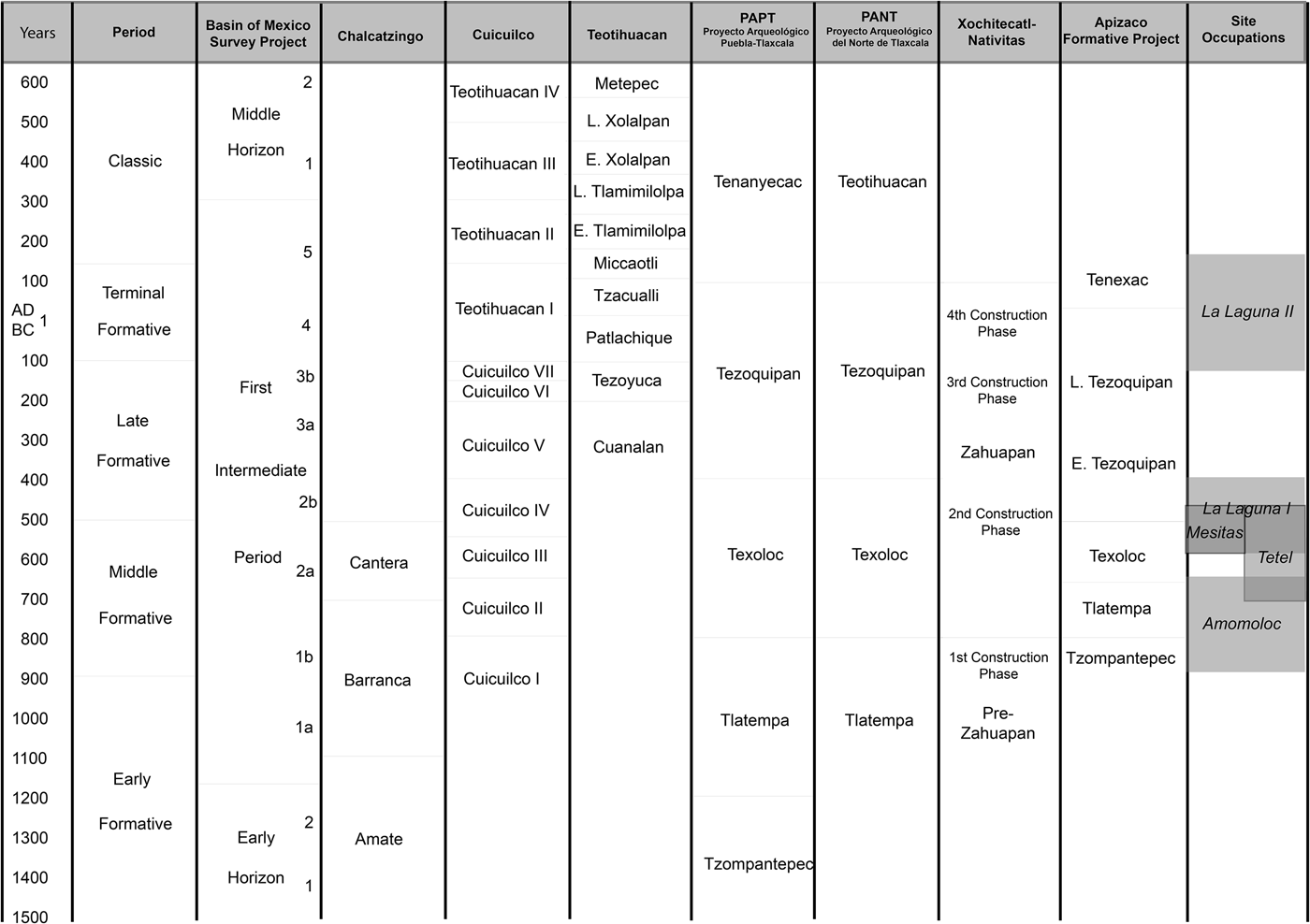
Investigations at four sites in central and northern Tlaxcala provide a diachronic sample of domestic assemblages including decorated ceramics and personal adornments for this particular subregion, but one with a significant gap in the chronological sequence (see contributions in Lesure, ed. Reference Lesure2014) (Figure 2). The site of Amomoloc is earliest (900–650 b.c.), followed by Tetel (750–500 b.c.), Mesitas (600–500 b.c.), and La Laguna—which has an early occupation (600–400 b.c.), a partial to near-complete abandonment (400–100 b.c.), and a second occupation squarely within the Terminal Formative period and terminating with another abandonment (100 b.c.–a.d. 150). The first three sites are therefore single-component whereas La Laguna has two sizable Formative occupations separated by a significant population contraction or hiatus, a complete abandonment during the Formative-Classic transition, followed by ephemeral reoccupations during later periods. Associated Formative period ceramic phases for the study region are Tzompantepec (900–800 b.c.), Tlatempa (800–650 b.c.), Texoloc (650–500 b.c.), Tezoquipan (500 b.c.–a.d. 50/100), and Tenexac (a.d. 50/100–150). La Laguna's cyclical occupation makes it difficult to pinpoint the transition from early to late Tezoquipan, and the subdivision of this long phase is needed. The abandonment following the site's second occupation truncates our sample of Tenexac materials, which surely extend later elsewhere. During the sixteenth century this area was inhabited by Nahuas and Otomis, with the former concentrated more to the south and the latter to the north (García Cook and Merino Carrión Reference García Cook, Carrión, García Cook and Carrión1997).
Comparative chronology for Formative and Classic period central Mexico drawing from the following sources: Grove (Reference Grove1987a); Lesure (ed. Reference Lesure2014); Merino Carrión (Reference Merino Carrión1989); Müller (Reference Müller1990); Rattray (Reference Rattray2001); Sanders et al. (Reference Sanders, Parsons and Santley1979); Serra Puche et al. (Reference Serra Puche, Arce and Mendoza2004).
The three earliest sites cover a few hectares and are classifiable as villages, with Mesitas perhaps something smaller such as a hamlet. Erosion is severe at all three (Borejsza et al. Reference Lesure, Borejsza, Carballo, Frederick, Popper and Wake2008), resulting in the absence of standing architecture. Although the deflated nature of the three village sites makes architectural comparisons of households impossible, subterranean pit-features provide relatively secure chronological contexts and their spatial distributions define different household units (J. Carballo Reference Carballo2011). Artifacts from these three sites were recovered as part of Lesure's Proyecto Formativo y Precerámico en la Región de Apizaco. The artifact densities we present are based on project excavations of 129 m3 at Amomoloc, 39 m3 at Tetel, and 52 m3 at Mesitas.
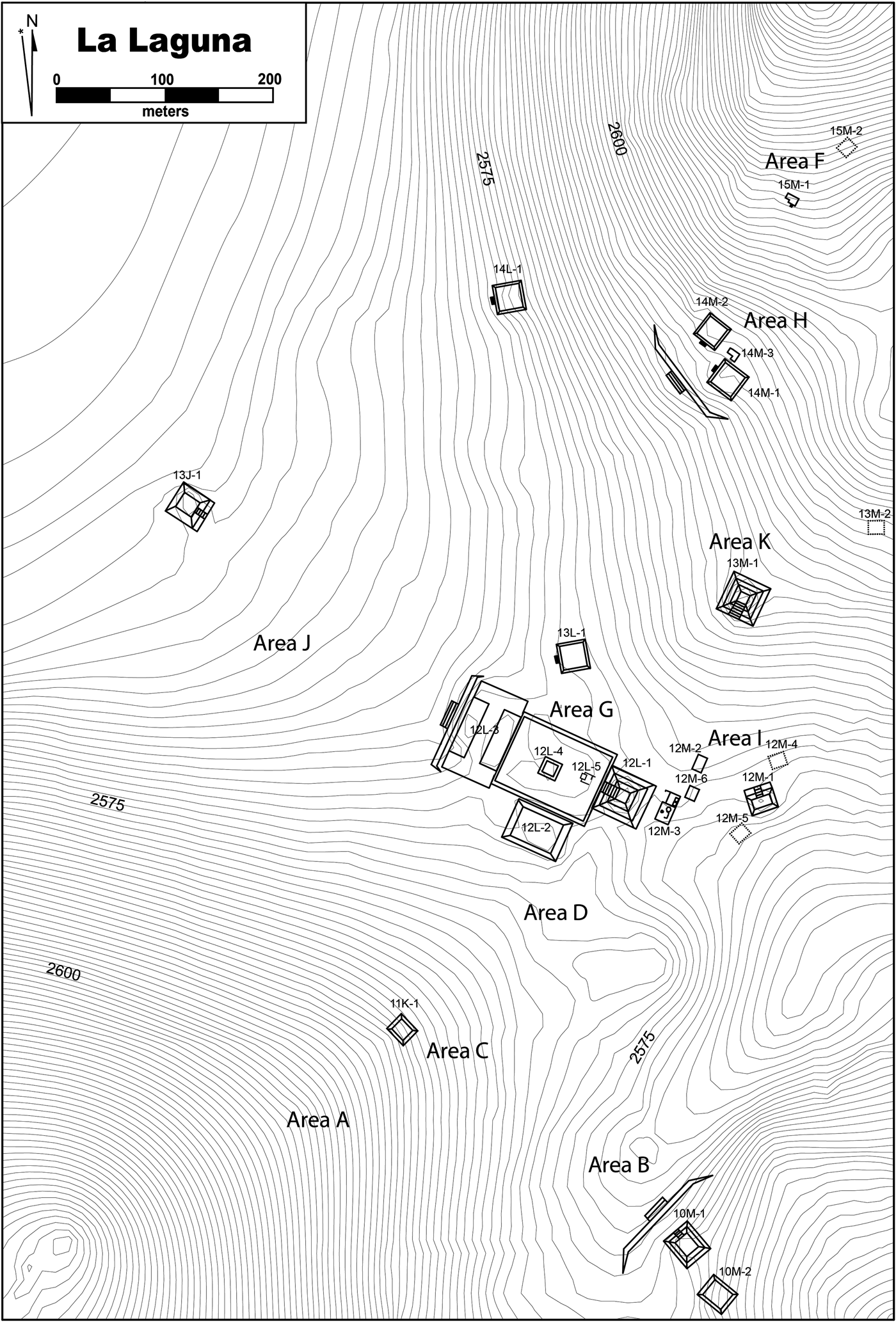
The distribution of Texoloc and early Tezoquipan phase ceramics at La Laguna indicate that the site was several orders of magnitude larger than the villages during its first occupation and covered approximately 100 ha or a square kilometer during its later occupation during the late Tezoquipan and Tenexac phases (Figure 3). Artifacts we discuss from La Laguna were recovered as part of David Carballo's Proyecto Arqueológico La Laguna (PALL), which comprised 612 m3 of excavation.Footnote 1 Like their contemporaries, the early occupants of La Laguna deposited domestic refuse in subterranean pits, but little architecture can be reliably dated to this period. Early dates from the initial construction phases of one of the central temple-platforms at the site (Structure 12M-1) may suggest that the structure began as a domestic platform during the early occupation, and the site's ballcourt (Structure 12 L-3) appears to have been constructed earlier in the occupation sequence (Carballo Reference Carballo2012), but all structures considered here date to the later occupation. The better preservation and larger size of structures at La Laguna permitted excavation of domestic architecture in five separate areas and the excavation of ceremonial structures within the site center. Yet the later occupants residing in these structures ceased the archaeologically useful practice of burying their trash in subterranean pits, usually redepositing it combined with earlier materials within construction fill instead. We therefore must rely more heavily on deposits from living surfaces from three of the excavated late domestic contexts (Areas F, H, and I) with residential architecture, various degrees of chronological mixing, and select features such as burials and termination deposits.
La Laguna, showing excavation areas and structures visible on the surface or detected through excavation and remote sensing.
By comparing domestic assemblages from these four sites and their contemporaries we will examine diachronic and regional trends in personal adornment and decorated ceramics. For La Laguna we also draw comparisons between the most secure early and late deposits (pit features in sterile tepetate substrate versus upper living surfaces and other features) and between domestic areas and spaces for public ceremonies. We emphasize three domestic contexts in particular. Areas of the site associated with a large and elaborate residential complex (Area H, including Structures 14M-1, 14M-2, and 14M-3) and a small and modest residential platform (Area F, including Structure 15M-1) both have early and late occupations in which materials from the architecturally invisible early occupation were incorporated into the construction and pit contexts of the later occupation. The residential structures in both areas date to the second occupation, beginning in the first century b.c., but Structure 15M-1 appears to have been abandoned in the first century a.d., while the Structure 14M-1 complex was abandoned one or two generations later during the second century (see Carballo Reference Carballo2009). Chronological mixing and overlap therefore pose potential problems, but the occupations were generally contemporaneous and excavations in these areas and elsewhere at the site indicate that greater indices of higher status are concentrated near the site center during both the early and late occupations. The Eastern Plaza (Area I) is a central area that served a mix of residential and ceremonial functions, with more evidence of residential activities during the early occupation and of community-level activities during the later occupation. Samples were obtained from early pits in tepetate and the features and living surface of one extensively excavated structure (Structure 12M-3) that dates to the second occupation and was associated with supra-household food storage and preparation (Carballo et al. Reference Carballo, Barba, Ortíz, Blancas, Cingolani, Barrera, Walton, Rodríguez López and Couoh2014a).
STYLE AND CONSUMPTION VIEWED THROUGH CERAMIC VESSELS
Stylistic expression through ceramic vessels used in daily and special-occasion consumption activities was a shared practice of all households in Formative period central Mexico, as decorated pottery sherds are recovered in every domestic context, regardless of chronological phase or household status. We consider the ceramic assemblages from all four sites in our study area to examine the importance of decorated pottery as a medium for the expression of identity, and how that expression changed over the course of a millennium (see Lesure et al. Reference Lesure, Carballo, Carballo, Borejsza, Rodríguez López and Lesure2014a:Table 11.4, Reference Lesure and Lesure2014b:Tables 9.1 and 9.2). The data reveal a decrease in the use of decorated pottery over time, as well as a simplification in the designs depicted on serving vessels, associated with the development of more and larger settlements around 650 b.c., and coinciding with the increased use of personal adornment in northern and central Tlaxcala, to be discussed later.
Decorated pottery intended for the presentation of food at events involving groups of people tend to be more visible than cooking pots or storage vessels, and it is likely that the styles exhibited on these vessels were used actively by artisans to express and negotiate their individual identities as well as group affiliations. For example, highly visible aspects of ceramics including vessel shape and color have been associated with the communication of regional identity among modern Tarascan potters (Hardin Reference Hardin and Washburn1983:10), and Hegmon and Kulow (Reference Hegmon and Kulow2005) suggest that decorative painting on Mimbres pottery was a form of agency, which could operate along a spectrum from novelty to conformity within the structuring confines of particular material-culture traditions. Numerous studies have illustrated the variety of social, economic, and political dynamics at play in the production and consumption of food, including wealth, status, gender, and ethnicity, among other axes of variability (for example, Blitz Reference Blitz1993; Brumfiel Reference Brumfiel, Johansen and Bauer2011; Dietler and Hayden Reference Dietler and Hayden2001; Mills Reference Mills2004; Mintz Reference Mintz1985; Pollock Reference Pollock1983; Twiss Reference Twiss2007; Welch and Scarry Reference Welch and Scarry1995). Differences in the proportion of serving vessels relative to the number of cooking vessels at Amomoloc, Tetel, Mesitas, and La Laguna may indicate a greater emphasis on food presentation by some households or in certain areas of the sites, and provide insight into the importance of decorated pottery as a medium for the expression of various identities across time and space.
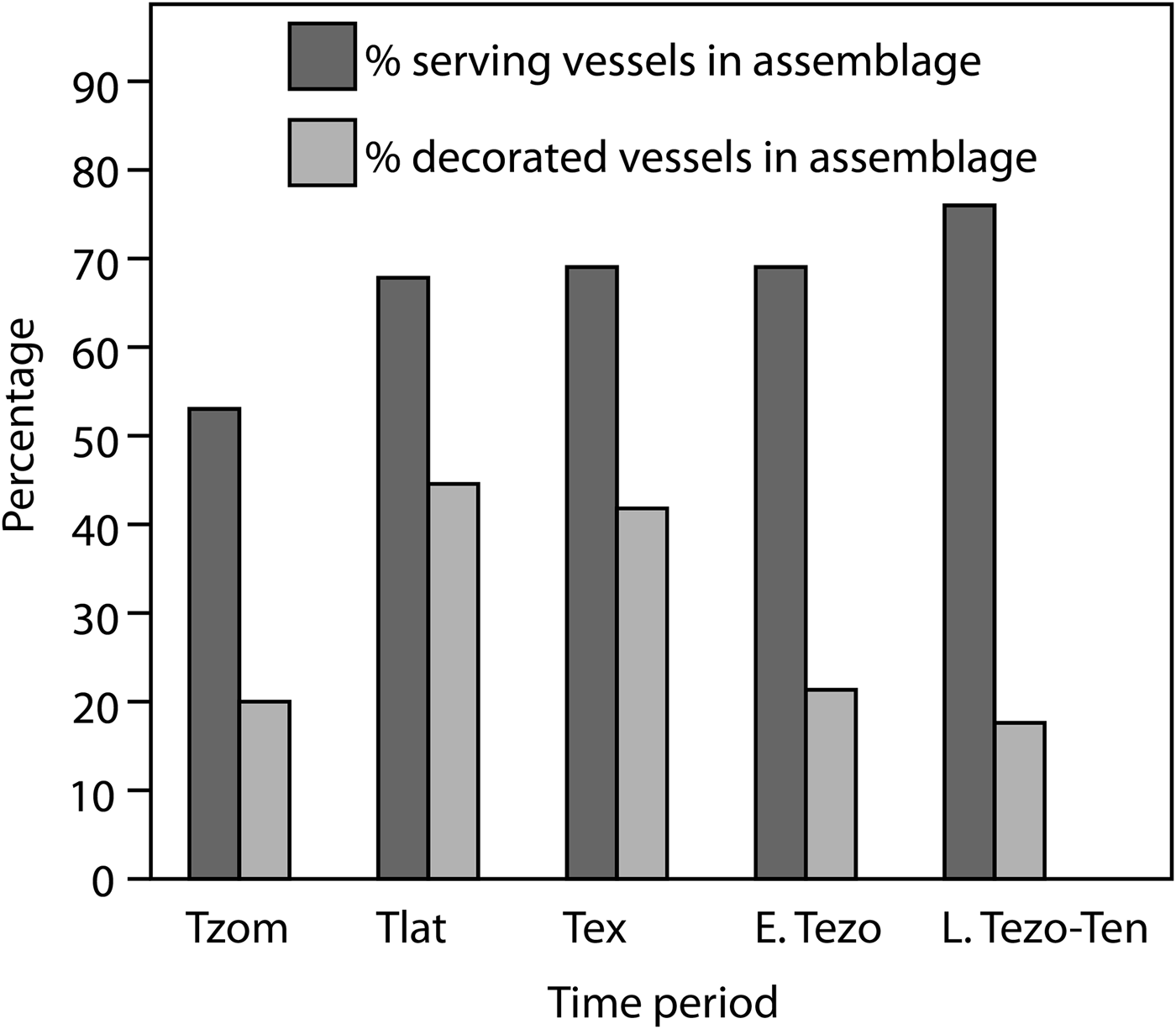
Examining the ceramic data from chronologically secure contexts at each of the sites over the sequence, the proportion of serving vessels to cooking and storage vessels grew steadily over time, from about 53% of the assemblage in the Tzompantepec phase to 75% in the Tenexac phase, indicating that the presentation of food was an increasingly important aspect of household consumption during the Formative period in Tlaxcala (Figure 4). In contrast, the percentage of decorated vessels reached its highest level early in the sequence, during the Tlatempa phase (44%), and then decreased substantially in the following phases, to below 20% by the Tenexac phase.
Percentages of serving and decorated vessels in assemblage by ceramic phase with all four sites from Tlaxcala grouped. Note the general increase in proportion of serving wares with corresponding decrease in decoration. Includes data from Lesure et al. (Reference Lesure, Carballo, Carballo, Borejsza, Rodríguez López and Lesure2014a:Table 11.4, Reference Lesure, Rodríguez López, Borejsza, Carballo, Carballo and Lesure2014b:Table 9.1).
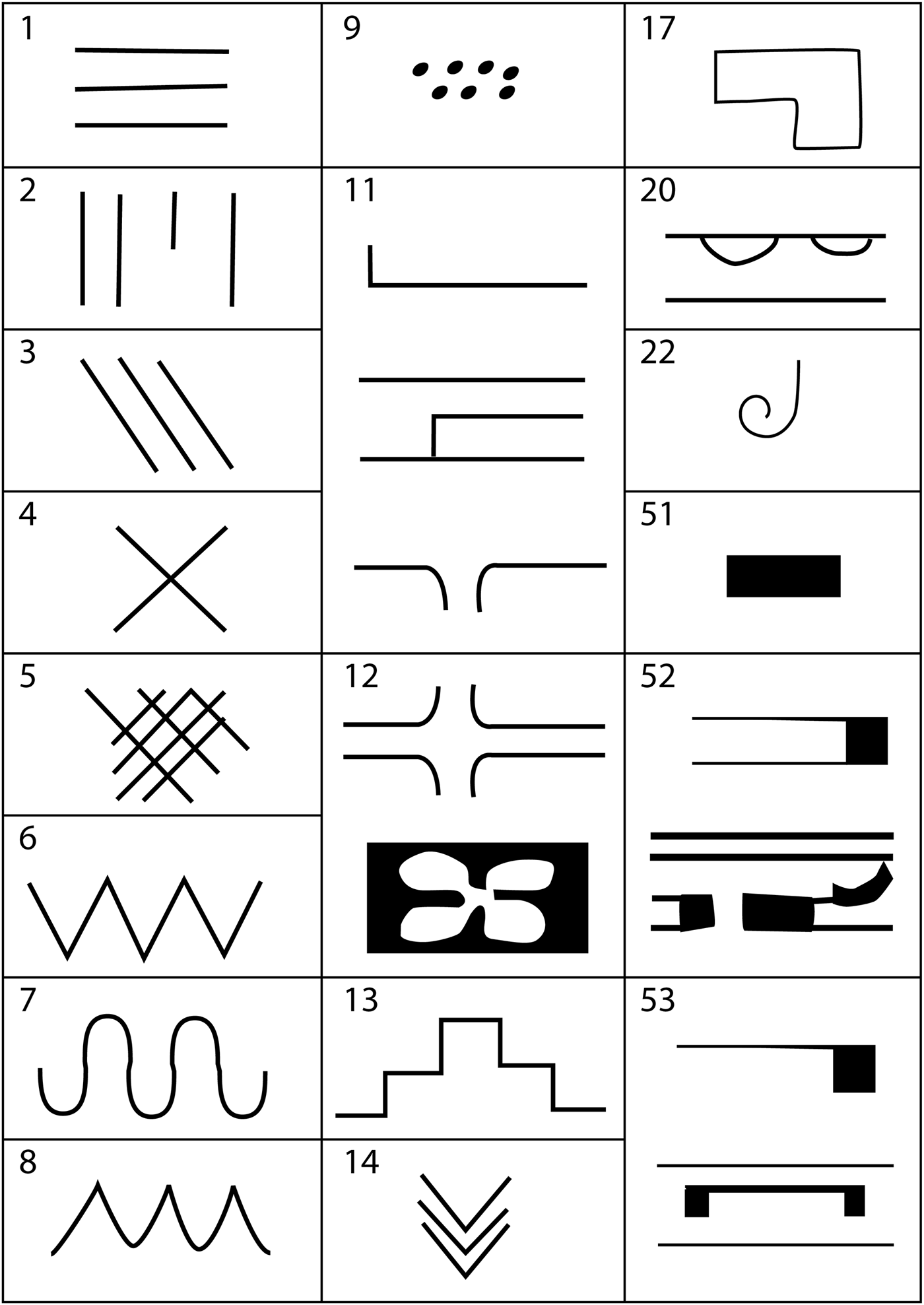
This decrease in decorated serving vessels is accompanied by the disappearance of the more elaborate design motifs of the Tlatempa phase white wares (Figure 5), and a decrease in the overall diversity of design motifs depicted on serving vessels. General motifs in the Tzompantepec through Tenexac assemblages of our Tlaxcalan sample are presented in Figure 6 (for detailed illustrations of design motifs and descriptions of pottery types see J. Carballo [Reference Carballo2011] and Lesure et al. [Reference Lesure, Papadopolus and Urton2012, Reference Lesure, Carballo, Carballo, Borejsza, Rodríguez López and Lesure2014a, Reference Lesure, Rodríguez López, Borejsza, Carballo, Carballo and Lesure2014b]). The most common design (Design Code 1) is the presence of one to four horizontal, parallel lines (incised, grooved, or excised) that typically run along the rims of vessels and often serve to connect other, more elaborate design motifs on vessels, but our focus is on motifs involving more than just simple horizontal lines.
Reconstructed pottery from Amomoloc (top) and La Laguna (center, bottom) based on complete and semi-complete vessels. Incised white wares (top) are typical serving vessels of the Tlatempa and Texoloc phases, which change during the Tezoquipan (center) and Tenexac (bottom) phases. Illustrations by Pedro Cahuantzi Hernández.
Common design motifs from Amomoloc, Tetel, Mesitas, and La Laguna. Modified from Lesure et al. (Reference Lesure, Rodríguez López, Borejsza, Carballo, Carballo and Lesure2014b:Figure 9.2). Note: design codes are numbered and referenced in Figure 7.
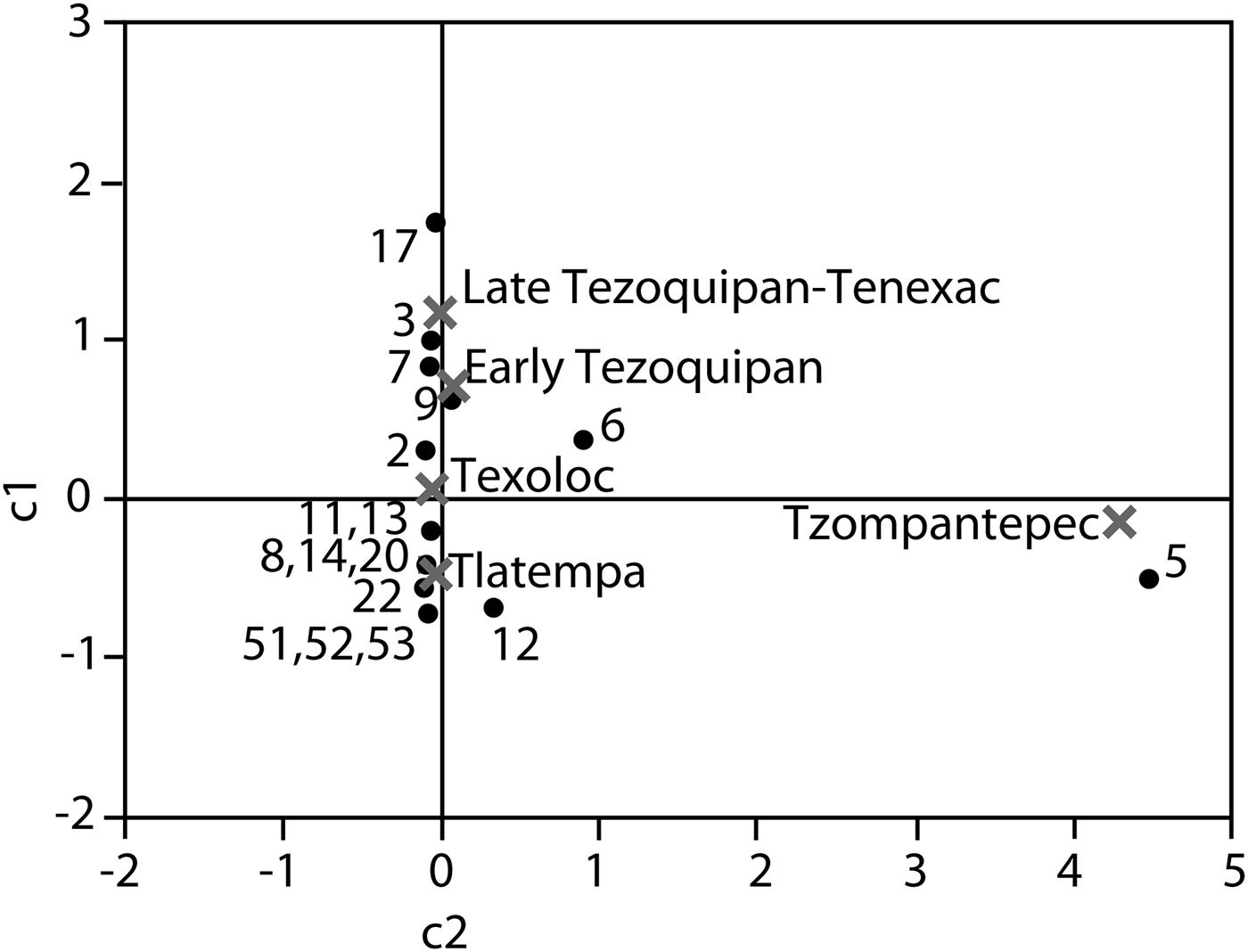
Correspondence analysis was used to elucidate patterning in the use of design motifs, since it is well suited to non-numeric data, such as counts or presence/absence data, and its graphic display of variability in the patterning of data can be useful for capturing change over time (for detailed explanations of correspondence analysis see Madsen [Reference Madsen and Madsen1988], Shennan [Reference Shennan1997:308–341], and Smith and Neiman [Reference Smith and Neiman2007:239–240]). Figure 7 depicts the clustering of 10 different motifs with the Tlatempa phase, while only one motif was strongly associated with the earliest Tzompantepec phase and six motifs with the latest three phases together (Texoloc through Tenexac phases). The individual motifs corresponding with the Tlatempa design codes are also the most variable. Within Design Code 11, the classic double-line-break of the Middle Formative and the most common motif depicted on Tlatempa pottery, there are dozens of variations on the line-break theme (see Lesure et al. Reference Lesure, Carballo, Carballo and Harrison-Buck2012:Figure 3.10), while the motifs common in the Texoloc to Tenexac phases, such as the undulating lines of Design Code 7, have few possible variations.
First two principal axes plot of the correspondence analysis of the counts of design motifs by ceramic phase. The numbers refer to the Design Codes in Figure 6.
These analyses indicate that although the serving of food in vessel forms designed for such purposes (for example, dishes and bowls) continued to be important for households of the later Formative period, domestic pottery became a less important medium for the expression of identity through the variety of design motifs seen in earlier phases. This decrease in stylistic expression through decorated pottery coincides with an increase in expression through personal adornment. We turn to these materials from Formative period contexts next, after first examining social dynamics of personal adornment from ethnohistoric contexts in central Mexico.
STYLE IN CENTRAL MEXICAN ADORNMENT
Portable forms of personal adornment serve in varied cultural and historical contexts to elaborate upon the physical self in daily performances of dimensions of identity such as age, gender, status, and kin or cultural affiliation (Hodder Reference Hodder1977; Joyce Reference Joyce2000; White and Beaudry Reference White, Beaudry, Majewski and Gaimster2009). Colonial period central Mexican documents provide valuable information concerning practices of adornment and the complex mix of class signaling and sumptuary laws, cultural/ethnic identification, age and gender roles, and commodification and market purchasing power that contributed to why any particular individual might wear any particular form of adornment (Brumfiel Reference Brumfiel, Brumfiel and Fox1994; Joyce Reference Joyce2000; Rounds Reference Rounds1979; Smith Reference Smith, Smith and Berdan2003). Although multiple sources state that forms of dress and adornment became increasingly regulated by sumptuary laws with the consolidation of the Aztec empire, certain laws or norms suggested in texts may have not been followed in practice, particularly outside of imperial capitals or political boundaries (Berdan and Anawalt Reference Berdan and Anawalt1997:188). Justyna Olko (Reference Olko2005) presents a thorough review of Aztec adornment that includes a detailed database compiling the appearance of various types and raw materials referenced within textual sources or depicted within pictorial ones. Items of nonperishable adornment that seem most likely to have been restricted to the nobility during the Postclassic period include diadems, large nose rings, and labrets made of scarce materials such as gold and turquoise. Yet none of these were present during the Formative period, which is our focus.
Common Postclassic adornments inserted in earlobes or strung around the neck, wrists, or hips were also present during the Formative period and are preserved at sites throughout central Mexico. We will refer to ear adornments using the following definitions: earplugs are solid; earspools are hollow or ring-like; and earflares are earspools that flare out significantly on the forward-facing side. Since there is no standardized way of classifying ear adornments in the literature, we take the liberty of using this classification for simplicity. Many authors differentiate earplugs and earspools from earflares, but tend to qualify the former two as being solid (what we are calling earplugs) or hollow, tubular, ring-like, etc. (what we are calling earspools).
For strung adornments we deal primarily with beads of uncertain positioning on the body, though we assume that other pieces with attributes of pendants or pectorals were hung from the neck. Textual sources provide a jumping off point for our study, and a passage referring to the Otomi in Book 10 of de Sahagún's (Reference Sahagún, Dibble and Anderson1961) Florentine Codex is particularly informative. It indicates that ear adornments made of polished obsidian, ceramic, and perishable materials were available to Otomi commoners and suggests the following status gradations in adornment styles:
The lip plugs of the rulers were green stone lip plugs, or sea shell lip plugs, or gold lip plugs. And also the ear plugs of the brave men, the brave warriors, were gold ear plugs or copper ear plugs, or sea shell ear plugs, or mirror stone ear plugs, or turquoise [mosaic] ear plugs. The lip plugs of all the [other] people were of rock crystal, obsidian, or smoky stone, and their ear plugs were of obsidian or smoky stone, or those known as stalactites, green ones resembling turquoise, or ear plugs made of black beetles, or pottery ear plugs. And furthermore, at last came their ear plugs of dried maize stalks or reed ear plugs. (de Sahagún Reference Sahagún, Dibble and Anderson1961:177−178)
The passage highlights the range of materials used for adornment during the Postclassic period and the pervasiveness of ear perforation, at least among the Otomi, to the point that some individuals fashioned simple adornments from vegetation. Consistent with the passage, the production of polished obsidian earspools has been archaeologically documented at the Otomi city of Otumba, where the use of such adornments and their ceramic counterparts does not appear to have been restricted by social status (Charlton Reference Charlton, Hodge and Smith1994; Charlton et al. Reference Charlton, Charlton, Nichols, Santley and Hirth1993; Nichols Reference Nichols, Hirth and Pillsbury2013). The significantly higher occurrence in colonial documents of ear adornments incorporating gold and turquoise relative to those made of greenstone, obsidian, ceramic, or other more readily available materials (Olko Reference Olko2005: 162–167) suggests that gold and turquoise adornments were more noteworthy to scribes and likely reflect the upper reaches of a status gradation. Less clear is whether jade adornments were commercially available to anyone who had the means to acquire them in the marketplace. Some varieties of greenstone are said to index noble status in Book 11 of the Florentine Codex (de Sahagún Reference Sahagún, Dibble and Anderson1963:221–226); yet the discussion of merchants in Book 10 (de Sahagún Reference Sahagún, Dibble and Anderson1961:60–61), and Cortés' (Reference Cortés and Padgen1986:103) description of the Tlatelolco market in his second letter, make greenstone and even gold adornments seem commoditized. Further, the documentation of lapidary adornment production within commoner households at Teotihuacan (Widmer Reference Widmer1991) and Xochitecatl-Nativitas (Hirth et al. Reference Hirth, Puche, Arce, León and Hirth2009) is suggestive of domestic economies with little if any institutional oversight for certain classes of lapidary goods during the Classic and Formative periods. The important point for our purposes is that a Postclassic precedent exists for a range of variability in the materials used for fabricating adornments that is somewhat connected to social status or class.
Other dimensions of identity such as occupation and age were also signaled and negotiated through adornment in the Postclassic period. As with ear adornments, varieties of necklaces and pectorals registered in textual and pictorial sources emphasize the fanciest examples and associate them with rulers or nobility (Olko Reference Olko2005:175–181). An exception to this pattern are the neck adornments of high-ranking warriors—many of whom likely achieved their status—including a frequently mentioned necklace of strung snail shells, the chipolcozcatl (Olko Reference Olko2005:177). Joyce (Reference Joyce2000) has discussed the ceremony of Izcalli, dedicated to the fire deities Xiuhtecutli and Milintoc, as an example of an Aztec lifecycle ritual that included the initial perforation of the earlobes of eight-year-old boys and girls, as described in Book 2 of the Florentine Codex (de Sahagún Reference Sahagún, Dibble and Anderson1981:164). She (Joyce Reference Joyce2000:477) notes that, “[c]hildren who experienced the Izcalli ritual together were introduced to the repertoire of actions that would characterize all their later participation in religion: singing, dancing, ceremonial drinking and shedding sacrificial blood. They also began the process of expanding a perforation in the ear lobe to eventually allow use of adult ear ornaments.”
The fact that earplugs and earspools require the act of perforation and the gradual stretching of the lobe in order to accommodate larger adornments aligns them particularly well with the physical demarcation of one's stage in the lifecycle and associated social roles. In the case of the Izcalli ritual there does not appear to have been significant variation in how the earlobes of children of different genders were perforated; age was the central structuring principle. Yet based on a reanalysis of mortuary data from Tlatilco, Joyce (Reference Joyce, Grove and Joyce1999) emphasizes the long tradition of ear adornment in central Mexico and the possibility of variable forms of identification during the Formative period relative to the Postclassic period, with style communicating other dimensions of identity such as gender. We follow her lead in keeping multiple possibilities of identification through style on the table and in working back in time from insights gleaned from colonial documents to our Formative assemblages.
Formative Period Personal Adornment
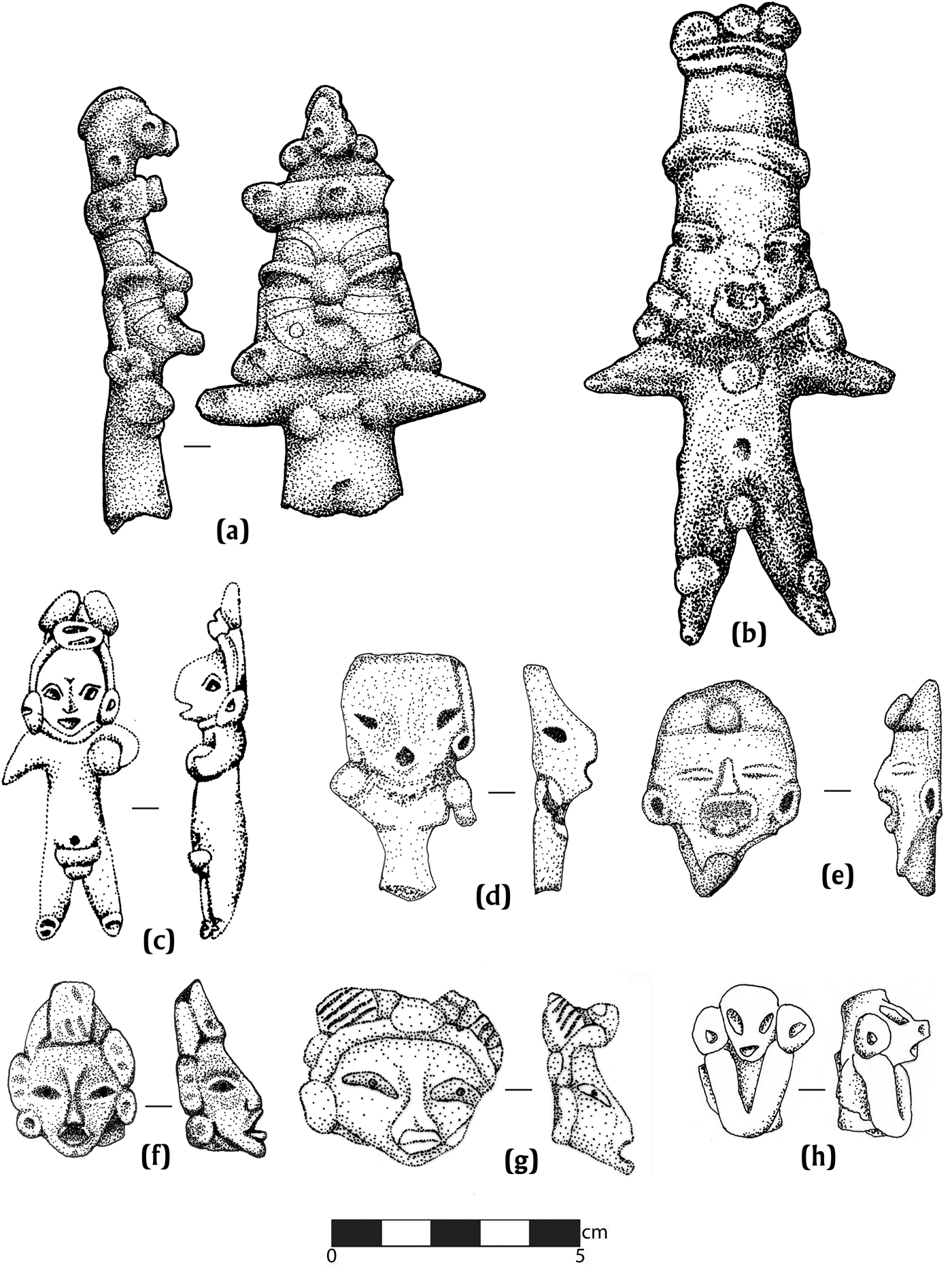
Lacking the textual detail of ethnohistoric sources, norms of personal adornment for Formative period central Mexico are typically deduced through artifact assemblages, archaeological context, and iconographic representations of people, particularly seen in clay figurines. The latter demonstrate the importance of durable artifact types we discuss here to decorating the body, but also that we are often missing important forms of adornment such as headdresses composed of fabric, feathers, and/or paper, other articles of clothing, and body paint or scarification (Figure 8). Based on formal and stylistic analyses of the figurines from Formative Tlaxcala and elsewhere in central Mexico, we perceive the relationship between imagery on the figurines and social reality to have been very loose (Lesure Reference Lesure, Papadopolus and Urton2012, Reference Lesure2015; Lesure et al. Reference Lesure, Carballo, Carballo and Harrison-Buck2012). Figurines do not appear to have conveyed what Formative period central Mexicans looked like in any but the most general sense.
Formative figurines from Tlaxcala. Top: Cuatlapanga type, Tlatempa phase (a combination of traits from types C1 and B in the Basin of Mexico), including (a) female with bird headdress, nose ornament, and pectoral, and (b) male with pendant. Middle: (c-d) Ehco type, Texoloc phase (links to type E2 in the Basin of Mexico), including (c) male ballplayer, (d) female; (e) Huehuetitla type, Tezoquipan phase (with an eye form that links to type G in the Basin of Mexico), unsexed individual with possible disc-mirror in headdress. Bottom: (f) Huehuetitla and (g) Huiloac (with generalized links to types G, I and L in the Basin of Mexico), (h) Terminal Formative, possible Teotihuacan 1 type. Note that all figurines likely wear ear adornments.
Their generic nature notwithstanding, figurines provide a perspective on what some idealized types of adorned individuals may have been during various phases of the Formative period and how this matches or diverges from artifact inventories. We base our discussion here on Lesure's (Reference Lesure and Lesure2014) analysis of 463 figurine heads from the four Tlaxcalan sites, 139 of which come from the secure chronological contexts that we use for temporal comparisons. Many of these correspond to types C, E, G, and H in the Basin of Mexico sequence (see Niederberger Reference Niederberger1976; Reyna Robles Reference Reyna Robles1971; Vaillant Reference Vaillant1930), but we have designated them with regional type names. Facial features were a sustained focal point for stylistic expression, which likely accounts for the fact that a large majority (82%) of individuals are depicted wearing ear adornments, and that headdresses were primary loci for stylistic variability. Ear adornments are observed on figurines identified as both female and male, and it is the unsexed category that has the largest proportion of examples without clear ear adornments. Very few (under 2%) of the ear adornments were rendered as a solid appliqué, which may indicate an earplug; the rest feature a punched hole suggestive of an earspool.
Figurines adorned with nose, chest, wrist, or ankle ornaments are relatively common in the Tlatempa phase and then drop precipitously beginning in the Texoloc phase. Chest adornments appear on 45% of late Tlatempa bodies, drop to 7% in the Texoloc phase, and never supersede that value for the remaining phases of the Formative period. Depictions of nose adornments follow a similar pattern. A potentially gendered difference in adornment of Tlatempa phase figurines is suggested in chest adornments, which are more common on males (75%) than females (42%), but the sample of identified males is small (n = 8, versus 50 identified females). Tlatempa phase females also wear nose adornments (32%). The decrease in bodily adornments, other than the ears, on figurines following the Tlatempa phase runs counter to the artifact record from our study area, which features an increase in lapidary ornaments that would have hung from people's bodies or have been incorporated into their headdresses (see Figure 8, center row, right). This change in plastic representation and the complete lack of actual ear adornments at the three village sites show an interesting disconnect between idealized personhood and the quotidian practices of households.
Ear Adornments
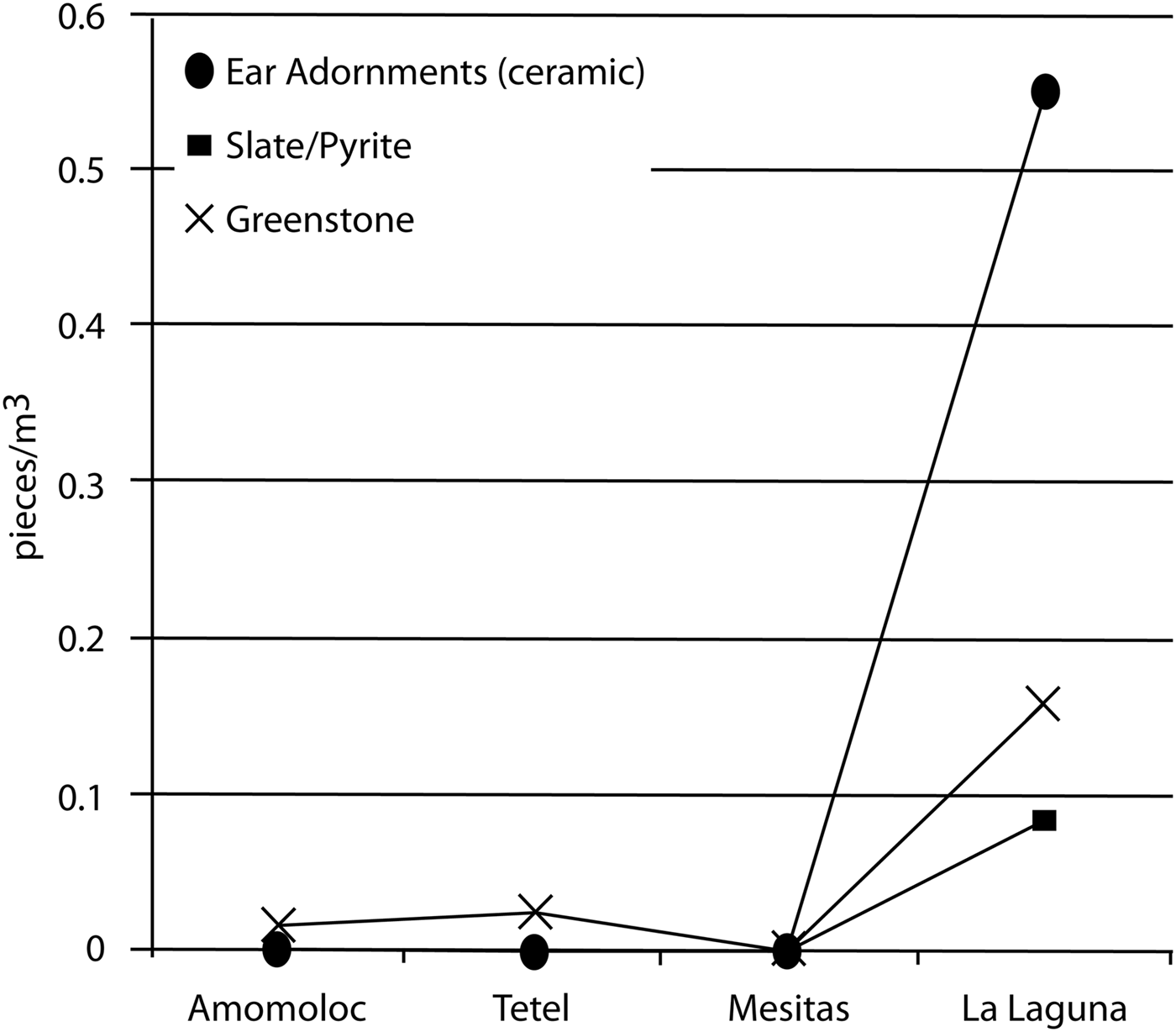
Ear adornments made of non-perishable materials such as ceramic or stone are one of the most archaeologically conspicuous forms of personal adornment found in Formative period central Mexican artifact assemblages. It is therefore surprising that no ceramic ear adornments were recovered from the three village sites, even though their inhabitants regularly decorated their figurines with them (Figure 9). Some inhabitants of the villages may have possessed ear adornments but, being rare possessions, these may have been heavily curated and infrequently deposited in archaeological contexts. At La Laguna, in contrast, ear adornments are registered from the earliest contexts, during occupation contemporaneous with Tetel and Mesitas. As was the case at other central Mexican sites, both ceramic earplugs and earspools at La Laguna could be decorated through slip, paint, and/or incising. Earspools offered other possibilities due to their thinness, including lattice-like cutouts (calada in the Spanish literature), and scalloping or extensions on the rim. Formal and stylistic attributes of ear adornments attesting to some levels of additional labor involved in making finer or more decorated pieces are typically understood by Mesoamericanists to relate to relative household status (see, for example, Love Reference Love and Fowler1991).
Ceramic ear adornments from La Laguna. Size gradations in (a) earplugs and (b) decorated earspools and earplugs.
Within our sample of 335 ceramic ear adornments from La Laguna several axes of variability are observable that might relate to dimensions of the identity of their owners, including age, gender, kinship, or status (Figure 10). Hollow earspools likely would have required greater skill in manufacture than earplugs because their thin walls would have been more difficult to form and more prone to breakage during firing. A consequence of this fineness is that earspools are over represented in relation to earplugs by over four times—the former have a mean completeness of 20% while the latter average 88%. If we correct for this depositional bias by reducing the number of earspool fragments proportionally to the largely complete earplugs we arrive at the conclusion that the inhabitants of La Laguna were wearing both types in relatively equal proportions, with perhaps a ratio on the order of 1.3:1 for earspools to earplugs. In addition to their thin walls, the paste of earspools is finer than for earplugs, yet we do not see the additional skill required for making earspools as prohibitive to households of lesser economic means. It is probable that any household with a resident potter or closely connected to one through extended household networks would have access to the clay and ability necessary for producing earspools. We therefore leave the relationship between type of ceramic ear adornment and social status as an open question to be examined further below. The three lapidary examples from La Laguna—one of jadeite and two of tecalli (onyx)—stand apart, however, in being made of nonlocal raw materials. This small subsample implies differential access to exchange networks likely associated with gradations in status.
Densities of adornments from the four sites, listed in general chronological order.
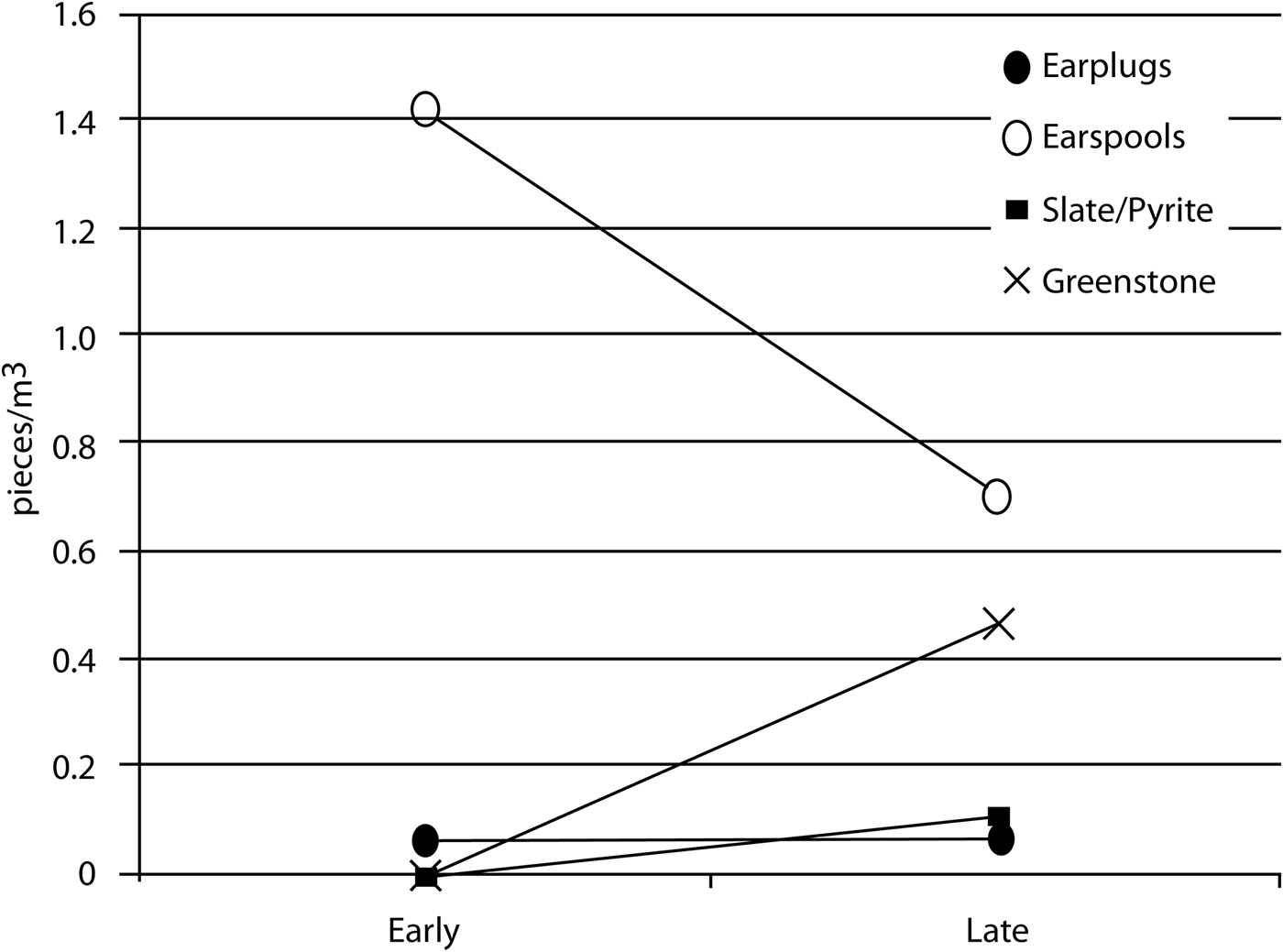
Published reports for Puebla-Tlaxcala by García Cook (Reference García Cook1976), for the Formative period occupation of the Teotihuacan Valley by Sanders et al. (Reference Sanders, West, Fletcher and Marino1975), and for Cuicuilco B by Müller (Reference Müller1990), help to contextualize ear adornments from La Laguna within a contemporaneous regional setting and with respect to the two growing urban cores of the period. García Cook's study remains one of the best synthetic treatments of ear adornments for Formative period central Mexico. It and other studies demonstrate the lack of consensus regarding whether frequencies of earspools and earplugs are chronologically significant. Most analysts who favor a chronological shift place earspools earlier and earplugs later, but solid plugs were recovered in secure Middle Formative contexts at Chalcatzingo (Grove Reference Grove and Grove1987b). The decrease in density of earspools by half at La Laguna between the secure early occupation and final occupation may represent a significant change (Figure 11). Nevertheless, earplug densities remain similar between the two chronological contexts and it is also possible that earspools are overrepresented in early contexts due to the relatively low excavation volume of secure early deposits—16 m3 for early contexts versus 91 m3 for late contexts. We are in agreement with García Cook (Reference García Cook1976) that earspools were relatively more abundant earlier in Tlaxcala, yet there was not the replacement of one type for the other later during the Formative period. Notable in this regard is the fact that the ratio of earspools to earplugs from late deposits at the 14M elite complex is roughly double that of Structure 15M-1 (approximately 4:1 and 2:1, respectively) even though the occupation of the elite complex extended some 50–100 years later than the common residence.
Densities of adornments within secure early and late occupation contexts at La Laguna.
The difference in the earspool to earplug ratios of the presumed elite and commoner household assemblages does appear to relate to subtle gradations in social status. Another supporting line of evidence is that the three lapidary ear adornments from La Laguna were all made with a greater investment of labor from nonlocal jadeite and teccalli as earspools. It is possible then that these status markers are the idealized type depicted almost exclusively in Formative figurines. Another association between earspools and a higher end of a status gradation at La Laguna is the fact that they are more frequently decorated than earplugs: 12% involve plastic techniques such as incision, punctation, and lattice-like cutouts of centers, while another 13% have bichrome slip or painted surfaces, compared with 8% plastic decorations for earplugs and exclusively monochrome surface treatments. Earspools with the most elaborate decoration of lattice-like cutouts are spatially restricted to contexts in the center of the site, at Structures 12M-1, 12M-3, and 13M-1. Accordingly, earspools at La Laguna may be termed more elaborate and expressive than earplugs, and this expression likely coincided with conceptualizations of social status.
In comparative terms, La Laguna's ratio of over 5:1 in favor of earspool fragments relative to earplug fragments, uncorrected for completeness, is much greater than other published inventories. García Cook (Reference García Cook1976) reports an even 1:1 ratio at site T-288 from the Proyecto Arqueológico Puebla-Tlaxcala and a skew in the opposite direction of 5:1 or more earplugs to earspools at Tlalancaleca and Gualupita las Dalias. The latter site is of a similar size to La Laguna whereas Tlalancaleca is several times larger. Since these sites were general contemporaries and all likely possessed rank differences among households, the discrepancy may be due to sample bias—the median earspool fragment from La Laguna is only 17% complete—or due to some form of ethnic or other cultural identification. Yet a ratio just shy of 5:1 in favor of earplugs is also reported from Cuanalan (Sanders et al. Reference Sanders, West, Fletcher and Marino1975:106; see also Manzanilla Reference Manzanilla, Monjarás-Ruiz, Brambila and Pérez-Rocha1985) and one closer to 1:1 is reported from Chalcatzingo (Grove Reference Grove and Grove1987b:Table 16.1), so it is also possible that the inhabitants of La Laguna were exceptional in their affinity for thin, hollow earspools.
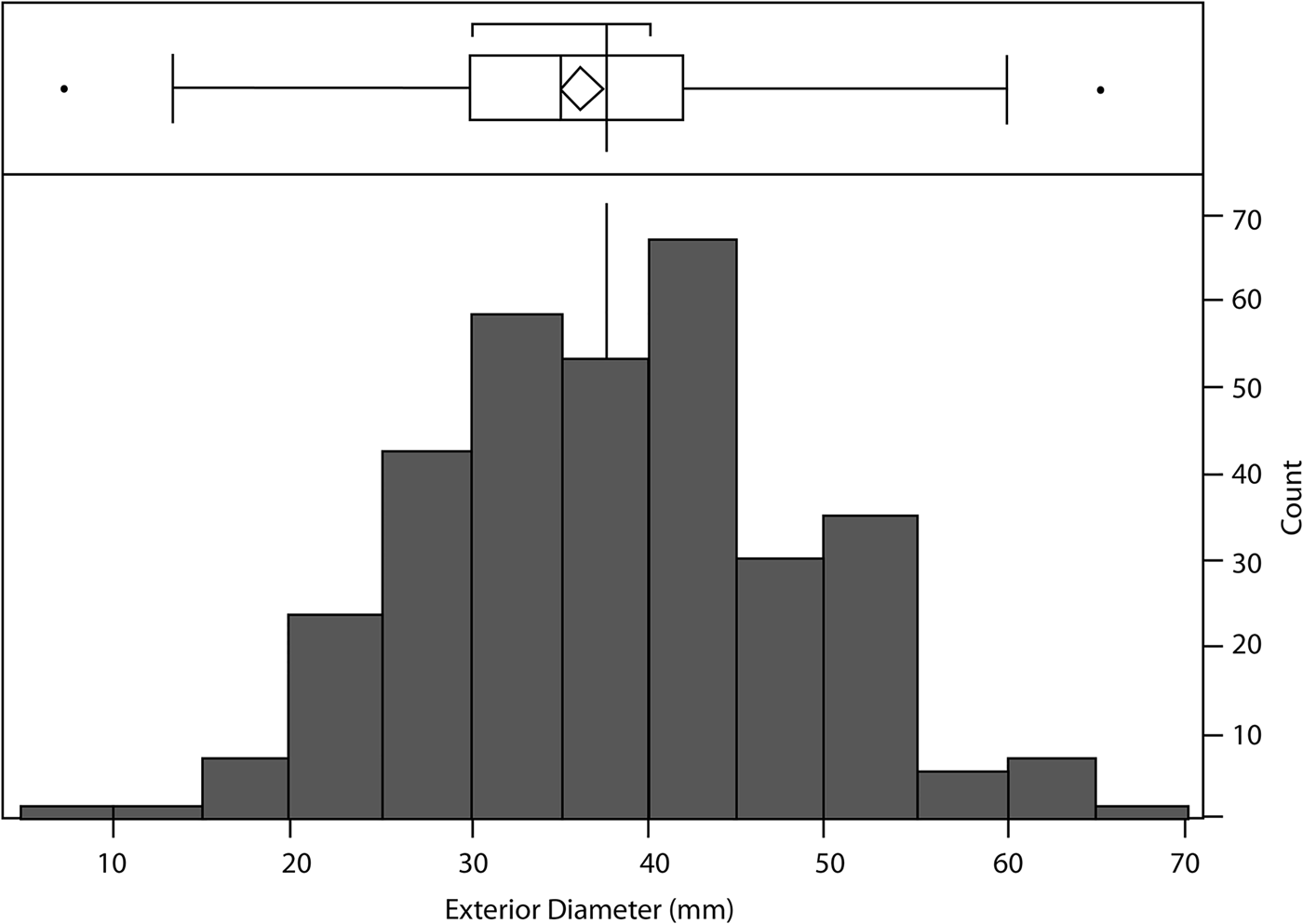
Size represents another important axis of variability in ear adornments, and in this case the normal distribution observed in samples from La Laguna indicates that age, or time spent wearing ear adornments, is the primary structuring variable (Figure 12). Like Sanders and colleagues (Reference Sanders, West, Fletcher and Marino1975) noted for later Formative period sites in the Teotihuacan Valley, Cuanalan and Tezoyuca, the bell-curve size distribution in ear adornments for La Laguna matches what one would expect if individuals first pierced their ears in youth and continued to gradually expand the lobes throughout their lifetimes. Except for underrepresentation at younger age grades, it matches an expected demographic curve and mirrors the regional pattern documented by García Cook (Reference García Cook1976:Figure 1) based on surface collections and excavations at four other Formative period sites within Tlaxcala. The smallest earplug recovered at La Laguna originated from the final living surface of Structure 12M-3 and possesses a diameter of only 7 mm (Figure 9a). We agree with Müller's (Reference Müller1990:198–199, Lámina 52) classification of these artifacts as very small earplugs rather than their classification by Sanders and colleagues as small labrets, because their tubular form would have caused them to slip easily into the mouth as a labret, which move much more frequently than ear adornments; slipping would have been prevented by the forms with flared ends that these authors illustrate on the same plate (Sanders et al. Reference Sanders, West, Fletcher and Marino1975:105, 407, Plate 89 n–p). Such miniature earplugs would then represent the first formal ear adornment for the youngest eligible age grade within the community. Part of the relative underrepresentation of small earplugs if they follow an expected demographic distribution is that their small size has biased recovery; another might be that a perishable lobe expander, such as a maguey thorn, was used until the hole was expanded to the diameter of a more typical size.
Distribution of ear adornment size from all contexts at La Laguna.
Once an initial aperture in the lobe was established, several lines of evidence suggest that individuals at an earlier stage of expanding their lobes, whether due to age or initiate status, more frequently wore earplugs than earspools at La Laguna. Of the nine examples measuring 20 mm in diameter or less, seven (78%) are earplugs; for those 25 mm or less the proportion of earplugs drops to 44% (14 of 32), which is still significantly more than the 14% of the full sample that are earplugs. If we add the completeness correction to get a minimum-number-of-individuals approximation, earplugs would have outnumbered earspools at La Laguna on the order of 3.5:1 in lower size grades. Mean diameters of ear adornments are also illustrative in demonstrating a positive correlation between size and decoration. The mean diameter of decorated earplugs is a full 10 mm higher than the mean for undecorated earplugs (38.5 mm to 28.5 mm, respectively), and the most elaborate, lattice-like earspools are the largest (mean = 45.8 mm). Together these patterns suggest that earlier-stage wearers, who were possibly younger, wore simpler ear adornments than later-stage wearers, who were possibly older. For all individuals, the decision or imposition to use such ear adornments would have been a permanent statement of identity since, like with adornment through cranial deformation or tooth modification, the process was irreversible as earlobes stretched to such sizes do not close up again.
Diversity within secure household assemblages of ear adornments at La Laguna is discernible but subtle. Looking either at cumulative contexts from excavation areas at the site, of mixed chronology, or only those most closely associated with residential structures, but of smaller sample size, there is a perceptible tendency for larger ear adornments in Area H and its more elaborate structures (mean = 36.5 mm and 36.7 mm, respectively) than for Area F and its more humble house construction (mean = 33.2 mm and 33.5 mm, respectively). The ratio of earspools to earplugs is also greater in Area H (4.2:1) than in Area F (2.3:1), but in reducing the sample to secure contexts most directly associated with the structures that trend does not hold (2:1 for Complex 14M and 3:1 for Structure 15M-1; however, with only 6 and 4 examples represented, respectively).
Fragments of ear adornments were recovered from the fill of four of the 14 burials excavated by the PALL, which could be used to evaluate the relationship between adornment and individual identity. Two of these contained only a single fragment or two small fragments not in direct association with the body and do not deserve consideration as part of a purposeful association as a mortuary deposit. A third contained nine earspool fragments recovered in the stratigraphic layer directly above the bundled remains of a mature adult male buried outside of Structure 12M-2, in the site center, but none were in direct association with the remains and the largest specimen is only 40% complete. Yet a fourth burial did contain a single complete earplug in direct association with an older woman (estimated at between 48–66 years old at the time of death) buried in the top of a pit within Structure 12M-3. Based on a worn facet on her one preserved patella, indicative of considerable time spent kneeling, and multiple lines of evidence of supra-household scale food activities in the structure, we interpret this woman as someone closely involved in centralized food production activities (Carballo et al. Reference Carballo, Barba, Ortíz, Blancas, Cingolani, Barrera, Walton, Rodríguez López and Couoh2014a). Though it was only a single white earplug, rather than a matching pair, its completeness could suggest it was this woman's personal possession; yet its small size (20 mm) would be inconsistent with her advanced age.
Variability in ear adornment relating to chronology and community size is therefore suggested by a broad perspective of all four Tlaxcalan sites for the Formative sequence, and size distributions from La Laguna suggest usage as part of individual lifecycles with increasing elaboration of decoration during the lifespan of an individual. When examined at the level of individual households, however, our data suggest only subtle differences in this form of adornment and are insufficient to satisfactorily address other issues relating to individual and household identity.
Beads and Pendants
Lapidary adornments in Formative period central Mexico most commonly included beads and pendants made of greenstone (Figure 13) and disc-mirrors made of slate covered on one side by pyrite, with perforations indicating some use as adornment. Socially valued adornments were also made from shell, and spatial and temporal variability in all materials is readily apparent. At the four sites we investigated no slate-pyrite mirrors or shell artifacts were recovered from the three small villages but they were from La Laguna (Figure 14). Two greenstone beads were recovered from a single pit feature at Amomoloc, giving a density of .016 pieces/m3 for operations at the site as a whole (Lesure et al. Reference Lesure, Wake, Borejsza, Carballo, Carballo, Rodríguez López and Guzmán2013:234). Depending on what types of greenstone are included, this is roughly two to three times lower than for non-offering deposits at contemporary Chalcatzingo (Lesure Reference Lesure and Robb1999:Table 3-1, based on Grove and Cyphers [Reference Grove, Guillén and Grove1987:Table 4.1], Merry de Morales [Reference Merry de Morales and Grove1987], and Thompson [Reference Thompson and Grove1987:Tables 17.1, 17.2]). Only a single fragment of a jade pendant was recovered from all excavations at Tetel, with a problematic provenience from a looter's pit, and no greenstone was found at Mesitas.
Greenstone beads and pendants from La Laguna.
Slate artifacts from La Laguna, both with perforations and residues of oxidized pyrite: (a) disc-mirror and (b) pendant.
Greenstone adornments and fragments appear to have been equally scarce during the early occupation of La Laguna, but 100 pieces were recovered by PALL excavations among mixed and secure late deposits, providing a total site density of .163 pieces/m3. If we remove offering contexts from the Central Plaza and layers on top of the three largest temples the sample is reduced to 42 pieces and a density of .096 pieces/m3. Though this is several times higher than for the village sites and somewhat higher than non-offering contexts at Chalcatzingo, many of the objects from Chalcatzingo are of much higher quality manufacture and the densities from La Laguna do not compare to greater Xochitecatl simply on the virtue of the over 4,600 fragments of jadeite from a single domestic production context within the residential area of Nativitas (Hirth et al. Reference Hirth, Puche, Arce, León and Hirth2009; Serra Puche and Lazcano Arce Reference Serra Puche and Arce2011:87–102). Significant variability is therefore observable in access to and use of adornments made from these imported materials correlating somewhat with community size, though their absence in secure early deposits at La Laguna—when we estimate the settlement to have ranged from 50 to 100 ha—is suggestive of an important temporal change in adornment practices within our study area.
Greenstone artifacts from La Laguna recovered by the PALL include beads (71%), pendants (13%), and fragments with perforations or polished surfaces indicative of having served as adornments (15%). There is also the single jadeite earspool fragment, which we group with lapidary adornments, but a fragmentary figurine head and two celts are not included in the analyses. Seventy of the artifacts were visually classified by Julieta López Juárez (Carballo et al. Reference Carballo, Rodríguez López, López Juárez, Lesure, Carballo and Barba2012; see also López Juárez Reference López Juárez2011). Of these, the overwhelming majority appear macroscopically to be of peridotite (67%) and jadeite (23%), with the remaining 10% distributed among schist, serpentine, and limestone of varying greenish hues, as well as single blackish gabbro and reddish marl beads that are classified together with the others because their forms are identical to greenstone beads. The jadeite artifacts would have traveled the farthest from Guatemala, while other types of greenstone are available in central Mexico but would have been imports that likely came from at least 100 km away. Slate is also not local to Tlaxcala and may have been imported to La Laguna from areas within the states of Puebla, Mexico, or Oaxaca (López Juárez Reference López Juárez2011). PALL operations recovered seven complete disc-mirrors, six pendants, and 38 fragments with evidence of modification.
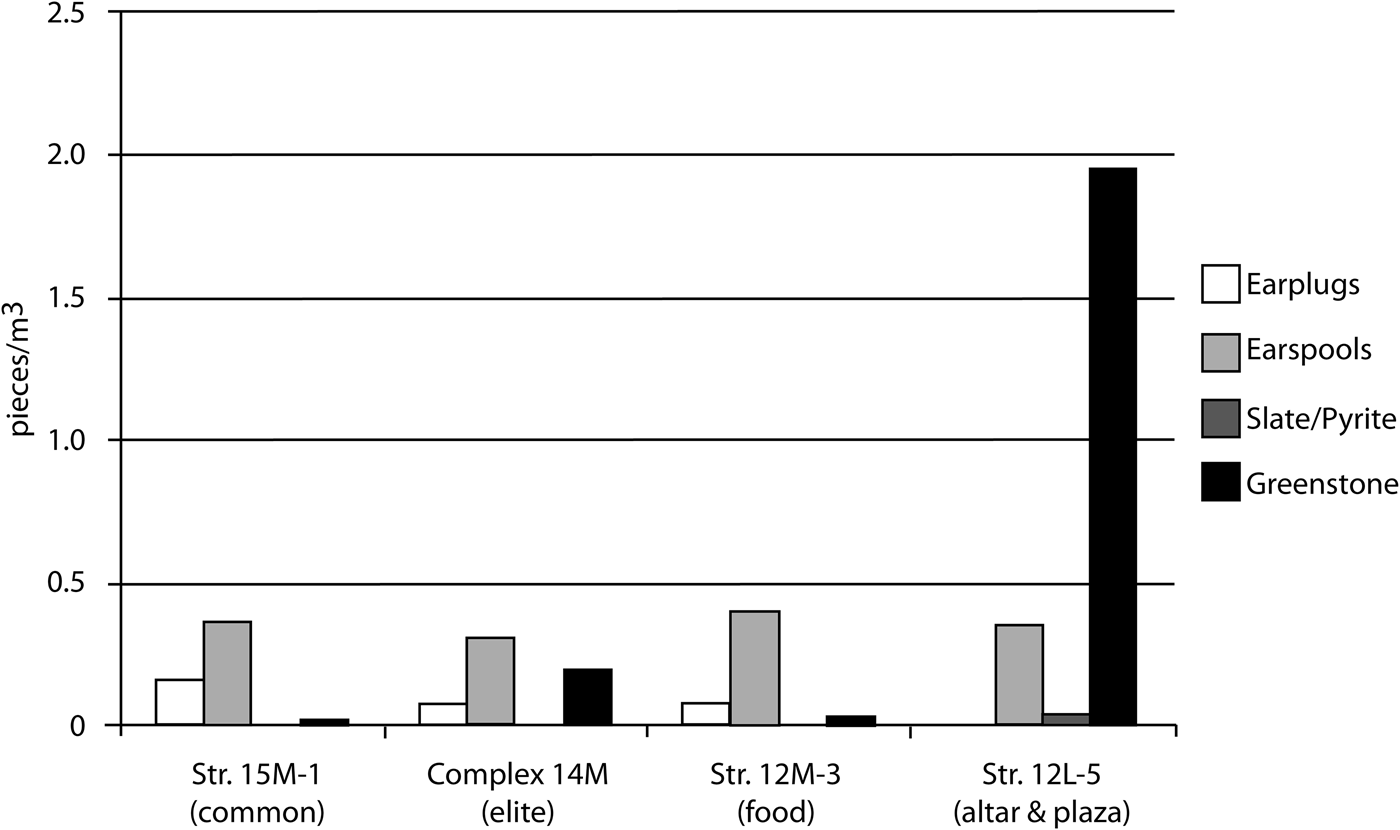
Variability in lapidary adornments at La Laguna by area of the site and by structure is striking (Figure 15). There is a strong contrast in the distribution of greenstone adornments observed in comparing the 14M complex (28%) and Structure 15M-1 (1%, a single bead), indicating that access to imported goods is a much more sensitive index of status than are ceramic ear adornments. The single jadeite earspool fragment originated from the minimally explored residence in the center of the site, Structure 12M-2, and a bead and two worked pieces (3%) were recovered from the structure with mixed residential and community functions, Structure 12M-3. Viewed in terms of excavation volume, the density of greenstone adornments from the 14M complex (.2 pieces/m3) is ten times that of Structure 15M-1, and five times the next highest structure that is not a temple platform or the Central Plaza.
Densities of adornment within four areas of La Laguna.
Nevertheless, by far the most compelling pattern for lapidary artifacts at the site is their overwhelming distribution within public ritual offering contexts within the civic-ceremonial precinct. Over half (58%) of all the greenstone adornments from La Laguna were excavated in the immediate vicinity of a small altar (Structure 12 L-5) in the Central Plaza directly in front of the main temple structure (Structure 12 L-1). The density of this context eclipses all others at the site for greenstone and it also produced relatively high quantities of slate pendants and other debris, which we interpret as ritual deposits associated with the metaphorical sowing of precious substances (see Carballo Reference Carballo2012). Ninety-six percent of all slate fragments were also deposited along this central axis of the plaza and complete slate-pyrite mirrors and pendants were cached within the three primary temples at the site. Five such mirrors formed part of the most elaborate offering on top of Structure 12 L-1, which also included 15 large obsidian bifaces, whereas a second offering nearby contained the remains of the pelt of a large feline. In cases that permit determination, disc-mirrors exhibit perforations suggestive of having once been fastened to headdresses or other articles of clothing prior to their final deposition as part of a community termination ritual.
DISCUSSION AND CONCLUSIONS
We have considered how the households of Formative period central Mexico expressed their collective and individual identities through styles of decorated serving wares and personal adornment, focusing particularly on four sites from Tlaxcala. Use of these classes of material culture would have been in the context of embodied practices that were often synchronous, such as when adorned individuals engaged in domestic or public consumption events using decorated ceramics. Yet the temporal changes we observe in these two classes of materials relative to one another relate to broader shifts in how households within central and northern Tlaxcala articulated with their communities, and may also apply to other contexts within Formative period central Mexico or elsewhere in Mesoamerica.
The most significant chronological trend we observe is a decrease in the use of decorated serving wares with a corresponding increase in forms of ceramic and lapidary adornments. This pattern may be explained within a relational framework to daily household practices that considers systems of common difference (Wilk Reference Wilk2004) enacted along a spatial continuum ranging from private to public (Robin and Rothschild Reference Robin and Rothschild2002), whereby household activities articulated with those of a wider community. Wilk notes that common difference operates through simultaneous inclusion and exclusion and the exercise of two kinds of power, the first to compete within arenas of shared styles and forms of symbolic communication, and the second to define the logic and stakes of such competitive arenas. “Both types of power are real and both have value, but one acts within a set of categories that are defined and controlled by the other” (Wilk Reference Wilk2004:93).
Households within the initial villages of central and northern Tlaxcala, such as Amomoloc and Tetel, exhibit significant concern with stylistic expression through ceramic decorations and the social relevance of personal adornment, while in actuality practicing little to no adornment using the artifact classes discussed here. Social organization within more rural villages such as these is likely to have been more kin focused. Stylistic choice in the ceramics and figurines from this period appears to reference similar objects from Early Formative style networks and idealized adornment practices of certain individuals at contemporary, Middle Formative paramount centers such as Chalcatzingo, Cuicuilco, and Xochitecatl. Figurines from the early villages demonstrate a disconnect between idealized and lived realities since they are more elaborately adorned than later examples, but the individuals who made and used them were not competing within a system of common difference at the level of those living in paramount centers with access to much finer lapidary adornments (Chalcatzingo) or who were producing these intensively (Xochitecatl). Ear adornments are the one class of personal adornment that continues to be prevalent in later Formative figurines and remains of artifact examples in archaeological assemblages from our study area and elsewhere in the region show their increased frequency over time. The ear adornments of figurines appear to be disproportionately marked as earspools rather than earplugs, which may represent another point of disconnect between idealized and actual forms since greenstone earspools appear earlier than the appropriation of this type of adornment through use of ceramic earspools or earplugs, which do not require access to long-distance exchange networks.
Between the Texoloc and Tezoquipan phases at La Laguna, household practices and community-level interaction shift in an interconnected manner. Consumption events remained important within residential and plaza settings, attested to by stability or even a slight increase in proportions of serving wares, but stylistic expression through decorative serving wares declined substantially—measured both as the proportion of decorated vessels and in the diversity of decorative motifs. An increase in personal adornment and decrease in decorated pottery coincide with changes in the elaboration of the spatial continuum of public-private interaction, including the first indications of large-scale public architecture in the region. Although this regional development occurs close to a millennium later than in other parts of Mesoamerica, and many centuries later than in other parts of central Mexico, it would still have been a novel experience for local inhabitants.
Early constructions remain poorly understood at La Laguna, but later ceremonial architecture demonstrates a blending of components of pan-Mesoamerican inventories of public architecture such as temples, plazas, and ballcourts, with significant formalization in the layout and orientation of sacred space that typifies multiple sites of the later Formative period and persists as a distinctive central Mexican urban tradition (Carballo and Aveni Reference Carballo and Aveni2012; Smith Reference Smith2008:94–123). The sacralization of these spaces involved ritual practices that featured the offering of personal adornments prominently, including greenstone beads and pendants, slate-pyrite mirrors, and feline pelts (Carballo Reference Carballo2012). These depositional contexts were prioritized by the inhabitants of La Laguna much more so than domestic burials or other household spaces. Accordingly, even though the shift in emphasis from decorated serving wares to personal adornment may suggest earlier corporate household identities making way for a greater emphasis on individual demarcation within larger settlements, these public ritual deposits expressed strongly corporate premises. They involved themes relating to fertility, liminality, and dedication and termination in manners that exhibit much greater emphasis on the elaboration of public ceremonial space relative to domestic space and which cannot be connected directly to high-ranking individuals through archaeological evidence such as burials or iconography.
The orchestrators, participants, and spectators of public rituals at La Laguna's center were also surely adorned themselves for such occasions, but likely also during the more quotidian semi-private/public interactions that characterized life in this town and in contemporaneous proto-urban centers. These interactions would have frequently involved individuals with ear adornments that identified them as subjects of a certain status but more importantly of varied age grades. That earspools rather than earplugs were the more elaborate or even idealized type of adornment at La Laguna is indicated by their greater likelihood of being decorated and larger, as well as by the fact lapidary versions made from imported materials were also hollow earspools. Having more access to lapidary earspools than earlier villages in the region, but significantly less than contemporary proto-urban centers, households at La Laguna appear to have elaborated on the ceramic form at substantially higher levels than their contemporaries at other sites—thereby creating a localized regime for expressing common difference. Earspools persisted as the desired type of ear adornment among later central Mexican cultures, with gradations in value among the Aztecs based on material type and marking status and occupation. As was true among the Aztecs, however, ear adornments also appear to have been used in lifecycle rituals during the Formative period. Based on a comparison of the assemblage from La Laguna with other published cases we suggest that the size of ear adornment correlates more strongly with age than with status (outside of age) and that newer initiates and/or younger individuals were more likely to wear undecorated earplugs. Household status was more strongly signaled through nonlocal resources including polished greenstone, slate, onyx, and modified and unmodified shell. These materials do not appear in the sample of excavated domestic burials from La Laguna, however, and their greater occurrence within higher-status residences is still considerably less than is seen in the public offering contexts of the Central Plaza and three major temples at the site—where these materials formed part of less individualized, more community focused dedication and termination rituals for sacred spaces and the entities they represented.
RESUMEN
Las unidades domésticas formativas del altiplano central mexicano representan contextos analíticos fundamentales para entender las grandes transformaciones sociales durante un milenio (900 a.C. − 100 d.C.) que fue testigo de la expansión y contracción de varias redes regionales estilísticas y económicas; la formalización de instituciones políticas y religiosas de larga duración; y la urbanización inicial y la formación del Estado. Los individuos utilizaron cánones estilísticos en la articulación de elementos importantes de sus identidades colectivas individuales a través de prácticas de consumo comensal y de adorno personal. En este estudio consideramos el estilo en el contexto de vasijas de servicio y adornos portátiles, principalmente de sitios ubicados en el estado de Tlaxcala. Evaluamos la forma en que la expresión estilística por parte de estas clases de artefactos contribuyó a cambios en las conceptualizaciones de la identidad familiar e individual y su articulación con las redes sociales comunitarias y regionales. Notamos el fuerte énfasis en el uso colectivo de los estilos, con la posibilidad de también diferenciar socialmente a los individuos por su edad, estatus y otros aspectos de su identidad.
ACKNOWLEDGMENTS
Research described here was funded by grants from the National Science Foundation (D. Carballo 2009:BCS-0941278; Lesure 2001:BCS-0003961; 2003:BCS-0313762), the Wenner-Gren Foundation for Anthropological Research (Lesure 2001:6722), The H. John Heinz III Fund of the Heinz Family Foundation (Lesure 2003), the National Geographic Society (D. Carballo 2009), University of California Institute for Mexico and the United States/ El Consejo Nacional de Ciencia y Tecnología (D. Carballo 2007), and the Foundation for the Advancement of Mesoamerican Studies, Inc. (D. Carballo 2005:FAMSI inventory No. 05018). We thank these institutions as well as the logistical support provided by the Consejo de Arqueología, Instituto Nacional de Antropología e Historia. We are also grateful to Cynthia Robin and Scott Hutson for organizing this special section and providing useful comments on earlier drafts, as well as to Leonardo López Luján, Joyce Marcus, Deborah Nichols, Carrie Dennett, and two anonymous reviewers for their comments and bibliographic assistance.