Despite being a common occurrence, very little has been published on how healthcare institutions can address antimicrobial shortages.Reference Quadri, Mazer-Amirshahi and Fox 1 – Reference Paskovaty, Lucarelli, Patel, Ryan, Seyboth and Thackray 4 Antimicrobial stewardship programs (ASPs) have been proposed as ideally suited to deal with antimicrobial shortages.Reference Griffith, Patel and Sutton 5 To our knowledge, no publications have quantified ways in which an ASP can impact drug utilization during a shortage of antibiotics. We describe here the response of an ASP to a critical multidrug antimicrobial shortage at a large tertiary-care academic hospital as well as the subsequent effects on antimicrobial use and hospital-level outcomes.
METHODS
Hospital Description and Baseline Antimicrobial Stewardship Activities
Barnes-Jewish Hospital (BJH) is a 1,252-bed tertiary care academic medical center located in St. Louis, Missouri. The ASP at BJH was started in 1984, and at the time the shortage began in 2015, the ASP was composed of 2 infectious diseases (ID) trained pharmacists who provided practice guidelines and guidance to other pharmacy staff. Clinical pharmacists tasked with reviewing antimicrobial use as part of their standard duties were embedded with most services, though they did not track their interventions. No pre-existing interventions or use restrictions were in place for most antimicrobials, including the drugs in short supply. Previous shortages had been addressed through messaging alone.
Shortage Timeline and Interventions
Meropenem and imipenem
On October 5, 2015, procurement failure and low stock of meropenem (MEM) led to a drug shortage alert from the pharmacy leadership. Attempts to purchase imipenem-cilastatin (IPM), an alternative carbapenem, were unsuccessful. Pharmacy and medical leadership formed a task force comprised of 2 ID physicians, 2 ID-trained clinical pharmacists, an ID pharmacy resident, and an ID fellow. Interventions were executed in a staggered fashion (Supplementary Figure 1), starting with an informational campaign composed of a hospital-wide e-mail announcement, messages to clinical pharmacy, and guidance on alternatives to MEM. Subsequently, active drug-stock tracking was implemented for all anti-pseudomonal antibiotics. Finally, physician-directed prospective auditing of MEM and IPM use was implemented. During the shortage, the pharmacy acquired as much additional drug stock as was made available from suppliers. Shortage conditions ended on January 1, 2016, after a regular supply was re-established.
Piperacillin-tazobactam
On October 20, 2015, lack of purchasable supplies led to an additional shortage declaration for piperacillin-tazobactam (TZP). The shortage task force expanded its scope to include TZP utilizing an enhanced approach. In addition to aggressive messaging to the clinical pharmacy, specialties with high TZP usage, including general surgery and emergency medicine, were identified. Treatment protocols utilizing TZP were identified and modified to replace TZP with alternative agents, accompanied by corresponding changes to electronic order sets. Prospective auditing of TZP use was also performed through December 28, 2015.
Physician-directed prospective auditing of antimicrobial use
The electronic medical record was queried to identify all patients actively prescribed the drugs affected by the shortage. Each chart was then reviewed by a task force member to identify the indications, microbiologic sensitivities, and severity of illness. In cases in which a substitution was considered safe and reasonable, the primary team was called and a change was recommended. The final decision regarding whether to accept or reject this recommendation remained with the primary team. The frequency of review ranged from 1 to 3 times per week and was adjusted by task force leadership based on shortage severity.
Study Design
Data on antibiotic utilization were retrospectively obtained for all patients hospitalized at BJH between May 1 and December 31, 2015. Antibiotic data were analyzed individually as well as categorized into broad-spectrum gram-negative antibiotics or anti-methicillin-resistant Staphylococcus aureus (MRSA) antibiotics. Broad-spectrum antibiotics included cefepime (FEP), IPM, MEM, TZP, and ertapenem. Anti-MRSA antibiotics included daptomycin, ceftaroline, linezolid, and vancomycin. Antibiotic use was captured in days of therapy (DOT), mirroring the definitions used in the CDC National Healthcare Safety Network (NHSN) Antimicrobial Use surveillance module. 6 Antimicrobial use was calculated and plotted in DOT per 1,000 patient days (PD).Reference Polk, Fox, Mahoney, Letcavage and MacDougall 7 The number of audits was tracked by date and plotted against antibiotic utilization figures.
Daily antibiotic use for each antibiotic and antibiotic group were plotted, and pre- and post-intervention use were compared. To assess overall impact on antibiotic use, linear regression models with autoregressive integrated moving average (ARIMA) errors were fit to the natural logarithm of daily rates, accounting for the correlation of errors over time. Covariates included calendar day and indicator variables for intervention status for each day. Intervention dates for MEM and TZP were defined as the dates when shortages were first announced to medical staff (ie, the first intervention). Percent changes in rates were then estimated from the fitted models where the coefficients were assessed to be statistically significantly different from null (ie, zero).
To assess the impact of interventions on remaining supply, we calculated the days of use remaining (DUR), defined as the cumulative amount of stocked drug (in grams) divided by the standard daily pseudomonal dose, ie, the quantity of drug used in 24 hours to treat a pseudomonal infection in an adult with normal renal function. For MEM, this dosage was 3 g (1 g administered every 8 hours); for IPM the dosage was 2 g (0.5 g every 6 hours); for FEP, the dosage was 6 g (2 g every 8 hours); and for TZP, the dosage was 18 gm (4.5 g every 6 hours).
Change in antibiotic expenditure during the shortage was calculated by comparing antibiotic use during the shortage with use over the prior 5 months. The estimated expenditure per 1,000 PD for those periods was calculated by multiplying DOT per 1,000 PD with the standard daily pseudomonal dose and the publicly reported average wholesale price (AWP) per gram of drug. 8
All-cause mortality for the drug-shortage period (October–December 2015) was compared to the mortality rates for October–December for the preceding 3 years. Clostridium difficile infection (CDI) rates were obtained as NHSN lab-ID reported cases per 1,000 PD. Statistical significance was assessed using the Student t test.
Regression models with ARIMA errors adjustment was performed using R version 3.2.4 (R Foundation for Statistical Computing, Vienna, Austria). All other analyses were performed using SAS version 9.4 (SAS Institute, Cary, NC), and graphs were produced using SPSS Statistics version 20 (IBM, Armonk, NY). P values <.05 were considered statistically significant. This study was approved by the Washington University Institutional Review Board.
RESULTS
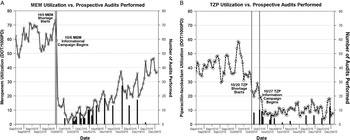
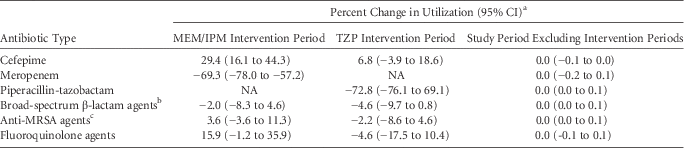
Substantial declines in antimicrobial use were observed for all the drugs affected by the shortage during the study period. Decreases in antimicrobial use corresponded with episodes of physician-directed audit and feedback, which totaled 273 audits (172 for MEM, 25 for IPM, 76 for TZP) (Figure 1). Audits were successful in triggering antimicrobial use changes 23% of the time for MEM, 26% of the time for IPM, and 40% of the time for TZP. Shortage intervention periods were associated with statistically significant decreases in antibiotic utilization for MEM, IPM, and TZP, with a compensatory increase in FEP (Table 1). Despite significant changes in MEM, TZP, and FEP use, overall, broad-spectrum, anti-MRSA, and fluoroquinolone agent use did not change over the course of the interventions.
Antimicrobial use during a drug shortage: impact of number of daily drug use audits performed. Legend: ○, meropenem (MEM); ◊, piperacillin-tazobactam (TZP). *Bars=no. drug-use audits performed that day.

Antimicrobial Use During a Drug Shortage: Impact on Antimicrobial Use by Drug-Targeted Intervention Period

NOTE. CI, confidence interval; MEM, meropenem; IPM, imipenem; TZP, piperacillin-tazobactam; NA, not available; MRSA, methicillin-resistant Staphylococcus aureus.
a Intervals that exclude 0 are statistically significant.
b Broad-spectrum β-lactams: cefepime (FEP), IPM, MEM, TZP, and ertapenem.
c Anti–methicillin-resistant Staphylococcus aureus agents: daptomycin, ceftaroline, linezolid, and vancomycin.
Stockpiles of MEM and IPM increased rapidly after shortage interventions began (Supplementary Figure 2). MEM stores increased from a low of 100 DUR to >3,000 DUR. FEP stock remained stable throughout the shortage, with approximately 1,000 DUR available on average. TZP supplies averaged 200 DUR throughout the shortage.
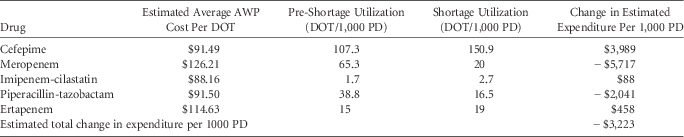
Antibiotic expenditure declined by $3,223 per 1,000 PD (Table 2). MEM use declined from a pre-shortage average of 65.3 to 20 DOT per 1,000 PD, while TZP use decreased from 38.8 to 16.5 DOT per 1,000 PD. FEP use increased from 107.3 to 150.9 DOT per 1,000 PD during the shortage, and smaller increases were observed for IPM (1.7 to 2.7 DOT per 1,000 PD) and ertapenem (15 to 19 DOT per 1,000 PD).
The Impact of an Antimicrobial Shortage and Subsequent Conservation Efforts on Estimated Hospital Antimicrobial Expenditure

NOTE. AWP, average wholesale price; DOT, days of therapy; PD, patient days.
The unadjusted hospital mortality rate for the October–December period decreased to 4.09 deaths per 1,000 PD for the shortage year 2015, compared with 4.67, 4.78, and 4.60 for the same months in previous years (P=.03). Length of stay did not significantly change for the October–December period in the shortage year compared with the same periods in the 3 previous years. Clostridium difficile infection (CDI) rates did not differ significantly between the shortage period compared with the same months in 2015 (data not shown; P=.86).
DISCUSSION
Antimicrobial stewardship programs have many well-established benefits. Our study is the first to characterize another useful function: effective conservation of antibiotics during drug shortages. Messaging and changes in guidelines and decision support were a very effective method at first for reducing antibiotic use. However, prospective intervention was required to sustain reduced antibiotic utilization rates. In this study, systematic changes, such as the guideline and decision support changes used to intervene on TZP utilization, appear to have had a more sustainable effect than messaging alone (as was done for MEM).
Prospective auditing clearly reduced antimicrobial use, if transiently, which potentially provided the edge needed to prevent stock depletion. However, auditing was labor intensive. A team of 6 clinicians was required to audit the shortage drugs, likely due to the large patient volume at BJH. The system used was also the most rapidly deployable option rather than the most efficient.
Unsurprisingly, our study demonstrates that when specific drugs are targeted for conservation, there is a corresponding increase in the use of alternative drugs. This response, colloquially referred to as “squeezing the balloon,” is common and expected during both drug shortages and routine antimicrobial stewardship efforts.
Gross hospital outcomes and CDI rates showed no discernible immediate deleterious effect of the shortage and conservation efforts during the study period; however, long-term effects of our emergency stewardship efforts remain to be determined. This is a well-known limitation to antimicrobial stewardship monitoring: the effects of microbial susceptibility patterns may be subtle, occurring months afterward.Reference Valiquette, Cossette, Garant, Diab and Pepin 9 , Reference Bantar, Sartori and Vesco 10 Persistent stewardship programs are also needed so that ongoing monitoring can detect delayed effects and allow for corrective responses.
Our study has several limitations. The brief shortage duration limits our ability to make a more detailed assessment of rare outcomes such as antimicrobial-resistant infections or infection-related mortality. Additionally, our interventions were bundled, making it challenging to determine the effects of individual elements. However, initial communications to medical providers were highly effective in reducing antibiotic use. Appropriateness of use was not monitored during this study. Under shortage conditions, the imperative was deemed to be conserving antibiotics in short supply for cases in which alternatives would be ineffective. Recommendations were often made to take patients off otherwise appropriate antibiotics in favor of effective non-shortage drugs. Lastly, our estimated drug costs were based on average wholesale price, rather than actual expenditure, and we did not consider antibiotic stockpiling, drug price changes related to the shortage, or emergency purchases of alternative antibiotics. For example, emergency supplies of ceftazidime, ceftazidime-avibactam, and ceftolozane-tazobactam were purchased, but a negligible amount of these agents was utilized.
In conclusion, antimicrobial stewardship is a successful method of conserving antibiotics during a drug shortage. Our efforts dramatically reduced selected antibiotic utilization, increased reserve stock of critically short antibiotics, saved pharmacy costs, and did not negatively impact overall patient length of stay or mortality. Hospitals facing critical drug shortages should consider utilizing antimicrobial stewardship teams to conserve medications while maintaining a high standard of patient care.
ACKNOWLEDGMENTS
We would like to acknowledge the members of the healthcare informatics team at BJC for their assistance with data collection.
Financial support: Data were collected in part from work supported by the Centers for Disease Control and Prevention Safety and Healthcare Epidemiology Prevention Research Development Grant 2015-010 “Accelerating Hospital Reporting to NHSN’s Antibiotic Use and Resistance Module.”
Potential conflicts of interest: All authors report no conflicts of interest relevant to this article.
SUPPLEMENTARY MATERIAL
To view supplementary material for this article, please visit https://doi.org/10.1017/ice.2016.289