1. Introduction: Linguistic complexity in writing
The topic of my paper is linguistic complexity – specifically, in academic writing for English learners (ELs) in US schools. Linguistic complexity is largely what transforms everyday speech into academic writing. It is not about inflating our prose with unnecessarily complex sentences – what Lanham derisively calls the ‘academic style’ (Reference Lanham1979) – but about a mature command of language that opens up new opportunities for thinking in different ways, for interacting appropriately with a wider range of people, and for articulating new kinds of meaning.
All language teachers want to help their students develop maturity in their writing. For this, we need tools to identify where our students are in their development and to help move them along. However, these tools are not readily available, either from state-approved academic standards in the US or from the related pedagogical literature. I would like to present to you the preliminary results of a project that we have designed to address this problem.
Most of us can recognize mature writing when we see it. Example (1) shows a sample from a student whom we will call Amir. Amir is an eighth-grade student from northeast Africa, a refugee, living in Vermont. His proficiency is assessed as ‘Beginning’ (see Table 2) by our state-level English language standards, at level 2 on a 6-point scale. Here is his response to a story he has read in class.
(1) In the beginning of the book Justin doesn't know what he wants for his social life. Justin is in high school and he wants to be in the middle group because so he won't get bullied by other kids and he thinks that being in the middle is a safe place to be for him, ‘It's not a bad place to be the middle its comfortable it's easy and it's safe’. Justin knows being in the middle is a safe place for him. Justin is afraid to be friends with someone who is not in his middle group. Because kids will be mean to him.
In analyzing Amir's text, we notice a few grammatical errors that we might be tempted to correct, but in fact, his message is clear. He even cites from the story to support his claims. However, we recognize that this is somehow not up to eighth-grade level. Compare his writing with a benchmark extract released by the Vermont Department of Education, which sets the standards for writing development at grade K-12:
(2) Because of all [Hester's] alienation, she got to examine human nature from an outsiders point of view. That caused her to think and maybe examine her own actions. After that she has a very clear sense of right and wrong and become a better person. An example of that is when she is fighting to keep Pearl and she says, ‘He gave her in requital of all things else, which he has taken from me’ (Vermont Department of Education 2008).
This essay scored 5 on a five-point-scale for eighth-grade writing. The accompanying analysis highlights the extract as demonstrating ‘insightful’ character analysis. But what marks this writing as more mature than Amir's? First, there is the level of abstraction: nouns like ‘alienation’; phrases like ‘examine her own actions’. There is greater cohesion in the use of the extended-reference pronouns ‘that’ and ‘this’ to summarize ideas from a preceding sentence, helping the text to flow smoothly. There is a compactness about the expression of cause–effect relationships, predicated clause-internally either through an adverbial phrase (‘Because of Hester's alienation’) or through the verb ‘cause’ in the second sentence – both more concise alternatives than adding new clauses (‘Because she was alienated. . .; And then she thought. . . .’).
In short, the difference between this text and Amir's is primarily in the linguistic choices that allow the benchmark text to express a certain complexity of meaning. These choices are much more characteristic of academic English writing than they are of everyday speaking.
2. State-approved writing standards
Unfortunately, the standards to which Amir and all K-12 students are accountable do little to identify these choices beyond broad generalizations like ‘insightful’. In the US, standards for academic literacy are currently defined at the level of individual states or consortia of states. Vermont, in which this study is anchored, uses a Framework of Standards and Learning Opportunities for core academic subject areas with a set of underlying ‘Vital Results’ that include writing in various genres (Vermont Department of Education 2010a). The standards are elaborated in a system of Grade Level Expectations (GLEs), which provide detailed benchmarks, rubrics, and scored samples of student writing for each level (Vermont Department of Education 2008, 2010b).
The Vermont Department of Education is nationally well respected for its comprehensive and progressive approach to writing. The GLEs for Writing specify several standards for effective composition, including writing conventions, language structures, and textual elements such as context, focus, voice, and organization. However, they do not explain what kinds of language choices would enable a writer to meet those standards satisfactorily.
2.1. Challenges for English learners (ELs)
Such guidance is especially critical for ESOL teachers. The challenges for ELs in American schools are daunting. For a start, they may lack a foundation of everyday vocabulary and sentence-level fluency: word order, tense formation and the like. This is the foundation that linguistic complexity builds on, and native English speakers bring it to the classroom with years of natural L1 acquisition behind them. Native English speakers rarely have to puzzle over the difference between ‘did’ and ‘has done’, or what ‘by’ means in different contexts. They also have an internalized vocabulary of culture-specific idioms and stock phrases: prefabrications that they can infuse automatically into their writing.
But the gaps for ELs are not only in everyday language. More seriously, many ELs, especially refugees, may have missed years of schooling before coming to this country. Newcomers and their parents may be pre-literate. Others may have spent years stumbling through grade levels, grasping certain aspects of language development, but missing others that have never been made explicit. Consequently, they may display what a colleague calls the ‘Swiss cheese’ effect: a linguistic repertoire that seems to hold together on the surface but is full of gaps.
Yet, under current federal regulations, these learners are held to the same achievement standards as their peers. The No Child Left Behind Act (1981) mandates that ELs take state-approved standardized tests in mathematics and language arts after one year in this country. Thus, they may have to learn grade-level content, with the linguistic complexity that it presupposes, at a much faster rate than their peers. Further, the Act sets annual ‘Measurable Achievement Objectives’ for all ELs in listening, speaking, reading, and writing. To tackle these demands of integrated content and language learning, ESOL teachers urgently need guidelines for systematic assessment and instruction in academic English.
3. English language proficiency standards: WIDA
Responding to this need, most states have developed assessment systems for English language proficiency, spearheaded by the field's largest professional organization, TESOL (Teachers to Speakers of Other Languages), which first developed a comprehensive system of K-12 Standards in 1997. (TESOL 1997, 2006). Prominent among state assessment systems is WIDA (World-Class Instructional Design and Assessment), adopted by a growing consortium of more than twenty states, of which Vermont is a member. Recently, the WIDA standards have been ‘augmented by TESOL as the national model’ (Gottlieb, Cranley & Cammilleri Reference Gottlieb, Cranley and Cammilleri2007: Resource Guide−5).
The WIDA standards specify communicative competence in social, instructional, and academic English language for core content areas. Their assessment frameworks organize the domains of listening, speaking, reading, and writing into grade-level clusters from PreK to 12, and they map language development across six proficiency levels from ‘Entering’ (Level 1) to ‘Reaching’ (Level 6), where students are considered ready for grade-level academic performance. Within the matrices of the standards, model performance indicators (MPIs) describe how students might perform specific language functions related to school instructional topics, and the kind of support they would need at different levels of proficiency.
The WIDA Standards have revolutionized ESOL assessment in Vermont and undoubtedly for the other member states too. The MPIs offer clear illustrations of student performance and concrete suggestions for support, which can be adapted across domains to fit the particular situation. To this extent, they explicitly align content with language learning in order to help teachers scaffold instruction appropriately.
Nevertheless, even WIDA stops short of describing how linguistic complexity develops. In their matrices, language functions such as ‘describe’, ‘classify’, and ‘compose’ lack accompanying explanation about how to realize them in appropriate language structures. Even the writing rubric, which includes a strand for linguistic complexity, expresses progress between proficiency levels only in generalizations:
Simple and expanded sentences show emerging complexity used to provide detail . . . A variety of sentence lengths of varying linguistic complexity; emerging cohesion used to provide detail and clarity (Gottlieb et al. Reference Gottlieb, Cranley and Cammilleri2007: Resource Guide−54)
From such generalizations, teachers must decide what ‘emerging complexity’ looks like: which ‘variety of sentence lengths’ is appropriate for which purposes; which strategies signal ‘emerging cohesion’; and how these strategies change as writing matures.
The answers to these questions are not to be found in textbooks. In the US, even the most popular current ESOL grammar textbooks claiming a theme-based focus do not follow the actual development of writers and speakers in content-immersed environments. Rather, their Tables of Contents are developed introspectively, moving from clause-level topics such as simple tense formation and regular verb forms toward ‘complex’ structures such as passive, modal verbs, and subordinate clauses, without explaining how these structures contribute to purpose, focus, voice, or the other elements required by state standards.
It is not only WIDA teachers who seek such guidance. In California, Schleppegrell (Reference Schleppegrell2003) pointed to the same need with reference to the comprehensive network of state-approved standards for English Language Arts and English Language Development. In fact, this need is now acknowledged at the federal level, by the National Center for Educational Evaluation and Regional Excellence:
The Panel feels that the best way to promote the development of AE [academic English, brackets mine] is to use a curriculum with a scope and sequence aimed at building AE. Unfortunately, the Panel knows of no existing curricular materials that have solid empirical support for this purpose. . . . It is also unfortunate that few resources provide guidance to districts in teaching academic English to ELs. (Gersten et al. Reference Gersten, Baker, Shanahan, Linan-Thompson, Collins and Scarcella2007: 24).
4. Genres and grammatical development
I believe the most promising response to this issue comes from the theoretical perspective of Systemic Functional Linguistics (SFL), which originated with the work of Michael Halliday in the 1970s (Halliday & Matthiessen Reference Halliday and Matthiessen2004) and which takes a genre-based approach to linguistic description. Schleppegrell (Reference Schleppegrell2003) invokes this perspective to propose a ‘pathways’ approach to expository and narrative writing. Each of the six pathway genres, she explains, has its own characteristic purpose and structure, realized in correspondingly appropriate linguistic strategies. In her conclusion, Schleppegrell calls for more detailed research along these lines. She suggests that each genre be analyzed at specific grade levels for its associated grammatical features, and that writing samples be ‘collected and ordered to illustrate different levels of achievement of the purposes of the genre’ (Reference Schleppegrell2003: 19).
The project I present here is a direct response to Schleppegrell's invitation. Its ultimate goal is to develop a data-based continuum of linguistic complexity for developing writers that can be used to monitor and guide their progress in school-based genres. This is to be distinguished from the ‘scope and sequence’ suggested by the NCEE above, which implies some sort of prescriptive formula for what we think students should be able to do at different stages. We know that the path of development in academic English is very difficult to predict for individual ELs. Their linguistic repertoire will vary widely depending on many factors, including similarities between home and target language, level of L1 literacy, continuity of schooling, exposure to different genres in English, and the type of modeling and scaffolding offered by their teachers. The goal of a developmental continuum is not to predict, but to document our observations of what students typically do in response to real writing prompts. Based on these observations, we hope to chart a general path representing the typical progress of students in a given population, allowing for all the variation and gaps that the diversity of this population entails. Once we know the direction of the path, we can help move our students proactively along it. We will also be able to identify gaps and address them through differentiated instruction.
5. Setting for the project
The setting for our ongoing project is a Vermont middle school containing a diverse population of ELs. Our database so far includes some 90 texts, collected from about 30 students in grades six through eight. The students come from more than a dozen language backgrounds, including the Congo, Burundi, Tanzania, Kenya, Bosnia, India, Bhutan, Vietnam, Burma, Nepal, and Iraq. The writing samples were collected by their ESOL teacher – my co-researcher, Nancy Nadel – from many classroom assignments over the course of about 18 months between 2008 and early 2010. The students’ English proficiency spans the WIDA scale from ‘Entering’ (Level 1) to ‘Reaching’ (Level 6). In their literacy level, the students range from newcomers with no prior schooling to US-born who have attended school for several years.
6. SFL and academic English
Our framework for charting and interpreting the data draws heavily on the work of SFL scholars (Derewianka Reference Derewianka1990; Schleppegrell Reference Schleppegrell2003, Reference Schleppegrell2004; Droga & Humphrey Reference Droga and Humphrey2003; Martin Reference Martin, Christie and Martin2007; Schleppegrell & Go Reference Schleppegrell and Go2007; Christie & Derewianka Reference Christie and Derewianka2008). An essential notion of SFL is that language is organized into different text-types, or genres, to meet the socially-situated expectations of the ‘discourse community’ that uses them (Hyland Reference Hyland2008). Within these genres, grammar consists of a set of choices for making meaning. For academic English, the choices are crucial:
In school-based tasks, the language itself plays the major role in making meaning. . .It is through grammatical choices that different meanings are construed and different contexts are realized. . . (Schleppegrell Reference Schleppegrell2004: 74–75)
For several decades, the Australian curriculum has been enlightened by SFL insights, from language arts in the state of Queensland (Queensland Studies Authority 2007) to an ESL Scope and Scales in South Australia (Morgan Reference Morgan2009). Our focus on writing, however, was most directly informed by the developmental continuum of Christie & Derewianka (Reference Christie and Derewianka2008), which charts the emerging linguistic complexity of Australian native English speakers from ages six through eighteen in the subjects of language arts, history, and science. Their continuum distinguishes three levels of meaning construction that together constitute the register of a given text:
• Ideational meaning: How is experience represented as processes, participants, and circumstances at clause level? How are logical relationships established between clauses?
• Interpersonal meaning: How does the writer ‘speak’ to the reader?
• Textual meaning: How is information organized for coherence and cohesion?
The ideational component of register involves the ‘chunking’ of ideas as noun groups (participants), verb groups (processes) and adverb groups (circumstances) into clauses; and the combining of clauses into sentences and texts to represent logical relationships such as cause–effect, contrast, and so on. Skilful choices at the ideational level can produce the ‘depth’, ‘focus’, ‘purpose’, and ‘context’ that are required (but not defined) by state-approved writing standards and rubrics such as the Vermont Framework.
At the interpersonal level of meaning, the writer engages the reader, constructing an appropriate authorial ‘voice’, ‘stance’, and ‘tone’ in terms of conventional academic standards. In formal writing, the voice must be more objective, less personal than in everyday speaking. We do not expect, for example, to see expressions of emotion or rhetorical questions like ‘Don't you think so?’ from mature writers. The interpersonal level requires a good sense of audience.
The textual component also requires a sense of audience. Good writers make their texts easy for readers to navigate. With no physical contextual support or opportunities for real-time negotiation of meaning, writers must shape their texts to make sure the information flows smoothly. State-approved standards interpret textual strategies as ‘coherence’, ‘cohesion’, and ‘organization’.
Christie & Derewianka's (Reference Christie and Derewianka2008) continuum was designed for young Australian native English speakers. A continuum for ELs should look rather different insofar as their linguistic development, especially in middle school, is not necessarily driven by cognitive development. Their continuum should represent all the heterogeneity of learning backgrounds typical of an ESOL class such as ours; for example, students with limited prior schooling will take much longer to acquire grade-level language proficiency in English writing than students who have already learned to apply higher-order thinking skills in their L1. Our task, therefore, was to apply this useful SFL framework to a middle school ESL setting, with no presumption that our results would mirror the age-related progression from ‘congruent’ to ‘incongruent’ (or abstract) meaning shown by the grammar choices of the Australian children (Christie & Derewianka Reference Christie and Derewianka2008: 218).
7. A data-driven continuum
The purpose of our continuum is to mark indicators of linguistic development for our EL writers, in relation to standards-based grade level expectations. Accordingly, our database consists of these students’ texts, written as classroom or homework assignments.
The students’ grammatical choices were recorded following Christie & Derewianaka's (Reference Christie and Derewianka2008) template for the construction of meaning. The texts were sorted according to their authors’ most recently assessed level of English proficiency. The six WIDA levels were collapsed into three broader bands: ‘Beginning’ (Levels 1–2), ‘Expanding’ (Levels 3–4), and ‘Reaching’ (Levels 5–6), acknowledging Schleppegrell's caution (Reference Schleppegrell2003) about the futility in a content-immersion environment of assigning particular linguistic choices to a specific level of proficiency with any precision.
The data bank included only unedited writing samples, collected by Ms. Nadel from 30 students over the course of eighteen months. As the analyst, I attempted to exclude any grammatical choices that I judged to be copied from published texts or from a teacher-given scaffold, such as sentence starters or response templates. That judgment was difficult at first, but familiarity with the assignments produced over time a sense for what was spontaneous in a student's writing. Thus, I only documented choices that were both frequent enough to reflect general tendencies and well controlled enough to suggest mastery.
7.1. The genre: Response to Text
Our focus was limited to one genre, ‘Response to Text’, on the premise that each genre has its own structure and characteristic linguistic features, and is most clearly analyzed in its own terms (Schleppegrell, personal communication). ‘Response to Text’ includes both literature and informational text. It is a good choice because it involves several subgenres that transfer across academic content fields, including recount, reflective composition, and explanation (Schleppegrell Reference Schleppegrell2003). The purpose of this genre is specified by the Vermont Framework of Standards:
. . .students show understanding of reading, connect what has been read to the broader world of ideas, concepts and issues, and make judgments about the text. (Vermont Department of Education 2010a)
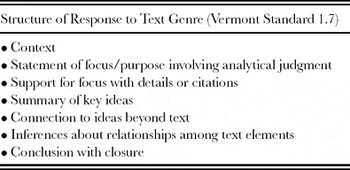
The structure can be inferred from the descriptors in the Grade 5–8 GLEs, as well as from corresponding rubrics and analyses of benchmark samples. Table 1 represents a synthesis of all these documents.
Grade-Level Expectations for Writing Grades 5−8 (compiled from Vermont Department of Education 2010b)

These descriptors suggest a set of required ingredients rather than a linear structure. For example, ‘Context’ is expected at the beginning of a response, but also throughout, as new ideas about characters or events are introduced. Furthermore, GLEs vary across the grade levels. For example, at Grade Five, ‘Context’ simply involves ‘selecting appropriate information to set context/background’ (e.g. by introducing and identifying a character), whereas at Grade Eight, it involves selecting and summarizing interpretive themes.
Table 1 shows that the Expectations for this genre structure involve ideational meaning, specifying statements of context, purpose, key ideas, and so on. They also involve interpersonal meaning from fifth grade on, where their writing rubrics specify ‘purpose/stance/voice/tone’. They call for textual cohesion at all grade levels by ‘organizing ideas using transition words/phrases’, and for coherence at eighth grade by ‘excluding loosely related or extraneous information’ (Vermont Department of Education 2010b).
As I explained earlier, the linguistic features that best realize these GLEs are not specified either by the state or the WIDA standards. However, a list of features is provided in Schleppegrell (Reference Schleppegrell2003), compiled from an extensive body of research in the SFL literature, for the genres of Recount, Reflective Composition, and Explanation, all of which are subgenres of Response to Text. An examination of benchmark samples for this genre by the State of Vermont confirms the validity of Schleppegrell's list. Accordingly, I used this set of target features to guide my analysis.
Against this backdrop of GLEs and target features, the linguistic choices of our students were charted. An overview of the results is summarized in Table 2. This summary chart is aligned horizontally with the three WIDA proficiency bands. Vertically, it organizes ideational, interpersonal, and textual choices. The table shows in bold the specific language features that differentiate ELs from their native-English speaking peers, based on Christie & Derewianka's (Reference Christie and Derewianka2008) descriptors for Australian children.
Overview: Developmental Continuum of Linguistic Complexity for English Learners, Grades 6–8; Response to Text1

1Vermont Standards 1.7; 5.18; Vermont Grade Level Expectations Writing #4–7, 5:11, 5.13
This overview is currently being elaborated into a detailed list of indicators for each proficiency band. For the present, I will simply share from this list some intriguing illustrations of developing complexity.
8. Complexity in ideational meaning
At the lower proficiency stages, we can expect major differences between ELs and native speakers in their ideational language choices. ELs have to learn the basic order of word groups, which may be different in their own languages. The English clause typically chunks our experience in terms of participants, processes, and circumstances, in that basic order. Participants represent the people, places, and things we refer to in texts. Processes represent what they do and what happens to them in terms of acting, saying, thinking, having, and being. Circumstances represent the settings in which these situations occur – typically, settings of time and space. We can see that the High-Beginning level writer in the following example has his word chunks in the right order:
(3) I participant bike process to school circumstance in the morning circumstance and goes home in the afternoon. When I got home from school my uniform is wet because I was sweating. But I am still enjoying the weather. In the rain season, it's very wet. [Level: High-Beginning]
But we can see with this writer another developmental challenge that most native speakers do not have to face: distinguishing present from past forms. Contrary to what most ESOL grammar textbooks suggest, present tense does not necessarily precede past in the natural order of L2 acquisition. Our learners, immersed in school language, will probably hear past forms just as frequently as present, through exposure to narrative genres such as fiction and history. Thus, they tend to use these forms interchangeably until they internalize the different contexts of their use. Similarly, our writer has not yet learned to distinguish between forms that express habitual actions or states (present simple) and those that express actions in progress (present progressive).
Another indicator noticed at Beginning level is the tendency to chain clauses together in coordinate or simple subordinate structures, using conjunctions like and, but, and because. This is also typical of inexperienced L1 writers (Christie & Derewianka Reference Christie and Derewianka2008). Like their counterparts, ELs begin, as they expand in complexity, to pack these basic clauses with information, as we see in the example below with the embedding of an adjective clause in the first noun group:
(4) [The kids she coaches in soccer participant] are refugees. [Level: Expanding]
Interestingly, we found that expansion of noun groups with adjective clauses comes fairly early – again, in contrast to the scope and sequence of a typical ESOL grammar textbook, where ‘complex clauses’ would probably be introduced only after ‘simple’ clause-level information, such as modal verbs and the verb tense system, had been covered. In fact, adjective clauses appear more frequently and with more mastery than either modals or perfect tenses in our Expanding level texts. This makes sense when we consider the usefulness and frequency of adjective clauses for identifying and elaborating participants in everyday discourse (Fox & Thompson Reference Fox and Thompson1990).
We do still see clause-chaining at the Expanding level, but now with more connectors than and, but, or because. For example, we see more conditional clauses with if. As a signal of hypothetical logical relations, if is quite a challenging form for ELs, not cognitively, but structurally, because the meaning of its two conjoined clauses depends crucially on the correct choice of verb form:
(5) Marisa thinks if she starts drawing horses like Euphemia she would get respect. [Level: Expanding]
This intermediate writer has not yet learned to signal the difference between possible future conditions using [present tense + will], and ‘unreal’ hypotheses using [past tense + would]. Nevertheless, her attempt at this ‘unreal’ construction indicates progression from congruent toward incongruent grammatical choices and a possible readiness for instruction on this point.
It is only as we move toward higher proficiency levels that we see the emergence of grammatical metaphor in ideational meaning. Grammatical metaphor has been identified as ‘the key indicator of language development’ (Christie & Derewianka Reference Christie and Derewianka2008: 24). Consider the following invented sentence.
(6) Her inability to resist temptation and his insistent approaches resulted in a passionate affair.
Syntactically, this sentence consists of one simple clause. Its complexity rests in the construction of the initial noun group: Her inability to resist temptation and his insistent approaches. This noun group is packed with information. If we unpack its meaning, we find that it consists of several clause-level processes:
she was unable to resist temptation
he approached
he was insistent
The grammatical metaphor consists in packaging all these processes, which would normally be represented with verb groups, into a single noun group, as if they referred to a participant. We call this strategy nominalization. And the highly abstract meaning of the resulting noun group is very incongruent with the kinds of participants that young writers are familiar with, such as persons, places, and things.
Grammatical metaphor does not come easily, even to native speakers. In Christie & Derewianka's continuum (Reference Christie and Derewianka2008), it emerges in the middle school years, but given its structural complexity, we might expect its mastery to take longer for ELs. In fact, we do find our language learners attempting to use abstract participants, as in the example below.
(7) So not able to draw a horse like Euphemia it really bothers her. (Level: Reaching)
The writer is responding to a story about jealousy between the protagonist, Marisa, and another girl who can draw horses better. Her sentence here presents a preliminary attempt at nominalization, embedding one clause-level proposition into the participant slot of a higher clause. A more accurate production might read
[So not being able to draw a horse like Euphemia participant] really bothers her.
An even better alternative might be to summarize the information given in the previous text in a pronoun or demonstrative of extended reference:
[This problem] really bothers her.
The student may not yet be familiar with this textual function of demonstratives, having encountered this and that in everyday speech only in reference to concrete persons and things. Nevertheless, if we recognize what the writer is trying to do here rather than what she could have done better, we could compliment her on this developmental achievement beyond simple clause-chaining, and encourage her attempts at nominalization by helping her to notice correct models in other texts (Fotos & Ellis Reference Fotos and Ellis1991). The advantage of a developmental continuum is that it allows us to track student progress by responding to certain errors as indicators of progress rather than summarily correcting them in ways that may not be helpful.
9. Complexity in interpersonal meaning
I will refer only briefly here to this dimension of register, to give a glimpse of our findings. To construct interpersonal meaning, our adolescent ELs must choose appropriate expressions of authorial voice, tone, and stance, just as native speakers do. Both populations need to move beyond the self-expression of everyday language and find socially accepted ways to communicate attitude, engagement with the reader, and strength of conviction. Central to this domain is the language of modality (Martin & White Reference Martin and White2005), where skilled writing becomes increasingly nuanced beyond the plain usage of modal verbs (must, might, could) and acquires a repertoire of lexical choices for more measured judgments of certainty or desirability (without a doubt. . . .; it is imperative that. . .). The added challenge for ELs is that they have to start from the beginning in mastering even the simpler grammatical forms such as modal verbs, that small but essential repertoire. Native speakers hardly have to think about the differences between them: growing up with parental directives, they quickly learn that must is more directive than should, and that I might is less certain than I will. They soon learn in everyday conversation how to modulate these meanings.
In our data, it is in the Expanding level stages that modals come into their own as epistemic markers, to express degrees of certainty in Response to Text. Modals may be reinforced with adverbs of probability:
(8) If she would write poems like those . . . Poems would probably be good. [Level: Expanding]
Also typical at this stage is the use of formulaic evidential phrases to engage the reader (As you can see. . .) or to interject author's voice (It seems to me. . .). These useful phrases are respected in academic writing because they ‘entertain’ the possibility that the author's position is only ‘one of a number of possible positions’ (Martin & White Reference Martin and White2005: 104).
A similar advance is made from Beginning to Expanding stages in the modulation of affect. At Beginning stages, our ELs tend to express their feelings ‘through simple verbs and adjectives (like, want; sad, mad)’ (Table 2), and to signal gradation of those feelings through everyday intensifiers (really; a lot) or simply through exclamatory punctuation more appropriate for informal genres:
(9) This poem not so serious . . . It tried to be serious and easy. But it not! [Level: Beginning]
At the most advanced Reaching stages, the author speaks to the reader more self-consciously through tentative hedging phrases (I would say. . .; I imagine. . .) and through the use of de-personalized evidence, rather than strength of feeling, to support a claim:
(10) All this shows that . . . her determination was way more powerful than her jealousy. [Level: Reaching]
10. Complexity in textual meaning
The textual level of meaning involves the organization of texts. The SFL framework captures nicely how this is done through the grammar of theme and rheme, which is essentially the process of setting up a topic as starting-point (theme) which orients the reader to the information that follows (rheme). At sentence level, theme–rheme organization is closely associated with the ‘known–new contract’ (Kolln & Gray Reference Kolln and Gray2010), an implicit understanding whereby readers expect writers to build coherence by placing familiar information at the beginning of the sentence and introducing new information toward the end. This new information then itself becomes the starting-point, or theme of the next sentence, to orient the reader to yet another rheme.
The simplest type of thematic development is probably achieved through personal and demonstrative pronouns (he, they; this, those), which pick up previously-introduced referents and carry them forward as themes. This grammatical strategy is very common in everyday conversation and emerges early for our ELs in narrative Response to Text when the referents involved are clearly identifiable, such as characters in a story. Our learners also grasp quickly the thematic function of articles, switching from indefinite a/an to definite the after first mention of a participant:
(11) Teacher gave him a book to read . . . [He] read the book. (Level: Beginning)
More interesting, however, is what our ELs start doing at the intermediate levels. According to the state standards for Response to Text (Table 1), middle-school writers need to make and support analytical judgments. For this type of meaning, thematic development involves more than identifying and tracking characters in a story. Unlike narratives, where coherence comes from the order of events, analytical judgments are structured by logical relationships (Schleppegrell Reference Schleppegrell2003) which must be made explicit. One way of making them explicit is to repeat or paraphrase verbs that refer to thinking processes, in effect making these processes the theme. This is what we see in the following example, responding to the 2009 inauguration poem for President Obama:
(12) When I read the poem, this expression made me think. After I reflected, I understood what she meant. What she meant was, anywhere you go there is something dangerous or something that will make you happy. [Level: Expanding; emphasis mine.]
At first glance, the marked thematic development in this example seems cumbersome. The writer's repetition of verbs or clauses from one sentence to the next is unlikely to be modeled by writing teachers, who more often focus on cohesive devices such as transitional adverbs and conjunctions to show logical relationships. No doubt a fluent English speaker would find a more elegant way to build information from one clause the next. But far from showing deficiency, this spontaneous attempt at thematic development indicates progress at the Expanding level. The repeated phrases may even suggest early steps toward the use of extended reference with pronouns and demonstratives like this and it, as discussed earlier. In any case, this writer's experimentation with organizational strategies suggests a level of textual awareness that some native speakers of the same age might not have.
The GLEs for this genre also require that writers summarize key ideas and infer relationships among text elements (see Table 1). These expectations involve higher-level thematic development through ‘macro-themes’, which set up the main idea or topic at the outset, pointing ahead to the various sub-topics to be developed (Martin & Rose Reference Martin and Rose2003; Christie & Derewianka Reference Christie and Derewianka2008). In this genre, the macro-theme is likely to be interpretive, such as a judgment of character traits. Thus, returning to the text we saw in example (10):
(13) Throughout the story ‘Drawing horses’ main character, Marisa showed determination and jealousy. (Level: Reaching]
As the text unfolds over less than two pages, offering illustrations of first determination and then jealousy, this writer makes constant references back to the macro-theme. Finally, she summarizes what has gone before and adds her final conclusion, based on the illustrations, as a ‘macro-new’ element (Martin & Rose Reference Martin and Rose2003).
(14) All this shows that even though she was jealous in the end her determination was more powerful than her jealousy. Her determination was way more powerful because even though she got picked on for her drawing and people mistook her drawing for something else, she didn't let that stop her from keep on trying. [Level: Reaching]
Certainly, the writer's language choices are formulaic. She is probably following some template provided by the teacher for character analysis. But the awkwardness of her style is not dissimilar to that of native English speakers at her grade level. More importantly, this writer is clearly accumulating a set of linguistic tools that will serve her well for thematic development. She summarizes ideas with extended reference pronouns (All this. . .that), even if not consistently. She uses nominalization to summarize her previous illustrations of Marisa's behavior in two single words: jealousy and determination. One of them, determination, then becomes the theme for her supporting claim in the second sentence.
Notice too her strategic clause combinations. The first sentence embeds a noun clause which is itself elaborated by an embedded adverb clause:
(14a) All this shows [noun clause that {adverb clause even though she was jealous} in the end her determination was way more powerful than her jealousy].
In the second sentence, the main clause is elaborated with an adverbial clause of reason which is itself elaborated with two coordinated clauses of concession:
(14b) Her determination was way more powerful [adverb clause because {coordinated adverb clauseseven though she got picked on for her drawing and people mistook her drawing for something else}, she didn't let that stop her from keep on trying].
Earlier in this paper, I remarked that the WIDA writing rubric calls for ‘a variety of sentence lengths of varying linguistic complexity’ without explaining why, when, or how they should vary. In Example 14, we now have a clear illustration of how sentence variety may be purposeful. By manipulating clause type and clause order, the writer starts with a summarized idea (All this), builds in a concession (even though. . .) as a modulating counterargument, and focuses the main idea in final position. This evidence of purposeful syntactic agility is far more noteworthy and praiseworthy than the writer's stylistic awkwardness or her minor error with gerund formation in the last clause.
11. Conclusion
In conclusion, I hope to have offered a flavor of our findings so far and how they enable us to view our students’ grammatical choices, including inaccurate ones, as indicators of their developing ability to construct meaning. Even at this preliminary stage, our developmental continuum views our students’ performance from the perspective of what they can do rather than what they can't. The indicators allow us to go deeper than summative scores on standardized assessments, to identify which areas of language an individual has mastered and where they may be stuck. My colleague Ms. Nadel, who teaches the children in this study, is already using the indicators to trace her students’ paths, help them validate their achievements, and encourage them forward.
We are excited about the potential of a model like this for academic writers at all levels. Most writers in academic settings, even native speakers, can benefit from developing their grammatical muscles. Teachers can help them by charting their development with the ‘genre awareness’ of different writing contexts (Johns Reference Johns2008) and by showing them how to analyze their own linguistic choices for the construction of effective meaning.
Acknowledgements
I would like to thank several people for helping me with this analysis, especially my co-researcher, Nancy Nadel, who is still collecting all the texts in our project and helping me think them through; Lauren Hoyt, for her helpful insights at the conception of this framework; Mark Nigolian, for several thoughtful conversations about academic language and state standards; Mary Schleppegrell for setting me on the right track with SFL; Jim Martin for his recommendations of helpful texts; the two anonymous reviewers for their helpful input, especially regarding SFL; Graeme Porte, for advising me throughout the development of this paper; and crucially, the English learners at Hunt Middle School.
Elizabeth O'Dowd is Professor of Applied Linguistics and Director of TESOL Graduate Studies at Saint Michael's College, Vermont, in the United States, where she teaches courses in grammar, world languages, and bilingualism. She is the author of Prepositions and particles in English: A discourse-functional account (Oxford University Press, 1998), and co-author with M. Kathleen Mahnke of Grammar Links 2: A theme-based course for reference and practice (Houghton-Mifflin, 2005).