- CM
Congregational Magazine
- DWL
Dr Williams's Library, London
- HCP
House of Commons Papers
- HLRO
House of Lords Record Office
- JSSL
Journal of the Statistical Society of London
- TUHS
Transactions of the Unitarian Historical Society
Christianity has often had an uncomfortable relationship with statistics. Some church leaders have cited David's sin in numbering the Israelites as biblical foundation for their opposition to figures.Footnote 1 Others have argued that, by definition, religion and spirituality represent inward experiences which are not susceptible to external quantification. Many have found themselves victims of the abuse of statistics, whereby numerical data have been the instruments for, at worst, persecution or, at best, misrepresentation. Against this background it is unsurprising that the discipline of ecclesiastical statistics has evolved slowly and patchily. Britain has been no exception.Footnote 2 A few quantitative sources derive from the seventeenth century, but, in this Journal, Margaret Spufford concluded that it is not really possible to count the godly at this period.Footnote 3 One heavily statistical secondary work (by Robert Currie, Alan Gilbert and Lee Horsley) purports to analyse religious data from 1700, but, in reality, there is little eighteenth-century content.Footnote 4 Its limitations have not prevented one sociologist from using it to estimate church membership in 1800.Footnote 5 By contrast, most standard books on English and Welsh religion during the Hanoverian era tend to be accounts ‘with the numbers left out’, spectacularly so in the case of the relevant volume in the Oxford History of the Christian Church.Footnote 6 The eighteenth century is commonly seen as ‘a pre-statistical age’ in religious terms.Footnote 7 Not until we reach the mid- to late nineteenth and twentieth centuries have historians been able to study religious change in Britain on a more certain quantitative foundation.
Can this situation be improved upon? This article sets out, in a preliminary way, to assemble the extant primary and secondary evidence about religious affiliation in England and Wales during the long eighteenth century, and to see how far it can be harmonised and integrated to paint a holistic statistical picture of the national religious landscape throughout these 160 years when the country was transformed by industrialisation and urbanisation. In so doing, purely local sources will be deliberately avoided, for they can be difficult to interpret and to reconcile with each other. This is not to deny, of course, the likely existence of regional or urban/rural variations in religiosity, the geographical and topographical diversity already being qualitatively apparent in such local studies as have been published to date.Footnote 8 Short-term trends will likewise be ignored, whether caused by the economic cycle, political events, natural disasters or religious revivals, aiming instead to provide five numerical snapshots of the situation in 1680, 1720, 1760, 1800 and 1840. Finally, proxy measures, notably data about the number of clergy and churches, will be shunned since there is no standard ratio between them and levels of adherence and hence no guarantee that they will have tracked religious allegiance and practice. In particular, statistics of the registration of non-Anglican places of worship will be excluded. This was a requirement introduced by the Toleration Act of 1689, the process being managed initially by county and borough quarter sessions or episcopal and archidiaconal registries and after 1852 by the Registrar General. One modern writer, Alan Gilbert, has made some use of these data to chart the growth of Nonconformity, while noting ‘serious ambiguities of meaning and categorisation’.Footnote 9
Although logic might suggest that the analysis should commence with the Church of England, since it was the religion by law established, in reality the nature of the sources makes it more sensible to quantify initially the non-Anglicans. For, in a society where Church and State were indivisible, and all citizens technically members of the Church, unless they opted out, and required to attend its services,Footnote 10 the number of Anglicans was in some senses the vast residue of the people once those dissenting from the Church had been subtracted. Of the latter, Protestant Nonconformists were by far the most numerous, tracing their roots to the Puritan and separatist traditions of Elizabethan times but being given impetus as a movement by the Act of Uniformity of 1662 and the subsequent ejection from their livings in the Church of some 2,000 Presbyterian and other ministers who refused to conform. Even then the fault-lines between Church and Dissent were by no means rigid, with many Nonconformists (notably Presbyterians and some Independents, albeit not Baptists and Quakers) continuing to attend their parish churches in addition to the chapel. This practice was adopted by Wesleyans from their origins in the 1730s and pursued by them until well into the nineteenth century.Footnote 11 For their part some Anglicans also frequented the meeting, not least in the large number of localities where the Church offered only single duty on a Sunday and Dissenting services held at a different time afforded supplementary spiritual nourishment. Such overlap naturally makes it more difficult to separate the population into rival religious camps. It was likewise the case that denominational demarcations within Nonconformity were less sharply-drawn before 1750 than they were to become subsequently, especially in the nineteenth century.
The returns of conventiclers in 1669 provide a first aggregate estimate of post-Restoration Nonconformity, made at a time when efforts to enforce the new laws against them were already beginning to slacken. They are incomplete, especially in omitting eight counties and parts of others, but corrected for missing values were long ago (in the 1910s) believed to indicate at least 120,000 Nonconformists (implicitly adults) in England and Wales, although more recently David Wykes has cast doubt on their statistical utility.Footnote 12 The Compton census of 1676 was taken in the wake of the Declaration of Indulgence in 1672–3, which had encouraged Dissent into the open, but on the eve of a fresh wave of persecution. The taking of the census was said to have caused many Nonconformists to revert to Anglicanism. It is likewise geographically incomplete, not least in the Province of York, so the total of 93,000 Dissenters (presumed to be aged sixteen and over) requires upward revision. Moreover, the census was designed only to capture ‘Dissenters … which either obstinately refuse or wholly absent themselves from the Communion of the Church of England at such times as by Law they are required’, excluding occasional conformists.Footnote 13 Taking a less restrictive definition of Nonconformity, and factoring in the children of Dissenting families, might have swollen the number to a community of perhaps 225,000 souls during the Restoration era. This is altogether more plausible than the post-Restoration maxima of 150,000 families suggested by the Unitarian Joseph Cornish in 1797,Footnote 14 and of 250,000 adults excluding Quakers by Douglas Bebb (a Methodist historian) in 1935,Footnote 15 the workings for which remain obscure.
The Toleration Act of 1689 removed the barriers to Nonconformist growth, and there was much contemporary comment that numbers rose significantly thereafter. The list of Dissenting congregations and hearers compiled by the Presbyterian John Evans between 1715 and 1729 (but mainly in 1716–18) provides the best evidence for the early eighteenth century, although it too requires correction for omissions.Footnote 16 The manuscript has been most systematically studied by Michael Watts (in the 1970s), who, supplementing it with other contemporary sources, has proposed figures of 338,000 Nonconformists in England (including the Quakers) and 18,000 in Wales (excluding them).Footnote 17 Watts acknowledges the weakness of the Welsh data, and his figure for the principality is certainly lower than the 27,500 (including Quakers) suggested by Thomas Rees, a late nineteenth-century (but still respected) historian of Welsh Nonconformity.Footnote 18 Watts's combined total of 356,000 is somewhat in excess of the older (early twentieth-century) estimates by C. E. FryerFootnote 19 and Bebb (who excluded children).Footnote 20 However, it stands lower than the 400,000 put forward by Horton Davies in 1952Footnote 21 and the 500,000 English and Welsh Nonconformists suggested by Geoffrey Holmes in the 1970s, on the basis of research which, sadly, was never fully written up prior to the author's death.Footnote 22
By 1730 it had become obvious to many insiders that Old Dissent overall was declining, and a small pamphlet war was triggered by Strickland Gough's An enquiry into the causes of the decay of the Dissenting interest, published that year. So an anonymous Dissenting estimate of 700,000 in 1732 seems improbable,Footnote 23 although Gilbert's 100,000 Baptist, Congregational and Methodist adherents in England in 1750, estimated in the 1970s, feels low.Footnote 24 Perhaps 250,000 would be a reasonable guess for all Nonconformity in the 1750s. Another list of Presbyterian, Baptist and Independent meetings compiled by the Baptist Josiah Thompson in 1772–3 did not enumerate hearers,Footnote 25 but correlation with figures of membership and attendance for individual churches contained in his contemporaneous manuscript ‘History of Protestant Dissenting congregations’ has enabled a modern historian, James Bradley, to plot the direction of travel in most counties. In only four was there any sign of growth relative to population since 1715–29, in four the position was static and in thirty-two there was a significant decline, often by one-half or even more. Whereas at the former date Presbyterians, Baptists and Independents had exceeded 5 per cent of the people in eighteen English counties, by the latter it was only in nine.Footnote 26 This might indicate a figure of no more than 250,000 Nonconformists from the Old Dissenting traditions in England and Wales in the early 1770s, making allowance for the Quakers (but not the New Dissent, principally the Methodists, who might have added a further 100,000), a far more dramatic fall in support than suggested by the 6 per cent reduction in meetings between 1715–29 and 1772–3.Footnote 27
Twenty years later, in the 1790s, the trend had generally been reversed, partly under the impact of the Evangelical revival and partly as a consequence of demographic growth. One Dissenting minister claimed in 1790 that the Three Denominations alone were ‘considerably above a twentieth part of the inhabitants of this country’,Footnote 28 while a foreign visitor was inclined to estimate all English Nonconformists in 1791 at about 100,000 families, perhaps implying 500,000 souls.Footnote 29 This figure broadly accords with Gilbert's more recent (1970s) calculation, which projected combined Baptist, Congregational and Methodist adherence in England (excluding Wales) rising from 320,000 in 1790 to 500,000 in 1800, to reach 8.7 per cent of the adult population.Footnote 30 The proportion, perhaps raised to something nearer one in ten after allowance for Wales and small Nonconformist denominations, appears more realistic than the entirely ungrounded ratio of one in eight (omitting Methodists) proposed by the Congregationalist Edward Williams in 1794Footnote 31 or what reads like more than one in four by Lord Robert Montagu for 1800.Footnote 32
By 1815 the total had risen again, to not far short of 1,000,000. This figure is consistent with one contemporary estimate (by a Calvinist) for 1815Footnote 33 and with the late twentieth-century back-projected work of Watts.Footnote 34 Other commentators were more optimistic about Nonconformist fortunes at this date, notably the Baptist William Jones (who reckoned Dissenters to comprise more than one-fifth of the population in 1815)Footnote 35 and the Unitarian Thomas Belsham, who, in 1818, thought that practising Anglicans were already fewer in number than active Nonconformists of all kinds.Footnote 36 This somewhat imaginative approach was maintained by the Congregationalist Benjamin Hanbury who, anxious to provide evidence for the repeal of the Test and Corporation Acts, wrote a paper in 1828 which, on the basis of several generous assumptions, concluded that there were 3,000,000 Nonconformists, equivalent to one-quarter of the population.Footnote 37 This was double the upper limit advanced by Charles Hulbert two years before.Footnote 38 Independent validation might have been afforded by the government's returns of sectaries in 1829, were it not for the fact that only those for Lancashire were printed at the time and that the central files went up in flames with the Palace of Westminster in 1834. Such duplicate returns as do survive, generally among the archives of quarter sessions in local record offices, are insufficiently complete and accurate to warrant generalisation about national trends.Footnote 39
Hanbury's total would have been more plausible a decade later, for Nonconformity was undoubtedly growing at a very fast rate during the 1830s (by two-fifths, to judge from membership data).Footnote 40 Estimates of the Nonconformist community for the 1830s vary. One writer in the Dissenting newspaper The Patriot in 1833 guessed at 4,400,000 Nonconformists, including children and occasional attenders. However, this figure needs to be reduced by about 300,000 so as to exclude Roman Catholics, often classed as Dissenters at this time. It was further abated by Simeon Woodhouse (a Methodist New Connexion minister) in 1839, who considered it based upon too large a multiplier of hearers per place of worship, his own adjustment implying just over 3,000,000 Nonconformists.Footnote 41 This was also the number arrived at by applying the then (1834) bishop of London's ratio of Dissent comprising one-fourth of the people.Footnote 42 A more stridently anti-Dissenting source ventured 1,900,000 (all but 700,000 of whom were Wesleyans) in 1836,Footnote 43 while an early statistician, John McCulloch, seemingly offered a maximum of 2,500,000 in 1837.Footnote 44 The Congregationalist Josiah Conder inflated it to 4,500,000 to 5,000,000 in 1838, of whom 3,000,000 were regular worshippers.Footnote 45 Another Congregationalist, James Matheson, similarly arrived at a figure of 3,000,000 Nonconformist attendants in 1839, inclusive of Sunday scholars.Footnote 46 Omitting the Catholics, an Evangelical newspaper, The Record, calculated 2,350,000 hearers in the same year but suggested that the number be doubled to compute the total Nonconformist constituency.Footnote 47 Membership alone was reckoned by The Record to be in the region of 750,000, which is fairly consistent with Gilbert's 1970s research.Footnote 48
Summing up these aggregates for Nonconformity in England and Wales, and selecting the data which appear to be most firmly grounded, it may be conjectured that their numbers rose from 225,000 in the 1670s to 360,000 in the 1710s, dipped to 250,000 in the 1750s, and then grew again, standing at 350,000 in the 1770s, 650,000 in the 1790s, 1,000,000 in the 1810s and 2,750,000 in the 1830s. Although it lies just outside the period, the government's religious census of 1851 does provide something of a reality-check on these figures. The census measured attendance at services of religious worship and Sunday schools on one day (30 March). Including estimates for defective returns, it revealed the Church of England and Protestant Nonconformity to be neck-and-neck, with 5,293,000 and 5,213,000 worshippers respectively in England and Wales. Nonconformists thus apparently constituted 29 per cent of the population.Footnote 49 In reality, the proportion was lower, possibly even one-fifth, given that Nonconformists were far more prone to go to chapel or Sunday school twice a day than Anglicans (necessitating allowance for double-counting) and to worship regularly each week.Footnote 50 This might suggest around 4,000,000 Nonconformists in England and Wales in the mid-nineteenth century.
The foregoing represents a somewhat broad-brush picture. Greater precision can be introduced by examining what is known about the numerical fortunes of individual Nonconformist denominations, commencing with the Quakers. A mixture of contemporary and later estimates for the 1660s coalesces at a minimum of 30,000 and a maximum of 40,000 adults and children.Footnote 51 The movement evidently grew strongly thereafter, peaking around 1700, when there may have been close on 100,000 souls, although a significant number was in Scotland and Ireland.Footnote 52 Decline ensued, with the English Friends reduced to 40,000 hearers in the late 1710s, according to Watts's investigations in the 1970s;Footnote 53 Wales would probably have added no more than 2,500. Notwithstanding reports by two foreign observers (Johann von Archenholz in 1789 and Frederick Wendeborn in 1791) of 60,000 Quakers,Footnote 54 membership in England and Wales in 1800 was 19,800 with some 8,000 non-members (unlike other Nonconformists, Friends had relatively few adherents not in membership).Footnote 55 Membership decreased slowly during the next four decades, to reach 16,200 by 1840.Footnote 56 Overall Quaker community size was estimated at 20,000 in both 1812 and 1815,Footnote 57 which was probably not too far out, given that there were 22,500 attendances in 1851 (translating, for Watts, into 16,900 actual attendants).Footnote 58 Hulbert's estimate of 50,000 in 1826 therefore seems quite inflated,Footnote 59 and even Woodhouse's figure of 30,000 in 1839 may have been too generous.Footnote 60
Baptists were divided theologically, principally between General (Arminian) and Particular (Calvinistic) Baptists, making their enumeration something of a challenge. At the Restoration there were perhaps 25,000 of all sorts.Footnote 61 General Baptists were more numerous than Particular Baptists at the outset, and their numbers grew throughout the 1670s and 1680s, certainly exceeding 30,000 worshippers.Footnote 62 By 1715–29 the fortunes of the two groups had reversed, and the General Baptists were declining. At that time, according to Watts in the 1970s, there were an estimated 59,300 hearers in England (40,500 Particular and 18,800 General Baptists) and 4,100 in Wales (all Particulars), or 63,400 in total.Footnote 63 This figure had halved by the 1750s, when there may not have been more than 20,000 Particular and 6,000 General Baptist hearers, including a combined membership not exceeding 10,000.Footnote 64 In terms of the number of meetings, recovery had started by the early 1770s,Footnote 65 a decade which also witnessed the emergence of the New Connexion of General Baptists, a movement that assiduously reported its membership statistics, starting with 1,600 in 1770.Footnote 66 In about 1800 the most plausible estimates of members are (for England) 25,000 Particular Baptists (two-fifths more than in 1790), 2,000 old General Baptists and 3,500 new General Baptists, and for Wales 10,000 Particular Baptists, making 40,500 in all.Footnote 67 Applying the Baptist member/hearer ratio of 3.7 which obtained in 284 chapels and 71 communities in the 1830s,Footnote 68 this would equate to 150,000 worshippers, a five-fold increase in less than fifty years. By 1840 membership had surpassed 100,000 in England (86,200 Particular Baptists, 600 old General Baptists and 14,600 new General Baptists) and 25,000 in Wales, equivalent to 465,000 hearers on the basis of a multiplier of 3.7.Footnote 69 This is about 105,000 more than an estimate in The Record in 1839, which evidently excluded attendance at preaching stations,Footnote 70 but 35,000 less than Matheson's figure, also for 1839, which included Sunday scholars.Footnote 71 At the same time the membership is probably underestimated, on account of the many Baptist chapels which were unaffiliated to local associations, so 500,000 worshippers may be correct. Allowing for growth during the intervening decade, such a figure for Baptists in England and Wales in 1840 is consistent with the 930,000 attendances enumerated at the 1851 religious census, corrected (for double-counting) by Watts to 592,000 attendants.Footnote 72
Congregationalists were often hard to distinguish from Presbyterians during the late seventeenth century. Allowing for this, and for non–responding counties, the 1669 return of conventiclers suggests about 25,000 adults.Footnote 73 By the late 1710s Congregationalist hearers numbered an estimated (by Watts) 59,900 in England and 7,600 in Wales.Footnote 74 Membership in England alone has been calculated by Gilbert in the 1970s as 15,000 in 1750, and for 1800 35,000 in England and 15,000 in Wales.Footnote 75 Applying the member/hearer ratio of 5.3 for a sample of Congregational chapels in the 1830sFootnote 76 would produce 265,000 worshippers in 1800. Forty years later, membership had grown enormously, to 127,000 in England and 43,000 in Wales, pointing to 901,000 hearers if a multiplier of 5.3 is used.Footnote 77 The real figure was probably somewhat lower, given that the multiplier is possibly less robust than its Baptist equivalent,Footnote 78 with Matheson's 750,000 in 1839 being the most plausible,Footnote 79 and – pro rata – in line with Conder's estimate for the Three Denominations in 1838.Footnote 80The Record reported 564,000 hearers exclusive of preaching stations in 1839.Footnote 81 A total of 725,000 in 1840 seems to accord best with the 1,214,000 worshippers and Sunday scholars (unadjusted for twicing) counted in 1851 and with Watts's derivative estimate of 789,000 attendants.Footnote 82
Presbyterians were by far the most numerous branch of Nonconformity for at least sixty years after the Restoration. Adjusting for eight non-responding counties, they may have numbered 70,000 adults in 1669,Footnote 83 while their estimated hearers in 1715–29 were 179,300 in England and 6,100 in Wales (according to Watts in the 1970s).Footnote 84 Thereafter, the movement underwent theological liberalisation, secession and numerical decline, suffering particular losses to the Church of England (among the affluent) and Independency. A Unitarian tradition incrementally emerged, which, augmented by Unitarian General Baptists (with forty–five congregations in 1828),Footnote 85 seems to have attracted 35,000 hearers (including 8,000 members) by the early 1830sFootnote 86 and 50,100 attendances (or 37,000 attendants) in 1851.Footnote 87 However, a rump of around sixtyFootnote 88 Presbyterian chapels remained Trinitarian and increasingly looked for alliance with congregations formed by Scottish Presbyterians in England. From 1836 this led to the progressive establishment of the Presbyterian Church of England. By 1851 there were 37,100 attendances in the Presbyterian Church of England (equating to 28,300 attendants), besides 11,800 of the Church of Scotland in England and Wales and 31,600 (21,800 attendants) of the United Presbyterian Church (formed in 1847 by the union of dissenters from the Church of Scotland).Footnote 89
Quakers, Baptists, Congregationalists, Presbyterians and Unitarians collectively comprised the Old Dissent (although there were also the Muggletonians, originating in 1651, whose membership peaked at 250 in 1698).Footnote 90 With the Evangelical revival, they were joined by a New Dissent, of which Methodism was the major manifestation. The Methodists were divided into Arminians, the followers of John and Charles Wesley (Wesleyans), and Calvinists, under the leadership of George Whitefield, Selina, countess of Huntingdon, and (in Wales) Daniel Rowland and Howell Harris. The Wesleyans did not formally separate from the Church of England until after John Wesley's death in 1791, and even then many remained church Methodists, simultaneously attending church and chapel, until well into the nineteenth century. ‘There is a large body of people who seem to fluctuate between them and the establishment’, remarked one statistician struggling to compute their number in 1837.Footnote 91 Another complication was that many were drawn to the novelty of Methodist field-preaching, and the vast crowds that attended on such occasions included the curious as well as the spiritually committed.Footnote 92
Certainly, in any formal sense, Wesleyan Methodism grew only slowly from the 1730s,Footnote 93 with membership at the end of the next decade probably still in four figures and a total community only just in five.Footnote 94 Members were systematically recorded from 1767, when there were 22,600 in England and Wales, the total thereafter rising to 26,500 in 1771, 37,600 in 1781, 57,100 in 1791, 88,200 in 1801, 143,900 in 1811, 197,200 in 1821, 245,700 in 1831 and 325,000 in 1841.Footnote 95 As with the Old Dissent, the Methodist constituency was broader than membership, a few contemporary and later commentators even suggesting by a factor of five or more.Footnote 96 However, the consensus seems to be around three or four times.Footnote 97 In view of the strength of Sunday schools in Wesleyanism, a multiplier of three and a half would seem appropriate post-1810, although three would perhaps suffice before. This would result in a Wesleyan community in England and Wales of 80,000 in 1770, compatible with the figure quoted by Wendeborn in 1791,Footnote 98 265,000 in 1800 and 1,150,000 in 1840 (on a par with Matheson in 1839 but proportionately somewhat higher than McCulloch's estimate in 1837, which was for all Methodists).Footnote 99 Watts has calculated Wesleyan attenders on 30 March 1851 as 982,000, with attendances of 1,544,500.Footnote 100 The 15 per cent decrease in hearers between 1840 and 1851 reflects the damage inflicted by the Wesleyan Reform agitation from 1849.
The Wesleyan Reformers were but the last in a line of Methodist denominations which issued from the strife in Wesleyan Methodism after Wesley's death. The first to emerge was the Methodist New Connexion, which had 3,000 members in 1797, 10,400 in 1821 and 20,500 in 1841,Footnote 101 perhaps indicating a community of 60,000 by 1840,Footnote 102 as against an estimated 62,900 attenders and 99,000 attendances in 1851.Footnote 103 The Primitive Methodists developed in the 1800s, reporting 200 members in 1811, 16,400 in 1821, 37,200 in 1831 and 76,000 in 1841,Footnote 104 which (adopting the multiplier of 3.4 derived from the Congregational Magazine survey)Footnote 105 points towards 250,000 hearers by 1840, the attenders in 1851 being 335,700 and attendances 511,200 (the 1840s being a decade of especially rapid growth for the Primitives).Footnote 106 The Independent Methodists, a union of revivalist groups formed in 1806, had 4,000 members by 1829,Footnote 107 equivalent to perhaps 10,000 hearers; the latter figure is more plausible than any calculated from the 1851 census when a fair number of their societies were missed or misclassified.Footnote 108 The Tent Methodists enjoyed only a fleeting existence (1814–32), their membership standing at 700 in 1820 and peaking at 3,500 in 1825, with hearers probably never reaching 10,000.Footnote 109 The Bible Christians, originating in 1815 and mainly localised in the West Country, had 6,400 members in 1826 and 11,400 in 1841;Footnote 110 assuming the same member/attender ratio as in 1851 (when there were 48,100 attenders),Footnote 111 this implies about 41,000 worshippers in 1840. The Protestant Methodists commenced in 1827, recording 2,500 members in 1829Footnote 112 and 4,000 by 1836 when they amalgamated with the Wesleyan Methodist Association,Footnote 113 translating to 12,000 souls. The Association itself returned 21,300 members in 1837 and 22,100 in 1841,Footnote 114 probably amounting to 65,000 hearers at that time, with an estimated 62,600 attenders in 1851 (and 94,100 attendances).Footnote 115 The Arminian Methodist Connexion likewise joined the Association in 1837, after only five years of independence, having reached 1,800 members and perhaps no more than 5,000 hearers.Footnote 116
The English Calvinistic Methodists were first manifest as the Whitefieldites, named after George Whitefield. Like Wesley, he attracted large open-air congregations,Footnote 117 but, by the late 1740s, there were no more than sixty societies or preaching places in England with a community (probably overestimated) of 20,000.Footnote 118 Whitefield died in 1770 yet the members of the societies that he founded were still reckoned at 10,000 in 1785.Footnote 119 Some merged into Congregationalism, others joined the Countess of Huntingdon's Connexion and others became Calvinistic Methodist. Notwithstanding the extravagant claim of 100,000 in 1800,Footnote 120 membership of the Countess's Connexion never exceeded 7,000 according to its most recent historian.Footnote 121 The figure of 35,000 regular attenders in 1828Footnote 122 also seems rather high, given that there were fewer than fifty places of worship in England and Wales in the 1810sFootnote 123 and that Watts has calculated 22,700 attenders on census day 1851.Footnote 124 The strength of the Calvinistic Methodists lay in Wales. By 1750 they perhaps had 10,000 members there,Footnote 125 with over 30,000 by 1815Footnote 126 and 37,600 twenty years later.Footnote 127 This suggests 115,000 hearers in the 1830s, rendering implausible Conder's figure of 300,000 attendants for all types of Calvinistic Methodists in 1838.Footnote 128 Watts has computed 19,300 individual Welsh Calvinistic Methodist worshippers in England in 1851 and 161,000 in Wales.Footnote 129
Several other denominations in the Protestant tradition emerged during the late eighteenth and early nineteenth centuries. The Moravians had a community of 5–6,000 adults and children by 1748, including 2,500 communicant and non-communicant members by 1753.Footnote 130 With children, British membership (excluding Ireland) was 3,400 in 1822Footnote 131 and, most likely, virtually unchanged in 1835, when there were 5,000 members, including in Ireland.Footnote 132 Watts estimates 7,200 Moravian worshippers in 1851.Footnote 133 The Inghamites were formed when Benjamin Ingham separated from the Moravians in 1755, attracting some 3,500 members in the late 1750s, 3,000 of whom left in 1761, joining the Sandemanians and other denominations.Footnote 134 Inghamite membership fell to 250 by 1813,Footnote 135 but there were still 2,200 attendances in 1851.Footnote 136 The Sandemanians (after Robert Sandeman) were the English variant of the Scottish Glassites, established in 1762 and recording 750 attendances in 1851.Footnote 137 The New Church (or Swedenborgians, after Emanuel Swedenborg) was founded in 1787, had 1,500 members in 1825 and 2,500 in 1841,Footnote 138 2,000 members, 2,000 Sunday scholars and an unknown number of seatholders, regular attendants and ‘readers and receivers of the Doctrines’ in 1827,Footnote 139 and 7,500 attendants in 1851.Footnote 140 Despite a contemporary rumour of 100,000, the Southcottians (followers of the prophetess Joanna Southcott) numbered 20–30,000 at their height (1805–15),Footnote 141 but were reduced to just 270 attendances in 1851.Footnote 142 The Churches of Christ, formed in 1827, had 1,300 members by 1842.Footnote 143 The Christian Brethren, who commenced in 1828, had nearly 200 assemblies by 1840 and 7,100 worshippers a decade later, although the real total will be somewhat higher, owing to the misclassification of at least one-third of assemblies in 1851 as isolated congregations.Footnote 144 The Catholic Apostolic Church (Irvingites, after Edward Irving), inaugurated in 1832, had 4,900 attendants in 1851.Footnote 145 The Latter Day Saints (Mormons), arriving in 1837, had 3,600 members by 1840Footnote 146 and 23,200 worshippers in 1851.Footnote 147
Finally, there were the foreign Protestant communities, which had declined during the seventeenth century, until Louis xiv of France revoked the Edict of Nantes in 1685, leading to an influx of Huguenots. Robin Gwynn, the modern writer who has researched the issue most thoroughly, has calculated (conservatively) that 40–50,000 French Protestants settled in England between the late 1670s and the reign of Queen Anne. Estimates for any given point have ranged widely, but 16,200 seems a reasonable figure for 1681–5, with a peak of 33,500 in 1701–5, three-quarters of whom were Calvinists.Footnote 148 Assimilation of their congregants to mainstream society virtually wiped out the French Protestant churches as the eighteenth century progressed, and only two were recorded in 1851, with 400 attendances.Footnote 149 A curious millenarian hybrid of Huguenots and English were the French Prophets, whose membership peaked at 450 in 1711–15.Footnote 150 There were six German Protestant places of worship in 1815 and 1851, with 1,600 attendances at the latter date.Footnote 151
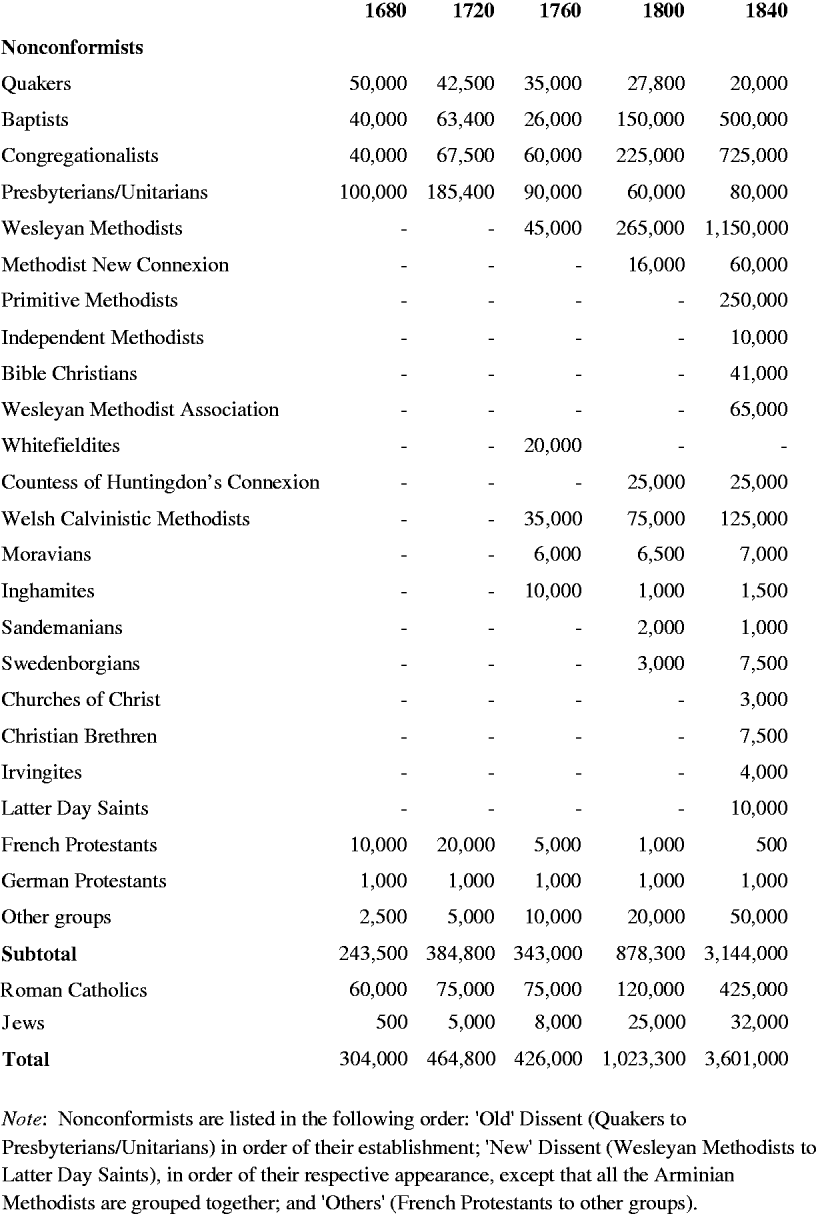
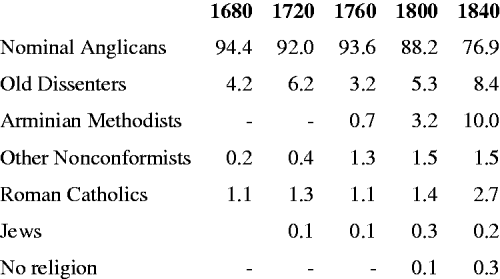
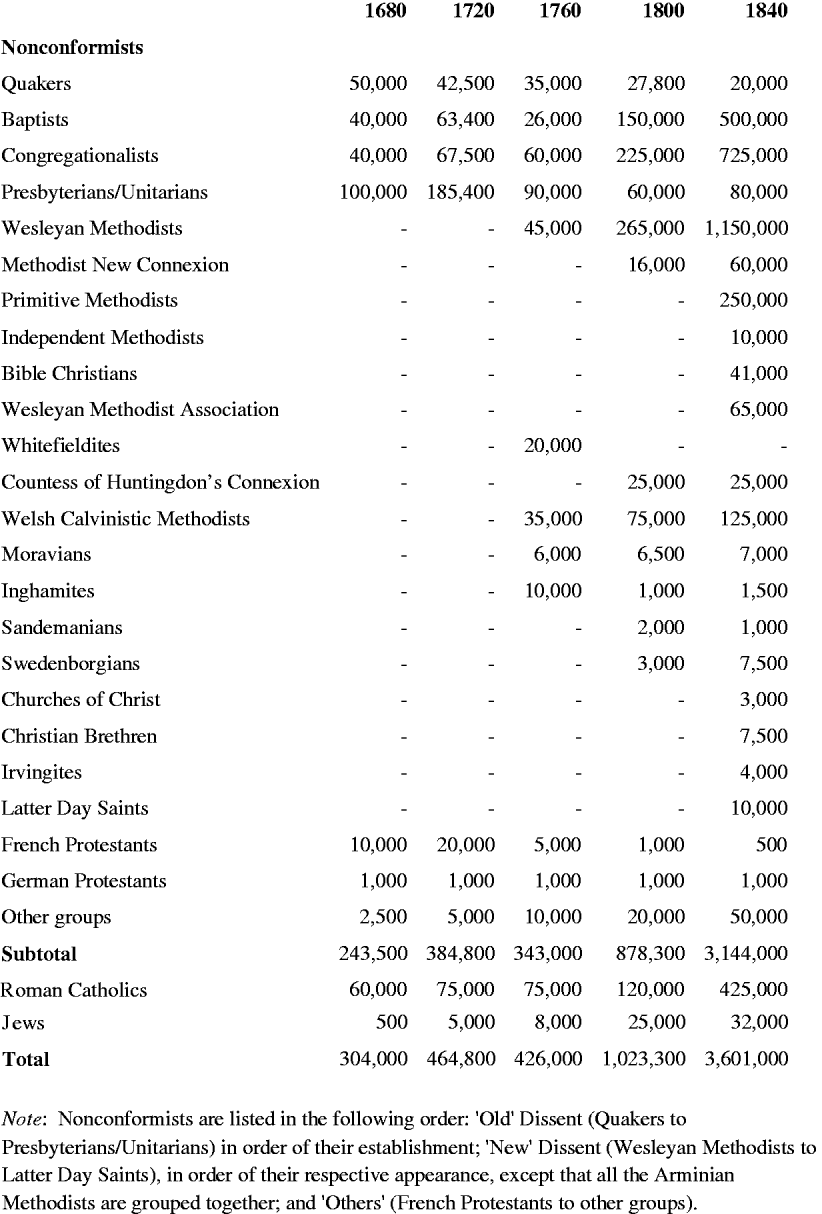
These detailed denominational data for Nonconformity are summarised in Figure 1, with additional estimates (including for smaller bodies and isolated congregations) and extrapolations by the author. The table naturally embodies a degree of subjectivity in determining which of any competing estimates seems the most surely grounded, as well as a significant amount of guesswork, albeit informed by strong contextual knowledge and (for the end of our period) sanity-checking against the 1851 religious census. Figure 1 shows the Nonconformist constituency in England and Wales increasing from 244,000 to 385,000 in 1680–1720, declining to 343,000 by 1760, before growing again, reaching 878,000 by 1800 and 3,144,000 by 1840. These totals exceed those given in the aggregate analyses of Nonconformity considered earlier in this paper, but not hugely. Not dissimilar figures have thus been arrived at via two different routes, which provides some assurance that the calculations may be in the right ballpark. On the whole, the more granular, bottom-up data prepared denomination by denomination seem preferable to the top-down aggregates. As a percentage of total population (see Figure 2),Footnote 152 Nonconformity grew from 4.4 per cent in 1680 to 6.6 per cent in 1720, fell away to 5.2 per cent in 1760 (notwithstanding the birth of Methodism), and then doubled its relative numbers in the two succeeding forty-year periods. By 1800 one person in ten was a Nonconformist and by 1840 one in five (one-half of them Arminian Methodists). All these figures include members, other adult adherents, children or, from the 1780s, Sunday scholars (of whom there were perhaps 900,000 in Nonconformist schools by 1840).Footnote 153
Estimates of non-Anglican communities in England and Wales, 1680–1840.
Estimates of religious communities in England and Wales, 1680–1840, expressed as a percentage of the population.

Roman Catholics had no equivalent of the Nonconformist concept of membership, and their numbers were mostly expressed in terms of total population, inclusive of children. Estimates were often bedevilled by the strong strain of anti-Catholicism which permeated English society, and which led to some very exaggerated contemporary figures, although one of the highest in the Restoration era (200,000 in 1677) actually came from a Catholic source.Footnote 154 Fear of papists was especially rife around the time of the 1676 Compton census, as a result of the duke of York's second marriage and a widespread conviction that he had converted to Catholicism, perhaps resulting in many individuals being wrongly suspected of recusancy in the census.Footnote 155 On the other hand, the census probably omitted church papists. Taking it at face value, and supplementing it with John Leyburn's confirmation register for the Province of York (which was poorly covered in 1676), the most plausible modern calculation of Catholics in England and Wales in about 1680 is 60,000.Footnote 156 What happened during the next half-century is confused, some evidence pointing to decline and some to growth. The extremes range from 25,000 to 180,000, with two respected recent historians, Gilbert and Jean-Alain Lesourd, inexplicably (they offer no arguments) nailing their colours to the higher statistical masts.Footnote 157 Unfortunately, while the House of Lords commissioned the Church of England to undertake two surveys of papists in 1705 and 1706, the returns survive too patchily to permit a definitive answer.Footnote 158 However, several local studies since the 1960s suggest that the direction of travel was a modest increase,Footnote 159 so that the middling-range contemporary estimates of 70–80,000 may be the most realistic for 1720.
More certainty surrounds the situation in the mid-1760s when a fresh census was commissioned by the House of Lords, in response to a concern that Catholic numbers were growing rapidly, one newspaper even quoting 200,000 for the London area alone.Footnote 160 A good set of returns survives, centrally and locally, for this 1767 census.Footnote 161 Some under-registration is believed to have occurred, which might raise the official total of 67,900 to 72,000, perhaps even a bit more (albeit John Bossy's 80,000, deduced from his research on rural Northumberland in the 1960s, seems too high).Footnote 162 This accords with the incomplete returns of the Catholic vicars apostolic to Rome in 1773, which, allowing for children of non-communicating age, points to 75,000 Catholics in England and Wales.Footnote 163 Another House of Lords census in 1780 counted about 70,000Footnote 164 but, notwithstanding Joseph Berington's maximum of 60,000 and Edmund Burke's 50,000 published in that year,Footnote 165 the enumeration is again thought to be deficient. The minimum for 1780 may well be 80,000, although Lesourd, correcting for higher non-response by Anglican clergy than in 1767 and factoring in trends in Catholic baptisms, has latterly advanced 91,000.Footnote 166 However, between 1680 and 1780 Catholics were not much more than 1 per cent of the population (see Figure 2).
From the 1780s immigration from Ireland had a transformational effect, both numerically and on the nature of English Catholicism. Lesourd's modern estimates of the English and Welsh community rose from 106,000 in 1790 to 120,000 in 1800, 208,000 in 1815, 315,000 in 1830 and 493,000 in 1845.Footnote 167 His 1800 figure is broadly compatible with the 129,000 (including Scotland) calculated independently by Currie, Gilbert and Horsley in 1977 (by back-projecting from the Catholic share of marriages in 1844).Footnote 168 That for 1815 seems plausible, yet other estimates for the decade range from 100,000 to 500,000.Footnote 169 Lesourd's 1830 total is consistent with Hulbert in 1826 but not with the Catholic hierarchy's 512,000 for the same year, nor with Currie, Gilbert and Horsley's (1977) 250,000 for Britain.Footnote 170 Probably something is wrong with the last-named authors' methodology, which produces only 305,000 in 1840, whereas Lesourd's 493,000 in 1845 can be reconciled with Catholic vicariate reports and McCulloch's estimate for 1837, albeit not with the speculative 700,000 in the Catholic Directory in 1840 nor the 2,000,000 put about by some Protestant sources at the time.Footnote 171 For 1840, having carefully weighed up the merits and demerits of each of these estimates, 425,000, 2.7 per cent of the population, seems the most probable, almost double the proportion in 1800. These community figures compare with 292,000 Catholic worshippers at the 1851 religious census,Footnote 172 exemplifying how Catholic practice (as opposed to profession) had declined with Irish immigration.Footnote 173
Jews, effectively the only non-Christian faith in England and Wales during this period,Footnote 174 were also measured in terms of their community. They had been banned from England during the reign of Edward i and only readmitted in 1656. Their numbers built up slowly, perhaps to 600 by 1689, after which there was a significant influx from Amsterdam, mostly refugee Sephardim from Spain and Portugal but with some Ashkenazim from central and eastern Europe.Footnote 175 They stood at 6,000 in 1738, according to D'Bloissiers Tovey's contemporaneous report,Footnote 176 and at 7–8,000 during the debates on the Jew Bill in 1753, in the view of a pseudonymous author at the time.Footnote 177 Writing in 1791, a foreign observer thought that there were still no more than 12,000,Footnote 178 but he seems to have allowed for only 1,000 in the provinces, which was too low. A figure of 20–26,000 is usually accepted for around 1800, following Patrick Colquhoun in 1797.Footnote 179 Estimates for 1827–30 mostly ranged from 22,000 to 30,000, with Francis Goldsmid's 27,000 of 1830 (based on projections from synagogue burial returns and death ratios) perhaps most accurate.Footnote 180 In 1845 the chief rabbi's enquiry suggested 35,000,Footnote 181 and this remained the case in 1851 according to Vivian Lipman's 1950s analysis of several sources, including the religious census. The census itself returned 6,000 attendances, many Jews being non-observant.Footnote 182
Finally, beyond the Church of England, there is irreligion. Atheism, in the strict sense of the word, hardly existed before the end of the eighteenth century (Britain's first avowedly atheistic book only appearing in 1782), even though the term was widely (mis)applied to those whose behaviour and thoughts were deemed ‘ungodly’.Footnote 183 Neither should unbelief be confused with anti-clericalismFootnote 184 or blasphemy.Footnote 185 Freethought in the Hanoverian era was largely an intellectual exercise, a matter for philosophers and theologians. Hence, when several Anglican bishops asked their clergy at visitation from the 1730s whether any of their parishioners ‘profess to disregard religion’, few received any affirmative replies for fifty years. One of the first serious exceptions was from the mother city of the Anglican communion in 1786,Footnote 186 but complaints soon began to multiply thereafter as, with the French Revolution, incumbents perceived a convergence of irreligion and socio-political radicalism.Footnote 187 Certainly, an infidel tradition in Britain is usually traced from the 1790s. Yet many radicals were Christians,Footnote 188 while secularism was slow to evolve as an organised movement, in succession to Owenism, and it had limited quantitative appeal. During the 1840s the number of secular societies never exceeded 75, while the circulation of The Reasoner was not much above 1,500; the National Secular Society (founded in 1866) never had more than 4,000 members.Footnote 189 At the same time, there is evidence from surveys of working-class city districts at the end of our period that some made no religious profession, so irreligion cannot be discounted from calculations for 1800 and 1840 (see Figure 2).Footnote 190
Subtracting the estimated number of Nonconformists, Catholics and Jews, as summarised in Figure 1, from the population produces the percentages of nominal Anglicans which appear in Figure 2. Regrettably, it is not possible to validate these figures at national level, since no question about religious profession was asked in connection with the civil census until 2001, and even then it did not differentiate between Christian denominations in England and Wales. A handful of local censuses exist for the eighteenth century, such as Hertford in 1747 (77 per cent Anglicans),Footnote 191 Stockport in 1754 (71 per cent)Footnote 192 and Woodbridge in 1777 (85 per cent).Footnote 193 There were further house-to-house surveys, conducted by statistical societies or home missions, in deprived working–class districts in the 1830s and 1840s. These yielded variable results, including instances where the Church of England commanded the allegiance of less than one-half the populace, where Roman Catholicism (as in Liverpool) or Nonconformity (as in Essex) was especially strong.Footnote 194 The only national proxy of religious affiliation at the end of our period is the proportion of marriages solemnised by the Church of England, 95 per cent in 1838–40, but since it was bureaucratic and costly to register non-Anglican places of worship for weddings, and many Nonconformists were attracted to the architectural and liturgical setting of Anglican ceremonies, this measure needs to be viewed with caution.Footnote 195
While the Church of England could thus lay claim to the support of the overwhelming majority of people, it did not follow that profession was translated into practice, especially in the form of constant churchgoing, notwithstanding the continuing statutory obligations on Anglicans to attend their parish church after the Toleration Act of 1689 and the remnants of ecclesiastical and civil discipline to ensure that they did so.Footnote 196 Sermons and tracts abound with clerical grumbles about absenteeism from worship, but it is hard to judge how much weight to attach to them, since they are characteristic of the moralising complaint literature penned by the clergy of almost any age. A few historians have been tempted to rely upon the number of communicants reported in diocesan clergy visitation returns as a means of quantifying religious practice.Footnote 197 This might seem logical, given that the 1604 canons required all parishioners to take holy communion at least three times per annum, one of which was to be at Easter. However, as Robin Gill has argued in recent years, popular attitudes to and observance of the sacrament have varied widely over time and place, and likewise has their relationship to churchgoing.Footnote 198 Throughout the period under review holy communion was lightly partaken,Footnote 199 with, for instance, Anglican communicants in 1834 representing just 13 per cent of Anglican hearers in 126 English towns and villages and 22 per cent in an unnamed diocese.Footnote 200
Evidence for Anglican churchgoing must thus be sought elsewhere, from other questions in the visitation returns or from different sources altogether. What there is for the eighteenth century points to a progressive increase in the numbers who rarely or never attended church and to decreasing regularity in worship among those who did go.Footnote 201 Diocesan audits of sittings in 1815 confirmed that, in any case, the majority of people could not have been accommodated in Anglican places of worship.Footnote 202 By the 1830s and 1840s, when visitation returns and local churchgoing counts provide harder figures, it was common for average Anglican congregations to represent no more than one-fifth of the population in towns.Footnote 203 On census Sunday 1851, according to Watts, 20 per cent of people attended parish churches in England and 11 per cent in Wales.Footnote 204 Many more than this will have worshipped with the Anglicans at some point during the year, other than for rites of passage, one Hampshire clergyman reckoning (in 1832) that 24 per cent of his adult flock attended constantly, 20 per cent generally, 37 per cent occasionally and 19 per cent never.Footnote 205 Like many contemporaries, Horace Mann, architect of the 1851 census, assumed that Anglicans were less assiduous worshippers than Nonconformists. He therefore doubled the number of their attenders (corrected for twicing) on census day to arrive at the total of those who ever went to church.Footnote 206 He offered no empirical justification for this adjustment, although some anecdotal proof can be found in the original schedules of the census.Footnote 207 If he was right, 42 per cent of English and Welsh would have been churchgoing Anglicans, 30 per cent chapel-going Nonconformists, 3 per cent churchgoing Catholics and 25 per cent non-churchgoers (the same proportion of total absentees given by writers at the start of the century).Footnote 208
These quantitative musings, unadjusted for any double-counting arising from dual confessional allegiances, are necessarily speculative and subject to revision in the light of future detailed research on individual religious traditions. As such, they must be used with a degree of circumspection. But, as the first attempt to establish some sort of holistic baseline and without recourse to proxy measures, they do demonstrate the principal religious changes which occurred during this period of 160 years, and they do seem to be broadly compatible with the 1851 religious census. The Church of England held on to an affiliation market share of over 90 per cent for the first half of this long century but ceded ground thereafter, particularly during the final four decades, triggering demands for disestablishment from the 1840s. It lost the support of almost one-fifth of a growing population between 1680 and 1840, with an ever increasing number of nominal Anglicans also ceasing to practise. Nonconformity in all its variants more than quadrupled in the same interval, mainly from 1760 and especially after 1800, with Arminian Methodism the principal engine of expansion. Roman Catholicism kept pace with demographic growth, but, even reinforced by Irish immigration, remained a limited force in 1840, not least considering that the Irish were indifferent mass-goers. Judaism and overt irreligion were both negligible.
In one sense, these are not startling conclusions. Neither is it asserted that numbers are everything (the disproportionate influence on national life exercised by comparatively small denominations such as the Quakers and Unitarians is certainly testimony to that). Yet these tentative statistics do provide more secure empirical foundations on which to debate key themes in the religious historiography of the long eighteenth century and beyond, including the genesis and progress of Methodism and the Evangelical revival, the pastoral performance of the Church of England, the alienation of the working classes from organised Christianity, the origins of religious pluralism, the roots of anti-Catholicism, and the sectarianisation of party politics. In particular, they highlight the value of ‘data’ sitting alongside ‘discourse’ in assessing whether Hanoverian England was ‘a confessional state’Footnote 209 and in any continuing application of secularisation theory to the study of ‘the death of Christian Britain’ from 1800.Footnote 210