The reforms of 1883–85—namely the Corrupt and Illegal Practices Act of 1883, the Third Reform Act of 1884, and the Redistribution of Seats Act of 1885—radically reshaped Britain's electoral system.Footnote 1 Taken together, these three acts were as much a leap in the dark as the more celebrated widening of the franchise in 1867. When a general election was called in November 1885, few could claim to have much idea of what kind of Parliament, or political culture, would emerge. The Manchester Guardian forecast “great uncertainty as to the result of the coming election, on the grounds (1) of the vast number of new electors [and] . . . (2) in consequence of the large number of new constituencies created.”Footnote 2 Similarly, the Times described “the uncertainty as to the result of the struggle” stemming from “the unknown effect of the extension of the franchise.”Footnote 3
Conservative auguries on the election result—and their party's future—were gloomy.Footnote 4 Salisbury and Northcote were exceedingly pessimistic on the probable radicalism of the newly enfranchised agricultural laborers, who had displaced the farmers as the largest voting class in the rural divisions, the Tories' traditional strongholds.Footnote 5 By contrast, the strikingly democratic reforms delighted many radical Liberals, foremost among them Joseph Chamberlain. The former screw manufacturer and mayor of Birmingham had seen his star rise dramatically since his appointment to Gladstone's cabinet in April 1880, and by 1885 he could reasonably claim to be Britain's best known radical.Footnote 6 The reforms, and the popular excitement they generated in the months leading up to the election, emboldened Chamberlain to float his controversial “Unauthorized Programme” before the nation in a succession of high-profile public meetings held during the spring and summer of 1885.Footnote 7
Chamberlain's program proposed free education, land reform, disestablishment of the Church of England, graduated taxation, death duties, elected county government, manhood suffrage, and payment of MPs.Footnote 8 As such, it constituted a bold attempt to place state intervention, the condition of the poor, and the legitimacy of wealth and property prominently on the political agenda. He presented it in often explosive language, as heralding a new “radical millennium” and “reign of democracy” that would prioritize “natural rights” and a “ransom of private property” in return for its security.Footnote 9 Unsurprisingly, Whiggish Liberals—especially Hartington, Goschen, and Granville—were alarmed by both the content and tone of Chamberlain's performances. Gladstone's own manifesto, issued in September, sought to diffuse the tensions at the top of his party, but its timid contents—streamlining parliamentary procedure, registration reform, and a modest measure of local government—were regarded by Chamberlain as “a slap in the face.”Footnote 10 Although “Radical Joe” paid lip service to Gladstone—mischievously remarking at Birmingham in November that “I concur with everything in his manifesto . . . but I think I may go a little further”—he unleashed his full wrath on the Whigs.Footnote 11 He nominated Goschen as a “whipping boy” to be targeted in speeches, and at Lambeth in September publicly criticized Goschen's infatuation with “the old Whig programme.”Footnote 12 His spat with Hartington was similarly high profile, and Randolph Churchill was by no means wide of the mark when he described Chamberlain's “headlong war . . . against the Whigs.”Footnote 13
Despite these divisions, the Liberals comfortably won the 1885 election by 319 seats to the Conservatives' 249, with poor results in the boroughs counterbalanced by outstanding gains in the counties that had been altered most dramatically by reform.Footnote 14 Seeking to gauge how far Chamberlain's program influenced this result and had an impact on the tens of thousands of campaign speeches delivered across the country has understandably inspired considerable scholarly interest and no little disagreement. In this article I reassess this debate through a wide-ranging quantitative analysis of the electoral language of 1880 and 1885.Footnote 15 Using multimillion-word databases (“corpora”) of Liberal and Conservative speeches, I primarily focus on a case study of the campaign in East Anglia but also include parallel supplementary studies of the national campaign featuring frontbench party leaders and the campaign in constituencies outside East Anglia. In the article, I argue that we have underestimated the impact of the unauthorized proposals on the content of the campaign, especially in rural constituencies, and that Chamberlain was in fact in a far stronger position after the election than many historians—and he himself—imagined.
■■■
An assessment of the impact of the “Unauthorized Programme” on the 1885 campaign is complicated by Chamberlain's lack of clarity in the preceding months. He vacillated in tone and stridency from speech to speech, mostly according to ebbs and flows in his turbulent relationships with other leading Liberals.Footnote 16 At some points, he appeared to present his proposals as little short of a revolutionary program for reinventing the nation, while at others, he dismissed the idea that they constituted a platform at all, being merely a set of personal aspirations.Footnote 17 Writing in retrospect in 1891, however, he was inclined to remember his boldness above his timidity, recalling “the so-called ‘Unauthorized Programme’ of 1885 on which about two-thirds of the Liberal Party fought the election.”Footnote 18
Despite his occasionally brazen claims that the unauthorized proposals represented a national manifesto, Chamberlain's program was designed primarily as a nostrum to urban, rather than rural, ills. It was inspired by investigations into the plight of the urban poor in the East End of London (by Andrew Mearns) and in Newcastle (by Robert Spence Watson), as well as by Sir Charles Dilke's royal commission on the housing of the working classes. These men had minimal personal acquaintance with the countryside, and Chamberlain himself had only become familiar with the conditions of the rural poor during a visit to Wiltshire in the summer of 1885.Footnote 19 Chamberlain's emphasis on towns and cities also made political sense. The vast majority of prior radical electoral success had been in boroughs, whereas rural regions had generally remained stubbornly Tory since 1832. While the reforms of 1883–85 certainly had the potential to shake things up, it seemed unlikely that they would fundamentally change this situation overnight.
Historians' views of the electoral impact of the program, its influence on Liberal party ideas and ideology, and how far it achieved its authors' strategic objectives, are mixed. A small group—including, most prominently, C. H. D. Howard—see Chamberlain's intervention as an electoral success in 1885 and a major contributing factor to the astonishing Liberal gains in the counties.Footnote 20 For John Belchem, the program's weaker impact in the boroughs—the lack of an “urban cow” to graze beside her rural sister—was the chief reason Chamberlain failed to arouse national working-class enthusiasm.Footnote 21 Paul Readman and Alun Howkins, meanwhile, cite the importance of land reform in moving the general Liberal agenda further towards anti-landlordism, compulsory purchase, and, ultimately, redistribution of wealth.Footnote 22 Alan Simon, in his article on the program's proposed disestablishment of the Church of England, also agrees that Chamberlain succeeded in placing the religious question at the heart of the campaign, and Patricia Lynch acknowledges that the unauthorized proposals indirectly inspired sharp Liberal attacks on landlords and Anglican clergy in the countryside.Footnote 23 Indeed, historians have estimated the number of “Chamberlainite” Liberal MPs returned in 1885 to be as high as 160–80 (a growth of roughly one-third from 1880). This figure certainly suggests that the program was, as Chamberlain believed, widely cited by Liberal candidates and may have contributed to electoral success.Footnote 24
There are, however, a much larger number of historians who take a more negative view that the “Unauthorized Programme” was no coup for Chamberlain and that its specific proposals excited little Liberal enthusiasm. David Hamer contends that “to many Liberals it looked merely a rhetorical gloss on a basically unexciting set of reform policies,” and Peter Marsh argues that Chamberlain was “dazzled by the doubling of the electorate” and produced an ill-judged manifesto that, despite limited positive influence in certain rural regions, “repelled more voters than it attracted.”Footnote 25 Henry Pelling, meanwhile, suggests agricultural laborers' support for Liberalism in 1885 arose “more out of fear of fiscal change, which might increase the cost of living, than because of any positive attraction of Chamberlain's social programme.”Footnote 26 Hugh Cunningham, James Moore, and Michael Barker are similarly skeptical on the popular purchase of the unauthorized proposals, as is Peter Clarke and Kevin Langford's study of the agricultural laborers in 1885 in Suffolk, which argues that the “three acres and a cow” slogan (coined by Chamberlain's close ally Jesse Collings) was “ridiculed by the Conservatives and disowned by Liberals.”Footnote 27 Indeed, Jon Parry and Robert Self suggest that the program did more to fire enthusiasm on the other side by energizing moderate and conservative opinion, especially in defense of church and property.Footnote 28 These ascriptions of failure to Chamberlain's program are made despite the general acknowledgement that the tone and content of the 1885 campaign were significantly more radical than that of 1880.
Indeed, it is striking that even those historians who credit the program with firing major enthusiasm in the countryside do not—even in the face of the outstanding Liberal gains—credit this particularly to Chamberlain himself. Readman and Howkins grant him indirect credit, but stress the importance of specific proposals of land reform articulated by allies such as Collings and Joseph Arch above Chamberlain's charismatic leadership, his program, or his general radical vision.Footnote 29 Lynch, even though she argues that the 1885 election pushed rural Liberalism to the left, sees this as a grassroots process that depended more on constituency traditions and the differing approaches of candidates than external influences from Birmingham.Footnote 30 Parry, although he acknowledges the force of the attack on traditional Liberalism from 1885, is also inclined to view Chamberlain as a storm in a teacup because his municipal socialism (which was seen as ad hoc, compulsory, and confiscatory) was at odds with the thinking of traditional Liberal radicals, such as John Bright, who belonged to the party's moralistic-economy wing.Footnote 31 Overall, although historians disagree on the extent to which the program influenced constituency speaking campaigns and on its electoral success, they are united in being remarkably sparing in their attribution of credit to Chamberlain, and they generally view his position in the immediate aftermath of the election as weakened.
I would challenge this popular view by advancing two arguments. The first is that, while historians have acknowledged the transformative influence of the reforms of 1883–85 on electioneering in the countryside, they have yet to develop a comparable understanding of the reforms' parallel impact on electoral language. This has caused us to underestimate the degree to which the basis of rural political appeals were quite fundamentally recast in 1885, with the agricultural laborer immediately—and permanently—replacing the farmer as the most targeted and canvassed voting class. While this is a significant general finding, it is also important because it serves to greatly strengthen the fundamentals of Chamberlain's position. The cessation of rural politicians' traditional emphasis on farming, which had dominated in 1880 and before, and the new centrality of the agricultural laborer gave “Radical Joe” a much stronger launching pad for his unauthorized proposals in 1885 than has been acknowledged. His real mistake was that he misread its location: he aimed his program at the boroughs when his real democratic strength lay in the countryside.
This leads to my second argument, which is that the program—especially its proposals of land reform, disestablishment of the Church of England, and free education—dominated the rural platform in 1885 and formed the cutting edge of Liberal appeals and Conservative counter-appeals. Historians who dismiss the program as a tactical failure, and even those who view its impact as mixed, are thus perhaps taking Chamberlain's pessimism at the national 1885 result a little too literally. His defeatist writings, his continuing quarrels with frontbench Liberals, and, especially, his defection from the party six months later, all make it easy to underestimate just how strong he really was in the aftermath of the 1885 election. He may have ended up with a different power base than he anticipated and failed to conclusively “destroy” (as he put it) the Whigs in one contest, but the fact that he fell short of his own wildly optimistic predictions should not diminish the impact he did achieve. He transformed the 1885 campaign and unambiguously claimed the mantle of “the Liberal leader of the future” (as the Birmingham Daily Post hailed him) and as “the coming man” of British politics (as Henry Labouchere put it).”Footnote 32 Indeed, the impact that the potentially radical new Parliament might have had in defining post-reform Britain over the next six years—and Chamberlain's role in it—remain unknown, as it was aborted after only six months. At this counterfactual crossroads, it seems fairer to blame Gladstone's conversion to Home Rule over Chamberlain's supposed failure to seize the popular initiative in 1885 as the decisive factor in knocking the wind from the sails of radicalism for the next two decades.
■■■
Before I proceed further, my methodology requires some introduction. Concerned almost exclusively with extra-parliamentary election speeches,Footnote 33 my analysis primarily focuses on those delivered by grassroots constituency candidates in East Anglia in the 1880s. This region is composed entirely of heavily rural constituencies and provincial boroughs.Footnote 34 However, to provide a much more national survey, I made parallel analyses of the national campaign, and speeches in other localities. Despite the emphasis on language, my study differs from other discourse-driven studies because its primary aim is not to reconstruct the rhetoric or cultural narrative of a particular place, time, or group.Footnote 35 Instead, it prioritizes the systematic investigation of broad linguistic trends over a huge volume of speech, using quantitative, computer-driven methods. As such, it sacrifices some depth for breadth. I used a corpus—a multimillion-word electronic database of campaign speeches that were digitized from newspaper reports—to assess the impact of key issues, ideologies, values, personalities, and traditions on Liberal and Conservative language in different elections and localities. This methodology, surprisingly simple, and is inspired by the field of corpus linguistics. In this field, corpora are interrogated with computerized text-retrieval techniques with the aim of answering linguistic research questions, principally by electronically counting the occurrence of words and establishing common patterns between them (“concordancing”).Footnote 36
I use corpora because they have considerable utility for the study of texts as vast as election campaigns, which probably totaled close to half a billion spoken words nationwide.Footnote 37 For example, concordances can establish how often Conservative speakers in East Anglia mentioned “Imperialism” or “Ireland” relative to Liberal opponents, and in what elections. Alternatively, a concordance could be used to assess whether “Gladstone” was cited more often by frontbench speakers than “Beaconsfield” in 1880, or “Salisbury” in 1886. Crucially, while corpora naturally lend themselves to a quantitative approach, they can also be used qualitatively, especially through the “key word in context” (KWIC) technique. This displays each sentence containing a nominated word or phrase (for example, “Gladstone”) as a list, allowing the sentences to be manually assessed en masse. This allows each instance a word appears to be checked to ensure accuracy, and also allows sentences potentially to be categorized into groups (such as criticism versus praise, pro versus anti), facilitating analyses of how words were commonly used and with what political arguments they were connected.
Although historians have very seldom used corpora to analyze language, their value has been well demonstrated in political science.Footnote 38 Their unique selling point is that they allow us to assess typicality, scope, and power of key issues, concepts, and personalities across a huge volume of language. This can permit a more holistic analysis—allowing the ability to measure rather than intuitively estimate—the important characteristics of vast texts that are physically impossible to manually analyze (or even read) in their totality. This quantitative methodology is, unsurprisingly, not without controversy, and I offer a defense of the judicious and careful use of corpora in political history elsewhere.Footnote 39 It will suffice to say that my general approach is to employ quantification cautiously and selectively when it is useful rather than seeing it as a replacement for the traditional close manual reading of speeches. Indeed, the following analysis employs both qualitative and quantitative methods in tandem throughout.
I used four corpora in my research. The most important are the East Anglian Corpus and the Frontbenchers Corpus. The remaining two—the Pre-1880 East Anglia Corpus and the Outside East Anglia Corpus—are supplementary. All quantitative interrogation of these corpora was performed using AntConc, a free, open-source, text-analysis program. The East Anglian Corpus contains just under a million words of speech, taken from newspapers, from the nine general elections held between 1880 and December 1910. It is representative and balanced, containing equal quantities of speech from each Norfolk and Suffolk constituency. It is divided into equal subsamples of 50,000 words for the nine elections and the two parties: eighteen subsamples altogether. In 1880, there are 50,000 words for the Conservatives, for example, and 100,000 for both parties taken together.Footnote 40
The Frontbenchers Corpus, meanwhile, contains approximately 1.5 million words of the high-profile election speeches delivered by the leading lights of the two parties, i.e. the cabinet and shadow cabinet members. These speeches are taken from the Times, and the corpus includes every extra-Parliamentary speech reported from a frontbencher from the dissolution of Parliament to the last return, subdivided by party. To make this corpus directly comparable with the East Anglian Corpus, its concordance results are also weighted to 50,000 word ratios per party, per election. In a 200,000-word subsample for Liberal speakers in 1885, the scores would be multiplied by 0.25 to get the weighted Liberal reading.
The two supplementary corpora add extra context when useful. The Pre-1880 East Anglian Corpus is just 70,000 words and consists of two subdivisions from 1835 and 1874.Footnote 41 The Outside East Anglia Corpus is more important and is used to investigate grassroots language outside of Norfolk and Suffolk in 1880 and 1885. It contains some 300,000 words of speech, approximately 75,000 for each party at each election, which are similarly weighted to be comparable to the other corpora.Footnote 42 Speeches from forty seats are included in this corpus (selected by electronic availability from the British Library Newspaper Archive) to represent the diversity of Britain's regions and constituency types as well as possible.Footnote 43
■■■
Historians have had relatively little to say about the impact of the 1883–85 reforms on electoral language and culture in the counties, despite their keen interest in the parallel electioneering developments.Footnote 44 This seems to be because the majority of local studies deal with urban areas, and those that do focus on rural constituencies invariably cover just one of the 1880 and 1885 elections, not both.Footnote 45 However, despite the lack of specific comparisons between these elections, historians such as Howkins, Readman, and Lynch have suggested that the 1883–85 reforms had a sizeable impact on language in the countryside, particularly because they helped stimulate popular discourses of rural radicalism, especially romantic and sentimental evocations of idealized village communities and pre-enclosure Britain.Footnote 46 However, there is little acknowledgement that this change catapulted the laborer into a new position of prominence in 1885. Indeed, Barker contends that the laborers “could not pretend to be the decisive influence” and that farmers were the crucial swing voters.Footnote 47 Lynch, meanwhile, argues that both parties assumed that “Hodge” would generally defer to the wishes of his landlord master, making it inexpedient to canvass him.Footnote 48
In my investigation of the changing basis of political language in the countryside, I found that the emphasis of politicians' appeals immediately and permanently shifted from farmers to agricultural laborers in 1885. This change established a rhetorical as well as electoral constituency for Chamberlain's unauthorized proposals in rural and semi-rural divisions, which had been absent in 1880.
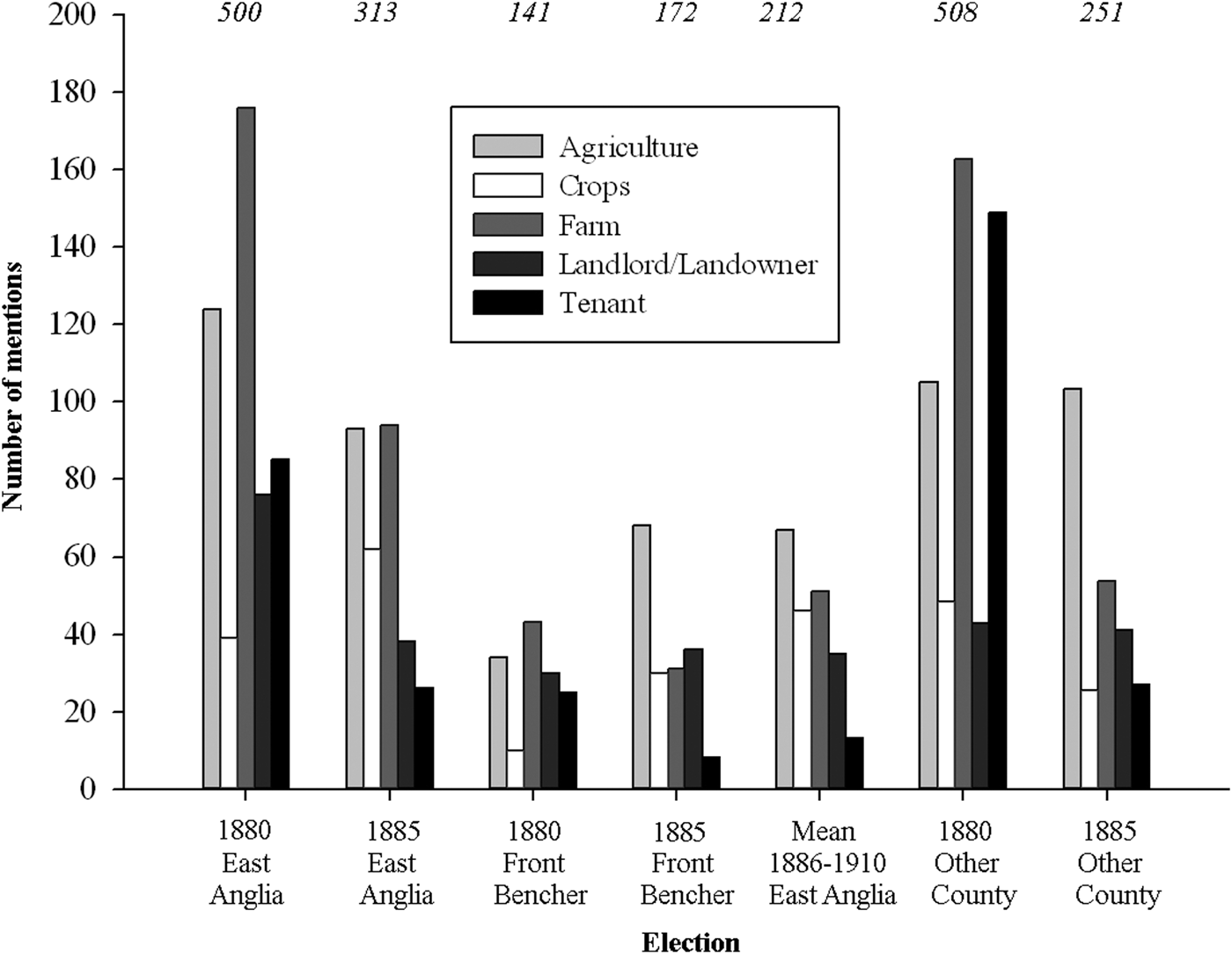
I start with an analysis of the language of farming in the election of 1885, comparing it to that of the previous election, of 1880, mainly focusing on the campaign in East Anglia. To measure the visibility of farming in the election, I used a taxonomy (group of keywords) that reliably correlates to occasions where parties talked about farming: “agriculture,” “crops,” “farm,” “landlord,” and “tenant.”Footnote 49 The purpose of the taxonomy is to provide a reliable (although not perfect) tracking mechanism, which can simply measure the relative salience of given issues in large corpora.Footnote 50 All keywords were treated as “lemmas”: “farm,” for example, also includes “farmer,” “farming,” “farmland,” and all derivatives. Using these five lemmas ensured that the concordances miss a far smaller amount of relevant language than they would if I relied on just one. Crucially, each mention of a keyword is manually re-checked in its original context using a KWIC to make sure no words are included incorrectly.Footnote 51 This process of quantification is thus done with extreme care, performed with continual cross-referencing back to the original text. The results for the visibility of the language of farming in East Anglia and nationally for 1880 and 1885 are displayed above in Figure 1. Each election on this graph (and those throughout the article) is represented by a 50,000-word subsample for each party, or 100,000 when both parties are combined, as is the case here.
The Language of Farming, 1880–1910.Footnote 52 The combined score for all five keywords for each election is shown at the top, in italics. Each bar represents both parties combined (100,000 word samples).

Figure 1 clearly suggests that farming loomed particularly large in East Anglia in 1880. The lemma “agriculture” is at its peak, with 124 hits (56 mentions by Conservatives and 68 by Liberals), well ahead of its usage level, 93, in 1885 and a mean score of 67 for the seven subsequent elections before the Great War. Overall, the aggregate reading of 500 for all five farming keywords in 1880 is easily greater than the 313 for 1885 and the average score of 212 for the seven other elections fought between 1886 and 1910. These figures suggest that in 1880, farming was roughly equal in prominence in East Anglia as other contemporary national issues, such as finance and foreign policy.Footnote 53 Indeed, this high reading for 1880 is rendered still more distinct because a disproportionate proportion—60 percent—of contested East Anglian divisions were actually boroughs in this election, skewing the speaking campaign towards constituencies where, one would imagine, farming would be less important. Indeed, if we take East Anglian county divisions alone, the aggregate score for 1880 (rounded to an equivalent ratio) is 1,155, compared to 403 for counties alone in 1885: a still starker difference.Footnote 54 Finally, Figure 1 also includes columns for “other county constituencies.” These readings are drawn from the Outside East Anglia Corpus, which contains a wide range of speeches taken from constituencies all over Britain. Taking just the county seats from this corpus, the combined score of 508 for all five farming keywords for 1880 is double the 251 of 1885. This suggests that these trends applied in counties throughout Britain, not just in East Anglia.
The centrality of farming to the 1880 election is also well demonstrated by the tone of Liberal and Conservative speeches. In East Anglia, Anthony Hammond (Liberal, West Norfolk) extolled the “farmers of Norfolk, amongst whom we lived, not merely on terms of acquaintance, but on terms of friendship”Footnote 55 and promised to “serve both as their member for Parliament and as their master of the hounds.”Footnote 56 In East Suffolk, Robert Lacey Everett (Liberal) told his audience that “[if] you wish to see your brother farmers are in earnest and wish to see your brother farmers safe . . . vote for me.”Footnote 57 In fact, it seemed to be the presumption that members for Norfolk and Suffolk counties were returned primarily to represent the bipartisan agricultural interest above party. Thomas Thornhill (Conservative, West Suffolk) remarked that “any measure for the benefit of the agricultural community, whether emanating from Whig or Tory, would receive his support” while his running partner, Herman Biddell, made a similar promise.Footnote 58 In South Norfolk, Clare Sewell Read, when criticized for his want of independence from the Tory whip, issued a four-thousand word printed “Defence” to each household in the division to explain why he was “a farmer first and a Tory second.”Footnote 59 It is worth pointing out that these appeals were not simply a response to the peculiar intensity of the agricultural depression in 1880. The poor state of farming was the norm rather than the exception in these decades, and candidates in future elections similarly complained of the “terrible depression in farming,” the “depression which hangs over the agricultural interest,” and how the lean times were simply “ancient history now.”Footnote 60
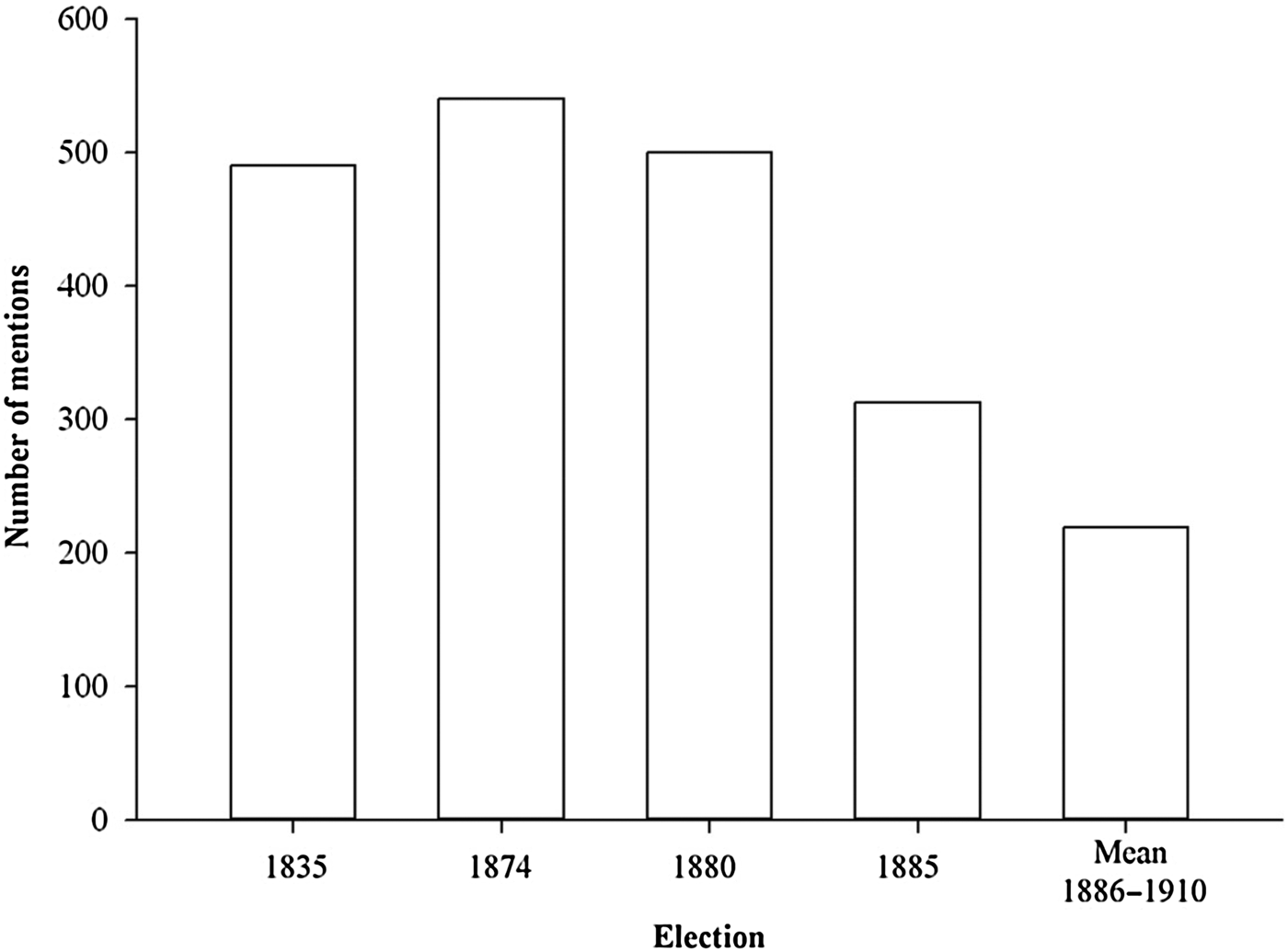
It seems likely, then, that farming in 1880 was not merely a transitory election issue, but reflected the dominant paradigm of pre-reform countryside politics, which possessed a predominantly farmer-based franchise in many, if not most, rural divisions. It was arguably this, rather than the depression, that influenced candidates to talk continuously about farming. This point can be illustrated more powerfully by comparing the East Anglian language of 1880 to that of 1874 (and even 1835) using the supplementary pre-1880 corpus to investigate the speaking campaigns in these older contests, once again using the five-word farming taxonomy.Footnote 61
Figure 2 shows that in 1874 these farming keywords were mentioned a combined total of 540 times by both parties, a very similar reading to the 500 we saw for 1880.Footnote 62 Perhaps more strikingly, the score of 490 for 1835 is also very similar.Footnote 63 These three pre-reform election aggregates are well ahead of the 313 for 1885 and the average of 212 for the 1886–1910 period. We can thus reasonably conclude that the preponderance of farming in rural discourse in 1880 represented the continuation of a long-standing tradition rather than a passing period of excitement. Indeed, while rural political life was by no means insulated from the ebb and flow of the national political mood, it seemed likely that farming would always be a central election issue in the countryside while farmers comprised the dominant voting class. In this respect, R. L. Olney and Richard Davis are perhaps right to argue that the substance of rural politics had not changed fundamentally in the fifty years since 1832.Footnote 64 There was thus nothing automatic about the modernization of politics: while tenant farmers continued to dominate the franchise in the countryside, it seemed unlikely that the basis of rural electoral language would change.
The Language of Farming in East Anglia, 1835–1910. Each bar represents both parties combined (100,000 words sample).
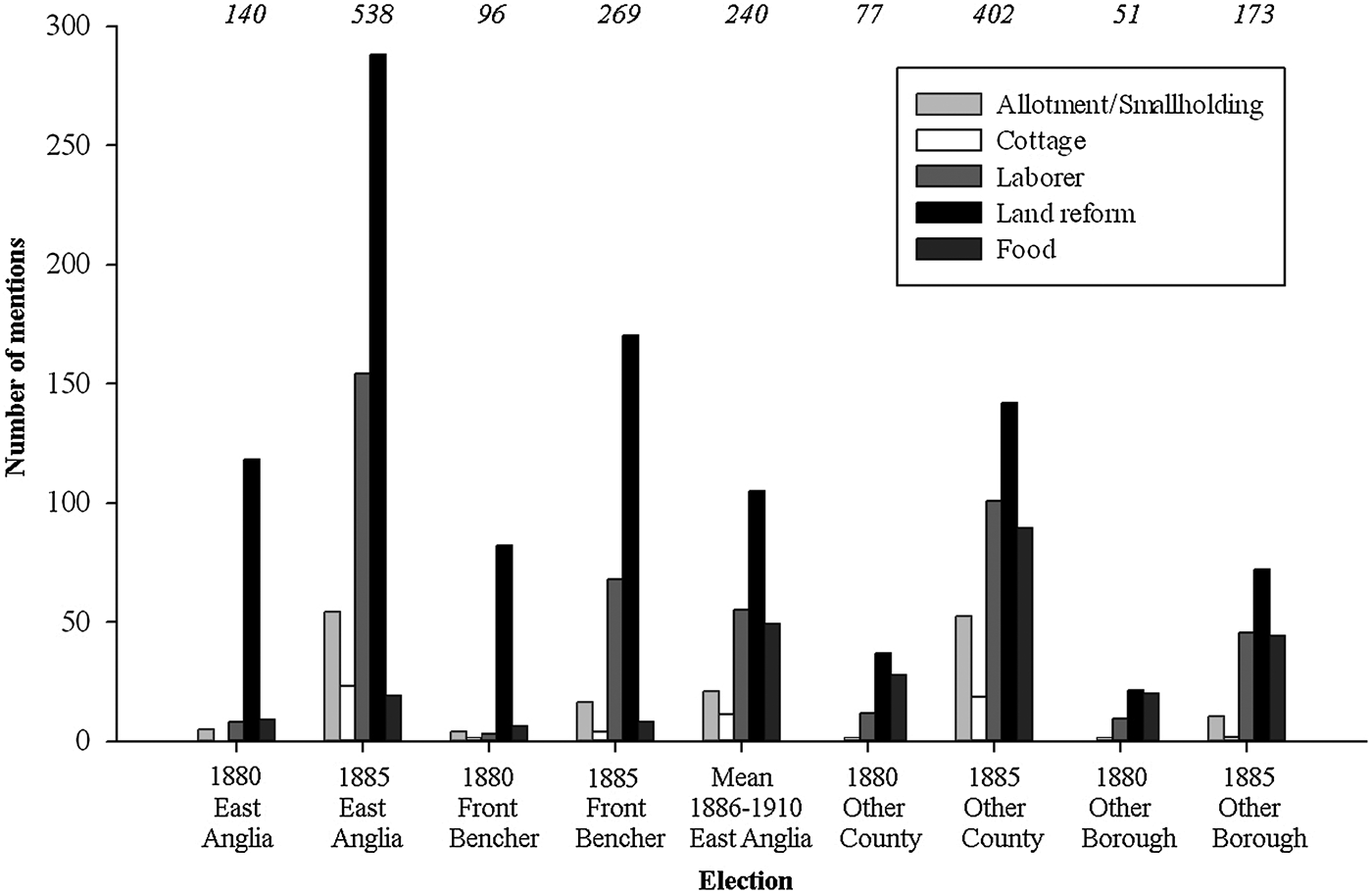
What impact, then, did the agricultural laborers have when they became voters in 1885? Figure 3 represents the findings for another five-word taxonomy, this time to track the visibility of agricultural laborers, and agricultural laborers' issues. The lemmas selected were “labourer,” “allotment,” “cottage,” “food,” and “land” (restricted to contexts of land reform).Footnote 65Figure 3 shows a dramatic increase in the visibility of agricultural laborer's issues in 1885 compared to 1880. The aggregate scores for East Anglia nearly quadruple between 1880 and 1885, moving from 140 to 538 mentions. In the frontbench speaker's corpus, these scores increase almost as dramatically: from 96 in 1880 to 269 in 1885. In county constituencies outside East Anglia, the supplementary corpus suggests a still more startling inflation, from 77 to 402 aggregate mentions. Indeed, even borough constituencies outside East Anglia, where laborers were scarcely represented, register a threefold jump. These overwhelming trends suggest that the enfranchisement of “Hodge” prompted a quite dramatic recasting of the language of the countryside in 1885, where direct appeals to him—and issues such as rural housing, food, and allotments—exploded in frequency, whereas the language of tenant farming declined. Of course, neither set of vocabulary was entirely mutually exclusive, and appeals aimed at agricultural laborers would by no means necessarily be unappealing to farmers, or vice versa. We thus naturally cannot assume that changes in word frequency correlate precisely to actual shifts in appeal, but we can confidently conclude that the center of gravity of rural political language had shifted dramatically.
Agricultural Laborers' Issues in Party Language, 1880–1910. The combined score for all five keywords for each election is shown at the top in italics. Each bar represents both parties combined (100,000 words sample).
Although 1885 marked the peak of the dominance of the agricultural laborer in electoral discourse in East Anglia, Figures 1 and 3 also suggest that Hodge's enlarged presence continued to be felt until the Great War, and that he continued to overshadow his tenant farmer employer during these decades. Indeed, the East Anglian Daily Times declared in 1885 that “the labourer, having got the vote, is now as good a man as his master.”Footnote 66 Parties were still keener to flatter him. Gurdon (Liberal, North Norfolk) “was anxious that the new voters should prove that they should have the same privileges as the influential farmers . . . had had for years.”Footnote 67 Many radical Liberals went further: an East Norfolk speaker declared that “the labourer now read newspapers . . . the days when he could be cajoled by occasional doles of broth and blankets were over,” and Jacob Tillett (Norwich) proudly described a county meeting where “farmers continually created a disturbance . . . the labourers told them to be quiet . . . and turned their masters out.”Footnote 68 The Conservatives also fought hard to gain Hodge's support. Of the 538 mentions of laborers' issues in 1885, 55 percent came from their side. Hunter-Rodwell (Eye) complained of Liberal attempts to “make out that the landlords and the farmers had been the enemies of the labouring class” while Thornhill (Stowmarket) praised “his own property [where] the labourers had a good cottage and garden, for which they paid 1s a week” and Lord Rendlesham (Woodbridge) made an almost identical boast.Footnote 69 This communitarian emphasis on the traditional harmonious hierarchy of landlord, farmer, and laborer was the antithesis of that of the radicals' more antagonistic appeal, and these attitudes were later embodied by Lord Winchelsea's National Agricultural Union in the 1890s.Footnote 70
Overall, the qualitative and quantitative evidence scarcely suggests that either party was unprepared for the new voters in 1885 or believed that they would be deferential or apathetic, as Lynch and Pelling have suggested. On the contrary, it seems that rural politicians adapted strikingly quickly to the new electoral conditions before a vote had even been cast, shifting the center of gravity of their appeals from farmer to laborer. Indeed, both sides seemed acutely aware that Hodge possessed both an interest in politics and his own political (although not necessarily party) identity. Whether parties liked it or not, the man who, according to an 1874 Ipswich Conservative, “drives a muck cart . . . follows a plough, who does not know the distinction between a Whig and a Tory, and who can neither read, write, nor spell the word” was the new master of rural politics.Footnote 71 For the East Anglian Daily Times, his allegiance was “yet to be won,” while the Eastern Daily Press judged that he attended meetings “not for the purpose of agreeing with [the] speakers . . . but for the purpose of weighing them [and] thinking over them.”Footnote 72 All this made it politically essential for parties to specifically target him from the platform. Indeed, a South West Norfolk Conservative agent warned a local party benefactor, Lord Walsingham, that “Amherst's [the candidate] seat will not be worth a dog's purchase [sic]” unless the party held meetings in each village and adopted “a paid labourers' agent who can take talk [sic] to the labouring class in their own language.”Footnote 73 Thus, Lynch's use of 1885 as an example of the continued centrality of tradition in rural politics is misleading.Footnote 74 If anything, what was more striking in this contest was the pragmatic willingness of the rural parties to move quickly and decisively away from traditional appeals and towards a more populist and democratic language, which, they believed, would appeal to the new voters. This root and branch recasting and reinterpretation of the language of rural politics should be regarded as being equally as important as the much more celebrated organizational developments that accompanied them.
It is against this changed backdrop, then, that Chamberlain's unauthorized proposals appeared on platforms in the countryside. The Conservatives feared that such proposals would serve to fire a latent radicalism in the rural electorate that had been released by the Third Reform Act. Edward Murray Ind (Ipswich) remarked darkly that “Mr. Chamberlain and Mr. Collings had taken the agricultural labourer under their wing,” and the warning signs were already there.Footnote 75 In Norfolk, Joseph Arch had arranged for eighty mock ballot papers to be created so agricultural laborers could practice voting, and only two voted Conservative.Footnote 76 Across the border in Suffolk, Collings had embarked on a tour of each county division to address large rallies of laborers. It was this fear that prompted the South West Norfolk agent's warning and that moved an Ipswich Conservative to predict that “the agricultural labourers had been got hold of by those Radical liars and he was very much afraid that [they] would go Radical.”Footnote 77 The electoral basis and parameters of rural political life had radically altered, and few seriously doubted that the stage was set for new content. As I argue in the next section, it was Chamberlain's program that did by far the most to supply it.
■■■
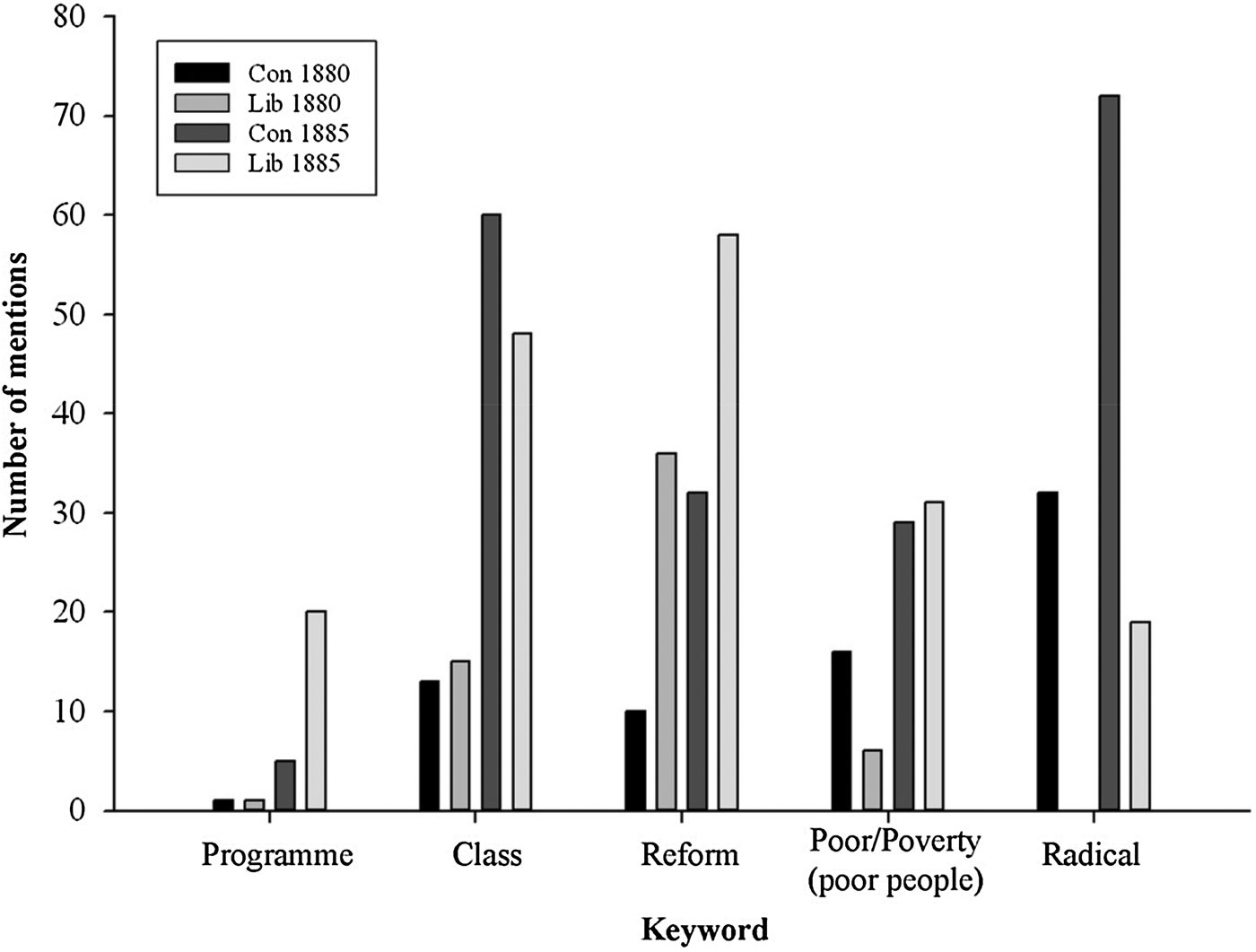
Having established the changed background of the 1885 contest, we can now proceed to an analysis of the impact of the “Unauthorized Programme” on the respective party platforms in East Anglia, in other constituencies, and in the frontbench speaking campaign. As outlined above, historians have disagreed on the degree to which the program's proposals became important election issues and the extent to which they achieved their author's personal and political objectives. I begin my analysis with the basic question: to what extent was the campaign of 1885 dominated by radicalism. Figure 4 represents the findings for East Anglia, again, using a five-word taxonomy. It shows that each radical lemma registers a considerable jump in frequency among both parties; and overall, the cross-party aggregate score of 374 for 1885 is nearly three times the 130 of 1880.
Radicalism in East Anglia, 1880–1885. Each bar represents each party individually (50,000 word sample).
This also reveals some interesting trends for specific keywords. The first, “Programme,” seems to enter political vocabulary in 1885 in East Anglia, and this trend is also mirrored among frontbenchers and in other borough and county constituencies.Footnote 78 Indeed, a KWIC analysis reveals that the vast majority of the 1885 hits refer to Chamberlain's program. Still more interesting is the second keyword, “class,” mentioned 13 times by Conservatives and 16 by Liberals in East Anglia in 1880. This roughly quadruples in 1885—with scores of 60 and 48 respectively—and also sees substantial increases on the national stage and in other constituencies outside the region.Footnote 79 Interestingly, use of the term “class” is higher in East Anglia and among frontbenchers in 1885 than in any of the seven subsequent elections, eclipsing even the Edwardian contests influenced by the New Liberalism.Footnote 80 It is important to add the qualification that this language of class sometimes referred to relationships—and often tensions—between landowners, farmers, and laborers rather than unambiguously representing a language of national class conflict. But its rise in 1885 is still striking.Footnote 81
Of the three remaining keywords, the most telling is perhaps “radical,” cited 32 times by East Anglian Conservatives in 1880 but not at all by Liberals. In 1885, it was mentioned 72 times by Conservatives and 19 times by Liberals. These rises are explained on the one hand by some Liberals' beginning to self-identify with radicalism: Cecil Norton in Yarmouth was confident enough to refer to the local party as “we Radicals,” and Collings at Ipswich and Richard Wright at Norwich scarcely tried to hide their caucusite credentials.Footnote 82 On the other hand, Conservatives were increasingly using “Radical” as a general pejorative label for their opponents, whom they argued had metamorphosed under the influence of Birmingham. Ailwyn Fellowes told his Mid Norfolk audience that “I think the coming fight will not be between the Tory and the Whig parties, but between the Tory party and rampant raging Radicalism.”Footnote 83 Indeed after 1885, the Conservatives' use of the more respectable term “Liberal” (which they employed 297 times in 1885) declined rapidly, and after 1892 they were content to describe their opponents as “Radical” by a margin of two to one.Footnote 84 All this was by no means limited to East Anglia, and outside of the region “radical” increased from 21 mentions in 1880 to 72 in 1885 in our borough corpus subsection, from 14 to 99 in my county subsection, and from 5 to 31 mentions among frontbenchers of both parties.
These trends confirm, then, that compared with that of 1880, the 1885 campaign featured a greatly increased emphasis on radicalism. However, apart from the scores for “programme,” there is still little hard evidence that this should be attributed directly to Chamberlain. In investigating the unauthorized proposals themselves, I analyzed the three most famous, where the historiographical debate is most developed: land reform, disestablishment of the Church of England, and free education.Footnote 85
Discussions centering on the land, who owned it, and how best to use it were not new in 1885, having been ubiquitous staples of rural politics throughout the eighteenth and nineteenth centuries.Footnote 86 However, from 1870, these discussions were energized, first, by the agricultural depression and, second, by the agitation surrounding ground game and agricultural holdings. After 1885, however, the enfranchisement of the agricultural laborer encouraged Chamberlainite radicals to adopt the ideas of American land tax proponent Henry George and economics professor J. E. Thorold Rogers and call for the compulsory acquisition and division of private lands by local authorities to give laborers a stake in the soil.Footnote 87
The general cause of land reform undoubtedly gained increased purchase in East Anglia in 1885, rising from 118 aggregate mentions in 1880 to 288 in 1885, with a very even split between the parties.Footnote 89 References also roughly doubled among frontbench speakers, from 82 cross-party mentions in 1880 to 173 in 1885, and in constituencies outside of East Anglia, which increased from 21 to 37 in boroughs, and from 72 to 142 in counties. Indeed, the inflated importance of land reform in 1885 is also indicated by the increases of other lemmas since 1880. In East Anglia, these included “acre,” which rose from 3 to 51 cross-party mentions; “allotments/smallholdings” (5 to 54); “transfer” (1 to 23); and “cow” (0 to 19). Unsurprisingly, more than 95 percent of the mentions of these words in 1885 amongst both parties were in the context of land reform, and of those, over 70 percent clearly related to Chamberlain's proposals.
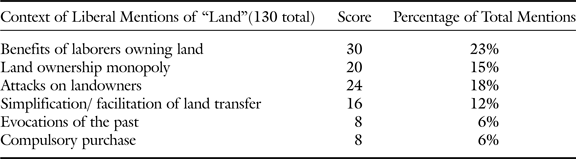
These figures are enlightening, but we need a clearer analysis of context to draw firmer conclusions. Using KWICs, I classified each instance when land reform was cited in East Anglia in 1885, repeating it five further times to deepen the above aggregate analysis of keywords by investigating how they were actually used and connected to political arguments. Table 1 above displays this for the Liberals in their 50,000-word 1885 sample. It shows that 44 (33 percent) of Liberal mentions were either complaints about the monopolization of land by elites or attacks on landowners. These remarks were often forthright: Falk in East Norfolk argued that “a man who had more landed property than he knew what to do with should be compelled to sell part of it . . . to be given out to the agricultural labourer,” while Tillett in Norwich contended that “the soil in England should no longer remain the monopoly of a few thousand . . . [it] should to a much greater extent come within the reach of every honest man in England.”Footnote 90 The next-largest portion reflects the 30 instances in which Liberals extolled the benefits of owning land. Wright at Norwich claimed that “the love of all that was beautiful in the world, industry, thrift and sobriety had been associated with the ownership of land,” while a Mid Norfolk speaker declared his belief in “men having . . . half an acre to an acre of land to cultivate, which would . . . add to the chances of a man's sobriety and steadiness.”Footnote 91 Collings told his audience a tale of “a time when the rural population of this country had interests of various kinds in the lands on which they dwelt . . . rights of common, of cutting turf, of feeding cattle and poultry . . . a time of rude abundance.”Footnote 92 These appeals were, as Readman has suggested, often highly sentimental—an observation also supported by the fact the Liberals mentioned “enclosure” 15 times in 1885. It was entirely absent from the 1880, 1874, or 1835 corpora.Footnote 93
Liberals and Land Reform in East Anglia in 1885: Common ContextsFootnote 88
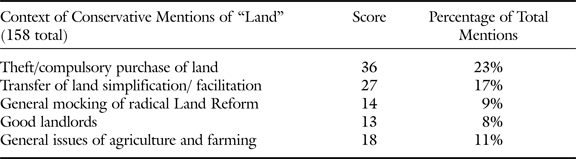
An equivalent analysis of the 158 Conservative mentions of Land Reform in East Anglia in their 50,000 word sample is shown in Table 2. It shows that the most popular context for Conservatives was the proposed compulsory purchase of land. Another 14 (9 percent) of instances consisted of general mockery of radical land proposals, which were attacked with zeal. Weller-Polley (Sudbury) claimed the Liberals wanted to “seize the land altogether, an act on a par with highway robbery. . . . [T]he squire and the farmers would [be] . . . driven away” while Amherst at South West Norfolk claimed that “Mr Chamberlain . . . who had gone in for robbery . . . said in January last that for generations the agricultural labourer had been oppressed, ignored, defrauded. . . . [T]he rich must pay a ransom for the evil they had done.”Footnote 94 Finally, Bourke at King's Lynn characterized the Liberal programme as “revolutionary doctrines . . . Free Education . . . land compulsorily taken . . . compulsion was the Alpha and Omega.”Footnote 95 Although most mentions of land reform were attacks on Chamberlain's scheme, Conservatives were not entirely negative. They attempted to defend the much-assailed landlords in 13 instances, and advocated in 27 instances the cheapening and simplification of land transfer. Both were typified by Bourke's reassurance that “I am quite sure every large proprietor of land would be only too happy to see the transfer of land made more easy.”Footnote 96 Indeed, this moderate reformist position allowed some Conservatives to claim they were closer to Gladstone's manifesto than were the radicals.Footnote 97
Conservatives and Land Reform in East Anglia in 1885: Common Contexts
Overall, this analysis has confirmed that Chamberlain's proposals on land reform were highly influential inside and outside East Anglia among both parties and, to a lesser but still notable degree, among frontbenchers. While some Liberal candidates in Norfolk and Suffolk (notably Everett at Woodbridge, Colman at Norwich, West at Ipswich, and Crossley at Lowestoft) refused to tow the Chamberlainite line, they still found it difficult to sideline the issue. In East Anglia, the 342 explicit cross-party mentions of land reform or allotments not only massively outstripped the equivalent scores in 1880 but also easily eclipsed other issues of the campaign—with the exceptions, as shown below, of free education and church disestablishment—that historians have often cited as central. Free trade, prices and laborers' wages (highlighted especially by Pelling, Barker, and Anthony Howe) were certainly important, but trailed at 169 mentions between both East Anglian parties combined.Footnote 98 Indeed, even the combined mentions of foreign policy, war, Egypt, India, the Sudan, and General Gordon (indisputably key events in Gladstone's second ministry) totaled only 214 in East Anglia.Footnote 99 Ireland and Parnell accounted for 76, while Gladstone's key manifesto proposals—reforms to local government and parliamentary procedure—registered a paltry 44 and 10 mentions respectively. Indeed, this striking picture could also be seen in rural constituencies outside of East Anglia almost as vividly.Footnote 100 Even frontbench speakers, who traditionally emphasized foreign policy, mentioned land reform more often.Footnote 101 Overall, these readings make it extremely difficult to dispute that Land Reform was anything other than a dominant issue in 1885.
A second plank in the Chamberlainite platform was the disestablishment and disendowment of the Church of England. The privileges of the established church, not to mention its perceived Toryism, were long-running grievances for a Liberal Party increasingly influenced by Nonconformity. A much-publicized survey by the Liberation Society found that more than 500 Liberal candidates in 1885 were in favor of disestablishment, and only 43 against.Footnote 102 As Simon has argued, “agitation over the question was both fierce and ferocious; and was closely bound up with the name of Joseph Chamberlain.”Footnote 103 Indeed, the corpora suggest that in 1885, disestablishment was as big an issue as land reform. Among both East Anglian parties, “church” was mentioned 35 times in 1880 but 216 in 1885; “religion” increased from 20 to 48 mentions; and “disestablishment” itself surged from 2 to 77. In the speeches of frontbenchers and in other constituencies, the picture was similar. In the former, cross-party aggregates for all three words were 74 in 1880, rising to 189 in 1885, while in the latter they were 71 and 41 for 1880 boroughs and counties respectively, advancing to 268 and 331 for 1885.Footnote 104
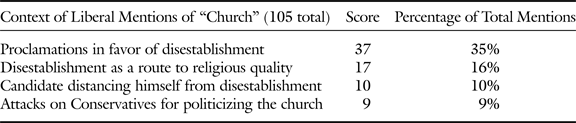
How, then, can we account for these steep increases? Using the keyword “church” (by far the most prominent religious lemma) I performed an aggregate KWIC analysis of the actual campaign arguments. Table 3 below shows the results for the Liberals in East Anglia in 1885. It suggests that the most common context (35 percent of mentions) were proclamations in favor of disestablishment. These varied in tone: Collings was explosive, boasting that “we will dispense with that great burden on the land—the Church of England,” while George Rix at East Norfolk was more measured, asking “why should the Nonconformist classes . . . which the majority of the inhabitants of the towns and villages are . . . be compelled against their will to support a body from which they conscientiously dissented?”Footnote 105 Meanwhile Gurdon (South Norfolk) declared himself “a staunch Churchman” and reassured fellow Anglicans that “Disestablishment and Disendowment will not hurt the present race of clergymen.”Footnote 106 The most popular argument in favor of disestablishment was unsurprisingly religious equality (17 mentions) and seemed to arouse high passion: Everett pronounced that “the spirit of the age has . . . softened the yoke of State Churches, but the cruel memories of the past make me rejoice to see that yoke about to be completely broken to pieces and destroyed.”Footnote 107 The argument for religious equality also extended (in 9 instances) to attacks on the Church's political bias to Toryism, which for Stevenson (Eye) represented “the Tories . . . trying to identify the fortunes of the party with the fortunes of the Church . . . [that] raise[d] in the hearts of all those who were not a member of the Church of England the most rancorous hatred.”Footnote 108
Liberals and the Church in East Anglia in 1885: Common Contexts
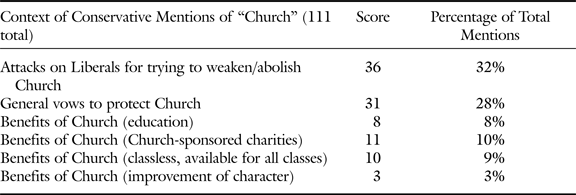
For their part, East Anglian Conservatives were perhaps more animated in their opposition to disestablishment of the church than they were to radical land reform. Speakers mentioned “church” 111 times, and Table 4 shows the most common contexts. 32 percent of mentions were criticisms of the Liberal attacks on the Church of England, and these were often fierce. Amherst argued that “they would lose a great deal and gain nothing except destroy[ing] one of the greatest bulwarks of Christianity in the world” while Bentinck (North-West Norfolk) lamented that “it is rather hard to realize what the effects of Disestablishment would be—no religious service for the Coronation, our Throne open to any religion, and our fine old churches and cathedrals turned into music-halls one day and Mr. Bradlaugh preaching in the pulpits the next.”Footnote 109 The 31 pledges to defend the Church were also trenchant: Hoare (North Norfolk) swore that the Conservatives were “a party whose tenets are loyalty to the throne, fidelity to the Church,” while Francis Hervey (Bury St. Edmunds) declared that “the first clause in the Magna Carta was undertaking to defend the Church of England and our Queen had sworn to defend it.”Footnote 110 Indeed, many clergymen also issued robust defenses of their church from independent platforms. Reverend Constantine Frere circulated a pamphlet in Suffolk titled “The Coming Election and the Coming Danger,” which attacked the Birmingham radicals; and the Bishop of Norwich himself made a sweeping intervention by publishing an open letter in the press, calling on “every Churchman (layman, or clergyman) [and] every loyal citizen . . . [to] be our defence by word or deed.”Footnote 111 The remainder of the Conservative defense was more positive, and many speakers went beyond simply presenting the Church as an untouchable and unquestionable edifice, making a case for its benefits for the community through education, charity, and improved civic character.
Conservatives and the Church in East Anglia in 1885: Common Contexts
Overall, from the quantity and tone of the rhetoric surrounding the issue of the disestablishment of the church, one might be tempted to conclude, as with land reform, that Chamberlain had successfully set the agenda by choosing an issue that roused both Liberals and Conservatives and created a clear dividing line. However, as with land reform, the proposal also had its public Liberal detractors: ten instances where “church” was mentioned were candidates distancing themselves from outright disestablishment or disendowment. A good example was the chairman of a North-West Norfolk meeting who, just before Joseph Arch was about to deliver a stinging attack on the Church, proclaimed that “he was of those who contended that . . . Disestablishment . . . would be a national mistake, that . . . Disendowment would be more than a mistake . . . it would be a national sin.”Footnote 112 Nevertheless, Chamberlain had once again succeeded in transforming the election agenda and placing himself at the heart of the political fire fight. Excitement on a religious issue never ran as high again, and the average cross-party East Anglian readings for “church,” “religion,” and “disestablishment” declined by a factor of four to averages of just 55, 27, and 13, respectively, for the next seven elections. Despite the agitation over Welsh Disestablishment in 1892 and 1895, and Ritualism in 1900, no other individual speaking campaign came close to matching 1885.Footnote 113
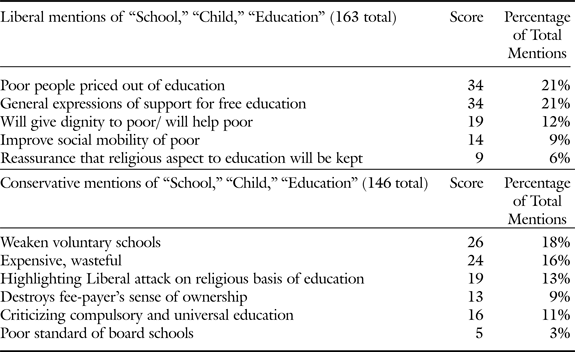
The final main plank of the “Unauthorized Programme” was free education. Chamberlain's proposal was to increase the provision of secular board schooling run by local authorities, and to pay the school pence for those who could not afford it. This would in theory give the poorer classes an alternative to Church of England voluntary schooling, which, in rural areas especially, was often the only option available.Footnote 114 Unlike land reform and church disestablishment, this issue has not attracted a great deal of historiographical interest or been widely recognized as a particular political controversy in 1885.Footnote 115 However, the corpus suggests it made a considerable impression on the campaign. “School” was mentioned just 17 times by both parties in East Anglia in 1880, but this increased by a factor of six to 102 in 1885, with “education” similarly rising from 23 in 1880 to 145 by 1885, and “child” nearly quadrupling from 16 to 62 mentions. Increases in all three lemmas were just as striking outside of East Anglia, especially in the counties, and were also notable among frontbenchers.Footnote 116Table 5, below, shows an aggregate KWIC analysis (this time for all three lemmas) for both parties.
Liberals, Conservatives and Education in East Anglia 1885: Common Contexts
As the first table shows, 21 percent of Liberal mentions were general expressions in favor of Chamberlain's scheme. Most of the rest were discussions of the policy's impact, and this overwhelmingly focused on the potential to better the lot of the poor: Stevenson, for example, argued that school fees came at “the very period of their life when the shoe pinched most.”Footnote 117 Speakers seldom shied away from the compulsory aspect of the measure, contending that it would give dignity to the poor and improve their social mobility. Wright asked his audience to imagine “the saving to the country in the preservation of all those youths from criminal lives . . . [that] Free Education would remedy” and Arch advocated that all children “must [be] sent to school . . . [so] . . . they could pass . . . the required standards.”Footnote 118 Once again, however, the Liberals were not unanimous, and some moderates felt moved to reassure their audiences that the religious aspect of education would be kept. One Liberal speaker even pronounced that he “thought it was to the eternal disgrace of Birmingham, that there . . . the Bible was first shut out of the elementary schools.”Footnote 119
For their part, the Conservatives argued (in 19 instances) that religion would be undermined by the creation of secular board schools. Bourke described it as “destroying religious education . . . [it] will sap the foundations not only of the Church of England but of all religion”; and Bullard (Norwich) saw it as “spreading . . . Unitarian and atheist views.”Footnote 120 However, most of their other objections struck a libertarian chord, such as criticism of the scheme's expense (24 instances) and the argument that voluntary schools would be bankrupted by free competition (26 instances). For Hervey “the reason why the Birmingham school of politicians were going about advocating so-called Free Education” was to make “children the children of the state, and not of their parents, and . . . be brought up as citizens, and not as men and women.”Footnote 121 Similarly, a general critique of compulsion was popular (16 mentions), with Charley (Ipswich) berating the “legislative straightjacket” composed of “compulsory, communistic and socialistic ideas” and Amherst declaring that “the Radical, programme was full of measures of compulsion, but the Conservatives did not propose to compel people to do things; they believed in giving them the facilities of doing things and leaving them to execute them of their own free will.”Footnote 122
On the face of it, then, this analysis of the three main planks of the “Unauthorized Programme” strongly suggests that the impact of Chamberlain's proposals in East Anglia in 1885 was little short of immense, and his effect on the frontbench speaking campaign was also considerable. Although we must treat the readings from the supplementary corpus of constituencies outside of East Anglia tentatively, it too has consistently corroborated that in counties (and to a lesser extent in boroughs) that land reform, disestablishment, and free education were three principal campaign issues of 1885, equaled only by foreign policy (in its broadest sense).
There remains one powerful objection to this analysis: namely, how far Chamberlain and his program deserve the credit for this transformation of the campaign platform in 1885? Could the prominence of new ideas instead be the work of a broader constellation of radicals and publicists, or indeed represent the reassertion of an older tradition of radical nonconformity resurfacing in areas of historical strength, such as East Anglia?Footnote 123 While we should not overlook these important influences, the prima facie case for Chamberlain's having played the conductor's role is extremely strong. First, his program was undeniably the most prominent—and certainly the most controversial—radical intervention in the national campaign, and the issues that he nominated were the ones emphasized on the platform. That the unauthorized proposals had numerous radical detractors (most prominently Bright, who disagreed with what he called “new fangled propositions,” especially free education and land reform) further strengthens the significance of Chamberlain's particular intervention. Second, he personally achieved an enormous increase in profile: from being barely referenced by candidates in 1880 he became the second most often cited frontbencher of the 1885 campaign, behind Gladstone and ahead of Salisbury.Footnote 124 Indeed, although Gladstone still led Chamberlain in number of mentions in 1885, no other statesmen in the 1880–1910 period managed a comparable leap from obscurity to national prominence in the space of one contest as “Radical Joe” managed from 1880 to 1885.Footnote 125 Third, leading Liberals—including Gladstone, Hartington, Bright, Viscount Escher, and Lord Grosvenor clearly blamed Chamberlain almost exclusively for placing these issues on the campaign agenda, even if they disagreed on their electoral effect.Footnote 126 Fourth (and perhaps most simply), if Martin Pugh and Michael Barker's estimations of 160–180 Chamberlainite MPs returned in 1885 are anything near accurate, it seems almost impossible to deny his radicalism anything but a central role.
However, the most compelling argument for the significance of the “Unauthorized Programme” lies in the uniqueness of the 1885 contest compared to the remaining seven elections before the Great War. Never again did church disestablishment achieve anything approaching comparable prominence, even in 1892 and 1895, when the Newcastle Programme promised Welsh disestablishment, or in 1900, when ritualism was an issue.Footnote 127 Free education barely registered again, barring a brief resurgence in 1892, when Conservative speakers played for a “gratitude vote” after having enacted the Elementary Education Act in 1891.Footnote 128 Finally, while land reform remained important in East Anglia, it failed to achieve comparable salience again until 1906.Footnote 129 If the transformation of the political agenda in 1885 was the beginning of a wider rise of radicalism that Chamberlain followed rather than led, it seems hard to explain why this contest represented the high-water mark of late-Victorian radicalism, or why the Newcastle Programme failed to energize popular Liberalism to anything like the same extent in 1892 and 1895 after he had departed.Footnote 130 Similarly, it is seems challenging to explain why the widespread sense of betrayal felt by agricultural laborers in 1886 for the Liberals' jettisoning radicalism for Home Rule, was so wedded to Chamberlain and Collings.Footnote 131
■■■
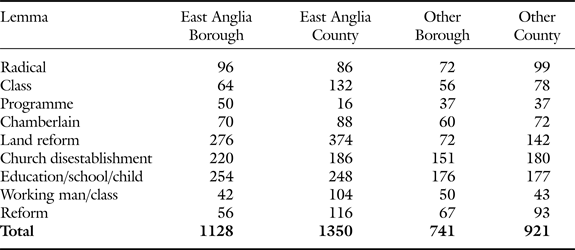
My analysis of corpora suggests that the language of electoral politics in the countryside was transformed in the space of one general election. Rural candidates in 1880 addressed their appeals to the dominant voting class of farmers, as they had in 1874, and even as far back as 1835. The pre-1885 electoral platform was not one where radicalism, and ideas such as disestablishment, free education, or interventionist land reform were likely to make an impact outside the boroughs. The enfranchisement of the laborer changed this dramatically and immediately posed a new challenge to the parties. On the one hand, this was a matter of logistics: of broadcasting party message more loudly to more sets of ears. On the other, it was a question of reformatting the message so that Liberalism and Conservatism would appeal to a new class of voters whose politics were unknown but probably radical. Historians have acknowledged the former but surely underestimated the latter. My analysis demonstrates the extent to which agricultural laborers' concerns eclipsed the staple language of farming in the space of one election in East Anglia and in county constituencies elsewhere. But this change was not just in tone. The proposals of Chamberlain's “Unauthorized Programme” were speedily installed at the center of the contest and inspired inflammatory and impassioned appeals from both sides. Chamberlain may have aimed his program at the boroughs, but it bit deeper in the counties. Inside and outside East Anglia, an aggregate analysis of radical language, as shown in Table 6, finds counties ahead of boroughs by a ratio of 55 to 45 in both cases.
Radicalism in Boroughs and Counties in 1885. (All readings in this table are weighted to 100,000 words for ease of comparison.)
While the lead for county constituencies shown in Table 6 is not huge, it is arguably remarkable that they are ahead at all, given Chamberlain's urban focus, their prior dominance by Toryism, and the fact that the vast majority of the Liberal's best-known radicals were entrenched in boroughs.Footnote 132 Moreover, Table 6 and my general findings suggest that the majority of historians—and Chamberlain himself—were wrong to see the 1885 election as a radical failure. Rather than depicting a contest where the unauthorized proposals dominated in boroughs, where the Liberals did badly, this analysis instead shows them resonating more strongly in counties where the Liberals did well.
How important, however, should we regard the pyrotechnics of 1885 to be in the politics of this era more broadly? Could it be argued that Chamberlain's influence was simply linguistic, rather than ideological, and that his manifest impact on the 1885 contest was largely white noise, enjoying only limited influence on deeper Liberal doctrine and beliefs? Although it is almost impossible to demonstrate the intellectual impact—especially given the Liberal Party that fought the 1885 election ceased to exist a few months later—it seems hard to argue that political language can be wholly divorced from political ideology. In other words, the fact that Chamberlain and his proposals seemed so important and were the subject of so much political argument could not help but pose more fundamental political questions about what Liberalism and Conservatism meant in an increasingly democratic age. Indeed, the radicalism of 1885 undoubtedly created new ideological dividing lines in East Anglian politics. Moderate Liberals were caught in a difficult position. With radicals like Collings introducing Chamberlain as the working classes' “greatest and most powerful friend, the man of the future . . . where the hopes of democracy lie” and Wright complaining that “Mr. Gladstone's manifesto has fallen a little short of that of Mr. Chamberlain” old Liberals like West and Colman faced the same dilemma as Hartington, Forster, and Goschen.Footnote 133 This was what the Eastern Daily Press called “the choice of moderate Liberals,” namely, whether to keep the company of the radicals or the Conservatives.Footnote 134 As it transpired, they broadly chose to remain with the former, but it was more or less impossible to maintain anything approaching a consistent party platform in 1885. Conservatives ridiculed them without mercy: Wright's views were described as going “somewhat further than the mealy-mouthed words of Mr. Colman,” while the Norfolk Mail thought them “repugnant to the more respectable and thoughtful Liberals.”Footnote 135 West, meanwhile, was mocked by Charley as possessing “views diametrically opposed to those of Mr. Collings,” and by the Ipswich Journal as having become a “tool of the Birmingham Party.”Footnote 136 Indeed, it certainly seemed likely that Chamberlain had weakened the ties many moderates felt with their party, and although the number of defections in 1885 has probably been exaggerated by Lynch, they were still significant.Footnote 137 In this respect, historians who see Chamberlain's intervention in 1885 as a tactical failure are perhaps forgetting that smashing the ideological hold of Whiggery on the Liberal Party was as important to him as seizing the national election agenda. Even if my analysis of the latter is rejected, it is difficult to deny his success in the former.Footnote 138
The enfranchisement of the agricultural laborer, and what Lord Rendlesham called the “communistic and socialistic ideas Mr. Chamberlain was advocating” also presented new challenges for the Conservatives.Footnote 139 While they trenchantly opposed the Birmingham program, their answer was by no means wholly negative. They tried to present an image of a modernized party, and made a bid for the libertarian ground they felt their opponents had vacated. The 1885 election was littered with Conservative self-assessments stressing their progressive credentials: Bullard professed himself “not one of the last century Tories . . . [he] wanted to move with the times,” while Birkbeck claimed that he was “not an old-school Tory . . . he was almost a liberal-conservative, or what twenty years ago would have been considered a Liberal.”Footnote 140 For Charley, the whole election came down to “the controversy which is agitating England from one end to another . . . whether we are to depend upon ourselves or upon the State.”Footnote 141 Indeed, it was perhaps symbolic that it was J. P. D. Cobbold—a member of the old brewing family that had dominated Ipswich Conservatism for four decades between the 1840s and 1880s—who opened an 1885 meeting by promising to reclaim “the old banner of Liberalism inscribed with the word ‘Freedom’ which at the present time [was] Caucus.”Footnote 142 This rethinking and rebranding of Conservatism in the face of the radical menace was at least in part a response to Chamberlain's intervention, but as Parry and Self argue, this was also part of his plan.Footnote 143 To be seen as the primary enemy of Toryism was arguably half the battle in establishing himself as leader of the radical Liberal Party of tomorrow.
Overall, this article has argued that historians should recognize the transformative impact of the 1883–85 reforms on party language. The new system represented a break from the past not just in the way elections were fought, but also in the way they were articulated, and even conceived of, by contemporaries. The enfranchisement of the rural working class was as important as the enfranchisement of the urban working class twenty years previously, and it was ironically the agricultural laborer who did most to help Chamberlain into a far stronger position in 1885 than historians—who have perhaps taken “Radical Joe” too much at his word—have generally recognized. It was not for nothing that William Tuckwell, a Warwickshire clergyman and Christian Socialist, recalled that in 1885 “his [Chamberlain's] influence with the democracy had for some time past excelled Gladstone's; I found of late that if audiences cheered Gladstone's name for two minutes, they cheered Chamberlain's for five.”Footnote 144 It was also telling that—despite his private dissatisfaction with the election result—Chamberlain gave a speech to a Liberal banquet in Birmingham after the final returns in 1885 where, as he recalled in 1891, “I claimed that the battle had been fought and won on the Unauthorized Programme, which had saved the Liberal Party from disaster.”Footnote 145 These immodest words might have been bluster, but they were scarcely those of a man whose position had been weakened. Chamberlain's “Unauthorized Programme” was more than a paper tiger: it may have fallen short of what he intended, but it succeeded in placing him at the heart of a new and emerging political divide, with an increasingly radical Liberal Party on one side and a more self-consciously progressive Conservative Party on the other. Had Gladstone not surprised the country with Home Rule in 1886, uprooting the 1885 Parliament and detonating a party realignment of a still larger scale, the impact of reform might have been an almost immediate shift towards radical government rather than, as it turned out, two decades of radical opposition.