Studies in the USA and Europe consistently report that 20–60% of acute and peracute bovine mastitis cases are due to coliform bacteria (Cebra et al. Reference Cebra, Garry and Dinsmore1996; Hogan & Smith, Reference Hogan and Smith2003). Coliform mastitis, generally caused by Escherichia coli, is associated with severe clinical signs, especially in early lactation, and results in considerable economic losses to the dairy industry (Kutila et al. Reference Kutila, Suojala, Lehtolainen, Saloniemi, Kaartinen, Tahti, Seppala and Pyörälä2004). The clinical signs seen with coliform mastitis are known to be due to production of lipopolysaccharide (LPS) endotoxin. In ruminant mastitis, LPS is responsible for local signs (inflammation, oedema, change in the appearance of the milk etc.) as well as general systemic signs (hyperthermia, anorexia, prostration) which in some cases results in death (Lohuis et al. Reference Lohuis, Schukken, Verheijden, Brand and Van Miert1990). Consequently, the severity of coliform mastitis is linked to the number of bacteria producing LPS that multiply in the cistern of the mammary gland. Furthermore, coliform mastitis may be associated with a secondary bacteraemia which might contribute to the severity of the observed signs. Cebra et al. isolated Esch. coli from the blood of 32% of cows with acute mastitis caused by this pathogen (Cebra et al. Reference Cebra, Garry and Dinsmore1996). Bacteria were isolated from the blood of cows scored as only a ‘mild reaction’ in a study performed by Wenz et al. Reference Wenz, Barrington, Garry, McSweeney, Dinsmore, Goodell and Callan2001.
The efficacy of treatment with antimicrobials in coliform mastitis has been questioned because they have little effect on reducing the duration of intramammary infections and also because a high rate of spontaneous bacteriological cure occurs in bovine coliform mastitis (Jones & Ward, Reference Jones and Ward1990; Pyörälä et al. Reference Pyörälä, Kaartinen, Kack and Rainio1994; Pyörälä & Pyörälä, Reference Pyörälä and Pyörälä1998). In some studies, however, antimicrobial treatments have been recommended. This recommendation is based on reducing the risk of bacteraemia, increasing survival rate of cows and reducing milk production losses (Wenz et al. Reference Wenz, Barrington, Garry, McSweeney, Dinsmore, Goodell and Callan2001; Dosogne et al. Reference Dosogne, Meyer, Sturk, van Loon, Massart-Leen and Burvenich2002; Rantala et al. Reference Rantala, Kaartinen, Valimaki, Stryrman, Hiekkaranta, Niemi, Saari and Pyörälä2002). One reason for the lack of consensus is that not many placebo controlled studies have been conducted. The use of positive controls, generally an approved intramammary antimicrobial, will usually result in one treatment being better or equivalent to the other. Owing to the small number of cows participating in experimental studies, only pronounced benefits can achieve statistical significance.
In Europe, only a few antimicrobials are registered as being effective against the Gram-negative organisms causing bovine mastitis, and although the distribution of the drugs in the swollen udder quarter is limited (Ziv, Reference Ziv1980) most of them are available for intramammary use. To be effective, when administered by a systemic route, the active molecule must be able to penetrate the mammary tissue rapidly, diffusing well from the blood to tissues of the udder and to the milk cistern as well as being capable of staying there for a sufficient time at a bactericidal/bacteriostatic concentration. Broad-spectrum antimicrobial drugs such as fluoroquinolones and third generation cephalosporins have been recommended and used to treat coliform mastitis (Dosogne et al. Reference Dosogne, Meyer, Sturk, van Loon, Massart-Leen and Burvenich2002; Erskine et al. Reference Erskine, Bartlett, VanLente and Phipps2002; Rantala et al. Reference Rantala, Kaartinen, Valimaki, Stryrman, Hiekkaranta, Niemi, Saari and Pyörälä2002). Enrofloxacin, marbofloxacin and their metabolites have been shown to reach high concentrations in milk (Schneider et al. Reference Schneider, Valle, Woehrle and Boisrame2004) and were recently approved for systemic treatment of acute coliform mastitis.
Danofloxacin is a third generation fluoroquinolone, which at the time of the described study was already licensed for the treatment of respiratory and enteric bovine diseases. Considering the milk kinetics of danofloxacin following intravenous administration (Shem-Tov et al. Reference Shem-Tov, Rav-Hon, Ziv, Lavi, Glickman and Saran1998) a good efficacy in cases of acute coliform mastitis was to be expected. The milk withdrawal period for danofloxacin is 4 d. Because evidence for the general benefit of antimicrobial treatment in coliform mastitis is still controversial, we conducted the following study to demonstrate that systemic treatment of induced Esch. coli mastitis with danofloxacin is of considerable benefit when compared with placebo.
Materials and Methods
Experimental animals and study facilities
The study was conducted in GLP experimental facilities to Good Clinical Practice VICH guidelines (International Co-operation on Harmonization of Technical Requirements for Registration of Veterinary Medicinal Products) under veterinary supervision and complied with applicable animal welfare and regulatory requirements (VICH, 2001). The study protocol underwent ethical review and withdrawal criteria on welfare grounds were determined a priori.
Twenty-three Prim'Holstein lactating cows were pre-selected for the study and kept on straw-bedded floors in two open barns. Antimicrobial-free concentrate feed was provided daily. The animals had free access to good quality hay and water. Milking was performed twice a day at approximately 7:30 and 16:30 using a milking device which enabled measurement of the volume of milk collected from each quarter. Udders were cleaned with towels before milking and teats dipped after milking (Lactotremp, Manus, Maurepas, France). Cows were observed daily for any clinical signs during the 2-week acclimatizing period. Only productive (>10 l/d milk yield) healthy animals that had not received treatment within 7 d prior to inoculation and those with quarters free of any mastitis pathogens through three consecutive bacteriologically negative examinations at day −9, day −7, day −1 and with somatic cell counts (SCC) <200 000 cells/ml were selected for the intramammary challenge which took place on day 0.
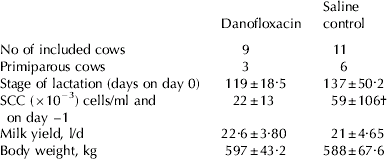
Animals were allocated to treatment, either danofloxacin (Advocin 180®/A180®, Pfizer Animal Health) or negative control (saline) according to a randomized block design with blocks based on pre-inoculation milk production. Details of cows allocated to each treatment group are presented in Table 1.
Details of cows that satisfied pre-determined criteria for treatment (mean±sd)
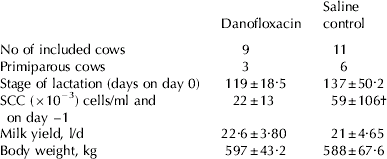
† One animal had a SCC >100 000
Inoculum and intramammary inoculation procedure
Cows were inoculated intra-cisternally via a sterile teat cannula in one rear quarter after the evening milking on day 0. The Esch. coli strain (serotype F5) used for the challenge was previously isolated from a field case of acute mastitis. The strain was maintained at −20°C then subcultured in broth medium and subsequently washed in pyrogen-free phosphate-buffered (PBS). The dose of inoculum was determined by spectrophotometric method. A total volume of 1 ml containing approximately 26 cfu/ml was infused into one rear quarter of each enrolled cow. Following inoculation, a control sample of the inoculum was diluted and plated out to confirm adequacy of the dose of inoculum.
Treatment protocol
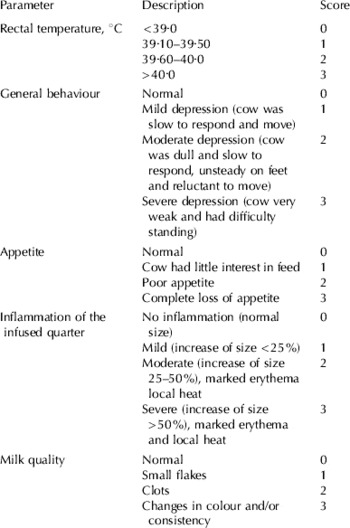
Animals were individually examined and assessed for their general health status and the severity of their mastitic condition at each milking after the inoculation. Cows received the treatments (A180®/saline) on an individual basis, when acute clinical signs that satisfied pre-determined criteria were evident. These pre-determined criteria included both general systemic signs (total score ⩾5) and local signs (total score ⩾2) (Table 2). Total general systemic score comprised rectal temperature, general behaviour and appetite. Total local score was composed of inflammation of the quarter and milk quality. Each parameter was scored on a scale 0–3.
Estimation of severity of the general and local signs following the intra-cisternal inoculation with Escherichia coli

The test product (A180®) or the placebo control (saline) was administered intravenously (i.v.) via a jugular vein following the decision to treat. The cows were dosed according to their body weight (BW) recorded on study day −1. Nine cows received danofloxacin i.v. once (6 mg/kg; Advocin 180®/A180® Pfizer Animal Health, Sandwich, UK) and eleven cows received normal saline solution i.v. once (1 ml/30 kg, Chlorure de sodium 0·9%, Lavoisier, Paris, France).
Measurements
The milk yield for each quarter of each cow was measured and recorded twice daily from study day −7 to study day +21. Rectal temperature, general behaviour, appetite, inflammation of the infused quarter and milk quality were scored (Table 2) once on study day −1, twice on study days 1, 2, 3 and 4, once on study days 5–9 inclusive and once on study days 12, 14, 16 and 21. The increase of the size of the infused quarter was estimated visually by comparison with the contralateral quarter.
Milk samples were collected aseptically three times for bacteriological examination before challenge and again on the day of inoculation (day 0) from the quarter to be inoculated, then again on study day 1 (a.m and p.m milkings) as well as study days 7, 14 and 21. All the pathogens isolated were identified in accord with the National Mastitis Council Laboratory Handbook on Bovine Mastitis (National Mastitis Council, 1999).
SCC were determined using a electro-optical Fossomatic method for milk samples collected three times before the challenge, once on study day 0 from the quarter to be infused and then twice daily from the inoculated quarter on study days 1–21 inclusive.
Blinding and statistical analyses
Persons assigning the cows to either treatment group, preparing the syringes and in charge of the administration of products were different from those carrying out clinical and microbiological examinations. Personnel performing SCC did not know an individual cow's allocation to treatment. The following statistical analyses were carried out using SAS (version 6.12) software (SAS Institute, Cary NC 27513, USA). Statistical analysis was carried out on treatment failure using Fisher's Exact test. Milk yields and log-transformed SCC were analysed using linear mixed models for repeated measurements with pre-treatment values as covariates. Clinical assessments (general behaviour, appetite, inflammation of the inoculated quarter and milk quality) were analysed with categorical models for repeated measurements. Marginal probabilities were used as the response function with treatment, time and their interaction as independent variables/factors. All statistical differences were assessed at the two-sided 5% level of significance.
Results
General description and bacteriological examination
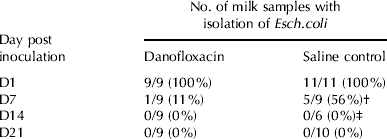
The average milk yields and body weights of the two treatment groups prior to inoculation were very similar. Mean SCC prior to treatment was slightly higher for the saline-treated animals than for danofloxacin-treated animals; more primiparous cows were assigned to saline treatment than to danofloxacin treatment (Table 1). Eleven of the 23 inoculated cows were eligible for treatment 13 h after inoculation, eight after 18 h and one after 23 h. Although Esch. coli was isolated from all inoculated quarters at a.m. and p.m. milkings on day 1 post-inoculation (Table 3), three cows did not go on to satisfy the pre-determined criteria for treatment. One control cow died peracutely as a result of the induced acute mastitis 6 d post-inoculation. On study day 7 all nine cows treated with danofloxacin were able to provide a milk sample from the inoculated quarter and only one of these samples was positive for Esch. coli (Table 3). At this time only nine of the 11 saline-treated cows were able to provide a milk sample from the inoculated quarter, one cow having died and the inoculated quarter of another cow being non-productive, of these available nine samples five were positive for Esch. coli. On study day 14, all cows treated with danofloxacin produced milk samples from the inoculated quarter whereas this was the case in only 6 of the original 11 saline-treated cows. Esch. coli was not isolated from any samples collected on study days 14 and 21 from cows of either treatment group.
Comparison of bacteriological cure rates after treatment of induced Escherichia coli mastitis
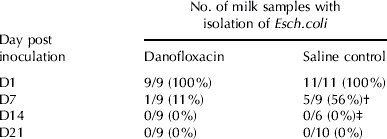
† 2 missing samples: 1 due to the death of the cow; 1 due to non-productive quarter
‡ Milk samples could only be obtained from 6 control cows
Somatic cell count
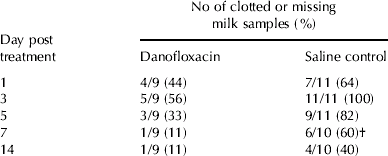
Owing to the formation of clots in milk after inoculation, as well as quarter inflammation rendering the quarter non-productive, determination of SCC was not possible for many samples (Table 4). When there was a sufficient number of cows in each treatment that produced milk samples in which SCC could be performed (post-treatment days 19, 20 and 21), means SCC were statistically significantly lower (P=0·0091) in the danofloxacin group. Prior to day 19 post treatment many more samples taken from the danofloxacin group could be counted compared with those taken from the saline-treated group.
Clotted or missing (non-productive quarter) milk samples from treatment groups after inoculation of Escherichia coli
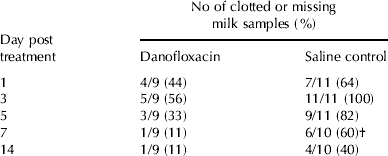
† One cow died per-acutely
Milk production
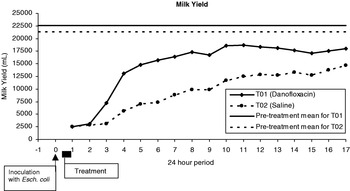
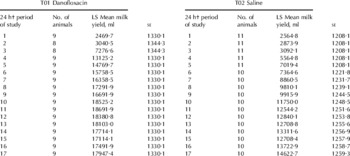
Means of milk production for each treatment dropped dramatically the day after inoculation of Esch. coli and then increased progressively in both groups (Fig. 1). However, complete return to pre-challenge values did not occur within the observation period. The means had returned to approximately 81% of the pre-inoculation mean in the danofloxacin-treated group compared with approximately 51% in the control group. There was a significant treatment difference (P=0·0003) over all time points, a significant time effect (P=0·0001) and a treatment-by-period interaction (P=0·0004). In addition, statistically significant treatment differences were shown at each time point from 3 d to 17 d post treatment, with the danofloxacin group having higher milk yields.
Mean 24-h milk yield of cows (ml) from period 1† (after the beginning of treatment) to period 17 in both groups. Treatment was administered 13 h post inoculation (11 cows); 18 h post inoculation (8 cows) and 23 h post inoculation (1 cow).

Rectal temperature
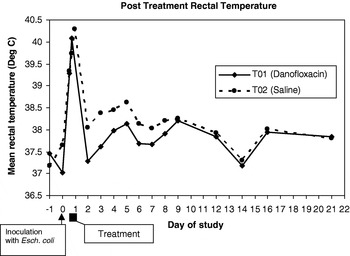
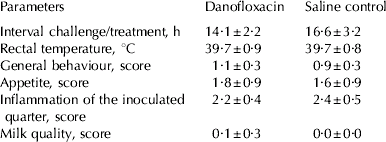
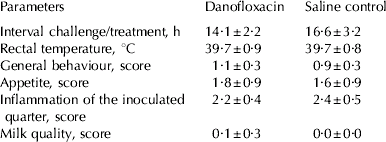
Means of rectal temperature for each treatment sharply increased to values above 39·5°C in both groups approximately 13 h after Esch. coli inoculation. At the time of treatment, the rectal temperature was above 39·5°C for 14/20 animals, of these 8 had rectal temperatures above 40°C (Table 5). Rectal temperatures decreased thereafter in all cows but values were lower in the danofloxacin-treated group than in the control group during the week after treatment (Fig. 2).
Mean rectal temperature of the cows (°C) from day −1 to day 21 in both groups (day 0 was the day of inoculation). Treatment was administered 13 h post inoculation (11 cows); 18 h post inoculation (8 cows) and 23 h post inoculation (1 cow).

Comparison of recorded parameters for danofloxacin and control saline groups at the time of treatment (mean±sd)
Milk quality and local inflammatory response
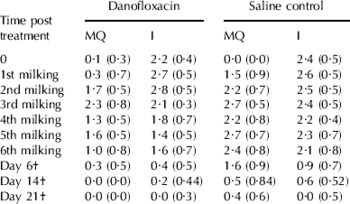
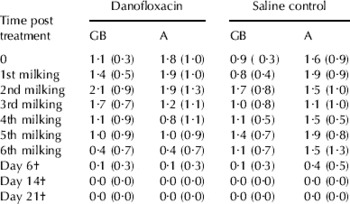
When a milk sample could not be collected owing to agalactia or recumbency no score was allocated for milk quality. Secretions from the inoculated quarters were discoloured (yellowish) and contained large fibrin clots. Milk quality scores increased post treatment (Table 6). The highest score values were recorded at the third milking for both treatment groups. Scores decreased in the danofloxacin group from the fourth milking. On study day 6 post inoculation, no cows in the danofloxacin group had a score of 2 or above compared with five cows with a score of 2 or more in the control group. Analysis of score values for milk quality recorded on study days 1, 6 and 14 post inoculation showed no statistically significant differences between treatments (P=0·1421) but did demonstrate a statistically significant time effect (P=0·0027).
Comparison of the local clinical mean scores (±sd) for milk quality (MQ) and inflammation (I) of infused quarters

† Day post inoculation
At the time of treatment, all the inoculated quarters displayed a mild to severe inflammation and scored 2–3. Quarter swelling decreased from the 4th and the 7th milking (data not shown) post treatment for the danofloxacin group and the saline group, respectively. On study day 6 post inoculation, a score of 0 was recorded for 5/9 cows in the danofloxacin group but only for 3/11 cows in the negative control group. Danofloxacin-treated animals showed statistically significant lower inflammation scores (P=0·004) than those for the placebo control group.
General clinical examination
At the time of treatment all the cows, except for one in the control group, were slightly depressed (Table 7). General behaviour scores increased to a maximum in both treatment groups at the 2nd milking post dosing and then decreased in similar manner (Table 7). A maximum score (score 3) was recorded on study days 4 and 5 post inoculation for the control cow which died per acutely on study day 6. After the challenge and on the day following dosing, all the animals had a poor appetite. The appetite score decreased sharply in the danofloxacin group and returned to 0 on post-treatment day 5 in 7/9 cows compared with only 6/11 control cows. Although a statistically significant difference was not demonstrated between the two treatments with respect to general behaviour and appetite, there were obvious beneficial trends seen with the danofloxacin group and there was a significant treatment-by-time interaction for appetite.
Comparison of the general clinical scores (±sd) for general behaviour (GB) and appetite (A)

† Day post inoculation
Discussion
The aim of this study was to evaluate the potential efficacy of systemic danofloxacin in the treatment of induced acute Esch. coli bovine mastitis. A low inoculum dose (26 cfu) was used because a high inoculum dose is generally associated with a severe local inflammatory response and it was reported (Hill & Shears, Reference Hill and Shears1979; Vangroenweghe et al. Reference Vangroenweghe, Duchateau and Burvenich2004) that those animals that displayed a pronounced local acute inflammatory reaction showed fewer systemic clinical signs. Therefore it is reasonable to assume that a low-dose inoculum is able to mimic spontaneous field cases of acute Esch. coli mastitis with both local and systemic signs. Before treatment, the clinical course and clinical signs of disease were similar in the danofloxacin and negative saline groups for the recorded parameters. Despite efforts to introduce clear definitions and scoring for mild, moderate and acute host response (Wenz et al. Reference Wenz, Barrington, Garry, McSweeney, Dinsmore, Goodell and Callan2001) there is still some confusion in terminology. In this study, cows were included for treatment on an individual basis when pre-determined criteria (general and local signs) were satisfied. We considered that the clinical signs selected represented the clinical signs of acute mastitis seen in field cases. In this way the experimental study reported here strived to mimic the natural disease as closely as possible thereby giving it credibility as an indicator of efficacy of treatment in ‘clinical cases’.
The benefit of antimicrobial therapy for the treatment of Esch. coli mastitis is still controversial. Owing to the pronounced inflammatory response in the mammary gland, spontaneous bacteriological cure often occurs (Hill et al. Reference Hill, Shears and Hibbitt1978; Jones & Ward, Reference Jones and Ward1990; Erskine et al. Reference Erskine, Tyler, Riddell and Wilson1991; Pyörälä et al. Reference Pyörälä, Kaartinen, Kack and Rainio1994). Our results confirmed the high rate of spontaneous cure since none of the milk samples that could be obtained from the inoculated quarters of placebo controlled cows were positive for Esch. coli on days 14 and 21 post inoculation (Table 3). Moreover it is sometimes claimed that antimicrobials may cause rapid death of bacteria and subsequent release of LPS. However, Dosogne et al. (Reference Dosogne, Meyer, Sturk, van Loon, Massart-Leen and Burvenich2002) reported that treatment with enrofloxacin was not associated with an enhanced release of LPS in experimental Esch. coli mastitis. Results from several trials have failed to show a beneficial effect of antimicrobials when compared with either untreated controls or with drugs without in-vitro activity against coliforms (Jones & Ward, Reference Jones and Ward1990; Craven, Reference Craven1991a, Reference Cravenb; Pyörälä et al. Reference Pyörälä, Kaartinen, Kack and Rainio1994). Insufficient contact of the antimicrobial with the bacteria in the mammary gland is considered a major cause of treatment failure in mastitis (Sandholm et al. Reference Sandholm, Kaartinen and Pyörälä1990). The choice of the route of administration, intramammary or systemic, should be primarily based on the location of the bacteria in the udder and the physical characterization of the active molecule used for the treatment. The systemic route is justified by the real risk of bacteraemia developing in cows with coliforms (Erskine et al. Reference Erskine, Tyler, Riddell and Wilson1991; Cebra et al. Reference Cebra, Garry and Dinsmore1996) and also because drug distribution is poor when administered into the swollen quarter (Ziv, Reference Ziv1980). The advantage of systemic route was demonstrated in a study in which the efficacy of intramuscularly and intracisternally administered cefquinome was compared in experimental Esch. coli mastitis (Shpigel et al. Reference Shpigel, Levin, Winkler, Saran, Ziv and Bottner1997). Systemic therapy significantly improved clinical recovery and return to milk production. Recently, in a field study, no significant differences were found in bacteriological and clinical cures between a local and systemic antimicrobial treatment (Serieys et al. Reference Serieys, Raguet, Goby, Schmidt and Friton2005). However, interpretation of those results is difficult because the antimicrobial used for each route was different, some clinical cases treated were without systemic signs and the number of cases of coliform mastitis treated in each group was low. The present study, with a negative control group, produced results easier to interpret but for animal welfare reasons this approach is only possible in experimental conditions when cows are observed regularly in order to treat them rapidly with supplementary medication if necessary.
Fluoroquinolones are highly lipophilic compounds able to pass through the epithelia and are particularly suitable for systemic treatment of intramammary infections (Ziv, Reference Ziv1980). Danofloxacin, like other fluoroquinolones, acts by inhibiting the DNA gyrase enzyme and blocking super coiling of the bacterial DNA. This damages and fragments the bacterial chromosome and results in bacterial lysis (Vancutsem et al. Reference Vancutsem, Babish and Schwark1990). Taking into account the exponential growth of Esch. coli in the mammary gland during the first hours after infection (Hill & Shears, Reference Hill and Shears1979; Riollet et al. Reference Riollet, Rainard and Poutrel2000; Burvenich et al. Reference Burvenich, Van Merris, Mehrzad, Diez-Fraile and Duchateau2003) it is expected that danofloxacin will be efficacious in rapidly reducing numbers of bacteria and consequently the total release of LPS which is responsible for clinical signs.
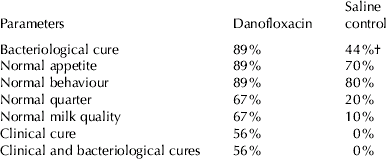
Despite both treatment groups developing a comparable severity of disease after the inoculation of Esch coli, cows treated with danofloxacin demonstrated a more rapid and more complete response to treatment than the saline-treated cows (Table 8). Statistically significant differences were found for milk production, SCC and udder inflammation. Obvious beneficial trends were recorded in the danofloxacin group for rectal temperature, milk quality, general behaviour and appetite; however, the observed trends were not statistically significant. Similar beneficial effects were previously reported with other fluoroquinolones. Some benefits have been reported for cows with experimental Esch. coli mastitis after administration of parenteral enrofloxacin, especially with respect to milk production (Hoeben et al. Reference Hoeben, Monfardini, Burvenich and Hamann2000; Rantala et al. Reference Rantala, Kaartinen, Valimaki, Stryrman, Hiekkaranta, Niemi, Saari and Pyörälä2002). Parenteral marbofloxacin in combination with a local cloxacillin treatment was seen to demonstrate its efficacy in field cases of dairy cows with acute coliform mastitis (Grandemange & Davot, Reference Grandemange and Davot2002).
Comparison of recorded parameters for danofloxacin and saline control groups on day 7 post inoculation
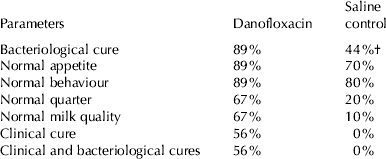
† 2 missing samples: 1 due to the death of the cow; 1 due to non-productive quarter
This experimental Esch. coli mastitis study demonstrated the benefits of treating acute mastitis with a single dose of an effective antimicrobial over a negative control. These benefits were very apparent in animal health and welfare as well as in productivity. In terms of return to milk production (Table 9) and disappearance of clinical signs, this study clearly supports the use of systemic danofloxacin in the treatment of acute Esch. coli mastitis.
Least Squares Means of daily milk yield for each treatment with se

† Period 1 is defined as the time period that encapsulates the first two milkings post treatment. This period may cover two milkings on successive days, afternoon milking and the morning milking of the next day
The use of parenteral treatment in coliform mastitis remains controversial. A single parenteral dose of danofloxacin in cows with experimentally induced acute Esch. coli mastitis demonstrated benefits, especially in the restoration of milk production, reduction in SCC and udder inflammation. Early treatment of acute mastitis is relatively easy to perform in experimental conditions; therefore these results need to be confirmed in the field with spontaneous cases of acute coliform mastitis. As danofloxacin therapy improves recovery and survival of cows with mastitis as well as reducing the loss of milk production, such treatment is beneficial both for welfare of animals and financial productivity.
The authors to thank Julie Cunningham for typing the manuscript.