Significant outcomes
• Patients are less likely to experience symptomatic relapse when switched to treatment with risperidone long-acting injectable (RLAI) compared with oral quetiapine.
• Patients experienced improved functioning and quality of life (QoL) with either RLAI or quetiapine treatment.
• Overall tolerability was generally comparable with previously published studies, with no new safety issues identified.
Limitations
• Interpretation of these data is limited by those factors inherent to open-label treatment studies.
• Therapeutic benefit with RLAI may have been accentuated by more frequent face-to-face contacts during this treatment.
• Quetiapine doses used in clinical practice may be higher than those used in the current study.
Introduction
Schizophrenia is a chronic, disabling disease that requires long-term treatment. However, effective long-term symptom improvement is often complicated by symptomatic relapse (Reference Schooler1). Sustaining remission and achieving functional recovery are increasingly recognised as important goals when treating schizophrenia and related disorders (Reference Davidson, Schmutte, Dinzeo and Andres-Hyman2).
Experts suggest that functional outcomes should also be included when measuring the efficacy of schizophrenia treatments (Reference McEvoy3). Some studies have shown that most patients achieving functional recovery are in remission, as defined by a reduction in positive and negative symptoms (Reference Robinson, Woerner, McMeniman, Mendelowitz and Bilder4,Reference San, Ciudad, Alvarez, Bobes and Gilaberte5). For example, a multicentre study of 1010 outpatients with schizophrenia in Spain identified remission from positive and negative symptoms in 45% of patients (Reference San, Ciudad, Alvarez, Bobes and Gilaberte5). Only 10% of patients in this sample, however, met the criteria for adequate functioning based on the Global Assessment of Functioning Scale (6). Of the 106 patients meeting the criteria for functional recovery, 103 (97%) were also in symptomatic remission from positive and negative symptoms, suggesting functional improvement includes symptomatic remission. Similarly, another study has evaluated remission lasting ⩾2 years in patients who were followed for 5 years after their first symptomatic episode of schizophrenia or schizoaffective disorder (Reference Robinson, Woerner, McMeniman, Mendelowitz and Bilder4). Remission occurred in 47% of patients, whereas only 26% achieved adequate social functioning based on the Social Adjustment Scale interview (Reference Schooler, Hogarty and Weissman7).
Adherence to antipsychotic treatment is felt to be key to sustaining remission and achieving functional recovery. Findings from a post hoc analysis illustrate the importance of adherence with long-term antipsychotics for improving functional outcomes in the treatment of patients with schizophrenia (Reference Dunayevich, Ascher-Svanum and Zhao8). Using data from four randomised, double-blind, 24−28-week clinical trials with antipsychotics, longer treatment adherence was significantly associated with greater improvements in functioning, based on QoL measures.
Long-term adherence with first-generation antipsychotic therapies is often inadequate, with medication non-adherence affecting nearly half of outpatients with schizophrenia treated for 1 year (Reference Rosa, Marcolin and Elkis9). Treatment non-adherence has been shown to be a major risk factor for relapse (Reference Leucht and Heres10). Important factors contributing to non-adherence or partial adherence include poor treatment tolerability (Reference Yamada, Watanabe and Nemoto11), with superior compliance in patients treated with better tolerated atypical antipsychotics compared with first-generation neuroleptics (Reference Dolder, Lacro, Dunn and Jeste12); lack of insight; health beliefs; problems with treatment access; embarrassment/stigma concerning illness; medication perceived as unnecessary; patient or family opposed to medications; no perceived daily benefit; medication interferes with life goals; poor therapeutic alliance; complicated treatment regimen; cognitive dysfunction; and lack of social support (Reference Dolder, Lacro, Dunn and Jeste12–Reference Löffler, Kilian, Toumi and Angermeyer15).
Medication adherence may be improved by treating patients with long-acting antipsychotic formulations (Reference Leucht and Heres10,Reference Kane16,Reference Schooler17). RLAI was the first long-acting atypical antipsychotic available for clinical practice, and is currently available worldwide. The 2-year, randomised, controlled, RLAI relapse prevention trial (ConstaTRE) was designed to compare relapse using standard symptomatic criteria in stable patients with schizophrenia or schizoaffective disorders treated with either RLAI or the oral atypical antipsychotic, quetiapine (Reference Gaebel, Schreiner and Bergmans18).
Aim of the study
Here we report functional recovery results from the ConstaTRE trial, using several standardised measures of functional improvement.
Materials and methods
Study design
This multicentre, open-label, randomised, active-control, 2-year study comparing RLAI versus oral quetiapine was conducted from October 2004 to November 2007 at 124 sites in 25 countries (Reference Gaebel, Schreiner and Bergmans18). Results of a small descriptive arm in which patients could also be randomised to aripiprazole was described in a separate report (Reference de Arce Cordón, Eding, Marques-Teixeira, Milanova, Rancans and Schreiner19). This trial was conducted in accordance with the latest version of the Declaration of Helsinki and guidelines of the International Conference on Harmonisation for Good Clinical Practice, and the study protocol and consent were approved by an Institutional Review Board. Informed consent was obtained on all patients after the nature of the procedures had been fully explained prior to study enrolment.
Patient population
Symptomatically stable adults aged ⩾18 years old with schizophrenia or schizoaffective disorder (6) were eligible to participate in this clinical trial if they were: symptomatically stable (judged to be clinically stable by the investigator); using a stable dose of antipsychotic for ⩾4 weeks that included monotherapy with oral risperidone (⩽6 mg daily), olanzapine (⩽20 mg daily), or a first-generation neuroleptic (⩽10 mg haloperidol or its equivalent); candidates for switching therapy due to insufficient symptomatic control, side effects, or patient request; and living in the same residence for ⩾30 days. Both stable outpatients and inpatients could be eligible for participation. Women were required to be surgically sterile or practicing an effective method of birth control (e.g. prescription oral contraceptives, contraceptive injections, intra-uterine device, double-barrier method, contraceptive patch, male partner sterilisation, or abstinence), and have a negative pregnancy test at baseline. Patients were excluded if they had a Diagnostic and Statistical Manual of Mental Disorders, 4th edn (DSM-IV) axis I diagnosis other than schizophrenia or schizoaffective disorder; were treated with antipsychotics other than oral risperidone, olanzapine, or a first-generation oral neuroleptic; or had been previously determined to be non-responders to risperidone, quetiapine, or ⩾2 antipsychotics despite adequate drug doses/duration. Patients were excluded if they were being treated with mood stabilisers or antidepressants that were not at stable doses for ⩾3 months before study entry. Patients were also excluded if they had phenylketonuria or hypersensitivity to risperidone or quetiapine; had drug or alcohol dependence during the preceding month; or were deemed to be at acute risk of suicide or had a history of suicide attempt(s).
Treatment schedule
Treatment recommendations followed approved dosing guidelines for RLAI and quetiapine. Stratified randomisation according to previous treatment was used to ensure comparability of treatment arms with regard to previous treatment. Three strata were used: oral risperidone (40%); olanzapine (30%); and a first-generation oral neuroleptic (30%). Within each stratum, patients were randomly allocated 1 : 1 to RLAI or quetiapine in countries where aripiprazole was not available, or 2 : 2 : 1 to RLAI, quetiapine, and aripiprazole in countries with aripiprazole availability. Eligible patients were randomly assigned to receive open-label treatment with RLAI or oral quetiapine for a maximum of 24 months. RLAI was initiated with 25 mg injections administered every 2 weeks, with patients continuing current oral medication (risperidone, olanzapine, or a first-generation neuroleptic) for the first 3 weeks of RLAI treatment to ensure adequate antipsychotic coverage until the main release of risperidone from RLAI occurred. After 3 weeks, the baseline oral psychotic was tapered-off over 1–2 weeks. Patients randomised to RLAI with no history of risperidone exposure received 2 mg oral risperidone daily for 2 days before the first RLAI injection to ensure tolerability. RLAI dosage could be increased in increments of 12.5 mg for patients experiencing worsening of psychotic symptoms or insufficient efficacy, to the maximum approved dose of 50 mg every 2 weeks. Increases were only permitted to occur during scheduled visits and at a minimum of 4 weeks after a previous change in the RLAI dose. RLAI dosage could be decreased as needed due to adverse events (AEs) at the treating physician's discretion.
In patients randomised to quetiapine, the study drug was initiated at 25 mg twice daily, increased in increments of 25–50 mg two to three times daily on the second and third day, as tolerated, in order to achieve a target dosage by treatment day 4 of 300–400 mg daily in divided doses, administered two to three times daily. If required, additional dosage adjustments in increments of 25–50 mg were permitted to occur at intervals of ⩾2 days to the maximum approved daily dose of 750 mg. Antipsychotics used before randomisation were tapered off over 2 weeks, starting after the first administration of quetiapine. Adherence was monitored by evaluating the amount of study medication returned at assessment visits using pill counts; a phone call every 2 weeks for patients on quetiapine could be considered both a way to address and increase adherence with the oral compound.
The need for a dose of study medication that exceeded the maximum maintenance doses or the addition of supplemental antipsychotic agents to control disease symptoms led to discontinuation of study medication, with the patient considered to have relapsed because symptoms were no longer sufficiently controlled by the study medication.
Patients using stable doses of mood stabilisers or antidepressants for ⩾3 months before enrollment continued these medications after study drug initiation. Changes in dosage or initiation of a mood stabiliser or antidepressant were permitted during this study, if clinically necessary. Anticholinergic medication and benzotropine mesylate were permitted to treat extrapyramidal symptoms. Sedatives were prohibited except for benzodiazepines for sleep. Lorazepam could be used for agitation, as needed, with a maximum dose of 4 mg/day, during no more than 4 days in any 7-day period; a comparable dose of diazepam was permitted in countries where lorazepam was not available. All other use of anxiolytics was prohibited. β-Blockers were not permitted unless used to treat hypertension or treatment-emergent akathisia.
Assessments
Patient demographics, disease characteristics, and a physical examination were obtained at an initial screening visit. Weight, height, and baseline questionnaires assessing symptom severity were obtained at a subsequent baseline evaluation appointment 2 weeks later. Follow-up appointments were conducted every 3 months. Every 2 weeks, treatment was monitored for any change in patient status that would suggest an unscheduled visit was necessary; this assessment was conducted at the time of injection in patients treated with RLAI and by telephone for those treated with quetiapine.
Efficacy and safety
Efficacy was assessed by evaluating the Positive and Negative Syndrome Scale (PANSS) and change in Clinical Global Impression-Severity (CGI-S) at baseline and every 3 months. The primary efficacy assessment in this study was time from randomisation to relapse, defined by criteria used in a previous comparative study (Reference Csernansky, Mahmoud and Brenner20):
• psychiatric hospitalisation;
• increase in level of care necessary and ⩾25% increase in PANSS total score from baseline or an increase of 10 points if the baseline score was ⩽40;
• deliberate self-injury;
• emergence of clinically significant suicidal or homicidal ideation;
• violent behaviour resulting in significant injury to another person or property;
• significant clinical deterioration defined as a CGI-S score of 6 (much worse); and
• exceeding the registered dose of the drug (50 mg every 2 weeks for RLAI and 750 mg daily for quetiapine).
These or similar criteria have been used in other studies to define relapse in patients with schizophrenia (Reference Peuskens, Trivedi and Malyarov21–Reference Hough, Gopal, Vijapurkar, Lim, Morozova and Eerdekens23).
Safety was evaluated by recording treatment-emergent AEs (TEAEs) at each visit. A more complete description of overall efficacy and safety were reported in a previous publication (Reference Gaebel, Schreiner and Bergmans18).
Functional status
Functional status was evaluated using the Social and Occupational Functioning Assessment Scale (SOFAS). The SOFAS provides information on an individual's social and occupational functioning, with possible scores ranging from 1 (severe impairment) to 100 (excellent function) (6). Cutoff points describing social, work, or school functioning on the SOFAS include: 100 = superior function, 90 = good functioning in all areas, 80 = no more than slight impairments, 70 = some difficulty, 60 = moderate difficulty, 50 = serious impairment, 40 = major impairment, 30 = inability to function in almost all areas. The SOFAS was scored by each of the 107 investigators participating in this study. Clinicians applying the SOFAS to patients were instructed to consider only impairments that were a direct consequence of mental or physical conditions, and not those as a result of environmental or opportunity limitations. Improvements in function were identified by increases in SOFAS scores
Quality of life
QoL was evaluated using two self-administered QoL measures: the Medical Outcomes Survey Short Form 12 (SF-12) and the Schizophrenia Quality of Life Scale Revision 4 (SQLS-R4). Both QoL measures were completed by participating patients. The SF-12 is a 12-item subset of the Medical Outcomes Survey SF-36, with good correlation demonstrated to the SF-36 (Reference Ware, Kosinski and Keller24). Similar to the SF-36, the SF-12 also produces scores for eight domains, and can generate composite physical and mental component scores. All scales of the SF-12 were calculated to use the same standardised norm, with a mean of 50 [standard deviation (SD) = 10]. For the current analysis, only physical and mental component scores were analysed. The SQLS-R4 is a validated 33-item self-report measure from which two domains of QoL are scored: psychosocial feelings and vitality (Reference Martin and Allan25). Items were scored on a five-point Likert scale from ‘never’ to ‘always’. Both individual domain and total scores were standardised by a scoring algorithm on a scale from 0 to 100. The SOFAS was measured every 6 months. The SF-12 and SQLS-R4 QoL measures were collected at treatment months 1, 3, 6, 12, 18, and 24. Improvements in QoL were indicated by increases in SF-12 component scores and decreases in SQLS-R4 scores.
Data analysis
Sample size was based on estimated rates of 1-year relapse of 30% for RLAI and 42% for quetiapine, as observed in a previous relapse study that reported 1-year relapse in 27% of patients treated with long-acting depot antipsychotic versus 42% with oral medication (Reference Schooler17); and based on the expectation that RLAI and quetiapine would exceed efficacy findings as observed for oral risperidone and haloperidol. With a power of 80% and a two-tailed significance level of 5%, it was estimated that 251 patients per treatment group would be needed to identify a difference in relapse rates. To adjust for an estimated 20% patient discontinuation for reasons other than disease relapse, a minimum of 628 patients was determined to be necessary.
Based on the protocol design, an analysis of efficacy was performed after the last patient had completed 1 year of treatment. The protocol allowed early termination of the trial at this point if a difference in efficacy at the 0.1% significance level (two-tailed) was observed.
All patients treated with at least a single dose of study drug were eligible for efficacy and tolerability analyses (intent-to-treat). Demographic, efficacy, and safety parameters were evaluated using descriptive statistics. Within-group differences in change from baseline for SF-12 and SQLS-R4 were determined via Wilcoxon's signed-rank test; between-group differences were tested with the Wilcoxon two-sample test. Statistical tests were interpreted at the 5% significance level (two-tailed). Differences between treatment arms in safety parameters were not statistically tested because the study was not powered to show differences or equivalence in these parameters.
Results
The results of the prespecified analysis led to the recommendation by independent experts to terminate the trial early due to achieving the predetermined difference in efficacy after the last enrolled patient completed 1 year of treatment.
Patients
A total of 710 patients were enrolled and randomised (355 per group). Data collected on 25 patients from one site were excluded from efficacy and safety analyses because the study at that site was not conducted in a manner consistent with Good Clinical Practice Guidelines. An additional 19 patients (14 RLAI and five quetiapine) did not receive trial medication, leaving an evaluable data set of 666 patients. Nineteen patients treated with RLAI and eight with quetiapine were ongoing at the time the study was stopped as per the protocol.
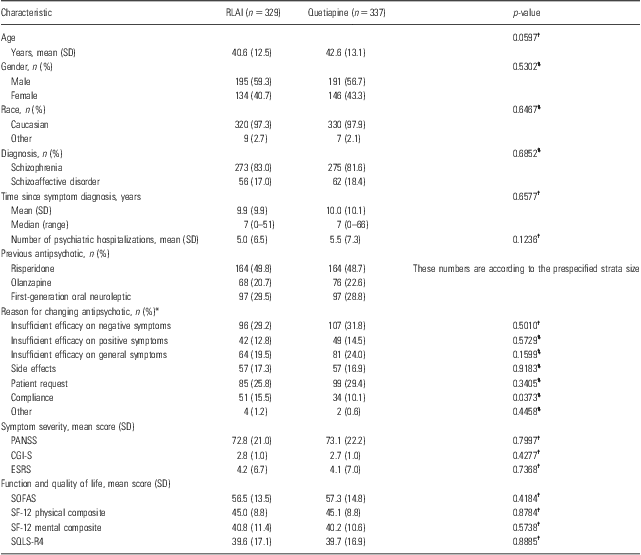
Baseline demographics were similar between treatment groups (Table 1). The only statistically significant between-treatment difference was for compliance (p = 0.037). Active, concomitant diseases were reported by 62.9% of patients treated with RLAI and 60.5% with quetiapine. The most common active concomitant diseases were endocrine (23.7% RLAI and 23.1% quetiapine), psychiatric (22.8% RLAI and 19.6% quetiapine), cardiovascular (11.9% RLAI and 12.8% quetiapine), and neurological (13.4% RLAI and 11.0% quetiapine). During the study, concomitant medications were used by 82.7% of patients treated with RLAI and 75.1% with quetiapine, most commonly antipsychotics and anxiolytics, anti-Parkinson drugs, mood stabilisers/antiepileptics, and analgesics.
Baseline demographics

CGI-S, Clinical Global Impression-Severity; ESRS, Extrapyramidal Symptom Rating Scale; PANSS, Positive and Negative Syndrome Scale; RLAI, risperidone long-acting injectable; SD, standard deviation; SF-12, Short Form-12; SOFAS, Social and Occupational Functioning Assessment Scale; SQLS-R4, Schizophrenia Quality of Life Scale-Revision 4.
*More than one reason permitted for each patient.
†Wilcoxon 2-sample test, two-sided.
‡Fisher's exact test, two-sided.
Two-year treatment was completed by 151 patients (45.9%) in the RLAI group and 120 (35.6%) in the quetiapine group (p = 0.0074). Excluding patients who discontinued due to relapse, no differences were observed in reasons for discontinuation between treatment groups. The most common reasons for discontinuation included withdrawal of consent (33.4%), AEs (4.6%), loss to follow-up (4.8%), and injection refusal (2.8%). The mode doses averaged over all subjects were 33.6 mg (SD = 10.1) every 2 weeks with RLAI, and 413.4 mg (SD = 159.2) daily with quetiapine. Mean treatment duration was 483.8 days (SD = 277.8) with RLAI, and 400.7 days (SD = 290.6) with quetiapine, and the median treatment durations were 701 days and 366 days, respectively.
Efficacy and safety
Efficacy data were available for 327 patients treated with RLAI and 326 with quetiapine. Relapse occurred in 54 patients (16.5%) treated with RLAI and 102 patients (31.3%) with quetiapine. Safety and tolerability were evaluated in 329 patients treated with RLAI and 337 with quetiapine. TEAEs occurred in 225 patients with RLAI (68.4%) and 235 with quetiapine (69.7%). The most common AEs with RLAI versus quetiapine were psychiatric symptoms (43.2% vs. 43.0%), somnolence (1.8% vs. 11.3%), weight gain (7.0% vs. 6.2%), headache (6.1% vs. 5.0%), and possibly prolactin-related TEAEs (4.6% vs. 1.5%). Death occurred in three patients treated with RLAI (two committed suicide and one had deep-vein thrombosis and peptic ulcer perforation), and two patients treated with quetiapine (one suicide and one myocardial infarction). None of the deaths was considered by the treating clinicians to be possibly or probably related to the study drug.
Functional status
Mean SOFAS scores throughout treatment are shown in Fig. 1. Baseline function status was similar in both treatment groups, representing serious functional impairment. Increasing SOFAS scores represent improved function. SOFAS scores were consistently higher in the RLAI group, and significantly different from quetiapine at months 6, 12, and endpoint (p ⩽ 0.04). The mean SOFAS score at endpoint was almost five points higher with RLAI [63.2 (SD = 17.4; 95% confidence interval (CI) 61.2–65.2] vs. 58.4 (SD = 18.5; 95% CI 56.3–60.5); p = 0.001]. At endpoint, the SOFAS score continued to represent serious impairment for patients treated with quetiapine, whereas scores improved from serious impairment at baseline to moderate functional difficulty at endpoint with RLAI.
Social and Occupational Functioning Assessment Scale (SOFAS) scores from baseline to endpoint. Significant between-treatment differences: *p < 0.05; **p = 0.001. RLAI, risperidone long-acting injectable; SOFAS, Social and Occupational Functioning Assessment Scale.
The mean change in SOFAS scores from baseline to endpoint was significant for RLAI for each assessment period and endpoint (p < 0.0001). The mean change from baseline was significant with quetiapine at each treatment month assessment (p < 0.0001); however, the difference at endpoint failed to achieve statistical significance, although a trend was seen (p = 0.055). Between-treatment differences in change in SOFAS scores for RLAI versus quetiapine, respectively, were significant at treatment months 6 [6.1 (SD = 15.2) vs. 2.7 (SD = 11.0); p = 0.02], 12 [9.5 (SD = 11.2) vs. 6.1 (SD = 10.7); p = 0.009], and endpoint [6.6 (SD = 15.2) vs 1.1 (SD = 16.1); p < 0.0001].
Quality of life
SF-12 physical and mental component scores increased from baseline to month 24 for both RLAI- and quetiapine-treated patients (p < 0.0001) indicating improved QoL (Fig. 2). Baseline physical and mental component scores were similar between treatment groups. Between-group differences in physical component scores were significant at treatment months 6 (p = 0.03) and 18 (p = 0.01), but did not achieve significance at endpoint (p = 0.09). There were no significant between-group differences in mental health component scores throughout treatment or at endpoint. Within-treatment changes in physical component scores were significant at each treatment month and endpoint for RLAI (p ⩽ 0.001) and at each treatment month (p < 0.05), but not at endpoint (p = 0.11) for quetiapine.
Medical Outcomes Survey Short Form 12 (SF-12) component scores from baseline to endpoint as a measure of quality of life. Significant between-treatment differences: *p < 0.05; **p = 0.09. MCS, mental composite score; PCS, physical composite score; RLAI, risperidone long-acting injectable.
Baseline SQLS-R4 total scores were similar between treatment groups, and decreased gradually from baseline, indicating improving QoL (Fig. 3). There were no significant between-treatment differences in scores throughout treatment or at endpoint. Within-treatment changes from baseline in SQLS-R4 were significant for total, psychosocial, and vitality for both RLAI and quetiapine at each assessment and endpoint (p < 0.0001).
Schizophrenia Quality of Life Scale Revision 4 (SQLS-R4) domain scores from baseline to endpoint. There were no significant between-treatment differences. RLAI, risperidone long-acting injectable.
Discussion
Patients with clinically stable schizophrenia or schizoaffective disorder treated with oral risperidone, olanzapine, or a typical antipsychotic were significantly less likely to experience symptomatic relapse when switched to treatment with RLAI compared with oral quetiapine. In addition, patients treated with RLAI and quetiapine experienced improved functioning and QoL over 24 months, as shown by significant within-treatment changes from baseline in SOFAS, SF-12, and SQLS-R4 scores. SOFAS scores were consistently higher with RLAI than with quetiapine, and significantly higher at treatment months 6, 12, and endpoint. SF-12 physical component scores were significantly higher with RLAI than with quetiapine at treatment months 6 and 18, although mental component scores were similar with RLAI and quetiapine. SQLS-R4 scores were numerically lower (suggesting better QoL) with RLAI than with quetiapine; however, these differences were not statistically significant.
Baseline SF-12 and SQLS-R4 values in the current population were comparable with those reported for stable outpatients with schizophrenia or related disorders in other studies (Reference Aki, Tomotake and Kaneda26,Reference Faulkner, Cohn, Remington and Irving27). Functional improvements with RLAI have similarly been reported in earlier studies. For example, significant improvements in mental health, social functioning, and vitality QoL using the SF-36 (p < 0.001) were likewise seen in a comparable open-label, 50-week RLAI trial evaluating stable patients switched to RLAI (Reference Lasser, Bossie, Gharabawi and Kane28). QoL data from a 24-month, RLAI open-label study of 50 patients with recent-onset psychosis similarly showed significant improvement of the SF-12 mental health component [a change of 13.9 (SD = 14.4) at endpoint; p < 0.0001], although the change in physical component in that study was not significant [a change of −2.38 (SD = 11.1) at endpoint; p = 0.2] (Reference Emsley, Medori, Koen, Oosthuizen, Niehaus and Rabinowitz29). Baseline mental component scores were considerably lower in that study [SF-12 physical component 51.4 (SD = 8.5) and mental component 32.9 (SD = 10.0)], as would be expected in patients with recent-onset psychosis, compared with the stable patients included in the current study. Mean SOFAS score also changed significantly [a change of 26.0 (SD = 14.6) at endpoint; p < 0.0001]; although the baseline SOFAS score in that study was also lower [36.3 (SD = 9.4)] than in the current study with stable patients (SOFAS score∼57). SOFAS differs from the Global Assessment of Functioning Scale used in the earlier study by San et al. (Reference San, Ciudad, Alvarez, Bobes and Gilaberte5) by focusing exclusively on social and occupational function without influence from severity of psychosocial symptoms. Furthermore, functional impairment from general medical conditions was also considered when rating function in the SOFAS. Therefore, utilising SOFAS may provide a broader view of overall function than functional measures used in earlier studies.
Overall tolerability was generally comparable with previously published studies (Reference Schooler17,Reference Gharabawi, Gearhart and Lasser30), with no new safety issues identified.
Interpretation of these data is limited by those factors inherent to open-label treatment studies. A double-blind trial design requiring patients to accept placebo injections over a 2-year period when approved drugs are available would be unethical. A possible confounder from this lack of blinding might have been the increased face-to-face contact time between patient and staff with RLAI, due to the requirement of appointments for injection administration, compared with quetiapine, which provided frequent phone-contact assessments. Although this method more closely simulates clinical practice, increased provider contact time may have provided additional benefit for patients treated with injectable therapy. Therefore, therapeutic benefit with RLAI may have been accentuated by more frequent face-to-face contacts during this treatment. In addition, quetiapine doses used in clinical practice may be higher than those used in the current study. Mean doses of both drugs were similar to effective doses reported in other controlled clinical trials for schizophrenia or related disorders: RLAI near-maximal effective dose 25 mg every 2 weeks and quetiapine near-maximal effective dose 150–600 mg/day (Reference Davis and Chen31). Furthermore, over half of all patients withdrew before completing the full 2-year treatment. However, reasons for withdrawal were similar between assigned treatments in the current study. Rates and reasons for withdrawal were also comparable with an earlier, analogous study of stable patients with schizophrenia or schizoaffective disorder randomised to oral risperidone or haloperidol, with 18% of patients given either risperidone or haloperidol withdrawing due to patient choice, and 12% with risperidone and 15% with haloperidol withdrawing due to side effects (Reference Csernansky, Mahmoud and Brenner20). Withdrawal for reasons other than relapse occurred in 14% of patients with risperidone and 20% with haloperidol. Likewise, only 12 of the initial 29 patients in a trial randomising patients to quetiapine or haloperidol decanoate for 48 weeks completed treatment (Reference Glick and Marder32). Additionally, as in the current study, patients were clinically stable but requiring/desiring a treatment change at study entry; future studies might wish to perform additional analysis on the extent of improvement in order to supplement data on evaluation of symptom-worsening or relapse after switching therapies. Furthermore, efficacy may have been over-estimated by excluding patients who had been previously determined to be risperidone or quetiapine non-responders; therefore, including an artificially high proportion of potential responders.
Functional improvements with schizophrenia treatment may be particularly meaningful in clinical assessment (Reference McEvoy3,Reference Webber and Marder33). The improvements realised with RLAI in the current study may have important clinical implications. RLAI treatment resulted in a higher rate of remission, as well as important improvements in functioning and QoL. Superior efficacy and functioning are important when treating conditions like schizophrenia that require long-term maintenance therapy, as better treatment response also predicts improved medication adherence and persistence (Reference Perkins, Gu, Weiden, McEvoy, Hamer and Lieberman34).
In summary, data from the current study support earlier studies demonstrating good long-term efficacy after switching to RLAI for stable patients with schizophrenia or schizoaffective disorder. Functional status and QoL improved after switching to either RLAI or quetiapine, although benefits were significantly better with RLAI.
Acknowledgements
This study was supported by a grant provided by Janssen Pharmaceutical Companies of Johnson & Johnson in EMEA. The sponsor designed the study, collected and analysed the data. The authors would like to acknowledge Dr. Rossella Medori for trial design and medical conduct supervision. Dr. Medori was European Medical Director at Janssen-Cilag during study conduct and analysis. Dr. Alice Lex from Janssen-Cilag GmbH was involved in protocol design, protocol execution and reporting. Paul Bergmans from Janssen-Cilag BV, the Netherlands, is also acknowledged for providing statistical analyses. Editorial and writing support were provided by Tam Vo, PhD, and a team from Excerpta Medica.
Authors contributions: Dr. Schreiner was involved in providing input in the design and analyses of the study, and study reporting. Drs. Rouillon, Eriksson, Burba, Raboch, and Kaprinis, contributed as clinical investigators. All authors were involved in the interpretation of the data and the writing of the manuscript. All authors have reviewed and approved the final version of the manuscript, and were responsible for the decision to submit this manuscript for publication.
Declaration of interests: Frédéric Rouillon received grants from, served as consultant and speaker for, and participated in advisory boards for Eli Lilly, Janssen-Cilag, Bristol-Myers Squibb, Lundbeck, Biocodex, Sanofi, and Servier. Lars Eriksson served as consultant, advisor and speaker for Janssen-Cilag, AstraZeneca, Eli Lilly and Bristol-Myers Squibb. Benjaminas Burba has no conflicts of interest. Jiri Raboch has no conflicts of interest. Georgios Kaprinis received support concerning travel and accommodation expenses from various pharmaceutical companies in order to participate in medical congresses. No other conflict of interest exists. Andreas Schreiner is an employee and a member of Medical Affairs EMEA at Janssen-Cilag GmbH, Germany, and is shareholder of Johnson & Johnson.