Introduction
Insects provide essential ecosystem services as pollinators, detritivores and regulators of pest abundance (Losey and Vaughan, Reference Losey and Vaughan2006). Dung-colonizing beetles are no exception; they aerate dung and move it below ground, thereby reducing dung-dwelling parasites (Sands and Wall, Reference Sands and Wall2017), improving soil structure and quality, facilitating nitrogen and carbon recycling and preventing dung from building up on pasture (Bornemissza, Reference Bornemissza1970; Fincher, Reference Fincher1981; Yamada et al., Reference Yamada, Imura, Shi and Shibuya2007; Nichols et al., Reference Nichols, Spector, Louzada, Larsen, Amezquita, Favila and Network2008). These services are estimated to contribute at least £400 million to the U.K. agricultural industry annually, calculated to the current day equivalent in 2019 (Beynon et al., Reference Beynon, Wainwright and Christie2015; Eliasen, Reference Eliasen2019). However, in Northern temperate pastureland systems many dung beetle species are in widespread decline, some having become locally extinct (Biström et al., Reference Biström, Silfverberg and Rutanen1991; Lobo, Reference Lobo2001; Roslin et al., Reference Roslin, Forshage, Ødegaard, Ekblad and Liljeberg2014; Natural England, Reference Lane and Mann2016). Some of this decline can be attributed to an intensification of farming and habitat fragmentation (Hutton and Giller, Reference Hutton and Giller2003; Filgueiras et al., Reference Filgueiras, Iannuzzi and Leal2011). However, chemicals used to treat cattle for pests and parasites, the residues of which are excreted in dung in toxic concentrations, also may have contributed to this decline via nontarget lethal and sublethal effects (Sommer et al., Reference Sommer, Steffansen, Nielsen, Grønvold, Jensen, Jespersen, Springborg and Nansen1992; Floate et al., Reference Floate, Wardhaugh, Boxall and Sherratt2005; Jacobs and Scholtz, Reference Jacobs and Scholtz2015).
The macrocyclic lactones (MLs) (including ivermectin, eprinomectin, doramectin and moxidectin) are used extensively in livestock farming (Stafford and Coles, Reference Stafford and Coles1999). They are broad spectrum endectocides, active against warbles, mites, lice and gastrointestinal worms (Sutherland and Campbell, Reference Sutherland and Campbell1990; Floate et al., Reference Floate, Wardhaugh, Boxall and Sherratt2005). Administration of MLs to cattle can be via subcutaneous or intramuscular injection, topically (pour-on), or orally. Once metabolized in the body, up to 98% of the active ingredient is excreted in the faeces, although the amount and rate of elimination varies with route of administration (Campbell, Reference Campbell1989; Sommer et al., Reference Sommer, Steffansen, Nielsen, Grønvold, Jensen, Jespersen, Springborg and Nansen1992; McKellar and Gokbulut, Reference McKellar and Gokbulut2012). A second major class of chemicals used in livestock husbandry are the synthetic pyrethroids (SPs), for the control of nuisance flies and ectoparasites (Pickett, Reference Pickett2004). In cattle, the route of elimination for SPs is mainly via the faeces, and the amount and rate of excretion also varies with the compound applied and route of administration (Venant et al., Reference Venant, Belli, Borrel and Mallet1990; Floate et al., Reference Floate, Wardhaugh, Boxall and Sherratt2005).
At environmentally relevant concentrations, residues of both MLs and SPs in dung have been shown to have lethal effects on dung colonizing insects (Wall and Strong, Reference Wall and Strong1987; Kruger and Scholtz, Reference Kruger and Scholtz1997; Vale et al., Reference Vale, Grant, Dewhurst and Aigreau2004, Reference Vale, Hargrove, Chamisa, Grant and Torr2015) of all life-cycle stages (Ridsdill-Smith, Reference Ridsdill-Smith1988; Sommer et al., Reference Sommer, Steffansen, Nielsen, Grønvold, Jensen, Jespersen, Springborg and Nansen1992; Cruz Rosales et al., Reference Cruz Rosales, Martínez, López-Collado, Vargas-Mendoza, González-Hernández and Fajersson2012; Mann et al., Reference Mann, Barnes, Offer and Wall2015; Pérez-Cogollo et al., Reference Pérez-Cogollo, Rodríguez-Vivas, Delfín-González, Reyes-Novelo and Ojeda-Chi2015; Sands and Wall, Reference Sands and Wall2018). However, sublethal effects resulting from exposure to ML and SP residues have been less thoroughly investigated (Wardhaugh and Rodriguez-Menendez, Reference Wardhaugh and Rodriguez-Menendez1988; Houlding et al., Reference Houlding, Ridsdill-Smith and Bailey1991; Kruger and Scholtz, Reference Kruger and Scholtz1997; Dadour et al., Reference Dadour, Cook and Hennessy2000; Bang et al., Reference Bang, Lee, Na and Wall2007; Cruz Rosales et al., Reference Cruz Rosales, Martínez, López-Collado, Vargas-Mendoza, González-Hernández and Fajersson2012; Martinez et al., Reference Martinez, Lumaret, Zayas and Kadiri2017). In consequence, the ecosystem services dung beetles provide may be more severely compromised than indicated simply by an understanding of the lethal effects (Manning et al., Reference Manning, Beynon and Lewis2017).
The aim of the work described here was to investigate the effect of MLs and SPs used in cattle farming on the reproductive physiology and fecundity of Onthophagus similis (Scriba), a temperate dung beetle species. Specifically, the study asked two questions. First, does in vitro exposure to sublethal doses of the ML ivermectin in dung affect the reproductive output and physiology of O. similis? And secondly, on farms in South West England, does the long-term use of MLs and SPs in beef herds have an impact on the reproductive development of O. similis in the field?
Methods
Laboratory investigation
Twenty dung-baited pitfall traps were used to catch beetles at a registered organic farm in South West England from 9th–13th May 2018. Pitfall traps comprised a pot (18 cm depth × 16 cm diameter), buried to rim level in soil. The soil was packed tightly around the pot rim to ensure the capture of both flying and walking dung beetles. Traps were positioned in a field adjacent to grazing cattle between 09:00–11:00 am, and placed ~10 m apart. Fresh cattle dung was collected as bait and placed on a chicken wire mesh on top of the buried pot, using a 20 cm diameter pat former, which held 1 kg dung. The bait covered the entire opening of the pot to prevent the exit of beetles. Traps were protected from rain by 15 cm diameter aluminium dishes, supported using 30 cm bamboo canes, dug into the soil. The cattle from which dung was collected had not been treated with any MLs or SPs for ~6 months. Bait was replaced with fresh dung every other day, and on days where dung was not replaced, the crust was peeled off and discarded.
Dung for use in the experiment was collected from the same farm and was homogenized with an industrial paddle mixer (Silverline 850W; Lufton Trading Estate, Yeovil) for 15 min and stored at 4 °C before use. Dry weight analysis of a subsample, using sequential drying in an oven followed by reweighing, showed that the dung was 11.5% dry mass. Beetles were collected from traps daily and placed into terraria, made from plastic containers (8, 11.5, 17 cm) with holes in the lid to allow air exchange. The terraria contained 400 g of clean sand and 250 g of cattle dung, and were stored at 4 °C. O. similis was identified using the morphological keys of Jessop (Reference Jessop, Barnard and Askew1986) and Skidmore (Reference Skidmore1991).
Before the experiment commenced, beetles were starved for 24 h. Experimental terraria, as described above, were maintained at 20 °C, on a 12 : 12 h light : dark cycle in an illuminated cooled incubator (Sanyo Electric, Osaka City, 540-6226, Japan). Each terrarium was supplied with 250 g of dung spiked with ivermectin (Ivomec Super®, Boehringer Ingelheim Ltd., Berkshire) at concentrations of 0.01, 0.1 and 1 ppm in wet dung. This product also contains 10% w/v clorsulon; a narrow-spectrum flukicide which is inactive against insects. Dilutions were made by mixing the required quantity of 1% ivermectin (Ivomec Super®) in 10 ml of ethanol per kg of dung. The solution was mixed into the dung for 10 min using a spoon and glass rod to ensure it was thoroughly homogenized throughout the dung. The dung for the control group was spiked with ethanol only. To allow evaporation of the solvent, mixtures were left for 1 h before use.
Twelve terraria were each populated with 13 O. similis of approximately equal sex ratio. Dominant males (those with a horn) were also divided evenly between the groups. Once divided, terraria were randomly allocated to treatments (0.01, 0.1 and 1 ppm ivermectin and ethanol control), with three repeats of each. The terraria were maintained for 3 weeks in total, with dung replaced weekly. After three weeks, all beetles were killed and stored in ethanol.
Dissections were carried out on all-female beetles in Ringer's solution (EMD Millipore Corporation, Billerica, MA 01821, USA) under a GX dissecting microscope (GT Vision Ltd., Standsfield, CO10 8LY). Females were designated a reproductive state: gravid or non-gravid. Individuals were defined as gravid if oocytes were differentiated, and non-gravid if oocytes were undifferentiated so that the coiled germarium was one mass. Oocyte counts and measurements were only taken for gravid individuals. The basal oocyte was measured; this was the most mature oocyte at the base of the coiled germarium. A count was also taken of the total number of maturing oocytes. Additionally, the left hind leg was removed for measurement of the tibia. This measurement was used as an indication of beetle size; it was assumed that tibia length and body size varied isometrically (e.g. Lease and Wolf, Reference Lease and Wolf2011; Knapp et al., Reference Knapp, Knappová and Miller2013). The hind tibia of all females was measured, regardless of reproductive state. All egg and leg measurements were made using a Lecia MZ12 dissecting microscope and Leica DFC295 digital camera and the Leica Application Suite V3.8, measurement tool (Leica Microsystems Ltd., Milton Keynes, MK14 6FG).
Field investigation
Twenty-three beef cattle farms in the South West of England were selected. Some farms used macrocyclic lactones predominantly (n = 9), some used synthetic pyrethroids (n = 7), and the others used no MLs or SPs at all (n = 7). All farms had been under the same regime for the management of pests and parasites for 3 or more years.
Pitfall trapping was carried out from 13th June to 26th July 2016 on all 23 farms (as described by Sands and Wall, Reference Sands and Wall2018). Traps were set up on pasture as previously described, between 09:00 and 12:00 noon, and left for 24 h. Ten traps were placed at each farm along a straight line transect, 5 m apart. The traps were separated from cattle by a fence to avoid damage, but were within 50 m of a field grazed by cattle during the trapping period. Traps were baited with homogenized dung collected from the nearest farm forgoing ML or SP use. After collection, O. similis were preserved in ethanol for later dissection of a random sample. Identification and dissections were carried out as described previously.
Data analysis
Data were analysed using the statistical package RStudio (Version 3.4.4; R Core Team, 2018). A one-way ANOVA was used to assess the differences in oocyte length and number between ivermectin treatment groups in the laboratory investigation. For the field investigation, binary logistic regression was carried out with female reproductive state (defined as gravid or non-gravid) as the dependent variable, to determine whether farm type (MLs, SPs or none) could predict the reproductive state of a female. All means are stated ±standard error. Where data are non-normal, medians (±interquartile range) are stated.
Results
Laboratory investigation
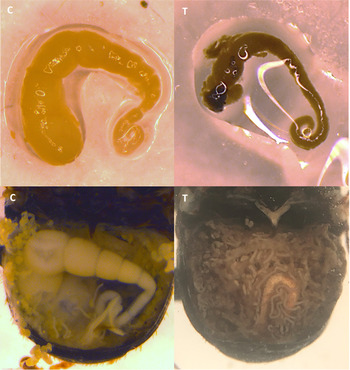
Observations indicated that at the lower concentrations of ivermectin the fat body was large and white to light yellow (fig. 1). At higher concentrations of ivermectin, the fat body was smaller and darker yellow. At the highest concentrations, the fat body and oocytes were brown. At 1 ppm ivermectin, beetles appeared to be slower in their movements, taking longer to become active when removed from the dung for counting. At the end of the three-week trial, 3.7% (±1.8) of beetles died in the control group and 0, 4.8% (±2.0) and 7.5% (±2.5) died when exposed to dung containing 0.01, 0.1 and 1 ppm of ivermectin, respectively. All mortalities, excluding one case, occurred in the third week of the experiment.
Ovary of O. similis when exposed to dung treated with ethanol only (control – C) or ivermectin at 1 ppm (T). Dung beetles were exposed for 3 weeks, with dung replaced weekly.

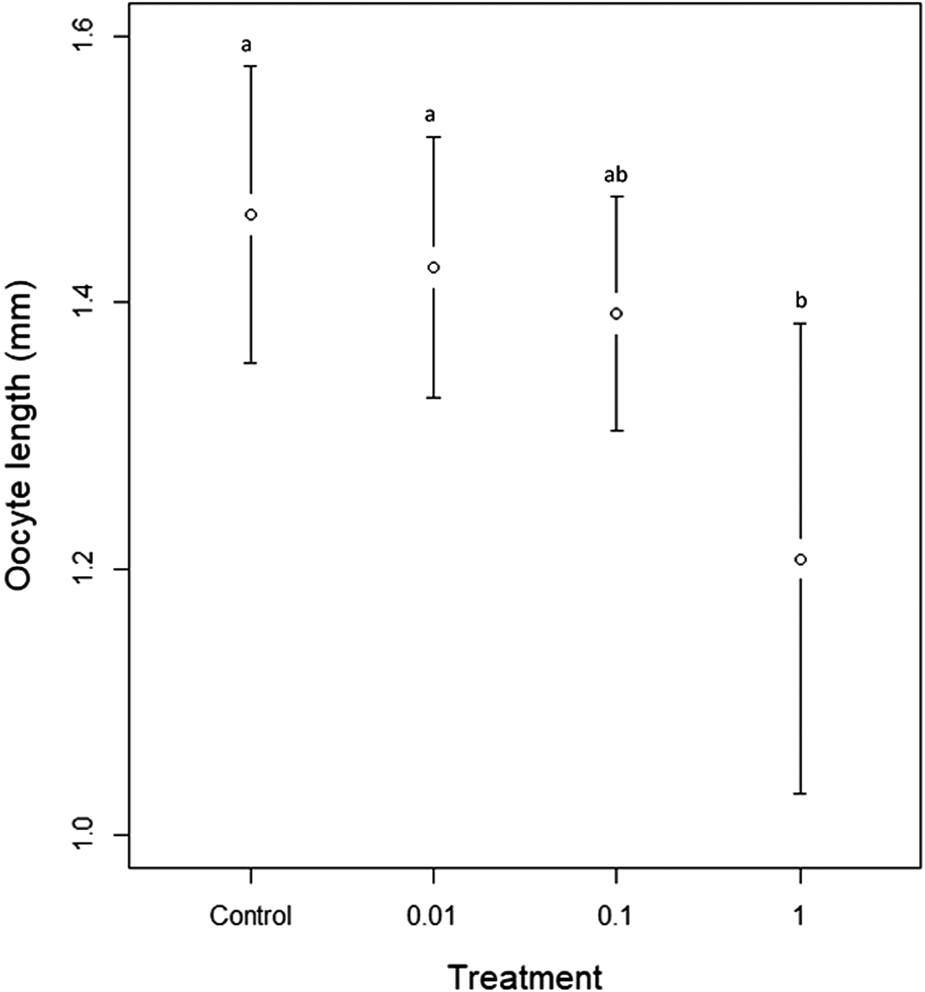
In total, 90% of female O. similis were gravid and each gravid female matured an average of 7.5 (±0.21) oocytes. The number of mature oocytes in gravid females did not differ between the treatment groups (F 3,77 = 0.78, p = 0.51). However, there was a significant difference in oocyte length between the treatment groups (F 3,77 = 3.66, p = 0.016; fig. 2). Oocyte length was significantly smaller in beetles that were exposed to dung containing 1 ppm ivermectin than the control group (Tukey HSD: p < 0.02), and beetles exposed to dung containing 0.01 ppm ivermectin (Tukey HSD: p < 0.05; fig. 2). There was no relationship between the size of hind tibia and oocyte length (t 79 = 1.42, p = 0.16).
The mean oocyte length (±95% confidence intervals) of gravid O. similis after three weeks, when exposed to dung treated with ethanol only (control) or ivermectin at 0.01. 0.1 or 1 ppm. Letters above bars indicate significant differences between means as indicated by Tukey Multiple Range tests.

Field investigation
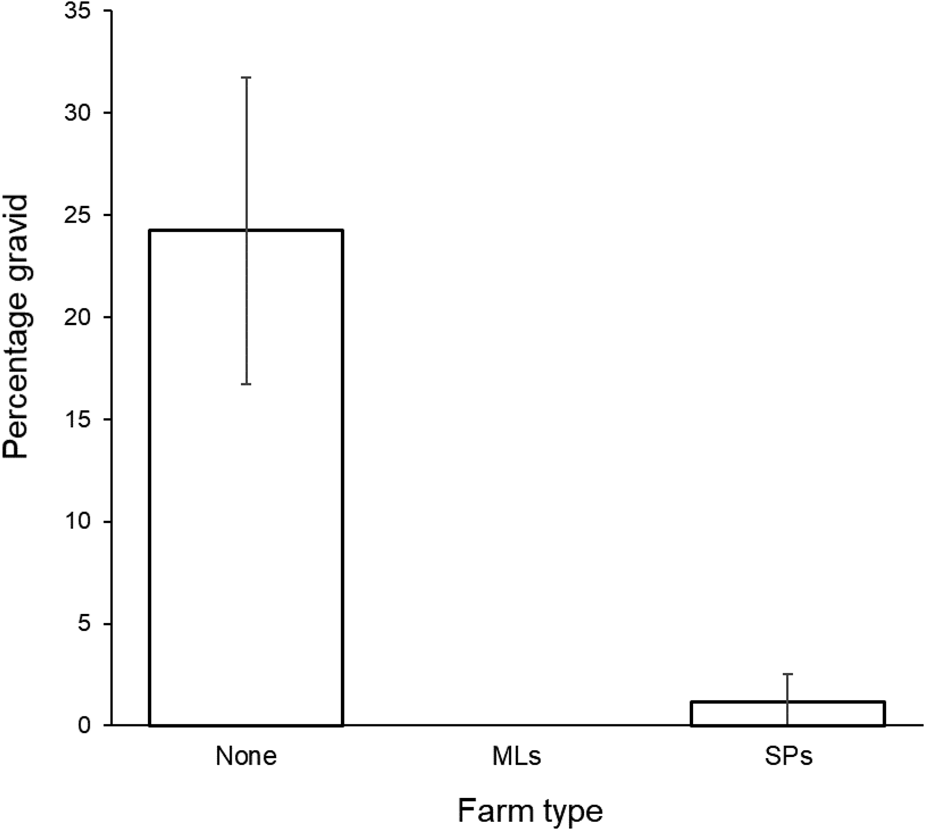
Amongst the O. similis trapped on farms, of which a sample was selected (n = 145), only 6% were gravid. The median number of oocytes found per gravid female was 4 (±1.5), and the median basal length of oocyte was 1.44 mm (±0.13) (n = 9). Farm type was a significant predictor of the number of gravid O. similis (χ 22,63 = 15.42, p < 0.001; fig. 3). On farms where no MLs or SPs were used, 25% of females trapped were gravid. In contrast, 1% of the females trapped were gravid on farms that used SPs, and no gravid females were trapped at farms that used MLs.
Percentage of gravid O. similis beetles collected by pitfall trapping during the summer of 2016 on farms with different pesticide/parasiticide history (none (n = 33), macrocyclic lactones (n = 26), synthetic pyrethroids (n = 86)) in South–West England. Percentages are calculated for each farm type. Bars display the standard error.

O. similis is assumed to be a spring-breeding species, but we are unaware of published reports to this effect. To confirm this assumption, we also dissected female O. similis (n = 81) collected in a related study on 16 of these same farms from 15th August–8th September 2016 (Sands and Wall, Reference Sands and Wall2018). No collected individuals were gravid, confirming our assumption.
Discussion
In the present study, the length of the basal oocyte of O. similis was significantly reduced when beetles were fed on dung spiked with ivermectin at 1 ppm (ww), compared to 0.01 ppm ivermectin and the control group (figs. 1 and 2). The higher concentration corresponds to the peak residue concentration of ivermectin in dung 3 days after pour-on treatment to cattle with a standard dose of 200 µg kg−1 of ivermectin (Sommer et al., Reference Sommer, Steffansen, Nielsen, Grønvold, Jensen, Jespersen, Springborg and Nansen1992). There was also a significant association between the use of chemicals on farms and the percentage of O. similis that were gravid; farms using MLs and SPs had virtually no gravid females.
Other studies have demonstrated similar results. For example, a bioassay using Euoniticellus intermedius (Reiche), fed with ivermectin-spiked dung, showed a relationship between oocyte length and ivermectin concentration, with the smallest basal oocytes recorded at the highest ivermectin concentration of 0.3 ppm (ww) (Martinez et al., Reference Martinez, Lumaret, Zayas and Kadiri2017). Reduced oocyte length has also been demonstrated with exposure of beetles to the MLs doramectin and abamectin (Dadour et al., Reference Dadour, Cook and Hennessy2000). Effects of MLs on reproductive output have also been demonstrated. Significantly fewer brood masses were made by E. intermedius in dung collected from cattle 1 to 14 days after a 200 µg kg−1 injection of ivermectin (Kruger and Scholtz, Reference Kruger and Scholtz1997), and when E. intermedius was exposed to dung spiked with 0.1 ppm of ivermectin (Cruz Rosales et al., Reference Cruz Rosales, Martínez, López-Collado, Vargas-Mendoza, González-Hernández and Fajersson2012). Brood ball production of Onthophagus binodis (Thunberg) was reduced by 67% in dung collected 1 week after cattle were treated by injection with avermectin B1 at 200 µg kg−1 (Ridsdill-Smith, Reference Ridsdill-Smith1988). Similar effects have been noted with SPs (Wardhaugh et al., Reference Wardhaugh, Longstaff and Lacey1998; Vale et al., Reference Vale, Grant, Dewhurst and Aigreau2004; Bang et al., Reference Bang, Lee, Na and Wall2007), for example brood ball production by Metacatharsius troglodytes (Boheman) was reduced by 40 and 80% when exposed to dung spiked with 0.1 ppm (ww) and 1 ppm (ww) of deltamethrin respectively, compared to controls (Sands and Wall, Reference Sands and Wall2018).
The reduced oocyte size in the present study may result from delays in development in response to ML residues. This may be due to suppressed feeding activity, which has been demonstrated in several species in the presence of ivermectin (Wardhaugh and Rodriguez-Menendez, Reference Wardhaugh and Rodriguez-Menendez1988; Finnegan et al., Reference Finnegan, Flanagan and Gormally1997). Suppressed feeding in the presence of ivermectin may result from paralysis of muscles used to process food or for locomotion. Additionally, detection of volatiles by Scarabaeus cicatricosus (Lucas) antennae has been shown to be significantly reduced when dung was spiked with 0.001 to 0.2 ppm ivermectin compared to controls (Verdú et al., Reference Verdú, Cortez, Ortiz, González-Rodríguez, Martinez-Pinna, Lumaret, Lobo, Numa and Sánchez-Piñero2015). Dung patches are highly ephemeral so altered volatile sensitivity could reduce the ability of beetles to find food and mates. Supressed feeding may result in a smaller fat body and therefore reduced energy reserves for oocyte production. Indeed, the size of the fat body appeared reduced in the current study, possibly resulting in the reduced oocyte size.
The combined lethal and sublethal effects of MLs and SPs at the egg, larval or adult stage are likely to reduce the long-term abundance of dung-beetles on farms using these chemical treatments. Models based on lethal effects, parametrized with laboratory data, have suggested that a single treatment of the ML eprinomectin could reduce the abundance of Onthophagus taurus (Schreber) by 35% when cattle were treated 14 days after the emergence of beetles (Wardhaugh et al., Reference Wardhaugh, Holter and Longstaff2001). The inclusion of sublethal effects to such models is likely to result in predictions of even greater reductions in abundance.
Previous work has highlighted an association between the long-term use of MLs and SPs and reduced beetle species richness (Sands and Wall, Reference Sands and Wall2018). Effects were predominantly on paracoprids, such as Onthophagus, while paradoxically finding a higher abundance of endocoprids, such as Aphodius, on farms that used MLs or SPs. The authors speculated that competitive interactions between the beetle guilds may be responsible, along with differential sensitivity to chemicals. For example, Gittings and Giller (Reference Gittings and Giller1998) suggested that the presence of the paracoprid Geotrupes spiniger (Marsham), in combination with weather conditions, may have prevented the development of Aphodius larvae by promoting the rapid removal of dung from pastures in Ireland in summer. Hence, when paracoprids such as Onthophagus species are absent, due to their sensitivity to MLs and SPs, the resource may become dominated by Aphodius and therefore, the diversity of species on pasture reduced.
There is evidence that more complex beetle communities achieve the greatest differences in ecosystem services. Over a period of 36 weeks, mixed species assemblages of Aphodius and Onthophagus dung beetles were shown to achieve the highest cattle dung decomposition rates in comparison to monoculture treatments, when the biomass of beetles was standardized (Beynon et al., Reference Beynon, Mann, Slade and Lewis2012). A similar conclusion was reached in a study by Manning et al. (Reference Manning, Beynon and Lewis2017) where the dung-removing capacity of Aphodius ater (De Geer), Aphodius fossor (L.) and Onthophagus joannae (Goljan) was assessed in polycultures or monocultures. The three species treatment and the monoculture containing A. fossor removed a larger quantity of dung than the other two monoculture treatments. A mixed community including the paracoprid beetle Onthophagus nuchicornis (L.) was also found to remove a greater quantity of dung than the endocoprids, Aphodius erraticus (L.) and A. fossor in monocultures (Manning and Cutler, Reference Manning and Cutler2018). Mixed dung beetle assemblages were shown to result in 32% lower CO2 equivalent emissions compared to monoculture treatments (Piccini et al., Reference Piccini, Arnieri, Caprio, Nervo, Pelissetti, Palestrini, Roslin and Rolando2017).
However, in the present study, some caution should be taken from the long-term farm experiment; the sample size was low, only finding a total of 9 gravid females. To gain more confidence in the results, the study should be repeated, perhaps with a larger sample of beetles.
Overall, these studies suggest that dung beetle species are not functionally redundant; species-rich assemblages, including the presence of paracoprid beetles such as O. similis, may contribute disproportionally towards ecosystem function. The sublethal effects on reproduction observed in the present study may, therefore, result in greater alterations to dung beetle communities over time than from lethal effects alone. Reductions in dung beetle species richness and/or abundance resulting from the combined lethal and sublethal effects of MLs and SPs are therefore likely to reduce ecosystem function on pastures.
Acknowledgements
We would like to thank Mike and Paul Amos for allowing access to their farm for dung collection and the many farmers who allowed pitfall trapping in their pastures.