





Highlights
-
• No significant Foreign Language Effect emerged on superstition beliefs.
-
• L2 proficiency, not test language, predicted lower superstition levels.
-
• Higher L2 proficiency was linked to more rational judgments.
-
• L2 proficiency should be controlled in Foreign Language Effect research.
1. Introduction
In an increasingly multilingual world, understanding how language influences cognition is crucial. Research on the Foreign Language Effect (FLE) comparing bilinguals using their native (L1) and foreign (L2) language suggests that using a foreign language can influence moral judgement and decision-making (for a review, see Circi et al., Reference Circi, Gatti, Russo and Vecchi2021; Purpuri et al., Reference Purpuri, Vasta, Filippi, Treccani, Wei and Mulatti2025b). In a typical FLE experiment, the experimental group performs a task in L2 that taps into moral and/or decision-making processes, while the control group performs an equivalent version of the task in L1. Results generally reveal systematic differences between the responses of the two groups. While much attention has been paid to these language-dependent shifts in higher-order evaluative processes, one crucial factor has often been overlooked: how proficient someone is in L2.
Differences in L2 proficiency between the experimental and control groups could constitute a confounding factor in this type of studies. In general, random assignment allows researchers to achieve a (probabilistic) balance of pre-existing participant characteristics (e.g., L2 proficiency, I.Q., etc.) across conditions. However, random assignment alone is effective only when sample sizes are sufficiently large, a condition that psychological experiments rarely meet (cf. Goldberg, Reference Goldberg2019). An imperfect and uncontrolled balancing of confounding variables, when coupled with publication bias (i.e., the pervasive tendency in the psychological literature for null or opposite-to-expected findings not to be published (cf. de Bruin et al., Reference De Bruin, Treccani and Della Sala2015a, De Bruin et al., Reference De Bruin, Treccani and Della Sala2015b), may lead to a distorted representation of the literature on a given phenomenon. This risk is also present in the literature on the FLE (cf. Hu et al., Reference Hu, Martín-Luengo and Navarrete2026), raising the concrete possibility that this body of research may not faithfully reflect the true effect of using L2 on reasoning processes.
In addition to imperfectly effective randomisation, systematic factors may also contribute to a differential representation of L2 proficiency levels across experimental and control groups. A particularly relevant factor in this respect is differential dropout related to language proficiency. Online FLE studies, including previous work from our lab (e.g., Nadarevic et al., Reference Nadarevic, Plier, Thielmann and Darancó2018; Purpuri et al., Reference Purpuri, Vasta, Filippi, Wei and Mulatti2024b, Purpuri et al., Reference Purpuri, Vasta, Filippi, Wei and Mulatti2025c), have reported higher dropout rates in the experimental (L2-tested) condition than in the control (L1-tested) condition. Moreover, in some studies (e.g., Hadjichristidis et al., Reference Hadjichristidis, Geipel and Surian2019), more participants have been assigned to the experimental condition to compensate for anticipated data loss due to miscomprehension of the experimental materials. This pattern suggests that participants with insufficient L2 proficiency may be more likely to self-exclude when experimental materials are presented in L2 (i.e., in the experimental condition). Consequently, despite random assignment, the experimental group may disproportionately comprise individuals with higher L2 proficiency compared to the control group.
Actually, the potential moderating role of L2 proficiency in the FLE is not a new concern, and some studies have attempted to address it often reporting mixed results, with some studies finding moderating effects of L2 proficiency and others not (for a review, see Del Maschio et al., Reference Del Maschio, Crespi, Peressotti, Abutalebi and Sulpizio2022; Pavlenko, Reference Pavlenko2017; Purpuri et al., Reference Purpuri, Vasta, Filippi, Treccani, Wei and Mulatti2025b). In general, however, studies addressing this issue have mostly relied on subjective measures of proficiency (cf. Del Maschio et al., Reference Del Maschio, Crespi, Peressotti, Abutalebi and Sulpizio2022), assessed L2 proficiency only in the experimental group and/or failed to measure proficiency comprehensively, that is, through tests covering multiple linguistic domains. Moreover, even when L2 proficiency was assessed, it was often not directly included in the analyses, but rather used only to verify matching between the experimental and control groups on this variable.
For instance, Privitera et al. (Reference Privitera, Li, Zhou and Wang2023) assessed L2 proficiency in both the experimental and control groups using an objective test (i.e., 15 grammar questions and 10 vocabulary questions). However, despite showing that the control and experimental groups had comparable levels of L2 proficiency, they ultimately chose not to include these measures in their analyses. Moreover, the inclusion of objective L2 proficiency measures led to the exclusion of eight participants from the experimental group due to voluntary dropouts, which may again point to the self-selection bias described above. Similarly, Del Maschio et al. (Reference Del Maschio, Del Mauro, Bellini, Abutalebi and Sulpizio2022) assessed L2 proficiency using a 40-item questionnaire (30 grammar and 10 comprehension questions), but only for the experimental group and not for the group assigned to the native language condition. The current study addresses the fact that previous research on the FLE has not typically collected objective measures of L2 proficiency and, when such measures were collected, did not incorporate them into the analysis, or administered them to both experimental and control groups.
This limitation is particularly relevant given that L2 proficiency may influence the extent to which individuals process information in a foreign language. Studies on the FLE show that using and thinking in a foreign language can dampen emotional intensity, pushing people to make more utilitarian decisions. For example, in foreign language, people might take more risks or be more willing to accept harm if it maximises overall outcomes (Keysar et al., Reference Keysar, Hayakawa and An2012; Winskel and Bhatt, Reference Winskel and Bhatt2020). It can also reduce superstitious thinking (Hadjichristidis et al., Reference Hadjichristidis, Geipel and Surian2019) and change how we perceive dishonesty and crime (Alempaki et al., Reference Alempaki, Doğan and Yang2021). Recent evidence also shows that processing information in a foreign language increases tolerance of ambiguity, the degree to which people can tolerate novel and/or unpredictable situations, compared to a native language (Purpuri et al., Reference Purpuri, Vasta, Filippi, Wei and Mulatti2024b). Yet, how much does proficiency in that foreign language really matter in these scenarios?
Language proficiency is more than just speaking a language; it is about mastering a complex web of skills, from everyday conversation to the cognitive demands of academic tasks (Purpuri et al., Reference Purpuri, Mulatti, Filippi and Treccani2024a; Purpuri et al., Reference Purpuri, Treccani, Filippi and Mulatti2025a). Frameworks like the Common European Framework of Reference for Languages (CEFR) break it down into levels (A1 to C2), but scholars debate whether such classifications fully capture the depth of proficiency, especially when it comes to higher-order thinking (Hulstijn, Reference Hulstijn2011).
When we consider how language affects decision-making, proficiency becomes a key piece of the puzzle. A lack of proficiency might lead to misunderstandings or hesitation when interpreting ambiguous information, potentially skewing results. Recent research (Purpuri et al., Reference Purpuri, Vasta, Filippi, Wei and Mulatti2025c) suggests that the FLE might actually be influenced by participants’ language skills, not just the switch from one language to another. In other words, differences in fluency could be the real driver behind these cognitive shifts, rather than the language itself.
1.1. The present study
The present study aims to further investigate the connection between L2 proficiency and superstition, building on our previous work (Purpuri et al., Reference Purpuri, Vasta, Filippi, Wei and Mulatti2024b, Purpuri et al., Reference Purpuri, Vasta, Filippi, Wei and Mulatti2025c) and drawing inspiration from the material and experiment on superstition conducted by Hadjichristidis et al. (Reference Hadjichristidis, Geipel and Surian2019).
Hadjichristidis et al. (Reference Hadjichristidis, Geipel and Surian2019) showed that thinking in a foreign language might reduce superstitious beliefs, suggesting that using a non-native language could attenuate intuitive or heuristic thinking. However, their study relied solely on self-reported measures of L2 proficiency and, importantly, assessed L2 proficiency only in the experimental group and not in the control group, leaving open the question of whether the effect was driven by the novelty of the language context or by individuals’ ability to process it fluently.
By including objective measures of L2 proficiency, we were aiming for a clearer understanding of how language and fluency intersect with superstitious thinking. We hypothesised that higher L2 proficiency will lead to less superstitious thinking, no matter the language of the test. This has important implications for everything from education to cognitive therapy, as we continue to unravel the intricate ways language relates to cognition.
To test our hypothesis, we conducted a large online study involving responses from a total of 355 participants. All participants were asked to evaluate four superstitious scenarios and four filler scenarios, indicating whether the meaning of the scenario was positive or negative. Half of the participants read these scenarios in their native language (Italian), while the other half read them in a foreign language (English). Additionally, all participants completed an extended English language placement test and answered questions about their magical beliefs (see Methods). This approach allowed us to disentangle the individual contributions of the FLE and proficiency in the foreign language on participants’ superstitious beliefs.
While the present study is not the first to address the issue of L2 proficiency in the FLE, it seeks to contribute to the literature by adopting a more comprehensive and fine-grained assessment of second language proficiency. Specifically, L2 proficiency was measured using a 100-item test covering levels from A1 to C2, allowing for a more detailed characterisation of participants’ linguistic competence across a broad proficiency spectrum.
This approach differs from much of the existing literature, where proficiency has often been assessed with relatively limited objective measures (e.g., short grammar and vocabulary tests) or through subjective self-report scales. For instance, prior studies have employed brief instruments consisting of a small number of items, which may not fully capture the multidimensional nature of language proficiency (e.g., Privitera et al., Reference Privitera, Li, Zhou and Wang2023). Moreover, as highlighted in previous meta-analytic work (e.g., Del Maschio et al., Reference Del Maschio, Crespi, Peressotti, Abutalebi and Sulpizio2022), the measurement of L2 proficiency has frequently been inconsistent across studies and, in some cases, not clearly reported for all experimental groups.
The present study therefore prioritises a more robust operationalisation of L2 proficiency to increase the precision with which its role in modulating the FLE can be examined. At the same time, we acknowledge that other dimensions of language experience (e.g., frequency of use, age of acquisition, immersion) may also influence the effect. These factors were not directly assessed in the current design and should be systematically considered in future research to provide a more holistic account of bilingual experience.
2. Methods
2.1. Participants
The sample size was determined using G*power. Based on Study 3 of Hadjichristidis et al., Reference Hadjichristidis, Geipel and Surian2019, we performed a power analysis using the effect size of the Language × Scenario type interaction (i.e., f = .16). In order to obtain a power = 0.80 with an alpha = .05, the analysis indicated a minimum sample size of n = 309 participants for an analysis of covariance (ANCOVA; two groups, one covariate), with half of the participants being assigned to one condition (L1) and the other half to the second condition (L2) (see pre-registration: https://osf.io/y85vd). Nevertheless, to maximise the study’s statistical power and account for potential dropouts, we opted to gather data from as many participants as feasible.
A total of 431 volunteers participated in the study and completed the experiment online. They also provided biographical and linguistic information. After eliminating incomplete answers and two participants who completed the questionnaire in less than 5 minutes (an insufficient amount of time to meaningfully complete the questionnaire), 355 participants were included in the analysis (249 female, 100 male, 4 non-binary, 2 did not provide this information); mean age = 21.66 years (1 participant did not provide this information, age range: 18–56 years). Then, 156 participants were randomly assigned to the Italian questionnaire (L1_Italian condition), and 199 to the questionnaire in English (L2_English condition). All participants had studied English as a second language as part of their previous scholastic education. Participants were asked to self-rate their level of English according to the Common European Framework. They could choose between B1, B2, C1 and C2. Then, 111 participants chose B1, 146 participants B2, 46 participants C1 and 25 participants C2, while 27 did not provide this response. Overall, 131 participants stated that they possess an official language certificate: 21 reported that they possess a B1 certification, 65 a B2 certification, 30 a C1 certification and 15 a C2 certification.
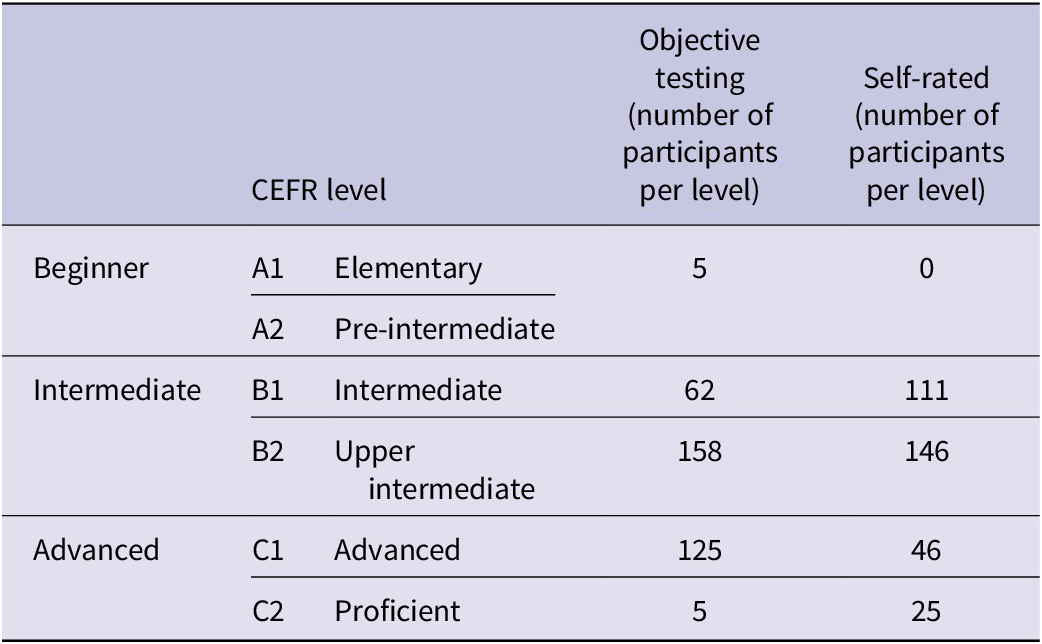
All participants completed an English language placement test. Five participants positioned themselves at an elementary/pre-intermediate (A1/A2) level, 62 participants at an intermediate (B1) level, 158 participants at an upper intermediate (B2) level, 125 participants at an advanced (C1) level, and five participants at a proficient (C2) level (see Table 2).
Participants also reported their level of education, with 32 participants holding a middle school diploma, 294 a secondary school diploma, nine a bachelor’s degree, 16 a master’s degree, five a doctoral degree and three a master’s degree.
The study (Ref. 2024-04 ESA) received ethical approval from the Ethics Committee of the University of Trento and participants provided their consent at the beginning of the online questionnaire. Informed consent was obtained from all participants. Research has been performed in accordance with the Declaration of Helsinki (https://www.wma.net/policies-post/wma-declaration-of-helsinki/).
2.2. Materials and procedure
At the initial stage, we used the same materials and followed the same procedure as in the original experiment (Hadjichristidis et al., Reference Hadjichristidis, Geipel and Surian2019, Study 3). The study was conducted by means of an online survey administered through Qualtrics. Participants evaluated eight scenarios: four superstitious scenarios (two bad-luck and two good-luck scenarios) and four filler scenarios (see Table 1). The scenarios were presented in two blocks, each comprising two superstitious scenarios (either bad luck or good luck) and two filler scenarios. For the block containing the bad-luck scenarios (and two filler scenarios), we used a 9-point scale ranging from 1 (neutral) to 9 (very negative), whereas for the block containing the good-luck scenarios (and two filler scenarios), we used a 9-point scale ranging from 1 (neutral) to 9 (very positive). As in the original experiment, we supplemented the scales with SAM figurines (Lang, Reference Lang, Tuma, Maser, Tuma and Maser1985). The presentation order of blocks and the scenarios was randomised separately for each participant. The scenarios were presented one at a time, each on a separate page. Once participants judged a scenario and moved to the next one, they could not revert to previous pages to make corrections.
English version of the materials used in the experiment

Table 1. Long description
The table is organized into two columns: Scenarios and Description. It is divided into three thematic sections.
1. Bad-luck scenarios:
- Mirror: Surgery at a hospital on the day a bathroom mirror breaks.
- Black cat: Taking a difficult driving test after a black cat crosses the path from left to right.
2. Good-luck scenarios:
- Four-leaf clover: Giving an important work presentation after finding a four-leaf clover in a park.
- Falling star: Meeting a romantic interest at a party after seeing a falling star in the sky.
3. Control scenarios:
- Blocked sink: Submitting a job application on a day when the kitchen sink is blocked.
- White dog: Taking an exam after seeing a man with a white dog in front of the building.
- Tulips: Handing in apartment rental documents after noticing tulips in a public garden.
- Airplane: Attending a job interview after seeing an airplane in the sky while walking from a cafe.
Each description concludes with a question asking how the participant would feel about the primary task under the specified condition.
After completing the test, adding to the original experiment, we administered a complete English language placement test, prepared by an English as a Foreign Language teacher, with adaptations from official certification tests. The 100 questions of the tests ranged from an A1 to a C2 level (see Table 2 for a description of the levels and the number of participants for each level) and aimed to evaluate participants’ L2 proficiency.
Common European Framework of Reference for Languages (CEFR)

Table 2. Long description
The table is organized into five columns: C E F R level category, alphanumeric level, descriptive level, objective testing participant count, and self-rated participant count.
* Beginner category includes levels A 1 Elementary and A 2 Pre-intermediate. Objective testing shows 5 participants for this group, while self-rated shows 0.
* Intermediate category includes levels B 1 Intermediate and B 2 Upper intermediate. B 1 has 62 objective and 111 self-rated participants. B 2 has 158 objective and 146 self-rated participants.
* Advanced category includes levels C 1 Advanced and C 2 Proficient. C 1 has 125 objective and 46 self-rated participants. C 2 has 5 objective and 25 self-rated participants.
Note: This guideline serves to describe the achievements of learners of foreign languages across Europe and, increasingly, in other countries. Developed by the Council of Europe as the central component of the project “Language Learning for European Citizenship” between 1989 and 1996, its primary goal is to offer a universal method for learning, teaching and assessing languages across Europe. The six reference levels are gaining widespread recognition as the European standard for assessing an individual’s language proficiency.
Participants were subsequently asked to complete the magical beliefs scale used in the original experiment (adapted from Wisemann and Watt, Reference Wisemann and Watt2004), which they all received in their native language. The magical beliefs scale included six items: “Do you say “fingers crossed” or actually cross your fingers?” “Do you sometimes carry a lucky charm or object?” “Do you sometimes knock on wood or touch wood?” “Would you be anxious about breaking a mirror because it is thought to cause bad luck?” “Are you superstitious about the number 13?” “Have you avoided walking under a ladder because it is associated with bad luck?” Participants provided responses to each question using a 5-point scale, ranging from 1 (No, absolutely not) to 5 (Yes, absolutely). The inclusion of this scale aimed to investigate whether language influences feelings evoked by superstitious scenarios beyond individual differences in magical beliefs.
Finally, participants filled out a set of demographic questions, where they were asked to provide information about their cultural and linguistic background.
3. Results
3.1. Effect of language and L2 proficiency on superstition
An ANCOVA was carried out to test if there was an effect of language and L2 proficiency on the questionnaire’s answers. We included the superstitious scenarios’ scores (Questions 1 – mirror, 2 – black cat, 5 – four-leaf clover and 6 – falling star) as the dependent variable, language as the fixed factor and L2 proficiency as the covariate. The main effect of language did not reach the significance criterion (F = 0.14), while L2 proficiency resulted significant, F(1, 352) = 4.68, p = .031, ηp 2 = .013, revealing that, regardless of the language in which the questionnaire was presented, the more proficient participants were in the second language, the lower the value assigned to the items, and thus the lower their level of superstition (Figure 1).
Superstitious scenarios’ scores (mean) sorted by L2 proficiency, in both the English (ENG) and Italian (ITA) conditions. Each dot corresponds to the score of at least one participant. Grey and brown regions indicate the confidence interval (95%).

Figure 1. Long description
The graph is titled Language of the questionnaire and L 2 proficiency. The horizontal X axis is labeled L 2 proficiency with numerical markers at 25, 50, 75, and 100. The vertical Y axis is labeled Superstitious scenarios’ scores with numerical markers at 1, 3, 5, 7, and 9.
Data points are scattered across the plot area. Grey circles represent the E N G condition and brown triangles represent the I T A condition. Both datasets show a wide vertical spread across all proficiency levels.
Two downward-sloping linear regression lines are present.
* A solid black line represents the E N G condition, starting near a score of 5 at low proficiency and ending near 4 at high proficiency. It is surrounded by a grey shaded 95 percent confidence interval.
* A dashed black line represents the I T A condition, following a similar slightly negative slope, surrounded by a brown shaded 95 percent confidence interval.
A legend on the right side is titled Language of the Questionnaire. It identifies the solid line as E N G and the dashed line with a triangle marker as I T A.
We conducted the same ANCOVA on filler scenario scores, with language as the fixed factor and L2 proficiency as the covariate. In this analysis, neither the main effect of language nor L2 proficiency was significant (F = 0.30 and F = 0.68, respectively), suggesting that L2 proficiency affected only superstitious scenarios.
3.2. Magical belief and superstition
Next, we considered the Magical Belief Scale that the participants had to fill in. We conducted an ANCOVA with the superstitious scenarios’ scores as the dependent variable, language as a fixed factor, and the scores on the Magical Belief Scale as a covariate. The covariate was found to be significant (F(1, 325) = 154.84, p < .001, ηp 2 = .323), indicating that superstitious participants (i.e., lower scores on the Magical Belief Scale) responded more superstitiously in the superstitious scenarios. We conducted the same ANCOVA on filler scenarios, with language as a fixed factor and the magical belief scale as a covariate. Again, scores on the Magical Belief Scale were significant (F(1, 325) = 17.08, p < .001, ηp 2 = .050), indicating that, although to a lesser extent than for the superstitious scenarios, more superstitious participants continued to respond more superstitiously even to filler scenarios. These results suggest that superstitious participants tend to assign emotional value to all types of scenarios, including neutral ones (Figure 2).
Superstitious and filler scenarios’ scores (mean) sorted by Magical Belief scores, in both the English (ENG) and Italian (ITA) conditions. Each dot corresponds to the score of at least one participant. Grey and brown regions indicate the confidence interval (95%).

Figure 2. Long description
A two-panel scatter plot titled Language of the questionnaire and Magical Belief.
Left Panel: The y-axis is labeled Superstitious scenarios’ scores ranging from 1 to 9. The x-axis is labeled Magical Belief scores ranging from 1 to 5. The data shows a strong negative linear correlation. E N G data points are grey circles with a solid black regression line and grey 95 percent confidence interval. I T A data points are tan triangles with a dashed black regression line and tan 95 percent confidence interval. Both lines start near a y-score of 7.5 at x-score 1 and descend to approximately y-score 3 at x-score 5.
Right Panel: The y-axis is labeled Filler scenarios’ scores ranging from 1 to 9. The x-axis is labeled Magical Belief scores ranging from 1 to 5. The data shows a much flatter, slightly negative linear trend compared to the left panel. E N G and I T A regression lines and confidence intervals overlap significantly, starting around y-score 4 at x-score 1 and ending near y-score 2.5 at x-score 5.
Legend: Located to the right of the panels under the heading Language of the Questionnaire. A solid black line represents E N G and a dashed black line represents I T A.
3.3. Relationship between L2 proficiency and magical belief
To explore if there is a direct relation between proficiency in L2 and magical belief, we conducted a Pearson’s correlation analysis between L2 proficiency and Magical Belief Scale. This resulted in a positive correlation (r = .12, p = .029), indicating that the more proficient participants are in English, the more their responses tend towards 5 in the Magical Belief Scale, which is the value indicating the least superstitious (see Figure 3). This means that as L2 proficiency increases, participants are more likely to score towards the “least superstitious” end of the scale, reinforcing the idea that language proficiency plays a role in reducing superstitious beliefs.
L2 proficiency sorted by Magical Belief scores. Each dot corresponds to the score of at least one participant. The grey region indicates the confidence interval (95%).

Figure 3. Long description
The scatter plot is titled L 2 proficiency and Magical Belief. The horizontal X axis is labeled Magical Belief scores and ranges from 1 to 5. The vertical Y axis is labeled L 2 proficiency and ranges from 0 to 100 in increments of 25.
Data points are represented by tan dots scattered across the grid. The density of dots is highest between Magical Belief scores of 2 and 5. While the dots are widely dispersed vertically, there is a slight upward concentration as the X axis values increase.
A solid black linear regression line starts at approximately 50 on the Y axis when the X axis is 1 and rises with a very shallow positive slope to just above 55 on the Y axis when the X axis is 5. A light grey shaded region surrounds this line, representing the 95 percent confidence interval, which remains relatively narrow and consistent in width across the entire span of the graph.
3.4. Impact of age on superstitious beliefs
In an ANCOVA, we examined whether Age had an effect on superstition. One participant was excluded because they did not report their age. We set the superstitious scenarios as dependent variables, language as a fixed factor and age as a covariate. Age resulted in a significant covariate, F(1, 351) = 5.37, p = .021, ηp 2 = .015, showing that older participants were less superstitious if compared to younger participants (Figure 4). Previous research has demonstrated a positive association between age and superstitious beliefs (Epstein, Reference Epstein, Funder, Parke, Tomlinson-Keasey and Widaman1993). However, other studies have found a different pattern, indicating that younger individuals tend to be more superstitious than older adults (Corrigan et al., Reference Corrigan, Pattison and Lester1980; Gallup and Newport, Reference Gallup and Newport1991).
Superstitious scenarios’ scores (mean) sorted by age, in both the English (ENG) and Italian (ITA) conditions. Each dot corresponds to the score of at least one participant. Grey and brown regions indicate the confidence interval (95%).

Figure 4. Long description
A scatter plot titled Language of the questionnaire and Age. The horizontal x-axis represents Age in years, ranging from approximately 18 to 55. The vertical y-axis represents Superstitious scenarios scores, ranging from 1 to 9.
Two data groups are plotted:
* E N G (English condition) is represented by grey circular dots and a solid black regression line. The line shows a very slight negative slope, remaining relatively flat near a score of 4 across all ages. A light grey shaded region indicates the 95 percent confidence interval, which widens as age increases.
* I T A (Italian condition) is represented by brown triangular dots and a dashed black regression line. This line shows a more pronounced negative linear trend, starting near a score of 4.5 at age 18 and descending toward a score of 2 by age 55. A light brown shaded region indicates the 95 percent confidence interval, which also widens significantly at higher ages.
The majority of data points for both groups are clustered between the ages of 18 and 25, with sparse data points extending toward the right of the graph.
3.5. Gender differences in superstitious thinking
We then performed another ANOVA in order to examine if there were any gender-related differences on superstition. Six participants were excluded from this analysis (4 = non-binary, 1 = other, 1 participant did not provide this information), as their number was too small to be consistent. We set the superstitious scenarios as dependent variables, language and gender as fixed factors. The main effect of gender resulted to be significant, F(1, 345) = 33.30, p < .001, ηp 2 = .088, with female participants being more superstitious (mean = 4.705, sd = 1.85) if compared to male participants (mean = 3.393, sd = 1.89), while the interaction between Gender and Language of the questionnaire did not reach the significance criterion (F = 0.79; see Figure 5). While females scored an average of 4.7 on the superstitious scenarios, males scored 3.4, suggesting a noticeable difference in how superstition is experienced between genders. The absence of an interaction between gender and the language of the questionnaire indicates that these gender differences are independent of the language used in the study (Figure 5).
Superstitious scenarios’ scores (mean), sorted by Language of the questionnaire and Gender (F = female, M = male). Vertical bars represent standard errors, while black dots represent the aggregated means.

Figure 5. Long description
The graph features a vertical y-axis labeled Superstitious scenarios’ scores ranging from 3.0 to 5.0 and a horizontal x-axis labeled Language of the Questionnaire with two categories: E N G and I T A.
Two data series are plotted:
* Female (F): Represented by a solid red line. In the E N G category, the mean score is approximately 4.75. In the I T A category, the mean score slightly decreases to approximately 4.65.
* Male (M): Represented by a dashed red line. In the E N G category, the mean score is approximately 3.25. In the I T A category, the mean score increases to approximately 3.55.
Each data point is marked with a black dot representing the aggregated mean and includes vertical error bars indicating standard error. The female scores are consistently higher than the male scores across both languages.
3.6. Educational level and superstition
Next, in an ANCOVA, we examined whether the reported level of instruction had an effect on superstition. However, contrary to expectations, in this analysis, the level of instruction did not emerge as a significant covariate (F = 0.45, p = .50), indicating that formal education does not play a major role in shaping superstitious beliefs in this context.
4. Discussion
The primary aim of the present study was to determine whether higher proficiency in L2 influences participants’ superstitious beliefs, regardless of the language in which the questionnaire is administered. The study investigated the role of second language proficiency on superstitious beliefs, challenging the conventional understanding of the FLE.
Our analysis of data from 355 participants revealed no significant differences between responses given in the participants’ native language and those given in their second language. These findings do not provide evidence in support of the FLE hypothesis, according to which using a foreign language should result in more rational and less emotionally driven responses. Instead, our results showed that L2 proficiency played a critical role: participants with higher proficiency in their second language exhibited lower levels of superstition, regardless of whether they completed the questionnaire in L1 or L2. Most previous studies’ findings (e.g., Hadjichristidis et al., Reference Hadjichristidis, Geipel and Surian2019) suggest that using an L2 leads to more rational thinking due to emotional distancing. In contrast, our results indicate that L2 proficiency itself is a more significant predictor of reduced superstitious beliefs. Participants with higher English proficiency demonstrated less superstition, irrespective of the language of the questionnaire. These findings are also inconsistent with our preregistered hypotheses, in which we expected L2 proficiency to moderate the FLE. Instead, we found an effect of L2 proficiency, but no evidence of an FLE. Whereas previous studies have almost consistently reported the presence of the FLE across different contexts, the pattern observed here suggests that the FLE may be less robust and less pervasive than previously assumed, raising the possibility that earlier estimates of the FLE have been partly distorted by publication bias (cf. Hu et al., Reference Hu, Martín-Luengo and Navarrete2026).
The lack of significant language effects on superstition observed in the present study and the prominent role of L2 proficiency also highlight the need to reconsider the results of previous FLE’s studies. Previous studies may have overlooked the impact of L2 proficiency by focusing solely on the language in which materials were presented or by relying solely on subjective measures to assess proficiency (e.g., participants’ self-assessment of their English proficiency. Differences in L2 proficiency between experimental and control groups, when unassessed or inadequately measured, could artificially generate an FLE, even when the observed effects are actually driven by proficiency disparities. Objective measures of language proficiency, such as standardised language tests, are essential to ensure a more accurate assessment (Privitera et al., Reference Privitera, Li, Zhou and Wang2023, Reference Purpuri, Treccani, Filippi and Mulatti2025a).
In Table 2, it is possible to see a comparison between the number of participants at each English proficiency level as determined by objective CEFR testing and self-reported ratings. Notably, there are significant discrepancies between the two methods of assessment. For instance, no participants self-rated as beginners (A1), yet objective testing identified five individuals at this level. Conversely, while 62 participants objectively tested at B1 (Intermediate), 111 participants self-identified at this proficiency level. The upper-intermediate level (B2) shows more consistency, with 158 participants objectively tested and 146 self-rated in this category. A striking divergence is observed at the advanced levels. Objective testing classified 125 participants at C1 (Advanced), while only 46 self-reported at this level. Similarly, at the C2 (Proficient) level, only five participants were objectively tested, but 25 self-identified as proficient. These discrepancies highlight potential overestimation or underestimation of language proficiency by participants when self-reporting. It underscores the importance of using objective measures to accurately assess language skills, as self-assessment may not reliably reflect actual proficiency. This misalignment can have significant implications for research relying on self-reported data, which constitute the majority of studies assessing L2 proficiency, suggesting that objective testing should be prioritised for more accurate classification. This shift in methodology might yield more reliable data, ultimately refining our understanding of the FLE and its implications. In the present study, analyses including the Magical Belief Scale as a covariate revealed, as expected, a significant effect, indicating that superstitious participants were more likely to make superstitious choices, thus supporting the internal coherence of our experiment. Additionally, Pearson’s correlation analysis indicated that higher L2 proficiency was associated with reduced superstitious responding (i.e., less superstitious responses), suggesting once more that L2 proficiency can mitigate superstitious tendencies, although the mechanisms underlying this association remain unclear. Interestingly, participants with stronger superstitious tendencies evaluated not only superstitious scenarios, but also filler scenarios, as more superstitious. This may reflect a general tendency among more superstitious individuals to perceive a wider range of situations as capable of influencing the outcome of their choices, regardless of whether they are broadly recognised as superstitious. Importantly, however, the effect observed for filler scenarios was substantially smaller than that found for superstitious scenarios (ηp 2 = .050 versus ηp 2 = .323).
Although the FLE has often been interpreted as evidence that using a foreign language reduces emotional reactivity and leads to less biased and more rational decision-making, this account has been increasingly challenged in recent literature. In particular, the assumption that foreign language use systematically improves decision quality does not hold consistently across domains.
For example, Hayakawa et al. (Reference Hayakawa, Lau, Holtzmann, Costa and Keysar2019) reported unreliable effects of foreign language use on risk-taking and raised concerns about the robustness of earlier findings. Extending this line of work, Muda et al. (Reference Muda, Niszczota, Hamerski and Białek2025) found that foreign language use increased risk-taking in prenatal testing decisions, a context in which higher risk has meaningful real-world consequences, and where attenuated emotional reactivity did not account for the observed pattern. Similarly, Muda et al. (Reference Muda, Pennycook, Hamerski and Białek2023) showed that individuals processing information in a foreign language were less accurate in distinguishing real from fake news. Further evidence comes from Białek et al. (Reference Białek, Muda, Stewart, Niszczota and Pieńkosz2020), who demonstrated that foreign language use distorts the allocation of cognitive effort, leading individuals to engage in unnecessary deliberation on simple problems while failing to sufficiently deliberate on problems that require it. Taken together, these findings challenge a straightforward interpretation of the FLE as promoting less biased and more rational decision-making.
In light of these inconsistencies, alternative theoretical accounts have been proposed. Hayakawa et al. (Reference Hayakawa, Tannenbaum, Costa, Corey and Keysar2017) framed the FLE in terms of whether foreign language use leads individuals to “think more” or “feel less,” with their findings suggesting that the effect is better explained by weakened intuitive responses rather than enhanced deliberative processing. Building on this perspective, Białek (Reference Białek2023) proposed a metacognitive disruption account, according to which foreign language use interferes with conflict monitoring processes that allow individuals to detect when their initial responses may be incorrect. Consistent with this account, Hu et al. (Reference Hu, Martín-Luengo and Navarrete2026) showed that foreign language use reduces feelings of rightness, which play a critical role in determining when individuals re-evaluate their moral judgments. Across these contributions, a common conclusion emerges: foreign language use does not necessarily enhance reasoning, but may instead degrade the metacognitive signals that guide when increased cognitive effort is warranted.
The present findings are consistent with this broader framework. If foreign language use disrupts metacognitive calibration, then differences in L2 proficiency between experimental and control groups do not merely introduce random variability, but may instead produce systematic differences in the degree of metacognitive interference. From this perspective, proficiency acts not only as a moderator but also as a potential confounding factor that can mimic or amplify apparent language effects. Accordingly, the observed association between higher L2 proficiency and reduced superstition may reflect lower levels of metacognitive disruption during foreign language processing, rather than an increase in rational decision-making per se.
Our study found significant age and gender effects on superstition. Older participants tended to be less superstitious, and female participants were more superstitious compared to male participants. Previous research has reported both positive and negative associations between age and superstitious beliefs (e.g., Corrigan et al., Reference Corrigan, Pattison and Lester1980; Epstein, Reference Epstein, Funder, Parke, Tomlinson-Keasey and Widaman1993; Gallup and Newport, Reference Gallup and Newport1991). Similarly, other studies have found that female participants tend to express more superstitious beliefs (e.g., Maqsood et al., Reference Maqsood, Jamil and Khalid2018). However, these results may reflect cultural characteristics of our sample rather than actual effects of age or gender per se.
Regarding the participants’ reported level of instruction, when examining whether it had an effect on superstition, we found that it does not significantly influence the participants’ superstitious beliefs. Despite our initial assumptions that education level might play a role in moderating superstitious tendencies, our findings do not support them. Possibly, other factors might be more critical in shaping these beliefs.
One limitation of this study is that we did not assess participants’ IQ or socio-economic status (SES). Therefore, the present study cannot determine which specific factor accounts for the observed effects. Indeed, the observed mitigation of superstitious tendencies may have been driven not by L2 proficiency per se, but by one of these two variables, or by other factors associated with proficiency. Individuals with higher IQ or SES are more likely to be both more proficient in L2 and less prone to superstitious beliefs. Future studies should consider this. In addition to this, our study has been developed in an experimental setting, and it might not have taken into account the importance of considering differences in foreign language experience across different contexts (cf. Privitera et al., Reference Privitera, Li, Zhou and Wang2023), potentially undermining the ecological validity of our results. Future studies should test our hypothesis in an applied field. One other limitation is that, while we excluded incomplete responses and participants who completed the questionnaire in an implausibly short time, we did not include an explicit comprehension check. At the same time, we note that our exclusion criteria were designed to mitigate low-quality data, and the overall completion times suggest that most participants engaged meaningfully with the task.
In conclusion, our findings suggest that higher proficiency in L2 is associated with superstitious beliefs, independently of the language used. There is a need to re-evaluate the existing literature on the FLE. Studies that have not accounted for L2 proficiency may have reported biased results, attributing effects to the language of presentation rather than to proficiency. Future research should prioritise assessing and accounting for L2 proficiency when investigating the FLE. By doing so, researchers can better isolate the effects of language from proficiency and provide a clearer understanding of bilingual decision-making and judgement processes. Additionally, exploring other individual differences that correlate with language proficiency could offer deeper insights into the cognitive mechanisms underlying rationality and superstition.
The present findings do not allow us to conclude that L2 proficiency directly enhances rational decision-making. Rather, they suggest that proficiency-related variables may substantially shape how individuals process and respond to foreign-language materials.
Data availability statement
The datasets used and/or analysed during the current study are available from the corresponding author on reasonable request.



 Open access

