Introduction
Coral reef habitats are one of the most diverse and multilayered ecosystems on the planet. Their primary productivity is greater than most other oceanic and terrestrial ecosystems. Thus, these ecosystems are often considered as the rain forests of the ocean. Although coral reefs occupy less than 1% of the ocean floor, one-third of all marine species worldwide are found in coral reef ecosystems (Brandl et al. Reference Brandl, Rasher, Côté, Casey, Darling, Lefcheck and Duffy2019; Connell Reference Connell1978). Around the globe, 15% of corals are situated in the Atlantic Ocean, 53% in South-East Asia, 19% in the Pacific and 9% in the Red Sea (Sorokin Reference Sorokin, Lange, Mooney and Remmert1993). According to estimates, coral reefs host about 830,000 different species (Fisher et al. Reference Fisher, O’Leary, Low-Choy, Mengersen, Knowlton, Brainard and Caley2015). Coral reefs offer several other significant environmental services and financial advantages to a vast global human population (Buddemeier et al. Reference Buddemeier, Joan and Richard2004; Hoegh-Guldberg Reference Hoegh-Guldberg2015). Coral reefs are important for coastal protection and erosion mitigation as they play a key role in reducing the wave energy by acting as natural barriers (Ferrario et al. Reference Ferrario, Beck, Storlazzi, Micheli, Shepard and Airoldi2014). They also help in addressing climate change impacts, particularly in mitigating the effects of sea-level rise (Burke and Spalding Reference Burke and Spalding2022). Economic benefits offered by coral reefs are estimated to be 70 folds higher than those of the tropical forests. It has been estimated that the economic value of coral reefs range between US$ 100,000 and 600,000 per sq.km (UNEP-WCMC 2006). In spite of their ecological and economic significance, coral reefs around the world have declined remarkably during the past couple of decades due to various climatic and non-climatic issues. Climate change-mediated threats, such as coral bleaching, ocean acidification and ocean deoxygenation, have been reported as primary threats (Hughes et al. Reference Hughes, Kerry, Baird, Connolly, Dietzel, Eakin, Heron, Hoey, Hoogenboom, Liu, McWilliam, Pears, Pratchett, Skirving, Stella and Torda2018). Human-induced threats such as coral collection, destructive fishing practices, tourism impacts, development activities and pollution have also been responsible for the degradation of coral reefs (Eddy et al. Reference Eddy, Lam, Reygondeau, Cisneros-Montemayor, Greer, Palomares, Bruno, Ota and Cheung2021; Hoegh-Guldberg et al. Reference Hoegh-Guldberg, Poloczanska, Skirving and Dove2017).
Typical reef habitats support a diverse range of reef-associated flora and fauna. These flora and fauna are often interrelated, and some of the interrelationships are species-specific. This association is required to maintain a healthy reef habitat. However, spatial competition for substratum exists among those organisms in the reef habitat (Connell et al. Reference Connell, Hughes, Wallace, Tanner, Harms and Kerr2004). As a result, the competitive relationships between corals and other sessile reef species such as hydrocorals, zoanthids, sea anemones, sponges, ascidians, macroalgae and octocorals have often affected the integrity of reefs (Fong and Paul Reference Fong, Paul, Dubinsky and Stambler2010; Glynn and Enochs Reference Glynn, Enochs, Dubinsky and Stambler2010; Hughes et al. Reference Hughes, Rodrigues, Bellwood, Ceccarelli, Hoegh-Guldberg, McCook, Moltschaniwskyj, Pratchett, Steneck and Willis2007). Among the many space competitors, macroalgae are common in many regions, and their increased abundance has resulted in the degradation of corals. Phase shift on a coral reef refers to the phenomenon of a reef transforming from a coral-dominated one to macroalgae-dominated one (Brown et al. Reference Brown, Bender-Champ, Hoegh-Guldberg and Dove2020; Gardner et al. Reference Gardner, Côté, Gill, Grant and Watkinson2003; Ledlie et al. Reference Ledlie, Graham, Bythell, Wilson, Jennings, Polunin and Hardcastle2007; McClanahan and Muthiga Reference McClanahan and Muthiga1998; Nyström et al. Reference Nyström, Folke and Moberg2000; Rogers and Miller Reference Rogers and Miller2006). Macroalgae are crucial constituents of coral reef communities that play key ecological roles such as regulating reef structure, nutrient retention and recycling, primary productivity, trophic support and more (Littler and Littler Reference Littler, Littler, Lembi and Waaland1988). Despite their ecological benefits, macroalgae compete with corals due to their need for adequate space on hard surfaces for establishment and growth (Amsler Reference Amsler and Amsler2008b). Mass bleaching events, heat stress, disease outbreaks, polluted waters, nutrient enrichment, etc. can cause the proliferation of macroalgae affecting the growth and survival of corals.
Generally, reef habitats on account of their structural complexity provide shelter to several reef-associated fishes. Herbivorous fish species inhabiting the reef are essential to the upkeep of a healthy reef ecosystem as they graze on macroalgae to control their abundance (Choat and Clements Reference Choat and Clements1998; Tebbett et al. Reference Tebbett, Hoey, Depczynski, Wismer and Bellwood2019). The consumption pattern of marine herbivores is a significant ecological force that regulates the structure and dynamics of coral and algal communities (Amsler Reference Amsler2008a; Bellwood and Fulton Reference Bellwood and Fulton2008; Hughes et al. Reference Hughes, Rodrigues, Bellwood, Ceccarelli, Hoegh-Guldberg, McCook, Moltschaniwskyj, Pratchett, Steneck and Willis2007; Paul et al. Reference Paul, Cruz-Rivera, Thacker, McClintock and Baker2001). These herbivores feed on the macroalgae as excavators, croppers and browsers (Bellwood et al. Reference Bellwood, Hughes, Folke and Nyström2004), which inhibits the growth of algae and helps corals (Hughes et al. Reference Hughes, Rodrigues, Bellwood, Ceccarelli, Hoegh-Guldberg, McCook, Moltschaniwskyj, Pratchett, Steneck and Willis2007). Among the macroalga-feeders, parrotfishes, as reported by many, are probably the most important herbivores that help in maintaining the ecological integrity in many global reefs (Adam et al. Reference Adam, Kelley, Ruttenberg and Burkepile2015). The dietary habits of parrotfishes are highly diverse, encompassing a wide range of food resources including algae, seagrasses, smaller benthic organisms, calcareous materials and detritus (Veeramani et al. Reference Veeramani, Ravi, Kesavan and Balasubramanian2010). Rabbit fishes are another homogenous group of grazers and croppers of algae that help to reduce the amount of space-competing macroalgae on the reef (Green and Bellwood Reference Green and Bellwood2009). Gut content analyses from previous studies have demonstrated species-specific dietary preferences within this group. For instance, the diets of Siganus canaliculatus and Siganus javus are predominantly composed of leathery brown macroalgae, whereas Siganus lineatus, Siganus punctatissimus, Siganus punctatus and Signanus vulpinus exhibit a more generalized feeding strategy, consuming a mixture of diverse algal material, cyanobacteria, detritus and sediments (Hoey et al. Reference Hoey, Brandl and Bellwood2013). In spite of their ecological significance, these herbivorous reef fishes are destroyed by several human activities such as overfishing and habitat destruction and also by climate change impacts (Bellwood et al. Reference Bellwood, Hughes, Folke and Nyström2004; Hughes et al. Reference Hughes, Rodrigues, Bellwood, Ceccarelli, Hoegh-Guldberg, McCook, Moltschaniwskyj, Pratchett, Steneck and Willis2007; Jackson et al. Reference Jackson, Kirby, Berger, Bjorndal, Botsford, Bourque, Bradbury, Cooke, Erlandson, Estes and Hughes2001; Mumby et al. Reference Mumby, Hastings and Edwards2007). This condition leads to phase shift from coral-dominated reef habitat to macroalgae-dominated environment (McManus et al. Reference McManus, Meñez, Reyes, Vergara and Ablan2000; Szmant Reference Szmant2002) causing significant repercussions.
The Gulf of Mannar on the southeast coast of India is known for its 21 uninhabited islands and surrounding shallow-water coral reefs (Edward et al. Reference Edward, Mathews, Raj, Laju, Arasamuthu, Kumar, Kumar, Bilgi, Udhayan, NiharRanjan, Ganesan, Manimozhi, Sankar, Pradeep, Vasanthakumari, Paulraj and Shameer2023). These reefs provide livelihood to thousands of dependent fisherfolk from hundreds of fishing villages along the coast. There are several threats, including coral bleaching events, disease outbreaks, microalgal blooms, bioinvasion, destructive fishing, over exploitation and pollution, that threaten the very survival of corals in the Gulf of Mannar (Edward et al. Reference Edward, Mathews, Raj, Laju, Arasamuthu, Kumar, Kumar, Bilgi, Udhayan, NiharRanjan, Ganesan, Manimozhi, Sankar, Pradeep, Vasanthakumari, Paulraj and Shameer2023). Coral cover in the Gulf of Mannar has exhibited considerable fluctuations over the past decades, largely influenced by mass bleaching events (Edward et al. Reference Edward, Mathews, Raj, Laju, Arasamuthu, Kumar, Kumar, Bilgi, Udhayan, NiharRanjan, Ganesan, Manimozhi, Sankar, Pradeep, Vasanthakumari, Paulraj and Shameer2023; Raj et al. Reference Raj, Aeby, Mathews, Williams, Caldwell, Laju, Bharath, Kumar, Arasamuthu, Asir, Lisa, Andrew, Monica and Edward2021). Mass coral mortalities and subsequent increase of algal cover have been noted during the bleaching episodes of 2010 and 2016 (Edward et al. Reference Edward, Mathews, Raj, Laju, Arasamuthu, Kumar, Kumar, Bilgi, Udhayan, NiharRanjan, Ganesan, Manimozhi, Sankar, Pradeep, Vasanthakumari, Paulraj and Shameer2023; Raj et al. Reference Raj, Aeby, Mathews, Williams, Caldwell, Laju, Bharath, Kumar, Arasamuthu, Asir, Lisa, Andrew, Monica and Edward2021). At this juncture, the role of herbivorous fishes for grazing on the proliferating algae is very important. A total of 228 reef-associated fish species belonging to 48 families have been reported throughout the reef areas of GoM, among which 28 species are herbivorous reef-associated fishes belonging to four families. Of the 28 herbivorous fish species, 8 are from the family Scaridae 11 from Acanthuridae, 3 from Pomacentridae and 6 from Siganidae (Laju Reference Laju2019). These fishes are critical to control the algal cover to help corals to recover from catastrophic bleaching events, but ecological studies on them have not been made.
Previous studies on various global reefs have employed gut content analysis to examine the dietary composition and feeding behaviour of herbivorous reef fishes, providing critical information regarding their trophic interactions and ecological roles (Hyslop Reference Hyslop1980). Although similar ecological patterns are presumed in the Gulf of Mannar, it is important to investigate these interactions for a clearer understanding and better management. In this study, we examined the stomach contents of four common herbivore species, namely S. ghobban, S. javus, S. canaliculatus and S. lineatus, and evaluated their diet compositions and ontogenetic diet shifts. We also assessed the abundance of these four species on the reef to provide insights into feeding ecology and their potential role in reef maintenance.
Methodology
Study site
Apart from the fringing reefs around the 21 islands of the Gulf of Mannar, there are several isolated patch reefs found between the islands and the mainland and even beyond the islands in deeper waters (Kumar et al. Reference Kumar, Magotra, Parikh and Rajawat2017). The Pattinamaruthoor Patch Reef (N 08° 54’ 6.06” E 078° 12’ 52.95”) with a significant extent of corals is one among them, occurring in the Tuticorin region of the Gulf of Mannar (Raj et al. Reference Raj, Mathews and Kumar2019). It is located approximately 4 km from the mainland and about 3 km from the nearby Koswari Island. The genus Acropora is dominant on this patch reef where the depth ranges between 1 and 3 m (Raj et al. Reference Raj, Mathews and Kumar2019), and their immediate surroundings have sparce seagrass beds with the dominance of Oceana serrulata (Mathews et al. Reference Mathews, Raj, Thinesh, Edward and Wilhemsson2010). This patch reef is dominated by Scaridae and Siganidae, while other herbivorous fish families were relatively less in abundance (Emmett et al. Reference Emmett, Raj, Mathews and Laju2021). S. ghobban, S. javus, S. canaliculatus and S. lineatus were selected based on their abundance on the study site. While the reefs around the islands are comparatively well-protected under the MPA called the Gulf of Mannar Marine National Park, active fishing happens on this reef, primarily by the fishermen from the nearby coastal village called Pattinamaruthoor (Figure 1).
Map showing the study site in the Gulf of Mannar.

Underwater assessment
Benthic cover
Benthic cover in the Pattinamaruthoor Patch Reef was assessed on two occasions, in January 2022 and January 2023, using the Line Intercept Transect (LIT) method (English et al. Reference English, Wilkinson and Baker1997). A total of five 20-m LITs were laid for the assessment with a minimum interval of 25 m between them. Data on the covers of scleractinian corals, octocorals, algae (macroalgae and turf algae), sponges, crustose coralline algae (CCA), abiotic (dead corals, sand, rock, etc.) and others (echinoderms, molluscs, zoanthids, etc.) were collected using the LITs. One-way ANOVA in SPSS 16 was used to assess variations in benthic community structure between the survey years.
Fish density
Density of the four target herbivorous fish species, S. javus, S. canaliculatus, S. lineatus and S. ghobban (Figure 2), was assessed in 2022 and 2023 using the belt transect method (English et al. Reference English, Wilkinson and Baker1997) involving underwater visual census concurrently with benthic assessment. It was carried out during the same time of both years (January) to minimize the influence of seasonal variability. Five 50 × 2 m belt transects were laid parallel to the shore with a minimum gap of 25 m between them. Along each transect, the numbers of selected fish species were counted irrespective of the size. The selected fishes are common in the Gulf of Mannar and hence were identified easily underwater through the morphometric characteristics. Although the transects employed for benthic and fish surveys were not permanent, they were consistently established at the same locations during successive surveys using GPS coordinates to maintain comparability of data. Using SPSS version 16, relationships between the density of herbivorous fish, macroalgal cover and live coral cover were analysed for the years 2022–2023.
Underwater images of selected species from Pattinamaruthoor patch reef (a) Scarus ghobban; (b) Siganus javus; (c) Siganus canaliculatus; (d) Siganus lineatus.

Sample collection and gut content analysis
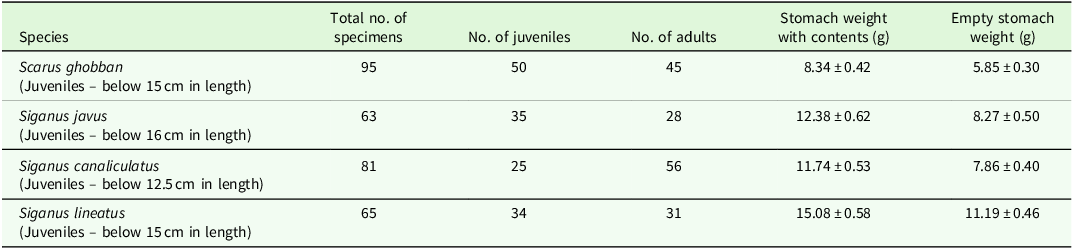
The fish specimens for gut content analysis were collected from the Pattinamaruthoor fish-landing centre after confirming with the fishermen that the fish were captured from the Pattinamaruthoor patch reef. The specimens obtained included both juveniles and adults. Between January 2022 and January 2023, fish samples were collected from the Pattinamaruthoor landing centre three times per month with a minimum interval of eight days. Fishes caught using gill nets, fish traps and hooks were collected. Preservation agents were not used in the field as the collected fishes were brought to the laboratory within in an hour. A total of 304 specimens were collected, of which 95 individuals were S. ghobban; 81 were S. canaliculatus; 65 were S. lineatus and 63 were S. javus (Table 1). To prevent bacterial degradation of gut contents, the fish specimens were immediately placed in ice slurry. After that, in the laboratory, specimens were photographed immediately, and morphometric data were collected for species confirmation. Using a standard laboratory measuring scale and a physical balance, the fish’s length and weight were recorded. The categorization of juveniles and adults for each species was done based on size ranges provided in earlier published works; S. ghobban (Tresnati et al. Reference Tresnati, Utari, Yasir, Aprianto, Rahmani, Yanti and Tuwo2021); S. canaliculatus (Latuconsina et al. Reference Latuconsina, Kamal, Affandi and Butet2022); S. lineatus (Wood land Reference Wood land1990) and S. javus (Rajaprabhu et al. Reference Rajaprabhu, Kirubagaran, Santhanakumar, Sendhil kumar and Dharani2021). All specimens of all examined species were above 10 cm in size.
Details of specimens collected and weight of stomach contents (±standard error)

Following that, the specimen was dissected in accordance with the protocols described in Sagar et al. (Reference Sagar, Nair and Gop2019). In order to dissect the fish, a fine scissor was carefully placed at the back of the gill isthmus posterior to the anal fin, and the longitudinal cut was made. After making a second transverse cut to release the coelom, the digestive system was removed and placed in a Petri dish for examination. The stomach weight was measured along with its contents, and the weight of the empty stomach was then measured after removing the contents. This approach facilitates the accurate estimation of the food content weight within the stomach. The food items were then photographed, and the petri dish was inspected under a light microscope to view all the contents. The gravimetric approach was used to measure the weight of prey items in the stomach contents (Sagar et al. Reference Sagar, Nair and Gop2019). The dietary items were dried via filter papers to remove any remaining water, and an electronic balance was used to measure the mass of the prey items to the closest 0.01 g. The proportion of different types of diet was calculated based on the overall weight of the stomach contents.
Results
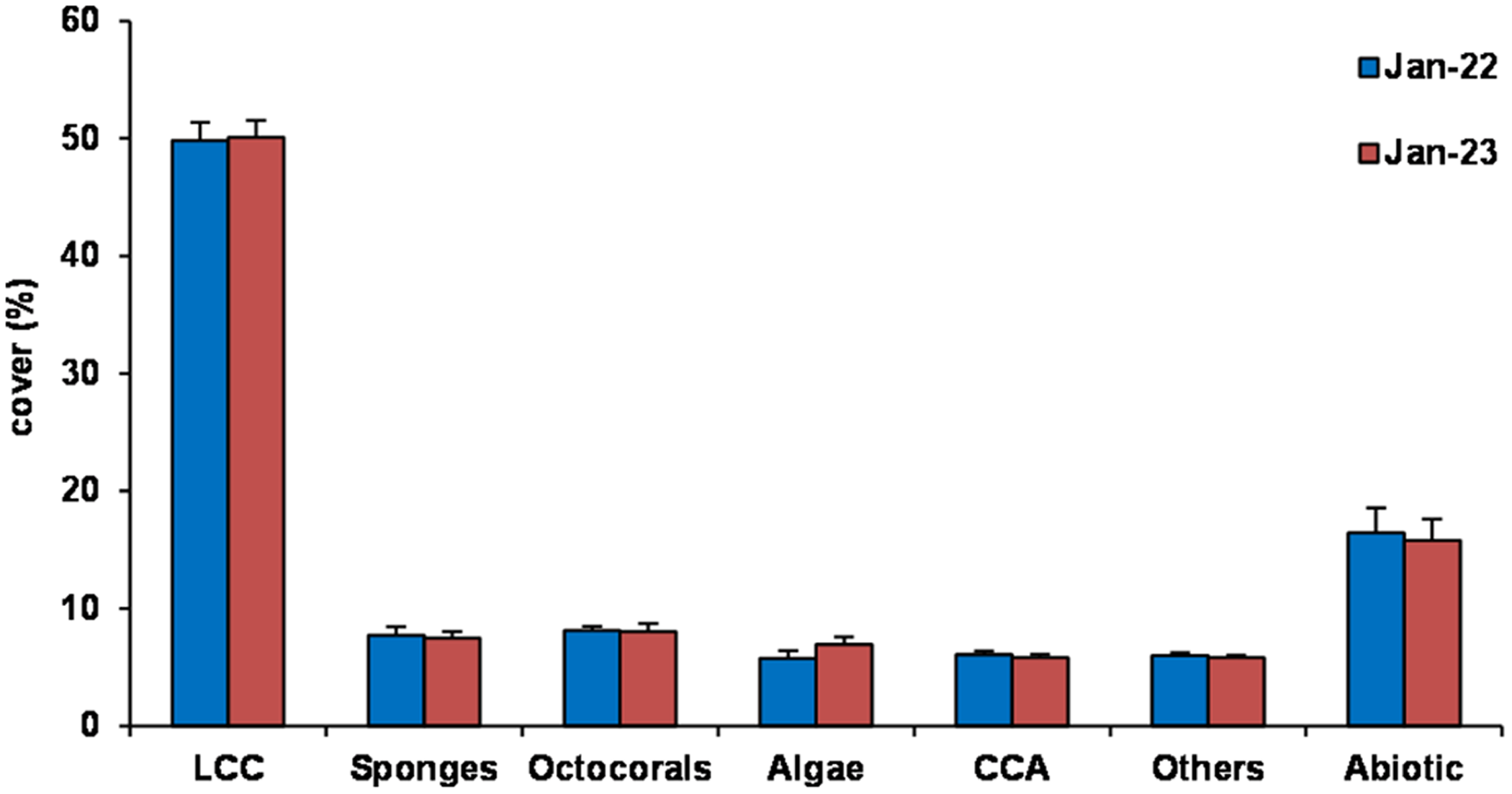
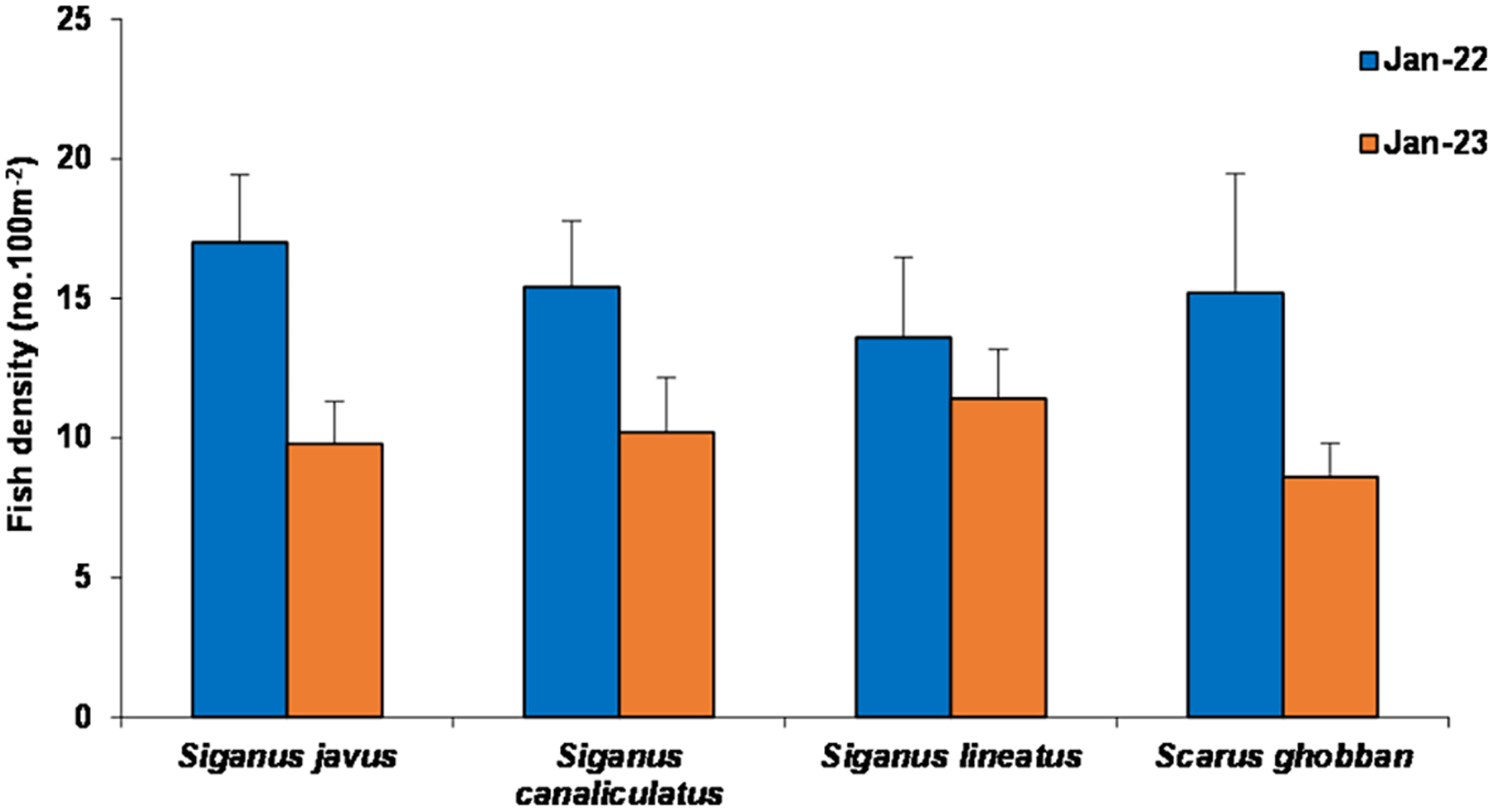
Among the benthic communities on Pattinamaruthoor Patch Reef, live corals were the dominant category with 49.83% followed by abiotic with 16.45%, and the covers of octocorals, algae, sponges, CCA and others were 8.14%, 5.75%, 7.73%, 6.10% and 6%, respectively, in January 2022. There was no significant deviation after a year in 2023 when the live coral cover increased slightly to 50.10% (p > 0.05; F = 0.44; p = 0.542). In contrast, macroalgal cover increased significantly to 6.96% during the same period (p < 0.05; F = 14.52; p = 0.019) (Figure 3). The densities of S. javus, S. canaliculatus, S. lineatus and S. ghobban were 17 no.100 m−2, 15.4 no.100 m−2, 13.6 no.100 m−2 and 15.2 no.100 m−2, respectively, in January 2022 and invariably the densities of all four species were found to have decreased in January 2023 with 9.8 no.100 m−2, 10.2 no.100 m−2, 11.4 no.100 m−2 and 8.6 no.100 m−2, respectively (Figure 4). The density of observed fish species and macroalgal cover were found to be negatively correlated, although this relationship was not statistically significant (r = −0.32, p = 0.367). Fish density and live coral cover also showed a weak, non-significant relationship (r = −0.15, p = 0.674). A modest increase in algal cover in 2023 was accompanied by lower fish densities, suggesting a possible decrease in grazing pressure.
Differences in benthic community structure on Pattinamaruthoor patch reef during the study period between January 2022 and January 2023. LCC – Live Coral Cover; CCA – Crustose Coralline Algae.

Difference in the densities of examined fish species on Pattinamaruthoor patch reef between January 2022 and January 2023.

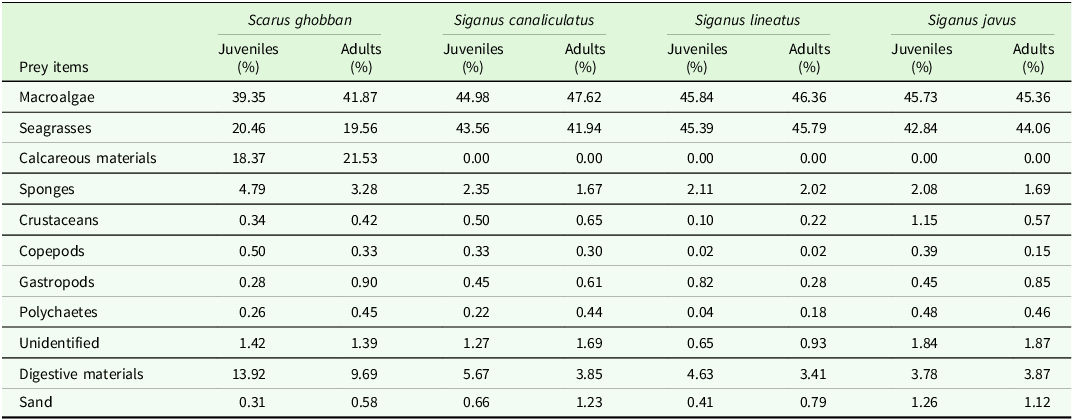
The stomach content analysis revealed notable variations in dietary composition among the examined herbivorous reef fishes on Pattinamaruthoor patch reef. In S. ghobban, the average stomach weight with contents was 8.34 g (SE ± 0.42), while the empty stomach was 5.85 g (SE ± 0.30). The diet was dominated by algae (filamentous green algae and red algae) (40.87%), followed by calcareous materials (20.27%) and seagrasses (19.92%). For S. canaliculatus, the average stomach weight was 11.74 g (SE ± 0.53) with contents and 7.86 g (SE ± 0.40) when empty. Algae constituted the largest proportion of the diet (47.20%) closely followed by seagrasses (42.20%). S. lineatus exhibited an average stomach weight of 15.08 g (SE ± 0.58) with contents and 11.19 g (SE ± 0.46) when empty. The most prevalent item in the stomach contents was algae with 46.13% followed by seagrasses with 45.62%. In S. javus specimens, the average stomach weight was 12.38 g (SE ± 0.62) with its contents and 8.27 g (SE ± 0.50) when empty. Algae accounted for 45.55% of S. javus stomach contents, followed by seagrasses (43.46%) (Table 2).
Percentage of observed prey items in dissected specimens

It was difficult to identify the algal species in the diet of experimented fishes due to the extensive digestion and structural degradation. However, the proportion of filamentous green algae and red algae was roughly 60% and 40%, respectively, in all the four species. Identifiable filamentous green algae in the diet include Cladophora sp. and Chaetomorpha sp. and red algae include Gracilaria sp., Hypnea sp., Asparagopsis sp. and Jania sp. Among the seagrasses in the diet, O. serrulata and Thalassia hemprichii were identifiable and dominant, while other species were also observed without identifiable morphometric traits. Other invertebrate organisms observed in smaller quantities include sponges, crustaceans, copepods, gastropods and polychaetes, along with sand and unidentified things. Figure 5 shows the prey items observed in the stomach contents of tested fish species.
Observed prey items from the examined species (a) Cladophora sp. (Filamentous green alga) (b) Asparagopsis sp. (Red alga) (c) Chaetomorpha sp. (Filamentous green alga) (d) Jania sp. (Red alga) (e) Oceana serrulata (Seagrass), (f) Thalassia hemprichii (Seagrass) (g) Gastropods (Unidentified) (h) sponge spicules (Unidentified) (i) Polychaetes (Unidentified).

Between adults and juveniles, there were slight differences in the gut content. In S. ghobban, S. canaliculatus and S. lineatus, adults were found to feed slightly more on macroalgae than juveniles. Invariably, all juveniles of all four species were found to have more sponge spicules than the adults. In S. ghobban, adults had significantly more calcareous materials in their guts (21.53%) when compared to juveniles (18.37%) (Table 3).
Differences in prey preferences of adults and juveniles among the examined species

Discussion
The role of herbivorous fishes in the maintenance of reef ecosystems around the world has been well established (Kramer et al. Reference Kramer, Marks and Turnbull2003; Mumby et al. Reference Mumby, Dahlgren, Harborne, Kappel, Micheli, Brumbaugh, Holmes, Mendes, Broad, Sanchirico and Buch2006; Newman et al. Reference Newman, Paredes, Sala and Jackson2006; Walters et al. Reference Walters, Smith, Coyer, Hunter, Beach and Vroom2002; Williams and Polunin Reference Williams and Polunin2000). Control of macroalgal proliferation by herbivores promotes coral regeneration, growth and reproduction (Ferrari et al. Reference Ferrari, Gonzalez-Rivero and Mumby2012; Foster et al. Reference Foster, Box and Mumby2008; Lirman Reference Lirman2001; Mumby and Harborne Reference Mumby and Harborne2010; Nugues and Bak Reference Nugues and Bak2006). Mass coral mortalities are often followed by macroalgal proliferation that hinders the natural coral recovery. Similar to many tropical reef ecosystems, reefs in the Gulf of Mannar have been affected severely by multiple bleaching events and consequent algal proliferation (Edward et al. Reference Edward, Mathews, Raj, Thinesh, Patterson, Tamelander and Wilhelmsson2012, Reference Edward, Mathews, Raj, Laju, Selva Bharath, Arasamuthu, Dinesh Kumar, Bilgi and Malleshappa2018, Reference Edward, Mathews, Raj, Laju, Arasamuthu, Kumar, Kumar, Bilgi, Udhayan, NiharRanjan, Ganesan, Manimozhi, Sankar, Pradeep, Vasanthakumari, Paulraj and Shameer2023; Raj et al. Reference Raj, Aeby, Mathews, Williams, Caldwell, Laju, Bharath, Kumar, Arasamuthu, Asir, Lisa, Andrew, Monica and Edward2021). In particular, the bleaching events in 2010 and 2016 induced increases in algal cover to match or surpass the coral cover, although slow recovery has been recorded (Edward et al. Reference Edward, Mathews, Raj, Laju, Arasamuthu, Kumar, Kumar, Bilgi, Udhayan, NiharRanjan, Ganesan, Manimozhi, Sankar, Pradeep, Vasanthakumari, Paulraj and Shameer2023; Raj et al. Reference Raj, Aeby, Mathews, Williams, Caldwell, Laju, Bharath, Kumar, Arasamuthu, Asir, Lisa, Andrew, Monica and Edward2021). Hence, the role of herbivores is of paramount importance here to help corals recover from the catastrophic events through growth and natural recruitment. The present study is the first investigation in these reefs to understand the link between the macroalgae abundance and the availability of herbivores.
The average coral cover in the Gulf of Mannar, encompassing all the 21 islands (excluding patch reefs), has been reported to be 27.3% in 2021; the value was 37.0% in 2005, and the decrease was due to successive bleaching events and other natural and human-induced factors (Edward et al. Reference Edward, Mathews, Raj, Laju, Arasamuthu, Kumar, Kumar, Bilgi, Udhayan, NiharRanjan, Ganesan, Manimozhi, Sankar, Pradeep, Vasanthakumari, Paulraj and Shameer2023; Raj et al. Reference Raj, Aeby, Mathews, Williams, Caldwell, Laju, Bharath, Kumar, Arasamuthu, Asir, Lisa, Andrew, Monica and Edward2021). In contrast, the present study revealed that coral cover in Pattinamaruthoor Patch Reef was significantly higher than the average cover of the Gulf of Mannar during the study period, and this is presumably due to the domination of fast-growing acroporans. Likewise, the average algal cover increased from 21.6 to 36.1% for the island reefs between 2005 and 2021 (Edward et al. Reference Edward, Mathews, Raj, Laju, Arasamuthu, Kumar, Kumar, Bilgi, Udhayan, NiharRanjan, Ganesan, Manimozhi, Sankar, Pradeep, Vasanthakumari, Paulraj and Shameer2023), while the algal cover was only around 7% on the Pattinamaruthoor patch reef, with a small increase of around 1% within a year. According to Laju (Reference Laju2019), carnivorous fishes constituted the most abundant group within the reef areas of the Gulf of Mannar followed by omnivores, whereas herbivorous fishes represented only about 15% of the total fish population. The densities of the four selected herbivores on Pattinamaruthoor patch reef can be considered fair, taking into consideration the overall low abundance of herbivores in the Gulf of Mannar (Laju Reference Laju2019) and the prevailing active commercial fishing in this patch reef (Emmett et al. Reference Emmett, Raj, Mathews and Laju2021). This comparatively higher abundance of herbivore fishes is presumably the reason for the lower algal cover on this patch reef. These results highlight the role of herbivorous fishes in maintaining low algal abundance and supporting reef stability at Pattinamaruthoor patch reef.
However, the observed increase in algal cover during the study period may presumably be attributed to reduced grazing pressure as there was a decline in the fish density. There was a negative correlation between the density of observed herbivorous fish and macroalgal cover. Even though this trend is established in several reef regions around the world, we approach this cautiously due to the short-term nature of this study. These results emphasize the importance of long-term monitoring to clearly understand the relationships between herbivorous fishes, macroalgal cover and coral cover.
Feeding patterns of fishes may be influenced by the availability of food sources, as well as the species’ opportunistic feeding behaviour (Emmett et al. Reference Emmett, Raj, Mathews and Laju2021; Perpetua et al. Reference Perpetua, Gorospe, Torres and Demayo2013). The gut content analysis of the four examined species revealed that the fishes had fed predominantly on macroalgae and seagrasses, each accounting for more than 40%. These feeding preferences directly support their role in cropping fast-growing algae that typically colonize newly available substrata following disturbances. The identifiable algae in the gut content of the examined species are common reef dwellers and are often a disturbance to recovering corals. Environmental conditions in the Gulf of Mannar promote the growth and distribution of seagrasses (Edward et al. Reference Edward, Raj, Mathews, Kumar, Arasamuthu, D’Souza and Bilgi2019; Mathews et al. Reference Mathews, Raj, Thinesh, Edward and Wilhemsson2010). In particular, the areas between the islands and the mainland are completely occupied by seagrasses (Mathews et al. Reference Mathews, Raj, Thinesh, Edward and Wilhemsson2010) with occasional patch reefs such as the Pattinamaruthoor patch reef. This patch reef is surrounded by seagrass beds on all four sides from the periphery. Hence, there is a regular movement of fishes between reefs and seagrasses. All four species have been reported to feed both on seagrasses and algae (Fox and Bellwood Reference Fox and Bellwood2008; Green and Bellwood Reference Green and Bellwood2009; Hughes et al. Reference Hughes, Rodrigues, Bellwood, Ceccarelli, Hoegh-Guldberg, McCook, Moltschaniwskyj, Pratchett, Steneck and Willis2007; Jones et al. Reference Jones, Almany, Russ, Sale, Steneck, van Oppen and Willis2009). Thus, the comparatively low amount of algal cover on the patch reef is compensated by the extensively available seagrass beds, which are predominantly composed of O. serrulata followed by T. hemprichii.
Herbivorous fish species can revert to occasional carnivory to satisfy their nutritional needs (Depczynski and Bellwood Reference Depczynski and Bellwood2003; Horn Reference Horn1989), and all four examined species are known to consume amphipods, polychaetes, crustaceans, bivalves and various other invertebrates (Al-Marzouqi et al. Reference Al-Marzouqi., Jayabalan and Al-Habsi2009; Gorospe and Demayo Reference Gorospe and Demayo2008, Veeramani et al. Reference Veeramani, Ravi, Kesavan and Balasubramanian2010), and it is evident from the study. Parrotfishes including S. ghobban have also been reported to display the feeding behaviour of scraping the corals (Abu-Taweel et al. Reference Abu-Taweel, Al-Fifi, Abada, Khemira, Almalki, Modafer and Yaseen2023; Mumby et al. Reference Mumby, Dahlgren, Harborne, Kappel, Micheli, Brumbaugh, Holmes, Mendes, Broad, Sanchirico and Buch2006, Yarlett et al. Reference Yarlett, Perry, Wilson and Harborne2020). It has also been reported widely that fishes can opportunistically feed on food sources that are available in plenty, as it plays a role in their survival (Emmett et al. Reference Emmett, Raj, Mathews and Laju2021). Marine sponges are a potent competitor to corals as they outgrow corals under severe climatic conditions. The proliferation of sponges on the reefs of the Gulf of Mannar, including the Pattinamaruthoor reef, has been significant as reported by several recent studies (Raj et al. Reference Raj, Mathews and Kumar2019, Reference Raj, Emmett and Mathews2023). Emmet et al. (Reference Emmett, Raj, Mathews and Laju2021) reported that sponge spicules constituted 2 to 10% of the gut content of several herbivorous fishes. In the present study, sponge spicules were found in all four species, indicating possible opportunistic feeding (Burkepile et al. Reference Burkepile, Adam, Roycroft, Ladd, Munsterman and Ruttenberg2019; Dunlap and Pawlik Reference Dunlap and Pawlik1996). Though it is premature here to say that these herbivorous fishes feed directly on sponges, there is a possibility.
Though there was not much difference in the feeding behaviours of juveniles and adults in this study, there were noticeable minor differences due to the increased scraping ability and grazing efficiency with growth. Juvenile reef fishes are reported to be nursed in nearby seagrass areas (Evans et al. Reference Evans, Wilson, Field and Moore2013), and this study revealed that juveniles of three out of four examined species had equal or more seagrasses in their diet than the adults. Juveniles of herbivores can lean towards carnivory (Depczynski and Bellwood Reference Depczynski and Bellwood2003), and this is probably the reason for more consumption of sponge spicules by juveniles of all four species. Adult parrot fishes have been reported increasingly feed on live corals (Bruggemann et al. Reference Bruggemann, van Oppen and Breeman1994), which is evident from the results of this study.
Regardless of their biological functions, reef fishes are common targets of local fishermen, and their economy is heavily reliant on them (Laju Reference Laju2019; Mathews et al. Reference Mathews, Samuel, Edward, Bhatt, Patterson Edward, Macintosh and Nilaratna2012; Russ et al. Reference Russ, stockwell and Alcala2005). There are hundreds of fishing villages along the coast of the Gulf of Mannar, and thousands of fishermen use the reef areas for their livelihood every day. There was a sharp decline of all four selected species on the reef within one year, likely causing an increased algal cover. Fishermen employ several destructive fishing methods to catch reef fishes in the Gulf of Mannar (Edward et al. Reference Edward, Mathews, Raj, Laju, Arasamuthu, Kumar, Kumar, Bilgi, Udhayan, NiharRanjan, Ganesan, Manimozhi, Sankar, Pradeep, Vasanthakumari, Paulraj and Shameer2023). In particular, trap fishing (Emmett et al. Reference Emmett, Raj, Mathews and Laju2021) specifically targets herbivorous reef fishes from Scaridae and Siganidae, affecting the food web on the reef. If the depletion of herbivorous fishes continues, it is likely that algal cover may increase to become a significant issue. More bleaching events have been predicted for the corals of the Gulf of Mannar at different emission scenarios (Raj et al. Reference Raj, Aeby, Mathews, Williams, Caldwell, Laju, Bharath, Kumar, Arasamuthu, Asir, Lisa, Andrew, Monica and Edward2021). Hence, space competition from algae may become a potent problem in the future, where the role of herbivorous fishes is of critical importance. This is probably the scenario for all the reef areas of the world, considering the imminent threat posed by climate change. Though the outcome of the study is not surprising and based on short-term monitoring, it adds to the existing evidence of the importance of herbivorous fishes in keeping the harmony of coral reefs and alerts reef managers to take important management actions to control the exploitation of these ecologically important fishes.
Acknowledgements
The authors express their thanks to Suganthi Devadason Marine Research Institute (SDMRI) for financial assistance and for the provision of facilities.
The authors also thank the authorities of Manonmaniam Sundaranar University, Tirunelveli for the academic smooth sailing (Reg. No. 22117022271001).
Author contributions
S. Sivasankar: Methodology, Investigation, Data curation, Writing – original draft, Formal analysis
K. Diraviya Raj: Conceptualization, Supervision, Data collection, Writing – review & editing.
Competing interests
The authors declare that they have no known competing financial interests or personal relationships that influence the work reported in this paper.
Ethical standards
No approval of research ethics committees was required to accomplish the goals of this study.