Introduction
Cancer during pregnancy has an incidence of 1/1,000, and when diagnosed, the most common ones are breast cancer (1/10,000), Hodgkin’s lymphoma (1/6,000) and head and neck cancer (1/10,000). If a diagnosis is made during pregnancy, the treatment cannot wait until delivery, and there is concern about the effects that radiotherapy may have on the foetus. The multidisciplinary group has to assess and ethically make decisions with regard to the mother and foetus.Reference Kal and Struikmans1
The three main effects that may occur with exposure to radiation are: lethality, congenital anomalies manifesting at birth and long-term effects, such as leukaemia.Reference Latorre Travis2
The probability of damage caused by radiation depends on the gestational stage of the foetus and the dose of radiation that reaches the foetus. There are three stagesReference De Santis and Straface3–Reference Rusell and Montgomery5:
a) Preimplantation: covers the first 10 days after conception; at this stage, the cells divide rapidly and are poorly differentiated; exposure to radiation during this stage causes a failure in implantation, and in cases that are viable, this can cause congenital malformations with doses as low as 0·1 Gy.
b) Organogenesis: starts in the second week until eighth after conception; cells begin to differentiate to form organs; radiation at this stage can cause malformations, mainly in the central nervous system, such as hydrocephalus, microcephaly, microphthalmia and mental retardation, with doses as low as 0·1 Gy.
c) Foetal: cell growth stage from the ninth week until delivery; irradiation during this period can cause mental retardation and long-term leukaemia or solid tumours in childhood, at typical doses of 0·5–0·7 Gy.
In humans, the long-term side effects of radiation have been observed in survivors of atomic bombs. It has been reported in 11 pregnant women exposed to radiation from the atomic bomb in Hiroshima, of which seven foetuses had microcephaly and mental retardation, the other four were without abnormal manifestations (they were far away from the exposure). In the analysis of pregnant women who survived the atomic bomb in Nagasaki, seven foetal deaths, six neonatal deaths and four alive with mental retardation have been reported.Reference Yashimoto and Mabuchi6
Several authors have evaluated the stage of gestation and dose of radiation for possible effects after exposure, which is why the threshold dose above which a foetus could develop congenital birth defects is between 0·1 and 0·2 GyReference De Santis and Straface3, Reference Mole7, Reference Latorre Travis8. From week 16 of gestation to birth, effects will be unlikely as long as the dose is <0·5 Gy.Reference De Santis and Straface3
Nuyttens et al.Reference Nuyttens, Prado and Jenrette9 described a case of a 29-year-old woman, in her 16th week of pregnancy, with squamous cell carcinoma of the tongue, who had a partial glossectomy with a left supraomohyoid neck dissection and received radiotherapy at a dose of 64 Gy in 32 daily fractions. The dose received by the foetus was in the range of 0·27–0·86 Gy, and the baby was born without abnormalities.
Another pregnant woman at 20 weeks of gestation diagnosed with a head and neck cancer, reported by Podgorsak et al.,Reference Podgorsak, Meiler and Kowal10 received a dose of 66 Gy in 33 fractions, with protection of the foetus, which received a dose between 0·086 and 0·033 Gy. These two cases indicate that patients with head and neck tumours can be irradiated with high doses during pregnancy, since the foetus was found to be exposed to a dose <0·1 Gy, representing a relatively safe dose.
In the case of our patient, the diagnosis was of a tonsil cancer. Head and neck tumours comprise 3% of all malignant tumours, and those of oropharynx representing 0·5%. A diagnosis is usually made through an incisional biopsy. The most frequent histology (95%) is squamous cell carcinoma, which is treated through chemoradiotherapy using platinum and teletherapy.Reference Bray, Jacques Ferlay and Soerjomataram11
Clinical Case
A 35-year-old female, a carrier of Behcet’s disease, underwent 5 years of treatment with hydroxychloroquine, prednisone and low-molecular-weight heparin. In this case, the patient, being a carrier of Behcet’s disease, had a high risk for cancer of the oral cavity and oropharynx with an HR of 2·11,Reference Sea Jung, Min Ji and Dong Soo12 so the cancer could be related to the tonsil.Reference Wang, Wang and Shen-Min13 The patient’s gynaeco-obstetric history was: menarche at 12 years, regular 28/3, three pregnancies, twice aborted and pregnant at the time of diagnosis (17·5 weeks of gestation).
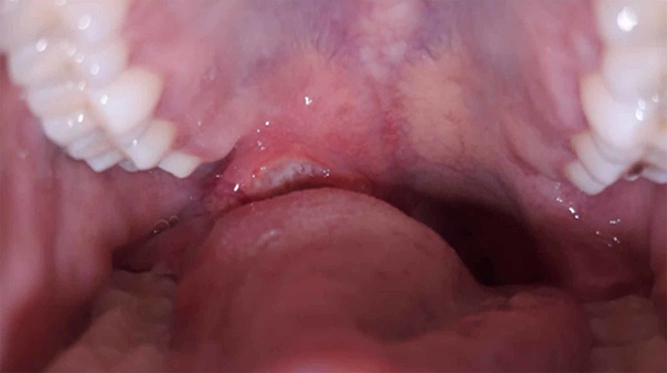
Her oncological situation started on December 2017 with an increase in volume in the preauricular, parotid and right mandibular angle, with a progressive growth. At the initial physical examination, a 8 × 10 cm tumour was observed in the right parotid region and fixed cervical ganglion levels II and III; these were painless on palpation, with difficulty in opening the mouth (Figures 1 and 2). In the oral cavity, a tumour that had invaded the right retromolar trigone was observed (Figure 3); it was decided to perform a biopsy, with a report of basaloid squamous cell carcinoma.
Tumour on right tonsil (anterior view).

Tumour on right tonsil (lateral view).

Oral cavity tumour on right tonsil invading retromolar trigone.

After a discussion with a multidisciplinary team (oncological head-and-neck surgeon, medical oncologist, radiation oncologist, oncology gynaecologist and a representative of the unit’s ethics committee), it was determined that the patient was a candidate to receive concomitant radiochemotherapy and placement of a gastrostomy catheter before the start of treatment.
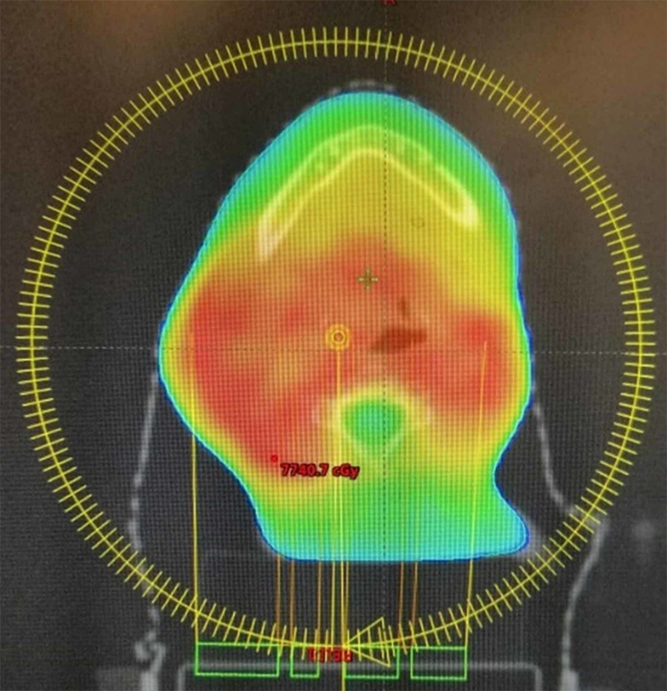
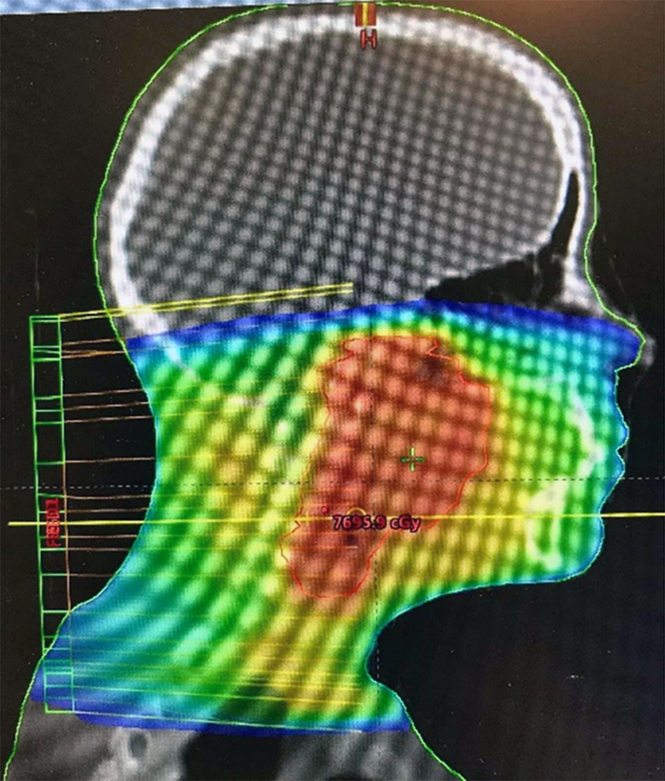
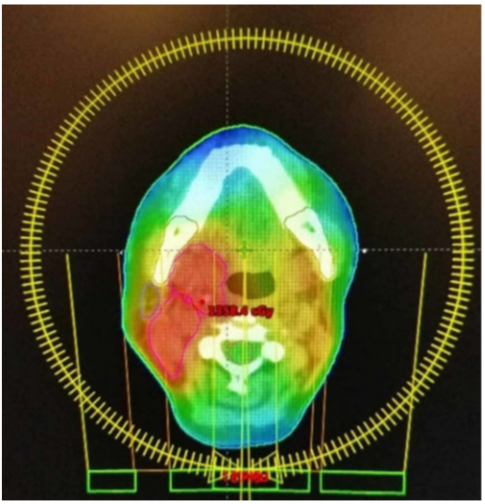
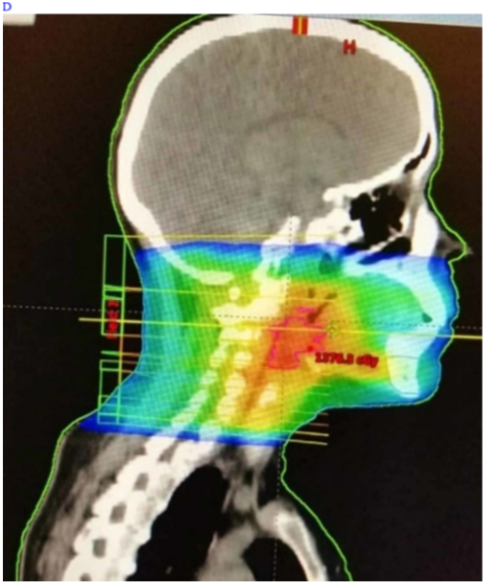
The patient and her relatives were informed about the risks and benefits of receiving treatment, and upon receiving consent, IMRT treatment was planned with 6 MV photons, a dose of 69·96 Gy to the primary tumour and 59·4 Gy to ganglion levels II, III and IV bilaterally in 33 fractions (Figures 4 and 5).Reference Stessin, Ozyigit and Clifford Chao14
IMRT treatment plan.

IMRT treatment plan (sagittal view).

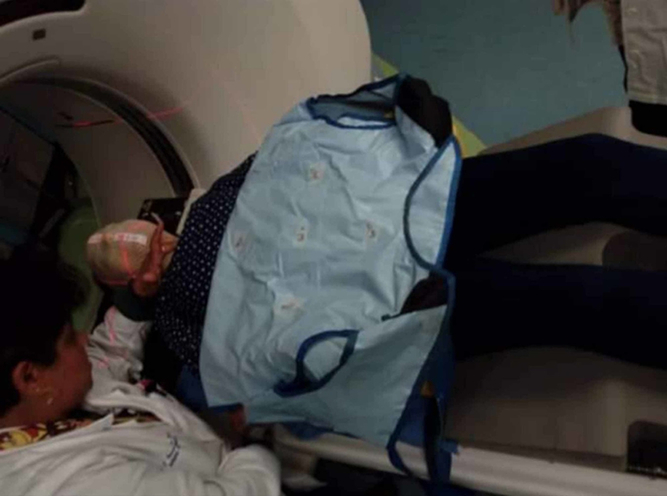
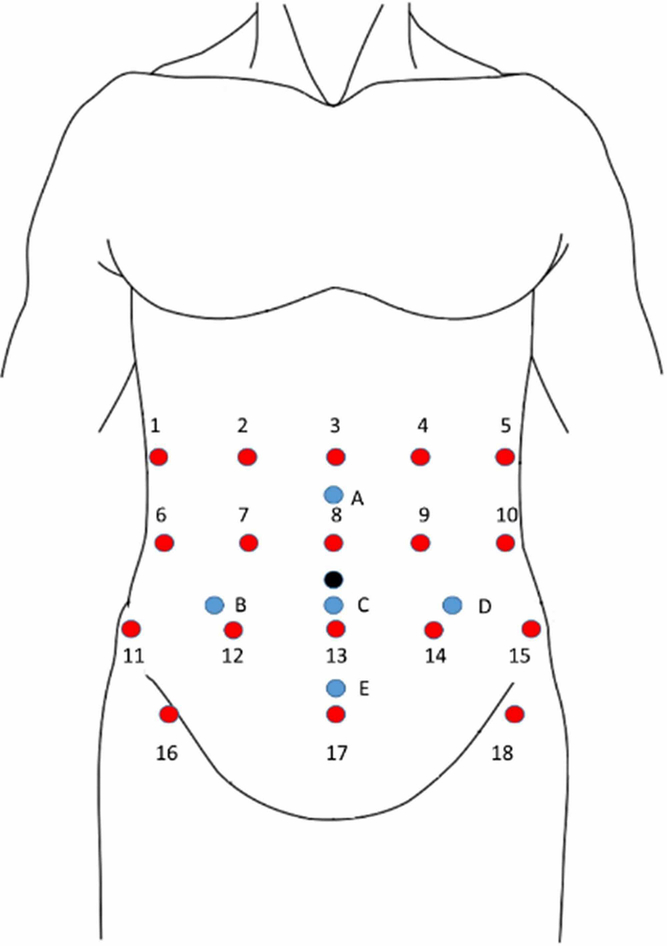
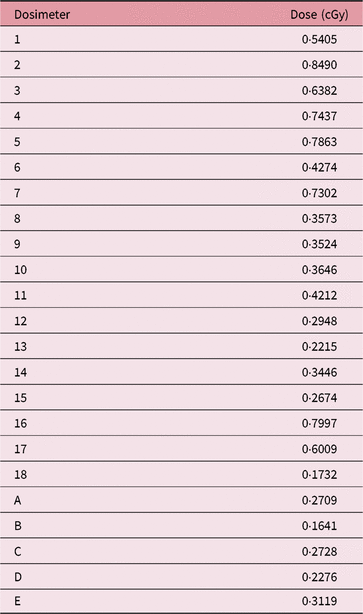
Radiation therapy was started at 22 weeks of gestation. The patient was placed in the dorsal decubitus position with a thermoplastic mask and lead tablecloth shield was provided. Dosimeters were placed on the skin of the abdominal and pelvic regions as well as on the shield (Figure 6). Tests on the skin were 0·7997–0·17 cGy (Figure 7 and Table 1).
Placement of the patient for treatment.

Dosimeter placement on the abdomen and pelvis (red dots, skin; blue points, mandil).

Foetal dosage acquired during treatment

The patient received one cycle of chemotherapy with cisplatin 120 mg, and upon presenting with grade II anaemia, chemotherapy treatment was suspended. In the 27th treatment fraction, a significant decrease in tumour volume was observed; so adaptive radiotherapy was performed to complete the treatment schedule (Figures 8 and 9).
Adaptive radiotherapy treatment plan (axial view).

Adaptive radiotherapy treatment plan (sagittal view).

Radiotherapy was completed as the only treatment modality at 30 weeks of gestation, presenting with side effects of grade II radiodermatitis and grade I mucositis.
A newborn was delivered by caesarean at 34 weeks of gestation. The baby was without malformations and whose general conditions were satisfactory. At 18 months of follow-up, the patient was clinically without evidence of tumour in the treated region.
Discussion
Radiation exposure to a pregnant women’s abdomen (after 20 weeks of gestation), being treated for cancer of the tonsil, was found to be minimal. So the probability of producing few or no effects after radiation exposure to the foetus is low.
Conclusions
In the present case, we demonstrated safe administration of radiotherapy in a pregnant patient with tonsil cancer, because her pregnancy was successfully concluded, with no abnormalities in the newborn, and at 18 months of follow-up, the patient showed adequate control of the disease.
Radiotherapy in combination with chemotherapy has been shown to be effective for local control of tonsil cancer. In the case of our pregnant patient, radiotherapy, as the only modality, provided local control and little exposure of radiation to the foetus.
In relation to the 5-year prognosis, survival is estimated at 70%. Close monitoring of the patient will continue.
Acknowledgements
None.