No part of the United Kingdom can be considered safe from both the direct effects of the weapons and the resultant fallout.
Protect and Survive Footnote 1Maggie Gee's novel, The Burning Book (1983), brings into focus some key issues in British literary culture's response to the nuclear threat. It is, in many ways, a conventional family saga, tracing the story of the Ship family through the twentieth century as characters variously meet, fall in and out of love, get married, have children and pursue different careers. However, its realist literary form gradually breaks down in the face of nuclear emergency: periodically the narrative of the family's lives is interrupted by voices from Hiroshima, as the novel enters the 1980s headlines from an imagined United States–Soviet crisis begin to appear in the text, and at the end the family's stories are violently truncated as nuclear war breaks out. Finally, the reader is asked to imagine the novel he or she is holding itself going up in flames as the world ends. The Burning Book is an angry novel, but it also understands how protest can be compromised by the scale and abstraction of apocalyptic nuclear futures, and by the distractions of everyday life. By asserting the need to campaign against nuclear war, it epitomizes a broader cultural shift in the early 1980s: after a period of seeming accommodation to the existence of nuclear weapons, nuclear war suddenly seemed urgent once again.
One of the novel's rather clever conceits is not to make nuclear war or campaigning for peace the preoccupation of most of its protagonists. Rather, it shows how the nuclear threat shadows and threatens everyday life, but is largely unnoticed until crisis breaks out. Only one character, Angela, becomes consciously preoccupied with the nuclear threat and, although she attends some protests and plans to write a book against war, she struggles to maintain both activities in the face of the numbing terror of nuclear apocalypse. In a revealing passage, we are told Angela's choice of reading:
Her typewriter waited on the table with neat rows of books against war. Goodwin's K/V Papers, Akizuki's Nagasaki 1945 … Hersey's Hiroshima, Cox's Overkill, Four Minutes to Midnight by Nicholas Humphrey, Thompson's Protest and Survive … Angela knew she should protest more, but she sometimes felt frozen with fear. And fear gave a glow like virtue, nobody felt it like her … She was trying to write her book against war, but oh – she just wanted John here.Footnote 2
The books on Angela's table, ranging from testimony of the atomic attacks that concluded the Second World War to polemical anti-nuclear writings from the late 1970s onwards, is very much what one would expect of a nuclear-concerned citizen in the 1980s. Yet she finds both protest and writing problematic: the thought of nuclear war is so overwhelming that it is difficult to protest; she is so scared by the subject on which she wishes to write that she longs for the sense of security, the illusion of protection, provided by the presence of her partner.
This captures two important characteristics of 1980s nuclear culture. The first is a preoccupation with representation. Writing is stymied by the nuclear subject. Since I have written on this elsewhere, albeit in relation to United States literature, I will not discuss this here, except to point out that writing itself often becomes the subject of nuclear literature because the status of writing as a record of human culture and history is threatened by nuclear war.Footnote 3 For this reason, the games of language and representation played in experimental postmodern texts are particularly urgent: the nuclear context invests them with the utmost gravity. The prime example of this is Russell Hoban's Riddley Walker (1980), in which the radically changed English language of a society hundreds of years after an apocalyptic conflict captures, in its novel grammatical and linguistic forms, the fracturing cultural impact of nuclear war.
The second characteristic of 1980s nuclear culture captured in Angela's anxiety is consciousness of acute vulnerability. I want in this article to suggest that nuclear literature of this decade, although it often lacks an overt politics, in the sense of a programme of recommended policy actions, is charged with what we might call a politics of vulnerability. By exposing the vulnerability of individuals, nations and the world to nuclear devastation, it delegitimizes a Cold War status quo predicated on nuclear peril. Commenting on the American context, Joseph Masco has written that the ‘contradiction nuclear arsenals evoke is that as more national-cultural energy is put into generating “security” through improved weapons systems, the vulnerability of the nation to new military technology is ever further revealed’.Footnote 4 The 1980s British experience is a case in point of this phenomenon and has consequences for the literary representation of late Cold War life. In the 1980s a series of developments and crises made nuclear war seem possible, and the more governments and other authorities tried to provide reassurance about national security, the more people's sense of vulnerability was exacerbated. Just as this special volume of the BJHS makes the case that nuclear culture, though much neglected, is an important aspect of British history in the second half of the twentieth century, so this article argues that the 1980s, though rarely conceived of in this way, was a distinctive nuclear decade with a culture inflected by this context.
The nuclear 1980s I discuss is a ‘long’ decade but not a very long one. It begins in 1979 with the Three Mile Island accident (raising questions about the safety of nuclear power), NATO's announcement that American cruise and Pershing II missiles would be deployed in Europe (a strategic decision inspiring much protest), the Soviet invasion of Afghanistan (signalling a heightening of Cold War tensions and leading to a proxy war, with the United States arming the Mujahedeen resistance), and election victories for Margaret Thatcher in Britain and (in 1980) Ronald Reagan in the United States (two cold warriors whose hard-line stances did much to raise the temperature of the Cold War). This context produces a resurgence of nuclear-themed literature. Nuclear anxiety begins to peter out with progress toward arms reduction in the second half of the 1980s but, although the dramatic changes of 1989 seem so definitively to reduce the possibility of global nuclear war, there is a time lag during which nuclear concerns continue to work their way through the culture and appear in literary texts.
In order to tell the story of this nuclear 1980s, I want to return to Angela's choice of reading matter in The Burning Book. On her shelf is E.P. Thompson's Protest and Survive, a reaction to a British government civil-defence campaign, Protect and Survive. Ideas of protection and protest, a development from the security/vulnerability dynamic Masco identifies, provide a useful way of theorizing 1980s nuclear literature. As the epigraph to this article illustrates, in order to construct a narrative of national civil security, Protect and Survive had to make visible the vulnerability of the country to nuclear attack. In so doing, it invoked a level of insecurity it was unable to quell with its reassurance about the efficacy of civil defence.
Protect/Protest
On 16 January 1980, The Times began a four-part series about the state of Britain's civil defence, drawing attention, in the process, to a civil-defence pamphlet, Protect and Survive (1976), largely unknown in Britain before this point and designed to be distributed should the country ever face nuclear war.Footnote 5 On 10 March, the BBC investigative news programme, Panorama, ran a documentary on civil defence, broadcasting clips from an animated video version of Protect and Survive that would be shown on television in the run-up to nuclear attack. Both the booklet and the films advised householders to prepare themselves for nuclear war by making small-scale improvements to the home: constructing simple ‘inner refuges’, stockpiling food and water and so on. Over the next months and years, Protect and Survive became part of the iconography of 1980s nuclear culture in Britain. The reaction both against and in defence of the campaign is illustrative of a broader dialectic between discourses of protection and protest that can be used to make sense of some of the dynamics at play in British nuclear culture and literature at this time. (It is worth noting that across the Atlantic, similar contrapuntal discourses were also in operation, but in the interests of coherence this article will confine its focus to Britain. David Seed's excellent article ‘The debate over nuclear refuge’ is recommended as an introduction to the instabilities generated by the issue of security in factual and fictional representations of nuclear shelter in American texts from the early Cold War onwards.Footnote 6)
Protect and Survive was significant because it came to denote, for those opposed to the way in which the Cold War was being conducted, the absurdity not only of the idea of nuclear civil defence, but of the Cold War logics of Mutual Assured Destruction and, conversely, ‘limited’ nuclear war. As much as the advice offered by Protect and Survive was meant to offer reassurance that nuclear attack could be survived, it served ultimately, and inadvertently, to highlight the vulnerability of ordinary citizens in a decade in which the threat of nuclear war came to seem much more urgent.
The measures advocated in Protect and Survive devolved responsibility for protection from government to individuals and, more particularly, given the preponderance of images of parents and children in the cartoons and animations used to illustrate the advice, to families (the broader politics of which are an important issue in the 1980s). Rather than advocating public shelters or a programme of evacuation, for instance, the leaflets encouraged people to build sheltered spaces within their homes. The implication was that government protection of its citizens lay less in defending the country in the event of attack than in deterrence: if deterrence failed, protection on a national level would also have failed and people would be on their own. Protect and Survive thus implied the at least temporary dissolution of the social contract on a national level. It also, and this was perhaps the characteristic of it most frequently noted by those who opposed it, seemed to offer comically ineffective measures with which to ride out a holocaust: drawing curtains; painting windows white; sheltering under doors propped against walls. In counterpoint to this inadvertent comedy, the chillingly neutral tone with which it dealt with imagined deaths (it was advised that dead relatives should be wrapped in bin liners, labelled and left outside the house), forced people to confront an environment in which the ceremonies of grieving and remembrance of the dead would be suspended.
The phrase, ‘protect and survive’, swiftly became more widely associated with civil defence. On 22 November 1980, The Times announcements column carried an advertisement for Protect and Survive Monthly, which described itself as ‘the new magazine for everyone considering buying a fallout shelter or survival equipment’.Footnote 7 By the following year, according to The Times, the magazine had twelve thousand subscribers, and was launching a Survivor's Wine Club, ‘based on the assumption’, in the dry commentary of the newspaper, ‘that the average nuclear bunker would double perfectly as a wine cellar when not more urgently needed’.Footnote 8
More frequently, Protect and Survive inspired a counterdoctrine of resistance and protest. In April 1980, the historian and anti-nuclear activist E.P. Thompson produced the pamphlet Protest and Survive, which contributes to Angela's nuclear education in The Burning Book. On 26 October 1980, a newly revitalized CND (whose membership in the 1980s rocketed to record levels after a period of seemingly terminal decline in the previous decade), adopted the phrase ‘protest and survive’ for a Trafalgar Square rally attracting, according to CND's estimates, eighty thousand people.Footnote 9 In November of the same year Thompson's essay was republished in a Penguin collection of anti-nuclear essays, also called Protest and Survive, edited by Thompson and Dan Smith.
Protect/Protest and Survive remained resonant for several years. In 1982, the Schools Against the Bomb group produced a programme for the BBC community television series Open Door, under the title Protest and Survive, in which they drew attention to what they saw as the absurdity of civil-defence planning, claiming, for instance, that while three weeks' warning of nuclear war was expected in which to distribute the Protect and Survive booklet, ‘Her Majesty's Stationery Office say it will take them at least four weeks just to print enough to go round.’Footnote 10 In Threads (1984), the BBC's landmark depiction of nuclear attack on Britain, Protect and Survive is part of the assumed experience when the run-up to nuclear war is imagined, and can be seen playing on the television in the background as a man tries desperately to reinforce his home against nuclear attack. More generally, it entered popular culture: ‘Protect and survive’ was the title of songs by Jethro Tull and the Dubliners (‘World War Three can be such fun/If you protect and survive’) and Discharge made ‘Protest and survive’ the title of one of their songs. It had evidently become such a commonplace by the mid-1980s that an otherwise positive Times review of John Burrows's 1984 nuclear musical, Wartime Stories, confessed to the ‘heart sinking’ when Protect and Survive appeared onstage and yet another mockery of it was imminent.Footnote 11
Literary culture, too, was drawn by the seeming absurdity of Protect and Survive. Robert Swindells's young-adult novel, Brother in the Land (1984), opens with a nuclear attack and the young narrator, Danny, remembering that, in the suddenly long-lost world of peacetime Britain, a teacher had ‘brought this book to school once, Protect and Survive or some such title. It reckoned to tell what would happen if H-bombs fell on Britain. It was pretty horrible, but it didn't tell the half of it. Not the half of it’.Footnote 12 Swindells's is one of a number of 1980s nuclear fictions for teenagers that explicitly sought to raise awareness amongst this age group, and which were impressively robust in their refusal to pull punches in their depiction of nuclear war. In Brother in the Land, for instance, Danny's attempts to preserve the life of his young brother in a brutal post-nuclear society ends with his brother dying, being buried and thus becoming the ‘brother in the land’ of the title.
More famously, Raymond Briggs's graphic novel When the Wind Blows (1982), the success of which might be judged by the fact that it was translated into stage, radio drama and film versions, constructs a derisory view of civil defence, typical of the period, by the rather ingenious and heartbreaking conceit of simply letting its trusting elderly protagonists, Hilda and Jim, take government reassurance at face value (‘Thank Goodness I got those Official Leaflets today. Suppose I hadn't! We'd have been totally non-prepared!’) and then following the consequences as they seek to protect their home under nuclear attack.Footnote 13 Although Protect and Survive is not explicitly invoked in the book, it is the clear point of reference and makes an overt appearance in the successful film adaptation. The book's success lies in its erasure of a direct voice of protest (the closest we get to it is the couple's son laughing cruelly down the phone at his father's naivety), leaving the reader to feel outrage on the couple's behalf.
Of course, most literature published in the 1980s did not directly refer to Protect and Survive. Its significance is not, then, that it directly inspired many literary responses (although it certainly inspired some). Rather, the controversy generated around it was symptomatic of broader divisions in Cold War society. Belief in state protection, and protest against it, frequently signalled not only differing views on nuclear strategy but a whole host of other beliefs that would put one on one side or the other of the gulf between the forces of a new, radical Conservatism, epitomized by the policies of Margaret Thatcher's government (and those of Reagan in the United States), and those ranged against it. Opposing views on nuclear arms and strategy often revealed entirely antithetical conceptions of the social world.
It may help to explain this if we return to Angela's reading in The Burning Book. Thompson's key rhetorical flourish in Protest and Survive runs as follows:
We must throw whatever resources still exist in human culture across the path of this degenerative logic. We must protest if we are to survive. Protest is the only realistic form of civil defence.
We must generate an alternative logic, an opposition at every level of society.Footnote 14
Even allowing for the exaggeration for rhetorical effect that one might expect of a political pamphlet, this is an extraordinarily angry refutation of government policy. No mere disagreement over nuclear strategy, it rejects the very concepts of both civil defence and (by implication) nuclear deterrence as a foundation for international peace. It points too to broader schisms. In calling for an ‘alternative logic’ operating ‘at every level of society’ it hints at a rejection of much more than defence policy. In what remains of this paper I will turn directly to nuclear literature of the 1980s to show how these alternative logics play themselves out.
Alternative logics: British nuclear literature in the 1980s
There is a series of sites of conflict between competing visions of society, part of the zeitgeist of the 1980s, around which the representation of nuclear issues coalesces, the chief of which are gender and family, the environment, and society and socio-economic organization. We can see how nuclear issues are mapped into these – how central they are to the lived experience of the 1980s – by turning to ‘nuclear literature’, by which I mean not only those texts that are explicitly about nuclear war, but also ‘mainstream’ texts in which consciousness of the nuclear threat is part of the expected fabric of characters' psychologies.Footnote 15 Although it is not possible in a short article like this to provide a detailed overview of this literature, I hope that, by locating key issues in relation to a few texts, I can both make the case for understanding the 1980s as a decade with a distinctive nuclear culture (a case usually made almost exclusively about the 1950s, and then usually in relation to the United States) and demonstrate that this culture was part of a broader series of confrontations in British society.
Gender and family
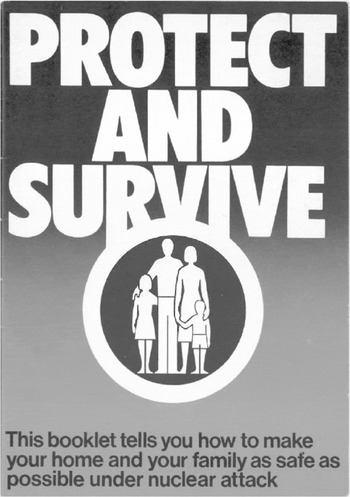
Adorning the predominantly orange front cover of the Protect and Survive leaflet (Figure 1) is a logo consisting of a white circle, within which – in white silhouette on a black background – are depicted a ‘nuclear’ family (father, mother and two children, one male and one female). In the film version each informational segment ends with a brief animated sequence in which the words ‘PROTECT AND SURVIVE’ wrap themselves around the silhouette of the family and then solidify into the white circle.
Cover image, Protect and Survive, London: Central Office of Information, 1980.

This is an image of protection: the circle seals the family off from putative outside threats and the parents' hands rest reassuringly on their children's shoulders. The advice contained within the leaflet is intended to be similarly reassuring of the possibility of protection, showing how to strengthen the shell of the home within which the family resides, and how to seal it against outside threats like radioactive fallout. The primary focus for protection seems to be the middle-class family: although the leaflet explains what to do in flats and bungalows, each of the first two images of dwellings puts us firmly in suburbia, with a silhouette of a semi-detached, new-build house with a a garage and trees at its side; later, when the booklet returns to the world outside the house to show the male adult disposing of fire hazards in a dustbin, a similar world of semi-detached houses, with shrubbery in the gardens, is in evidence in the background of the image.Footnote 16
Such design choices, while almost certainly made with only practical issues consciously in mind, are, of, course, not innocent of ideology. They need to be understood in the context of the politics, and contemporary social visions, of the family. To this end it is worth noting that Protect and Survive advice assumes a vision of society in which, under the stress of nuclear attack, the country atomizes into individual family units: the first paragraph of advice in the ‘Planning for survival’ chapter is to ‘stay at home’ (there are stern warnings that if you move to a new area ‘the authority in your new area will not help you with accommodation or food or other essentials’) and the survival kit for the ‘inner refuge’ shows clothing for two adults and two children.Footnote 17 In the weeks following attack, Britain is envisaged as a nation of families cut off from one another, sheltering in their homes, and awaiting advice from the authorities, presumably through the medium of the portable radios they are advised to keep in their shelters. While such advice is made for practical reasons – clearly being in the open as fallout drifts across the country is not a good idea – it is a vision of social organization that effaces human connection (and potentially civil unrest) in anything other than the seemingly ‘natural’ unit of the family. The family, dutifully following advice, becomes the instrument through which state power and control is exercised over the population (or, rather, through which the population enacts its own acquiescence).
That this is not politically neutral should be obvious (as should the fact that so stridently asserting that protection of the family was possible was not necessarily comforting when a little household DIY was all that was being offered as the palliative to thermonuclear attack). Yet the reading of home and family as intimately bound up in Cold War culture has tended almost exclusively to have been made in relation to early Cold War United States society (another culture in which discourse about nuclear civil defence was prevalent). Most notably, Elaine Tyler May's Homeward Bound finds a ‘symbiotic connection between the culture of the cold war and the domestic revival’ of the 1950s, and shows just how thoroughly politicized by the nuclear Cold War the seemingly apolitical spaces of US middle-class family homes were.Footnote 18 For May – as also for Alan NadelFootnote 19 – domestic ‘containment culture’ of the 1950s can be mapped into the matrices of American foreign policies of containment. Far from being disconnected from the anxieties of a threatening post-war environment around the world, the spaces of the family home were intimately bound up with them. By providing a seemingly natural and depoliticized space, an oasis in which anxieties about nuclear technology and the spread of Communism could be forgotten, the home gave legitimacy to American Cold War domestic and foreign policies (and was thus, of course, actually thoroughly politicized). Decked out with the consumer technologies of the post-war boom, it symbolized the triumphs of American capitalism, and was the product and the source of powerful narratives favouring conformity and consensus. The baby boomer family was a powerful symbol of an American way of life that had to be defended against both the ideology and the nuclear weaponry of the Soviet Union; it also dictated gendered aspirations and divisions of labour that ‘contained’ subversion and dissent.
Of course, as May and Nadel reveal, American society was more heterogeneous in its aspirations and experiences than the image of the idealized suburban family home might suggest, and it is unsurprising that this image concealed, rather than resolved, deep-seated social anxieties and that containment culture was soon torn apart by its internal contradictions. Nevertheless, the ‘nuclear’ family of the 1950s continued to provide a powerful symbol throughout the Cold War. It is notable that by the 1980s the 1950s was being (mis)remembered nostalgically, particularly in the political rhetoric of the right, as a period of stability, with the ‘nuclear’ families of that era contrasted with the broken families of the 1980s on whom were blamed many of the social ills of the era.
In Britain there was no direct equivalent to the American containment culture of the 1950s. The collapse of British global power after the Second World War, and the greater processes of reconstruction required before prosperity could emerge, meant that the affluent suburban family could not serve quite the same ideological function as it did in America. Nevertheless, there were parallels, and in the 1980s in Britain there was a similar nostalgia for an earlier period of domestic and social stability, seemingly less riven by social unrest. In contrast, the contemporary moment was characterized, in the discourse of some on the right, by familial breakdown, and higher divorce rates and delinquency were blamed for many of the ills of British society.
The domestic environments depicted in Protect and Survive advice could not thus be anything other than highly charged ideologically. They entered a world in which the family unit, and alternatives to it, were a source of considerable controversy. Conservative discourse in the 1980s, drawing from the perspective that Keith Joseph enunciated in a 1974 speech where he expressed anxiety about single mothers, claiming that the ‘human stock is threatened’ by ‘a high and rising proportion of children … being born to mothers least fitted to bring children into the world and bring them up’, made the family a point of anxiety.Footnote 20 Harking back to a supposed golden age of family, this discourse found in contemporary single-parent households all kinds of threats to social order. At the same time, the anti-nuclear movement was being energized by feminists, most obviously at Greenham Common (where, as Alison Young puts it, the ‘unique dynamic was a demand for disarmament yoked to an analysis of patriarchy’),Footnote 21 but also throughout the feminist movement, which frequently offered an analysis of the family as an embodiment of repressive patriarchal structures. Further, many in the movement saw continuities between the threatened violence of nuclear war and domestic male violence, as in Alyson White's contention that ‘the struggle against male violence, whether on an individual level in the home or institutionalised and legitimised in the arms race, cannot be seen as separate issues’.Footnote 22
Consequently, families become the site of acute anxiety in nuclear literature. In ‘Thinkability’, the introduction to Einstein's Monsters (1987), his collection of short stories with a loose nuclear theme, Martin Amis imagines killing, instead of protecting, his family if nuclear war breaks out: ‘I shall be obliged to retrace the long mile home … Then – God willing, if I still have the strength and, of course, if they are still alive – I must find my wife and children and I must kill them.’Footnote 23 In Amis's conception, the family home ceases to be the sanctuary of Protect and Survive, becoming instead the location for one of the most terrible crimes imaginable. Elsewhere, Amis talks of the ‘one defence against nuclear attack’ being the ‘cyanide pill’.Footnote 24 Flaunting vulnerability becomes the protest, the discourse of protection short-circuited by the shock tactic of suicide.
Ian McEwan similarly charges the family with nuclear peril in his novel The Child in Time (1987), although here the threat to the family is more prosaic and the nuclear context provides imagery with which to understand it. Focused on the loss of the daughter, Kate, of the narrator, Stephen (she is abducted and never found), McEwan's novel cannot really be said to be ‘about’ nuclear war at all, but it is a nuclear text for the link it makes between acute personal anxiety and grief, and an identifiably 1980s preoccupation with nuclear peril. It even has a nuclear crisis: a confrontation between East and West that escalates rapidly from ill-advised punches thrown between Russians and Americans in a tense Olympic sprint final. A friend, Morley, later describes to Stephen the way in which this threat challenged his identity as a protective parent: ‘Loving [his children] … was a lesson in vulnerability. During the height of the Olympic Games crisis he and his wife had lain awake all night, speechless with fear for the boys, horrified by their own helplessness to keep them from harm.’Footnote 25
What both Amis and McEwan are doing is undermining the idea that protection of the family is possible in a nuclear age. Both writers invoke vulnerability, and although only Amis explicitly articulates protest, both undermine protection discourses by locating a radical instability and insecurity at the heart of the late Cold War family. Indeed, The Child in Time explicitly addresses the politicization of the family: Stephen serves on a government committee charged with producing a new childcare handbook, and testimony to the committee, throughout the novel, shows how much competing visions of society invest in differing concepts of family. Furthermore, family becomes the metaphor by which the nation is understood. The prime minister, who features as a character, is described as ‘the nation's parent … a repository of collective fantasy’.Footnote 26 Far from offering protection in this paternal and military role (he is shown being trailed by staff and communications equipment that keep him tied to the nuclear button), he and, by extension, the country are shown to be as fragile as the family; he is a ‘courteous rather than an authoritative presence, disconcertingly vulnerable’ in a way that might echo Morley and his wife's vulnerability.Footnote 27
In some fiction, the nuclear context is used explicitly to open up alternative gender roles. In scenes to which I shall turn later in this article, Gee's The Burning Book consciously makes women the centre of anti-nuclear protest, and Louise Lawrence's Children of the Dust (1985) imagines a post-holocaust scenario in which alternative models of family can flourish. Of course, the nuclear subject can invite a regressive gender politics as much as a progressive one. In David Graham's Down to a Sunless Sea (1979), for instance, the nuclear slaughter of almost everyone on Earth is followed by a deeply unpleasant scene in which the novel's heroic protagonist, pilot of a plane that survives nuclear war, manages miraculously to hook up with an attractive Russian female pilot who has also steered her plane to safety. Within a day of so doing, he is assured by her that it is their duty – as she swiftly goes on to demonstrate – to ‘work in love’ together to rebuild the world.Footnote 28
Despite the range of perspectives 1980s nuclear literature offers on gender and family issues – from male and rather adolescent sexual fantasy to critique of patriarchal values and structures – it shares a common understanding of how contemporary gender roles are mapped into the logics of the late Cold War nuclear threat.
The environment
One of the central anxieties that Protect and Survive seeks to quell – and one of the central anxieties of the nuclear age, notwithstanding the fact that heat and blast were expected to be deadly for far more people – is that of radioactive contamination: ‘Fall-out is dust that is sucked up from the ground by the explosion. It can be deadly dangerous. It rises high in the air and can be carried by the winds for hundreds of miles before falling to the ground.’Footnote 29 Advice for protection against fallout was, unsurprisingly, about sealing things off, turning them into smaller, self-contained spaces to limit their participation in the ecologies of exchange and interaction that couple them to larger environments. This was not merely a case of making the house tight against radioactive fallout, but of making a single space within it – the ‘fall-out room’Footnote 30 – secure. Within this, a still smaller discreet space, the ‘inner refuge’, was needed, ‘for the first two days and nights after an attack, when the radiation dangers could be critical’.Footnote 31 Beyond and within this, further self-contained spaces were also necessary: covered stores of water, individually wrapped items of food and so on.
Such advice is unsurprising: if one accepted the (controversial) premises that the home would survive the initial attack, and a world would remain into which it was worth emerging, then precautions like this made sense. Nevertheless, this focus on boundaries inevitably raised fears of what might happen if they were breached. Radiation conjures up what Joseph Masco calls the ‘nuclear uncanny’, a ‘rupture in one of the basic cognitive frames of orientation to the world’: ‘radiation disrupts the ability of individuals to differentiate their bodies from their environment, producing paranoia’.Footnote 32 As Masco points out, the unsettling quality of the nuclear uncanny is as much to do with what is imagined as with what is directly experienced by the body: radiation's ‘very invisibility [allows] its proliferation in the realm of the imagination’.Footnote 33Protect and Survive entered the public domain in a decade when fears of radioactive fallout and contamination were rife and proliferating, not only in anxieties about future nuclear wars, but in public discourse about the storage and transport of nuclear materials for both military and civilian purposes. Although the linking of environmental concerns and nuclear fears dates back to the weapons-testing controversies of the 1950s, it is in the 1980s that more profound links were made between nuclear and environmental activists. Accidents at civilian power stations at Three Mile Island in 1979 and Chernobyl in 1986 increased the general sense of nuclear technology as dangerous, and the well-publicized new theory that ‘nuclear winter’ would follow nuclear war (with temperatures dropping on Earth because of the sunlight blocked by dust blown into the atmosphere) helped cement the public impression that nuclear war would be catastrophic for the global ecosystem.Footnote 34
Successful television representations of nuclear war and the nuclear industries fed this sense. Threads depicts Britons being thrown back into modes of agricultural production reminiscent of the Middle Ages, and struggling to grow crops in a climate ravaged by nuclear winter. The premise for the thriller series Edge of Darkness (1985) is a series of shady connections between civilian and military nuclear establishments. In a key image, ending the first episode and referencing public debate about the transport of nuclear materials, trains carrying hazardous matter are shown rumbling across the country at night. This general increased visibility of nuclear material in public discourse means that also visible is one of its signature and disturbing characteristics: its ability to pass through things.
Consequently, Protect and Survive's advice about precautions to resist radiation runs the risk of evoking powerful fears of nuclear materials that it is unable to control. Assertions about the facility with which radioactive contamination might be kept out are likely to be undermined by anxieties that nuclear materials cannot be controlled, and that they might pass invisibly through the barriers erected by the householder.
An environmentalist perspective is apparent in two main ways in 1980s British nuclear literature. The first is a literal depiction of ecological contamination or of a threatened environment. This is a powerful quality of Lawrence's young-adult novel Children of the Dust (1985). The first section of the book, set during and after a nuclear attack, is preoccupied with radioactive dust, and is focalized through a fifteen-year-old girl, Sarah, as she shelters with her step family and the world outside their shelter dies. She imagines ‘the dust of fall-out blowing across the ruins of their civilization, burying buildings and people’.Footnote 35 Gradually, family members are forced to venture outside their shelter, and the section ends with Sarah dying, vomiting blood from radiation sickness with which she sickened as a result of gathering supplies to save her stepsister, Catherine. In Martin Amis's London Fields (1989) there is the threat of nuclear war, but not nuclear war itself. Accompanying the implied nuclear threats are mysterious weather phenomena that point to disruptions in the global ecology: there are ‘convulsions’ that ‘make us feel … what it is to live in a universe’; winds ‘tear through the city, they tear through the island, as if softening it up for an exponentially greater violence’.Footnote 36
Such literal depictions of compromised environments draw on a longer tradition in nuclear literature, their best-known forebear being Nevil Shute's novel On the Beach (1957), where fallout gradually spreads round the world and destroys all human life. However, there is a second, broader, sense, in which there is an environmental consciousness in operation in 1980s nuclear literature.
An ecological consciousness essentially involves the understanding that what happens on a local level scales up to impact on a global level. Rather than imperilling a single country, nuclear war is frequently represented as an assault on the Earth itself, as in the examples above of nature blasted by radiation or going out of kilter. The emphasis is on global, not national, peril. This can decouple people from allegiance to their political masters and against the citizens of another country, and suggest instead alliances between peoples against their political establishments. The axes of conflict over nuclear policy can shift, in other words, from the horizontal (NATO against Warsaw Pact countries) to the vertical (the ‘people’ versus the Cold War military and political establishments of both West and East). Rarely do literary depictions of nuclear war show much interest in which side ‘wins’; rather, they evince scepticism about the possibility of winning, and – in some cases at least – portray the political establishments of NATO and Warsaw Pact countries as complicit in threatening ordinary people. Such perspectives might be derided as naive (a simplistic construction of what ‘they’ are trying to do to ‘us’), but they allow the articulation of a peace agenda in the interests of a common humanity that transcends national boundaries. At the most basic level, such perspectives might be found in simple cynicism about the actions of authorities in the time of nuclear war, as in Swindells's Brother in the Land, where Danny's faith in the Cold War establishment is progressively eroded: soon after nuclear attack he realizes that advice in booklets like Protect and Survive is a fantasy (his father has a booklet that says that ‘the dead would be collected and feeding-centres set up’, but this never happens);Footnote 37 then he finds out that trucks sent to collect the wounded for hospital are in fact taking them away to be shot; finally, he's forced to confront the realization that the soldiers in whom he had invested hope have established fascistic forms of government. This echoes an important motif in two of the key televisual representations of nuclear war in the 1980s, Threads and Peter Watkins's The War Game (made in the 1960s, seen in various fora since then, but first broadcast on the BBC only in 1985), in which the inadequacies of civil defence are soon followed by frightening manifestations of state power as people are forcibly rehoused, food supply is restricted and military assets are used to control the population.Footnote 38
Simply by representing a globally threatened humanity, nuclear texts speak to a planet bound together in a common vulnerability. Such conceptions of what it is to be human are, of course, locally rooted (products of a Western conception of the individual that is more historically and geographically specific than it pretends to be), but they nevertheless assert human connection in ways that make the Cold War nuclear threat part of a global system of power in which the military establishments of East and West are seen to have a mutual investment in the maintenance of a global nuclear stand-off.
Society and socio-economic organization
As well as frequently positing a globalized, threatened humanity, 1980s nuclear texts also reproduce in microcosm the alternative social visions being thrashed out in arguments between left and right, and highly charged by the Thatcher administration and opposition to it. While Protect and Survive posits a simple politics for the post-nuclear world (maintain the family unit and await instructions from the implicitly trustworthy authorities via the portable radio kept in the inner refuge), nuclear texts frequently suggest dissent about social organization.
The representation of such dissent resonates with the way in which contesting or defending nuclear policy frequently became part of a broader ideological battle. Although one's attitude toward nuclear policy could not be universally determined by one's voting intentions, the close alliance between the British Conservative government and Reagan's Republican administration in the United States, their joint commitment to one of the most contentious nuclear strategy decisions of the period – the siting of US Pershing and cruise missiles at British bases – and the Labour Party's adoption of unilateral disarmament as a manifesto commitment, meant that nuclear protest tended to be of the left, while the belief in deterrence tended to be of the right. Further, these positions were mapped into broader debates about the economy in a period in which, against a background of economic turmoil and industrial unrest, radical free-market reform was a policy of governments in both Britain and the United States. For instance, writing in the 1980s about Trade Union CND, Ruth Longoni and Walter Wolfgang argued that to protest against nuclear weapons was also to work for a more sustainable economy:
It is in the context of arms conversion and challenging the arms economy that the slogan ‘Jobs not Bombs’ is realistic. The damaging effect of arms expenditure on the economy and jobs is now widely realised … Arms spending is inflationary; the industry is capital-intensive and employs fewer workers per pound than do other sectors of the economy. Weapons are paid for at the expense of essential public services.Footnote 39
The context from which Longoni and Wolfgang write is that of a series of confrontations (anti-union legislation, strikes) between the Conservative government and the unions in the 1980s. Their opposition to nuclear weapons cannot be separated from other contemporary discourses of protest.
Literature set after nuclear attack often uses the post-holocaust environment to play out competing visions of society. In Brother in the Land, Danny follows a leader, Branwell, who coordinates an uprising against the local military authorities and organizes work and food details centrally. When the Swiss military arrive, seemingly to rescue them, Branwell concedes that what they have is a ‘commune’,Footnote 40 although he rejects the idea that it is communist – nevertheless, the possibility puts them at odds with this new military force in the world and the community fails. Lawrence's Children of the Dust also plays out alternative social visions. In the years following nuclear attack, two different communities – embodying competing social ideals from the 1980s – emerge in competition with one another. One, an underground military complex, is a strictly hierarchical society representative of the 1980s British establishment (it is opposed, in the words of its commander, to ‘dangerous left-wing ideals and extreme socialist principles … [and] the threat to democracy which had resulted in nuclear war’).Footnote 41 Outside the bunker, however, a very different society – a loosely organized collective, sharing resources and challenging ideals held dear in 1980s conservative discourse (one character even notes how the ‘old nuclear family system didn't work so we're going to live and work together’) – provides a new – and, in the novel's terms, successful – way of doing things.Footnote 42
Such overt incarnations of competing social visions are not restricted to texts actually depicting nuclear war. In McEwan's The Child in Time, for instance, we are presented with a near future where the everyday banality of the Cold War is ongoing, with occasional nuclear crises but no actual conflict, but also one in which the Conservative vision of a shrunken state, with the privatization of key services (welfare, education) has rather chillingly come to pass.
So while nuclear weapons have a tendency to be portrayed as exceptional, with policies about their acquisition and use frequently presented as single-issue topics, nuclear literature tends to show, albeit rather clumsily in some cases, that they are rooted in broader visions of societies and relations within and between them. That said, very few nuclear texts explicitly endorse particular strategic policy positions. Their representation of the horrors of nuclear war, while predicated on the rather woolly sense that nuclear weapons are a ‘bad’ thing, does not dictate whether strong nuclear armament, multilateral disarmament or unilateral disarmament is the best way to prevent nuclear war.
This does not mean, though, that they are without a politics. Implicit, in almost all of them, is a politics of vulnerability. To see this in action, we can return to the novel with which this article began, Gee's The Burning Book, one of the few texts directly to represent nuclear protest. In the run-up to the nuclear war that ends the novel, we see a ferment of political activism spreading across the country:
At Greenham Common, at Lakenheath, the wire was wrapped round with bodies. Women, no longer gentle, were out in the freezing open. Women slept out in the freezing winter under the freezing rain. They lay in front of the missiles, wrapped the barbed wire in flesh. The policemen carried the bodies away but the women kept coming.Footnote 43
The mode of demonstration harmonizes with the object of protest. It is, noticeably, pacifist in action as well as in intent, a deliberate exposure of flesh to rain and barbed wire. It functions by celebrating, and drawing attention to, vulnerability: ‘freezing open’, ‘freezing rain’ ‘flesh’, against ‘barbed wire’. Vulnerability is flaunted here, an embrace of imminent destruction that – contrary to the discourses of Protect and Survive – seeks not to reassure, but to strip away the illusion of both protection and survival, to gamble naked flesh against the nuclear holocaust that awaits. That this is a protest by women is also crucial: it signals a gendering of resistance to Cold War threat that protests nuclear weapons as a product of a broader and oppressive patriarchy.
It is in this vulnerability – notwithstanding that it is not always so directly expressed – that the politics of nuclear literature lies. Simply by representing the threat of war, war itself and its aftermath, 1980s nuclear literature makes visible a nuclear threat that had, in the preceding decades, become so commonplace as to be mundane. It challenges the sense that living under the nuclear shadow is normal, shows the failure of deterrence and civil defence, and draws attention to the debates being played out across the country in confrontations over nuclear policy. While nuclear literature is rarely directly anti-war, it cannot help but make – except in the most militant survivalist fantasies – vulnerability visible. On the most basic level, it shows protection failing.