1. Introduction
On 10 August 2018, a panel of the World Trade Organization (WTO) circulated its almost 400-page report in the EU–Energy Package dispute to WTO Members,Footnote 1 which had been initiated by the Russian Federation (Russia) against the European Union (EU) and certain of its Member States.Footnote 2 At first glance, this decision may seem overly technical as it addresses highly complex factual realities of the natural gas industry. Nevertheless, it is an important milestone in the history of the WTO, for several reasons.
First, it is a good example of how international economic disputes of a politically sensitive nature can be resolved in a spirit of friendly cooperation, by adhering to the rulebook of the WTO. At the heart of this dispute is a clash between two models of energy governance: (i) the ‘liberalist’ model, currently pursued by the EU, which promotes competition in the entire gas supply chain and encourages diversification among gas suppliers, supply routes, and energy sources; and (ii) the ‘statist’ model, promoted by Russia, which is based on the vertical integration of strategic energy-supplying companies, such as Russia's Gazprom, and government control over these companies.
The terms ‘liberalist’ and ‘statist’ should not be understood in their absolute sense. As explained in section 2 below, the EU's gas market is not entirely free from all forms of government control. On the other hand, in recent decades, some forms of competition between gas suppliers were allowed in Russia's gas market. For example, several gas suppliers independent from the Russian Government, such as Novatek and ITERA, currently compete with Gazprom in Russia's domestic gas market. However, despite these relatively mild liberalization reforms, Russia's gas market remains to be largely dominated by one vertically integrated State-trading enterprise, Gazprom.Footnote 3 Gazprom, the majority of whose shares is owned by the Russian Government, enjoys an exclusive right to export natural gas via pipelines from the territory of Russia, which allows it to cross-subsidize its domestic operations, and controls Russia's domestic gas transmission network for long-distance gas transportation (the Unified Gas Supply System or UGSS). Other private gas suppliers rely on third-party access to the UGSS to deliver their gas to consumers in Russia, and have a significantly lower market share than Gazprom in Russia's gas market. Moreover, even though the private companies sell gas in the segments of the Russian gas market where prices are not regulated, their prices are influenced by the level of prices charged by Gazprom, which are regulated by the Government.Footnote 4
The ultimate objective of the EU's model is to create a single competitive gas market in the EU, with integrated pipeline networks. This should, in turn, reduce prices, enhance competition between suppliers, and increase service standards. Another important objective of the EU's gas market is energy security (i.e. security of gas supply), which the EU and its Member States promote through building increasingly connected internal pipeline networks, and diversification of supply sources and routes.Footnote 5 It was not disputed by the parties, nor questioned by the Panel, that natural gas ‘plays an essential and ever-growing role in the energy balance of many countries, including the [EU]’, and that disruptions of energy supply may potentially have ‘severe social, economic and, ultimately, political consequences’.Footnote 6 With a view to achieving these objectives, for several decades, the EU has developed a comprehensive package of rules, known as the Third Energy Package.Footnote 7
Many of these rules have, however, faced a strong opposition from Russia and Gazprom, whose key interests have been to preserve the security of demand for Russian natural gas and to protect Gazprom's multi-billion-euro assets in the EU. Gazprom is today the largest single exporter of natural gas to the EU.Footnote 8 Its ownership of natural gas transmission and distribution pipelines and its control of natural gas storage capacity have been central to its operations in EU markets.Footnote 9 As the Third Energy Package has ostensibly put these interests at risk, shortly after its accession to the WTO, Russia challenged the WTO-consistency of the fundamental pillars of this Package.Footnote 10
The differences between the two models of energy governance (i.e. market driven vs. state driven) are not new or unique to the EU or Russia. Instead, the two approaches reflect a common policy difference between upstream energy-producing countries and downstream energy-consuming countries. The former often rely on income flowing from energy sales and prefer to maintain government control over these activities. They also have a traditional preference for long-term sale and purchase agreements to ensure security of demand. Contemporary energy policies of downstream countries typically put emphasis on markets and market mechanisms, short-term trading in particular, to provide the optimal outcome in terms of price and, to a more limited extent, security of supply. These differences in approaches may create political tensions, which are particularly visible in the EU–Russia natural gas trade.
Against this political backdrop of the EU–Energy Package dispute, it was essential for the Panel in its legal analysis not to drift too far away from economic considerations into the area of high politics. While one may disagree with certain technical aspects of the Panel's findings and reasoning, the Panel achieved this crucial task with commendable success.Footnote 11
Second, the Panel Report is the first decision involving challenges to a WTO Member's regulatory framework for its domestic energy market, in particular the market for natural gas. As discussed further, the report addresses a number of previously underexplored issues, including the interaction between the General Agreement on Tariffs and Trade 1994 (GATT, 1994) and the General Agreement on Trade in Service (GATS) in the context of network-bound trade; the meaning of certain key terms in the GATS, such as the ‘commercial presence’ of a foreign service supplier in the importing Member; ‘likeness’ between natural gas and liquefied natural gas (LNG);Footnote 12 and distinction between border restrictions and internal regulations. The Panel Report also provides guidance on the evidence that a complainant must adduce to establish de facto discrimination.
Although this report is currently under appeal,Footnote 13 given the political significance of this case for the EU's energy market and the many novel issues analyzed by the Panel, it appears useful to draw preliminary conclusions from the Panel's findings already at this stage. In section 2, we provide a general background on the EU's liberalization reforms leading to the adoption of the Third Energy Package. In section 3, we discuss the Panel's findings on the WTO-consistency of certain selected aspects of the Third Energy Package. Section 4 contains our conclusions, including comments on measures that the EU and its Member States may have to take to implement the Panel's findings, if they are not overturned, as well as the potential implications of the Panel's findings for the EU's internal gas market and energy security.
2. The EU's Long and Thorny Path towards the Completion of Its Internal Gas Market
In theory, the EU's founding treaties, with their pro-internal market-oriented economic content, have been applicable to the energy sector since the 1950s. In reality, however, energy played such a strategic and political role in respect of national sovereignty that the EU Member States could not and would not transfer significant regulatory powers in this sector to the EU.Footnote 14 For this reason, energy was consciously excluded from the process of European integration, and, for a long time, the energy sector and national energy monopolies were protected from the effects of EU law.Footnote 15
As a result, national gas monopolies and national gas markets persisted from the 1950s to the late 1990s and, in practice, beyond. In the late 1980s, the EU's approach to the energy sector began to change. This was largely driven by energy market reforms in the United States (US) and the United Kingdom, and the positive early experiences of these countries. A state-controlled sector started slowly changing into something more market-oriented. However, the path towards competitive markets has been slow, with resistance coming from both the industry and the national governments.
Natural gas market liberalization in the EU has taken place through three consecutive legislative packages. In the 1990s, the various directives constituting the so-called First Energy PackageFootnote 16 were adopted. These reflected the political realities of the 1990s: their content was not very ambitious. The First Energy Package did, however, establish a regulatory basis for future regulation of this area. Negotiated or regulated third-party accessFootnote 17 and functional unbundlingFootnote 18 were among the key issues covered in the directives. However, it was clear that these first steps were not in themselves sufficient to create a competitive energy market.
In 2003, the Second Energy PackageFootnote 19 followed. Its aim was to speed up the process of creating competitive gas and electricity markets. The Package's new directives and regulations included more detailed sector-specific obligations, which were intended to achieve further liberalization of the European energy markets. The new legislative instruments included provisions on national energy market authorities (NRAs), regulated third-party access, functional and legal unbundling, as well as provisions creating a regulatory framework for cross-border interconnectors (pipelines). The outcome, however, was still insufficient. An energy sector specific inquiry conducted under the competition law competences of the EU Commission in 2007 clearly indicated that, despite the existing regulatory framework, several problems remained: market concentration was still high, cross-border trade had not developed, vertical market foreclosure remained a problem, and third-party access regimes did not provide the right outcome due to long-term capacity reservations and lack of transparency.Footnote 20 Moreover, the system of price formation for natural gas was imperfect as it relied on the price of oil rather than a market price for gas.
In order to resolve these problems, the EU Commission proposed a new sector-specific legislative package: the Third Energy Package. The EU Commission also initiated a campaign directed at the energy industry to address specific competition issues and enhance market functioning, based on the enforcement of competition law.Footnote 21
The Third Energy Package was adopted in 2009.Footnote 22 It introduced a raft of new regulations and included internal market directives for electricity and gas with rules on ownership unbundling,Footnote 23 new powers for NRAs, more detailed regulations on third-party access to electricity and gas networks, and the establishment of a new, EU-level energy authority, known as the Agency for the Cooperation of Energy Regulators. In addition, the Third Energy Package created a competence for the EU to enact further legislation on specific issues relating to the functioning of energy markets. This legislation included a new type of instrument in EU energy law, known as ‘network codes’, which regulate details of, among other things, capacity allocation, balancing, and tariffs for transportation.
The EU law also regulates many other aspects of the EU internal gas markets, such as planning and financing of new infrastructure, security of supply-related aspects of energy markets, transparency, gas trading, and other matters.
While the first and second of these packages from the end of 1990s and 2003 may be considered as ‘liberalization’ or ‘deregulation’ measures,Footnote 24 the Third Energy Package from 2009 and subsequent developments should more appropriately be regarded as a move towards higher regulatory control and increased public sector involvement in the internal energy markets. Essentially, the initial idea of a bottom-up regulatory approach towards energy and energy markets has today been partially replaced by a top-down style of regulation.Footnote 25 One example of this public sector influence on market mechanisms consists in regulatory and financial incentives provided to energy infrastructure projects, such as ‘projects of common interest’ (PCIs), under the EU Regulation on Trans-European Networks for Energy.Footnote 26 A PCI status and public sector funding may be, and often are, decisive for an infrastructure project (it is this public funding that either makes or breaks a new cross-border pipeline project). This essentially translates into administrative market creation in the sense that public sector and the EU in particular, instead of market forces, make decisions on pipeline investments, based on the objectives of market creation, diversification of supply source and routes, and security of supply. Thus, even though some pipeline projects may not necessarily make any commercial sense, they may be considered to be instrumental to the achievement of these public policy objectives, and will, therefore, be provided administrative and financial support. Moreover, in some cases, the lack of detailed understanding of energy markets and of the impact of specific pipeline projects on the EU's energy policy objectives may cause investments with limited public policy and commercial rationale.Footnote 27
The transformation of the EU energy markets after the adoption of the Third Energy Package has been remarkable. Cross-border trade and natural gas trading in ‘trading hubs’ have taken off. Arguably, several factors have led to these changes, including the development of an increasingly dense EU internal pipeline system; an increasing number of pipelines that have reverse flow capabilities; and fundamental changes in the global LNG market. However, these changes may also be attributed to the EU's new regulatory regime, including the regulated third-party access, and ownership unbundling, which are reinforced by antitrust rules.Footnote 28
3 The Panel's Findings on the WTO-Consistency of the Third Energy Package
Russia advanced multiple claims, listed below, against different aspects of the Third Energy Package, including the national laws of Croatia, Hungary, and Lithuania implementing the Package, under different WTO provisions. However, Russia succeeded in only a few of these claims, which are italicized in the list:
• unbundling measure, challenged under Articles II:1, XVI:2(a), XVI:2(e), and XVI:2(f) of the GATS, and Articles I:1 and III:4 of the GATT 1994;
• public body measure, challenged under Article XVII of the GATS;
• LNG measure, challenged under Article I:1 of the GATT 1994;
• infrastructure exemption measure, challenged under Articles I:1, X:3(a) and XI:1 of the GATT 1994, and Article II:1 of the GATS;
• upstream pipeline networks measure, challenged under Articles I:1 and III:4 of the GATT 1994;
• third-country certification measure, challenged under Articles II:1, VI:1, VI:5(a) and XVII of the GATS; and
• the Trans-European Networks for Energy (TEN-E) measure, challenged under Articles I:1 and III:4 of the GATT 1994, and Article II:1 of the GATS.Footnote 29
Our discussion below is limited to Russia's claims against (i) the unbundling measure under Article II:1 of the GATS, (ii) the LNG measure, (iii) the infrastructure exemption measure under Article XI:1 of the GATT 1994, (iv) the third-country certification measure under Article XVII of the GATS, and (v) the TEN-E measure under Articles I:1 and III:4 of the GATT 1994. The Panel's assessment of the other measures was facts intensive and does not appear to have raised important systemic issues.Footnote 30
3.1 What are the Energy Services at Issue?
Before addressing Russia's claims, the Panel decided to answer certain threshold questions. As Russia raised many claims under the GATS with respect to most of the challenged measures, the Panel had to identify what types of energy services at issue were affected by these measures.
Russia's Panel Request defined these services as ‘[n]atural gas pipeline transport services’ or ‘pipeline transport services’ supplied through a commercial presence in the EU. In both its Panel Request and the Panel proceedings, Russia, however, stated that the relevant services covered almost the entire gas supply chain, rather than ‘pipeline transport’ in its narrow sense – the transmission of natural gas via pipeline systems.Footnote 31 The Panel had to analyze, in particular, whether ‘pipeline transport services’ covered ‘supply’ of natural gas (or ‘supply services’) and ‘LNG services’. A broad definition of the services at issue would also broaden the scope of the challenged measures and the reach of Russia's claims under the GATS.
As a general matter, the Panel observed that this open-ended definition of the services at issue did not allow it to identify with sufficient clarity the services that were subject to Russia's claims. The Panel recalled that the application of the GATS is premised on the identification of the specific services sectors with respect to which a Member may have taken specific commitments. Thus, if a panel were not able to identify the relevant sector, it would not be able to determine whether the responding Member had taken the relevant specific commitment with respect to that sector, and, consequently, whether it has acted inconsistently with the commitment. The Panel further noted that ‘[t]he application of other GATS provisions [such as the most most-favoured-nation (MFN) treatment obligation in Article II:1] is also premised on the identification of sectors’.Footnote 32
With respect to Russia's specific allegation that the services at issue encompassed supply services, the Panel stated that the supply of natural gas, including its production and direct sale to consumers, was not ‘a service’ subject to the GATS. In the Panel's view, the supply of natural gas, which is ‘unquestionably a “good”’, involves trade in goods, subject to the GATT 1994.Footnote 33
With respect to LNG services, Russia contended that, without access to these services, the transportation of re-gasified LNG via pipeline networks would not be feasible. For the Panel, however, the mere fact that the two services are complementary did not ‘necessarily and automatically’ mean that they constituted the same service.Footnote 34 In this respect, the Panel noted distinctions between ‘essential or core activities’ performed in relation to LNG services (i.e. liquefaction of natural gas for purposes of its maritime transportation by LNG tankers overseas, and offloading and re-gasifying LNG at LNG terminals), on the one hand, and the transmission of natural gas via pipeline infrastructure, on the other.Footnote 35 Moreover, the Panel observed that Russia's argument that the two services constituted the same service was contradicted by the fact that some other auxiliary services that also enable transmission of natural gas (e.g. ‘[b]ulk storage services of liquids or gases (CPC 7422)’) were inscribed in separate headings of the GATS Schedules of Croatia, Hungary, and Lithuania (i.e. the EU Member States whose measures Russia challenged in some of its claims).Footnote 36 Thus, the only service that the Panel found to be relevant to Russia's GATS claims was the transmission of natural gas via pipeline systems, excluding supply and LNG services.Footnote 37
The Panel's analysis of the services at issue warrants two comments. First, while the Panel's conclusion on the meaning of ‘pipeline transport services’ is sound, the Panel's reasoning has its weaknesses. In particular, the Panel found it unnecessary to address the EU's argument that LNG services and pipeline transport services are classified explicitly as two different services in a newer version of the United Nations Central Product Classification (CPC 2.1). This document replaced the original version of the CPC, which was used by many GATT Contracting Parties as a basis for scheduling their GATS specific commitments (the UN Provisional CPC).Footnote 38 The Panel may have been reluctant to rely on this direct evidentiary source to avoid a novel question raised by the EU of whether it constitutes ‘supplementary means of interpretation’ under Article 32 of the 1969 Vienna Convention on the Law of Treaties, and, therefore, could be used to interpret the GATS.Footnote 39
However, a reference to the CPC 2.1 could arguably have strengthened the Panel's conclusion, which otherwise does not address all of the important questions raised by Russia. For example, had the Panel identified the specific services sector, other than ‘pipeline transport services’, to which LNG services properly belong, this could have strengthened its view that two complementary services do not ‘necessarily and automatically’ constitute the same service.Footnote 40 Had the Panel identified that other sector by relying on the CPC 2.1, according to the principle of ‘mutual exclusivity’ of services sectors in the CPC,Footnote 41 this would mean that LNG services could not also fall under the ‘pipeline transport services’ sector.Footnote 42 Hence, the two services would have to be considered as different, mutually exclusive services. The Panel, however, declined to address this issue.Footnote 43
The GATS does not, in principle, exclude the possibility that two complementary services may fall within the same services sector. In China–Electronic Payment Services, the panel recognized that a service, which is made up of several services, may be considered to be an ‘integrated service’, if all of the elements of this service, taken together, are necessary for the relevant transaction to take place.Footnote 44 Similarly, one could argue that, in the context of gas trade, a long-distance supply of natural gas overseas could not take place without involving both LNG services and pipeline transport services.Footnote 45 The Panel did not explain sufficiently why the notion of ‘integrated’ services would not apply to the relationship between LNG services and pipeline transport services.
Second, the Panel's distinction between WTO rules applicable to energy services, such as the GATS, and those applicable to energy goods, including the GATT 1994, has significance for other disputes involving trade in energy, as well as network-bound trade more generally. In these areas, in many jurisdictions, one and the same entity, frequently with monopoly rights, may be both the supplier of goods (e.g. natural gas) and related services (e.g. LNG services, pipeline transport services, and bulk storage of gases). It may, therefore, be difficult to draw a clear demarcation line between the two separate legal regimes for goods and services applicable to different business operations of such entities.Footnote 46
3.2 Russia's Claims against the Unbundling Measure
The unbundling measure addresses the conflict of interests between vertically integrated undertakings/companies (VIU) owning their pipeline networks and other third-party users of these networks. In a nutshell, this measure requires the separation (‘unbundling’) of entities performing any of the functions of production or supply, on the one hand, and transmission system operators (TSOs) or transmission systems (e.g. pipelines), on the other hand. There are three models of unbundling under the EU Gas Market Directive:
• the ownership unbundling (OU) model, according to which a pipeline transport service supplier must be structurally separated from entities engaged in the production or supply of natural gas in order for it to supply pipeline transport services in the EU;
• the independent system operator (ISO) model, according to which a VIU may own the transmission system, but the TSO is required to be separate from the VIU by complying with the OU rules; and
• the independent transmission operator (ITO) model, under which the owner and operator of a transmission system, the TSO, belongs to a VIU, but certain behavioral and organizational requirements apply to the relationship between the two entities.
EU Member States must implement the OU model. The ISO and ITO models are optional and may be implemented only with respect to transmission systems that belonged to VIUs on 3 September 2009 (i.e. the date of entry of the Gas Market Directive into force).Footnote 47
Russia claimed that the unbundling measure in the EU Gas Market Directive resulted in de facto violation of the MFN obligation in Article II:1 of the GATS, which provides that: ‘[w]ith respect to any measure covered by [the GATS], each Member shall accord immediately and unconditionally to services and service suppliers of any other Member treatment no less favourable than that it accords to like services and service suppliers of any other country’. To establish that the measure at issue was inconsistent with Article II:1, Russia had to prove that (a) it fell within the scope of the GATS; (b) the relevant services and service suppliers (i.e. pipeline transport services and suppliers) were ‘like’; and (c) the measure accorded less-favorable treatment to Russian services and service suppliers than that accorded to like services and service suppliers of any other country.Footnote 48 Although Russia succeeded, in part, in establishing the first two elements, it ultimately failed to demonstrate the third element.
For Russia, the less-favorable treatment stemmed from the fact that the unbundling measure allowed EU Member States to choose between implementing only the OU model or implementing the ISO and/or the ITO models in addition to the OU model. Russia argued that its service suppliers were prevented from supplying their pipeline transport services to the EU through a commercial presence under the OU model implemented in some EU Member States, whereas certain VIUs of other countries were able to continue supplying these services under the ISO and ITO models, which were implemented in addition to the OU model in some other EU Member States. The italicized parts of table 1 below illustrate Russia's method of comparing the treatment accorded to its service suppliers with that accorded to the service suppliers of other countries in order to prove the existence of de facto discrimination.Footnote 49 Russia's comparison, however, ignored situations where Gazprom was treated more favorably than the service suppliers of other countries, for example, situations in which it continued to supply pipeline transport services under the ITO model implemented in Germany.
Russia's method of establishing de facto discriminationFootnote 50
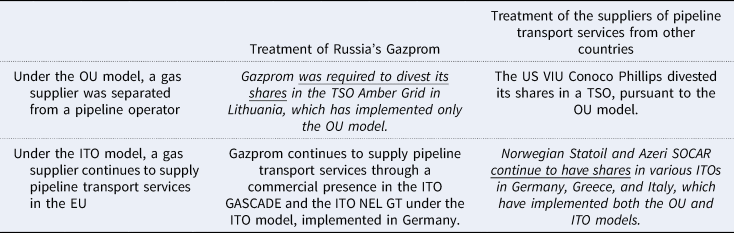
The Panel found that Russia's approach to compare the treatment accorded to different ‘subsets’ of Russian service suppliers and those of other countries was insufficient to show de facto discrimination as it could ‘skew[] the proper comparison for purposes of determining [less-favorable treatment]’.Footnote 51 In the Panel's view, the real reason why the unbundling measure may have had a greater impact on Gazprom than the service suppliers of other countries was that Gazprom had a greater commercial presence on EU gas markets than the other suppliers when the Directive entered into force.Footnote 52
Moreover, the Panel rejected certain of Russia's examples of TSOs that were claimed to be Russian, and where Gazprom was required to sell its shares pursuant to the OU model. Based on the definition of the terms ‘commercial presence’, ‘ownership’, and ‘control’ in the GATS, the Panel found that these companies were not, in fact, Russian service suppliers for purposes of the GATS. In particular, the Panel determined that Gazprom did not have a commercial presence in the EU through service suppliers where it owned less than 50% of shares or where it had no power to name the majority of directors.Footnote 53 These examples were, therefore, excluded from the comparison of treatment accorded to Russian and non-Russian service suppliers in the EU.
Given that the Panel's findings that the unbundling measure is WTO-consistent were to a large extent based on its factual assessments, it is unlikely that the Appellate Body will disturb them. The Appellate Body may review such assessments only in the limited circumstances where concerns are raised regarding the Panel's objectivity under Article 11 of the Understanding on Rules and Procedures Governing the Settlement of Disputes (DSU).Footnote 54 However, as the standard of proof for substantiating these claims is very high,Footnote 55 in most cases the Appellate Body has rejected them. On its face, the Panel's reasoning with respect to this measure seems to be well grounded and does not appear to have exceeded the bounds of the Panel's discretion as ‘the trier of facts’.Footnote 56
3.3 Claims against Measures that Russia Perceived to be ‘Exemptions’ from Unbundling
Russia also made several claims with respect to measures that it perceived to be ‘exemptions’ from the unbundling measure: in particular the public body measure, the upstream pipeline networks measure, LNG measure, and the infrastructure exemption measure.Footnote 57 Russia did not succeed in proving any of these claims, except one instance of the application of the infrastructure exemption measure, i.e. the 2009 Infrastructure Decision for the OPAL Pipeline (OPAL Decision). Below, we discuss the Panel's findings with respect to the LNG measure and the OPAL Decision.
3.3.1 LNG Measure
Russia claimed that LNG imported into the EU via LNG facilities, such as LNG terminals, is excluded from the application of the unbundling measure and in this way receives an advantage within the meaning of Article I:1 of the GATT 1994, which is not accorded to Russian natural gas imported into the EU via pipelines.Footnote 58 Article I:1 of the GATT 1994 is a provision analogous to Article II:1 of the GATS, establishing the MFN obligation in the context of trade in goods. To prove its claim, Russia had to demonstrate that (a) the LNG measure fell within the scope of Article I:1; (b) the relevant imported products were ‘like’; (c) the LNG measure conferred an advantage on a product originating in the territory of any country; and (d) that advantage was not extended immediately and unconditionally to the like products of Russian origin.Footnote 59
The key difficulty that Russia faced in this claim was establishing ‘likeness’ between LNG and natural gas in its gaseous state (pipeline gas). It is well settled in WTO law that ‘likeness’ must be demonstrated by analyzing criteria such as: ‘(a) the properties, nature and quality of the products; (b) the end-uses of the products; (c) consumers’ tastes and habits in respect of the products; and (d) the tariff classification of the products’.Footnote 60 In the Panel's view, each of these criteria, except the third one on which neither party provided evidence, led to the conclusion that LNG and pipeline gas were not ‘like’. The Panel, for example, found that they do not share the same physical properties, nature and quality (i.e. LNG is liquid while pipeline gas is gaseous).Footnote 61 While re-gasified LNG and pipeline gas have identical end-uses (e.g. both are used for heating), LNG in its liquid form, unlike pipeline gas, may also be used as a transport fuel, including for vessels.Footnote 62 The Panel also noted that LNG and pipeline gas are classified under different headings of the World Customs Organization Harmonized Commodity Description and Coding System, which is used by WTO Members to schedule their GATT tariff commitments (i.e. HS Codes 2711.11 and 2711.21 respectively).Footnote 63 Given that Russia's claim did not pass the ‘likeness’ test, the Panel rejected it.Footnote 64
The accuracy of some of the Panel's factual conclusions may be questioned. With regard to the physical properties of pipeline gas and LNG, natural gas, in both its liquid and gaseous states, has the same molecular structure – both liquids and gases are classified as fluids. Put simply, as opposed to solids in which there is a rigid atomic structure, atoms in liquids and gases can flow. The main difference between the two is their compressibility.Footnote 65 Moreover, LNG is only a method of transportation and will always be re-gasified before use (e.g. as a fuel for heating or transport). Thus, at the time of their consumption, pipeline gas and LNG are identical products: simply natural gas.Footnote 66 Finally, the use of natural gas as a maritime transport fuel is currently a small-scale activity. One report suggests, that out of more than 60,000 commercial vessels in operation globally, fewer than 125 vessels operate on natural gas.Footnote 67 This segment will undoubtedly grow in the future, but is a long way from being a natural gas market with real significance.
The Panel's factual assessment of the elements of ‘likeness’ was certainly informed by the evidence supplied by the disputing parties. That said, given the technical nature of this assessment, the Panel could have sought information from a scientific expert or international agencies specializing in the field of energy trade, such as the Energy Charter Conference.Footnote 68 This would have allowed the Panel to base its factual conclusions on more solid scientific grounds and to arrive at a better-informed understanding of how different segments of energy markets work.Footnote 69
3.2.2 OPAL Decision
Under the infrastructure exemption measure, certain energy infrastructure projects may be exempted from unbundling and other requirements of the Third Energy Package, such as third-party access and regulated tariffs, if they, inter alia, qualify as a ‘[m]ajor new gas infrastructure, i.e. interconnectors’ – a project connecting energy markets of several EU Member States.Footnote 70 Russia's claim concerned a specific instance of the application of this measure, as reflected in the OPAL Decision. In particular, it concerned certain conditions that were imposed by virtue of this decision on the operator of the OPAL pipeline, OPAL GT,Footnote 71 for granting the exemption.Footnote 72 The first, and the most relevant, of these conditions was the ‘50% capacity cap’, which limited the ability of OPAL GT, to allocate, in any given year, more than 50% of capacities in the pipeline to dominant undertakings on one of the Czech gas markets, including Gazprom.Footnote 73
The OPAL pipeline was built as an inland transportation route to deliver Russian gas to Western Europe, in particular the German/Czech border, through an entry point in German Greifswald. Russian gas reaches that point via the offshore pipeline Nord Stream, which was built by Russia to ease its reliance on the transit routes via Ukraine and Belarus. Hence, this project has a strong political background.Footnote 74
Russia claimed that the conditions imposed on OPAL GT constituted a de facto quantitative import restriction on Russian natural gas that was inconsistent with Article XI:1 of the GATT 1994, which provides, in relevant part, that ‘[n]o prohibitions or restrictions other than duties, taxes or other charges … shall be instituted or maintained by any contracting party on the importation of any product of the territory of any other contracting party’.Footnote 75 Given that the OPAL Decision ‘described the capacity cap as an annual 50% cap on the “exit capacity” of OPAL at the Czech border’,Footnote 76 the first question that the Panel had to address was whether the OPAL Decision is an internal EU regulation, or a border measure.
This question was of a threshold nature determining the applicability of Article XI:1 to the measure at issue. The GATT 1994 draws a fundamental distinction between border measures in the form of quantitative prohibitions or restrictions, which are addressed in Article XI:1, and internal regulations, which are subject to the national treatment obligation in Article III:4 of the GATT 1994. The purpose of this distinction is to limit the reach of Article XI:1, which could otherwise capture a wide array of internal regulations, most of which would have some restrictive effect on imports.Footnote 77 While different aspects of the same measure may fall under these two provisions,Footnote 78 one and the same aspect of the measure cannot be considered as both an internal regulation and a border measure. In this respect, Ad note to Article III states that ‘any law, regulation or requirement … which applies to an imported product and to the like domestic product and is … enforced in the case of the imported product at the time or point of importation, is nevertheless to be regarded as an internal … regulation or requirement …, and is accordingly subject to the provisions of Article III’ (emphasis added). Thus, a measure that, by its very design and structure, is an internal regulation applicable to both domestic and imported like products cannot fall within the scope of, and, consequently, violate, Article XI:1.
In light of this guidance, to determine the applicability of Article XI:1, a panel would normally assess whether the challenged measure applies to both imported and domestic like products. As clarified by the panel in Indonesia–Chicken, ‘this does not mean that the “identical” measure must apply to like domestic products; rather, that there is an equivalent measure for like domestic products’.Footnote 79 In the present case, for example, the Panel could have examined whether an infrastructure exemption with conditions similar to those imposed on OPAL GT could be granted, or were granted, to pipeline networks carrying natural gas of domestic origin. In some disputes, the distinction between border and internal measures was also drawn by assessing whether the application of the challenged measure was triggered by internal factors, which occurred after the product had already been imported.Footnote 80 In the present case, the application of the EU's competition rules could arguably have been such a factor.
The Panel chose a different approach, however, focusing its inquiry on the restrictive effect of the measure on Gazprom's ability to import its natural gas via the Nord Stream–OPAL pipeline route. The Panel noted that due to ‘the fixed nature of pipeline infrastructure and the necessity for natural gas transported by pipeline to flow along predetermined paths and to be imported through a limited number of fixed entry points’, the exit conditions imposed on OPAL GT at the Czech border could have an effect on the entry conditions and, consequently, on the importation of Russian gas through this route.Footnote 81 For the Panel, this was sufficient to establish the applicability of Article XI:1 to the OPAL Decision.
After addressing the threshold question, the Panel analyzed whether the OPAL Decision constituted a quantitative restriction inconsistent with Article XI:1. The Panel upheld Russia's claim based on the following considerations: (i) the OPAL pipeline transports natural gas exclusively of Russian origin, exported by Gazprom; (ii) the ‘50% capacity cap’ applies to Gazprom; and (iii) Gazprom can, therefore, utilize only 50% (as opposed to 100%) of the OPAL pipeline's capacity.Footnote 82 At the same time, the Panel found it irrelevant that: (i) the OPAL Decision does not extend to Russian gas suppliers other than Gazprom, such as Novatek, which do not export natural gas to the EU, because of Gazprom's export monopoly on natural gas under Russia's domestic law; and (ii) other opportunities for the importation of natural gas by Gazprom exist in the EU market, such as using other pipeline routes, including through Belarus or Ukraine, or selling gas at Greifswald's entry point.Footnote 83 Thus, the Panel's finding of inconsistency of the OPAL Decision with Article XI:1 was based on what the Panel considered to be a limiting effect of this measure on imports of Russian natural gas supplied by a major importer of this commodity to the EU.
The Panel's analysis raises an important systemic question of how a distinction between border and internal measures must be drawn in the context of network-bound trade. The Panel's approach may have been driven by the particular features of natural gas as a commodity that must necessarily be transported through fixed infrastructure. While, for most goods, conditions imposed after importation would be considered internal measures and would thus fall outside the scope of Article XI:1, the Panel considered that, in the case of natural gas, a broader view has to be taken.Footnote 84
The Panel's overall analysis of the WTO-consistency of the OPAL Decision may also have been informed by the Panel's apparent understanding that this measure was largely a political tool to limit artificially the dominant position of Gazprom in the EU's gas market, and to force Gazprom to utilize the existing gas transit routes through Belarus–Poland and Ukraine. Given that, due to the geographic location of the OPAL pipeline, no third parties could effectively utilize the remaining 50% of its capacity, the measure objectively did not have a strong economic rationale.Footnote 85 The political nature of this measure is further confirmed by the fact that the more recent 2016 OPAL Exemption Decision, which revised the 2009 OPAL Decision, lifted the ‘50% capacity cap’.Footnote 86 If the EU had wished to defend the OPAL Decision based on public policy grounds, such as compliance with its antitrust rules, it could have invoked Article XX(d) of the GATT 1994 as a defense. This provision allows Members to adopt measures that are necessary to secure compliance with laws or regulations which are not themselves GATT-inconsistent. However, the EU did not do so.
3.4 Russia's Claim against the Third-Country Certification Measure
Russia also challenged the third-country certification measure in the domestic laws of Croatia, Hungary, and Lithuania implementing the EU Gas Market Directive, which establishes procedures for the certification of TSOs by the EU Member States’ NRAs and the EU Commission. When a TSO is controlled by a person from a third country, the certification procedures must include the assessment of whether the certification ‘will not put at risk the security of energy supply’ in the relevant EU Member State or in the EU at large. In contrast, in the case of domestic TSOs, the ‘security of supply’ assessment is not required.Footnote 87 Given that this measure applies only to TSOs controlled by foreign entities, Russia claimed that it is inconsistent with the national treatment obligation in Article XVII:1 of the GATS. Pursuant to this provision, ‘each Member … [must] accord to services and service suppliers of any other Member … treatment no less favourable than that it accords to its own like services and service suppliers’.Footnote 88
While the EU did not dispute the existence of discrimination under Article XVII:1,Footnote 89 it maintained that the third-country certification measure was necessary to ensure the EU's security of energy supply and hence to maintain public order within the meaning of a general exception in Article XIV(a) of the GATS. To substantiate its defense, the EU had to prove, first, that the measure was provisionally justified under the sub-paragraph (a) of Article XIV, and, second, that it fulfilled the requirements of the chapeau of Article XIV.Footnote 90 The EU's defense under the sub-paragraph (a) was based on the following main considerations, with which the Panel agreed:
• Security of energy supply is a ‘fundamental interest of society’ in the EU to which foreign control of TSOs may pose a ‘genuine and sufficiently serious threat’ within the meaning of footnote 5 to Article XIV(a).Footnote 91 This is because foreign governments have the means to require or induce foreign-controlled TSOs to undermine the EU's energy security, which may, in turn, have ‘severe social, economic and, ultimately, political consequences’ for the EU.
• The measure was designed to ensure the EU's security of energy supply and ‘is manifestly apt’ to contribute to this objective as it, inter alia, ‘involves [an ex ante] “screening mechanism which allows the competent authorities to detect and assess in advance the potential risks to [energy security]”’.
• The measure's trade restrictiveness is limited as in reality ‘all applications for third-country certification have so far been granted’.
• Russia did not demonstrate that a reasonably available less-trade-restrictive alternative measure existed, which would achieve an equivalent level of protection of the EU's objective.Footnote 92
The Panel, however, found that the measure did not pass the legal test of the chapeau of Article XIV, which requires that ‘measures [be] not applied in a manner which would constitute a means of arbitrary or unjustifiable discrimination between countries where like conditions prevail’ (emphasis added). In particular, the Panel considered that similar threats to the security of gas supply were posed by both foreign and domestic TSOs. In particular, the Panel saw ‘no reason to conclude that there is no risk of domestic persons having commercial interests and/or personal and family links in foreign countries, which would render them vulnerable to requirements and inducements emanating from foreign governments’.Footnote 93 On this basis, the Panel found it unconvincing that the ‘security of supply’ assessment was required only with respect to foreign-controlled entities, while domestic TSOs were certified without any such assessment.Footnote 94
One drawback in the Panel's examination of the EU's defense is that, in determining the ‘necessity’ of the ‘security of supply’ assessment for the fulfillment of the EU's objective under sub-paragraph (a), the Panel did not examine sufficiently the content of the measure, i.e. how precisely it operates in practice. While it is clear that the measure involves an ex ante ‘screening mechanism’, the Panel did not assess the specific criteria on the basis of which the screening is conducted by the EU Commission and the relevant NRAs. For example, are these criteria of a purely political, discretionary, or technical nature? Without answering this question, it would appear difficult to assess properly the alleged contribution of the measure to its stated objective or its trade restrictiveness.
The Panel's cursory analysis of these issues may be explained by its reluctance to interfere with the EU's discretion as to which measures it considered were ‘necessary’ to fulfill the objective of energy security, which is ‘a fundamental interest of society’ in the EU and may be threatened by politically motivated measures of energy-exporting Members. That said, the amount of deference the Panel gave to the EU in its assessment of the consistency of the third-country certification measure with sub-paragraph (a) is unusual. In such assessments, panels have traditionally been lenient only with respect to the first element of their analysis – whether the challenged measure was designed to protect one of the objectives listed in general exceptions, such as the protection of public order in Article XIV(a). The analysis of the other elements, such as the alleged contribution of the challenged measure to its stated objective and its trade-restrictiveness, has so far been more rigid.
3.5 Russia's Claims against the TEN-E Measure
The last challenged measure, the TEN-E measure, consists of certain provisions of the EU Regulation on Trans-European Networks for Energy, which (i) set forth the criteria for the PCI designation of energy infrastructure projects; and (ii) established regulatory and financial incentives to facilitate the implementation of such projects. In order to be designated as a PCI project, the infrastructure must meet certain specific criteria that relate to market integration, sustainability, and/or security of supply, including contribution to diversification of gas supply sources.Footnote 95 Russia claimed that the criterion of ‘diversification’ discriminated de facto against natural gas of Russian origin within the meaning of Articles I:1 (MFM) and III:4 (national treatment) of the GATT 1994.Footnote 96 Thus, to resolve Russia's claims, the Panel had to interpret the meaning of this criterion, in particular whether it required the diversification from Russia as a source of natural gas supply.
The Panel acknowledged that the TEN-E measure itself did not define the concept of ‘diversification of gas supply’,Footnote 97 nor did the measure refer to Russia in any way. The Panel, however, observed that in the context of certain priority gas corridors of the EU in which the TEN-E measure incentivized the development of additional infrastructure (such as the Baltic Energy Market Interconnection Plan), the measure referred to diversification away from ‘a single supplier’.Footnote 98 The Panel then read these references in the context of a blueprint prepared by the EU Commission, identifying Russia as that supplier.Footnote 99 On this basis, the Panel found that the measure operates ‘to bring within the scope of [certain gas] corridors projects developing infrastructure aimed at connecting a number of EU member States with sources of natural gas supply other than Russia’, by providing these projects with financial and regulatory incentives.Footnote 100 The Panel stated that ‘by this means, the TEN-E measure provides more favourable conditions for the transportation of natural gas of any origin other than Russian’, and, therefore, discriminates against natural gas of Russian origin in a manner inconsistent with Articles I:1 and III:4 of the GATT 1994.Footnote 101
The EU's defense was based on a general exception in Article XX(j), which allows Members to take measures ‘essential to the acquisition or distribution of products in general or local short supply’. The EU argued that natural gas may become such a product in the event of the disruption of the gas supply, since ‘the transmission of gas requires especially dedicated fixed infrastructure that is costly and time-consuming to build’.Footnote 102 However, the Panel found that Article XX(j) concerns only situations where a product is ‘presently in short supply’, but not situations where a product is being at risk of becoming in short supply in the future. The Panel thus rejected the EU's defense.Footnote 103
The Panel's analysis raises two systemic questions for WTO Members at large. The first question is whether a measure may be considered to have a detrimental impact on the competitive opportunities of products of a certain origin within the meaning of Articles I:1 or III:4 (e.g. Russian gas) when it in fact aims to correct the inequality of competition between these products and products of other origins, due to the underdeveloped infrastructure between consumers and the alternative sources of supply. This question is particularly pertinent in the context of network-bound trade, where there is no market without a sufficiently developed infrastructure, such as gas pipelines and LNG terminals, the construction of which normally costs billions of euros in investments and takes many years.Footnote 104 The lack of adequate energy interconnectors in the EU led to a situation in which, in 2013, Russia was a single or predominant gas supplier in many of its Member States, with the following market shares: ‘Austria (63%), Bulgaria (100%), Czech Republic (100%), Estonia (100%), Finland (100%), Greece (67%), Hungary (95%), Latvia (100%), Lithuania (100%), Poland (77%), Romania (92%), Slovenia (58%) and Slovakia (100%)’.Footnote 105 In these circumstances, one can hardly argue that, at the time of the adoption of the TEN-E measure, there was a completed gas market at an EU-wide level with the effective gas-to-gas competition, where consumers could choose freely between different sources of gas supply.Footnote 106 Hence, the TEN-E measure has aimed to correct this problem by, inter alia, incentivizing the development of infrastructure carrying gas from sources other than Russia and interconnections between fragmented EU gas markets. This does not necessarily mean that the competitive opportunities of Russian gas are diminished. Russian gas is already a predominant or a single source of supply in many markets of the EU, and is delivered to those markets via numerous existing pipeline networks, many of which were built decades ago during the Soviet era. Thus, one may argue that the TEN-E measure does not discriminate against Russian gas and does not place it at a disadvantage vis-à-vis natural gas of other origins. Rather, by breaking Gazprom's monopoly in certain of the EU Member States, the TEN-E measure forces all market participants to compete on an equal footing.Footnote 107
But, even if measures correcting the inequality of competitive opportunities between goods of different origins would violate Articles I:1 or III:4,Footnote 108 the second question is whether such measures may be justified under GATT general exceptions, other than Article XX(j). The main implication of the Panel's findings is that measures that, through regulatory or financial incentives, aim to diversify away from a monopolistic supplier, or to promote infrastructure connections between an importing WTO Member and other Members with which the importing Member would otherwise not trade, will likely be inconsistent with Articles I:1 or III:4. One exception that Members could try to use to justify such measures is Article XX(d) of the GATT 1994, which, as noted, allows Members to adopt measures that are necessary to secure compliance with laws or regulations but that are not themselves GATT-inconsistent, including laws and regulations governing competition and energy security.
4. Concluding Remarks on the Implications of the Panel Report for the EU's Internal Gas Market and Energy Security
Although Russia advanced multiple claims against the Third Energy Package, the Panel found only limited inconsistencies with WTO law, while largely recognizing the EU's freedom to pursue its regulatory reforms in the natural gas market. In particular, the Panel did not find the EU's long-standing policy of unbundling the VIUs’ pipeline activities from their other gas market activities, such as production or supply, to violate WTO rules. Similarly, the Panel did not take issue with the EU's approach to regulate differently the activities of the operators of pipeline networks and LNG facilities.
A key message of the Panel's adverse findings against the EU is that measures to diversify away from Russian gas – either through restrictions on a pipeline capacity that may be used by Gazprom to transport its gas or the advantageous treatment of natural gas of non-Russian origin in the promotion of pipeline infrastructure projects – will likely be found to violate WTO law.
The Panel's findings were appealed by both the EU and Russia and the precise outcome of the dispute is, therefore, still uncertain. However, assuming for the sake of argument that the Appellate Body were to uphold the Panel's findings, the EU and its Member States may have to take the following implementing measures to bring themselves into conformity with their WTO obligations. These measures would require changes in the EU's regulation of its internal gas market and may potentially have an impact on the EU's energy security.
The Panel's finding regarding the WTO-inconsistency of the OPAL Decision suggests that any regulatory restriction on a pipeline capacity that Gazprom requires for the transportation of its natural gas via pipelines may be seen as inconsistent with Article XI:1, unless justified under a general exception of the GATT 1994. On 28 October 2016, the OPAL Decision was modified. Under the new regime (the 2016 OPAL Exemption Decision), Gazprom may now use up to 80% of the OPAL pipeline's transmission capacity, and, with no third-party demand for capacity, Gazprom could potentially use the full capacity of the pipeline.Footnote 109 It remains to be seen whether the new OPAL Decision has resolved the EU–Russia dispute over this measure. Unlike the previous regime for the OPAL pipeline that could only be explained by politically driven decision-making, the new regime represents a move towards a more market-driven approach.
To implement the Panel's finding on the WTO-inconsistency of the third-country certification measure, Croatia, Hungary, and Lithuania may have to create a certification regime for domestic TSOs. The EU may also have to extend PCI designations to projects that would transport Russian gas. The essential drawback of such an amendment to the TEN-E measure is that the EU would have to allocate its budget for PCI projects that do not contribute to, but rather undermine, the EU's objective of diversification and that increase even more the EU's reliance on Russia as its major supplier of natural gas. Alternatively, the EU and its Member States could repeal these two measures. This would, however, limit the ability of the EU authorities to detect potential risks for the EU's energy supply security during the certification of foreign TSOs and to promote the development of energy infrastructure of strategic and economic significance for the EU.
As in the case of the Panel's finding on the OPAL Decision, the Panel's findings on the TEN-E measure essentially suggest that the EU should rely more on market signals to achieve the completion of its internal gas market and the objectives of diversification and security of supply. Due to the recent increase in cross-border interconnectors with reverse flow capabilities, LNG, and storage facilities, the EU's gas market is now very different from how it looked at the time of the adoption of the Third Energy Package and the TEN-E measure. It is more diverse in terms of both suppliers and supply routes and less vulnerable to security of supply risks.Footnote 110 In light of these recent developments, easing its reliance on the ‘administrative market creation’ model may not be a bad idea for the EU.
The EU–Russia gas relations are complex. While it is clear that, from a commercial perspective, both parties are mutually dependent and locked into each other, it is equally clear that strong tensions exist between their political objectives. As noted earlier, these tensions are not unique to EU–Russia energy relations, but are common for upstream – downstream country relations in general. The existence of a neutral dispute resolution mechanism, such as that in the WTO, to defuse some of the tensions is a necessary and important component of international energy trade.