


1. INTRODUCTION
The ability to read and write has long been considered a cornerstone of modern society, essential for economic growth and social development and the very root of individual self-awareness and potential (Cipolla Reference Cipolla1969). Most historians would agree that the great process of modernisation that took place in the western world between the 18th and the 20th centuries would have been impossible without a largely literate population and the spread of knowledge through the written word. Historically there was a fundamental cleavage within Europe between a central and northern region characterised by relatively high levels of literacy as opposed to a southern flank where literacy was low. The dividing line is not altogether different from that dividing Protestant from Catholic Europe. After the French Revolution, public authorities began to take it upon themselves to set up public education systems where children learned to read and write. Literacy was only the initial step in the educational process, but it was a key one. Schools became the vehicle through which education was made available to the largest possible group of people.
These points help explain not only the great cleavages in literacy existing in historic Europe but also the general process of growth in both literacy and education. Were other fundamental factors involved? Some authors have argued that there is a basic cultural substratum involved in the configuration of oral and literate cultures that may also have been important even in the ancient world (Goody Reference Goody1963, Reference Goody1968, Reference Goody1987; Graff Reference Graff1987; Thomas Reference Thomas1992). More generally, what are the determinants of literacy in historical societies? Can observed differences be explained in terms of public policies or are deeper, more structural forces involved? Why did some people learn how to read and others did not? Can these disparities continue to be observed today when, from a definitional standpoint, everyone is literate? These and other related issues will be discussed in this paper with specific reference to the case of Spain.
2. THE SPANISH CONUNDRUM
Spain was characterised by low levels of literacy until relatively recently, much like other southern and eastern European nationsFootnote 1. Its rather unsatisfactory performance with respect to this hallmark of modernisation has often been attributed to the backward nature of Spanish society. Extreme disparities in literacy as well as important differences by sex constitute key characteristics of historical literacy in Spain that warrant further research. How can Spain have literacy levels that in some areas are comparable to those of Sweden, with practically no male illiteracy, and in others are levels typical of non-European populations? These regional disparities hold in basically rural areas where agricultural production prevailsFootnote 2. Contrasts such as these are difficult to find in Europe during that period. They constitute a puzzle of keen historical importance that warrants a convincing explanation.
Before the 19th century, only approximate estimates of literacy based on indirect measures are available (Soubeyroux Reference Soubeyroux1998). With the advent of modern census data, this changes. In the past three decades, historians, especially economic historians, have pioneered our understanding literacy in 19th and 20th-century Spain. The research of Antonio Viñao has addressed a wide variety of issues related to literacy and schooling (see e.g. Viñao Reference Viñao1982, Reference Viñao1985, Reference Viñao1990, Reference Viñao1998, Reference Viñao2012, Reference Viñao, Novella, Mora and Agenjo2017, Reference Viñao2018). More pertinent to this discussion, the pioneering book by Clara Eugenia Núñez (Reference Núñez1992) provided the empirical and conceptual basis for much research on literacy appearing in the past three decades.
From the outset, Núñez was interested in the contribution of literacy and human capital to economic growth. This was stated clearly in her initial book (Reference Núñez1992, pp. 31–45, 165–199), in her more recent contributions (e.g. Reference Núñez1997, Reference Núñez2003a, Reference Núñez2003b, 2010) and in her collaboration with Gabriel Tortella (Núñez and Tortella, 1999). Despite the commonsense nature of this proposal, the empirical results were not as strong as expected, in part because the areas of highest literacy in the country tended to coincide with those where there were few indications of substantial economic or social change (Pérez Moreda Reference Pérez Moreda1997; Reher Reference Reher1997). To date, this basic proposal continues to await fully convincing empirical proof, though it is unquestionable that a revolution in education must have played a significant role in the economic growth in Spain, at least after the 1920s.
From a very different perspective, a recent paper by Juif and Quiroga (2019), based on the heights and educational status of military conscripts for the early part of the 20th century, shows convincingly that «movers» (migrants) tended to be taller and more educated than the «stayers» left behind. In this way, migration and its links to education became a key process whereby people with more education moved from the more backward to the more dynamic regions of the countries. In so doing, in the words of the authors of this study, migration led to a «brain drain» that contributed to regional inequality in Spain (p. 122) but, in so doing, to economic growth as well (Núñez Reference Núñez2003b; Quiroga Reference Quiroga2003). This migratory link between education and economic growth does not negate the potential importance of education for economic change in any given region, though here the precise links remain speculative.
The links between human capital and economic status have been addressed at an individual level in two recent studies referring to very different periods of history. Alvarez and Fernando Ramos Palencia (Reference Álvarez and Ramos Palencia Ramos Palencia2018) studied the micro results found in the Castastro del Marqués de la Ensenada, undertaken circa 1750, to explore the links between human capital and male labour earnings in 18th-century Spain. In order to do this properly, education (literacy and numeracy) is linked to occupational skills and earnings for adults present on the Catastro. While they find statistically significant results, the direction of causality is not clear, leading the authors to discuss the role of unobserved variables such as family background that makes interpretation of results rather challenging. Beltrán Tapia and de Miguel Salanova (Reference Beltrán Tapia and de Miguel Salanova2021) address the issue of literacy and class mobility in Madrid between 1880 and 1905 where they look at the likelihood of being illiterate in terms of parents' socio-economic status. They discuss the expansion of the educational system as a factor in the partial reduction of inequality. They also analyse the returns to education by studying the social mobility of children with data referring to these same children a quarter of a century later. They reach the conclusion that literacy does indeed tend to enhance social mobility during this period though high inequality and inadequate schooling can prevent social mobility for a large part of the population.
The growth itself of literacy is a research topic where our knowledge continues to be incomplete. For a wide-ranging discussion of literacy growth in urban areas, see Barquín et al. (Reference Barquín, Pérez and Sanz2016). Núñez (Reference Núñez1992, Reference Núñez2003b) suggests that growth in literacy was rather slow during the 19th century with few signs of any change in its regional distribution (see also Quiroga Reference Quiroga2003). Other research has pointed to a relative lag in growth in Spain in comparison with Italy, especially during the 20th century, attributed at least in part, to differences in the pace of increasing feminisation within the primary-school teaching profession (Capelli and Quiroga Reference Capelli and Quiroga2020, Reference Capelli and Quiroga2021). Related indirectly to this issue but centred on an earlier period, Carmen Sarasúa (Reference Sarasúa and Martínez-Carrión2002) makes use of the Diccionario de Pascual Madoz with data from 4000 towns and villages to show that differences by sex in access to educational resources in rural areas constitute an important limitation to the spread of literacy, especially among girls (p. 461). The role of common lands has been shown to have a positive impact on the funding of schools and literacy rates, partially offsetting the negative effect of weak economic growth and a low commitment of Spanish institutions to primary education (Beltrán Tapia Reference Beltrán Tapia2013). Ultimately, the growth of education depended on resources that were often limited during this period (see e.g. Núñez Reference Núñez1992; Rueda Reference Rueda and Suárez1999; Barquín et al. Reference Barquín, Pérez and Sanz2016).
While much of this recent literature has made mention of regional disparities in literacy, few have examined this issue specificallyFootnote 3. In a recent paper, based largely on 1860 census data, Beltrán and Martínez-Galarraga (Reference Beltrán Tapia and Martínez-Galarraga2018) have reset the playing field for our understanding of literacy in 19th century Spain. Making use of the literacy estimates for 464 judicial districts, they have etched the basic outlines of literacy in the country and suggest that the fraction of day labourers within the agricultural population of any given district was a key determinant of prevailing literacy, especially among males. This seminal article constitutes the point of departure for the present paper.
The goal of this paper is to deepen our understanding of regional disparities of literacy in historic Spain by introducing a different, value-based perspective on the subject. This analysis makes use of available census material, micro-census data taken from different parts of Spain and in-depth interviews of elderly informants. The basic argument is that these regional disparities are crucially influenced by the value placed by families on the importance of reading and how this was transmitted to young children, often well-before they ever entered school. It constitutes a root cause because, basically, it defines the baseline value placed by society (and families) on literacy and on education. Wherever this support was lacking, as it clearly was in different regions, educational efforts, both public and private, could never be fully successful. This argument does not negate the importance of other explanations, specifically those laid out in the Beltrán Tapia and Martínez Galarraga paper (2018) that operate at a different, though related, level of causality affecting selective human capital formation. We will see that levels of literacy in 19th-century Spain are the result, in part, of the make-up of rural populations, but also of the disparities in the values existing in different regions of the country with respect to education and its usefulness for life. This cleavage is visible in 19th-century Spain, reflects but goes beyond the weight of day labourers in rural populations, appears to have existed in more remote historical times and continues to exist today. It constitutes an enduring characteristic of society that has traditionally been cause for concern. It is our hope that this paper will widen the scope of existing debates on literacy and on education in Spain.
3. EXPLORING REGIONAL DIMENSIONS OF LITERACY IN 19TH CENTURY SPAIN
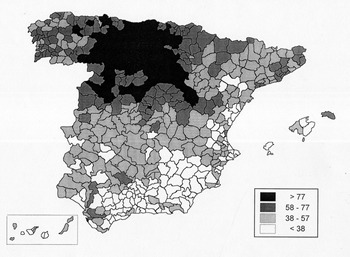
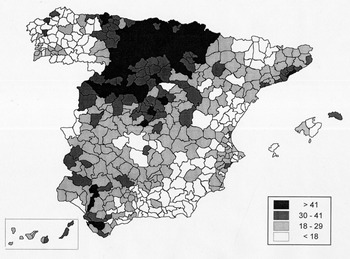
The point of departure for this discussion is marked by the results derived from the first Spanish census (1887) to contain literacy data broken down by age and sex. We estimate adult literacy as the percentage of persons aged 31-35 who know how to read and write. This age group was chosen because it is an age when the maximum levels have been reached for any given cohort. Maps 1 and 2 contain a regionalisation of literacy patterns in Spain for the country's 476 judicial districts (Reher et al. Reference Reher, Nogueras and Pombo1993). The basic distribution is very clear. Literacy is fairly high among men in Old Castile and Leon (corresponding to the upper meseta), as well as along much of the Cantabrian coast in the North. The Basque Country and Navarre are also areas of high literacy. Other pockets of fairly high male literacy can be found around Barcelona, in parts of Galicia and near Seville. The lowest literacy is found in much of Andalusia, Murcia and areas of the Levant. Literacy is also fairly low in Extremadura and New Castile (the lower meseta) as well as in areas of Zaragoza and the interior of Catalonia. Both the Balearic and the Canary Islands have relatively low levels of literacy. The basic map of female adult literacy is not altogether different from that of male literacy, with the great exception being Galicia and much of the Levant, where literacy is extremely low, and areas around Cadiz, where it is relatively high. These results mirror those presented in the Beltrán and Martínez-Galarraga (Reference Beltrán Tapia and Martínez-Galarraga2018) based on the 1860 Census, suggesting that the regional pattern of literacy did not change during the second half of the 19th century.
Male adult literacy in Spain, 1887 (per cent literate).
Source: 1887 census returns for 476 judicial districts.

Female adult literacy in Spain, 1887 (per cent literate).
Source: 1887 census returns for 476 judicial districts.

These maps do not do full justice to the extent of regional differences in literacy that rival or surpass those existing in most other European countries. Looking at the same age group and using provincial data, male adult literacy in Alava, Santander and Palencia (all in the North) ranges between 86 and 88 per cent as opposed to between 32 and 33 per cent in Malaga, Almeria and Granada (South). For women, regional patterns were similar, but levels are considerably lower, ranging from 56 to 69 per cent in the Northern part of the country to as low as 11-13 per cent in Almeria (South), Castellon (Levant) and Lugo (Galicia)Footnote 4. When using judicial districts instead of provinces, the differences are much greater. For men, in a total of 14 districts less than 25 per cent of the adult male population is literate. All of these districts are located either in Andalusia or Murcia or on the island of Ibiza. On the other end of the scale, there are 14 districts in which more than 90 per cent of the adult males are literate. In the case of the very rural and very undeveloped Riaño (northern part of Leon), 97 per cent of the men are literate. All of these high literacy districts are located in the northern part of the country. For adult females, results are equally impressive. In 15 districts, more than 60 per cent of adult women are literate. With few exceptions, these districts are in the North and are mostly rural. At the other extreme, in 24 districts fewer than 10 per cent of the women know how to read and write, and in four of them fewer than 6 per cent are literate. These districts are located in the South, in the region of Galicia, on the island of Ibiza and in areas of the Levant. According to the Census of 1887, disparities in literacy among adult women varied by a factor of nearly 8, while for men they varied by a factor of more than 4. These are enormous differences, especially in a relatively small country like Spain. There is little evidence suggesting that this basic regional distribution of literacy changed significantly during the 19th centuryFootnote 5.
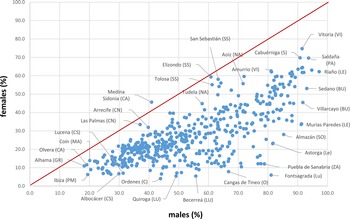
Figure 1 contains a scatterplot in which male adult literacy is portrayed on the x-axis and female adult literacy is on the y-axis. The diagonal line represents equal levels of literacy for both sexes, with points above showing higher female literacy and points below higher male literacy. The distance from the data point to the diagonal line represents the importance of male-female differences in literacy; the greater the distance, the greater the difference between males and females. Several data points have been labelled with the name of the district and its corresponding province so as to facilitate a clearer understanding of these resultsFootnote 6. The main takeaways from this fascinating figure can be summarised in the following points: (1) Male literacy was invariably higher than female literacy, with the exception of Medina Sidonia in the province of Cadiz. (2) Male-female differences were greatest by far in districts clustering in the lower right-hand corner of the figure and are most visible in regions in the Northwest, especially in certain parts of Galicia, with moderately high male literacy and extremely low female literacy. The district of Fonsagrada in Lugo, with literacy rates of 81.1 per cent among males and 5.9 per cent among women, is an extreme example. (3) Sex differentials are lowest near the diagonal line, with districts in the Basque Country showing relatively small differencesFootnote 7. (4) The highest levels of male literacy are found in districts on the upper meseta. (5) Extremely low levels of female literacy are found in Galicia and in certain areas of the Eastern part of the country (the Levant and in Ibiza). (6) On the whole, the correlation of male and female literacy is positive and significantFootnote 8.
Literacy by sex in Spain in 1887 (% literate, 31-35) [476 judicial districts]
Source: 1887 Census

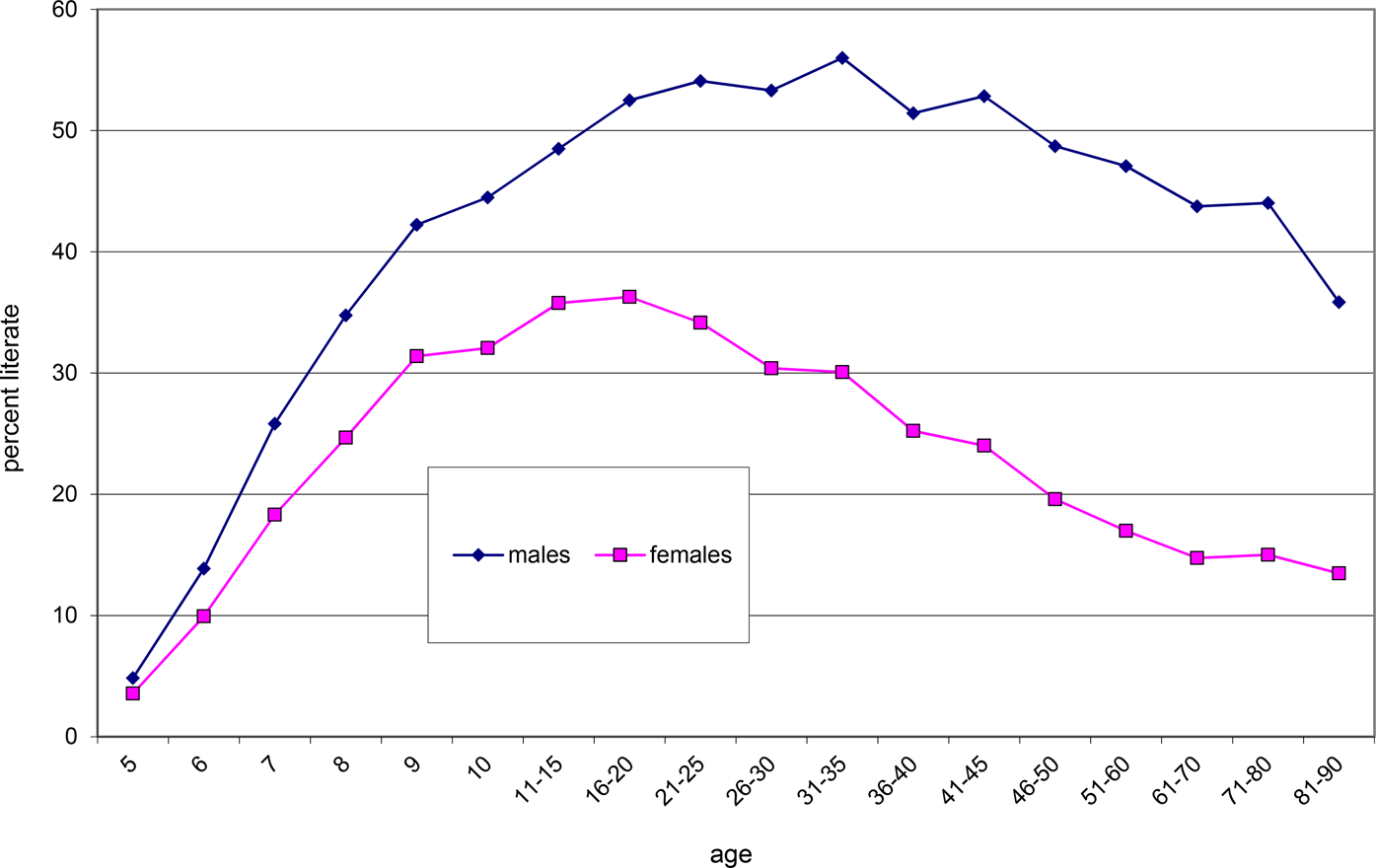
Key aspects regarding the acquisition of literacy as well as historical trends before the census date emerge when looking at national data for both sexes over the life course (Figure 2). The results can be summarised in the following points: (1) A small percentage of both sexes was literate at a very young age (5-6). (2) The acquisition of literacy was very rapid for both sexes up until 9 years of age when 43 per cent of boys and 32 per cent of girls were literate. (3) The peak age for literacy among young girls is 11-15 (or 11-20), whereas it was considerably later for young boys (21-30). This difference can be explained in part by the educational efforts of the military as well as by practical training in reading and writing for young men (Quiroga Reference Quiroga1999). (4) Differences by sex become most notable after 10 years of age when literacy among males continues to increase, but not among females. Considering that, basically, people only learned how to read and write when they were young, historical literacy trends can be approximated by considering levels holding for people at ages above 20Footnote 9. Increases in literacy were greater among women (where literacy levels more than double) than among men (20-25 per cent increase), but for both sexes were quite important. Despite the relatively low levels of literacy holding in 1887, it is clear that investments in the education of young people during the course of the 19th century had an important effect on literacy, especially among womenFootnote 10.
Literacy by age and sex in Spain, 1887.
Source: Population Census 1887

Literacy is normally explained from two different vantage points. One of them is based on the availability of adequate schooling (supply). Children often learned how to read and write at school. Underlying this type of explanation is the belief that schools were in a position to fulfil those societal needs that some families were either unwilling or unable to provide. In other words, schools were either a complement to family input or a substitute for it. The other explanation is based on the perceived usefulness of literacy for people's lives (demand). If people knew that they would benefit from being literate, in an economic, social or cultural way, it would behoove them to acquire a skill that was bound to enhance their chances of success in life. Implicit in this argument is that in different social subgroups or in different regions of any given country, the motivation for learning how to read and write may have been quite different.
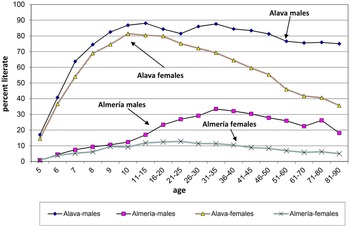
Exploring the process of literacy acquisition over the life course is a useful point of departure for this discussion. There is evidence to suggest that the way people learned how to read and write was quite different in high and low literacy regions of the country. Figure 3 contains literacy rates by age and sex for a high-literacy province (Alava, in the North) and a low-literacy one (Almeria, in the South). A number of important differences can be seen in the data presented here that can be summed up in the following points. (1) Children began reading in Alava at a very young age, and by 6 nearly 40 per cent of young children (boys and girls) were already literate. Quite the opposite occurs in Almeria where levels were extremely low and progress quite slow. At 5-6 years of age, practically nobody knew how to read or write. In fact, the 15 per cent literacy holding for 5-year-olds in Alava was only surpassed by boys in Almeria at 11-15 years of age and was never surpassed by girls. (2) The peak age for literacy was reached much earlier in Alava than in Almeria. This was especially the case for boys who by 10-15 had reached their maximum literacy in Alava, but only reached it by 31-35 years of age in Almeria. For women there were also differences, but not nearly so pronounced (aged 10 as opposed to 16-20). (3) The gains in literacy during the 19th century are apparent for both provinces and both sexes. These gains however were greater for women in Alava whose literacy grew by more than 40 percentage points over the course of the century, as opposed to Almeria where the percentage gains were far smaller. (4) For young people in Alava, there was no longer any significant difference in literacy by sex. Indeed, at 21-25 years of age these differences were negligible. The fairly important differences by sex mentioned earlier affected older age groups but not younger ones. This process does not appear to be significant in the southern province of Almeria.
Patterns of literacy adquisition in two Spanish provinces, 1887.
Source: Population Census 1887

The situations in Almeria and Alava are strikingly different. Not only are overall levels of literacy in sharp contrast, but the entire process of literacy acquisition appears to be completely different. In Alava, people learned how to read and write at a very young age and differences by sex were always small, thus suggesting that the family played a very important role in this process, either directly with young children reading at home or indirectly by encouraging their schooling. In Almeria it is clear that the family did little or nothing to promote children's education. The few people who actually learned how to read did so in school, on the job or in the military. The process was completed at a far higher age and for a far lower percentage of the population than it was in the North. These two provinces are worlds apart not only with respect to literacy levels, but also with respect to how and when this skill was acquired. Everywhere, literacy improved greatly during the 19th century, but the intensity of improvement in each province was quite different.
A traditional explanation for literacy hinges on the premise that differing social structures may be at the root of the enormous disparities in literacy existing in the country. The basic idea here is that people acquired literate skills because these were perceived to be useful to them in life in one way or another. It is well known that social structure in rural society was decidedly different in the northern meseta than it was in Andalusia. In the North, access to landholding was widespread, as opposed to Andalusia where a small percentage of the population held the great majority of land and a large segment of the rural population was made up by landless day labourers (jornaleros). It is the classic cleavage between a minifundio and a latifundio system of rural labour. This is a powerful argument because it suggests that people who had access to their own farms, those who bequeathed them in inheritance, those who administered them, etc., would all have ample reasons to know how to read. On the other hand, day labourers—omnipresent in the South—really had very few reasons to learn how to read and write, at least insofar as it influenced their ability to make a decent living. This is precisely the argument used by Beltrán and Martínez-Galarraga in their 2018 paper where they specify this link within a formal model in which the ratio of day labourers to the total agricultural population was used as an independent variable. The results are very clear, at least among men. The same basic pattern is observable with data from the 1887 census.
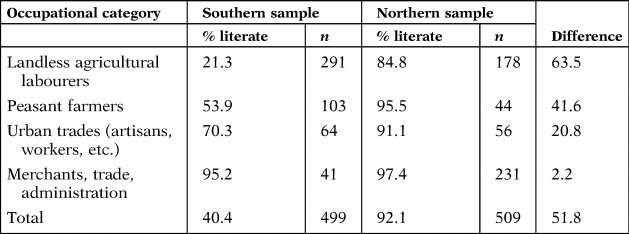
It is unquestionable that all high literacy regions (at least for males) are ones in which access to land is widespread, as opposed to the low literacy ones characterised by large estates and relatively high proportions of day labourers present in the population. Nevertheless, there are also indications that differences in literacy go far beyond the specific constraints of different social and economic groups in society. While this sort of heterogeneity cannot be detected with general census returns, it is easy to see with local data. In order to do this properly, we generated a small data set based on local population counts (padrones) for a small selection of villages and dates taken from both the high and the low literacy areas of the countryFootnote 11. By comparing the northern and the southern samples for male literacy across different occupational categories for the earliest period for which we have local data (prior to 1920), the extent to which literacy was determined more than by social structure becomes apparentFootnote 12.
The data in Table 1 are striking, suggesting that everywhere important social differences in literacy attainment existed. This result supports the basic premise that different social groups perceived different levels of usefulness in knowing how to read and write. Yet they also suggest that realities go far beyond this type of social structural constraint. In both samples, it is clear that people working in urban trades or as merchants had higher literacy levels than day labourers. Despite this, however, literacy in specific occupational categories was invariably higher in the northern sample than in the southern one, often by a vast margin. In the Northern sample basically everyone knew how to read and write, independent of his social or economic position, while in the Southern sample just the opposite occurred. Even among day labourers, while in the Southern sample 21 per cent were literate, in the Northern sample this was the case for 85 per cent of day labourers. Differences by occupational category were of course important for literacy but in the North literacy was greater in every occupational group than it was in the South. We are faced with two very different societies: one in which knowing how to read and write must have been deemed important by practically everyone and another one where it was not, and this disparity affected all social groups.
Literacy among adult males (20-60), 1895-1920, by occupation

Note: Southern Sample = Luque (Cordoba) 1896, 1919, Priego de Córdoba (Cordoba) 1910. Northern Sample = Cervera de Pisuerga (Palencia) 1883, 1893, 1905, 1915.
A final issue remains to be addressed. There is some evidence that these regional literacy patterns may have been long-standing ones. Based on 1887 results presented above, it is clear that there was little change over the 19th century. How far back do these regional patterns extend? Unfortunately, here our answer is less clear than we might hope. Despite the difficulties, several aspects of literacy during the period are clear. These include a rise in literacy levels during the 16th century or earlier (Lawrance Reference Lawrance1985, pp. 83-87) and in the 18th century, with a period of stagnation or decline in the 17th century (Nalle Reference Nalle1989, pp. 68-73; Tapia Reference Tapia1993-94, p. 286; Soubeyroux Reference Soubeyroux1998, pp. 251-254; Viñao Reference Viñao1998, pp. 257-260), extremely low female literacy rates (Tapia Reference Tapia1993-94, pp. 289-291; Antón Pelayo Reference Antón Pelayo1998, p. 324; Soubeyroux Reference Soubeyroux1998, pp. 243-246) and great differences in literacy by socio-economic group (Tapia Reference Tapia1993-94, pp. 295-303; Soubeyroux Reference Soubeyroux1998, pp. 246-251). We know much less about the regional patterns of literacy during the period. Yet there are some signs that basic 19th century patterns may have held at earlier dates (Nalle Reference Nalle1968, pp. 68-69; Antón Pelayo Reference Antón Pelayo1998, pp. 324-325; Soubeyroux Reference Soubeyroux1998, pp. 241-243). After 1887 literacy increased significantly everywhere in Spain, though with few exceptions by the central decades of the 20th century the basic regional patterns of literacy continued to be similar to those holding in the past (Núñez Reference Núñez1992, pp. 89-122).
4. EXPLAINING LITERACY IN SPAIN
The explanations for these long-standing literacy patterns in Spain are multiple and layered. A number of them are related in one way or another to some of the points raised earlier: the role of the family, the cultural differences existing on the Iberian Peninsula at any given time and the importance of social structure and access to property. Even these, however, are only part of the picture. We will start this discussion with the immediate, empirical factors influencing literacy directly towards the end of the 19th century but will conclude with some more far-reaching attempts to delve into the nature of the cultural values holding in the country.
Several of the variables contained in the 1887 census provide a starting point for understanding the observed patterns. High literacy was related to the existence of relatively small settlements, with widespread access to land and with relatively high densities of clergy and other subpopulations that were literate by definition (administrators, notaries, police, pharmacists, etc.). Rural settlement patterns and farm size had very concrete implications for educational opportunities. In the South farms tended to be rather large and villages were both large and relatively distant from one another. The agricultural day labourers normally lived in the villages and travelled to the fields where they worked. This regimen often entailed prolonged stays away from the villages, living on cortijos. This was especially the case during harvest time, but also happened during other seasons of the year. Where villages and farms were small, however, the distance from one settlement to another was never very great. People might live on small farms, but they were never far from the village.
The second type of settlement is more easily compatible with uninterrupted schooling than the first one in which entire families might spend weeks on end working from cortijos. This point is brought out in a series of in-depth interviews we conducted with elderly people from southern and northern parts of the countryFootnote 13. A number of the informants from the South remembered their lives on the cortijos in the countryside and how there used to be itinerant teachers who gave lessons in reading and writing in the afternoons in return for lunch and a little money the parents would provideFootnote 14. None of them considered this more than anecdotal experience because where they really learned to read (if indeed they did) was in schools or in the military service when they were considerably older. By contrast, informants in the Northern region invariably recalled attending schools in the villages in an uninterrupted way. Some of them spoke of how their fathers would take them to school before heading out to the fields for work. Distance to school was a structural constraint on the access to education whose importance depended on by how much effort families were willing to invest in the schooling of their children.
By virtue of the Ley Moyano (1857) smaller settlements were supposed to have a greater density of schools and teachers with respect to the total population than larger onesFootnote 15. In 1887 the supply of teachers (and schools) was higher in regions with smaller settlements. The ratio of teachers to inhabitants varies by a factor of more than 3; with one teacher for every ninety-six youths 6-20 years of age in Old Castile and Leon or for every 106 in the Basque Country and Navarre, as opposed to one teacher for 247 youths in Andalusia, 322 in Murcia and 296 in the Balearic Islands.
The existence of schools is a key part of any explanation of literacy. Most people learned how to read at school and the dramatic increase in literacy and in overall educational attainment taking place in Spain between the middle of the 19th and the middle of the 20th centuries is unquestionably a matter of formal, increasingly public education. The State began to invest heavily in education during this period. Before, most schools were privately funded, often by the Church. Since the early part of the 19th century, there had been a steady stream of initiatives designed to set up a network of primary schools culminating in Ley Moyano of 1857. Throughout the period studied here, and for more than a century after the 1857 law was passed, increases in public funding of education were common (Núñez Reference Núñez1992, pp. 208-220), leading to considerable growth in the actual number of schools (Núñez Reference Núñez1992, p. 229; Viñao Reference Viñao1998, p. 538). Until the early decades of the 20th century, however, funding for these public schools was for the most part local (Núñez Reference Núñez1992, pp. 286-287). The coverage of nationally funded public education was not complete before the Second Republic during the 1930s or later.
Throughout most of the 19th century, private, often Catholic, schools—themselves mostly locally funded—coexisted with locally funded public schools. The vast diversity of schooling opportunities present during the latter part of the 19th century should be understood against the backdrop of an educational system whose funding was basically a local affair. Not surprisingly, regions where access to literacy for the young was most widespread were also those with the highest levels of school enrolment. The 1887 census gives us very strong evidence on this point, with more than 50 per cent of children (6-20) of both sexes enrolled in primary or secondary schools in Old Castile, Leon, the Basque Country and Navarre, as opposed to 20 per cent in Andalusia, 18 per cent in Murcia and only 10 per cent in the Balearic Islands (Reher et al. Reference Reher, Nogueras and Pombo1993: Table 20, pp. 107-108). Far higher rates of literacy existed in those regions where investments in education were greatest (Reher et al. Reference Reher, Nogueras and Pombo1993: Table 21).
Asking whether or not literacy was determined by education in Spain is, in a sense, begging the real question of why in some areas in Spain, apparently independent of wealth, people were so much more willing to invest in the education of their young than they were in others. Greater educational opportunities existed because families demanded them (Reher Reference Reher2011). In some areas of the country, local populations were willing to fund educational systems and to make sure they functioned well, whereas in others they simply were notFootnote 16. In other words, schooling was abundant and successful in those areas that valued it and much less so in those that did notFootnote 17.
In many ways, the family was the most important factor influencing education and literacy. Its impact appears before a child ever entered school as well as during his schooling. It is not possible to be successful in education without the support of the family and it is within a familial context that values are instilled that may help or hinder the child in his education. Self-discipline, the importance of the written word, priorities in the organisation of one's time or the importance of goals are all the types of values that families are able to instil in their offspring. Families, of course, embody more general social values as well. It is within the home that values any society considers important are first learned (Reher Reference Reher1998, Reference Reher2021). When families and societies value education, they support educational opportunities for their societies and their children. The funding of private schools in villages is, to a considerable extent, the manifestation of the value those societies place on education.
It would be erroneous to consider families as passive participants in social processes. They have never been hesitant to implement strategies for social reproduction, economic betterment or survival as best they see fit. Families filtered access to education for their children in accordance with their own hierarchy of values. Different children were not necessarily treated in the same way within any given family with regards to their access to educational opportunities. The sex differences in literacy so characteristic of Spain began within the family, where girls were often discouraged from learning how to read, or at least they were less encouraged to do so than were boys. In this sense, families were implementing social norms by which it was less important for girls to be literate. There may also have been other filters governing access to education, applied either within families (differentials by birth order, e.g.) or among families belonging to different social groups. Families were not hesitant to put into practice their own values on matters such as these.
It is clear that at least two very distinct ideational value systems coexisted in Spain: one perceived education and literacy to be of vital importance for children while the other considered it to be only of marginal usefulness, something to be subordinated to more pressing concerns. Simply stated, in literate Spain, reading and writing were valued, while in illiterate Spain they were not, or at least not very much. The existence of these stark cleavages in Spain is underscored by a number of the results taken from our in-depth interviews as well as by some interesting empirical data.
In the Northern regions children often learned how to read while they were still at home, before schooling ever began. During this period, from a legal and normative standpoint (the Ley Moyano and subsequent legislation) schooling was to be obligatory for children between 6 and 9 years of age (Núñez Reference Núñez1992, pp. 216-224). In reality, however, coverage was never complete until the central decades of the 20th century. This being the case, the levels of literacy of 5-7 years old seen in the North would have been unattainable unless there was some instruction at home. Already at 5 years of age, 15 per cent of the children in the North knew how to read and write as opposed to 0 per cent in the South. The testimonies of elderly people in the North have suggested that children learned how to read at home. More often they were favourably predisposed to be literate by watching parents write letters or read books or by observing books around the houseFootnote 18. The testimony of one informant in the province of Santander is a good example of this. His mother, a widow, raised him and his three siblings alone. When asked if there were books at home or if anybody read to him, initially he replied negatively. Then he said that his mother used to read scriptures to him when he was very young (perhaps four or five), though he considered this to be «religion, not reading» (sic)Footnote 19. Letters from kin were also read to the children. All of these were indirect ways of teaching and showing by example the value of reading and writing to young children.
With few exceptions, this sort of situation was foreign to informants from Andalusia. The scant value families in the South placed on reading is underscored by instances in the village of Luque (Cordoba) at the end of the 19th century where a father was listed as literate on the local padrón and yet none of the offspring living at home above 10 years of age knew how to read and write. In 1896, out of a sample of 32 families in which the household head was literate and had grown-up offspring (10) coresiding at home with him, in 18 cases (56%) the children were not literate even though the father wasFootnote 20. Are these cases of delinquent fathers? Perhaps they are not. This sort of parental neglect of education can only be explained by fact that the parents apparently never saw much real value in making sure their children learned how to read and write. The father had likely learned how to read while in the armed services, but never valued the experience (Quiroga Reference Quiroga1999). Reading was not really «important» for anyone in the family. This rather surprising contradiction never happens in the North, and even in the South it disappears from the local listings after around 1910-1920.
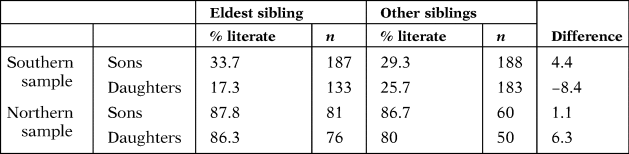
It is also apparent that not all children were given equal access to educational opportunities. The clearest example is with girls, where in much of Spain they were clearly discriminated, at least in comparison with opportunities given to boys. There were, however, other strategies at work. In our interviews in the South it became clear that the eldest daughter tended to be excluded from schooling because she was left in charge of the household and acted as a surrogate mother in the care for her younger siblingsFootnote 21. This was especially the case when families were large or when the mother was absent for one reason or another. In the North the eldest daughter might also be in charge of the household, but testimonies repeatedly emphasise that this never interfered with schooling. These testimonies receive empirical support from our local data (Table 2). Whereas in the South the eldest daughter was clearly penalised, in the North both sexes benefited from being the first-borne, as did first-born sons in the South. In other words, it appears as though literacy was perceived to be more important for the first-born children, probably as a preparation for life, except among women in the South where the opposite held. It is impossible to say whether these differences were caused by differing expectations for daughters or by differing family realities when they were young. Our data do not enable us to be more precise when assessing educational opportunities by birth order, sibset size or the gender make-up of the sibsetFootnote 22. Nevertheless, here too important differentials may have existed, both within families and across cultures.
Literacy by birth order, sex, prior to 1921 (siblings ˃10)

Note: Southern Sample = Luque (Córdoba) 1896, 1919, Priego de Córdoba (Córdoba) 1910. Northern Sample = Cervera de Pisuerga (Palencia) 1883, 1893, 1905.
Source: Southern and Northern samples of local population counts (padrones). For further details, see text.
Assuring educational opportunities for children was most difficult at harvest time. In the South, pressing economic tasks tended to take precedence over school, but in the North testimonies suggest that families did everything possible to ensure that their children continued to attend schoolFootnote 23. Attending school in the North was also facilitated by the proximity of schools to areas of agricultural labour. Even so, it is unquestionable that the observed differences were due mainly to the importance parents attached to education in each region.
The key here is the perceived and the experienced value of literacy that comes to light in the testimonies of the elderly people interviewed. In the South, most of those interviewed had learned how to read, albeit at a minimal level, when they were young. With some exceptions, these informants said that knowing how to read and write was good for keeping accounts or to «defend yourself» from people who might want to trick youFootnote 24. Despite this, for the most part during their adult lives many of them never had any reason to read at all, except perhaps for the sports page of the newspapers. They were, in fact, functionally illiterate.
In the North, reading was a part of people's livesFootnote 25. They read books and religious texts, as well as newspapers. Most of those interviewed also remember having written letters. When they were young, letter writing mainly consisted of the notes they put on letters their parents were writing to, say, an uncle who had emigrated to Madrid, Bilbao, Argentina or Venezuela. Later on, they did the letter writing themselves. Few if any ever mentioned that the reason to learn to read and write was to keep the books or to «defend oneself», as they did in the South. Reading occupied a relevant niche in their lives. Letter writing was singularly absent from family life in the South. There were people who wrote on behalf of other people in the village, say to a boyfriend who was away during the Civil War. Within families, however, letters are never mentioned in the testimonies we gathered. Generally, reading and writing appear to have had little use for the lives of rural folks in Andalusia, as opposed to the North where it was a daily activity for most peasant families.
In this sort of situation, it is not at all surprising that funding for education was far greater in the northern regions than it was in the southern ones or in the Levant. This funding might come from rich families, from emigrants, from religious foundations or from municipal governments. Whatever the source, empirical data show convincingly that it was much more plentiful in the North. It is unquestionable that there were, at the very least, two different societies in Spain; one where reading was valued by the great majority of the population and another where it was not. By implication, in one part of the country cultural transmission must have been largely an oral affair as opposed to the other where it was literate to a great extent. Everywhere both oral and literate cultures coexisted, but in the southern and much of the eastern parts of the country orality had the upper hand or at least was relatively more important, whereas in the North it was relatively less important. The stark differences in literacy existing during the 19th century underscore the strength of this divide. Future research would do well to explore these issues further in order to turn the very basic north/south dichotomy outlined here into a more nuanced perspective with many different shades of meaning in different regions and social groups.
In sum, the most comprehensive explanation to date of the regional distribution of literacy in 19th century Spain is based on the weight of day labourers in agricultural populations as shown on the census of 1860 (Beltrán Tapia and Martínez-Galarraga Reference Beltrán Tapia and Martínez-Galarraga2018). The rationale behind this explanation is that there were differential investments in the human capital of children of day labourers as opposed to those of farmers. We fully subscribe this type of reasoning, but the explanation presented here goes beyond it in an important way. While differential investments by social group certainly were important, there were also important disparities in the way societies and families valued literacy in different regions that affected all segments of society, not just a specific occupation or social group. The North/South differences affecting every occupational category shown in Table 1 provide convincing evidence for this. We have argued that the enormous regional differences in Spain are the result, first, of this intrinsic value ascribed by families and societies to literacy and education and, second, to the specific social make-up of local and regional populations. In this sense, both approaches are complementary rather than contradictory.
5. DISCUSSION OF RESULTS AND SOME PRELIMINARY CONCLUSIONS
Despite relatively limited evidence, there is some reason to believe that the striking regional patterns of literacy that come to light in the census of 1887 had characterised Spain for a very long time. It is unquestionable that they existed at the end of the Ancien Régime and the early part of the 19th century. There is also some indication that they may have also held at least since the 18th century and perhaps earlier. Further into the past, it is more a matter of conjecture based on the long-standing nature of certain cultural practices than the clear-cut result of adequate empirical evidence. Over this prolonged period, there is very little evidence suggesting that the overall regional pattern changed. Further into the past our considerations fall perforce into the realm of more or less reasonable speculation. That said, however, there is some empirical evidence that the regionalisation of literacy seen in the 19th and 20th centuries may bear some resemblance, at least statistically, to the depth of Romanisation on the Peninsula, the timing of the Reconquest (Beltrán and Martínez Galarraga Reference Beltrán Tapia and Martínez-Galarraga2018) and the duration of the Muslim domination of Al-Andalus (Cinnirella et al. Reference Cinnirella, Naghavi and Parolo2020). These associations offer the intriguing possibility that the historical origins of the geography of literacy in Spain may reach much further back into history than is currently thought.
These long-standing patterns appear related, at least in part, to the durability of the basic agricultural cleavages existing on the Peninsula, with relatively large estates and day labourers predominating in the South and small farms and peasant farmers in the North. It is a stability with implications not only for occupation-specific educational expectations but also for the pervasive social and cultural attitudes regarding literacy and education analysed in this paper. Specifically, the regional disparities so visible in the 19th century may well have been the result of the long-standing local social inequalities existing in different areas of the Peninsula, cemented over time by climate, settlement size, unchanging occupational structures and a series of dominant cultures (Roman, Islamic and Christian) that did little or nothing to change existing attitudes. Should this be the case, a hypothetical map of literacy among, say, day labourers in 1887 could well be similar to one for literacy among farmers, merchants or any other occupational category. Levels by occupational category would differ, of course, but regional distributions would not. The small local samples presented here point to the existence of a much larger reality driven by climate, history and social inequality. More research on this issue is necessary.
At a deeper level, it is difficult not to associate the basic map of literacy with the existence of at least two different cultures on the Peninsula, a literate one and an oral one, one indoors and centred on the home and the other outdoors in public venues. The origins of these grassroots cultural constructs are unknown but they may well have predated the effect of agricultural structures, the forces of modernisation or the dominant cultures on the Peninsula. They provide the basic tapestry informing the historical continuities so apparent with regard to literacy in Spain. They also provide the only possible, albeit somewhat speculative explanation for the fact that even today the basic map of education continues to be perfectly recognisable.
By the early part of the 20th century, two important reformers explained literacy in Spain from two very different, even opposing perspectives. One of them was based on the lack of adequate schools. For Lorenzo Luzuriaga writing in 1919, this was at the origin of substandard literacy in the country. If there were more schools and better funded ones, the problem of illiteracy in the country could be overcome. For Federico Olóriz writing in 1900, despite the problems caused by the lack of schools and teachers, the real problem was «…the social atmosphere of indifference and even hostility towards education, created over centuries by tradition and misery (…), and which have only been partially overcome in Spain». One author touches on the immediate cause of literacy (schools) and the other emphasises the underlying social context in which schools functionedFootnote 26. The results of our study do not support the emphasis placed by Luzuriaga Medina (Reference Luzuriaga Y Medina1919) on the importance of schools, mostly because it has been shown that the effectiveness of schools and even their very existence was dependent upon the society where they were located and the degree to which literacy was deemed important by people. Any analysis of literacy based solely on the prevailing school system and its coverage is superficial at best and possibly misleading as well. However, we do not share the insistence of Olóriz (Reference Olóriz1990) that the prevalence of literacy was low basically because of the «misery» of Spanish society either. Was it simply a matter of backwardness?
We are inclined to think that it was much more than that, especially considering that in Spain equally «miserable» areas showed striking differences in literacy. Was Andalusia really more backward than the plains of Old Castile? Can Mallorca, where literacy was quite low, especially for women, be considered backward where by the mid-19th century infant mortality was far lower there than in any other region of Spain and living standards were quite high (Pérez Moreda et al. Reference Pérez Moreda, Reher and Sanz Gimeno2015)? From an economic standpoint, unquestionably the two most dynamic areas of Spain at the time were in the Basque Country and in Catalonia, one located in a high literacy area and the other characterised by literacy levels that were moderate at best. For social science historians, one of the most troubling aspects of literacy during Spain's transition to modernity is that it is not correlated in the expected direction with any other indicator of modernisation. A case in point is the apparently contradictory role of literacy for the demographic transition in southern European countries (Livi Bacci Reference Livi Bacci1971, Reference Livi Bacci1977; Reher and Iriso Napal Reference Reher and Iriso-Napal1987, Reference Reher and Iriso-Napal1989). Clara Eugenia Núñez and others have shown how literacy, and more generally education, was essential to economic development in Spain during the period 1860-1950 (Núñez Reference Núñez1992, Reference Núñez1997; Núñez and Tortella Reference Núñez, Tortella, Núñez and Tortella1999). Even though from a commonsense standpoint it is hard to dispute the validity of this assertion, empirically the case is not entirely convincing. How could it be when literacy (and primary education) was highest in some of the most economically backward parts of the country?
Clearly, looking at illiteracy in terms of backwardness and literacy in terms of modernisation is not a profitable line of enquiry. The wealth and complexity of Spanish history defy simple explanations and straightforward patterns of causality. We choose to believe that everywhere in Spain people were rational actors and they chose the options that best suited their goals. In some areas of the country, being literate was perceived to be central to individual and collective goals, whereas elsewhere it was not, or at least not to the same extent. By the 19th and the early 20th centuries, clear-cut goals began to emerge in favour of a literate society and the State was aggressively intervening to make sure its population became literate and educated. This push for literacy and education was intended to change the nature of a society that for centuries had been characterised by important differences between oral and literate culture.
The push for literacy was eventually successfulFootnote 27. By the second half of the 20th century, everywhere in Spain nearly everyone was literate, and today there is little to distinguish literacy in Spain from literacy in most Western European nations. It was a process that contributed, directly or indirectly, to many changes in Spanish societyFootnote 28. Does this mean that public policy was finally able to erase that centuries-old dividing line between orality and literacy in the country? Does it mean that modernisation had finally triumphed? At a more general level, is it legitimate to expect the modern State to be able to eliminate long-standing structural and cultural aspects of any given society? In Spain, there is some reason to question just how complete that victory has been. At present education is compulsory until 16 years of age and basically everyone who is young is literate. Yet there is some reason to suspect that this victory may be far from complete. Many indicators included in the PISA tests suggest that the basic geography of schooling and achievement in Spain is not altogether different from the one existing well over a century ago and probably much earlier (Carabaña Reference Carabaña2008; Foces Gil Reference Foces Gil2015; Álvarez and Cortés Reference Álvarez Álvarez and Cortés Valenciano2018). They lead us to the conclusion that the past may continue to weigh heavily upon the present of Spanish society. The literate/oral dichotomy may still be very much alive in Spain though we no longer measure it in terms of literacy or primary education.
Acknowledgements
This paper has been long in the making and, as is often the case, it is very much a collective effort. The author has been fortunate indeed on this front. The initial research received funding from a grant from the Spanish Ministry of Education and Culture (PB96-0646). The original ideas for this paper were presented at the History Seminar at the University of California, Los Angeles (2004), at the Education Seminar of the Universidad Complutense de Madrid (2019) and at the Real Academia Conquense de Artes y Letras (2019). Lively input from these encounters was instrumental in helping shape the finished product. The input from the journal editors and the three external reviewers led to important changes and certainly improvements in the manuscript. I have also benefitted from helpful suggestions, comments and critiques provided by Francisco Beltrán Tapia, Julio Carabaña, Miguel Jiménez Monteserín, Héctor Pérez Brignoli, Francisco Ramírez Gámiz, Miguel Requena, Teo Ruiz, Javier Silvestre and Daniel Tirado. Key archival research and assistance with interviews was provided by Guillermo Reher as well as by a host of friends and colleagues in many parts of Spain, too numerous to mention here. I have an enormous debt of gratitude with all of these people. Any errors in the argument are, of course, the responsibility of the author.
Appendix
Oral testimonies cited in text