


%20--%3e%3c!DOCTYPE%20svg%20PUBLIC%20'-//W3C//DTD%20SVG%201.0//EN'%20'http://www.w3.org/TR/2001/REC-SVG-20010904/DTD/svg10.dtd'%3e%3csvg%20version='1.0'%20id='Layer_1'%20xmlns='http://www.w3.org/2000/svg'%20xmlns:xlink='http://www.w3.org/1999/xlink'%20x='0px'%20y='0px'%20width='64px'%20height='64px'%20viewBox='5.5%20-3.5%2064%2064'%20enable-background='new%205.5%20-3.5%2064%2064'%20xml:space='preserve'%3e%3cg%3e%3ccircle%20fill='%23FFFFFF'%20fill-opacity='0'%20cx='37.785'%20cy='28.501'%20r='28.836'/%3e%3cpath%20fill='%23595959'%20d='M37.441-3.5c8.951,0,16.572,3.125,22.857,9.372c3.008,3.009,5.295,6.448,6.857,10.314%20c1.561,3.867,2.344,7.971,2.344,12.314c0,4.381-0.773,8.486-2.314,12.313c-1.543,3.828-3.82,7.21-6.828,10.143%20c-3.123,3.085-6.666,5.448-10.629,7.086c-3.961,1.638-8.057,2.457-12.285,2.457s-8.276-0.808-12.143-2.429%20c-3.866-1.618-7.333-3.961-10.4-7.027c-3.067-3.066-5.4-6.524-7-10.372S5.5,32.767,5.5,28.5c0-4.229,0.809-8.295,2.428-12.2%20c1.619-3.905,3.972-7.4,7.057-10.486C21.08-0.394,28.565-3.5,37.441-3.5z%20M37.557,2.272c-7.314,0-13.467,2.553-18.458,7.657%20c-2.515,2.553-4.448,5.419-5.8,8.6c-1.354,3.181-2.029,6.505-2.029,9.972c0,3.429,0.675,6.734,2.029,9.913%20c1.353,3.183,3.285,6.021,5.8,8.516c2.514,2.496,5.351,4.399,8.515,5.715c3.161,1.314,6.476,1.971,9.943,1.971%20c3.428,0,6.75-0.665,9.973-1.999c3.219-1.335,6.121-3.257,8.713-5.771c4.99-4.876,7.484-10.99,7.484-18.344%20c0-3.543-0.648-6.895-1.943-10.057c-1.293-3.162-3.18-5.98-5.654-8.458C50.984,4.844,44.795,2.272,37.557,2.272z%20M37.156,23.187%20l-4.287,2.229c-0.458-0.951-1.019-1.619-1.685-2c-0.667-0.38-1.286-0.571-1.858-0.571c-2.856,0-4.286,1.885-4.286,5.657%20c0,1.714,0.362,3.084,1.085,4.113c0.724,1.029,1.791,1.544,3.201,1.544c1.867,0,3.181-0.915,3.944-2.743l3.942,2%20c-0.838,1.563-2,2.791-3.486,3.686c-1.484,0.896-3.123,1.343-4.914,1.343c-2.857,0-5.163-0.875-6.915-2.629%20c-1.752-1.752-2.628-4.19-2.628-7.313c0-3.048,0.886-5.466,2.657-7.257c1.771-1.79,4.009-2.686,6.715-2.686%20C32.604,18.558,35.441,20.101,37.156,23.187z%20M55.613,23.187l-4.229,2.229c-0.457-0.951-1.02-1.619-1.686-2%20c-0.668-0.38-1.307-0.571-1.914-0.571c-2.857,0-4.287,1.885-4.287,5.657c0,1.714,0.363,3.084,1.086,4.113%20c0.723,1.029,1.789,1.544,3.201,1.544c1.865,0,3.18-0.915,3.941-2.743l4,2c-0.875,1.563-2.057,2.791-3.541,3.686%20c-1.486,0.896-3.105,1.343-4.857,1.343c-2.896,0-5.209-0.875-6.941-2.629c-1.736-1.752-2.602-4.19-2.602-7.313%20c0-3.048,0.885-5.466,2.658-7.257c1.77-1.79,4.008-2.686,6.713-2.686C51.117,18.558,53.938,20.101,55.613,23.187z'/%3e%3c/g%3e%3c/svg%3e)
%20--%3e%3c!DOCTYPE%20svg%20PUBLIC%20'-//W3C//DTD%20SVG%201.0//EN'%20'http://www.w3.org/TR/2001/REC-SVG-20010904/DTD/svg10.dtd'%3e%3csvg%20version='1.0'%20id='Layer_1'%20xmlns='http://www.w3.org/2000/svg'%20xmlns:xlink='http://www.w3.org/1999/xlink'%20x='0px'%20y='0px'%20width='64px'%20height='64px'%20viewBox='5.5%20-3.5%2064%2064'%20enable-background='new%205.5%20-3.5%2064%2064'%20xml:space='preserve'%3e%3cg%3e%3ccircle%20fill='%23FFFFFF'%20fill-opacity='0'%20cx='37.637'%20cy='28.806'%20r='28.276'/%3e%3cg%3e%3cpath%20fill='%23595959'%20d='M37.443-3.5c8.988,0,16.57,3.085,22.742,9.257C66.393,11.967,69.5,19.548,69.5,28.5c0,8.991-3.049,16.476-9.145,22.456%20C53.879,57.319,46.242,60.5,37.443,60.5c-8.649,0-16.153-3.144-22.514-9.43C8.644,44.784,5.5,37.262,5.5,28.5%20c0-8.761,3.144-16.342,9.429-22.742C21.101-0.415,28.604-3.5,37.443-3.5z%20M37.557,2.272c-7.276,0-13.428,2.553-18.457,7.657%20c-5.22,5.334-7.829,11.525-7.829,18.572c0,7.086,2.59,13.22,7.77,18.398c5.181,5.182,11.352,7.771,18.514,7.771%20c7.123,0,13.334-2.607,18.629-7.828c5.029-4.838,7.543-10.952,7.543-18.343c0-7.276-2.553-13.465-7.656-18.571%20C50.967,4.824,44.795,2.272,37.557,2.272z%20M46.129,20.557v13.085h-3.656v15.542h-9.944V33.643h-3.656V20.557%20c0-0.572,0.2-1.057,0.599-1.457c0.401-0.399,0.887-0.6,1.457-0.6h13.144c0.533,0,1.01,0.2,1.428,0.6%20C45.918,19.5,46.129,19.986,46.129,20.557z%20M33.042,12.329c0-3.008,1.485-4.514,4.458-4.514s4.457,1.504,4.457,4.514%20c0,2.971-1.486,4.457-4.457,4.457S33.042,15.3,33.042,12.329z'/%3e%3c/g%3e%3c/g%3e%3c/svg%3e)
Introduction
Invasive group A streptococcal (iGAS) infection is associated with significant morbidity and mortality, with case fatality reaching 25% in elderly cohorts. Reference Nelson, Pondo and Toews1 While typically sporadic, outbreaks have been reported with increasing incidence. Reference Smith, Marchant, Coelho, Bardsley, Wright and Love2 Outbreak surveillance is important to facilitate early identification and guide preventative actions.
Outbreaks of iGAS infections in acute hospitals and maternity settings are well described Reference Nelson, Pondo and Toews1,Reference Steer, Lamagni and Healy3 and have also been associated with healthcare services delivered at home. Reference John, Smith, Sawyer, Brokenshire, Anderson and Roberts4,5 GAS transmission in these settings is frequently associated with patients with wounds or receiving wound care and/or insufficiencies in appropriate infection prevention and control (IPC) measures. Reference Steer, Lamagni and Healy3,Reference John, Smith, Sawyer, Brokenshire, Anderson and Roberts4,5
Primary care, outpatient and ambulatory care settings (which we refer to as “outpatient and ambulatory care” (OAC)) may similarly be associated with increased iGAS outbreak risk, particularly where wound care is provided. However, we are aware of very few published outbreak reports associated with OAC, nor are these settings specifically addressed within guidelines for healthcare-associated iGAS infections. Reference Steer, Lamagni and Healy3 This may lead to lower awareness of outbreak risk and suboptimal responses following GAS cases. We aimed to describe the outbreaks and clusters within OAC settings, alongside a focused literature review, to inform surveillance and response actions.
Methods
This was a cross-sectional study using routinely collected data, with a supporting narrative literature review.
Operational definitions
iGAS cases were defined aligning with public health guidance and adapted for the OAC setting. 6 Noninvasive GAS cases were defined as GAS isolated from a nonsterile site and in the absence of severe GAS infection presentation. An iGAS outbreak required at least two confirmed or probable cases (at least one being iGAS) linked by molecular characterization and epidemiological association (excluding exclusively same-household links) and without evidence of another more plausible shared transmission setting. An iGAS cluster did not require the additional molecular characterization.
The contexts considered within OAC were adult or pediatric primary health care (such as General Practice), ambulatory care, hospital outpatient or walk-in clinics, and health centers.
Outbreak detection
Registered medical practitioners and diagnostic laboratories must inform health protection teams (HPTs) about suspected iGAS cases and confirmed iGAS isolates, respectively. These iGAS isolates are sent to a reference laboratory for molecular characterization, including emm typing. Whole genome sequencing (WGS) to compare isolate genetic relatedness can provide additional evidence that epidemiologically linked cases are associated with an outbreak. Reference Steer, Lamagni and Healy3,5,6 HPTs will investigate if there are any epidemiological and/or microbiological links between cases, forming an outbreak control team on identification of a potential outbreak.
Data sources and extraction
We used a structured database query of the HPT case and incident management systems (HPZone; InFact UK Ltd, Shipley, Yorkshire, BD17 7D, UK; and CIMS; UK Health Security Agency, 2025) to generate a line list of clusters/outbreaks managed by the South East HPT between August 2015 and August 2025 and extracted detailed data from those meeting the cluster/outbreak definition.
Statistical analysis
We used descriptive frequency statistics to summarize incident characteristics. Outbreak genetic subtype is summarized by emm type and emm pattern genotype. Reference Bessen, Kumar and Hall7
Narrative literature review
We searched PubMed for iGAS cluster/outbreak reports in the OAC setting in high-income countries, published between August 2000 and August 2025. Following deduplication, we independently screened texts using preset criteria.
Ethics
The data used is routinely obtained and processed for communicable disease surveillance and control under section 251 of the National Health Service Act 2006, and no ethical approvals were required.
Results
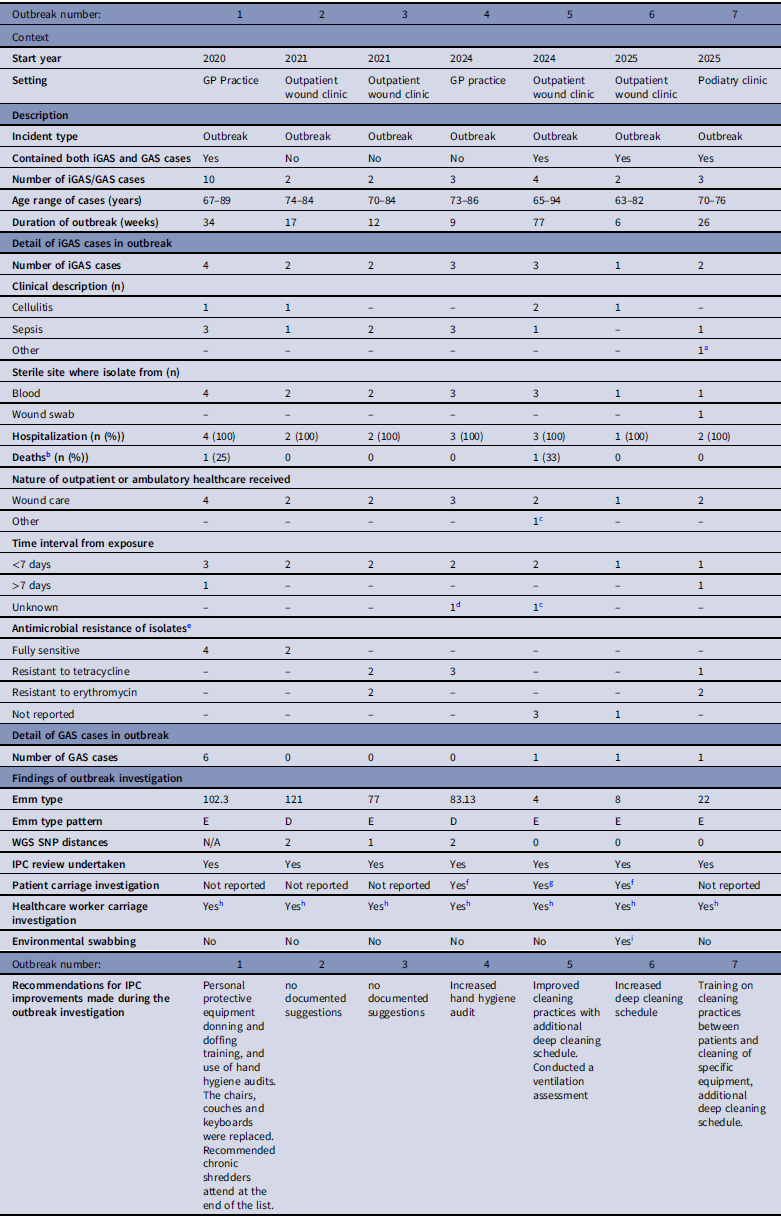
Seven iGAS outbreaks and no clusters were identified within OAC settings. All outbreaks occurred within wound clinic contexts, including two within primary care, one in a podiatry clinic, and the remaining four within outpatient clinic settings. Details are reported in Table 1.
Descriptions of outbreaks of invasive group A streptococcal infection associated with outpatient and ambulatory care settings in South East England between 2015 and 2025

Table 1. Long description
The table presents data on seven outbreaks of invasive group A streptococcal (iGAS) and group A streptococcal (GAS) infections in outpatient and ambulatory care settings. It includes columns for outbreak number, context (start year, setting), description (incident type, number of cases, age range, duration), detail of iGAS cases (number, clinical description, sterile site isolates, hospitalization, deaths), nature of outpatient or ambulatory healthcare received, time interval from exposure, antimicrobial resistance of isolates, and detail of GAS cases. The table also includes findings of outbreak investigation such as Emm type, WGS SNP distances, IPC review, patient and healthcare worker carriage investigation, environmental swabbing, and recommendations for IPC improvements. Each row provides specific data for each outbreak, detailing the clinical descriptions, hospitalization rates, deaths, and antimicrobial resistance patterns. The table highlights the settings, types of incidents, and the duration of outbreaks, providing a comprehensive overview of the outbreaks and the investigations conducted.
a Necrotizing fasciitis.
b No mortality-data linkage as part of the project. Follow-up solely for mortality information is not part of routine Health Protection Team outbreak management, and therefore, note-recorded details may be incomplete.
c The outbreak report determined the case was likely infected via secondary transmission from a household contact who regularly attended clinic for wound care. Time interval from exposure is unknown.
d Unclear from the outbreak report the exact time the third case received their regular dressing changes.
e Some have multiple resistances reported.
f Nil additional cases identified.
g One further GAS case was identified (emm type matched and case included in outbreak).
h Nil additional cases identified.
i Nil positive swabs.
GP, General Practice; iGAS, invasive group A streptococcal infection; GAS, group A streptococcal infection; WGS, whole-genome sequencing; IPC, infection, prevention control.
All outbreaks were identified within the last 5 years. Outbreak size ranged from two to 10 cases of iGAS/GAS (median three). Outbreak cases were older patients who had received regular care for chronic wounds. We identified few other risk factors among iGAS cases: one case resided in a care home, and none injected drugs; comorbidity data was not routinely collected. All iGAS cases were hospitalized and two died shortly after admission. Each outbreak was associated with a different specific emm type. Where performed, all case isolates clustered genomically (0–2 single nucleotide polymorphism (SNP) differences). All isolates were emm genotype pattern D or E and, of those where antimicrobial sensitivity was reported, 46% of cases were fully sensitive.
Prospective case finding through healthcare worker (HCW) swabbing (all outbreaks) and patient swabbing (three outbreaks) identified an additional asymptomatically colonized patient. Environmental swabbing (one outbreak) did not isolate group A Streptococcus. IPC practice reviews were conducted for all seven outbreaks: recommendations included audit of hand hygiene practices, improvements to cleaning practices, and moving appointments for patients with chronic GAS carriage to the end of clinics.
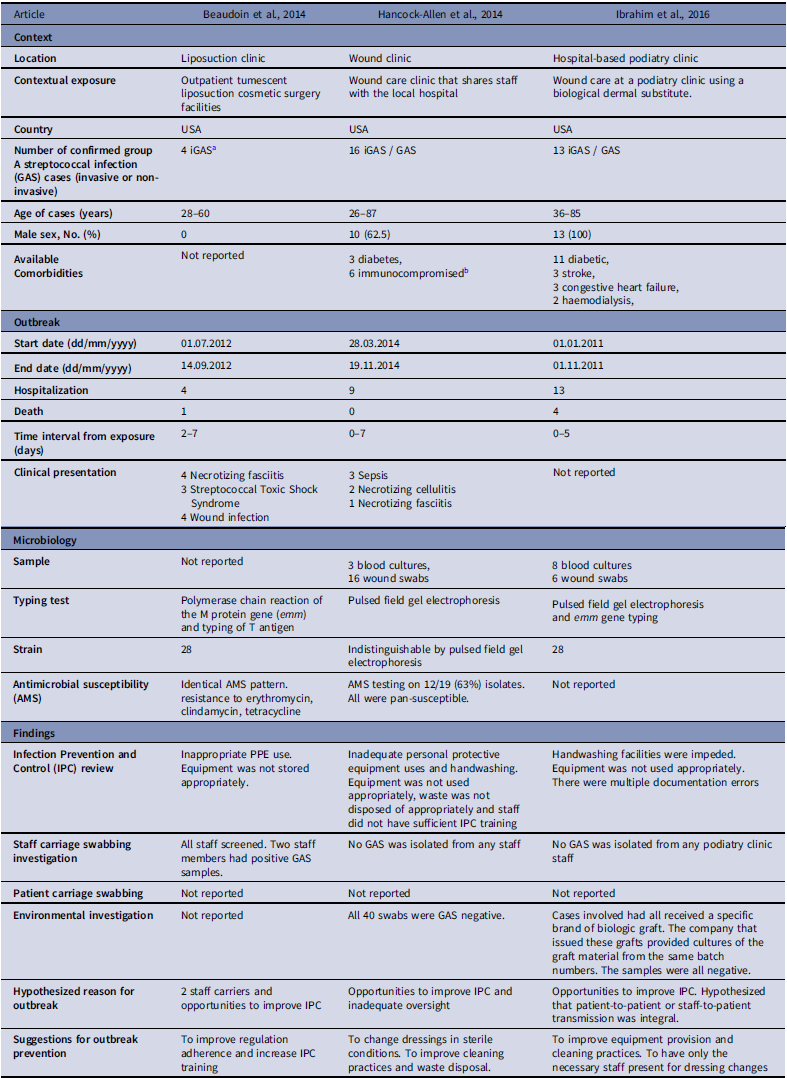
Our narrative review identified three OAC-associated outbreaks from a total of 1535 screened publications. Reference Beaudoin, Torso and Richards8–Reference Ibrahim, Sellick and Watson10 The details of each outbreak are described in Table 2. All outbreaks occurred in the USA and involved a liposuction facility and two wound care clinics (one a podiatry clinic). The two outbreaks associated with the wound care clinics were relatively large and occurred in older-age cohorts with underlying comorbidities. Within their respective investigations, no clear transmission routes were identified. Comparatively, for the outbreak in the liposuction facility, two surgical team members were found to be colonized with group A Streptococcus.
Descriptions of invasive group A streptococcal infection outbreaks in outpatient and ambulatory care settings included in the narrative review

Table 2. Long description
A table comparing invasive group A streptococcal outbreaks in outpatient and ambulatory care settings across three studies. The table has 15 rows and 12 columns. Column headers include Article, Context, Location, Contextual exposure, Country, Number of confirmed group A streptococcal infection (GAS) cases, Age of cases, Male sex, Available Comorbidities, Outbreak, Clinical presentation, Microbiology, Antimicrobial susceptibility, Findings. Row labels include Beaudoin et al., 2014, Hancock-Allen et al., 2014, Ibrahim et al., 2016. Each row provides detailed information on the context, location, and specific outbreak details such as the number of cases, age range, male sex percentage, comorbidities, outbreak dates, clinical presentation, microbiology samples, typing tests, strains, antimicrobial susceptibility, infection prevention and control review, staff and patient carriage swabbing investigations, hypothesized reasons for the outbreak, and suggestions for outbreak prevention.
a There were 9 suspected GAS cases reported, defined as an inflamed surgical site and either purulent discharge or fever and chills in a patient with no alternative diagnosis. Reference Beaudoin, Torso and Richards8
b Immunocompromised defined as a patient on chronic steroid use, with a history of an immunocompromising condition (eg, active cancer), or on immunosuppression medications (eg, methotrexate, tacrolimus).
iGAS, invasive group A streptococcal infection; GAS, non-invasive group A streptococcal infection cases; AMS, antimicrobial susceptibility; IPC, infection prevention and control.
Discussion
Our regional data demonstrate that iGAS outbreaks in OAC settings are a persistent occurrence. Infections followed delivery of wound care to elderly patients and were frequently presentations of cellulitis associated with skin-tropic or generalist strains frequently resistant to second-line antimicrobials. One outbreak was relatively large (10 iGAS/GAS cases), and all iGAS cases were hospitalized, with two deaths, underlining the potential severity of iGAS outbreaks. In keeping with community iGAS outbreak investigations associated with home healthcare, 5 transmission routes were not definitively identified, particularly through HCW carriage, though there was evidence that patient carriage and/or infection, and inadequate prevention of HCW or fomite contamination may have had a role.
In contrast, the literature review identified only three published reports globally within OAC settings: one associated with a liposuction facility and two within chronic wound care settings. Reference Beaudoin, Torso and Richards8–Reference Ibrahim, Sellick and Watson10 The outbreak linked to a liposuction facility had a rapid increase in cases, was in the context of significant non-adherence to regulations, and two HCWs were found to be colonized with GAS. The two large GAS outbreaks in wound care clinics were more prolonged, associated with substantial IPC inadequacies and did not clearly identify a transmission route. All three reports involved a high proportion of the iGAS/GAS cases being hospitalized.
The settings, population demographic and durations of the two published outbreaks associated with wound care were broadly comparable to characteristics within our region. This is consistent with there being a risk of potentially large and severe GAS outbreaks in OAC wound care settings, particularly if IPC precautions are not strictly adhered to. Notably, outbreaks in our region were typically smaller and with fewer identified IPC lapses compared to the published literature. The extent of investigation (eg, degree of prospective swabbing) may explain this, or cases may have been genuinely fewer due to stricter IPC precautions and/or earlier outbreak detection.
Limitations of our approach may have led to over- or under-estimation of GAS burden in OAC settings. For the narrative review, whilst our search strategy was comprehensive, we limited our approach to only one database and may have not identified all relevant studies. In addition, publication bias and/or lack or systematic outbreak and case detection methods may underestimate frequency and impact. Our regional data may also underestimate the GAS outbreak burden, as non-invasive GAS cases are non-notifiable in the UK, and we restricted our review to HPT case records. Notwithstanding, a key strength of our review is the high reporting rate of iGAS cases to HPTs (a statutory requirement in the UK). In terms of over-estimation, as OAC cases resided in the community and may have had multiple possible routes of GAS acquisition, it is possible the HPT misattributed cases as acquiring GAS in OAC-setting outbreaks. However, investigation of alternative common exposures by the HPT and high genomic relatedness in the context of mostly uncommon emm types makes this less likely. During our 10-year review period, all seven outbreaks occurred within the last five years, consistent with the general pattern of increased reporting of iGAS outbreaks. Reference Smith, Marchant, Coelho, Bardsley, Wright and Love2 Contributing factors may be increased awareness and improvements in systemic surveillance approaches (eg, comparing emm typing).
This correspondence highlights that OAC settings providing wound care may be predisposed to iGAS outbreaks, particularly if IPC practices are weak. Few published reports suggest that previous awareness of this risk may have been limited. For HPTs, our findings illustrate the importance of careful risk assessment and review of IPC practices even after a single case in these contexts, alongside outbreak surveillance, aligning with the wider guidance for GAS in healthcare settings and its known capacity for significant clinical and public health impact. Reference John, Smith, Sawyer, Brokenshire, Anderson and Roberts4
Acknowledgments
Thank you to Maria Saavedra-Campos for supporting querying case and incident management system databases.
Author contribution
Samuel Healy—data analysis, writing.
Rebecca Bestwick—data analysis, writing.
David Roberts—conceptualization, supervision, writing.
Financial support
This concise communication received no financial support, and the authors have no conflicts of interest to declare.
Competing interests
The ICMJE disclosure form has been completed, and no conflicts of interest have been identified.

 Open access

