Introduction
Seagrass meadows are high-productivity marine and estuarine systems that provide feeding and breeding grounds for a wide range of fauna (Duffy et al., Reference Duffy, Pratt, Anderson, Land and Shutler2018). Seagrass meadows and their valuable ecosystem services are, however, vulnerable to environmental change (Alvarez Zarikian et al., Reference Alvarez Zarikian, Blackwelder, Hood, Nelsen and Featherstone2000; Mateu-Vicens et al., Reference Mateu-Vicens, Khokhlova and Sebastián-Pastor2014; Unsworth et al., Reference Unsworth, van Keulen and Coles2014; Arias-Ortiz et al., Reference Arias-Ortiz, Serrano, Masqué, Lavery, Mueller, Kendrick, Rozaimi, Esteban, Fourqurean, Marbà, Mateo, Murray, Rule and Duarte2018). In linking environmental change and biodiversity, regional and global studies have focused increasingly on elucidating the requirements of organisms that inhabit seagrass meadows (Attrill et al., Reference Attrill, Strong and Rowden2000; Somerfield et al., Reference Somerfield, Yodnarasri and Aryuthaka2002). Identifying these optimal habitat conditions are essential for being able to use particular species as indicators of environmental health.
Seagrass meadows have much higher biodiversity relative to the surrounding unvegetated areas (e.g. Hirst & Attrill, Reference Hirst and Attrill2008). A large proportion of this biodiversity is comprised of meiofauna (Hirst & Attrill, Reference Hirst and Attrill2008), including ostracods and foraminifera. The seagrass meadows provide suitable microhabitats for the settlement and growth of stratified assemblages of these organisms within the sediment column (Pusceddu et al., Reference Pusceddu, Gambi, Corinaldesi, Scopa and Danovaro2014). Ostracods and foraminifera found in seagrass meadows or in proximity to seagrass vegetation (Brasier, Reference Brasier1975; Kamiya, Reference Kamiya1989; Forsey, Reference Forsey2016) are extremely sensitive to environmental change as their lifespan is relatively short and their larvae lack extensive dispersal capability (Kennedy & Jacoby, Reference Kennedy and Jacoby1999). In healthy meadows, ostracods and foraminifera are well distributed within the seagrass sediments as organic matter – allochthonous and autochthonous – trapped by the seagrass canopy provides an abundant source of nutrients. Given the good preservation potential of their tests, ostracods and foraminifera contribute calcium carbonate as substrate within the sediment (Brasier, Reference Brasier1975). However, environmental and anthropogenic factors such as seawater temperature, salinity, water depth, dissolved oxygen and pH that structure the ecosystem create pressures that cause some benthic assemblages to not thrive, whereas other more resistant taxa impose opportunistic life strategies that invariably exclude the less competitive and more sensitive species (Trabelsi et al., Reference Trabelsi, Elloumi, Hamza, Ayadi, Zghal and Ayadi2018).
Information regarding the distribution and connectivity of benthic organisms among different habitats within a marine system is essential for understanding ecological processes, particularly for assessing the vulnerability of benthic assemblages to anthropogenic disturbance (e.g. Rosli et al., Reference Rosli, Leduc, Rowden, Clark, Probert, Berkenbusch and Neira2016; Zaleha et al., Reference Zaleha, Nasiratul_Shahida, Siang and Kamaruzzaman2016; Wilson et al., Reference Wilson, Hayek and Bowles2018). In addition, knowledge of these processes provides greater insight into the development of marine biodiversity patterns over time (Reich et al., Reference Reich, Di Martino, Todd, Wesselingh and Renema2015). Thus, representative taxa such as ostracods and foraminifera are extremely valuable proxies for elucidating the implications of environmental change within coastal marine systems. Despite their wide use as bioindicators in other regions (Ruiz et al., Reference Ruiz, González-Regalado, Borrego, Abad and Pendón2004), very little is known about the assemblages of these taxa or the impact of disturbance within seagrass meadows in South-east Asia. Meadows in this region are under particular threat due to significant human modification of the coastal environment (Tan et al., Reference Tan, Saunders and Yaakub2018b). Contemporary studies (Faiz et al., Reference Faiz, Mohamed, Omar and Ahmad2017, Reference Faiz, Mohamed, Omar and Malek2018) have focused on foraminiferal distribution, and little attention has been given to how this distribution can be applied to environmental monitoring. Furthermore, multiple studies have applied foraminifera as proxies for assessing the environmental status of coastal habitats (Murray, Reference Murray2000; Buosi et al., Reference Buosi, Frontalini, Da Pelo, Cherchi, Coccioni and Bucci2010; Sreenivasulu et al., Reference Sreenivasulu, Praseetha, Daud, Varghese, Prakash and Jayaraju2019); similar studies relying on ostracods as proxies are much rarer (Suokhrie et al., Reference Suokhrie, Saraswat, Nigam, Kathal, Nigam and Talib2017). The distribution of benthos is influenced strongly by a suite of abiotic factors including sediment size, sediment organic content, sediment nutrient content, water quality, current velocity and water depth (Koukousioura et al., Reference Koukousioura, Dimiza, Triantaphyllou and Hallock2011; Magno et al., Reference Magno, Bergamin, Finoia, Pierfranceschi, Venti and Romano2012; Dutertre et al., Reference Dutertre, Hamon, Chevalier and Ehrhold2013). Knowledge of habitat compartmentalization, specialization and niche segregation of these taxa is therefore essential before utilizing them as environmental bioindicators (Pati & Patra, Reference Pati and Patra2012; Benito et al., Reference Benito, Trobajo, Ibáñez, Cearreta and Brunet2015). The relative importance of these factors for ostracods and foraminifera within seagrass systems needs to be constrained. In addition, the degree to which live-dead and surface-subsurface assemblages reflect the original living communities, rather than postmortem biostratinomic processes (e.g. Meldahl, Reference Meldahl1987; Darroch, Reference Darroch2012; Darroch et al., Reference Darroch, Locatelli, Mccoy, Clark, Anderson, Tarhan and Hull2016) also needs to be considered.
Studying ostracods and foraminifera in detail requires understanding the characteristics and ecological function of their habitat. Estuaries are complex systems; changing environmental parameters causes natural changes in the faunal composition over small geographic areas (Alve, Reference Alve1995; Alves et al., Reference Alves, Adão, Patrício, Neto, Costa and Marques2009; Kandratavicius et al., Reference Kandratavicius, Muniz, Venturini and Giménez2015). These benthic organisms are key components in estuaries and their spatial distribution and abundance are often associated with gradients of salinity, particle size and water nutrients (Pati & Patra, Reference Pati and Patra2012; Kandratavicius et al., Reference Kandratavicius, Muniz, Venturini and Giménez2015). However, the changes in environmental conditions over small distances make it difficult to interpret what proportion of observed local assemblage composition, abundance and diversity patterns are due to natural or anthropogenically caused changes (Alve, Reference Alve1995).
In this paper, we aim to answer the following questions. Is there spatial-scale variation in the composition of ostracod and foraminifera assemblages within an estuarine system? Do certain taxa prefer vegetated to unvegetated habitats in the estuary? Are certain assemblages niche-specific? We answer these questions by investigating the habitat preferences of ostracod and foraminifera assemblages in the seagrass and non-seagrass zones of the Sungai Pulai Estuary, Malaysia. Through a multivariate statistical approach, we analysed the abundance, distribution and diversity of ostracod and foraminiferal assemblages in seagrass (vegetated) and non-vegetated habitats of the estuary. We also evaluated these assemblages with respect to sediment depth. We then established relationships between habitat type and niche definitions, parameters essential for predicting changes in estuarine environments.
Materials and methods
Sampling site
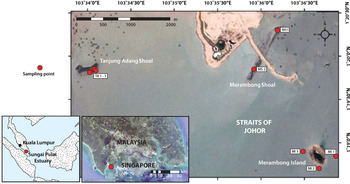
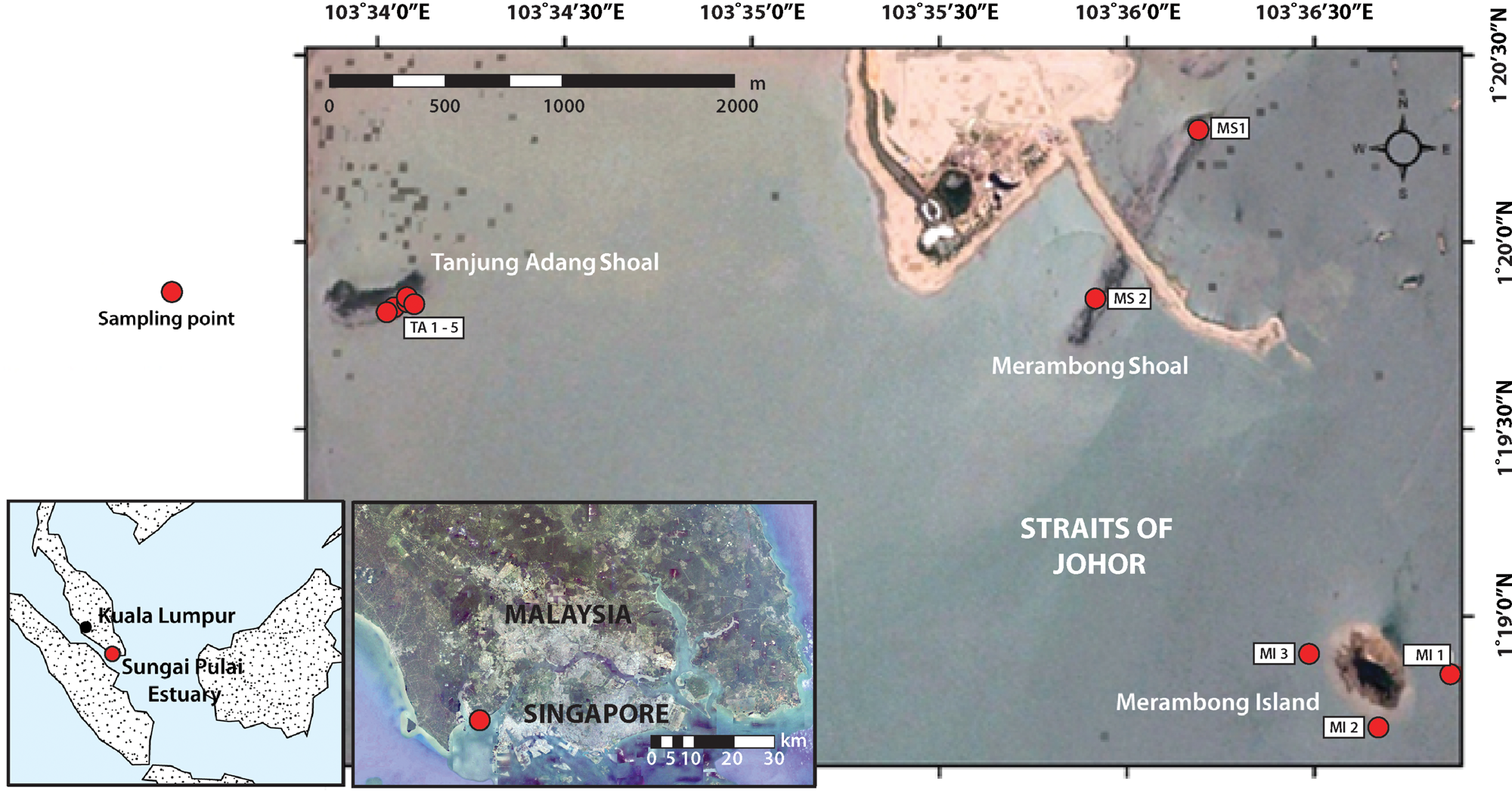
We selected three sampling sites along the Sungai Pulai Estuary (Figure 1): Tanjung Adang Shoal (Stations TA 1–5), Merambong Shoal (MS 1 and MS 2), and Merambong Island (MI 1–3). The sites represented both vegetated (Tanjung Adang and Merambong shoals) and an unvegetated area (Merambong Island). The dominant meadow-forming seagrass species at Tanjung Adang Shoal are Enhalus acorides and Cymodocea serrulata, whereas E. acoroides and Thalassia hemprichii dominate at Merambong Shoal. Other species, such as Halophila ssp. and Halodule ssp., are found in both meadows (Rozaimi et al., Reference Rozaimi, Fairoz, Hakimi, Hamdan, Omar, Ali and Tahirin2017). The shoals of Tanjung Adang and Merambong have lost areal cover due to coastal modification (Hossain et al., Reference Hossain, Hashim, Bujang, Zakaria and Muslim2018); as such, the seagrass meadows of the Sungai Pulai Estuary have been prioritized for conservation efforts (Tan et al., Reference Tan, Saunders and Yaakub2018b). In comparison, Merambong Island is an uninhabited island located along the Straits of Johor. Various macroalgal species have been recorded off the island (e.g. Poong et al., Reference Poong, Lim, Phang, Sunarpi, West and Kawai2013; Tan et al., Reference Tan, Lim, Lin and Phang2018a). Previously, the waters surrounding the island were clear with only small turbid-water areas. Over the past years, however, extensive silting due to nearby reclamation activities has caused the turbid zones to expand in size (Sabri et al., Reference Sabri, Said, Azman and Goto2013).
Sampling sites along the Sungai Pulai Estuary, Malaysia, at Tanjung Adang Shoal (TA 1–5), Merambong Shoal (MS 1–2) and Merambong Island (MI 1–3). Tanjung Adang and Merambong shoals are vegetated (seagrass-covered) areas, whereas Merambong Island is a non-vegetated area.
We sampled benthic ostracod and foraminifera between August 2015 and March 2016. For surficial sediments (up to ~10 cm sediment depth), we used a Petite Ponar grab sampler to collect sediments at water depths between 1.1 and 11 m. We also sampled deeper sediments through sediment coring. These sediment cores allowed us to assess the depth distribution of ostracods and foraminifera. We manually hammered PVC pipes (50 cm in length, 50 mm internal diameter) into the sediment to collect core samples (maximum of 40 cm in length). For the grab-core samples, the sediments were stored in plastic bags and transported fresh to the laboratory. Bulk sediment samples were preserved and stained with a solution of 10% formalin premixed with Rose Bengal stain at a concentration of 2.0 g l−1. This stain was used to determine the presence of live ostracods and foraminifera in the fresh sediment samples (Malek et al., Reference Malek, Omar and Faiz2014). We classified shells as ‘living’ only if the bright pink staining was clearly observed within the foraminiferal chambers. ‘Live’ assemblages in this study reflected the environmental conditions, whereas we used the ‘dead’ (thanatocoenotic) assemblages to determine biological production/mortality rates and post-mortem accumulation (Malek et al., Reference Malek, Omar and Faiz2014). Due to the scarcity of the live populations (less than ~20%), we used the total (live and dead) assemblages (after Faiz et al., Reference Faiz, Mohamed, Omar and Malek2018) in calculating the taxa abundances, species composition and diversity indices. Bulk sediment samples were washed gently with water through a 1000 μm sieve to remove pebbles and were then washed again through a series of Retsch sieves (500, 150 and 63 μm). The 150 μm fraction was used for collecting the ostracods and foraminifera via observation through a stereomicroscope. The collected individuals were then mounted on reference slides, identified and counted. The fraction of sediments remaining on the 150 μm sieve was transferred to a Petri dish, allowed to air dry, and weighed afterwards. We identified meiofauna that were >125 μm to avoid counting juvenile forms that are often abundant yet difficult to identify (Malek et al., Reference Malek, Omar and Faiz2014).
For the sediment downcore samples, the PVC core barrel was cut longitudinally to extrude the sediment samples. The core was sliced every 10 cm; the samples then underwent fraction separation by wet sieving. We processed the samples in a similar manner as the grab-core sediment samples. All individual ostracods and foraminifera were hand-picked using a brush to separate them from sediment grains. As above, live and dead individuals were separated, counted and identified to species level under a light microscope. We relied on morphological identification based on Loeblich & Tappan (Reference Loeblich, Tappan, Loeblich and Tappan1988) and Sen Gupta (Reference Sen Gupta and Sen Gupta2002). Selected individuals were imaged using a benchtop scanning electron microscope (Toshiba TM4000).
Environmental parameters
We collected dissolved oxygen (DO), temperature, pH, depth and salinity measurements directly from the overlying water column at all sampling sites, whereas we recorded particle size and organic matter content, sample separation, quantification and identification of species, and the analysis of physicochemical parameters of the sediment in the lab (see Supplementary Material Table S1). Dried sediment samples were sieved using a 2 mm Retsch sieve to remove pebbles, and then the sieved material was ground using a mortar and pestle. The percentage of organic matter was determined through loss on ignition (LOI). The ground sediment samples (5–10 g) were placed in an oven at 550°C, and the weight loss during the combustion process represented the organic matter content of the sediment (Heiri et al., Reference Heiri, Lotter and Lemcke2001). To determine sediment size fractions, we prepared a slurry by adding 10% hydrochloric acid (HCL) and distilled water. For particles less than 20 and 2 μm (i.e. silt and clay fractions, respectively), sedimentation methods based on Stokes Law were used to deduce particle size distribution. The amount of sediment in suspension was determined by extracting the sample using the pipette method (Kettler et al., Reference Kettler, Doran and Gilbert2010). For particles > 20 μm in size, the dried samples were sieved using sieve shakers (1 mm, 500 μm, 250 μm, 125 μm and 63 μm; Endecotts, London, UK). The sieved samples were weighed, and we then calculated the percentage of silt, clay and sand. We classified the sediments according to their particle size distribution and their texture using a soil texture triangle chart (Soil Science Division Staff, Reference Ditzler, Scheffe and Monger2017).
Statistical analysis
We applied multivariate statistics (Primer-E, version 7) for analysing ostracods and foraminifera data from the vegetated and non-vegetated assemblages to relate community structure to the physicochemical conditions. The abundance of both ostracods and foraminifera was transformed to fourth-root for Bray–Curtis similarity, data that were used subsequently for the hierarchical clustering of meiofauna samples into species and family groups within the sample sites. Ordination by non-metric multidimensional scaling (nMDS) and principal component analysis (PCA) summarized patterns in species composition and environmental influence (percentage of silt, clay and sand fractions, organic matter content, water depth, temperature, dissolved oxygen concentration, pH, salinity) on species assemblages. Permutation-based hypothesis testing analysis of similarity (ANOSIM) assessed differences between groups of multivariate samples from different sites and sediment depths. We performed a separate step to obtain a Bray–Curtis dissimilarity matrix that was then applied to assess differences in species abundance using similarity percentages (SIMPER). This approach allows the identification of specific taxa responsible for the differences between groups as this measure will not account for the absence of species, but rather it focuses on the assemblage composition and the relative abundance of taxa (Field et al., Reference Field, Clarke and Warwick1982; Legendre & Legendre, Reference Legendre, Legendre, Legendre and Legendre2012). We characterized the biodiversity of assemblages using four parameters: species diversity (S) as number of species in each sample; dominance (D); Shannon–Weaver index (H); and Pielou's evenness (J), which describes the division of individuals between taxa (Pielou, Reference Pielou1975). Principal coordinate analysis (PCO) produced a multiple scatter plot of the species distribution with environmental variables. Finally, the abundance data were log(x + 1) transformed before using Euclidean distance to test the influence of environmental variables for differences between the structure of assemblages. We selected Euclidean distance because it retains the mean and variance properties of the original data, including any null values.
Results
Taxa abundance
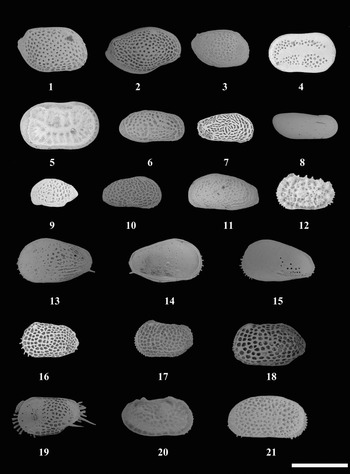
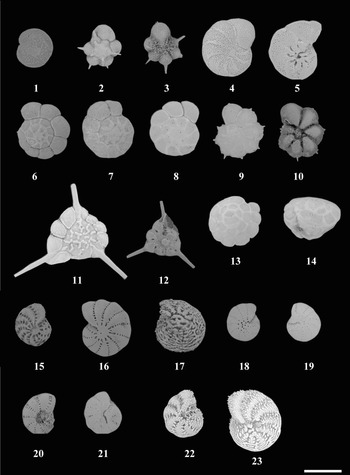
Low agreement between live and dead assemblages was discovered at all stations. The live-dead agreement was calculated based on the proportion of live vs dead individuals in the assemblage. Results indicate that the proportion of live individuals was less than 20% in all samples, a range consistent with findings from other estuaries in Malaysia (Malek et al., Reference Malek, Omar and Faiz2014; Faiz et al., Reference Faiz, Mohamed, Omar and Ahmad2017, Reference Faiz, Mohamed, Omar and Malek2018). We analysed the abundance of ostracods and foraminifera based on two factors: site and sediment depth. We identified 1133 individual ostracods and 7242 individual foraminifera from all three sites combined. There were 1013 and 5878 individuals of ostracods and foraminifera, respectively, found in the surface sediment layer. In the 35–40 cm sediment layer, we found 120 ostracods and 1364 individuals of foraminifera. We identified 56 species and 17 families of ostracod as well as 82 species and 24 families of foraminifera. The greatest number of ostracods was observed at Merambong Island (706 individuals) and the greatest number of foraminifera (3700 individuals) at Tanjung Adang Shoal. A complete list of species found in our study is presented in Supplementary Material Tables S2, S3, S4 and S5. Scanning electron images of some representative specimens are illustrated in Appendices A and B.
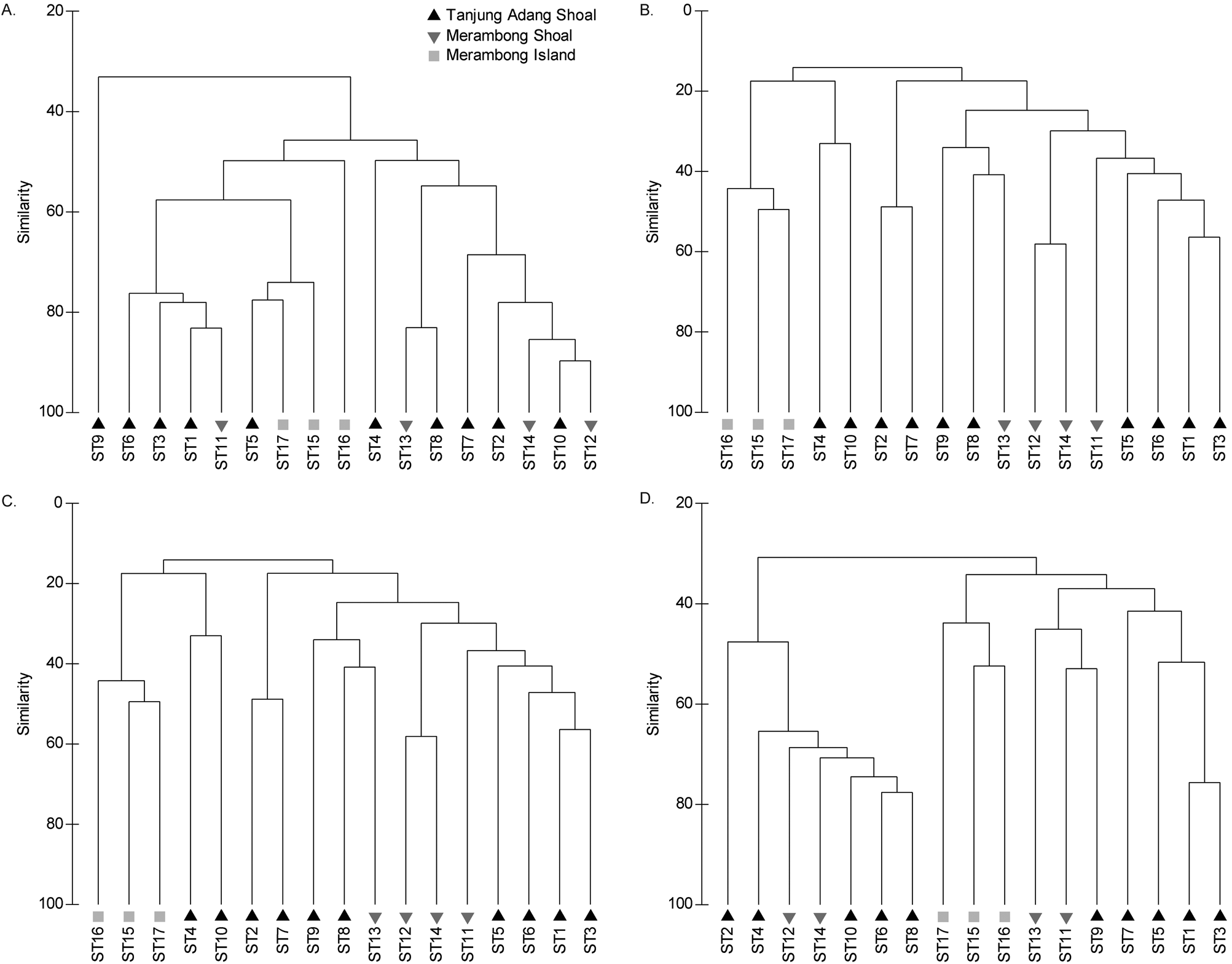
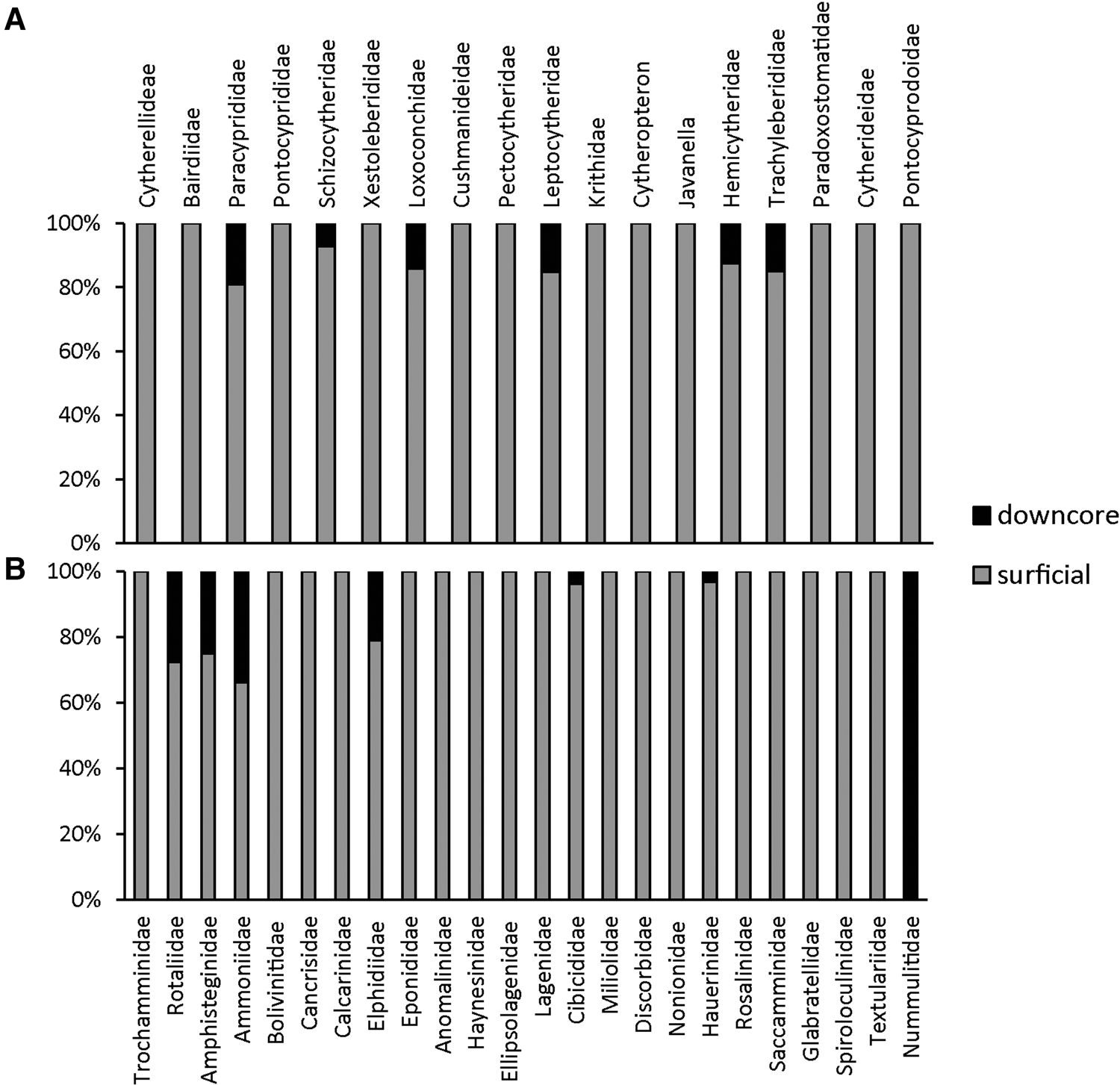
Cluster analysis grouped families and species of ostracods at Merambong Island (similarity of 37.10%) separate from Merambong and Tanjung Adang shoals. Furthermore, cluster analysis separated the downcore samples (ST12 & ST14) from the surficial sediment (ST11 & ST13) samples at Merambong Shoal for clustering at both the species- and family-level. Likewise, some ostracod families such as Cytherellidae, Paracyprididae, Pontocyprididae and Leptocytheridae were found only in surficial sediments of Merambong Shoal and were absent in downcore sediments at these sites. The foraminiferal families of Haynesinidae, Discorbidae, and Glabratellidae were found only in the surficial sediments of Merambong Shoal, whereas Amphisteginidae and Cibicididae were found only in the downcore sediments at this shoal. This variation within Merambong Shoal indicates that species composition varied at different sediment depths. Certain families of ostracods (Hemicytheridae, Trachyleberididae) and foraminifera (Ammoniidae, Elphidiidae, Rotaliidae) were found at both Tanjung Adang Shoal and Merambong Shoal (Figure 2). Both species- and family-level clustering separated the meiofauna groups in seagrass (Tanjung Adang and Merambong shoals) and non-seagrass (Merambong Island) assemblages (Figure 2).
Cluster analysis of meiofaunal assemblages of surficial (ST1, ST3, ST5, ST7, ST9, ST11, ST13, ST15, ST16, ST17) and downcore sediment (ST2, ST4, ST6, ST8, ST10, ST12 and ST14) samples collected from the Sungai Pulai Estuary. Clustering is based on: (A) ostracod families; (B) ostracod species; (C) foraminifera families; and (D) foraminifera species.

Non-metric multidimensional (nMDS) scaling and analysis of similarity (ANOSIM)
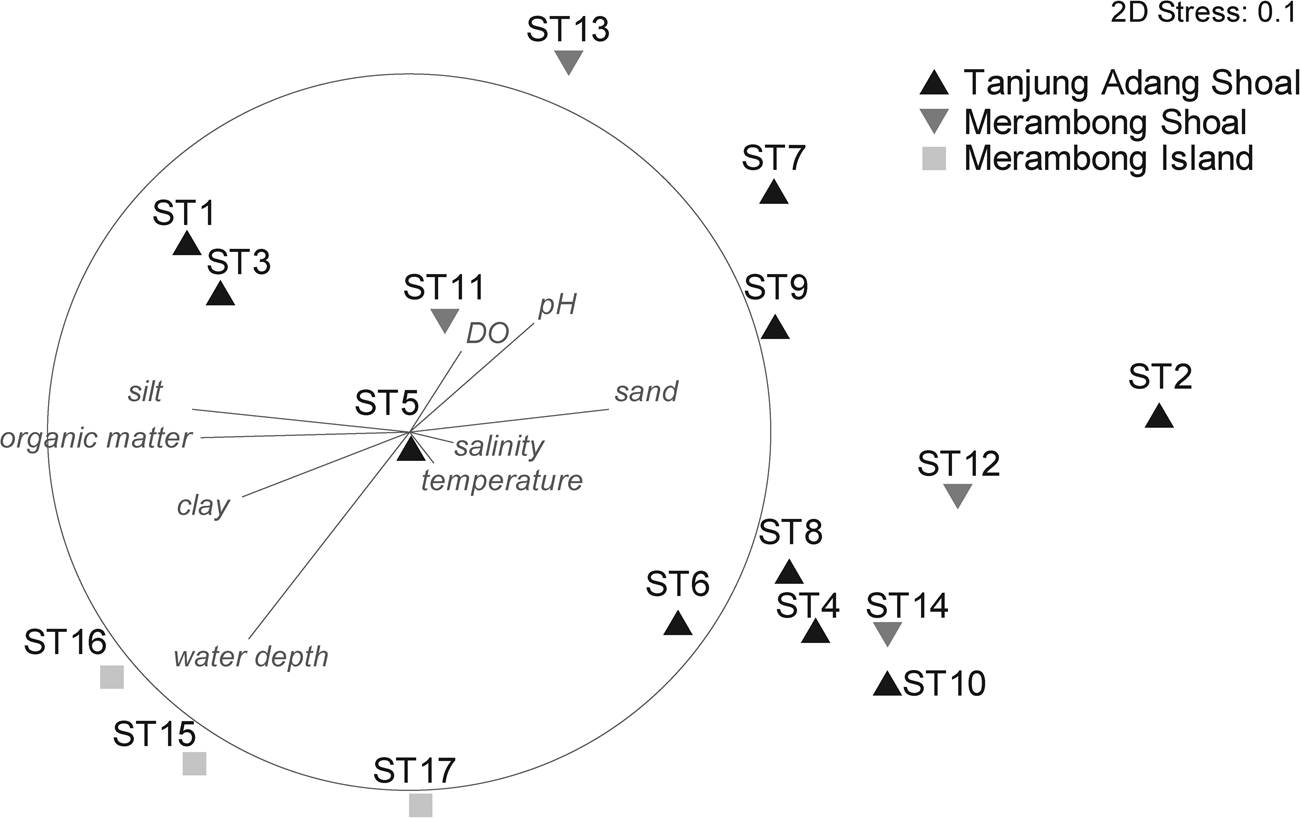
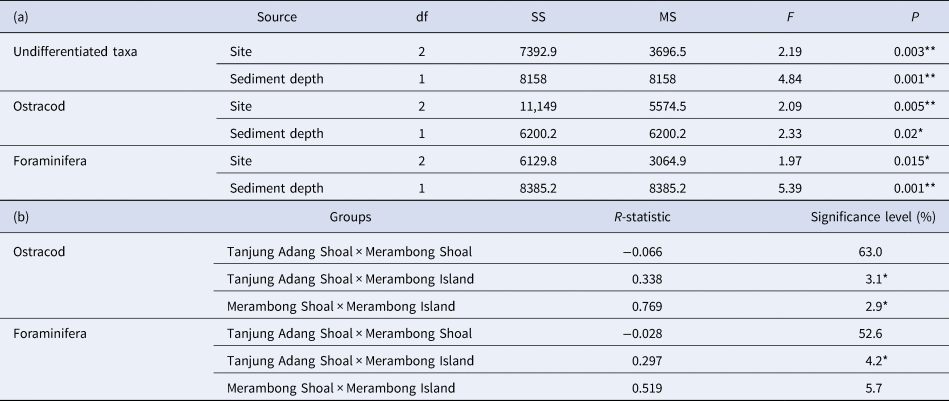
Non-metric multidimensional scaling (nMDS) plots illustrated the variation in the distribution of samples across all sediment depths for each site. Stations at Merambong Island formed a group that was separate from the Tanjung Adang and Merambong Shoal sites. However, the stations at Merambong Shoal varied within the site and were well differentiated from the Tanjung Adang Shoal and Merambong Island samples (Table 1). The Kruskal's stress was ~0.1, a reasonable value given the variation in the study area (Figure 3). The samples varied more within all three sites in both surficial and downcore sediments than between sites. PERMANOVA (Table 1) of the factors (site and sediment depth) showed that the distribution of ostracods and foraminifera differed significantly between Tanjung Adang Shoal, Merambong Shoal and Merambong Island (P < 0.05). We observed significant differences between the abundance of taxa in both surficial and downcore sediments (P < 0.05). Consistent with the cluster analysis, ANOSIM (Table 1) distinguished two groups of taxa: the seagrass (Tanjung Adang and Merambong shoals) and non-seagrass (Merambong Island) systems.
Non-metric multidimensional scaling (nMDS) plot of ostracod and foraminifera assemblages in the Sungai Pulai Estuary. Surficial sediments were from ST1, ST3, ST5, ST7, ST9, ST11, ST13, ST15, ST16 and ST17 whereas downcore samples were from ST2, ST4, ST6, ST8, ST10, ST12 and ST14.

Statistical tests of the variations in ostracod and foraminifera distributions

(a) PERMANOVA for all sites and sediment depths. ‘Undifferentiated taxa’ refers to tests for both ostracod and foraminifera combined. *P < 0.05; **P < 0.01. (b) ANOSIM pairwise tests for the site factor. R-values close to 0 depict no separation between factor levels and R-values approaching 1 depict a high separation between factor levels. *P < 5%.
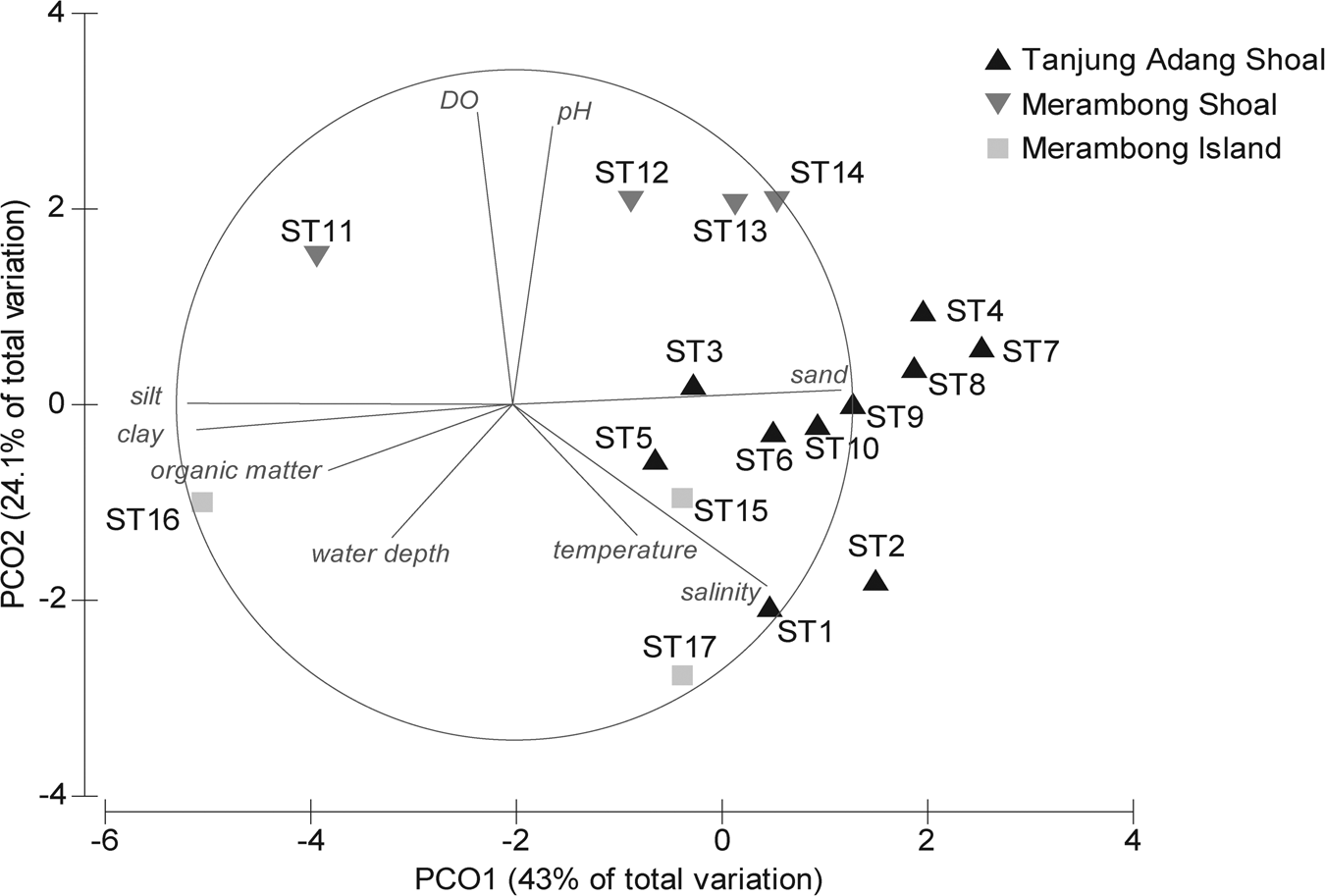
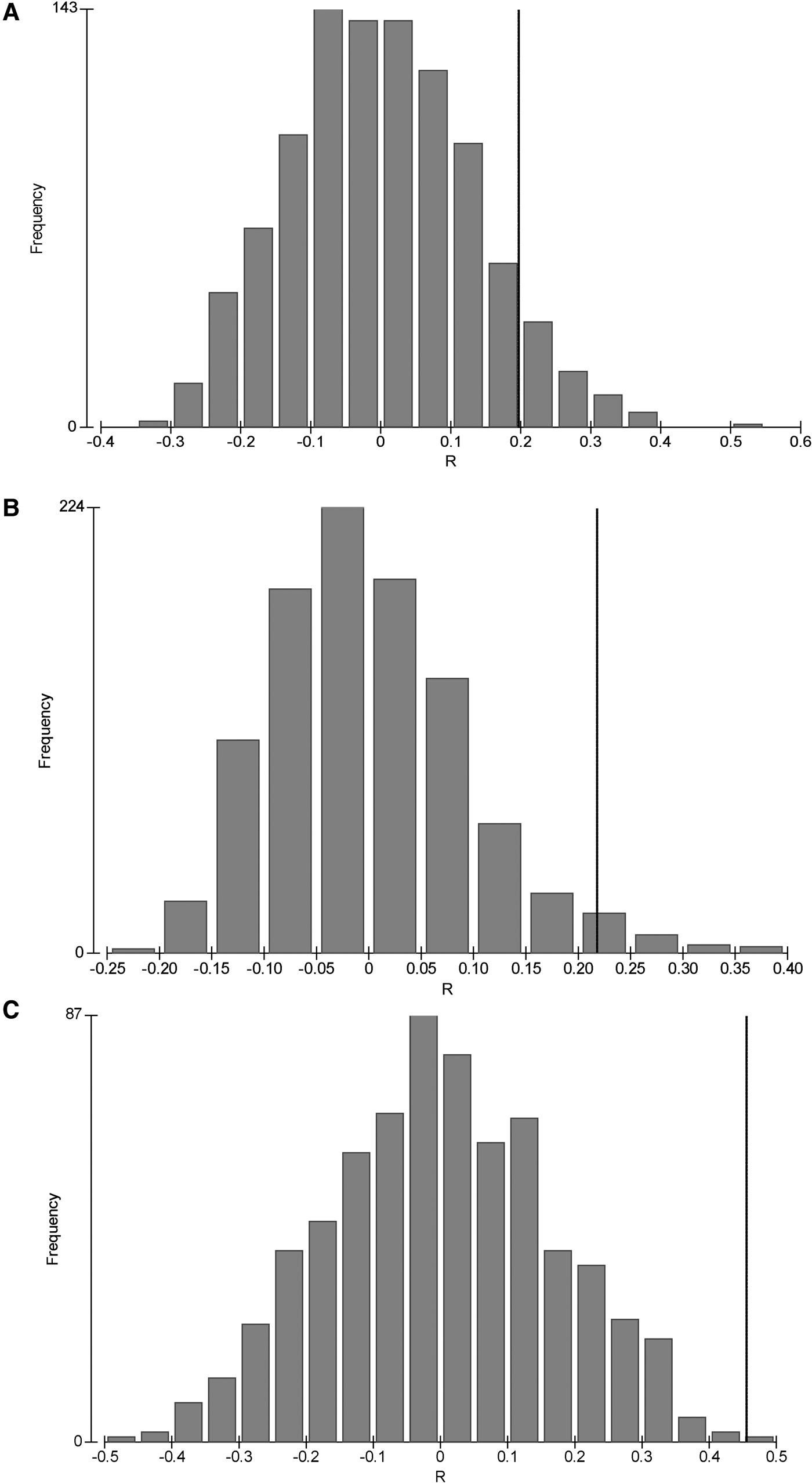
Environmental variables could also explain inter-site variation. Sand (average values 49–95%) has the strongest influence on ostracod and foraminifera variation. Salinity (average range 32–33‰) was the second most important variable for explaining variation (Supplementary Material Table S1). In the PCO plot, the first three axes explained 80.7% of the total variation (Figure 4). The variables that contributed to the variation were sand (mean = 6.13%, SD = 6.49), salinity (mean = 32.4 ppt, SD = 0.64), and organic matter (mean = 1.65%, SD = 1.02). At Tanjung Adang Shoal, sand and salinity most influenced the meiofaunal distribution, whereas organic matter and salinity had the strongest influence for the Merambong Island meiofauna. At Merambong Shoal, sand and pH had the most influence on the meiofaunal distribution. At the species level, the nMDS produced a similar pattern of variation as the family level between the three sites, producing a Kruskal stress of 0.16 (for ostracods) and 0.10 (foraminifera). PERMANOVA, based on ostracod and foraminifera distribution at all sites and sediment depths, illustrated a significant difference between sites and sediment depth (PERMANOVA, P < 0.05) for both ostracod and foraminifera distribution. We then ran ANOSIM to identify and assess the relative strength of the factors driving this variation. Ostracods had an R of 0.197 and a significance of 7.9% (Figure 5). Pairwise tests showed Tanjung Adang and Merambong shoals had less separation between sites with an R-value near 0; therefore, there were no significant differences in the distribution of ostracods between both sites (R = −0.066, P > 0.05). ANOSIM run for Tanjung Adang Shoal and Merambong Island produced a significant difference between the sites (R = 0.338, P < 0.05). These two sites had a relatively higher separation and differed significantly (P < 0.05, R = 0.769) (Table 1).
Principal coordinate analysis of the ostracod and foraminifera assemblages at Tanjung Adang Shoal, Merambong Shoal, and around Merambong Island based on measured environmental variables. Surficial sediments were from ST1, ST3, ST5, ST7, ST9, ST11, ST13, ST15, ST16 and ST17 whereas downcore samples were from ST2, ST4, ST6, ST8, ST10, ST12 and ST14.

ANOSIM of individual ostracod abundance: (A) at Tanjung Adang Shoal, Merambong Shoal and around Merambong Island (R = 0.197, P = 0.079); (B) between surficial and downcore sediments (R = 0.218, P = 0.026); and (C) between seagrass (Tanjung Adang and Merambong shoals) and non-seagrass (Merambong Island) sites (R = 0.456 and P = 0.001).

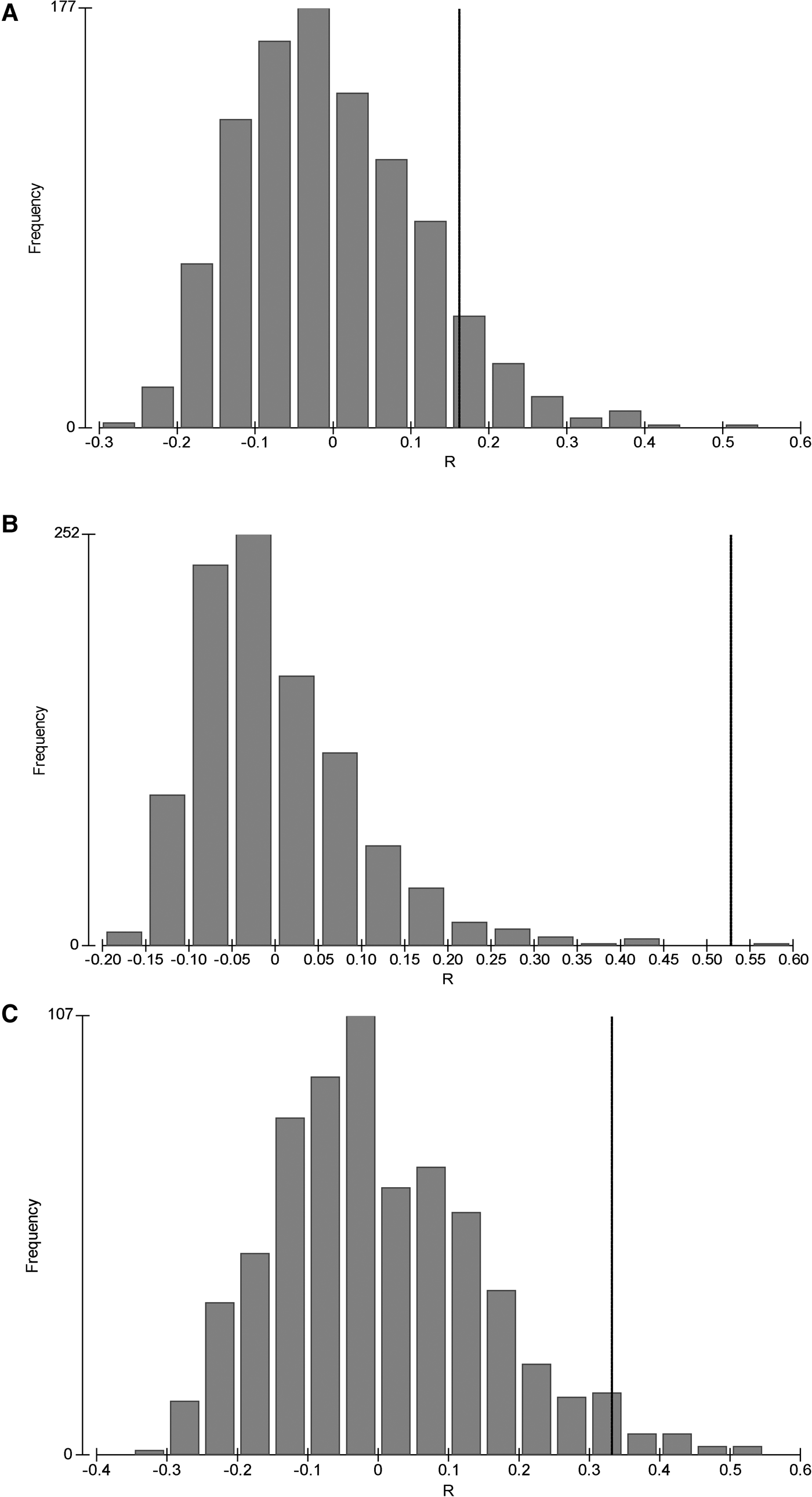
ANOSIM tests for foraminifera species had an R of 0.162 and a significance of 8.5% (Figure 6). Pairwise tests between the Tanjung Adang and Merambong shoals produced an R-value near 0 with no significant difference in the distribution of foraminifera between both sites (R = −0.028, P > 0.05). Thus, there was little separation between the sites, a similar result as that for ostracods. Pairwise tests between Tanjung Adang Shoal and Merambong Island had an R-value close to 0, but the sites differed significantly (R = 0.297, P < 0.05). Finally, pairwise tests between Merambong Shoal and Merambong Island produced a higher R-value (0.519) and were significantly different (P < 0.05), testifying to a marked separation between these two sites (Table 1). As Merambong Shoal is a seagrass area and Merambong Island is a non-seagrass area, the higher R-value obtained between these sites leads to understanding whether the presence of seagrass influences the distribution of foraminifera or its distribution was influenced by other environmental factors.
ANOSIM of individual foraminifera abundance: (A) at Tanjung Adang Shoal, Merambong Shoal and Merambong Island (R = 0.162, P = 0.085); (B) between surficial and downcore sediments in the Sungai Pulai Estuary (R = 0.528, P = 0.002); and (C) between seagrass (Tanjung Adang and Merambong shoals) and non-seagrass (Merambong Island) sites (R = 0.332 and P = 0.029).

Similarity percentages (SIMPER)
Undifferentiating ostracod and foraminifera assemblages
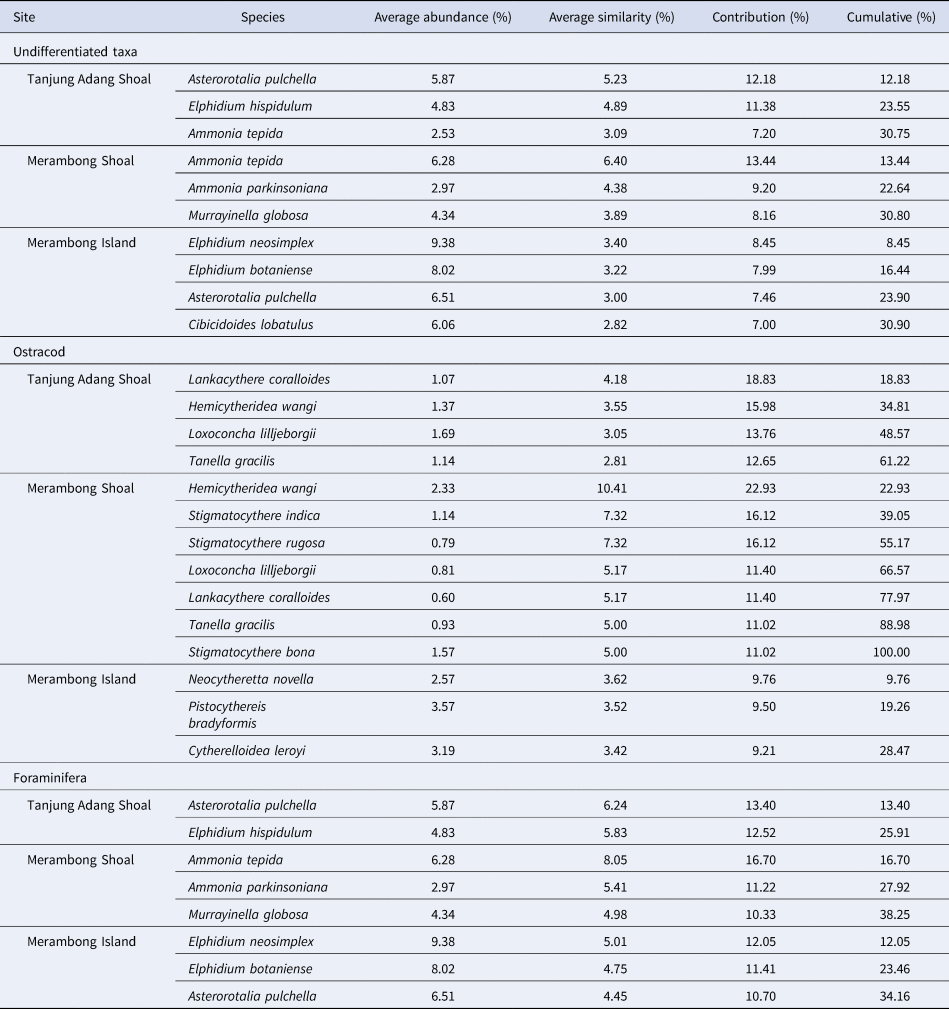
SIMPER showed that in surficial and downcore sediments, the taxa contributing to the highest species abundance in Tanjung Adang Shoal, with an average similarity of 42.96%, were the foraminifera Asterorotalia pulchella (12.18%), Elphidium hispidulum (11.38%) and Ammonia tepida (7.20%). At Merambong Shoal, these species of foraminifera, with an average similarity of 47.65%, were Ammonia tepida (13.44%), A. parkinsoniana (9.20%) and Murrayinella globosa (8.16%). Finally, at Merambong Island, having an average similarity of 40.25%, the taxa that contributed to the highest species abundance were the foraminifera Elphidium neosimplex (8.45%), E. botaniense (7.99%) and Asterorotalia pulchella (7.46%) (Table 2).
Similarity percentages (SIMPER) of species contributions between surficial and downcore sediments at Tanjung Adang Shoal, Merambong Shoal, and around Merambong Island

‘Undifferentiated taxa’ refers to tests for both ostracod and foraminifera combined.
Ostracod assemblages
We used SIMPER to explain the differences and similarities between the factors of sites, sediment depth and vegetation (Table 2). When we examined both surficial and downcore sediments, Tanjung Adang Shoal ostracod assemblages had an average similarity of 22.20%. Species that contributed to the high abundance of ostracods at this site were Lankacythere coralloides (18.83%), Hemicytheridea wangi (15.98%), Loxoconcha lilljeborgii (13.76%) and Tanella gracilis (12.65%). Merambong Shoal had an average similarity of 45.38%; the species contributing to the abundance of ostracods at this site were H. wangi (22.93%), Stigmatocythere indica (16.12%), S. rugosa (16.12%), L. lilljeborgii (11.40%), Lankacythere coralloides (11.40%), Tanella gracilis (11.02%) and S. bona (11.02%). For Merambong Island, this site had a relatively low average similarity (37.10%), and species contributing to the diversity of ostracods here were less than 10% in abundance, the most abundant being Neocytheretta novella (9.76%), Pistocythereis bradyformis (9.50%) and Cytherelloidea leroyi (9.21%). Merambong Shoal and Merambong Island had a high average dissimilarity (86.91%) reflecting a marked difference in the distribution of ostracods between these two sites (Table 2). Finally, Tanjung Adang Shoal and Merambong Island also had a marked average dissimilarity (87.02%).
Foraminifera assemblages
SIMPER analysis of foraminifera in the surficial and downcore sediments of Tanjung Adang Shoal, produced an average similarity of 46.60%, with the most abundant taxa being Asterorotalia pulchella (13.40%) and Elphidium hispidulum (12.52%). At Merambong Shoal, Ammonia tepida (16.7%), A. parkinsoniana (11.22%) and Murrayinella globosa (10.33%) contributed to the highest abundance with an average similarity of 48.18%. At Merambong Island, with an average similarity of 41.60%, Elphidium neosimplex (12.05%), E. botaniense (11.41%), Asterorotalia pulchella (10.70%) and Cibicidoides lobatulus (10.00%) contributed most to the abundance. Tanjung Adang and Merambong shoals had an average dissimilarity of 54.04% (Table 2), and therefore showed relatively low separation values. In contrast, Tanjung Adang Shoal and Merambong Island had a greater separation with an average dissimilarity of 70.30%. The highest dissimilarity was between Merambong Shoal and Merambong Island (72.27%). In the context of seagrass and non-seagrass systems, both ostracods and foraminifera had a lower similarity between seagrass assemblages than non-seagrass assemblages (Figures 5 and 6).
Variation in environmental parameters
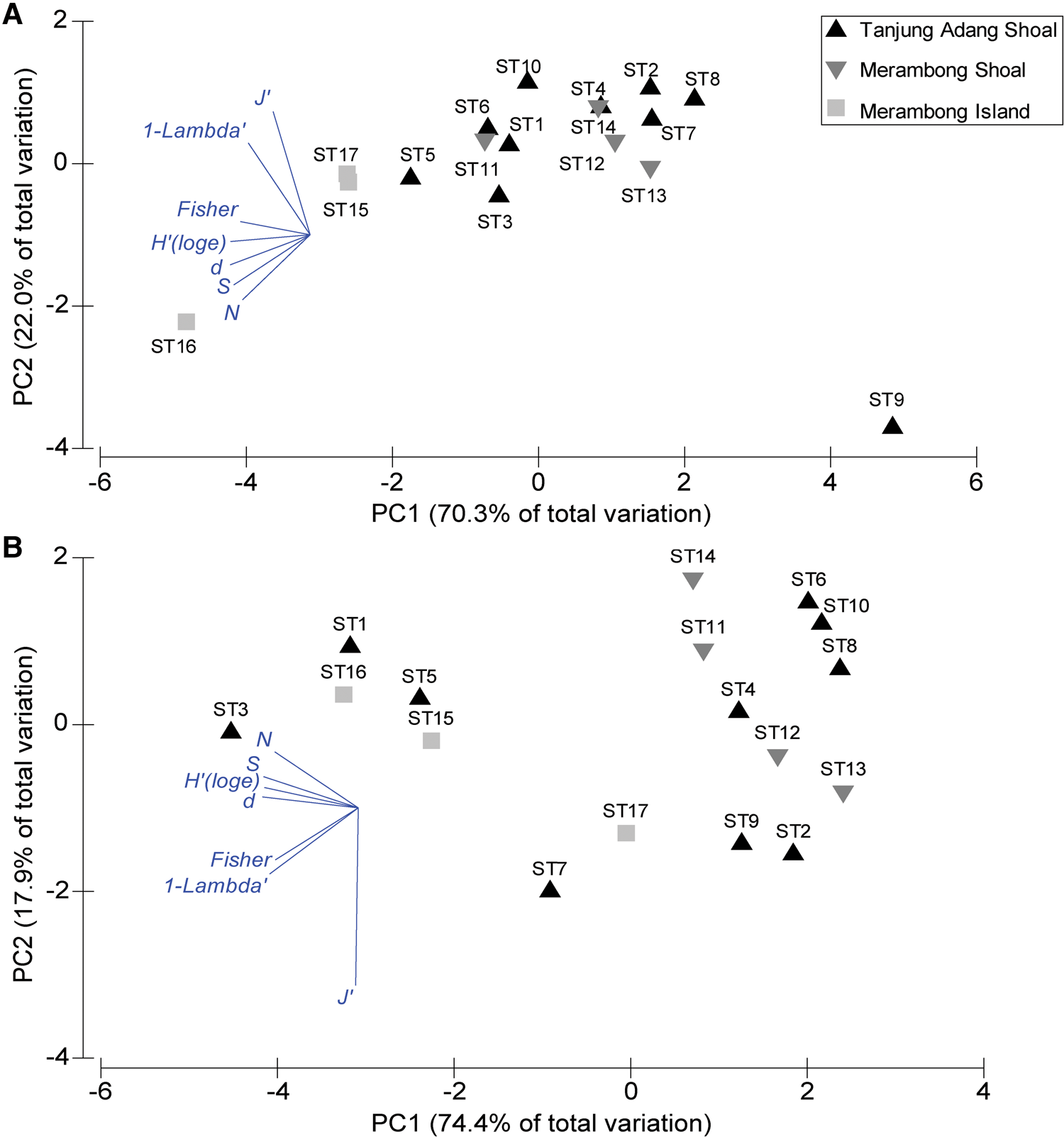
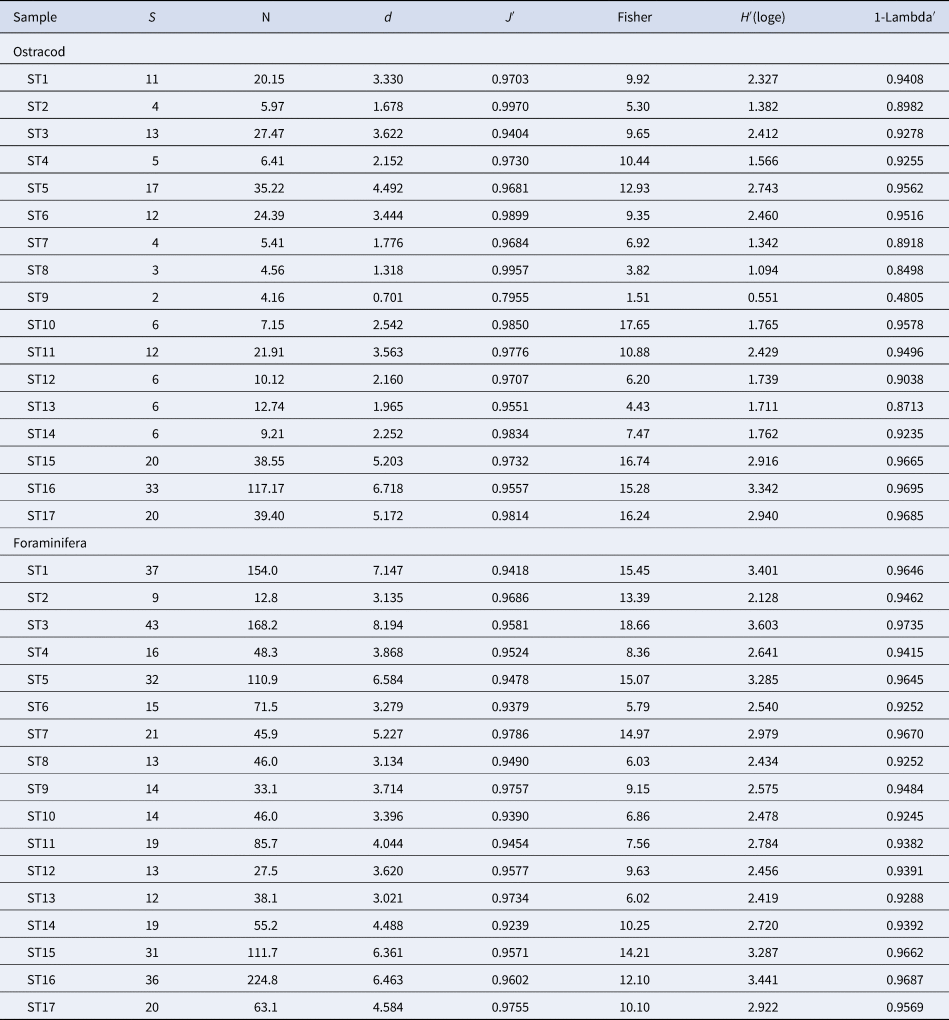
More ostracod and foraminifera families (Figure 7) were found in surficial sediments (more than 80% and 60%, respectively) than at depth (less than 20% and 40% for ostracod and foraminifera, respectively). To fully understand ostracod and foraminifera assemblages between the surface and depth, we analysed the variation in the distribution of meiofauna taxa between the surficial and downcore samples via the Linnhe diversity index (Table 3). The first two principal components of a PCA run using the diversity index for ostracods explained 92.4% of the total variation in the estuary. Ostracods were evenly distributed (Figure 8) between sites (Pielou's evenness, J, mean = 0.96, SD = 4.57 × 10⁻²). For foraminifera, the first two principal components of the PCA explained 92.3% of the total variation. Foraminifera were evenly distributed (Figure 8) between sites (Pielou's evenness, J, mean = 0.96, SD = 1.55 × 10⁻²).
Distribution of: (A) ostracod and (B) foraminifera families in surficial and downcore sediments in the Sungai Pulai Estuary.

Principal component analysis of species diversity indices for: (A) ostracod and (B) foraminifera at Tanjung Adang Shoal, Merambong Shoal and around Merambong Island. Surficial sediments were from ST1, ST3, ST5, ST7, ST9, ST11, ST13, ST15, ST16 and ST17 whereas downcore samples were from ST2, ST4, ST6, ST8, ST10, ST12 and ST14.
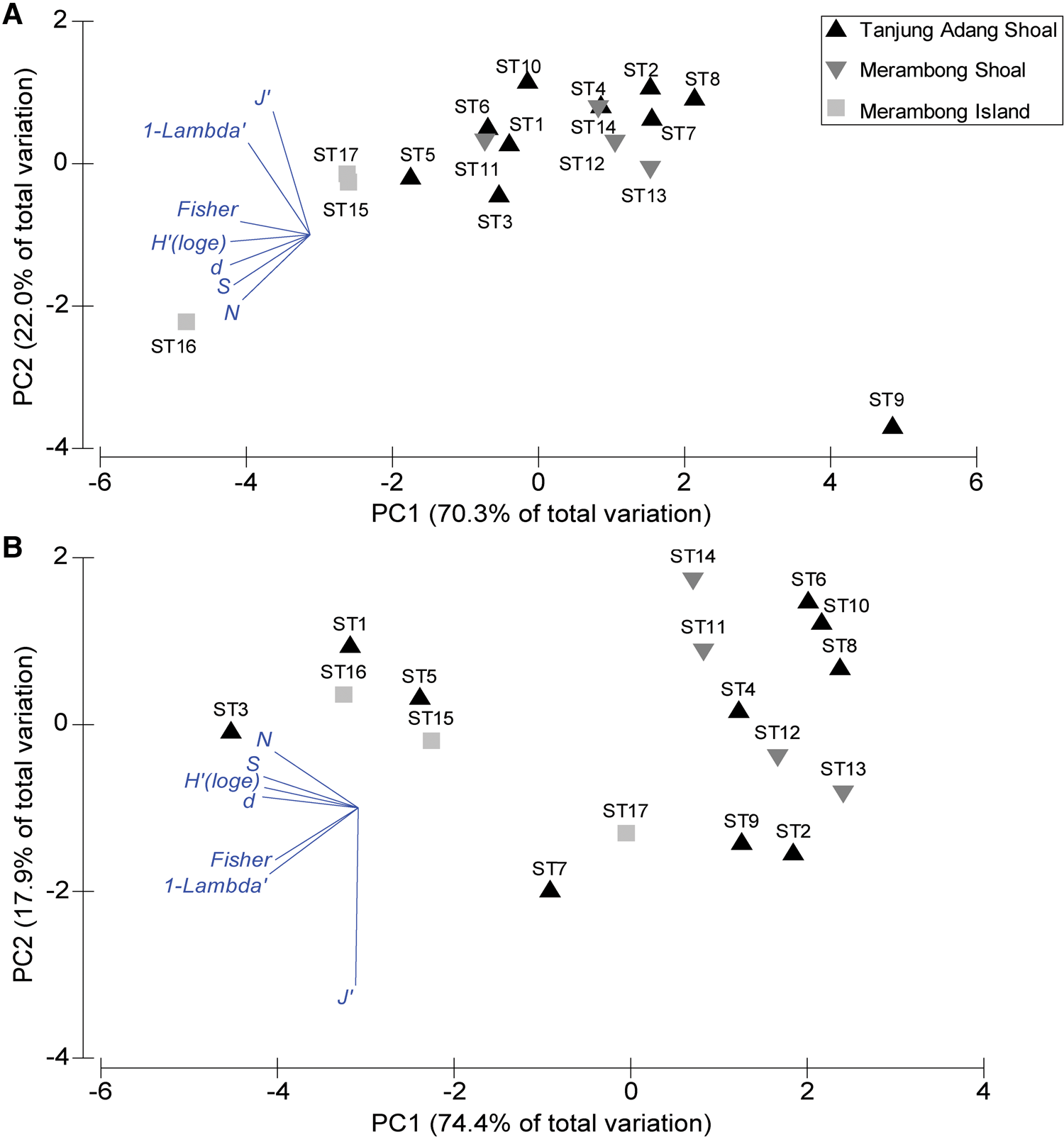
Diversity indices of ostracod and foraminifera assemblages in the Sungai Pulai Estuary from ST1–ST10 (Tanjung Adang Shoal), ST11–ST14 (Merambong Shoal) and ST15–ST17 (Merambong Island)

S = total species, N = total individuals, d = species richness (Margalef, [(S−1)/log (N)]), J′ = Pielou's Evenness [H′/log (S)], and Fisher = species diversity (α).
Discussion
Multivariate analysis
Multivariate analysis showed a clear separation of seagrass (PERMANOVA, P < 0.05) (Tanjung Adang and Merambong shoals) and non-seagrass (Merambong Island) assemblages. Ostracod species such as Loxoconcha lilljeborgii, Hemicytheridea wangi and Stigmatocythere indica were found only in seagrass systems, whereas most foraminifera taxa were distributed among both seagrass and non-seagrass systems. Ostracod and foraminifera taxa varied between the surficial and downcore sediments (PERMANOVA, P < 0.05) at both the family and species level. PCA identified water depth, percentage of sand and organic matter as the main drivers of the distribution of ostracods and foraminifera, results that are consistent with other studies (e.g. Sen Gupta, Reference Sen Gupta and Sen Gupta1999; Hussain et al., Reference Hussain, Rajeshwara Rao and Mahalakshmi2012).
Habitat preference of ostracods and foraminifera
The high abundance of the foraminifera Ammonia parkinsoniana, A. tepida and Elphidium hispidulum in Tanjung Adang Shoal, Merambong Shoal and around Merambong Island reflects a brackish environment (Debenay et al., Reference Debenay, Beneteau, Zhang, Geslin, Redois and Fernandez-gonzalez1998). These taxa dominate in estuaries, coastal lakes and lagoons where salinity, oxygen, organic matter and nutrient levels change rapidly (Alve & Murray, Reference Alve and Murray1994). Ammonia tepida was abundant at all three study sites. The salinity of the study area (31–33 ppt) provided a favourable condition for this taxon within the estuarine system (Debenay et al., Reference Debenay, Beneteau, Zhang, Geslin, Redois and Fernandez-gonzalez1998). Ammonia tepida has different morphofunctional adaptations in response to their habitats and environment (Debenay et al., Reference Debenay, Beneteau, Zhang, Geslin, Redois and Fernandez-gonzalez1998). When unsuitable conditions occur, the microhabitat preferences of A. tepida may change in relation to environmental conditions (Jorissen, Reference Jorissen1988). Its presence also indicates a preference for higher nutrient inputs represented by refractory organic matter (Jorissen, Reference Jorissen1988); the presence of seagrass may have enhanced the accumulation of organic matter in the sediment and provides a suitable habitat for this species. In such a high productivity estuarine environment, A. tepida play an important role in sediment nutrient fluxes and phytodetrital carbon and nitrogen processing (Wukovits et al., Reference Wukovits, Bukenberger, Enge, Gerg, Wanek, Watzka and Heinz2018). These observations raise questions about the mechanisms that enable foraminifera to influence sediment carbon and nitrogen fluxes. Further research is needed to understand the impact of the abundance of A. tepida on phytodetritus and nutrient cycling in the sediment of the estuarine system.
Loxoconcha was a dominant ostracod found at all sites. Loxoconcha is commonly found in modern shallow marine and brackish environments, and also as fossils in the Upper Cenozoic (Ozawa et al., Reference Ozawa, Ishii and Nakao2014). This ostracod is a useful bioindicator in high-nutrient/low-oxygen environments, such as estuaries, due to its opportunistic behaviour (Rodriguez-Lazaro & Ruiz-Muñoz, Reference Rodriguez-Lazaro, Ruiz-Muñoz, Horne, Holmes, Rodriguez-Lazaro and Viehberg2012). In this study, the ostracods Hemicytheridea wangi and Stigmatocythere indica were found only in the seagrass parts of the Sungai Pulai Estuary. These taxa are often considered as important contributors to the faunal biodiversity in seagrass meadows (Forsey, Reference Forsey2016), although their presence is also common in habitats that are in proximity to seagrasses (Forsey, Reference Forsey2016).
Diversity, taxa variation and species composition in seagrass and non-seagrass areas
Families of foraminifera clustered into distinct seagrass (H′ = 3.60) and non-seagrass (H′ = 3.44) systems. Elphidium (Elphididae) and Ammonia (Rotaliidae) were the most numerically abundant taxa (2533 individuals and 2239 individuals, respectively) (Supplementary Material Table S2 and S3). In comparison, in seagrass meadows along the Tunisian coast, the most diverse benthic assemblages of foraminifera recorded a Shannon–Weaver index, H′, of 3.33 (Trabelsi et al., Reference Trabelsi, Elloumi, Hamza, Ayadi, Zghal and Ayadi2018); we observed a maximum H′ of 3.60 at Tanjung Adang Shoal. For non-seagrass areas, H′ for foraminifera at Petchaburi, Thailand, ranged between 0.59 and 2.84, and H′ values of 0.18–2.79 were recorded at Kupang Bay, Indonesia (Toruan et al., Reference Toruan, Risamasu and Paulus2017). Foraminiferal diversity therefore appears to be greater in vegetated zones. Foraminifera (H′ = 3.60) at the family level had a greater diversity than ostracods at the family level as well (H′ = 2.743). The lower diversity of ostracods in seagrass zones may be due to the tide-related changes in water depth, causing adverse effects on ostracods that are sensitive to exposure during low tide (Horne & Boomer, Reference Horne, Boomer, Sherwood, Gardiner and Harris2000).
Both meiofauna could be seen forming a niche at seagrass and non-vegetated systems, which helps in understanding the function of each niche in a habitat. According to niche theory, the patterns of distribution of meiofauna are controlled by environmental factors that have reached their critical threshold. For each species, different factors may be limiting distributions temporally and spatially (Murray, Reference Murray2000; Benito et al., Reference Benito, Trobajo, Cearreta and Ibáñez2016). However, the idea of niche still remains theoretical as the interaction of environmental controls may cause the realized niche to vary from one region to another (Murray, Reference Murray2014). Several additional measures such as integrity test of morphology and stable isotope analysis should be considered in the future for a more precise ecological understanding of the niches formed by the two taxa in seagrass systems. The study on carbon and oxygen isotopic records of species-specific ecology of benthic ostracods and foraminifera can be interpreted in light of, for example, the seasonality and depth of calcification in the sediment (Ravelo & Hilaire-Marcel, Reference Ravelo and Hillaire-Marcel2007; Ishimura et al., Reference Ishimura, Tsunogai, Hasegawa, Nakagawa, Oi, Kitazato, Suga and Toyofuku2012). Their shells provide information on species composition in microenvironment that enables to decipher variation within taxa and niche (Bhaumik et al., Reference Bhaumik, Kumar, Ray, Vishwakarma, Gupta, Kumar and Sain2017; Caporaletti, Reference Caporaletti2017).
Relationship of taxa assemblages with environmental gradients
Organic matter content and the percentage of sand influence the composition of ostracod and foraminifera assemblages at both the family and species level; this pattern is consistent with other studies where sediment particle size plays a major role in determining ostracod and foraminifera distribution (Hussain et al., Reference Hussain, Rajeshwara Rao and Mahalakshmi2012; Kandratavicius et al., Reference Kandratavicius, Muniz, Venturini and Giménez2015; Benito et al., Reference Benito, Trobajo, Cearreta and Ibáñez2016). The distribution of Murrayinella globosa dominated sandy areas, in particular at Tanjung Adang Shoal. Elphidium advenum, E. botaniense, E. hispidulum and E. neosimplex had distributions mostly in sandy-mud zones (e.g. MI 2) located around Merambong Island (Figure 1). Several other dominant species found in the studied estuarine system, including Asterorotalia pulchella and Cibicidoides lobatulus, have also been documented on the Sunda Shelf, South China Sea (Szarek et al., Reference Szarek, Kuhnt, Kawamura and Kitazato2006) and within brackish deltaic systems (Faiz et al., Reference Faiz, Mohamed, Omar and Ahmad2017, Reference Faiz, Mohamed, Omar and Malek2018). Foraminifera are also abundant in sediments having a higher organic matter content, and this organic material represents an important energy source for foraminifera (Sen Gupta, Reference Sen Gupta and Sen Gupta1999). The high amounts of organic matter in the sediments around Tanjung Adang Shoal are likely due to the presence of extensive seagrass beds, which contribute autochthonous organic matter as well as trapping allochthonous organic matter (Rozaimi et al., Reference Rozaimi, Fairoz, Hakimi, Hamdan, Omar, Ali and Tahirin2017; Hidayah et al., Reference Hidayah, Tahirin, Fairoz and Rozaimi2019).
Taxa assemblage at different sediment and water depths
Ostracods and foraminifera within the first 10 cm of the sediment (surficial and downcore) were greater in number – at the family level (Figure 7) – compared with the deeper sediments (10–40 cm layer). This suggests niches exist for taxa at different depths in the sediment column. For example, foraminifera from members of the foraminiferal family Nummulitidae were found only in downcore sediments; none were observed in surficial sediments (Figure 7). This observation has also been reported for Nummulitidae in other studies, as members of this family tend to live in deeper parts of the sediment bed and avoid highly illuminated areas near the water surface (Hohenegger, Reference Hohenegger2000). These benthic symbiont-bearing foraminifera (Uthicke & Nobes, Reference Uthicke and Nobes2008) are most diverse in subtropical and tropical regions (Hohenegger, Reference Hohenegger2000; Woeger et al., Reference Woeger, Briguglio, Kinoshita and Hohenegger2016). Comparatively, Elphidiidae, Rotaliidae and Ammoniidae are common at both the surface and at depth in the sediment column. Although taxa living in the depths could be one factor leading to the variation in surface and subsurface assemblage composition, other factors such as biostratinomic and taphonomic processes could also be biasing the preservation of some taxa over others at depth (Darroch, Reference Darroch2012).
Some of the rare ostracods found at depth in the sediment are those from the family Paracyprididae (Supplementary Material Table S5). This family had been reported in a range of brackish-water sites including Japan, the North Atlantic and the Gulf of California (Maddocks, Reference Maddocks1988; Hiruta & Kakui, Reference Hiruta and Kakui2016). Its presence in Tanjung Adang Shoal suggests an association with seagrasses; however, further studies must confirm the role and importance of seagrasses for this ostracod's habitat preferences. Water depth represents a confounding variable that affects the distribution of meiofauna in the estuarine system (Figure 3). Most ostracods were concentrated in the deeper portions of the estuary (Merambong Island), whereas foraminifera were most abundant in shallow waters (Tanjung Adang and Merambong shoals). A plausible explanation is that foraminifera are better at withstanding the subaerial exposure of intertidal environments (Frenzel & Boomer, Reference Frenzel and Boomer2005). Ostracods can be useful indicators of environmental change at depths below mean water level (Horne & Boomer, Reference Horne, Boomer, Sherwood, Gardiner and Harris2000); however, they risk drying out if exposed subaerially, surviving only for a limited time by closing their valves and diminishing their respiration (Boomer & Eisenhaur, Reference Boomer, Eisenhaur, Holmes and Chivas2002). Thus, foraminifera are more useful bioindicators above the mean high-water level (Frenzel & Boomer, Reference Frenzel and Boomer2005).
The differences between surface and subsurface community compositions in the Sungai Pulai estuary could also be produced by the spatial distribution of seagrass meadows, the existence of sediment mixing by biogenic elements, or deep-tier sediment bioturbation. For example, the areal extent of seagrass meadows can shift over time due to natural processes or human-related activities (Brasier, Reference Brasier1975; Duarte et al., Reference Duarte, Martins, Rosa, Matos, Roleda, Reusch, Engelen, Serrão, Pearson, Marques, Caçador, Duarte and Jueterbock2018; Alonso Aller et al., Reference Alonso Aller, Eklöf, Gullström, Kloiber, Linderholm and Nordlund2019). There is evidence of changes in the size of seagrass meadows in the studied estuary and sediment composition over the past two decades (Shaari et al., Reference Shaari, Shazili, Abdullah, Abdullah, Husain and Tahir2017; Hossain et al., Reference Hossain, Hashim, Bujang, Zakaria and Muslim2018). Such changes are known to shift faunal spatial distributions along the vertical sediment layers on decadal timescales in response to changing currents, salinities and depth (especially in estuarine environments), and thus produce differences in surface and subsurface community assemblages (e.g. Nash et al., Reference Nash, Binnie and Cann2010; Potouroglou et al., Reference Potouroglou, Bull, Krauss, Kennedy, Fusi, Daffonchio, Mangora, Githaiga, Diele and Huxham2017). In addition, bioturbation processes can be a further cause leading to the variation in community composition of the surface-subsurface interphases. Bioturbators, especially callianassid shrimp would certainly be among the contributing factors in mixed sediment layers (Meldahl, Reference Meldahl1987; Darroch et al., Reference Darroch, Locatelli, Mccoy, Clark, Anderson, Tarhan and Hull2016), bringing up (often very old) material from the depths, and allowing deeper burial of recently dead material into subsurface sediment layers (Darroch, Reference Darroch2012). Indeed, callianassid shrimp are known to occur in South-east Asian seagrass meadows (Duarte et al., Reference Duarte, Terrados, Agawin, Fortes, Bach and Kenworthy1997; Vonk et al., Reference Vonk, Kneer, Stapel and Asmus2008; Kneer et al., Reference Kneer, Asmus and Jompa2013). Other potential bioturbators such as polychaetes (Zaleha et al., Reference Zaleha, Diyana, Suhaili and Amirudin2009; Shi et al., Reference Shi, Ghaffar, Ali and Cob2014) and bivalves (Che Cob et al., Reference Che Cob, Arshad, Wan Muda, Abd. Ghaffar, Mohamed, Sahrani, Ali, Cob and Ahmad2008; Zaleha et al., Reference Zaleha, Diyana, Suhaili and Amirudin2009) in Sungai Pulai Estuary have been reported. However, the extent of bioturbation effects upon micro-habitat processes such as the relationship with surface-subsurface assemblage composition at the meadow seascape-level is still unknown, and we interpret all surface-subsurface differences in meiofaunal composition to reflect the compositions of the original living communities.
Resolution of benthic ostracods and foraminifera data as proxies for environmental studies
In this study, live and dead assemblages were used to analyse abundance, diversity, taxonomic variation and species distribution of meiofaunal communities within a tropical estuary. This study, therefore, presents a reference base for more in-depth work into the seagrass and non-seagrass parts of the estuary. Agreement between live and dead assemblages can also be significantly impacted by biostratinomic and taphonomic processes (e.g. Kowalewski et al., Reference Kowalewski, Carroll, Casazza, Gupta, Hannisdal, Hendy, Krause, LaBarbera, Lazo, Messina, Puchalski and Rothfus2003; Kidwell, Reference Kidwell2007; Darroch, Reference Darroch2012; Darroch et al., Reference Darroch, Locatelli, Mccoy, Clark, Anderson, Tarhan and Hull2016; Valls et al., Reference Valls, Zamora, Rueda and Mesquita-Joanes2016; Alves Martins et al., Reference Alves Martins, Hohenegger, Frontalini, Dias, Geraldes and Rocha2019). For example, the spatial mixing of dead material due to bottom currents could plausibly lead to reduced dissimilarity between communities, and the artificial inflation of species diversity in death assemblages (Tomašových & Kidwell, Reference Tomašových and Kidwell2009). However, Darroch (Reference Darroch2012) also suggested that dead tests are rarely transported long distances between facies. If all environments are being treated equally, it is likely that all dead material reflects individuals that were living in that environment, and, despite being in close proximity, it is unlikely there was lateral sediment transport among our three seagrass and non-seagrass sites. The relative sheltering of the sites within the Johor Straits (Figure 1), and the functional ability of the seagrass canopies (de Boer, Reference de Boer2007) in allowing retention of particulate matter add credence to this hypothesis. It is equally plausible that the environmental factors above worked in concert rather than independently; these need to be collectively considered in understanding any environmental changes at the local level.
Foraminifera can provide sufficient resolution to pick up even minor impacts of the change in the environment (Pieri et al., Reference Pieri, Martens, Stoch and Rossetti2009). For example, the Sungai Pulai estuarine region's fluctuation in salinity, temperature and organic matter demonstrates different preferences for certain species, which indicate that species distribution is subject to conditions of environmental variation. Opportunistic and tolerant species such as A. tepida directly benefit from accumulation of organic matter or indirectly through competition and predation. In addition, the presence and absence of certain foraminifera species such as the Nummulitidae in surficial and downcore sediment reveals the tolerance level of the species towards the environmental gradients such as light penetration through the water column. The foraminifera of Sungai Pulai Estuary are more abundant than ostracods, diverse and closely related to environmental parameters, such as, water depth, salinity, organic matter and substrate. Although the taxa assemblage is used to explain the variability of species in the estuarine system, the distinction between natural variability and apparent environmental setting could be a main challenge. Thus, we recommend the use of stable isotope analysis of ostracods and foraminifera tests in future studies to avert the mixing of environmental signals in the estuarine system, since stable isotopes of oxygen and carbon in the test of microfossils tend to vary with water depth and salinity (Rohling & Cooke, Reference Rohling, Cooke, Rohling and Cooke1999; Simstich et al., Reference Simstich, Stanovoy, Bauch, Erlenkeuser and Spielhagen2004).
Several past works have employed foraminifera (Reich et al., Reference Reich, Di Martino, Todd, Wesselingh and Renema2015; Darroch et al., Reference Darroch, Locatelli, Mccoy, Clark, Anderson, Tarhan and Hull2016), ostracods (Forsey, Reference Forsey2016), gastropods (Reich, Reference Reich2014), mollusc and fish communities (Koskeridou et al., Reference Koskeridou, Thivaiou, Giamali, Agiadi and Mantzouka2019) as proxies of currently existing seagrass meadows but especially in applying faunal records as proxy indicators of seagrass-dominated palaeo-environments (Reich et al., Reference Reich, Di Martino, Todd, Wesselingh and Renema2015; Forsey, Reference Forsey2016). Seagrass detritus has low preservation potential and is hardly identified in the rock record though there are rare exceptions (Reich et al., Reference Reich, Di Martino, Todd, Wesselingh and Renema2015). Our study shows the potential of using ostracod and foraminifera tests as species-independent proxies for seagrass-dominated communities, thus helping to demarcate the size and location of present and past meadows. Extant seagrasses in this region, especially those in the modern (present) submerged areas of the Sunda Shelf, are not likely to have occurred any earlier than 6000 years before the present (ka BP). The existing seagrass meadows in Malaysia are thus successional colonizations after the last sea-level transgression event during the late Holocene (Tjia & Sharifah Mastura, Reference Tjia and Sharifah Mastura2013). Assuming the presence of an undisturbed layer of sediment, ostracods and foraminifera are therefore a rich historical repository of biogeochemical processes in a seagrass meadow (Reich et al., Reference Reich, Di Martino, Todd, Wesselingh and Renema2015). On the other hand, disturbances in sediment layers can also be deduced through foraminiferal records (e.g. Jorissen & Wittling, Reference Jorissen and Wittling1999). Such are the possible pathways for future uses of these meiofaunal proxies in deciphering present and past scenarios of local environmental change.
Conclusion
We obtained information regarding the habitat preferences of the ostracods and foraminifera in the Sungai Pulai Estuary, Malaysia. The combined application of benthic ostracods and foraminifera indicates the development of an estuary in response to natural or anthropogenic disturbances. However, the resolution levels and applicability of ostracods and foraminifera as viable bioindicators varies according to their sensitivity towards those changes. If a basis was required for selecting a taxon as an indicator of environmental change in the estuarine system, ostracods would pick up impacts in shallow waters of high nutrient/low oxygen areas. In contrast, the use of foraminifera helps in detecting environmental changes in habitats with important ecological roles such as seagrass meadows, compared with ostracods that are less associated with seagrass vegetation. The indicator taxa were chosen based on previously cited research, local abundance, ecological significance or combinations of two or more of these reasons. Growth rate and physiological responses of the organisms need to be included in future work to obtain a detailed understanding of their role and relationship with the habitat and environment. We suggest that the outlook on bioindicators should focus on the more common species such as Loxoconcha lilljeborgii, Asterorotalia pulchella, Murrayinella globosa, Ammonia tepida and Elphidium neosimplex, taking due precautions that live-dead assemblages, preservation of tests and factors influencing sediment mixing and depositional processes may complicate any straightforward interpretations of the findings.
Supplementary material
The supplementary material for this article can be found at https://doi.org/10.1017/S0025315420001162.
Acknowledgements
We thank Siti Aishah Tahirin and Nur Hidayah Hamdan for their assistance in sample pre-processing, and Dr Murray Hay for constructive comments in improving the final version of the manuscript.
Financial support
This research was supported by Universiti Kebangsaan Malaysia through the grant UKM-GUP-2018-120 and the Ministry of Education, Malaysia grant FRGS/1/2019/WAB09/UKM/02/1.
Appendix A
Representative ostracod specimens from Sungai Pulai estuary: 1. Loxocorniculum triconicula (Zhao & Whatley, 1989), 2. Loxoconcha lilljeborgii (Brady, 1868), 3. Loxoconcha malayensis (Zhao & Whatley, 1989), 4. Cytherella hemipuncta (Swanson, 1969), 5. Cytherelloidea leroyi (Keij, 1964), 6. Tanella gracilis (Kingma, 1948), 7. Kotoracytehre inconspicua (Brady, 1880), 8. Parakrithella australis (McKenzie, 1967), 9. Cytheropteron rhombiformis (Chen, 1981), 10. Hemicytheridea cancellata (Brady, 1868), 11. Hemicytheridea wangi (Zhao & Whatley, 1989), 12. Stigmatocythere roesmani (Kingma, 1948), 13. Exterior view of Keijella reticulata (Whatley & Zhao, 1988), 14. Interior view of Keijella reticulata (Whatley & Zhao, 1988), 15. Borneocythere paucipunctata (Whatley & Zhao 1988), 16. Lankacythere coralloides (Brady 1886), 17. Pistocythereis bradyformis (Ishizaki, 1968), 18. Pistocythereis cribriformis (Brady, 1865), 19. Venericythere darwini (Brady, 1868), 20. Neocytheretta adunca (Brady, 1880), 21. Miocyprideis sp. Scale bar = 300 μm.

Appendix B
Representative foraminifera specimens from Sungai Pulai estuary: 1. Amphistegina lessonii (d'Orbigny, 1826), 2. Dorsal view of Murrayinella globosa (Millet, 1903), 3. Ventral view of Murrayinella globosa (Millet, 1903), 4. Dorsal view of Cibicidoides lobatulus (Walker & Jacob, 1798), 5. Ventral view of Cibicidoides lobatulus (Walker & Jacob, 1798), 6. Ammonia beccarii (Linnaeus, 1758), 7. Ammonia parkinsoniana (d'Orbigny, 1839), 8. Ammonia falsobeccarii (Rouvillois, 1974), 9. Dorsal view of Pararotalia stellata (de Ferussac, 1827), 10. Ventral view of Pararotalia stellata (de Ferussac, 1827), 11. Dorsal view of Asterorotalia pulchella (d'Orbigny, 1839), 12. Ventral view of Asterorotalia pulchella (d'Orbigny, 1839), 13. Dorsal view of Rotalidium annectens (Parker dan Jones, 1865), 14. Ventral view of Rotalidium annectens (Parker & Jones, 1865), 15. Elphidium advenum (Cushman, 1922), 16. Elphidium asiaticum (Polski, 1959), 17, 22 & 23. Elphidium hispidulum (Cushman, 1936), 18 & 19 Elphidium neosimplex (McCulloch, 1977), 20. Elphidium sp. 1, 21. Elphidium sp. 2. Scale bar = 200 μm.