Prelude: routes and connections – encounters and traces
In 2010, Thai choreographer and dancer Pichet Klunchun performed Nijinsky Siam at the international Theater der Welt theatre festival in the German city of Mülheim an der Ruhr. Pichet, who practises and teaches traditional Thai dance combined with contemporary techniques,Footnote 1 based his performance on the traces of Siamese body movements he discovered in Vaslav Nijinsky's dancing.Footnote 2 As he explained in an artist talk, Pichet had been intrigued by photographs of Nijinsky in Thai-inspired costumes and poses and sought to re-create the dance he imagined Nijinsky had invented in La danse siamoise at the Paris Opera in 1910.Footnote 3 In 2010, Pichet created a new work, Nijinsky Siam, by interweaving Nijinsky's movements with Siamese elements,Footnote 4 to the score of Danse orientale by Norwegian composer Christian Sinding. In addition, he integrated paintings, photographs, puppets and shadow plays into his performance. It is ‘an Asian dancer's interpretation of a Westerner's interpretation of an Asian traditional dance’, as critic Tara Tan put it.Footnote 5
After the festival, I corresponded with Klunchun's manager, Sojirat Singholka, in Bangkok, and his main researcher, Philippe de Lustrac, in Paris about Nijinsky Siam.Footnote 6 The conversation was primarily of a methodological and theoretical nature, as the questions Pichet addresses in his performance, and the questions I have been dealing with in my work on global theatre history,Footnote 7 address the same epistemological challenge: how should we handle connections, intersections and entanglements in theatre history?
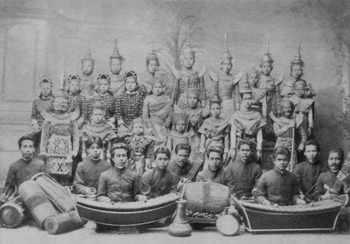
Pichet Klunchun and his team of researchers had discovered that Nijinsky's La danse siamoise was in fact a result of choreographer Mikhail Fokine's and costume designer Leon Bakst's interaction with Siamese dancers in St Petersburg, the Boosra Mahin Theatre Troupe, also known as the Royal Siamese Theatre Troupe (Fig. 1). Bakst and Fokine attended a performance of the company in late October 1900 in St Petersburg, and this theatrical event had a strong impact on the artists. Dance critic Valerian Svetlov was also in the audience. This early encounter of Fokine, Bakst and the Siamese troupe resulted in an interweaving of artistic forms, conventions and traditions that Klunchun reworks in his performance Nijinsky Siam. Yet how can historical scholarship disentangle and reveal such cultural entanglements of the past? Taking my encounter with Pichet Klunchun in 2010 as a starting point, I shall address this historiographical problem by following Boosra Mahin and his troupe on their tour.
Boosra Mahin's Siamese Theatre Troupe in Berlin, September 1900 (public domain).

According to a Straits Times article from 9 June 1900, the troupe's first stop was at Singapore's Town Hall, after which they were ‘originally intended for the Paris Exhibition, but are now proceeding direct to Russia at the special invitation of the Czar. After touring through Europe they return to Siam via America’. The article's information about the itinerary turned out to be misleading. In fact, the troupe changed their route more than once, and whether they ever performed in the United States remains unclear. In which cities did the troupe perform? For whom? At what venues? What can we say about their cultural encounters? How can we track historical connections and make them understandable or even visible? How can we recognize and understand the multifaceted spectrum of entanglements and make them traceable? These questions will be framed within a broader research paradigm informed by global and transnational theatre history.
Theatre histories of connected routes and encounters
In theatre studies, interest in transnational, transcultural or global histories is increasing. It has been influenced in turn by larger movements towards globalization and transnationalization within the historical disciplines in general. Writing in the first issue of the Journal of Global History (2006), Patrick O'Brien introduces two distinct approaches to modern global history, namely comparative histories and the study of connections between people(s). Historians such as Christopher Bayly,Footnote 8 Jürgen OsterhammelFootnote 9 and Dominic SachsenmaierFootnote 10 have demonstrated that historical trends and events that have conventionally been described in distinct national or regional terms can and should also be considered as interconnected networks of growing contacts, transfers and entanglements between world regions and nations. The following recurrent features handled in recent publications on global and transnational history can be filtered out as key perspectives of the field:
• searches for less obvious connections and hidden traces;
• searches for and studies of transfers, circulations of models, concepts, relationships, objects, acteurs in different directions, beyond geographical borders, temporally, spatially, imaginatively, etc.;
• detailed and comparative studies of transnational mobility;
• strict consultations of the respective historical context of both the researcher and the object of study;
• studies of social connections, channels, and ‘flows’ of capital, trades, information, concepts, images, cultural productions, etc.
Global or transnational theatre history, too, focuses more on cultural connections than on separated entities; emphasizes interweaving or entanglements rather than intrinsic analysis of artworks; argues more for the dynamics and circulation of forms, performers and productions, than for an understanding of cultural artefacts and culture as something stable and fixed.Footnote 11 Bayly advocates combining such a ‘lateral history’ of connections with the ‘vertical history’ of institutions and ideologies. If we think of Bayly's two dimensions as lines intersecting at certain points, then these points of intersection might be regarded as ‘contact zones’ or ‘hubs’,Footnote 12 where different groups or cultures correlate with institutions or conventions and cultural entanglements take place. At these hubs, cultural goods and ideas are exchanged.
Following historian Adam McKeown's idea of a social (as opposed to a conventional physical) geography of migrant workers, formulated in his study ‘Global Migration 1846–1940’, one could also add the idea of a theatrical geography constituted by actors/acteurs, agents, and a theatrical infrastructure.Footnote 13 Adapting Arjun Appadurai's notion of ‘scapes’ in order to grasp the flows of ideas, media and finance of contemporary globalization, the notion of theatrescapes enhances our understanding of theatrical history on a global scale.Footnote 14Theatrescapes, I argue, comprehend the dynamic relations and relational dynamics of a worldwide distribution of theatre as well as the global or transnational cultural mobility of theatrical performers, artists and managers since the mid-nineteenth century.
The cultural globalization of the present should be correlated with historical precedents, so that it is essential to examine the historicity of globalization. The scholarly interest in globalization expressed in concepts such as ‘flows’ of people, goods, money and information, ‘across endlessly shifting social landscapes’,Footnote 15 is on the agenda not only of cultural anthropologists but also of cultural historians, including Stephan Greenblatt.Footnote 16 In his ‘mobility studies manifesto’ Greenblatt lists key points for describing and coming to terms with the mobility of cultures or cultural mobility:
1 taking mobility in a highly literal sense: ‘The physical, infrastructural, and institutional conditions of movements – the available routes; the maps; the vehicles’ etc. – have to be taken into consideration;Footnote 17
2 shedding light on hidden as well as conspicuous movements of peoples, objects, images, texts and ideas;
3 identifying and analysing the ‘contact zones’ where cultures intermingle and cultural goods are exchanged.Footnote 18
Mobility usually depends on the presence of pre-existing pathways and routes to facilitate movement. The etymology of the word ‘route’ refers us to the Latin ruptum, which in fact means ‘broken, interrupted’, and can be read as both an interrupted way or as a prescribed path. ‘Route’ as a noun or verb is not congruent with ‘tour’ as a noun or verb, yet a tour can be made on a specific route.
Theatre, arts and music benefited considerably from the Industrial Revolution and its achievements, as well as the expanding transport and communication infrastructure in Asia, Europe and the United States. Railways, steamships, telegraphy and so on enabled theatrical agents, impresarios, actors, musicians and dancers to travel. By the 1850s, steam travel to Asia was offered by France, the Netherlands and Great Britain. In addition, the development and expansion of new media contributed to the rapid dissemination of artistic products and ideas. It was along such pre-existing transport and communication infrastructure that the Boosra Mahin troupe moved on its tour of Europe. Yet what routes did they take? How can we track their itineraries? What source material is handed down that theatre historians might consult?
Boosra Mahin's troupe en route: tours, detours, contact zones
Little has been hitherto published about the Boosra Mahin troupe, except for contemporary reviews in the year of their big tour, 1900, brief mentions in travel books and ethnomusicological essays about their music.Footnote 19 The research that I present here is based on unpublished archival material, advertisements, travel accounts, phonogram recordings, theatre programmes and newspaper articles from Singapore, Russia, Germany, Austria and France.
Bangkok
In 1890, future Russian czar Nikolas II, then still a crown prince, went on a sailing trip around the world, including East Asia, where he would launch the construction of the Trans-Siberian Railway in 1891. After visiting India, Ceylon, Java and China, Nikolas and his entourage came to Thailand in 1890, which then was one of the only Asian countries that had not been colonized, despite France's efforts.Footnote 20 The prince was enthused with Thai theatre, and by the Boosra Mahin Theatre in particular.Footnote 21 Its director, the eponymous Boosra Mahin, was the wealthiest theatre owner in Thailand.Footnote 22 He had been educated partially in Europe, and was the son of Prince Phya Mahin, who owned a theatre in Bangkok, the Prince Theatre (which accommodated between eight hundred and a thousand spectators). European writers, politicians and businessmen who visited Thailand described the Boosra Mahin Theatre in various travelogues. Norwegian naturalist Carl Alfred Bock, who spent fourteen months in Thailand and at the royal court, describes Mahin's theatre as the ‘best theatre in Bangkok’.Footnote 23 Georges Dürwell, president of the Société des études indo-chinoises, writing in 1911, noted the ‘exclusively feminine nature’ of the princely theatre.Footnote 24 Nikolas invited Boosra Mahin and his troupe to St Petersburg and Europe after he had seen one of the troupe's shows in Bangkok.
Singapore: Town Hall, June 1900
Before the troupe performed in St Petersburg, they went to Singapore, Alexandria, allegedly North America and then several European cities (Vienna, Paris and Berlin). The first performance of the world tour of the troupe probably took place at the Town Hall in Singapore in June 1900. An article entitled ‘Siamese Theatrical Co.’ in the Straits Times from 9 June 1900 remarked on the sheer novelty of the troupe:
At the Town Hall, last night, there was given the first of two performances by the Boosra Mahin Siamese Theatrical Troupe, which has just come down from Bangkok and intends to tour and perform in Europe. The show is altogether a unique one, and is probably the first of the kind to tour Europe. The company consists of over thirty Siamese dancing girls, who give selections from Siamese classical plays, which are neither entirely Chinese nor Malay in character, yet have some of the features of both. Dancing is, of course, the feature of the whole performance, and these girls do it beautifully. They came out last night attired in costly and beautiful costumes, and they danced with great precision … The show was brought to a finale by the whole company standing in a semi-circle with fans breasted and heads bowed and singing the Siamese National Hymn to the accompaniment of the orchestra … Mr. de Basagoiti, the Secretary of the Troupe, [has] the difficult but pleasant task of guiding this bevy of shy, coy maidens from the Land of the White Elephant through the gay cities of Europe and America.Footnote 25
At the turn of the century, Singapore was known as a cosmopolitan hub with its clubs from various nations, theatres, ‘smoking concerts’, a public library, reading rooms, museum and botanical gardens open to the public.Footnote 26
According to the Handbook to Singapore from 1907, the Town Hall, built in 1854, was devoted to ‘public purposes’. It was the premier performance venue for the European population but was also frequented by ‘native’ spectators as well.Footnote 27 An announcement in the Singapore Free Press and Mercantile Advertiser from 8 June 1900 notes the appearance of a ‘celebrated Siamese Lakon’: ‘To Night. Town Hall, Theatre. Last Night. The Celebrated Siamese Lakon (Boosra Mahin Troupe) Siamese Classical Play. Full Siamese Orchestra. Magnificent Dresses’.Footnote 28 The Straits Times from 9 June 1900 remarked not only on the troupe's ‘weird’, though not ‘unpleasant’, music but also on topical references to world politics, in this case the Boer War, which were integrated into the performance:
The dancing is done to the accompaniment of a Siamese orchestra, whose weird music is not at all unpleasant to the European ear. Graceful dancing, posing, and slow gyrations largely predominated. Scene 2 of Part II. was a dance performed by 12 maidens, each holding a folded Union Jack in her hand, a compliment no doubt to our entry into Pretoria.Footnote 29
At the time when Boosra Mahin's troupe performs at the Town Hall, this venue is under the control of the municipal commissioners, i.e. the British. The embedding of the Union Jack into the performance not only signals the adaptation of the show to the respective local audience, but also integrates a political statement and the peculiar acknowledgement of the British colonial power by representatives of a country that had never been colonized.
Paris: the (missed) Exposition universelle
World Fairs are contact zones or hubs for cultural encounters sui generis. From their inception, when the first World Exhibition opened in 1851 at the London Crystal Palace, they were closely tied to the achievements of industrialization and the improvement of global transport. These factors enabled exhibiting nations to attend – and to compete with each another – and also permitted visitors from various parts of the globe to meet people from foreign countries and get acquainted with cultural artefacts known until then only via illustrated newspapers, encyclopedias or other visual cultural products.Footnote 30 As various newspaper articles noted, Boosra Mahin's troupe was scheduled to perform at the Exposition universelle that took place between 15 April and 12 November 1900 in Paris. Contemporary newspapers and exhibition catalogues of the Expo contain, however, no reference to an actual performance. There were Siamese pavilions (with an advertisement of the French ‘Brasserie Vetzel’ put on top of the roof), yet no Royal Siamese dance troupe. Audiences in search of ‘exotic’ performances could enjoy Otojiro Kawakami and Sada Yacco,Footnote 31 Loïe Fuller and Cléo de Merode, who performed more or less ‘authentic’ Cambodian dances – next to some Parsis – at the ‘Indo-Chinese Theatre’. As Bruno Petzold writes, the visitors were struck by the ‘authenticity’ of de Merode's show – whereas the critics, among them the prince of Cambodia, Imkanthor, were not convinced at all by her rendition of Cambodian dancing, as a German correspondent reported: ‘To be honest: what does good old Cléo know about Cambodia and of the wonderful art of the Khmers? No wonder that Cléo's dances brought only a wincing smile to the lips of Cambodian prince Imkanthor, who was among the audience’.Footnote 32
It seems that the Siamese troupe was not given the chance to perform at the Exposition universelle, and the question is, why? According to a letter from the impresario Victor Bamberger, who was based in Paris at the time and was supposed to care for the troupe after their show at the Paris Expo, the troupe's embarkation to Europe was delayed and therefore they missed it. Bamberger also mentions the miserable business conditions for touring companies in Paris. Boosra Mahin and the Parisian-based representative of the Thai government contacted him in order to manage the business affairs of the troupe with immediate effect. The Siamese government official praises the troupe as ‘the best in Thailand’ and mentions that the costumes are worth several thousand pounds.Footnote 33
Given the reputation and recommendations of the company, why should the hosting responsibilities for a troupe from Thailand have been more complicated than those of any other nation? It seems that Thailand occupied an intermediary position. It neither belonged to the industrial nations representing their economic and industrial progress and power at the Expo, nor was it one of the colonized regions that were put on display by the colonizing states. In any case, the troupe's itinerary had to be rerouted for a second time. On 3 August 1900, Bamberger cabled the administration office of the Berlin Zoological Garden and offered them the troupe of twenty-three female and twelve male performers for August or September: ‘offer Siamese Theatre troupe 23 girls 12 men with orchestra just arrived from Bangkok for august or September cable by saturday whether theoretically interested – Bamberger continental paris.’Footnote 34
Vienna: Venice in Vienna (Prater), late August 1900
When Bamberger cabled Berlin, the troupe was stranded on the banks of the Canale Grande – in Vienna, or more precisely in the Venice in Vienna theme park. Modelled on Venice in London, Venice in Vienna was established in May 1895 in Vienna's Prater public park by businessman Gabor Steiner and writer Ignaz Schnitzer. Over five thousand square meters, there extended imitation Venetian canals and piazzi which served as a vicarious experience of a trip to Venice, including gondola rides and Italian restaurants. There were also venues for operettas, concerts, street acrobats, dancers and performers of all kinds.Footnote 35 Boosra Mahin's troupe spent a couple of days in Vienna when passing through to Trieste.
Steiner organized the troupe's show, and it seems that the rerouting of their itinerary also resulted in a dramaturgical rerouting in that their programme had to be cut down to a length of thirty minutes. The Neue freie Presse for 1 August 1900 reports that the performance, in particular the dances and the ‘peculiar music’, created in the audience a strange mood; the troupe is described as ‘a sight to be seen’ (Sehenswürdigkeit) due to their beautiful faces and costumes: ‘it is pleasurable to follow the strange theatrical presentation for half an hour, yet any longer duration of the performance would run the risk of boring the European audience due to the monotony of the movements and music’.Footnote 36 It seems that the diverting nature of the theme park and its audiences could not be reconciled with the aesthetics of the Siamese show, which evidently required a high degree of concentration and preparedness to engage with thoroughly ‘strange’ conventions.
Berlin: Zoologischer Garten and Institute for Musicology
The reception would be different in Berlin, another unplanned stop of Boosra Mahin and his performers. Impresario Victor Bamberger cabled the director of the Berlin zoo, Ludwig Heck, in order to advertise the troupe. Bamberger had Mahin take photographs of the troupe to be sent to Ludwig Heck, who then travelled to Vienna to get an idea of the performance, and after this ‘inspection’ they closed a deal: the troupe would perform in the German capital in late August.
In his letter to Heck, Bamberger points to a few technical issues, such as how to arrange the stage, which should be kept simple, but in a way still ‘Siamese’.Footnote 37 As Frädrich reports, the stage was designed in the ‘Siamese’ style and enhanced by an exhibition of costumes, weapons and tools that the troupe had brought from home.Footnote 38 The Illustrierte Zeitung is more precise in its description of the stage and mentions it as being modelled after the pavilion of a Buddhist temple decorated with white elephants. Among the invited guests for the premiere were Mr Chorn, Siamese resident in Berlin, and Prince Paribatra Sukhumbandh,Footnote 39 one of the sons of the Thai king, who was then receiving military training as a Prussian Hauptmann (captain) in the city, yet neither of them were able to attend the Berlin premiere of Boosra Mahin.
The programme that Boosra Mahin's troupe presented alternated dance, music and theatrical scenes, all referring to Siamese traditional stories and costumes. As almost all newspaper articles underline, the programme was not an entirely ‘authentic’ Siamese performance, because it was reduced in length to one to two hours instead of the four to five hours that it would have been in Bangkok. The show begins with a ramplang dance, followed by a historical spear fight called rambok performed with silver weapons, then a love scene by children accompanied by a singing choir. During the intermission, the performers play a ball game where the ball is passed without using the hands, then a fan dance follows, danced by twelve girls who accompany their movements with melodious singing. The show closed with a mask dance called ramasun.
Ramasun, or ramahsoon, appears also to have been presented as a separate play. A brochure located in the Deutsches Theatermuseum in Munich characterizes the show as an ‘old Siamese fairy tale (translated from Sanskrit)’, directed by Boosra Mahin, and ‘adapted for European stages by A. Conty’, who actually was Bamberger's secretary.Footnote 40 The programme further mentions the dramatis personae, and points to the reduction of the play's length in accordance with European theatre conventions. In the original version, it reads, the performance would take between eight and ten hours, yet for the European stage it was limited to the ‘most crucial and interesting scenes’; in addition, the spoken parts are reduced to a minimum, the main focus being placed on the pantomimic elements.Footnote 41
All reviews mention the costumes and headdresses of the performers as eye-catching. Next to the splendid and expensive garments, the golden, tapering helmets and the sharp metal caps on the fingernails of the dancers especially impressed the European spectators.Footnote 42 In an announcement of the Berlin performances, one newspaper recommended spectators see the show in the evening, because the electric light would sensationally boost the splendour of the performance.
Equally impressive to the Germans were the movements and beauty of the Siamese women. The daily Berliner Morgenpost even contrasted them with the appearance and physiognomy of their European sisters: ‘They perform fan, torch and sword dances to quite strange rhythms which both alienate and delight. Quite unique is movement of the fingers and palms, which no European woman can emulate’.Footnote 43
Other descriptions of the female performers, presumably written by male critics, carry more explicitly sexist overtones. A positive assessment came from unexpected quarters. The famous German critic Alfred Kerr reviewed the show in his usual cynical style but was still impressed. He counted thirty-five female performers and seemed to be taken by the female dominance and the responsibility that this meant for Boosra Mahin, whom he calls, in reference to the director of the Berlin court theatre, ‘a Siamese Hochberg’.Footnote 44 He also loosely describes selected parts of the performance, such as the pantomime scene ‘Gno’, a love story between a demigod and the daughter of an officer. His conclusion applauds the achievements of the troupe – and playfully criticizes the court theatre of Berlin, which was notorious for its conservatism: ‘It has been a long time since we have been so delighted. Our amusement could only be matched if our court theatre would move to Siam’.Footnote 45
Ethnomusicological recordings
When the troupe came to Europe at the turn of the century, the interest in foreign cultures had increased exponentially due to the world fairs, ethnographic shows and numerous publications of explorers, scientists and affluent tourists. Of the several disciplines that concerned themselves with exotic cultures, such as anthropology and psychology, and whose approach was not always laudable (and in fact was sometimes downright racist), I would like to briefly mention the new field of ethnomusicology. A number of musicologists were also among the visitors of the Siamese troupe and they took the opportunity to record their singing and playing on the new technology of the phonograph. As musicologist John Joyce observes, ‘The phonograph record was a completely new element in musical life, eventually reaching and changing every aspect of it. Audiences, performers, music historians and critics, music educators, even composers – all were touched in some way by this invention’.Footnote 46 The phonograph permitted the recording, storage and repetition of a musical event (at least acoustically), and, at a later point in time, its dissemination. Two protagonists are worth mentioning here, Carl Stumpf and Erich Moritz von Hornbostel, both of them co-founders of comparative musicology or ethno-musicology. As they pointed out frequently, they were not interested in recording and analysing music of foreign cultures alone, but also felt themselves, as Europeans, responsible for conserving cultural utterances that had ‘died out’ as a direct result of European imperialism and colonialism.Footnote 47 Their growing collection of music recordings from almost all parts of the world resulted in the foundation of a ‘phonogram archive’, which still exists and nowadays is part of the collection of the Museum for Ethnology in Berlin.
The songs and musical pieces of the Siamese theatrical troupe were among the very first recordings made by Stumpf and Hornbostel, parts of which are still available in the phonogram archive in the ‘Archiv Siam’ collection, consisting of twenty waltzes and containing orchestral pieces, diverse instruments and singing recorded in September 1900. As the Berliner illustrierte Zeitung reports, all instruments played by the male performers were of old Thai origin and their sound was described as pure and clear, but ‘not at all shrill’, and the notes were interwoven and created original melodies. The author is convinced that ‘a few cultivated [European] composers’ could be influenced by the music.Footnote 48
In an article based on the encounter with the Siamese musicians, Stumpf elaborates in detail on the methodology of his recordings and research, which were done both in the Zoological Garden and at Stumpf's studio. As Stumpf points out, he was assisted by Boosra Mahin himself, as well as by his secretary, Mr de Basagoiti.Footnote 49 Next to the musicological recordings and research that were undertaken, the troupe's performances in Berlin might have influenced another famous figure in the music sector: German composer Paul Lincke, who, only two years after the Berlin visit, in 1902, finished composing the ‘Siamesische Parade’ (Siamese Parade), a piece of music which is part of his operetta Nakiris Hochzeit oder Der Stern von Siam (Nakiri's Wedding or The Star of Siam), with a libretto by Heinrich Bolten-Baeckers. It premiered at the Apollo Theater, Berlin, on 6 November 1902.
The troupe's performance in Berlin was apparently an economic and political success for all concerned. Next to Chorn and Paribatra, also other attachés (who, as the respective articles in the daily newspapers point out, were fluent in German, English and French), Siamese students who studied in Germany and influential businessmen of the city were invited to the premiere, which was followed by a dejeuner at the Zoo's restaurant.Footnote 50 The articles stress the liberal attitude of the Siamese king Dichulalongkorn, who went on his first trip to Europe in April 1897,Footnote 51 and who allowed Boosra Mahin and his performers to leave the country as the first troupe to tour abroad.
St Petersburg: Mikhailovski and Alexandrinski Theaters, October 1900
In late October 1900, the troupe finally came to St Petersburg, where they performed at the Mikhailovski and Alexandrinski Theatres. The routing comes full circle here. The Moscow Newspaper from 26 October 1900 describes in detail the instruments and costumes of the show, and particularly praises the complete covering of the bodies – as compared with the titillating ‘nakedness’ of the European ballet dancers. Fokine, Bakst and Svetlov attended one of the St Petersburg shows. Svetlov would later write in the Bulletin des théâtres impériaux:
The performances by the Siamese troupe revealed a new sphere of exotic choreography hitherto unknown to us. Several motifs of certain dances, original in terms of their choreography and the beauty of their form, the intricacy of their patterns and combinations, could become new elements of our European choreography (of course after necessary adjustments to suit our own art). A master of experimental ballet could draw valuable lessons.Footnote 52
Conclusion
It was not until 1910 that Leon Bakst designed the costumes for Nijinsky's La dance siamoise at the Maryinsky Theatre, St Petersburg (later in Paris). Before that, he would paint the beautiful and glittering Royal Siamese Dancers, 1901, in which he depicted a ‘Torch Dance’ of the troupe.Footnote 53 Theatre and dance history books have well documented Fokine's and Nijinsky's activities and innovations and their artistic and cultural impact in the aftermath. More than a century later, Pichet Klunchun created his Nijinsky Siam on the basis of La danse siamoise and archival material he uncovered.
Returning now to the perspectives of global history, and the keywords that Greenblatt mentions as constitutive of cultural mobility, the following preliminary conclusions can be made regarding the routing and rerouting of Boosra Mahin's Troupe.
Overlapping routes and tours. The troupe follows the very same routes and intersections taken by politicians, diplomats and businessmen and described in their travelogues. These are part and parcel of a global map of international travel and trade of the period.
Detours. The Boosra Mahin Troupe's tour was subject to frequent changes of itinerary due to various political and economical reasons that still need more research.
Networks. The troupe's tour was made possible only by a dense network linking political figures and impresarios, producers and artists, scientists and representatives of the entertainment sector, and fellow artists. The quality of the relationships between these acteurs varies and can be characterized by (diplomatic) cultural mediation, political power, cultural interests, personal relationships and economic interests.
Contact zones. As described by Greenblatt and Pratt, contact zones are places where entanglement and cultural encounters take place. The contact zones of the troupe's journey included theatre buildings, an entertainment park, a zoological garden, a recording studio, a market place and a town hall in the cities of St Petersburg, Vienna (a faked version of Venice), Berlin, Bangkok, Singapore, and possibly other cities we do not yet know of. Different groups, cultures, conventions, institutions and economic and political interests intermingle here, resulting in productive (and sometimes debatable) changes and adaptations of the performers, the programme and their audiences.
Adaptation/customization. As I have tried to illustrate, the programme that the troupe put onstage never stayed the same, but was subject to ever-changing dramaturgical adaptations; the shows were customized to the theatrical and cultural conventions of the audience and to the spatial configuration of the performance venue.
Reception. The impact of the troupe on heterogeneous audiences resulted in aesthetic, stylistic and disciplinary stimuli.
Circulation. The troupe itself circulated cablegrams in order to announce their visit and negotiate terms to book them; we must also consider the circulation of ideas, styles and scholarly knowledge. The routing and detours, the dead ends and short cuts the troupe had to make, resonate, I argue, with the routes that we have to follow as researchers if we want to track traces of entangled histories of theatrical cultures.
My first encounter with the troupe took place in Mülheim, Germany, and initiated an archival journey through different geographical regions and different time zones, including countless reroutings, blind alleys and new side trails. When I started my tour, I had a handful of questions. On my metaphorical tour, they multiplied, and I shall carry on with a rucksack of unsolved queries on the troupe's roots, route and reception. This article needs to be seen as just a stopover on a shifting theatrical landscape around 1900.