1 Introduction
Simultaneously with the expansion of a theoretical debate concerning deliberative democracy, there is a growing body of empirical research related to deliberative practices. Many empirical studies concentrate on the outcomes of deliberation, analyzing changes in participants’ opinions and knowledge on the issue at hand (Luskin et al., Reference Luskin, Fishkin and Jowell2002; Mendelberg and Karpowitz, Reference Mendelberg and Karpowitz2007). Moreover, there are studies focusing on processes of deliberation, some of them measuring the quality of deliberation (Steenbergen et al., Reference Steenbergen, Bächtiger, Spörndli and Steiner2003). Some researchers have focused on the question of what kind of people engage themselves in discursive participation (Lomax Cook et al., Reference Lomax Cook, Delli Carpini and Jacobs2007), and others have analyzed the impact of deliberative discussions on the participants’ competence and propensity for civic engagement (for a review, see Delli Carpini et al., Reference Delli Carpini, Lomax and Jacobs2004).Footnote 1 Some recent studies cast doubts on the capacity of deliberation to enhance civic engagement. Most notably, Mutz (Reference Mutz2006) has challenged the view that deliberation would increase the readiness to act politically. Empirical research on the civic impact of deliberation has partly been based on survey data measuring every-day political talk (Mutz, Reference Mutz2006), as well as data from different types of experimental settings (Morrell, Reference Morrell2005; Mendelberg and Karpowitz, Reference Mendelberg and Karpowitz2007) and deliberative mini-publics (Luskin et al., Reference Luskin, Fishkin and Jowell2002; Hansen and Andersen, Reference Hansen and Andersen2003).
The term deliberative mini-public refers to a forum where a representative group of citizens is gathered together to discuss a certain controversial policy issue (Fung, Reference Fung2003; Goodin and Dryzek, Reference Goodin and Dryzek2006). Deliberative mini-publics include, among others, citizen juries, consensus conferences, and deliberative polls. In addition to small group discussions, participants usually hear experts and read briefing material on the issue at hand. Discussions are moderated and follow certain rules of procedure in order to ensure that the ideals of deliberative democracy, such as mutual respect, are followed. Most deliberative mini-publics have at least three goals. They aim to educate participants, stimulate public discourse, and advise government decision makers (Brown, Reference Brown2006: 204). Deliberative democrats have regarded deliberative mini-publics as instruments of democratic reform, mostly because they are expected to provide a representation of enlightened public opinion, and because they are believed to enhance participants’ competence for democratic participation (Fung, Reference Fung2003).
This article analyzes how participation in a deliberative mini-public affects the participants’ ‘civic virtues’, that is, their civic skills and their propensity to act politically. As the formulation of informed and reflective judgements on political issues is a central aim in democratic deliberation, civic virtues can be regarded as positive side effects of deliberation, which may also enrich democratic political systems more generally (see e.g. Elster, Reference Elster1986). We interpret civic virtues broadly, and analyze the potential of deliberation to increase knowledge, political efficacy, social and political trust, as well as readiness for political and collective action. Our empirical analysis is based on the results of a deliberative experiment held in Finland in November 2006. The topic of this citizen deliberation experiment was nuclear power. More specifically, the participants were asked to make a decision on the question of ‘Should a sixth nuclear power plant be built in Finland?’
Our experiment followed largely the procedures used in previous deliberative mini-publics. It was, however, primarily designed as a scientific experiment and had therefore no direct policy implications concerning the use of nuclear power in Finland. Our main focus was the impact of decision-making procedures on democratic deliberation. Therefore, the experiment had two treatments. Half of our small groups were asked to reach a decision by secret vote, whereas half of the groups were expected to formulate a common written statement. The design was motivated by the fact that there are disputes within deliberative theory on the role of consensus in deliberative processes (Dryzek and Niemeyer, Reference Dryzek and Niemeyer2006; see also Delli Carpini et al., Reference Delli Carpini, Lomax and Jacobs2004). Moreover, some deliberative mini-publics, such as consensus conferences and citizens’ juries, involve consensus-building processes, because they are expected to come up with a common statement on the issue at stake. In deliberative polls, on the other hand, either no group decision is made or it is made by a secret ballot, mostly because of the risk of group pressure (Fishkin, Reference Fishkin2003: 130). However, there are no previous experimental studies on the impact of different procedures used in deliberative mini-publics.
2 Deliberation and civic virtues: theory and hypotheses
Although theories of deliberative democracy are based on different philosophical traditions (Rawls, Reference Rawls1993; Habermas, Reference Habermas1996), they share a similar ideal of collective decision making. According to this ideal, democratic decisions should be based on public discussion among equal citizens or their representatives (Gutmann and Thompson, Reference Gutmann and Thompson1996: 95; Gastil, Reference Gastil2008: 8–11). In deliberative discussions, political views are mutually justified by arguments, and these arguments are judged only by their merits. Deliberators have to justify their opinions by appealing to normative principles that are acceptable to others, and therefore, deliberation encourages appeals to generalizable principles of justice and the common good (Bohman, Reference Bohman1996: 4–6; Gutmann and Thompson, Reference Gutmann and Thompson2004: 3–7; Thompson, Reference Thompson2008). Moreover, the plausibility of epistemic beliefs and consistency of argumentation are tested in deliberative discussions (Dryzek, Reference Dryzek2000: 173–74). As a consequence, decision-making based on deliberation is expected to bring about more reasonable and rational decisions than decisions based merely on the aggregation of individual preferences (Dryzek and List, Reference Dryzek and List2003; Gutmann and Thompson, Reference Gutmann and Thompson2004: 13–21).Footnote 2
This article focuses on the ‘side effects’ of deliberation and seeks to decipher how taking part in deliberative discussions affects people’s civic virtues. As pointed out above, deliberative democrats argue that deliberation, understood as a process of mutual justification, increases participants’ knowledge and corrects their misconceptions on the discussed issue. This argument has been challenged, for example, by Sunstein (Reference Sunstein2002, Reference Sunstein2005) who argues that social pressures related to deliberative discussions may lead to an amplification of errors. According to Sunstein, false epistemic beliefs may gain more support in group discussions when people want to conform to the position that is dominant in the group. Moreover, deliberation may be based on a skewed pool of factual arguments if discussion takes place among like-minded people who are not confronted with alternative views.
Deliberative mini-publics can be regarded as forums approximating the ideals of deliberation, and they have certain procedural features that may alleviate the problems pointed out by Sunstein. First, the participants of deliberative mini-publics are selected by random sampling (deliberative polls) or other recruitment methods that ensure that different views are represented in discussions (Brown, Reference Brown2006). Second, deliberation in mini-publics takes place under defined rules, and third, it is monitored by trained moderators who interfere if these rules are violated. These features help to ensure that different views are actually heard in the discussions. Participants in deliberative mini-publics are thus likely to be confronted with new arguments and evidence, different from what they held initially (see also Mutz, Reference Mutz2006: 73–74). In addition, the use of balanced expert information should help to prevent extreme biases in the pool of factual arguments put forward in the course of deliberation.
The question whether deliberation increases participants’ knowledge on the issue at hand has been regularly studied in conjunction with deliberative polls and also in other deliberative mini-publics. It has been established that participation in deliberative mini-publics increases knowledge on the topic of deliberation (see e.g. Fishkin et al., Reference Fishkin, Luskin and Jowell2000; Luskin et al., Reference Luskin, Fishkin and Jowell2002; Hansen and Andersen, Reference Hansen and Andersen2003; Barabas, Reference Barabas2004). In addition to an increased knowledge, deliberation can be expected to improve other skills needed in democratic participation. By engaging themselves in deliberation, people should become more able to comprehend and resolve political problems. Especially, the capacity of formulating and justifying proposals as well as willingness to listen, cooperate, and compromise are expected to increase (Smith and Wales, Reference Smith and Wales2000; Gastil et al., Reference Gastil, Deess and Weiser2002; Fung, Reference Fung2003).
Internal political efficacy is a subjective measure of an individual’s evaluation of his or her own political competence. The improvement of political knowledge and skills through deliberation may be reflected in an increased sense of internal efficacy. For example, Hansen (Reference Hansen2004: 287) and Giannetti and Lewanski (Reference Giannetti and Lewanski2006) have found that deliberation in mini-publics increases internal efficacy. Although political skills may, objectively measured, improve in deliberative discussions in which people are confronted with opposite views to their own, this may also cause doubt and vacillation on one’s position, and reduce the sense of internal efficacy (Mutz, Reference Mutz2006: 119). Indeed, empirical evidence on the effects of democratic deliberation on internal efficacy is mixed (see Morrell, Reference Morrell2005).
External political efficacy, on the other hand, refers to an individual’s assessment that his or her political views and action have an impact on the political process. In other words, external efficacy refers to the perception that the political system is responsive to citizens’ demands and action (Niemi, Reference Niemi1988; Morrell, Reference Morrell2005: 51–54). It may be assumed that participation in deliberative mini-publics enhances external efficacy because it increases participants’ self-confidence with respect to what they can achieve in politics. There is some empirical support for this assumption (Hansen, Reference Hansen2004: 286; Giannetti and Lewanski, Reference Giannetti and Lewanski2006). However, deliberation typically involves confrontation with opposing viewpoints that could also lead to a reduced sense of external efficacy. Political trust is rather closely related to the concept of external efficacy as it refers to the extent to which political institutions and actors fulfill people’s normative expectations, such as responsiveness (Warren, Reference Warren1999). Political trust may increase through deliberation as people learn to understand the processes of democratic decision-making, which can make them more trusting toward institutions and actors of representative democracy.
Participation in deliberative mini-publics has been found to enhance social trust and proneness to collective action (Delli Carpini, Reference Delli Carpini1997). Social trust is, in fact, an important prerequisite for deliberation to emerge in the first place (McLaverty and Halpin, Reference McLaverty and Halpin2008). The procedural features of deliberative mini-publics, most notably discussion rules and the use of moderators, enhance the development of deliberative norms such as sincerity and mutual respect. These may, in turn, increase interpersonal trust (Dryzek and List, Reference Dryzek and List2003). It may be argued, further, that, as far as small group discussions in deliberative mini-publics include people representing different social groups, they may be expected to increase generalized interpersonal trust in particular.
In the course of deliberative discussions, participants indeed hear alternative viewpoints and have to relate their own views to them. As arguments, which purely refer to particular interests or self-interest, are not effective in a deliberative discussion, participants must adhere to other-regarding arguments in order to be heard. Therefore, as long as all relevant viewpoints are represented in deliberation, the deliberative setting can be expected to encourage arguments appealing to the common good and generally acceptable principles of justice. Consequently, socially desirable motivations expressed in a deliberative setting may contribute both to an increase of social trust and to a greater readiness for collective action. This expectation is related to the argument put forward by such theorists of democratic participation as Mill (Reference Mill1858) and, more recently, Barber (Reference Barber1984). They have argued that public discussion has the potential to help citizens to overcome their immediate self-interest and subjective values and become more ‘other-regarding’ (Barber) or ‘public spirited’ (Mill; see e.g. Ackerman and Fishkin, Reference Ackerman and Fishkin2002).
Based on the theoretical discussion above, we hypothesize that participation in a democratic deliberative mini-public has the following, partially interlinked, positive ‘side effects’. We anticipate that deliberation increases the following:
Hypothesis 1: Political knowledge because people are confronted with new information as well as views and rationales that are different from their own.
Hypothesis 2: Internal political efficacy.
Hypothesis 3: External political efficacy and political trust.
Hypothesis 4: Interpersonal trust and preparedness for collective action.
It may be assumed, further, that the above-mentioned effects contribute positively to people’s willingness to act politically. Internal efficacy and external efficacy are both elements of people’s perception on how they can influence politics (Morrell, Reference Morrell2005: 56). Furthermore, trust in parliament and politicians increases people’s propensity to vote (Grönlund and Setälä, Reference Grönlund and Setälä2007). Generalized social trust, on the other hand, is regarded as an element of social capital that facilitates collective action, including forms of political participation (Putnam, Reference Putnam2000: 19–21). If deliberation has the above-mentioned side effects, we hypothesize further that
Hypothesis 5: Deliberation increases the preparedness to act for political goals.
Our experiment was designed to study the impact of decision-making methods on deliberation. Consensus is a central regulative ideal especially in Habermas’ discourse theory of democracy. At the same time, most deliberative democrats, including Habermas (Reference Habermas1996: 306) himself, are ready to admit that real world decision-making requires majority voting. However, Chambers (Reference Chambers2001: 241–46) has argued that majority decisions can, at worst, ‘derail’ deliberative processes. The use of majority vote does not necessarily encourage those in majority to listen to minorities and understand their points of view. In contrast, consensus-building procedures require cooperative search for a solution, which, in turn, encourages openness and willingness to compromise among deliberators. Furthermore, the requirement of consensus supposedly leads to more thorough deliberation, as all participants need to agree on the outcome. Consequently, the effects of deliberation on civic virtues should be more evident when deliberation aims at consensus instead of majority decision. Thus, we may add an additional hypothesis concerning the impact of the decision rule on civic virtues.
Hypothesis 6: We assume that the impact of deliberation on civic virtues (hypotheses 2–5) is larger when deliberation aims at consensus rather than majority decision.
Even though our hypotheses assume that deliberation increases civic virtues, we are aware of more skeptical scholarly views. Especially Mutz (Reference Mutz2006, especially Ch. 4) has put forward an important counter-argument to our expectations. Her empirical analysis suggests that exposure to oppositional views decreases people’s willingness to take part in political activities. She concludes that discussions with like-minded people encourage political participation, whereas exposure to conflicting views and political disagreement lead to cross-pressures, which cause uncertainty on one’s own views and make subjects passive, especially when it comes to political action for specific partisan goals.
3 The citizen deliberation experiment
Our experimental design was inspired by the tension between the consensual ideal of deliberative democracy and real-life decision-making where voting often is a necessity. In order to test the impact of decision-making rules, two experimental treatments were enforced. In six small groups, the decision on the issue of a sixth nuclear power plant was made by secret ballot (vote treatment), whereas in the remaining six groups, the decision was made by formulating a commonly accepted statement (common statement treatment). The participants were randomly assigned to these small groups. The variation in the decision-making procedure was the only difference between the treatments.
In the vote treatment, members could vote yes, no, or cast an empty ballot. In the common statement treatment, there was a predetermined procedure of writing a final statement on which all group members could agree. The common statement procedure was designed to help the groups to complete the statement within the time limit of the event, as well as to avoid group pressure. The procedure did not aim for consensus in a strict sense, but emphasized the search for a ‘meta-consensus’ on the viewpoints and facts related to the nuclear power decision (cf. Dryzek and Niemeyer, Reference Dryzek and Niemeyer2006). The common statement procedure also resembled the way in which charges have been formulated in Citizens’ Juries. The description of the procedure of formulating a common statement and the decisions of all small groups are available at www.dce.abo.fi. The impact of deliberation on participants’ energy opinions is analyzed in another article, but it can be mentioned that, against our expectations, treatment did not have any systematic impact on the development of energy opinions. Moreover, we found that there were neither indications of group pressure among the participants in general, nor significant differences between the two treatments in this respect (Setälä et al., Reference Setälä, Grönlund and Herne2010).
Nuclear power was chosen as a topic for several reasons: (1) It is a relevant topic that concerns all citizens; (2) it is an issue that is continuously debated in the media; (3) it is a contested and politicized issue in Finland; (4) the decision of building nuclear power plants is a part of the democratic process because the Eduskunta (parliament) decides on nuclear power plant permissions; (5) it was (correctly) anticipated that the political decision on the issue would not be made before the citizen deliberation event; and (6) finally, in the latest decisions made by the Eduskunta in 1993 and 2001, political parties did not coerce party discipline on their MPs. As a result, most political parties were divided – each MP voted according to his or her conviction.Footnote 3
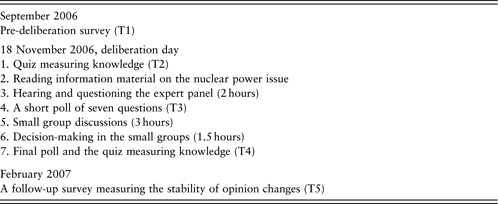
Table 1 shows the phases of the experiment, and the five surveys conducted during the experiment (T1–T5). The first phase was the recruitment of participants, which was a three-stage procedure. First, a random sample of 2500 persons among all eligible voters in the constituency of Turku region was drawn.Footnote 4 A preliminary invitation to take part in the citizen deliberation was sent out in September, accompanied by the first survey (T1).Footnote 5 The invitation included information where participants were promised a remuneration of 100 Euros, free meals during the day, and a compensation for travel costs. The survey was answered and returned by 23.7% (n = 592) of the sample, and 244 of the respondents agreed to participate in the event. Therefore, the second stage of the recruitment process was based on self-selection. A reminder to return the survey was considered unnecessary as there were more than enough volunteers. At the third stage of the recruitment process, the number of participants was cut down so that the target sample of 144 people, that is, 12 small groups consisting of 12 persons each, could be reached. We invited 194 of the 244 volunteered to take part in the citizen deliberation event. This selection was based on strata in order to guarantee equal representation in terms of age and gender. Within strata, random sampling was exploited. Of the invited, 135 participants finally showed up.
The timeframe of the experiment

Brown (Reference Brown2006: 212, 213) has pointed out that even though random selection of potential participants is often used in order to achieve representativeness in deliberative mini-publics, random sampling does not guarantee equal opportunity for everyone to participate. Rather, it provides an equal probability of being chosen to participate. Especially, the phase of self-selection can lead to deliberation among elite citizens. Although random sampling was the primary method in our experiment, the participants were not fully representative of the general public. First of all, men were slightly overrepresented among participants, even though there was a gender balance among the invited.Footnote 6 On average, the participants were also more educated than the adult Finnish population at large. When it comes to age, the participants corresponded to the age structure of the voting-age population. Concerning political activity, the participants were more active than the non-volunteered respondents who filled in the survey at T1. The participants also had more internal efficacy (for similar findings, see e.g. French and Laver, Reference French and Laver2009: 433). In an experiment based on people’s willingness to participate, this pattern is difficult to avoid. Citizens who are interested and active in politics are more likely to take part in political events, also of an experimental nature. Nevertheless, the participants were equally divided between supporters and opponents of nuclear power, thus corresponding to the opinion structure measured among the non-volunteered.
The deliberation day started with a quiz including 10 questions on energy politics and five questions addressing general political knowledge (T2). After completing the quiz, the participants were asked to read briefing material on nuclear energy. An expert panel was then heard and questioned in a plenary session. The panel consisted of two experts supporting nuclear energy, a member of parliament from the National Coalition Party and the director of communications of a nuclear power company; and two experts opposing it, a member of parliament from the Green Party and a representative from the Finnish Association for Nature Conservation. Each member of the panel made a short presentation after which the participants were allowed to pose questions to the experts.Footnote 7
After the plenary session, the participants completed a short survey of seven questions measuring energy opinions. The goal of this survey was to gauge possible effects by the provided information and the expert panel (T3). The actual deliberation took place in 12 small groups. These groups consisted of 10–13 members. The discussions were moderated and the participants were asked to follow deliberative rules of discussion, such as giving respect to others’ opinions and justifying one’s own views. In the beginning of the group discussions, each participant stated a viewpoint, which they wished to be discussed, and a free discussion on those viewpoints followed. The discussions lasted for 3 hours, after which the groups were asked to make a decision on whether a sixth nuclear power plant should be built in Finland. After this, the sessions ended with a survey with the same questions as in the first survey in September (apart from the background variables), the participants’ evaluations of the experiment, as well as a replication of the quiz measuring knowledge (T4). In February 2007, a follow-up survey was conducted (T5).
One may raise the question whether the fact that the citizen deliberation experiment did not have any direct impact on Finnish energy policy undermined participants’ motivation to deliberate. Nonetheless, the reports written by the small group moderators show that with very few exceptions, all participants were both motivated and serious about their task of deliberation and decision-making. The small group discussions were also audio-recorded and transcribed. The transcriptions of group discussions indicate that, in accordance with our theoretical expectations, the deliberative process was more thoroughgoing in the common statement groups than in the secret ballot groups. First, the process of deliberation was somewhat longer in the common statement groups. Second, there are indications that deliberation aiming at a common statement was different from deliberation ending in secret ballot. The transcriptions suggest that the process of writing a statement brought about more intense and focused deliberation on alternative energy policies. Discussions aiming at a common statement were also more inclusive because each group member had to consider the acceptability of the viewpoints and facts to be included in the statement.Footnote 8
4 Results
In the following, the research hypotheses are tested. Individual survey responses were measured before and after deliberation (pre-/post-test design), and these changes are analyzed statistically using t-tests. All analyses are carried out within the group of participants of the citizen deliberation experiment (N = 135).Footnote 9 Hypothesis 1 concerns knowledge gain. How did the provided information and deliberation in small groups influence the participants’ level of knowledge? We measured the participants’ objective level of knowledge on energy issues as well as their general political knowledge twice, at the beginning (T2) and at the end (T4) of the deliberation day.
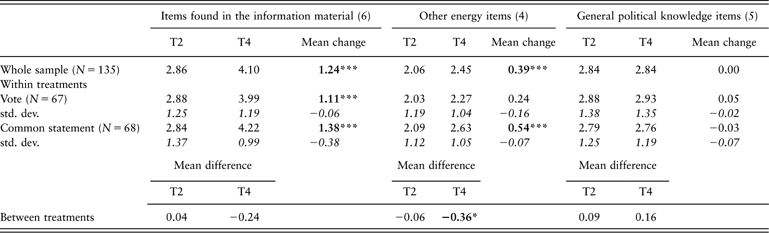
In the quiz, there were 10 questions measuring knowledge on nuclear power and other energy issues, as well as five questions pertaining to general political knowledge. Six of the energy questions could be answered by reading the information material given to the participants after the first measurement of knowledge.Footnote 10 In Table 2, the development political knowledge is analyzed in the whole sample, within the two treatments as well as between them. The information items are handled in three groups. First, we want to see how well the participants acquired the information included in the written material. Second, the impact of deliberation can be traced by analyzing those four energy-related information items for which no answer could be found in the information material. Third, a control is made through using the remaining five items measuring general political knowledge.
The participants’ knowledge levels before and after the deliberation day. The sum of correct answers (arithmetic mean)

Statistically significant at the * 0.05 level; ** 0.01 level; *** 0.001 level; (two-tailed test).
A glance at the whole sample verifies that there indeed were clear information gains during the day. Not surprisingly, the largest knowledge increases are achieved among the questions to which answers could be found in the information material. On average, the respondents knew the right answer to almost three out of six questions in the beginning, but at the end of the day, over four answers were correct. There is a mean increase of 1.24 correct answers, statistically significant at the 0.001 level. Also knowledge of the four energy-related questions not included in the information material shows a statistically significant increase in the whole sample. General political knowledge did not, however, increase during the day, which seems quite logical. These results are in line with results from other deliberative experiments. The experience of deliberative mini-publics suggests that through deliberation participants acquire more knowledge on the issue at hand (Luskin et al., Reference Luskin, Fishkin and Jowell2002; Barabas, Reference Barabas2004; Hansen, Reference Hansen2004).
It has been claimed, however, that the research design of experiments on deliberation makes it impossible to determine whether participants acquire knowledge primarily through reading information materials, listening to expert panels, or deliberating in small groups (cf. Muhlberger, Reference Muhlberger2006: 3). Since everything, including the reading of the information material, happened in the course of one single day in our experiment, it was not considered meaningful to measure knowledge levels three times. Therefore, we are not in the position to establish to what extent knowledge gains were based on the provided information on the one hand and small group deliberation on the other hand. Nevertheless, the setting of our experiment with two treatments casts some additional light on this matter.
When we look at the two treatments, the participants’ knowledge increased somewhat more in the common statement treatment. Both treatments show, however, a similar development in relation to the dispersion of knowledge. The decreases in standard deviation indicate that the participants became more uniformly informed on all energy issues in both treatments. Perhaps the most interesting finding is in the second column, which shows that the members of the common statement groups gained more knowledge on energy questions to which no answer could be found in the written material. It seems that, as anticipated, common statement as a decision-making method had a more positive impact on the participants’ knowledge on energy issues. This is also verified by the independent samples t-tests at T4, where the common statement participants show a significantly higher level of energy-related knowledge on items not available in the information package. The information exchanged among participants in the course of deliberation led to larger learning effects in the common statement treatment. When all 10 energy items are combined (not shown in Table 2), the sum variable shows a statistically significant increase only in the common statement treatment (significance = 0.001). As the requirement of a common statement led to a more thoroughgoing deliberation, the finding supports the view that not only the provided information, but also deliberation contributed to an increase in knowledge. Hypothesis 1 has been corroborated, and hypothesis 6 has gained support on this matter.
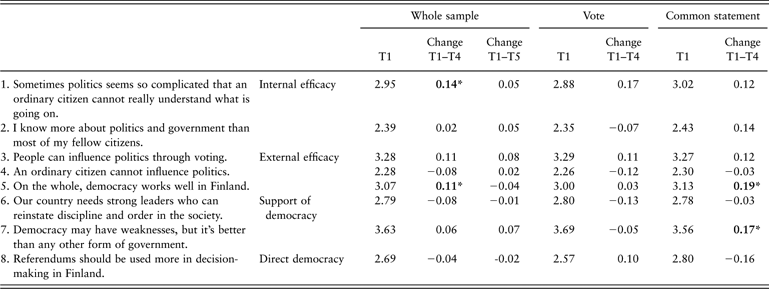
In Table 3, we analyze statements that measure internal and external political efficacy and other relevant democratic attitudes. There were three measurement points for these items (T1, T4, and T5), and the comparisons are made between them in the whole sample. As no changes prevail at T5, the analysis within treatments in the table displays only comparisons between T1 and T4. Two major results emerge. First, there are only minor changes during the process. Second, there are no substantial differences between treatments. When it comes to hypothesis 2, there is no increase in the participants’ internal efficacy (statements 1 and 2). On the contrary, there is a slight decrease in internal efficacy (statement 1) at the end of the deliberation day. It appears that the confrontation with written and oral information, as well as deliberation in groups led to an increased feeling that politics is complicated. Therefore, hypothesis 2 does not gain support in light of the analysis.
The development of political efficacy and opinions on democracy

Coding of the statements: 1 = ‘fully disagree’; 2 = ‘partially disagree’; 3 = ‘partially agree’; 4 = ‘fully agree’.
Significance levels as in Table 2.
Next, we move on to hypothesis 3, which concerns external efficacy and political trust. Within the whole sample, there is a significant increase concerning the functioning of democracy in Finland (statement 5), but there are no significant changes on other items measuring external efficacy (statements 3 and 4). Moreover, the development of satisfaction with Finnish democracy and support for democracy as a form of government shows some differences between treatments. Within the common statement procedure, both the evaluation of the functioning of Finnish democracy and support for a democratic form of government increase, whereas this cannot be observed in the vote treatment. It should be noted, however, that when the levels are tested between treatments (not displayed in Table 3), they are not statistically significant. What is more, none of these increases prevail at T5.
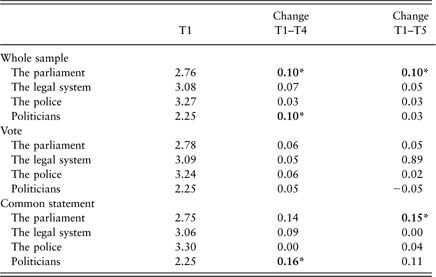
In Table 4, the development of trust in public institutions is studied. Two significant changes in trust have occurred between T1 and T4, that is, an increase in trust in the parliament as well as in politicians. This increase is a result of deliberation, and it supports our theoretical expectation that deliberation makes people more trusting toward representative actors and institutions. When we analyze the development within treatments, the common statement procedure seems to have led to more significant changes. Trust in parliament and politicians increased more in the common statement treatment, and the higher trust in parliament prevails at T5 (the increase at T4 was significant at the 0.1-level). Based on the analysis in Tables 3 and 4, our hypotheses 3 and 4 gain some support.
The development of political trust. ‘How much do you trust the following Finnish institutions?’

Scale: 1 = ‘just a little’; 2 = ‘not very much’; 3 = ‘quite a lot’; 4 = ‘a great deal’
Significance levels as in Table 2.
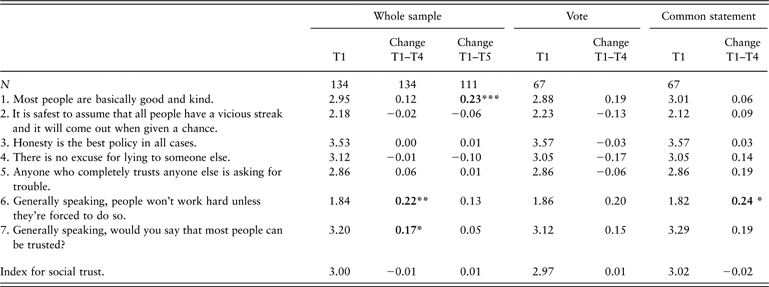
Social trust and other-regarding attitudes (hypothesis 4) were measured through a ‘Machiavellian’ set of six statements (cf. Marks and Lindsay, Reference Marks and Lindsay1966). These, together with a standard question on generalized interpersonal trust were used to construct a social trust index. The development of social trust is examined in Table 5.Footnote 11 The social trust index does not change between the different points of measurement. Among the individual items, however, there are changes in two. There is a small increase in generalized social trust after deliberation, which corresponds to our theoretical expectations.
The development of social trust among the participants

Somewhat unexpectedly, there is also a small increase in support for the claim that people do not work hard unless they are forced to do so, although this view has a low support altogether. Maybe the fact that the participants had worked hard under supervision during the experiment influenced some participants’ views when filling in the survey at the end of the day. This assumption is backed up by the fact that this view increased especially in the common statement treatment, where the participants had to work slightly longer when drafting the statement. At T5, there is an increase of support for statement 1: ‘most people are kind’. The increase has occurred between T4 and T5, which means that this change may not have been due to participation in the citizen deliberation experiment. Contrary to our hypothesis 6, there is no substantial difference between treatments concerning social trust.
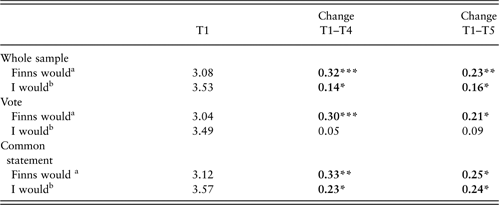
We also measured the participants’ inclination for voluntary collective action with two statements concerning an energy-specific issue (hypothesis 4). More concretely, they measure the respondents’ readiness to save electricity under shortage and other people’s willingness to do the same. As can be seen in Table 6, the two statements show a statistically significant and persistent increase. The participants’ own willingness to save electricity was high to begin with, so there was little room for an increase. The most significant increase is in the participants’ belief in other Finns’ willingness to save electricity if necessary. This can depend on the fact that the deliberative setting encouraged expressions of socially desirable motivations, which, in turn, gave rise to positive perceptions concerning others’ motivations. Electricity saving can be regarded as a kind of collective action that is in everybody’s interests and does not include any partisan or controversial ends (cf. Pellikaan and van der Veen, Reference Pellikaan and van der Veen2002: 14).
The development of belief in and preparedness for collective action

a Finns would save electricity if there was a lack of it and they were asked to do so.
b I would save electricity if there was a lack of it and I was asked to do so.
Significance levels as in Table 2.
Coding of the statements as in Table 3.
Both the increase in personal preparedness to save electricity and in the belief in other people’s willingness to do the same prevailed in the follow-up survey T5. This suggests that the changes in participants’ motivations and beliefs concerning this issue have been quite profound. There is also one notable difference between the treatments. The common statement procedure increased the participants’ own willingness to save electricity if needed, whereas there was no such effect in the vote treatment. The difference was also significant between the treatments at T4 (P = 0.03, not displayed in Table 6). This difference may be due to the fact that the formulation of a common statement encouraged cooperativeness among the participants, which in turn had a positive effect on the participants’ propensity for collective action. The results in Tables 5 and 6 give some support for hypothesis 4, and also give some support for hypothesis 6.
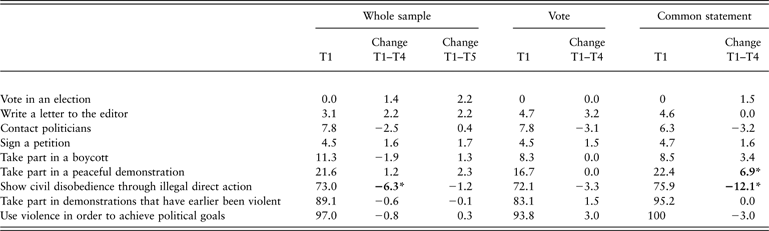
Finally, in Table 7, we look at the development of the participants’ readiness for political action. Political participation was measured through standard questions with the alternatives of ‘have done’, ‘have not done but might do’, and ‘would never do’. The measurement was carried out at T1, T4, and T5. Given the question wording and the short time frame between T4 and T5, it would not be realistic to anticipate that the mode of ‘has done’ would have increased as a result of deliberation. Therefore, we analyze the share of respondents who choose ‘would never do’ in order to see whether the readiness for political participation actually changed in the course of the experiment. Many of the political action items do not vary among the group of participants. Voting, writing a letter to the editor, and signing a petition as well as contacting a politician are almost unanimously accepted as potential forms of participation. Conversely, political violence is not accepted by the participants. Given the starting point and the total absence of violence in Finnish politics, only boycotts, peaceful demonstrations, and civil disobedience had real potential to increase as a result of deliberation.
Propensity for political action among the participants (Percentage of would never do).

‘The following statements concern different forms of political action’.
‘If an issue were important to you, what would you do in order to influence politics?’
‘Please tell me what you have done, what you might do, or what you would never do?’
The variables have been coded in the following manner:
1 = ‘would never do’; 0 = ‘has done’; 0 = ‘might do’; don’t know’s have been coded as missing.
Significance levels as in Table 2.
There are only minor changes in the table between T1 and T4. The readiness for civil disobedience through illegal direct action grows a little during deliberation. Before deliberation, 73% announced that they would never do this. After deliberation, the share has gone down to two-thirds. In our control survey in February, the share has gone up again close to the initial level. Therefore, the slightly increased preparedness to show civil disobedience seems to have been a temporary rather than a permanent phenomenon. There is, however, an interesting difference between the treatments concerning civil disobedience. Participants in the common statement treatment show an increase of readiness to civil disobedience, whereas the same does not apply to participants in the vote treatment. It should be noted, on the other hand, that participants in the common statement treatment show an increased reluctance toward peaceful demonstrations after deliberation. Our hypothesis 5, which anticipated that deliberation would increase the readiness to act politically does not gain convincing support in light of the analysis. Being exposed to different views did not, however, lead to an increased passivity either, as Mutz (Reference Mutz2006) suggests.
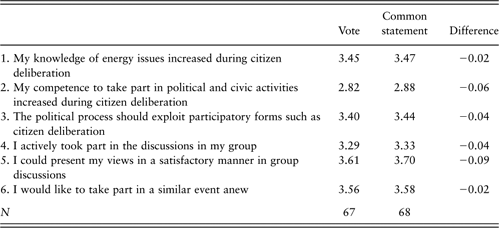
We have also exploited a set of statements, the participants’ ‘feelings’ about the experiment, in order to gauge further possible differences between the treatments in relation to civic skills and political action. These five statements are presented in Table 8. There are no statistically significant differences between the two treatments in this respect. Most participants found (correctly) that their knowledge on energy issues increased during the experiment. Most people also found that they could present their views in a satisfactory manner in the discussions and that they actively took part in them. There was also a strong support for more use of citizen deliberation methods in the political process (statement 3), and the participants were willing to take part in a similar event again (statement 6).

We can conclude this section in the following manner. Hypothesis 1 is verified, hypotheses 3 and 4 are partially verified. Hypothesis 2 is not verified. Hypothesis 5 is neither verified, nor falsified. Finally, hypothesis 6, which claims that consensus-oriented deliberation creates more civic virtues can be considered as partially verified. This applies especially to hypothesis 1 (knowledge), but also to hypotheses 3 (external efficacy and political trust) and 4 (collective action).
6 Conclusions
In this article, we have analyzed the impact of participation in a citizen deliberation experiment on the participants’ civic virtues. More precisely, we have taken a look at their civic competence, social and political trust, and their inclination to collective and political action. Our experiment was designed to study how different decision-making procedures affect democratic deliberation and its outcomes. Half of our subjects were exposed to a common statement treatment, whereas half of them used secret ballot as a decision-making method. Both treatments were expected to reach a decision on the question at hand, that is, nuclear power. We anticipated more civic virtue increase in the common statement procedure, because this procedure was expected to bring about a more thorough deliberation and cooperative problem-solving. In fact, this assumption was to some extent verified. This finding calls for further experimental research on democratic deliberation focusing on the impact of decision-making procedures.
Among the participants of the citizen deliberation experiment, the level of knowledge on energy politics increased clearly, which is in line with our theoretical expectations and earlier empirical findings. It is also worth pointing out that the level of knowledge increased more in the common statement groups, which can be a consequence of a more thorough deliberative process within these groups. Despite the increase in the level of knowledge, there was a slight increase among all participants in the perception that politics sometimes is too complicated for ordinary citizens. The epistemic complexity of the nuclear power issue probably explains this increase. The decrease in internal efficacy contradicts the results of some previous empirical studies.
Trust in representative actors (politicians) and institutions (parliament) increased among the participants. Also satisfaction with democracy in general and Finnish democracy in particular increased. These changes were larger in the common statement treatment. The common statement procedure, in particular, seems to have made the participants more aware of the necessity of compromise in politics, and thus understanding of the institutions and actors of representative democracy. The effects of deliberation on generalized interpersonal trust were small but positive, and there were no differences between treatments in this respect. It is noticeable that deliberation increased the participants’ readiness for voluntary collective action when it comes to electricity saving, especially in the common statement treatment. Even more significantly, deliberation increased the participants’ belief that other people would be ready to save electricity. This may be interpreted as a consequence of the fact that a deliberative setting encourages expressions of socially desirable motivations. Undoubtedly, saving electricity under shortage was acceptable to all participants, regardless of their views on energy politics.
The clear increase in the preparedness for this type of collective action is especially notable considering the absence of significant changes in items measuring the preparedness for political action. The participants of the experiment did not become more prone to engage in political action, apart from the temporary increase in their propensity for civil disobedience. This finding appears to be related to the fact that participants’ external political efficacy did not increase either. It is worth pointing out, however, that the participants’ proneness to political participation did not decrease, which would have been in line with Mutz’s argument that exposure to conflicting views reduces people’s willingness to act for political goals.
Acknowledgement
The research was kindly funded by Åbo Akademi Foundation, the Academy of Finland and the Society of Swedish Literature in Finland. The authors thank Prof. James Fishkin, Prof. Arthur Lupia, and Prof. Brigitte Geissel, the anonymous referees of EPSR as well as participants at several research seminars; particularly at the ECPR joint sessions of workshops in Helsinki 2007 and at the CPSA 2008 Conference in Vancouver for their valuable comments and suggestions. The authors especially thank Staffan Himmelroos for organizing the experiment and assisting them in the research process.