I
In early modern Europe, a fugitive existence was the price often attached to heterodoxy or dissidence. Those whose beliefs challenged the status quo had to stay one step ahead of the religious and political authorities that guarded it. They were thus forced to spend much of their lives either in hiding or on the run. In fact, the latter state was a response to an escalation in the danger already associated with the former. By publishing anonymously or ensuring that meetings with like-minded contemporaries took place in secret, heterodox and dissident thinkers could ward off the greater danger that would arise if the authorities got wind of their activities or if their cover was blown. Should this, however, happen, then a discreet tip-off or an astute inference could provide a window of opportunity in which to take to the road and seek out a safer haven or more tolerant abode.
Of course, in many cases, the precautions were either insufficient or the tip-off came too late. Early in the morning on 7 April 1789, the German theologian Carl Friedrich Bahrdt (1741–92) was woken by his secretary and called downstairs to the wine garden that he had managed on the outskirts of Halle. Ten years earlier, Bahrdt had found refuge in the Prussian university town after fleeing punishment by the authorities of the old Reich on account of his profanizing translations of the Bible. In the interim, the situation had, however, changed. August 1786 had seen the death of Frederick the Great, the enlightened Prussian monarch, under whose rule Bahrdt had found protection. He had been succeeded by his not-so-enlightened nephew Frederick William II. On that early spring morning in 1789, Bahrdt realized that he was about to pay a price for the resistance he had mounted against the policies of the new regime. From his vantage point overlooking the river Saale, he could see three bailiffs of the court approaching the wine garden. As they drew nearer, Bahrdt thought of mounting his horse and fleeing the scene. In contrast to the situation ten years earlier, there was, however, neither the time to escape nor the safe haven awaiting him, were his escape to be initially successful. This time, flight was not an option.Footnote 1
The lengthy interrogations and fifteenth months of imprisonment that awaited Bahrdt might seem to earn him a place among the numerous other heretics and dissidents who on account of their beliefs suffered similar hardship at the hands of the authorities. If Marx, however, taught us that the tragedies in history often repeat themselves in the guise of farce, then his claim – beyond its original application to the Second French Empire – finds further vindication by considering the case of Bahrdt. Admittedly, such a remark at first appears uncharitable; after all, imprisonment and interrogation are unpleasant experiences and as such more the stuff of tragedy than farce. Yet an element of farce was already present in the earlier episode, when in 1779 Bahrdt had felt compelled to flee eastwards across the territory of the Reich and seek Prussian protection. Well-informed observers of this episode already knew that Bahrdt was not just eluding the imperial authorities. His sudden departure from Heidesheim on the Rhine, where he had been attempting to administer a school in accordance with the programme of pedagogical reform known as Philanthropinism, saved him from creditors demanding repayment of their investment in this project.Footnote 2 Even more egregiously, Bahrdt, a Protestant preacher and family man with wife and children, had fathered twin girls with one of the maids who worked at the school. Thus, in his final months in Heidesheim, Bahrdt was facing the prospect of financial ruin and social disgrace.
And yet all this impending ignominy was obscured by another crisis. Two years earlier, Bahrdt had published a second edition of his modernizing reinterpretation of the Holy Word, The most recent revelations of God, told in letters and stories.Footnote 3 The imperial authorities, who had taken no measures against the first edition, responded this time by declaring the translation to be an exercise in profanation and issuing a Conclusum enforcing Bahrdt's suspension from all official positions. Conceivably, Bahrdt could have defused the situation by publicly declaring his belief in the core articles of Christianity and then continuing to do what he had done in the past, namely: ‘preach orthodoxy while cunningly hiding his heterodoxy’.Footnote 4 Instead he did the opposite. His escape to Prussia was accompanied by the publication of a Glaubensbekenntnis (Profession of faith), in which Bahrdt disavowed any belief in original sin, in the divinity of Jesus Christ, in the doctrine of his crucifixion for the atonement of mankind's sins, in the eternal torments of hell and other such doctrines.Footnote 5 Upon arriving in Halle, pious townsfolk made the sign of the cross when Bahrdt passed on the street. They did so because of his reputation as a ‘heretic’: an imputation that conveniently overshadowed the other scandalous details about Bahrdt's life.Footnote 6
If the status of persecuted heretic was preferable to that of amoral reprobate, this was in large part because under an enlightened regime such as that of Frederician Prussia ‘heretics’ could expect a higher degree of toleration than had been the case in past centuries. The sense that this liberal attitude was in danger upon the accession of Frederick's successor was seemingly vindicated when Johann Christian Woellner, the new cultural minister, promulgated the Edict on Religion in July 1788. Although this Edict was not as draconian and regressive as the voices of protest claimed at the time, it clearly announced the end to any toleration of public expressions of heterodoxy. A remarkable debate ensued, made up of over a hundred pamphlets. The most scurrilous of them was an anonymous play, which did not shy away from directly criticizing the monarch. Bahrdt insisted that he had only arranged its publication, yet the suspicion that he was the author was in fact the reason for the visit the three bailiffs paid Bahrdt at his wine garden in April 1789.Footnote 7
This article will, however, focus on the other reason for Bahrdt's subsequent detainment. Sometime in the mid-1780s, Bahrdt organized a secret society that began convening at his wine garden as an irregular (i.e. not formally recognized) lodge. The fact that the core group numbered twenty-two members seems to have been the reason why the organization referred to itself as the Society of the XXII.Footnote 8 The adoption of the second name German Union indicates a further stage in the organization's history, in which it reconstituted itself as a corresponding society with branches extending throughout Germany and beyond.Footnote 9 It presented itself to prospective members as a necessary – and necessarily clandestine – ‘counter-balance’ to off-set the ascendancy of those ‘proponents of enthusiasm and superstition’ who particularly in Prussia had assumed positions of power.Footnote 10 Apart from its free cities, the German lands remained a patchwork of absolutist monarchies and principalities, none of which foresaw a legally sanctioned place for organized opposition. If opposition was therefore to organize itself, it would have to do so covertly.
At first sight, the German Union seems to affirm the thesis put forward in Reinhart Koselleck's classic work Critique and crisis (German original: 1959), particularly with regard to his account of the antagonism between the early modern state and the secret societies of the Enlightenment.Footnote 11 However, closer examination reveals a more complicated situation. Just as there were multiple reasons compelling Bahrdt to seek refuge in Halle in 1779, the following analysis will reveal multiple motives for the secrecy in which Bahrdt's organization veiled itself. The first section of this article will demonstrate that the secrecy of the German Union was not just occasioned by its unsanctioned opposition to the traditional authorities.
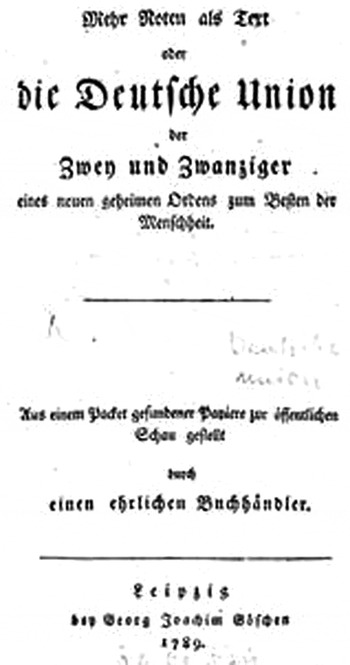
Subsequent sections of this article will engage in some detective work in outlining the forces that conspired to bring about the demise of the German Union. In early 1789, a pamphlet appeared in Leipzig under the title Mehr Noten als Text (MNaT) (More notes than text; see Figure 1 for the title page). Within its 128 pages, it laid before the eyes of the public the manifestos and programmatic texts of the organization (Text) and supplemented this with extensive and often acerbic commentary (Noten). As will be shown, MNaT had been compiled by the translator, publisher, and adviser at the ducal court in Weimar, Johann Joachim Christoph Bode (1731–93). Bode was, however, only one of a number of actors involved in this ‘exposure’ (as such pamphlets that revealed the secrets of a secret society are generally known). The insight this yields into the fractious and clandestine aspects of the eighteenth-century republic of letters once more unsettles an interpretation derived from Koselleck's thesis. This is because the multiplicity of (non-state) actors complicates any attempt to account for the downfall of the German Union in terms of a simple clash between the forces of subversion, as represented by the secret society of the German Union, and the forces of order, as represented by the state authorities. In the conclusion, some insights derived from this inquiry will be mined for their potential to suggest an alternative approach to understanding the changing status of heterodoxy and dissidence in late eighteenth-century Germany.
The title page of Mehr Noten als Text.

II
The two events that bookend the following story, namely: first Bahrdt's founding of the German Union and secondly his subsequent imprisonment, suggest a narrative arc conforming to a simple pattern: the Enlightenment, personified in one its most fearless champions, attempts to resist and even subvert the repressive policies of the late absolutist state; the state then apprehends, interrogates, and finally incarcerates said champion. The fact that Bahrdt's challenge to the state lands him in prison only a few short months before the Parisian crowd storms the Bastille can then take on a symbolic value; east of the Rhine the old order manages to ward off the subversion that west of the Rhine proves to be its undoing. If it was, however, argued above that the reasons compelling Bahrdt to flee across Germany in 1779 are not as simple as they first might seem, then it is wise to approach the secrecy concealing the German Union and the circumstances of Bahrdt's imprisonment with similar circumspection.
The confrontation between the hypostatized entities of the Enlightenment and Absolutism, or alternatively (bourgeois) society and the (early modern) state, underpins Reinhart Koselleck's Critique and crisis. Koselleck's account was first formulated well over half a century ago and yet it frames the drama in accordance with a narrative of subversion whose logic remains beguiling.Footnote 12 Moreover, in characterizing ‘Enlightenment and mystery’ as ‘historical twins’, it suggests a relationship between the public sphere and the arcane sphere, i.e. the sphere constituted by the enthusiasm of the time for secret societies, in a manner that the subsequent literature has rarely articulated with such sharpness.Footnote 13 For this reason, it represents a germane point of reference in trying to contextualize Bahrdt's secret society within the longer narrative of Enlightenment history. Yet while the case of the German Union initially seems to affirm the enduring relevance of Koselleck's perspective, the more detailed investigation to follow also reveals the limits of his interpretation.
Koselleck's commitment to the narrative of subversion derives from the ambiguity he imputes to the confrontation between the early modern state and an increasingly assertive bourgeois society. What were the terms of this confrontation? According to the absolutist model (which Koselleck derived almost completely from Hobbes), politics was the prerogative of the early modern state. Thus, the relationship between state and society could not be political in any sense extending beyond the axiomatic exchange of obedience for security. In the other direction, the nascent bourgeois society could not define its relationship to the state in the moral terms by which it internally regulated and judged the actions of its own members; at least this dispensation of political action from moral critique was deemed valid by those who recognized a doctrine of reasons of state. As a result of this ambiguity, the antagonism between state and society unfolded in an oblique, pseudo-political, pseudo-moralistic register, culminating ultimately in the collapse of the early modern state and in the ascendency of a form of ideologized moral politics, exemplified by the terror of the French Revolution. According to Koselleck, the subversive dynamic had been channelled through two forums: on the one hand, the republic of letters, whose open discourse anticipated the public sphere, and on the other hand, the masonic lodges and secret societies, which constituted a parallel arcane sphere.
Although neither Bahrdt nor his German Union feature in Critique and crisis, it is hard to imagine an organization more congenial to Koselleck's account of how the secret societies developed over the course of the eighteenth century; a development whose culmination according to Critique and crisis occurs in the form of the Illuminati order, the secret society established in 1776 by the professor of canonical law at the university of Ingolstadt, Adam Weishaupt (1748–1830). For Koselleck, this order represented the politicization of the latent antagonism implicit in the self-understanding of the Masonic lodges as extra-political niches, governed only by their own moral laws and thus lying beyond the jurisdiction of the state. It is not a stretch to see in the German Union a further radicalization of this antagonism. The progression was discernible in the attitude towards princes as bearers of state power. Whereas the masonic lodges had been keen to enlist princes as patrons and protectors, the admissibility of princes to the Illuminati formed the object of a protracted dispute within the ranks of the order; despite the benefits that flowed from their patronage, their membership represented an incursion of the old corrupted order into the inner sanctum where the new order was being prepared.Footnote 14 For Bahrdt's German Union, there was no debate: princes and ministers were expressly excluded from membership.Footnote 15
This exclusion suggests that Bahrdt's secret society was edging towards a more overt avowal of its opposition towards state power. And yet, in accordance with Koselleck's thesis, this opposition was still loath to admit its political character; the German Union, after all, aspired not to political power, but rather to a ‘moral power over the nation’.Footnote 16 This ambition testifies to the conflation of politics and morality diagnosed by Koselleck as symptomatic of those who in their moral critique of the absolutist state no longer honoured its fundamental political achievement of imposing order upon a Europe recently ravaged by religious civil war. If Critique and crisis makes no mention of Bahrdt's conceit of a ‘moral power over the nation’, the note that Bode attaches to this expression can stand in for the sentiment such an expression might have elicited from Koselleck:
How modestly this man [i.e. Bahrdt] calls the power that the Union achieves in this form over the nation a ‘moral power’! This Union will presumably coerce the nation not through a standing army nor through a formal inquisition but only guide it through the unity of thought, or rather non-thought, in other words through an undisputed Enlightenment.Footnote 17
While admittedly formulated in a more polemical diction, one feels that Koselleck could not have said it better himself, particularly because Bode seems to sense the ‘totalitarian’ character of an Enlightenment incapable of distinguishing between politics and morality.
The means by which Bahrdt planned to attain this moral power over the nation likewise speak to another feature of Koselleck's account. In a letter Bahrdt wrote in 1782 to Franz Dietrich Freiherrn von Ditfurth (1738–1813), an assessor at the Imperial Court in Wetzlar, he reported on how he had for many years been toying with an idea that he saw as simply a ‘castle in the air’ but which in an epiphany-like moment he had connected with Freemasonry. A postscript to the letter elaborates upon his belief that there had to be a thread ‘on which all people in all parts of the world can pull without any of them knowing that this is the thread of Freemasonry…In short there has to be something in the eyes of the public which is entirely different from what the public thinks it is.’Footnote 18 Bahrdt then revealed that books and journals would be this ‘something’: although appearing to the public in the innocent guise of reading material, they would actually function as secret conduits of influence for the society Bahrdt was envisioning. In formulating the plans five years later for the German Union (plans then MNaT subsequently revealed to the public), Bahrdt built upon these ideas. He foresaw a network of reading societies that served as a cover for the secret society and at the same time provided an audience and a market for the literature the society would distribute. In this manner, Bahrdt hoped to achieve a secret monopoly over the German book market, while at the same time guiding the nation in a pro-Enlightenment direction. As hare-brained as this plan was, it can be seen as an ingenious attempt to interlock those two dimensions of bourgeois society identified by Koselleck as so corrosive to the old order, namely the public and the arcane sphere.
Thus, an examination of the German Union relying largely on the material reproduced in MNaT seems at first highly germane to Koselleck's account of the tension between the state and bourgeois society in the early modern period. However, if we shift the focus from the contents of MNaT to the circumstances of its actual production, aspects of the story come to light which sit less easily with the narrative of subversion. An appreciation of these aspects can begin by noting Carlo Ginzburg's characterization of Koselleck's work as an interpretation that ‘cleverly reworks the old conspiratorial thesis advocated by the Abbé Barruel’.Footnote 19 The Abbé Barruel was the French (ex)-Jesuit publicist whose Mémoires pour servir à l'histoire du Jacobinisme (1797–8) laid before the eyes of the reading public the panoramic vision of a grand conspiracy directed against the old order and culminating in the French Revolution. In this work, Barruel found space to mention and dismiss the allegation that Bode's hand was behind MNaT. The reason for this position lay in Barruel's conviction that the German Union was simply a front for the Illuminati order. Ditfurth had in fact been a member of the Illuminati and provides one reason why the link between the Illuminati and the German Union is not to be totally dismissed out of hand. But there was a problem: this was also true of Bode, the compiler of MNaT. After becoming a member in 1782, Bode swiftly rose to a prominent position in the order. If the German Union was then really a front for the Illuminati, how was it possible to explain the possibility that Bode as a leading member of the Illuminati was responsible for sabotaging it? Faced with this quandary, Barruel was adamant that there was not ‘the least probability that Bode, who had taken so active a part in this conspiracy, would be very forward in laying it open to the public’.Footnote 20 His explanation was that Bode was not responsible for MNaT, but rather the named publisher Georg Joachim Göschen (1752–1828).
If the allegation of Bode's responsibility for MNaT created problems for Barruel, what does its verification imply for Koselleck's interpretation? Admittedly, Koselleck integrated a considerable degree of abstraction into his account, prompting another reader to describe it as a ‘highly sublime form of conspiracy theory’.Footnote 21 From these heights of sublimity, Bode's responsibility for MNaT is reduced from the embarrassment it represented for the likes of Barruel to a mere historical curiosity. And yet an analysis that uncovers the antagonism between two ostensibly pro-Enlightenment figures such as Bahrdt and Bode also reveals countless other fault lines running through the intellectual landscape. As we will see, the ‘Enlightenment’ turns out to be socially fractured to a degree that can easily cast doubt upon its status as more than just a catchphrase of the period (at least in the German-speaking lands where the term Aufklärung found a prominent place in the public discourse of the time). Does this fractured Enlightenment still cohere enough to carry the weight of the role Koselleck assigns it as the protagonist of a grand drama, busily engaged in the work of undermining the old order? More generally, do all the small acts of subversion within the social sphere (such as Bahrdt's German Union and Bode's sabotage of it) still add up to some meta-subversion of state authority as envisaged by Koselleck? After all, if we have multiple subversions working at cross-purposes and even pitted against each other, it is not evident why the aggregate itself should also be modelled as subversion.Footnote 22 As Geoffrey Cubitt has noted against a different thematic backdrop: ‘If conspiracies are varied and numerous, what happens in politics and society is likely only rarely and irregularly to be what any particular set of conspirators has intended.’Footnote 23
The secrecy in which the German Union veiled itself was, in any case, not just the subversive form of secrecy that underpins Koselleck's interpretation and that allowed the secret societies to constitute themselves as a separate sphere. Particularly in the early phases of the organization, Bahrdt had appealed to other qualities of secrecy. In addition to providing the means to conceal and to protect those on the ‘inside’, secrecy also has the capacity to entice and tantalize those on the ‘outside’. Numerous eighteenth-century imposters had exploited this natural curiosity and fleeced the naive of their money by charging high fees for initiation into the secret of the secret societies. In all the subsequent controversy about Bahrdt's society, many who were mindful of such schemes simply dismissed the German Union as a cynical money-making exercise. A lengthy digression in MNaT suggested to readers that the German Union was essentially a throwback to the Dukatensozietät, a society founded in the late 1740s essentially as an eighteenth-century Ponzi-Scheme.Footnote 24
The fact that such insinuations were of a piece with widespread opinion of Bahrdt's character serves as a reminder of another aspect of the secrecy observed, however imperfectly, within the German Union. Because Bahrdt had become such a divisive and controversial figure within the German public sphere, it was imperative to suppress the knowledge that he was the driving force behind the organization. ‘Conceal yourself completely!’ was the advice given to Bahrdt by one supporter, who acted as one of his frontmen.Footnote 25 Observing this imperative should have been viable, at least in theory, because by late 1787 the German Union had transformed itself into a corresponding society. As a result, it operated not so much on the basis of face-to-face interaction but primarily through missives and circulars sent out to members from its centre in Halle or one of its sub-centres. Thus, the secrecy was a means to protect the organization not just from the authorities but also from the negative fall-out potentially caused by Bahrdt's reputation. Interestingly enough, MNaT does not once mention Bahrdt by name, although it contains a knowing allusion to his hand in the affair.Footnote 26 In the published reviews of MNaT and in the repudiations of alleged membership, the fact that he had founded the society and authored its manifestos soon attained the status of an open secret.
The realization that the secrecy of the secret societies had a polyvalent character can also lead to an appreciation of the fact that secrecy was not limited to the arcane sphere of the secret societies but also played its part in the public sphere. This in turn prompts us to revisit another aspect of Koselleck's thesis. In describing the indirect countervailing powers gestated within bourgeois society, Koselleck constructs an intriguing dualism, manifest in the republic of letters and the masonic lodges as institutions beholden to the opposing principles of publicity and secrecy.Footnote 27 As James Van Horn Melton pointed out in a more recent work: ‘The masonic preoccupation with secrecy appears strangely antithetical to the transparency demanded by enlightened journalists and publicists.’Footnote 28 And yet whatever claims for transparency journalists and publicists might have put forward, it was the opacity attending to the experience of dealing with printed material (who is the actual author? who is responsible for circulating it?) that allowed Bahrdt to graft a secret society onto a network of reading societies. An examination of the circumstances behind the appearance of MNaT provides a further salutary reminder that enlightened journalists and publicists (such as Bode) were highly adept at cultivating their own forms of secrecy.
It seems appropriate to draw attention to these arcane aspects of the public sphere by pointing to an episode that predates the German Union and sheds some light on the background to the relationship between Bode and Bahrdt and more generally on the clandestine aspects of publishing in the German-speaking territories of the eighteenth century.Footnote 29 Before resettling in Weimar in 1778, Bode had been a publisher in Hamburg. During this time, he had come to Bahrdt's aid by overseeing the publication of the first edition of The most recent revelation of God, the work whose second edition landed Bahrdt in trouble with the imperial authorities. Admittedly, Bode's involvement in the production of the first edition is not apparent by simply perusing the title page, which names Johann Friedrich Hartknoch in Riga as the publisher. In fact, Hartknoch's name is a ruse; the title page is an example of the kind of trick a publisher might employ in the politically fragmented German-speaking lands if there was a fear of punitive measures imposed by the political and religious authorities. In a letter to Bahrdt from July 1771, Bode reported his concerns about the reaction to Bahrdt's translation from the stalwart defender of Lutheran orthodoxy in Hamburg, Johann Melchior Goeze (1717–86):
In doing the corrections I have found that the book would cause me to completely lose the little friendship that Herr Goeze has shown me until now. Admittedly this is my least worry, but to avoid an unpleasant exchange with him about the last hours of death and the final judgment, I want to come up with a clever strategy, such as a Maskopey with a distant bookseller.Footnote 30
What is a Maskopey? Because the word has disappeared from modern German, the answer will occur more readily to those who recall the Dutch Maatschappij, which denotes an association or a society. If one consults the 85th volume of Krünitz's Ökonomisch-technologische Encyklopädie (1802), this meaning is connoted with nefariousness and surreptitiousness: the Maskopey is ‘an association secretly created to do harm to others’.Footnote 31 The Maskopey Bode eventually devised soon played itself out to the disadvantage of Goeze and – if one were to take Goeze's hard-line, orthodox, point of view – also to the disadvantage of all those souls exposed to the corrupting influence of Bahrdt's translation. Bode printed the books in Hamburg under Hartknoch's impressum and then smuggled them out before ordering them back in. In this manner, he was able to give the finishing touches to the illusion that the books were foreign wares.
Such strategies serve as a reminder that the public sphere constituted by print media was also infused with its own forms of secrecy. They furthermore prompt us to ask how necessary it is to posit the dialectical opposition of Enlightenment and secrecy as thesis and antithesis, which plays such an important role in structuring Koselleck's account. A more situative approach, no longer bewitched by abstract dichotomies, could then demonstrate its sensitivity towards the varying dosages of secrecy and openness at play in various institutional contexts. To some extent, this has already happened in the research that views the secret societies as part of the eighteenth-century public sphere, as counter-intuitive and paradoxical as this might initially seem.Footnote 32
We can keep this debate in the back of our minds in the next section, which seeks to map out the Maskopey behind the production of MNaT. Once more, two publishers will join forces in an arrangement that occurs to the detriment of a third party. The arrangement will provide a further opportunity to observe how in late eighteenth-century Germany circumstances were more complicated than a cursory glance at a title page might initially suggest.
III
A short satirical play published in 1789 imagined Bahrdt's rage in response to the appearance of MNaT: ‘Since the accursed book: Mehr Noten als Text appeared, all of hell is in an uproar! If I had you, you traitor, in my hands, I would…kick you so hard that you would no longer be able to put pen to paper’; and then some pages later: ‘I would like to know the devil who betrayed our secret, it has to have been one of our members.’Footnote 33 The implication was that a turncoat within the organization was responsible for the exposure. This was not true. As will be shown in due course, multiple documents corroborate an attribution of MNaT to Bode. Bode was not a member of the German Union. This therefore raises the question about the source of the material: who gave Bode the manifestos, plans, membership lists, and other documents he presented to the public in his exposure?
MNaT begins with a preface entitled: ‘The Publisher Addressing His Respected Audience’. Given that the Leipzig publisher Johann Georg Göschen is named on the book's cover, it would seem reasonable to assume that Göschen was responsible for these few pages, which justify the contents of the volume as a necessary counter-measure to the monopolistic ambitions of the German Union. And yet in what must count as one of the more bizarre manoeuvres in the smoke-and-mirrors world of late eighteenth-century publishing, Göschen's name, placed at the end of the preface, seemingly in order to underscore his authorship, is followed by an asterisk that references a postscript immediately following the preface. In this postscript, Göschen declares that in fact he did not write the preface. The true state of affairs was clarified by a letter Göschen wrote a decade later detailing the specific authorship of the preface and the broader responsibility for the exposure: ‘Bode in Weimar is the author of the piece Mehr Noten als Text, in which the Union was exposed to the world. I made a contribution to the piece; only the few lines after the preface are my work.’Footnote 34
Bode as a former member of the defunct Illuminati knew full well how the publication of the secret texts could debilitate a secret society. On 1 May 1787, he had set out on a journey from Weimar to Paris. This journey would later take on a sinister significance in the eyes of later conspiracy theorists such as Barruel, who saw in it a vital piece of evidence for the claim that the Illuminati had planned and caused the French Revolution. Barruel had no doubts about the ominous chain of events forming the drum roll in the grand drama of subversion: ‘It had been first set on foot by the arrival of Bode [in Paris]; it was completed at the Club of the Jacobins.’Footnote 35 In fact, the situation was quite the opposite. Only four days after embarking on his journey Bode reached Fulda where a friend and fellow member of the order gave him a book: Einige Originalschriften des Illuminaten Ordens (Some original writings of the Illuminati order). The book was a compilation of these writings seized by the Bavarian government, which in 1784 had launched a campaign to repress the order. It took a few days before the significance of this exposure dawned on Bode. On 7 May, he wrote in his diary: ‘I have every now and again dipped into the book: Einige Originalschriften des Illuminatenordens. The book is highly damaging…It will be difficult to continue regular work after this publication! What a shame!’Footnote 36
A little over a year later, it was Bode's turn to play the saboteur by putting together an exposure, this time targeting the German Union. On 15 March 1789, he could indulge a rather impish hint at his accomplishment in a letter to his friend, the writer and poet Elisa von der Recke (1754–1833): ‘The Union, or the 22, is as good as demolished. Simply get a hold of “Mehr Noten als Text, or the German Union of the 22” from the bookshop, and if you can guess the annotator, so, I entreat you, keep your opinion to yourself.’Footnote 37 Bode's letter obviously indicates that Recke had played no active role in the production of the piece. Such a role would have been conceivable in view of the fact that her name appeared on the membership list printed in MNaT. Furthermore, she had indeed had the other material – the oath and the plans, which Bode had also reprinted – in her hands. As she later explained, at the encouragement of a friend, the naturalist Johann Melchior Beseke (1746–1802), she had initially displayed a conditional interest in membership of the German Union, which she had, however, retracted after examining the plans for the society.Footnote 38
If Recke was not the source of the documents, how did Bode come into their possession? In fact, the evidence suggests that Recke was nearby but not present when the exchange of material occurred. An entry in Bode's diary for 22 October 1788 reads: ‘Began to write the preface and the notes for the exposure of the Union.’Footnote 39 Obviously, Bode had the material at hand by this date. Twelve days earlier, he had met with Recke and the well-known Berlin publisher Friedrich Nicolai (1733–1811) in Naumburg. In fact, in a letter sent to Nicolai on 3 October 1788, Bode puts forward the tavern ‘Zum Scheffel’ as the precise location for their ‘rendez-vous’.Footnote 40 Bode had advised Nicolai, who had been attending the Leipzig book fair, not to set out too late on his journey ‘as the last half or so mile to Naumburg is very hard to follow in the dark’. Nicolai seems to have arrived without mishap and sometime in the course of their meeting, presumably at a moment when Recke was not present, Nicolai handed to Bode the material for MNaT.
How did Nicolai get his hands on this material? A letter dated 17 June 1788 and preserved in his papers provides the answer. The letter was from Matthias Wilhelm von Madeweis (1745–1830), who at the time held the office of master of the masonic lodge in Halle. Madeweis was well informed about the first phase of Bahrdt's masonic activities and had already attempted in the previous year to devise a means of suppressing them. In an appeal to a friend and fellow mason who held a position on the supervisory boards for Prussian universities and schools, he suggested an official statement warning students in Halle about Bahrdt's disreputable practices. In another letter, he informed the Grand Lodge in Berlin about the measures already taken against Bahrdt, including the visit to Bahrdt's wine garden undertaken by a delegate from the lodge in Halle. A letter from the beginning of October reported with some indignation about the futility of these attempts to compel Bahrdt to desist from his activities: Bahrdt was still holding lodges a couple of times a month and charging the sum of 10 Taler for promotion through all degrees. There was the fear that if Bahrdt was not stopped from engaging in this ‘nonsense’ (Unfug), the official lodge would suffer considerable damage.Footnote 41
It is not clear to what degree the Freemasons in Halle appreciated how Bahrdt had resolved at the end of 1787 to transform his pseudo-masonic, ‘irregular’ lodge into a corresponding society. Whatever actual changes Bahrdt had instituted, it presumably seemed to them that he was persisting in his mysterious mischief. It was time to try a new approach. Madeweis therefore wrote to Nicolai in June 1788, beginning his letter in the effusive tones of one masonic brother confiding in another: ‘Mon frère d'Orient! Brand shiny new pieces of news (Ganz funkel nagel neue Neuigkeiten) from the Orient here, dear friend, which will interest you all the more because they relate to plans to ruin you and all your colleagues.’Footnote 42 Despite such flourishes, Madeweis was not appealing to Nicolai as a fellow mason. Rather, in referring to him and his ‘colleagues’, Madeweis was actually alluding to the publishing profession. Presumably, in his reasoning he had taken stock of the failure of the university officials and fellow Freemasons in forcing Bahrdt to relent from his activities. He was therefore willing to try another tack by enlisting the help of a publisher such as Nicolai.
Madeweis felt justified in doing this because he had obviously read the programmes and plans of the German Union and had recognized on this basis that Bahrdt's project was more than just a masonic matter; in addition to this, it pursued the goal of a monopoly over the book trade. Such a monopoly would force non-compliant publishers and book dealers out of business. His letter to Nicolai was accompanied by the following documents: the plan, the oath, the elaboration upon the plan, the list of members. After proudly presenting Nicolai with this material, he concluded his letter by asking for Nicolai's opinion: ‘So what do you say? It is a financial undertaking, draped in a Weishauptian robe, don't you think?’Footnote 43 In Madeweis's estimation, the plan was too poorly conceived to justify any real concern. By the same token, he thought that it would not hurt to draw people's attention to the venture. He therefore left it up to Nicolai to do what he thought was best with the material.
The question still remains about Madeweis's source for this material, given that he also was not a member of the German Union. In fact, he had anticipated Nicolai's curiosity on this very point: ‘How have I come into possession of these trinkets (Sächelchen) while still keeping my Taler in my pocket? Well, dear Nicolai, I am not allowed to tell you that, and you also may tell no one that you have found out about this through me.’ Yet if Madeweis remained tight-lipped about his source, it is hard to resist the speculation that it had something to do with his civilian office as the postal director in Halle. After all, discharging this office would have put him in a prime position to notice the explosion of postal activity emanating from Bahrdt's wine garden after Bahrdt had decided to transform his lodge into a corresponding society. Bahrdt had actually foreseen the importance of postmasters for this undertaking and the plans therefore contain explicit provisions for their targeted recruitment. It was important to bring them onside to protect the society against its enemies.Footnote 44 In fact, the German Union was able to enlist seven such postmasters.Footnote 45 Madeweis was not among them. It does not seem out of the question that Madeweis could not resist the temptation of taking a peek inside the mail issuing forth from Bahrdt's wine garden and that he then decided to direct some of it in a different direction, namely: to Nicolai in Berlin.
At this point, it is worthwhile reviewing the links in the long chain extending from Bahrdt and his secret society to MNaT that, true to its nature as an exposure, revealed the German Union to the public and in doing so sealed its demise. If Bahrdt was an unwitting participant in the production of the exposure by originally producing the secret documents exposed to the public gaze, Madeweis as the postmaster in Halle provides the next link in the chain (although the possibility cannot be entirely discounted that he did not illicitly seize the documents himself but received them from an as-yet-unidentified intermediary). What is clear is that in mid-June 1788, he then sent the material off to Nicolai in Berlin. Four months later, Nicolai passed this material on to Bode at their meeting in Naumburg. Bode returned home to Weimar where he spent the next months adding his notes to the text before sending it off to Göschen in Leipzig. Göschen printed the pamphlet in early 1789. All in all, an impressively convoluted Maskopey!
IV
MNaT did not fail to achieve its desired effect. While the exhortations from the Hallenser Freemasons had at most persuaded him to change the format of his secret society, Bahrdt claimed that upon the appearance of Bode's exposure he ceased all activity associated with the German Union.Footnote 46 Undoubtedly, the most pernicious item in the pamphlet was the list of members, which contained the names of numerous prominent publishers, writers, officials, and other members of the North German Protestant elite. The Weimar publisher Friedrich Justin Bertuch (1747–1822) was the first to respond to the revelation of his alleged membership. He did so by inserting a notice in a February 1789 edition of the literary journal he had helped to find, the Allgemeine Literatur-Zeitung (ALZ). In this notice, he repudiated any formal membership, although he did admit to an exchange of letters with the organization.Footnote 47 Numerous others followed his example by making statements in subsequent editions of the same journal. In these statements, they distanced or dissociated themselves from Bahrdt's organization and protested the inclusion of their names on the list published in MNaT.
Although Bahrdt's name was not to be found on the list nor anywhere else in MNaT, another short pamphlet Nähere Beleuchtung der Deutschen Union (Closer illumination of the German Union), which appeared shortly afterwards, filled in the blank.Footnote 48 The author of this pamphlet, the Leipzig writer Johann Gottlob Schulz, also quoted from some further plans that Bode had not had in his hands. Schulz's source was a secretary formerly employed by Bahrdt, Samuel Christian Röper. Besides supplying Schulz with material, Röper had denounced Bahrdt to the authorities as the author of the play satirizing Woellner's Edict on Religion. This set the wheels in motion leading to Bahrdt's arrest and imprisonment. And yet the judiciary commission, when it passed its sentence in September 1789, also acknowledged the role MNaT had played in extending the investigation to the German Union:
Some time ago a publication appeared in Leipzig with the title: Mehr Noten als Text. The publication gave notice about a secret society, the German Union, or the Association of the Twenty-Two, and the conjecture arose that Dr Bahrdt stood at the centre of this society. Partly for this reason and partly because unfavourable conversations have spread about the purpose of the society, the investigation has also directed its attention to this matter.Footnote 49
In an argument that presumably dismayed the Freemasons, whose earlier direct intervention had been so unsuccessful, the court found that there were no reasons to deny Bahrdt's society the toleration afforded by the Prussian monarchy to other such masonic systems.Footnote 50 The leniency shown in this charge might have been prompted by the consideration of all those other prominent figures throughout Prussia and Northern Germany who had had some affiliation with the German Union. The decision to not punish Bahrdt for these activities spared them the embarrassment caused by their association with a condemned organization. It was a different matter with regard to the authorship of the satirical play. Here, culpability could be more specifically pinpointed (even if Bahrdt stubbornly refused to admit authorship). Bahrdt thus remained in prison as a result of the play and the Freemasons had, at least on one level, reason to be relieved: the German Union was dead.
Curiously, the whole sequence of events leading to the demise of the German Union had been foreseen by the doctor and leading member of its highly active Marburg branch Ernst Gottfried Baldinger (1738–1804). At some time in 1788, he took stock of the society's plans and enumerated the enmities that it could expect to provoke. First on his list were (1) the princes and ministers; in other words the representatives and bearers of state power, who were excluded from membership. Baldinger was, however, aware that the German Union also exposed itself to the hostility of (2) ‘all book dealers’ and to (3) ‘Freemasons of all constitutions’.Footnote 51 As prescient as Baldinger's words were, his list actually records in reverse order the series of blows delivered to the German Union. After all, the state authorities arrived late at the scene; their prosecution of Bahrdt had been preceded by the sabotage orchestrated by Bode and Göschen as booksellers, and their intervention followed in turn upon the footsteps of the Freemasons who had tried to suppress Bahrdt's activities.
Of course, it can be asked whether Bode's actions were motivated by his concern for the book trade or by his investment in the world of secret societies. It is in any case interesting that another prophetic remark had noted how he represented a dire threat to the German Union. In July 1788, Adolph Freiherr Knigge (1752–96), the writer and former member of the Illuminati now attending to his estates near Hannover, received a visit from a member of the German Union. It was Knigge who had originally recruited Bode as a member of the Illuminati in 1782. Knigge's subsequent expulsion from the order two years later as a result of a dispute about a planned reform had paved the way for Bode's elevation to a position of effective leadership. In 1788, the bitterness still lingered. Knigge, although chastened by his past experiences with secret societies, lent his support to the German Union. In doing so, he gave unequivocal advice: ‘Beware of Bode in Weimar. He must have no access to us.’Footnote 52 Thanks to Madeweis and Nicolai, Bode, as of October 1788, received unapproved access; the secret manifestos and programmatic texts lay on his writing table. MNaT was the result.
Thus, it was not originally the political authorities but rather other social actors who conspired to scuttle Bahrdt's project. Furthermore, Bode in hiding the role he played behind the veil of anonymity, was not trying to evade persecution from the authorities. Rather, he was undoubtedly concerned about the social backlash, provoked in large part by printing the membership list. In the statement he had sent to the Allgemeine Literatur-Zeitung, Beseke, who had earlier directed Recke's interest to the German Union, complained how the unnamed compiler of MNaT (i.e. Bode) had published a membership list for whose reliability he was not willing to vouch. His annoyance at the cover of anonymity employed by the compiler then gave him the opportunity to lament the culture of the German public sphere in general, characterized as it was by ‘cloak-and-dagger operations’, by a lack of courage, and by the manner in which either ‘the passions or that other scourge that had become so prevalent’, namely: ‘private interest’, were given free rein.Footnote 53 Beseke's comment hardly qualifies as a highly coherent social critique, but it does register some aspects of this culture – such as the tension between the public sphere and private interests – worthy of consideration in the concluding remarks to this inquiry.
V
As the case unfolded between Bahrdt's arrest in April and the judgement passed in September, Madeweis, the postmaster in Halle, wrote to Bertuch in Weimar to keep him appraised of new developments. On 30 June 1789, he informed Bertuch that Bahrdt was in good spirits; he ‘is writing a Volks Moral in prison and is in such good spirits that not even the smallest worry seems to trouble his soul’.Footnote 54 A subsequent letter has no date but presumably was written on 12 or 13 September as it reports on Bahrdt's sentence: two years imprisonment (Festungshaft), which the king had reduced to one year.Footnote 55 A further letter dated 4 November reports that Bahrdt was to be transported any day to Magdeburg where he would remain until his release in July 1790.Footnote 56 Nowhere within these letters does Madeweis hint at the part he played in the sequence of events leading to Bahrdt's arrest. One wonders to what degree his interest in the case was sustained in part by a slightly guilty conscience.
Madeweis's letters also are oblivious to the psychological stress Bahrdt had actually experienced in prison. The assurance of his ‘good spirits’ seems to have been made in ignorance of the despair that befell Bahrdt upon learning from Woellner that his seditious and insolent actions had infuriated the king. Woellner informed Bahrdt that the king was considering a public execution as the condign punishment. This effectively meant that Bahrdt now had the opportunity to assume the central role in a tragic drama culminating in his martyrdom for the cause of heterodoxy. And yet at the critical moment, his resolve departed him. ‘Yes, merciful Sir!’, he wrote to Woellner on 7 June, ‘I now see my errors in such a terrible light that I recognize my imprisonment…not as a punishment (since I have not sinned on purpose) but rather as a kindness rendered by God in leading me onto a better path.’Footnote 57 In beseeching letters to Woellner, Bahrdt detailed his intention to write a book denouncing the Enlightenment. Woellner reported this to the king: Bahrdt now recognized that the enemies of the Christian religion were ‘despicable men’. His book would expose ‘the infamy of the Enlightenment thinkers and reveal to the whole world the evil tricks through which some of them had created a secret society which plotted against Christianity and into which Bahrdt had had the misfortune of being misled’.Footnote 58 It should be noted that Bahrdt never wrote this book; once he felt confident that his life was no longer in danger he went on producing works that continued to challenge the political status quo and the religious orthodoxy. Nevertheless, his apostasy in mid-1789 makes for sobering reading; Bahrdt himself would later excuse his letters to Woellner as ‘products of madness, caused by the prospect of death on the scaffold’.Footnote 59
Above the door of the reading room in the Prussian Privy State Archives in Berlin, where one can read Bahrdt's letters to Wöllner, a motto taken from Spinoza's Tractatus politicus exhorts readers non ridere, non lugere, neque detestari, sed intelligere, i.e. to ‘not mock, lament or execrate human actions, but to understand them’. If we take these words to heart, then the inadequacy of the earlier appeal to Marx's Eighteenth Brumaire becomes apparent; an awareness of the farcical element helps us overcome any naïve tendency to take Bahrdt's story at face value, yet the resulting interpretation is tied more to an attitude of mockery than to one of understanding. Bahrdt's own defence of a passing lapse into madness is similarly problematic. A far more promising prospect of reaching a genuine understanding of these events lies rather in the consideration of a leitmotif running through Bahrdt's life. This is the leitmotif of the ‘project’. On repeated occasions, Bahrdt invested his energies into ventures in education, (self-)publishing, and into the reunion of the Catholic and Protestant confessions. All these undertakings bore the stamp of the project mania which had gripped much of Europe since the late seventeenth century. The German Union was no different. One of his collaborators later reported on Bahrdt's excited state after the sleepless night in which the idea for the German Union had ‘sprung forth from his projecting head’.Footnote 60
It is worth reflecting on several aspects of this general enthusiasm for projects in the seventeenth and eighteenth centuries as the German Union demonstrates how it also left its imprint upon heterodoxy and dissidence. Although most often prey to delusions of grandeur, many early modern projectors strove to integrate a technical rationality into their plans by choosing those means best suited to achieving the ends aimed at by the project. What were the best means to promote Enlightenment? Bahrdt believed to identify them in a secret society grafted onto local reading societies. Of course, this would also double as an effective way to increase the distribution of his own writings. Bahrdt's shrewdness in this regard was typical of the skill demonstrated by many projectors in matching not only ends with means, but also matching their own self-interest – indeed that ‘private interest’ whose baleful influence Beseke so lamented – with the interest of a patron or a broader collective. The dubiousness of this purported congruence rubbed off onto the perception of the projector. As a type, the projector became associated with duplicity. In selling their projects with assurances that their implementation would redound to the benefit of a more general or higher interest, the projectors stereotypically retained a keen eye for any prospect of an improvement in their own fortunes. A cursory remark from Bahrdt summing up his experiences in the early 1780s with the Learned Book Society in Dessau, a venture in self-publishing that later influenced the literary ambitions of the German Union, demonstrates this insouciant sense of enlightened self-interest: ‘I invested money, ran up debts, and in the end, as the Learned Book Society was carried to its grave, I had nothing to show for my patriotism.’Footnote 61 Flippant as the remark might be, it implies that ‘patriotism’, rather than entailing a willingness to make sacrifices, should yield pecuniary gains.Footnote 62 Bahrdt's commitment to the cause of heterodoxy – a cause that in eighteenth-century Germany had embraced an alliance with reason (as opposed to revelation) and in the process come to denote itself as ‘Enlightenment’ – was essentially the same: Bahrdt expected to profit from it. When this commitment instead threatened to cost him his life, he was willing to disavow it.
The incursion of the ‘projecting spirit’ onto the field of religion was registered by the defenders of orthodoxy in a revealing manner: whereas the enemy of orthodoxy had been previously denounced as a heretic, in the eighteenth century there was a tendency to replace the heretic with the conspirator. This sense that Christianity was threatened not by heresy but by conspiracy was articulated by Wöllner in his letter to the king and ultimately generated those grand conspiracy theories associated with names such as Barruel. Documenting further the highly mediated process of reception by which these conspiracy theories found a distant echo in more modern narratives of subversion such as Koselleck's is a task for another day. For now, it suffices to acknowledge the scepticism that is warranted in the face of those views – or derivatives of those views – that equate history with the implementation of a singular conspiratorial plan. A more tenable alternative would instead track the growing confidence of multiple historical subjects, acting independently of each other (and often at cross-purposes), in applying a planning mentality, i.e. a profane calculus of ends and means, to manifold aspects of social life. In short, the ‘projecting age’ (Defoe) teaches us to not look for the plan in history, but rather the people in history learning to plan – most often in accordance with their individual self-interests. In as much as secrecy constitutes a frequently used means in these plans, there are, as Cubitt noted, ‘varied and numerous’ conspiracies in play: Bahrdt's ‘conspiracy’ (i.e. the German Union) against the forces of ‘enthusiasm and superstition’ ends up being sabotaged by Bode's (and Nicolai's and Madeweis's) ‘conspiracy’ against Bahrdt, just as Bode's earlier ‘conspiracy’ (i.e. the Illuminati) had been exposed to a similar act of sabotage.
Even if the story is less about conspirators in the sense of a grand, encompassing conspiracy and more about projectors pursuing private interests, the affinity shared by conspirators and projectors comes into view by considering a common difference to the heretic. Whereas the heretic lives and dies by an ethics of principle (Gesinnungsethik), conspirators and projectors by contrast operate strategically and in accordance with an ethics of consequence (Verantwortungsethik) – and more specifically an ethics of consequence privileging those strategies whose expected consequences align with their own particularized self-interest. As daring and dangerous as their actions might be, their goal is success and happiness not in the next world but rather in this one. The point was made by Bode in MNaT when commenting upon the claim that the German Union was devoted to fulfilling the mission of the founder of Christianity. If one really wants to take Jesus as the role model, then, as Bode noted, one ‘does not desire a kingdom of this world’;Footnote 63 and Bahrdt's vision of a network of reading societies as the basis for a monopoly of the German book market was very much a vision of a ‘kingdom of this world’.
Bode's criticism was astute in its insinuation that the frame of reference for Bahrdt's actions was the here and now. This in turn reflects a more general sea change in the fortunes of heterodoxy. The hour of the uncompromising heterodox thinkers, willing to sacrifice themselves for their beliefs, was over. Moreover, heterodoxy was not the unconditional disadvantage it had once been; under certain circumstances it had even become compatible with self-interest. Indeed, Bahrdt's life demonstrates how in some situations courting controversy and cultivating notoriety by openly defying orthodoxy could even represent the strategically preferable option. The question then became how deep this commitment to heterodoxy actually was. How would it hold up under duress?
Bahrdt's letters to Woellner provide one answer, at least for his specific case. Earlier heretics who lived either on the run or in hiding obviously valued life enough to motivate such attempts to elude their persecutors. Should their evasion, however, fail, then they were loath to do what Bahrdt did, namely: disavow their beliefs. A consideration of Bahrdt's reaction to the prospect of public execution suffices to dispel any claim of kinship with the heretic willing to embrace martyrdom – a claim underscored by numerous (admittedly often ironical) references in the contemporary literature – and reveals instead his kinship with the projectors guided by self-interest. In extremis, self-interest simply meant self-preservation. To the extent that the Enlightenment implied a rational calculation of worldly interests, repudiating it could in certain circumstances represent the enlightened thing to do.
The situation was perhaps most succinctly expressed by Bahrdt himself. In 1782, he had created quite a stir in Halle by anonymously publishing a Kirchen- und Ketzeralmanach, a satirical almanac in which at one point he referred to himself in the third person as ‘the heretic Bahrdt’ in describing an earlier feud with an orthodox theologian. Bahrdt's ridicule latched onto the failure of this particular theologian to appreciate the fact that ‘the actual heretics (die eigentlichen Ketzer) had in fact been dead for centuries’.Footnote 64 Once more a cursory remark, but Bahrdt's own life demonstrates how true it was.