Introduction
In patients with squamous cell carcinoma (SCC) of the head and neck, the role of planned neck dissection following treatment with primary chemoradiation therapy is controversial.Reference Hillel, Fakhry, Pai, Williams, Blanco and Zinreich 1 – Reference Yovino, Settle, Taylor, Wolf, Kwok and Cullen 3 The chances of successful surgical neck salvage diminish once nodal disease has become clinically apparent.
Consequently, the concept of the planned neck dissection has become popular.Reference McHam, Adelstein, Rybicki, Lavertu, Esclamado and Wood 4 However, it is difficult to predict which patients would benefit most from this treatment. A high incidence of persistent cervical nodal disease would support a planned neck dissection approach. Historically, the planned neck dissection has been preferred to the salvage neck dissection as the former allows staging based on pathology, leading to more accurate prognoses and lower neck failure rates. The benefit of a planned neck dissection may vary depending on the original stage of cervical disease.Reference Pellitteri, Ferlito, Rinaldo, Shah, Weber and Lowry 2 However, there is still debate as to the appropriate threshold at which failure to control nodal disease following chemoradiation would justify proceeding with planned neck dissection in all patients in any specific neck stage subgroup.
Further controversy has developed with the increasing availability of positron emission tomography computed tomography (PET-CT) scanning as a modality for assessing residual disease.Reference Pellitteri, Ferlito, Rinaldo, Shah, Weber and Lowry 2 , Reference Lango, Myers and Garden 5 Some centres suggest observation in patients with a residual neck mass, provided there is ongoing regression of disease and the patient has a complete metabolic response on PET-CT at 12 weeks post-treatment.Reference Porceddu, Jarmolowski, Hicks, Ware, Weih and Rischin 6 , Reference Corry, Peters, Fisher, Macann, Jackson and McClure 7 The significant risk of complications following a major surgical procedure such as neck dissection necessitates the development of appropriate management protocols that limit patient morbidity whilst addressing residual disease in a timely fashion.
This study aimed to identify the incidence of persistent viable neck disease in patients with mucosal head and neck SCC after treatment with primary chemoradiation at a tertiary head and neck cancer treatment centre, and specifically aimed to identify any patient subgroup that may benefit from planned neck dissection.
Materials and methods
We performed a retrospective analysis of the medical records of patients treated at Waikato Hospital with primary chemoradiation for SCC of the oral cavity, oropharynx, hypopharynx or larynx between August 2001 and August 2008. Data were collected from a prospectively maintained chemotherapy database developed by the oncology department at Waikato Hospital, Hamilton, New Zealand, and from a review of patient electronic records cross-referenced with hard-copy medical charts.
Patients excluded from the study included those with a nasopharyngeal carcinoma and those with skin or salivary gland primary tumours or distant metastases at presentation. The nasopharyngeal carcinoma group was excluded as this tumour's behaviour differs in many ways from that of other head and neck cancers, including its close association with Epstein–Barr virus infectionReference Henle, Henle, Ho, Burtin, Cachin and Clifford 8 – Reference Niedobitek 11 and its greater sensitivity to radiotherapy and therefore higher curability. The skin and primary salivary gland SCC groups were excluded as the primary treatment modality for these tumours in our unit is surgery. We also excluded any patient who had distant metastases at presentation, no evidence of cervical nodal involvement, primary surgical treatment, or treatment with palliative intent.
All patients included in the study received external beam radiotherapy (66 to 70 Gy) to the primary site, except for one patient who had unknown primary disease. Necks were irradiated with 66–70 Gy to gross disease, 60–63 Gy to high risk areas and 50–56 Gy to low risk prophylactic areas. Five chemotherapy regimens were used concurrently with radiation: cisplatin alone in 27 (64.7 per cent) patients; carboplatin and 5-fluorouracil in 6 (14.3 per cent) patients; intra-arterial cisplatin in 4 (9.5 per cent) patients; cisplatin and 5-fluorouracil in 3 (7.1 per cent) patients; and carboplatin alone in 2 (4.8 per cent) patients. No patient received neoadjuvant chemotherapy.
Eight patients underwent a PET-CT scan. Computed tomography was used to assess 24 patients and magnetic resonance imaging was used to assess 6. The four remaining patients did not have further imaging due to factors such as the palliative nature of their treatment.
A clinical complete response was defined as the absence of visible or palpable disease at the primary site, or at the site of previous neck adenopathy. Radiological complete response was characterised by the absence of lymph nodes with a short axis diameter exceeding 15 mm in the jugulodigastric region of level II, the absence of lymph nodes with a short axis exceeding 10 mm at other sites, and a lack of other radiological features suspicious of residual disease (e.g. peripheral nodal enhancement, loss of normal architecture or central necrosis). Further analysis was performed to determine rates of persistent nodal disease for those patients with early (i.e. node (N) stage 1) or advanced (i.e. N2–3) neck disease at presentation.
Actuarial survival curves were created using the Kaplan–Meier method.
Results
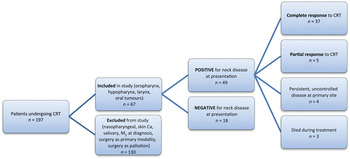
Of 197 head and neck SCC patients identified in the database (Figure 1), 49 had evidence of nodal involvement by mucosal head and neck SCC and were treated with primary chemoradiation. Of these, four were excluded from the analysis due to uncontrolled primary site disease after chemoradiation, as were three patients who died during treatment.
Flow chart depicting patient selection and response to chemoradiation (CRT).

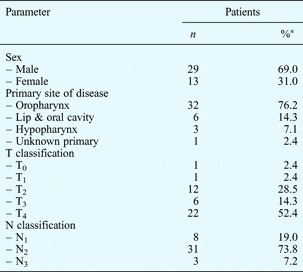
The remaining patients were initially divided into the two groups of interest: those with a complete response and those with a partial response to chemoradiation (Table I and Figure 1). The median follow-up period for the 42 patients included in this analysis was 28 months (mean 28.9, range 7–61 months).
Patient characteristics

* Of total patient study population, n = 42. T = tumour; N = node
Thirty-seven patients achieved a complete response to chemoradiation and five managed only a partial response. The characteristics of the two groups with respect to the primary tumour location are shown in Table II. Of the 37 complete responders to chemoradiation, no patient underwent a neck dissection, either as a planned procedure or for disease recurrence, and 32 (86.5 per cent) remained free of disease recurrence. One patient suffered a metachronous primary: he had initially had a right piriform fossa primary with N2c neck disease, then three years later developed a left oropharyngeal carcinoma with ipsilateral neck disease. This patient was disease-free from his initial piriform fossa tumour and was not included with the five patients with disease recurrence. Two patients (5.4 per cent) failed at the primary site but had no neck recurrence, while three (8.1 per cent) suffered distant metastatic spread. Thus, in our study group no patient who was judged to have shown a complete response to chemoradiation went on to develop recurrent cervical nodal disease.
Patient response by primary tumour location

Data represent patient numbers (percentages of total study population).
Five patients were considered to have a partial response to chemoradiation; all underwent a neck dissection. These five patients had pre-treatment neck stages of N1, N2b, N2c, N2c and N3. One (20 per cent) of the five patients had pathologically positive neck nodes.
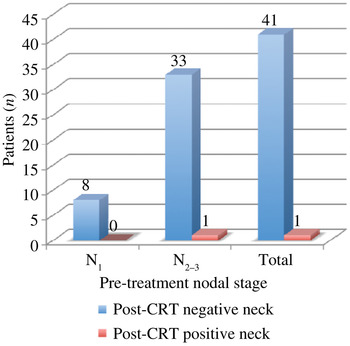
The neck node outcome following chemoradiation was analysed according to nodal status at baseline. Although one of the eight patients in the N1 group achieved only a partial response following chemoradiation, none of the patients in this group was found to have viable residual neck disease. Of the 34 patients in the N2–3 group, 33 (97.1 per cent) were free of neck disease following chemoradiation, while only 1 patient (2.9 per cent) had a pathologically positive neck (Figure 2) despite 4 having achieved a partial response.
Bar chart showing post-chemoradiation (CRT) neck status in relation to pre-treatment nodal (N) group.

Residual viable SCC was found in only one of the five patients with a partial response. Six neck dissections were performed on the five patients: two patients underwent selective neck dissection of levels II–IV (one had concurrent bilateral neck dissections), one underwent selective neck dissection of levels I, II, III and V, and the two remaining patients underwent radical neck dissection.
Two patients who underwent neck dissection died of distant metastases, one at two months following completion of chemoradiation and the other at 30 months. There was no significant complication recorded for any neck dissection performed for residual neck disease following chemoradiation.
The mean time elapsed between diagnosis and proceeding to neck dissection was 6 months (range 5 to 8 months), and the median time elapsed between completion of chemoradiation and proceeding to neck dissection was 2.7 months (mean 2.8, range 2.2–3.5 months).
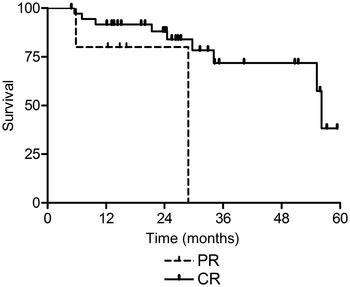
Overall survival for the complete response and partial response groups is shown in Figure 3.
Kaplan–Meier plot showing cause-specific survival according to disease response. Log-rank p = 0.063. PR = partial response; CR = complete response

Discussion
Policies for the surgical treatment of the neck after radical chemoradiation for head and neck SCC vary across institutions. Authors have reported widely differing rates of neck failure, from 0–25 per cent for complete respondersReference Yovino, Settle, Taylor, Wolf, Kwok and Cullen 3 , Reference Corry, Peters, Fisher, Macann, Jackson and McClure 7 , Reference Lavertu, Adelstein, Saxton, Secic, Wanamaker and Eliachar 12 – Reference Armstrong, Pfister, Strong, Heimann, Kraus and Polishook 14 to 0–50 per cent for partial responders.Reference Yovino, Settle, Taylor, Wolf, Kwok and Cullen 3 , Reference Armstrong, Pfister, Strong, Heimann, Kraus and Polishook 14 , Reference Lau, Phan, Mackinnon and Matthews 15 On the balance of current literature, our centre adopted a policy of observation of the neck in patients achieving a complete response after chemoradiation, although it took several years to accumulate sufficient data in our own institution to evaluate outcomes. The results of the present study reinforce our current policy. We have established evidence from our institution confirming that a planned neck dissection is not necessary in the event of a complete response in the neck following radical chemoradiation. Conversely, given the 20 per cent failure rate in the neck for the few patients with a partial response to chemoradiation, we do recommend a neck dissection in these cases. We believe the benefit of a neck dissection in this group outweighs the risks associated with a post-chemoradiation neck dissection.
The specific area of interest of this study made recruiting large numbers of patients difficult even over a 7-year period: 130 patients in the database did not meet our inclusion criteria, and a further 18 were excluded due to lack of neck disease at presentation (Figure 1). Twenty-five of the patients excluded had laryngeal primaries; most had surgery as a primary modality treatment and the remainder lacked nodal disease, or were either treated with palliative intent or received radiotherapy alone. This left no case of laryngeal SCC in the study group (Table I). The relatively small numbers were a limitation of this study. It may be worth repeating this study over the subsequent seven-year period for comparison and to add statistical significance to our institution's results, although changing practice may alter the outcomes over that time period.
As a retrospective audit, this study was limited by its reliance on recorded data from electronic and hard-copy medical charts. Data may have been incomplete; for example, a minor complication of a neck dissection (e.g. minor wound infection) may not have been recorded even if treated appropriately. Furthermore, a prospective study would have been able to maintain contact with patients transferred to other centres.
Another variable in our study was the heterogeneous nature of the chemotherapy: five different regimens were administered. An ideal study would examine only one regimen, although this would restrict numbers even more as the regimens used varied according to patient co-morbidities and other factors. Several of our patients had short follow-up periods, including those with a recent diagnosis (11 patients were diagnosed in the year preceding August 2008). Seven patients died of disease, giving predictably short follow-up periods. Three patients moved centres but were not lost to follow up: their progress and their disease status were recorded. Unfortunately, one patient was lost to follow-up after one year for unknown reasons; this may have been due to moving centres, but no records could confirm this.
In 2006, Pellitteri et al. Reference Pellitteri, Ferlito, Rinaldo, Shah, Weber and Lowry 2 commented that neck dissection performed ‘quite early’ after completion of chemoradiation showed the highest incidence of persistent viable tumour cells. In our study, patients with a partial response showed a median time from completion of chemoradiation to neck dissection of 11.7 weeks, with none having a neck dissection before 9.6 weeks. The 1 patient with residual disease had their neck dissection performed at 9.6 weeks after completion of chemoradiation. We feel this was sufficient delay for this case to be regarded as a case of truly persistent disease. Indeed, several studies have advocated assessing the neck at 12 weeks before making a decision regarding surgical treatment, in order to avoid falsely determining a patient as having residual viable tumour when the tumour was destined to die over time due to a delayed response to chemoradiation.
Positron emission tomography computed tomography is an important imaging modality that is promoted in many centres to assess the neck at 12 weeks. Although it was not routinely used in our centre during the study period, eight selected patients did undergo such scanning. Positron emission tomography computed tomography is an advanced imaging modality that shows potential in assessing clinically or radiologically evident residual lymphadenopathy in patients with head and neck SCC. During the majority of the time period encompassed by this study, PET-CT was relatively difficult to access in New Zealand. The first PET scanner in New Zealand was established in 2006, and construction of a national cyclotron capable of producing Reference Eisenhauer, Therasse, Bogaerts, Schwartz, Sargent and Ford 18 fluorodeoxyglucose took place in 2010. Prior to this, a significant proportion of patients were required to travel to Australia to undergo PET imaging, with resultant delays in establishing their definitive management.
The patient catchment area for the tertiary Waikato head and neck multidisciplinary team (MDT) is geographically dispersed across the central North Island of New Zealand, and consequently the team's imaging acquisition characteristics were not necessarily homogeneous. The radiological protocol established by members of the Waikato head and neck MDT stipulated that all patients should be assessed by axial helical CT with a maximum slice interval of 5 mm and administration of an iodinated intravenous contrast agent. As regards imaging size criteria, previous studies have suggested that nodal positivity should be based on a cut-off threshold of 10–15 mm depending on the nodal level; however, the imaging protocols of different units vary.Reference Dammann, Horger, Mueller-Berg, Schlemmer, Claussen and Hoffman 16 – Reference Yeung, Liauw, Amdur, Mancuso, Hinerman and Morris 19 It has similarly been established that the treatment effects of chemoradiation result in alterations in the characteristics of tissues, which can complicate the assessment of residual disease by procedures that focus on morphology.
-
• Chemoradiation of head and neck squamous cell carcinoma generally enables good primary site and cervical nodal control
-
• Complete chemoradiation response reduces the risk of residual viable tumour
-
• This study's findings support observation of the neck following complete chemoradiation response
-
• Persistent post-chemoradiation lymphadenopathy warrants neck dissection
-
• Positron emission tomography computed tomography may guide the need for surgical intervention after partial chemoradiation response
Positron emission tomography computed tomography has been shown to be highly sensitive for residual nodal disease, with a high negative predictive value.Reference Porceddu, Jarmolowski, Hicks, Ware, Weih and Rischin 6 , Reference Kubota, Yokoyama, Yamaguchi, Ono, Qureshy and Itoh 20 , Reference Gupta, Master, Kannan, Agarwal, Ghsoh-Laskar and Rangarajan 21 However, it currently suffers from a high false positive rate,Reference Kubota, Yokoyama, Yamaguchi, Ono, Qureshy and Itoh 20 – Reference Yao, Graham, Hoffman, Smith, Funk and Graham 22 especially if performed early after completion of chemoradiation. Interpretation of PET-CT is a specialised area of radiology which is still developing, and as such the widespread utilisation and understanding of this imaging modality will improve with time. Interpretation of PET-CT images also depends on the standardised uptake threshold value chosen. Twelve weeks is commonly recommended as the preferred interval for PET-CT imaging following chemoradiation for head and neck SCC, although no optimal time interval has been conclusively determined.
Conclusion
Evidence has emerged supporting the use of interval PET-CT imaging following the completion of chemoradiation for head and neck SCC, to help identify those patients who would benefit from further intervention. However, access to appropriate nuclear medicine facilities and expertise continues to develop and is not universal. Based on current literature and the results of this study, we believe that in certain clinical environments it is appropriate to observe the neck in patients achieving a complete response to chemoradiation, as determined by clinical examination and CT imaging at four to six weeks post-treatment, regardless of the pre-treatment stage of the neck. However, based on the significant rates of persistent disease in patients with a partial response to chemoradiation, we recommend a consolidation neck dissection in this patient subgroup.
Acknowledgement
We would like to thank the oncology department at Waikato Hospital for maintaining the database on which this study was based.