




Non-technical Summary
Of all Early Cretaceous enantiornithine birds (Aves: Ornithothoraces), Longipteryx chaoyangensis, from the 121-million-year-old Jiufotang Formation in northeastern China, has the greatest number of specimens attributable to it. Longipteryx is easily characterized by an elongate rostrum and rostrally restricted large dentition. Although numerous specimens of Longipteryx are present in collections, descriptions of soft tissue traces such as body and wing (remex) plumage, are largely absent in the literature. Here we describe two new specimens of Longipteryx with the best-preserved body and wing plumage thus far, revealing a wing profile likely more narrow than other enantiornithines with remex traces. Additionally, all Longipteryx specimens completely lack ornamental tail feathers despite preservation of other soft tissues. Given the number of described specimens with preserved soft tissues and yet no tail feathers, it is likely this taxon lacked them all together, regardless of sex.
Introduction
The Cretaceous enantiornithines were the most diverse group of Mesozoic birds (Chiappe and Witmer, Reference Chiappe and Witmer2002; O’Connor and Chiappe, Reference O’Connor and Chiappe2011). The greatest portion of this known diversity comes from Lower Cretaceous deposits in northeastern China (ca. 121–131 Ma), which collectively yield the Jehol Biota, representing the cumulative organisms found across the Huajiying, Yixian, and Jiufotang formations (Zhou and Wang, Reference Zhou and Wang2010, Reference Zhou and Wang2024; Pan et al., Reference Pan, Sha, Zhou and Fursich2013). These volcanolacustrine deposits preserve numerous organisms, often with soft tissues, including non-avian dinosaurs, birds, squamates, and pterosaurs (Zhou and Wang, Reference Zhou and Wang2010). Of these organisms, enantiornithines are among the most numerous terrestrial vertebrates collected in these deposits (Zhou and Wang, Reference Zhou and Wang2010).
The exceptional preservation that characterizes fossils from these deposits provides insight into enantiornithine ontogeny (Chiappe et al., Reference Chiappe, Shu’An and Qiang2007; O’Connor et al., Reference O’Connor, Zheng, Pan, Wang, Wang, Zhang and Zhou2020; O’Connor, Reference O’Connor2022) and diet (O’Connor et al., Reference O’Connor, Clark, Herrera, Yang, Wang, Zheng, Hu and Zhou2024), and allows direct observation of soft tissues (e.g., feathers, skin, muscle traces) (O’Connor et al., Reference O’Connor, Chiappe, Chuong, Bottjer and You2012; Wang et al., Reference Wang, O’Connor, Zhao, Pan, Zheng, Wang and Zhou2021). Of these preserved soft tissues, feathers are the most common (O’Connor et al., Reference O’Connor, Chiappe, Chuong, Bottjer and You2012; Wang et al., Reference Wang, O’Connor, Zhao, Pan, Zheng, Wang and Zhou2021). Along with open pennaceous contour feathers, confuciusornithiforms and some enantiornithines preserve a pair of elongate, ornamental tail feathers with proportionally wide rachises (O’Connor et al., Reference O’Connor, Chiappe, Chuong, Bottjer and You2012; Hu et al., Reference Hu, O’Connor and Zhou2015; Wang et al., Reference Wang, O’Connor, Zhao, Pan, Zheng, Wang and Zhou2021). Based on their variable presence in individuals of the same species and their non-aerodynamic morphology, these rachis-dominated feathers (RDFs) are often considered sexually dimorphic, suggesting sexually selected pressures acted on enantiornithine plumage as early as 131 Ma (O’Connor et al., Reference O’Connor, Chiappe, Chuong, Bottjer and You2012; Wang et al., Reference Wang, O’Connor, Zhao, Pan, Zheng, Wang and Zhou2021). Although the number of enantiornithine specimens preserving body and tail feathers continues to increase, those preserving remiges that allow for morphological description (e.g., Protopteryx, Eopengornis) are comparatively uncommon (Wang et al., Reference Wang, O’Connor, Zheng, Wang, Hu and Zhou2014; O’Connor et al., Reference O’Connor, Zheng, Pan, Wang, Wang, Zhang and Zhou2020). The paucity of specimens preserving remiges compared to contour feathers is unusual and may suggest taphonomic loss of these feathers during the early stages of post-mortem tissue breakdown.
Longipteryx is one of few Jehol avifauna taxa for which numerous specimens have been described (Zhang et al., Reference Zhang, Zhou, Hou and Gu2001; Wang et al., Reference Wang, Shen, Liu, Gao, Cheng and Zhang2015; O’Connor et al., Reference O’Connor, Clark, Herrera, Yang, Wang, Zheng, Hu and Zhou2024). This taxon is easily identified by its distinct elongate rostrum (~60% of the skull’s length) and proportionally large, distally restricted dentition (Li et al., Reference Li, Wang, Wang, Chiang, Wang, Zheng, Huang, Hsiao and Zhou2020; O’Connor et al., Reference O’Connor, Clark, Herrera, Yang, Wang, Zheng, Hu and Zhou2024). Longipteryx belongs to a diverse clade of enantiornithines known as the Longipterygidae, currently comprised of six taxa: Longipteryx chaoyangensis Zhang et al., Reference Zhang, Zhou, Hou and Gu2001, Chromeornis funkyi O’Connor et al., Reference O’Connor, Wang, Clark, Kuo, Davila, Wang, Zheng and Zhou2025, Boluochia zhengi Zhou, Reference Zhou1995 (O’Connor et al., Reference O’Connor and Chiappe2011), Longirostravis hani Hou et al., Reference Hou, Chiappe, Zhang and Chuong2004, Rapaxavis pani Morschhauser et al., Reference Morschhauser, Varricchio, Chunling, Jinyuan, Xuri, Xiadong and Qingjin2009, and Shanweiniao cooperorum O’Connor et al., Reference O’Connor, Wang, Chiappe, Gao, Meng, Cheng and Liu2009. Although Longipteryx has been the subject of much previous research including investigations of its diet, dentition, and quadrate morphology (Stidham and O’Connor, Reference Stidham and O’Connor2021; Clark et al., Reference Clark, Hu, Benson and O’Connor2023; Wang et al., Reference Wang, Li, Wang, Bailleul and Wang2023; O’Connor et al., Reference O’Connor, Clark, Herrera, Yang, Wang, Zheng, Hu and Zhou2024), the plumage of this taxon has yet to be described or discussed, due in part to the absence of significant soft-tissue preservation in previously described specimens. Here, we qualitatively describe two new Longipteryx chaoyangensis specimens that preserve traces of body feathers and remiges. These specimens allow for qualitative description-based interpretations of potential wing shape and suggest rectrices were entirely absent in this taxon.
Methods
Longipteryx specimens STM 8-28 and STM 8-132 (Fig. 1) were collected Jianchang county, Liaoning Province, China, by an amateur fossil collector and donated to the Shandong Tianyu Museum of Nature (Pingyi, China) where they are now housed. These specimens are referable to Longipteryx based on: rostral length (~60%); dental arrangement (distally restricted); dental morphology (proportionally large, labiolingually compressed, and recurved); humerus morphology (weakly developed but proximodistally long deltopectoral crest); and metatarsal proportions (metatarsal IV longer than metatarsals III and II) (Zhang et al., Reference Zhang, Zhou, Hou and Gu2001). Photos of the fossil were edited in Adobe Photoshop version 24.3.0 to increase contrast, improve clarity, and correct color balance. Anatomical nomenclature primarily follows Baumel et al. (Reference Baumel, King, Breazile, Evans and Vanden Berge1993) using the English equivalents of the Latin terminology. All measurements used for description and comparisons were taken in ImageJ (Schneider et al., Reference Schneider, Rasband and Eliceiri2012), utilizing the scale measuring tool calibrated to in-photo scales.
Specimens STM 8-28 (1, 2) and STM 8-132 (3, 4). Soft tissue traces of the body and contour feathers and are preserved in both specimens, although to a greater degree in STM 8-28. Dotted lines denote the area of preserved remex traces in (2) and (4). Green arrow, probable alula; yellow arrows, the leading edge of the wings post-wrist joint; pink arrows indicate the trailing edge of the wing. Abbreviations: al = alula; h = humerus; ipt = inner primary trace; opt = outer primary trace; pt = primary trace; sc = potential scapulary feathers; st = secondary trace; ul = ulna. Scale bars in (1, 3) equal 20 mm.

Figure 1. Long description
A four-panel scientific display.
Panel 1 (top-left): A photo of specimen S T M 8-28 showing a dark fossilized bird skeleton with extensive soft tissue. A green arrow points to the alula on the left wing. Yellow arrows mark the leading edge of the wing post-wrist, and pink arrows indicate the trailing edge. A 20 mm scale bar is at the bottom right.
Panel 2 (top-right): A line drawing of S T M 8-28. The body is shaded brown for contour feathers. The inner wing area is shaded blue for underwing contour feathers. Dotted lines outline the wing shape. Labels include ‘al’ for alula, ‘h’ for humerus, ‘ul’ for ulna, ‘st’ for secondary trace, ‘ipt’ for inner primary trace, and ‘opt’ for outer primary trace.
Panel 3 (bottom-left): A photo of specimen S T M 8-132, showing a more fragmented fossil. Yellow arrows indicate the leading edge and pink arrows indicate the trailing edge of the wings. A 20 mm scale bar is at the top right.
Panel 4 (bottom-right): A line drawing of S T M 8-132. The body and upper wing are shaded brown for contour feathers and ‘sc’ for potential scapulary feathers. Large grey shaded areas represent ‘st’ (secondary traces), and pink shaded areas at the wing tips represent ‘pt’ (primary traces). Dotted lines define the preserved remex area.
A legend at the bottom defines the color coding: brown for body contour feathers, blue for underwing contour feathers, pink for primaries, and grey for secondaries.
Repositories and institutional abbreviations
BMNH – Beijing Museum of Natural History; DNHM - Dalian Natural History Museum; HGM – Henan Geological Museum; PMOL – Paleontological Museum of Liaoning; SG – Shenyang Institute of Geology and Mineral Resources; STM – Shandong Tianyu Museum; IVPP – Institute of Paleontology and Paleoanthropology.
Results
Specimen STM 8-28
The individual is preserved in a single slab in ventral aspect (Fig. 1). Based on humeral length (~33.4 mm), estimated body mass is 75.5–89.1 g, similar in size to extant icterids (e.g., Sturnella) (Field et al., Reference Field, Lynner, Brown and Darroch2013). Although much of the skeletal elements are poorly preserved, soft tissue traces are prevalent, surrounding the entire skeleton except for the rostrum and feet. Contour feathers, which are better preserved than the remiges, extend from the rostral margin of the antorbital fenestra to the dorsal and ventral margins of the neck, across the shoulders, around the pectoral girdle and ribcage, underneath each wing radiating outwards from the ulna, down the legs to the distal end of the tibiotarsi, and around the pygostyle. The body contour feathers and remiges can be differentiated based on their lengths and open-pennaceous (body) and closed-pennaceous (wing) morphologies, respectively. The contour feathers are all darkly preserved and range in length from 8–10 mm across the head and neck region, 10–13 mm around the pectoral girdle, and 5–17 mm surrounding the pelvic girdle and pygostyle. The layer of dark-colored underwing feather traces on the right wing are likely contour feathers, based both on their position relative to the remiges and their nonuniform lengths, which measure 12–25 mm. Those extending off the caudal margin of the pygostyle tend to be shorter (~5–8 mm), projecting just beyond the distal tip of the bone.
Both wings are partially folded, although to a lesser degree in the right wing in which the remiges traces are more complete. The right humerus:radius angle measures ~30.6°, and the radius:carpometacarpus angle measures ~58.2°. These same angles on the left wing measure ~27.3° and ~8.9°, respectively. In contrast to the contour feathers, the remex traces are much fainter and not as consistently preserved, with only the mid to distal portions consisting of dark-colored traces. A darker patch of feathers preserved above the right manus with a smooth leading edge is tentatively interpreted as the alula. It projects from the proximocranial surface of the alular metacarpal on the right wing with a preserved length of 25 mm. Of the two major preserved primary remex traces of the right wing, one demarcates the outer margin of the wing with the other more medially positioned. Following the outer trace to its proximal origin suggests this remex (or remiges) may have attached near the distoventral end of the second phalanx of the major digit. This feather is ~98 mm long, from the area of probable articulation to the distal tip of the dark-colored trace. Similarly, the second primary trace, with an estimated length of 94 mm, appears to have attached near the midpoint of the minor metacarpal. However, precise location of articulation is difficult to determine due to poor preservation of the proximal region. The number of primaries cannot be determined due to poor preservation and overlap caused by the folded position of the wing.
The secondary remiges are very faintly preserved. Total length can only be estimated for a single secondary feather that attaches at the proximocaudal surface of the ulna and measures approximately 55 mm (Fig. 1). This feather appears to be symmetrically vaned with a rounded distal margin. The trailing margin of the wing formed by the secondaries is faint but appears linear. STM 8-28 does not preserve any trace of rectrices.
Specimen STM 8-132
The individual is primarily preserved in a single slab in ventral aspect preserving body contour feather and remex traces (Fig. 1). Based on the humeral length (~33.7 mm), the estimated body mass of the individual is 76.7– 90.9 g, which is similar to STM 8-28 (Field et al., Reference Field, Lynner, Brown and Darroch2013). Both forelimbs are preserved in an unusual position, partially folded and rotated cranially, such that the dorsal aspect of both wings is exposed from the elbow joint. Most of the skeletal elements are either missing or very poorly preserved, being heavily crushed throughout. The body contour feathers begin near the midline of the antorbital fenestra and extend across the neck, torso, upper tibiotarsi, around the pelvic region, and surround the pygostyle. These contour feathers range in length from 8–12 mm across the head and neck region, to 15–18 mm around the pelvic girdle and legs. Those that immediately surround the pygostyle are comparatively shorter (4–8 mm) than the contour feathers that surround the rest of the body, similar to what is observed in STM 8-28. Two longer (16–26 mm) fan-like tracts of contour feathers extend from the shoulder area and likely represent scapulary feathers folded upwards and cranially due to the unusual position on the forelimbs (Fig. 1.4).
As in STM 8-28, the distal portions of the primary feathers consist of dark-colored traces, whereas the proximal portions leave little to no trace. On the right wing, the primary feather traces appear to originate from the caudal surface of the distal portion of the major digit, and measure 85–90 mm from the points of probable articulation to the distal margins of the dark-colored traces. On the left wing, the major digit is not preserved, making estimated length of the discernable primary traces equivocal. However, using the preserved portions of the right manus to estimate remex lengths, those of the left would measure approximately 95–120 mm. This discrepancy suggests the traces of the right wing are distally incomplete. The secondary feathers on both wings are seemingly overlapping and clumped together distally, originating along the caudal margin of the ulna. The shortest secondary feather traces measure 25.7 mm and 28.9 mm on the right and left wings, respectively. The longest secondary feather traces measure 70.3 mm and 71.8 mm on the right and left wings, respectively. Like STM 8-28, STM 8-132 does not preserve any trace or impression of rectrices.
Discussion
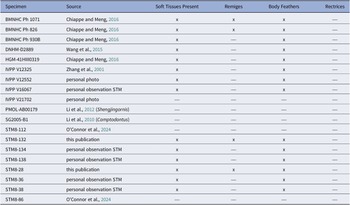
Longipteryx is known from 19 specimens—more than any other enantiornithine (Zhang et al., Reference Zhang, Zhou, Hou and Gu2001; Li et al., Reference Li, Gong, Zhang, Yang and Hou2010; Wang et al., Reference Wang, Shen, Liu, Gao, Cheng and Zhang2015; Chiappe and Meng, Reference Chiappe and Meng2016; O’Connor et al., Reference O’Connor, Clark, Herrera, Yang, Wang, Zheng, Hu and Zhou2024), and many preserve soft tissue structures (Table 1). Although preserved body contour feathers in specimens attributable to Longipteryx are relatively common, preserved remiges are quite rare. The two new Longipteryx specimens described here provide new information on the plumage of this distinctive Early Cretaceous enantiornithine.
Comparative remex lengths among enantiornithines—as the ratio between the longest secondary and primary feathers increases, so does the aspect ratio of the outstretched wing

Table 1. Long description
The table contains eight columns: Taxon, Catalog, Source, Humerus, Hum:Prime, Longest primary, Longest secondary, and Sec:Prime.
* Longipteryx (STM 8-28): Humerus 33.4, Hum:Prime 0.3408163, Longest primary 98, Longest secondary 55, Sec:Prime 0.56122449.
* Longipteryx (STM 8-132): Humerus 33.7, Hum:Prime 0.2808333, Longest primary 120, Longest secondary 71.8, Sec:Prime 0.59833333.
* Orienantius (BMNHC Ph 1154): Humerus 28.5, Hum:Prime 0.3294798, Longest primary 86.5, Longest secondary 51.1, Sec:Prime 0.59075145.
* Protopteryx (BMNHC Ph 1158): Humerus 30.87, Hum:Prime 0.3631765, Longest primary 85, Longest secondary 59.6, Sec:Prime 0.70117647.
* Eopengornis (STM 24-1): Humerus 38.8, Hum:Prime 0.4110169, Longest primary 94.4, Longest secondary 68.6, Sec:Prime 0.72669492.
* Junornis (BMNHC Ph 919a): Humerus 25.9, Hum:Prime 0.352381, Longest primary 73.5, Longest secondary 63.6, Sec:Prime 0.86530612.
In STM 8-28 and 8-132, both specimens preserve extensive traces of contour feathers which surround most of the body except for the rostrum distal to the caudal margin of the antorbital fenestra and below the ankle joint. These observations are in alignment with observations in Longipteryx IVPP V12325 and BMNHC Ph930B (Zhang et al., Reference Zhang, Zhou, Hou and Gu2001; Chiappe and Meng, Reference Chiappe and Meng2016). These featherless areas of body are also present in most enantiornithines (Chiappe and Witmer, Reference Chiappe and Witmer2002; Chiappe et al., Reference Chiappe, Di, Serrano, Yuguang and Meng2020; Liu et al., Reference Liu, Chiappe, Zhang, Serrano and Meng2019, Reference Liu, Chiappe, Wu, Meng, Zhang, Qiu, Xing and Zeng2022), except for some Late Cretaceous amber-encased taxa, which show feathers extending around the pedal digits (Xing et al., Reference Xing, McKellar, O’Connor, Bai, Tseng and Chiappe2019).
Notably, although difference in the maximum estimated body mass between STM 8-28 and STM 8-132 is minimal (~2% difference), the longest measurable preserved primary traces differ by approximately 18%, suggesting either individual or sexually dimorphic variation in wing chord length. Alternatively, it could suggest differences in preserved completeness (STM 8-132 being more complete) (Table 2). Although feathers are preserved throughout the body in these two Longipteryx specimens and others (Table 1), there is a notable absence of rectrices in all described specimens. Therefore, we suggest that this taxon entirely lacked rectrices—both ornamental RDFs, which are more common in other enantiornithines, as well as feathers constituting a rectricial fan (Table 1). Here we discuss the implications of the discernable remex morphology and the significance of the lack of RDFs within the genus Longipteryx.
Fossil specimens attributable to Longipteryx and the presence or absence of various soft tissues

Table 2. Long description
The table contains six columns: Specimen, Source, Soft Tissues Present, Remiges, Body Feathers, and Rectrices. Presence is indicated by an x and absence by a dash.
* B M N H C Ph 1071: Source Chiappe and Meng 2016. Present: Soft Tissues, Remiges, Body Feathers. Absent: Rectrices.
* B M N H C Ph 826: Source Chiappe and Meng 2016. Present: Soft Tissues, Remiges, Body Feathers. Absent: Rectrices.
* B M N H C Ph 930B: Source Chiappe and Meng 2016. Present: Soft Tissues, Body Feathers. Absent: Remiges, Rectrices.
* D N H M dash D 2889: Source Wang et al. 2015. Present: Soft Tissues, Body Feathers. Absent: Remiges, Rectrices.
* H G M dash 41 H I I I 0319: Source Chiappe and Meng 2016. Present: Soft Tissues, Body Feathers. Absent: Remiges, Rectrices.
* I V P P V 12325: Source Zhang et al. 2001. Present: Soft Tissues, Body Feathers. Absent: Remiges, Rectrices.
* I V P P V 12552: Source personal photo. Present: Soft Tissues, Body Feathers. Absent: Remiges, Rectrices.
* I V P P V 16067: Source personal observation S T M. Present: Soft Tissues, Body Feathers. Absent: Remiges, Rectrices.
* I V P P V 21702: Source personal photo. Absent: All categories.
* P M O L dash A B 00179: Source Li et al. 2012. Absent: All categories.
* S G 2005 dash B 1: Source Li et al. 2010. Absent: All categories.
* S T M 8 dash 112: Source O’Connor et al. 2024. Absent: All categories.
* S T M 8 dash 132: Source this publication. Present: Soft Tissues, Remiges, Body Feathers. Absent: Rectrices.
* S T M 8 dash 134: Source personal observation S T M. Present: Soft Tissues, Body Feathers. Absent: Remiges, Rectrices.
* S T M 8 dash 138: Source personal observation S T M. Present: Soft Tissues, Body Feathers. Absent: Remiges, Rectrices.
* S T M 8 dash 28: Source this publication. Present: Soft Tissues, Remiges, Body Feathers. Absent: Rectrices.
* S T M 8 dash 36: Source personal observation S T M. Present: Soft Tissues, Body Feathers. Absent: Remiges, Rectrices.
* S T M 8 dash 38: Source personal observation S T M. Present: Soft Tissues, Body Feathers. Absent: Remiges, Rectrices.
* S T M 8 dash 86: Source O’Connor et al. 2024. Absent: All categories.
Potential wing profile supports previous hypotheses for enantiornithine flight strategies
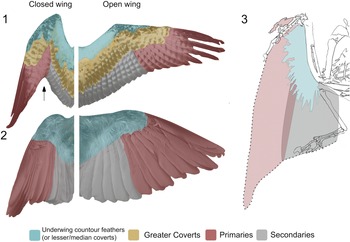
Even in the best enantiornithine specimens preserving traces of remiges (e.g., Protopteryx, Eopengornis), the wings are always folded to some degree, confounding observations of the full wing profile and subsequent inferences regarding flight strategies and ecology (Wang et al., Reference Wang, O’Connor, Zheng, Wang, Hu and Zhou2014; O’Connor et al., Reference O’Connor, Zheng, Pan, Wang, Wang, Zhang and Zhou2020). However, some observable patterns in the remiges of living birds can help elucidate probable enantiornithine wing profile morphology despite these preservational obstacles. Among extant birds, those with proportionally longer primaries compared to their secondaries (~ 30–40% that of longest primary) have blade-like, high aspect ratio wings characterized by the presence of a distinctive cranially excavated notch along the trailing edge of the wing when folded (Fig. 2.1) (e.g., anatids, falconids, pandionids, lariids) (Lovette et al., Reference Lovette2016). In contrast, when the lengths of the secondaries are subequal to those of the primaries, the wing profile is broad with a low-aspect ratio and, importantly, has a reduced or absent notch when the wing is folded (Fig. 2.2). This pattern is consistent across birds—as the secondary:primary ratio increases, so too does the broadness of the wing profile.
Change in wing profile morphology. Major feather tract regions of the wing in ventral aspect are given colored labels (figure legend). (1) A high aspect wing—Pandion haliaetus (Linnaeus, Reference Linnaeus1758), family Pandionidae—presenting the dorsally excavated notch (indicated by the black arrow) between the primaries and secondaries when the wing is bent. In contrast, (2) low-aspect ratio wings—Junco hyemalis (Linnaeus, Reference Linnaeus1758), family Passerellidae—lack this notch and present primaries subequal in length to the secondaries. (3) The right forelimb and remex traces of STM 8-28 as preserved, with hypothetical positioning, and areas of overlap between the primary and secondary feathers.

Figure 2. Long description
A three-panel anatomical diagram. A legend at the bottom identifies four feather regions: blue for Underwing contour feathers or lesser/median coverts, yellow for Greater Coverts, red for Primaries, and gray for Secondaries.
Panel 1 shows the ventral aspect of a high-aspect wing from Pandion haliaetus. The left side shows a closed wing where a black arrow points to a deep dorsally excavated notch between the red primaries and gray secondaries. The right side shows the wing fully open, revealing the elongated profile.
Panel 2 shows the ventral aspect of a low-aspect wing from Junco hyemalis. In both closed and open views, the red primaries and gray secondaries are subequal in length, resulting in a continuous, rounded trailing edge without a notch.
Panel 3 is a line drawing of the right forelimb and remex traces of specimen S T M 8-28. The skeletal structure is outlined in black. Overlaid are colored regions representing hypothetical feather positions: a light blue area for coverts, a large red area for primaries extending distally, and a gray area for secondaries. A darker red overlapping zone indicates where the primary and secondary feathers meet.
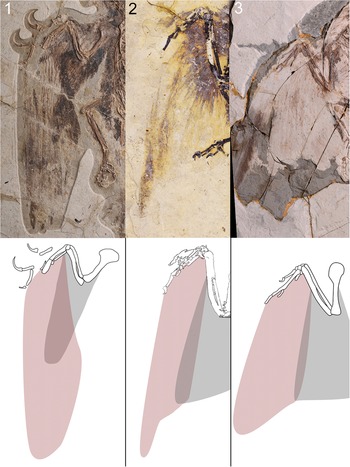
Compared to other enantiornithines preserving remiges, STM 8-28 and STM 8-132 have relative secondary:primary lengths (as percentages) similar to that of Orienantius, being approximately 56–59% (Table 2). The same percentages in Eopengornis and Junornis measure 73% and 87%, respectively, suggesting these two enantiornithines had comparatively broader wing profiles than Longipteryx and Orienantius (Wang et al., Reference Wang, O’Connor, Zheng, Wang, Hu and Zhou2014; O’Connor et al., Reference O’Connor, Zheng, Pan, Wang, Wang, Zhang and Zhou2020) (Fig. 3). Although folding of the wings in all these enantiornithine specimens hinders observation of the wing profile, there is a clear absence of an inter-remex notch on the trailing edge of the wing, which is particularly clear in Longipteryx (Fig. 1). Instead, in STM 8-28, the trailing-edge margin of the secondaries is linear with the wing partially folded. In contrast, the basal pygostylian bird Confuciusornis, with its elongate primaries and relatively shorter secondaries, preserves a clear notch between the primary and secondary feather tracts (Falk et al., Reference Falk, Kaye, Zhou and Burnham2016) (Fig. 3). Reconstruction of the unfolded wing reveals a high aspect ratio morphology (approximately 1:2.5) unlike any extant neornithine, with the lengths of the secondary feathers being only ~19% that of the primaries (Falk et al., Reference Falk, Kaye, Zhou and Burnham2016) (Fig. 3.3). Based on the clear absence of a notch between the primaries and secondaries in the folded wings of these enantiornithine taxa (e.g., Longipteryx, Eopengornis, Junornis, Orienantius), we suggest they had comparatively broader wings than Confuciusornis. Among neornithines, similar wing profiles, in which the inter-remex notch is absent or reduced when the wing is folded, are present among families that primarily utilize continuous or flap-gliding flight styles, such as parulids, fringinalids and turdids (del Hoyo et al., Reference del Hoyo, Elliott, Sargatal and Cabot1992, Reference del Hoyo, Elliott, Sargatal and Cabot1999; Lovette et al., Reference Lovette2016). Using predicted wing-loading models, previous findings have suggested that the Early Cretaceous enantiornithines (Protopteryx, Eoalulavis, Junornis, Concornis) utilized bounding or flap-gliding flight strategies (Liu et al., Reference Liu, Chiappe, Serrano, Habib, Zhang and Meng2017; Serrano et al., Reference Serrano, Chiappe, Palmqvist, Figueirido, Marugan-Lobon and Sanz2018; Chiappe et al., Reference Chiappe, Di, Serrano, Yuguang and Meng2020). Remex feather traces of Longipteryx support this interpretation, indicating that gliding or soaring flight strategies were unlikely in this taxon.
Remex comparisons with other Mesozoic birds. Colors of major feather tract regions of the wing continued from Figure 2. Approximate outlines of the primary and secondary flight feather tracts of (1) Confuciusornis sanctus Hou et al., Reference Hou, Zhou, Gu and Zhang1995 (IVPP V1315) (photo courtesy of Gao Wei), (2) Longipteryx chaoyangensis (STM 8-28), and (3) Eopengornis maratini Wang et al., Reference Wang, O’Connor, Zheng, Wang, Hu and Zhou2014 (STM 24-1) (photo courtesy of Xioali Wang). Note the varying degrees of differences between the primary and secondary lengths across the three taxa, showing distinct differences from proportionally long primaries (Confuciusornis) to primaries and secondaries of similar length (Eopengornis). These two represent rather high- and low-aspect ratio wing profiles in vivo, respectively, whereas Longipteryx may have had a wing profile somewhere in-between.

Figure 3. Long description
A three-panel layout comparing the wing morphology of three Mesozoic birds.
Panel 1 (Left): Confuciusornis sanctus (I V P P V 1315). The top photo shows a dark, elongated wing fossil with distinct primary feathers. The bottom line drawing illustrates a high-aspect ratio wing profile. A light pink shaded area represents the primary flight feathers, which are significantly longer than the secondary feathers, represented by a smaller, darker grey shaded area behind the humerus and ulna.
Panel 2 (Center): Longipteryx chaoyangensis (S T M 8-28). The top photo shows a yellowish fossil slab with skeletal elements and feather impressions. The bottom line drawing shows an intermediate wing profile. The pink primary tract and grey secondary tract are more balanced in length compared to Panel 1, though the primaries still extend further distally.
Panel 3 (Right): Eopengornis martini (S T M 24-1). The top photo shows a fossil with broad feather impressions on a grey stone. The bottom line drawing illustrates a low-aspect ratio wing profile. The pink primary tract and the grey secondary tract are of nearly equal length, creating a much broader, shorter wing shape compared to the other two taxa.
Although fossilized soft tissues help elucidate how enantiornithines flew, the underlying skeletal remains must also be considered when interpreting potential flight strategies. Osteological correlates, such as the morphology of the humerus’ deltopectoral crest [which anchors some of the primary flight muscles (e.g., mm. pectoralis major and deltoideus major)] previously have been associated with certain flight strategies among extant birds—and previously have been invoked in support of inferences regarding enantiornithine flight style (Chiappe et al., Reference Chiappe, Di, Serrano, Yuguang and Meng2020; Wang et al., Reference Wang, Clark, O’Connor, Zhang, Wang, Zheng and Zhou2024). Proximodistally short, but dorsoventrally deep deltopectoral crests (similar to Confuciusornis) are typically associated with extant birds that use burst flight or rapid continuous flapping (e.g., alcids, apodids) (Serrano et al., Reference Serrano, Costa-Pérez, Navalón and Martín-Serra2020). In contrast, long, weakly developed deltopectoral crests are often seen in birds with low wing beat frequency flight strategies such as soaring or gliding (e.g., procellarids, cathartids) (Serrano et al., Reference Serrano, Costa-Pérez, Navalón and Martín-Serra2020).
Although the potential wing profile of Longipteryx, based on proportional remex lengths and pattern of the trailing edge with the wing folded, does not suggest low frequency wing beat strategies (i.e., gliding, soaring), the proximodistally long and cranially shallow deltopectoral crests of their humeri do. Although bounding and intermittent flap-gliding remain plausible energy-efficient flight strategies for enantiornithines, the combination of these traits observed in Longipteryx suggests this taxon, and other enantiornithines, may have utilized a flight style unrepresented by modern birds. This is further supported by the unusual semi-lunate morphology of the humeral head, which suggests a more limited range of dorsoventral motion during the flight stroke compared to neornithines, and the caudally restricted and weakly developed sternal keel indicating a relatively reduced m. pectoralis major (Baumel et al., Reference Baumel, King, Breazile, Evans and Vanden Berge1993). The unique skeletal differences present in the flight apparatus of enantiornithines compared to neornithines suggests direct comparison to crown birds, with regards to locomotor behaviors, may not only result in inaccurate predictions but may also fail to capture the significance of this important radiation for understanding the early evolutionary refinement of avian flight (Lo Coco et al., Reference Lo Coco, Motta, Agnolín and Novas2025).
Complete absence of rectrices in an enantiornithine
Enantiornithine rectrices, when present, typically consist of RDFs—an extinct feather morphotype characterized by a proportionally wide rachis with a C-shaped cross-section that contrasts with the hollow tube-like rachis present in extant feathers (O’Connor et al., Reference O’Connor, Chiappe, Chuong, Bottjer and You2012; Xing et al., Reference Xing, O’Connor, McKellar, Chiappe, Bai, Tseng, Zhang, Yang, Fang and Li2018; Carroll et al., Reference Carroll, Chiappe and Bottjer2019; Wang et al., Reference Wang, O’Connor, Zhao, Pan, Zheng, Wang and Zhou2021). These feathers vary between taxa in terms of proportional length and extent of the pennaceous vane (streamers vs. racket-plumes) and, when the vane is distally restricted, the shape and proportion of the racket. Due to their ornamental (i.e., not forming a lift producing aerodynamic surface) morphology, their variable preservation (e.g., two out of five feather-bearing specimens of Protopteryx preserve RDFs), and the presence of analogous structures in some sexually dimorphic extant birds, these feathers are widely considered to be sexually dimorphic and present only in males (O’Connor et al., Reference O’Connor, Chiappe, Chuong, Bottjer and You2012, Reference O’Connor, Wang, Zheng, Hu, Zhang and Zhou2016; Wang et al., Reference Wang, O’Connor, Zhao, Pan, Zheng, Wang and Zhou2021; Clark et al., Reference Clark, O’Connor, Price, Pruett-Jones, Wang, Zhang, Wang, Zheng and Zhou2026). RDF racket plumes are also variably present in confuciusornithiforms (e.g., in a sample of 106 Confuciusornis specimens preserving soft tissues, 62% have RDFs) and similarly widely interpreted as sexually dimorphic (Chinsamy et al., Reference Chinsamy, Chiappe, Marugán-Lobón, Chunling and Fengjiao2013; Zhou et al., Reference Zhou, Pan, Wang, Wang, Zheng and Zhou2024; Zhou and Wang, Reference Zhou and Wang2024).
In contrast, multiple soft-tissue-bearing specimens of Longipteryx have now been recovered and none preserves evidence of rectrices (Table 2). It should be noted that preserved remiges in Longipteryx specimens are also rare, which may suggest potential taphonomic bias for the loss of heavier feathers (e.g., remiges, rectrices) during the early stages of post-mortem tissue breakdown. However, even in instances where remiges and extensive body feathers are preserved, such as in STM 8-28 and 8-132, traces or impressions of tail feathers are unambiguously absent (Table 2; Figs. 1.1, 3). This strongly suggests that this species was characterized by the complete absence of rectrices, regardless of sex, which is a condition absent among all extant birds (Lucas and Stettenheim, Reference Lucas and Stettenheim1972). Female enantiornithines and Confuciusornis have been long hypothesized to lack rectrices entirely (pygostyle surrounded by body contour feathers), and the implications on flight this would have had has only been briefly discussed (O’Connor et al., Reference O’Connor, Wang, Zheng, Hu, Zhang and Zhou2016).
Although aerodynamic or maneuver-assisting tail feathers are not essential for flight in neornithines, as evinced from aerial locomotion in individuals that lack tail feathers due to molting (e.g., flight after shock-molt (Møller et al., Reference Møller, Nielsen and Erritzøe2006)), rectrices nevertheless help facilitate navigation, take-off, and changes in speed (Thomas, Reference Thomas1993; Terrill and Shultz, Reference Terrill and Shultz2023). Although spreading and pivoting of the rectrices aids in steering, some genera (e.g., Neafrapus, Mearnsia, Pitta) demonstrate that sustained and maneuverable flight is still achievable with greatly reduced (shortened), though not absent, rectrices (Winkler et al., Reference Winkler, Billerman, Lovette, Billerman, Keeney, Rodewald and Schulenberg2020, Reference Winkler, Billerman, Lovette, Billerman, Keeney, Rodewald and Schulenberg2024). Movement of the rectrices during flight (e.g., raising, lowering, and fanning) are all facilitated by the underlying rectricial muscles (e.g., mm. levator caudae, depressor caudae, lateralis caudae) (Baumel et al., Reference Baumel, King, Breazile, Evans and Vanden Berge1993; Clark et al., Reference Clark, Atterholt, Clark and Seward2025). Currently, evidence from both preserved potential rectricial muscles and RDF morphologies, suggest that enantiornithines may have lacked similar levels of rectricial control compared to modern birds, but were likely able to move the tail, and the corresponding RDFs, along a dorsoventral plane (Clark et al., Reference Clark, O’Connor, Price, Pruett-Jones, Wang, Zhang, Wang, Zheng and Zhou2026). Therefore, interpretations of Longipteryx and other described enantiornithines, suggest they must have utilized fundamentally different methods of approaching and landing on surfaces compared to modern birds. This adds to growing evidence from humeral and sternal morphology that enantiornithines utilized flight strategies not directly analogous those present in any living bird (Zheng et al., Reference Zheng, Wang, O’Connor and Zhou2012; Liu et al., Reference Liu, Chiappe, Serrano, Habib, Zhang and Meng2017; Chiappe et al., Reference Chiappe, Di, Serrano, Yuguang and Meng2020; O’Connor, Reference O’Connor2022). However, with the diversity of enantiornithines likely far exceeding what is represented by the fossil record, it should be noted that clade-wide conclusions are potentially erroneous.
Conclusion
Though discoveries from the Jehol deposits continue to increase known enantiornithine diversity, information pertaining to remex morphology remains relatively scant. The two new Longipteryx specimens described here provide the first evidence of wing shape in this important taxon. Comparative lengths of the remiges and their overall shapes with the wing folded suggest an aspect ratio that is lower than most previously described enantiornithines, but potentially similar to Orienantius. Additionally, the aspect ratio of the wing of enantiornithines, now including Longipteryx, was also much lower than that predicted for Confuciusornis. Currently there are 19 known specimens of Longipteryx, a majority of which preserve some trace of soft tissue with none preserving rectrices, suggesting that if this taxon exhibited integumentary sexual dimorphism, it did not do so via ornamental tail feathers as is predicted for some enantiornithines like Protopteryx (O’Connor et al., Reference O’Connor, Chiappe, Chuong, Bottjer and You2012; Wang et al., Reference Wang, O’Connor, Zheng, Wang, Hu and Zhou2014; O’Conner et al., Reference O’Connor, Wang, Zheng, Hu, Zhang and Zhou2016).
Acknowledgments
Thanks to B. Marks, D. Willard, S. Hackett, and J. Bates, of the Field Museum (Chicago, IL USA), for access to bird collections. We thank S. Yin, X. Yin, and X. Zhang for facilitating our visit to the STM. We thank the editor and two reviewers for their helpful and constructive comments.
Funding
This research was in part funded by the Taishan Scholars Program of Shandong Province (Ts20190954) and the National Natural Science Foundation of China (NSFC) grant number (42572027, 42288201).
Competing interests
The authors declare no competing interests.



 Open access

