As research investigating the course and consequences of problematic parenting has unequivocally demonstrated the detrimental effect of poor parenting on children's development (Cicchetti & Carlson, Reference Cicchetti and Carlson1989), maladaptive parenting practices should be considered a pervasive problem and significant public health concern. However, scant attention has been directed toward delineating and explicating the etiology of problematic parenting behaviors. Although preliminary work has documented relationships between psychosocial factors and caregiving behaviors (e.g., McLoyd, Jayaratne, Ceballo, Borquez, Reference McLoyd, Jayaratne, Ceballo and Borquez1994; Sturge-Apple, Davies, & Cummings, Reference Sturge-Apple, Davies and Cummings2006a), the physiological underpinnings of those relationships are not as well understood and therefore warrant further examination.
Previous research has proposed that alterations in physiological systems as a result of contextual risk factors may be an important link between those risk factors and individual functioning in family contexts (e.g., Repetti, Taylor, & Seeman, Reference Repetti, Taylor and Seeman2002). Thus, individual differences in physiological arousal and regulation stemming from psychosocial adversity may help explain associations between psychosocial risk factors and subsequent maladaptive parenting behaviors (Mills-Koonce et al., Reference Mills-Koonce, Propper, Gariepy, Barnett, Moore and Calkins2009; Sturge-Apple, Davies, Cicchetti, & Cummings, Reference Sturge-Apple, Davies, Cicchetti and Cummings2009). Accordingly, in an effort to expand the knowledge base surrounding the determinants of problematic parenting practices, the present research is an examination of how particular psychosocial risk factors, namely, maternal depressive symptomatology and low socioeconomic status (SES), influence mothers’ physiological functioning during challenging parenting contexts. Of additional interest is how underlying patterns of maternal physiological functioning may be differentially associated with diminished caregiving behaviors including maternal insensitivity, hostility, intrusiveness, and passive disengagement.
Models of allostasis (e.g., McEwen, Reference McEwen2002) may provide a useful heuristic for delineating the form and function of maternal physiological functioning during stressful parent–child interactions. Allostasis refers to the regulatory efforts of physiological systems in response to physical, psychosocial, and environmental challenges (McEwen, Reference McEwen2002), and how well those response systems adapt to changing external conditions. Optimal adaption involves appropriate and efficient activation of stress response systems (with the function of marshaling psychophysiological resources aimed at responding to the potential stressor or challenge), as well as the ability to disengage response systems upon the termination of the arousal-provoking stimulus (in order to conserve psychophysiological resources and return to homeostatic functioning). When applied to the study of parenting, the usefulness of an allostasis framework lies in its ability to possibly explain how physiological response systems may serve as mechanisms in the relationship between more distal psychosocial stressors and actual psychological and behavioral forms of responding during stressful parent–child interactions. According to this framework, individual differences in physiological responses to stressful parent–child interactions (resulting from particular psychosocial stressors) may eventuate in very different behavioral responses. For example, normative physiological activation (i.e., activation of an appropriate magnitude) in response to a stressful interaction with one's child is likely to enable a behavioral response that is effective at addressing the challenge associated with that interaction. However, as external sources of stress and challenge increase in magnitude or chronicity, allostatic response systems may become overtaxed when attempting to regulate both the stress related to a normative challenge (e.g., parenting), and the increasing stress external to that particular challenge (e.g., economic adversity, depressed mood, etc.). This accumulation of multiple sources of stress, in turn, creates the potential for physiological dysregulation. Therefore, the physiological systems of parents dealing with chronic stress of a sufficient magnitude (high allostatic load) may be unable to successfully regulate in the face of additional stress from challenging parent–child interactions. In turn, compromised physiological regulation is likely to diminish parental capacity to call upon effective parenting behaviors and strategies.
To expand understanding of physiological processes in associations with parenting, the present study focused on examining autonomic nervous system (ANS) indices of psychological arousal and reactivity. The selection of this specific stress–response system was guided by evidence that the ANS is primed in the context of stressful interactions (e.g., Appelhans & Luecken, Reference Appelhans and Luecken2006; Tomaka, Blascovich, Kibler, & Ernst, Reference Tomaka, Blascovich, Kibler and Ernst1997) and, as such, is implicated in models of allostatic load. Within the ANS are two separate systems including the sympathetic nervous system (SNS) and the parasympathetic nervous system (PNS). The SNS reflects the first wave of autonomic responding to stressful events. It helps prime the body for fight–flight responses by increasing cardiac output, oxygen flow, and blood glucose levels (Berntson et al., Reference Berntson, Bigger, Eckberg, Grossman, Kaufmann and Malik1997; Porges, Reference Porges2006). In contrast, the PNS has an inhibitory effect on the SNS by shifting resources to restorative, homeostatic functions. During times of challenge and threat, the PNS withdraws vagal control of the heart, resulting in a greater ability to attend to or engage with the external source of stress. This action also serves to increase SNS influence upon the heart. Therefore, successful adaptation to environmental stressors requires a delicate balance in the operation of both the SNS and PNS (Quigley & Stifter, Reference Quigley and Stifter2006). As an indicator of maternal ANS response to stressful parent–child interactions, we utilized a measure of cardiac autonomic functioning that captures the complex interactions between the SNS and PNS inputs to the sinus node (referred to as sympathovagal balance). Sympathovagal balance quantifies the ratio between activities within the two systems, which reflects the overall autonomic state that results from the sympathetic and parasympathetic influences. This physiological indicator of ANS functioning has been implicated as a possible pathway in models exploring the impact of stress and challenge on physical (e.g., Hall et al., Reference Hall, Vasko, Buysse, Daniel, Hernando and Chen2004) and psychological (Gallo & Lueken, Reference Luecken and Gallo2008; Sloan et al., Reference Sloan, Shapiro, Bagiella, Boni, Paik and Bigger1994) well-being.
Risk Factors, ANS Functioning, and Problematic Parenting
In line with determinants of parenting conceptualizations detailing how psychosocial sources of stress and challenge may eventuate in problematic caregiving behaviors (e.g., Belsky & Jaffee, Reference Belsky, Jaffee, Cicchetti and Cohen2006; Belsky & Vondra, Reference Belsky, Vondra, Cicchetti and Carlson1989), we examined the impact of maternal depressive symptoms and low socioeconomic resources as potentiators of maladaptive patterns of sympathovagal functioning in the parent–child context. Furthermore, these constructs were chosen because of their associations with physiological mediators of allostatic load and with diminished/altered parenting behaviors. First, consistent with the “stress gets under your skin” hypothesis, much research has explored how lower SES (defined as lower income to needs ratio, single parenting, low maternal education, housing problems; e.g., Evans, Kim, Ting, Tesher, & Shannis, Reference Evans, Kim, Ting, Tesher and Shannis2007) is implicated in physiological models of allostatic load (e.g., Juster, McEwen, & Lupien, 2009; Seeman, Epel, Gruenewald, Karlamangla, & McEwen, Reference Seeman, Epel, Gruenewald, Karlamangla and McEwen2010). To date, the literature seems to converge on the consensus that SES is associated with manifestations of allostatic load in physiological systems. Of relevance to the present study, a recent review of the literature examining allostatic load and SES concluded that lower SES was consistently related to allostatic load primarily through cardiovascular components of summary indices of allostatic load (Dowd, Simanek, & Aiello, Reference Dowd, Simanek and Aiello2009). Socioeconomic difficulties have also been implicated in diminished parental capacities to provide supportive, sensitive, and consistent caregiving (for reviews, see Bradley & Corwin, Reference Bradley, Corwyn, Bornstein and Bradley2003; McLoyd, Reference McLoyd1998). Empirical data have charted these associations across various developmental periods, suggesting that the effects of low SES on parenting are quite robust, and recent work on a large, representative sample has replicated many smaller empirical studies by concluding that poverty is associated with decreased maternal responsiveness (Mistry, Biesanz, Taylor, Burchinal, & Cox; Reference Mistry, Biesanz, Taylor, Burchinal and Cox2004).
Depressive symptomatology and major depression have also been implicated in models of allostatic load on physiological systems (e.g., McEwen, Reference McEwen2002). Germane to the present study, depressive symptomatology has been specifically associated with altered sympathetic nervous system functioning (e.g., Carney, Freedland, & Veith, Reference Carney, Freedland and Veith2005), including increased levels of basal norepinephrine (Lake et al., Reference Lake, Pickar, Ziegler, Lipper, Slater and Murphy1982) and increased overall sympathetic nervous system activity (e.g., Veith et al., 1984). Maternal depression and depressive symptomatology have also been unequivocally associated with perturbations in parenting behaviors. Numerous studies to date across a wide range of samples and methodologies have detailed associations between depressive symptoms and parental insensitivity, increased hostility, and rejection, as well as disengagement (Goodman & Brumley, Reference Goodman and Brumley1990; Goodman & Gotlib, Reference Goodman and Gotlib2002). Qualitative reviews of the literature on depressive symptoms and parenting have charted these associations and meta-analytic reviews have documented the significant strength of these associations (e.g., Downey & Coyne, Reference Downey and Coyne1990; Lovejoy, Graczyk, O'Hare, & Neuman, Reference Lovejoy, Graczyk, O'Hare and Neuman2000). A meta-analytic study of the associations between maternal depression and observations of parenting behaviors conducted by Lovejoy and colleagues (2000) found moderate to modest effect sizes, ranging from 0.40 for hostile/harsh parenting, to 0.26 for disengaged parenting, to 0.16 for positive parenting.
ANS and Problematic Parenting
Neurobiological frameworks highlight the significance of aberrations in the functioning of physiological systems in shaping coactions with our environment and thus provide a foundation for associations with problematic caregiving behaviors (e.g., Bridges, Reference Bridges2008; Bugental, Olster, & Martorell, Reference Bugental, Olster, Martorell and Kuczynski2002). Research examining parental ANS functioning during stressful parent–child contexts provides some empirical support for the expectation that allostatic models of sympathovagal balance may be associated with problematic caregiving. Studies have documented associations between infant emotionality and parental physiological reactivity (e.g., Donovan, Leavitt, & Balling; Reference Donovan, Leavitt and Balling1978; Del Vecchio, Walter, & O'Leary, Reference Del Vecchio, Walter and O'Leary2009). A recent report by Hill-Soderlund and colleagues (2009) examined maternal vagal activity in response to infant distress during the Strange Situation paradigm (SSP). The use of this paradigm is informative in that it allows the identification of mother's repeated reactivity and recovery to children's distress during two different periods of separation from the mother and two different reunion episodes. Results from this study revealed that during separation episodes, mothers evidenced significant vagal withdrawal indicative of attempts at regulatory control of physiological reactivity to children's distress. To our knowledge, only one study has examined linkages between ANS functioning and specific caregiving behaviors. Mills-Koonce et al. (Reference Mills-Koonce, Propper, Gariepy, Barnett, Moore and Calkins2009) reported on associations between maternal parasympathetic reactivity during a stressful parent–child interaction (the Still Face paradigm) with 6-month-old infants and several different parenting behaviors including global sensitivity, intrusiveness, detachment, and positive regard. Results revealed significant parasympathetic withdrawal during the challenge interaction. However, this change was only meaningfully associated with intrusive parenting behaviors, such that less withdrawal was associated with more intrusive parenting. Thus, dampened parasympathetic reactivity may eventuate in more controlling and negative caregiving when parents are faced with challenging child rearing situations.
This earlier empirical work examining parental physiological arousal has primarily explored physiological reactivity to stressful child-rearing contexts in a linear fashion. However, psychophysiological researchers surmise that multiple phenotypes of the stress response system exist with important differences in both the form and function of the response (e.g., El-Sheikh et al., Reference El-Sheikh, Kouros, Erath, Cummings, Keller and Staton2009; Heim, Elhert, & Hellhammer, Reference Heim, Elhert and Hellhammer2000). McEwen and Wingfield (Reference McEwen and Wingfield2003) proposed qualitatively distinct forms of allostatic load present in physiological systems. In turn, these patterns may guide possible hypotheses detailing how maladaptive allostatic functioning may eventuate in problematic parenting behaviors. We focus on two possible forms of maladaptive regulation, including hyperarousal and hypoarousal response patterns. A hyperarousal pattern denotes a lack of adaptation to repeated stressors such that the individual's physiological stress response system shows heightened activity and dampened recovery. Thus, this profile is defined by the presence of elevated levels of physiological activation in response to a stressful event. A hypoarousal pattern represents a downregulated response such that physiological systems evidence dampened activation to environmental stress and challenge. The integration of pattern-based approaches to simultaneously chart processes inherent in each pattern is essential when considering models of allostatic load. Thus, the present study examined possible nonlinear configurations of maternal physiological arousal through the utilization of growth mixture modeling (GMM) techniques. GMM can reveal qualitatively different profiles of trajectories that are not anchored on a linear or continuous scale. In turn, meaningful patterns in the response process can be delineated and explored. Consequently, we utilized mixture modeling to identify McEwen's hypothesized patterns of allostatic load, using maternal sympathovagal functioning in response to a challenging parenting context as an index. We expected that we would extract the three primary patterns including a normative arousal profile, a hyper- or elevated arousal profile, and a hypo- or dampened arousal profile.
Developmental Considerations
Finally, previous studies have primarily examined associations between ANS functioning and parenting during infancy; however, little is known about how these associations may play out in different developmental stages. Thus, in the present study we explored how maternal sympathovagal reactivity to stressful child interactions was associated with parenting behaviors during the toddler period. We focused on the developmental context for several reasons. From a developmental standpoint, toddlerhood is consistently posited as a significant period of developmental plasticity including rapid changes in emotion regulation and emerging abilities in mobility and exploratory behavior (e.g., Edwards & Liu, Reference Edwards, Liu and Bornstein2002). Thus, parents must contend with children's fluctuating bids for support and protection against a backdrop of increasing demands for autonomy and exploration. Responsive parenting during this developmental stage is contingent upon the ability to flexibly adapt to children's developing competencies while retaining the ability to maintain control and respond appropriately in the context of challenging parenting situations. Parenting has historically been dimensionalized across two primary axes including sensitivity/warmth and behavioral control (Baumrind, 1966: Maccoby & Martin, Reference Maccoby, Martin, Mussen and Mussen1983), out of which arise meaningful behaviors of critical relevance to parenting toddlers including maternal insensitivity, harsh/hostile and intrusive behaviors, and disengagement/detached behaviors. Consequently, we examine differential associations between profiles of allostasis in maternal physiological functioning and these four primary caregiving behaviors.
In summary, the purpose of the current research is to examine maternal physiological functioning in challenging caregiving contexts as a predictor of parenting behaviors. Drawing on models of allostasis and allostatic load, we hypothesized that three forms of sympathovagal functioning would emerge including a normative response, a hyperarousal response and a hyperarousal response. Furthermore, we examined how SES and maternal depressive symptomatology may influence allostasis in the form of maternal physiological reactivity and regulation during stressful parent–child interactions. Drawing from previous research examining allostatic load models, we hypothesized that maternal depressive symptomatology would be associated with the allostatic load profile defined by hyperarousal and lower SES would be primarily associated with hypoarousal of sympathovagal activity. To control for the possible effects of child behaviors on maternal sympathovagal reactivity, we covaried maternal reports of challenging parenting tasks in model analyses. Finally, we hypothesized that parenting behaviors would be differentially related to patterns of allostatic load. Specifically, given the elevated activation within the hyperarousal profile, we expected mothers within this group to evidence higher levels of harsh/hostile and intrusive parenting. Conversely, we hypothesized that dampened activity within the hypoarousal profiles would be differentiated by higher levels of disengagement/detached parenting coupled with higher maternal insensitivity.
Method
Participants
Data for the present research were drawn from a project concerned with examining multiple aspects of mother–toddler relationships. The sample consisted of 153 mothers and their 17- to 19-month-old children from a midsized city in the northeastern United States. Participants were recruited both through posting flyers in community locations (e.g., doctor's offices, daycares, and libraries) and through a recruiter at local offices of Women, Infants, and Children, which is a government-funded public agency providing assistance for low-income mothers with young children or expecting a child.
Recruitment was conducted so as to obtain a diverse sample of mother–toddler dyads with proportionate numbers experiencing socioeconomic distress. Participants fell into one of two SES-based groups: low SES (n = 82) and middle SES (n = 71). For study enrollment, mothers in the middle SES group were required to have completed their bachelor's degree at an accredited 4-year college or university, and to have an income unsupplemented through government assistance (e.g., food stamps). Mothers in the low SES group were required to be receiving some form of public assistance (verified through Department of Human Services records), and did not complete a degree at an accredited 4-year college or university. Median family income of participants was $46,093 per year; however, one-third of the sample reported earnings below $10,200 annually. Mothers were between ages 18 and 42 (M = 24). Participants identified themselves as European American (55% of mothers and 49% of children), African American/Black (26% of mothers and 25% of children), and Latina (11% of mothers and 12% of children), with smaller percentages of biracial (5% of mothers and 14% of children), Asian (less than 2% of mothers, 0% of children), and Native American/Alaskan (less than 1% of mothers, 0% of children).
Procedures
Data were collected during one 2-hr laboratory session. The laboratory session consisted of an intake interview, during which the mother was set up with a wireless electrocardiograph (ECG) monitoring system. The system comprised a two-lead configuration, which was processed in a wearable platform attached to the mother's hip. Thus, no constrictions in movement were necessary as mothers could walk around freely while being monitored. Mother and child then participated in the SSP (Ainsworth & Wittig, Reference Ainsworth, Wittig and Foss1969), after which the mother completed a battery of questionnaires while her child was in the room with her. The session ended with a free-play paradigm (FP). Finally, mothers were compensated $75 for their time.
The intake interview and questionnaire session both took place in a room with comfortable furniture similar to that found in an average home (couch, armchair, television, age-appropriate toys for the child, etc.). The SSP and FP took place in an observation room equipped with cameras. The observation room also contained a one way mirror so that participants could be observed unobtrusively from an adjacent filming room. Both the SSP and FP were videotaped for later coding.
SSP
To obtain information regarding maternal physiological arousal to stressful parent–child interactions, the present study utilized the standard SSP for 18-month-old children. The SSP has been used in previous research exploring maternal functioning and has proven a meaningful index of physiological arousal and regulation (e.g., Hill-Soderlund et al., Reference Hill-Soderlund, Mills-Koonce, Propper, Calkins, Granger and Moore2009). The standard paradigm was conducted as described in Ainsworth and Wittig (Reference Ainsworth, Wittig and Foss1969) and Ainsworth, Blehar, Waters, and Wall (Reference Ainsworth, Blehar, Waters and Wall1978). The SSP consists of seven episodes, each of which lasts for 3 min. The episodes were as follows: (1) mother and child entered the paradigm room in which there were various toys and two bean-bag chairs; (2) a stranger entered the room and sat in a chair directly across from the mother. She remained silent and nonresponsive for 1 min, engaged the mother in conversation during the next minute, and attempted to engage the child in play during the final minute; (3) mother left her child in the room with the stranger; (4) mother called to the child two times from outside the room and then entered the room; (5) mother exits, leaving child alone in the room; (6) stranger reenters the room; and (7) same as Episode 4. If the child became extremely upset during the two separation episodes (3 and 5), such as intense crying for at least 30 s, or if the mom was unable to handle seeing her child distressed, the episode was terminated early and the next episode began.
Heart rate collection/processing
During the SSP, mothers ECG signals were recorded using Alive Heart Monitors from Alive Technologies Pty. Ltd. (http://www.alivetec.com/index.htm). This platform allowed real-time monitoring of mother's ECG activity without tethering wires to a base station. Thus, mothers were able to freely move about the room while having their ECG signal recorded, increasing the ecological validity of the paradigm. EGC monitors used a precordial, two-pole electrocardiogram lead on the chest. Data from these leads were fed into a portable unit strapped to the mother and stored on a drive located on the monitor on the mother. The ECG signal was sampled at 300 Hz and had a voltage range of −2.5 to 2.5 V.
The ECG analysis was processed off-line. First, a data file containing the heart interbeat intervals (IBIs) for the entire collection period was created for editing. To reduce noise processes in the IBI signal due to artifacts (e.g., movement, environmental interferences) a discrete time-matched filter was applied to the IBI data. First, a noise detector determined which sections of the IBI signal across the 20-min recording time were relatively free of noise. Then, those sections were utilized to create a template estimation of the IBI signal. This template was correlated with the original IBI signal to detect the presence of the template within the noisy signal. For a more detailed account of these methods, see Chen, Ba, Ignjatovic, Heinzelman, and Sturge-Apple (2010). This application was successful in reducing noise to below 10% for almost all of the subjects. Fourteen of the participants evidenced noise thresholds above 10%. Their ECG data was imputed for use in study analyses (details on data imputation provided in the Results Section).
FP session
Both mother and child participated in a 10-min FP session, for which the experimenter led them into a room containing appealing, age-appropriate toys. The mother was instructed to play with her child as she normally would at home. At the end of the 10 min, the experimenter knocked on the wall signaling the end of the session.
Measures
Socioeconomic adversity
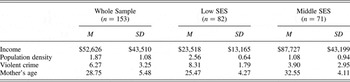
At recruitment, participants for the current study were identified as either low SES or middle/high SES. Group membership was used as a measure of socioeconomic adversity (see Table 1). Mother–child dyads in the low SES group reported a mean family income of $23,518 a year (range = $1,625–$26,410). Mothers reported on average 2.5 children in the household (range = 1–11). When income was considered against the total number of people in the family, the average per capita yearly income for the low SES group was $2510. In contrast, the middle SES group reported an average income of $85,727 (range = $77,709–$287,000), per capita income averaged $54,847 per year. Mothers reported on average 1.8 children in the household (range = 1–4). We also utilized mother's address in order to examine neighborhood statistics. Compared to mothers in the middle SES group, mother–child dyads in the low SES group resided in areas demarcated by low housing costs, high population density, and the highest rates of violent crime (http://www.city-data.com/city/Rochester-New-York.html).
Means and standard deviations of demographic information between low SES and middle SES groups

Note: SES, socioeconomic status.
Sympathovagal functioning
Power spectral analysis of the IBI time series across the laboratory session was used to quantify the sympathovagal balance (Pomeranz et al., Reference Pomeranz, Macaulay, Caudill, Kutz, Gordon and Kilborn1985; Task Force of the European Society of Cardiology, 1996). The power spectrum contains both high-frequency (HF = −0.15 to 0.40 Hz) and low-frequency (LF = −0.04 to 0.15 Hz) components (e.g., Task Force, 1996). Power in the HF component reflects the influence of the parasympathetic branch of the ANS, and power in the LF component reflects the influence of the sympathetic branch. The LF to HF ratio reflects sympathovagal balance. Increases in the ratio in response to environmental stress are hypothesized to be an indicator of physiological response in the ANS such that higher values indicate dominance of the SNS and lower values indicated dominance of the PNS (Luecken & Gallo, Reference Luecken and Gallo2008).
To conduct the power spectral analysis, the IBI time series across the seven different episodes of the SSP were analyzed using successive, overlapping windows of data in a time-series fashion. Thus, the spectral analysis of the IBI signal was performed within a 16-s window of data and power in the LF and HF bands were extracted (e.g., Jovanov, Reference Jovanov2008). The window was shifted 1 s and the above analysis was repeated. The resulting stream of data was then converted into a ratio statistic via the division of the LF by the HF. The LF/HF ratio statistic was time matched to the appropriate SSP episode and subsequently sectioned into each episode of the SSP. Finally, the average LF/HF ratio was calculated by taking the mean of the ratio values within each episode and used as an indicator of sympathovagal balance.
Maternal depression
Maternal depression was measured using the Beck Depression Inventory II (BDI-II; Beck, Steer, Ball, & Ranieri, Reference Beck, Steer, Ball and Ranieri1996), an updated version of the BDI restructured to correspond to DSM-IV diagnostic criteria. The BDI-II includes 21 self-report items designed to assess the severity of depression experienced by the respondent. Each item is a self-evaluative statement, scored 0–3 (3 = most severe) and corresponds to a particular depressive symptom (e.g., worthlessness, loss of energy, etc.). A respondent's total score for the BDI-II indicates the category of depression within which they fall (0–12 = minimal; 13–19 = mild, 20–28 = moderate, and 29–63 = severe). In the present sample, the average BDI-II score was 8.07 with a range from 0 to 41. This score is comparable to other mean scores in community-based populations (e.g., Segal, Coolidge, Cahill, & O-Riley, Reference Segal, Coolidge, Cahill and O'Riley2008). Using category scores, 20% of the sample fell within the mild to severe range. Of the remaining sample, 90% endorsed at least one item. The BDI-II is highly correlated with the BDI (r = .93). The BDI-II yields an internal consistency of α = 0.87 in the current sample.
Parenting behaviors
Select scales from the Iowa Family Interaction Rating Scales (IFIRS; Melby & Conger, Reference Melby, Conger, Kerig and Lindahl2001) were utilized to assess parenting during the free-play session. The IFIRS is a global coding system that assesses behavioral and emotional traits of parents during dyadic interactions. Scales utilized during the FP session included: insensitivity, intrusiveness, passive disengagement, and harsh/hostile parenting behaviors. Insensitivity was measured by maternal behaviors that indicated lack of affection, care, or support toward the child. Harsh/hostile parenting was defined as physically invasive/distressing behaviors and verbalizations used to control or demean the child, such as yanking or grabbing the child, derogatory comments, and angry tone of voice. Intrusiveness measured the extent to which the parent was overcontrolling with the child or did not allow any room for the child's independent play or exploration. Examples of intrusive behavior include taking toys out of the child's hand while they are still playing, instructing the child how to play, or excessive hovering over the child. Passive disengagement assessed the extent to which mothers displayed passive behaviors that put physical or emotional distance between the parent and child. Examples include ignoring the child, choosing not to participate in play with the child, or showing a lethargic, apathetic attitude toward the child. A trained coder blind to family demographic information watched the previously recorded FP and clean-up sessions and rated mothers on a Likert scale ranging from 1 (not characteristic) to 9 (very characteristic) for each dimension of parenting. A second coder rated 20% of parents to ensure interrater reliability. Reliabilities across the four parenting variables across the two coders ranged from acceptable to good (r = .69–.85).
Child challenging behavior
Child challenging behavior was measured via the challenging behavior subscale of the Parenting Daily Hassles questionnaire (PDH; Crnic & Greenberg, Reference Crnic and Greenberg1990). The PDH includes 20 self-report items that measure the degree to which common everyday events concerning parenting and interactions with their child are hassling for the respondent. Each item of the PDH includes a frequency measure (how often the hassle occurs) and an intensity measure (how hassling each event is). Previous research has demonstrated acceptable test–retest and interrater reliability as well as validity (Crnic & Greenberg, Reference Crnic and Greenberg1990). The challenging behavior subscale consists of the intensity scores of seven items measuring the extent to which mothers find their children to be difficult (e.g. “The kids won't listen or do what they are asked without being nagged”). Mothers rated the intensity of each of these behaviors on a Likert scale from 1 to 5 (1 = least intense). Internal consistency of the challenging behavior subscale is acceptable (α = 0.71).
Results
The results are presented in two sections. The first section details the results of mother sympathovagal activity during the course of the SSP. The second section presents analyses of sociocontextual determinants and maternal caregiving outcomes associated with different patterns of maternal sympathovagal reactivity.
To parameterize our model of allostatic load examining mother sympathovagal functioning across the 20-min SSP, we utilized a GMM approach (e.g., Li, Duncan, Duncan, & Acock, 2006; Muthén, Reference Muthén and Kaplan2004; Ram & Grimm, Reference Ram and Grimm2009). The GMM approach can be viewed as a special form of a multiple group model when the “groups” in the data are unobserved or latent. Thus, the GMM approach allows for the examination of population heterogeneity such that within a distribution, certain classes of respondents may exist. Extended to a repeated-measures context, the researcher can explore whether there is a presence of unobservable classes or patterns in the trajectories of the data and test the number of possible patterns at the empirical level through model comparisons as well as at the substantive level through theory driven hypotheses (e.g., Muthén & Muthén, Reference Muthén and Kaplan2005).
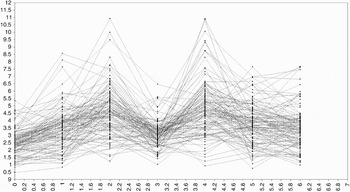
The first step in model estimation is to determine the parameterization of the growth function. Given the nonlinearity present in the data, as mother's sympathovagal levels increased and decreased on average as a function of the differing episodes in the SSP (see Figure 1), a latent basis growth modeling approach was selected. Latent basis models are particularly suited for this context because of their ability to allow for the parameterization of complex, nonlinear change dynamics in repeated-measures assessments (McArdle & Epstein, Reference McArdle and Epstein1987; Meredith & Tisak, Reference Meredith and Tisak1990). Within latent basis growth modeling, the loadings parameterizing the intercept latent variable are fixed to “1” so as to capture the initial value of the variable, as is typical in growth curve modeling procedures. However, in contrast to linear and quadratic growth functions, a latent basis approach allows for the slope or change loadings to be estimated freely as a function of the data. This is similar in respects to the free determination of factor loadings for latent variables in the structural equation modeling framework. By freely estimating the slope loadings, the model allows the slope construct to describe the actual pattern or shape of the change. To parameterize the latent basis slope function, the first loading is fixed to “0” and a second loading is fixed to “1,” typically the point of greatest change is set to 1. In the present study, we set Episode 5 of the SSP (child alone in room) as the point of highest reactivity given that this is hypothesized to represent the greatest distress to children and mothers during the SSP. All other loadings are freely estimated and loading estimates reflect change in reference to the loading time point fixed to 1. Estimated factor loadings can then be interpreted to explore the pattern and rate of change in the construct over the repeated assessments. Furthermore, the slope factor mean estimate captures average overall change across the course of the time series (for a detailed application on latent basis modeling, see Ram & Grimm, Reference Ram and Grimm2007).
Observed individual trajectories across seven episodes of the Strange Situation (SS) obtained from 121 mother–toddler dyads. Numbers on the x axis correspond to episodes in the SS paradigm. Dots in the plot represent individual scores at each episode with lines connecting trajectories.

Our next analytic step was to examine whether there were latent groups in the latent basis trajectories. All models were estimated using the latent variable software MPlus, Version 6.1 (Muthén & Muthén, Reference Muthén and Muthén2006). The flexibility of MPlus for growth mixture modeling allows researchers to fully explore how the patterns emerge. That is, we can explore the presence of differences in factor slope means and latent basis loadings across the different classes. Releasing these constraints across the classes assumes that the groups underlying the data differ in these particular ways. We hypothesized that three profiles would emerge from the data including a regular or moderate level of sympathovagal functioning, a dampened or hypoarousal of sympathovagal functioning, and an elevated or hyperarousal pattern. Thus, we conducted our nested GMMs with this hypothesis in mind. Upon the identification of the most optimal number of profiles in trajectories of maternal sympathovagal activity, we next examined how contextual covariates were differentially associated with class membership. Finally, we explored mean level differences in maternal caregiving practices across the different profiles.
To determine the optimal number of profiles, we used three tests for comparing nested models including the Bayesian information criterion (BIC; Schwartz, 1978), entropy (e.g., Muthen, 2004), and the Vuong–Lo–Mendell–Rubin likelihood ratio test (VLMR; Lo, Mendell, & Rubin, Reference Lo, Mendell and Rubin2001). The model with the lowest BIC value is generally considered the best-fitting model. As a further test of model fit, the VLMR provides a p value that indicates whether the k − 1 profile model is rejected in favor of the k profile model (for more details, see Nylund, Asparouhov, & Muthen, Reference Nylund, Asparouhov and Muthen2007). Finally examination of entropy informs as to the level of confidence that individuals are classified with values higher than 0.80, indicating high confidence (Muthen, 2004). However, it is also important to consider the practical applications of profile solutions along with statistical measures of model fit. Therefore, substantive implications were also taken into account when determining optimal number of profiles (e.g., Muthén, Reference Muthén and Kaplan2004). For each mother, the GMM analysis produces posterior (Bayesian) probabilities of likelihood of membership in each latent profile with mothers classified into the latent profile for which the posterior probability is highest. The probabilities are a function of the model's parameters (estimated conditional response probabilities and estimated prevalence of each latent class). Inspection of these classifications and posterior probabilities was undertaken to ensure that mothers had a high likelihood of being classified correctly (e.g., probability > 0.60).
Given that this was a cross-sectional research design, subjects had complete data across the different measures used in the analysis. The only exception to this was with respect to the ECG data. A maximum of 31% of the data were missing due to several factors including, equipment malfunction (wireless connection was broken, heart monitor battery turned off), timing notation difficulties, and sensors not placed correctly. In addition, participants with complete sympathovagal ratio data were checked for possible outliers, and four subjects evidenced values more than 3.5 SD away from the mean in six different episodes. These values were removed. To maximize our sample size, missing ECG data were imputed utilizing multiple imputation (MI) with an expectation maximization (EM) technique with the Amelia II software package (Honaker, King, & Blackwell, Reference Honaker, King and Blackwell2009). MI uses data imputation with an EM algorithm and results in five different datasets, which are then merged into one finalized dataset. The MI is less biased than a data set singly imputed with EM and listwise deletion of cases (e.g., Enders, Reference Enders2001) and performs well when the data are missing completely at random (e.g., no identifiable pattern exists in the missing data) and the amount of missing data is as high as 50% (Schlomer, Bauman, & Card, Reference Schlomer, Bauman and Card2010). To evaluate whether the ECG data were missing completely at random (MCAR), we examined the patterns of missing data using Little's MCAR test (Little, Reference Little1988). Little's test suggested that the data were indeed MCAR, χ2 (4) = 3.64, p = .46. Therefore, in order to retain the maximum amount of statistical power, we utilized the MI estimated values in study analyses.
Profiles of maternal sympathovagal functioning
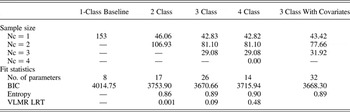
We explored several possible parameterizations of latent profiles of maternal sympathovagal functioning in the SSP. To examine the best profile solution, we extracted one, two, three, and four GMM analyses and compared fit indices as well as substantive interpretations across the different solutions. In our modeling, we specified that mean level differences in both latent intercept and latent slope factors could vary across classes. We also allowed the latent basis slope loadings to vary over classes. This was done to ensure that the trajectory factors detailing how sympathovagal levels changed over the course of the SSP could be relatively distinct across different classes, if different classes were able to be extracted from the population. As is typical in growth modeling, we also constrained error variances on the manifest indicators of sympathovagal level in each episode of the SSP to be equal to one another. This assumes that random fluctuations in sympathovagal levels are equal to one another in the time series. Finally, to maximize our class distinctions we constrained the variances of the mean level intercept and slope constructs to be 0 within class. Results of model testing across number of classes are presented in Table 2 and revealed that model fit was best for the three-class model. The three-class model had the lowest BIC of the models extracted. In addition it had the highest entropy value with the exception of the four-class solution. However, the four-class solution resulted in 0 persons classified into the fourth class rendering it obsolete. The VLMR also indicated that the three-class solution was preferable to the two-class solution. In terms of substantive considerations, the three-profile solution cohered to our hypothesized allostatic load trajectories including a normative or moderate arousal profile, an elevated or hyperarousal profile, and a dampened or hypoarousal profile.
Fit statistics for growth mixture models with freely estimated means and pattern loadings

Note: Sample size is based on estimated counts for latent classes based upon posterior probabilities; BIC, Bayesian information criterion; VLMR LRT, Vuong–Lo–Mendall–Rubin likelihood ratio test of additional class.
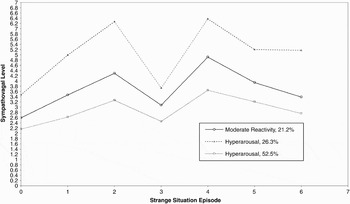
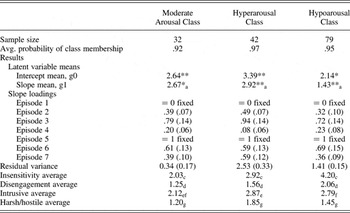
Inspection of the latent basis slope means reveal how the three profiles were identified (see Table 3). First, the average sympathovagal activity is modeled in the slope mean. Inspection of these means reveal that the mothers in the moderate class had midlevel arousal, whereas the mothers in the hyperarousal class evidenced the highest levels of overall activity in the ANS system over the paradigm. The hypoarousal class evidenced the lowest average level of activity. The equality of these means were tested through the Wald Statistic Test (Engle, Reference Engle, Intriligator and Griliches1983) available in MPlus. Tests suggested that the means were significantly different from one another (Wald statistic = 150.92, 2 df, p < .001). Next, in exploring the changes in the latent basis loadings across the different classes it is clear that sympathovagal trajectories take a different shape depending upon class membership (Table 2). The sympathovagal trajectories across the SSP paradigm for these three profiles are also graphed in Figure 2 to ease interpretability. From the slope loadings, we can see that mothers in the hyperarousal class evidenced the biggest changes in sympathovagal activity. They had the highest levels of reactivity to the two separation episodes implying increased sympathetic arousal to child distress, coupled with a large drop in sympathovagal levels during the first reunion. Of interest, mothers in this pattern did not recover during the final reunion episode and evidenced consistently elevated arousal at the end of the paradigm. Mothers in the normative/moderate arousal profile evidenced heightened sympathovagal activity during the two separations, but were able to modulate down during the two reunion episodes, demonstrating flexibility and adaptation in the sympathovagal system. Finally, mothers in the hypoarousal group demonstrated increased sympathovagal activity during the separations; however, these were at the lowest levels of the profiles.
Plot comparisons of estimated means and trajectories of three different sympathovagal profiles from latent basis model with the three-class solution. Groups are identified in the plot key.

Parameter estimates for three-class model

Note: Values with common subscripts denote significant between-group differences as examined by the Wald test of significant differences at p < .05.
*p < .05. **p < .01.
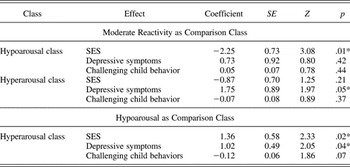
Our next step was to delineate how class membership was differentially predicted by psychosocial risk constructs. This was accomplished by including covariates in our model analysis as predictors of class membership through logistic regression equations. The model ran well and summary statistics are presented in Table 2 because the inclusion of covariates in mixture models may eventuate in changes in class definition. However, in our analyses the inclusion of covariates did not change trajectory profiles or membership in a significant way, suggesting that the profiles were not culled on the basis of covariates (e.g., number of classes identified changes as a function of covariates), but that the covariates were meaningfully related to the three different profiles as identified. This is summarized in Table 4. Because logistic regressions require a comparison class, the table has the moderate arousal profile as the comparison class first, then compares the hypoarousal and hyperarousal profiles second. Using the normative/moderate arousal profile as the comparison class, logistic regression coefficients revealed that mothers with lower SES were more likely to be in the hypoarousal class compared to the normative/moderate class. In addition, mothers with higher levels of depressive symptomatology were more likely to be in the hyperarousal class compared to the normative/moderate class. In comparing between the hyperarousal and hypoarousal classes, the distal covariates were significantly related to membership. Mothers reporting lower levels of SES were more likely to be classified in the hypoarousal group, whereas mothers reporting higher depressive symptoms were more likely to be classified in the hyperarousal group. Thus, sociocontextual determinants differentially predict maternal regulation.
Logistic regression coefficients for three-class model

Note: SES, socioeconomic status.
*p < .05.
Our final step was to examine mean differences in maternal parenting behaviors according to typology group through the inclusion of these variables in our model analysis as outcomes associated with class membership. To accomplish this, MPlus estimates the mean level of these variables within each class. Wald tests can then be used to test for significant differences in the mean levels across the different profiles. We explored differences in maternal insensitivity, passive disengagement, intrusiveness, and harsh/hostile parenting practices with their toddler across the three sympathovagal patterns. Results are presented in Table 3 with mean levels of parenting behaviors across class. The moderate/normative arousal class was primarily identified by mothers who evidenced the lowest levels of problematic parenting including lower insensitive, disengaged, intrusive, and harsh/hostile parenting. The hyperarousal class was identified primarily by mothers who were high on harsh/hostile and intrusive caregiving behaviors coupled with moderate amounts of maternal insensitivity. Finally, the hypoarousal class was identified as having the highest levels of insensitive caregiving in conjunction with higher levels of disengagement/detached caregiving. Of interest, they were also high on intrusive parenting as well (see Table 3 for more details).
Discussion
Parenting is a dynamic and transactional process that is multiply influenced. In an attempt to delineate the etiology of problematic caregiving behaviors, we integrated conceptual models of allostatic load with psychosocial risk factors to explore how distal and proximal factors may operate in parenting risk models. Our approach of applying a pattern-based perspective for differentiating allostatic configurations of parental physiological functioning during stressful caregiving contexts broadens our understanding of how models of allostasis may operate in determinants of parenting models. Distinct patterns of maternal sympathovagal activity emerged including a normative pattern, a hyperarousal pattern, and a hypoarousal pattern. Findings revealed that psychosocial risk factors were differentially associated with patterns of allostatic load. Finally, allostatic patterns were associated with meaningful differences in maternal caregiving behaviors. Our findings serve to highlight new avenues for the application of allostatic models to examining the determinants or emergence of problematic parenting behaviors.
The GMM analysis revealed the presence of three different allostatic patterns in the data. The first pattern was in line with our hypothesized moderate reactivity pattern and consisted of mothers who evidenced modest levels of sympathovagal reactivity to stressful child contexts. Highlighting the importance of an organism's ability to react and engage with external challenges through the activation of physiological mediators, mothers with this pattern appeared to be sensitive to child distress, as evidenced by increased sympathovagal activity. The moderate increases in ANS activity indicate the mother's active engagement with the challenge of child distress. Furthermore, as models of normative allostasis predict, these mothers were also able to effectively modulate that arousal during the reunion episode with their child. Thus, mothers in this group evidenced a flexible sympathovagal response during the distress and recovery episodes of the SSP. Parenting behaviors exhibited by this group could be best classified as higher levels of maternal responsiveness and sensitivity coupled with low levels of overreactive/harsh parenting. The ability of these mothers to modulate physiological arousal in stressful parent–child contexts is translated into their ability to engage in optimal parenting behaviors when interacting with their child.
Another profile was marked by elevated maternal sympathovagal response over the course of the interactional paradigm. By examining the latent basis loadings of maternal reactivity in this profile, it becomes evident that mothers experienced elevations in sympathovagal activity during the first and second separations, and in contrast to the other profiles, evidenced an increase in sympathovagal activity during the final reunion episode. In addition, in contrast to the other profiles, these mothers have a physiological profile that is less flexible and adaptive during stressful parent–child contexts. The directionality of this inflexibility is amplified or heightened during challenge such that the cardiovascular mediators of stress are primed to respond quickly. However, sympathovagal activity continues to evidence heightened arousal even when the stressor is dampened, which is maladaptive. In terms of risk factors predicting physiological functioning, this profile was defined by the highest levels of maternal depressive symptomatology. Thus, in our sample, elevated depressive symptoms were associated with heightened sympathovagal activity in stressful contexts. This finding supports previous empirical work documenting associations between depressive symptoms/ disorder and elevated activity in the SNS. Extending this research to parenting models, it appears that maternal depressive symptoms may eventuate in elevated or amplified physiological arousal during stressful child interactions. Why there is an association between depressive symptoms and amplified physiological activity is not entirely clear. One suggestion is that elevated physiological arousal may be indicative of heightened attention and orienting toward social stressors coupled with the inability to activate internal resources for regulating distress and reactivity. This heightened arousal was parlayed into an interesting pattern of caregiving behaviors evidenced by the highest levels of harsh/intrusive caregiving behaviors coupled with modest levels of insensitivity.
A final profile emerged and was defined by dampened levels of maternal sympathovagal arousal to toddler's distress. Sociocontextual determinants suggested that this group was differentiated by socioeconomic risk. Given that the dampened group was also the largest group identified in the GMM analyses, these findings may be somewhat surprising in the context of research examining relationships among mother/toddlers, which has typically examined more normative populations. However, given the emphasis on recruiting a sample with equal representation among low and high SES groups, these findings illuminate the strong impact that SES may have on maternal stress response systems. The mothers from the lower SES group in the present study primarily resided in densely populated urban areas marked by higher rates of crime. The cumulative wear and tear of the chronic stress of living in poverty and dangerous neighborhoods may have eventuated in the downregulation of the physiological response system inherent in this profile (e.g., Repetti et al., Reference Repetti, Taylor and Seeman2002; Repetti, Wang, & Saxbe, Reference Repetti, Wang and Saxbe2009). In turn, this damped arousal is associated with the highest level of maternal disengagement along with intrusive behaviors during interactions with her child. Thus, it appears that when the physiological arousal system is overwhelmed and dampened down through allostatic load in response to challenging environments, these mothers inhibit engagement with their child through increased passivity. When they are engaged, they evidence higher rates of intrusive and overstructuring behaviors as opposed to flexibly interacting with their child during play.
In conjecturing on the possible mechanisms by which allostatic mediators of environmental stress may eventuate in different parenting behaviors, neurocognitive perspectives may be informative (Farah, Noble, & Hurt, Reference Farah, Noble, Hurt and Illes2005). Specifically, studies have shown that chronic stress associated with poverty (e.g., Evans & Schamberg, Reference Evans and Schamberg2009) is associated with deficits in executive functioning and working memory. Specifically, areas associated with attentional shifting, visuospatial planning, and working memory appear to be impacted (e.g., Deater-Deckard, Sewell, Petrill, & Thompson, Reference Deater-Deckard, Sewell, Petrill and Thompson2010). In turn, these deficits may eventuate in parenting difficulties associated with allostatic alterations in physiological stress systems. Sociocognitive models also suggest associations between parental attributions/motivations and altered physiological functioning (Bugental et al., Reference Bugental, Olster, Martorell and Kuczynski2002). Further studies examining additional correlates and mechanisms associated with allostatic load patterns in parenting process models will help elucidate proximal mechanisms associated with problematic parenting.
Several limitations of the present research warrant discussion. First, because fathers were not assessed in the present study, we were not able to examine the role of the father–child relationship in associations between sociocontextual risks and parenting behaviors. Given previous work demonstrating the importance and differential impact of father–child relationships (e.g., Sturge-Apple, Davies, & Cummings, Reference Sturge-Apple, Davies and Cummings2006b), it will be important for future research to include samples of fathers to determine whether our findings based on mother–child data are comparable for father–child relationships. Second, the cross-sectional design cannot definitively address the temporal ordering of relationships in our process model. Our conclusions would be bolstered through examining the model processes over time. Third, the present study focused on the PNS/SNS axis; however, future research examining parental physiological functioning in the context of child distress would benefit by increasing the diversity of physiological assessments. Allostatic load biomarkers of chronic stress emphasize the importance of examining multisystemic physiological indices including neuroendocrine, immune, and metabolic functioning in addition to markers of cardiovascular system functioning (e.g., Juster et al., 2009). Although it was not possible to investigate all of these biomarkers in the present study, future research detailing their role in parenting models is necessary.
In summary, the present study illuminates how allostatic conceptualizations of maternal physiological reactivity to child distress may be an important explanatory construct in understanding the determinants of problematic parenting behaviors. In this regard, assessments and interventions with distressed parent–child dyads may benefit from including a focus on the experiential and physiological components of negative emotion in the parent–child subsystems during therapeutic intervention. For example, different approaches (e.g., cognitive–behavioral vs. psychodynamic–relationship-based approaches) could include an assessment of their impact on subsequent physiological arousal during parent–child interactions. The wireless, remote ANS sensing system employed in the current study adds to the feasibility for this approach by examining physiological arousal and regulation in real-time during parent–child transactions. In addition, the present research further highlights the importance of utilizing typological or pattern-based approaches to understanding the complex dynamics of parent–child relationships. The GMM patterns derived illustrate the power and psychological utility of pattern-based approaches in parsimoniously capturing dynamic transactions that occur in parent–child dyads.