INTRODUCTION
The discarded by-catch from fisheries is an important concern throughout the world (Zeler & Pauly, Reference Zeler and Pauly2005). Along the tropical waters, the shrimp trawl fisheries account for over one-third of the global total of discarded catch (Alverson et al., Reference Alverson, Freeberg, Pope and Murawisk1994). The most common fishing gear used for commercial shrimp capture is the bottom trawl net, which is poorly selective and is responsible for the accidental catch of non-target species such as algae, sponges, cnidarians, molluscs, annelids, non-target crustaceans, echinoderms and fish (Saila, Reference Saila1983; Svane et al., Reference Svane, Hammett and Lauer2009).
The shrimp fishery is largely practised on the Brazilian coast (2°N–33°S) (D'Incao et al., Reference D'Incao, Valentini and Rodrigues2002). On the south-eastern coast (19°S–23°S), the main target species are the seabob shrimp (Xyphopenaeus kroyeri Heller, 1862), the pink shrimp (Farfantepenaeus brasiliensis Latreille, 1817, F. paulensis Pérez-Farfante, 1967 and F. subtilis Pérez-Farfante, 1936), the Argentine stiletto shrimp (Artemesia longinaris Bate, 1888), the red shrimp (Pleoticus muelleri Bate, 1888) and the southern white shrimp (Litopenaeus schmitti Burkenroad, 1938). Details about the Brazilian fisheries production are available at the site www.ibama.gov.br. The abundance of crab species as by-catch in these fisheries is high (Lunardon-Branco & Branco, Reference Lunardon-Branco and Branco1993; Graça-Lopes et al., Reference Graça-Lopes, Tomás, Tutui, Severino-Rodrigues and Puzzi2002; Severino-Rodrigues et al., Reference Severino-Rodrigues, Guerra and Graça-Lopes2002), but unfortunately they have low commercial value or are discarded (Branco & Fracasso, Reference Branco and Fracasso2004).
In northern Rio de Janeiro State, the shrimp fishery occurs from four harbours, including around 250 boats and 500 fishermen, with an average of two fishermen per boat. The fishing ground encompasses 200 km2 of coastal waters, which are highly influenced by discharges from the Itabapoana and Paraíba do Sul Rivers. The shrimp fishery is a mono-specific activity and the main target is the seabob shrimp, but the by-catch of other marine organisms is a real issue regarding this fishery (Di Beneditto, Reference Di Beneditto2001; Di Beneditto et al., Reference Di Beneditto, Ramos and Lima2001). In this context, the aim of the present study is to provide the first record of the brachyuran crab species as by-catch from shrimp fishery practices in northern Rio de Janeiro State, south-eastern Brazil, and point out the most affected species.
MATERIALS AND METHODS
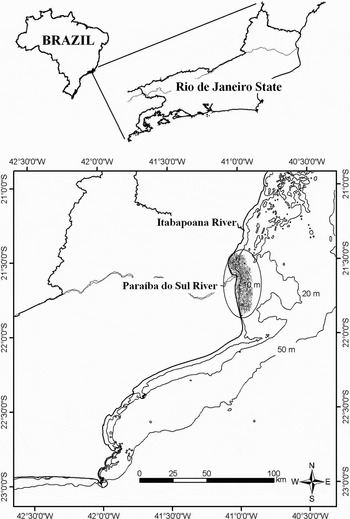
The present study was conducted in northern Rio de Janeiro State (21°30′S–21°50′S). From April 2006 to March 2007, the samples of crabs were collected once a month from one boat based at Atafona Harbour (21°35′S), whose trawlers were conducted from 0 to 4 nautical miles offshore and from 10 to 15 m depth (Figure 1). The sampling effort was around 3–4 hours per month. The bottom trawl net measured about 10 m in length with a horizontal opening of about 6 m and a cod-end mesh size of 15 mm from knot to knot.
Northern Rio de Janeiro State and the indication of the fishing ground where the brachyuran crabs were collected.

The species identification was based on Melo (Reference Melo1996). The frequency of occurrence was categorized according to Dajoz (Reference Dajoz2005), which indicates that constant (Co) is if the presence of species is in more than 50% of the samples, accessory (Ac) is between 25% and 50%, and accidental (Ad) is below 25%. The species abundance was classified as proposed by Graça-Lopes et al. (Reference Graça-Lopes, Severino-Rodrigues, Puzzi, Pita, Coelho and Freitas1993), which considers very numerous (Vn) to be those who represent more than 5% of the total number of individuals, numerous (N) between 1% and 5% and a few numerous or rare (Ra) below 1%.
The catch per unit effort (CPUE) was calculated monthly, for each species, as the number of specimens per trawl time. The CPUE values were compared through the one-way analysis of variance and the Tukey test was applied to post-hoc comparisons. In order to verify if there was a seasonal pattern to the crabs' occurrence, the study period was grouped into the dry season (April to September) and the wet season (October to March) and the t-test was applied.
RESULTS
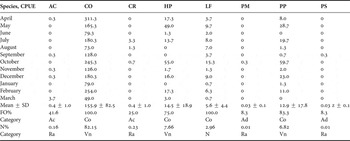
During the study, eight species and 6833 crab specimens were recorded: Arenaeus cribarius (Lamarck, 1818) (N = 11), Callinectes ornatus (Ordway, 1863) (N = 5613), Cronius ruber (Lamarck, 1818) (N = 16), Hepatus pudibundus (Herbst, 1785) (N = 523), Libinia ferreirae (Brito Capello, 1871) (N = 202), Persephona mediterranea (Herbst, 1794) (N = 1), P. punctata (Linnaeus, 1758) (N = 446) and Portunus spinimanus (Latreille, 1819) (N = 1).
The portunid Callinectes ornatus was the most representative species, followed by H. pudibundus and Persephona punctata. All these three species were considered as constant and very numerous. The other five species represented only 3.39% of the total abundance, and they were recorded as additionally or accidentally occurring (Table 1). In relation to the monthly CPUE values, C. ornatus was significantly greater than the others crabs (F = 36.96; P < 0.0001) (Table 1).
Catch per unit effort (CPUE), frequency of occurrence (FO%) and abundance (N%) of brachyuran crabs from the coastal shrimp fishery in northern Rio de Janeiro State.

AC, (Arenaeus cribarius); CO, (Callinectes ornatus); CR, (Cronius ruber); HP, (Hepatus pudibundus); LF, (Libinia ferreirae); PM, (Persephona mediterranea); PP, (P. punctata); PS, (Portunus spinimanus); Co, constant; Ac, accessory; Ad, accidental; Vn, very numerous; N, numerous; Ra, rare.
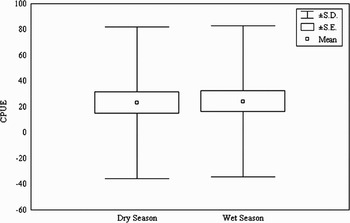
A noticeable seasonal pattern was not found relating to the crabs' occurrence along the study area (Figure 2). The CPUE values did not vary significantly between the dry and wet seasons (t = −0.0793; P = 0.9369).
Catch per unit effort (CPUE) values for dry and wet seasons, considering all the brachyuran crabs sampled in northern Rio de Janeiro State.

DISCUSSION
The occurrence of brachyuran crabs as by-catch in shrimp fishery conducted along the Brazilian coast has already been studied by some authors (e.g. Lunardon-Branco & Branco, Reference Lunardon-Branco and Branco1993; Teixeira & Sá, Reference Teixeira and Sá1998; Severino-Rodrigues et al., Reference Severino-Rodrigues, Guerra and Graça-Lopes2002; Costa & Di Beneditto, Reference Costa and Di Beneditto2009). Costa & Di Beneditto (Reference Costa and Di Beneditto2009) investigated the by-catch in shrimp fishery practised between 22°00′S and 22°20′S, less than 50 km south from our study area. The sampling effort (3–4 hours of trawling per month) and crab species records in these two studies were the same, with the exception of Cronius ruber, but some differences in crabs' abundance were found. In our study, the total abundance was more than nine times greater than in Costa & Di Beneditto (Reference Costa and Di Beneditto2009), and the high number of Callinectes ornatus was responsible. Variables such as water temperature, sediment and salinity, which are rather different between these areas (21°30′S to 21°50′S and 22°00′S to 22°20′S) (Muehe & Valentini, Reference Muehe and Valentini1998), can be influencing this crustacean presence. The portunid C. ornatus preferred marine habitats with low to moderate salinity, and areas where the water temperature is above 20°C, with muddy bottom (Mantelatto & Fransozo, Reference Mantelatto and Fransozo1999; Reigada & Negreiros-Fransozo, Reference Reigada and Negreiros-Fransozo2001; Guerra-Castro et al., Reference Guerra-Castro, Carmona-Suérez and Conde2007). Moreover, this species depends on estuarine areas to complete its life cycle (Pita et al., Reference Pita, Severino-Rodrigues, Graça-Lopes and Coelho1985). These features explain its representation in the coastal waters from 21°30′S to 21°50′S, which is largely influenced by the Itabapoana and Paraíba do Sul Rivers, and can also explain its low occurrence between 22°00′S and 22°20′S where the discharge from rivers is absent and the water temperature is lower than 20°C.
Braga et al. (Reference Braga, Fransozo, Bertini and Fumis2005) suggest that the brachyuran migrations during the reproductive period and the sampling methodology (e.g. net mesh size, distance from coast line and depth where the sampling is done) can interfere in the species records along the coastal areas. This could explain, at least in part, the low records of other crab species. In the study area, the low salinity and the muddy bottom in coastal areas can limit the presence of typical marine species that are associated with sandy and/or rocky bottoms, such as Arenaeus cribarius, Cronius ruber, Persephona mediterranea and Portunus spinimanus (Cervigón et al., Reference Cervigón, Cipriani, Fischer, Garibaldi, Hendrickx, Lemus, Márquez, Poutiers, Robaina and Rodriguez1993; Buckup & Bond-Buckup, Reference Buckup and Bond-Buckup1999). Moreover, the species Callinectes ornatus has aggressive behaviour towards sympatric crabs (Guerra-Castro et al., Reference Guerra-Castro, Carmona-Suérez and Conde2007), and it could be excluding the other species.
The high number of C. ornatus indicates a resident pattern along the coastal fishing ground where the seabob shrimp is captured, and confirms its preference for marine habitats near estuarine areas. The by-caught specimens of C. ornatus can be used as bait in Balistidae (triggerfish) fishery practice seasonally by the local fishermen, but the other crabs are always discarded after by-catch. The present study is the first record of brachyuran crabs species as by-catch between 21°30′S and 21°50′S, and indicates that these crustaceans could be better used locally as fishery resources.
ACKNOWLEDGEMENTS
Our thanks to the fishermen from Atafona Harbour who provided us with the crab specimens and to Silvana Ribeiro Gomes who helped us during the monthly samples. We also thank the Instituto Brasileiro do Meio Ambiente e dos Recursos Naturais Renováveis—IBAMA for the license to collect zoological samples (License no. 16401-1). This work was supported by Fundação de Amparo a Pesquisa do Estado do Rio de Janeiro—FAPERJ (E-26/110.286/07 and E-26/103.038/08) and Conselho Nacional de Desenvolvimento Científico e Tecnológico—CNPq (305160/06-0, 470021/08-0 and 300241/09-7).