


Introduction
Anger management training has gradually emerged in different forms, and from different psychotherapeutic alliance modalities. Anger management programmes employing a cognitive behavioural framework are now in wide use. A wide range of literature in the form of randomized controlled trials, literature reviews and meta-analyses (Edmondson & Conger, Reference Edmondson and Conger1996; Renwick et al. Reference Renwick, Black, Ramm and Novaco1997; Beck & Fernandez, Reference Beck and Fernandez1998; Watt & Howells, Reference Watt and Howells1999; Dyer, Reference Dyer2000; Deffenbacher et al. Reference Deffenbacher, Dahlen, Lynch, Morris and Gowensmith2000; DiGiuseppe & Tafrate, Reference DiGiuseppe and Tafrate2003; Siddle et al. Reference Siddle, Jones and Awenat2003; Del Vecchio & O'Leary, Reference Del Vecchio and O'Leary2004) highlight the effectiveness of anger management strategies.
Anger management programmes have been used with a variety of patient populations including: drug abusers (Awalt et al. Reference Awalt, Reilly and Shopshire1997; Reilly & Shropshire, Reference Reilly and Shopshire2000), emotionally disturbed adolescents (Davis & Boster, Reference Davis and Boster1992; Kellner & Bry, Reference Kellner and Bry1999, Snyder et al. Reference Snyder, Kymissis and Kessler1999), parenting groups (Fetsch et al. Reference Fetsch, Schultz and Wahler1999), persons with learning disabilities (Kellner & Tutin, Reference Kellner and Tutin1995; Gilmour, Reference Gilmour1998), prison inmates (Holbrook, Reference Holbrook1997), patients with mild essential hypertension (Larkin & Zayfert, Reference Larkin and Zayfert1996), post-traumatic stress disorder sufferers (Gerlock, Reference Gerlock1994), and patients with brain injury (Uomoto & Brockway, Reference Uomoto and Brockway1992).
Southampton CBT Service had provided an outpatient anger management service for 10 years prior to this study. In this paper we describe an evaluation of the programme delivered in routine clinical practice through a randomized controlled trial.
Aims and objectives
The aims and objectives of the study were to assess the effectiveness of an anger management programme using a cognitive behavioural framework.
Intervention
The programme is based on Novaco's model of anger (Novaco, Reference Novaco1976) and Meichenbaum's (Reference Meichenbaum1985) ‘stress inoculation’ training, but with certain developments and additions designed to cope with the particular challenge of running this type of group. A brief description of how the programme was organized and a summary of its contents follows. More details on this can be found in Bradbury & Clarke (Reference Bradbury and Clarke2006). The programme has been manualized by the second author (http://www.isabelclarke.org/Anger_Programme.pdf). This manual made it possible for the programme to be organized by the second author but run by facilitators from a variety of health professions (psychiatrists, nurses, occupational therapists and psychologists) under close supervision, as a CBT learning experience. Referrals came both from the primary- and secondary-care services; including psychologists, psychiatrists, nurses, community teams and general practitioners.
The programme starts with an emphasis on arousal control. The focus is on retraining attention to bodily arousal, which is often screened out by angry individuals until it is too late, through cognitions such as: ‘I'm cool’, ‘nothing gets to me’. This makes it possible to control arousal by making space and by using controlled breathing. Chronic high arousal is a common accompaniment to an anger presentation, and the role of this in creating a dangerously low threshold for loss of control is explained. Lifestyle issues around stress reduction are also discussed. This provides a basis for the next stage of the programme where the focus is on cognitive challenge and management of interpersonal interaction.
Once arousal has been noted and reduced, appraisal is guided with two flow charts. The first emphasizes the choice open to the individual and the possibility of making a realistic appraisal of the situation. The second leads on to either a problem-solving approach where there is a realistic problem that can be tackled, to safe discharge where the person is powerless to make change, or to cognitive restructuring where the style of thinking is implicated in producing or magnifying the anger response. As problem anger normally manifests itself in interpersonal interactions, sessions on assertiveness skills and on ‘putting yourself into the other person's shoes’ or increasing empathy, are included. The course ends with a consideration of ‘personal rules’ or dysfunctional assumptions. The cognitive restructuring element of the programme is central, and based closely on the homework monitoring carried out by participants. Group members are trained to recognize cognitive errors (e.g. jumping to conclusions, all-or-nothing thinking, overgeneralization, etc.). The cognitive restructuring does not attempt to challenge the rationality of the thinking, but rather its utility, as certain styles of thinking are bound to maintain arousal and therefore the anger response that the participant claims to want to diminish. This approach to CBT works less by evidence testing, and more by appraisal of style of thinking, leading to consciously chosen, more adapted, behavioural choices.
Assessment and screening before entering the programme were important. The large number of referrals received included many individuals whose anger problems had impacted on their lives and relationships, but who were not necessarily committed to making the kind of radical change in how they conducted themselves that this programme demanded. Therefore, assessment covered the dimensions of the anger problem for that person and its impact on their life and relationships; their ability to make the connections between physical arousal, thoughts and feelings necessary for a cognitive behavioural approach and their willingness to relinquish threat and violence as means of regulating relationships. Their commitment to attend regularly and to complete homework assignments was also assessed. This process eliminated a considerable proportion of referrals who had attended through the pressure of others and whose motivation was suspect. Individuals directed towards the programme by courts of law often fell into this category. People for whom the group format was not acceptable, or whose impulse control was too poor to manage in a group were also excluded.
The groups themselves experienced considerable dropout and this was allowed for in the numbers recruited. People with anger problems often expect to be dominant in a social situation and an essential part of the facilitation process, supported by the supervision, was that the facilitators established dominance in alliance with a group of participants who saw the group as a genuine opportunity to change. In this way, a therapeutic culture was established which contributed enormously to the success of the programme. Inevitably, this was not comfortable for those with a less complete commitment, who tended to drop out at the point when they realized that they were expected to make real behavioural change and that the programme and example of others in the group demonstrated how such change was possible.
The programme
The programme started by establishing the distinction between anger and violence and by exploring the group's ideas about anger. The importance of anger as a valuable and necessary human resource, but one that can only be utilized if properly managed, was emphasized. The group focused on using anger in a productive manner. The central role of homework monitoring and trying out the techniques between sessions and recording the results was emphasized. Monitoring sheets for noting events, feelings, thoughts and physical arousal were distributed each week for discussion at the start of the next session. In this way, individuals' changing relationship to their anger was brought under scrutiny in the group context. The group is thus presented as a place to reflect upon anger. The real change takes place between sessions and is reported back to the group.
The programme consisted of 12 weekly sessions of 90 min duration. Sessions 1 and 2 focused primarily on recognition and control of arousal. The role of the sympathetic nervous system in closing off rational appraisal and precipitating the organism towards action is introduced. The somatic experience of anger is explored, with emphasis on identifying early somatic triggers and using breathing and relaxation techniques to bring down arousal. Sessions 3 and 4 present participants with the challenge of being able to choose how to react, once the initial adrenaline rush has been mastered, and applies problem-solving skills to this exercise of choice. Sessions 5–8 introduce the cognitive rationale and the application of cognitive challenge to each individual's anger-inducing cognitions, as identified through the homework. Sessions 9 and 10 cover the interpersonal topics of assertiveness and empathy. Sessions 11 and 12 deal with assumptions and core cognitions underlying the anger response, and with relapse prevention.
The programme includes regular handouts of flowcharts and educational material, e.g. on the best way to discharge anger, for the participants.
Ethical issues
This study received formal ethical approval from the Ethics Committee, Hampshire Partnership NHS Trust.
Methods
Study design and duration
The study was a randomized controlled trial which compared a CBT-based anger management programme with a control group of patients on a waiting list. The study lasted for 2 years. The assessments were carried out at baseline, at the end of a waiting period (3–4 months) for the control group, and at the end of the group therapy and then at 6 months follow-up for the clients in the CBT group.
Randomization
Randomization was performed distantly by a statistician according to gender and from the list of all the patients who had been accepted for treatment. After randomization patients were allocated to either treatment or the control arm (waiting list). Randomization was performed for each therapy group separately.
Study population
Study subjects were selected from those referred to the anger management programme run at the Department of Psychiatry, Royal South Hants Hospital, Southampton. The control group were selected from the same source. The programme does not accept patients with a psychotic illness and none of the patients in our study group were in-patients.
A power calculation based on previous research predicted that with up to 30 patients in each group, there is an 80% chance of detecting a difference between the two groups on both the Novaco Anger Assessment Scale (NAS; Novaco, Reference Novaco1975) and the State-Trait Anger Expression Inventory (STAXI; Spielberger, Reference Spielberger1988) at the 0.05% level of significance if such difference exists. All the new clients referred for anger management training who fulfilled our inclusion criteria, were approached. Those considered suitable, were provided with information on the study project. Clients who consented in writing were included in the study.
Control group
All referrals were assessed and screened in the same way. The randomization took place after assessment. The treatment group then entered treatment, and the control group was put on a waiting list. Clients in this group were provided with the therapy in the next available group. On average the patients were on a waiting list for 3–4 months.
Inclusion and exclusion criteria
The criteria used by the service for inclusion were as follows: history of being unable to manage anger with or without history of mental illness in the past and with no current psychosis or severe depression at the time of referral and who expressed motivation to work on change.
Exclusion criteria included: excessive use of alcohol or drug use, significant cognitive impairment, and active psychosis or severe depression. The same criteria were used by our study project. Alcohol or drug use disorders were diagnosed using clinical judgement based on International Classification of Diseases – 10th edition research diagnostic criteria (ICD-10 RDC) diagnoses.
All the clients considered suitable for the group therapy were approached. No separate criteria were used to measure motivation for this trial as this had been assessed at an early stage for the treatment programme, as mentioned previously. Clients who considered anger as something causing significant problems in life, who showed a willingness to work on their anger and who agreed to attend the group sessions were considered as motivated.
Outcomes and assessments
Anger was measured using the NAS and the STAXI. The Clinical Outcomes in Routine Evaluations (CORE) Scale (CORE System Handbook, 1998) was used to measure the wellbeing and life functioning of the subjects. The Hospital Anxiety and Depression Scale (HAD; Zigmond & Snaith, Reference Zigmond and Snaith1983) was used to measure depression and anxiety and the Evaluative Beliefs Scale (EBS; Chadwick et al. Reference Chadwick, Trower and Dagnan1999) was used to measure beliefs about self and others. We also collected information on demographic variables like, age, gender, ethnicity, marital status and employment status.
The NAS was developed by Novaco (Reference Novaco1994), based on his information-processing model of anger. The scale had its origin in the Novaco Anger Inventory (NAI; Novaco, Reference Novaco1975). It is a self-assessment measure and has two parts. Part A consists of 48 items, which are divided equally into three domains; the cognitive domain, the arousal domain and the behavioural domain. Part B comprises 25 items, each describing situations in which individuals may become angry. The scale has shown high internal consistency (r = 0.97) and test–retest reliability (r = 0.86) (Novaco, Reference Novaco1994). The scale was found to posses moderate to good inter-correlations with other anger-related measures, and moderate to good prospective validity (Jones et al. Reference Jones, Thomas-Peter and Trout1999). However, some of the individual subscales have been found to have poor internal reliability.
The STAXI provides a concise measure of the experience and expression of anger. Trait anger is defined as the disposition to perceive a wide range of situations as annoying or frustrating, and the tendency to respond to such situations with more frequent elevations in state anger. Individuals high in trait anger experience state anger more often and with greater intensity than individuals low in trait anger. Anger expression is conceptualized as having three major components, i.e. anger towards others, anger towards self and the individual differences in the extent to which a person attempts to control the expression of his anger. The STAXI consists of 44 items. Individuals rate themselves on each item on a 4-point scale, which measures either the intensity or the frequency of the item under consideration. State Anger (S-Anger) is a 10-item scale which measures the intensity of angry feelings at a particular time. Trait Anger (T-Anger), is also a 10-item scale which measures individual differences in the disposition to experience anger. Finally, there is an anger expression scale (AX/EX), based on 24 items which provides information on how frequently anger is expressed regardless of direction of expression. The scale has been extensively studied for validity and reliability. Data from such studies indicate that the scale has sufficient validity and reliability (Spielberger et al. Reference Spielberger, Jacobs, Russell, Crane, Butcher and Spielberger1983).
The EBS is an 18-item scale, which measures negative personal evaluations. The EBS assesses beliefs in three dimensions, i.e. self-others, others-self and self-self. It was found to have good internal reliability, a clear factor structure and high concurrent validity (Chadwick et al. Reference Chadwick, Trower and Dagnan1999).
The HAD is a 14-item, self-assessment scale designed to measure anxiety and depression. It has a high internal consistency, face validity and concurrent validity (Zigmond & Snaith, Reference Zigmond and Snaith1983).
The CORE is a self-report questionnaire and has 34 items. Each item is scored on a 5-point scale, ranging from 0 (not at all) to 4 (most or all the time). The total score is calculated by adding the response values of all 34 items. The minimum score that can be achieved is 0 and the maximum is 136. The measure is problem scored, i.e. the higher the score the more problems the individual is reporting. CORE covers the following major areas: subjective wellbeing (four items), problems/symptoms (12 items), life functioning (12 items) and risk/harm (six items). The mean of all 34 items can be used as a global index of distress. However, mean item scores for the domain of wellbeing, problems/symptoms, life functioning and risk can also be used separately. The scale has been found to have sufficient validity. The CORE has high reliability, with high internal consistency (α = 0.75–0.95) and test–retest reliability (R = 0.87–0.91) (CORE System Handbook, 1998).
Data entry and analysis
Analyses were carried out using SPSS software version 14 (SPSS Inc., Chicago, IL, USA). For normally distributed data, parametric tests were used. Where data were not normally distributed, non-parametric tests were used. The differences between groups at baseline were measured using an independent t test. The differences between the two groups were measured using the linear regression command in SPSS (analyse>regression>linear) with the scores of the different measures as dependent variables and the treatment group as the independent variable. These same analyses were repeated while controlling for the baseline scores. To measure the differences at outcome among participants according to the number of sessions attended we used an ANOVA.
Results
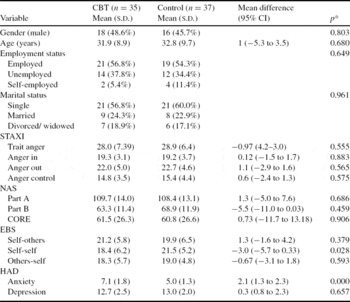
There were no statistically significant differences between the two groups in terms of age, gender, employment or marital status at baseline. Table 1 shows comparison of treatment and control groups before they received therapy. The two groups were similar on most variables, except HAD anxiety subscale scores and EBS, opinion about self subscale score, as highlighted in Table 1.
Comparison of control group with treatment group at baseline

CI, Confidence interval; STAXI, State-Trait Anger Expression Inventory; NAS, Novac Anger Assessment Scale; CORE, Clinical Outcomes in Routine Evaluations Scale; EBS, Evaluative Beliefs Scale; HAD, Hospital Anxiety and Depression Scale.
All values are mean (s.d.) except gender, employment status and marital status, which are n (%).
*Independent-sample t test significance. Two-tailed p value (except for gender, employment status and marital status).
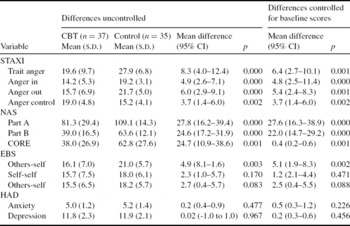
When the two groups were compared at the end of the therapy, the CBT group showed significant improvement compared with the control group on STAXI subscales, anger trait, anger in, anger out, anger control, the two subscales of NAS, CORE and the EBS subscale opinion about others, but not on HAD subscale scores as shown in Table 2.
Differences between treatment and control groups at end of therapy

CI, Confidence interval; STAXI, State-Trait Anger Expression Inventory; NAS, Novac Anger Assessment Scale; CORE, Clinical Outcomes in Routine Evaluations Scale; EBS, Evaluative Beliefs Scale; HAD, Hospital Anxiety and Depression Scale.
The clients in the CBT group were divided into subgroups; those who attended 1–4 sessions (group 1: n = 14, 37.8%), those who attended 5–8 sessions (group 2: n = 13, 35.1%) and those who attended 9–12 sessions (group 3: n = 10, 27.0%).
Discussion
The two groups (treatment and control) were similar at the start of the therapy in various demographic and clinical variables. All clients who attended one or more sessions were included in the trial. The clients were screened for active, serious, mental illness at the start of the therapy and this is shown by the fact that mean scores on anxiety and depression subscales were in the range of mild to moderate [HAD scores are categorized as normal (0–7), mild (8–10), moderate (11–14) and severe (15–21)]. We also found that there was no statistically significant change between treatment and control groups on these measures at the end of the therapy. This possibly reflects the fact that our therapy was aimed at helping clients with anger and not with anxiety or depression. One third of the clients in the treatment group attended ≥8 sessions, and two thirds of the clients attended ≥5 sessions.
We found an anger management programme using CBT techniques to be effective in helping clients with their anger according to two measures of anger (STAXI and NAS). Clients in our group showed improvement in their ability to control their anger. They also showed reduced anger towards self and towards others. These clients also showed improved ability to respond to anger-provoking situations. There was also improvement in overall psychopathology according to the CORE scores and improvements in beliefs about self on the EBS subscale of others-self. This subscale measures a person's perception of what others think of him/her. This is an interesting finding. It was observed during the group sessions that the most common thinking error clients made in relation to their anger was jumping to conclusions. It is understandable that people with anger have unhealthy perceptions of others' comments and actions. The construct others-self possibly measures this aspect of self-perception, therefore when clients were able to think of an alternative style of thinking through cognitive therapy they were better able to perceive benign actions of others in a less hostile way, which improved their perception of what others think of them. The two sessions of the programme with an interpersonal focus might also have contributed to this result. This change in thinking style not only helped to reduce clients' anger, but it should also have a positive impact on their ability to relate to others in general.
Withdrawals and dropouts
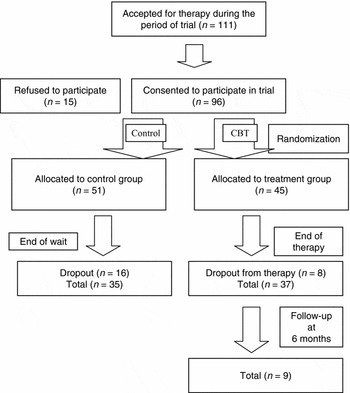
We expected a high dropout rate. However, the dropout rate at follow-up was even higher than expected. We sent three reminders to each participant of the course at 6 months post-therapy follow-up. In spite of this only nine clients responded. We were therefore unable to compare the two groups at 6 months follow-up. This could have provided valuable information about the effect of therapy in the longer term after clients had stopped attending the group.
This is a group of patients with high rates of non-attendance, both before and after joining the group. We carried out analyses on the available data. Figure 1 shows a flow diagram of the trial. Since 6 months follow-up data was available only on nine clients from the treatment group, we were unable to perform meaningful analysis of the follow-up data. The clients were sent self-assessment measures through the post at 6 months follow-up. They were sent three reminder letters. Those who did not respond 3 months after the last reminder were considered as non-responders. Possible reasons could include change of accommodation, moving out of the area, busy lifestyle, lack of interest in completing forms, dissatisfaction with service contact, and disengagement from service contact due to maintained improvement. It is possible that further attempts to contact clients by phone may have resulted in improved response rates. This was not possible due to lack of resources.
Flow diagram of anger management trial.

Criticism of the method
Ideally, a controlled trial should include both randomization and double-blind procedures. Blinding procedures are difficult to apply in studies of psychotherapy, particularly in routine practice. The assessment measures were completed by the patients themselves; therefore the facilitators of the groups were blind to the assessment measures.
We assigned control group clients to a waiting list. Comparison with a waiting list also means we can not exclude the possibility that improvements in the treatment group might be due to meeting with group members. We could have collected valuable information about the impact of the different facilitators on outcome of the group, since they came from different professional groups. Within the limits of this study, the number of facilitators (at three per group) was insufficient for analysis of this variable.
Research in clinically naturalistic settings
It is recognized that such research is most likely to provide results that are relevant to routine clinical practice; the present study provides a more rigorous evaluation of a service that had been run and evaluated routinely for many years, with good outcome results and high local credibility. It is argued that more such studies are needed. There are problems in running a study alongside routine practice in a busy service without dedicated resources. For instance, the problems with follow-up highlight the difficulties of administering such a study with no extra administrative resources.
Acknowledgements
We are grateful to The Research and Development Directorate, Department of Psychiatry, Royal South Hants Hospital, Southampton for providing secretarial and other support. We are also grateful to the therapists and patients who participated in this trial.
Declaration of Interest
None.
Learning objectives
(1) CBT when delivered using a manual and on outpatient basis, is effective for treating anger problems.
(2) A therapy programme needs to build in flexibility to be able to deal with issues as they arise, such as high dropout and problems with motivation.
(3) This study provides some indirect evidence that trainees from different professional backgrounds are able to deliver a service under supervision using a manual. This could be further explored in future research.



Comments
No Comments have been published for this article.