Introduction
In recent years, there has been growing research and interest in the area of psychological well-being and life satisfaction (Diener et al. Reference Diener, Suh, Lucas and Smith1999; Ryan & Deci, Reference Ryan and Deci2001; Frey et al. Reference Frey, Luechinger and Stutzer2004). This research has been broadly motivated by the emerging field of positive psychology (Diener et al. Reference Diener, Suh, Lucas and Smith1999; Vaillant, Reference Vaillant2000). In general, the aims of positive psychology are to examine well-being through valued experiences (e.g. satisfaction, hope or altruism) (Seligman & Csikszentmihalyi, Reference Seligman and Csikszentmihalyi2000).
A growing number of studies have examined the various correlates and predictors of life satisfaction in adult populations. These predictors have spanned the areas of: socio-economic factors (DeNeve & Cooper, Reference DeNeve and Cooper1998; Diener, Reference Diener2000; Bellis et al. Reference Bellis, Lowey, Hughes, Deacon, Stansfield and Perkins2012); partner relationships and social connectedness (Lucas et al. Reference Lucas, Clark, Georgellis and Diener2003; Frey et al. Reference Frey, Luechinger and Stutzer2004; Lucas, Reference Lucas2005; Gardner & Oswald, Reference Gardner and Oswald2006; Lucas & Clark, Reference Lucas and Clark2006; Dolan et al. Reference Dolan, Peasgood and White2008; Mellor et al. Reference Mellor, Stokes, Firth, Hayashi and Cummins2008); unemployment (Winkelmann & Winkelmann, Reference Winkelmann and Winkelmann1998; van Praag et al. Reference van Praag, Frijters and Ferrer-i-Carbonell2001; Dolan et al. Reference Dolan, Peasgood and White2008); income and finances (DeNeve & Cooper, Reference DeNeve and Cooper1998; Winkelmann & Winkelmann, Reference Winkelmann and Winkelmann1998; van Praag et al. Reference van Praag, Frijters and Ferrer-i-Carbonell2001); physical health (Ryan & Deci, Reference Ryan and Deci2001; van Praag et al. Reference van Praag, Frijters and Ferrer-i-Carbonell2001; Oswald & Powdthavee, Reference Oswald and Powdthavee2006; Dolan et al. Reference Dolan, Peasgood and White2008; Bellis et al. Reference Bellis, Lowey, Hughes, Deacon, Stansfield and Perkins2012); and personality traits (DeNeve & Cooper, Reference DeNeve and Cooper1998; Ozer & Benet-Martinez, Reference Ozer and Benet-Martinez2006; Steel et al. Reference Steel, Schmidt and Shultz2008). In general, this research has found that levels of life satisfaction are higher among those who have: higher socio-economic status; a partner relationship; social resources and support; employment; financial resources; good health; and certain personality characteristics (e.g. low neuroticism, high extroversion). However, these effects tend to explain only relatively modest amounts of variance in overall life satisfaction measures (DeNeve & Cooper, Reference DeNeve and Cooper1998; Diener et al. Reference Diener, Suh, Lucas and Smith1999; Bartels & Boomsma, Reference Bartels and Boomsma2009).
Mental health problems form an important class of potential predictors of life satisfaction since it may be reasoned that mental health may play an important role in shaping an individual's life satisfaction and well-being. This issue has been examined by a number of studies that have generally found the presence of mental health problems to be associated with reduced life satisfaction (Murphy et al. Reference Murphy, McDevitt-Murphy and Barnett2005; Bray & Gunnell, Reference Bray and Gunnell2006; Desousa et al. Reference Desousa, Murphy, Roberts and Anderson2008; Beutel et al. Reference Beutel, Glaesmer, Wiltink, Marian and Brahler2010; Koivumaa-Honkanen et al. Reference Koivumaa-Honkanen, Rissanen, Hintikka, Honkalampi, Haatainen, Tarja and Viinamäki2011; Bellis et al. Reference Bellis, Lowey, Hughes, Deacon, Stansfield and Perkins2012; Sun & Shek, Reference Sun and Shek2012; Flèche & Layard, Reference Flèche and Layard2013; Layard et al. Reference Layard, Chisholm, Patel and Saxena2013). For example, Flèche & Layard (Reference Flèche and Layard2013) examined the association between mental health and life satisfaction in three societies (Great Britain, Germany and Australia) using fixed-effects regression methods. This analysis showed the presence of substantial associations between mental health problems and life satisfaction following control for non-observed fixed sources of confounding. In a related study, Layard et al. (Reference Layard, Chisholm, Patel and Saxena2013) concluded that mental health was the single biggest predictor of life satisfaction.
While there has been growing research linking mental health to life satisfaction, research in this area is subject to a number of limitations. First, the ways in which life satisfaction has been assessed have varied between studies, with some studies using responses based on a single-item measure (Bray & Gunnell, Reference Bray and Gunnell2006; Desousa et al. Reference Desousa, Murphy, Roberts and Anderson2008; Bellis et al. Reference Bellis, Lowey, Hughes, Deacon, Stansfield and Perkins2012; Flèche & Layard, Reference Flèche and Layard2013; Layard et al. Reference Layard, Chisholm, Patel and Saxena2013), whereas others have used multiple-item assessments (Murphy et al. Reference Murphy, McDevitt-Murphy and Barnett2005; Beutel et al. Reference Beutel, Glaesmer, Wiltink, Marian and Brahler2010; Koivumaa-Honkanen et al. Reference Koivumaa-Honkanen, Rissanen, Hintikka, Honkalampi, Haatainen, Tarja and Viinamäki2011; Sun & Shek, Reference Sun and Shek2012). Second, consideration has not always been given to a wide range of psychiatric diagnoses spanning psychological condition, mental health problems, substance use and suicidality (Flèche & Layard, Reference Flèche and Layard2013; Layard et al. Reference Layard, Chisholm, Patel and Saxena2013). Third, many studies have been cross-sectional and only examined the associations between mental health problems and life satisfaction at one point in time (Murphy et al. Reference Murphy, McDevitt-Murphy and Barnett2005; Bray & Gunnell, Reference Bray and Gunnell2006; Desousa et al. Reference Desousa, Murphy, Roberts and Anderson2008; Beutel et al. Reference Beutel, Glaesmer, Wiltink, Marian and Brahler2010; Bellis et al. Reference Bellis, Lowey, Hughes, Deacon, Stansfield and Perkins2012). Fourth, studies have varied in the extent to which they control for potentially confounding factors; some studies have controlled for observed covariates (Murphy et al. Reference Murphy, McDevitt-Murphy and Barnett2005; Desousa et al. Reference Desousa, Murphy, Roberts and Anderson2008; Beutel et al. Reference Beutel, Glaesmer, Wiltink, Marian and Brahler2010; Bellis et al. Reference Bellis, Lowey, Hughes, Deacon, Stansfield and Perkins2012; Layard et al. Reference Layard, Chisholm, Patel and Saxena2013), whereas others have used fixed-effects regression methods to control for non-observed sources of confounding (Flèche & Layard, Reference Flèche and Layard2013). Finally, no previous study has used longitudinal data from a well-studied birth cohort to examine reciprocal causal pathways between mental health problems and life satisfaction.
Against this background, this paper reports on a study of the associations between mental health problems and life satisfaction in a birth cohort studied to 35 years. The aims of this research were:
-
1. To examine the associations between mental health problems and life satisfaction assessed using a multi-item inventory, over the developmental period from 18 to 35 years.
-
2. To adjust any associations between mental health problems and life satisfaction for observed and non-observed sources of confounding through the use of fixed-effects regression methods.
-
3. To assess possible causal associations between life satisfaction and mental health using structural equation modelling (SEM).
Method
Participants
Participants were members of the Christchurch Health and Development Study (CHDS) birth cohort. The CHDS is a longitudinal study of 1265 children born in the Christchurch (New Zealand) urban region over a 4-month period during 1977. This cohort has been studied at regular intervals from birth until age 35 years (Fergusson & Horwood, Reference Fergusson and Horwood2001, Reference Fergusson, Horwood, Joyce, Nicholls, Thomas and Wilkinson2013). All phases of the study have been subject to ethical approval by the Canterbury Regional Health and Disabilities Ethics Committee. All data were collected with the signed consent of the study participants.
Outcome
Life satisfaction
At ages 18, 21, 25, 30 and 35 years information about life satisfaction was collected in face-to-face interviews using a custom-written questionnaire which required participants to rate their current satisfaction with each of 11 areas of their life: work; leisure time; partner relationships; relationships with people of the same sex; relationships with people of the opposite sex; social life; money; independence; daily interactions with others; the future; and life as a whole. Participants responded on a four-point scale where ‘1’ was very unhappy; ‘2’ was unhappy; ‘3’ was happy; and ‘4’ was very happy. These items were used in a series of confirmatory factor analyses aimed at assessing the dimensionality of the life satisfaction measures. This analysis showed that when due allowance was made for correlated specificity, the test items fitted a single factor model. Details of the model fitting are provided in online Supplement 1. To represent overall life satisfaction assessments at ages 18, 21, 25, 30 and 35 years, ratings from the 11 items were summed to provide life satisfaction scores. The resulting scales were of moderate to high internal consistency (α = 0.84 to α = 0.89). This measure has been used as an outcome variable in two previous analyses of CHDS data (Boden et al. Reference Boden, Fergusson and Horwood2008; Fergusson et al. Reference Fergusson, McLeod and Horwood2013).
Mental health problems
At ages 18, 21, 25, 30 and 35 years, participants were questioned in face-to-face interviews about their experience of the following mental health problems during the 12 months prior to each assessment.
Major depression and anxiety disorder
Participants were questioned about symptoms of major depression and a range of anxiety disorders (generalized anxiety disorder, panic disorder, agoraphobia, social phobia, specific phobia) in the previous 12 months using items from the Composite International Diagnostic Interview (CIDI; World Health Organization, 1993) to assess Diagnostic and Statistical Manual of Mental Disorders, 4th edition (DSM-IV) criteria (American Psychiatric Association, 1994). Using this information, participants were classified on dichotomous measures reflecting whether they met diagnostic criteria for major depression or anxiety disorder in each of the intervals: 17–18, 20–21, 24–25, 29–30 and 34–35 years.
Suicidal ideation/attempt
Participants were questioned using custom-written survey items about whether they had ever thought about killing themselves or had attempted suicide in the 12 months prior to the assessment and the frequency of such thoughts or attempts (Fergusson et al. Reference Fergusson, Boden and Horwood2008). Using this information, participants were classified on dichotomous measures reflecting whether they met diagnostic criteria for suicidal ideation/attempt in each of the intervals: 17–18, 20–21, 24–25, 29–30 and 34–35 years.
Alcohol/illicit substance dependence
Participants were questioned about problems associated with their use of alcohol or illicit drugs in the previous 12 months, using CIDI items to assess DSM-IV symptom criteria for dependence. Using this information, participants were classified on dichotomous measures reflecting whether they met diagnostic criteria for alcohol dependence or illicit substance dependence in each of the intervals: 17–18, 20–21, 24–25, 29–30 and 34–35 years.
Statistical analyses
Associations between mental health disorders and life satisfaction
The first phase of the analysis examined the associations between presence of mental health problems (major depression, anxiety disorder, suicidal ideation/attempt, alcohol dependence and illicit substance dependence and any mental health problem) and life satisfaction at ages 18, 21, 25, 30 and 35 years. For ease of interpretation, the life satisfaction data were standardized to have a mean of 100 and standard deviation (s.d.) of 10. In each case, the analysis pooled the repeated observations at ages 18, 21, 25, 30 and 35 years to obtain an estimate of the population-averaged associations between presence of mental health problems and life satisfaction using a generalized estimating equation (GEE) modelling approach (Zeger & Liang, Reference Zeger and Liang1986). These models were of the form:
 $$Y_{it} = B0 + B{\rm 1}\,X_{it} + B{\rm 2}\,{\rm AGE}_{it} + U_{it} $$
where Y it was life satisfaction for the ith participant in time period t (t = 18, 21, 25, 30, and 35 years), X it was the measure of mental health for each individual i at time t, AGE it was the age of individual i at the time period t, and U it was the disturbance term. In these models, the coefficient B1 provides an estimate of change in life satisfaction with changes in the mental health measure X it . The coefficient B2 provides an estimate of the effects of age on life satisfaction. The models assumed an unstructured correlation matrix of life satisfaction scores for each individual over time. These models were extended to include multiplicative tests of age × mental health problems and sex × mental health problems interactions.
Adjustment for confounding
The availability of repeated-measures data makes it possible to take into account confounding by non-observed fixed factors by using fixed-effects regression models. An account of the use of fixed-effects regression methods can be found in Hamerle & Ronning (Reference Hamerle, Ronning, Arminger, Clogg and Sobel1995) and Allison (Reference Allison2009). The models fitted were of the form:
 $$Y_{it} = B0 + B{\rm 1}\,X_{it} + B{\rm 2}\,{\rm AGE}_{it} + \mu _i + U_{it} $$
where μ i were a set of individual specific terms that were assumed to reflect the effects of all non-observed fixed sources of variation in the outcome Y i . These factors include all childhood, family and personal characteristics that have a fixed effect on outcomes over time. Thus fixed effects may include both genetic and environmental influences.
The models in Eqs. (1) and (2) above were fitted using Stata 12 for Windows (USA).
Examining the direction of causation
To explore the possibility of reciprocal associations between the measures of life satisfaction and mental health over time, a structural equation model described in Boden et al. (Reference Boden, Fergusson and Horwood2010) and Fergusson et al. (Reference Fergusson, Boden and Horwood2009) was fitted to the data. This analysis made it possible to estimate reciprocal associations between life satisfaction and mental health, taking into account the correlated effects of fixed sources of variation influencing the measures of life satisfaction and mental health over time and the across-time continuities in these measures.
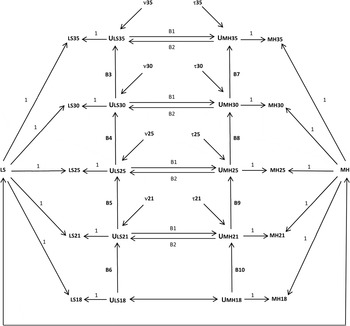
This model is shown in Fig. 1 and assumes the following: (1) observed life satisfaction scores at time t (denoted LS t, with t = 18, 21, 25, 30, 35 years) were influenced by fixed sources of variation (LS) that were constant over time and by time-dynamic sources of variation (ULSt); (2) the observed mental health measures (denoted MHt, with t = 18, 21, 25, 30, 35 years) were also influenced by fixed sources of variation (MH) that were constant over time and time-dynamic sources of variation (UMHt); (3) the fixed factors of LS and MH were permitted to be correlated; (4) the time-dynamic components of life satisfaction (ULSt) and mental health (UMHt) were linked by autoregressive processes in which past life satisfaction predicted future life satisfaction and in which past mental health predicted future mental health, respectively; (5) the time-dynamic components of life satisfaction and mental health were reciprocally related at t = 21, 25, 30 or 35 years so that current ULSt influenced current UMHt and vice versa with these reciprocal effects assumed to be constant over time (see online Supplement 5).
Structural equation model of the association between measures of life satisfaction and number of mental health problems assessed on five occasions. This is an autoregressive model of life satisfaction and mental health problems incorporating fixed effects and reciprocal paths between time-dynamic components of life satisfaction and mental health. LSt, Life satisfaction at time t; LS, fixed effects component of LSt; ULSt, time-dynamic component of LSt; νt, disturbance term for ULSt; MHt, mental health problems at time t; MH, fixed effects component of MHt; UMHt, time-dynamic component of MHt; τt, disturbance term UMHt. Time t is shown as 18, 21, 25, 30 and 35 years representing assessments in the intervals: 17–18, 20–21, 24–25, 29–30 and 34–35 years.

The reciprocal causal model depicted in Fig. 1 was fitted to the observed measures of life satisfaction and mental health problems for the intervals of 17–18, 20–21, 24–25, 29–30 and 34–35 years. The fit of this model was then compared with the fit of two other models that assumed unidirectional causal effects between life satisfaction and mental health problems. These models were: (1) a model that assumed a unidirectional effect from life satisfaction to mental health problems (i.e. B1 ≠ 0; B2 = 0); (2) a model that assumed a unidirectional effect from mental health problems to life satisfaction (i.e. B1 = 0; B2 ≠ 0).
The model in Fig. 1 was fitted to the data of 1056 respondents assessed on measures of mental health and life satisfaction at ages 18, 21, 25, 30 or 35 years. In each case, the model was fitted to the variance–covariance matrix of the repeated measures of mental health problems and life satisfaction using methods of full-information maximum likelihood estimation. Model fitting was conducted in MPlus 7 (Muthén & Muthén, Reference Muthén and Muthén1998–2012). Model goodness of fit was assessed on the basis of the model χ 2 goodness-of-fit statistic, the comparative fit index (CFI) and the root mean square error of approximation (RMSEA). In well-fitting models, the CFI should be close to 1 and the RMSEA less than 0.05. These indices were supplemented by Akaike's information criterion (AIC) for comparison of the relative fit of the three models. The model with the smallest AIC may be assumed to be the best fitting from a series of alternatives (Schermelleh-Engel et al. Reference Schermelleh-Engel, Moosbrugger and Müller2003).
Sample size and sample bias
The analyses reported in this paper were based on data from respondents studied at age 18 years (n = 1024), age 21 years (n = 1011), age 25 years (n = 998), age 30 years (n = 986) and age 35 years (n = 961) for whom information was available on both mental health problems and life satisfaction for at least one assessment from 18 to 30 years. These samples represented between 78.6% and 82.2% of the participants surviving to age 18 years (n = 1245), age 21 years (n = 1240), age 25 years (n = 1234), age 30 years (n = 1231) and age 35 years (n = 1223).
The level of sample attrition raises issues of the extent to which the results may have been influenced by sample selection bias resulting from selective sample attrition. To examine this issue, all analyses were repeated using the techniques described by Carlin et al. (Reference Carlin, Wolfe, Coffey and Patton1999). These methods involved a two-stage process. In the first stage, a sample selection model was constructed by using data gathered at birth to predict inclusion in the analysis sample. In all cases, this analysis showed that there were statistically significant (p < 0.05) tendencies for the analysis sample to under-represent children from more socially disadvantaged backgrounds (low parental education, single parent family, child of Māori or Pacific Island ethnicity and low socio-economic status). On the basis of the fitted selection model, the sample was then post-stratified into a series of groups and the probability of inclusion in the analysis sample was estimated for each group. In the second stage of the analysis, the data were reanalysed with the observations for each individual weighted by the inverse of the probability of sample inclusion. In all cases, the weighted analyses produced essentially identical conclusions to the results reported here, suggesting that the effects of missing data and possible sample selection bias on the results were likely to be minimal.
Results
Associations between mental health disorders and life satisfaction
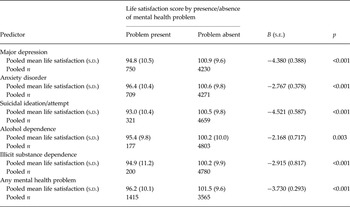
Table 1 shows the associations between measures of mental health in the past 12 months (major depression, anxiety disorder, suicidal ideation/attempt, alcohol dependence, illicit substance dependence, any mental health problem) and mean life satisfaction scores pooled over the repeated observations obtained at ages 18, 21, 25, 30 and 35 years. The source data on which this table was based are presented in online Supplement 2. The pooled associations were analysed by fitting population-averaged regression models that included age as a factor (see Method). Table 1 reports the regression coefficients, standard errors and p values relating each mental health problem to the pooled mean life satisfaction scores (scaled to a mean of 100 and a s.d. of 10). The table shows that in all cases, the presence of mental health problems was associated with statistically significant reductions in life satisfaction (p < 0.01). Inspection of the regression coefficients suggested that overall, those reporting mental health problems had mean life satisfaction scores which were from 0.21 to 0.45 s.d.s lower than those not reporting mental health problems. These analyses were extended to test for multiplicative age × mental health problem, and sex × mental health problem interactions. Only two statistically significant interactions were found [sex × alcohol dependence (p = 0.044) and age × any mental health problem (p = 0.035)]. However, given the number of comparisons made and the weak associations, these interactions were likely to be due to chance variation as a result of multiple statistical significance testing. This conclusion was supported by the Bonferroni corrected p value (p = 0.008); using this value, neither of the interactions was statistically significant.
Life satisfaction scores by presence/absence of mental health problems (past 12 months) pooled over all observations at 18, 21, 25, 30 and 35 years

s.e., Standard error; s.d., standard deviation.
Adjustment for confounding
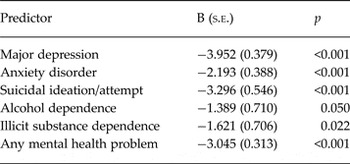
One explanation of the findings in Table 1 is that the associations between mental health and life satisfaction reflect the presence of non-observed confounding factors. To address this issue, the analyses in Table 1 were extended by fitting fixed-effects regression models to control for non-observed fixed sources of confounding (see Method). The adjusted results in Table 2 show that, in all cases, control for confounding reduced the regression coefficients linking mental health problems with life satisfaction. Nonetheless, after adjustment, all associations between mental health problems and life satisfaction remained statistically significant (p < 0.05), with the exception of alcohol dependence that was marginally statistically significant (p = 0.05).
Estimated effects of presence of mental health problems on life satisfaction scores after adjustment for confounding by non-observed fixed factors

s.e., Standard error.
The fixed-effects regression models reported in Table 2 were further extended to include additional control for a series of time-dynamic covariates that were correlated with both mental health and life satisfaction. These covariates included the respondent report (in the past 12 months prior to the assessment) of: being in a cohabiting partnership; experiencing interpersonal problems; experiencing financial problems; and weekly income from employment. The same pattern of adjusted associations was observed in these analyses (see online Supplement 3), suggesting that the associations between mental health and life satisfaction were resilient to control for both non-observed fixed sources of confounding and the correlated effects of other time-dynamic processes.
Accumulation of mental health problems and life satisfaction
To summarize the associations between life satisfaction and the accumulation of mental health problems, a further analysis was conducted on the number of mental health problems experienced (categorized as none, 1, 2, and 3+ problems). Descriptive information (mean, s.d., n) for the mean life satisfaction scores at each assessment age, and pooled over all observations, by the number of mental health problems is shown in online Supplement 4. A fixed-effects regression model was fitted to the repeated-measures data on life satisfaction and number of mental health problems to control for confounding by non-observed fixed factors. This analysis showed the presence of a significant linear association (B = −1.974, s.e. = 0.188, p < 0.001) between the number of mental health problems reported at a given time and mean life satisfaction scores. After adjustment for confounding, the number of mental health problems explained 7.3% of the variance in life satisfaction.
Examining the direction of causation
The above findings clearly suggest the existence of a robust causal relationship between life satisfaction and mental health over time. This conclusion, in turn, raises issues regarding the direction of causation. On the one hand, it can be argued that mental health problems will reduce life satisfaction (Murphy et al. Reference Murphy, McDevitt-Murphy and Barnett2005; Bray & Gunnell, Reference Bray and Gunnell2006; Desousa et al. Reference Desousa, Murphy, Roberts and Anderson2008; Beutel et al. Reference Beutel, Glaesmer, Wiltink, Marian and Brahler2010; Koivumaa-Honkanen et al. Reference Koivumaa-Honkanen, Rissanen, Hintikka, Honkalampi, Haatainen, Tarja and Viinamäki2011; Bellis et al. Reference Bellis, Lowey, Hughes, Deacon, Stansfield and Perkins2012; Flèche & Layard, Reference Flèche and Layard2013; Layard et al. Reference Layard, Chisholm, Patel and Saxena2013). However, on the other hand, it may be suggested that life satisfaction is a resiliency/vulnerability factor that influences susceptibility to mental health problems (Park, Reference Park2004; Faragher et al. Reference Faragher, Cass and Cooper2005; Sirgy, Reference Sirgy2012). To represent the associations between life satisfaction and mental health, the structural equation model in Fig. 1 was fitted to the data (see Method and online Supplement 5). This model examined the relationship between life satisfaction and the number of mental health problems observed at 18, 21, 25, 30 and 35 years. Three versions of the structural equation model shown in Fig. 1 were fitted to the data:
-
Model 1. A model assuming reciprocal paths between life satisfaction and mental health (i.e. B1 ≠ 0; B2 ≠ 0).
-
Model 2. A unidirectional model assuming life satisfaction influenced mental health but there was no effect of mental health on life satisfaction (i.e. B1 ≠ 0; B2 = 0).
-
Model 3. A unidirectional model assuming that mental health influenced life satisfaction but life satisfaction did not influence mental health (i.e. B1 = 0; B2 ≠ 0).
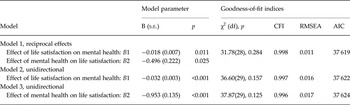
Table 3 summarizes the goodness of fit of the three models and shows that model 1 (reciprocal paths) provided the best fit to the observed data. Further, comparison of model χ 2 statistics showed that the fit of model 1 was significantly better than the unidirectional model 2 [Δχ 2 = 4.82, degrees of freedom (df) = 1, p < 0.05] and model 3 (Δχ 2 = 6.09, df = 1, p < 0.05).
Summary of fitted model coefficients for the causal associations between life satisfaction and the number of mental health problems and model goodness of fit indices

s.e., Standard error; df, degrees of freedom; CFI, comparative fit index; RMSEA, root mean square error of approximation; AIC, Akaike's information criterion.
Finally, the reciprocal model was fitted to the data on the individual mental health problems major depression, anxiety disorder, suicidal ideation/attempt, alcohol dependence and illicit substance dependence. The majority of the structural equation model analyses (major depression, illicit substance dependence, suicidal ideation/attempt) showed statistically significant effects of life satisfaction on mental health, while statistically significant effects of mental health on life satisfaction were found for anxiety disorder. These findings are generally consistent with the conclusion that overall mental health and life satisfaction were reciprocally related variables (see online Supplement 5).
Discussion
In this article, we examined the associations between life satisfaction and psychiatric disorder using data gathered over the course of a 35-year longitudinal study. This research had a number of strengths when compared with existing research. These strengths include: (a) the availability of life satisfaction and mental health measures from late adolescence to mature adulthood; (b) comprehensive measurement of mental health problems using DSM diagnostic criteria; and (c) the availability of longitudinal data permitting adjustment for non-observed confounding and an examination of reciprocal associations between life satisfaction and mental health. A commentary on the major findings and their implications is provided below.
-
(1) In confirmation of previous research there were consistent findings suggesting that the presence of mental health problems was associated with reductions in life satisfaction. This conclusion held for measures of major depression, anxiety disorder, suicidality, alcohol dependence and illicit substance dependence. Overall, the presence of mental health problems was associated with a 0.21 to 0.45 s.d. reduction in mean life satisfaction scores.
-
(2) These analyses were extended to adjust the associations between mental health problems and life satisfaction by controlling for non-observed fixed covariates. Fixed-effects regression controls for any source of non-observed confounding (including genetic), providing this influence has a fixed and enduring effect on life satisfaction. The analysis showed that after adjustment, significant associations (p < 0.05) remained between life satisfaction and major depression, anxiety disorder, suicidal ideation/attempt and illicit substance dependence. In agreement with a previous analysis (Swain et al. Reference Swain, Gibb, Horwood and Fergusson2012), there was no statistically significant association between alcohol dependence and life satisfaction (p > 0.10). After statistical control, those reporting any mental health problem had mean life satisfaction scores that were 0.30 s.d.s lower than those with no disorder. This analysis was extended to examine the dose–response relationship between the number of disorders reported and mean life satisfaction. This analysis showed a consistent trend for mean life satisfaction to decline with increasing reports of mental health problems. Those reporting three or more disorders had mean life satisfaction scores that were nearly 0.60 s.d.s lower than those reporting no mental health problems (see online Supplementary Table S4.2).
These findings are generally consistent with previous research that has examined the linkages between mental health and life satisfaction (Murphy et al. Reference Murphy, McDevitt-Murphy and Barnett2005; Bray & Gunnell, Reference Bray and Gunnell2006; Desousa et al. Reference Desousa, Murphy, Roberts and Anderson2008; Beutel et al. Reference Beutel, Glaesmer, Wiltink, Marian and Brahler2010; Koivumaa-Honkanen et al. Reference Koivumaa-Honkanen, Rissanen, Hintikka, Honkalampi, Haatainen, Tarja and Viinamäki2011; Bellis et al. Reference Bellis, Lowey, Hughes, Deacon, Stansfield and Perkins2012; Sun & Shek, Reference Sun and Shek2012; Flèche & Layard, Reference Flèche and Layard2013; Layard et al. Reference Layard, Chisholm, Patel and Saxena2013). In addition, the conclusions are consisted with the conclusions of genetically informative studies using twin samples to control for confounding (Kendler et al. Reference Kendler, Myers, Maes and Keyes2011; Bartels et al. Reference Bartels, Cacioppo, van Beijsterveldt and Boomsma2013; Nes et al. Reference Nes, Czajkowski, Røysamb, Ørstavik, Tambs and Reichborn-Kjennerud2013).
-
(3) To explore the associations between life satisfaction and mental health further, a structural equation model was fitted to the data. This analysis suggested the presence of a reciprocal association between life satisfaction and mental health in which: (a) increasing life satisfaction was associated with fewer mental health problems (B = −0.018, s.e. = 0.007, p = 0.011); and (b) an increasing number of mental health problems was associated with declining life satisfaction (B = −0.496, s.e. = 0.222, p = 0.025).
While substantial research has been conducted on life satisfaction and mental health, in nearly all of the studies research has focused on the influence of life satisfaction on mental health. An exception is Sun & Shek (Reference Sun and Shek2012) who examined the relationship between life satisfaction and behavioural adjustment in a sample of Chinese adolescents. This analysis found evidence of reciprocal relationships between life satisfaction and behavioural adjustment and concluded ‘…that adolescents with higher level of positive youth development were more satisfied with life and had lesser problem behaviour, with higher level of life satisfaction and lower level of problem behaviour mutually influencing each other’ (p. 541). These conclusions are consistent with the findings of this study. These emerging findings of reciprocal relationships between life satisfaction and mental health highlight the need for more research in this area and for studies to avoid unidirectional analysis of the effects of life satisfaction on mental health without consideration of a reverse association.
While this study has a number of strengths relating to the longitudinal design, it is not without limitations. In particular, the findings reported in this paper are specific to a particular cohort studied over a particular time period using a particular set of measurements. The extent to which the study findings generalize to other contexts is not known. Notwithstanding these reservations, the present study suggests the presence of robust reciprocal associations between mental health problems and life satisfaction.
Supplementary material
For supplementary material accompanying this paper visit http://dx.doi.org/10.1017/S0033291715000422
Acknowledgements
This research was funded by grants from the Health Research Council of New Zealand (HRC 11/792), the National Child Health Research Foundation (Cure Kids), the Canterbury Medical Research Foundation and the New Zealand Lottery Grants Board.
Declaration of Interest
None.