When speakers produce words, the process of selecting and retrieving the target word is sometimes helped by prior naming events, and sometimes hindered. In some contexts, adults experience interference from previously named words that are semantically related to the target word (e.g., Belke, Meyer, & Damian, Reference Belke, Meyer and Damian2005; Howard, Nickels, Coltheart, & Cole-Virtue, Reference Howard, Nickels, Coltheart and Cole-Virtue2006). A handful of studies have also described lexical interference effects in young children (Booth & Vitkovitch, Reference Booth and Vitkovitch2008; Gershkoff-Stowe, Reference Gershkoff-Stowe2002; Stemberger, Reference Stemberger1989). This literature is much smaller and less systematic than that focusing on adults, but the available studies raise interesting questions about how lexical interference manifests in childhood and how the dynamic activities that support language use may or may not change with development. This study fits within that literature. It examines the influence of semantic context and previous trials on interference in 3-year-old children during a naming task.
In adults, interference from recently named items has been studied within blocked cyclic naming and continuous naming paradigms. The general pattern of findings is that naming pictures with shared meaning (e.g., cat, dog) produces interference, measured in response latencies and/or naming errors. In blocked cyclic naming, participants name small sets of items, repeating a set several times within a block. Blocks are composed of semantically homogeneous sets (e.g., pig, cow, horse, sheep), or mixed sets. Interference manifests as slower responding and/or more errors within the homogeneous blocks relative to the mixed blocks (Abdel Rahman & Melinger, Reference Abdel Rahman and Melinger2007; Belke et al., Reference Belke, Meyer and Damian2005; Damian & Als, Reference Damian and Als2005; Schnur, Schwartz, Brecher, & Hodgson, Reference Schnur, Schwartz, Brecher and Hodgson2006). In continuous naming (Brown, Reference Brown1981; Howard et al., Reference Howard, Nickels, Coltheart and Cole-Virtue2006), participants name a series of pictures, and items from different semantic sets (e.g., farm animals, fruits) are dispersed throughout the list. Interference manifests as a slowing of successive responses within a semantic set. Interference has also been observed in repetitions or perseverations of previous responses (e.g., pig, cow, horse, cow) in speakers with aphasia and in healthy adult speakers under speeded naming conditions (Hsiao, Schwartz, Schnur, & Dell, Reference Hsiao, Schwartz, Schnur and Dell2009; Vitkovitch, Kirby, & Tyrrell, Reference Vitkovitch, Kirby and Tyrrell1996; Vitkovitch, Rutter, & Read, Reference Vitkovitch, Rutter and Read2001). In healthy adult speakers, these errors do not occur as immediate repetitions, but surface with several trials intervening (Vitkovitch et al., Reference Vitkovitch, Kirby and Tyrrell1996, Reference Vitkovitch, Rutter and Read2001).
Interference effects provide insight into the nature and organization of lexical processing, and into the ways in which “experience changes language processing” (Oppenheim, Dell, & Schwartz, Reference Oppenheim, Dell and Schwartz2010, p. 228). Of interest for the current study is the mechanism responsible for producing such effects. One possibility is that semantic interference may be caused by residual or ongoing activation of past targets (e.g., Belke et al., Reference Belke, Meyer and Damian2005; Vitkovitch et al., Reference Vitkovitch, Kirby and Tyrrell1996). In recent years, however, researchers have interpreted interference from past naming responses as effects that are instantiated in relatively long-term changes to the strength of connections along lexical pathways, rather than short-term residual activation (Damian & Als, Reference Damian and Als2005; Howard et al., Reference Howard, Nickels, Coltheart and Cole-Virtue2006; Hsiao et al., Reference Hsiao, Schwartz, Schnur and Dell2009; Oppenheim, Dell, & Schwartz, Reference Oppenheim, Dell and Schwartz2007; Oppenheim et al., Reference Oppenheim, Dell and Schwartz2010). This shift is driven by several important observations about the conditions that do and do not constrain interference. As noted above, interference is semantically based, occurring among words that share overlapping patterns of activation via shared features or categories. It is important to note that interference effects do not increase with shorter response–stimulus intervals (RSI). Given that residual activation is thought to last for several seconds at most (Bock & Griffin, Reference Bock and Griffin2000; Dell, 1986), the observed insensitivity to RSI makes explanations based in short-term lingering activation unlikely (Hsiao et al., Reference Hsiao, Schwartz, Schnur and Dell2009; Oppenheim et al., Reference Oppenheim, Dell and Schwartz2010; Schnur et al., Reference Schnur, Schwartz, Brecher and Hodgson2006; Vitkovitch et al., Reference Vitkovitch, Kirby and Tyrrell1996). Interference is, however, sensitive to the number of prior related responses: in blocked cyclic naming studies, the effects typically do not appear until the second block of naming (Abdel-Rahman & Melinger, Reference Abdel Rahman and Melinger2007; Belke et al., Reference Belke, Meyer and Damian2005; Schnur et al., Reference Schnur, Schwartz, Brecher and Hodgson2006). In continuous naming, the effects are cumulative: response latencies become incrementally longer with each exposure to items from a given semantic set (Howard et al., Reference Howard, Nickels, Coltheart and Cole-Virtue2006). In addition, interference effects are robust to intervening items (Damian & Als, Reference Damian and Als2005; Howard et al., Reference Howard, Nickels, Coltheart and Cole-Virtue2006). Thus, naming horse is slower after naming cow, even if several unrelated items intervene (although note that interference does dissipate when many items intervene; Schnur, Reference Schnur2014). In light of these findings, researchers (Damian & Als, Reference Damian and Als2005; Howard et al., Reference Howard, Nickels, Coltheart and Cole-Virtue2006; Hsiao et al., Reference Hsiao, Schwartz, Schnur and Dell2009; Oppenheim et al., Reference Oppenheim, Dell and Schwartz2010) have interpreted and modeled interference as arising from experience-driven incremental learning or strengthening of connections along lexical pathways. In some contexts, experience-driven change in the connection weights to words sharing features or connections can interfere with activation and selection of the target word, leading to slower or less successful naming. For example, in the model implemented by Howard et al. (Reference Howard, Nickels, Coltheart and Cole-Virtue2006), interference develops over time because the activation of target words strengthens the connections along the pathways to those words. When speakers attempt to name related items (i.e., other words within the semantic set), semantically related words also receive activation. Those words that have strengthened connections also become stronger competitors, delaying selection of the target word.Footnote 1 An interesting implication of this perspective on interference is that although it is a disruption to time or accuracy that is measured, this disruption is indexing learning and change within the lexical system.
A handful of studies have also reported interference effects in very young children's speech, primarily through the lens of perseveration errors. There is some, albeit limited, evidence for changes with development in susceptibility to interference during lexical access, or in the temporal dynamics that govern interference effects. Stemberger (Reference Stemberger1989), for example, reported a diary study of spontaneous speech errors produced by his two children, and observed that the children produced a higher rate of between-clause perseverative errors than that observed for adults. Vousden and Maylor (Reference Vousden and Maylor2006) reported that 8- and 11-year-old children produced a higher rate of perseveratory errors than adults in a tongue twister task. Focusing on very young speakers, Gershkoff-Stowe (Reference Gershkoff-Stowe2002) examined toddlers’ picture-naming errors during book sharing, and reported that perseverative errors occurred more frequently in the responses of participants who were approximately 16 to 23 months old (peaking at the onset of their vocabulary explosion) than 28-month-old infants. For both age groups, the vast majority of these errors were repetitions of the immediately preceding response, a notable difference from the pattern produced by healthy adults (Vitkovitch et al., Reference Vitkovitch, Kirby and Tyrrell1996, Reference Vitkovitch, Rutter and Read2001). The absence of immediate perseverative errors in adults has been interpreted as reflecting an immediate but temporary inhibition of activation of the just-named target (Vitkovitch et al., Reference Vitkovitch, Kirby and Tyrrell1996, Reference Vitkovitch, Rutter and Read2001). Booth and Vitkovitch (Reference Booth and Vitkovitch2008) noted the possibility that the different patterns observed for children and adults might indicate a lack of immediate suppression in very young children, and looked for an age-related shift from immediate to delayed repetition when 4- and 6-year-old children named a set of 30 pictures. However, both groups showed above-chance tendencies to repeat the immediately preceding response. For the older group, there was also an above-chance tendency to repeat the response that had been produced two trials prior. The results hinted at, but did not demonstrate, a difference in the temporal dynamics of interference by age from preschool to early school age.
Thus, the evidence with respect to the manifestation of interference from past responses and the potential for developmental change is limited and scattered across age ranges. Moreover, it is not clear how interference phenomena in children should be interpreted. As in earlier studies with adults, lexical interference in children has been attributed to residual activation mechanisms (Booth & Vitkovitch, Reference Booth and Vitkovitch2008; Gershkoff-Stowe, Reference Gershkoff-Stowe2002; Stemberger, Reference Stemberger1989). By extension, the possibility that there may be age-related differences in the amount, control, or time course of residual activation has been considered (Booth & Vitkovitch, Reference Booth and Vitkovitch2008; Stemberger, Reference Stemberger1989). Researchers have also doubted the likelihood that changes occur with development in the efficiency or timing of “shutting down” of residual activation, arguing instead that any differences in susceptibility are more likely due to age-related changes in the robustness of lexical activation that arise as children develop richer and stronger connections within their lexical systems (Booth & Vitkovitch, Reference Booth and Vitkovitch2008; Budd, Hanley, & Griffiths, Reference Budd, Hanley and Griffiths2011; Dell, Burger, & Svec, Reference Dell, Burger and Svec1997; Gershkoff-Stowe, Reference Gershkoff-Stowe2002). When lexical representations are more fragile, activating the target word will be more difficult and more vulnerable to interference. However, to date, researchers have not explored the possibility that interference effects might arise as the result of learning and change rather than short-term residual activation.
If production-driven incremental learning occurs in adults and manifests as semantic interference, then such a mechanism may also account for the interference effects that occur in early childhood. However, the systematic comparisons that have informed understanding of the mechanisms of interference in adulthood have not been pursued with children, and it is not known whether interference effects are subject to the same influences as in adults. Several important pieces of information are needed to develop a clearer picture of how interference from prior naming events manifests in childhood, namely, whether such interference is a semantic phenomenon, whether interference effects are cumulative, and whether interference effects are insensitive to RSI and intervening material. The current study addresses the first two of these needs.
With respect to semantic effects, recent work (Snyder & Munakata, Reference Snyder and Munakata2013) has demonstrated that 6-year-old children show slower responding to semantically homogenous sets in blocked cyclic naming, supporting the view of a semantic effect. More information is needed about early development, however. In the study reported by Gershkoff-Stowe (Reference Gershkoff-Stowe2002), the 28-month-old children produced perseverative errors for semantically related targets as well as unrelated targets (e.g., car/ball, p. 674). These children named pictures in two books, one with a mixed set of items and one containing animal pictures (Polar Bear, Polar Bear by Bill Martin Jr.). Although the error rate was higher with the animal book, perseverations did occur for both stimulus sets. The stimulus books differed on two counts: the animal book presented pictures from a homogeneous semantic set. It also presented words that were much less likely to be familiar to the 2.5-year-old children in the study (e.g., flamingo, walrus, leopard). Thus, it is possible that lexical familiarity rather than semantic context was responsible for the higher rate of interference in the animal book. Finally, in the research reported by Booth and Vitkovitch (Reference Booth and Vitkovitch2008), 4-year-old children named 30 animals and produced perseverative naming errors, as well as semantically related, nonperseverative errors. There was no semantically heterogeneous set, and so it is not known whether the children in this age range would have also shown interference effects that were not semantically constrained.
With respect to questions about the cumulative nature of interference effects, Snyder and Munakata (Reference Snyder and Munakata2013) reported that, unlike adults, interference effects in blocked cyclic naming emerged from the first experimental block, rather than only emerging in later blocks. Such a result could point to different mechanisms or faster buildup of interference; however, the authors also noted that the difference in outcome may have been a methodological artifact. Other studies have not examined interference from the perspective of growth of interference across responses.
The purpose of the current study was to examine whether some of the influences on interference that hold for adults also hold for young children. The goal was to gain insight into the possibility that an incremental learning mechanism may also be an appropriate account of interference in early childhood. Three-year-old children named a series of pictures presented one at a time on a computer monitor. There were two sets of pictures, a semantically homogeneous set (animals, consistent with prior child-focused work; Booth & Vitkovitch, Reference Booth and Vitkovitch2008; Gershkoff-Stowe, Reference Gershkoff-Stowe2002) and a mixed set. The study resembled previous work with children (Booth & Vitkovitch) and adults (Vitkovitch et al., Reference Vitkovitch, Kirby and Tyrrell1996) in that it presented a continuous list of animals for naming. The two stimulus sets were well equated for likely difficulty of naming. Measures of response accuracy, response latency (response time [RT]), and perseverative errors were taken. RSI was not manipulated, but was controlled to assure relatively constant RSI across conditions and participants. Finally, this study was not designed to examine the robustness of interference to intervening material, but to provide a foundational picture for future investigations of interference phenomena. The research questions were as follows:
-
1. Do 3-year-old children show semantically constrained interference effects?
-
a. Given two sets of stimuli that are well balanced for likely familiarity and difficulty of the items, are they slower and/or less successful in naming items from a semantically homogenous set? I expected that the children would show more difficulty with the semantically homogeneous picture set, measured via response accuracy and RT.
-
b. Are perseverative errors more frequent among semantically related targets, given well-matched stimulus sets? I expected that repetitions of immediately preceding responses would occur, and would be more frequent in the semantically homogeneous set. Repetitions among semantically related items, but not unrelated items, would be consistent with a semantic interference effect. However, given prior evidence that somewhat younger children also produce unrelated perseverations (Gershkoff-Stowe, Reference Gershkoff-Stowe2002), the possibility of such effects in 3-year-olds could not be ruled out.
-
-
2. Do 3-year-old children show semantic interference effects that are cumulative? I anticipated that interference would increase across blocks, and that the increase would be greater for the semantically homogenous condition. Because it involves change over time, a cumulative semantic interference effect would be more consistent with a learning mechanism than a residual activation mechanism and would lay the foundation for future confirmatory work. Because residual activation is thought to be rather short lived, it would not be expected to accrue beyond a very small number of trials, and thus consistent growth of interference would not be expected. The strongest evidence for cumulative semantic interference would be a result showing similar outcomes for the two conditions at the start of the experiment, followed by decrements in performance in the semantically homogenous condition across time, measured as increases in errors and/or increases in RT.
-
Alternatively, other outcomes might more easily be interpreted as being due to residual activation or other factors. For example, a stable pattern (i.e., not increasing across the experiment) of worse performance in the semantically homogeneous condition might be indicative of short-term residual activation effects within that condition (or less interestingly, poor matching of the conditions resulting in the homogenous condition containing more challenging items). A pattern of frequent, immediate repetition errors in one or both conditions might also be interpreted as more likely based in residual activation than learning.
METHOD
Participants
Nineteen 3-year-olds (8 girls) completed the study. The mean age of the participants was 3 years, 5 months (3;5; range = 3;0–4;0). All children spoke English as their first and primary language, and parents reported no concerns with their language development. Maternal education was collected as a proxy for socioeconomic status, and ranged from high school to graduate or advanced degrees. One mother reported some high school completed, 11 reported some or all of a college/university degree completed, and 7 reported advanced degrees.
An additional four children participated but were not included in the final sample. Two children did not complete the task, and two others were excluded due to low speech intelligibility.
Stimuli
The stimuli consisted of two sets of 28 child-friendly, color pictures. The semantically homogenous set of pictures contained 28 animal images. For the mixed list, the choice of stimulus words was constrained by the children's age and the need to match the items to the animals list on a number of variables. For this reason, it was not possible to have a set completely devoid of relationships among items. The mixed stimulus set contained two or three items from each of 10 categories. The picture stimuli consisted of royalty-free images, available either in the public domain or purchased through a royalty-free image site (Shutterstock.com). All of the stimuli were chosen to be items whose label was likely to be known by 3-year-old children, based on reported age of acquisition (AoA). The two stimulus sets were matched closely for average AoA, frequency, and length in syllables. In addition, because voice keys may be differentially sensitive to different classes of phonemes (Kessler, Treiman, & Mullennix, Reference Kessler, Treiman and Mullennix2002), the two lists were matched as closely as possible on an item-by-item basis for initial phoneme, place, or manner of articulation, subject to the other constraints. AoA was calculated as the age in months at which 75% of children are reported to produce the word according to the McArthur–Bates Communicative Development Inventory (Dale & Fenson, Reference Dale and Fenson1996; Jørgensen, Dale, Bleses, & Fenson, Reference Jørgensen, Dale, Bleses and Fenson2010), or where these values were not available, age reported by Morrison, Chappell, and Ellis (Reference Morrison, Chappell and Ellis1997) for 75% correct picture naming. Several items were below 75% but above 50% at 30 months on the McArthur–Bates Communicative Development Inventory (the highest age for which data are available). These items were considered to be acquired at 36 months for the purposes of constructing the stimulus set. Frequency was calculated as the number of occurrences per million for the age range of 36 to 47 months in the ChildFreq database (Bååth, Reference Bååth2010). The average AoA for the animals set was 27.7 months (SD = 5.97, range = 14–36); for the mixed list, it was 28.0 months (SD = 4.99, range = 19–38). The average frequency within the animal list was 220.6 (SD = 184.47, range = 22–722); within the mixed list, it was 197.1 (SD = 163.80, range = 16–737). The average number of syllables in the anticipated label was 1.6 (range = 1–3) within both lists. There were no significant differences between the stimulus sets on any of these variables (all ts < 1). Appendix A lists the full set of stimuli.
Procedure
The research task was completed in a single session, either at the University of Alberta or in a quiet room within the participant's childcare center. For the experimental task, list order (animals or mixed first) was counterbalanced across children. For each list, the child was familiarized with the pictures and their labels before beginning the naming task proper. Images of the items were presented five or six to a page. The experimenter named each item, and the child identified the item by pointing to it. Incorrect pointing responses were very rare, and corrected by returning to the item before moving to the next page. The familiarization procedure provided some assurance that the children had at least some knowledge of the lexical targets.
For the naming task, the children sat at a child-size table, at a comfortable viewing distance from a laptop computer. The images were presented using E-Prime software (Schneider, Eschman, & Zuccolotto, Reference Schneider, Eschman and Zuccolotto2002). A directional boundary microphone connected to the Psychology Software Tools button box was used for voice key capture of RTs, and a second microphone attached to a digital recorder was used to audio record the session. The experiment began with two demonstration items followed by three practice items that could be repeated if needed. Children were encouraged to “say what the picture is right away as soon as you know.” The instructions also emphasized that it was okay if the children made naming errors.
The pictures appeared on a white background within a black frame. Each trial began with an orienting cue. A small octagon entered the frame and moved toward a circle target at the center of the screen. The point of entry of the octagon and path to the center varied on different trials. The stimulus picture appeared immediately after the octagon reached the center target, and remained on the screen for up to 5 s. The child's response triggered the voice key, at which point small red stars appeared in the four corners of the frame while the image remained on the screen, and the experimenter advanced to the next trial with a mouse click. This manipulation was intended to guard against children becoming confused if a picture disappeared before a response (e.g., due to a lip pop or other false trigger), and to provide an indication of the voice key functioning. A video camera filmed the computer screen during the task; the video was then checked for trials in which there were clear failures of the voice key functioning (early trigger by artifacts or trigger failures). At the mouse click, the orienting screen reappeared, followed by the next stimulus item. The duration of the orienting screen was 1 s from the mouse click to the onset of the stimulus picture. The RSI was therefore 1 s plus the experimenter's reaction time to advance the trial.
Within each list, the order of the 28 pictures was randomized by the experimental software. The 28 items were presented in four blocks of 7. At the end of each block, a happy face screen appeared with the words Great Job. The experimenter provided encouragement and reminded the child to continue to “say what each picture is, right away as soon as you know it.” The manual advance of trials allowed the experimenter to pause the experiment if necessary, but typically the trials proceeded uninterrupted between the breaks. The average RSI within blocks was 1.6 s. The average interval between blocks was 13.4 s. At the end of the first list, a short play break ensued.
Transcription, scoring, and reliability
Two research assistants transcribed responses. Given the young age of the participants, phonological errors were expected. The transcribers recorded the orthographic gloss; if they could not confidently identify the lexical item, they coded the response as unintelligible. Occasional responses in which the child was off-task or that contained experimenter error were coded as unusable. Responses coded as correct included the expected label as well as reasonable alternatives (e.g., bunny/rabbit; crocodile/alligator; mitten/glove), and diminutives or related forms (e.g., dog/doggie/puppy). Responses coded as in error included (a) responses containing a hesitation (e.g., um, or a sound- or part- or whole-word revision); (b) no response, response timeouts, and unintelligible responses; and (c) naming errors. In the mixed condition, these included occasional errors that named only a part of the whole picture (e.g., foot/toe; tree/branch).
For reliability, four (21%) randomly selected transcripts were independently transcribed and coded by both research assistants. Reliability, computed as the number of agreements divided by the total number of judgments, was >99% for judgments of whether or not a trial was usable, and 97% for judgments of correct/error.
RESULTS
Children's response accuracy and perseverative errors are addressed first, before turning to RTs. For the analyses of response accuracy and RT, the effects of condition, block, and their interaction on performance were investigated using linear mixed-effects models with participants and items as crossed random effects. Block (1–4) was included in these analyses as a numerical predictor for the analysis of change over time. Treatment coding was used for the categorical predictor, condition, with the animal condition as the reference. Analyses were implemented using the lme4 package (Bates, Maechler, Bolker, & Walker, Reference Bates, Maechler, Bolker and Walker2015) in R (R Core Team, 2015), with random intercepts for participants and target items. Models were compared using the Akaike information criterion and likelihood ratio (χ2). The figures present the observed means and standard errors calculated across all subjects and trials (i.e., not averaged within each subject).
Accuracy
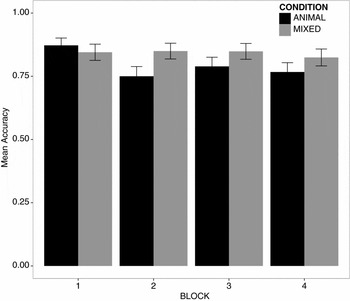
Out of 1,047 usable responses (animal condition = 522; mixed condition = 525), there were 190 errors (18%). Of these, 106 (56%) contained a hesitation; 30 (16%) were a nonresponse, timeout or unintelligible; and 54 (28%) contained a naming error. Of the naming errors, 44 (81%) involved the production of another item from the same stimulus set. Response set errors accounted for virtually all of the naming errors in the animal condition (99%) and approximately half (53%) of the naming errors in the mixed condition. The remaining 9 errors in the mixed set varied: naming part of the target (e.g., toe/foot), and providing related but incorrect responses (e.g., coffee/cup, climb up/ladder, shirt/dress, moon/balloon). The likelihood of an accurate response was analyzed with mixed logit modeling, using the glmer function within the lme4 package (Bates et al., Reference Bates, Maechler, Bolker and Walker2015). Note that the analysis produces results in log odds of the outcome. For ease of interpretation, however, descriptive data are given in the original unit of measurement, accuracy. Figure 1 presents the mean response accuracy for each combination of condition and block. As can be seen, Figure 1 points to somewhat higher accuracy for the animal condition than the mixed condition in Block 1, followed by higher accuracy for the mixed condition than the animal condition in subsequent blocks.
Mean response accuracy by condition and block.

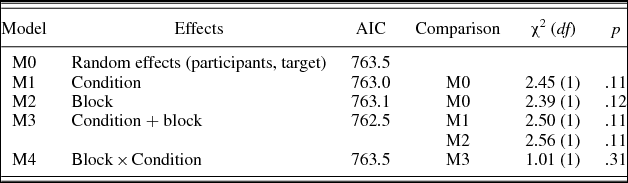
Table 1 presents the outcomes of successive model comparisons. Neither condition nor block showed a significant main effect, nor did the interaction between the two. An analysis by trials rather than blocks also showed no significant effects.
Model outcomes for accuracy

Note: AIC, Akaike information criterion; M1–4, Models 1–4 included random intercepts for participants and targets, in addition to the fixed effects of interest.
Perseverative responses
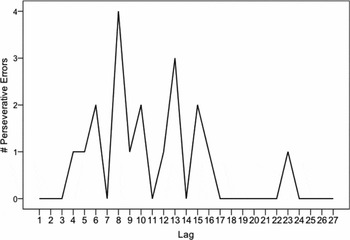
Perseverative responses were calculated as the number of repetitions out of the total number of naming errors that named an item within the current response set. Thirteen of the 19 participants produced at least 1 such repetition error. Overall, there were 34 response set errors in the animal condition, and 10 response set errors in the mixed condition. Within the animal condition, 56% of response set errors were repetitions of prior responses (n = 19); within the mixed condition, this value was 60% (n = 6). By necessity, all of the repetitions in the animal condition were semantically related to the target by the category of animal. Four of the six repetitions in the mixed condition were judged to be semantically related to the target, based on thematic (hand/mitten; hand/glove) or taxonomic relationships (firetruck/tractor; chair/table). Of the remaining two, one shared a phonological relationship (moon/balloon). The other, although coded as not semantically related, could be argued to be related within a child's experience based on event schema (clown/birthday cake; coded as a repetition of cake). Given the low number of repetition errors, inferential analyses were not conducted. For comparison to the prior literature, however, Figure 2 presents the distribution of repetition errors in the animal condition as a function of lag. As can be seen, there were no immediate repetitions, with the first repetition emerging at a lag of 4 (i.e., with three responses intervening). The vast majority of the repetition errors occurred at lags ranging from 4 to 16, with one error at a lag of 23. The distribution of repetitions in the mixed condition was not notably different from that for the animals. Repetition errors occurred at lags of 2, 6, 8, 10, 21, and 23. Again, there were no immediate repetitions.
Total number of perseverative response errors in the animal condition, by lag.

Response latencies (RT)
The analysis of RTs included all correct responses that were produced without a vocal hesitation or response time out. Two children had usable RTs from less than 30% of trials, and so they were excluded from the RT analysis. For trials containing errors in the use of the voice key (e.g., early triggers due to lip pops), RTs were recaptured manually by offsetting the time between the event that had triggered the voice key and the actual onset of the response. In the event that the triggering event could not be unambiguously identified, the response was discarded as unusable. Prior to analysis, the RTs from usable trials were screened for extreme values. RT values that were more than 3 SD above the mean for each Condition × Block cell were removed as potential outliers. In total, 26 data points were trimmed as potential outliers (3.2% of RTs), leaving 781 data points for analysis.
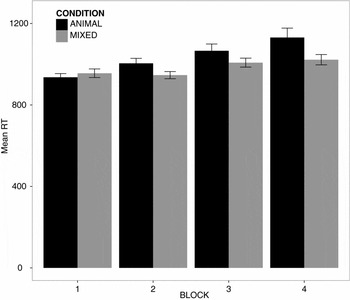
Figure 3 presents the mean RTs for each combination of condition and block. As can be seen, the response latencies are very similar in the two conditions in Block 1. Response latencies appear to increase over the successive blocks, with a greater apparent increase in the animal condition.
Mean response time by condition and block.

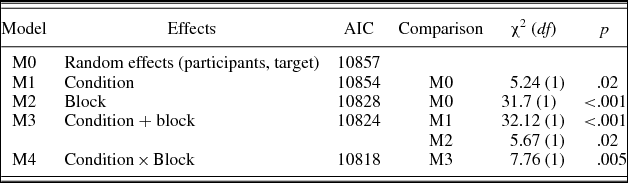
The analyses supported these observations. Table 2 presents the outcomes of successive model comparisons for RT. Both condition (model M1) and block (M2), when added as main effects, produced significant effects and were preferred over a model containing only the random intercepts for participants and items. A model containing both main effects (M3) was preferred over models containing only one of the two predictors. The final model, containing the interaction between condition and block (M4), was preferred over the model containing main effects only. The final model revealed statistically significant predicted gains in RT as a function of block for each condition, but with a greater degree of slowing in the animal condition: 65 ms (p < .001) for the animal condition versus 23 ms (p = .005) for the mixed condition. An analysis by trial rather than block revealed a similar pattern of results. The final model containing the interaction between condition and trial was preferred over a model containing main effects only, χ2 (1) = 4.76, p = .03. The slopes predicted by this model were statistically significant for both conditions, with a predicted increase in response latency of 8.2 ms per trial in the animal condition (p < .001) and 3.7 ms for the mixed condition (p = .001).
Model outcomes for RT

Note: AIC, Akaike information criterion; M1–4, Models 1–4 included random intercepts for participants and targets, in addition to the fixed effects of interest.
DISCUSSION
The purpose of this study was to examine whether 3-year-old children show semantic interference in a naming task, and whether the interference is cumulative. On the whole, the results point to interference patterns that are similar to what has previously been observed for adults, and are consistent with the view that 3-year-old children show cumulative semantic interference. Although this study was not designed to examine all of the influences on interference that have been studied in adults, the results suggest that interference in children, like adults, may best be understood as arising from incremental learning mechanisms. This observation provides a foundation to further examine how experience shapes language processing and representation in development.
The first research question asked whether 3-year-old children would show interference that was semantic in nature, as evidenced by an increase in errors, perseverations, or RTs in the animal condition relative to the mixed condition. The RT results indicate that the semantically homogeneous condition led to interference during naming. It is important to note that the semantically homogeneous stimulus set was contrasted with a well matched mixed set. This provided an important control for RT effects arising due to overall familiarity of the stimuli, or fatigue or loss of attention over blocks. The two stimulus sets were balanced for AoA, frequency, and word length in syllables, and the similarity in RTs within Block 1 supports the view that the items within the two sets did not differ systematically in naming difficulty. This lends support to the conclusion that the observed difficulty in the animal condition stemmed from the relationships among the items within the stimulus set. Researchers have noted that, among other things, shared activation among semantically related items must be present within the lexical system for semantic interference to arise (Howard et al., Reference Howard, Nickels, Coltheart and Cole-Virtue2006; Oppenheim et al., Reference Oppenheim, Dell and Schwartz2010). The results of the current study suggest that this is a feature of lexical processing as young as 3 years old.
The RT results are also consistent with the view that the interference was cumulative: it increased with successive exposures, measured in blocks and also trials. Previous discussions have described lexical interference in young children using the language of residual activation, or as a “local” effect between the current target and the interfering item. The current results, however, do not fit as easily with such a mechanism as they do with a learning-based account. In particular, it is difficult to reconcile the fact of interference increasing across trials with a residual activation mechanism. Such a view would assume that toward the end of the animal list, items from the beginning remained active to allow for the continued growth of residual activation. Given that the experiment ran approximately 2 min from the beginning to the end of a given list, this seems unlikely, as residual activation is typically assumed to dissipate within seconds (Bock & Griffin, Reference Bock and Griffin2000; see Oppenheim et al., Reference Oppenheim, Dell and Schwartz2010). The results fit more easily with the view that the children experienced changes in the strength of the long-term connections within lexical representations with each response, and that it was these changes that led to related items becoming increasingly stronger competitors, with the resultant slowing of responses. It is important to note, however, that several additional pieces of evidence are needed going forward to provide more definite evidence for this mechanism. In the adult literature, the incremental learning perspective has been supported by the observation that interference effects are robust to variations in RSI and to intervening, unrelated material between experimental items. Such evidence with young children is needed.
One unexpected result in the current study was the finding that repetition errors were infrequent. Although many of the children produced at least 1 such error (13/19 participants), the total number of such errors was very low at only 25 out of 1,047 responses (2.4%). Moreover, such errors occurred with relatively similar frequency to the converse pattern, namely, response set errors in which the error preceded an upcoming response (e.g., naming lion as tiger when tiger has yet to occur as the target). Thus, it is not clear whether the repetition errors recorded in the current study represented true perseverations (i.e., driven by a prior response) or simply were related, response-set errors that happened by chance to follow a previous response. It is possible that factors related to the interacting items themselves rather than perseveration per se played a role. For example, there were several pairs of items that were involved in exchanges on more than one occasion: tiger/lion (n = 7), giraffe/zebra (n = 7), bird/chicken (n = 4), hand/mitten (n = 2), clown/king (n = 2; king was a demonstration item and was included in familiarization and thus was considered as within the response set).
It is interesting to note that when repetition errors did occur, they patterned much more like previous data from adults than from children, with no instances of immediate repetition. This finding was unexpected, and invites further investigation. In several respects, this study was closer in methods to those used previously with adults than with children (e.g., computer-based, control of RSI, emphasis on performance), and further investigation may provide insight into the effects of methodological and stimulus variations on children's repetition patterns. The lack of immediate repetitions suggests that they were not the result of residual activation; however, the relative rarity of these responses prohibits further analysis or comment.
The current results fit with a number of prior studies that have identified points of similarity in the mechanisms or process underlying lexical processing in children and adults (Gershkoff-Stowe, Reference Gershkoff-Stowe2002; Gershkoff-Stowe, Connell, & Smith, Reference Gershkoff-Stowe, Connell and Smith2006, Jerger, Martin, & Damian, Reference Jerger, Martin and Damian2002). These studies have indicated that children, like adults, show shared activation and competition among similar items. Evidence from blocked cyclic naming (Snyder & Munakata, Reference Snyder and Munakata2013) and picture–word interference (Jerger et al., Reference Jerger, Martin and Damian2002) indicates that shared activation among categorically related items occurs in children as young as 5 years old. The results of the current study extend this finding down to children as young as 3 years old. This is not to assume, however, that all aspects of processing are the same for younger children and older children, or children and adults. At a minimum, young children come to the language task with a different knowledge base and less experience with the words that they do know, and this will affect processing outcomes. As noted above, one view of apparent interference effects in young children is that they may reflect challenges activating nascent or fragile representations for target words. Given the young age of the participants in this study, it would be expected that some of the necessary word representations would be relatively fragile, and thus prone to error or slow retrieval. This certainly could have influenced performance. However, the fact that response difficulty (as measured by RT) grew over time and grew more in one condition than the other argues against fragile representations as the sole basis for any naming difficulties. An important avenue for future work would be to systematically manipulate the representational strength of target words, either via lexical variables such as AoA and frequency, or via recent experience (e.g., see Gershkoff-Stowe, Reference Gershkoff-Stowe2002) to observe how representational integrity interacts with other purported influences on lexical selection.
The current results also invite further investigation of how experience-driven changes in processing manifest as a function of age and language status. In this study, children's overall vocabulary development and proficiency was not assessed. Future work would benefit from understanding how overall language or lexical ability relate to the manifestation of interference effects. In addition, researchers have noted that learning rate is a critical parameter in producing cumulative interference, as the rate of change has to be sufficient to overcome the effects of “noise” in the system (Oppenheim et al., Reference Oppenheim, Dell and Schwartz2010). Manipulations and examinations of interference phenomena may provide insight into rate of learning and factors that affect rate of learning in different groups of children. In addition, an important finding in the adult literature is that interference is robust to intervening, unrelated items. The current study was not designed to determine whether such stability is seen in less mature systems. Within a system that is in flux with new learning, one might expect change to be more volatile: interference might build up more quickly (cf. Snyder & Munakata, Reference Snyder and Munakata2013), but also dissipate more quickly in the face of new, possibly unrelated, information.
Another fruitful direction for future research would be to consider the relative contributions of different types of similarity to learning and interference in children. In the current stimulus sets, the defining relationships are argued to be semantic in nature, and the semantic relationships among the items within the animal set are argued to provide the basis for the interference effects. As previously noted, however, the relationships included both categorical and thematic or associative relationships, and perceptual relationships were necessarily present as well. These relationships were also present, to a lesser extent, in the mixed stimulus set. In addition, within the stimulus set, some targets may be more central to children's understanding of a category than others. Thus, some items may have contributed more than others to the experience of interference, and there may have been more than one contributing factor. Prior research has demonstrated that perceptual similarity is also a source of interference in young children's lexical processing (Gershkoff-Stowe et al., Reference Gershkoff-Stowe, Connell and Smith2006), and that thematically based semantic relationships are important in early childhood and may produce stronger effects on lexical processing than categorical relationships (McCauley, Weil, & Sperber, Reference McCauley, Weil and Sperber1976). Thematic relationships can also produce interference in blocked cyclic naming with adults (Abdel-Rahman & Melinger, Reference Abdel Rahman and Melinger2007). Interference phenomena can provide insight into the organization or strength of connections within the lexical system, and an interesting direction for future work would be to examine whether there are age-related changes in the manifestation of interference from different sources of shared activation.
Finally, I have argued that the results of this study are more in line with incremental learning than residual activation as the source of interference, but as previously noted, further investigations are needed to more definitively define the mechanisms involved. Moreover, it remains possible that changes or differences in the dynamics of residual activation and decay may be relevant to understanding some developmental patterns. For example, it has been proposed that individuals with specific language impairment experience slower decay of memory traces (Poll, Watkins, & Miller, Reference Poll, Watkins and Miller2014). In addition, the finding that somewhat younger children produce immediate perseverations of unrelated items (Gershkoff-Stowe, Reference Gershkoff-Stowe2002) is arguably challenging to accommodate within the semantically driven incremental learning view presented here, leaving open the question of whether such a pattern needs to be explained with a different mechanism.
In conclusion, this study provides evidence for cumulative semantic interference in children's picture naming. The results suggest that incremental learning rather than residual activation may be the appropriate mechanism to account for such interference, highlighting a point of similarity between children and adults. Future research will need to examine manipulations of RSI and intervening, unrelated material between stimulus items in order to provide more conclusive evidence. An additional direction for future work includes understanding how different sources of similarity may contribute to interference patterns and, possibly, to production-driven change in children's lexicons. Finally, this study examined interference through the lens of continuous naming, and used errors and RTs to gain insight into lexical processes. Although much of the prior work on interference in children has focused on error patterns, this study demonstrates that RT is a feasible means to use with children as young as 3 to gain insight into lexical processing in the context of successful naming. In addition, in the adult literature, important insights into the nature and organization of lexical processing and experience-dependent change have emerged from the combined findings of continuous naming and blocked cyclic naming. The current study indicates that the methods used with adults can be successfully adapted for the abilities of young children while maintaining control over important experimental variables (e.g., timing). Future work would benefit from extending the examination of blocked cyclic naming into the preschool years.
APPENDIX A
Stimulus items

ACKNOWLEDGMENTS
I thank Vincent Porretta for help with statistical analyses in R, Erin Dodd and Kathleen Engel for help with stimulus preparation, and Janice Bedard and Jaslyn Dunger for help with data collection and coding.