


Introduction: the Appearance Anxiety Inventory
One of the criticisms of cognitive behaviour therapy (CBT) is the limited evidence for the factors that mediate change (Hayes, Villate, Levin and Hildebrant, Reference Hayes, Villate, Levin and Hildebrant2011; Hofman, Reference Hofman2008; Longmore and Worrell, Reference Longmore and Worrell2007; Worrell and Longmore, Reference Worrell and Longmore2008). This observation also applies to CBT for Body Dysmorphic Disorder (BDD) where there is limited research into the factors that mediate the outcome of treatment. At present there have been two randomized controlled trials that demonstrated the benefits of CBT compared to a waiting list (Rosen, Reiter and Orosan, Reference Rosen, Reiter and Orosan1995; Veale et al., Reference Veale, Gournay, Dryden, Boocock, Shah and Willson1996). However, there is no evidence for the processes that may mediate improvement following treatment. Such studies are challenging since they require sample sizes much larger than that for a randomized clinical trial. This would enable linear regression models to be conducted which assess the factors that predict long term response to treatment (Kraemer, Wilson, Fairburn and Agras, Reference Kraemer, Wilson, Fairburn and Agras2002).
There are a number of self-report scales that measure the severity of symptoms in BDD, such as the Body Image Disturbance Questionnaire (Cash, Phillips, Santos and Hrabosky, Reference Cash, Phillips, Santos and Hrabosky2004), the Dysmorphic Concern Questionnaire (Mancuso, Knoesen and Castle, Reference Mancuso, Knoesen and Castle2010), the Cosmetic Procedure Screening Scale (Veale et al., Reference Veale, Ellison, Werner, Dodhia, Serafty and Clarke2011) and the impact of Body Image on the Quality of Life (Cash and Fleming, Reference Cash and Fleming2002; Hrabosky et al., Reference Hrabosky, Cash, Veale, Neziroglu, Soll and Garner2009). There is also an observer rated scale: the Yale Brown Obsessive Compulsive Scale modified for BDD (Phillips et al., Reference Phillips, Hollander, Rasmussen, Aronowitz, DeCaria and Goodman1997). All these scales tend to measure predominantly the “output” – in particular the degree of preoccupation, distress and interference in a person's life. However, there are no scales that measure factors that may mediate response to treatment. Such measures could help to explore which mediating factors are associated with subsequent changes in outcome or prognosis. It is recognized, though, that measuring the processes and output may overlap to a certain extent, and that better outcome scales focusing on distress and quality of life may therefore be required.
The items for the new scale (i.e. the Appearance Anxiety Inventory) were drawn from the literature on trans-diagnostic processes that occur in mental disorders (Harvey, Watkins, Mansell and Shafran, Reference Harvey, Watkins, Mansell and Shafran2004) and a theoretical model of the maintenance of BDD (Neziroglu, Khemlani-Patel and Veale, Reference Neziroglu, Khemlani-Parel and Veale2008; Veale, Reference Veale2004, Veale et al., Reference Veale, Gournay, Dryden, Boocock, Shah and Willson1996). In this model, the distorted imagery and associated shame is central to the experience of the self as an aesthetic object. The responses to a distorted image and shame include various cognitive processes (e.g. self-focused attention, rumination, and comparing or mental planning of cosmetic procedures) and behaviours (e.g. appearance-checking in reflective surfaces, questioning others, avoiding people, or adopting safety-seeking behaviours such as camouflaging the perceived defect). Furthermore, changes in distorted imagery, cognitive processes and behaviours mediate change in outcome such as preoccupation, distress and interference in life. However, this model needs to be tested empirically.
The present study sought to address the need for a measure of factors that mediate change by developing and validating a new scale, the Appearance Anxiety Inventory (AAI). The AAI is a self-report measure that focuses on the cognitive processes and safety seeking behaviours that are characteristic of a response to a distorted body image and associated shame. The intention is to develop a scale that is brief, free to use, sensitive to change during treatment, and suitable for weekly assessment. The scale aims to have the potential to determine if the theorized cognitive and behavioural processes mediate change. It also seeks to assist clinicians and clients to determine which processes to target during therapy. The psychometric properties of the AAI were therefore examined in a clinical group of patients with BDD (Study 1) and in a non-clinical community group of people with high appearance concerns (Study 2). The latter group was chosen as analogue population of people with BDD (for example, they wanted to improve one or more features in their appearance and were motivated to have a cosmetic procedure). Body image concerns are often on a continuum with people with BDD on the extreme end. We would therefore expect similar processes in an analogue population of BDD, but occurring at a lower frequency than in BDD. It was therefore hypothesized that the BDD group should score significantly greater on the AAI than non-clinical group with high appearance concerns.
Study 1: Method
Participants
A total of 139 participants with BDD participated in the first study. The median age of the participants was 28 (IQR = 12). This group consisted of 67 (48.2%) males and 72 (51.8%) females. Thirty-four (24.5%) were unemployed or on long-term sick leave, 53 (38.1%) were employed or self-employed, 2 (1.4%) were retired, 18 (12.9%) were students, and 3 (2.2%) were homemakers, and 29 (21.1%) unknown. All participants completed the questionnaires before any treatment.
We report on a sub-sample of 12 participants with BDD whose AAI was repeated at weekly intervals during treatment to determine sensitivity to change. The median age of the treatment group was 33 (IQR = 15). The treatment group consisted of 5 males and 7 females. Three (25%) were unemployed, 5 (42%) were employed or self-employed, 2 (17%) were full-time students, and 2 (17%) did not specify their occupation.
Procedure
Participants were recruited from outpatient settings. A structured diagnostic interview (SCID for DSM-IV) was used to diagnose BDD as the main problem in all participants. A SCID was not conducted for comorbidity in all the participants. The BDD group was interviewed with the Yale Brown Obsessive Compulsive Scale for BDD (BDD-YBOCS) (Phillips et al., Reference Phillips, Hollander, Rasmussen, Aronowitz, DeCaria and Goodman1997) and the Brown Assessment of Beliefs Scale (BABS) (Eisen et al., Reference Eisen, Phillips, Baer, Beer, Atala and Rasmussen1998). A sample (12) of the BDD group completed the AAI weekly during cognitive behaviour therapy.
Measures
Appearance Anxiety Inventory (AAI). The AAI was developed through a process of iteration. Experienced clinicians and people with BDD reviewed the items and the wording was accordingly modified. It was tested in a pilot study of people with BDD before the final version was used for the study. The scale was comprised of 10 items. Each item is scored on a 5-point Likert scale ranging from 0 for “not at all” to 4 for “all the time”. The maximum score is 40, and higher scores reflect greater frequency of a process. The total score is obtained by summing all the items. No items are reverse scored.
Yale Brown Obsessive Compulsive Scale modified for BDD (BDD-YBOCS; Phillips et al., Reference Phillips, Hollander, Rasmussen, Aronowitz, DeCaria and Goodman1997).The BDD-YBOCS is a 12-item observer rated measure for assessing the severity of BDD symptoms that occurred during the past week. The first 5 items rate BDD-related preoccupations, and the second 5 items rate BDD-related behaviours. The BDD-YBOCS also rates one item on the degree of insight and one item on the degree of avoidance behaviour. Each item is rated on a scale 0–4 (range from 0–48). Higher summed scores indicate greater BDD symptomatology. A clinical case is likely to score 24 or more.
Brown Assessment of Beliefs (BABS; Eisen et al., Reference Eisen, Phillips, Baer, Beer, Atala and Rasmussen1998). The BABS was used for appearance-related beliefs that participants provided about themselves. The BABS is a 6-item observer rated measure for the degree of conviction in a belief (e.g. “I am as ugly as the Elephant man”). Items measure conviction, perception of others’ views of beliefs, explanation of differing views, fixity of ideas, attempts to disprove ideas, and insight, respectively. Each item is rated from 0–4 (from least to most severe). Total scores are summed to give a possible range of 0–24, with higher scores representing higher conviction in a belief.
Body Image Quality Of Life Inventory (BIQLI; Cash and Fleming, Reference Cash and Fleming2002). The BIQLI consists of 19 items on a 7-point Likert scale (with values ranging from −3 (very negative effect) to +3 (very positive effect) and measures the impact of body image concerns on a range of life domains. A lower score indicates more negative impact of body image on a person's quality of life. Hrabosky et al. Reference Hrabosky, Cash, Veale, Neziroglu, Soll and Garner(2009) found that people with BDD scored a mean of −1.81 (SD = 0.68) compared to 0.06 (SD = .16) in female psychiatric controls and 0.4 (SD = 1.21) in male psychiatric controls.
The Patient Health Questionnaire (PHQ-9; Kroenke and Spitzer, Reference Kroenke and Spitzer2002). The PHQ-9 is a self-report version of the PRIME-MD diagnostic instrument for common mental disorders. The PHQ-9 is the depression module, which scores each of the 9 DSM-IV criteria as “0” (not at all) to “3” (nearly every day). The PHQ-9 total score for the 9 items ranges from 0 to 27. A higher score represents higher depression symptomatology.
Generalized Anxiety Disorder assessment (GAD-7; Spitzer, Kroenke, Williams and Lowe, Reference Spitzer, Kroenke, Williams and Lowe2006). The GAD-7 is designed primarily as a screening and severity measure for symptoms of generalized anxiety disorder. The total score of the GAD-7 is the total score of the 7 items, which ranges from 0 to 21. Scores of 5, 10, and 15 represent cut points for mild, moderate, and severe anxiety, respectively.
Statistical analysis
Horn's Parallel Factor Analysis (Horn, Reference Horn1965) was used first to examine factorial validity of the AAI. This was computed using the factor analysis programme “FACTOR”(Lorenzo-Seva and Ferrando, Reference Lorenzo-Seva and Ferrando2006). This method was chosen as it is more accurate than Cattell's scree and Kaiser-Guttman methods (Wilson and Cooper, Reference Wilson and Cooper2008; Zwick and Velicer, Reference Zwick and Velicer1986). The internal consistency of the AAI was evaluated using Cronbach's alpha. Total scores of the AAI were not normally distributed. Therefore, Spearmann's Rho correlations between the AAI and the BDD-YBOCS, BABS, BIQLI, PHQ9 and GAD7 were computed to test convergent validity. Given that the total scores were not centred on a common mean we report a median and inter-quartile range as descriptors of variance. Non-parametric comparisons (Wilcoxon signed ranks tests) were used to compare pre-treatment (before session 1) and post-treatment (session 16) scores due to the small sample size not being normally distributed.
To reduce missing data from partially filled in questionnaires, the average score was computed for questionnaires where only one item was missing. This value was then entered for unanswered questions. Missing values were not replaced from questionnaires with more than one item missing. The total score was disregarded but the scores for the individual items were used.
Study 1: Results
Factor analysis
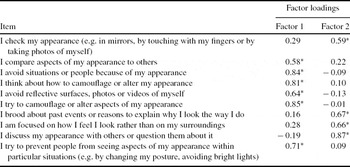
A parallel factor analysis was performed using the 10-item pool. We extracted 2 components, using optimal implementation of Parallel Analysis (PA) for determining the number of dimensions. We used Principal Components Analysis and Direct Oblimin Rotation. The data were not normally distributed. Analysis of Mardia's (Reference Mardia1970) multivariate asymmetry found a significant kurtosis (Coefficient 135.08, statistic 5.42, p < .001). Therefore, the polychoric analysis was run. No items were removed as they met all of the following criteria that were set for each item: communality > 0.3, factor loading on at least one factor > 0.5, no complex factor loadings; indicated by loading > 0.4 on more than a single factor. Fifteen (10.8%) participants had missing data and they were excluded from this analysis, resulting in n = 124 participants with BDD for this analysis. The Kaiser-Meyer-Olkin (KMO) measure verified sampling adequacy for the analysis. The Bartlett's test of sphericity (χ2 = 558.1, df = 45, p < .00001) indicated that correlations between items were sufficiently large for factor analysis, as the Kaiser-Meyer-Olkin (KMO) test = 0.87 (good), and the determinant was 0.009. Two factors were extracted, and the factor loadings after rotation are reported in Table 1. The first factor is characterized by avoidance (accounting for 37.5% of variance), and the second factor by threat monitoring (accounting for 22.8% of the variance).
Factor loadings for the final two-factor solution in participants with BDD (Study 1)

*p<.05.
Internal consistency
Reliability analysis using the BDD group data showed the AAI had good internal consistency with Cronbach's α = .86.
Convergent validity
The AAI was significantly correlated with the BDD-YBOCS with a moderate coefficient indicating a strong relationship between AAI and symptoms of BDD (Table 2). There was also a significant moderate correlation with the PHQ-9 and the GAD-7 showing that higher scores on the AAI are associated with greater symptoms of generalized anxiety and depression. The AAI shared a small but significant correlation with the BABS and a moderate negative correlation with the quality of life affected by body image (BIQLI). Higher scores on the AAI are therefore associated with more negative appearance beliefs about oneself, and with greater negative impact of body image on a person's quality of life.
Correlations between AAI and additional measures (Study 1)

**p< .001, *p< .05.
Sensitivity to treatment
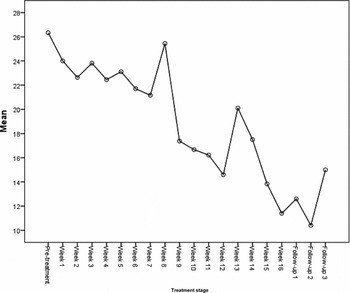
AAI scores were assessed during treatment in 12 participants with BDD on a weekly basis to determine sensitivity to change. Therapists followed a protocol for cognitive behaviour therapy as described by Veale and Neziroglu Reference Veale and Neziroglu(2010) with a maximum of 16 sessions and 3 follow-ups (at 1-month, 3-months, and 1-year). Figure 1 shows change on the AAI in the sample receiving CBT for their BDD. The AAI scores reduced significantly during treatment from a Median of 26.00 (IQR 9.50) to 10.50 (7.50) over 16 weeks (Z = −2.81, p < .01). There was a corresponding significant reduction in the scores of BDD-YBOCS from a median of 38.50 (IQR 11.25) to 23.00 (12.00) (Z = −2.666, p < .01). Scores on individual items on the AAI before treatment were compared with scores at the final treatment session 16.
Graph reporting the mean of the total scores on the AAI for participants receiving CBT for BDD (pretreatment through to final follow-up)

Study 2: Method
In Study 2, we validated the AAI in a community sample.
Participants
We recruited 108 participants from the community who were characterized by reporting high appearance concerns. The median age of the group was 28.5 (IQR = 14). This group consisted of 26 (24.1%) males and 82 (75.9%) females. Sixty-five were single, 34 (31.5%) were married or cohabiting, and 9 (8.2%) were divorced. There were 10 unemployed or on long-term sick leave, 73 employed or self-employed, 3 retired, 19 students, and 2 homemakers and 1 missing.
Procedure
Participants were identified and recruited by an e-mail sent to 1833 volunteers (aged above 18) on the Mind Search database at the Institute of Psychiatry, King's College London. This database contains details of individuals in the local community who have volunteered to participate in psychological or psychiatric research. To determine high appearance concerns, recipients were asked if they wanted to improve one or more features in their appearance and were motivated to have a cosmetic procedure (for example, if the person was planning a cosmetic procedure or waiting until they could afford a procedure). Select-Survey ASP (TM) version 8.1.1 was used to create a web-based version of the questionnaires. They were invited to repeat the AAI one week later. The first questionnaire was completed by 108 participants (5.9% of those who were invited to take part). Sixty-seven participants (62% of total sample) repeated the AAI questionnaire one week later to determine test-retest reliability of the AAI. Participants received a £10 high street gift voucher in thanks for their time.
Measures
The participants completed the following questionnaires:
Appearance Anxiety Inventory (described above).
Cosmetic Procedure Screening (COPS; Veale et al., Reference Veale, Ellison, Werner, Dodhia, Serafty and Clarke2011). The COPS questionnaire comprises 9 items. Items are scored from 0 (least impaired) to 8 (most impaired). It is designed to measure severity of BDD symptoms and identify people with BDD. The total scores range from 0 to 72 with higher scores reflecting increased symptoms of BDD. A score above 40 reflects increased likelihood of a diagnosis of BDD. The scale is free to download from www.kcl.ac.uk/cadat/ under “Research”, “Questionnaires”, and “Body Image Questionnaires”. The Cronbach's alpha in our community group (N = 108) was .86.
Hospital Anxiety and Depression Scale (HADS; Zigmond and Snaith, Reference Zigmond and Snaith1983). The HADS is a 14-item self-report instrument to screen for severity of symptoms of depression and anxiety over the past week. There are two 7-item subscales for anxiety and depression, with a range of scores from 0–21 on each subscale. The standard cut-offs to indicate clinical levels of depression or anxiety are 11. Cronbach's alpha has been high in a number of validation studies (Bjelland, Dahl, Haug and Neckelmann, Reference Bjelland, Dahl, Haug and Neckelmann2002).
The Multidimensional Body Self Relations Questionnaire (MBSRQ; Brown, Cash and Mikulka, Reference Brown, Cash and Mikulka1990). Two sub-scales of the MBSRQ were used: The Body Areas Satisfaction Subscale (BASS) and Appearance Evaluation (AE) subscales. The Body Areas Satisfaction subscale consists of 9 items that assess dissatisfaction and satisfaction with a variety of different body areas or features related to the face or hair. The Appearance Evaluation Subscale contains 7 items to describe general body image evaluation. Higher scores on these subscales indicate greater appearance satisfaction and more positive body image evaluation.
Statistical analysis
Horn's Parallel Factor Analysis (Horn, Reference Horn1965) was used to examine the factorial validity as described in the Statistical Analyses for Study 1. The reliability of the AAI was evaluated using Cronbach's alpha. Total scores of the AAI were correlated using Spearman's rho with the COPS, HAD and the MBSRQ to test convergent validity. We used the same strategy as described in Study 1 for missing data.
Study 2: Results
Factor analysis
To replicate the factor analysis of the AAI in the community group, two components were identified for extraction using Principal Components Analysis and Direct Oblimin Rotation described in Study 1. Analysis of Mardia's (Reference Mardia1970) multivariate asymmetry found a significant kurtosis (coefficient 149.40; Statistic 9.860; p = .0000). Therefore the polychoric analysis was run. The Kaiser-Meyer-Olkin (KMO) measure verified sampling adequacy for the analysis and Bartlett's test of sphericity (χ2 = 535.7, df = 45, p< .0001) indicated that correlations between items were sufficiently large for factor analysis, as the Kaiser-Meyer-Olkin (KMO) test = 0.92 (very good), and the determinant of the matrix was 0.005. Two factors were extracted but it was unstable as only two items loaded on Factor 2 (Threat Monitoring); these were item 2 which had a loading of 0.89 and Item 9 which had a complex loading of 0.44 on factor 2 and of 0.40 on Factor 1. Therefore one-factor solution was attempted with the same procedure as described in the factor analysis in Study 1. The Kaiser-Meyer-Olkin (KMO) test = 0.9212 and the determinant of the matrix = 0.0055. The Bartlett's test of sphericity was 535.7 (df = 45; p < 0.001). All the items loaded between 0.37 (item 1) and 0.83 (item 3) and this accounted for 54% of the variance in scores on the AAI.
Internal consistency
Reliability analysis showed that the AAI had high internal consistency in the community group with Cronbach's α = .91.
Test-retest reliability
The AAI had good test–retest reliability after 1 week with an intra-class correlation of 0.87 (p < .001). The first administration had a mean of 15.45, SD = 8.68, and range 1 to 38. The second administration had a mean of 16.03, SD = 8.74, and range 2 to 35.
Convergent validity
The AAI correlated moderately with the HAD depression subscale and anxiety subscale (Table 3). The AAI correlated highly with the COPS indicating that the process measure is correlated with diagnostic symptoms of BDD. The AAI also correlated moderately negatively with the MBSRQ (BASS subscale) −.669, p < .001) and the MBSRQ (AE subscale) (rho = −.692, p < .001) indicating that higher scores on the AAI are associated with lower body satisfaction and positive appearance evaluation respectively.
Correlations between AAI and additional measures (Study 2)

**p < .001.
Group differences
Participants in the BDD group (Mdn = 27.0, IQR = 12.0) scored significantly higher than the community sample (Mdn = 13.0, IQR = 13.5) on the AAI (U = 3020.50, n = 247, Z = −8.06, p < .001, r = .51).
Discussion
The current study set out to develop and validate the psychometric properties of a new process measure of appearance anxiety in BDD, to assist in research and clinical settings. Analysis of the AAI in a clinical and community sample established the inventory's reliability, validity, and factor structure. The AAI demonstrated good internal consistency, which shows that the scale was measuring a coherent general construct.
The AAI was shown to have adequate temporal stability as measured over a 1-week test-retest period in the community group. Evidence of the validity of the AAI in measuring symptoms of BDD came from its significant and strong associations with BDD symptoms measured by the YBOCS and COPS and depression and anxiety. The AAI also demonstrated its sensitivity to change during treatment. Furthermore, total AAI scores were significantly higher in individuals with BDD compared to a non-clinical sample. Individuals treated for BDD showed significant reductions in AAI scores similar to the BDD-YBOCS during CBT.
The AAI consisted of two latent factors in the BDD group. The first of these represented avoidance and camouflaging; the second factor was comprised of threat monitoring. These factors represent the classic way of responding by either approach or avoidance of a potential threat. The items on the avoidance factor refer to avoiding cues that might trigger negative evaluation by self or others, trying to camouflage the self or avoiding any reminders of appearance. The item on comparing is partly a complex factor as it loads on both avoidance (0.59) and to a lesser extent on threat monitoring (0.29). This may be because the process of comparing a feature consists of social ranking. Individuals might fear rejection or humiliation and after ranking themselves as inferior (Threat Monitoring), they are likely to enact submissive behaviour and social avoidance. The “Threat Monitoring” component includes items on checking in an attempt to verify exactly how one looks. This includes being excessively self-focused and checking the internal image against that seen in a mirror or reflective surface. Ruminating and questioning others may be in response to a memory of an image in an attempt to verify exactly how one looks and problem solve. Individuals with BDD might therefore switch from a classic conflict between approach and avoidance. Alternatively, some people with BDD may opt mostly for one strategy or the other. Inevitably these processes have the unintended consequence of strengthening the behaviour, increasing preoccupation and distress, and maintaining the symptoms of BDD. Therefore the main strategy of CBT for BDD after an engagement is: (i) to alter the context or meaning of a distorted image through imagery re-scripting or other interventions; (ii) to stop all the cognitive and behavioural responses measured by the AAI that maintain the preoccupation and distress of BDD and a poor quality of life.
Two factors on the AAI were not replicated in Study 2 in the community group with high appearance concerns. However, the factors may be less distinct in a non-clinical group because approach or avoidance may be less differentiated at lower frequencies. This may lead to one factor based on severity characterized by threat monitoring leading to avoidance and vice versa. At higher frequencies, the same processes may be more distinct.
Implications
The immediate implication from this study is that the AAI can be used as a potential measure for use in clinical and research settings for assessment over the course of a treatment intervention. The AAI may also be used to assess the outcome of treatments in case studies, and in controlled and uncontrolled trials with larger samples. The AAI is brief, and so can be used frequently to assess change in both clinical and research settings. For example, it may be helpful to determine which of the two factors to target first; whether some people adopt a strategy of mainly avoidance or threat monitoring and whether this predicts outcome or whether other psychological therapies or medication may be associated with a different pattern of response. It may also be of interest to validate the scale in other body image disorders, such as eating disorders or people who have difficulty adjusting to a disfigurement, to determine if there are differences in coping styles.
Limitations and future directions
There are limitations in the current research. We are not able to fully describe the comorbidity in our sample of people with BDD, although clinicians determined that BDD was their primary diagnosis according to DSMIV prior to treatment. Other limitations include the fact that the AAI does not focus on: (i) the experience of body image or felt impression being distorted; (ii) meta-cognitive beliefs about the image, for example, the degree to which a person believes that their image is an accurate representation of their appearance and in context; and (iii) beliefs and assumptions about being ugly or defective. These constructs would also need to be measured weekly in any mediating study of cognitive processes on symptoms.
Replication of the current results in a new sample of individuals with BDD or another body image disorder (such as bulimia nervosa or a disfigurement) would add strength to the findings, particularly the latent structure of the symptoms found in the current sample. Future research into the AAI could also examine the sensitivity of the measure to treatment effects in a larger sample (and effect of other therapies or SSRI medication which do not target the processes identified), as well as the ability to distinguish between those who respond to treatment and those who do not. As discussed above, the AAI is designed to assist in determining whether a mediator changes before measures of distress and quality of life.
Conclusion
The current study has validated a brief self-report scale that can be used by clinicians and researchers to assess the cognitive processes and behaviours that maintain symptoms of BDD. The AAI can be used as a tool for treatment planning and outcome measurement.
Acknowledgements
David Veale, Nell Ellison, and Ana Costa would like to acknowledge salary support from the National Institute for Health Research (NIHR) Biomedical Research Centre for Mental Health at South London and Maudsley NHS Foundation Trust and the Institute of Psychiatry, King's College London. The views expressed are those of the author(s) and not necessarily those of the NHS, the NIHR or the Department of Health. We should like to thank Caroline Easter and Alana Fogarty for their assistance in data entry and preparation.






Comments
No Comments have been published for this article.