There is a very powerful force that is available to all of us and which is frequently untapped, the power of collaboration. Collaboration has many meanings and ways of being realised. In this address, two aspects of collaboration will be discussed. First, collaboration will be described as a communicative strategy, which can be taught to family members, friends and clinicians when talking with a person with traumatic brain injury (TBI) to make conversations satisfying and enjoyable experiences for all concerned. Second, the value of collaboration within our clinical and research practice will be described, with a particular focus on ways collaboration can advance assessment and treatment approaches for people with TBI. Collaboration can enable discoveries to be made, help us to find new treatments and to think outside the box.
Research into the assessment and facilitation of communication skills for people with TBI is a relatively new field of academic enquiry. Modern descriptions of cognitive-communication disorders did not commence until the 1980s (Hagen, Reference Hagen and Holland1984; Hartley & Jensen, Reference Hartley and Jensen1991), which was the decade I commenced working with people with TBI and their families. In my first position at Lidcombe Hospital Head Injury Unit I was given the task of assessing and treating the communication of people with TBI and the tools in my dusty filing cabinet included aphasia tests such as the Western Aphasia Battery (Kertesz, Reference Kertesz2006), the Mt Wilga High Level Language Test, which was unpublished, and some verb and noun pictures. One shining light was Prutting's Pragmatic Protocol which at least examined people with brain injury during conversations (albeit with the clinician)(Prutting & Kirchner, Reference Prutting and Kirchner1987). Standardised aphasia assessments gave limited information when the goal was to establish what was possible for these young men and women in their everyday lives. It was at this time that I became aware of the work of Dr Mark Ylvisaker and his colleagues, which gave me clear direction regarding what to do (Haarbauer-Krupa, Henry, Szekeres, & Ylvisaker, Reference Haarbauer-Krupa, Henry, Szekeres, Ylvisaker and Ylvisaker1985; Ylvisaker, Reference Ylvisaker1992; Ylvisaker, Feeney, & Urbanczyk, Reference Ylvisaker, Feeney, Urbanczyk, Durgin, Schmidt and Fryer1993a, Reference Ylvisaker, Feeney and Urbanczyk1993b; Ylvisaker, Urbanczyk, & Feeney, Reference Ylvisaker1992). I was particularly drawn to this work, because it was not typical of the way speech pathologists were writing about TBI at the time. While Ylvisaker and Feeney discussed ‘functional’ interventions, their conceptualisation was broad and inclusive, incorporating tenets from fields of educational psychology (drawing heavily on Vygotsky), philosophy, neuropsychology and speech pathology (Ylvisaker & Feeney, Reference Ylvisaker and Feeney1998). It was the richness and complexity of these combined theoretical perspectives which illuminated how a brain injury could result in more than just a loss of naming ability or problems with topic maintenance. Rather, these authors showed that communication problems after brain injury required the examination of language functioning, cognition and executive skills within the context of the person with the injury, their families, their goals for the future and their expectations of the rehabilitation process. Ylvisaker and Feeney were some of the first authors to explain why people with brain injury could talk but not communicate in everyday social contexts.
This address pays homage to Dr Mark Ylvisaker and also Dr Tim Feeney, his colleague and collaborator. As this is my last ASSBI Presidential address I take this opportunity to honour Dr Mark Ylvisaker. His research and his legacy will continue for future generations of speech pathologists and health professionals working in the field of TBI. Dr Ylvisaker's keynote address at the 1999 ASSBI conference gave those present the experience of his enthusiasm, intellect and staggering breadth of knowledge, his humility and generosity. Dr Ylvisaker was a gifted teacher.
One of the concepts he spoke about was training parents of young children with brain injury in the use of collaborative and elaborative communication skills (Ylvisaker, Sellars, & Edelman, Reference Ylvisaker1998). Ylvisaker and colleagues emphasised the importance of equal contributions by the person with TBI and their clinicians, families and social networks in dealing with the consequences of the injury. The rationale for this collaboration was, first, to communicate respect, and to enhance generalisation and community inclusion (Ylvisaker, Szekeres, & Feeney, Reference Ylvisaker, Szekeres, Feeney and Chapey2001). Contextualised assessment and intervention permeates Ylvisaker and Feeney's work with the acknowledgement that for treatment to be effective it needs to be situated in everyday tasks or routines (Ylvisaker, Turkstra, & Coelho, Reference Ylvisaker, Turkstra and Coelho2005). This approach was contrasted with so-called ‘traditional’ approaches to treatment, which were essentially drill and practice in isolated clinical settings bearing little resemblance to real-world communication activities.
The involvement of everyday communication partners as collaborators during the assessment and treatment of communication was seen as critical to the success of rehabilitation for people with TBI (Ylvisaker et al., Reference Ylvisaker, Feeney, Urbanczyk, Durgin, Schmidt and Fryer1993a). Inclusion of communication partners was described as beneficial because it increases the number and variety of observations that can be made and improves the likelihood that the person with TBI will comply with the intervention. Training communication partners was described as an efficient training tool, increasing the likelihood that the family member will have the skills to creatively and effectively modify interventions and supports as new issues arise in the future. Finally, including communication partners increases the number and variety of natural learning trials for the individual with brain injury, and thus facilitates more rapid acquisition of positive communication alternatives and more efficient generalisation (Ylvisaker, Reference Ylvisaker1998).
The themes of Ylvisaker and Feeney have been applied in my work across a number of projects, including examining the communication of people with brain injury during everyday conversations with everyday communication partners (Guo & Togher, Reference Guo and Togher2008; Jorgensen & Togher, Reference Jorgensen and Togher2009; Togher, Reference Togher2000; Togher, Hand, & Code, Reference Togher, Hand and Code1997; Tu, Togher, & Power, Reference Tu, Togher and Power2011). I have also studied the communication of people with TBI within natural contexts in conjunction with everyday communication partners, such as during jointly produced story telling with friends (Jorgensen & Togher, Reference Jorgensen and Togher2009), casual conversations with friends (Bogart, Togher, Power, & Docking, Reference Bogart, Togher, Power and Docking2012) and a comparison of interactions between a mother and a paid carer (Tu et al., Reference Tu, Togher and Power2011). Ylvisaker and Feeney's ideas have also had a significant bearing on training programmes our research team has developed, which aim to improve communication for people with brain injury across a range of communication partners, including members of the community (Togher, McDonald, Code, & Grant, Reference Togher, McDonald, Code and Grant2004), paid carers (Behn, Togher, Power, & Heard, Reference Behn, Togher, Power and Heard2012) and families and friends (Togher, McDonald, Tate, Power, & Riedijk, Reference Togher, McDonald, Tate, Power and Rietdijk2009, in press; Togher et al., Reference Togher, McDonald, Tate, Power, Ylvisaker and Riedijk2011; Togher, Power, Riedijk, McDonald, & Tate, Reference Togher, Power, Riedijk, McDonald and Tate2012).
Collaboration in Conversation
Ylvisaker's (Reference Ylvisaker1998) description of collaboration during conversation provided a clear blueprint for clinicians regarding how to teach families and friends to engage in positive, engaging and rewarding conversations (Ylvisaker et al., Reference Ylvisaker, Sellars, Edelman and Ylvisaker1998). This work was a critical component in the development of a training programme developed by my team, which we called ‘TBI Express’ (Togher et al., Reference Togher, McDonald, Tate, Power, Ylvisaker and Riedijk2011). Furthermore, resources arising from this programme are now freely available online to provide a model for families and friends regarding how to collaborate during conversations with people with TBI (http://sydney.edu.au/health-sciences/disability-community/tbi_express/). This resource is the end product of a clinical trial where the effectiveness of training communication partners of people with TBI was compared to training the person with TBI alone and a delayed treatment control group.
TBI Express: A Clinical Trial
Two approaches have been shown to improve the communication of those with TBI. Training in social skills is helpful, as is training partners to deal with difficult communication behaviours. However, to date, no research has compared these two approaches to rehabilitation. Consequently, it is unknown whether best results are achieved with the inclusion of communication partners of people with TBI in the training process. This project was therefore designed to answer this question.
This study was a three-arm, non-randomised controlled trial of interventions targeting social communication skills following TBI in adult participants. Forty-four people with severe TBI were allocated to one of three groups: the TBI group, where only the person with TBI was trained; the JOINT group, where both the everyday communication partner (ECP) and the person with TBI were trained together; and a delayed treatment control condition. The trial examined the question whether including everyday communication partners in the training process provided additional benefit for participants when compared to training the person with TBI alone, and additionally, whether training the person with TBI alone was more effective than no training.
Participants
Our group of 44 participants had a mean age of 36 years, a mean education level of 12 years, were chronically impaired and at least 12 months post injury. All participants had sustained a severe TBI and were characterised by a typical male to female ratio. All TBI participants demonstrated a noticeable social communication disorder as rated by two independent speech pathologists. They also all fell within the impaired range on the Scales of Cognitive Ability for Traumatic Brain Injury (Adamovich & Henderson, Reference Adamovich and Henderson1992). Their 44 everyday communication partners had a mean age of 50 years and a mean education level of 13 years. Of the everyday communication partners, 80% were female, and 80% of this group knew the person before the TBI. The majority were partners or parents; however, siblings and friends also participated in the study.
Participants were allocated to three groups according to communication partner availability to attend the training programme. The dropout rate was very low, with 93% retention post-assessment. At baseline there were no significant differences between the three groups on key demographic and severity variables.
TBI Express
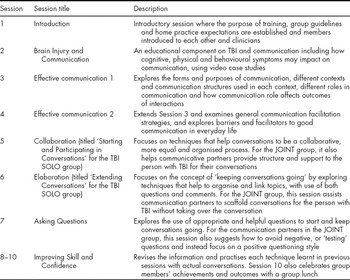
The TBI JOINT group was treated in groups of 4–5 participants who attended all sessions with their communication partners. Two therapists facilitated group sessions. Each session lasted 2.5 hours and, in addition, each participant received an hour of individual treatment each week to focus on individually relevant communication difficulties, and to foster compliance with practice between group sessions. The treatment extended for 10 weeks using a treatment manual, called TBI Express, which focused on facilitating interpersonal communication skills (Togher et al., Reference Togher, McDonald, Tate, Power, Ylvisaker and Riedijk2011). Treatment approaches were drawn from the work of Dr Mark Ylvisaker, in particular his work on strategies to improve collaboration and elaboration in conversations. The communication partner was encouraged to enhance and support the communication skills of the person with TBI by modifying their own conversation. The theoretical basis of the interventions was also drawn from well-established observations of the behaviour of communication partners in conversations with people with TBI (Togher et al., Reference Togher, Hand and Code1997; Ylvisaker et al., Reference Ylvisaker, Sellars, Edelman and Ylvisaker1998), and known features of different types of discourse (Eggins & Slade, Reference Eggins and Slade1997). The 10 weeks covered seven modules (Table 1).
TBI Express Training Overview

Collaboration as a Conversational Strategy
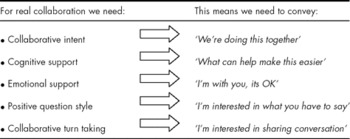
Collaboration is a multifaceted concept with five key elements, including having collaborative intent when approaching the interaction, providing cognitive and emotional support for the person with TBI, approaching the interaction using a positive questioning style and, finally, considering turn taking as a collaborative process (Table 2).
Key Features of Collaboration During Conversation (Ylvisaker et al., Reference Ylvisaker, Sellars, Edelman and Ylvisaker1998)

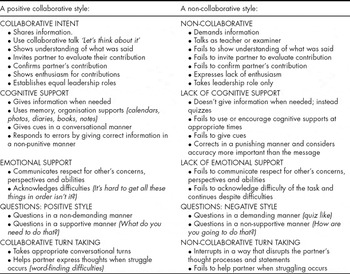
Communication partners can be non-collaborative, which means they engage in behaviours which do not promote the joint production of the conversation. Alternatively, a communication partner can modify their contribution to the conversation using collaborative strategies, which help the person with brain injury to contribute to the flow of ideas. Some examples of the specific collaborative and non-collaborative behaviours can be found in Table 3.
Types of Collaboration (Togher et al., Reference Togher, McDonald, Tate, Power, Ylvisaker and Riedijk2011; Ylvisaker et al., Reference Ylvisaker, Sellars, Edelman and Ylvisaker1998)

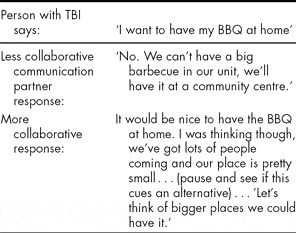
Collaborative interactions are perceived to be more satisfying, rewarding and less effortful. An example of a collaborative interaction is one where the partner acknowledges the views of the person with TBI, provides them with time to consider other options and indicates that the interaction is jointly produced (Example 1).
Comparison of Less Collaborative with More Collaborative Responses from Communication Partners

The TBI SOLO group received identical treatment to the JOINT group. The only difference was that they attended without their communication partner. The treatment manual paralleled the JOINT group content, with a focus on enhancing communication in everyday contexts, and using strategies suggested by Ylvisaker and Togher to extend conversations. There was a waiting list control group who received deferred treatment at the completion of the study.
Outcome measures were collected at the initial assessment, at 1–3 weeks after the group intervention was complete and at 6 months after the intervention. Two discourse samples were collected on each occasion: (1) casual conversation (CC), in which the participants were asked to have a chat about any topic for a few minutes, and (2) purposeful conversation (PC), in which the participants were asked to generate a list of situations they were expecting to face over the next few weeks in which communication was important to them.
The primary outcome measure included the Measure of Participation in Conversation, from the Adapted Kagan scales (Togher, McDonald, Tate, Power, & Rietdijk, Reference Togher, McDonald, Tate, Power and Rietdijk2010), which is a blinded rating of the level and quality of conversational participation. We also completed a number of secondary outcome measures (Togher et al., Reference Togher, McDonald, Tate, Power and Rietdijk2009) including a qualitative analysis of the participants’ experiences of the training process (Togher et al., Reference Togher, Power, Riedijk, McDonald and Tate2012).
Results
Training communication partners was more efficacious in improving the everyday interactions of people with TBI than training the person with TBI alone (Togher et al., in press). This was attested to by blinded ratings of the participation of the person with brain injury during conversation, and also the degree to which their partner facilitated the interaction. The training programme was successful due to the increased engagement of the communication partner with the explicit acknowledgement that they could make a significant contribution to the way their relative with TBI communicated. The principles espoused by Ylvisaker et al. (Reference Ylvisaker, Sellars, Edelman and Ylvisaker1998), including the importance of communication being a collaborative and elaborative process, and also the idea of Kagan et al. (Reference Kagan, Black, Duchan, Simmons-Mackie and Square2001) that everyday communication partners can be taught to reveal the competence of the person with TBI, were also critical to the success of the training programme. Most ECPs were wives and mothers who had changed their communication styles after the injury, which, in some cases, were detrimental to successful everyday interactions. Sensitively targeting the behaviours of the ECP, such as reducing their use of test questions and not speaking on behalf of the person with TBI, led to a significant change in everyday interactions. We therefore concluded that training everyday communication partners is an important complementary treatment for people with TBI and their families, to facilitate and promote improved communication outcomes.
Research Translation
So, in most research presentations this is the end of the story. However, in our case our team was keen for the insights we had made to be made available to the people who could make use of them – clinicians and people with TBI. Therefore, with a relatively modest amount of money, my team worked with a film production company to produce demonstration videos of good vs. poor interactions. Together with our director and the actors, we examined transcripts between mothers and sons and husbands and wives in our study and used these real transcripts to develop scripts demonstrating the collaborative and elaborative behaviours we had taught during our communication partner training study.
These videos are now freely available on the Internet along with the scripts, which also have notes to cue which behaviours are collaborative and those which are not (http://sydney.edu.au/health-sciences/disability-community/tbi_express/index.shtml). In one video a mother and son are having a casual conversation, but where she is engaging in non-collaborative behaviours. These include:
• Giving him too many options without allowing him enough time to think about the choices;
• Asking him to rely on his memory without giving cues;
• Testing his memory rather than helping the conversation to be interesting or enjoyable;
• Correcting him in a punishing manner while making his errors obvious rather than giving a natural conversational response;
• Talking to him like a teacher, including praising his ability to remember in a condescending way;
• Lecturing him on correct behaviour rather than showing understanding; and
• Taking a leadership role in conversation and stating her own plans rather than allowing him to contribute.
The interaction is then repeated between the same mother and son; however, in this scenario they engage in a collaborative conversation. The content is the same but the conversational strategies are very different. In this video the mother uses the following conversational strategies:
• Asks questions that include information that helps him remember, rather than putting pressure on him to remember;
• Gives cues in a conversational manner;
• Gives correct information conversationally and connects his incorrect information to the correct answer to make his error less obvious;
• She contributes her opinions so that they are sharing equally in the conversation;
• Invites him to share his opinions without putting pressure on him;
• Acknowledges his opinion even though she may not agree;
• She communicates respect for his concerns;
• She makes a suggestion about going to the shops but leaves it open for him to agree or disagree; and
• She guides him to organise his thinking and make a plan.
There are also two videos demonstrating how to help a person elaborate during conversation. The videos and scripts, which include all the cues and behaviours we taught, are all freely available online. There is also a communication skills toolkit, which was used as part of the TBI Express training and which served as a guide for the best ways participants found to work together in facilitating successful and enjoyable conversations. Online videos and treatment resources provide an accessible research outcome for clinicians and people with TBI, and offer materials that will help people identify collaborative and non-collaborative communication behaviours within their own interactions. The idea of being collaborative was a potent concept clinically, and once communication partners could see that they were exhibiting some of these non-collaborative behaviours they were very keen to change them. This research translation activity is now being requested by funding bodies such as the National Health and Medical Research Council (NHMRC) and therefore will become more common in the future.
Collaboration: Advancing Research Agendas
The second part of this address is to describe the power of collaboration as a way of advancing our clinical research agendas, using two examples of large-scale collaboration in the field of acquired brain injury in Australia. The first is the NHMRC Clinical Centre of Rehabilitation Excellence (CCRE) in Aphasia Rehabilitation. This is a virtual centre of national and international collaborators led by Professor Linda Worrall from the University of Queensland. The goal of our five-year grant is to develop the Australian Aphasia Rehabilitation Pathway. Our research encompasses two complementary but currently independent research paradigms, including the impairment-focused and functional social approach to aphasia rehabilitation. In order to collaborate with stakeholders during this process a Knowledge Transfer and Exchange plan has been developed and Community of Practice meetings are convened regularly with major stakeholders. Knowledge translation has become a project in itself and is quite challenging. Nonetheless, the plan contains a variety of strategies to maximise implementation of the Australian Aphasia Rehabilitation Pathway. The goal is to encourage co-produced research with stakeholders, via:
• The Aphasia Community of Practice;
• Research affiliates, clinical affiliates, student affiliates, consumer organisations (e.g., Australian Aphasia Association, National Heart Foundation);
• Consumer reference groups;
• Face-to-face meetings and a CCRE website (www.ccreaphasia.org.au) to engage with the community of practice; and
• Hosting international and national aphasia conferences.
But what are some of the other benefits of collaboration? This programme of research has been a very good investment. Collaboration breeds success. Over the past year alone, our team has been involved in successful grants worth over 25 million dollars; 22 higher-degree students are enrolled in programmes across Australia; 22 research affiliates, who are active researchers, nationally and internationally, are engaging in collaborative activities with our team; 150 clinical affiliates, who are mostly clinicians working with people with aphasia, have registered to be part of our centre; and 90 people with aphasia have registered on our patient registry. As a result, there is an unprecedented amount of research in aphasia rehabilitation taking place around the country and our international colleagues are interested in using our success as a model for collaboration in their own countries.
Collaboration requires leadership and humility, generosity and an open mind. The challenge is to think about the work you are doing, which may be clinical work, research or both, and ask yourself the question who could help me expand and develop my ideas? Who would I like to work with? What could I achieve if I looked beyond my own circle of colleagues? Big answers and big challenges require big thinking, and collaboration enables you to develop concepts and inspire others to do the same.
Recently, Professor Skye McDonald was awarded the Moving Ahead Centre of Research Excellence Grant in Brain Recovery, also funded by the NHMRC (http://moving-ahead.com.au/). This $2.5 million programme of research is another exciting opportunity to develop the next generation of clinicians and researchers, as well as to answer some of the big questions in brain injury rehabilitation. I am pleased to be part of this team of researchers who have all generously contributed their intellectual energy to develop a cohesive national programme of research, which will improve the outcomes of people with traumatic brain injury. An exponential growth in research productivity, outcomes and new discoveries is expected which would not have been possible without this large-scale collaboration (McDonald et al., Reference McDonald, Anderson, Ponsford, Tate, Togher, Morgan and Murdoch2012). Developing research collaborations cannot occur without leadership, generosity, an open mind and a willingness to entertain new ideas. Transforming our research agendas to a new level will have unforeseen benefits for people with brain injury and their families, and for the community at large.
In summary, collaboration takes many forms, ranging from being a valuable skill which can be employed to improve conversations for people with TBI, through to a powerful process of facilitating research across continents. This address was written to provoke readers to think about their own practice, to include communication partners in treatment programmes where improved conversation is the goal, and to encourage increased collaboration involvement in clinical research programmes. The goal of both these types of collaboration has a similar outcome, which is to improve the lives of people with TBI, their families and their social networks.
Acknowledgements
This article is an abbreviated version of the ASSBI Presidential Address, which was delivered to the ASSBI/WFNR/AFRM Conference at the Melbourne Convention Centre, Melbourne, Australia in May 2012. The author would like to gratefully acknowledge co-authors on the TBI Express study quoted in this address, including Professor Skye McDonald, Professor Robyn Tate, Dr Emma Power and Rachael Rietdijk. This presidential address is dedicated to Dr Mark Ylvisaker.