Introduction
Locusts often undergo outbreaks that last over several generations (Lecoq, Reference Lecoq2005; Huis et al., Reference Huis, Cressman and Magor2007). The desert locust, Schistocerca gregaria Forskål, and the migratory locust, Locusta migratoria, show density-dependent phase polyphenism in behavioural, morphological and physiological characteristics (Faure, Reference Faure1932; Uvarov, Reference Uvarov1966, Reference Uvarov1977; Pener, Reference Pener1991; Heifetz & Applebaum, Reference Heifetz and Applebaum1995; Pener & Yerushalmi, Reference Pener and Yerushalmi1998). Although the behavioural aspect has been studied intensively (Simpson et al., Reference Simpson, McCaffery and Hägele1999; Seidelmann & Ferenz, Reference Seidelmann and Ferenz2002; Ferenz and Seidelmann, Reference Ferenz and Seidelmann2003; Tanaka & Zhu, Reference Tanaka and Zhu2003; Hassanali et al., Reference Hassanali, Njagi and Bashir2005), the morphological and developmental changes are also important in explaining locust outbreaks because some of these characteristics are directly related to population growth. In this study, we present evidence suggesting that solitarious and gregarious locusts of S. gregaria show different patterns of nymphal development and reproduction in response to crowding conditions. That is, solitarious (isolation-reared) nymphs are constrained by a trade-off between developmental time and the final body size attained, whereas gregarious (crowd-reared) nymphs evade this constraint and grow faster or as fast as solitarious ones without getting smaller as adults. In this study, we produced hatchlings of various body sizes, ranging from small to large, typical for solitarious and gregarious forms, respectively, and reared them under either isolated or crowded conditions to determine the effects of hatchling body size on nymphal growth and adult body size. Few studies have manipulated progeny size and investigated the influence of juvenile size on growth rates in arthropods (Fox & Czesak, Reference Fox and Czesak2000).
In studies to compare reproductive performance, locusts are often kept in small cages individually or in large cages as a group. Although the differences in the reproductive potential between crowded and isolated locusts are well documented, the conclusions are not always consistent. Certain factors, such as competition for food and egg-laying space, relating more to the experimental methods than to real phase characteristics, may contribute to these differences (Pener, Reference Pener1991). In this study, we minimized such differences by rearing all mated females individually in cages of the same size with either two males (crowded conditions) or with no males (isolated conditions). By collecting eggs from females with known body size, we analyzed the relationships between adult body size and fecundity in terms of egg size, egg number and egg biomass per egg pod between solitarious and gregarious lines.
Materials and methods
Insects and rearing conditions
The S. gregaria colony used in the present study has been described (Tanaka & Yagi, Reference Tanaka and Yagi1997). The rearing method was described elsewhere (Maeno & Tanaka, Reference Maeno and Tanaka2007). Briefly, nymphs and adults were reared at 32±1°C under a light-dark 16:8 h photoperiod and 40–70% relative humidity in a well-ventilated room. Locusts were kept either in a group of 100 individuals in a large cage (42×22×42 cm; crowded conditions) or in isolation in small cages (28×15×28 cm; isolated conditions). They were supplied with fresh leaves of orchard grass, cabbage and wheat bran. A gregarious line had been maintained at a density of ca. 100 individuals for more than 20 generations, and a solitarious line was established from the gregarious colony by rearing nymphs and adults individually in small cages, except for a short period for mating (Maeno & Tanaka, Reference Maeno and Tanaka2007). Plastic cups (diameter, 9 cm; height, 5 cm) filled with clean moist sand were placed in cages to collect egg pods. All experiments were carried out with 3rd and 4th solitarious generations and with >20th gregarious generations. The grass used was raised by the Field Management Section of NIAS at Ohwashi.
Hatchling groups
Body size and colour at hatching are closely correlated; for example, hatchlings with darker body colouration are heavier (Hunter-Jones, Reference Hunter-Jones1958; Tanaka & Maeno, Reference Tanaka and Maeno2006, Reference Tanaka and Maeno2008). We used body colour to divide hatchlings into five groups of different body sizes. To obtain hatchlings of various sizes, each of 30 20-day-old sexually mature isolation-reared females was paired with a sexually mature male for various lengths of time ranging from ten hours to ten days (Maeno & Tanaka, Reference Maeno and Tanaka2007). Females kept longer with a male tended to produce hatchlings with more extensive black patterns (Maeno & Tanaka, Reference Maeno and Tanaka2008). Hatchling body colouration was scored on the day of hatching using five colour grades ranging from entirely green to heavily black, as described by Maeno & Tanaka (Reference Maeno and Tanaka2007). In this study, these five categories were called hatchling groups, or HGs. Hatchlings of each HG to be reared in isolation had been weighed individually. The mean and SD were 13.0±1.6 mg (n=50), 14.8±1.3 mg (n=50), 15.8±0.9 mg (n=50), 17.2±0.9 mg (n=50) and 19.8±1.3 mg (n=50) in HGs 1, 2, 3, 4 and 5, respectively.
Determination of the number of nymphal stadia
S. gregaria normally passes through five or six nymphal stadia (Rao & Gupta, Reference Rao and Gupta1939; Maeno et al., Reference Maeno, Gotoh and Tanaka2004). Two methods were used to determine the number of nymphal stadia. In one method, the number of nymphal stadia was counted by checking the nymphs every day for ecdysis. In the other method, the eye stripes in the adult stage were counted. Adults with five nymphal stadia have six eye stripes, whereas those with six nymphal stadia have seven (Rao & Gupta, Reference Rao and Gupta1939). Under crowded conditions, it was difficult to follow the history of ecdyses for each individual, so only the second method was used.
Measurements of adult body weight
Within 24 h after the final molt, adults that had not started feeding were weighed to give an estimate of adult size. The weight gain per day was determined by dividing adult body weight by the number of days required for nymphal development. In this case, the hatchling body weight (7–25 mg) was not subtracted from the adult body weight (ca. 1000–2600 mg) because it was small and the differences among individuals were negligible.
Egg pod collection and measurements of egg size and egg number
Egg pods were collected from female adults of a solitarious line, as described above. Females of a gregarious line were weighed at adult emergence and marked individually with white paint (Pentel, EZL31-W, Japan). They were kept together with males in a group of about 100 individuals in a large cage during the first 12 days of adult life. To obtain egg pods from individual females with known body size, females were removed from the large cage and held individually in small cages with two sexually mature males. In S. gregaria, pairing of a female with a single male induces crowding effects on the progeny that are as strong as rearing her with many males (Hunter-Jones, Reference Hunter-Jones1958). Egg pods collected were incubated at 32±1°C. Egg length was measured using an ocular micrometer installed in a microscope two days after oviposition. A total of ten eggs were randomly chosen from each egg pod and placed on a piece of moist filter paper (9 cm dia.) to avoid desiccation before measurements. The number of eggs per egg pod was also counted at that time. In our unpublished observations, egg weight (y, mg) was highly correlated with egg length (x, mm) (y=2.09x–7.288; r=0.939, n=200, P<0.001). Thus, this equation was used to estimate egg weight from egg length. We adopted this method because eggs were often coated with sand particles glued with egg foam and removing them without damaging the eggs was very time consuming. After measurements, eggs were returned to moist sand and incubated at the same temperature until hatching. Only egg pods deposited after 25 days of adult emergence were used.
Statistics
Data for developmental and reproductive traits were mainly compared by a t-test or ANOVA using Stat View, version 6 (SAS Institute, Cary, North Carolina, USA). The number of eggs that correlated with adult body size was also analyzed by ANCOVA when it was appropriate. Ratios of egg biomass to adult body size were analyzed by the Mann-Whitney U test.
Results
Nymphal development and density
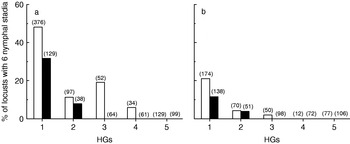
Desert locusts undergo either five or six nymphal stadia, as mentioned above. First, we examined the effects of hatchling body size and rearing density on this trait because it affects the duration of nymphal development. Hatchlings categorized into five different hatchling size groups (HGs) were reared under either isolated or crowded conditions. HG 1 consists of smallest hatchlings typical of solitarious forms, whereas HG 5 comprises largest ones typical of gregarious forms. The incidence of nymphs exhibiting six stadia depended on HG, rearing density and sex (fig. 1). The highest incidence was obtained when females derived from HG 1 (smallest hatchlings) were reared under isolated conditions. No nymphs exhibiting six stadia appeared from HG 5 (largest hatchlings) in females or from HGs 4 and 5 in males. The incidence of nymphs exhibiting six stadia within HG 1 was higher under isolated conditions than under crowded conditions in either females (χ2=10.429; df=1; P<0.001) or males (χ2=5.310; df=1; P<0.05). The duration of nymphal development was significantly shorter in locusts with five nymphal stadia (mean±SD: 30.0±2.2 days, n=175 for females; and 29.2±2.2 days, n=152 for males) than in locusts with six nymphal stadia (mean±SD: 33.6±2.5 days, n=170 for females; t=−13.969, df=343, P<0.001; 33.8±2.3 days, n=44 for males; t=−11.965, df=194, P<0.001). Within HG 1, adult body weight was significantly smaller in individuals with five nymphal stadia (mean±SD: 1947±142 mg, n=175 for females; and 1394±99 mg, n=152 for males) than in those with six nymphal stadia (mean±SD: 2166±182 mg, n=170 for females; t=−12.490, df=343, P<0.001; 1508±107 mg, n=44 for males; t=−6.577, df=194, P<0.001). Because the developmental performance in each HG was influenced by the number of nymphal stadia, the following analyses on nymphal development were conducted mainly for locusts with five nymphal stadia.
Proportions of individuals with six nymphal stadia in different hatchling size groups (HGs) of Schistocerca gregaria reared under (□) isolated conditions or (■) crowded conditions. (a) females, (b) males. Numbers on bars indicate n.

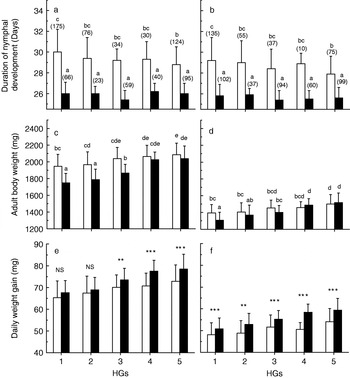
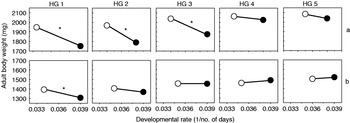
Rearing density influenced the duration of nymphal development (fig. 2a,b). In all HGs, nymphal development was faster under crowded conditions than under isolated conditions. Under isolated conditions, nymphs tended to grow slightly faster, as hatchlings were bigger (fig. 2a,b), and a negative correlation was found between individual hatchling body weight and developmental time for both sexes (data not shown: r=−0.211, n=439, P<0.001 for females; r=−0.154, n=312, P<0.01 for males). Under crowded conditions, developmental time did not vary with HG for either sex (P>0.05 each). However, hatchling body size influenced adult body weight under both isolated and crowded conditions; larger hatchlings attained a larger body weight at adult emergence (fig. 2c,d). Interestingly, rearing density resulted in differences in adult body weight in small hatchlings only. Daily weight gain during the nymphal stage was consistently greater under crowded conditions than under isolated conditions (fig. 2e,f), although the differences for HGs 1 and 2 in females were not significant (P>0.05; fig. 2e). In both sexes, larger hatchlings showed greater daily weight gain. Figure 3 summarizes the relationships between developmental rate (the inverse of the number of days required for nymphal development) and adult body weight for different HGs. For females (fig. 3a), a negative relationship indicating a trade-off was found in the smallest three HGs. For males (fig. 3b), a negative relationship was found only in HG 1. These results indicate that small hatchlings grow faster under crowded conditions than under isolated conditions at the expense of the final body size. Larger hatchlings also grew faster under crowded conditions than under isolated conditions, but without becoming smaller as adults.
Effects of hatchling body size on various developmental traits in Schistocerca gregaria. Duration of nymphal development (a) and (b), adult body weight (c) and (d) and daily weight gain (e) and (f) in locusts of different HGs reared under (□) isolated conditions or (■) crowded conditions. (a), (c) and (e), females; (b), (d) and (f), males. Means with one side of SD are presented. Numbers in parentheses in panel (a) and (b) indicate n. Different letters in each panel indicate significant differences at P<0.05 by Scheffé's test. Daily weight gain was tested by Mann-Whitney U test: NS, not significant; **, P<0.01; ***, P<0.001.

Relationships between developmental rate of nymphs and adult body weight in different HGs of Schistocerca gregaria reared under (○) isolated conditions or (•) crowded conditions. Data are based on results in fig. 2. (a) females, (b) males. Asterisks indicate significant differences in both adult body weight (by t-test) and developmental rate (by Mann-Whitney U test) between the two groups at P<0.05. Sample sizes are given in fig. 2.

Reproductive traits and density
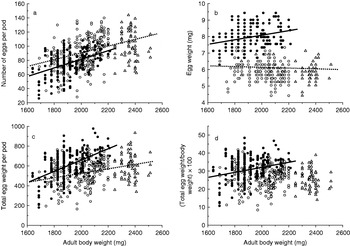
Female adults from a solitarious (isolation-reared) and a gregarious (crowd-reared) line were housed individually or with two male adults, and the number of eggs, individual egg weight and total egg weight per egg pod were determined (fig. 4). For the solitarious line, adults with five and six nymphal stadia are presented separately, because adult body weight was significantly smaller in the former, as mentioned above. The number of eggs per egg pod increased with adult body weight in both lines (fig. 4a; P<0.001). ANCOVA with adult body weight as the covariate indicated significant differences in the number of eggs between the two groups of solitarious adults (F1, 294=7.22, P<0.01), as well as between the two lines (F1, 527=23.69, P<0.001). Egg weight varied positively with adult body weight in the gregarious line (fig. 4b; r=0.269, n=234, P<0.001) but negatively in the solitarious line (r=−0.128, n=296, P<0.05). Mean egg weight was significantly greater in the gregarious line (mean±SD: 8.02±0.63 mg) than in the solitarious one (5.89±0.54 mg, t=41.66, df=528, P<0.001). No significant difference was found in egg weight between the two groups within the solitarious line (P>0.05). Total egg biomass per pod, calculated based on egg weight and the number of eggs per pod, was positively correlated to adult body weight in the two lines (fig. 4c). It was significantly larger in the gregarious line (604.6±134.9 mg, n=234) than in the solitarious line (554.1±13.2 mg, n=296, t=4.358, df=528, P<0.001). However, no significant difference was found in this trait between the solitarious females with five nymphal stadia (538.8±131.9 mg, n=193) and those with six nymphal stadia (582.8±122.6 mg, n=103, ANCOVA F1, 294=2.267, P>0.05) after adult body size was adjusted. Body weight-specific egg production (total egg mass/adult body weight) was relatively constant over a wide range of adult body weights in the solitarious line (fig. 4d; r=−0.031, n=296, P>0.05) but rapidly increased with adult body weight in the gregarious line (r=0.253, n=234, P<0.001).
Relationships between body weight at adult emergence and various reproductive traits in female adults of a solitarious and a gregarious line of Schistocerca gregaria. (a) the number of eggs per pod, (b) egg weight, (c) total egg weight per pod, and (d) total egg weight relative to adult body weight. Eggs produced by solitarious adults with (○) five or (△) six nymphal stadia are shown separately, together with those produced by (•) gregarious adults. Regression lines for the gregarious line are drawn by black lines, and those for the solitarious line are dotted lines. n=193 and n=103 for solitarious individuals with five and six nymphal stadia, respectively, and n=234 for gregarious individuals.

Trade-off between egg size and number
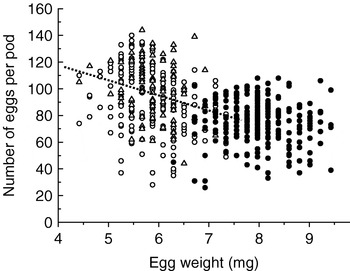
Figure 5 illustrates the relationship between egg weight and number per pod produced by adults of a solitarious and a gregarious line. The overall correlation involving all eggs produced by the two lines was highly significant (r=−0.456, n=530, P<0.001). In the solitarious line alone, the negative correlation was less obvious but still significant for egg pods produced by all adults (r=−0.273, n=296, P<0.001) and those produced by adults with five nymphal stadia (r=−0.286, n=193; P<0.001) or six nymphal stadia (r= −0.265, n=103, P<0.01). Unexpectedly, the corresponding correlation was not statistically significant for the gregarious line (P>0.05).
Relationships between the weight and number of eggs per pod laid by solitarious (isolation-reared) adults with (○) five or (△) six nymphal stadia and by (•) gregarious (crowd-reared) adults of Schistocerca gregaria. A negative correlation is found only in the solitarious line (dotted line). n=296 in the solitarious line and n=234 in the gregarious line.

Discussion
In S. gregaria, the density experienced by females as adults determines the progeny size (Faure, Reference Faure1932; Chauvin, Reference Chauvin1941; Hunter-Jones, Reference Hunter-Jones1958); solitarious females produce small green hatchlings and gregarious females large black hatchlings. The phase-dependent hatchling body colouration has been claimed to be determined after egg deposition by a water-soluble pheromonal factor produced by the accessory gland of the female parent (McCaffery et al., Reference McCaffery, Simpson, Islam and Roessingh1998; Simpson et al., Reference Simpson, McCaffery and Hägele1999; Hägele et al., Reference Hägele, Oag, Bouaïchi, McCaffery and Simpson2000; Simpson & Miller, Reference Simpson and Miller2007). However, recent studies have failed to reproduce this result and have concluded that hatchling body colour, as well as body size, are pre-determined in the ovary of the mother (Tanaka & Maeno, Reference Tanaka and Maeno2006, Reference Tanaka and Maeno2008). The variation in progeny size caused by the maternal effect influences the number of nymphal stadia (Hunter-Jones, Reference Hunter-Jones1958) and, thus, the development and body size at maturation, as demonstrated in this study. We investigated developmental performance of various sizes of S. gregaria hatchlings under isolated and crowded conditions. We confirmed that extra molting occurs only in small hatchlings (Hunter-Jones, Reference Hunter-Jones1958) and found that the incidence of extra molting also depends on the rearing density of the nymphs and the sex.
Because the number of nymphal stadia influences the duration of nymphal development and body size at maturation, our analysis of developmental traits was conducted mainly for locusts with five nymphal stadia. We found that, irrespective of hatchling body size, nymphal development was consistently faster under crowded conditions than under isolated conditions. Although locusts have received much attention (Faure, Reference Faure1932; Uvarov, Reference Uvarov1966), few reliable data are available about phase-dependent differences in duration of nymphal development and the information is not consistent. In S. gregaria and L. migratoria, nymphal growth has been reported to be faster in crowd-reared locusts than in those reared in isolation in some studies (Kennedy, Reference Kennedy1956; Uvarov, Reference Uvarov1966, Reference Uvarov1977; Pener, Reference Pener1991; Heifetz & Applebaum, Reference Heifetz and Applebaum1995), whereas the reverse conclusion has been reported in other studies (Staal, Reference Staal1961; Applebaum & Heifetz, Reference Applebaum and Heifetz1999). Most studies were conducted without considering the variation in the number of nymphal stadia. Crowding, particularly in late-stadium nymphs, can easily cause a shortage of food, and special care is required to avoid a secondary effect of crowding. In the present study, we analyzed locusts with five or six nymphal stadia separately and changed the grass twice a day for late-stadium nymphs to ensure that they had food ad libitum throughout nymphal life. Other factors influencing nymphal development and reproductive performance include temperature, humidity and food (Uvarov, Reference Uvarov1966). In the present study, variation in these conditions was minimized by rearing locusts in a similar way except for rearing density.
Rapid development often results in smaller body size. This negative relationship, or trade-off, is well documented in various organisms (Stearns, Reference Stearns1992). In S. gregaria, rearing density affects developmental rate and adult body size. We found a trade-off between the two variables for relatively small hatchlings, which grow faster but emerge as smaller adults under crowded conditions than under isolated conditions. However, such a trade-off is not found in large hatchlings, which grow faster under crowded conditions than under isolated conditions without becoming smaller adults (fig. 3). This finding may suggest an important feature of this locust, which often undergoes outbreaks. In solitarious forms, hatchlings are small and take a long time to mature (with low developmental rates) but can attain a large adult body size. At low population density at which food is less likely to be limiting, large adult body size, rather than rapid growth, may be more important in terms of fitness. Conversely, in gregarious forms, hatchlings are large and grow rapidly. These characteristics are likely to be adaptive under crowded conditions because large hatchlings are more tolerant to desiccation and fasting than small ones (Albrecht & Blackith, Reference Albrecht and Blackith1960), and rapid development would reduce the time of exposure to predators. Indeed, large hatchlings rarely undergo extra molting even if reared in isolation. With increased nymphal growth efficiency, gregarious locusts can accomplish both rapid growth and large adult body size by evading the trade-off by which solitarious locusts are constrained.
A comparison of reproductive performance between a solitarious and a gregarious line revealed another important feature of this locust. ANCOVA demonstrated that the number of eggs per pod depends on the body size of the female parent and confirmed that solitarious females produce more eggs than gregarious ones (Uvarov, Reference Uvarov1966). The present study also confirmed that gregarious locusts produce larger eggs than solitarious locusts (Uvarov, Reference Uvarov1966). Interestingly, with increased body size of the female parents, egg size tends to increase in gregarious forms, whereas it tends to decrease slightly in solitarious forms. A negative correlation between progeny size and female size is rare (Fox & Czesak, Reference Fox and Czesak2000). It is possible that under non-competitive conditions at low population density, selective pressure has favoured solitarious females to increase the number of eggs at the expense of individual egg size. The production of smaller eggs by larger females in isolation-reared locusts might be an adaptive response because the environment in which large adults occur is likely to be more favorable for nymphal growth compared with an environment where small adults occur. This would effectively lead to a reduction in the amount of investment to each egg without lowering hatchling survival and a greater investment in egg production. At high population density, on the other hand, large body size in hatchings is likely to impart increased fitness, as mentioned above. Because of such differences in selective pressure between the two phases, a trade-off between egg size and number, which is clearly shown when data for the two phases are combined, may become less obvious within the solitarious forms and non-significant within the gregarious forms.
In conclusion, locusts reared in isolation or in groups with minimal stress from competition for food and egg-laying space exhibit phase-dependent and body size-dependent differences in various developmental and reproductive characteristics. Unlike the solitarious forms in which development and reproduction are constrained by a trade-off, the gregarious forms have acquired capacities to grow faster without reducing the final body size and to produce more and larger eggs as the body size of the female parent increases. The latter is achieved by increasing the egg-developing capacity relative to body size. Crowding seems to serve as a stimulating signal for locusts to express a set of gregarious characteristics that contribute to rapid population growth during outbreaks.
Acknowledgements
The authors thank Ms Hiroko Ikeda, Ms Chieko Ito and Ms Masako Higuchi for laboratory assistance and Dr Toyomi Kotaki for helpful suggestions at NIAS. K.M. is grateful to Prof. Makio Takeda (Kobe University) for kind advice and encouragement. This study was partly supported by a JSPS Research Fellowship for young Scientists to K.M. and Kakenhi Funds of Japan to S.T. The authors wish to thank two anonymous reviewers who helped to improve the manuscript.