Introduction
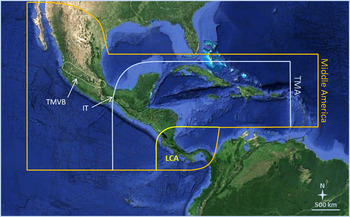
The Great American Biotic Interchange (GABI) refers to the long-recognized two-way migration of biota between South and North America as a result of a central-American land-bridge (Stehli & Webb, Reference Stehli and Webb1985). First applied to explain the distribution of mammals (Wallace, Reference Wallace1876; Von Ihering, Reference Von Ihering1900; Simpson, Reference Simpson1980; see Cione et al., Reference Cione, Gasparini, Soibelzon, Soibelzon and Tonni2015), this phenomenon has since been applied to include other lineages (Stehli & Webb, Reference Stehli and Webb1985; Weir et al., Reference Weir, Bermingham and Schluter2009; Pinto-Sánchez et al., Reference Pinto-Sánchez, Ibáñez, Madriñán, Sanjur, Bermingham and Crawford2012; Bacon et al., Reference Bacon, Silvestro, Jaramillo, Smith, Chakrabarty and Antonelli2015). The final closing of this land-bridge has been widely accepted to have occurred ~3.5 million years ago (Coates & Obando, Reference Coates, Obando, Jackson, Budd and Coates1996) and numerous evolutionary studies have used this date for calibration (see references in Bacon et al., Reference Bacon, Silvestro, Jaramillo, Smith, Chakrabarty and Antonelli2015). Recent studies indicate that the land-bridge may be as old as the Miocene (Bacon et al., Reference Bacon, Silvestro, Jaramillo, Smith, Chakrabarty and Antonelli2015; Montes et al., Reference Montes, Cardona, Jaramillo, Pardo, Silva, Valencia, Ayala, Pérez-Angel, Rodriguez-Parra, Ramirez and Niño2015). This land-bridge, which includes the critically important ‘Isthmus of Panama’, is an integral part of a larger area called Middle America (MA) that comprises eight countries (Mexico, Guatemala, Belize, El Salvador, Honduras, Nicaragua, Costa Rica and Panama) and sometimes the Antilles (fig. 1) (Chakrabarty & Albert, Reference Chakrabarty, Albert, Albert and Reis2011; Winker, Reference Winker2011). Although a large portion of Mexico is Nearctic in character, and properly belongs to North America, it is both conceptually and operationally useful to include Mexico in any discussion of GABI because of the obvious Neotropical imprint on Mexico's southern fauna – in contrast to its central and northern biota – and because the major transitional drainages between the Nearctic and Neotropical realms lie entirely within Mexico (Marshall & Liebherr, Reference Marshall and Liebherr2000; Miguez-Gutierrez et al., Reference Miguez-Gutiérrez, Castillo, Márquez and Goyenechea2013). The region of our focus, ‘tropical Middle America’ (TMA), is the portion of MA between the Isthmus of Tehuantepec in Mexico and the Panama–Colombia border. This region is occasionally referred to as ‘Central America’ in biogeographical and geological studies, but we avoid the term here because of its varied meaning and application in the biogeographical literature (e.g. Hulsey & López-Fernández, Reference Hulsey, López-Fernández, Albert and Reis2011; Matamoros et al., Reference Matamoros, McMahan, Chakrabarty, Albert and Schaefer2015) and because of its original geopolitical conception. An ‘extended TMA’ would include the Antilles. We use the term ‘Lower Central America’ (LCA) to refer to the area covered by Panama, Costa Rica and the southern portion of Nicaragua (after Smith & Bermingham, Reference Smith and Bermingham2005).
Map showing the approximate boundaries of areas in Middle America. Tropical Middle America (TMA) is the area between the Isthmus of Tehuantepec in the north and the border between Colombia and Panama in the south. Lower Central America (LCA) includes Panama, Costa Rica and part of Nicaragua. IT, Isthmus of Tehuantepec; TMVB, Trans-Mexican Volcanic Belt.

The freshwater fish fauna of MA comprises approximately 800 species. Mexico's waterways support around 500 fish species, 145 of which are primary and 350 secondary (Miller et al., Reference Miller, Minckley and Norris2005). Primary freshwater fishes are considered intolerant of saltwater, and as such their distribution and dispersal depend on freshwater corridors and connections. Secondary freshwater fishes also evolved and radiated in continental freshwaters but have their deeper origins in marine ancestors; at least some of their species are tolerant of some salinity, which is relevant to their colonization modes (see Matamoros et al., Reference Matamoros, McMahan, Chakrabarty, Albert and Schaefer2015; Tagliacollo et al., Reference Tagliacollo, Duke-Sylvester, Matamoros, Chakrabarty and Albert2015). Biogeographically too, the fishes of MA comprise a composite fauna; the Neotropical components, such as Cichlidae and Heptapteridae, are common in the south, as are the Middle American Poeciliidae and Profundulidae, while Nearctic lineages such as cyprinids, percids, centrarchids, catostomids and ictalurids are more common in the northern regions. In addition, Mexico has a unique endemic fauna (Goodeidae and Atherinopsidae) that distinguishes central Mexico (Miller et al., Reference Miller, Minckley and Norris2005). South of Mexico, Nearctic components of the Middle American fauna are either lost or diminished.
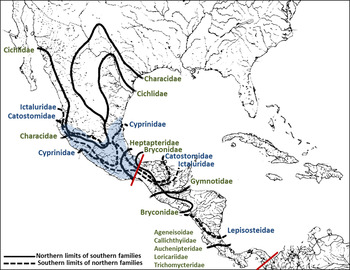
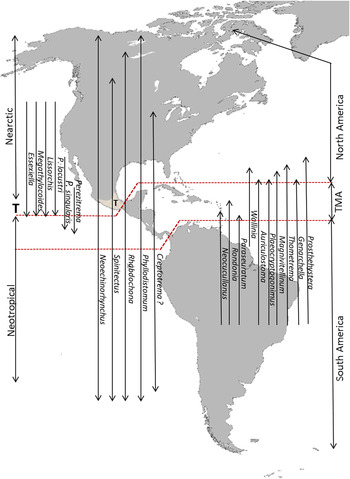
The 299 primary and secondary freshwater species that comprise the fish fauna south of Mexico (Matamoros et al., Reference Matamoros, McMahan, Chakrabarty, Albert and Schaefer2015), i.e. most of TMA, are in families such as Characidae, Cichlidae, Heptapteridae, Loricariidae, Poeciliidae and Profundulidae, of which secondary freshwater fishes such as cichlids, poeciliids and profundulids are particularly diverse (Miller, Reference Miller1966; Bussing, Reference Bussing and Thorson1976, Reference Bussing, Stehli and Webb1985, Reference Bussing1998; Albert et al., Reference Albert, Petry, Reis, Albert and Reis2011). Much of this fauna is thought to have been derived from South America (SA) (Myers, Reference Myers1966; Bussing, Reference Bussing1998; Hulsey & López-Fernández, Reference Hulsey, López-Fernández, Albert and Reis2011). Two cichlids (Cichlasoma beani and Herichthys cyanoguttatus) and one characid (Astyanax mexicanus) have made considerable inroads into Mexico, and two of them (A. mexicanus and H. cyanoguttatus) have their northernmost limits in southern Texas in the USA. Only three Nearctic families, Lepisosteidae (gars), Catostomidae (suckers) and Ictaluridae (Nearctic catfishes) have colonized TMA south of Mexico, each represented in TMA by one species, of which only the tropical gar, Atractosteus tropicus, reaches LCA (fig. 2). The nature of this diverse assemblage between two great biogeographical realms is therefore a rich resource for ecological and evolutionary studies (Miller, Reference Miller1966; Myers, Reference Myers1966).
The approximate distribution limits of major families of Nearctic and Neotropical freshwater fishes in Middle America. The distribution of Poeciliidae is not shown. The shaded area is the major transitional area between TMA and the Nearctic region (modified from Myers, Reference Myers1966).

The parasites of freshwater fishes of MA reportedly comprise mainly Nearctic components in the north, a mixture of Nearctic and Neotropical taxa in transitional areas of southern Mexico, and mostly Neotropical taxa south of the Isthmus of Tehuantepec (Aguilar-Aguilar et al., Reference Aguilar-Aguilar, Contreras-Medina and Salgado-Maldonado2003; Pérez-Ponce de León & Choudhury, Reference Pérez-Ponce de León and Choudhury2005; Rosas-Valdez & Pérez-Ponce de León, Reference Rosas-Valdez and Pérez-Ponce de León2008; Salgado-Maldonado, Reference Salgado-Maldonado2008; Salgado-Maldonado et al., Reference Salgado-Maldonado, Caspeta-Mandujano, Moravec, Soto-Galera, Rodiles-Hernández, Cabañas-Carranza and Montoya-Mendoza2011). In this study, we review the biogeography of the helminth fauna of freshwater fishes in TMA and evaluate the extent to which these parasites have been part of the Great American Biotic Interchange (GABI); we attempt this task by integrating information from parasite surveys – including previously unpublished data from Panama – and published phylogenetic analyses in the context of host biogeography and Earth history of TMA.
Materials and methods
The focus here is on adult helminths. Larval helminths are outside the scope of the study for several broad reasons: their history is arguably more closely tied to that of their definitive hosts and, for some helminths – in the case of trematodes especially, also their first intermediate hosts; their identity is often only known to family or genus because their identification to species is notoriously difficult; and they appear to have low specificity for their fish hosts (see, for example, García-Varela et al., Reference García-Varela, Sereno-Uribe, Pinacho-Pinacho, Domínguez- Domínguez and Pérez-Ponce de León2016). We use information in published surveys, reviews and systematic studies, mainly from Mexico, Honduras, Nicaragua, Costa Rica and, for the first time, information from Panama, to form an overall synthesis of the helminth parasites in MA (e.g. Moravec, Reference Moravec1998; Aguirre-Macedo et al., Reference Aguirre-Macedo, Scholz, González-Solis, Vidal-Martínez, Posel, Arjona-Torres and Siu-Estrada2001; Garrido-Olvera et al., Reference Garrido-Olvera, García-Prieto and Pérez-Ponce de León2006; Salgado-Maldonado, Reference Salgado-Maldonado2008; Sandlund et al., Reference Sandlund, Daverdin, Choudhury, Brooks and Diserud2010; studies by Mendoza-Franco and associates; this study, etc.). Published phylogenetic studies provide a basis for postulating evolutionary relationships and the historical biogeography of the host–parasite associations. Thus, information from parasite surveys and phylogenetics is integrated with fish systematics and biogeographical studies, and the latest geological reconstructions and hypotheses (e.g. Bermingham & Martin, Reference Bermingham and Martin1998; Smith & Bermingham, Reference Smith and Bermingham2005; Hrbek et al., Reference Hrbek, Seckinger and Meyer2007; Albert & Reis, Reference Albert and Reiss2011 and chapters therein; Bacon et al., Reference Bacon, Silvestro, Jaramillo, Smith, Chakrabarty and Antonelli2015; Matamoros et al., Reference Matamoros, McMahan, Chakrabarty, Albert and Schaefer2015; Montes et al., Reference Montes, Cardona, Jaramillo, Pardo, Silva, Valencia, Ayala, Pérez-Angel, Rodriguez-Parra, Ramirez and Niño2015; Tagliacollo et al., Reference Tagliacollo, Duke-Sylvester, Matamoros, Chakrabarty and Albert2015; other references appear later in the relevant sections).
In this review, we focus on ‘primary’ and ‘secondary’ freshwater fishes (Hulsey & López-Fernández, Reference Hulsey, López-Fernández, Albert and Reis2011). Primary freshwater fishes of TMA are those belonging to the orders Characiformes and Siluriformes (with the exception of ariid catfishes). Secondary freshwater fishes comprise mainly the order Cyprinodontiformes and the family Cichlidae. We avoid the third category of ‘marine derivatives’ – a diverse and disparate assemblage of taxa – because their history and biology make their parasite fauna difficult to evaluate in the context of GABI or continental biogeography. Nevertheless, reference is occasionally made to marine derivative fishes in our discussions when it is relevant to how freshwater fish–parasite associations developed in TMA.
The records of helminths in Mexico include the southern tropical regions of that country, and are reported separately in our tables for both practical and conceptual reasons; checklists of the Mexican helminth fauna have been published on a regular basis (e.g. Garrido-Olvera et al., Reference Garrido-Olvera, García-Prieto and Pérez-Ponce de León2006; Salgado-Maldonado, Reference Salgado-Maldonado2006; Pérez-Ponce de León et al., Reference Pérez-Ponce de León, García-Prieto and Mendoza-Garfias2007) and databases are continuously updated and verified (Luis García-Prieto, pers. comm.), allowing us to separate the northern part of TMA (in southern Mexico) from LCA where most of the other TMA helminth records are currently from. To obtain counts of monogeneans in South American freshwaters, we extracted the information from Cohen et al. (Reference Cohen, Justo and Kohn2013) by subtracting the number of species in Polystomatidae (21 spp. in amphibians and turtles), the single species of Iagotrema (in turtles) and 233 marine species from the total count of the 651 species of monogeneans reported by them; this yields a count of 396 species of freshwater fish monogeneans.
The Panama study
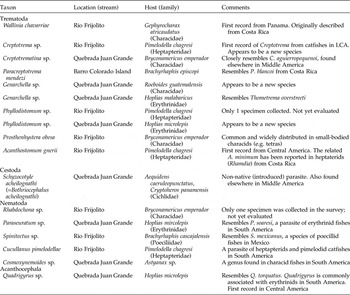
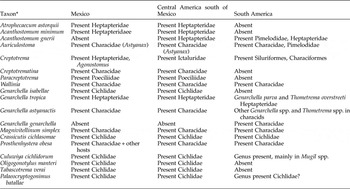
In total, 158 fish belonging to the following 15 species from 7 families were collected from Quebrada Juan Grande (09°08′40.5″N, 79°43′21.1″W) and Río Frijolito (09°08′58.1″N, 79°43′53.8″W) along Pipeline Road (Camino Oleoducto) in Soberania National Park, Panama, in January 2010 and examined for parasites (numbers of individuals examined in parentheses): Astyanax ruberrimus (10), Brycon petrosus (9), Bryconamericus emperador (31), Characidae gen. sp. (9), Gephyrocharax atricaudatus (27), Hyphessobrycon sp. (1) and Roeboides guatemalensis (13) (all Characidae); Hoplias microlepis (4) (Erythrinidae); Brachyraphis cascajalensis (14), Neoheterandria tridentiger (1) and Poecilia sp. (11) (Poeciliidae); Piabucina panamensis (10) (Lebiasinidae); Aequidens coeruleopunctatus (7) (Cichlidae); Pimelodella chagresi (10) (Heptapteridae); and Plecostomus hypostomus (1) (Loricariidae). Fish were collected using seines and hoop nets. In addition, Cryptoheros panamensis (3) (Cichlidae) was collected from Quebrada Juan Grande in August, 2011, and Brachyraphis episcopi (10) (Poeciliidae) was collected on Barro Colorado Island in January 2014. Necropsy work and parasite collection followed standard procedures (Choudhury et al., Reference Choudhury, Hoffnagle and Cole2004), except that only endoparasites were collected (Choudhury et al., Reference Choudhury, Zheng, Pérez-Ponce de León, Martínez-Aquino, Brosseau and Gale2013). A more complete analysis of this dataset, including the systematics and descriptions of taxa, will be reported elsewhere. Only information on distribution is reported here (table 1). This is also the first multi-species survey of freshwater fish parasites from Panama, and begins to address a crucial gap in our knowledge of fish parasites from LCA. The information from Panama also allows us to evaluate, for the first time, the nature of the transition across the entire span of Middle America.
Adult endohelminths of freshwater fishes from Soberania National Park, Panama.

In this review, we use names of genera without ‘sp.’ and ‘spp.’ where appropriate, because genera can also be regarded as portions or components of lineages, beyond static taxon names. So, for example, when we refer to Creptotrema as absent from an area, it means no species of Creptotrema is present there. Similarly, when we say Creptotrema is associated with a particular fish host, what we are drawing attention to is that the lineage component Creptotrema is associated with that host, and which particular species is irrelevant. Such usage simplifies writing and allows generalizations to be made where appropriate.
Results and discussion
Monogenea
Our compiled records indicate a fauna comprising 73 species in 31 genera and 5 families from Mexico as a whole, but only 24 species from TMA. The records of species of Cichidogyrus, Enterogyrus, Scutogyrus and Gyrodactylus cichlidarum can be ignored since these were likely introduced with African cichlids (evidently Oreochromis spp.). We also set aside the record of Gussevia from Astronotus ocellatus in Panama because it is an introduced cichlid there, but Gussevia is nevertheless present in TMA, in Herotilapia multispinosa in Nicaragua (Vidal-Martínez et al., Reference Vidal-Martínez, Scholz and Aguirre-Macedo2001a, Reference Vidal-Martínez, Aguirre-Macedo, Scholz, González-Solís and Mendoza-Francob), and the genus is also found on cichlids of the Antilles and SA (Hanek et al., Reference Hanek, Molnar and Fernando1974; Kritsky et al., Reference Kritsky, Thatcher and Boeger1989). Similarly, Sciadicleithrum has a wide distribution in Neotropical cichlids, including 4 species in southern Mexico, 2 spp. in LCA and at least 15 spp. in SA (Mendoza-Franco & Vidal-Martínez, Reference Mendoza-Franco and Vidal-Martínez2005; Kohn et al., Reference Kohn, Cohen and Salgado-Maldonado2008; Cohen et al., Reference Cohen, Justo and Kohn2013). A recent study (García-Vásquez et al., Reference García-Vásquez, Razo-Mendivil and Rubio-Godoy2015) indicates that Gyrodactylus is set to supersede other monogenean genera in species richness in MA. A recent summary (Bueno-Silva & Boeger, Reference Bueno-Silva and Boeger2014) puts the number of Neotropical Gyrodactylus species at 20, of which ‘more than 10 species’ are known from SA (Bueno-Silva & Boeger, Reference Bueno-Silva and Boeger2014). Cohen et al. (Reference Cohen, Justo and Kohn2013) listed 43 species from 13 genera in the family Gyrodactylidae, and 15 species of Gyrodactylus. In contrast, the family Dactylogyridae has at least 303 species in 59 genera in South America; Cohen et al. (Reference Cohen, Justo and Kohn2013) list 64 genera but we exclude 3 genera that appear to have been introduced with tilapia, one (a Dactylogyrus vastator) with carp, and one (Cleidodiscus sp.) whose host origin raises doubts. The dactylogyrid Urocleidoides occurs across a broad spectrum of hosts (in 10 families), its 22 constituent species showing varying degrees of host specificity (Mendoza-Franco et al., Reference Mendoza-Franco, Caspeta-Mandujano, Salgado-Maldonado and Matamoros2015).
The distribution of the 396 freshwater monogenean species recorded by Cohen et al. (Reference Cohen, Justo and Kohn2013) from SA show very few species from Colombia (12 native species) and Venezuela (9 native species), compared to >300 species from Brazil alone. While one may attribute this difference to some natural greater species richness in Brazil, it would be premature at the moment because there has also been a much greater effort in describing the Brazilian fauna than those of other, northern, countries in SA.
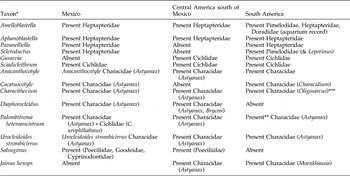
Several monogeneans in MA have distributions and host associations that make their Neotropical affinities evident (table 2). These include Amelloblastella, Aphanoblastella, Pavanelliella and Scleroductus in heptapterid catfishes, Anacanthocotyle, Cacatuocotyle, Characithecium, Diaphorocleidus, Jainus hexops, Palombitrema heteroancistrum and Urocleidoides strombicirrus in characids (mainly Astyanax spp.), and Gussevia and Sciadicleithrum in cichlids (Vidal-Martínez et al., Reference Vidal-Martínez, Scholz and Aguirre-Macedo2001a, Reference Vidal-Martínez, Aguirre-Macedo, Scholz, González-Solís and Mendoza-Francob; Mendoza-Franco et al., Reference Mendoza-Franco, Posel and Dumailo2003, Reference Mendoza-Franco, Reina and Torchin2009, Reference Mendoza-Franco, Caspeta-Mandujano and Salgado-Maldonado2013; Mendoza-Franco & Vidal-Martínez, Reference Mendoza-Franco and Vidal-Martínez2005; Cohen et al., Reference Cohen, Justo and Kohn2013; Kritsky et al., Reference Kritsky, Boeger, Mendoza-Franco and Vianna2013; Mendoza-Palmero et al., Reference Mendoza-Palmero, Blasco-Costa and Scholz2015). Many of these taxa have been reported in both TMA and SA (table 2).
Monogenean taxa in Tropical Middle America (TMA), relevant to discussions of the Great American Biotic Interchange (GABI), and their distribution and host associations.

* Genera represent lineages associated with particular host groups.
** Listed as a junior synonym of Urocleidoides by Cohen et al. (Reference Cohen, Justo and Kohn2013).
*** Rossin & Timi (Reference Rossin and Timi2014) also emended the genus.
The most parsimonious explanation for the apparent absence of Pavanelliella and Scleroductus in LCA is lack of sampling effort (coverage) or, if more sampling bears the absence out, localized extirpation. A large-scale molecular phylogenetic analysis of dactylogyrids in Neotropical catfishes – including taxa found in TMA – (Mendoza-Plamero et al., Reference Mendoza-Franco, Caspeta-Mandujano, Salgado-Maldonado and Matamoros2015) supports Amelloblastella and Aphanoblastella as monophyletic Neotropical taxa, and indicates a complex history of colonization and diversification of dactylogyrids in Neotropical siluriforms. Since GABI was not the subject of that study, little can be gleaned from it that informs us about biotic interchange in MA.
Anacanthocotyle was proposed for a monogenean from Astyanax fasciatus in TMA (Kritsky & Fritts, Reference Kritsky and Fritts1970). Jara (Reference Jara1986) reported it from Peru, and Boeger & Popazoglo (Reference Boeger and Popazoglo1995) listed this record as well. Neither the record nor the reference (Jara, Reference Jara1986) appears in Cohen et al. (Reference Cohen, Justo and Kohn2013), but we can regard the genus as being present in SA. Thus far, it appears that Astyanax spp. host a consistent assemblage of monogeneans across their distributional range, with limited diversification in MA in taxa such as Anacanthocotyle, Diaphorocleidus, Characithecium and Palombitrema (table 2) (Kritsky & Fritts, Reference Kritsky and Fritts1970; Mendoza-Franco et al., Reference Mendoza-Franco, Posel and Dumailo2003, Reference Mendoza-Franco, Reina and Torchin2009; Jogunoori et al., Reference Jogunoori, Kritsky and Venkatanarasaiah2004).
Sciadicleithrum is particularly common in southern Mexican cichlids, where its species seem to have diversified, but its presence in LCA may be underestimated. So far, the data indicate that the four species of Sciadicleithrum in Mexican cichlids form a more recently evolved monophyletic assemblage along with one species from LCA, while the other TMA species are nested within their South American relatives (Mendoza-Franco & Vidal-Martínez, Reference Mendoza-Franco and Vidal-Martínez2005). This is consistent with hypotheses about a colonization of TMA by cichlids from SA. This phylogenetic hypothesis of Sciadicleithrum and its proposed historical biogeography (Mendoza-Franco & Vidal-Martínez, Reference Mendoza-Franco and Vidal-Martínez2005) is also consistent with the subsequent finding of a Sciadicleithrum species in Aequidens in Panama that does not belong to the Mexican Sciadicleithrum clade (Mendoza-Franco et al., Reference Mendoza-Franco, Aguirre-Macedo and Vidal-Martínez2007). Gussevia has an unexpectedly patchy distribution in the region, being absent from Mexican heroine cichlids and apparently rare in LCA (one species from one cichlid in Nicaragua), but present in Antillean cichlids.
Salsuginus, a genus typical of cyprinodontiforms, presents a different case; it is widely distributed in Mexico, in the Greater Antilles and in LCA, but is apparently absent in SA (Mendoza-Franco & Vidal-Martinez, Reference Mendoza-Franco and Vidal-Martínez2001; Mendoza-Franco et al., Reference Mendoza-Franco, Vidal-Martínez, Cruz-Quintana and Prats León2006; Cohen et al., Reference Cohen, Justo and Kohn2013). Its hosts include fundulids farther north in the Nearctic region (Canada), goodeids and cyprinodontids in Mexico, and poeciliids, a cyprinodontid and a fundulid in the Greater Antilles (Mendoza-Franco et al., Reference Mendoza-Franco, Vidal-Martínez, Cruz-Quintana and Prats León2006). Salsuginus has been considered to be of Nearctic origin and, as such, one of the rare Nearctic components in TMA (Mendoza-Franco et al., Reference Mendoza-Franco, Vidal-Martínez, Cruz-Quintana and Prats León2006; Salgado-Maldonado, Reference Salgado-Maldonado2008).
Gyrodactylus and Dactylogyrus pose their own challenges and remain among the more intractable genera of monogeneans; this is due to the large number of constituent species, their wide distributional range, their diverse host-associations and the lack of any comprehensive modern phylogenies that include the areas under consideration here. Similarly, without a phylogenetic anlaysis, the complex biogeography and wide host range of Urocleidoides makes it impossible to suggest its geographical origin or primary host associations (Mendoza-Franco et al., Reference Mendoza-Franco, Caspeta-Mandujano, Salgado-Maldonado and Matamoros2015).
Other than the possible case of Salsuginus, the Nearctic influence on the monogenean fauna of TMA appears to be minimal. Monogeneans of Nearctic freshwater fish families that have extended their distributions to central and southern Mexico (e.g. Octomacrum of Cyrpinidae and Ligictaluridus spp. in Ictaluridae) are noticeably absent in TMA, which suggests no host-shifting of monogeneans from these hosts into the Neotropical fish fauna.
Our confidence in distributional patterns is also undermined by the highly uneven sampling across the areas in question. For example, Cohen et al. (Reference Cohen, Justo and Kohn2013) report only 4 species of monogeneans from 3 species of cyprinodontiform fishes (2 Poecilia spp. and Anablepsoides hartii) in SA, and 3 of the 4 records are from Venezuela alone! This is in stark contrast to the 10 species of Gyrodactylus from poeciliids in Mexico, 6 from Poecilia mexicana alone (Rubio-Godoy et al., Reference Rubio-Godoy, Paladini, García-Vásquez and Shinn2010; García-Vásquez et al., Reference García-Vásquez, Razo-Mendivil and Rubio-Godoy2015). The paucity of records from SA is remarkable, given the high diversity of cyprinodontiform fishes (>550 spp.) in the Neotropical region as a whole, but is it a reflection of any real diversity? Such uncertainty is a great impediment in our understanding of host–parasite associations in this fish group and any solid conclusions about the cyprinodontoid monogenean fauna in the Neotropical region.
Cestoda
There are very few records of fish tapeworms from TMA (Salgado-Maldonado, Reference Salgado-Maldonado2008; Sandlund et al., Reference Sandlund, Daverdin, Choudhury, Brooks and Diserud2010; table 1, this study). So far, records include introduced Schyzocotyle acheilognathi (=Bothriocephalus acheilognathi) in Panama, Guatemala and Honduras (Choudhury et al., Reference Choudhury, Zheng, Pérez-Ponce de León, Martínez-Aquino, Brosseau and Gale2013; Pinacho-Pinacho et al., Reference Pinacho-Pinacho, García-Varela, Hernández-Orts, Mendoza-Palmero, Sereno-Uribe, Martínez-Ramírez, Andrade-Gómez, López-Jiménez, Hernández-Cruz and Pérez-Ponce de León2015a; Salgado-Maldonado et al., Reference Salgado-Maldonado, Matamoros, Kreiser, Caspeta-Mandujano and Mendoza-Franco2015) and recently in Chiapas (Velázquez-Velázquez et al., Reference Velázquez-Velázquez, Mendez-Gómez, Salgado-Maldonado and Matamoros2015), B. pearsei from cichlids and heptapterids in southern Mexico, Proteocephalus gaspari in tropical gar in Nicaragua, and unidentified proteocephalideans from Chiapas (Salgado-Maldonado et al., Reference Salgado-Maldonado, Caspeta-Mandujano, Moravec, Soto-Galera, Rodiles-Hernández, Cabañas-Carranza and Montoya-Mendoza2011) and once from a cichlid in Costa Rica (Sandlund et al., Reference Sandlund, Daverdin, Choudhury, Brooks and Diserud2010). No native cestodes were found in the Panama study (table 1).
South America boasts a cestode fauna rich in proteocephalideans (Thatcher, Reference Thatcher1991; de Chambrier & Vaucher, Reference de Chambrier and Vaucher1999; Rego et al., Reference Rego, Chubb and Pavanelli1999; Rego, Reference Rego, Salgado-Maldonado, García Aldrete and Vidal-Martínez2000; de Chambrier et al., Reference de Chambrier, Zehnder, Vaucher and Mariaux2004, Reference de Chambrier, Scholz, Kuchta, Posel, Mortenthaler and Guardia2006, 2015). Rego (Reference Rego, Salgado-Maldonado, García Aldrete and Vidal-Martínez2000) listed 95 species, 90% of which were proteocephalideans, from 69 hosts, most of which were catfishes (siluriforms). Work done since then by de Chambrier, Scholz and their co-workers has reinforced this general pattern (de Chambrier et al., Reference de Chambrier, Waeschenbach, Fisseha, Scholz and Mariaux2015 and references therein). One explanation for the contrasting dearth of cestodes in TMA may be the low diversity of siluriform lineages (e.g. heptapterids) in TMA that are known to harbour tapeworms in SA. Other siluriform lineages, such the detritivore and algivore loricariids and trichomycterids in LCA, may not be suitable hosts. However, the nature and abundance of the intermediate hosts (copepods, other fishes) in TMA deserve scrutiny as contributing factors.
Characiforms, cyprinodontiforms and cichlids, which together make up much of the diversity of the TMA fish fauna, are not particularly known for their cestode fauna in the Neotropical regions; two Proteocephalus spp. and a Sciadocephalus species seem to be widely and typically found in peacock basses (Cichla spp.) (Scholz et al., Reference Scholz, Chambrier, Prouza and Royero1996; Rego, Reference Rego, Salgado-Maldonado, García Aldrete and Vidal-Martínez2000; Martins et al., Reference Martins, Pereira, Chambrier and Yamashita2009; Franceschini et al., Reference Franceschini, Zago, Zocoller-Seno and Veríssimo-Silveira2013; Yamada & Takemoto, Reference Yamada and Takemoto2013), and Rego (Reference Rego, Salgado-Maldonado, García Aldrete and Vidal-Martínez2000) listed Proteocephalus gibsoni from two other cichlids in the genera Astronotus and Geophagus. Reports of adult cestodes in South American cichlids also include an unidentified Bothriocephalus sp. (see Choudhury et al., Reference Choudhury, Zheng, Pérez-Ponce de León, Martínez-Aquino, Brosseau and Gale2013). Neither Astronotus nor Cichla colonized TMA naturally (both were introduced) and these parasites have not been reported in TMA. Only one Geophagus, G. crassilabris, is known from TMA, from its southernmost drainages (Chagres and Tuira rivers) (Smith & Bermingham, Reference Smith and Bermingham2005) and nothing is known about its endohelminths there. From characids, Rego (Reference Rego, Salgado-Maldonado, García Aldrete and Vidal-Martínez2000) list Monticellia coryphicephala and M. diesingi in Salminus spp. and Senga sp. in Astyanax scabripinnis. Among erythrinids, Hoplias malabaricus appears to have its own specific tapeworms, Proteocephalus regoi and Nominoscolex mattogrossensis from Paraguay and Brazil (de Chambrier & Vaucher, Reference de Chambrier and Vaucher1999; Rego, Reference Rego, Salgado-Maldonado, García Aldrete and Vidal-Martínez2000). This assemblage in cichlids and characiforms is a remarkably small cestode fauna for such a diverse group of fishes. No cestodes were listed for poeciliids. So, the paucity of cestodes in TMA may be a primary one and not a secondary loss. This pattern is reinforced by comparing surveys from southern Mexico, e.g. the Chiapas fauna (Salgado-Maldonado et al., Reference Salgado-Maldonado, Caspeta-Mandujano, Moravec, Soto-Galera, Rodiles-Hernández, Cabañas-Carranza and Montoya-Mendoza2011), and Costa Rica (Sandlund et al., Reference Sandlund, Daverdin, Choudhury, Brooks and Diserud2010).
Cestode diversity north of the Isthmus of Tehuantepec recovers somewhat, but remains low across Mexico. Only 14 species of tapeworms are known from native primary and secondary freshwater fishes of Mexico; 11 are native, 7 are proteocephalideans, only 2 are in hosts of Neotropical origin (Bothriocephalus pearsei in cichlids and a heptapterid, and Proteocephalus brooksi in Rhamdia, a heptapterid). The cestode fauna also displays a clear Nearctic bias. Of the 11 native species, 7 are characteristic parasites of their Nearctic hosts: 3 caryophyllideans (2 in a catostomid and 1 in a cyprinid), 3 corallobothrine tapeworms (all in ictalurid catfishes), and one Proteocephalus (P. singularis in gar). Another cestode, P. longicollis, a Holarctic species of salmonids (Hoffman, Reference Hoffman1999; Scholz et al., Reference Scholz, Hanzelová, Skeríková, Shimazu and Rolbiecki2007), was reported from Goodeidae (Mejia-Madrid et al., Reference Mejía-Madrid, Domínguez-Domínguez and Pérez-Ponce De León2005), a fish family endemic to northern MA.
Cestodes from MA display the usual, well-documented, host-lineage specificity, with the exception of B. pearsei, which has been reported from cichlids and heptapterid catfishes, both Neotropical hosts. Two Nearctic tapeworm taxa have notably extended their ranges far south in Mexico: Megathylacoides lamothei in Ictalurus furcatus (Scholz et al., Reference Scholz, Rosas-Valdez, Pérez-Ponce de León, Choudhury and de Chambrier2003; Rosas-Valdez & Pérez-Ponce de León, Reference Rosas-Valdez and Pérez-Ponce de León2008) and Proteocephalus singularis in the tropical gar Atractosteus tropicus (Salgado-Maldonado et al., Reference Salgado-Maldonado, Caspeta-Mandujano, Moravec, Soto-Galera, Rodiles-Hernández, Cabañas-Carranza and Montoya-Mendoza2011). If Proteocephalus gaspari from tropical gar in Nicaragua (de Chambrier & Vaucher, Reference de Chambrier and Vaucher1984) is related to Nearctic Proteocephalus spp., it would be the farthest south that a Proteocephalus from a Nearctic lineage has been able to extend into the Neotropical region.
The relationships of cestodes from Neotropical hosts in MA remain obscure. Bothriocephalus pearsei is either related to other North American Bothriocephalus species or was acquired by cichlids through host-shifting from the marine environment, and subsequently infected heptapterids where the two hosts overlap – an example of host-sharing. Little can be said also about the origins of Proteocephalus brooksi in Rhamdia and Proteocephalus sp. in Ictalurus (Garcia-Prieto et al., Reference García-Prieto, Rodríguez and Pérez-Ponce de León1996; Salgado-Maldonado, Reference Salgado-Maldonado2008) since there is no modern phylogenetic analysis of Proteocephalus in the Americas that includes Middle American species. As it stands now, the tapeworm fauna does not indicate any real biotic interchange across MA.
Trematoda
The trematode fauna of MA is probably the best-known helminth component in the region, due to numerous studies over the past decade using integrative taxonomic approaches and molecular phylogenetics (see Choudhury et al., Reference Choudhury, Aguirre-Macedo, Curran, Ostrowski de Núñez, Overstreet, Pérez-Ponce de León and Portes-Santos2016). In total, 53 species of trematodes (52 digeneans and 1 aspidogastrean) in 13 families have been reported from primary and secondary freshwater fishes from the region, as follows: Aspidogasteridae (1 sp.), Allocreadiidae (16 spp.), Alloglossidiidae (1 sp.), Angiodictydae (1 sp.), Apocreadiidae (6 spp.), Callodistomidae (2 spp.), Cryptogonimidae (10 spp., includes 3 species of Acanthostominae), Gorgoderidae (5 spp.), Haploporidae (4 spp.), Derogenidae (3 spp.), Lissorchiidae (1 sp.), Macroderoididae (2 spp.) and Microphallidae (1 sp.). Of these, 29 species in 21 genera and 10 families are known from TMA. The list becomes further restricted to 17 species in 9 families in LCA, not counting the 3 undescribed species of haploporids from characids and a cichlid in Costa Rica (Sandlund et al., Reference Sandlund, Daverdin, Choudhury, Brooks and Diserud2010) (table 1). The trematodes of the region show a consistent pattern of host association and many have ties to SA (table 3).
Selected taxa of Trematoda in Tropical Middle America (TMA) relevant to discussions of the Great American Biotic Interchange (GABI), and their distribution and host associations.

* Genera represent lineages associated with particular host groups.
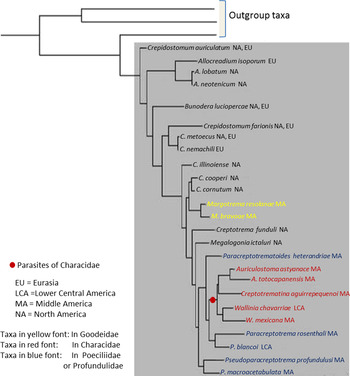
Allocreadiidae, an exclusively freshwater family, has the richest fauna, its morphological diversity also reflected by nine genera in this region. Of these, the genus Allocreadium is widely distributed in certain Nearctic cyprinids (Hoffman, Reference Hoffman1999) and is mostly found in the northern regions of MA. The family is diverse in the southern half of Mexico, particularly in cyprinodontiforms (eight allocreadiid species in the genera Margotrema, Paracreptotrema, Paracreptotrematoides and Pseudoparacreptotrema), and in the small-bodied characids, mainly Asytanax spp. (five allocreadiid species in the genera Auriculostoma, Creptotrematina and Wallinia). All allocreadiid genera – and most of their species – in the region have been studied using modern morphological and molecular techniques (Pérez-Ponce de León et al., Reference Pérez-Ponce de León, Rosas-Valdez, Aguilar-Aguilar, Mendoza Garfias, Mendoza-Palmero, García-Prieto, Rojas-Sánchez, Briosio Aguila, Pérez-Rodríguez and Domínguez-Domínguez2010; Curran et al., Reference Curran, Tkach and Overstreet2011, Martínez-Aquino et al., Reference Martínez-Aquino, Ceccarelli and Pérez-Ponce de León2013; Razo-Mendivil et al., Reference Razo-Mendivil, Mendoza-Garfias, Pérez-Ponce de León and Rubio-Godoy2014; Pérez-Ponce de León et al., Reference Pérez-Ponce de León, Razo-Mendivil, Mendoza-Garfias, Rubio-Godoy and Choudhury2015, Reference Pérez-Ponce de León, Pinacho-Pinacho, Mendoza-Garfias, Choudhury and García-Varela2016). The most complete phylogeny for Middle American allocreadiids to date (fig. 3, adapted from Pérez-Ponce de León et al., Reference Pérez-Ponce de León, Pinacho-Pinacho, Mendoza-Garfias, Choudhury and García-Varela2016) reveals the following: (1) three allocreadiid lineages (Auriculostoma, Creptotrematina and Wallinia) form a monophyletic group; they are present in characid fishes in MA and in SA; (2) this group nests within several lineages of Middle American allocreadiids in cyprinodontoids (mainly poeciliids) ranging from southern Mexico to Panama; (3) the Middle American genus Margotrema, a lineage associated primarily with goodeids, is situated deeper in the tree; and (4) all deeper nodes and branches on the tree are associated with progressively more northern (Laurasian) lineages (Margotrema, Crepidostomum, Allocreadium, etc.). These patterns do not support a simple northward expansion of allocreadiid taxa from SA, but instead indicate a ‘hot-spot’ of diversification in MA associated with cyprinodontiforms, which also gave rise to several allocreadiid taxa that now parasitize characids in MA and SA (fig. 3).
Simplified tree of allocreadiid relationships based on molecular data indicating diversification in cyprinodontoids and the relationships of the ‘characid’ clade (modified from Pérez-Ponce de León et al. (Reference Pérez-Ponce de León, Pinacho-Pinacho, Mendoza-Garfias, Choudhury and García-Varela2016) Journal of Parasitology 102, 131–142).

Not all allocreadiid taxa with Middle American–South American distributions conform to the aforementioned pattern of diversification. The genus Creptotrema remains the last genus of trans-American allocreadiids requiring a thorough study, which prevents a more robust reconstruction of allocreadiid diversification in the region. Nominal species of Creptotrema are found in fundulids in North America, in Agonostomus and Pimelodella in MA, and in fishes and a toad in SA (Brooks, Reference Brooks1976; Kohn et al., Reference Kohn, Fernandes and Cohen2007; Curran, Reference Curran2008; Salgado-Maldonado et al., Reference Salgado-Maldonado, Caspeta-Mandujano, Moravec, Soto-Galera, Rodiles-Hernández, Cabañas-Carranza and Montoya-Mendoza2011; Curran et al., Reference Curran, Pulis, Hugg, Brown, Manuel and Overstreet2012) (table 1). The relationships of the lineage currently rest on the position of its Nearctic member, C. funduli (fig. 3). If Creptotrema, as currently constituted, is monophyletic, then we need to explain this wide distribution across the Americas in disparate host clades, a task not easily accomplished under current geological and biogeographical scenarios. Alternatively, Creptotrema is not monophyletic, as suggested by Manter (Reference Manter1962) and followed by Brooks (Reference Brooks1976), and the Neotropical Creptotrema species have a separate, yet unknown, derivation. A phylogenetic analysis that includes Middle American and South American Creptotrema spp. would reveal whether the genus is monophyletic and if its Neotropical species comprise a separate monophyletic group.
Other trematode families (Cryptogonimidae, Haploporidae) may provide a different kind of information about colonization and diversification in MA. Within the Cryptogonimidae, the subfamily Cryptogoniminae comprises a large, diverse and widely distributed assemblage in marine and freshwater environments. They are especially common and diverse among perciform fishes such as Centrarchidae and Moronidae in North America (Hoffman, Reference Hoffman1999; Choudhury et al., Reference Choudhury, Aguirre-Macedo, Curran, Ostrowski de Núñez, Overstreet, Pérez-Ponce de León and Portes-Santos2016) and in Cichlidae in MA (Watson, Reference Watson and Thorson1976; Vidal-Martínez et al., Reference Vidal-Martínez, Aguirre-Macedo, Scholz, González-Solís and Mendoza-Franco2001b). Cryptogonimines are also found in centropomids in the coastal waters and coastal river systems in the region, and in South American freshwater fishes (Kohn et al., Reference Kohn, Fernandes and Cohen2007). Unfortunately, the cryptogonimines of the Americas have not been subjected to any comprehensive phylogenetic analysis. Yet, a robust phylogeny of cryptogonimines could address several hypotheses about their own evolutionary history in the Americas, and particularly about the colonization history of cichlids in MA, including: (1) a marine origin of Middle-American cryptogonimines of cichlids; (2) a close relationship with freshwater cryptogonimines of North American centrarchids; and (3) independent colonization events of/in Nearctic and Neotropical cryptogonimines (Choudhury et al., Reference Choudhury, Aguirre-Macedo, Curran, Ostrowski de Núñez, Overstreet, Pérez-Ponce de León and Portes-Santos2016). It appears that centrarchids and cichlids evolved from distantly related acanthomorph ancestors (Near et al., Reference Near, Dornburga, Eytana, Keck, Leo Smith, Kuhna, Moore, Price, Burbrink, Friedmang and Wainwright2013), and the two groups do not overlap in a way that could effect extensive host-sharing, so the leading hypothesis would be separate colonization and radiation of cryptogonimines in these two fish groups in their respective areas. What is of relevance to GABI, however, is whether there are cryptogonimines in Middle American cichlids that are truly shared with SA. We use ‘truly’ because taxonomic reassignments based on diagnostic morphological characters may not reflect true relationships in a group as diverse as Cryptogonimidae with its many genera in the Americas, most of them either monotypic or with few constituent species (Hoffman, Reference Hoffman1999; Vidal-Martínez et al., Reference Vidal-Martínez, Aguirre-Macedo, Scholz, González-Solís and Mendoza-Franco2001b; Choudhury et al., Reference Choudhury, Aguirre-Macedo, Curran, Ostrowski de Núñez, Overstreet, Pérez-Ponce de León and Portes-Santos2016). Thus, for example, the reassigning of the monotypic Middle American Pseudocaecincola batallae to the South American Palaeocryptogonimus (see Miller & Cribb, Reference Miller, Cribb, Gibson, Jones and Bray2008) suddenly alters the biogeographical connections between the regions and suggests that Middle American cichlids brought at least some of their South American cryptogonimid fauna with them, but is it accurate? Again, a molecular phylogeny could address this question and test other taxonomic arrangements in the cryptogonimids, with important implications for GABI. Finally, several nominal acanthostomines, Acanthostomum gnerii, A. minimum and A. astorquii, appear to be consistently present in heptapterid catfishes in TMA (table 3), and in heptapterid and pimelodid catfishes in SA; this association and their close similarity allows us to hypothesize that they may be closely related and derived from SA, the source of heptapterids in TMA.
The haploporids are similar to cryptogonimids in being present in both marine (coastal) and freshwater environments. In coastal systems, they seem to be particularly common in mugilids (Overstreet & Curran, Reference Overstreet, Curran, Jones, Bray and Gibson2005). In freshwaters of the Americas, they are found in secondary freshwater fishes such as poeciliids, cichlids and in marine derivatives (Aplodinotus grunniens), but notably also in primary freshwater fishes, particularly characiforms in MA (e.g. Astyanax, Brycon) and SA. Whether haploporids in Middle American characiforms are related to those in South American characiforms, or whether they are independent acquisitions in their respective current areas (MA and SA), will again depend on a comprehensive molecular phylogeny that includes haploporids in all of the categories of fishes in the region.
Some taxa, however, evidently dispersed northward into MA, and occasionally beyond, with their hosts, e.g. Acanthostomum spp. in heptapterids, Genarchella spp. in characids and heptapterids, Crassicutis spp. in cichlids, the alloglossidid Magnivitellum simplex in Astyanax, and Prosthenhystera spp. in Astyanax and Bryconamericus (Scholz et al., Reference Scholz, Vargas-Vazqueza and Salgado-Maldonado1995; Pérez-Ponce de León et al., Reference Pérez-Ponce de León, Razo-Mendivil, Rosas-Valdez, Mendoza-Garfias and Mejía Madrid2008; Rosas-Valdez & Pérez-Ponce de León, Reference Pérez-Ponce de León, Razo-Mendivil, Rosas-Valdez, Mendoza-Garfias and Mejía Madrid2008; Tkach & Curran, Reference Tkach and Curran2015; Hernández-Mena et al., Reference Hernández-Mena, Mendoza-Garcias, Ornelas-García and Pérez-Ponce de León2016). The presence of Prosthenhystera oonastica in Nearctic catfishes (Ictalurus spp.) in south-east NA (Tkach & Curran, Reference Tkach and Curran2015) is arguably a case of host-shifting from Astyanax. Consequently, we can predict that P. oonastica will also be present in Ictalurus spp. in Texas, where there is both historical and present-day sympatry of Ictalurus spp. and Astyanax. This is also one of the few clearly documented cases of shifting of a Neotropical taxon into a Nearctic host lineage, made even more remarkable by its northern extent. Finally, it appears that Prosthenhystera has been recorded in cichlids and ictalurids in Mexico (Salgado-Maldonado, Reference Salgado-Maldonado2008); in the light of P. oonastica, these records and associated specimens deserve special scrutiny.
The presence of Perezitrema, a macroderoidid trematode, in tropical gars of the genus Atractosteus (in TMA and the Greater Antilles; Moravec & Salgado-Maldonado, Reference Moravec and Salgado-Maldonado2002), is arguably an extension of the northern fauna. Gars (Lepisosteus and Atractosteus spp.) are well-known hosts of macroderoidids in North America (Hoffman, Reference Hoffman1999; Tkach et al., Reference Tkach, Pulis and Overstreet2010; Tkach & Kinsella, Reference Tkach and Kinsella2011). A recent phylogenetic analysis (Hernández-Mena et al., Reference Hernández-Mena, Mendoza-Garcias, Ornelas-García and Pérez-Ponce de León2016) shows that Perezitrema is a sister taxon to gar Macroderoides, and the placement of Perezitrema is also consistent with the colonization of TMA by gars from North America (Hernández-Mena et al., Reference Hernández-Mena, Mendoza-Garcias, Ornelas-García and Pérez-Ponce de León2016).
Finally, one trematode taxon, Polylekithum, is noteworthy in being present in the temperate regions of both Americas, but absent from TMA (Hoffman, Reference Hoffman1999; Kohn et al., Reference Kohn, Fernandes and Cohen2007). The genus is represented by at least two species in ictalurid catfishes in NA (Hoffman, Reference Hoffman1999; Curran et al., Reference Curran, Tkach and Overstreet2006; Barger, Reference Barger2012), and one (P. percai) in a percichthyid in SA (Ostrowski de Nuñez et al., Reference Ostrowski de Nuñez, Brugni and Viozzi2000). Curran et al. (Reference Curran, Tkach and Overstreet2006), citing morphological evidence, posited that the South American P. percai was not a Polylekithum, which would explain the wide disjunction as well as the disparate host-associations. A molecular phylogenetic analysis would resolve the issue.
Nematoda
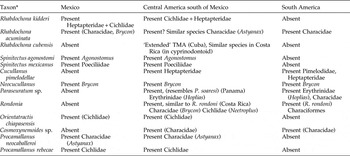
The nematode fauna of MA is dominated by spiruridans (Habronematoidea, Camallanoidea, Dracunculoidea), cucullanids and trichuridans (mainly Capillariidae). A variety of other forms is also present, including oxyuridans and cosmocercoideans (Moravec, Reference Moravec1998; Garrido-Olvera et al., Reference Garrido-Olvera, García-Prieto and Pérez-Ponce de León2006). Thus far, 57 species of nematodes in 28 genera from 13 families have been reported from freshwater fishes in Mexico. Salgado-Maldonado (Reference Salgado-Maldonado2008) listed 41 species from ‘Central America’ but the list included records from drainages and areas in MA that are either north of the Isthmus of Tehuantepec, transitional or not conventionally regarded as being within Central America (Papaloapan, Pánuco, Balsas, Santiago drainages, states of Jalisco, Guerrero, Veracruz, etc.). While these records help us to understand the nature of transitional faunas, we use them cautiously in delineating the TMA helminth fauna. Also, because so few studies from Neotropical regions outside Mexico had been conducted at the time, the checklist of Salgado-Maldonado (Reference Salgado-Maldonado2008) is de facto largely of southern Mexican records. What this also illustrates is that nematode diversity in Mexico is considerably higher in the southern regions as opposed to the Mesa Central and more northern drainages. Similarly, only 13 species of nematodes can be listed from TMA (tables 1 and 4).
The nematode fauna of TMA is thought to show a clear and dominant South American bias (Moravec, Reference Moravec1998; Salgado-Maldonado, Reference Salgado-Maldonado2008; Sandlund et al., Reference Sandlund, Daverdin, Choudhury, Brooks and Diserud2010; Salgado-Maldonado et al., Reference Salgado-Maldonado, Caspeta-Mandujano, Moravec, Soto-Galera, Rodiles-Hernández, Cabañas-Carranza and Montoya-Mendoza2011). A comparison of the fauna across TMA (table 4) reveals two patterns. First, several taxa such as Rhabdochona kidderi, R. acuminata, Procamallanus rebecae, P. neocaballeroi, Orientatractis chiapasensis, Spinitectus agonostomi, S. mexicanus and Neocucullanus neocucullanus are found both in southern Mexico and LCA (Moravec, Reference Moravec1998; González-Solís & Moravec, Reference González-Solís and Moravec2004; Garrido-Olvera et al., Reference Garrido-Olvera, García-Prieto and Pérez-Ponce de León2006; Salgado-Maldonado, Reference Salgado-Maldonado2008) (table 4). Second, and in contrast, several others such as Cucullanus pimelodellae, Rondonia rondoni and Paraseuratum sp. (tables 1 and 4), are shared between LCA and SA, but so far are absent from southern Mexico. This pattern may change for Rondonia because it was reported in a bryconid (Brycon guatemalensis) in Costa Rica (Sandlund et al., Reference Sandlund, Daverdin, Choudhury, Brooks and Diserud2010) and the host species is also found farther north in TMA. However, we expect a southern restriction for C. pimelodellae and Paraseuratum sp. because their hosts in LCA, Pimelodella and Hoplias (table 1), are not found in southern Mexico but are present in SA. As with many other helminth taxa, host-lineage specificity and host ranges in TMA play a major role in shaping the distributions of nematodes in the region.
Selected taxa of Nematoda in Tropical Middle America (TMA) relevant to discussions of the Great American Biotic Interchange (GABI), and their distribution and host associations.

* Genera represent lineages associated with particular host groups.
The nematode fauna of Neotropical Mexico and nearby areas also includes taxa whose affinities and origins remain obscure; species of the cosmocercoideans Orientatractis, Atractis and Raillietnema parasitize mainly cichlids in this area; these genera have a broad distribution in the tropics, sometimes even including the Oriental region (Bursey et al., Reference Bursey, Goldberg, Salgado-Maldonado and Mendez-de La Cruz1998; Moravec, Reference Moravec1998; González-Solís & Moravec, Reference González-Solís and Moravec2004; Bursey et al., Reference Bursey, Goldberg and Kraus2014). Capillariids are also well represented in the area (7 species in 5 genera), in hosts from across the spectrum of marine derivative, secondary and primary freshwater fishes in the families Eleotridae, Mugilidae (Agonostomus), Cichlidae, Synbranchidae (Ophisternon), Characidae (Astyanax) and Heptapteridae (Rhamdia). The sporadic and localized nature of many of these records and the absence of phylogenetic studies make it difficult to craft any biogeographical hypotheses for these nematodes.
A few other taxa are present over an extended TMA, e.g. Spinitectus agonostomi in southern Mexico, LCA and the Greater Antilles, and possibly Rhabdochona cubensis in both the Greater Antilles and LCA (table 4).
The biogeography of Spinitectus offers a possible departure from the usual northward expansion of southern taxa. Species of Middle-American Spinitectus form part of a clade along with several Nearctic species and one South American species, distinct from other species in SA and the Afrotropical and Asian regions (Choudhury & Dick, Reference Choudhury and Dick2001). While the morphological basis for this phylogeny remains sound, it is limited, and a molecular phylogeny could readily test competing hypotheses for the origin of Middle-American species of Spinitectus. If such a re-analysis resolves the basal polytomies that plague the existing phylogeny, it can address several important questions about Spinitectus in cyprinodontiforms such as profundulids and poeciliids: (1) are they closely related; (2) are they most closely related to other Nearctic species; and (3) are they more recently evolved among Spinitectus? The finding of S. osorioi in an atherinid from an Atlantic drainage in southern Mexico (Moravec et al., Reference Moravec, Salgado-Maldonado and Caspeta-Mandujano2010) also provides raw material to test hypotheses about the origin of S. osorioi in atherinopsids of the Mesa Central where the nematode was originally described (Choudhury & Pérez-Ponce de León, Reference Choudhury and Pérez-Ponce de León2001). Similar questions may be posed for species of Rhabdochona, e.g. Rhabdochona lichtenfelsi, R. cubensis and R. salgadoi, in cyprinodontiforms. Answers to these questions have implications for the historical biogeography of cyprinodontiforms in MA (discussed later).
Acanthocephala
The freshwater acanthocephalan fauna of MA is notably species poor; our database contains 15 species. Of these, Salgado-Maldonado (Reference Salgado-Maldonado2008) lists two species from TMA, one of which was unnamed but later described as Acanthocephalus amini from Cichlasoma urophthalmus in Yucatan, Mexico (Salgado-Maldonado & Novelo-Turcotte, Reference Salgado-Maldonado and Novelo –Turcotte2009). To this, we can add Neoechynorhynchus mamesi from Mexico, Guatemala, Honduras and Costa Rica, and Quadrigyrus sp. from Hoplias microlepis in Panama (Pinacho-Pinacho et al., Reference Pinacho-Pinacho, Sereno-Uribe, Pérez-Ponce de León and García-Varela2015b; table 1, this study). Only Neoechinorhynchus (golvani) was reported from the Costa Rican study, in cichlids (Sandlund et al., Reference Sandlund, Daverdin, Choudhury, Brooks and Diserud2010). Molecular studies suggest that N. golvani has diversified and may be a species complex (Martínez-Aquino et al., Reference Martínez-Aquino, Reyna-Fabián, Rosas-Valdez, Razo-Mendivil, Pérez-Ponce de León and García-Varela2009; Pinacho-Pinacho et al., Reference Pinacho-Pinacho, Sereno-Uribe, Pérez-Ponce de León and García-Varela2015b). Information from SA suggests that the continent has a morphologically diverse acanthocephalan fauna but, for its size, a modest number of species (37 species in 15 genera): Acanthodelta (1), Echinorhynchus (6), Gorytocephalus (3), Gracilisentis (1), Megapriapus (1), Neoechinorhynchus (6) Octospiniferoides (2), Palliolisentis (3), Pandosentis (1), Polyacanthorhynchus (2), Pomphorhynchus (5), Paracavisoma (1), Quadrigyrus (3), Rhadinorhynchus (1) and Wolffhugelia (1) (Vizcaíno & Lunaschi, Reference Vizcaíno and Lunaschi1987; Thatcher, Reference Thatcher1991, Reference Thatcher2006; Amin, Reference Amin, Salgado-Maldonado, García Aldrete and Vidal-Martínez2000, Reference Amin2013; Olmos & Habit, Reference Olmos and Habit2007; Santos et al., Reference Santos, Gibson, Tavares and Luque2008; Arredondo & Gil de Pertierra, Reference Arredondo and Gil de Pertierra2010; Melo et al. Reference Melo, Costa, Giese, Gardner and Santos2013). Of these, taxa such as Echinorhynchus and Pomphorhynchus appear to be amphi-American, possibly amphi-temperate, being absent from TMA altogether. Reports of acanthocephalans are sporadic and scattered; a review of South American acanthocephalans is therefore long overdue.
The reason for the poor diversity of acanthocephalans in TMA, and in MA generally, remains unclear. Pérez-Ponce de León & Choudhury (Reference Pérez-Ponce de León and Choudhury2005) proposed that acanthocephalans do not form part of a ‘core fauna’ (sensu Pérez-Ponce de León & Choudhury, Reference Pérez-Ponce de León and Choudhury2002) of several of the fish taxa (Characidae, Heptapteridae, etc.) in their source area, SA, and therefore the absence in MA was a primary one. Salgado-Maldonado (Reference Salgado-Maldonado2006) challenged this reasoning by citing several acanthocephalans in the same host families in SA, and proposed instead that the dearth of appropriate intermediate hosts in the region could explain the low diversity of these helminths. While it is true that several acanthocephalans show lineage specificity in South American fishes, the sporadic nature of the records from SA at the time, and to this day, make these records difficult to evaluate in the context of the ‘core fauna’ hypothesis; core faunas are not only specific for fish lineages (at varying hierarchical levels) but are also consistently and widely distributed in them (see discussion in following section). Certainly, Quadrigyrus seems to be consistently and predictably associated with erythriniid fishes (commonly Hoplias spp.) and so its presence in LCA (table 1), as part of its core fauna, is not surprising. Hoplias does not extend very far into MA, so Quadrigyrus is not found where erythrinids are absent.
The fishes, their helminth assemblages and ‘core faunas’
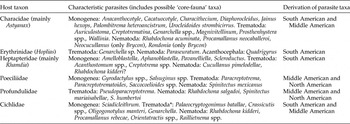
The foregoing review of the fish helminth fauna of TMA allows us to evaluate their associations as multi-species assemblages in their respective hosts (table 5). These assemblages indicate a pattern of host association that has been recognized from upper Middle American fish helminth fauna before (Pérez-Ponce de León & Choudhury, Reference Pérez-Ponce de León and Choudhury2002, Reference Pérez-Ponce de León and Choudhury2005), i.e. each fish lineage – most commonly family – seems to have a ‘core fauna’ of parasites (species or lineages) that are exclusive to, and widely distributed in, these host lineages. This pattern has been noted in north temperate fishes for a long time (e.g. Zchokke, Reference Zchokke1896; Van Cleave & Mueller, Reference Van Cleave and Mueller1934; Shulman, Reference Shulman, Dogiel, Petrushevski and Polyanski1958; Chubb, Reference Chubb1963; Halvorsen, Reference Halvorsen1971). Subsequent studies have addressed and confirmed that general trend in TMA (Salgado-Maldonado, Reference Salgado-Maldonado2008; Sandlund et al., Reference Sandlund, Daverdin, Choudhury, Brooks and Diserud2010). Pérez-Ponce de León & Choudhury (Reference Pérez-Ponce de León and Choudhury2005) also noted that even in transitional zones (where Nearctic and Neotropical fish hosts live in sympatry), host sharing by adult helminths was rare. Our study finds that, with few exceptions (e.g. Rhabdochona kidderi in heptapterids and cichlids), this pattern is also widely upheld by host–parasite assemblages in TMA; distinct helminth assemblages can be identified in primary and secondary freshwater host groups such as characids, erythrinids, heptapterids, poeciliids, profundulids and cichlids (table 5) (Pérez-Ponce de León & Choudhury, Reference Pérez-Ponce de León and Choudhury2005; Salgado-Maldonaldo, Reference Salgado-Maldonado2008; Pinacho-Pinacho et al., Reference Pinacho-Pinacho, García-Varela, Hernández-Orts, Mendoza-Palmero, Sereno-Uribe, Martínez-Ramírez, Andrade-Gómez, López-Jiménez, Hernández-Cruz and Pérez-Ponce de León2015a; this study).
Major host-taxa in Tropical Middle America (TMA), their characteristic parasites and hypothesized derivation of their parasite fauna.

* Trematodes with more restricted host range, but still found in Cichlidae, are not listed.
The current review also suggests that the concept of core faunas can be refined for particularly diverse host groups such as Characidae and Cichlidae. Diversification of these two host families has been accompanied by morphological changes and ecological shifts (Říčan et al., Reference Říčan, Piálek, Dragová and Novák2016) of the kind not seen in north temperate families such as Acipenseridae, Lepisosteidae, Amiidae, Hiodontidae, Salmonidae, Esocidae, Catostomidae, Ictaluridae, Moronidae and Centrarchidae, where core helminth faunas can be readily identified (Shulman, Reference Shulman, Dogiel, Petrushevski and Polyanski1958; Chubb, Reference Chubb1963; Dick & Choudhury, Reference Dick, Choudhury and Craig1996; Choudhury & Dick, Reference Choudhury and Dick1998; Nelson & Dick, Reference Nelson and Dick2002; Pérez-Ponce de León & Choudhury, Reference Pérez-Ponce de León and Choudhury2002, Reference Pérez-Ponce de León and Choudhury2005; Nelson et al., Reference Nelson, Johnson and Cott2010). Consequently, core parasite faunas of an entire family such as Characidae or Cichlidae may be more difficult to discern, since particular fish lineages within Characidae or Cichlidae may have their own distinct core faunas. The case of Characidae and the parasites of Astyanax in TMA illustrate our point. The characteristic intestinal helminths of Astyanax spp. (Auriculostoma, Wallinia, Creptotrematina, Magnivitellinum) in MA and beyond appear to be part of the core fauna of Astyanax, not Characidae as a whole, since these parasites do not appear, at present, to be a subset of a broader ancestral characid helminth fauna, even though Wallinia and Creptotrematina are found in other small-bodied characids (e.g. Bryconamericus, Gephyrocharax). On the other hand, parasites such as Prosthenhystera spp., Rhabdochona acuminata and several monogeneans (Characithecium, Anacanthocotyle, Cacatuocotyle) appear to be part of a broader characid helminth fauna. Our recognition of core faunas in characids is also hindered by the lack of data from their constituent species in many areas (Kohn et al., Reference Kohn, Fernandes and Cohen2007; Cohen et al., Reference Cohen, Justo and Kohn2013; Choudhury et al., Reference Choudhury, Aguirre-Macedo, Curran, Ostrowski de Núñez, Overstreet, Pérez-Ponce de León and Portes-Santos2016).
The formation, retention and recognition of core faunas in areas of colonization also depend on the source faunas; SA is a vast area comprising numerous major and minor drainages, and the origin of fish hosts in TMA can be traced to a subset of the area, i.e. mainly the northern and north-western drainages (Hulsey & López-Fernández, Reference Hulsey, López-Fernández, Albert and Reis2011; Matamoros et al., Reference Matamoros, McMahan, Chakrabarty, Albert and Schaefer2015). Unless it can be shown that a particular parasite is also present in related hosts in the source fauna, the absence of such parasites in TMA must be interpreted as a primary absence, not a secondary loss. At the present time, very little is known of the fish parasite fauna in potential source areas (e.g. Maracaibo, coastal Colombian drainages, other northern Venezuelan drainages), which makes it difficult to assess secondary loss. Finally, because core faunas may be regionally modified, especially in the case of significant colonization events as in GABI, we may find core faunas in particular host lineages in such areas but not elsewhere (e.g. associated with the poeciliid and profundulid radiation in MA). These ideas can be tested by hypothesis-driven sampling in potential source areas and more widely in TMA.
The fishes, their parasites and GABI
The origin of the fish helminth fauna of TMA is closely tied to two aspects of their hosts’ historical biogeography – their geographical origin and their subsequent history in the areas they occupy or their ancestors occupied. For primary fish hosts such as characids, bryconids, erythrinids and heptapterid catfishes, the source and basic mode of colonization appear to be uncontroversial. Setting aside the timing of such colonization, ichthyologists agree that these primary freshwater fishes colonized TMA from SA using freshwater corridors of dispersal (Hulsey & López-Fernández, Reference Hulsey, López-Fernández, Albert and Reis2011).
Among characids, one particular lineage, Astyanax, has evidently carried an impressive assemblage of helminths (table 5), all the way through TMA and onward to the northern reaches of MA. It also appears that Astyanax has ‘donated’ a gall-bladder fluke, Prosthenhystera, to a Nearctic host, Ictalurus. Although Prosthenhystera oonastica, the gall-bladder parasite specific to Ictalurus, is currently known only from the southern part of USA, it remains to be seen if future examination of Ictalurus spp. in Mexico will discover this parasite or a related species; if so, it would suggest that the first region of host-shifting was in MA, in drainages where Astyanax and Ictalurus occur in sympatry. Astyanax also has a rich intestinal trematode fauna in MA, comprising mostly allocreadiids but also one alloglossidid, Magnivitellinum simplex, whose sister taxon (Alloglossidium) is primarily in Nearctic (ictalurid) catfishes. The phylogeny of both the Middle-American allocreadiids (Pérez-Ponce de León et al., Reference Pérez-Ponce de León, Pinacho-Pinacho, Mendoza-Garfias, Choudhury and García-Varela2016) and Magnivitellinum simplex (Hernández-Mena et al., Reference Hernández-Mena, Mendoza-Garcias, Ornelas-García and Pérez-Ponce de León2016, see previous section) makes it difficult to explain the presence of these parasites in MA by a simple northward extension of Astyanax from SA. In the case of the allocreadiids, it would require that the trematodes of poeciliids and profudulids, within which the characid allocreadiid lineage in nested, are also found in SA, which they aren't, or at least haven't been yet. In the case of Magnivitellinum, it would require us to explain where the divergence between the Nearctic Alloglossidium and its sister clade M. simplex took place, since the two hosts only overlap in MA, but more importantly, how Magnivitellinum is then present in Astyanax in Brazil (where it was first found). The current evidence from two separate trematode lineages seems to suggest a controversial alternative, a southward colonization of SA by the characid allocreadiid lineage present in TMA, i.e. a reversal. It also suggests that these deep trematode diversification events may be much older than the latest 3.5 Mya closing age of the isthmus (Coates & Obando, Reference Coates, Obando, Jackson, Budd and Coates1996), and lends credence to an older Middle American land-bridge and fish movements (Bacon et al., Reference Bacon, Silvestro, Jaramillo, Smith, Chakrabarty and Antonelli2015; Matamoros et al., Reference Matamoros, McMahan, Chakrabarty, Albert and Schaefer2015; Montes et al., Reference Montes, Cardona, Jaramillo, Pardo, Silva, Valencia, Ayala, Pérez-Angel, Rodriguez-Parra, Ramirez and Niño2015).
Other parasites of Astyanax, such as its monogeneans and nematodes, do not present such controversy, and can be derived readily from the colonization of TMA from SA, but that is in the absence of any phylogenies of these parasites. Without the benefit of a phylogenetic analysis, we would have also simply derived the Asytanax allocreadiid fauna from SA because of the presence of shared taxa in these two locations. Results from ‘parascript’ studies (sensu Manter, see Brooks & MacLennan, Reference Brooks and MacLennan1993) may eventually require a re-evaluation of the historical biogeography of Astyanax in the region.
Information from other characiform taxa, such as Brycon, Bryconamericus, Roeboides, Gephyrocharax and Hoplias (tables 1–5) (Sandlund et al., Reference Sandlund, Daverdin, Choudhury, Brooks and Diserud2010) indicate a South American origin. Possible exceptions include the allocreadiid Wallinia in Gephyrocharax in Panama and in Bryconamericus in Costa Rica (see discussion of Middle-American allocreadiids).
The helminth fauna of heptapterid catfishes (see Rosas-Valdez & Pérez-Ponce de León, Reference Pérez-Ponce de León, Razo-Mendivil, Rosas-Valdez, Mendoza-Garfias and Mejía Madrid2008), the other primary freshwater Neotropical fish group for which we have the most parasite data, is also readily derived from SA and, with the exception of Creptotrema (see above), does not pose the same problems as some of the parasites in Astyanax.
Secondary freshwater fishes such as Poeciliidae and Cichlidae, suggest different scenarios of historical biogeography. The poeciliid helminth fauna cannot be summarized as a direct extension of a South American fauna; where affinities of parasites can be inferred or hypothesized, they are with species in other cyprinodontiforms, including those in Nearctic regions. This may also be the case with the core parasite fauna of Profundulidae (Pinacho-Pinacho et al., Reference Pinacho-Pinacho, García-Varela, Hernández-Orts, Mendoza-Palmero, Sereno-Uribe, Martínez-Ramírez, Andrade-Gómez, López-Jiménez, Hernández-Cruz and Pérez-Ponce de León2015a) (table 5). In contrast, the helminth fauna of Middle-American Cichlidae has clear ties to a wider Neotropical cichlid fauna that includes components in SA, but shows evidence of endemic diversification via acquisitions (e.g. cryptogonimids) during their time in MA (Vidal-Martínez & Kennedy, Reference Vidal-Martínez, Kennedy, Salgado-Maldonado, García Aldrete and Vidal-Martínez2000), and possibly from marine environments. The general similarity between the cichlid helminth fauna of Mexico (Yucatan and neighbouring areas) and LCA suggests that these faunas, or components of them, either have a common origin or developed through extensive host-sharing. More data are needed to establish the close or exclusive relationship of the parasite fauna between the cichlids of the Greater Antilles and those of south-eastern Mexico.
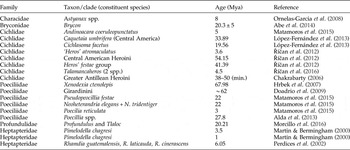
Perhaps the least understood aspect of the fish–helminth associations in TMA is when these associations orginated. While some aspects of the geological history of the region remain contentious (see discussions in Coates & Obando, Reference Coates, Obando, Jackson, Budd and Coates1996; Iturralde-Vinent & MacPhee, Reference Iturralde-Vinent and MacPhee1999; Montes et al., Reference Montes, Cardona, Jaramillo, Pardo, Silva, Valencia, Ayala, Pérez-Angel, Rodriguez-Parra, Ramirez and Niño2015; Tagliacollo et al., Reference Tagliacollo, Duke-Sylvester, Matamoros, Chakrabarty and Albert2015), the evidence (table 6) indicates that several lineages of both primary and secondary freshwater fishes have been in TMA much longer than the estimated final closing of the Panamanian isthmus ~3.5 Mya, while others may have colonized the area since. Thus, the fauna is evidently a mix of pre- and post-isthmian colonization and radiation (Bussing, Reference Bussing1998; Smith & Bermingham, Reference Smith and Bermingham2005; Chakrabarty & Albert, Reference Chakrabarty, Albert, Albert and Reis2011; Hulsey & López-Fernández, Reference Hulsey, López-Fernández, Albert and Reis2011; López-Fernández et al., Reference López-Fernández, Arbour, Winemiller and Honeycutt2013; Matamoros et al., Reference Matamoros, McMahan, Chakrabarty, Albert and Schaefer2015; Tagliacollo et al., Reference Tagliacollo, Duke-Sylvester, Matamoros, Chakrabarty and Albert2015). It also appears that the secondary freshwater fishes (Poeciliidae and Cichlidae) have been in the area since the Palaeocene, and much longer than any of the primary freshwater fishes, Bryconidae being the the oldest of the latter group (table 6).
Proposed ages of different taxa/lineages of primary and secondary freshwater fishes in Tropical Middle America (TMA).

The old, late Tertiary, age for both the Poeciliidae and Cichlidae in TMA has implications for the history of these fishes as well as their helminth fauna. Based on distribution and taxonomic affinities among certain poeciliids, Myers (Reference Myers1966) ‘found it reasonable to conclude’ that middle Central America formed ‘the main evolutionary center of this group’. While Myers (Reference Myers1966) initially – and tentatively – included the cyprinodontids and poeciliids in the fauna having a northern derivation, his final comments show him equivocating on this point. Hulsey & López-Fernández (Reference Hulsey, López-Fernández, Albert and Reis2011) noted that several lineages of cyprinodontiforms (cyprinodontids and poeciliines) currently south of the Trans-Mexican Volcanic Belt ‘may actually represent invasions from the North’. Hrbek et al. (Reference Hrbek, Seckinger and Meyer2007) concluded that the poeciliids were ‘an ancient clade’ ultimately derived from SA, but the phylogeny and biogeography presented by them may be interpreted differently. The deepest divergence in the tree presented by Hrbek et al. (Reference Hrbek, Seckinger and Meyer2007) is between lineages in TMA and SA, with subsequent recurring patterns of vicariance involving taxa in these two regions (Chakrabarty & Albert (Reference Chakrabarty, Albert, Albert and Reis2011) interpret the later ones as reversals). If the phylogeny of poeciliids is placed within the context of cyprinodontiforms as a whole, the deeper relationships are with groups outside SA, notably lineages in MA and NA (Goodiedae, Fundulidae and Cyprinodontidae) (Domínguez-Domínguez et al., Reference Domínguez-Domínguez, Pedraza-Lara, Gurrola-Sánchez, Pérez-Rodríguez, Israde-Acántara, Garduño-Monroy, Doadrio, Perez-Ponce de León, Brooks, Uribe-Aranzabal and Grier2010; Pohl et al., Reference Pohl, Milvertz, Meyer and Vences2015). An evolutionary origin of poeciliids in MA with deeper evolutionary ties to North America would be consistent with what we currently know or can hypothesize about the poeciliid helminth fauna. Tagliacollo et al. (Reference Tagliacollo, Duke-Sylvester, Matamoros, Chakrabarty and Albert2015) reiterated a South American origin for the poeciliids and showed how ‘coordinated dispersal’ across oceanic routes can result in similar biogeographic patterns between cichlids and poeciliids. If the poeciliids are indeed South American in origin, and if their Middle American parasite fauna, such as their allocreadiids and nematodes, do not occur in SA, then the poeciliids arguably acquired these helminth associates after the colonization of MA.
A recent study (Říčan et al., Reference Říčan, Piálek, Dragová and Novák2016) reveals two major centres of cichlid diversification in TMA, the Usumacinta drainage in southern Mexico and San Juan in Costa Rica. Because cichlids from these two centres share components of the helminth fauna, these associations may have developed early in the colonization of MA by cichlids and before the adaptive radiation of cichlids in these centres. We may also hypothesize that the ancestral core helminth fauna of cichlids was subsequently modified as cichlids underwent adaptive radiation in the area, mediated by changes in functional feeding morphology and, consequently, their diet (see Choudhury & Dick, Reference Choudhury and Dick2000; Říčan et al., Reference Říčan, Piálek, Dragová and Novák2016). Phylogenetic studies on cichlids (Chakrabarty, Reference Chakrabarty2006; Chakrabarty & Albert, Reference Chakrabarty, Albert, Albert and Reis2011) make a strong case for the close, and for a time exclusive, biogeographic relationship between TMA and the Greater Antilles via the heroine cichlids. To date, studies have found two of the ‘core fauna’ helminths, the monogenean Gussevia and the trematode Crassicutis cichlasomae, in Antillean cichlids. If a thorough investigation of Antillean cichlids continues to show such a reduced core fauna, it may indicate a loss during their history, possibly pointing to a more drastic colonization mode than one using freshwater corridors over established landmasses. Mendoza-Franco et al. (Reference Mendoza-Franco, Aguirre-Macedo and Vidal-Martínez2007) have made this case before for cichlid monogeneans, and Tagliacollo et al. (Reference Tagliacollo, Duke-Sylvester, Matamoros, Chakrabarty and Albert2015) have shown how cichlids may have dispersed using paths other than land corridors.
We have suggested earlier that the allocreadiid parasites of characids in TMA force us to consider reversals in the distribution of the fauna, particularly involving Astyanax. Ornelas-Garcia et al. (Reference Ornelas-García, Domínguez-Domínguez and Doadrio2008) placed Astyanax in MA at about 8 Mya, which also allows sufficient time for the diversification and establishement of the typical characid allocreadiid fauna. Chakrabarty & Albert (Reference Chakrabarty, Albert, Albert and Reis2011) demonstrated instances of reversals across several lineages of primary and freshwater fishes in TMA, including characids, but so far reversals have not been shown for Astyanax. Ornelas-Garcia et al. (Reference Ornelas-García, Domínguez-Domínguez and Doadrio2008) found evidence of lineage structuring within Aystanax in TMA and no isthmian reversals. Thus, a hypothesis of biogeographic reversal in allocreadiids is currently without any support from the fish hosts themselves.
We are just beginning to uncover the endohelminth parasite fauna of the southernmost regions of TMA (see table 1). Our preliminary data from Panama (table 1) support the relationship of the southern LCA drainages with those of SA (Smith & Bermingham, Reference Smith and Bermingham2005; Rodríguez-Olarte et al., Reference Rodríguez-Olarte, Mohica Corzo, Taphorn Baechle, Albert and Reis2011; Matamoros et al., Reference Matamoros, McMahan, Chakrabarty, Albert and Schaefer2015). A clustering analysis of the fish fauna shows that the Chagres and Tuira drainages of Panama have a shared history with those of western coastal Colombia (Rodríguez-Olarte et al., Reference Rodríguez-Olarte, Mohica Corzo, Taphorn Baechle, Albert and Reis2011). The parasite fauna may bear out the claim by Matamoros et al. (Reference Matamoros, McMahan, Chakrabarty, Albert and Schaefer2015) that the Chagres and Tuira are essentially South American drainages. Unfortunately, we know next to nothing of the helminth fauna from these drainages in Colombia that have close faunal relationships with those of southern Panama. As of now, the helminths from the Chagres drainage (table 1) show a clear, but general, similarity with taxa from SA, with the exception of Paracreptotrema mendezi in a poeciliid, a potential northern Middle-American derivative. The only parasite that might suggest a specific drainage relationship is Wallinia from Gephyrocharax in Panama (table 1); the only Wallinia (W. valenciae) found in SA is also from a Gephyrocharax species, from Lake Valencia in Venezuela, part of the Maracaibo drainage, which forms part of the extended drainage relationships linking LCA and north-western SA (Rodríguez-Olarte et al., Reference Rodríguez-Olarte, Mohica Corzo, Taphorn Baechle, Albert and Reis2011).
Conclusions and prospects
In summary, the evidence suggests that the helminth fauna of freshwater fishes in TMA is the product of a colonization history from both northern MA and SA, accompanied by in situ diversification, especially in poecillids and cichlids. There has been no biotic interchange of parasites across the two continents caused by primary freshwater fishes, since none of the Nearctic fish families, nor their helminth fauna, were able to reach SA (fig. 4). We are also unable to identify any helminth that primary Nearctic freshwater fishes may have contributed to the South American fauna by host-shifting. Not surprisingly, the helminth fauna of fishes unequivocally derived from SA – Cichlidae, Characidae, Bryconidae, Heptapteridae, etc. – have parasite faunas that are also largely South American in origin (table 5, fig. 4). Rather, the parasite fauna of TMA is significant for other reasons. The evidence hints at a northern origin for much of the cyprinodontiform parasite fauna, and potential host-shifting into other SA-derived fish hosts. Furthermore, the varying ages of different fish lineages in TMA allow for an old helminth fauna to be intermixed with a more recent assemblage (e.g. in Hoplias, Pimelodella, etc.) in the southern regions of TMA. Consequently, only a subset of the TMA helminth fauna may be an extension from SA into TMA since the Pliocene. While the parasites provide clues to host historical biogeography in the area, the helminth fauna is currently unable to resolve competing hypotheses about when TMA was colonized by the various fish hosts (e.g. Bussing, Reference Bussing1998; Matamoros et al., Reference Matamoros, McMahan, Chakrabarty, Albert and Schaefer2015; Tagliacollo et al., Reference Tagliacollo, Duke-Sylvester, Matamoros, Chakrabarty and Albert2015).
Selected taxa with inferred Nearctic or Neotropical origins (single unidirectional arrow, but see text for alternative explanations for Allocreadiidae). Taxa with double arrows are widely distributed with undetermined geographical origins. The composition and origin of Creptotrema are questionable. T, transitional zone between Nearctic and Neotropical regions; TMA, Tropical Middle America.

Answers to many of the unresolved questions will require several concurrent approaches. The recognition of species complexes and cryptic species (Pérez-Ponce de León & Nadler, Reference Pérez-Ponce de León and Nadler2010; Nadler & Pérez-Ponce de León, Reference Nadler and Pérez-Ponce de León2011) is already altering our understanding of helminth diversity and biogeography in the region (e.g. Martínez-Aquino et al., Reference Martínez-Aquino, Reyna-Fabián, Rosas-Valdez, Razo-Mendivil, Pérez-Ponce de León and García-Varela2009; Pérez-Ponce de León & Choudhury, Reference Pérez-Ponce de León and Choudhury2010; Razo-Mendivil et al., Reference Razo-Mendivil, Vázquez-Domínguez, Rosas-Valdez, Pérez-Ponce de León and Nadler2010, Reference Razo-Mendivil, Rosas-Valdez, Rubio-Godoy and Pérez-Ponce de León2015; Rosas-Valdez et al., Reference Rosas-Valdez, Choudhury and Pérez-Ponce de León2011; Xavier et al., Reference Xavier, Faria, Paladini, van Oosterhout, Johnson and Cable2015). As such, intra-species approaches that include phylogeography will likely provide finer resolution of biogeographical pattern and process, including the important role of drainage vicariance and dispersal, and as a result, the timing of particular host–parasite associations. Species that are reported widely, or in multiple host species or both (e.g. Prosthenhystera obesa, Magnivitellinum simplex) are obvious targets, and such approaches will provide much-needed information on contentious issues, such as the derivation of the fauna and the tempo of evolutionary change. Concurrently, we need: (1) broader sampling in drainages of LCA and north-western SA; (2) intensified survey work of cyprinodontiform fishes in MA; (3) intensive studies on Antillean cichlids; and (4) collection and molecular analysis of species in particular parasite groups that show promise in resolving biogeographical challenges, e.g. monogeneans, spiruridan nematodes and several families of trematodes, such as allocreadiids, cryptogonimids, gorgoderids and haploporids. Ultimately, studies based on integrative taxonomic methods and modern phylogenetic analyses hold the best promise of uncovering the seemingly intractable mysteries long hidden in the waters of this diverse and complex region.
Acknowledgements
We are indebted to Luis García-Prieto for providing access to the helminth database of the Colección Nacional de Helmintos, Universidad Nacional Autónoma de México, Mexico. We thank the following individuals and agencies for their help with the Panama study: Andrés Martínez-Aquino for help with fish collection and necropsy work; Chase Brosseau, Eric Gale, Tim Hartwick, Brennan Henricks, all St. Norbert College, and Richard Sanderson, University of Wisconsin – Green Bay, for help with sampling; Mike Draney and Vicki Medland, Cofrin Biodiversity Center, University of Wisconsin – Green Bay, for logistic help and support; Raineldo Urriola, Oris Acevedo, Marcela Paz, Lil Camacho and Orelis Arosemenas, Smithsonian Tropical Research Institute (STRI), Panama, for invaluable logistic support; and Diomedes Quintero Arias, Museo de Invertebrados G.B. Fairchild (MIUP), Universidad de Panamá, for facilitating export permits. We thank Miguel Rubio-Godoy, Instituto de Ecología, A.C., Xalapa, Mexico, for comments on an earlier draft of the paper, and two anonymous reviewers for their comments. G.P.P.L. thanks Robert Poulin, University of Otago, New Zealand, for lab facilities in his Evolutionary and Ecological Parasitology Group during G.P.P.L.'s sabbatical. A.C. thanks Steve Dhein, Cofrin-1923 Fund, for encouragement and continued support of research through STRI.
Financial support
This research was supported by the following: SNC Faculty Development grants to A.C., the Cofrin-1923 Fund, grants from the Programa de Apoyo a Proyectos de Investigación e Inovación Tecnológica (PAPIIT-UNAM) IN204514 and IN207213 to G.P.P.L. and M.G.V., respectively, DGAPA-UNAM and CONACyT to G.P.P.L. for sabbatical support, and Consejo Nacionalde Ciencia y Tecnología (CONACYT) 179048 to M.G.V.
Conflict of interest
None.
Ethical standards
The authors assert that all procedures contributing to this work comply with the ethical standards of the relevant national and institutional guides on the care and use of laboratory animals. Collections in Panama were made under ANAM collecting permits SE/A 95-09, SC/A 38-11, and SC/A 29-14.