The World Health Organization (WHO) defines a mass gathering as any planned or spontaneous event involving a significant number of attendees, capable of straining the services and resources of the host community, country, or nation. 1 By stretching the health-care system beyond its capacity, those events impose major public health challenges at the level of attendees’ health and nation-wide services. 2 In light of those challenges, recommendations for health-care provision in mass gatherings have first emanated from discourse on medical approach and management of pandemics in pilgrimage. Reference Ebrahim, Memish and Uyeki3 Subsequently, “Mass Gathering Medicine” emerged as a new discipline that was further emphasized by the World Health Assembly of Ministers of Health in Geneva in May 2014. Reference Memish, Zumla and McCloskey4
While mass crowds in most of the studies tend to be organized in the setting of a-priori planned events, such as the Hajj Pilgrimage, Reference Al-Tawfiq and Memish5,Reference Alaska, Aldawas and Aljerian6 the World Cup, Reference Yancey, Fuhri and Pillay7,Reference Eberhardt, Vinnemeier and Dehnerdt8 Summer Olympics, and championships, Reference Gutman, Schonnop and Stephens9 gatherings like protests and riots tend to be unexpected and spontaneous, imposing greater public health risks and threats. Reference Mani10 In this context, millions of protesters were drawn to unifying locations in each of Tunisia, Egypt, Libya, Morocco, Syria, and other Arab countries during the Arab Spring in 2011. Reference Memish, Stephens and Steffen11 Researchers tried to assess the situation of health-care workers and systems in those areas of conflict. Consequently, “Health Care Workers in Conflict Areas” emerged as another priority theme, leading to the launch of the “Commission on Syria: Health in Conflict” by The Lancet and the American University of Beirut (AUB) in 2016 to raise the profile of the Syrian crisis in global health. Reference Jabbour, Leaning and Nuwayhid12,13 Their latest scoping review revisited all evidence on health-care workers in the Arab Spring countries to highlight the main challenges hindering their work in conflict settings, including the lack of equipment, supplies, and drugs in addition to shortages of water and electricity, and poor sanitation. Reference Bou-Karroum, Daou and Nomier14
Lebanon has most recently witnessed a series of protests, which started on October 17, 2019, and were later paused due to the recent Covid-19 pandemic. Initiatives were taken to install first-aid tents in Martyr’s Square in Beirut, the capital city to care for protestors with physical injuries as well as mental health problems. Despite the efforts, there is neither evidence nor documentation describing the on-site health-care provision. In fact, research evidence on health-care provision in the setting of protests is generally scarce. The scoping review for the Lancet-AUB Commission on Syria in 2018 was among the first review papers to conclusively assess the published evidence about health care workers in the setting of protests, embodied by the “Arab Spring”. Reference Bou-Karroum, Daou and Nomier14 Moreover, most of the available literature in the Middle East and North Africa addresses the challenges faced by health-care providers in hospitals or emergency departments of conflict areas rather than what has been done on-site in active areas of protests.
In light of the above and considering the scarcity of scientific literature in this field, we conducted our current study to explore health-care provision during the recent unplanned public mass gatherings in Beirut, namely how the health-care system—particularly health-care providers—adapt to mass movements in the context of protests. By exploring the providers’ perceived challenges in providing emergency first aid and psychosocial support in mass gatherings, the study intended to identify the mechanisms of health-care delivery along with short- and long-term plans to enhance these services.
Methods
Study Design
A qualitative research study was conducted. Individual in-depth, semi-structured interviews were carried out with 12 health-care providers during November 2019.
Study Participants
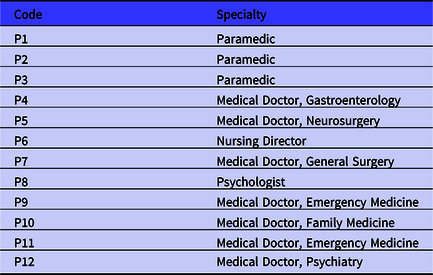
Health-care professionals who volunteered at the medical tents in Beirut’s protests were identified as potential participants by on-site visits to the tents. More participants were subsequently selected through a snowball sampling technique, whereby 1 identified participant led to another. The participants included in the study were of different specialties, such as medical doctors working in various fields, nurses, paramedics, and psychologists. A list of the 12 participants’ field of work is available in Table 1. Two researchers were present at each interview: 1 conducted the interview and the other took notes. The interviews were recorded, if consent was obtained to record, in order to validate the accuracy of the transcription or notes taken during the interview. Interviews carried out in Arabic and then translated to English.
Specialties of participants interviewed in the medical tents in Beirut, Lebanon – November 2019

Abbreviation: P, participant.
Data Collection
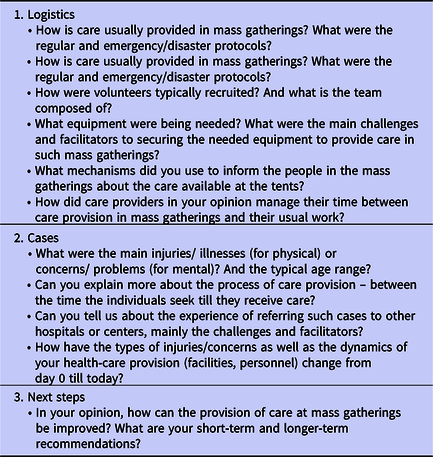
The interview questions were open ended allowing the participants to freely express their opinions and ideas. These were put by the research team collectively based on what was read in research papers and the knowledge of what was happening specifically in Lebanon. The interview guide was divided into 3 main parts based reflecting the study’s aims. The first part pertained to logistics with questions focusing on who did the work, who took the decisions, and how was the tents marketed, among others. The next part focused on the cases encountered, and the questions explored the type of medical emergencies treated. The last part covered the suggestions to improve the medical and psychological first aid services offered during mass gatherings in Lebanon, for both short- and the long-terms (Table 2).” Participants had the opportunity to additionally divulge into their concerns regarding health care in Beirut’s protests. The interviews were conducted face-to-face after obtaining an oral consent. The interviews were either in Arabic or English, based on the interviewee’s preference. The duration of each interview ranged between 20 and 30 min.
Standardized questions used as interview guide (English version) - Beirut, Lebanon – November 2019

Data Analysis
Analysis consisted of identifying, coding, and summarizing the concepts and themes. The 12 interviews were transcribed, and carefully reviewed. Codes emerged as subthemes from the information repeated by several interviewees, stressed upon by participants or that corresponded with data found in the literature. They were then categorized and labeled as themes. This process was followed by a more detailed indexing. The indexed information was categorized into 3 major themes: preparedness and logistics, encountered cases, and participants’ proposed recommendations. The 3 categories were further analyzed and discussed in relation to the Lebanese health-care system, as well as the literature to generate evidence-based recommendations. The information repeated by several interviewees was grouped under general themes or codes. These codes were compared with relevant published data from studies exploring similar experiences. The political, economic, and social situation in Lebanon made the experience unique with original themes drawn from what was happening.
Ethical Considerations
An oral consent was obtained before the interview. The interviewees were informed that they could withdraw their participation at any time they wanted. They were told that the voice recordings were stored safely, would not be used outside the current research project and would be disposed of at the end of the study. This study was conducted as part of a course requirement for second-year medical students, and an exemption was obtained from the Institutional Review Board (IRB) as the project would meet the criteria for exemption, which are: the interviewees are leaders in their field; oral informed voluntary consent is being sought from all interviewees (no written consent form is required, no signature required); and if interviewees mention any sensitive information, the students are instructed to disregard that information and not include it in the presentation or the report.
Results
Results are summarized hereafter by theme.
Logistics and Preparedness
All participants mentioned that they lacked knowledge of protocols to follow during protests, knowledge about the required equipment, and an organizational structure. Additionally, participants reported facing difficulty in securing needed equipment.
Protocols During Mass Gatherings
None of the participants reported following or knowing any specific protocol to follow for providing care during mass gatherings. “It starts as individual initiative then becomes collective; each one with his/her expertise and needs a good amount of time and efforts” (Participant 7 [P7]) was a very common answer showing that task division was done based on the available volunteers’ expertise. Providers were mainly applying first aid care and referring patients to primary care centers if needed.
However, 1 mental health specialist applied the WHO protocol for psychological first aid.
All participants agreed that no specific workflow was followed; “No protocols were followed. Providers connected through social media such as creating WhatsApp group and sharing a Facebook post. Then they created a google sheet to organize shifts and they met on the spot to assign the tasks” [P7].
Team Composition and Reaching Out to Volunteers
All participants have reported that team composition varied with time depending on available volunteers. The presence of a medical doctor was compulsory. Medical teams included physicians, pharmacists, nurses, paramedics, psychiatrists, and psychologists. Medical doctors who volunteered were of different medical specialties and at different levels of experience.
“Motivation to help made us take shifts outside our regular working hours; even some were competing on the shifts!” [P5]; this was agreed upon by all participants, who volunteered their own free time. Several showed willingness to dedicate additional time in cases of disaster or mass casualties.
As for the recruitment of volunteers, social media was the most agreed upon vector. “It started on Twitter when an Emergency Medicine resident noticed that the majority of the cases, he was seeing from the protests did not need hospitalization nor hospital expenses had they been dealt with in the squares. I took his tweet and posted it on Facebook, both on my page and on NGO pages.” [P10].
Gathering Needed Equipment
There was a consensus regarding the mostly used medications and/or equipment, including: stretchers, blood pressure measuring machines, gauzes, saline, topical antiseptics, oxygenated water, rapid glucose tests, oxygen tanks, pain medications, allergy and asthma medications. The mental health teams only reported the need for chairs and banners. When equipment is not available, patients are referred to hospitals through ambulances.
The reason for limited equipment was financial. Shortage was reported mostly with antibiotics and insulin provisions. Several participants reported some equipment disappearing or sabotaged.
Cases Encountered and Response
Many cases encountered by the participants were medical rather than mental health cases. People of different age groups were seen. Blunt and penetrating trauma was the most encountered complaint. Other cases include hypertension, cardiac arrest, syncope, asthma, exacerbation of chronic obstructive pulmonary disease (COPD), diabetes mellitus (DM), scabies, alcohol intoxication, and illicit drug use. Mental health cases were commonly people presenting with anxiety and panic attacks.
With regard to the process of care provision, most of the participants reported similar flow of provision of care. The patient is assessed by a paramedic or a nurse who takes history, followed by diagnosis and treatment plan, which is then discussed with the doctor or senior paramedic in charge. In case of complicated cases, patients were stabilized and referred to nearby hospitals by means of ambulances.
Referral of cases to hospitals was challenging due to monetary reasons. Referral depended on the financial status of the person and his/her willingness to seek further care. A participant reported that most cases that needed further attention did not cooperate with the referral process, mainly due to fear of being asked for their identification papers.
Dynamics as the Mass Gathering Evolved
With time, the type of cases seen changed. One noted that the cases changed from acute in nature to more chronic. Another mentioned that mental health related cases, such as anxiety and panic attacks, became more prevalent after a month. Participant [P8] said “You never know what to expect.” The cases were unpredictable and depended on the dynamics of events occurring on a particular day, while 5 participants reported that they have not noticed a change in the cases encountered.
Participants’ readiness also evolved. Participant [P9] reported that data entry of the cases seen throughout the month helped them know what to expect. Participant [P10] added “Our expectations have changed; I now know that there are cases that I just cannot take care of.” The tent also became more equipped as donations were being accepted. Organization of the flow of work also changed. “The team became fixed and each participant knew his task” [P7]. “We taught paramedics proper wound cleaning. We are going to train how to control heavy bleed in low resources settings” [P10].
Recommendations and Plans
Short-Term Improvements
Suggestions spanned 3 main categories: communication, resources, and trainings. Communication seemed to play a pivotal role in organizing the work. One participant mentioned the significance of communication between the civil defense, the Red Cross, and other providers on the ground. Setting up regular meetings between different groups, such as nonprofit organizations (NGOs), Red Cross, and volunteers, in order to coordinate the work proved to be a recurring recommendation. Advertising for these health-care tents during protests was another need. One of the participants offering psychological help claimed that providers broadcasted messages through “WhatsApp” to campaign for their free counseling, which also highlights the problem of resources. Participants recommended better allocation of resources and more sustainable and committed volunteers. One participant said: “Perhaps we can include volunteerism in curricula of medicine and nursing students.” [P10]. Regarding logistics, location appeared to be a recurring concern among participants. One participant complained about the crowds and noise near the first-aid tents and stressed on the need to relocate. Another participant highlighted the risks: “We need to have safety equipment such as helmets and jackets.” [P8]. Some participants stressed on having more sustainable tents against vandalism and harsh weather conditions.
As for training, it was mentioned multiple times as a need to improve. One participant recommended attending Middle East Medical Assembly (MEMA) conferences for conflict medicine. Some participants suggested regular educational training sessions.
Long-Term Improvements
The focus was mainly on resources and organization. Gathering financial and medical resources whenever mass gatherings is anticipated is a well-agreed upon recommendation. There was also a call for recruiting specialized personnel, more ambulances, as well as having more documentation. One participant [P7] stressed on the need for a storage room to protect all medical supplies. Another [P6] noted: “One hospital had 4 motorcycles ready to pick up emergency room nurses that were trapped at sites of roadblock.” The establishment of specialized organizations for mass gathering health needs was also agreed upon. One participant [P1] suggested a “unified Emergency Unit supervised or foreseen by the government that represents every NGO and volunteers available”. Another plan was the “Emergency Medicine Disaster Plan” comprised of volunteer emergency medicine doctors that would be dispatched to the areas of mass gatherings” [P11]. Some noted that there is need for more psychologists and psychiatrists in the country. One participant presented the of a free primary health clinic available for people in need.
Limitations
Our study was a primary study made to inform the decision-making process in a context-specific mass gathering that is prevalent in our region. Nonetheless, our study was restricted to mass gatherings in the capital Beirut while the entire country was witnessing protests due to the logistic measures hindering the commute. Moreover, we only solicited the feedback of health-care providers. It would be beneficial to explore the protestors’ perspective on health-care service at the field, the nearby hospitals’ accommodation to the situation, and the government’s response to these events. Our sample size was limited to only 12 health-care providers; however, despite the small sample size, saturation in recurring themes was relatively reached within the visited site.
Discussion
As the protests in Lebanon on October 17, 2019, started suddenly with no warnings, health-care providers had to react with minimal knowledge of what to expect. This study is the first to reflect on experiences, perceptions, facilitators, challenges, and recommendations of these health-care providers responding to physical injuries and psychological complaints requiring medical attention in Beirut’s protests. Notably, the uniqueness of the Lebanese experience was not reflected in similar previous studies and necessitated the emergence of new original themes. Our study constitutes the first step toward gaining a better understanding of the needed health services at times of unplanned mass gatherings, to further advance the Lebanese health-care system.
Our findings shed light on the absence of a clear protocol to follow, and the scarcity of resources and limited funds needed for adequate care provision. Funding deficit was not only limited to the purchasing and storing medical supplies but also to the logistics such as setting up the tents, which were often destroyed by vandalism. Another main issue was the lack of communication, driven mainly by the lack of any central body on a macro-level; thus, each group of volunteering medical providers, paramedics, and personnel present on ground had to create their own system, decreasing the effectiveness of care provision. The adopted mechanism in medical response to mass gatherings was found to be unorganized and based on individual efforts. It lacked a unified protocol that would confer coordination, guidance, and funding. Notably, there were no differences in answers between health-care providers according to gender. The interview questions did not address the political or ideological affiliations of the medical personnel volunteering to help.
Our results are consistent with previous studies of mass gatherings, in terms of the most common cases seen. Reference Krul, Sanou and Swart15,Reference Braga, Nhantumbo and Nhambomba16 Some challenges common to other contexts include lack of preparedness of health-care providers in dealing with cases in the field, and the absence of a unified protocol that would be implemented in an emergency situation. Reference Krul, Sanou and Swart15,Reference Civaner, Vatansever and Pala17 In the short-term, some of the suggestions implemented in other events and documented include the use of smart-phones in documenting cases described by McConnell and Memish, Reference McConnell and Memish18 and the use of online standardized surveys which are proven beneficial on the field, used in the 9th National Cultural Festival in Mozambique. Reference Braga, Nhantumbo and Nhambomba16 We further suggest the need to create funds and platforms that could be social-media-based, for volunteerism, as well as establishing better communication tools between volunteers; however, these actions are not sustainable.
To provide a better service on the long-term, a government-funded task force is essential. It would focus on formulating protocols, rapidly receiving field information during emergencies, and ensure more efficient use of resources through effective communication between different providers. Reference Memish, Zumla and McCloskey4 The task force should reach a network of health-care workers who respond accordingly at the onset of any mass gatherings. This task force would have representatives from different health-care organizations involved in first aid (professionals, Red Cross personal, NGOs, and others) to optimize communication and cooperation. These recommendations are supported by the guidelines documented in the published literature to allow for timely management and offer ways for adequate referral, transport and resource distribution. For on-site measures, we recommend having an average of 6 health-care providers for every 10,000 attendees, including first aid providers, along with nurses who have event-specific training on advanced life support. Reference Krul, Sanou and Swart15 These providers would be working based on unified common protocols for triage and management of the common injuries and problems presenting on-site. Reference Krul, Sanou and Swart15 As for documentation, a real-time data collection of health encounters using tablets and smart phones is applicable. Reference Braga, Nhantumbo and Nhambomba16 Results would be directly seen and analyzed by a central task-force coordinator. As such, based on the profile of injuries recorded, the health sector would plan strategies and take actions customized to the commonalities encountered. Reference Braga, Nhantumbo and Nhambomba16 To achieve better predictability and resource allocation, recourse models can be developed, based on the models used in the FIFA World Cup 2010 event, which was later validated by Smith et al. Reference Smith, Tuffin and Stratton19,Reference Smith, Wessels and Naicker20 These models would help stratify the gatherings into levels that could give decision-makers insight on the quantity and quality of providers and recourses needed in a specific gathering.
The strength of our study stems from the fact that information was gathered in real time, minimizing any recall bias. Interviews were diverse including personnel from different volunteering organizations present. Physicians of different specialties, psychologists, and volunteers were all interviewed. Moreover, there are minimal articles documenting or gathering data about mass gatherings in Lebanon and the region.
Conclusions
Providing health care on-site during protests and unplanned mass gatherings is a vital need in Lebanon and the region. Yet, the available literature is scarce. This research is the first in Lebanon to study health care in Lebanese protests. The unpredictability and unpreparedness of the volunteers, in addition to lack of effective communication and shortage of resources were all factors that hindered health-care provision. Thus, a task force composed of health-care workers in various fields led by the government, in which protocols are planned, personnel are trained, and resources are prepared beforehand, is in our view vital for better health-care provision. Moreover, future research with quantitative analysis is needed to build models of care during unplanned mass gatherings and later validate them before implementation.
Acknowledgments
We thank all health-care professionals who participated in our research for their assistance in providing us with valuable data, without which this report could not be completed.
Author contribution
F.Y. and S.B.K. contributed equally to this work. F.Y. and S.B.K. wrote the manuscript. All authors contributed to the study conception and design, in addition to data acquisition through interviews, data analysis and interpretation. All authors reviewed the final manuscript.