INTRODUCTION
The family Ophionereididae consists of five genera present in several marine habitats, from the intertidal zone to depths near 200 m and usually in or near rock cavities. The species of this family are characterized by discs with small and relatively thin scales, covered by tegument or not, robust arms ventrally inserted in the disc, and very strong quadrangular teeth (Borges & Amaral, Reference Borges, Amaral, Amaral, Rizzo and Arruda2005). In Brazil the family is represented by the genera Ophionereis (Lütken, Reference Lütken1859) and Ophioplax (Lyman, 1875).
The genus Ophionereis was established by Lütken (Reference Lütken1859), and is characterized by the presence of dorsal accessory plates and a single large arm scale. Clark (Reference Clark1953) reviewed the genus and provided descriptions and an identification key to the twenty-six known species. According to this author, the greatest difficulty in differentiating among the species of Ophionereis (as well as other genera of this family) is distinguishing between what can be called real characteristics and those characteristics subordinated to ontogenic developmental phases.
Four species of Ophionereis have been reported from the western Atlantic Ocean (O. reticulata, O. squamulosa, O. olivacea and O. dolabriformis). The present study documents the first occurrence of Ophionereis dolabriformis John & Clark, Reference John and Clark1954 in Brazil and also increases its bathymetric distribution upwards from 68–99 m to 14 m.
MATERIALS AND METHODS
The specimens of Ophionereis from Paraiba State, Brazil, were collected in 1981 on the continental slope between the coordinates 6°58′–7°34′S and 34°45′–34°46′W and between the isobaths of 10 and 35 m. The specimens from Bahia State were collected in 2002–2003 in the region of Camamu Bay, between the coordinates 13°00′S and 14°00′S and between the isobaths of 36 and 51 m.
The taxonomic identifications were based on the descriptions of Clark (Reference Clark1953), John & Clark (Reference John and Clark1954) and Thomas (Reference Thomas1973). Disc diameters were measured using a digital EDC 6″ caliper. The animals were photographed with a Canon A640 10MP digital camera coupled to a Nikon SMZ800 stereomicroscope.
The study material was preserved in 70% ethanol and stored in the Echinoderm collection (UFPB/ECH.) of the Paulo Young Invertebrate Collection at the Systematics and Ecology Department of the Universidade Federal da Paraíba, as well as in the Marine Invertebrate Laboratory (LABIMAR) collection of the Universidade Federal de Sergipe.
Type species: Ophiura reticulata Say, 1825.
DIAGNOSIS
Presence of supplementary dorsal arm plates. A single tentacle scale. Arm spines generally larger than one arm segment, especially the mid-spines. Disc scales equally sized and generally very small (modified from Tommasi, Reference Tommasi1970).
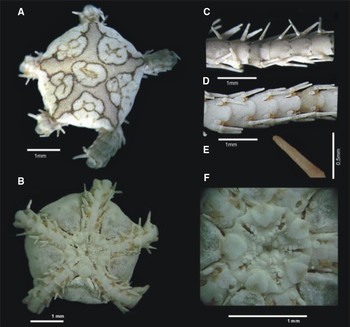
Ophionereis dolabriformis (UFPB/ECH. 1338). (A) Aboral view; (B) ventral view; (C) dorsal surface of the arm; (D) ventral surface of the arm; (E) detail of the arm spine; (F) oral frame.

Ophionereis dolabriformis John & A.M. Clark (in A.M. Clark, Reference Clark1953: 70)—John & A.M. Clark, 1954: 155, figures 9–11.
MATERIAL EXAMINED
UFPB/ECH.748 (1 spec., 7°28′S 34°34′W, 30 m); UFPB/ECH.749 (1 spec., 7°21′S 34°38′W, 30 m); UFPB/ECH.912 (1 spec., 6°55′S 34°43′05″W, 21 m); UFPB/ECH.913 (1 spec., 6°52′S 34°46′W, 18 m); UFPB/ECH.1044 (1 spec., 7°28′S 34°37′W, 24 m); UFPB/ECH.1045 (1 spec., 7°04′S 34°41′W, 22 m); UFPB/ECH.1046 (1 spec., 6°57′S 34°41′W, 26 m); UFPB/ECH.1082 (1 spec., 7°28′S 34°40′W, 14 m); UFPB/ECH.1083 (1 spec., 7°15′S 34°33′W, 35 m), UFPB/ECH.1338 (2 spec., 7°01′S 34°41′05″W, 24 m), and UFSITAB–106 (2 spec.).
DIAGNOSIS
Olive-green pentaradial pattern on the dorsal surface of the disc. Reduced accessory dorsal arm plates. Dark bands on the dorsal plates of the arms, 1 to 2 1/2 segments wide. Three long, thin arm spines (Figure 1E).
DESCRIPTION
Circular to pentagonal disc, 3.20 to 5.09 mm in diameter. Dorsal surface is covered with numerous imbricate scales of irregular sizes. Radial shields subtriangular, small and thin, each pair being separated by several scales. Pentaradial olive-green pattern on the dorsal surface (Figure 1A). Disc scales partially covering the first arm segment. Bursal slits elongated, and without genital papillae (Figure 1B & F).
Oral shield subtriangular, with proximal region narrow and distal region enlarged (resembling an arrowhead), partially covering the adoral shields. Adoral shields contiguous proximally, enlarged distally. Four oral papillae on each side of the jaw: infradental papilla long and robust; the two subsequent papillae flattened; the last being the widest and the most robust. A small triangular opening can be seen between the jaw pair. Some jaws have a small apical papilla between the infradental papillae (Figure 1F).
Long thin arms, with a small supplementary dorsal arm plate, longer than wide with distal region rounded (Figure 1C). Ventral arm plate rectangular, with side borders concave and distal borders wider and more rounded. Large, oval-shaped tentacle scale (Figure 1D). Three long arm spines, extremely narrow and fully toothed (Figure 1E). Olive-green bands observed covering 1 to 2 1/2 segments of the dorsal arm. Some arm spines have circular bands at their base, the same colour as disc reticulation.
BATHYMETRIC DISTRIBUTION
Thomas (Reference Thomas1973) reported this species at depths between 68 and 97 m; in the present study it was captured at depths between 14 and 35 m.
GEOGRAPHICAl RANGE
Mexico, Colombia, Venezuela and Brazil.
ECOLOGICAL NOTES
Clark (Reference Clark1953) analysed a specimen of O. dolabriformis collected at the mouth of the Orinoco River (Venezuela) at a depth of 86 m, and Thomas (Reference Thomas1973) encountered this same species at the mouth of the Gulf of Darien (Colombia), at depths between 92 and 99 m. The occurrence of O. dolabriformis in Camamu Bay, as reported in the present study, as well as the cases cited above, all suggest that the species can tolerate areas with strong brackish influences. Pomoroy (Reference Pomoroy2007) collected this species in Venezuela on sandy bottoms, usually at depths greater than 30 m. Ophionereis dolabriformis is reported here from marine environments, although at depths inferior to those previously recorded. Some specimens were collected at 14 and 18 m along the coast of Paraíba State, indicating that this species might well be found in shallower waters if more intensive collecting efforts were made along the coast. Ophionereis dolabriformis appears to be a relatively rare species, as only a few specimens were collected and analysed among all of the reports mentioning its presence.
REMARKS
Ophionereis dolabriformis differs from O. reticulata and O. squamulosa by having very reduced dorsal accessory arm scales, three long and thin arm spines, and by the absence of genital papillae. It differs from O. olivacea mainly in terms of the shape of the arm spines, which are wide and have rounded extremities in that species. In addition to these morphological differences, this species is easily distinguished from the others by the pentaradial colour pattern of the dorsal side of the disc, and by the dark bands on the dorsal arm segments covering one and a half segments on the proximal portion and two and a half segments on the distal portion.
According to Hendler (Reference Hendler2002), O. dolabriformis is included in a small group within the genus that is characterized by maintaining juvenile features into their adult phases. This group includes O. diabloiensis (Hendler, Reference Hendler2002), O. sexarradia (Mortensen, 1936), O. vivipara (Mortensen, 1933) and O. olivacea (Clark, 1901). Considering that the disc diameter in this species can reach 10.0 mm (Pomoroy, Reference Pomoroy2007), but the maximum size of the specimens analysed here was only 5.0 mm, some of the traits observed here (variations in the disc patterns and the presence of completely toothed spines) may be related to the ontogenic development of this species, or to the fact that these specimens belong to distinct populations with distinct morphological variations.
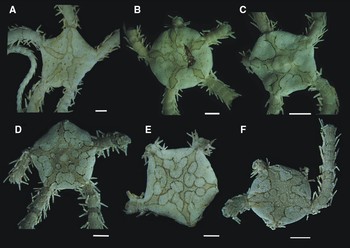
Variations of the disc patterns of Ophionereis dolabriformis (Figure 2) were observed, but the pentaradial pattern was maintained, and could be completely uniform, or empty, or with the pattern rays being connected by fine lines. According to Thomas (Reference Thomas1973), the species of the genus Ophionereis have been easily confused with one another, and one of the best ways to distinguish between them is to examine traits related to the arms, such as: the shape of the ventral and dorsal arm plates, the size of the dorsal supplementary plates, and the size and shape of the arm spines.
Variation of the disc patterns in Ophionereis dolabriformis. The specimens are identified by their collections numbers: (A) UFPB/ECH.1082; (B) UFPB/ECH.1338; (C) UFPB/ECH.748; (D) UFPB/ECH.1083; (E) UFPB/ECH.913; (F) UFPB/ECH.912. Scale 1 mm.

ACKNOWLEDGEMENTS
Thanks to the Biologist Mário S. Ximenez for collecting the material from Camamu Bay; to Milena B. Serrato from INVEMAR (Instituto de Investigaciones Marinas y Costeras), Colombia, for the collaboration; to Dr Thelma L. Dias for the valuable suggestions; to Samara T.A. Medeiros for translating the manuscript; and to PIBIC and CNPq (Proc. 484601/2007-5) for grants.