‘This is no less than a clash of civilizations – the perhaps irrational but surely historic reaction of an ancient rival against our Judeo-Christian heritage, our secular present, and the worldwide expansion of both.’
Bernhard LewisFootnote 1
‘Al Qaeda could not be happier than in a real clash among civilizations.’
Giandomenico PiccoFootnote 2
‘It is not … in the interest of the West to view this as a clash of Western and Muslim civilizations.’
Ahmed HashimFootnote 3
‘The current struggle against Islamist terrorism is not a clash of civilizations.’
Joseph NyeFootnote 4
‘This struggle has been called a clash of civilizations. In truth, it is a struggle for civilization.’
George W. BushFootnote 5
After the end of the Cold War, conflicts between civilizations struggling for influence on a new world order would pose the greatest danger for international stability and peace. This, at least, is the central tenet of Samuel Huntington’s famous and best-selling book The Clash of Civilizations and his earlier Foreign Affairs article.Footnote 6
More recently, events such as the terrorist attacks of 9/11 (11 September 2001) in New York, and the bombings in Bali, Madrid and London were interpreted by many as striking evidence for Huntington’s paradigm. Yet, the wide attention Huntington’s works have attracted in public discussion of international terrorism contrasts with its reception in the empirical academic literature in at least two respects.Footnote 7 First, scholarly work that has tested Huntington’s theoretical predictions has focused exclusively on patterns of militarized inter-state dispute, inter-state and civil wars. To our knowledge, no test exists of hypotheses derived from Huntington’s work on terrorism. And secondly, tests of Huntington’s arguments have typically failed to find evidence for a clash of civilizations.Footnote 8
However, empirical tests of Huntington are hampered by the fact that the term ‘clash’ is nowhere clearly defined in his work and that, depending on the pair of civilizations looked at, it means many different things to Huntington. Given the ambiguity of the term, tests that fail to find that inter-civilizational dyads in general are more likely to experience one particular type of conflict do not establish fully convincing evidence against Huntington. More importantly, existing scholarship has neglected that, for some civilizational dyads for which Huntington predicts a high level of conflict, he himself mentions terrorism, as in the clash of ‘Rest versus West’, or even explicitly emphasizes the use of terrorism, as in the clash of ‘Islam versus Rest’ and ‘Islam versus West’. Our test of Huntington’s predictions, then, provides additional insights as to the relevance of his paradigm.
Rather than merely testing predictions derived from Huntington’s work, however, we also compare his paradigm to a strategic theory of international terrorism. Our theory argues that the leaders of terrorist groups are predominantly rational and act strategically to reach their goal of gaining political influence on the political system of their home country. We argue that terrorist group leaders from other civilizations have a general interest in attacking Western targets due to their high strategic value, and a specific interest in attacking targets from those foreign countries whose government lends support to the government of the terrorists’ home country. We find broad support for our strategic theory as well as some limited support for Huntington’s predictions in a directed country dyad sample over the period 1969 to 2005.
Huntington and the clash of civilizations hypothesis
A New Era in World Politics?
Huntington’s clash of civilizations hypothesis has many facets. If there is, however, one central hypothesis in his work it is this: the dominant source of conflict will shift from the clash of ideologies during the Cold War period (liberal democracy vs. communism) to the clash between nations and groups of different civilizations after the end of the Cold War: ‘conflicts between groups in different civilizations will be more frequent, more sustained and more violent than conflicts between groups in the same civilization.’Footnote 9
He defined civilizations as ‘the highest cultural grouping of people and the broadest level of cultural identity people have’, being ‘differentiated from each other by history, language, culture, tradition, and, most important, religion’.Footnote 10 Huntington distinguished seven, or possibly eight civilizations – Western, Sinic, Japanese, Islamic, Hindu, Slavic-Orthodox, Latin American and, possibly, African. He posited that civilizational differences ‘are the product of centuries’ and ‘far more fundamental than differences among political ideologies and political regimes’ and are therefore ‘less mutable and hence less easily compromised and resolved than political and economic ones’.Footnote 11 Moreover, such differences are not merely an abstract construction: ‘[that] civilizations are meaningful entities accords with the way in which people see and experience reality’.Footnote 12
He then went on to argue that the Cold War had artificially plastered over and dampened inter-civilizational conflicts. The end of the Cold War allowed these conflicts to emerge and gain strength. They also drew strength from economic modernization, which tends to weaken the nation-state as a source of identity. This, in turn, led to a revival of religion as an alternative source of identity. As Huntington put it: ‘In the modern world, religion is a central, perhaps the central, force that motivates and mobilizes people.’Footnote 13 Finally, the declining power of Western civilization and the rising power of other civilizations allowed the latter to challenge Western hegemony.
Throughout his work on inter-civilizational conflicts, Huntington remained reluctant to formulate testable predictions arising from his paradigm. This is ironic given that he also stated that ‘a crucial test of a paradigm’s validity and usefulness is the extent to which the predictions derived from it turn out to be more accurate than those from alternative paradigms.’Footnote 14 Consequently, critics have charged his work with being ambiguous, inconsistent and sometimes self-contradictory.Footnote 15 Space constraints prevent us from engaging with these arguments in great detail. Instead, we concentrate on two aspects that are central to the focus of this article: the conflict intensity of pairs of civilizations and the meaning of the term ‘clash’.
Inter-Civilizational Pairs and Their Conflict Intensity
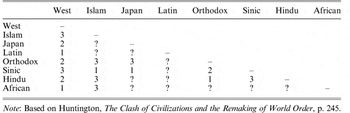
In addition to his hypothesis of a general clash of civilizations, Huntington regarded certain civilizations and certain pairs of civilizations as more prone to conflict than others. Yet Huntington’s argumentation with respect to the conflict intensity of inter-civilizational dyads was not fully specified. His book provides a network graphic, which distinguishes three degrees of conflict intensity.Footnote 16 Given that Huntington identified eight different civilizations, this results in twenty-eight civilization dyads. However, he provided information on the expected conflict intensity for only seventeen out of these twenty-eight dyads. Table 1 reproduces Huntington’s predictions.
Reproduction of Huntington’s Prediction of Conflict Intensity

Note: Based on Huntington, The Clash of Civilizations and the Remaking of World Order, p. 245.
We indicate the eleven civilization dyads for which Huntington did not provide an answer by a question mark – leaving open whether he meant that these dyads are not conflictual (for reasons he did not discuss) and should therefore be coded 0 or whether his paradigm does not allow him to derive a prediction with respect to this dyad. Huntington provided full information on conflict intensity only for dyads that include the West. This seems to result from his judgement that – as non-Western civilizations become increasingly self-assertive and Western countries attempt to maintain their economic, political and military dominance – there would be increasing conflict between ‘the West versus the Rest’.Footnote 17 But Islam also stands out. He provided information for five out of seven relations to other civilizations, four of which are highly conflictual.
What Does Clash Mean?
Huntington’s theoretical imprecision was not limited to the matrix of inter-civilizational conflicts. He also remained unclear about his second most important term: clash. While he stated that clashes between civilizations would become the greatest threat to world peace and that ‘the fault lines between civilizations will be the battle lines of the future’,Footnote 18 the term is nowhere explicitly defined or thoroughly explained. Rather, Huntington subsumed very different things under the same umbrella, depending on specific civilization dyads looked at. For example, the clash between the West and Japan is mainly described in economic terms, the conflict between the Western and the Sinic civilization mainly in military terms.
For some civilizational combinations, Huntington mentioned, almost in passing, the use of terrorism as one form of conflict. In the clash between the Rest against the West, he identified terrorism (together with nuclear arms) as one of the two weapons of the ‘non-Western weak’.Footnote 19 He referred much more explicitly to terrorism in his analysis of the Islamic civilization. For the clash between Islam and other civilizations, Huntington stated that ‘while groups from all religions have engaged in various forms of violence and terrorism, the figures make it clear that in the past decade Muslims have been involved in far more of these activities than people of other religions.’Footnote 20 To this he added a cross-reference to his own (in)famous phrase of ‘the bloody borders of Islam’ from 1993.Footnote 21 He particularly stressed the use of terrorism in relation to the asymmetric clash between Islam and the West. He argued that:
following the 1979 Iranian Revolution, an inter-civilizational quasi war developed between Islam and the West … [It] is a quasi war because, apart from the Gulf War of 1990–91, it has been fought with limited means: terrorism on one side and air power, covert action and economic sanctions on the other.Footnote 22
Huntington did not provide a systematic explanation of why terrorism is a favourite weapon employed in these clashes. The reason given for the use of terrorism by other civilizations against the West did not go beyond the observation that ‘terrorism historically is the weapon of the weak’.Footnote 23 His explanation of the extraordinary conflict intensity of Islam was not based on profound theoretical reasons either. He perceived Islam as a ‘religion of the sword’ with an absolutist ideology that makes cohabitation with other religions extremely difficult.Footnote 24 However, many religions, not just Islam, can be and have historically been misused for the purpose of justifying terrorist violence.Footnote 25 Huntington also argued that geopolitically the Islamic civilization has no clear borders but overlaps with most other civilizations and is not dominated by a core state, causing conflict both with neighbours and within the Islamic world. However, according to Huntington, the Latin American and African civilizations similarly miss a core state.Footnote 26 Finally, and in Huntington’s view most importantly, the large number of unemployed males between the age of 15 and 30 is a natural source of violence both within the Islamic civilization and between it and other civilizations. Yet many developing countries from other civilizations experience similar problems.
According to Huntington, one should expect a particularly strong clash between Islam and the West given the legacy of fourteen centuries of conflict. This conflict ultimately stems from similarities in the aspirations of the two civilizations – as universalistic and missionaryFootnote 27 – with simultaneous fundamental differences in culture and religion. ‘The underlying problem for the West’, wrote Huntington, ‘is not Islamic fundamentalism. It is Islam, a different civilization whose people are convinced of the superiority of their culture and are obsessed with the inferiority of their power.’Footnote 28 The Cold War period plastered over this conflict to some extent, but ‘the collapse of communism removed a common enemy of the West and Islam and left each the perceived major threat to the other.’Footnote 29
The strategic logic of international terrorism
In this section, we provide a competing account of international terrorism to that given by Huntington. On the micro-level our theory makes a crucial distinction between the leaders of terrorist groups and their followers.Footnote 30 We assume that terrorist leaders and followers come from the same population of ideologues and believers.Footnote 31 What differentiates the two is their relative position within terrorist groups. On the macro level, our theory specifies the conditions under which terrorist leaders of one country have a strategic interest in attacking targets from foreign nations, even though their ultimate goal is to gain influence on domestic political matters (see the next section). Our theory builds on the rational approach to identifying and explaining the causes of international terrorism in conflict over political influence.Footnote 32
Terrorist Group Leaders
The leaders of terrorist groups are distinguished by having a crucial, decisive position in the terrorist organization. They are the leaders and therefore behave predominantly strategically. From their perspective, terrorism is a rational strategy in a political struggle to achieve an end, not an end in itself. In other words, terrorist leaders instrumentalize terror because they want to make the powerful respond – preferably in a way that changes the situation better to suit the interests of the terrorists. Terrorism is not simply violence, often against civilians, in order to create fear. Rather, terrorism aims at creating fear, because the induced fear will in turn lead somebody else to respond in a way that makes it more likely that the terrorists will achieve their goals.
What are the goals of terrorist leaders? The exact answer depends on the type of terrorist organization. However, practically all terrorist leaders want to achieve some fundamental change in policies, or even a change in the political regime, of their home country or the wider region.Footnote 33 Terrorist group leaders thus strive to gain political influence and, ultimately, control. This generic end-goal unites terrorist groups despite extreme differences in their ideologies.
Following Rapoport and Shugart,Footnote 34 we can distinguish threeFootnote 35 over-lapping ‘waves of modern terrorism’: after the anti-colonial/ethno-nationalist and radical left waves, religious terrorism is now dominating, with Islam ‘at the heart of the wave’.Footnote 36 The anti-colonial and ethno-nationalist groups wanted national independence from colonial occupiers or secession for their ethnic group, and they were often successful. The radical left groups wanted to overthrow capitalism, which failed spectacularly. The Islamic terrorist groups want to force governments in Islamic countries to adopt policies in line with their own radical interpretation of Islam. Some are more ambitious still and want to topple any government that prevents, often by violent means, the Islamists from increasing their influence and grip on political power.Footnote 37
If fundamental political change is the ultimate goal of terrorist leaders, why do they resort to terror rather than other forms of political action and why does terror represent a suitable instrument for achieving their goals? Terrorist leaders typically face one or more of three constraints. The first is exclusion from the political process; the second is insufficient support among the wider population; while the third is the asymmetry in strength or power between the government and the terrorist group.
Terrorism is also instrumental in achieving intermediate goals in the long struggle for the ultimate goal of violent political change. First, terror raises the costs of political stability. Terrorist attacks create a feeling of insecurity, which provokes the targeted government to invest more heavily in security policies. Secondly, terrorist attacks stimulate political responses that worsen the situation of the terrorist group’s actual and potential supporters.Footnote 38 As we will see in the next section, this can help in the recruitment of terrorists. And thirdly, terrorist attacks generate media attention, which allows the terrorist leaders to gain voice and spread their ideology. Again, this will facilitate the recruitment of followers.
Thus, besides hitting the targeted enemy, terrorism serves terrorist leaders in their struggle to gather support and recruit followers. This is essential for the functioning and the success of the terrorist group.Footnote 39 Terrorists not only need shelter to raise the financial means to buy weaponry and to run training camps, they also need individuals willing to serve as terrorists. The leaders of terrorist groups (while often toying with weapons in front of television cameras) rarely fight their terror campaigns themselves. Rather, they usually act exclusively as terrorist group leaders. In other words, while they have ultimate strategic goals, perhaps the most important intermediate aim of terrorist attacks is to increase their support and recruit followers, to whom we turn now.
Followers
Terrorist followers are individuals who are attracted to the leaders’ ideology, but are not in a decisive or crucial position within the terrorist organization. Rather, they are the soldiers of the leaders and follow specified or unspecified commands, which may include the command of self-sacrifice in a suicide terrorist mission. In contrast to the group leaders, terrorist followers need not behave predominantly strategically or rationally. They may be driven by several, complex and varied motivations that may also depend on contextual and sometimes very personal circumstances.Footnote 40 We suggest, however, that three factors are essential in the successful recruitment of terrorists: ideological appeal, peer acknowledgement and political grievances.
If individuals do not share the ideology of the terrorist leaders, they will not support the terrorist group to reach its strategic goals, because under such circumstances their utility will decline if the group reaches its ultimate goal. The more appealing the terrorist leaders’ ideology and their strategic goals to parts of the population, the easier is recruitment. The radical left terrorist groups of the past failed not least because their ideology and goals did not appeal to the wider population and they therefore remained splinter groups.
Secondly, joining a terrorist group becomes more likely if potential followers receive some peer acknowledgement for doing so. While terrorists almost by definition are outcasts, the greater the acknowledgement they receive among the small group of direct supporters and among the wider population, the more they can feel justified in perpetrating acts that are normally regarded as heinous.Footnote 41 Targeting attacks against innocent civilians no matter what their personal circumstances and political attitudes is difficult to justify. Peer acknowledgement means that terrorists are not exclusively regarded as ruthless and ultra-violent criminals, but, by some at least, as heroic fighters for the righteous cause. The more peer acknowledgement terrorists receive, the more they will be able to overcome the scruples that might otherwise prevent them from joining terrorist groups. For these reasons, terrorist leaders invest in communication with their own peers, with the aim of raising their acknowledgement.Footnote 42 Media attention is of utmost importance as it helps the terrorist leaders to spread their propaganda to potential new recruits.Footnote 43
Finally, political grievances again raise the ideological appeal of terrorist groups. Such grievances spur hatred and anger and the wish to revenge oneself on those who are perceived as being the cause of grievance.Footnote 44 According to Bueno de Mesquita the ideological benefits that individuals derive from joining terrorist groups increase with reprisals from a regime ‘blamed for the loss of freedom, dignity and rights’.Footnote 45 Interviews with terrorists reveal how grievances inflicted by counter-terrorist measures provide a powerful incentive to join terrorist groups.Footnote 46
Differences between huntington’s paradigm and our strategic theory
In this section, we identify where Huntington’s paradigm and our theory make different predictions on patterns of inter-civilizational terrorism, which can be tested against each other. Based on Huntington, one would expect excessive terrorism from non-Western civilizations against Western targets, excessive terrorism emanating from the Islamic civilization and directed against non-Islamic civilizations, as well as excessive Islamic terrorism against Western targets.
Following our own theory, we focus on why terrorists can be drawn towards attacking foreign targets. Our theory posits that terrorist leaders aim for political influence in their country or wider region. Accordingly, one would expect that the victims of terrorism come mainly from the same country as the terrorists. This is indeed the case. While there is no dataset that comprehensively covers both international and purely domestic terrorism, estimates are that around 90 per cent of terrorism is in fact domestic, in the sense that the terrorists and their victims share the same nationality and no other aspect of the terrorist attack is international.Footnote 47
If terrorist leaders are focused on domestic political change, the question is why they attack foreign targets as well and why they attack victims from certain foreign countries much more than from others? Based on our strategic theory, we would expect, first, more terrorism directed against Western targets. With terrorist leaders dependent on media and public attention, attacking Western targets provides clear strategic benefits given that most of the media corporations have headquarters and their major customer base in Western countries. Attacking Western targets is certainly making it into the global news. It is also very difficult for the government of the terrorists’ home country to ignore such attacks and, since terrorists want the government to respond to their attacks, attacking Westerners has strategic value.
Secondly, our theory also predicts more terrorism directed against targets from other countries if the foreign government supports and stabilizes the government of the terrorists’ home country. Such support can take the form of, among other things, military alliances, military intervention in civil wars, arms transfers and economic aid. Indeed, some governments only survive with foreign support. In such cases, it can be the strength of the foreign power rather than the strength of the domestic government that prevents terrorist leaders from reaching their aims. The more the home government depends on foreign support, the more important the foreign power becomes as an obstacle to the terrorist leaders. If the terrorist attacks on foreign powers force the foreign power to reduce its support for the government the terrorists seek to overthrow, then the terrorist leaders get closer to their strategic goal.
This prediction of our theory holds true independently of the civilizational affiliation of either the terrorists or their victims. For example, our theory predicts that Russian support to Central Asian Republics who face a domestic conflict with Islamist terrorists will increase attacks against Russian targets. Similarly, American support to Colombia will increase anti-American terrorism by Colombian terrorists. According to Huntington the relationship between the Latin and the Western civilization should be relatively peaceful,Footnote 48 yet patterns of international terrorism show very substantial terrorist activity directed from Latin American terrorist groups against Western targets (around 14 per cent of all international and around 26 per cent of all inter-civilizational terrorist incidents during the period 1969 to 2005 fall into this category). Our strategic theory predicts such patterns given the very large extent of Western and particularly US support to Latin American governments in conflict with domestic terrorist groups, whereas Huntington’s clash of civilizations paradigm cannot adequately account for these patterns. The same goes for the relationship between the West on the one hand and the Hindu and Sinic civilizations on the other hand, which according to Huntington are conflictual and very conflictual, respectively.Footnote 49 Yet, the level of anti-Western terrorism originating from these civilizations is minuscule (around 0.4 and 1 per cent of all international terrorist incidents, respectively). Our strategic theory would predict such low terrorist activity given the relatively low extent to which governments of Hindu and Sinic states depend on Western foreign support.
Our strategic theory is, however, not necessarily inconsistent with all of Huntington’s predictions. For example, it is not inconsistent with his prediction of excessive terrorist activity from non-Western terrorists against Western targets or by Islamic terrorists on Western targets, even though it provides very different reasons for such activity. For Huntington, such terrorism is rooted in a deep and long-running civilizational conflict. For us, terrorists do not attack foreigners simply because they are foreign or from a different civilization. Terrorist leaders are not drawn to violence for violence’s sake, even if directed against other civilizations. Inter-civilizational terrorism is thus not a priori distinguishable from international terrorism within one civilization. Instead, anti-Western terrorism is the consequence of the high strategic value of attacking Westerners. Islamic terrorist leaders may face additional incentives to attack Western targets because of Western interference in countries of the Islamic civilization, whose support is often crucial in preventing Islamic terrorist groups’ bid for political influence.Footnote 50 Western aid, arms, military assistance, military personnel as well as economic and political support play a pivotal role in stabilizing the regimes in many Muslim countries like Egypt, Pakistan, Saudi Arabia and, nowadays, Afghanistan and Iraq, thus preventing Islamic terrorist leaders from reaching their goals. Terrorism targeted against the West as well as anyone co-operating with the West is supposed to provoke a military Western response that fosters anti-Western sentiments amongst the broader Muslim population. With anti-Western sentiments evolving on a large scale, radical Islamists hope that the West will come under pressure and will eventually withdraw its support, which would fulfil the strategic objective of the Islamic terrorist group leaders.
Huntington’s paradigm also posits the existence of an important dynamic in inter-civilizational clashes. He predicted that the end of the Cold War would trigger conflicts between different civilizations. Huntington saw the post-Cold War world as one in which different religions and cultures would shape people’s values and interests, leading to dominant conflicts of a new type: the clash of civilizations.Footnote 51 If he was right, then one would expect a structural break around the end of the Cold War, with increases in inter-civilizational terrorism against Western targets, inter-civilizational terrorism perpetrated by Islamic groups and, particularly, Islamic terrorism against the West.
The dynamics derived from our theory also differ from Huntington. In our theory, terrorist activity against victims of a specific nationality should go up if the strategic incentives for targeting these nationalities increase. This would be the case whenever the foreign support becomes more pivotal for the home country of the terrorist leaders. With respect to Islamic terrorism against Western targets, our theory suggests that dynamic changes in such terrorism do not depend on the prevalence of the Cold War as such, but on the strategic benefits Islamic terrorist leaders derive from targeting the West. These benefits go up when the West increases its extent of interference in the Islamic civilization. International events of the first half of this decade should have made the West and the United States in particular the single most important enemy of Islamic terrorist leaders. In particular, the Western invasions of Afghanistan and Iraq after 9/11 and the stabilization of embattled regimes in the Muslim world effectively serve as an obstacle to Islamic terrorist leaders, preventing them from reaching their goals.
Furthermore, because political grievances help terrorist leaders in recruiting new followers, the continuing presence of Western troops on the soil of Muslim countries and the seeming ease with which the coalition troops overthrew the Taliban regime and the government of Saddam Hussein are likely to have added to the feelings of powerlessness and humiliation among Muslim populations all around the world.Footnote 52 The ‘war on terror’ led by the United States may or may not be successful in fighting the terrorist leaders; the odds are, however, that it renders recruiting Islamic terrorist followers easier still.Footnote 53
Research design
In the remainder of this article we will test the predictions of Huntington’s paradigm as well as of our strategic theory of international terrorism. Before we do so, however, we discuss the research design in some detail.
Variables
Our measures of terrorism are based on the ‘International Terrorism: Attributes of Terrorist Events’ (ITERATE) dataset.Footnote 54 It includes as acts of terror ‘the use, or threat of use, of anxiety-inducing, extra-normal violence for political purposes by any individual or group, whether acting for or in opposition to established governmental authority, when such action is intended to influence the attitudes and behaviour of a target group wider than the immediate victims.’Footnote 55 Terrorist violence includes incidents as diverse as, among others, assassinations, bombings and armed attacks, arson and fire, kidnapping, and skyjacking, unless they are acts of ordinary crime or the violence is for purposes other than political, such as drug trafficking. Violence committed during international and civil wars is not coded as terrorism. Consequently, guerrilla attacks by rebel groups are not counted either, unless they are targeted against civilians or the dependants of military personnel.Footnote 56 Thus, ITERATE excludes terrorist attacks against soldiers of the coalition forces in Iraq, but includes kidnappings of foreign civil workers.Footnote 57
Importantly, ITERATE excludes all terrorism that is purely domestic. To qualify as international, a terrorist act must ‘through the nationality or foreign ties of its perpetrators, its location, the nature of its institutional or human victims, or the mechanics of its resolution, [reveal that] its ramifications transcend national boundaries.’Footnote 58 A terrorist act by groups fighting for independence (such as by the Irish Republican Army (IRA)) is counted as international if it takes place on the ruling country’s own soil, but if it is executed on the territory under dispute, then it is generally regarded as domestic. The exclusion of purely domestic terrorism is not a problem for our analysis. Neither Huntington’s clash of civilization’s paradigm nor our own strategic theory of international terrorism make predictions about the extent of domestic terrorism.
The dataset compiles a wealth of information on each terrorist incident. Most importantly for our purposes, it codes, where relevant, the three primary nationalities of terrorists and victims, as well as the number of people killed. Yet, ITERATE is not without problems. It does not list the exact number of fatalities belonging to each nationality. It is also dependent on mainly Western news reports and can therefore fail to capture incidents that did not make it into the news. This could bias the results towards finding Westerners as the main victims of international terrorism and could thus bias our analysis towards finding evidence for excessive anti-Western inter-civilizational terrorism. Unfortunately, there is nothing one can do to correct this potential bias since there is no way of knowing how much terrorism against non-Westerners fails to make it into Western news media and therefore into ITERATE. Despite these and other shortcomings, ITERATE represents by far the most detailed and complete existing dataset on international terrorism.
We code from the dataset two dependent variables: the annual sum of terrorist incidents and the annual sum of the number of people killed, which serves as a measure of intensity. The nationality information allows us to create directed country dyadic dependent variables. Thus, terrorism perpetrated by nationals of country x against nationals of country y are counted toward the x → y dyad, whether it takes place on the territory of country x, country y or some third country z. Using nationality information means that we lose terrorist acts for which ITERATE does not provide information on the primary nationality of terrorists or victims, but these are few in number. More importantly, to be on the conservative side, we do not include the terrorism committed by ‘Indeterminate Arabs, Palestine’ in the multivariate estimations. Our results are, however, robust to allocating each of these terrorist attacks to a randomly drawn Arab country.
An additional problem is that for the variable that measures the number of people killed, in a small number of cases (less than 2 per cent), ITERATE indicates that people were killed, but states the number of people killed as unknown. Unfortunately, the 9/11 terrorist attacks suffer from a combination of the two problems: 245 victims are stated (those on the planes), but for those killed on the ground, ITERATE does not state a number, probably because the 2,992 people killed in total (including the terrorists), as listed in the official 9/11 report, is not an exact figure.Footnote 59 Less clear is why ITERATE attributes the attacks to the group of ‘Indeterminate Arabs’, when fifteen of the nineteen hijackers were Saudi Arabian.
To avoid multiple counting, only the first nationality of the terrorists and the victims determines the origin and the target country of a terrorist act. This has the disadvantage that information on the second and third primary nationality of terrorists and victims is lost, but the vast majority of terrorist acts only involve one nationality of both terrorists and victims.Footnote 60 Our results are robust to attributing terrorist acts to all the first three main nationalities of terrorists and victims simultaneously.
Using nationality to determine the civilizational affiliation of terrorists and victims can be misleading. For example, if British-born Muslims kill primarily British citizens (as happened in the London attacks of July 2005), this would erroneously be coded as an intra-British and therefore intra-Western act of terrorism, whereas it is really an attack by Islamic terrorists on the West. Since this would bias the results against finding evidence for both Huntington’s and our hypotheses, we are not too concerned about such a measurement error.
Our central explanatory variables are variables of foreign support for domestic governments, in line with our strategic theory, and inter-civilizational dummy variables to account for Huntington’s predictions. A comprehensive test of our theory is hampered by the limited availability of data for a global sample on support rendered by the government of one country to that of another country. For example, we know of no comprehensive dataset of military aid by donors other than the United States. We include instead a measure of general economic aid.Footnote 61 In addition, we have data on arms transfers from the major weapons exporters,Footnote 62 both Western and non-Western, data on foreign intervention in domestic civil wars,Footnote 63 as well as data on military alliances between countries.Footnote 64 Foreign aid is measured relative to gross domestic product (GDP) of the receiving country,Footnote 65 whereas arms transfers are set in relation to domestic military expenditures.Footnote 66 In both cases, the idea is to measure foreign support relative to domestic capacity. For foreign intervention in civil wars, no data exist on the extent of foreign intervention. Instead, the variable makes use of the three-level ordinal scale for intensity of the armed conflict itself (below 25 annual battle deaths; above 25, but below 1,000; above 1,000). Military alliance is a dummy variable that indicates whether two countries had entered into a formal alliance in the form of a defence pact with each other. There is the possibility that more support is rendered to countries from which more terrorism emanates against nationals of the supporting country’s government (reverse causality). We mitigate this potential problem by lagging the foreign support variables by one year.Footnote 67
In order to test Huntington’s predictions we use three dummy variables for specific inter-civilizational pairs: rest v west for dyads in which the origin country is non-Western whereas the target country is Western, islam v rest for dyads in which the origin country belongs to the Islamic civilization whereas the target country does not and islam v west for dyads in which the origin country belongs to the Islamic and the target country to the Western civilization. Huntington was neither perfectly clear nor consistent on which country belongs to which civilization. We follow here Russett, Oneal and Cox’s classification,Footnote 68 but we stress that our results are robust to relying on Henderson and Tucker’s interpretation of Huntington instead.Footnote 69 We exclude terrorist attacks involving Israeli terrorists or Israeli victims from all estimations. This is because we do not want to inflate our estimates of Islamic terrorism against the West artificially by including this very peculiar conflict. Results are robust to including Israel in the estimations, either as a Western state as in Russet, Oneal and Cox’s classification or into the residual category of ‘other’ states as in Henderson and Tucker’s classification.
The inclusion of control variables is of great importance, because economic, political and geographical factors that are correlated with our foreign political support or with the civilizational dummy variables could determine international terrorism. Failure to include them would potentially lead to biased results. For example, some economists suggest that international terrorism is directed at wealthier Western countries.Footnote 70 Autocracies supposedly produce more terrorism,Footnote 71 whereas democracies are vulnerable as terrorist targets.Footnote 72 Size also matters: more populous countries will, ceteris paribus, generate more terrorism and suffer more from terrorism. Contiguous and geographically close countries should experience more terrorism. We control for all these factors – see the Appendix for variable definitions and data sources. Our results are robust to the inclusion of additional control variables such as bilateral trade, as well as the presence or intensity of armed conflict between countries or within the origin or target country. We can also remove intra-civilizational dyads from the sample or control for intra-civilizational terrorism via a dummy variable and the results still hold.
Estimation Methods
We are only interested in international terrorism, not in domestic terrorism, since Huntington did not make predictions about domestic terrorism and nor does our strategic theory do so. In our dataset, there are many incidents where the main nationality of the terrorists and the victims are the same. These cases do not constitute purely domestic terrorism since some other aspect of the incident or its resolution might transcend national boundaries. Otherwise, they would not be included in ITERATE. However, these are cases in which the distinction between international and domestic terrorism is often blurred. In other words, the ITERATE data are noisy and there is some measurement error in what counts as international and domestic terrorism. One can employ three strategies for dealing with such error. First, the ‘do nothing’ option simply ignores the error. Secondly, one can try to control for the measurement error. This is the strategy we have chosen in the reported estimates by including a dummy variable for identical dyads (i.e., where the main nationality of the terrorists and that of the victims are the same). In comparison to the first strategy, the efficiency of the estimates is likely to increase and any potential bias is likely to decline, but it does not necessarily disappear. Thirdly, one can remove identical dyads from the analysis. This option may reduce the efficiency of the estimate, but possibly also the bias. While we report only the results from the second strategy, we have conducted all three types of analyses and found no substantial differences in the parameters of interest. Our results are, therefore, robust and this apparent source of bias does not seem to matter much.
Our dependent variables are count variables, which is why we use a negative binomial regression model with standard errors adjusted for clustering on civilizational dyads. Terrorism data are over-dispersed, so that the Poisson model not only suffers from heteroscedasticity but also (and more importantly) from deflated standard errors.Footnote 73 The negative binomial model we use here accounts for over-dispersion by augmenting the Poisson distribution by a gamma distribution. Unless the distribution is grossly mis-specified, the negative binomial model gives more reliable estimates. Our sample covers the period 1969 to 2005 and up to 148 countries. Depending on data availability on the explanatory variables not all possible country dyads are included over the entire period.
Testing the clash of civilizations against the strategic logic of international terrorism
We conduct three types of analyses. First, we present simple frequency tables of international terrorism within and across civilizations. In the second set of analyses we report results from multivariate regressions, estimating one parameter for the variables of interest to test the static version of our hypotheses. However, since Huntington’s paradigm predicted a structural break in the coefficients of the inter-civilizational dummy variables, we also, thirdly, re-estimate these models allowing these coefficients to differ during and after the Cold War period.
The Static Perspective
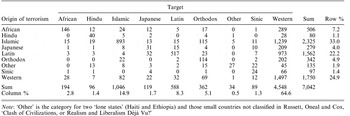
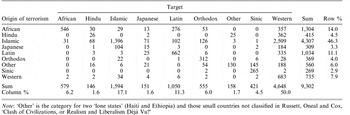
Tables 2 and 3 present frequencies of terrorist incidents and killings within and across civilizations. Despite the simplicity of such tables, the reported frequencies reveal an interesting pattern. The tables indicate that Westerners are the main target of international terrorism in general as well as of Islamic terrorists in particular. They also lend some provisional support to the hypothesis that the Islamic civilization is the most violent one in terms of international terrorism.
Sum of Terrorist Incidents in Directed Dyads of Civilizations

Note: ‘Other’ is the category for two ‘lone states’ (Haiti and Ethiopia) and those small countries not classified in Russett, Oneal and Cox, ‘Clash of Civilizations, or Realism and Liberalism Déjà Vu?’
Sum of Terrorist Killings in Directed Dyads of Civilizations

Note: ‘Other’ is the category for two ‘lone states’ (Haiti and Ethiopia) and those small countries not classified in Russett, Oneal and Cox, ‘Clash of Civilizations, or Realism and Liberalism Déjà Vu?’
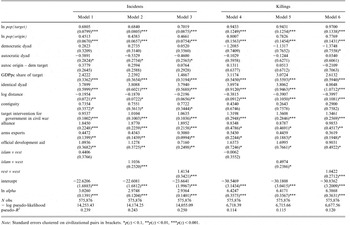
Yet frequency tables cannot control for other structural factors that may actually cause terrorism. We, therefore, now turn to multivariate analysis, for which Table 4 presents negative binomial regression results.
Negative Binomial Estimation Results

Note: Standard errors clustered on civilizational pairs in brackets. *p(z) < 0.1, **p(z) < 0.01, ***p(z) < 0.001.
We briefly discuss the results for the control variables before coming to our main results. We find that population sizes of both the origin and the target countries increase the number of incidents and killings. Significantly more terrorism is targeted against nationals of the same country than against those of other countries. Distance between terrorist and target country reduces terrorism. Contiguity is a weakly significantly positive factor for incidents, but insignificant for the number of people killed. Terrorism increases as the wealth of the targeted country increases relative to the country of origin. Moreover, our results show that combinations of political regime type do not differ systematically in their propensity to terrorism relative to the base category, the democratic origin–autocratic target dyad. Autocratic dyads seem to have fewer incidents, but not killings. Altogether, regime type does not seem to matter all that much.Footnote 74
As concerns our variables of main interest, we find clear support for our strategic theory of international terrorism. More terrorist incidents and killings emanate from countries that depend more on foreign economic aid and on arms imports against citizens of the foreign country sending aid and arms. More terrorism also is directed against foreigners from countries that have entered into a military alliance with the terrorists’ home country and that intervene in civil conflicts in the terrorists’ home country on the side of the government.
Turning to the inter-civilizational dummy variables, we find no significant effect with respect to terrorism from the Islamic civilization against nationals of all other civilizations in general. In other words, the Islamic civilization is not per se significantly more drawn to inter-civilizational terrorism if we control for the geographical and socio-political determinants of terrorist activity. However, we find significantly positive results for terrorism from other civilizations against the West and for Islamic terrorism against the West, as predicted by Huntington. As explained previously, such a result is, however, not necessarily inconsistent with our theory.
Inter-Civilizational Terrorism During and After the End of the Cold War
Huntington predicted that the end of the Cold War would trigger conflicts between different civilizations. If he was right, then one would expect a structural break around the end of the Cold War with an increase in anti-Western terrorism from other civilizations, in terrorism perpetrated by Islamic groups against other civilizations and, particularly, in Islamic terrorism against the West. Our theory does not predict any such structural breaks for general Islamic or general anti-Western terrorist activities. For Islamic terrorism against the West, the strategic logic of international terrorism suggests that this type of terrorism is spurred by active Western military involvement in the stabilization of embattled regimes in the Muslim world.
Previous studies of Huntington’s paradigm have typically been hampered by the fact that they could not or did not cover the post-Cold War period.Footnote 75 This allowed Huntington to simply dismiss such studies as ‘temporally irrelevant’.Footnote 76 Where studies have covered the post-Cold War period, they have typically tested Huntington’s predictions for variation over time by a Chow test.Footnote 77 We interact the inter-civilizational dummy variable of interest with a Cold War and a post-Cold War dummy variable. Both of these interacted terms enter the estimations and the Chow test functions via testing the hypothesis that the coefficients of the two interacted terms are equal to each other.Footnote 78
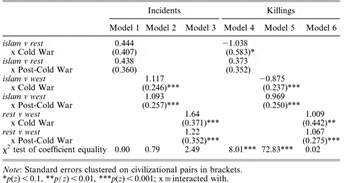
In Table 5 we report Chow test results. Note that all the other explanatory variables were of course included in the estimations, but because their coefficients are practically identical to the ones shown in Table 4 and, to save space, we only report coefficients of the interaction terms between the relevant inter-civilizational dummy variables on the one hand and dummy variables for the Cold War and post-Cold War period on the other hand together with tests of coefficient equality.Footnote 79
Tests for Structural Break in Inter-civilizational Dummy Variable Coefficients

Note: Standard errors clustered on civilizational pairs in brackets.
*p(z) < 0.1, **p(z) < 0.01, ***p(z) < 0.001; x ≡ interacted with.
Starting with the clash between Islam and the remaining civilizations, the islam v rest dummy variables are statistically insignificant both in the Cold War and in the post-Cold War period for terrorist incidents, whereas for terrorist killings the variable is negative and significant in the Cold War period and insignificant in the post-Cold War period. The Wald tests fail to reject the hypotheses of equal coefficients for terrorist incidents, but not for terrorist killings. However, this is no evidence for Huntington because Islamic terrorists turn from generating below average inter-civilizational terrorism to merely average.
Both of the islam v west dummy variables are statistically significant with the expected positive sign for terrorist incidents. However, the Wald test fails to reject the hypothesis of equal coefficients and, moreover, the dummy has a smaller coefficient during the post-Cold War period than before. As regards terrorist killings, the dyad between Islam and the West turns from one that generates significantly below average killings during the Cold War period to one with significantly above average killings.Footnote 80 Not surprisingly, the test of equality of coefficients suggests much higher terrorist activity in the post-Cold War period. The result for islam v west on terrorist killings, but not on incidents, can thus be interpreted as evidence for Huntington.
Finally, while the rest v west dummy variables are statistically significantly positive in both periods for both incidents and killings, the Wald tests fail to reject the hypotheses of equal coefficients. For incidents, for which the test is close to statistical significance, the rest v west dummy variable is, contrary to predictions based on Huntington, higher rather than lower in the Cold War period. In sum, there is no evidence for Huntington’s dynamic predictions with the exception of the clash between Islam and the West and, even then, only for terrorist killings as the dependent variable.
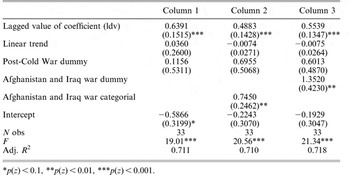
We now take a more detailed look at this particular case. To do so, we have re-estimated Model 6 of Table 4 in ‘four-year moving average sub-period’ models: we begin with a sample that covers only the years from 1969 to 1972, then include only the years from 1970 to 1973, and so on and finally estimate the years from 2002 to 2005. This gives thirty-four coefficients for each included variable. These coefficients describe the influence of a regressor on the dependent variable over time. The change in a parameter from one estimate to the next estimate captures the parameter difference between the first year from the first estimate and the last year from the next estimate.
In order to explore the dynamics of Islam versus West terrorism, we regress the estimated islam v west coefficients from the moving average sub-period models on their lagged values, a general time trend and a post-Cold War dummy variable. To these we add, in separate estimations, two operationalizations of the time period of the Afghanistan and Iraq wars: the first operationalization is a simple dummy variable coded 1 for the years 2002 onwards, and the second ‘counts’ the wars so that it is coded 1 in 2002 and 2 from 2003 onwards. Table 6 reports the results. The post-Cold War dummy is insignificant throughout. This would suggest that the end of the Cold War as such does not matter to Islamic terrorism targeted against the West. The invasions of Iraq and Afghanistan and the subsequent stabilization of pro-Western regimes seem to spur Islamic anti-Western terrorism, however, as both the dummy war variable (Column 2) and the categorical war variable are statistically significantly positive (Column 3).
Determinants of Variation over Time in ‘islam v west’ Coefficients on Killings

*p(z) < 0.1, **p(z) < 0.01, ***p(z) < 0.001.
These dynamics of terrorism in the Islam–West dyad do not necessarily falsify Huntington’s paradigm. After all, one can regard the wars in Afghanistan and Iraq as conventional military Huntington-type clashes between the West and Islam, to which the Islamic civilization responds with increasingly lethal terrorism (but not more terrorist incidents). However, the evidence fits better our strategic logic of international terrorism, which stresses the role that active Western military involvement in the Islamic civilization for the stabilization of embattled governments plays in promoting Islamic terrorism against Western targets.
Conclusion
The results reported in this article provide supportive evidence for our strategic theory of international terrorism: if foreign countries support the government of the terrorists’ home country with economic aid, arms transfers, military alliances and intervention in civil wars, then domestic terrorist leaders have a strategic incentive to attack nationals from that foreign country. This is exactly what we find in our estimations of international terrorism in a directed country dyad sample over the period 1969 to 2005. These patterns of international terrorism are predicted by our strategic theory and are simply incompatible with a non-strategic account of international terrorism, such as Huntington’s paradigm of a clash of civilizations. Cultural approaches have very low explanatory power when it comes to variation within a particular inter-civilizational dyad. There are strategic reasons why, for example, Canadian and Scandinavian citizens are far less likely to be targeted by Islamic terrorists than Americans and why these terrorists are far more likely to come from, say, Saudi Arabia or Pakistan than from Malaysia. In addition, Huntington’s paradigm is ill-equipped to explain variation in anti-Western terrorism across the various civilizational origins of the terrorists. The fact that citizens from Latin American and Western countries share the same religion does not diminish the high strategic value that terrorist leaders in many Latin American countries derive from attacking Westerners and Americans in particular. Conversely, the large cultural and religious gap between the Western and the Hindu and Sinic civilizations does not render Westerners particularly vulnerable to the risk of Hindu or Sinic terrorism in the absence of strong strategic incentives to attack Westerners. To understand these patterns of international terrorism one needs a political and strategic theory, not a cultural theory.
Our results also provide limited supportive evidence for some of the claims contained in Huntington’s paradigm, however. In line with Huntington, we conclude that there is excessive terrorism from non-Western and from Islamic countries on Western targets. This result is not necessarily inconsistent with our theory since terrorist leaders derive strategic benefits from attacking Western targets, for which our variables of strategic interest cannot fully account. More importantly, our analysis does not fully support Huntington’s predictions. The islam v rest dummy variable is not statistically significantly different from zero. The characterization of Islam drawn in Huntington’s work is thus exaggerated, at least with respect to international terrorism.
The dynamic perspective is also significantly at odds with Huntington. Most importantly, we do not find evidence for a simple structural break in the post-Cold War period. Terrorism originating from non-Western civilizations against Western targets and inter-civilizational terrorism originating from the Islamic civilization do not systematically increase after the end of the Cold War. The dynamics of Islamic terrorism against the West reveal an upward trend in the 1990s, but only for terrorist killings, not for incidents. Furthermore, this trend is also consistent with a strategic logic of international terrorism, which would suggest that Islamic attacks on Western targets go up when the West becomes more actively militarily involved in the Islamic civilization as part of the ‘war on terror’ led by the United States.
What does our analysis tell us about the likely future of international terrorism? If Huntington was right, then we will see more of anti-Western inter-civilizational terrorism, more of Islamic terrorism against other civilizations and, particularly, a further rise in Islamic terrorism against Western targets. The implications from our own theory of terrorism do not suggest any such upward trend. With respect to Islamic attacks on Western targets, Western countries are in a no-win situation. If they retreat from the Muslim world, this will be celebrated as a victory by the terrorist leaders and a toppling of pro-Western regimes dependent on Western support might follow. However, with continuing Western military intervention in the Muslim world, Islamic terrorist leaders will maintain and possibly increase their attacks on Western targets. Unless the ‘war on terror’ leads to the military defeat and destruction of terrorist groups, which seems unlikely based on what we have seen since 9/11, then it will probably increase, rather than decrease, Islamic terrorism against the West. Not only does the ‘war on terror’ raise the strategic benefits of perpetrating terrorist acts on Western targets, but, in addition, every Muslim hurt or killed in this war may facilitate the recruitment of new followers by Islamic terrorist leaders.
APPENDIX: INTER-CIVILIZATIONAL AND CONTROL VARIABLE DEFINITION AND DATA SOURCES
rest v west, islam v rest and islam v west: Dummy variables indicating civilizational identity of country of origin and target country.Footnote 81 ‘West’ includes all of Western Europe, plus Australia, Barbados, Belize, Canada, Czech Republic, Dominica, Grenada, Hungary, Jamaica, Malta, New Zealand, Papua New Guinea, Philippines, Poland, Slovak Republic, Solomon Islands, Trinidad, United States, Vanuatu and Western Samoa. ‘Islam’ includes Afghanistan, Albania, Algeria, Bahrain, Bangladesh, Brunei, Chad, Djibouti, Egypt, Gambia, Guinea, Indonesia, Iran, Iraq, Jordan, Kuwait, Lebanon, Libya, Malaysia, Mali, Mauritania, Morocco, Niger, Oman, Pakistan, Qatar, Saudi Arabia, Senegal, Seychelles, Somalia, Sudan, Syria, Tunisia, Turkey, United Arab Emirates, Yemen Arab Republic and Yemen People’s Democratic Republic. ‘Rest’ includes all non-Western countries for the rest v west dummy variable and all non-Islamic countries for the islam v rest dummy variable.
ln pop(origin) and ln pop(target): The natural log of population size of country of origin and target country.Footnote 82
GDPpc target share: The per capita GDP of the target country divided by the sum of per capita GDPs of target country of origin.Footnote 83
dem-dem, autoc-autoc and autoc-dem: Dummy variables indicating whether origin and target countries are pairs of democracies, autocracies or an autocracy–democracy combination. The omitted category is that of a democratic origin and autocratic target country. To be counted as a democracy, a country’s Polity value must be 6 or above.Footnote 84
identical dyad: A dummy variable that is set to 1 if the country of origin and target country are identical.
ln distance: The natural log of the distance between the capital cities of the country of origin and target country.Footnote 85
contiguity: This dummy is set to 1 if the two countries are contiguous by land or separated by less than 150 miles of sea water.Footnote 86