Introduction
Despite recent technological advances, it is often not possible to establish with confidence a pre-operative diagnosis in a patient with a conductive hearing loss. A variety of investigations have been advocated to establish the cause of an unexplained conductive hearing loss, including computed tomography (CT), tympanometry, laser vibrometry and serological testing. None of these techniques has sufficient sensitivity and specificity to allow a confident diagnosis to be made in all cases, and the otologist frequently has recourse to the exploratory tympanotomy in order to establish a diagnosis and to allow for surgical treatment.
Writing in 1982, PaparellaReference Paparella and Koutroupas1 observed that one would assume that much had been written about the findings at exploratory tympanotomy, allowing ‘a comparison of past and current findings so as to keep pace with developments of otology’. He noted that, in actual fact, a review of the literature revealed very little data about operative findings at exploratory tympanotomy.
A review of the current literature revealed that little has changed. Knowledge of the relative frequency of disorders encountered when operating upon a patient with a conductive hearing loss and normal tympanic membrane is essential in planning therapy and in enabling an informed pre-operative discussion with the patient.
We report a series of 340 consecutive tympanotomies carried out for conductive hearing loss by a single surgeon between 1989 and 2005.
Materials and methods
We analysed data for 340 tympanotomies (340 ears) carried out consecutively at university hospitals in Edinburgh and Dundee by the senior author. Demographic data and operative findings were recorded at the time of surgery by the senior author in a computer database (Lotus Approach). Information on patients who had undergone surgery for a conductive hearing loss was sought in the original database. In some cases, the information available in the database was supplemented by consulting the operation notes. Those patients who had a grossly abnormal tympanic membrane, or who were known to have had previous surgery pre-operatively, were excluded from further analysis. Data were transferred to a Microsoft Excel file and the operative findings were coded to allow data analysis.
Results
Three hundred and eighteen patients underwent exploratory tympanotomy for conductive hearing loss during the study period. Twenty-two patients underwent bilateral surgery, giving a total of 340 ears. All of the bilateral cases were found to have otosclerosis. Patients comprised 133 males and 185 females. Their ages ranged from seven to 85 years, with a mean of 50.8.
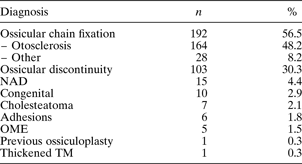
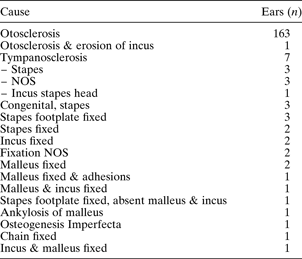
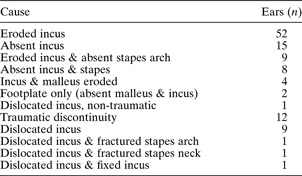
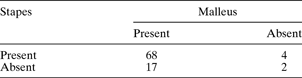
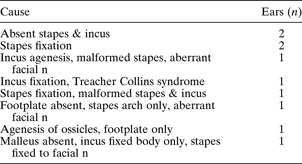
Patients' operative findings are shown in Table I. The most common diagnosis was ossicular chain fixation, and otosclerosis was the most common cause. The causes of ossicular fixation are displayed in Table II. The second most common diagnosis was ossicular discontinuity, and the causes of this are given in Table III. The operative findings in cases of ossicular discontinuity without a history of trauma are displayed in Table IV. Finally, the findings in those patients believed to have a congenital cause for their hearing loss are displayed in Table V. One patient was found to have had a previous ossiculoplasty that was not suspected from the history or examination.
Operative diagnoses
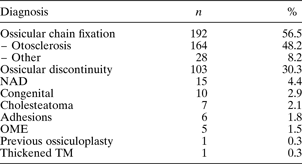
Total n = 340 ears. NAD = no abnormality detected; OME = otitis media with effusion; TM = tympanic membrane
Causes of ossicular fixation
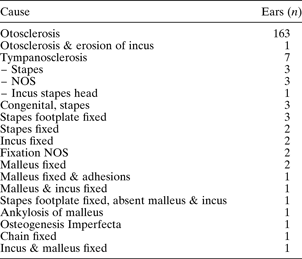
Total n = 192. NOS = neck of stapes
Causes of ossicular discontinuity

Total n = 103.
Operative findings in cases of non-traumatic ossicular discontinuity*
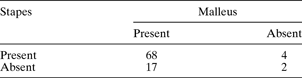
Data represent ears.
* All patients had partial erosion or loss of the incus.
Congenital causes of hearing loss

Total n = 10, n = 10
Discussion
Pre-operative investigations such as otoscopy, audiometry, tympanometry and high resolution CT scanning are helpful but cannot provide a reliable diagnosis for patients with a conductive hearing loss.Reference Kakehata, Futai, Kuroda and Shinkawa2 Although mean compliance as measured by tympanometry is lower in ears with otosclerosis, the overlap with the normal population is such that this parameter is not useful in the diagnosis of a conductive hearing loss with a normal tympanic membrane.Reference Browning, Swan and Gatehouse3 Shin et al. Reference Shin, Deguine, Cognard, Sevely, Manelfe and Fraysse4 found that, while CT scanning diagnosed 91.3 per cent of cases of otosclerosis, the accuracy was 57 per cent for other minor malformations. New techniques such as laser Doppler vibrometryReference Rosowski, Mehta and Merchant5 and wideband energy reflectanceReference Feeney, Grant and Marryott6 may be of use but their accuracy has yet to be proven in large clinical studies. Decreased serum antimeasles immunoglobulin (Ig) G may be diagnostic for otosclerosis but does not exclude stapes fixation of other causes (e.g. tympanosclerosis or idiopathic stapediovestibular ankylosis).Reference Karosi, Konya, Petko, Szabo, Pytel and Jori7 A pathological diagnosis of otosclerosis can sometimes be made on CT imaging.Reference Veillon, Stierle, Dussaix, Ramos-Taboada and Riehm8 For these reasons, exploratory tympanotomy is still required to establish a final diagnosis.
Surgeons have long desired to visualise the contents of the middle-ear space. The tympanomeatal flap was originally introduced for fenestration surgery. Lempert in 1946 described an inferiorly based tympanomeatal flap for tympanic neurectomy. Shea, writing on the development of stapedectomy, described the posteriorly based flap in use today.Reference Paparella and Koutroupas1
Although there are several large stapedectomy series reported in the literature,Reference Vincent, Sperling, Oates and Jindal9 there is, as Paparella noted, a relative paucity of data on operative findings at exploratory tympanotomy.Reference Paparella and Koutroupas1
Paparella reported a series of 316 exploratory tympanotomies. Sixty-three of these cases were performed for the investigation of sensorineural hearing loss and three for reasons unrelated to hearing loss. Of the remaining 250 cases, 38 had a history of stapedectomy and 118 had a history of previous otitis media. Of the 94 cases with a normal tympanic membrane, Paparella found the most common diagnosis to be otosclerosis (n = 75, 79.7 per cent) followed by congenital fixation of the stapes (n = 10, 10.6 per cent). Otosclerosis was also the most common diagnosis in our series (n = 164, 48.2 per cent). We found a large number of patients with ossicular discontinuity and a normal tympanic membrane (n = 103, 30.3 per cent), compared with Paparella's series. This number is considerably larger than previous studies, even accounting for the inclusion of traumatic cases. It has been recognised that pathological changes due to chronic otitis media can occur behind a normal tympanic membrane.Reference Ferlito, Paparella, Rinaldo, Schachern and Cureoglu10 Indeed, seven of our patients were found to have cholesteatoma at operation, and, of these, only two were under 18 years (being aged seven and 10 years), making a diagnosis of congenital cholesteatoma unlikely. The pattern of ossicular discontinuity found in our study (see Table IV) is similar to that previously described as sequelae of chronic otitis media.Reference Austin11
• Despite advances in imaging and other diagnostic tests, it is often impossible to establish with confidence a pre-operative diagnosis in a patient with conductive hearing loss
• This paper reports findings from a series of 340 exploratory tympanotomies for conductive hearing loss carried out by a single surgeon
• The most common operative diagnosis was otosclerosis, ossicular discontinuity was found more commonly than previously reported, and a small but significant number of patients had cholesteatoma
We found that 15 patients had no obvious abnormality at tympanotomy despite having a conductive hearing loss. Some of these patients may have had superior semicircular canal dehiscence,Reference Merchant, Rosowski and McKenna12 a condition which was not recognised at the time they underwent surgery, although it has long been recognised that patients with a conductive hearing loss may have no abnormality on exploratory tympanotomy.Reference Bess, Miller, Glasscock and Bratt13
Despite current advances in imaging and audiometry, there is still a necessity to directly visualise the middle-ear space to establish a diagnosis and to institute treatment. Knowledge of the common findings at exploratory tympanotomy will enable informed pre-operative discussion with the patient. The sequelae of chronic otitis media and cholesteatoma may be encountered behind a normal tympanic membrane.