


Why do people go out and vote in large-scale elections? This is a crucial question for understanding how democracies work. For example, many people consider high turnout to be desirable (Citrin, Schickler, and Sides 2003). One reason is that low turnout may imply unequal turnout yielding over-representation of some interests relative to others (Lijphart 1997). Yet, in many democracies it is common to see turnout levels that are substantially below 100% (Blais 2000). To better comprehend why many people decide to abstain, a proper understanding of what motivates voters to cast a vote is essential.
The answer to the simple question of why people vote continues to give rise to extremely divergent answers, however. Distinct schools in the social sciences approach it from completely different angles. On the one hand, economists and political scientists in the rational choice tradition are not surprised that people abstain. On the contrary, since Downs 1957 they have been puzzled by the fact that people vote at all. They refer to this as the “paradox of voting.” In the Downsian framework it is irrational to cast a vote in a large-scale election. The probability of being decisive for the outcome is negligible and, therefore, expected benefits from casting a vote fall short of the costs. Many theoretical and empirical papers have tried to explain the paradox. Only in the 1980s did rational choice models start to appear that show that turning out to vote might be rational in an instrumental sense for a limited number of voters (e.g., Ledyard 1984; Palfrey and Rosenthal 1983, 1985; Schram 1991). Predicted turnout levels remain far below those usually observed, however.
On the other hand, sociologists and political scientists outside of the rational choice tradition do not see the paradox. Many of them present empirical studies explaining the decision to vote by socioeconomic characteristics like education and age (Wolfinger and Rosenstone 1980) or by economic factors like the (expected) state of the economy (Lewis-Beck and Lockerbie 1989).1
For an overview, see Mueller 2003.
In this paper, we attempt to reconcile two of these approaches to the question of why people vote.2
To the best of our knowledge, no one has previously studied the effect of social embeddedness in a rational choice framework. Other studies reconcile various empirical findings with the rational choice approach, however. For example, Riker and Ordeshook (1968) and Tullock (1967) introduce a concept of civic duty into the rational choice framework. This has been criticized as being too ad hoc, however, because it fails to (rationally) explain where the sense of civic duty originates (Schram 1991). Others have derived a rational choice foundation for the relationship between turnout and the (expected) state of the economy (Kirchgässner 1985; Mueller 2003).
Communication is an important aspect of social embeddedness and a prerequisite for information exchange. Schram and Sonnemans (1996b) show that both group identity and within-group communication increase turnout in a setting similar to the one studied here. Goren and Bornstein (2000) find the same and show that groups use the opportunity of communication to coordinate on a reciprocal strategy towards other groups.
There are many situations where preferences or vote decisions are explicitly disclosed. For example, voters often reveal their preferred candidate in discussions with their neighbors or by using bumper stickers, campaign buttons, and yard signs. Moreover, on Election Day many people know whether others around them intend to vote or whether they have already voted (i.e., earlier that day or as an absentee voter).4
Note that the increase in possibilities for early and absentee voting (Patterson and Caldeira 1985; Stein 1998) increases the opportunities to reveal one's decision to vote.
On a slightly broader scale, (local) television news programs often report voting by public figures and opinion leaders (Schram and van Winden 1991), queues at polling stations, and so forth. In addition, hourly reports on turnout at specific polling stations are common in many countries.
These are all examples of common everyday information that might serve as cues triggering the motivation to vote. As an anonymous referee pointed out, these cues will weigh more heavily for some voters than for others. Moreover, it is beyond the scope of this paper to address the matter of how individual voters process this information when they decide to vote. Our goal is to study the outcome of this process in a controlled environment.
Most of what is known about the effect of social interaction on voter participation stems from field studies. This has yielded strong evidence of the importance of social embeddedness (e.g., Huckfeldt 1986; Kenny 1992). With such data, it is more difficult to uncover the structure of this relationship, however. For example, surveys typically show ex post that discussions amongst neighbors took place, but are not always informative about the content of these discussions or about who took the initiative. Moreover, inferences derived from such data about the effect of interaction per se are incomplete, because the benchmark of no interaction at all is not available. Also, many variables vary across individuals, making it difficult to isolate the effect of social interaction from other influences.7
Of course, multivariate techniques can help to isolate this effect. This is how many of the results presented above were derived. Nevertheless, one can never be sure whether the model is complete.
By carefully modeling the information flow between voters, we are able to isolate three elements in their complex social interaction that may help us better understand why people vote. First, we thoroughly distinguish between behavior in distinct roles, that is, early and late voters, and how this affects turnout. Early voters can choose between voting (and having their decision observed by another voter) and postponing the decision until later (so their decision will not be observed). Late voters can observe what an early voter did in first instance but do not know whether early postponement lead to abstention or a late vote. This distinction between the origin of the information (early voters) and its recipients (late voters) will allow us to study the strategic use of the turnout decision to influence other voters.8
By distinguishing between early and late voters, our setup combines simultaneous and sequential voting. Many elections involve such a combination (e.g., Dekel and Piccione 2000; Lohmann 1994; Morton and Williams 1999). Most studies focus on the ability of sequential procedures to increase electoral efficiency by spreading private information. Here, incomplete information is not essential (we only use it in one case, where voters do not know which candidate their neighbor supports).
Our wish to isolate specific elements in the exchange of information within a social environment gives rise to a stylized representation of voters' choices and the information they possess. This is a direct consequence of the need for internal validity of our experiments, that is, the ability to draw confident causal conclusions from the research (Loewenstein 1999). There is always a tradeoff between this internal validity and the external validity of experiments, that is, the possibility of generalizing the conclusions to situations outside of the laboratory (Schram 2005). In spite of this tradeoff, we believe that our results will be very relevant for understanding the participation decision. Though much more complex than in our laboratory environment, voters in the field have access to the same kind of information as voters in our experiment have (cf. the examples given earlier). One way to establish the external validity is by comparing our results to previous empirical studies. We will do so in our concluding discussion.
THE NIE PARTICIPATION GAME AND EXPERIMENTAL DESIGN
The basis for our analysis is the participation game introduced by Palfrey and Rosenthal (1983). The players in this game are the E voters in an electorate. Here, these are split in two equally sized groups, representing the supporters of two candidates. Each voter individually and privately decides between voting at cost c and abstaining (without costs). The votes in each group are counted and the group with most votes wins the election (with a coin toss deciding in case of a tie). Each member of the winning group receives an equal reward, independent of whether he or she voted. Members of the losing group receive a lower reward. In this way, the game combines an intergroup conflict for electoral victory with an intragroup voluntary contribution problem (because voters can benefit from the costly votes of the other members of their group).
We implement the following variation to the standard participation game.9
Our paper contributes to the limited experimental literature on participation games (e.g., Bornstein 1992; Hsu and Sung 2002; Schram and Sonnemans 1996a, 1996b). In this literature, relatively high rates of participation are found, albeit lower than observed in most general elections around the world. A typical result (replicated in our experiment) is that standard (Bayesian) Nash equilibria find little support.
A restriction to two-person neighborhoods is an obvious limitation. However, we are interested in the effect of information per se, and for this, it suffices to focus on the simplest case. Moreover, we shall show that the effect is large, even for the two-person neighborhoods. Bigger and overlapping neighborhoods are an interesting topic for future research.
Notice the difference with standard models of information cascades and herding (e.g., Banerjee 1992; Bikhchandani, Hirshleifer, and Welch 1992) and social choice (e.g., Fey 1998; Wit 1997). There, everybody is both sender and receiver, except for the first and the last player. In addition, contrary to the participation game, there is a common interest among players in these models.
The computerized experiment was run at the laboratory of the Center for Research in Experimental Economics and political Decision making (CREED) of the University of Amsterdam.12
RatImage (Abbink and Sadrieh 1995) was used to program the software.
The (read-aloud) instructions can be obtained from the authors or downloaded from http://www1.fee.uva.nl/creed/publications.htm.
Each electorate consists of twelve voters: two groups of six subjects each. Given that we do not know the structure of the correlations across observations, we treat the electorate as the only independent unit of observation, giving us fourteen such observations. Each subject is either sender or receiver throughout the experiment and knows her role from the beginning of the session.14
We chose to use fixed roles (senders or receivers) in order to exclude the possibility of implicit coordination through roles (e.g., vote when you are a sender, abstain when you are a receiver).
In four sessions, two electorates participated simultaneously, and six sessions were held with one electorate each. In sessions with more than one electorate, there is no interaction of any kind between subjects in different electorates. This is known to all subjects.
Our first treatment is related to the matching protocol of subjects within an electorate, where we distinguish between partners and strangers (cf. Andreoni 1988). In partners, subjects in an electorate are randomly allocated to groups at the beginning of the first round, and groups remain constant thereafter. In strangers, subjects are randomly reallocated to the two groups at the beginning of each round. A natural interpretation of partners versus strangers in this context is that partners constitute an electorate of voters who remain loyal to their candidate across elections. Strangers can be seen as “floating voters” who may switch from one candidate to another between elections (cf. Großer, Kugler, and Schram 2005). Of course, partners and strangers are varied in a between-subject design.
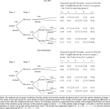
Our second treatment is varied in a within-subject design. It deals with the information about the neighbor's vote. If voters are informed, we distinguish between rounds in which neighbors are from the same (allies) and different (adversaries) groups, and rounds in which allies and adversaries each occur with probability of 0.5 (uncertain). As a control, we organized four uninformed electorates in which no information about others' votes was provided. In these sessions we keep the decision structure as close as possible to informed by maintaining the two decision-making stages described earlier as well as the labels sender and receiver. In the following analysis, we refer to subjects in these sessions as neighbors, senders, and receivers, even though no information was exchanged among them.
Each session lasts ninety-nine rounds. Thirty-three rounds use the information condition allies, thirty-three use adversaries, and thirty-three use uncertain.16
We vary the structure of preferences in neighborhoods in a within-subject design in order to restrict the number of electorates needed. On the other hand, we study the uninformed case in separate sessions in order to link our experiment to previous experimental participation games. As a consequence, uninformed subjects made ninety-nine decisions in the same setting, whereas informed subjects made 33 decisions in each of the three conditions. The differences between uninformed and informed are so strong (and stay strong if we only consider the first thirty-three or the last thirty-three rounds of uninformed), that we are confident that the number of rounds did not affect the results that we will present below.

Decision-Making Structure and Possible Payoffs within a Neighborhood
Hypotheses
In Appendix A, we present quasi-symmetric Nash equilibria for our experimental parameters.17
Goeree and Holt (2005) show that a logit equilibrium can account for the Schram and Sonnemans (1996a) data. Cason and Mui (2005) and Großer, Kugler, and Schram (2005) show the same for their own data. Our model is too complex to derive logit equilibria, however.
H1: Turnout is higher when neighbors are adversaries than when they are allies.
H2: When they are allies, senders participate at a higher rate than receivers.
H3: Senders participate at higher rates at stage 2 than at stage 1.
H4: Receivers participate more after observing abstention than after observing a vote.
H5: After observing a vote, receivers are more likely to participate if the neighbor is an adversary than in case of an ally.
We have no theoretical basis to predict the effect of our partners versus strangers treatment. Though Schram and Sonnemans (1996a) report higher turnout for partners in a standard participation game, the NIE effect might differ for the two, so it is unclear whether we should expect the same result. Intuitively, the information value of observing a neighbor's decision will be lower when groups are fixed. In partners, aggregate behavior is supposedly more predictable because the stable environment allows one to gather information about participation across rounds. This intuition predicts that NIE is more important for strangers than for partners.
EXPERIMENTAL RESULTS
This section presents and analyzes our experimental results. We start by comparing overall participation across treatments, followed by an investigation of participation rates in the three information conditions. After focusing on the behavior of senders and receivers, we will try to put the pieces of the puzzle together and get a grasp of what the effect of NIE is. For our analysis we use nonparametric statistics as described in Siegel and Castellan, Jr. (1988). For the reasons mentioned earlier, all of our tests are conducted at the electorate level.
Aggregate Participation Rates
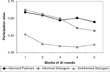
Figure 2 gives aggregate participation rates averaged over blocks of twenty rounds each (nineteen rounds in the last block).

Aggregate Participation Rates
Result 1: Neighborhood information exchange increases turnout.
For strangers, we have observations with and without information exchange. Aggregate average participation rates are substantially higher for informed than for uninformed strangers. When informed, participation starts at an average of 67% in rounds 1 to 20 and ends at 49% in rounds 81 to 99. At the same time, average participation by the uninformed varies between 46% and 37%. The null hypothesis of no difference is clearly rejected at the electorate level: there is not one observation for the uninformed that exceeds those of informed strangers (one-tailed Wilcoxon-Mann-Whitney test, 1% significance level).
Result 2: The stability of group composition does not affect turnout.
In our design, the stability of group composition is varied by way of our partners versus strangers treatments. The ‘loyal voters’ in partners start at an average participation rate of 65% and end at 57%. The floating voters in (informed) strangers decrease from 67% participation to 49%. A Wilcoxon-Mann-Whitney test cannot reject the null hypothesis of no difference (10% significance level, two-tailed test).18
Figure 2 suggests that a difference may occur in the last two blocks. The test does not reject the null hypothesis of no differences for these blocks either, however.
When there is no information exchange (uninformed strangers), aggregate participation rates are at similar levels to those observed in previous experimental studies on participation games. For example, Schram and Sonnemans (1996a) report average turnout rates of 31% (42%) for the winner-takes-all case with two groups of six players in strangers (partners). For strangers, this is somewhat lower than what we observe for the uninformed (38%). Aggregate participation rates in the two informed treatments are much higher than previously observed for both partners and strangers.
Participation Rates and Neighbors' Preferences
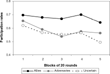
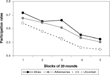
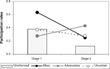
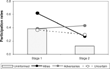
Figure 3 shows participation rates disaggregated for the treatments allies, adversaries, and uncertain for informed partners and strangers, respectively.19
The number of observations per block differs across information conditions because each condition is used thirty-three times in a predefined random sequence. In block 1 (2, 3, 4, 5), allies was used 6 (9, 6, 5, 7) times, adversaries 5 (7, 8, 8, 5) times, and uncertain 9 (4, 6, 7, 7) times.

FIGURE 3A. Participation Rates in Informed Partners

FIGURE 3B. Participation Rates in Informed Strangers
Result 3: When information is exchanged, turnout is highest amongst allies and lowest when neighbors do not know each other's preferences.
We observe the same ranking of participation in both figures, with average participation rates highest for allies and lowest in uncertain. This ranking is observed in all blocks of rounds, except one. A Friedman two-way analysis of variance by ranks rejects the null hypothesis of no ordering at the 5% significance level for partners and at 1% significance for strangers.
Note the distinct dynamics across information conditions. When voters are loyal to their candidate (partners) and neighbors are allies, participation remains stable (at approximately 70%).20
This result supports studies suggesting that segregation (i.e., allies) increases participation (e.g., Huckfeldt 1979, 1986; Takács 2001). That participation is lowest with uncertainty may seem surprising. Intuitively, one would expect participation in uncertain to lie between that in allies and adversaries. Apparently, the additional source of uncertainty drives down participation. A similar observation is made in Großer, Kugler, and Schram (2005), where participation rates are lower when uncertainty about others' preferences is introduced.
We can use result 3 to test the first of the comparative static predictions that we derived from the Nash equilibria for our game.
Test of H1. H1 predicts that turnout is higher when neighbors are adversaries than when they are allies. We observe the opposite in Result 3. At the end of this section, we discuss what may be driving this rejection of the equilibrium prediction.
Comparing Participation Rates for Senders and Receivers
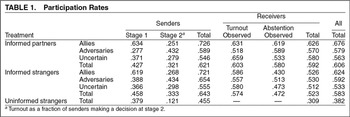
Table 1 gives the participation rates per treatment, role, and stage across all rounds. We start with a comparison of participation by senders and receivers.

Result 4: Senders participate at a higher rate than receivers do.
There are seven possible comparisons for sender and receiver turnout (three conditions each in informed partners and strangers, plus uninformed strangers). Only when neighbors are uncertain about each others' preferences in partners do we observe (nonsignificant) higher turnout for receivers. Aggregating across allies, adversaries and uncertain, we always observe higher turnout by senders, though the difference is relatively low in informed partners (3%-points), compared to informed strangers (12%-points) and uninformed strangers (15%-points). Wilcoxon signed ranks tests reject the null hypothesis of no difference for informed and uninformed strangers in favor of higher rates for senders (10% significance level, one-tailed tests), but cannot reject it for informed partners at the same significance level. When testing for allies, adversaries and uncertain separately we reject the null in favor of higher turnout by senders in three out of six cases.
The higher participation of senders than receivers when no information is exchanged comes as a surprise. Note that receivers participate at the same rate (31%) as subjects in standard participation games (Schram and Sonnemans 1996a). This result suggests an influence on participation by senders of the two-stage decision procedure itself. We can think of three possible explanations. First, there may be a “timing effect” where first movers behave differently from second movers, even when no information is exchanged (see, e.g., Rapoport 1997; Weber, Camerer, and Knez 2004). Second, the labels “sender” and “receiver” may cause a framing effect (e.g., Tversky and Kahneman 1981), provoking senders to participate more. Third, the freedom to delay the decision, that is, because the exact same alternative occurs again at stage 2, may be an explanation for our finding. Because our uninformed treatment is only used as a benchmark, we will not elaborate on this finding. It is important to note that participation by both senders and receivers in all of the informed groups is (much) higher than that of uninformed senders. It is on this higher turnout that we focus.
Finally, we use the results in Table 1 to test hypothesis H2.
Test of H2. H2 predicts that, when allies, senders participate at a higher rate than receivers do. This is supported by the numbers in Table 1. One-tailed Wilcoxon signed ranks tests show that the higher turnout of senders is not statistically significant when the allies are partners (at the 10%-level), but it is when they are strangers (5%-level). When informed partners and strangers are aggregated, the difference is statistically significant as well (1%-level).
Sender Behavior
In aggregate, senders' participate most when they are informed strangers and least when they are uninformed (cf. Table 1). Wilcoxon-Mann-Whitney tests show that the differences between informed partners and uninformed strangers (62% vs. 46%) and informed strangers and uninformed strangers (64% vs. 46%) are statistically significant at the 1% level, but the null that senders participate at the same rate in informed strangers and informed partners (64% vs. 62%) is not rejected at the 10% level (all one-tailed tests).
We can use Table 1 to have a closer look at result 3, that turnout is highest among allies, followed by adversaries. It appears that this ranking is mainly caused by the senders. Differences across information conditions appear to be smaller for receivers. For example, in strangers, there is almost no difference in aggregate receiver behavior across the conditions. In fact, for receivers, the differences are not significant in either informed partners or informed strangers (Friedman two-way analysis of variance by ranks, 10% significance level). In contrast, the differences are significant in both informed partners (5%-level) and informed strangers (1%-level) for senders. Apparently, senders play a crucial role in the aggregate result.
Of course, senders have two possibilities to participate. Table 1 and Figure 4 show participation rates at each of the two stages.

FIGURE 4A. Senders' Participation Rates at Stages 1 and 2 in Partners

FIGURE 4B. Senders' Participation Rates at Stages 1 and 2 in Strangers
Result 5: Senders attempt to influence their neighbor. If the receiver is an ally, senders mainly vote at stage 1. If the receiver is an adversary, senders participate more at stage 2.
Table 2 and Figure 4 show substantially higher sender participation rates for allies at stage 1 than at stage 2 in both informed partners (63% vs. 25%) and informed strangers (62% vs. 27%). The difference is statistically significant in both cases (5%-level, one-tailed Wilcoxon signed ranks test). For adversaries, we observe the opposite: senders' participation rates are lower at stage 1 than at stage 2 (28% vs. 43% when partners; 39% vs. 43% when strangers). The difference is significant (5%-level, one-tailed Wilcoxon signed ranks test) for partners, but not for strangers (at the 10% level). In uncertain, senders participate at a higher rate at stage 1 than at stage 2 (37% vs. 28% when partners; 37% vs. 30% when strangers), but the differences are much smaller than in allies and insignificant at the 10% level.

Note that “senders” in our uninformed control treatment participate at higher rates at stage 1 than at stage 2 (38% vs. 12%). This holds for each electorate. In fact, at stage 1 they participate at the same rate as senders do in adversaries or uncertain when information is exchanged. This appears to imply that there is a tendency to participate at a base rate of 30% to 40% by senders at stage 1, unless they are matched with an ally, in which case their turnout is almost twice as high. In the absence of information receivers participate at approximately this base rate as well. At stage 2, the “uninformed” base rate is at approximately 10% to 15%. In allies and uncertain, senders participate at somewhat higher rates than this, but the most noticeable fact is that senders whose neighbors are adversaries vote at a much higher rate (43%) at stage 2, when their decision is not observed.
Participation levels of senders and their patterns of behavior are similar for partners and strangers. In this respect, our conjecture that information exchange is more important in strangers is not supported for senders. However, senders are trying to influence their receiver-neighbors. If their choices have different effects on receivers in partners than in strangers, there may be an indirect effect of senders' behavior on the role of information exchange. We will discuss this in the next subsection. Here, we close with a result for the comparative statics.
Test of H3. H3 predicts that senders' turnout rates are higher at stage 2 than at stage 1. Result 5 shows that this is rejected for allies and supported for adversaries.
Receiver Behavior
Our focus is on the response of informed receivers to their neighbor's stage 1 decision. Uninformed receivers' behavior serves as a benchmark. We have two results.
Result 6: Receivers participate at a higher rate in partners than in strangers.
Contrary to senders, receivers behave differently in partners and strangers. Their turnout is lower in strangers (59% vs. 52%); both are substantially higher than the 31% in uninformed (cf. Table 1). One-tailed Wilcoxon-Mann-Whitney tests reject the null hypothesis of no differences in favor of higher rates for receivers in both informed conditions than in uninformed (1% significance level) and in informed partners than in informed strangers (10%-level). This holds for allies, adversaries, and uncertain, and for both observed decisions of their sender-neighbors (the only exception is that receivers vote at a higher rate when informed strangers than when partners after observing a vote by an adversary). Moreover, aggregate participation by receivers is lower than that by senders, especially in informed strangers (cf. result 4).
Result 7: Receivers reciprocate allied senders' stage 1 decisions in strangers.
For partners, responses to senders' stage 1 decisions vary: participation rates after observing a sender vote are equal to those after abstention in allies (63% vs. 62%), they are lower in adversaries (52% vs. 59%), and higher in uncertain (66% vs. 53%). Only the latter difference is statistically significant at the 10%-level (one-tailed Wilcoxon signed ranks tests). In contrast, for informed strangers we always observe higher participation rates after senders participate than when abstention is observed (allies: 59% vs. 43%; adversaries: 56% vs. 51%; uncertain: 58% vs. 47%). Wilcoxon signed ranks tests reject the null of no difference for allies and uncertain at the 10%-level (one-tailed tests), but cannot reject it for adversaries.
Contrary to senders, this result for receivers supports our conjecture that information exchange is more important in strangers than in partners. Note an important element of our design: receiver responses to sender stage 1 decisions remain unobserved by sender-neighbors, making it impossible for receivers to directly inform their neighbors about their decision. In partners, however, indirect information is passed on across rounds by way of aggregate (group) turnout(s). This seems to outweigh local neighborhood exchange (for more, see the following section). As a consequence, receivers do not respond systematically to sender-neighbors' stage 1 decisions when they are partners.
Finally, we present the results for our last two hypotheses.
Test of H4. H4 predicts that receivers respond to observed abstention by participating more. This is rejected by our data, especially for the strangers treatment.
Test of H5. H5 compares receivers' responses to an observed vote and predicts a higher turnout for receiver-adversaries. Table 1 rejects this prediction: in both informed partners and strangers, receivers vote more after seeing an ally vote than after participation by an adversary.
Interpreting the Results
In this subsection, we provide a general picture of the effect of neighborhood information exchange on participation. We do so by formulating a conjecture of what is taking place in our experiment and providing statistical tests for it. The processes described can account for Results 1 to 7 and for our conclusions with respect to H1–H5.
The core of our conjecture is an implicit coordination between subjects.21
Our aim is to provide a unified description of the behavioral patterns observed in our experiment. We do not intend to neglect voters' individual incentives. Coordination (explicit or implicit) allows individuals to better achieve their individual goals in repeated and sequential interactions, however.
Next, consider the level at which coordination takes place. Introducing NIE gives participants an opportunity to (implicitly) coordinate within their neighborhoods. This is possible in partners as well as in strangers. On the other hand, (implicit) coordination at the group level can arise across rounds in partners, but not in strangers. As a consequence, we predicted the relative importance of NIE to be lower in partners than in strangers. Therefore, we distinguish between the ways in which NIE works in both treatments.
Our major finding holds for both, partners and strangers, however: NIE substantially increases overall participation. Interaction within neighborhoods has a strong effect per se. For strangers, this follows directly from a comparison between our informed and uninformed treatments (58% vs. 38%; cf. result 1). For partners, we note that Schram and Sonnemans (1996a) report an average turnout of 42% without NIE, which is much lower than the 61% we observe. Moreover (as in the studies mentioned earlier), we observe no intergroup coordination toward (efficient) abstention.
First consider strangers, where implicit coordination seems impossible at the group level. Here, subjects rely much more on a period-by-period coordination within neighborhoods. The difference between allies and adversaries turns out to be important. When neighbors are allies, senders signal their preference for joint participation by voting early, and we see a strong response by receivers. They reciprocate a vote by their neighbor by voting themselves at much higher rates than after observing abstention. The situation is completely different when neighbors are adversaries. Senders no longer take the initiative to coordinate at higher levels of participation. Receivers realize this and do not respond to the observed decision. They (rightfully) assume that observed abstention is uninformative about second-stage sender behavior. This process can account for results 1, 3 (for the allies-adversaries comparison), 4, 5, and 7 for strangers; for our confirmation of H2 and H3 (for adversaries); and for our rejection of H1, H3 (for allies), H4, and H5.
In partners, there is an additional opportunity for implicit coordination by establishing bonds across rounds. Once more, implicit intragroup coordination appears to be taking place, again triggered by sender behavior. When neighbors are allies, senders try to provoke high levels by high participation at stage 1 (when they are adversaries, senders withhold their “signals”). This is successful, because it boosts the “coordinated” level of turnout to almost 70%. However, contrary to strangers, this is not caused by direct reciprocation by receivers. Even receivers who observe abstention vote at higher rates (62%, for allies). We attribute this to them experiencing higher levels of own group participation in all rounds. In this way, the senders' “signals” have an effect across rounds just as much as within rounds. It lifts the “coordinated” turnout to a higher level. These combined NIE- and partners-effects, triggered by senders, can account for results 1, 3 (for the allies-adversaries comparison), 4, 5, and 7 for partners. It also accounts for our confirmation of H2 and H3 (for adversaries), and for our rejection of H1, H3 (for allies), H4, and H5.
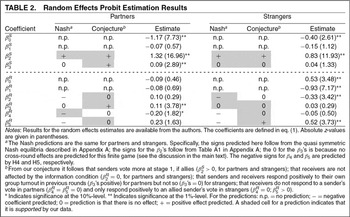
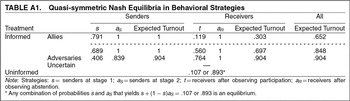
To test our conjecture, we estimate a model of sender and receiver behavior, and compare the results to both the predictions of quasi-symmetric Nash equilibria (see table A1 in appendix A) and our conjecture on implicit within-group coordination.22
Our experimental results show no support for the pure strategies in which everybody participates. Hence, we do not consider them further.

where i denotes the voter and t denotes the round.
is a dummy variable equal to 1 if a sender votes at stage 1 (if a receiver votes) and 0, otherwise.23
We only consider senders' stage 1 behavior because this is what our conjecture is most explicit about. Moreover, we include the round (scaled by dividing by 100) in the equation to allow for learning effects.
is equal to the number of votes cast by other members of the voter's group in the previous round. It is used to capture the cross-round effects in our conjecture for partners. The dummy variable Ti,t is equal to 1 if receiver i's sender-neighbor voted in round t. εi,t and μi are error terms, where the latter is a random effect used to correct for the panel structure in our data. The β's are coefficients to be estimated. The term Ti,t×ALLIESt is added to allow receivers to respond differently to turnout by an ally than by an adversary.

Table 2 presents the predictions for the coefficients and the results of our random effects probit estimation.24
This empirical analysis serves to test our conjecture by investigating individual choices. Therefore, we no longer use the electorate as the unit of observation, but the individual. The random effects specification corrects for correlations between an individual's choices across rounds.
In partners, we indeed observed some groups winning more often than others. More information is available from the authors.
Our results reject many of the Nash predictions. To some extent this may be a consequence of our restriction to quasi-symmetric equilibria or of not allowing for effects across rounds in the finitely repeated game. If we drop either of the restrictions, a plethora of equilibria appear, however. In essence, letting these restrictions go implies that the Nash concept loses its predictive power. In contrast, the straightforward predictions derived from our conjecture find support in the data.
We conclude that implicit intragroup coordination at the neighborhood- and group-level for partners and only at the neighborhood-level in strangers can explain most of our findings. In both cases, senders play an important coordinating role. This implicit coordination also explains why the Nash equilibria predict poorly, because these do no allow for any kind of coordination. Two results still need to be explained. Our result 2 (that aggregate participation levels are the same for fixed groups and changing groups) implies that the two types of implicit coordination yield comparable turnout rates for partners and strangers. Result 6 (that receivers participate more in partners than in strangers) is a consequence of receivers' role in group-level coordination in partners. Other findings that remain unexplained are: (1) senders vote at a higher rate at stage 1 than at stage 2, even without NIE. As discussed earlier, we can think of a number of reasons why this might be the case; (2) the uncertainty created in our treatment uncertain decreases participation. This explains the last part of result 3, but will not be elaborated, further.
CONCLUSIONS
Many social scientists are aware that social embeddedness matters for behavior in public goods settings in general and for voter participation in particular. Putnam, Leonardi, and Nanetti (1993), for example, argue that there is an important link between a society's social capital and its civilians' voter turnout. Kenny (1992) stresses the important influence of a voter's immediate social environment on the decision to vote. This environment has many dimensions, however. One important element is information about others' behavior. In this study, we have isolated this element by focusing on the exchange of information within “neighborhoods” in an electorate. We did so by extending the traditional participation game to allow for “neighborhood information exchange” (NIE). At a first stage, “sender-voters” decide whether to participate and their receiver-neighbor observes this decision. In case they abstain, senders again decide whether to participate at a second stage, this time simultaneously with the receivers. Sender- and receiver-neighbors are known to be either allies or adversaries or are uncertain about each other's preferences.
The experimental results we find for the NIE-participation game strongly support the notion that this information matters. We find substantially higher turnout when information is exchanged than is usually observed in experimental participation games. Turnout is higher when neighbors are allies than when they are adversaries. It is highest when allies can also establish bonds across rounds. These mutually reinforcing effects suggest a positive influence of segregation on turnout. We also find that senders strategically use their first mover position to influence receivers. They participate substantially more when being observed by an ally than they do at the second stage, when they are not observed. The reverse holds when neighbors are adversaries. In response, receiver-neighbors (in strangers) participate more when they observe an ally-sender participating.
Though some of the comparative statics we derived from Nash equilibria are supported by our data (notably the higher participation by senders when their neighbor is an ally), many are not. Overall, we find little empirical support for these equilibria, similar to previous findings in public goods experiments in general and experimental participation games in particular. Though it is conceivable that other equilibrium notions might provide a better underpinning of our results, it is not the goal of this study to provide these. At this stage of research, our aim is predominantly empirical (albeit based on a solid theoretical foundation). We are interested in observing the effect of NIE on the participation rates of distinct types of voters. The result is unambiguous: NIE increases participation. We have conjectured about the processes that are driving this result and have provided statistical evidence in support of this conjecture. Our explanation centers around (implicit) coordination between subjects. Information exchange allows voters to coordinate their decisions within supporter groups, leading to higher turnout levels than those that individuals would choose in absence of this information. This coordination was shown to take place at both the group and the neighborhood levels for partners and within neighborhoods for strangers. In both cases, first-stage behavior by senders appears to play an important role.
Our experiment can be best understood as an attempt to get a grasp of what is happening in the outside-the-laboratory world, in which the social environment is extremely more complex than just the exchange of information between two neighbors. The control we have in the laboratory allows us to search for explanations, one step at a time. In our view, an interesting research field can be opened by systematically varying the structure of neighborhoods and the content of information exchanged among voters in laboratory experiments. Of course, the external validity of such experiments should be a primary concern. One way to validate is by comparing experimental results to conclusions drawn from other methods, such as field studies. In this respect, it is important to note that many of our results are consistent with other empirical findings. Our main conclusion that social interaction (NIE) positively affects turnout supports previous findings on the effect of social interaction (Kenny 1992). In addition, our more specific conclusion that segregation yields high(er) participation is in line with empirical results presented by Huckfeldt (1979, 1986), Giles and Dantico (1982), and Mutz (2002).
We are optimistic that looking at the social environment can provide us with important insights into the long-lasting paradox of voting. Our conclusions with respect to the experimental data (as described in our conjecture) can serve as a first of such insights. One of the reasons that the social environment matters is that it allows for information exchange about other voters' turnout decisions. This information exchange serves as a coordination device with strong aggregate effects.
APPENDIX A: THE NIE PARTICIPATION GAME
In this appendix, we formally describe the NIE-participation game and present its quasi-symmetric Nash equilibria.
The Game
The NIE participation game has two stages. We assume an even and equal number of risk neutral players (voters) N=NA=NB in each of two groups i=A, B. Half of the voters in each group is of the type S (ender), denoted by ji,S, i=A, B, and the other half of the type R (eceiver), ji,R, i=A, B. Hence, each group consists of Ni,S=N/2 senders and Ni,R=N/2 receivers. Each voter knows her own type.
Definition 1 (neighborhood ϑ). A neighborhood ϑ is a matched pair of exactly one sender and one receiver.
Denote the neighbor of ji,S by n(ji,S) and the neighbor of ji,R by n(ji,R). Each voter is a member of exactly one neighborhood. Hence, there are N neighborhoods in the electorate.
Definition 2 (matching protocol Θ). We distinguish three matching protocols Θ. The sender and receiver in a neighborhood are either from
- the same group, ϑ∈Θallies⇒[ji,S∈i[hArr ]n(ji,S)∈i]∧[ji,R∈i[hArr ]n(ji,R)∈i];
- different groups, ϑ∈Θadversaries⇒[ji,S∈i[hArr ]n(ji,S)∈−i] ∧ [ji,R∈i[hArr ]n(ji,R)∈−i];
- an uncertain group, ϑ∈Θuncertain, where Θallies occurs with probability 0<prob(Θallies)<1 and Θadversaries with prob(Θadversaries)=1−prob(Θallies).
All N neighborhoodsϑ have the same matching protocol, which is common knowledge. The interpretation of definition 2 is that voters either know with certainty which candidate their neighbor supports (Θallies and Θadversaries), or have only probabilistic knowledge (Θuncertain) about her or his preferences. In the following, if the matching protocol Θm, m=allies, adversaries, uncertain, is not explicitly mentioned, a general case valid for all matching protocols will be under consideration.
The following structure and rules of the game are common knowledge to all players. At stage 1 all NA,S+NB,S senders simultaneously decide whether to vote
, or abstain,
, i=A, B, where superscript 1 refers to stage 1. Each receiver ji,R observes (only) the sender n(ji,R)'s decision and no other voter observes this decision. Senders who turn out to vote at stage 1 have no further decision to make, whereas senders who abstain at stage 1 have to decide again on voting at stage 2.
At stage 2, all NA,R+NB,R receivers and all senders who abstained at stage 1 simultaneously decide whether to vote,
, or abstain,
, i=A, B, where superscript 2 indicates stage 2 for senders. After all decisions have been made, voters are told the aggregate outcome of the election (the total number of votes cast in each group). No additional information about any other voter's turnout decision is given.
Aggregate turnout for i=A, B, is given by:

where
{0,1}, because senders can cast only one vote.
Revenues (the gross payoff to each member of the winning group) are denoted by w and assumed to be equal for senders and receivers in a group (
, i=A, B):

i=A, B, where −i refers to the opposing group. Furthermore, we assume identical participation costs to all voters, independent of type and stage, within the range c∈ (0,1), ∀ji,S, ∀ji,R, i=A, B. The common knowledge payoffs (denoted by π) for senders ji,S, and receivers ji,R, i=A, B, are then given by

Nash Equilibria
For this game, we derive Nash equilibria. Because of the extensive (but straightforward) computations involved, we only give the general structure of the way in which these are derived. More details are available in an extended analysis, which can be obtained from the authors or online at http://www1.fee.uva.nl/creed/publications.htm. Because notations can become cumbersome, we apply Kuhn's theorem (1953) by analyzing “behavioral” rather than mixed strategies. This allows us to consider strategies at each stage separately as opposed to strategies for the complete game. We consider behavioral strategies for each of the four situations a voter in group i=A, B, facing matching protocol Θm, m=allies, adversaries, uncertain, might be in, that is, the probabilities:
- that a sender will vote at stage 1 ;
- that a sender having abstained at stage 1, will vote at stage 2 ;
- that a receiver will vote after observing a neighbor-sender abstain ;
- that a receiver will vote after observing a neighbor-sender vote .
A voter will vote with probability 1 if the expected benefits minus the costs c are higher than the expected benefits from abstention. He or she will mix when the two are equal. Elaboration of expected costs and benefits involves calculating binomials, using the probabilities described in 1 to 4, above. Details can be found in the extended online appendix. For the hypotheses in the main text, we focus on quasi-symmetric equilibria:
Definition 3 (quasi-symmetric equilibrium). An equilibrium in behavioral strategies in the NIE participation game is quasi-symmetric if all voters in any particular decision situation play the same behavioral strategy, independent of the group they are in. This reduces our equilibrium analysis to four strategies.
We consider two types of quasi-symmetric equilibria. First of all, consider equilibria in pure strategies. As in Palfrey and Rosenthal (1983), it is straightforward to show that if c>1/2, the only Nash equilibrium is where nobody votes; and when c<1/2, the only Nash equilibrium in pure strategies is where everybody votes. This holds for all of our treatments. For the parameters used in our experiments we can normalize revenue to lie between 0 and 1, implying c=1/3. Hence, everyone casting a vote (with senders casting it either at stage 1 or at stage 2) is a Nash equilibrium in pure strategies. This is easy to confirm for the parameters chosen. A unilateral deviation from 100% turnout saves 1 token but decreases the expected revenue from 2.5 to 1.
Second, quasi-symmetric Nash equilibria for the stage game can be derived using the procedure described above. For m=allies and m=adversaries, the quasi-symmetric equilibria in behavioral strategies for the stage game are given in Table A1. For m=uncertain, no such (Bayesian) equilibria exist. Using backwards induction, these equilibria hold for each round, in partners and strangers.26
We abstract from coordination on Pareto dominant equilibria by means of punishment by playing the inefficient pure strategy equilibrium where everybody participates.
Note that there are two equilibria for m=allies;27
The two equilibrium strategies for receivers are also a “low” (.303) and “high” (.697) equilibrium in the standard participation game (Palfrey and Rosenthal 1983) with the same voting costs but two groups of equal size 3. This is intuitive, because all six senders vote with probability 1 in allies, hence creating a tie and the remaining receivers play a participation game of three against three.
We would like to thank Gary Bornstein, Jordi Brandts, Klarita Gërxhani, Arno Riedl, Joep Sonnemans, Lee Sigelman and three anonymous referees for helpful comments. This work has benefited from comments by seminar participants at New York University; FGV, Rio de Janeiro; and the University of Western Ontario and by conference participants of the 10th International Social Dilemma Conference, Marstrand, Sweden and the 59th European Meeting of the Econometric Society, Madrid.



Comments
No Comments have been published for this article.