


Introduction
The El Niño–Southern Oscillation (ENSO) is a natural climate phenomenon that affects both atmospheric and oceanic oscillations (Niedzielski, Reference Niedzielski2014). It has three phases defined by changes in sea surface temperature and trade winds over the central and eastern Pacific Ocean (Niedzielski, Reference Niedzielski2014): El Niño (warm phase), La Niña (cold phase), and neutral (neither El Niño nor La Niña). The cold and warm phases have a significant influence on environmental processes, most notably causing changes to weather patterns, including increased rainfall and flooding in some regions, and decreased rainfall and drought in others (Zhou et al., Reference Zhou, Wu and Dong2014).
The El Niño phase of ENSO is characterized by above-average sea surface temperatures in the central and eastern tropical Pacific Ocean, during which a weakening of wind speed or change in direction can cause higher-than-average rainfall over South America and drought across Southeast Asia (Climate Prediction Center, 2012). The onset, progression, and persistence of El Niño conditions vary, but they typically develop during the Northern Hemisphere spring or summer and often peak in winter (Liu et al., Reference Liu, Zhang, Jiang, Chen, Jin and Hu2025). El Niño fluctuates in frequency and intensity, occurring approximately every 2–7 years (Wang et al., Reference Wang, Luo, Yang, Sun, Cane and Cai2019), with events defined as moderate or strong (Santoso et al., Reference Santoso, Mcphaden and Cai2017; Wang et al., Reference Wang, Luo, Yang, Sun, Cane and Cai2019). A moderate El Niño event is defined as when sea surface temperatures are 0.5–2.5 °C above average. When temperatures exceed 2.5 °C above average, the event is classified as a strong El Niño (Wang et al., Reference Wang, Luo, Yang, Sun, Cane and Cai2019). Strong El Niños have caused catastrophic natural disasters worldwide, including flooding (Vos, Reference Vos1999), drought (Lestari et al., Reference Lestari, Sutriyono and Iskandar2018) and wildfires (Khandekar et al., Reference Khandekar, Murty, Scott and Baird2000).
Although the overall frequency of El Niño has remained relatively stable over time, there has been a sharp increase in the occurrence of strong events, pointing to a trend of rising intensity of this phenomenon (Wang et al., Reference Wang, Luo, Yang, Sun, Cane and Cai2019). During the 60-year period between 1901 and 1960, just one strong El Niño event occurred, but the subsequent 60-year period (1961–2020) experienced four (Wang et al., Reference Wang, Luo, Yang, Sun, Cane and Cai2019; Climate Prediction Center, 2024). Oceanic warming is likely responsible for the increasing severity of El Niño events, a trend that is predicted to worsen with the changing climate (Thirumalai et al., Reference Thirumalai, DiNezio, Okumura and Deser2017; Wang et al., Reference Wang, Luo, Yang, Sun, Cane and Cai2019).
In the western equatorial Pacific, particularly in Southeast Asia, El Niño causes reduced rainfall and increased temperatures (Thirumalai et al., Reference Thirumalai, DiNezio, Okumura and Deser2017; McAlpine et al., Reference McAlpine, Johnson, Salazar, Syktus, Wilson and Meijaard2018; Rifai et al., Reference Rifai, Li and Malhi2019; Fig. 2). However, the effects of El Niño are not uniform across the region. Southern Southeast Asia (south of 5°N) experiences stronger effects of El Niño than further north, primarily because of ocean surface currents in that area and proximity to the equator (Hariadi et al., Reference Hariadi, van der Schrier, Steeneveld, Sopaheluwakan, Tank and Roberts2021). During the strong El Niño event of 2015, Southeast Asia experienced record-breaking high temperatures and low rainfall, particularly in Peninsular Malaysia, southeastern Borneo, and southern Papua New Guinea (Rifai et al., Reference Rifai, Li and Malhi2019). These extremes are thought to be driven by climate change, highlighting the region’s increasing vulnerability to future events (Thirumalai et al., Reference Thirumalai, DiNezio, Okumura and Deser2017; Rifai et al., Reference Rifai, Li and Malhi2019).
The compounding effect of reduced rainfall and elevated temperatures contributes significantly to more frequent, intense and widespread wildfires (Wooster et al., Reference Wooster, Perry and Zoumas2012; Page & Hooijer, Reference Page and Hooijer2016), which cause widespread hazardous haze (Marlier et al., Reference Marlier, DeFries, Voulgarakis, Kinney, Randerson and Shindell2013; Ramakreshnan et al., Reference Ramakreshnan, Aghamohammadi, Fong, Bulgiba, Zaki, Wong and Sulaiman2018; Shokoohinia et al., Reference Shokoohinia, Assareh, Manomaiphiboon, Chusai, Kerkkaiwan, Unapumnuk and Aman2020). This is particularly significant in areas with extensive peatlands, such as Southeast Asia, which holds over half of the world’s tropical peatlands (Page et al., Reference Page, Rieley and Banks2011). Although peatlands are naturally fire-resistant, rapid degradation caused by deforestation and drainage for agricultural conversion, particularly in southern Southeast Asia (e.g. Indonesia, Malaysia), has dramatically increased their susceptibility to fires (Page et al., Reference Page, Rieley and Banks2011; Page & Hooijer, Reference Page and Hooijer2016; Harrison et al., Reference Harrison, Deere, Imron, Nasir and Asti2024). Repeated fires in these areas further degrade habitats, making them more vulnerable to long-term damage, with reduced resilience and loss of biodiversity (Cochrane, Reference Cochrane2003; Page & Hooijer, Reference Page and Hooijer2016). In Indonesia and some parts of Malaysia, fires are frequently used to clear land. Although intended as controlled burns, these fires often spread uncontrollably, especially during dry seasons intensified by El Niño events, leading to severe wildfires with extensive environmental and health consequences (Khan et al., Reference Khan, Hamid, Rahim, Maulud, Latif and Nadzir2020).
El Niño-induced extreme weather patterns have far-reaching impacts on human health and well-being. Drought can lead to catastrophic damage to farmlands, with devastating consequences for agriculture. Between 2015 and 2019, a total of > 20 million t of crops were lost as a result of drought, affecting the lives of over 100 million people in Southeast Asia (Venkatappa et al., Reference Venkatappa, Sasaki, Han and Abe2021). During severe fire seasons, typically associated with strong El Niño events, widespread haze significantly reduces air quality, extending as far as southern Thailand (Shokoohinia et al., Reference Shokoohinia, Assareh, Manomaiphiboon, Chusai, Kerkkaiwan, Unapumnuk and Aman2020). This haze has been linked to human deaths in Indonesia, Malaysia and Singapore (Roy & Goh, Reference Roy and Goh2019), and is estimated to cause the premature death of 33,100 adults and 2,900 infants annually in Borneo and Sumatra (Hein et al., Reference Hein, Spadaro, Ostro, Hammer, Sumarga and Salmayenti2022). Furthermore, it has led to school and airport closures, reduced job opportunities and disrupted transportation of goods, affecting local quality of life and the national economy (Limin et al., Reference Limin, Rieley, Jaya and Gumiri2006). Biological communities in Southeast Asia are also affected by El Niño, but the impacts are not always uniform across ecosystems. Whereas drought conditions can cause increased fruit availability in dipterocarp forests in East Kalimantan by triggering masting (i.e. simultaneous mass fruiting of many species; Fredriksson et al., Reference Fredriksson and Wich2006), in Central Kalimantan’s peat swamp forests, the combination of drought, heat, fire and smoke can result in an extended period of lower-than-average fruit production (Ashbury et al., Reference Ashbury, Meric de Bellefon, Kunz, Abdullah, Marzec and Fryns2022). More broadly, a decline in photosynthesis was observed in Southeast Asia during the strong 2014–2016 El Niño event, suggesting that drought conditions generally reduce plant productivity (Qian et al., Reference Qian, Qiu and Zhang2019). El Niño-driven fires and haze in Borneo have also been linked to increased litterfall (Harrison et al., Reference Harrison, Cheyne, Sulistiyanto and Rieley2007), reduced photosynthesis (Davies & Unam, Reference Davies and Unam1999), increased tree mortality (Berenstain, Reference Berenstain1986; O’Brien et al., Reference O’Brien, Kinnaird, Nurcahyo, Prasetyaningrum and Iqbal2003; Russon et al., Reference Russon, Kuncoro and Ferisa2015) and reduced biodiversity (Harrison et al., Reference Harrison, Deere, Imron, Nasir and Asti2024). Haze has far-reaching impacts on biodiversity, exemplified by a Singapore-based study that demonstrated a drastic decline in acoustic activity as a result of a strong El Niño event in 2015, specifically haze from forest fires in Borneo and Sumatra (Lee et al., Reference Lee, Davies and Struebig2017).
Southeast Asia faces ongoing environmental challenges that threaten its biodiversity, and these challenges are further exacerbated by El Niño. The region is experiencing the highest rates of deforestation of any tropical area, leading to loss of biodiversity at an unprecedented rate (Sodhi et al., Reference Sodhi, Posa, Lee, Bickford, Koh and Brook2010). Currently, > 4,500 of the region’s plant and > 2,500 animal species are threatened with extinction (IUCN, 2026). Because of the high concentrations of endemic species, loss of populations in this world-renowned biodiversity hotspot (Myers et al., Reference Myers, Mittermeier, Mittermeier, da Fonseca and Kent2000) will likely result in global extinctions (Sodhi et al., Reference Sodhi, Koh, Brook and Ng2004).
Southeast Asia’s primates face a particularly dire situation, with 94% of species threatened with extinction, outpacing the global average for primates (Estrada et al., Reference Estrada, Garber, Rylands, Roos, Fernandez-Duque and Di Fiore2017; IUCN, 2026). The primary threat is habitat loss as a result of agricultural expansion, logging, livestock farming, poaching and other forms of removal from the wild (Estrada et al., Reference Estrada, Garber, Rylands, Roos, Fernandez-Duque and Di Fiore2017). However, climate change is increasingly recognized as a factor in the decline of primate populations (Graham et al., Reference Graham, Matthews and Turner2016; Estrada et al., Reference Estrada, Garber, Rylands, Roos, Fernandez-Duque and Di Fiore2017; Zhang et al., Reference Zhang, Ameca, Cowlishaw, Pettorelli, Foden and Mace2019; Bernard & Marshall, Reference Bernard and Marshall2020). More extreme weather patterns are likely to render more habitat unsuitable and disrupt food availability (Graham et al., Reference Graham, Matthews and Turner2016; Estrada et al., Reference Estrada, Garber, Rylands, Roos, Fernandez-Duque and Di Fiore2017; Bernard & Marshall, Reference Bernard and Marshall2020). As the impacts of El Niño are predicted to worsen with climate change (Thirumalai et al., Reference Thirumalai, DiNezio, Okumura and Deser2017), it is probable that the climate-related impacts faced by primates may be even more pronounced in areas worst affected by El Niño.
In this review, we focus on how El Niño affects primates inhabiting Southeast Asia. Despite the growing recognition of climate change as a significant factor threatening primates, research in this area has only become a topic of interest within the last 25 years and is minimal compared to research on other taxonomic groups (Bernard & Marshall, Reference Bernard and Marshall2020). The regions where primates live are expected to experience 10% more warming than the global average, highlighting their heightened vulnerability to climate-related changes (Graham et al., Reference Graham, Matthews and Turner2016). Southeast Asia is expected to experience particularly severe climate impacts, with El Niño events intensifying and threatened species among the most vulnerable to these changes (Graham et al., Reference Graham, Matthews and Turner2016; Wang et al., Reference Wang, Luo, Yang, Sun, Cane and Cai2019). Understanding how these changes affect primates is urgent, given their high risk of extinction and critical role in contributing to ecosystem health and function (Estrada et al., Reference Estrada, Garber, Rylands, Roos, Fernandez-Duque and Di Fiore2017). By synthesizing current research into the impacts of El Niño-driven heat, drought, fire and smoke on Southeast Asian primates, our review aims to (1) assess the current state of knowledge, (2) highlight any gaps in this knowledge, and (3) identify opportunities for future research. Combined, this information will provide crucial guidance for future research and conservation initiatives in Southeast Asia.
Methods
On 30 April 2025, we conducted a systematic review of English-language literature using Web of Science (Clarivate, USA). We constructed three sets of search terms to encompass study region, taxa and topic. For study region, we specified all 11 Southeast Asian countries, including alternate names (e.g. both Myanmar and Burma were included). To build a complete list of taxonomic terms, we searched the IUCN Red List (IUCN, 2024) for all primate species known to inhabit these 11 countries. Using this list, we included as search terms both common names and genera. To search by topic, we included ENSO (and alternate names, e.g. El Niño) along with El Niño-related factors (i.e. temperature, rainfall, drought, fire, smoke, haze and smog). Search terms within each of the three sets were separated using the Boolean operator OR and were then combined across these three sets using the Boolean operator AND to create a single search. We entered all search terms under the category Topic, which searches for terms in the title, abstract and keyword fields, and performed the search using All Databases (Supplementary Fig. 1, Supplementary Material 1).
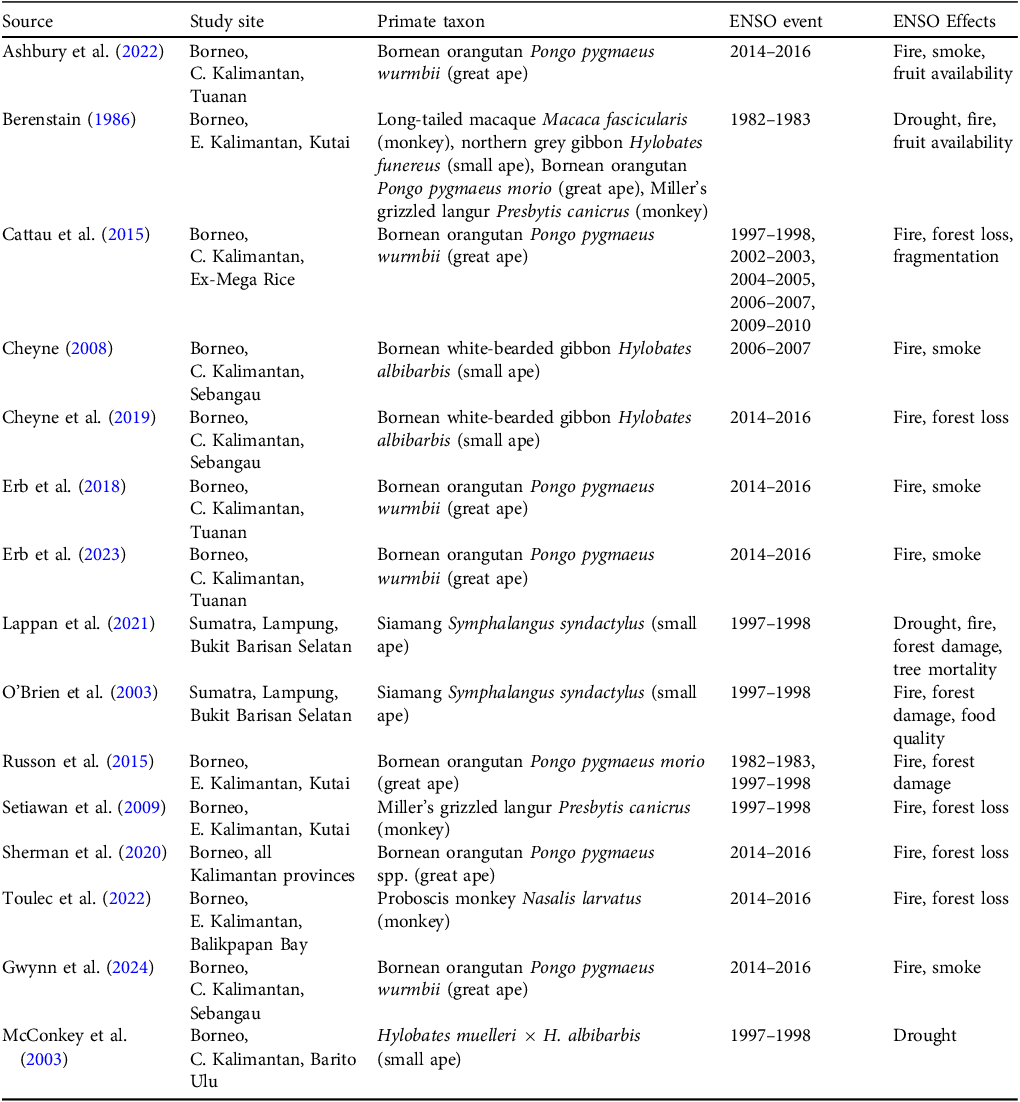
After removing duplicates (15 of 376; Supplementary Material 2), we reviewed the results by article type, ensuring that only the 257 peer-reviewed journal articles were included for further review. Next, we screened the articles by title, and only those mentioning any of the species of interest, El Niño or El Niño-related factors, or one or more of the included countries, were kept for the next stage (88). We then reviewed abstracts, only including studies of primates in the region of interest that mentioned El Niño, drought, fire, smoke, temperature or rainfall (32). We then conducted a full-text review of the remaining articles. In our final selection, we included studies that explicitly mentioned El Niño as a contributing factor to reduced rainfall, increased temperature, fire or smoke. Additionally, we included studies focusing on drought, fire or smoke that overlapped substantially with one or more El Niño events, even if El Niño was not explicitly mentioned, because of the stronger and more direct links between these phenomena and extreme climate events (Supplementary Table 1). We summarized the final 15 studies by location, taxon, El Niño event(s), and El Niño-related factor(s) (Table 1).
The 15 studies included in our review. For each entry, we provide the island, province and site where the study took place (all were conducted in Indonesia), taxon, date(s) of El Niño, and the El Niño-related effects.

Table 1 Long description
A table with 15 rows and 5 columns. The columns are labeled Source, Study site, Primate taxon, ENSO event, and ENSO Effects. Each row provides details of a study, including the source, study site in Borneo or Sumatra, the primate taxon studied, the ENSO event year(s), and the effects observed such as fire, smoke, drought, and forest loss. The studies cover various primates like Bornean orangutans, long-tailed macaques, and gibbons, with ENSO events ranging from 1982 to 2016.
Results
Geographical and taxonomic representation
The 15 selected articles demonstrate limited geographical and taxonomic representation of research on El Niño-driven environmental impacts on primates within Southeast Asia. All studies were conducted in Indonesia. Among these, 86.7% (13 of 15) were conducted in Borneo (Kalimantan) and the remainder in Sumatra. Of the studies in Borneo, 61.5% (8 of 13) were from three sites in Central Kalimantan, 30.8% (4 of 13) from two sites in East Kalimantan, and 7.7% (1 of 13) covered all Kalimantan provinces. In Sumatra, both studies were from the same research site in southern Sumatra (Table 1).
Taxonomically, studies focused on diurnal apes and monkeys, with no representation of the region’s nocturnal tarsiers or lorises (Table 1). The largest proportion (53.3%, 8 of 15) examined the Bornean orangutan (a great ape), covering all three subspecies: Pongo pygmaeus wurmbii, P. pygmaeus morio and P. pygmaeus pygmaeus. Small apes were the subject of 40% of studies (6 of 15), including Sumatra’s siamang Symphalangus syndactylus and Borneo’s white-bearded Hylobates albibarbis, northern grey Hylobates funereus and Hylobates muelleri × H. albibarbis (previously known as Hylobates muelleri × H. agilis) gibbons. Borneo’s monkeys were the subject of 20% of studies (3 of 15), covering the long-tailed macaque Macaca fascicularis, Miller’s grizzled langur Presbytis canicrus, previously known as P. hosei, and the proboscis monkey Nasalis larvatus. The majority of studies in our review focused on single species, but one covered multiple sympatric primates.
El Niño events and effects
The articles in our review investigated El Niño events from 1982 onwards, with a predominant focus on strong events, including 1982–1983 (13.3% of studies, 2 of 15), 1997–1998 (40.0%, 6 of 15), and 2014–2016 (46.7%, 7 of 15; Table 1). Only one study specifically examined the impacts of a moderate El Niño event (2006–2007). Most studies (73.3%, 11 of 15) concentrated on a single El Niño event, and the remainder (26.7%, 4 of 15) used longer datasets overlapping multiple events or examined impacts in areas previously affected by more than one El Niño event. The majority of articles (53.3%, 8 of 15) examined the direct impact of habitat loss as a result of fire. Three (20.0%) investigated the impacts of reduced habitat quality (including changes in food availability) resulting from drought, fire and/or smoke, and four articles (26.7%) focused specifically on smoke (Table 1).
The studies took diverse approaches to investigate the impacts of El Niño-driven drought, fire and smoke on primates. Nine studies conducted research during an El Niño event, but also collected data over a longer period of time, or used long-term datasets before and/or after the studied environmental factors (e.g. fire, smoke or drought) to investigate changes and recovery over time (Berenstain, Reference Berenstain1986; McConkey et al., Reference McConkey, Ario, Aldy and Chivers2003; Cheyne, Reference Cheyne2008; Russon et al., Reference Russon, Kuncoro and Ferisa2015; Erb et al., Reference Erb, Barrow, Hofner, Utami-Atmoko and Vogel2018; Cheyne et al., Reference Cheyne, Capilla, Abdulaziz, Supiansyah, Cahyaningrum and Smith2019; Ashbury et al., Reference Ashbury, Meric de Bellefon, Kunz, Abdullah, Marzec and Fryns2022; Erb et al., Reference Erb, Barrow, Hofner, Lecorchick, Mitra Setia and Vogel2023; Gwynn et al., Reference Gwynn, Morrogh-Bernard, Thornton, Segah, Azis and Van Veen2024). These datasets varied significantly in length, from 6 months to > 40 years, presenting evidence for both short- and long-term impacts. Two studies conducted research immediately after El Niño-induced fires, and continued long-term data collection for 3 years in one case (O’Brien et al., Reference O’Brien, Kinnaird, Nurcahyo, Prasetyaningrum and Iqbal2003) and 18 years in the other (Lappan et al., Reference Lappan, Sibarani, O’Brien, Nurcahyo, Andayani and Rustiati2021). Three articles involved population surveys conducted in areas directly affected by and following an El Niño event, but the data collection period did not directly overlap the event. Two of these were single surveys conducted after one or more El Niño events (Setiawan et al., Reference Setiawan, Nugroho and Pudyatmoko2009; Cattau et al., Reference Cattau, Husson and Cheyne2015), and the third compared three separate surveys covering a 10-year period, before and after the 2014–2016 strong El Niño event (Toulec et al., Reference Toulec, Lhota, Scott, Putera, Kustiawan and Nijman2022). One study documented a sharp increase in translocations of Bornean orangutans during the 2015 El Niño-driven fires, highlighting the direct impact of habitat loss (Sherman et al., Reference Sherman, Ancrenaz and Meijaard2020).
Impacts on primates
Among the 15 articles, three major themes emerged concerning the impacts of El Niño on primates: (1) population size and structure, (2) behaviour (diet, activity, ranging and social interactions), and (3) health and physical condition.
Population size and structure
Six studies examined the effects of fires on populations of primates on Borneo and Sumatra (Table 1). In the four months following the 1983 fires in Kutai National Park (Borneo), Berenstain (Reference Berenstain1986) observed groups of long-tailed macaques, orangutans, gibbons and Miller’s grizzled langurs. During this period, he documented no loss of groups or mortality for any of these species. Similarly, two years after the 2015 fires, a survey of proboscis monkeys in Balikpapan Bay (Borneo) showed no signs of decline (Toulec et al., Reference Toulec, Lhota, Scott, Putera, Kustiawan and Nijman2022).
In contrast, the four studies that examined the impacts of the 1997 fires documented significant changes in primate populations. Two studies, conducted a decade after the 1997 fires, found dramatic changes in Bornean primate populations. Ten years after the fires in Kutai National Park, surveys for Miller’s grizzled langur documented an alarming disappearance of the species from this site (Setiawan et al., Reference Setiawan, Nugroho and Pudyatmoko2009). Surveys in the Ex-Mega Rice Project area found that orangutan population density had dramatically increased because of crowding in small forest fragments that were isolated by fires 12 years previously (Cattau et al., Reference Cattau, Husson and Cheyne2015).
In the years after the 1997 fires, demographic changes in groups of siamangs at Bukit Barisan Selatan National Park (Sumatra) were documented over two time periods. Three years after the fires, O’Brien et al. (Reference O’Brien, Kinnaird, Nurcahyo, Prasetyaningrum and Iqbal2003) found that groups inhabiting burnt areas had a higher proportion of adults and subadults than groups in non-burnt areas (74% vs 63%) and also showed lower survival of infants and juveniles. Eleven years after the fires, Lappan et al. (Reference Lappan, Sibarani, O’Brien, Nurcahyo, Andayani and Rustiati2021) found that groups whose home ranges overlapped burnt areas were still smaller than those that ranged in unburnt areas.
Behaviour
Five studies examined the effects of drought, fire and smoke on the diets and activity patterns of long-tailed macaques, gibbons and orangutans in Borneo. Before, during and after the 1983 fires, Berenstain (Reference Berenstain1986) made full-day behavioural observations of one group of long-tailed macaques in Kutai National Park. He documented a sharp increase in the proportion of time the monkeys spent feeding on insects/caterpillars, foliage, stems, petioles and unripe seeds of dipterocarps during the 4 months after the fire. During this time, the macaques also increased resting and decreased foraging time.
McConkey et al. (Reference McConkey, Ario, Aldy and Chivers2003) studied food choices of two hybrid gibbon groups before and during a severe drought in 1997 in Barito Ulu, Central Kalimantan. They showed that gibbon food choice was influenced by weather-driven shifts in food availability. When other fruits were scarce during periods of low rainfall, gibbons consumed more figs, flowers and young leaves. An unusual peak in flower consumption was recorded during the drought, which was linked to an El Niño-induced mast that caused an atypical abundance of flowers.
Russon et al. (Reference Russon, Kuncoro and Ferisa2015) studied orangutan feeding, diet and activity patterns at Kutai National Park following the 1997 drought and fires. They showed that in the first year after the fires, orangutans ate twice the number of their top food choices (i.e. plant taxa representing > 20% of feeding time) and consumed a more diverse diet (50–100% more species) comprising relatively few fruit foods. By 12–15 years post-fire, however, the diet had returned to original patterns. In the 3–4 years post-fire, orangutans spent less time feeding and more time resting; but had shifted toward pre-fire activity patterns after 12–15 years, corresponding with changes in the availability and distribution of food.
Two studies examined the effects of smoke from the 2015 fires on adult female and flanged male orangutans at Tuanan. Ashbury et al. (Reference Ashbury, Meric de Bellefon, Kunz, Abdullah, Marzec and Fryns2022) used longitudinal data collected during 2010–2018 to compare activity and diet of adult females during low-fruit periods before and up to 32 months after the fires. They showed that female orangutans adopted energy-conserving shifts in their diet and activity patterns post-fire. In particular, in the low-fruit periods following the fires, females rested more and travelled less, while consuming less-preferred foods (e.g. bark, pith, mature leaves). In another study, Erb et al. (Reference Erb, Barrow, Hofner, Utami-Atmoko and Vogel2018) compared activity and diet of adult flanged males for 5 months before, 2 months during, and 3 months after the 80-day period of poor air quality caused by the 2015 fires. In this study, adult flanged males rested more during the smoke and post-smoke periods compared to the pre-smoke baseline. Similarly, during the post-smoke period, they travelled less while simultaneously consuming more calories compared to pre-smoke levels.
The impacts of fire and smoke on primate ranging and group cohesion were documented in four studies of macaques, gibbons and orangutans in Borneo, and siamangs in Sumatra. In the four months following the 1983 fires in Kutai National Park (Borneo), long-tailed macaques greatly reduced their daily range, exhibited more terrestrial behaviour and reduced group cohesion (Berenstain, Reference Berenstain1986). In Bukit Barisan Selatan National Park (Sumatra), O’Brien et al. (Reference O’Brien, Kinnaird, Nurcahyo, Prasetyaningrum and Iqbal2003) and Lappan et al. (Reference Lappan, Sibarani, O’Brien, Nurcahyo, Andayani and Rustiati2021) studied the home ranges of seven siamang groups following the 1997 fires. Groups whose home ranges included fire-damaged habitat had not substantially expanded their ranges into the recovering area during the 3–11-year period following the fires. By 18 years post-fire, however, the home ranges of two of the three groups included substantial areas of burnt habitat. Similarly, in 2002 (5 years after the fires), no siamang groups were observed in the burnt interior, but between 2012 and 2017, two groups and two or more solitary individuals were observed ranging there.
Two studies documented changes in ranging behaviour of apes in Borneo after the 2015 fires. In Sebangau Forest, Cheyne et al. (Reference Cheyne, Capilla, Abdulaziz, Supiansyah, Cahyaningrum and Smith2019) documented a shift in home range location for the group of white-bearded gibbons whose range was damaged by fire (up to 3 years post-fire). For the three adjacent groups whose ranges did not overlap burnt habitat, no changes were observed in their home range locations. At Tuanan, flanged male orangutans’ daily path length decreased in the 3 months following the smoke compared to the 5-month pre-smoke period (Erb et al., Reference Erb, Barrow, Hofner, Utami-Atmoko and Vogel2018).
Lastly, changes in social behaviour in response to wildfire smoke were documented in three studies of apes on Borneo. White-bearded gibbons in Sebangau reduced the number of singing days and song bout length on smoky days during the 2006 fires compared to non-smoky days (Cheyne, Reference Cheyne2008). In the 3 months following the 2015 fires, flanged male orangutans at Tuanan decreased their long-call rates during and/or after prolonged exposure to wildfire smoke (Erb et al., Reference Erb, Barrow, Hofner, Lecorchick, Mitra Setia and Vogel2023). In another study of Tuanan orangutans, Ashbury et al. (Reference Ashbury, Meric de Bellefon, Kunz, Abdullah, Marzec and Fryns2022) documented changes in the social behaviour of adult females during low-fruit periods before and after the 2015 fires. Post-fire, they documented decreased probabilities of association between females and weaned immature offspring, and between related and unrelated adult females, and increased probability of agonism.
Health and physical condition
Five studies examined the effects of fire and smoke on the condition and health of macaques and orangutans in Borneo. After the drought and fires in 1982–1983, long-tailed macaques in Kutai National Park appeared to lose weight and looked emaciated (Berenstain, Reference Berenstain1986). At Tuanan, Erb et al. (Reference Erb, Barrow, Hofner, Utami-Atmoko and Vogel2018, Reference Erb, Barrow, Hofner, Lecorchick, Mitra Setia and Vogel2023) used urine analysis to monitor changes in the energy status of flanged males and recorded their long calls, before, during and after smoky periods caused by the 2015 fires. They documented an increase in the proportion of urine samples containing ketones (indicating fat catabolism) as well as reduced vocal quality (i.e. increased harshness, perturbations, and biphonation) in the 3 months following the smoky period compared to the pre-smoke period. At Sebangau, Gwynn et al. (Reference Gwynn, Morrogh-Bernard, Thornton, Segah, Azis and Van Veen2024) also studied orangutans before, during and after the smoke in 2015, investigating the prevalence and intensity of gastrointestinal parasites. They found that, following exposure to wildfire smoke, orangutans had a higher prevalence of Enterobius and Trichuris spp., and greater hookworm (Necator americanus/Ancylostoma duodenale) infection intensity compared to the pre-smoke period. In a study of orangutan translocations during 2007–2017 across Kalimantan, Sherman et al. (Reference Sherman, Ancrenaz and Meijaard2020) showed that translocations were highest in 2015 and 2016, following the 2015 fires. High levels of translocations occurred in areas affected by fires and adjacent human-modified areas. Of the translocated individuals, approximately half of the starving, malnourished or underweight orangutans had been driven out of their habitats by the fires in 2015.
Discussion
Our systematic review highlights the varied impacts of El Niño-driven environmental changes on primates in Southeast Asia, with the majority of studies showing dramatic effects at both population and individual levels. Drought and fire can lead to habitat loss and degradation, as well as extended periods of low fruit production. This can cause dietary, behavioural and ranging changes in primates, which, in turn, can affect physical condition. Studies show that, in the short term, individuals inhabiting the worst-hit areas may suffer direct mortality as a result of fire or be displaced from their habitat, potentially leading to human intervention when animals enter human-dominated environments. Studies also show that longer-term consequences include crowding of primates within forest fragments, smaller groups, reduced infant survival rates and, in rare cases, local extirpation. Smoke inhalation can lead to behavioural changes, such as energy-conserving activity patterns and alterations in vocal behaviour and quality, and may contribute to a decline in overall health (Fig. 1).
Conceptual diagram illustrating the negative impacts of El Niño on Southeast Asian primates, based on our systematic literature review.

Fig. 1 Long description
A conceptual diagram illustrating the negative impacts of El Niño on Southeast Asian primates. The diagram shows various interconnected factors and their effects. At the bottom, an El Niño event is depicted, leading to increased temperature and reduced rainfall. These conditions result in drought, fire, and smoke, which in turn affect forest quality and fruit availability. Reduced fruit availability impacts the diet of primates, leading them to switch to fallback foods, consume fewer fruits, and consume more calories. This change in diet, along with increased activity such as rest and travel, affects the health of primates, causing emaciation, malnutrition, dehydration, ketosis, and reduced vocal quality. The health impacts, along with changes in group size and composition, and population density, lead to population-level impacts such as population crowding and local extirpation. The diagram also shows the interconnectedness of these factors, illustrating how El Niño events can have cascading effects on primate populations.
However, the published literature is limited in both scale and scope. We found only 15 studies on this subject, with narrow geographical and taxonomic representation. Of the 105 primate species inhabiting Southeast Asia (IUCN, 2024), only seven (7%) have been studied (33% of great apes, 16% of small apes, 5% of monkeys and 0% of tarsiers or strepsirrhines). Orangutans were the most frequently studied taxon, and there were no studies on lorises and tarsiers, which together represent 22% of Southeast Asia’s primate species. This limited taxonomic scope reflects a broader bias in primate research more generally: a review of primate studies published during 2011–2015 found that just under half of all recognized primate taxa were represented in the literature, with fieldwork focused on a small number of species at a few long-term field stations (Bezanson & McNamara, Reference Bezanson and McNamara2019). This bias leaves substantial gaps in understanding how El Niño affects the region’s primate diversity.
Though Southeast Asia comprises 11 countries, only one country (Indonesia) and two islands (Borneo and Sumatra) were represented in our literature review. This likely reflects the severity of El Niño-related drought and fire in these regions, driven by both their geographical location and anthropogenic pressure (Field et al., Reference Field, van der Werf, Fanin, Fetzer, Fuller and Jethva2016; Hariadi et al., Reference Hariadi, van der Schrier, Steeneveld, Sopaheluwakan, Tank and Roberts2021; Fig. 2). However, several other regions in southern Southeast Asia, such as Java and Sulawesi in Indonesia, Peninsular Malaysia and Malaysian Borneo (i.e. Sabah and Sarawak), are also home to diverse primate communities, yet the impact of El Niño in these regions has thus far been unexplored.
Map of El Niño’s weather effects from December to February across Southeast Asia. Locations of study sites included in our review are indicated by black circles. Map created using ENSO Global Weather Patterns by joe.riedl_portlandcc, hosted on ArcGIS Online (Esri, 2021).

The literature predominantly focuses on strong El Niño events, particularly those occurring in 1997–1998 and 2014–2016, revealing a research bias towards strong events and an increase in research interest in recent years, with a notable absence of research prior to the 1982–1983 strong El Niño event. Widespread fires and haze are more likely to occur during strong El Niño events; however, the lack of studies exploring the impacts of moderate events highlights a gap in our understanding of how these more frequent but less severe climatic events may affect primates. The one study that focused on a moderate El Niño event reported changes in behaviour (Cheyne, Reference Cheyne2008), suggesting that even less severe events can have consequences for primates.
Fire emerged as the most commonly studied El Niño-driven factor, probably because of its immediate and observable consequences. Of the 10 studies that considered fire as a key factor, nine documented negative impacts on primates, including habitat loss, displacement and reduced food availability. In contrast, one study found that El Niño-driven fires affected only a small proportion of proboscis monkey habitat, probably because of the species’ preference for riverine and coastal habitats, which are more resistant to fire (Toulec et al., Reference Toulec, Lhota, Scott, Putera, Kustiawan and Nijman2022).
Smoke also emerged as a significant factor influencing primates, but research has focused on only two species (the Bornean orangutan and white-bearded gibbon), with smoke exposure linked to negative effects on health and behaviour. These findings align with evidence from multiple studies on captive macaques exposed to wildfire smoke in the USA, underscoring the potential for long-term health consequences such as increased pregnancy loss and severe health and cognition outcomes for neonates and infants (Capitanio et al., Reference Capitanio, Del Rosso, Gee and Lasley2022; Berns & Haertel, Reference Berns and Haertel2024). A recent global review of wildfire smoke and impacts on wildlife highlighted the breadth of its impacts across species, including respiratory problems, reduced mobility and heightened vulnerability to disease (Sanderfoot et al., Reference Sanderfoot, Bassing, Brusa, Emmet, Gillman, Swift and Gardner2022).
The broader range of environmental changes caused by El Niño, such as drought and heat, remain relatively understudied in Southeast Asia’s primates. The few studies that considered these factors all focused on strong El Niño events, and found that drought reduces plant productivity, leading to lower fruit availability, which is linked to behavioural and dietary changes and reduced physiological condition (Berenstain, Reference Berenstain1986; McConkey et al., Reference McConkey, Ario, Aldy and Chivers2003; Ashbury et al., Reference Ashbury, Meric de Bellefon, Kunz, Abdullah, Marzec and Fryns2022).
Taken together, the limited environmental, taxonomic and geographical scope of the studies included in our review probably skews our understanding of how primates are affected across the region. In areas where fire risk is lower, the impacts of El Niño may manifest in subtle but still impactful changes, such as shifts in food availability or water sources. Although most studies attributed observed changes in primate behaviour and health to fire or smoke, extreme heat and drought also contribute, directly and indirectly, through effects on habitat quality and food resources driven by altered plant productivity (Berenstain, Reference Berenstain1986; McConkey et al., Reference McConkey, Ario, Aldy and Chivers2003). These interconnected factors (rainfall, temperature, fire and smoke) are rarely considered together, limiting our ability to pinpoint the explicit drivers of primate responses during these climatic events. As a result, this more nuanced understanding of El Niño’s multifaceted impacts remains a critical knowledge gap, constraining our ability to generalize the effects of El Niño across Southeast Asia’s diverse primate populations.
Our review reveals key limitations in our understanding of the long-term impacts of El Niño on primates. One-third of the research relied on short-term (≤ 1 year) data collection (McConkey et al., Reference McConkey, Ario, Aldy and Chivers2003; Cheyne, Reference Cheyne2008; Erb et al., Reference Erb, Barrow, Hofner, Utami-Atmoko and Vogel2018, Reference Erb, Barrow, Hofner, Lecorchick, Mitra Setia and Vogel2023; Gwynn et al., Reference Gwynn, Morrogh-Bernard, Thornton, Segah, Azis and Van Veen2024) and/or one-off post-event population surveys (Setiawan et al., Reference Setiawan, Nugroho and Pudyatmoko2009; Cattau et al., Reference Cattau, Husson and Cheyne2015), which provide valuable snapshots of how primates respond in the immediate aftermath of environmental disturbances. However, they do not provide insights into how populations adapt or recover over time. This is particularly important given that the ecological effects of El Niño-driven changes can continue over years or even decades. Furthermore, one-off population surveys conducted after one or more El Niño events are informative but limited in their ability to infer causal links between El Niño-driven environmental changes and observed population changes. In contrast, repeated population surveys conducted across a longer period offer a more in-depth understanding of population dynamics in relation to El Niño, allowing a more robust analysis of the impacts of environmental changes on primates.
The few longitudinal studies included in our review (spanning up to 40 years) underscore the importance of continuous monitoring to reveal both short- and long-term impacts. Longitudinal research offers crucial insights into primate resilience and recovery. For instance, two studies presented evidence suggesting that primates are capable of recovering and utilizing previously burnt forest within 2 decades if it is left to regenerate naturally (Russon et al., Reference Russon, Kuncoro and Ferisa2015; Lappan et al., Reference Lappan, Sibarani, O’Brien, Nurcahyo, Andayani and Rustiati2021); this is crucial information that cannot be obtained in shorter research periods. However, such datasets are rare because of the practical difficulties of maintaining extended research field programmes. This, along with the unpredictable nature of El Niño, explains why most research is concentrated at established long-term research sites, where researchers are able to respond opportunistically to environmental changes.
Our review underscores the significant impacts of El Niño on primates and highlights a need for more comprehensive research on primate responses to environmental extremes. Given the likely increase in the frequency and intensity of El Niño because of climate change, there is a pressing need to understand how these events affect primates in areas most vulnerable, particularly Southeast Asia. Given their large size, perceived charisma and critical role in ecosystem health and function, primates are an ideal focal group for research on climate-driven events. We recommend more research, to expand geographical and taxonomic representation and thus enhance our understanding of the diversity and severity of El Niño’s impacts across taxa and regions. Utilizing advanced research technologies such as camera traps, drones and autonomous recording units could enhance data collection by simultaneously reducing human risk and providing broader-scale insights into population- and species-specific responses to environmental changes. Finally, collaboration is essential, and building a network of researchers, particularly those with long-term study sites, would support the collection of robust, long-term, comparative datasets, strengthening conservation efforts across the region. Considering the potential implications of climate-driven events such as El Niño for biodiversity and ecosystem resilience, it is imperative that scientists and conservation practitioners act collectively to address this globally important issue.
Supplementary material
The supplementary material for this article is available at doi.org/10.1017/S0030605325102445
Author contributions
Conceptualization: EJB; literature review: EJB, WME; writing: EJB, WME; revisions and editing: EJB, WME; visualization: EJB, WME.
Acknowledgements
This research received no specific grant from any funding agency, or commercial or not-for-profit sectors.
Conflicts of interests
None.
Ethical standards
This research abided by the Oryx guidelines on ethical standards.
Data availability
All data curated and analysed for this study are provided in the supplementary material.


 Open access

