Introduction
The Suidae is a family within the Cetartiodactyla and comprises 17 species belonging to six genera. Originating in the Old World approximately 20 million years ago, they have successfully colonised the African and Eurasian continents (Frantz et al., Reference Frantz, Meijaard, Gongora, Haile, Groenen and Larson2016). Their counterparts in the New World are the pig-like peccaries, Tayassuidae, who diverged from the common ancestry during the late Eocene/early Oligocene (Frantz et al., Reference Frantz, Meijaard, Gongora, Haile, Groenen and Larson2016).
On the African continent, three genera of the Suidae are indigenous and listed on the International Union for Conservation of Nature (IUCN) Red List of Threatened Species as of the least concern: Phacochoerus F. Cuvier, containing Ph. africanus (Gmelin) and Ph. aethiopicus (Pallas) (de Jong et al., Reference de Jong, Butynski and d'Huart2016a, Reference de Jong, Cumming, d'Huart and Butynski2016b), Potamochoerus Gray, comprising Po. larvatus (F. Cuvier) (Seydack, Reference Seydack2016) and Po. porcus (Linnaeus) (Reyna et al., Reference Reyna, Jori, Querouil and Leus2016), and Hylochoerus Thomas, represented by H. meinertzhageni Thomas (d'Huart and Reyna, Reference d'Huart and Reyna2016). Of these, only the geographic range of Ph. africanus and Po. larvatus extends into South Africa (Skinner and Chimimba, Reference Skinner and Chimimba2005; Seydack, Reference Seydack2016). For most of the 20th century, Ph. africanus was commonly considered a subspecies of Ph. aethiopicus and is usually recorded as such in studies pertaining to its ecology, habits and/or parasites. Nowadays, the validity of the two species of warthogs is again recognised. In South Africa, Ph. a. aethiopicus became extinct in the 1870s, and since then only Ph. africanus remains (Skinner and Chimimba, Reference Skinner and Chimimba2005; Wilson and Reeder, Reference Wilson and Reeder2005; Grubb and d'Huart, Reference Grubb and d'Huart2010; de Jong et al., Reference de Jong, Butynski and d'Huart2016a, Reference de Jong, Cumming, d'Huart and Butynski2016b). However, the two species are sympatric in parts of north Somalia, as well as in parts of central, east, and southeast Kenya (de Jong et al., Reference de Jong, Butynski and d'Huart2016a, Reference de Jong, Cumming, d'Huart and Butynski2016b).
Of all the Suidae, Sus Linnaeus is the genus with an almost cosmopolitan distribution. This is not surprising, since the native range of S. scrofa Linnaeus covers vast areas of Eurasia and some North African countries, while humans have introduced the species in countries worldwide, including the Americas, Australia and Africa (Oliver and Leus, Reference Oliver and Leus2008; Frantz et al., Reference Frantz, Meijaard, Gongora, Haile, Groenen and Larson2016). The remaining species of the genus Sus inhabit various parts of Asia, all being listed on the IUCN Red List of Threatened Species as near threatened to critically endangered (Frantz et al., Reference Frantz, Meijaard, Gongora, Haile, Groenen and Larson2016). The second genus of the Suidae in Asia is monotypic, with Porcula salvania (Hodgson) considered extinct, except in a few areas in Assam (Narayan et al., Reference Narayan, Deka and Oliver2008; Frantz et al., Reference Frantz, Meijaard, Gongora, Haile, Groenen and Larson2016), whereas representatives of the third genus, Babyrousa Perry, are categorised as vulnerable and their geographic range is limited to Indonesia (Macdonald et al., Reference Macdonald, Burton and Leus2008, Reference Macdonald, Leus, Masaaki and Burton2016; Leus et al., Reference Leus, Macdonald, Burton and Rejeki2016).
In the Americas, the family Tayassuidae is represented by three extant species in three genera, Pecari tajacu (Linnaeus), listed as of the least concern on the IUCN Red List of Threatened Species, Tayassu pecari (Link), listed as vulnerable, and Catagonus wagneri (Rusconi), considered endangered (Gongora et al., Reference Gongora, Biondo, Cooper, Taber, Keuroghlian, Altrichter, do Nascimento, Chong, Miyaki, Bodmer and Mayor2011a, Reference Gongora, Reyna-Hurtado, Beck, Taber, Altrichter and Keuroghlian2011b; Keuroghlian et al., Reference Keuroghlian, Desbiez, Reyna-Hurtado, Altrichter, Beck, Taber and Fragoso2013; Altrichter et al., Reference Altrichter, Taber, Noss, Maffei and Campos2015).
Although the influence of parasites on host fitness as well as the population dynamics of their hosts is well documented (Hudson and Greenman, Reference Hudson and Greenman1998; Torchin et al., Reference Torchin, Lafferty and Kuris2001; Hudson et al., Reference Hudson, Rizzoli, Grenfell, Heesterbeek and Dobson2002), and the critical conservation status of many species of the Suidae and Tayassuidae is known, knowledge about their helminth parasites is scant.
Given that Ph. africanus is one of the most iconic suids on the African continent, surprisingly little work has been done on its helminth parasites, with most works focusing on taxonomy (Leroux, Reference Leroux1940; Ortlepp, Reference Ortlepp1964; Round, Reference Round1968; Troncy et al., Reference Troncy, Graber and Thal1973; Boomker, Reference Boomker1990; Beveridge, Reference Beveridge2014), and only a few studies describing the composition of helminth assemblages. The latter were conducted in mostly southern Africa and include surveys in Namibia as well as the Mpumalanga and Limpopo Provinces in South Africa (Horak et al., Reference Horak, Biggs, Hanssen and Hanssen1983, Reference Horak, Boomker and Potgieter1988; Boomker et al., Reference Boomker, Horak, Booyse and Meyer1991a; van Wyk and Boomker, Reference van Wyk and Boomker2011), while Ortlepp (Reference Ortlepp1964) examined material obtained from Ph. africanus from Mozambique and South African game reserves in Zululand, now part of KwaZulu-Natal Province. Boomker et al. (Reference Boomker, Horak, Booyse and Meyer1991a) provide a host parasite list for this host comprising 31 species of helminths: trematodes (n = 2), cestodes (n = 6) and nematodes (n = 23).
Even less is known about the helminth fauna of the remaining species of African wild suids, and, as for Ph. africanus, the majority of papers are taxonomic works or based on incidental findings (e.g. van den Berghe, Reference van den Berghe1943; Inglis, Reference Inglis1958; Ortlepp, Reference Ortlepp1964; Round, Reference Round1968; Troncy et al., Reference Troncy, Graber and Thal1973; Iori and Lanfranchi, Reference Iori and Lanfranchi1996).
Likely the best studied of the suids is S. scrofa, which may not be unexpected considering its wide geographic range and economic importance. Most of these studies were done on wild boars in Europe (see Järvis et al., Reference Järvis, Kapel, Moks, Talvik and Mägi2007 and references cited therein), with fewer studies conducted in Africa, Asia, the Middle East and the Americas (e.g. Ajayi et al., Reference Ajayi, Arabs and Adeleye1988; Pence et al., Reference Pence, Warren and Ford1988; McKenzie and Davidson, Reference McKenzie and Davidson1989; Esrony et al., Reference Esrony, Kambarage, Mtambo, Muhairwa and Kusiluka1997; Solaymani-Mohammadi et al., Reference Solaymani-Mohammadi, Mobedi, Rezaian, Massoud, Mohebali, Hooshyar, Ashrafi and Rokni2003; da Silva and Müller, Reference da Silva and Müller2013a, Reference da Silva and Müller2013b; Ahn et al., Reference Ahn, Ahn, Kim, Suh, Joo and Shin2015; Mansouri et al., Reference Mansouri, Sarkari and Mowlavi2016; Chaisiri et al., Reference Chaisiri, Aueawiboonsri, Kusolsuk, Dekumyoy, Sanguankiat, Homsuwan, Peunipoom, Okamoto, Yanagida, Sako and Ito2017).
The helminths of both barbirusas and peccaries are poorly studied (Schwartz and Alicata, Reference Schwartz and Alicata1933; Samuel and Low, Reference Samuel and Low1970; Corn et al., Reference Corn, Pence and Warren1985; Munro et al., Reference Munro, Kaspe, Sasmita and Macdonald1990; Romero-Castañón et al., Reference Romero-Castañón, Ferguson, Güiris, González, López, Paredes and Weber2008; Widyarsi, Reference Widyarsi2011).
The common warthog, Ph. africanus, is found in Grassland, Shrubland and Savanna habitats in sub-Saharan Africa. Warthogs are diurnal and spend much of the day grazing on short grass, preferring fresh and new shoots, sedges, herbs and wild fruits. Nights are spent holed up, typically in repossessed aardvark [Orycteropus afer (Pallas)] burrows that are changed frequently, possibly to avoid high parasite burdens (Somers et al., Reference Somers, Penzhorn and Rasa1994; Skinner and Chimimba, Reference Skinner and Chimimba2005). Socially, Ph. africanus is organised in the following categories: solitary males; bachelor groups containing 2–3 males more than one year old; matriarchal groups consisting of adult females with juveniles and/or yearlings; or yearling groups. Yearling groups comprising males and females break up as the females farrow and yearling males either move off as solitary adult males or remain part of bachelor groups (Somers et al., Reference Somers, Rasa and Penzhorn1995; Skinner and Chimimba, Reference Skinner and Chimimba2005).
In this paper, we describe the helminth community of Ph. africanus in a game reserve in the KwaZulu-Natal Province, South Africa, a region for which currently only scant information on this particular host-parasite system is available, and assess the influence of host age and sex on the composition and abundance of these helminth assemblages. We expected males to carry higher helminth burdens than females as is the case with many mammal species (Folstad and Karter, Reference Folstad and Karter1992; Poulin, Reference Poulin1996; Arneberg, Reference Arneberg2002; Moore and Wilson, Reference Moore and Wilson2002; Wirsing et al., Reference Wirsing, Azevedo, Larivière and Murray2007). With regard to the effect of age, we proposed two alternative predictions, namely that yearlings will be (a) more heavily infected than adults because of their not yet fully-developed immune system (Reinecke, Reference Reinecke1983; Anderson, Reference Anderson1987; MacIntosh et al., Reference MacIntosh, Hernandez and Huffman2010) or (b) less infected than adults due to the accumulation of helminth individuals and/or species in older animals (Behnke et al., Reference Behnke, Lewis, Zain and Gilbert1999).
We further compare our findings to earlier studies on the helminth parasites of warthogs in South Africa and compare similarities between helminth communities in warthogs and other species of the Suidae and Tayassuidae worldwide.
Materials and methods
Survey area
In March 2015, 31 free-roaming common warthogs were culled in the Pongola Game Reserve (PGR; 27° 22′ 09.26″ S, 31° 50′ 42.16″ E), KwaZulu-Natal Province, South Africa. The PGR is situated in the Savanna biome and forms part of the Zululand Lowveld. This bioregion is typically characterised by summer rainfall, although some rains might fall in winter, with mean annual precipitation ranging from 500–900 mm. Summers are warm to hot, and the mild winters remain frost-free (Mucina and Rutherford, Reference Mucina and Rutherford2006). The Pongola River, which flows through the reserve, is perennial and provides water throughout the year, together with the Pongolapoort Dam, which it enters within the boundaries of the reserve (http://www.pongolagamereserve.co.za). Altitude within the reserve varies from approximately 140–600 m above sea level (http://en-za.topographic-map.com/places/Pongola-Nature-Reserve-9257351/).
Survey animals and parasite collection
Warthogs were culled over a period of five days at different sites within the PGR, using single shot bolt action rifles during daylight (ethical clearance number: 11LV_HOF02) and within a radius of approximately 1 km from the water. The animals were shot as part of a project evaluating quality characteristics of warthog meat from different sex (males, females) and age classes [adults (>24 months), yearlings (12–24 months)] (see Rudman et al., Reference Rudman, Leslie, van der Rijst and Hoffman2018 for further details on age classification and processing of animals). Except for the fact that specific sex and age classes were targeted, warthogs were shot randomly and belonged to different groups. Of the 31 warthogs that were culled, 30 (eight adult females, eight adult males, eight juvenile females and six juvenile males) could be examined for gastrointestinal helminths.
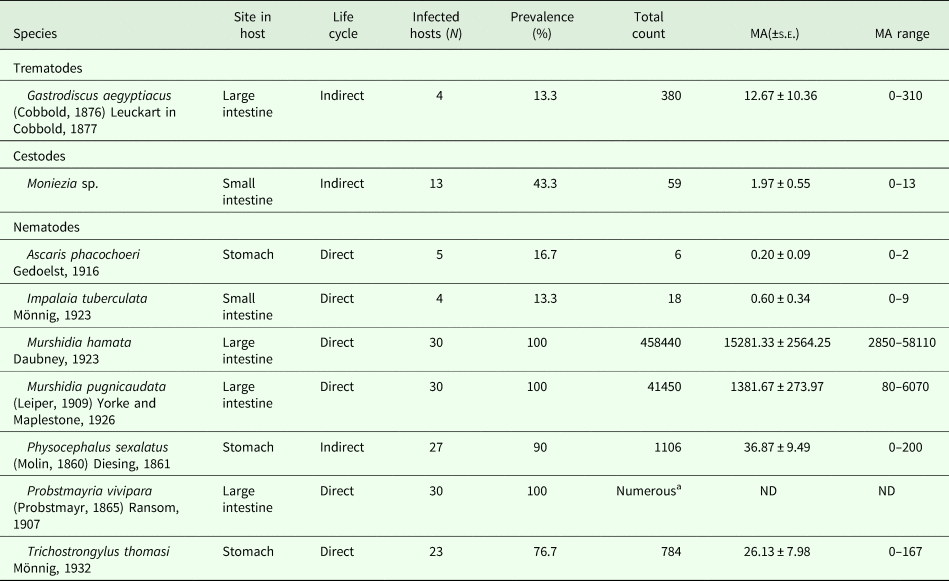
Carcasses were transported to the government accredited slaughter facility within the PGR, skinned and eviscerated. The gastrointestinal tract (GIT) was divided into stomach, small intestine and large intestine and these sections were placed into individual trays and cut open. Macroscopically visible parasites were removed and preserved in 70% ethanol. Aliquots of the ingesta from the different GIT sections were prepared and helminths collected from them as described by Boomker et al. (Reference Boomker, Horak, Booyse and Meyer1991a). The heart was opened and examined macroscopically for parasites. Longitudinal incisions, approximately 10 mm apart, were made in the lungs and liver and the exposed surfaces scanned macroscopically for parasites. All helminths collected were stored in 70% ethanol. Except for Probstmayria vivipara (Probstmayr, 1865) (see below), nematodes were identified and counted as temporary mounts in lactophenol under a compound light microscope. Cestodes and digeneans were cleared in Hoyer's medium for identification. Cestode counts reflect the number of scoleces present. We were not able to identify cestodes of the genus Moniezia Blanchard, 1891 to species level and list them here as Moniezia sp. However, Beveridge (Reference Beveridge2014) confirmed the presence of two species of Moniezia in warthogs. Identifications were based on descriptions and redescriptions of the various genera and species recovered; authorities of the species identified are listed in Table 1. Voucher material was deposited in the National Collection of Animal Helminths, Agricultural Research Council-Onderstepoort Veterinary Institute, South Africa (accession numbers S/2019/11-17).
Prevalence and mean abundance (MA ± s.e.) of gastrointestinal helminth parasites collected from 30 common warthogs in the Pongola Game Reserve, South Africa

ND, Not determined.
a This species was too abundant to obtain individual counts.
Data analysis
Three of nine helminth species recorded in this study (Ascaris phacochoeri, Impalaia tuberculata and Gastrodiscus aegyptiacus) demonstrated very low prevalence (13.3–16.7%), whereas the numbers of P. vivipara could not be established due to the extremely high infection intensity of this parasite. For the analyses of the effects of host sex and age on the number of helminths of a given species they harboured, we, therefore, selected the five remaining species (Moniezia sp., Murshidia hamata, M. pugnicaudata, Physocephalus sexalatus and Trichostrongylus thomasi). Of these, Moniezia sp. was the least prevalent (43.3%), resulting in a large number of zeroes in the dataset for this species. In addition, the numbers of Moniezia sp. varied weakly among infected animals (on average, 1.96 ± 0.5 worms per animal). Consequently, we chose to analyse the effect of host sex and age on incidence (i.e. whether a parasite occurs in a host individual or not; Stanko et al., Reference Stanko, Fričová, Miklisová, Khokhlova and Krasnov2015) rather than numbers of this species. The response variable for Moniezia sp. was thus dichotomous and took a value of either 1 or 0 if an individual was either infected with at least one helminth or not, respectively. We analysed the response variable using generalized linear models with the binomial error distribution and logit-link function. Categorical independent variables were host sex and host age as well as interaction between these factors, whereas we included host body mass as a continuous covariate. The effects of host sex and age and their interactions on the numbers of M. hamata, M. pugnicaudata, P. sexalatus and T. thomasi (separately) were analysed using generalized linear models with the gaussian error distribution and identity-link function. The values of the response variables were log+1-transformed prior to analyses. Host body mass was included in the model as a covariate. In addition, we calculated the number of helminth species recorded in each individual host and analysed the effect of host sex and age on this number in a similar way as we did for number of helminth individuals, except that we did not transform the values of the response variable. All analyses were done using R Statistical Environment (R Core Team, 2018). After the initial running of each model, we selected the best model based on the Akaike Information Criterion (AIC), using the function ‘dredge’ from the R package ‘MuMIn’ (Barton, Reference Barton2018) implemented in R, and ran the best model again (in cases, when the best model was not the intercept-only model).
Results
Overall GIT helminth prevalence in common warthogs from the PGR was 100%. Cestodes and trematodes were represented by one species each, whereas the majority of helminths were nematodes, represented by seven species belonging to six genera (Table 1). Except for A. phacochoeri and I. tuberculata, both of which had a low prevalence as well as abundance, all nematode species were highly prevalent. Probstmayria vivipara was the most abundant helminth in all hosts examined, followed by M. hamata which ranged from 2850–58110 individuals per host. Murshidia pugnicaudata was the third most abundant species, although it occurred in distinctly lower numbers (80–6070) than its congener. Mean species richness of GIT helminths was six, ranging from 4–7 species per individual host. In a single warthog, a metacestode of Taenia hydatigena Pallas, 1766 was collected from the mesenteries. No helminths were found in the heart, lungs and liver of the hosts examined.
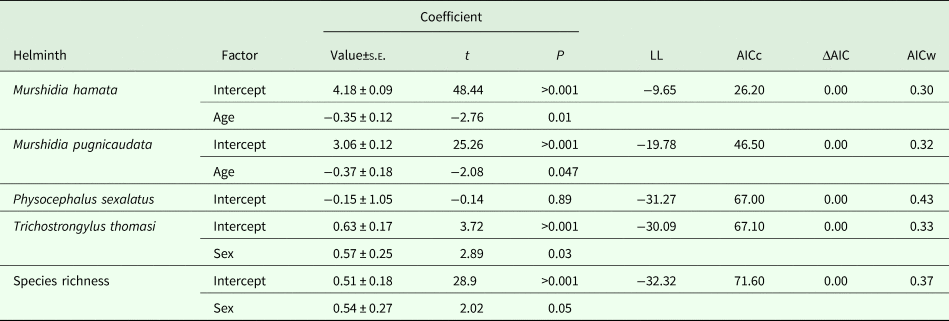
No effect of either host sex or age or their interaction was found for the incidence of Moniezia sp. (z-values of coefficients varied from −0.12 for intercept to 0.70 for the sex × age interaction; P > 0.48 for all). The best model for the incidence of Moniezia sp. was the intercept only model (log-likelihood = −20.53, AICcorrected = 43.2, ΔAIC = 0.00, AICweight = 0.37).
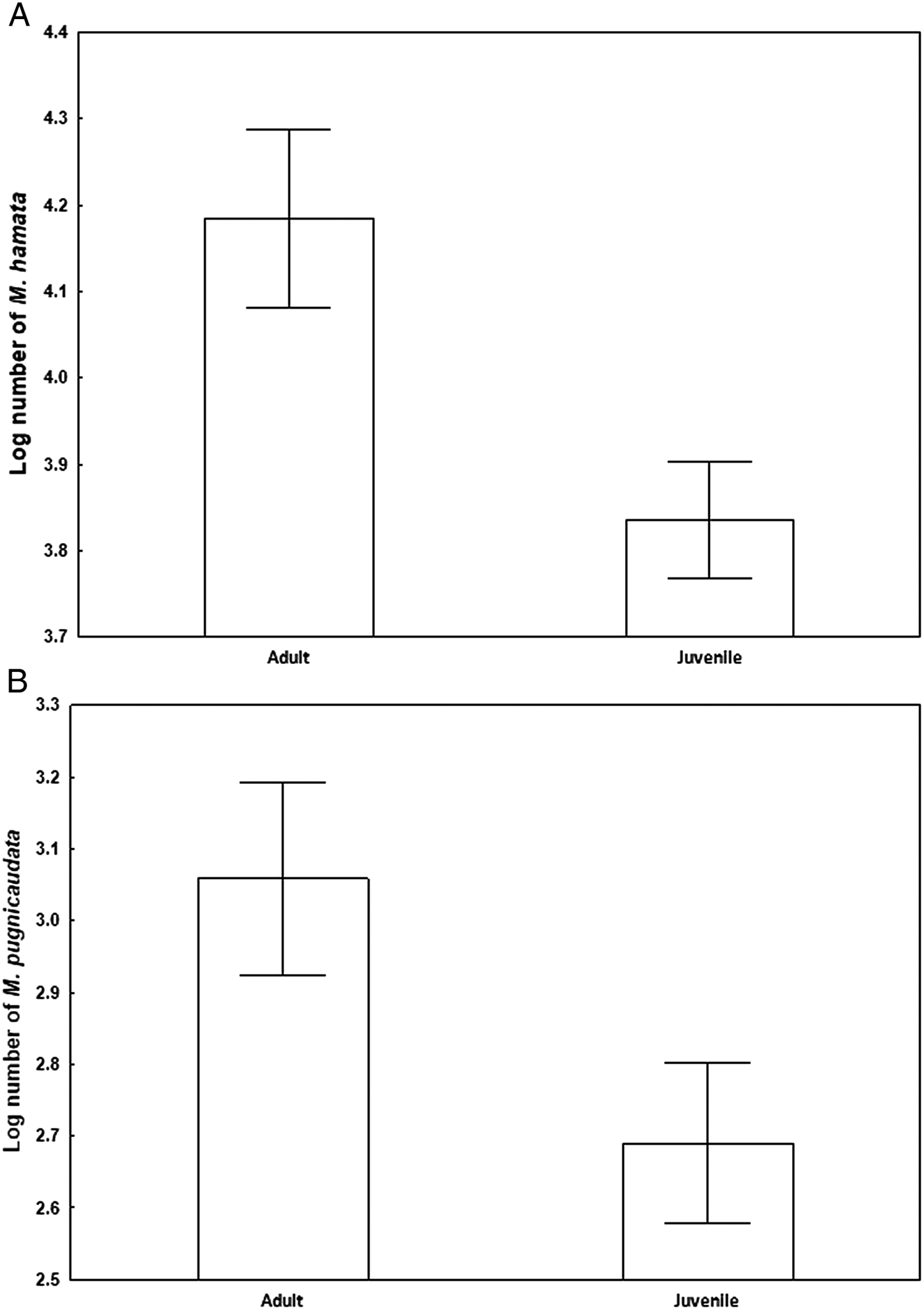
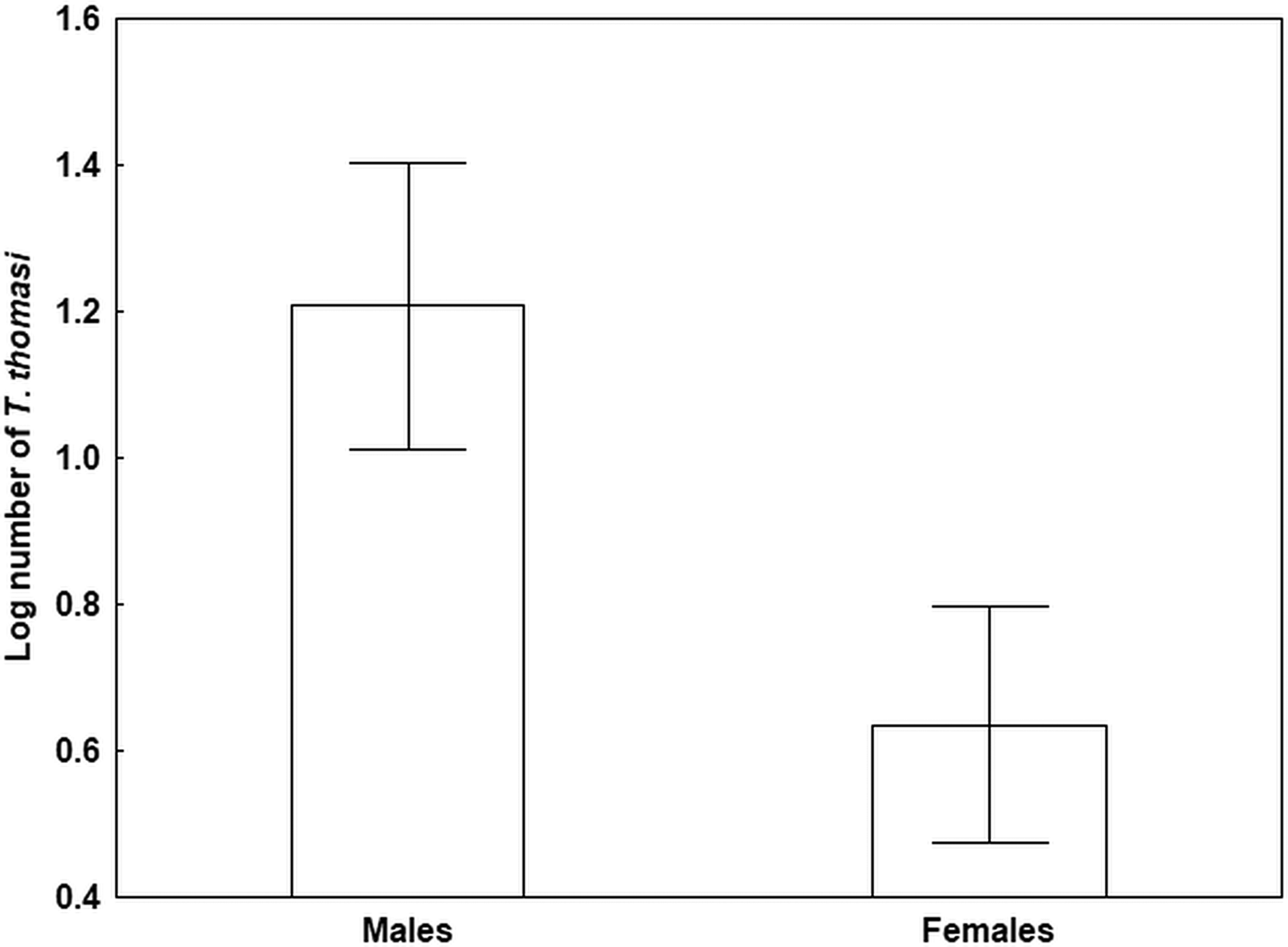
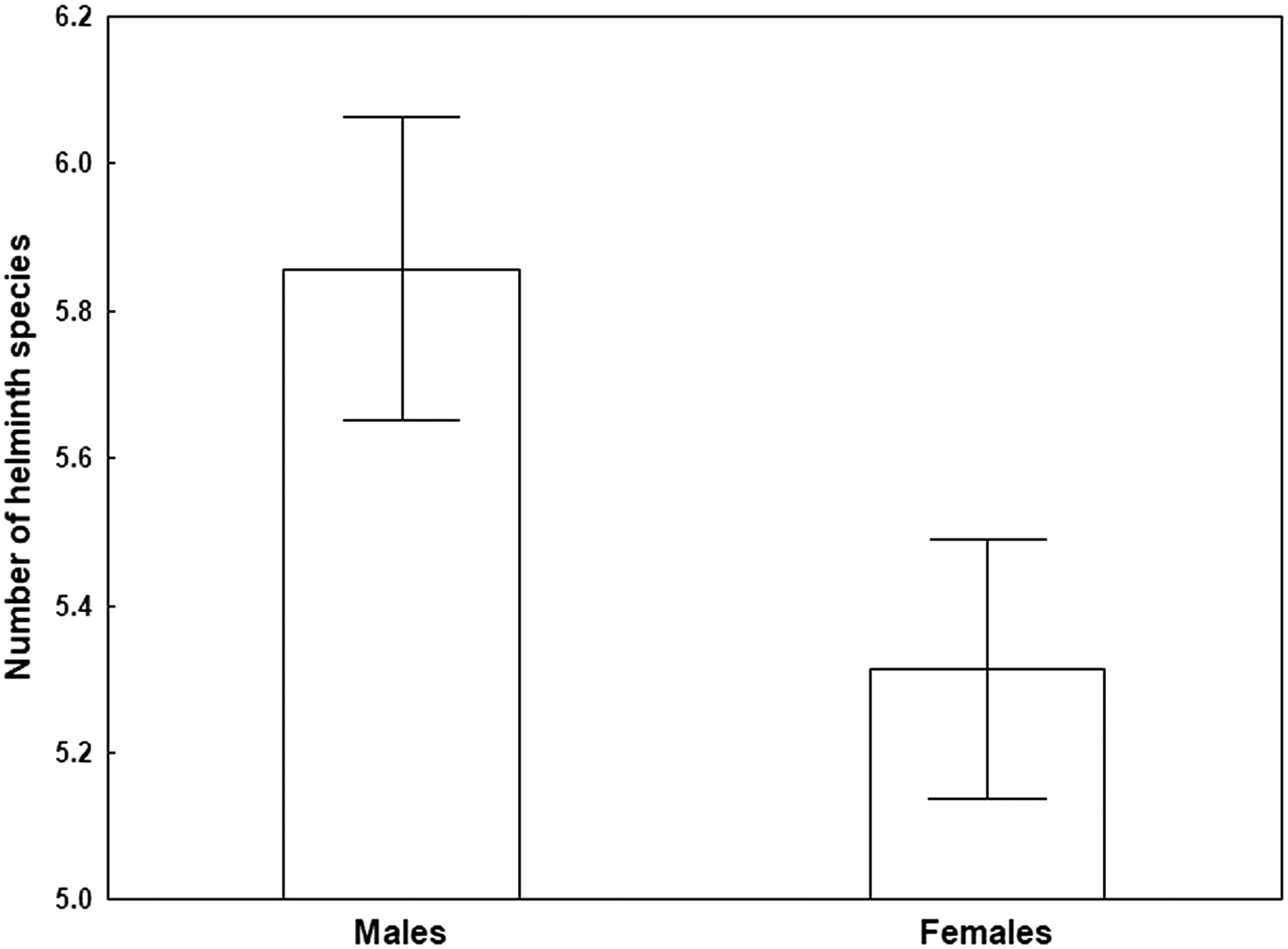
Numbers of M. hamata and M. pugnicaudata were similar in male and female warthogs, but were significantly higher in adults than in yearlings (Table 2, Fig. 1). No effect of either sex or age of a host on the numbers of P. sexalatus was found (Table 2). Numbers of T. thomasi were significantly higher in male than in female warthogs (Table 2, Fig. 2), but did not depend on host age (Table 2). Finally, male warthogs tended to harbour richer helminth assemblages than female warthogs, although this difference was only marginally significant (Table 2, Fig. 3).
Summary of best models of the effect of warthogs' age and sex and their interactions on the number of four helminths species and helminth species richness

LL, log-likelihood; AICc, Aikaike Information Criterion corrected for sample size; ΔAIC, delta AIC; AICw, AIC weight.
Body mass of a host individual was included in the full models as a covariate.
Reference levels of explanatory variables were female for sex and adult for age.
Mean (±s.e.) numbers of Murshidia hamata (a) and M. pugnicaudata (b) in adult and juvenile warthogs.

Mean (±s.e.) numbers of Trichostrongylus thomasi in male and female warthogs.

Mean (±s.e.) number of helminth species harboured by male and female warthogs.

Discussion
The prevalence of helminth infections in warthogs from the PGR was high and each animal that was examined harboured GIT helminths.
All nine species recovered had previously been recorded from Ph. africanus in South Africa and its neighbouring country Namibia (Ortlepp, Reference Ortlepp1964; Horak et al., Reference Horak, Biggs, Hanssen and Hanssen1983, Reference Horak, Boomker and Potgieter1988; van Wyk and Boomker, Reference van Wyk and Boomker2011), and are considered typical parasites of this host. Interestingly, while the number of species recorded from the GIT of warthogs from the PGR and Namibia was similar (9 vs 11), warthogs in Namibia did not harbour any Murshidia spp., but were instead host to Daubneyia spp. (as Oesophagostomum mpwapwae Duthy, 1948, O. mwanzae Daubney, 1924 and O. roubaudi Daubney, 1926). In addition, the genus Impalaia Mönnig, 1923 was represented by I. nudicollis Mönnig, 1931, while I. tuberculata was not found (Horak et al., Reference Horak, Biggs, Hanssen and Hanssen1983). Species richness of helminth assemblages in game and nature reserves in the Limpopo and Mpumalanga Provinces was usually higher than that in the PGR, and helminth assemblages in these two provinces contained both Murshidia spp. as well as Daubneyia spp. (as O. mocambiquei Ortlepp, 1964 and O. mwanzae) (Horak et al., Reference Horak, Boomker and Potgieter1988; Boomker et al., Reference Boomker, Horak, Booyse and Meyer1991a). It is noteworthy that Ortlepp (Reference Ortlepp1964) reported a similar separation of these two oesophagostomine genera in warthogs from Mozambique and KwaZulu-Natal, with the former harbouring only Daubneyia spp. while the latter were parasitised by only Murshidia spp. Little is known about the life cycle of either genus, but oesophagostomines in general have a direct life cycle and eggs as well as first- to third-stage larvae occur free in the environment (Anderson, Reference Anderson2000). A possible explanation for the observed differences in the geographic distribution pattern of the two genera might be a difference in their tolerance towards environmental factors. A number of species of the Strongylida, including Oesophagostomum spp. and Trichostrongylus spp., have been shown to differ in the ability of their eggs to develop at different faecal moisture contents and their susceptibility to moisture and hot and cold temperatures (Rossanigo and Gruner, Reference Rossanigo and Gruner1995; Anderson, Reference Anderson2000; O'Connor et al., Reference O'Connor, Walkden-Brown and Kahn2006).
In areas where Murshidia spp. occur, both species have a more or less equally high prevalence (Horak et al., Reference Horak, Boomker and Potgieter1988; Boomker et al., Reference Boomker, Horak, Booyse and Meyer1991a; this paper), which somewhat contradicts speculation by Troncy et al. (Reference Troncy, Graber and Thal1973) that H. meinertzhageni and not Ph. africanus is the true host of this parasite. However, we consistently found higher numbers of M. hamata than M. pugnicaudata. Similar results have been reported previously (Horak et al., Reference Horak, Boomker and Potgieter1988; Boomker et al., Reference Boomker, Horak, Booyse and Meyer1991a), and this might suggest certain variability in the suitability of warthogs as hosts for these two species.
Trichostrongylus thomasi had a high prevalence in the present study and, following Murshidia spp. and P. sexalatus, had the fourth highest mean abundance of all helminths found in warthogs in the PGR. It had a similarly high prevalence in warthogs in the Kruger National Park (KNP) (Horak et al., Reference Horak, Boomker and Potgieter1988) and the Hoedspruit Nature Reserve (HNR) (Boomker et al., Reference Boomker, Horak, Booyse and Meyer1991a), but was absent in warthogs examined in Limpopo Province by van Wyk and Boomker (Reference van Wyk and Boomker2011), and by Horak et al. (Reference Horak, Biggs, Hanssen and Hanssen1983) in Namibia, where T. colubriformis (Giles, 1892) was found instead, with low prevalence and abundance. Only a few Trichostrongylus spp. females were found in warthogs at a military base situated within the HNR, but separated from it by a number of fences (Boomker et al., Reference Boomker, Horak, Booyse and Meyer1991a). The latter authors pointed out that T. thomasi was typically a parasite of a number of antelope species and considered its presence in warthogs an accidental infection. Warthogs in the KNP, which supports a large diversity of antelopes, were parasitised by a number of Trichostrongylus spp. (Horak et al., Reference Horak, Boomker and Potgieter1988), and it is possible that the Trichostrongylus Looss, 1905 fauna of warthogs at a given locality reflects the helminth fauna of co-occurring antelopes. The same might be true for species of Impalaia, which parasitise a vast number of antelope hosts (Boomker, Reference Boomker1977; Gibbons et al., Reference Gibbons, Durette-Desset and Daynes1977). Unfortunately, there are no data on the helminth assemblages of antelope species in the PGR to confirm these assumptions.
Compared to other nematode species with a direct life cycle, the prevalence of A. phacochoeri (Ascaris sp. in Namibia) in warthogs in southern Africa is relatively low (2.6–46%) (Horak et al., Reference Horak, Biggs, Hanssen and Hanssen1983, Reference Horak, Boomker and Potgieter1988; van Wyk and Boomker, Reference van Wyk and Boomker2011; this study), and the highest mean abundance, recorded in warthogs from HNR, was 4.07 (Boomker et al., Reference Boomker, Horak, Booyse and Meyer1991a). Contrary to Impalaia spp., Murshidia spp. and Trichostrongylus spp., in which developing larvae hatch from the eggs and the phototropic infective third-stage larvae climb to the top of grasses, larvae of Ascaris spp. remain in the egg during their development, and it is the embryonated egg on the ground that has to be ingested by the host (Anderson, Reference Anderson2000). The former might be a more effective mode of transmission in herbivorous warthogs.
Although typically a parasite of equines and highly abundant in zebra in southern Africa (Ransom, Reference Ransom1907; Scialdo-Krecek, Reference Scialdo-Krecek1983; Scialdo-Krecek et al., Reference Scialdo-Krecek, Reinecke and Biggs1983), P. vivipara is clearly a most prominent nematode in helminth assemblages of warthogs, having a prevalence of 100% at all studied localities and an abundance either close to or in their millions (Horak et al., Reference Horak, Biggs, Hanssen and Hanssen1983, Reference Horak, Boomker and Potgieter1988; Boomker et al., Reference Boomker, Horak, Booyse and Meyer1991a; van Wyk and Boomker, Reference van Wyk and Boomker2011; this study). Their extraordinary abundance is likely the result of autoinfection, as females are viviparous and larvae develop to maturity in the large intestine; transmission from host to host is thought to occur when faeces containing larvae are ingested (Anderson, Reference Anderson2000). Allogrooming, including anal licking, has been reported in warthogs (Skinner and Chimimba, Reference Skinner and Chimimba2005) and might contribute towards the transmission of P. vivipara between hosts.
Of the species with an indirect life cycle, the nematode P. sexalatus, which uses a variety of dung beetles as intermediate hosts (Anderson, Reference Anderson2000; Schuster et al., Reference Schuster, Wibbelt and Kinne2014), had the highest prevalence in this and other studies conducted in southern Africa (48–92%), with a moderate abundance, except for the warthogs in Namibia and the HNR, where mean abundance was as high as 341.92 and 371.47, respectively (Horak et al., Reference Horak, Biggs, Hanssen and Hanssen1983, Reference Horak, Boomker and Potgieter1988; Boomker et al., Reference Boomker, Horak, Booyse and Meyer1991a; van Wyk and Boomker, Reference van Wyk and Boomker2011). The cestode genus Moniezia is transmitted by oribatid mites that serve as intermediate hosts (Xiao and Herd, Reference Xiao and Herd1992; Denegri et al., Reference Denegri, Bernadinaz, Perez-Serrano and Rodriguez-Caabeiro1998; Schuster et al., Reference Schuster, Coetzee and Putterill2000). While its prevalence in this and previous studies was moderate to low, with few individuals collected from infected hosts (Horak et al., Reference Horak, Biggs, Hanssen and Hanssen1983, Reference Horak, Boomker and Potgieter1988; Boomker et al., Reference Boomker, Horak, Booyse and Meyer1991a; van Wyk and Boomker, Reference van Wyk and Boomker2011), the genus nevertheless has a wide geographic range. The occurrence of P. sexalatus and representatives of Moniezia in a large variety of geographic localities suggests that their intermediate hosts are wide-spread and readily ingested by the warthogs while feeding.
To the contrary, G. aegyptiacus, whose life cycle entails a freshwater snail and metacercariae that encyst on vegetation near waterbodies (Malek, Reference Malek1971; Mukaratirwa et al., Reference Mukaratirwa, Munjere, Takawira and Chingwena2004), was found only in the PGR and one locality within the KNP (Horak et al., Reference Horak, Boomker and Potgieter1988). We believe that the presence of this digenean in the PGR is attributable to the Pongolapoort Dam, which forms part of the PGR and offers ample suitable habitat for freshwater snail intermediate hosts. The low prevalence of the parasite might be a result of warthogs being relatively independent of permanent sources of water (Skinner and Chimimba, Reference Skinner and Chimimba2005) and suggests that trematode infections play a minor role in this host.
Our finding of a metacestode of T. hydatigena in the mesenteries of one of the warthogs is not unexpected, and taeniids, including Echinococcus spp. and Taenia spp., have repeatedly been reported from warthogs (Horak et al., Reference Horak, Biggs, Hanssen and Hanssen1983, Reference Horak, Boomker and Potgieter1988; Boomker et al., Reference Boomker, Horak, Booyse and Meyer1991a; van Wyk and Boomker, Reference van Wyk and Boomker2011). They are some of the relatively few parasite species shared between warthogs and domesticated or feral pigs (Fabiyi, Reference Fabiyi1979; Eslami and Farsad-Hamdi, Reference Eslami and Farsad-Hamdi1992; Rajković-Janje et al., Reference Rajković-Janje, Bosnić, Rimac, Dragičević and Vinković2002). Interestingly though, the Taenia spp. found in warthogs, are those using carnivores as definitive hosts, whereas T. solium Linnaeus, 1758, one of the main helminths of zoonotic concern in pigs (Sinha and Sharma, Reference Sinha and Sharma2009), has not been reported from warthogs.
We found few effects of host sex or age on parasite assemblages in warthogs from the PGR. However, while the burdens of Murshidia spp. were similar in males and females, adults harboured significantly more worms than yearlings. While no comparative data exist for warthogs, studies on the influence of age on the composition of helminth assemblages in wild boar yielded mixed results. Some studies report a higher intensity of lung and stomach nematodes in younger animals (Humbert and Henry, Reference Humbert and Henry1989; Senlik et al., Reference Senlik, Cirak, Girisgin and Akyol2011), whereas others record an increase of infection with age (Foata et al., Reference Foata, Mouillot, Culioli and Marchand2006). Yet others found no difference between intensity of infection and hosts of different ages (Magi et al., Reference Magi, Bertani, Dell'Omodarme and Prati2002; Rajković-Janje et al., Reference Rajković-Janje, Bosnić, Rimac, Dragičević and Vinković2002). The increase of intensity in Murshidia spp. in adults observed in the present study is likely attributable to the accumulative effect of repeated exposure to infective stages of this genus in older animals over time, as has been demonstrated for direct life cycle nematodes in other mammalian hosts (Behnke et al., Reference Behnke, Lewis, Zain and Gilbert1999).
A similarly varied picture emerges when looking at gender-bias in helminth infections in Suidae. Although not statistically significant, Rajković-Janje et al. (Reference Rajković-Janje, Bosnić, Rimac, Dragičević and Vinković2002) found that female wild boars carried higher worm burdens than their male counterparts, whereas Senlik et al. (Reference Senlik, Cirak, Girisgin and Akyol2011) found male wild boars infected with higher numbers of the digenean Dicroceolium dendriticum (Rudolphi, 1819) when compared to females. In the present study, male warthogs supported larger numbers of T. thomasi as well as helminth assemblages that were more species rich than those seen in females, although the latter difference was only marginally significant. A number of factors pre-dispose males to parasite infections, e.g. immune-suppression based on male hormones, especially testosterone, larger body size, territoriality and movement patterns, dietary preferences and sociality, to name but a few (Folstad and Karter, Reference Folstad and Karter1992; Poulin, Reference Poulin1996; Arneberg, Reference Arneberg2002; Moore and Wilson, Reference Moore and Wilson2002; Wirsing et al., Reference Wirsing, Azevedo, Larivière and Murray2007). According to Somers et al. (Reference Somers, Penzhorn and Rasa1994), warthog males disperse more widely than females, following a dispersal pattern typical for mammals that are mostly polygamous. In addition, while Somers et al. (Reference Somers, Penzhorn and Rasa1994) found female home ranges to be slightly larger than those of males in a small reserve in South Africa, the opposite was true for warthogs in Kenya (Radke, Reference Radke1990). An increased vagility in males will likely expose them to a higher number as well as larger diversity of infective stages of parasites in habitats frequented by co-occurring antelope and other possible reservoir species. Furthermore, males in the present study weighed significantly more than females (Rudman et al., Reference Rudman, Leslie, van der Rijst and Hoffman2018). Increased food intake to maintain body mass would equally lead to increased exposure rates (Arneberg, Reference Arneberg2002; George-Nascimento et al., Reference George-Nascimento, Muñoz, Marquet and Poulin2004).
We found no host-related differences in the incidence of Moniezia sp. in the present warthogs. Contrary to this, Boomker et al. (Reference Boomker, Horak, Booyse and Meyer1991a) detected Moniezia sp. in young animals only, which is in accordance with Moniezia spp. in ruminants, where older animals develop immunity against infection (Reinecke, Reference Reinecke1983). A possible explanation for the absence of an age effect in this study might be that yearlings at 12–24 months of age would likely have had previous exposure to the parasite, triggering their immune response to subsequent infections.
Bushpigs, Po. larvatus, are the only species of wild suids that are sympatric with warthogs in South Africa. Originally, bushpigs in the southern African subregion were referred to as Po. porcus, as reflected in the zoological and parasitological literature; they should, however, be referred to as Po. larvatus (Skinner and Chimimba, Reference Skinner and Chimimba2005). Few bushpigs have been examined for their parasites, possibly because of their nocturnal habits and relatively limited distribution in forested areas (van Wyk and Boomker, Reference van Wyk and Boomker2011). Nevertheless, the few data from localities in South Africa and Mozambique suggest that warthogs and bushpigs have fairly distinct helminth assemblages, with only P. sexalatus and G. aegyptiacus being shared between the two (Ortlepp, Reference Ortlepp1964; van Wyk and Boomker, Reference van Wyk and Boomker2011). On the other hand, Morgascaridia sellsi (Morgan, 1927), O. aethiopicum Duthy, 1948 and Globocephalus versteri Ortlepp, 1964 appear restricted to bushpigs and have also not been detected in H. meinertzhageni, the remaining species of wild pigs in sub-Saharan Africa. Although originally described from an East African ‘wart-hog’ (Duthy, Reference Duthy1948), Ortlepp (Reference Ortlepp1964) believed the bushpig to be the normal host of O. aethiopicum and considered the warthog an accidental host. Moreover, it was Ortlepp's (Reference Ortlepp1964) contention that ‘as the habitats and the feeding habits of the two hosts are quite different, one would not expect them to harbour the same species of parasites’.
Interestingly, Ascarops strongylina (Rudolphi, 1819), a common parasite in Sus spp. worldwide, and also present in domesticated pigs in South Africa (Horak, Reference Horak1978), appears absent in Ph. africanus as well as in H. meinertzhageni. The parasite was, however, collected from Po. larvatus (Ortlepp, Reference Ortlepp1964). Similarly, Hyostrongylus rubidus (Hassall and Stiles, 1892), a common parasite of S. scrofa (Rajković-Janje et al., Reference Rajković-Janje, Bosnić, Rimac, Dragičević and Vinković2002; Senlik et al., Reference Senlik, Cirak, Girisgin and Akyol2011) and widespread in domesticated as well as feral pigs in Africa (Fabiyi, Reference Fabiyi1979; Permin et al., Reference Permin, Yelifari, Bloch, Steenhard, Hansen and Nansen1999; Nganga et al., Reference Nganga, Karanja and Mutune2008; Nissen et al., Reference Nissen, Poulsen, Nejsum, Olsen, Roepstorff, Rubaire-Akiiki and Thamsborg2011), was found in Po. larvatus (Boomker et al., Reference Boomker, Horak and Flamand1991b), but not in Ph. africanus or H. meinertzhageni.
Furthermore, in areas in Central and East Africa, where the distribution ranges of Phacochoerus and Hylochoerus overlap, these two genera share a number of parasite species, which incidentally, are absent from Potamochoerus: Bourgelatia hylochoeri (van den Berghe, Reference van den Berghe1943), B. pricei (Schwartz, 1928), D. farchai Troncy, Graber and Thal, 1973, D. goodeyi (Daubney, 1926), D. mwanzae (Daubney, 1924), D. yorkei (Thornton, 1924), M. hamata and M. pugnicaudata (Troncy et al., Reference Troncy, Graber and Thal1973; Iori and Lanfranchi, Reference Iori and Lanfranchi1996). Frantz et al. (Reference Frantz, Meijaard, Gongora, Haile, Groenen and Larson2016) present a phylogeny of extinct and extant Suidae in which Hylochoerus and Phacochoerus form a sistergroup to Potamochoerus. The above findings suggest that the closer relatedness of the former two genera is also reflected in their parasite communities. One should, however, not lose sight of the actual paucity of records (numerically as well as geographically) on the parasite communities of especially Hylochoerus and Potamochoerus in Africa. Hence, in some cases, the apparent absence of a given parasite, as for example that of the rather ubiquitous P. sexalatus in H. meinertzhageni, might simply be because of a lack of data.
In fact, P. sexalatus has the widest host range of helminths in suids and peccaries worldwide (Ortlepp, Reference Ortlepp1964; Corn et al., Reference Corn, Pence and Warren1985; Pence et al., Reference Pence, Warren and Ford1988; McKenzie and Davidson, Reference McKenzie and Davidson1989; Järvis et al., Reference Järvis, Kapel, Moks, Talvik and Mägi2007; Sato et al., Reference Sato, Suzuki and Yokoyama2008; Senlik et al., Reference Senlik, Cirak, Girisgin and Akyol2011; Chaisiri et al., Reference Chaisiri, Aueawiboonsri, Kusolsuk, Dekumyoy, Sanguankiat, Homsuwan, Peunipoom, Okamoto, Yanagida, Sako and Ito2017), and, to date, only seems absent in Hylochoerus in Africa and babirusas in Asia. Again, this phenomenon might be because of a lack of data for these species.
Generally speaking, helminth communities of wild suids in Africa have little in common with those of other pigs or pig-like hosts worldwide. A typically African genus that seems to have emerged within its African hosts and undergone successful radiation in especially warthogs is Daubneyia Leroux, Reference Leroux1940. To date, Daubneyia is represented by 13 species in Phacochoerus and Hylochoerus (Ortlepp, Reference Ortlepp1964; Troncy et al., Reference Troncy, Graber and Thal1973). Its counterpart in S. scrofa and, to an extent, in babirusas and peccaries is the genus Oesophagostomum Molin, 1861, with five species reported from these hosts (Troncy et al., Reference Troncy, Graber and Thal1973; Horak, Reference Horak1978; Munro et al., Reference Munro, Kaspe, Sasmita and Macdonald1990; Eslami and Farsad-Hamdi, Reference Eslami and Farsad-Hamdi1992; Rajković-Janje et al., Reference Rajković-Janje, Bosnić, Rimac, Dragičević and Vinković2002; Romero-Castañón et al., Reference Romero-Castañón, Ferguson, Güiris, González, López, Paredes and Weber2008). A single species described from a warthog, O. aethiopicum, is likely a parasite of Po. larvatus (see above; Duthy, Reference Duthy1948; Ortlepp, Reference Ortlepp1964).
Interestingly, the lungworm genus Metastrongylus Molin, 1861 is absent from any of the wild African suids, but is species rich in S. scrofa, with a wide geographic range (Pence et al., Reference Pence, Warren and Ford1988; Humbert and Henry, Reference Humbert and Henry1989; Järvis et al., Reference Järvis, Kapel, Moks, Talvik and Mägi2007; Sato et al., Reference Sato, Suzuki and Yokoyama2008; Senlik et al., Reference Senlik, Cirak, Girisgin and Akyol2011). Furthermore, it has also been recorded from domesticated and feral pigs in Africa (Horak, Reference Horak1978; Fabiyi, Reference Fabiyi1979; Permin et al., Reference Permin, Yelifari, Bloch, Steenhard, Hansen and Nansen1999). We believe that wild African suids in their natural environment had little exposure to earthworms, which serve as intermediate hosts for Metastrongylus spp. (Anderson, Reference Anderson2000), and that this parasite has been introduced into Africa and other parts of the world with the extensive translocation of domesticated pigs by humans.
Other genera, such as Ascaris Linnaeus, 1758 and Bourgelatia Railliet, Henry and Bauche, 1919 have a wide host range in Suidae and occur in wild suids in Africa as well as in S. scrofa and babirusas, but are represented by different species in different hosts (Troncy et al., Reference Troncy, Graber and Thal1973; Foata et al., Reference Foata, Mouillot, Culioli and Marchand2006; Sato et al., Reference Sato, Suzuki and Yokoyama2008; Widyarsi, Reference Widyarsi2011; Chaisiri et al., Reference Chaisiri, Aueawiboonsri, Kusolsuk, Dekumyoy, Sanguankiat, Homsuwan, Peunipoom, Okamoto, Yanagida, Sako and Ito2017). Similarly, G. versteri parasitises Po. larvatus (Ortlepp, Reference Ortlepp1964), whereas its congener in S. scrofa and peccaries is G. urosubulatus Alessandrini, 1909 (Rajković-Janje et al., Reference Rajković-Janje, Bosnić, Rimac, Dragičević and Vinković2002; Foata et al., Reference Foata, Mouillot, Culioli and Marchand2006; Romero-Castañón et al., Reference Romero-Castañón, Ferguson, Güiris, González, López, Paredes and Weber2008), while a further two species G. longimucronatus Molin, 1861 and G. samoensis Lane, 1922 occur in S. s. leucomystax in Japan (Sato et al., Reference Sato, Suzuki and Yokoyama2008).
In conclusion, warthogs have the most diverse helminth assemblages of the three genera of wild suids in sub-Saharan Africa. Their helminth fauna is most similar to that of H. meinertzhageni and both hosts have few helminth species in common with Po. larvatus, possibly reflecting the closer phylogenetic relatedness of Phacochoerus and Hylochoerus. Despite some helminth species being shared by wild suids in Africa and other Suidae and/or Tayassuidae, the helminth faunae of these pig and pig-like hosts, are largely divergent. It is quite clear from the literature that there is paucity of data on helminth parasites of wild suids in Africa and a need for further studies, inclusive of all three host genera and covering a wider geographic range.
Author ORCIDs
Boris R Krasnov, 0000-0002-0382-3331; Kerstin Junker, 0000-0001-6650-1201; Louw Hoffman, 0000-0003-2736-1933.
Acknowledgements
The authors thank Mr K Landman, Pongola Game Reserve, for allowing and assisting with the culling of the warthogs and the postgraduate students of the Meat Science team of Stellenbosch University for assistance with slaughter of the carcasses. Mr Frans Masubelle and Mr Daniel Chipana, Agricultural Research Council-Onderstepoort Veterinary Institute, are thanked for their assistance with helminth recovery from the ingesta. This is publication no. 1024 of the Mitrani Department of Desert Ecology.
Author contributions
LH, JB and KJ conceived the study. KJ, JB, MS and LH collected material. KJ and AS identified and counted the helminths. BRK and KJ analysed data and drafted the manuscript. All authors participated in finalising the manuscript.
Financial support
This research is supported by the South African Research Chairs Initiative (SARChI) and partly funded by the South African Department of Science and Technology (UID number: 84633), as administered by the National Research Foundation (NRF) of South Africa and partly by the Department of Trade and Industry's THRIP program (THRIP/64/19/04/2017) with Wildlife Ranching South Africa as partner and by Stellenbosch University. Any opinions, findings and conclusions or recommendations expressed in this material are that of the author(s) and the National Research Foundation does not accept any liability in this regard.
Conflict of interest
None.
Ethical standards
All applicable institutional, national and international guidelines for the care and use of animals were followed.